A Daily History of Holes, Dots, Lines, Science, History, Math, Physics, Art, the Unintentional Absurd, Architecture, Maps, Data Visualization, Blank and Missing Things, and so on. |1.6 million words, 7500 images, 4.9 million hits| Press & appearances in The Times, Le Figaro, Mensa, The Economist, The Guardian, Discovery News, Slate, Le Monde, Sci American Blogs, Le Pont, and many other places… 5000+ total posts since 2008.

Category: Information, Quantitative Display of

  • Visualizing Data: 100,000,000 Gallons of BP Oil in Other Contexts

    BP has caused 100,000,000 gallons of oil to be released into the Gulf of Mexico.

    With numbers getting to be this big, it gets a little harder to visualize even the scope of the breadth of the disaster let alone its effects on the ecosystem. So:

    100,000,000 gallons of oil would fill the 555′-tall Washington Monument seven times.         
    Wash Monument121

    100,000,000 gallons of oil would fill the Big Ben clock tower 70 times

    If 100 million one gallon jugs of oil were set side-by-side in a line it would stretch across the country and back again.

    If you had started to fill your car with 100,000,000 gallons of BP oil –it would’ve been  Amoco Oil–you would’ve started a little before the October 1973 gas shortage (at a rate of 5 gallons a minute).

    If on a clear night the best the human eye could see is 6,000 stars, and if each star represented a gallon of oil, it would take 40 years of clear nights to represent the BP disaster.       

    Hopefully it won’t take 40 years to clean this mess.

    ____

    Incidentally, you should check out the insipid history BP has provided for itself at its website For example:

    “Our history is full of discoveries, starting in
    1908 with oil found in a rugged part of Persia after a long and
    difficult search. Since then, discoveries large and small (and sometimes
    just in the nick of time) have fuelled our progress.”

    Is this written for first graders?

    “In our story, you may make a few
    discoveries of your own. Winston Churchill gives a rousing speech. The
    Smurfs cause a traffic jam. Our employees help construct a giant spool,
    build the world’s largest deepwater pipeline and bring solar power to
    remote villages in the Philippines.”

    It also looks like BP has misspelled “fueled” and “deep water” on their own website.  Nice attention to detail!


  • Visualizing Data: 4890 B-17s, 1944

    JF Ptak Science Books 

    At point point in 1944, there were 4,890 American B-17s in service (as part of an overall artime production of 350,000 aircraft).  This is what 4,890 B-17s might look like:


  • The Coming Sameness of Beauty–Lessons from a Soda Bottle of 1947

    JF Ptak Science Books  Post 1050

    The great beauty of beauty is its great unidentifiable qualities–unidentified that is until they are identified, quantified, signified, geometized, libeling the concept of beauty until it is nothing but a soured criminal contempt.
    Barbie-history-2
    In an antiquarian sense one way of establishing what “beauty” meant in a particular time is by looking at painting or sculpture, the idealized form representing gods and goddesses of strength and beauty and grace. For more recent times of less idolatry and more commercialization advertisements using images of women to sell whatever product the seller was trying to push on the viewer could also be used as a certain standard of attraction and beauty. (Assuming of course that we are talking about the recent past when images other than the product itself were being used to try and establish a desire and loyalty to the product. In the history of publishing, this is a relatively recent innovation that I think belongs to the 19th century and not before.)   In the case of using pretty women, the advertiser was trying to associate their product with a certain sense of beauty, or to at least attract the attention of a lazy reader to look at their coal tar soap because a pretty face was lined up next to it.

    Another interesting way of evaluating beauty could be found in the evolution of Barbie Dolls or GI Joes.  Or you could consult William Hogarth’s Analysis of Beauty.  And many other things of course, that deal with beauty in the human form (and more, or orders of magnitude more, that deal with beauty outside of ourselves, beauty in the forms of architecture or mathematics or the arrangement of sand or whatever). 
    00--beauty--gi joe
       
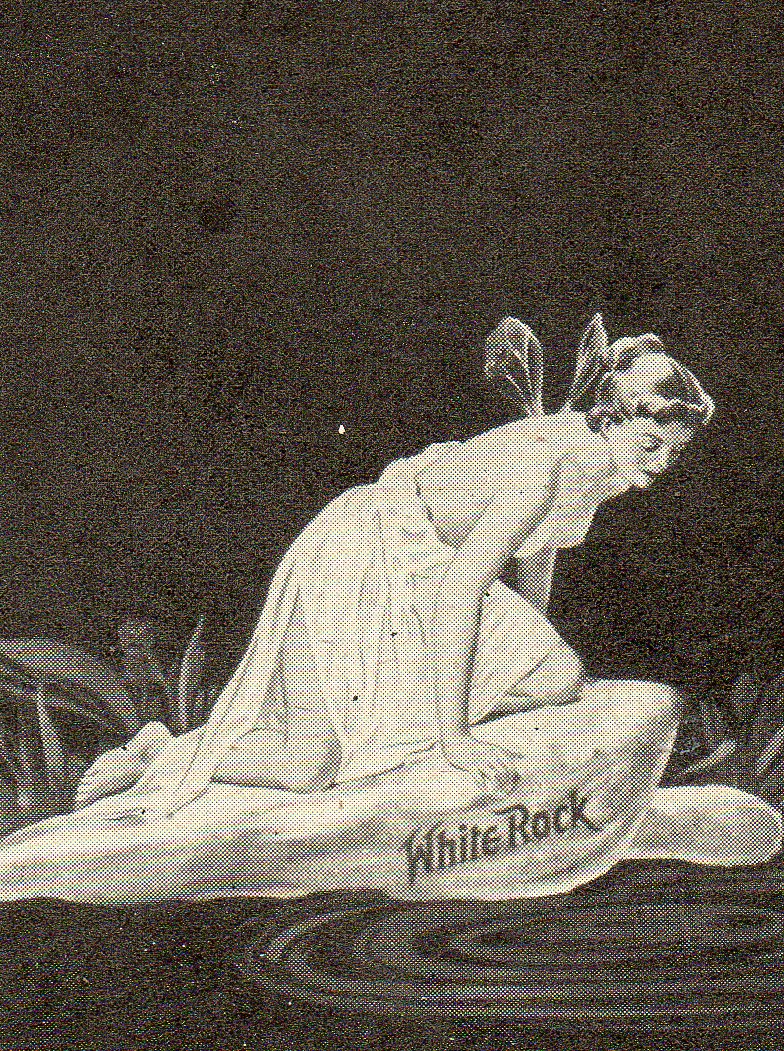
    I’m just going to give beauty 700 words here, or so, and so I’ll concentrate on just one picture of comparative beauty. (I guess that there have been 100 billion words written about beauty, though if you loosened up the definition of what ‘writing about beauty” mean, the number could probably be squeezed up to a trillion, which would mean 4 million books of 250k words each.  Probably the 10^10 is a better guess.)  As it turns out it is a picture from a story in Life magazine for 30 June 1947 of Psyche–the Greek goddess of the soul–used as the logo for White Rock soft drink company’s mineral water.  In general it’s a poor depiction of the goddess, and I’m not so sure that they even had the goddess in mind when the whole thing came into the bottler’s mind (she is after all described as a “sprite” in the LIFE magazine article).

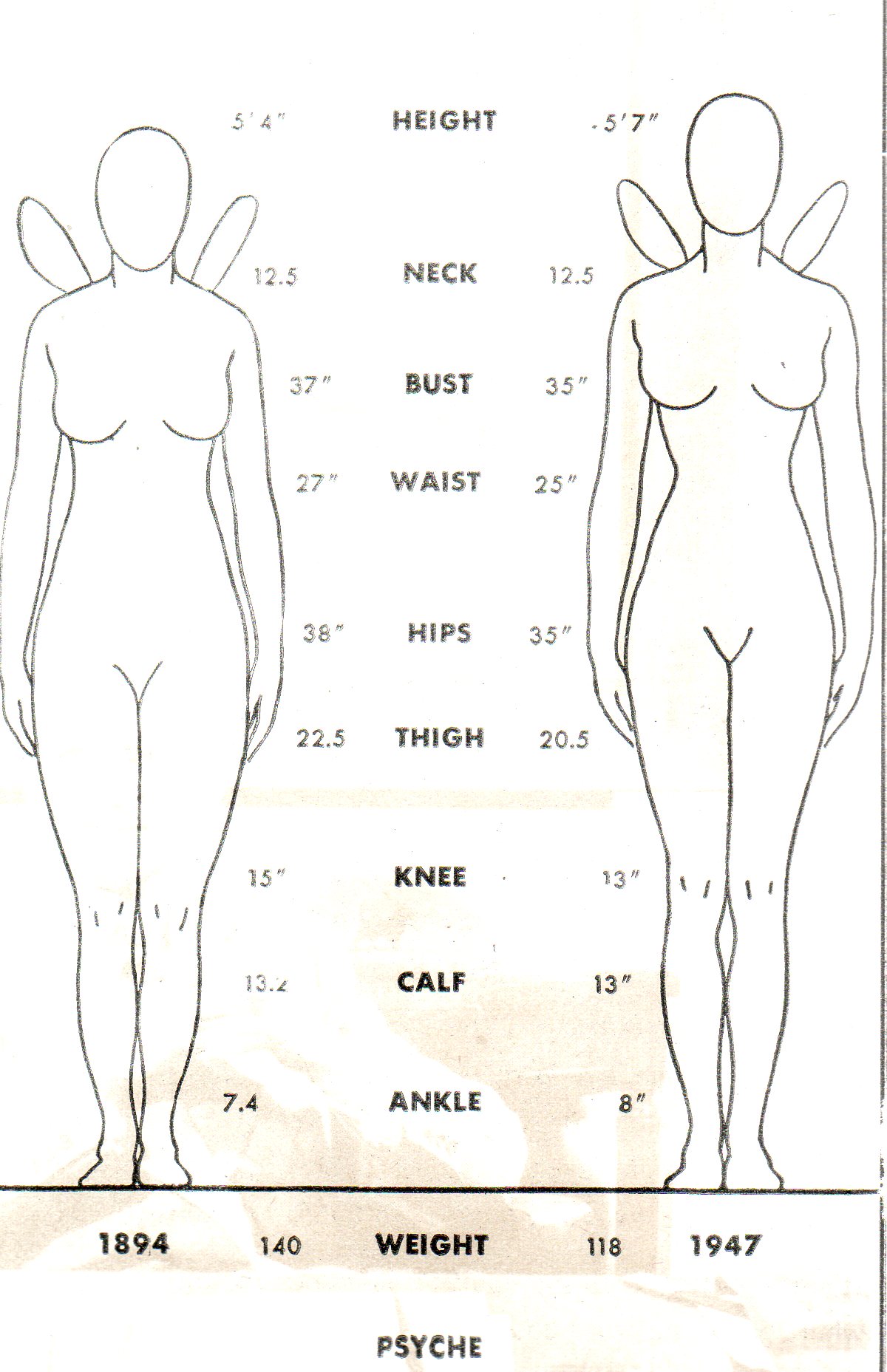
    What is of interest is the change in the image of Psyche on the face of the bottle over the years (shown here for 1893, 1924 and 1947) which is graphically depicted with measurement appraisals.
    00--beauty psyche 1038
    Psyche simply buffed up a little, getting taller, slimming down and generally made to be a little more common.  She did loose her nipples in 1947, or at least they became obscured, trailing away from their depiction in 1893.  (I once attended a U.S. Supreme Court argument on a case dealing with nipples and pasties and strip clubs.  It was a little bizarre, and as my mind wandered I took an interest in the court’s decoration, and particularly the frescoes–which of course included a full-nippled woman, staring down at the court from her height.)   
    00--beauty psyche 3040
    But it struck me that Psyche was simply becoming a more-generic depiction of beauty, which reminded me of this odd bit of beauty sanitizing prevalent among the wealthy of today, or at least among those–actors and advertising types–whose image helps set the stage for the beauty standard.  Now it is possible to vastly augment your appearance via surgical procedures to the common standard of what has been established as “beautiful”.  And the end result of this is that there is merging a certain sameness among the people whose faces everyone seems to know, and whose appearances change the way people think of beauty.  I find it striking that someone (for example)  like the actor Sharon Stone would turn her face into a common mask of someone else entirely, closing the ranks of differentiation in what is presented to mass market audiences as “beauty”.  Everyone is starting to look like everyone else, or so at least among movie actors. 

    And so it is perhaps finally appropriate that I chose Psyche to discuss here, because if the actors tend towards these procedures more and more, they’ll all be wearing the same sort of frozen mask that their ancient Greek precursors used to wear when in performance.  

    00--beauty psyche comp041


  • “Her Work” Visualizing the100-Hour Work Week of the 1947 Housewife.

    JF Ptak Science Books  Post 1047           Part of our History of Women Series

    “Like most busy young housewives, however, she gives little thought to
    the future–to satisfactory ways of spending the important years after
    her children have grown up and left home.” [See below.]
      
    00 marjorie

    0000 woman chores list024

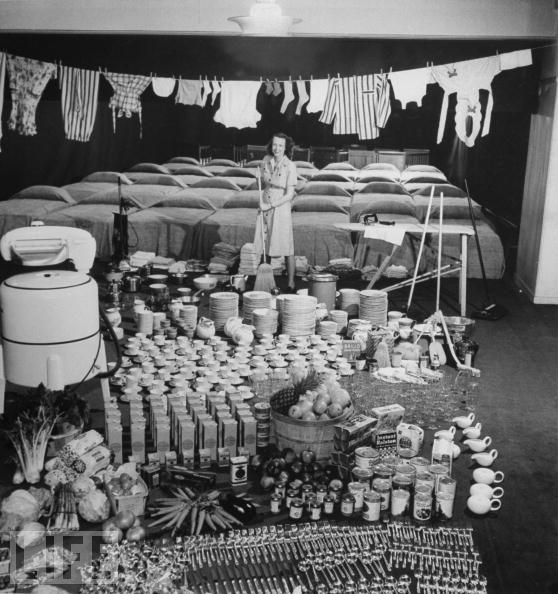
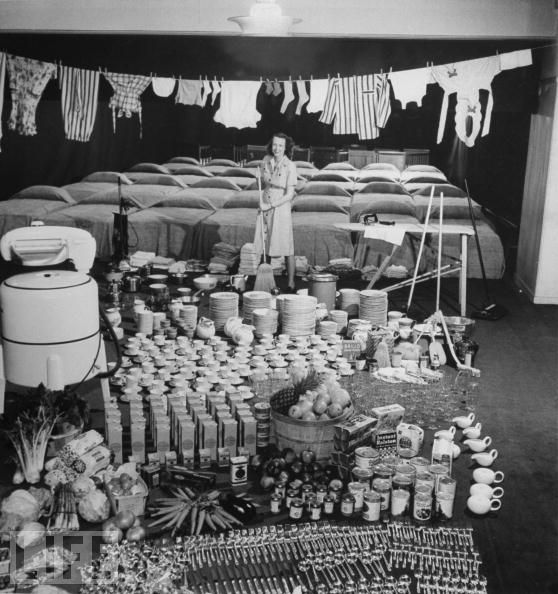
    This photo by Nina Leen [“Housewife Marjorie McWeeney amid symbolic display of her week’s housework” in “Woman’s Dilemma,” Life, June 16, 1947, p. 105] depicts part of the housewife-y stuff of attention in the course of her 100-long-week.  The remarkable part of the photo is that  all of this was displayed in a window display at Bloomingdales.

    Part of Ms. McWeeney’s average work week included “35 beds to be made, 750 items of glass & china, 400 pieces of silverware to wash, 174 lbs. of food to prepare, some of 250 pieces of laundry.on a line, & a ringer washing machine”–that plus paying attention to her children during  the 70+ hours a week in which they are awake.

    In the listing of Ms. McWeeney’s routine (“Her Work”) I see no evidence of Mr. McWeeney’s contribution to the daily chores. We see that he spends 15 minutes eating his breakfast before leaving for work at 8; returns home at 12 or a one-hour lunch before bolting at 1; and then returns at 6 for cocktails at 7:15 and then an hour long dinner at 8.  Perhaps he was helping bathe the kids before cocktails, perhaps not.  I can’t find evidence for Mrs. McWeeney’s present telephone number, so perhaps we’ll never know. But my sneaking suspicion is that Ms. McWeeney ran the house and kids solo, as was the general custom of the day, basically.

    Notes:

    From the LIFE magazine issue:

    “A nice husband, three fine children keep her busy 100 hours a week.

    “Mrs. John McWeeney of Rye, N.Y. has a big, good-looking husband who works in a nut and bolt company, and three children, Shawn, a grave little 4-year-old; John, called “Rusty,” almost 2, and baby Mark, 4 months old. She lives in a bright new seven-room house that has a safe backyard for Shawn and Rusty to play in and a number of modern machines to help her with her household chores. She uses a diaperservice and she can afford a cleaning woman once a week who does the heavy laundry.

    ” But even under these better than average circumstances Marjorie McWeeney’s hours are long and her work demanding. She must keep an eye on her children during their 70 waking hours a week and also watch over them when they are supposed to be in bed but may actually be popping down the stairs to ask for water or an extra goodnight kiss.

    “The picture [above] shows the household tasks that Marjorie must accomplish every week. She has a crib and four beds to make up each day, totaling 35 complete bed-makings a week. She has hundreds of knives, forks and utensils to wash, food to buy and prepare for a healthy family of five and a whole house to dust and sweep. . . .

    “Actually Marjorie’s chores are much lighter than they would have been a few generations ago. She cleans with machinery propelled by electricity, she uses food prepared in canneries, she buys clothes factory-made to fit every member of the family. But her jobs, though relieved of old-time drudgery, have none of the creative satisfactions of home baking, home preserving, home dressmaking. And, because her family unit is small with no aunts or cousins in the household, all the time she saves from housework must go into supervision of her children. Unless she makes special arrangements with a baby-sitter, she has no relief from child care.

    “Many women in Marjorie’s position feel that this is a life of drudgery, that it is not good for Marjorie, a graduate of a junior college, to stay with small children long, continuous hours. Marjorie herself has no desire to work outside. Because as an individual she likes the job that she does, she has no problem right now. Like most busy young housewives, however, she gives little thought to
    the future–to satisfactory ways of spending the important years after
    her children have grown up and left home.”


  • History of Dots Series: Missing the Beginning of the Stars as Dots

    JF Ptak Science Books     Post 1029

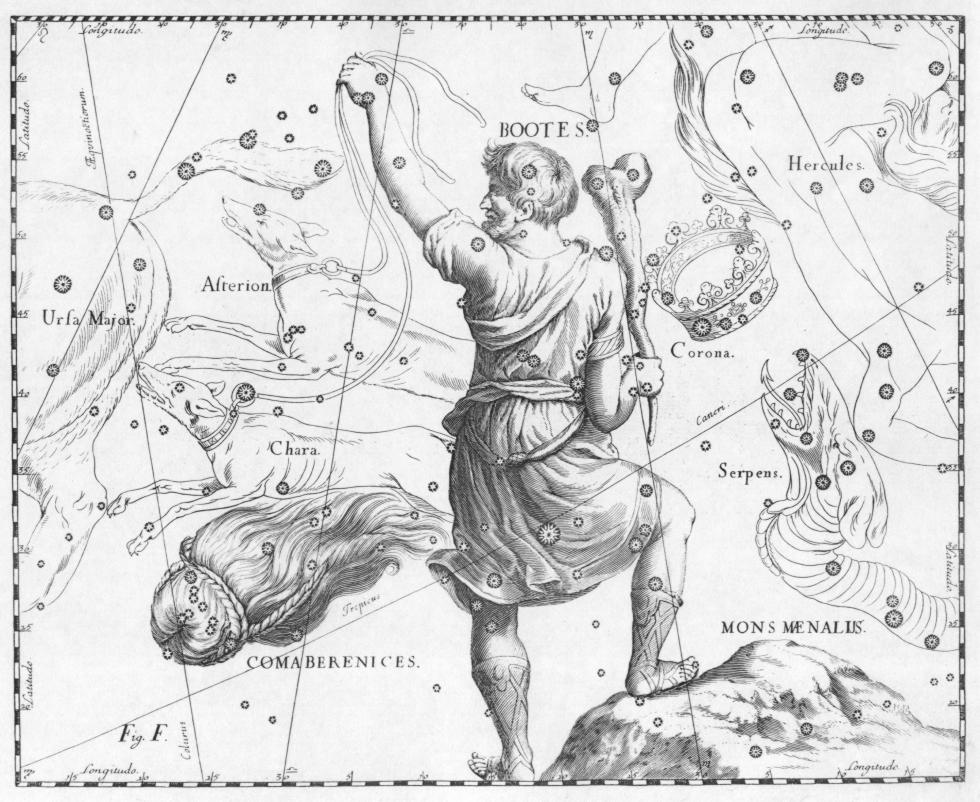
    Dots--hyginus

    [History of Dots series]

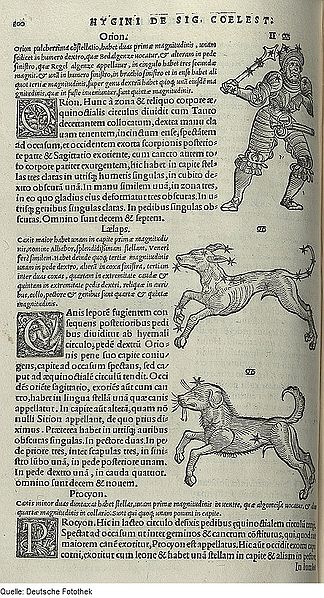
    I was wondering when it was that stars began to appear as dots in celestial atlases or astronomical works–dots rather than starry stars, decorated spheres with crusty circular fire rings about them.
    I felt that at some near point in the history of astronomy that t he conventional antiquarian way of representing a star would fall away with magnification, or clarity, just as has been the opposite case with the magnification of simple dots to reveal complex structures, say with the amplification of the flea eye…even a graphite pencil’s period at the end of a sentence on a piece of paper will turn itself from a dot into something as complex as the coastline of England (given enough magnification).
    Dots--siderus The first star atlas published in 1482 after the work of the first century astronomer and philosopher Hyginius1 contains maps of the constellations composed of such beautiful light-encrusted bits.  There wouldn’t be another work like this one, strangely, for another 75  years. Alessandro Piccolomini’s2 work of 1559 (which would be the first true star atlas), and again we see the familiar representation.  I thought that this would change with the invention of the telescope, so I checked out Galileo’s3 beautiful account (pictured at left) of his discoveries in the Sidereus–again the same complicated, sawblade stars. 
    Dots--hevelius
    This has not been a very scientific search thus far, only checking handy notes and images that I’ve made.  But the same result has been true for the star images in Bayer4, Cellarius5, Hevelius6(at right), Coronelli7, Flamseed8,  Doppelmayr9 and Bode10. Even William Herschel’s fabulous map of the galaxy is a collection of these pointed stars.  I think that I’ve just missed what is normally seen by regular folks as a conventional reassignment of star images to something more “modern”–and if that’s the case it has simply passed me by. (It seems though that among all of these that Hevelius comes closest–he inverts the familiar star pattern to the interior of a sphere.)  And I continue to miss it.  I’ve worked my incomplete survey now pretty close to the end of the 18th century, and I simply do not have a close answer..If anyone out there does have it, please let me know.  
    Notes:
    1. Hyginius Mythographus (fl. 1st century A.D.). Poeticon astronomicon. Edited by Jacobus Sentinus and Johannes Lucilius Santritter. Venice: Erhard Ratdolt, 14th October 1482. The first star atlas per se, standing alone in its field for a century.
    2. Piccolomini, Alessandro.  De la Sfera del Mondo.  1559                               
    3.  Galilei, Galilei  Sidereus Nuncius (known in English as Starry Messenger), published 1610
    4.  Bayer, Johann.  (1572 – March 7, 1625) Uranometria 1603, which was the first atlas to cover the entire celestial sphere.
    5. Cellarius, Andreas  (c. 1596 – 1665): Harmonia Macrocosmica (1660, 1661, 1708).
    6. Hevelius, Johannes (1611 – 1687): Firmamentum Sobiescianum, sive Uranographia (1690).
    7. Coronelli, Vincenzo (1650 – 1718):
    8. Flamsteed, John (1646 – 1719): Atlas Coelestis (1729, 1753).
    9. Doppelmayr, John Gabriel (1677 – 1750): Atlas Coelestis (1742).
    10. Bode, Johann Elert (1747 – 1826): Vorstellung der Gestirne auf XXXIV Tafeln (1782).


  • The 200′-Tall Woman and the History of Skirt Lengths–Interesting Images

    JF Ptak Science Books  Post 1023

    [Part of this site’s History of Women series.]

    This graph illustrating the history of skirt lengths in the United States is oddly interesting and appealing, a job well done.  I like that the graph lines fairly well reveal the amount of leg shown by the rising and lowering hemlines, measuring the height above the ankle from bottom to top. 

    1--may 7 skirt length 

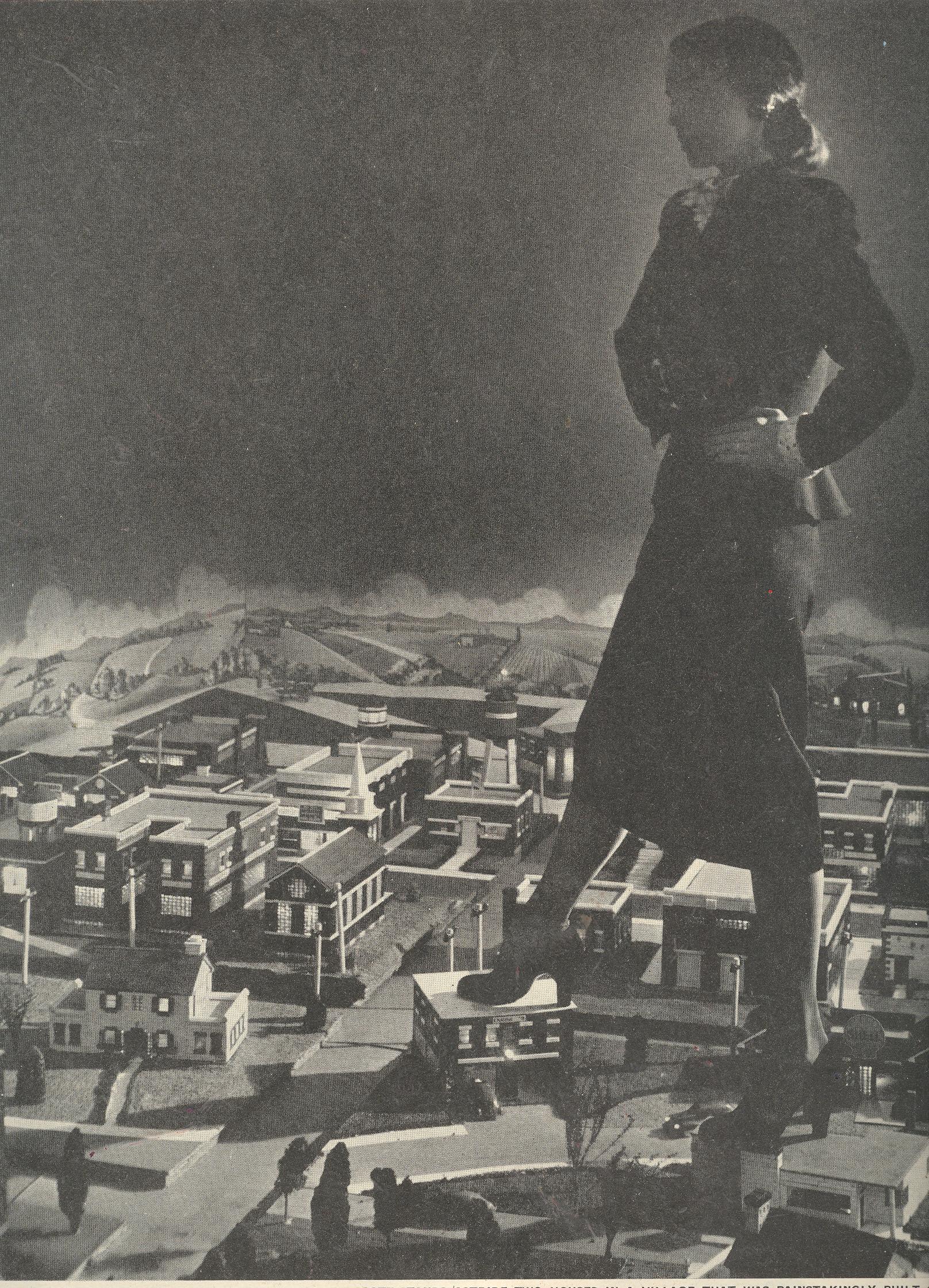
    Now:  I offer what I think must be the female record for the most distance between the ankle and the hemline–I reckon it to be about 60 feet. 

    There are certainly a wide universe of captions for this picture, but for some reason I’m most comfotable with the exposed-leg connection. 

    1--may 7 skirt length giant


  • Primer for Londoners on being Bomber by Nazis, July 27, 1940.

    JF Ptak Science Books LLC  Post 990

    [Also see my The Bombing of Britain in the Illustreite Zeitung, July 1940 post; also here.]

    Mar 28 bo,bing london 4 cratewr

    The
    Battle of Britain was an air battle begun weeks after the surrender of France (22 June 1940) in preparation for the Nazi
    invasion of England.  Hitler and the High Command believed Britain to be
    vulnerable2, and surrenderable, or at the least could be convinced not to interfere
    in the rest of the war.  But plans were
    made for the invasion—an invasion which could only be successful (it was reasoned)
    if there was complete naval or aerial superiority. The naval part was out of
    the question, especially since the Nazis had suffered such losses in the
    Norwegian campaign. The Luftwaffe was another story, and so the operation began. 

    Mar 28 bo,bing london 1

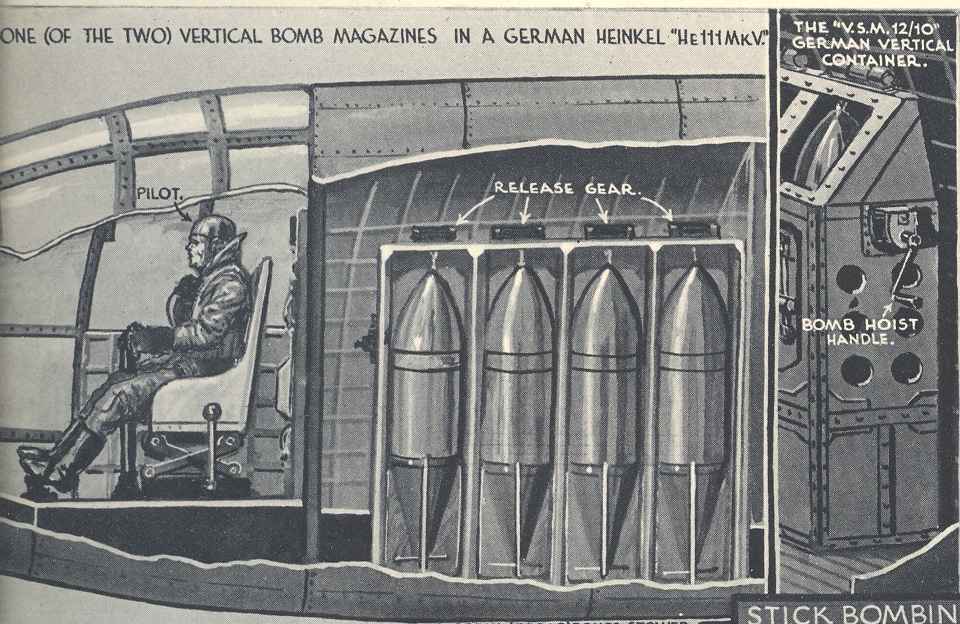
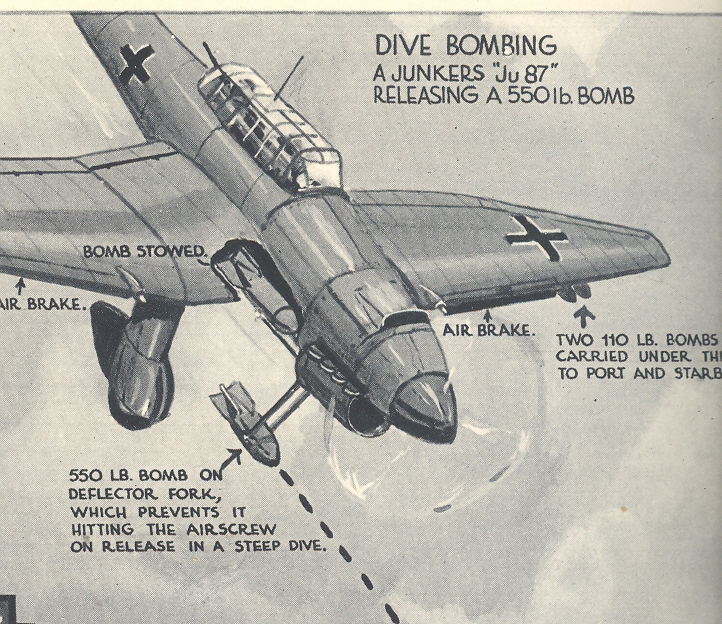
    The Illustrated London News published
    this pictorial introduction to Nazi bombing on 27 July 1940, just weeks after
    the campaign began.  At this point in the
    war the Luftwaffe operations were delegated to coastal installations and
    aircraft industries.  Mar 28 bo,bing london 2

    The terror bombing
    against citizens in cities—which was an idea not born here but rather 20 odd
    years before—wouldn’t begin for some months. 
    In the meantime, and at this early part of the campaign against England, the
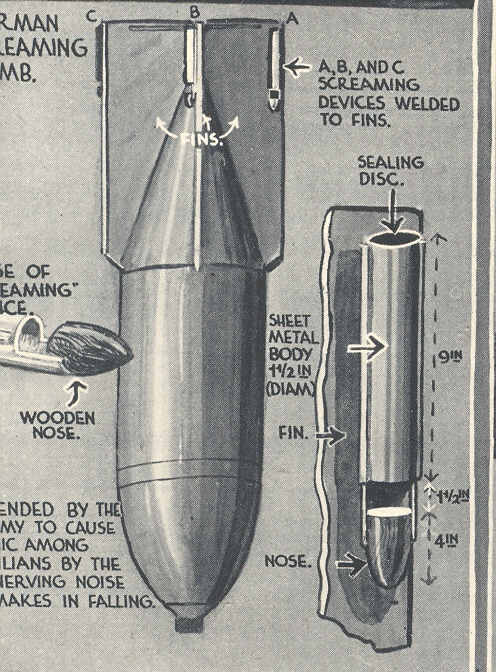
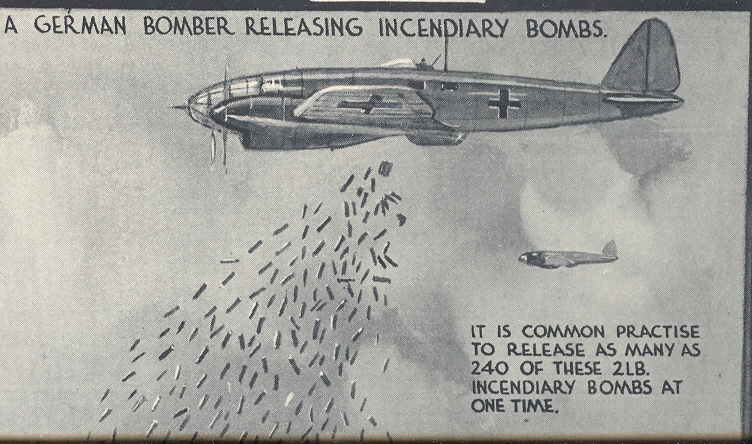
    British citizenry was introduced in a very proper way how the bombing was being
    carried out.  IT really does seem to be
    to be a very constructive, non-alarmist, cogent distribution of information to
    the general public about the potential for massive devastation.  

    Mar 28 bo,bing london 5  

    Notes:

    1.
    By the summer of 1941 the campaign was largely over, the Nazi effort doomed. England:
    1,023 fighters: 376 bombers, 148 coastal command aircraft for a total of
    1,547 aircraft and  544 pilots and aircrew killed.  There were also
    27,450 civilians killed and 32,138 wounded.  The Germans
    lost 873 fighters and 1,014 bombers for a total of 1,887 aircraft and 
    2,500 pilots

    2. The plan ‘Directive No. 16; On the Preparation of a Landing Operation
    against England’
    read, in part, as follows:

    Mar 28 bo,bing london 6

    “Since England, despite
    its militarily hopeless situation, still has not shown any signs of being
    prepared to negotiate, I have decided to prepare a landing operation against England and, if
    necessary, carry it out. The objective of this operation is to eliminate the
    English home country as a base for the continuation of the war against Germany…”

    “Included in these preparations is the bringing about of those preconditions
    which make a landing in England
    possible;”

    Mar 28 bo,bing london 7

    “a) The English air force must have been beaten down to such an extent
    morally and in fact that it can no longer muster any power of attack worth
    mentioning against the German crossing…”


  • Propaganda and the Dinner Table: Strike-Breaking and Graphical Display of Data, 1911

    JF Ptak Science Books LLC  Post 987

    Mar 25 dinner plate det

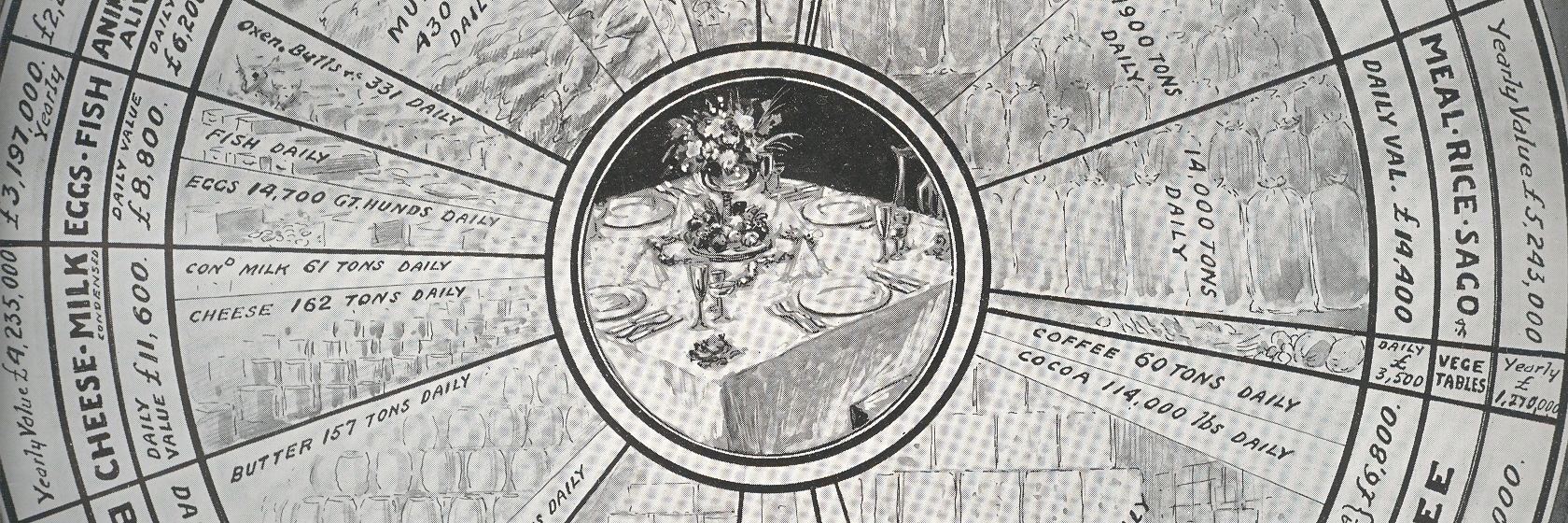
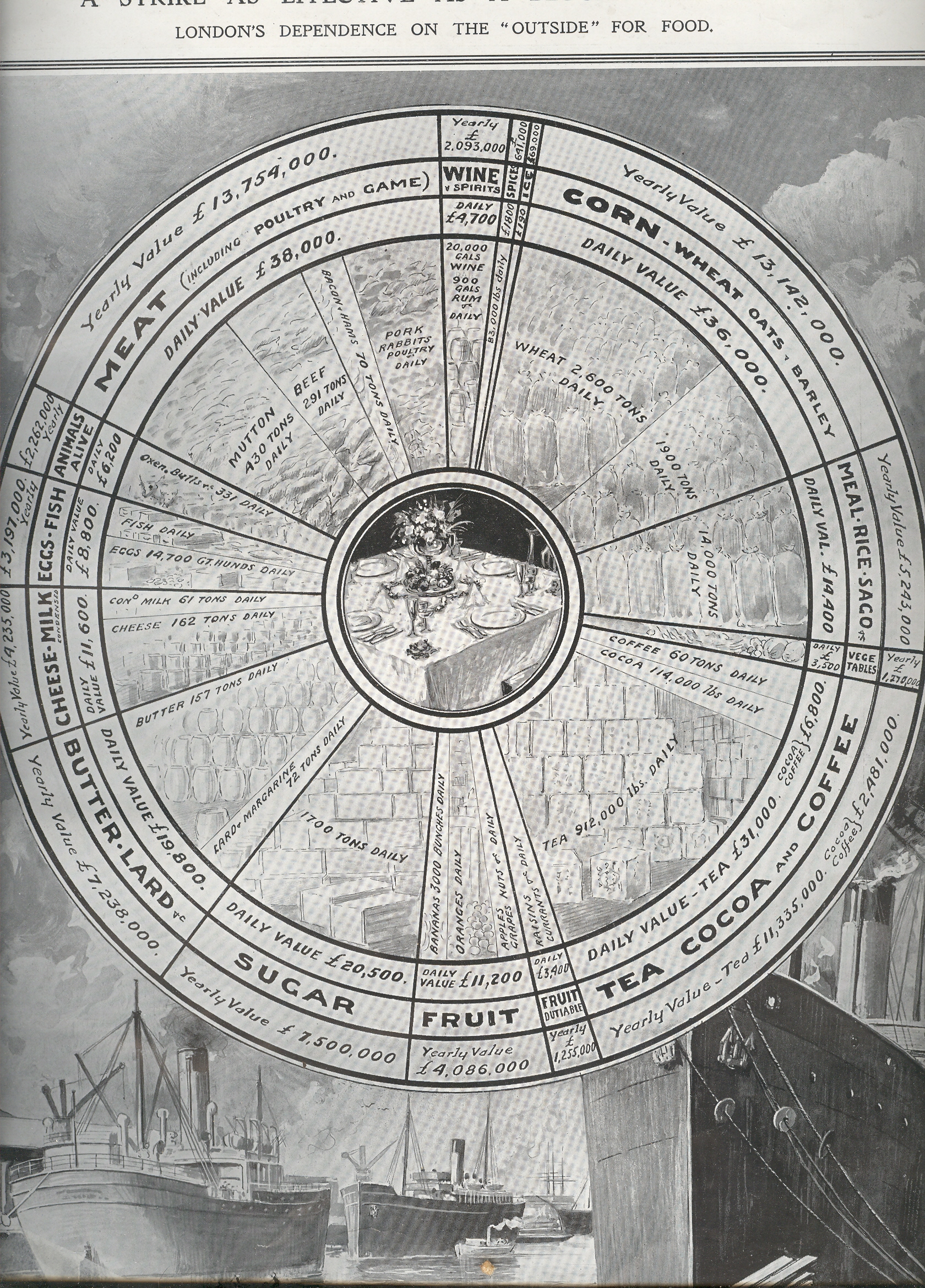
    This graphic display of the effects of a  transport workers’ strike is a pretty,
    well-designed piece of propaganda designed to draw in the general, middle-class
    (such as it was) and working population into league against the strikers.  At least that’s what it looks like to me: the
    strangulating effects of food not coming into the port of Liverpool
    and its attack on the family dining table. Literally, and figuratively: a
    table, by the way, that appears at the direct center of attention, the bull’s-eye
    of what is a target, made to look like the transport workers were taking direct
    aim at the symbol of the family. 

    All of what was going on of course was that some hard working people were
    trying to get a little more money to put food on their own  tables—the facilitators of food distribution
    for the nation’s people wanting nothing more than a little more food for
    themselves and their families.  And these
    were the people, by the way, who did not set a five-utensil place settings with
    linen table covers and a large fresh bouquet as is oddly the case in the illustration.

    By the time this illustration appeared in the Illustrated London News in August 1911 the movement had already
    been active for a year—there had also been a call to action the month before
    involving over 100,000 workers.  The National
    Sailors and Firemen’s Union, and the National Union of Ships’ Stewards, Cooks,
    Butchers and Bakers, dockhands, lorry rivers,  general laborers, and on and on, were involved
    in the strike, which was a bitter and confrontational battle between them,
    scabs, police, the army, and of course the owners of the means of production
    and shipping means.

    Mar 25 dinner plate


    After the battle of greed and need, need won.


  • The Hidden Death Hammer: Display of Quantitative Data for the Battle of Jutland, 1915.

    JF Ptak Science Books LLC  Post 986

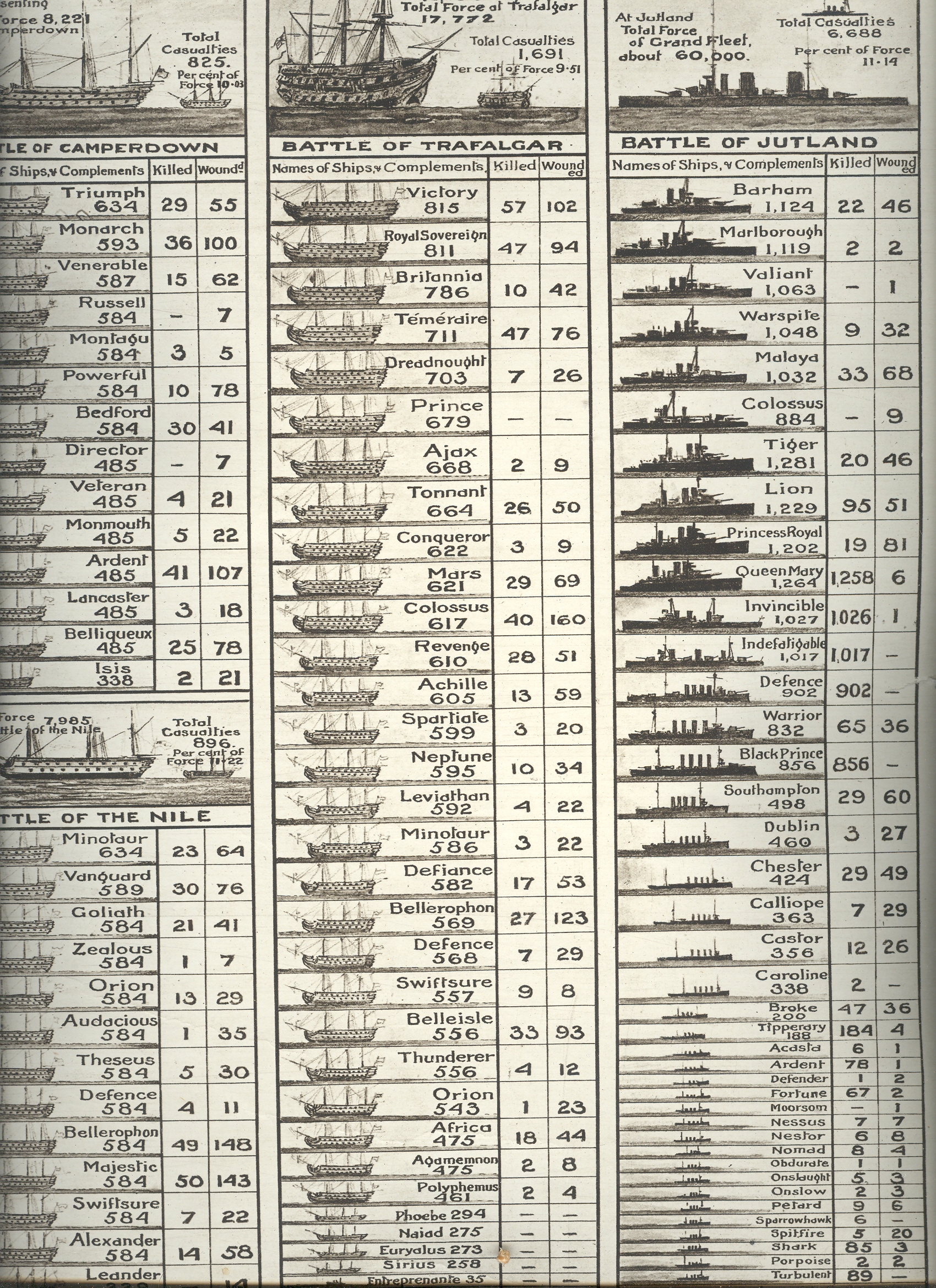
    A year and two weeks after the end of WWI, the Illustrated London News  published this compelling graphical display comparing
    the British naval losses at Jutland to three other great sea battles (Camperdown, the Nile and  Trafalgar). 
    The battle near Jutland (Denmark)
    was the largest naval engagement of WWI, involving the German Navy’s High Seas
    Fleet and the Royal Navy Grand Fleet, and took place May 31-June 1, 1915 (“The
    Day”).  It was an absolutely enormous
    engagement, with 250 vessels involved (151 for the Royal Navy, 99 for the
    German).1

    Mar 24 jutland

    The end result of the battle was mixed and still debated
    today; neither side could convincingly claim a conclusive victory from the
    affair.

    The Royal Navy losses at Jutland
    were staggering: 6,094 killed and 570 wounded, with German losses at 2,551
    killed and 507 wounded. 

    And while this graphical display places Jutland in a weak
    context with these other battles, and as pleasing as the thing is visually, the
    larger mark, the great lurking statistical and human beast lurking there in the
    mix of silhouettes and data, occurs about halfway down the far right column.

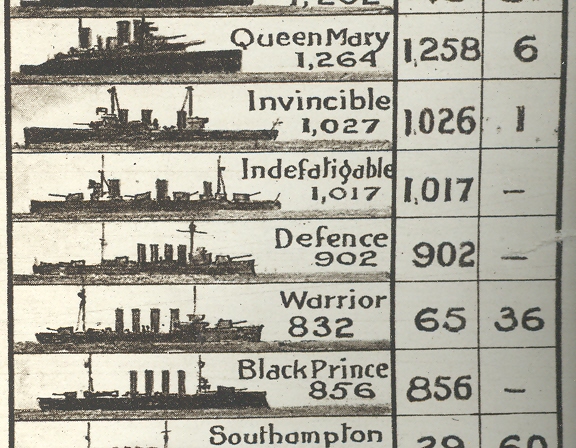
    Mar 24 jutland det

    Here we see the losses for five ships: the Queen Mary, the Invincible, the
    Indefatigable,
    the Defence, and
    the Black Prince.  Together, some 5066 men served aboard these
    vessels; at the end June 1, 1915, 5,059 of them would be dead.  Everyone aboard the Indefatigable, Defence
    and Black Prince would be killed; 1
    would survive on the Invincible, and
    6 would survive the killing of the Queen
    Mary
    . Astonishing, really.  And there
    are no other numbers like this on this chart.

    As certain and as clear as this representation seems, and as
    straightforward and seemingly elementary as it looks, I was shocked to see the
    numbers for those five Royal Navy ships, a “hidden” history within a broad
    comparative analysis. 

    Notes:

    1. England: 28 battleships,
    9 battlecruisers,
    8 armoured cruisers, 26 light cruisers,
    78 destroyers,
    1 minelayer,1
    seaplane carrier.
    Germany:
    16 battleships,
    5 battlecruisers,
    6 pre-dreadnoughts,
    11 light cruisers,
    61 torpedo
    boats.

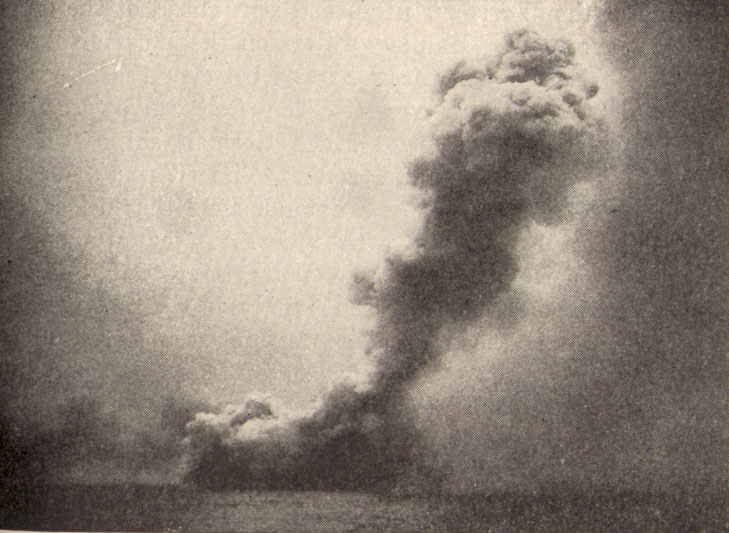
    [The Queen Mary going down.]

    Mar 24 queen mary


  • Mathematical Art: “The End of Simple Multiplication”, 1814

    JF Ptak Science Books  Post 982

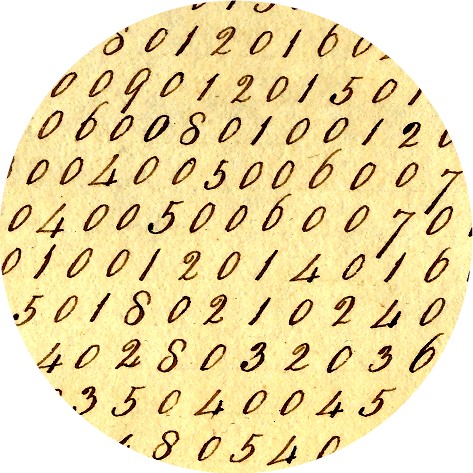
    Mar 22 end of multipiplication det

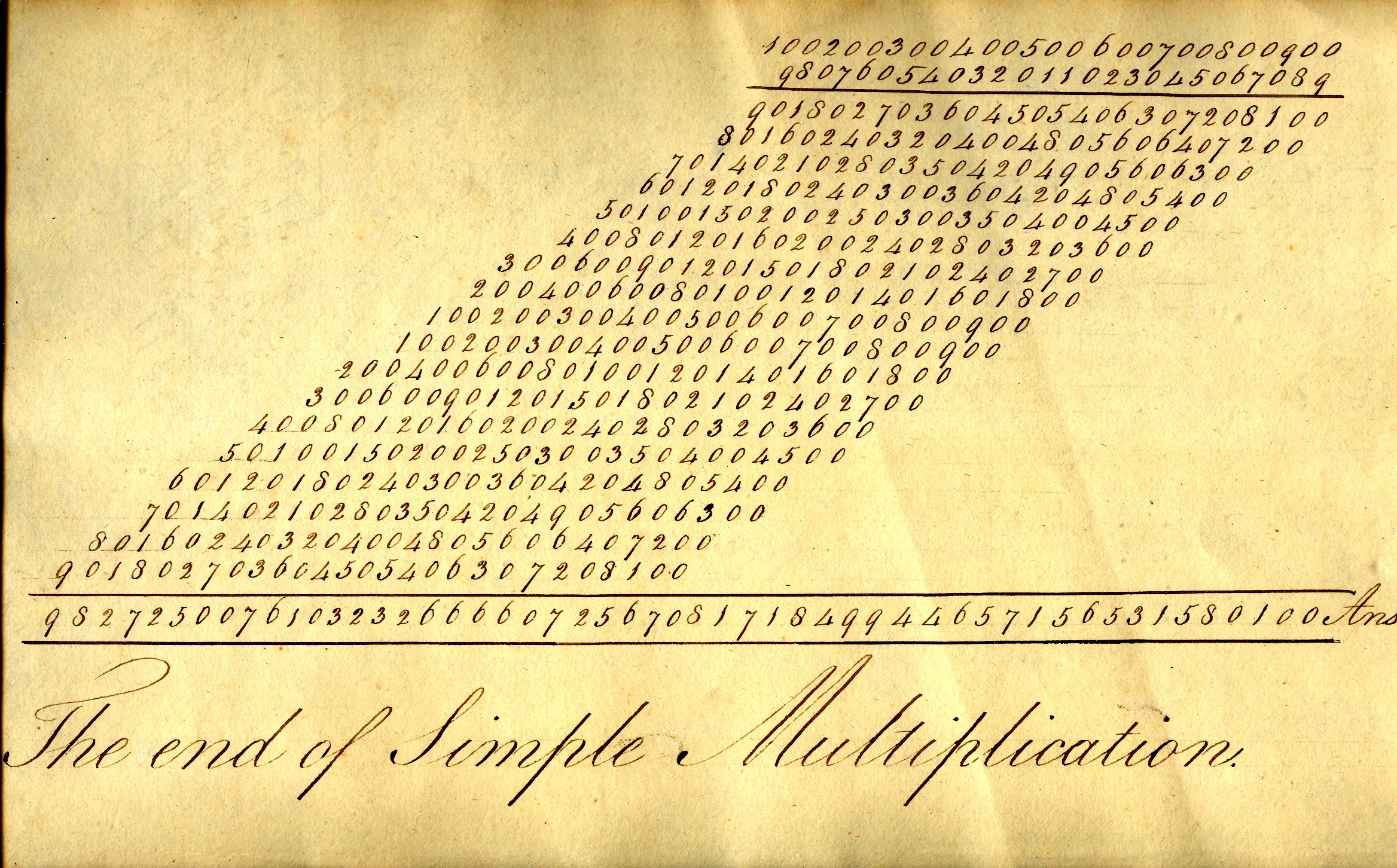
    I found this fabulous example of multiplication in a student’s workbook, written out in 1814.  Undoubtedly the sub-title, “the end of Simple Multiplication” was not intended to imply the literal end of multiplication (though the thought does invoke some interesting bits of fiction), just the result. It is simply a gorgeous object.

    Mar 22 end of multipiplication