A Daily History of Holes, Dots, Lines, Science, History, Math, Physics, Art, the Unintentional Absurd, Architecture, Maps, Data Visualization, Blank and Missing Things, and so on. |1.6 million words, 7500 images, 4.9 million hits| Press & appearances in The Times, Le Figaro, Mensa, The Economist, The Guardian, Discovery News, Slate, Le Monde, Sci American Blogs, Le Pont, and many other places… 5000+ total posts since 2008.

Author: JF Ptak

  • Image Archaeology–Images within Images Department, 1934

    JF Ptak Science Books LLC  Post 978


    Ebay mar 15 LIBERYbig eye

    This
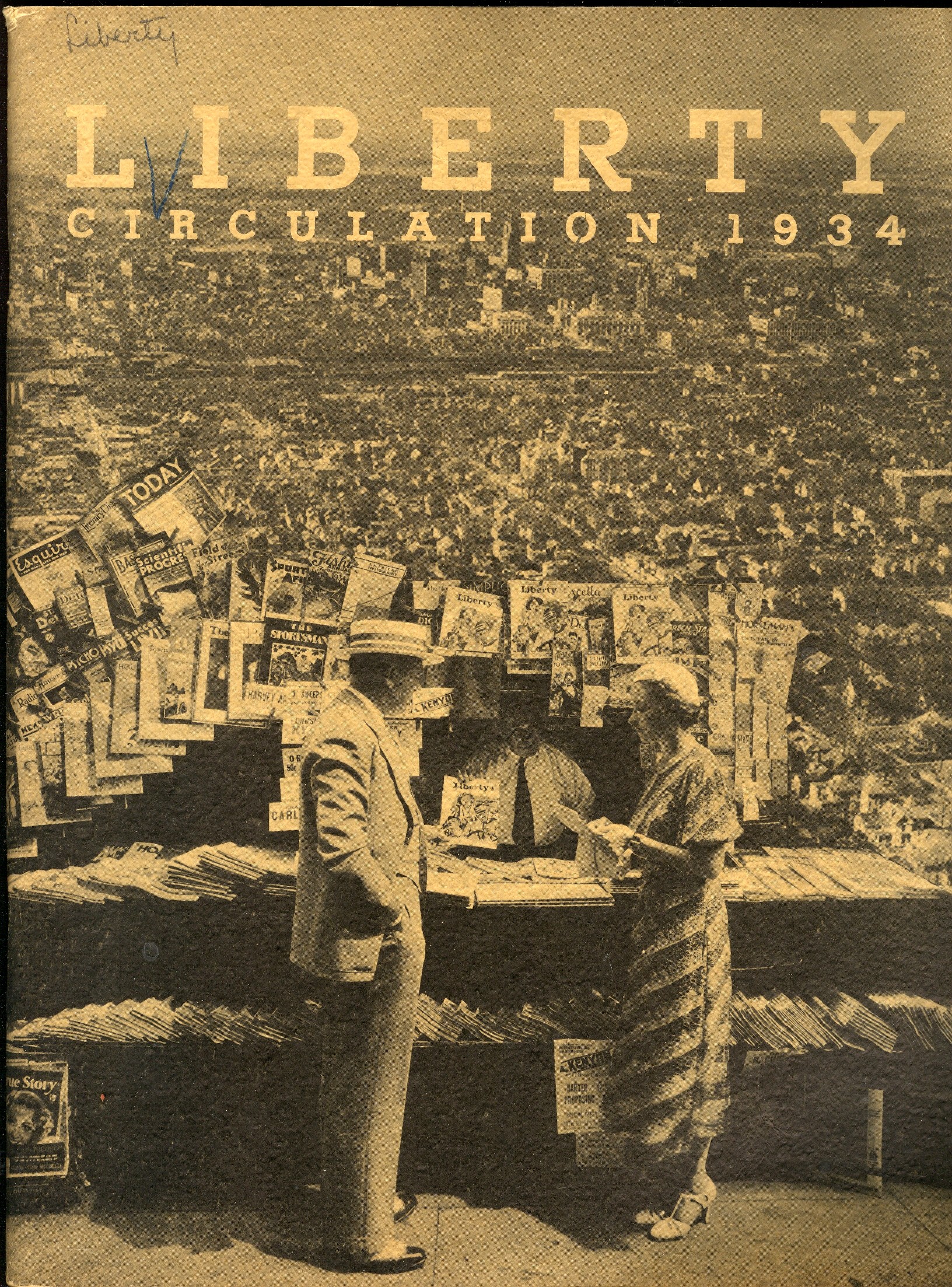
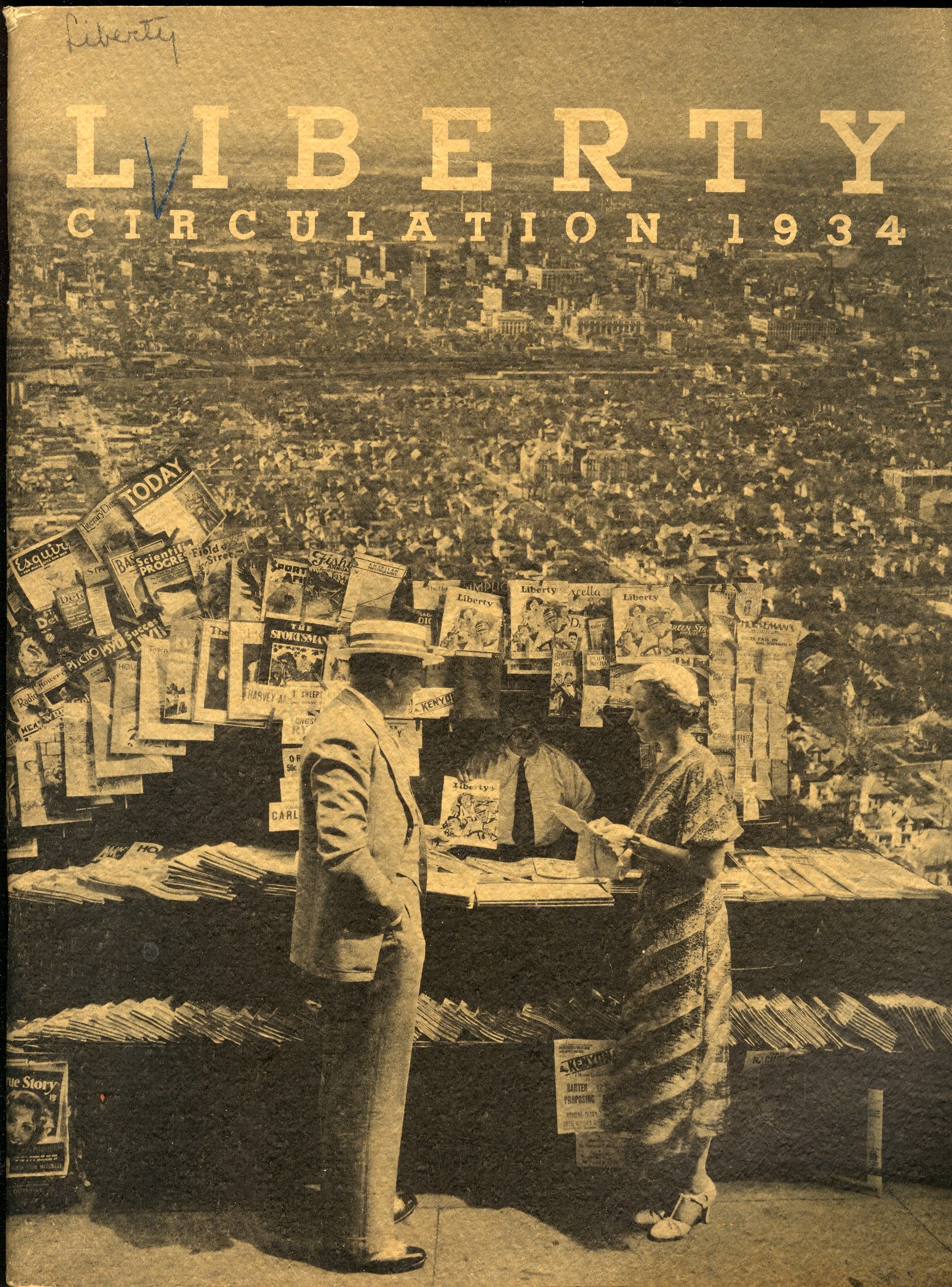
    short post comes in the can’t-judge-a-book-by-its-cover category, as the cover
    is absolutely the  most interesting component of this publication.  Unless of course you’re interested in knowing
    how many paid subscribers Liberty had in Asheville, North
    Carolina
    in 1934. 
    Or Salida, Colorado.

    Ebay mar 15 LIBERY

    Ebay mar 15 LIBERYman2

    That’s all there is to the innards of this pamphlet: circulation numbers
    for a prancing, popular magazine.  This
    would’ve been of great concern to the folks trying to sell and distribute Liberty, showing
    potential customers how far and wide the magazine was read. (And evidently it
    was very popular:  with a circulation per
    issue of about 2.2 million, it was the sixth most popularly-read magazine in
    the country, following Collier’s, McCall’s,
    Ladies Home Journal
    and The Saturday
    Evening Post
    , all of which had circulations between 2.3 and 2.9 million, so
    Liberty was not far off from being
    one of the most widely-circulated magazines in the country. It actually rose to
    the number two spot for a little while during the war.) 

    Ebay mar 15 LIBERYman
     
    This
    is not to say that the magazine itself was a bore, what with writers like P. G.
    Wodehouse,  Robert Benchley,  Edgar Rice Burroughs, Robert W. Chambers, F.
    Scott Fitzgerald, Murray Leinster,  Sax
    Rohmer and others making contributions here and there. 

    An
    odd bit about Liberty—they “timed” their articles.  The reader was told about how long, on average,
    it would take to read each piece, taking about three hours to read the entire
    issue.  That’s something I’ve never seen
    before. 

    So
    the contents turned out to be a bit of a bore—the cover, on the other hand, is just
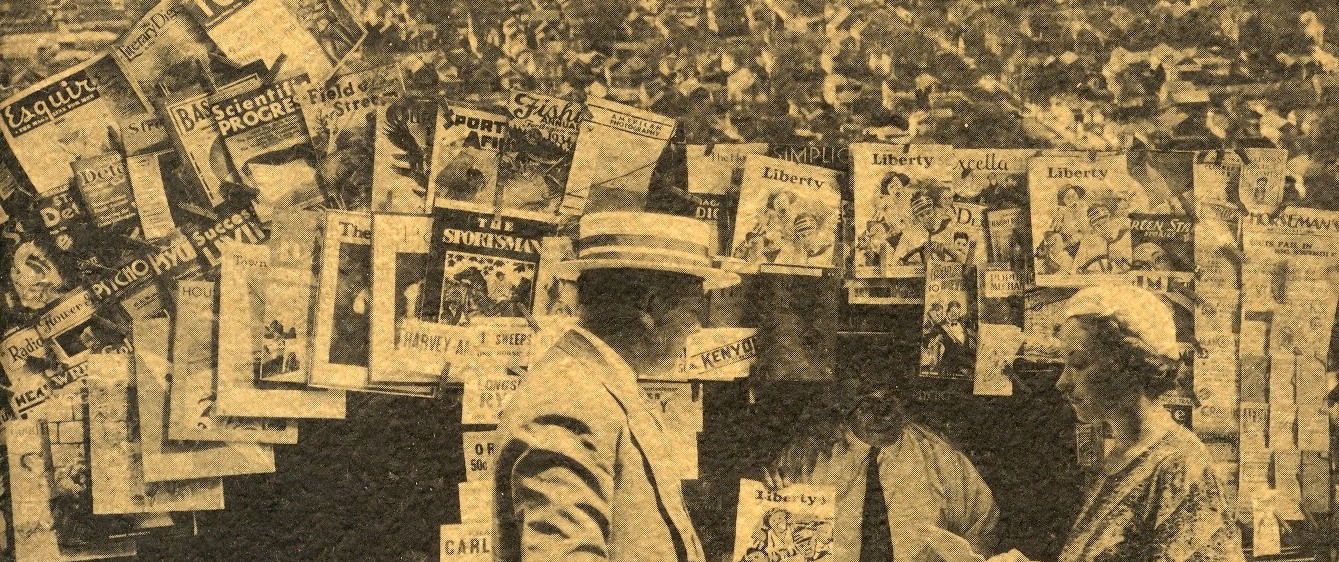
    lovely, a beautiful and seamless piece of photo montage with some interesting
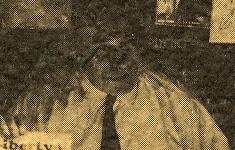
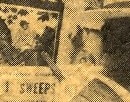
    semi-hidden images. I quite like the image of the white-shirt-tie magazine stand purveyor that emerges from the shadows (above). And also the face that emerges from underneath the rear brim of the boater on the fellow standing in front of the stand.

    Ebay mar 15 LIBERYface hat 

    This is just a lovely example of what ephemeral play one can draw from an unexpected source.

    Ebay mar 15 LIBERYbig eye


  • 200,000,000 Pounds of Buttocks–Or–Putting the Color Back in the Black-and-White

    JF Ptak Science Books   Post 977

    Well, this is a confusing title, with two seemingly unrelated affairs, no?  It is  probably sexier (?) too than the actual contents, but, we’ll let the cheeks fall where they may.  The origin of this post is found in the title to this large, over-sized 1937 pamphlet, Sat on by Millions:

    Mar 14 sat on

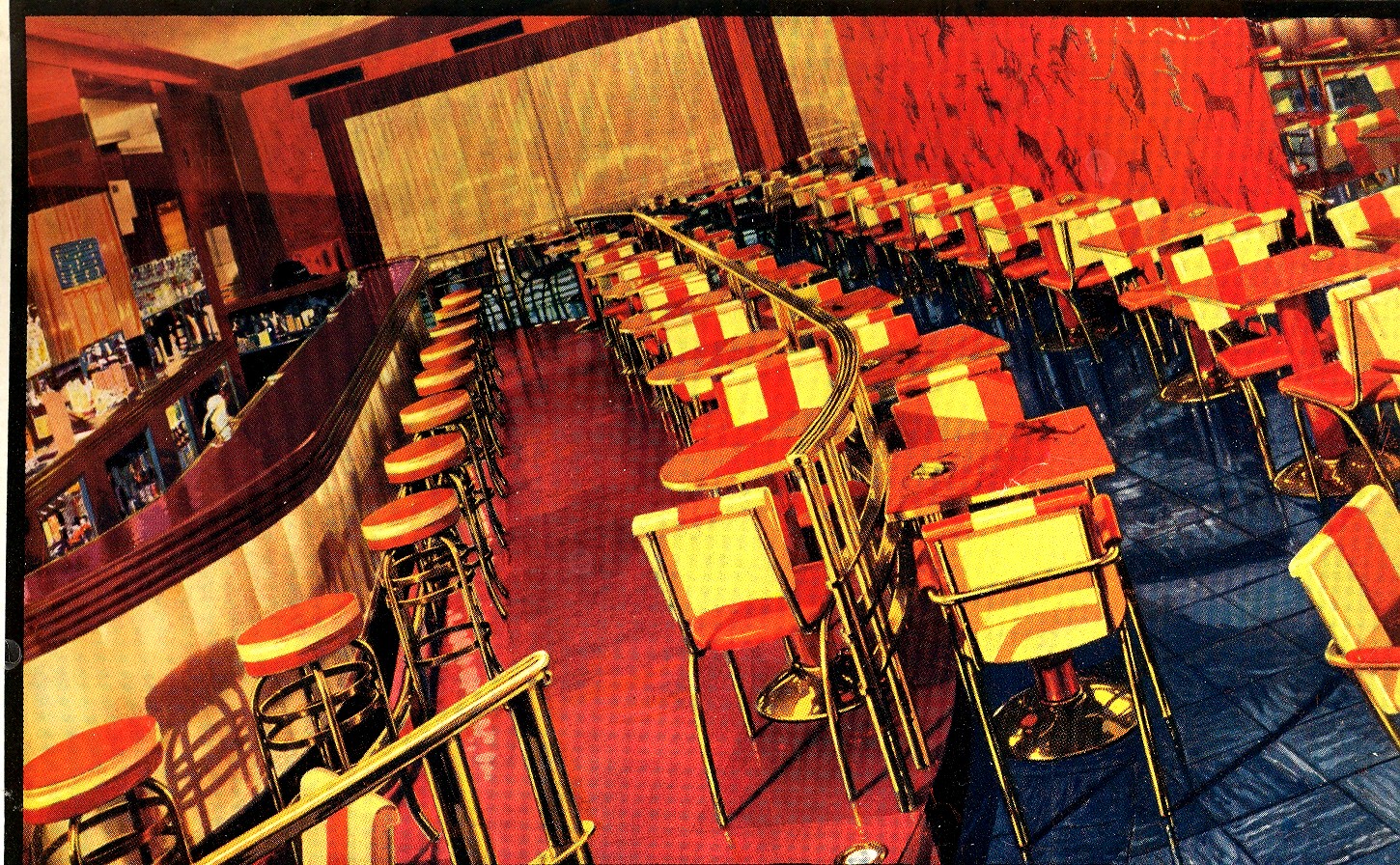
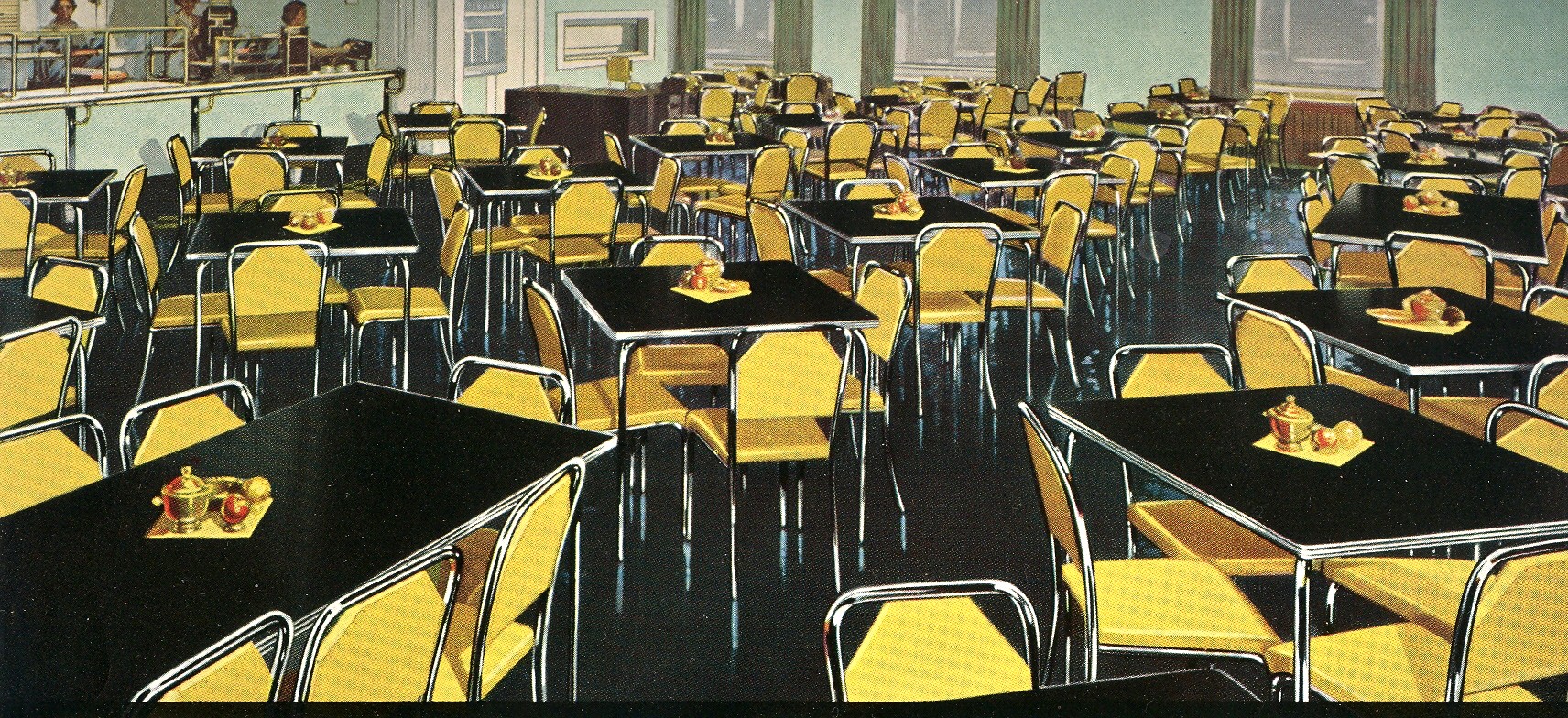
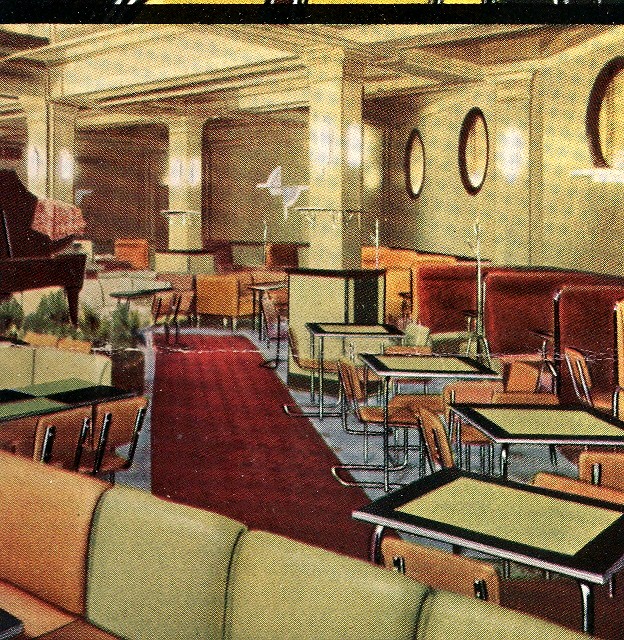
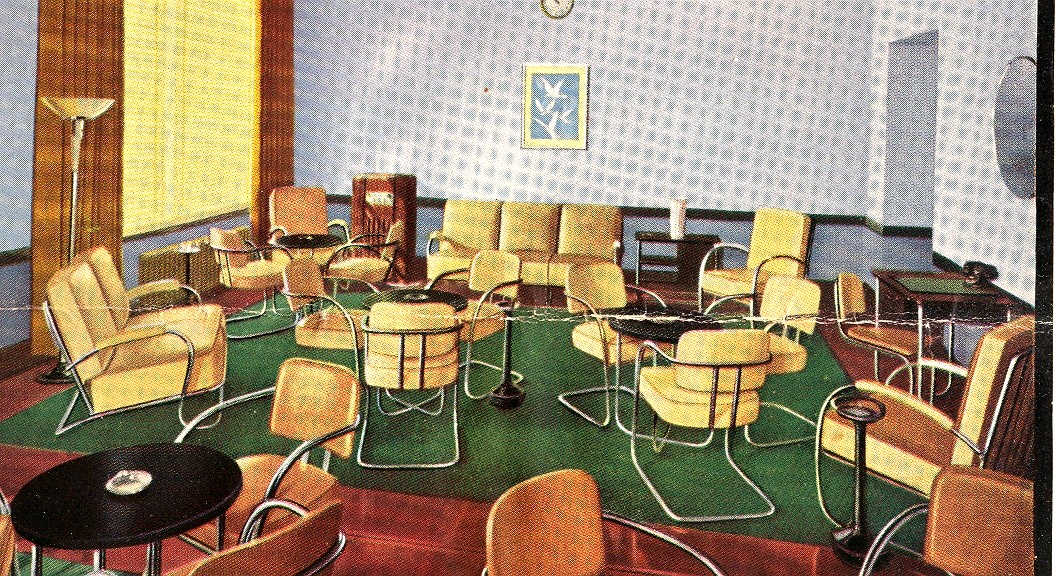
    This really is the “story of FABRIKOID”, a plastic-y bit of seating innovation brought to America by the good chemical engineers in service of du Pont.  It was the stuff used to make artificial artificial flowers and truck upholstery, book covers and bus tops.  But something happened somewhere along the line to make it more

    Mar 14 1st photo
    attractive to look at and feel, and thus was born the cushioned and upholstered restaurant/movie house chair that you could simply spray off with water from a hose.  (My friend Andy is much enamored with his new Honda “Element”, the interior outfitted in such a way that he could, he related excitedly, “wash out with the garden hose”.)

     Mar 14 2nd photo

    [Cafeteria  at Hobart Manufacturing, Troy, Ohio.]
     

    Du Pont did test it out with 200 million pounds of buttocks–a mechanical test of the equivalent of a 200-pound man sitting on a FABRIKOID-covered seat one million times.  The flexing was evidently perfect, the company recalling another great success story of another FABRIKOID chair being sat on by thousands at the Chicago World’s Fair

    Mar 14 3rd photo

    [Cocktail lounge at Pittsburgh’s Seventh Avenue Hotel.]

    and then sent out on a tour around the country.  (I’m not sure that I’d stand in a line to sit in the most-sat-in chair in the world, as appealing as that might be…)

    Mar 14 4th photo

    [Federal Reserve Club of Los Angeles.]

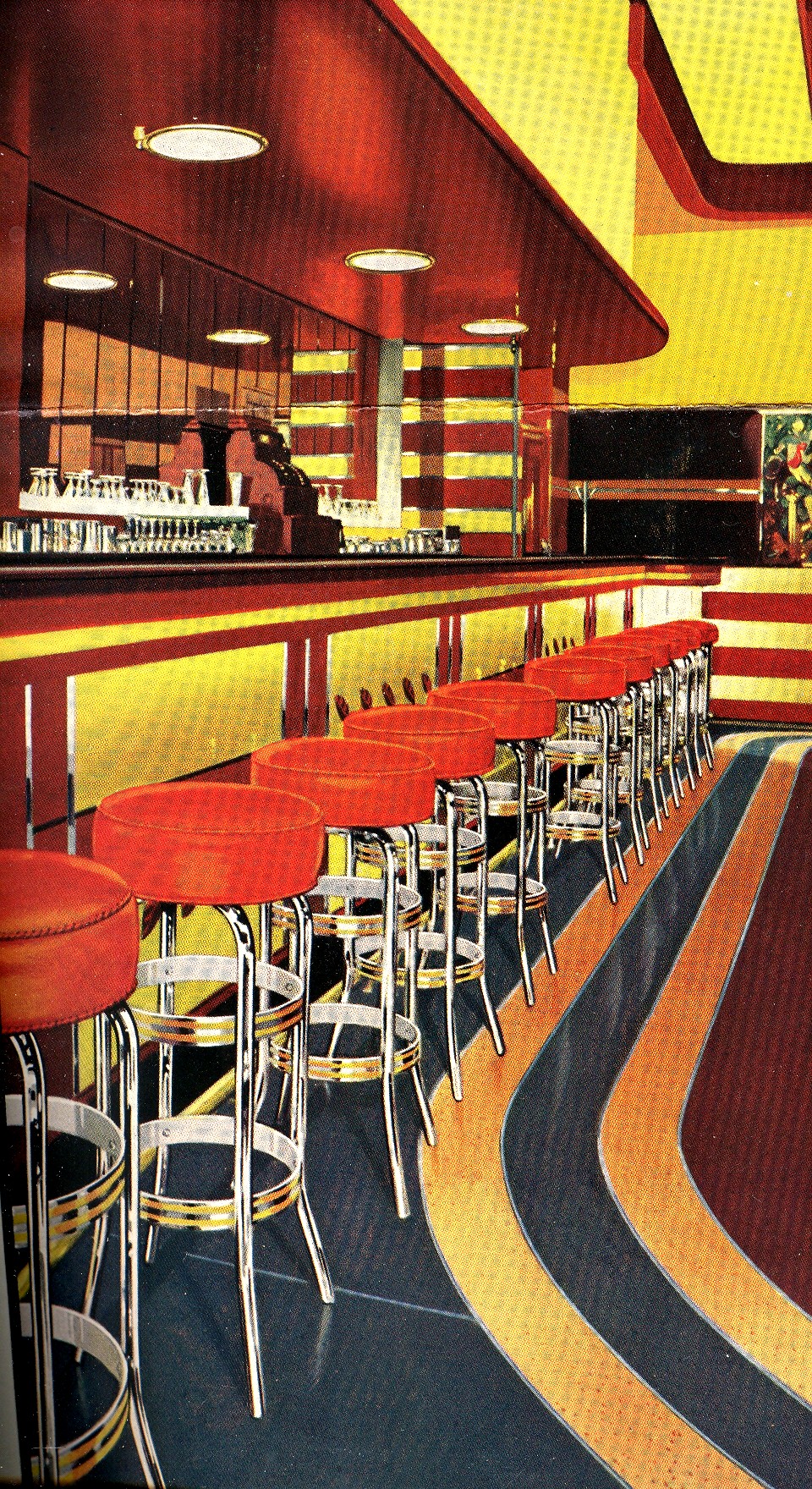
    But the more appealing aspect of this pamphlet–aside from the great chemical achievement–are the luxurious (and early) color photographs of the FABRIKOID-covered furniture.  There are colors to remind everyone that color did exist in the 1930’s, and that when Bogart was cruising a bar for raw whiskey and a cig it could’ve had blue floors and red and yellow chairs, and not just the simpler gray stuff that we’re used to seeing.

    Mar 14 5th photo

    [Cocktail lounge, University Club, Troy, Ohio.]

    Perhaps it is better seeing Bogey in a haze of smoke snuggled into a blackish chair rather than what it might’ve (blue and yellow) been.

    Mar 14 7th red bar


  • The (Really) Last Word in Skin Care: Lip Prep, Eye Sealing, Cavity Solidifiers and the Rubbery Chemical Appeals of Embalming Fashions

    JF Ptak Science Books LLC   an expanded post (#975) from 2010Mar 13 esco cover

    [Faint of heart, stop here.]

    This carefree stroll through the geology of death prep and care comes to us via the Embalmers’ Supply Company (ESCO) catalog, of 1941, serving and selling to members of the embalming profession since 1886.  It provides the Practioner with all means necessary to scrape away facial muscle, cement the jaw, seal the eyes, color “old age” eyebrows, fill cancerous cavities, mold over gaping wounds, position the arms, contour the chin, scoop out the brain, replace the blood, pull out the bowels, and all other manner of removal/drainage/fillup, and then apply makeup to cover all suture wounds and other “deficiencies”.

    Mar 13 eye sealer


    ·Posted by :

    ·in:

    —

  • Seeing Vision: Examples of Light and Sight, Personified

    JF Ptak Science Books LLC  Post 976


    (On seeing the morning’s rising sun): “Looks like light to
    me.” SpongeBob SquarePants


    “All the fifty years of conscious brooding have brought me
    no closer to answer the question, ‘What are light quanta?’ Of course today
    every rascal thinks he knows the answer, but he is deluding himself.”  A. Einstein

    “Are not gross bodies and light convertible into one
    another, and may not bodies receive much of their activity from the particles
    of light which enter into their composition?” I. Newton, Opticks,
    1704, Query 30.

    Mar 12 #51

    Depicting the capacity of sight and nature of light has been
    both an easy and a knotty problem in the history of science. Over the
    successive theories on the basis of light the artistic presentation of the
    phenomenon has been generalized (generally) in a very simple way:  by straight lines.  There’s certainly nothing wrong with that,
    the lines are just parenthetic place-holders suggesting direction, not actual
    descriptors of what light “looks” like.

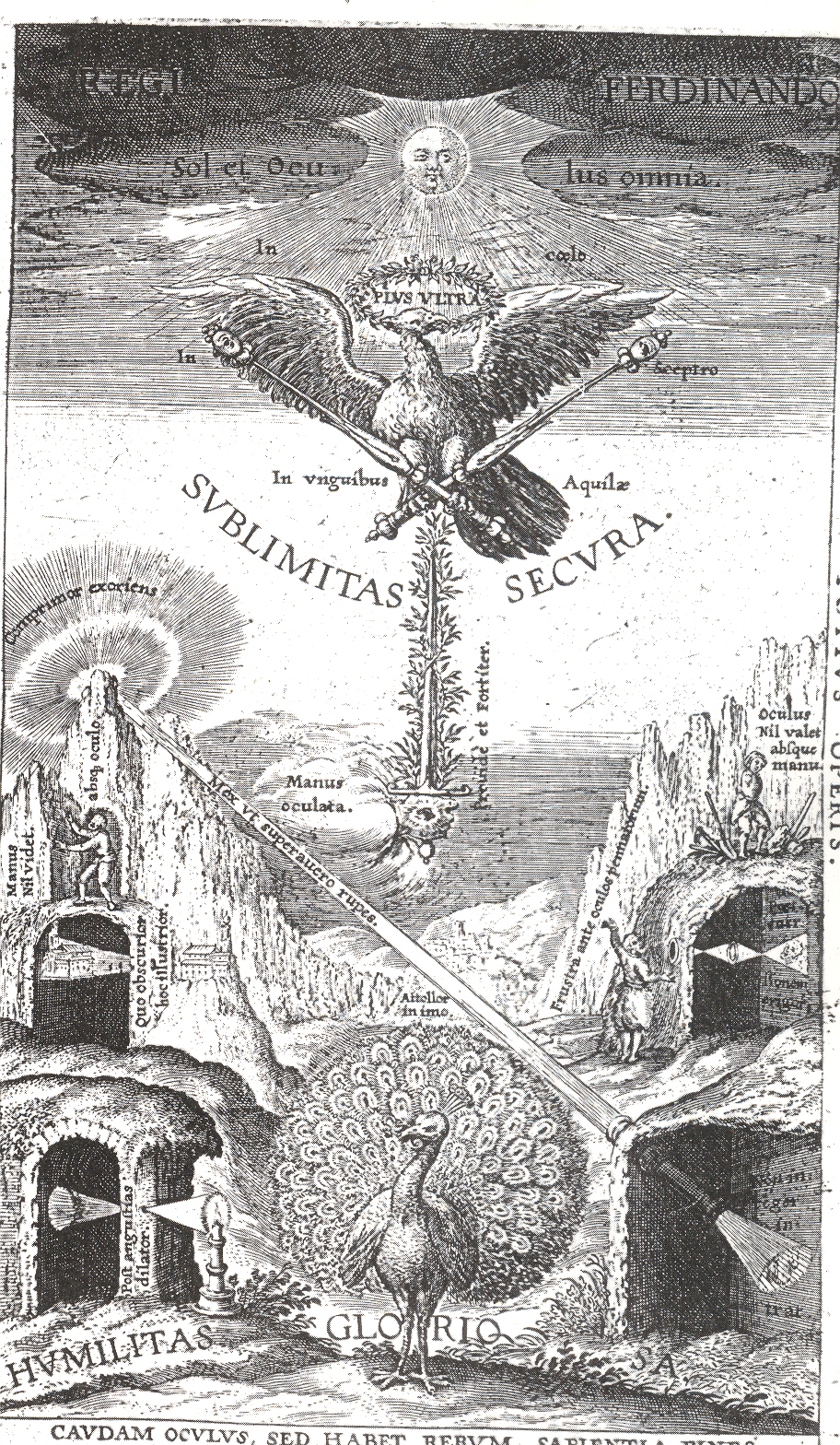
    There are literally hundreds if not thousands of images printed 1550-1850 to call upon to make this point, and I’ve selected but a few.  The first belongs to Jesuit astronomer Christoph Scheiner and which appeared in his  Oculusm hoc est: fundamentum opticum...,printed in Innsbruck in 1619. His work is an out-and-out landmark in the history of optics,  physiological optics and ophthahlmometry, and provided a springboard for two generations following him, not the least of whom was Rene Descartes. The illustration above is the book’s frontispiece, and features four camera obscuras demonstrating four principles of the eye, the middle ground of which is a beam of light 

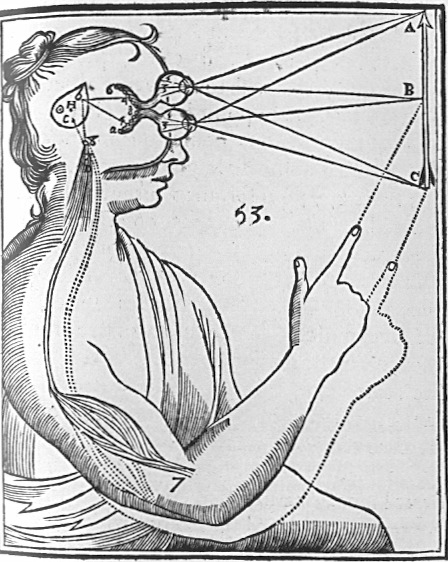
    Rene Descartes depicted the interpretation (in his  Principles of Philosophy of 1644) of light and its physiological reaction in the brain as follows:

    Cartesian_Vision

    the lines of sight depicting binocular vision, observed (and compressed) by the eye’s “particles” and processed by the pineal gland which in turn manipulate the “fluids” in the control of nerves and muscles. 

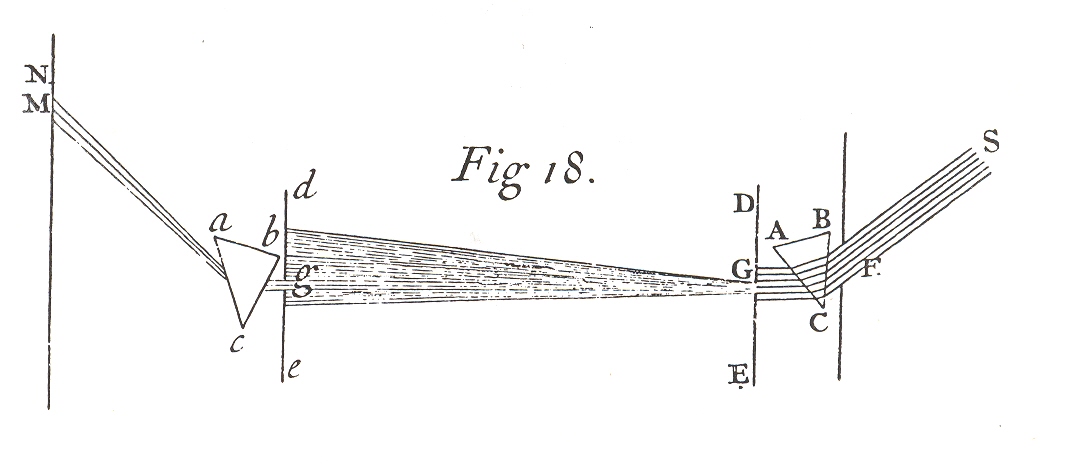
    Another example of even greater fame than the iconic image by Descartes is that of the diagram showing the connection between color and its reflective index by Isaac Newton, appearing in his Opticae of 1706.

    Mar 12 newton 

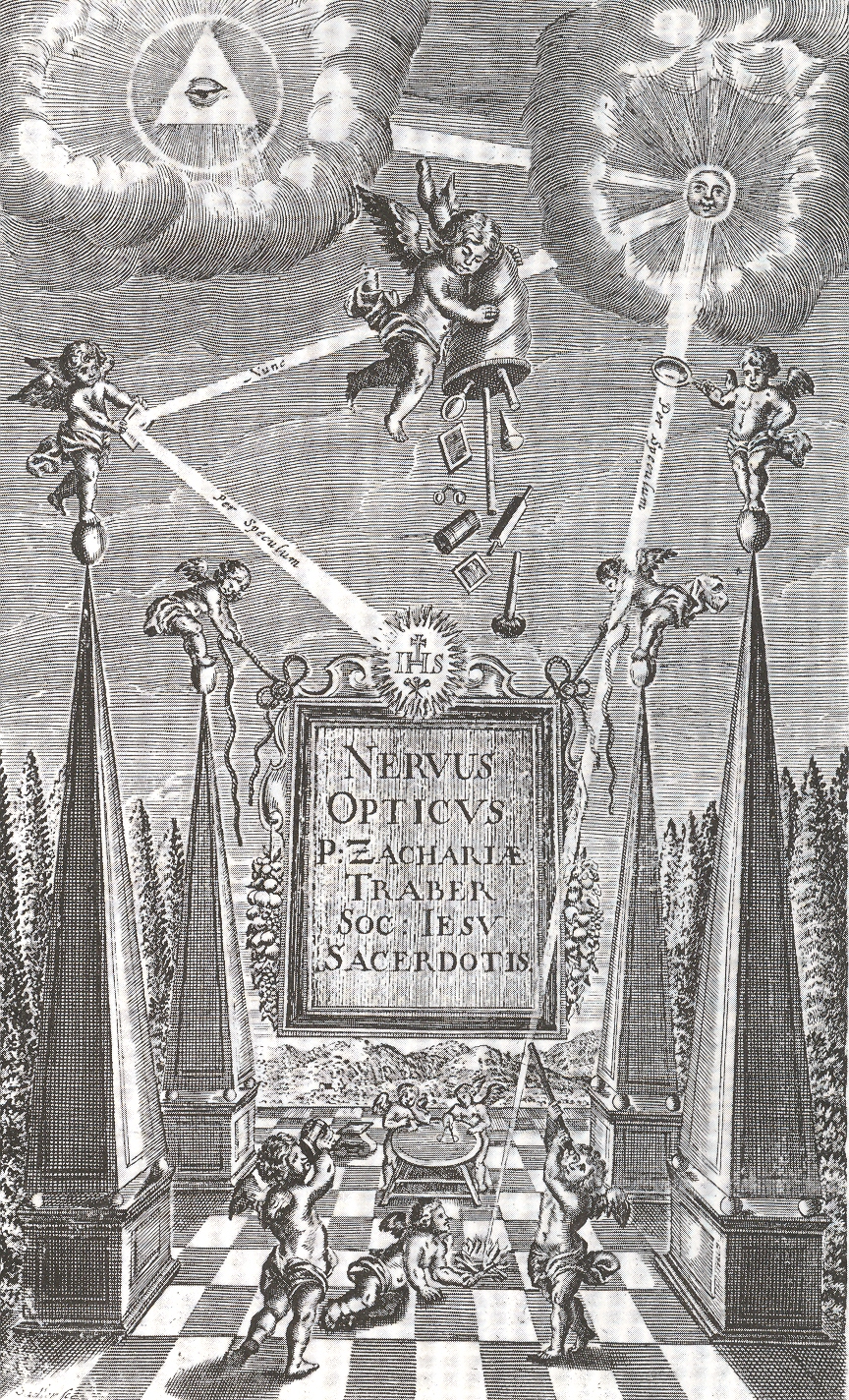
    Another fine example comes from Zacharias Traber’s (1611-1679) beautifully illustrated classic of optics (and physiological optics) , Nervus Opticus sive Tractatus Theoricus..., published in Vienna in 1690.  Traber is a great collector and synthesizer of the work done during and before his time, using the work of Descartes, Kepler, Schott, Kircher, Scheiner and Aguilon (for example), and then further implementing their ideas especially in the areas of color theory  and light refraction.  The image certainly reflects Jesuit Traber’s religious training, depicting the holy source of light (originating with the almighty force) which directs it to the sun; the light then is left to the inquisitive and playful hands of cherubs who reflect and magnify it, as well as use it to start a fire (from the condensing lens) and observe it through a telescope. The main cherub empties a sack containing a number of different optical tools, no doubt for the playful brethern beneath. 

    Mar 12 trauber 

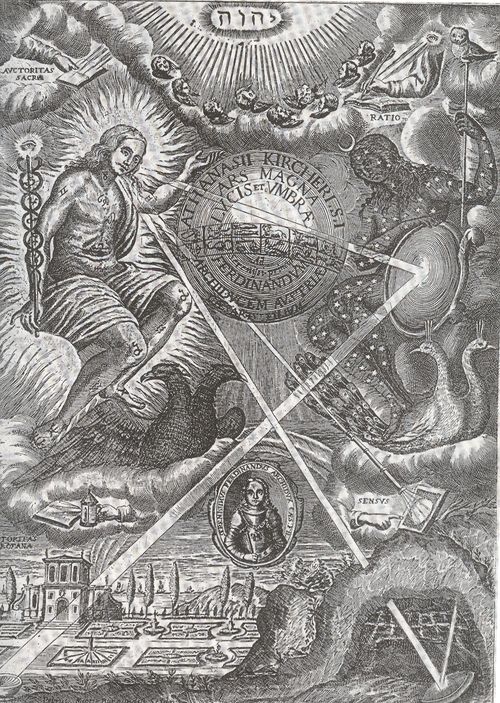
    And then of course there is the great, unstoppable, polymathic and sometimes incorrect Jesuit Athanasius Kircher.  This image appears in his masterwork Ars Magna lucis et umbrae, printed in Amsterdam in 1671, which deals with light and shadow, optical illusions, color, refraction, projection and distortion, sundials, mirrors, as well as astronomical subjects. Most of these subjects are clearly seen in the engraved frontispiece to the work (below), the source of all of the “rays” of light coming from the godhead, relayed through a telescope, reflected from a mirror, and gathered in a camera obscura. 

    Mar 12 kirch 

    Other interesting images from the Kircher include this spotlight.

    Mar 12 krirch detail long

    Mar 12 krirch black detail


  • Distribution of Ownership: What does “American Owned” Mean?

    JF Ptak Science Books LLC

    This enormous neon sign is the identifier chosen for our locally-owned chain supermarket here in Asheville, North Carolina.  It signifies that the people who own the store are American; it certainly has nothing to say about the supposed American distribution of the money spent in that chain, or how much of it replaces money sent out (along the wholesale food chain) for all of the products sold in the store that come from not-the-U.S.A.

    Downsized_0311001900

    There’s nothing necessarily wrong with non-American products being sold in boldly-proclaimed “American Owned” store, the owners proud that the people giving them their money in this mountain town 450 miles from the ocean are giving it to a Native Son.  The fact that this store is selling all manner of goods from all of the world seems to skirt the patriotic pronouncement of its pediment. Is it really necessary that they sell six brands of apple juice, four of which are manufactured with apples brought in god-knows-how from China? (Mott’s is one of these very national brands using Chinese apples–the country of origin is stamped in small blue letters near the mouth of the bottle.)  Ditto for orange juice–there are more brands, but the percentages of national/international seem to be about the same.  Even outside of fruits and veggies, it is very remarkable to me how many of the non-specialty products that line our supermarket shelves come are manufactured overseas, eating up shelf space for home-grown/produced/manufactured American products.

    This little screed could go on and on–I really just wanted to visit the issue of apple juice–especially since we’re in the heart of apple country, and the distribution of these juices stays the same even when our apples are in season. It seems entirely wrong and suspect that by some great unknown mechanism it is cheaper to send a ship filled with apple-squeezings half-way around the world, only to bottle it with sugar and water and other stuff, and sell it cheaper than the juice grown/produced/packaged just 15 miles away.  Somewhere along the food chain in this apple example must be a very weak link, which I guess must be the Chinese farmers and laborers, who must make–literally–nothing.

    This store also used to sell American flags made in China–but they went away.

    I am reminded that Wal-Mart originally distinguished itself as a “Buy American” store all those years ago, but that sentiment has long since passed into a dirt-filled bone-hole out there in red Arkansas clay, waiting for the time when it never existed.

    “American Owned” does not make an American-goods-sold-here store, not by any means.

    A friend of mine owns a clothing store with upper-end, better-made lines of outdoor wear.  He has seen many of his top suppliers of American made goods take their business offshore.  There is an appreciable difference in quality, and no difference in price–there is of course a greater profit to the owners who are banking on and exploiting the corporate brand.  My friend won’t carry these goods anymore, for many reasons, not the least of which is the salty quality.  He has gone so far as to include a large (tastefully designed) sign announcing “Not one thing here made in China”.  Customers love the sentiment, and then most chase after wherever the cheaper-made Chinese variants made off to. Some things just aren’t right.

    ·Posted by :

    ·in:


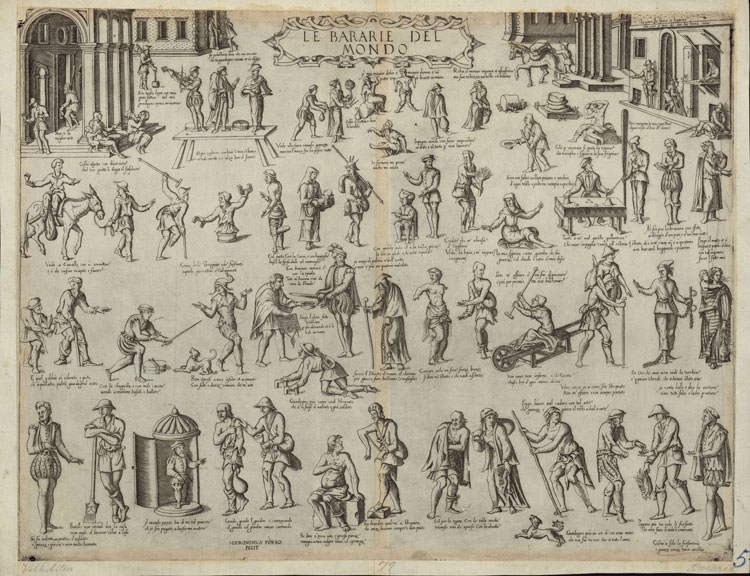
  • Popular Culture Imagery–16th Century Street People (Fools, Musicians and Pregnant Women and more)

    JF Ptak Science Books LLC Post 970

    Le
    barbarie del
    mondo,
    by Hieronymous Porro (fl
    1574-1604), depicts Italian street
    people collected under the unkind general heading of  “barbarism of the world”. I misread the description of the actions of the people in the print
    (found at the University
    of Texas
    website below) as “Making
    a living doing unnecessary tasks of nothing”—a harsh appraisal of the efforts
    of people who have nothing trying to make a little bit of change for bread, though it does describe the general sentiment of the print, wrong or not. Though the
    written descriptions are slightly kinder than this, the depictions of the social
    unfortunates was certainly not. 

    Mar 10 porro

    The people described in this image–the collection of unfortunates,a veritable museum of social “outcasts”–include fools, street laborers, merchants, the disabled, prostitutes, destitute women (with children), musicians, street performers, flagellants, religious zealots, and general beggars, not to mention what must’ve been alley dwellers, street-sleepers and the homeless.

    Not too much different from today. What makes this image remarkable to me is that it makes these generally invisible people visible, gathered together in one image.  Generally these people would be used occasionally as found objects, tertiary depictions in larger, grander artworks showing grand structures or town views, the people used to show scale, and the artist taking some small liberty by employing street people as the scale units rather than landed strollers. (See here for an example.) Holbein, de Hooghe, Bruegel–masters of the large gathering and crowds, did not attempt a solitary image to the underclasses’ underclass.

    [Source:  Harry Ransom Humanities Research Center, University of Texas, Austin.]


  • Popular Culture Images–The Long Road, Allegories of Life’s Stages

    JF Ptak Science Books LLC  Post 969

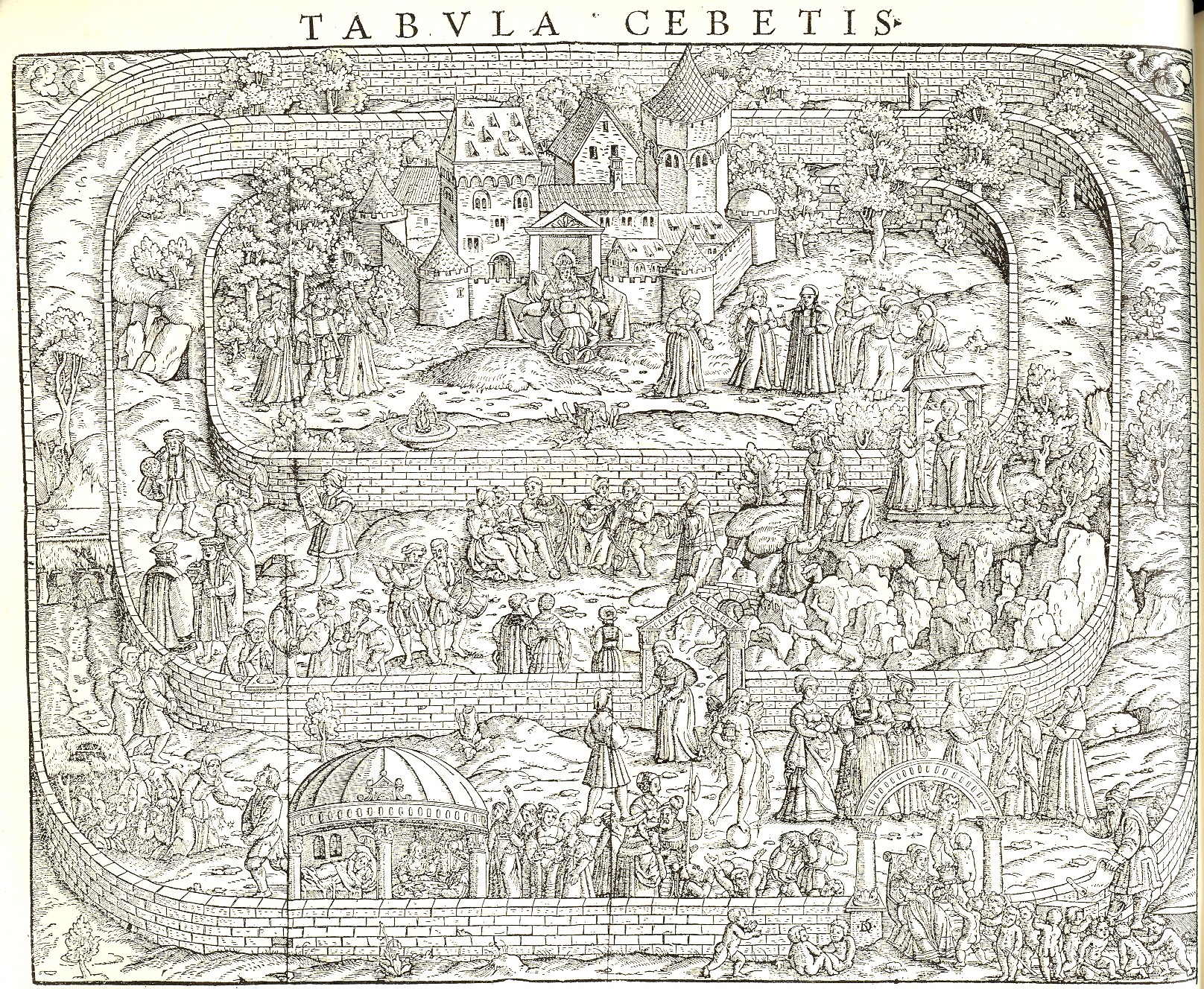
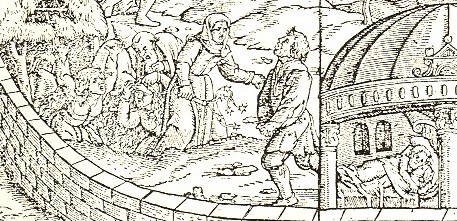
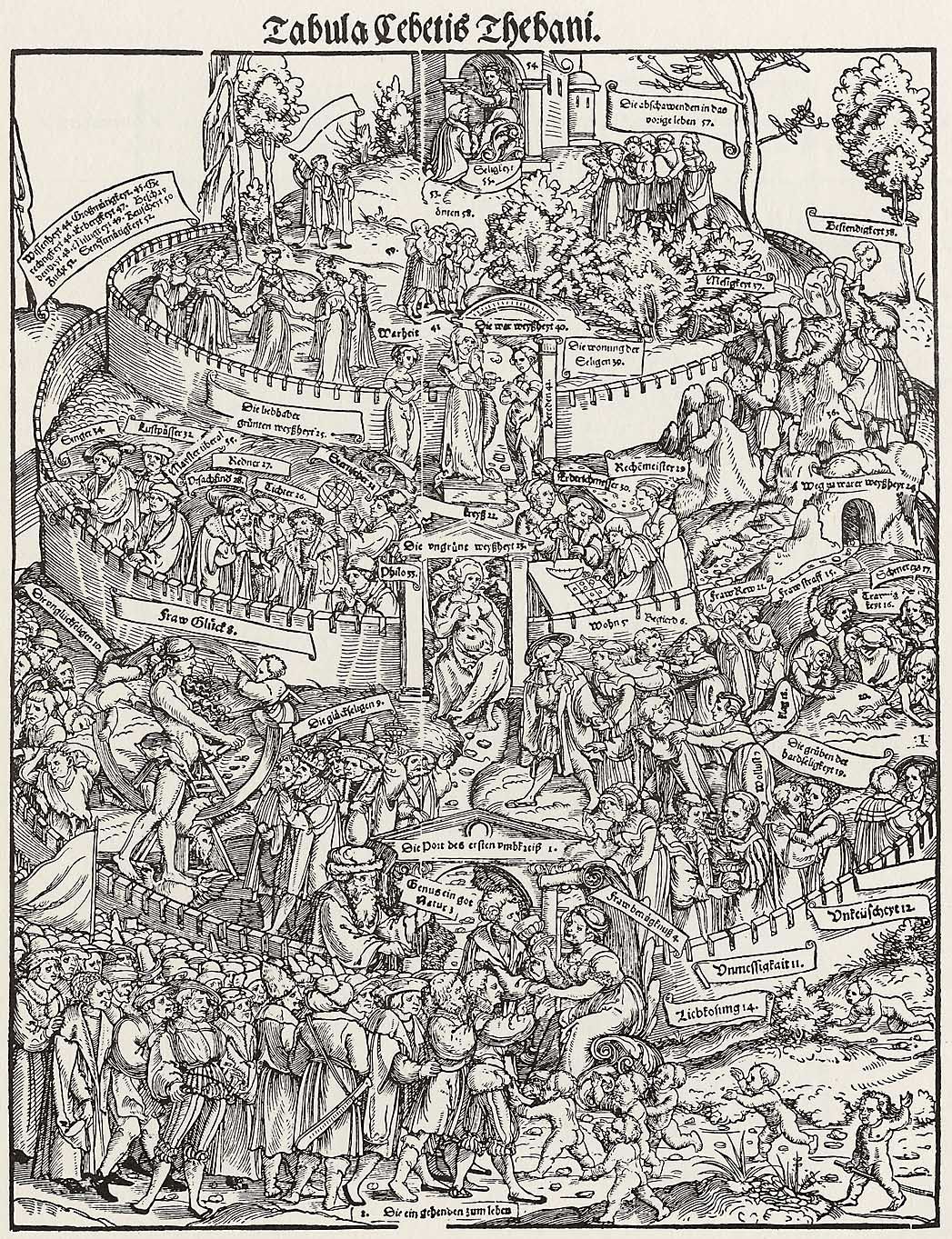
    This remarkable woodcut appears in Epictetus’ Enchiridion (1563), and is one in a long history of images portraying the moral life of humanity.  The longitudinal study of birth, corruption, vice, penance, achievement, want, lewdness, cowardice, sloth, and a penetrating multiple visits of the seven deadlies was intended to show the rough rode that lay ahead of us all on the way to the crowning glory.

    The full image appears below, with details following:

    Mar 9 life

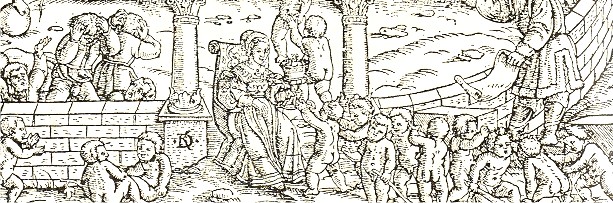
    This is a detail from the lower right, showing the beginning of life, an abundance of babies, with the foot of Fortuna seen at upper left, she observing (or not) the toddlers’ advances along the walls of life. 

    Mar 9 life beginning 

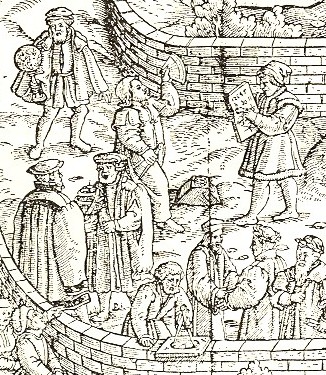
    The achievements of middle life are clearly seen:

    Mar 9 life middle age

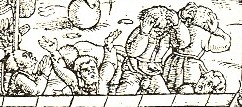
    As are the temptations of immoral life and the sins that await:

    Mar 9 life punishment

    Unfortunate sinners turned away at the foot of Fortuna:

    Mar 9 life punishmen2t

    And at the end of the journey, following the three concentric walls leading to finality:

    Mar 9 life end2t 

    This image looks a little suspect, but when you look at other woodcuts of the Tubula you can see this action a little more clearly (and from the side)–and what they reveal is Mother Church rewarding the supplicant with a crown.  This is more clearly seen below, in the 1551 versin of teh morality play by Johann Kramer (and published in Munchen);

    Mar 9 tabula

    The interpretations of these images areas varied as each of their characters, the details of which can be explained one way one day, and another the next; the morals and the end-tale stay the same. 

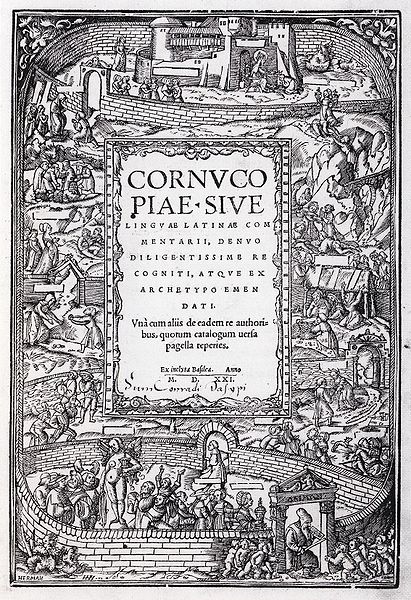
    Another example, this one from 1521 and after a work by Hans Holbein:

    Mar 9411px-Tabula_Cebetis_B,_woodcut_after_Hans_Holbein_the_Younger

    ·Posted by :

    ·in:

    — — —

  • A Note on “Opposite Sameness” in the History of Dots

    JF Ptak Science Books LLC  Post 968 

    Part
    of the History of Dots series that I find so attractive is the dot’s great
    equalizing effect.  The dot has the
    potential of making everyone, everywhere, feel the wonder of mighty
    insignificance—the Earth, for example, depicted from far away, a dot in the
    cosmos, the solar system a dot in the galaxy, the galaxy a dot in the realm of
    galaxies.  And then back again, powering perspective
    back inside us, finding the common thread of humanity again at the cellular level,
    a dot of sameness.

    Mar 8--dot hereschel

    For
    example, the map drawn by Sir William Herschel must have been a staggering
    thing to see when it was first published in the Philosophical Transactions of the Royal Society in 1785–at least
    by the popular viewer.  The enormity and
    expanse of galaxies was not yet understood, and to see (at this time) our own
    sun relegated to a point of sameness in what he deduced to be a spiral-shaped Milky
    Way Galaxy among many others could well have been an astonishing experience to
    a first-time viewer.

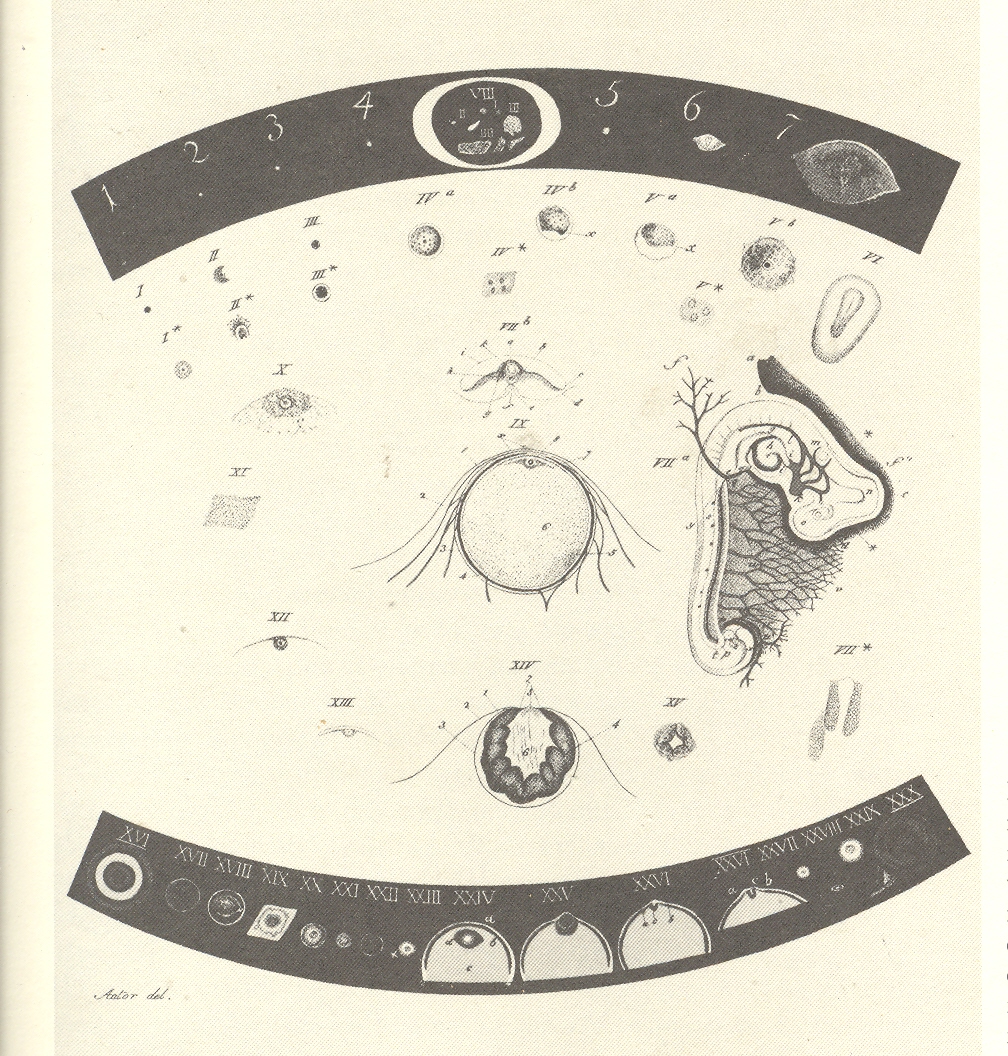
    So
    to for at the other end of the spectrum with the embryological work of Karl
    Ernst von Baer (an Estonian educated in Germany
    who worked in St. Petersburg)
    as it was published in his De ovi
    mammalium et hominis genesi
    (1827). 

    Mar 8--med dots

    His work established beyond all doubt that the reproductive processes
    for all mammals were generally the same—or without fundamental difference—from other
    animals.  And since “mammals” included “man”,
    it came as quite a shock to the popular audience that the basic facets of
    reproduction were little changed between dominant predator and all the other
    stuff. At the professional level Baer’s work was of enormous importance in the development
    of cell theory which would lead to natural selection…and he also established embryology
    as a discipline. 

    And so the substance of dots at opposing ends of measurement, bringing about a similarity of recognition.  Dots.


  • Bombing and the End of the World: the Physics of 1932 And All That

    JF Ptak Science Books 

    1932 in my book turns out to be one of the most collectively epochal years in the history of science.  Certainly others stand out for individual achievements, like 1905 (Einstein’s four papers over two volume of the Annalen), 1687 (Principia), but there are other yeas with fabulous achievements by numerous people.
    Mar 7 airmen det


    1543 is one.  That year witnessed the published of Copernicus’ De revolutionibus and Andreas Vesalius’ De humani corporis fabrica, two giant achievements for the outer and inner worlds, one challenging the structure of the universe and the other the Galenic tradition of physiology and anatomy. (To a lesser extent is Peter Ramus’ Animadversions on Aristotle which was a very sustained and elegant attack on the ancient-precept Aristotle an physics.)

    1859 saw the publication of On the Origin of Species…JC Maxwell’s work on the kinetic theory of gases, Riemann’s hypothesis, and the spectacular invention of the spectroscope of Kirchhoff and Bunsen (that turned much of the invisible universe visible).
    Mar 7 airmen det 2


    1939 (nuclear fission, chain reaction, neutron stars, magnetic moments, penicillin (advancement), Vit K, FM) and 1948 (nuclear structure, QED, transistor, Big Bang) also come quickly to mind.

    1932, though is really quite something, seeing a sweeping array of discoveries in the large and small.  Carl Anderson identified the positron while James Chadwick discovered the neutron; also, the Joliot-Curies’ made their monumental discoveries in radiation.1 Iwanenko described the neutron as a constituent f the nucleus, while Heisenberg described the nucleus as composed of protons and neutrons.  Knoll and Ruska built the electron microscope, allowing a vision of the interior parts of the interiors of the smallest things, offering images almost as spectacularly new as Hooke’s two centuries earlier.  Looking up and out, in the same year, Lev Landau postulated the existence of neutron stars while Karl Jansky invented radio astronomy. There was also the perfection of the “Polaroid” process by Ed Land, and the isolation of ascorbic acid (Vit C, by  Charles Glen King, and the beginning of a long war between him and Szent-Gyorgyi on priority of discovery).  (In the non-sciences, there was the addition of Franklin Roosevelt and Adolf Hitler to their national agendas. It was also a banner year for literature: Death in the Afternoon, Ernest Hemingway; Light in August, William Faulkner; 1919, John Dos Passos; The Thin Man, Dashiell Hammett; Tobacco Road, Erskine Caldwell; Young Lonigan, James Farrell; Little House in the Big Woods, Laura Ingalls Wilder; and Brave New World, by Aldous Huxley…)

    Mar 7 airmen 


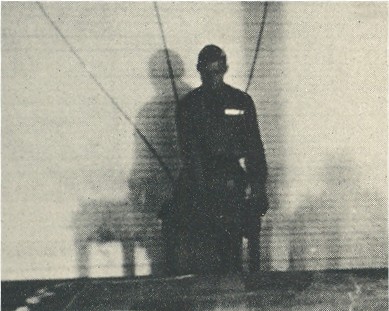
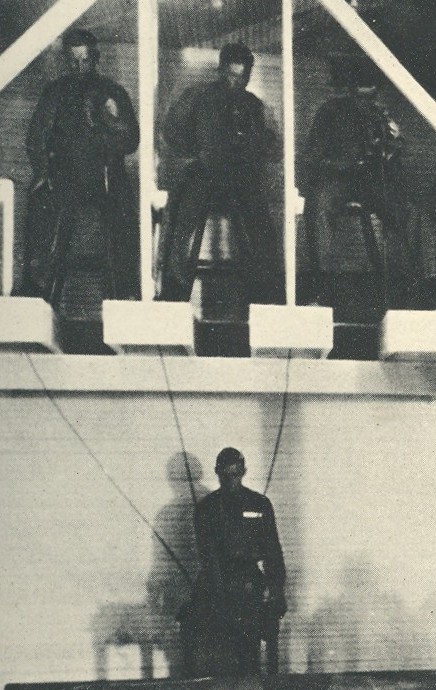
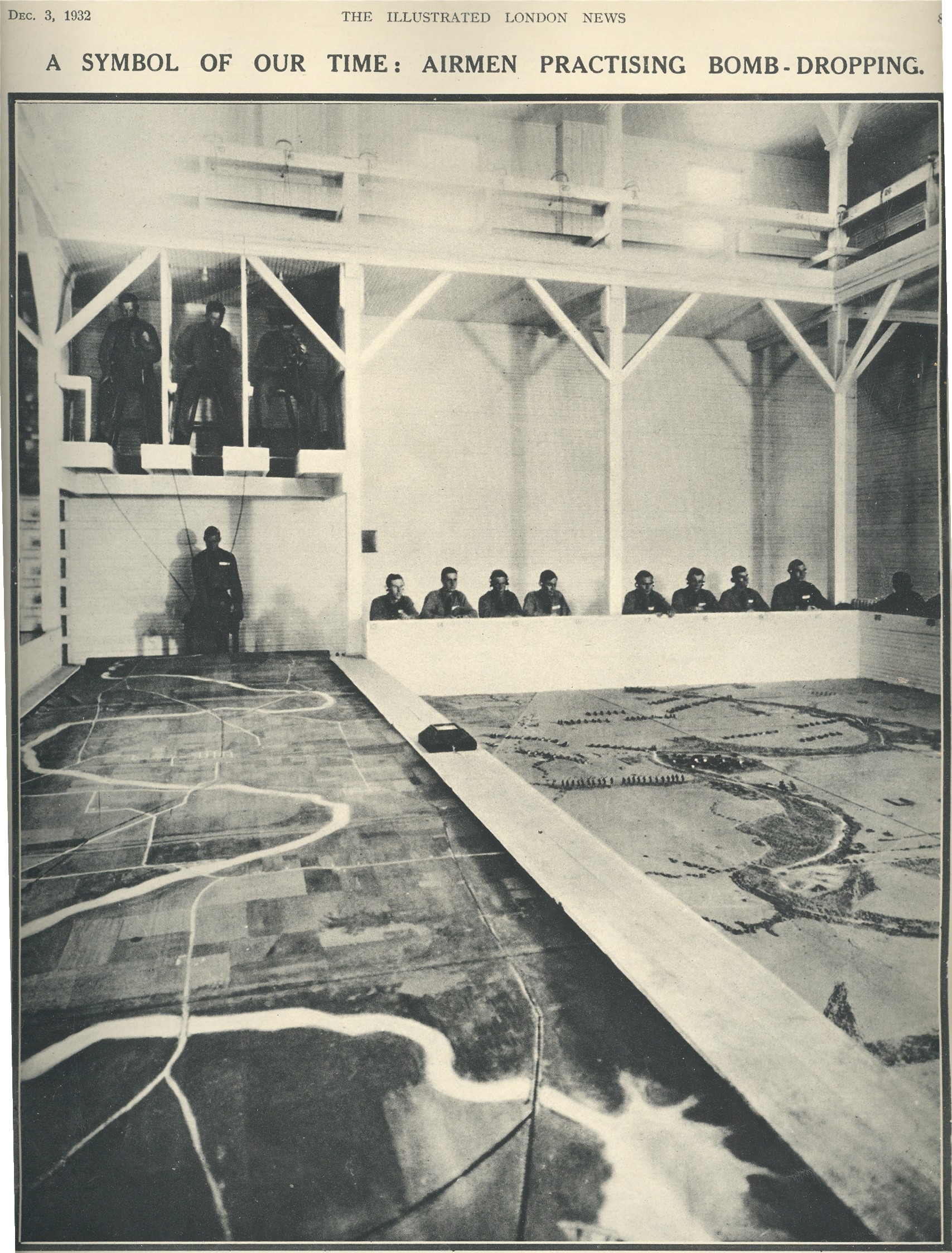
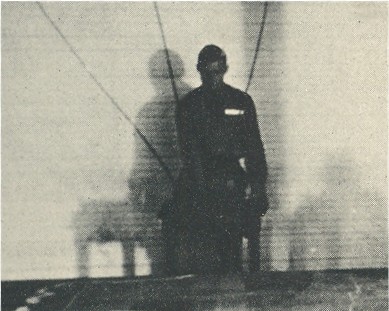
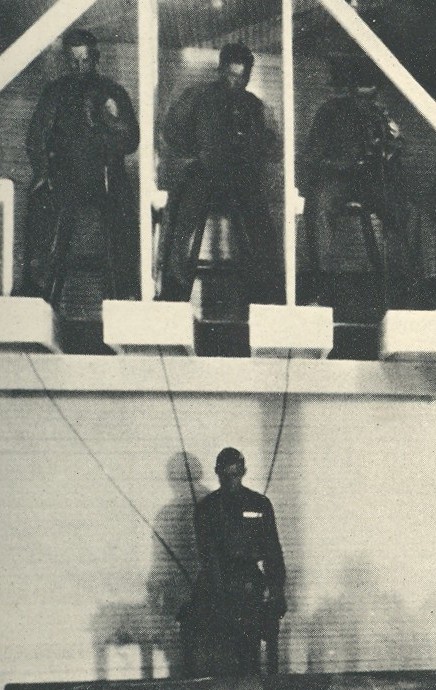
    The thread of thinking about all of this came to mind looking at this image of a bombing instruction room for aviation in England in 1932.  The image is also a great one; the aviator at far left looks like a marionette; the three men above responding to his piloting maneuvers as he concentrates on the endless panoramas of landforms that advances before him on a horizontal diorama.  It is a fabulous analog flight simulator constructed at a time of great change in aviation

    Wonder stories

    1932 is also the year of the publication of Carl W. Spohr’s classic future-vision/speculative fiction apocalyptic-atom bomb end-of-the-world two-parter (so many hyphens!) that appeared in Wonder Stories.2 The story begins with a relatively simple series of catastrophic bombings that lead to a sort of détente, a kind of mutually assured destruction, which is then upset when the combatants discover and construct the atomic bomb.   MAD breaks down, and the ensuing massive exchanges result in a  devastated world.   Pretty prescient stuff, all-in-all, even so far as the policy goes—especially so when you wrap this sci-fi story around the elements of 1932—Chadwick, Anderson, Joliot-Curie—that made all of this stuff possible just 13 years later.

    Notes

    1 The Joliot-Curie discovery was called “one of the most important discoveries of the century… the consequences of the discovery of artificial radioactivity are immense” from Segrè, From X-rays to Quarks, 198-199).  

    2.  Part one appeared in the March issue, which also carried stories like“Red April, 1965” by Frank K. Kelly; “The Eternal World” by Clark Ashton Smith; “Waves of Compulsion” by Raymond Gallun; “Mutiny on Mercury” by Clifford D. Simak; “The Time Stream” by John Taine (Eric Temple Bell), and others.  Pretty good bumper crop of sci-fi writers in itself.


  • The real Alice in Wonderland: Plus Alice in Miniland and Guinness Stout

    JF Ptak Science Books LLC Post 966Alice Liddell det

    Now that the new Tim Burton Alice film is out, let’s not forget that there was a real Alice on which Lewis Carroll’s Alice was based.  She looks, well, pretty formidable. (Alice Liddell.)


    Alice Liddell

    A photo by Carroll of Alice at a younger age.  In spite of his logic and math and Snark and Alice, Carroll’s “artistic” photos of children are pretty creepy to me. 

    Alice_Liddell_2

    ·Posted by :

    ·in:

    — —