A Daily History of Holes, Dots, Lines, Science, History, Math, Physics, Art, the Unintentional Absurd, Architecture, Maps, Data Visualization, Blank and Missing Things, and so on. |1.6 million words, 7500 images, 4.9 million hits| Press & appearances in The Times, Le Figaro, Mensa, The Economist, The Guardian, Discovery News, Slate, Le Monde, Sci American Blogs, Le Pont, and many other places… 5000+ total posts since 2008.

Author: JF Ptak

  • Lonely Man-Rakers in a Dry Lake Bed, 1567

    JF Ptak Science Books LLC  Post 1001       

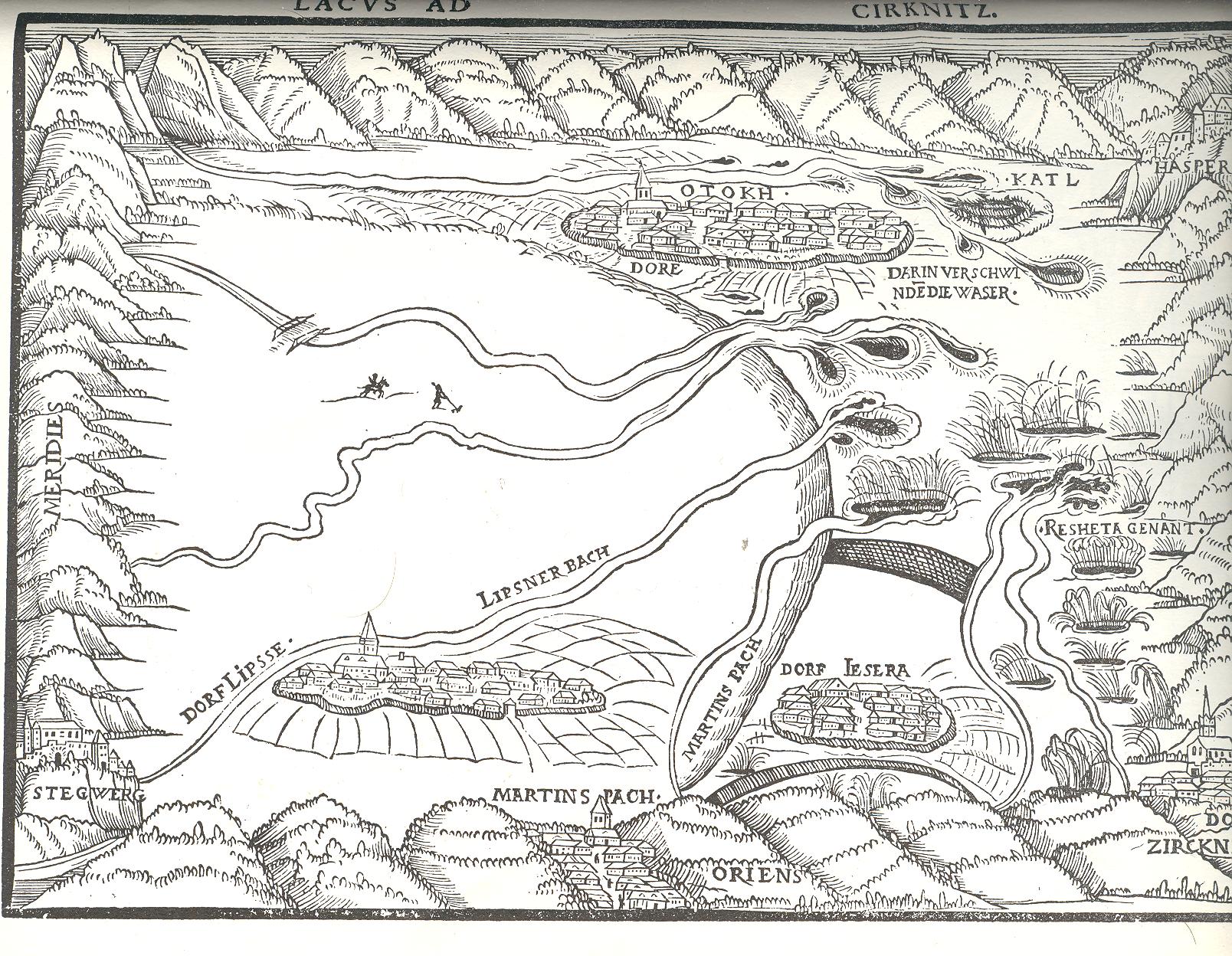
    This odd, semi-naïve “outsider-esque” map is found in George
    Wernher’s (d. 1567)  De admirandis Hungariae aquis hypomnemation depicts
    an intermittent lake region of the Inner Carniola region of Slovenia—more  precisely it shows the “disappearing” lake of Cirnitz,
    which is near the town of Otokh.  The map
    (which is oriented west/east

    Blog--april 8 rake

    at top/bottom) I think is showing the lake when it
    is “disappeared”.  What happens evidently
    is that when the water table rises it causes the groundwater and underground streams
    to also rise, seeping through the limestone lake bed and rising through caverns
    and sink holes; it becomes a periodic lake, though the appearance and disappearance
    of the water has been the subject of wide mytho-specuilation for the folks who have
    lived in the region for the last few thousands years.  

    The towns of Otokh and Lipsse are shown as walled entities,
    and according to some old gazetteers that I’ve consulted would actually be
    surrounded by the lake from time to time. 
    To further enunciate this the cartographer seems to have included cultivated
    lands around these towns–no doubt the resulting soil would’ve been rich I nutrients.  Also the eight rivers that feed the lake are
    shown here, ending at this time in small lakelets. 

    Although I liked the feel of this map it is not what
    attracted me enough to write this post—the main point of interest is at the center
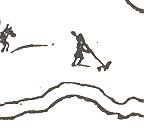
    of the map.  There, standing to the right
    of the horse and rider is a man working with a rake.  Blog--april 8 rake det
    These are the only two human figures in the
    map, and one of them is holding a rake. 
    Probably the person, along with the horse-and-rider and the small lake-bed
    bridge across one of the rivers were included to hammer home the point that the
    lake was gone, and that someone might be farming it. 

    In any event, the stick person looks like a lonely figure.

    I think that a good dictionary could be compiled of lonely
    figures like this that appear as “fillers” in maps and prints. These people have made a number of appearances in this blog, such as

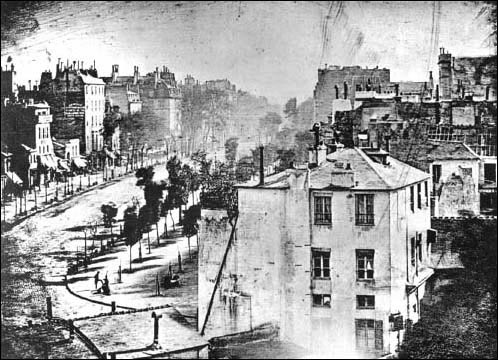
    in the case of the first photograph of a human
    being. Well, actually, it is the first photograph that just happens to capture
    a human in the emulsion. Since the  exposure time was so terribly long for
    this image to be made, the moving people and horses and carriages on the
    street, all of the city-life bits, were necessarily spectral, and mostly  invisible, in the photograph.  Only the
    stationary

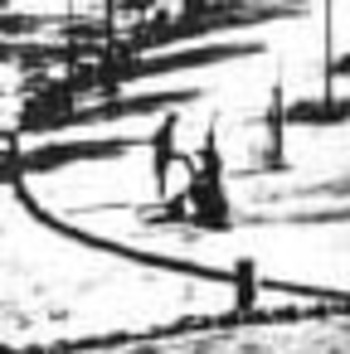
    April 8 street items were captured, and the only people captured here were two
    figures in the foreground, doing something or other (shoe shine?) that made
    them still for at least five minutes–long enough for their anonymous but
    famous photonic impressions to be captured.  April 8 detail


  • Controlling Time & Motion: Visualizing Directions for Human Movement #1.

    JF Ptak Science Books LLC  Post 1000

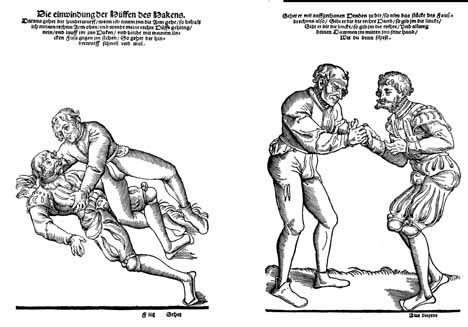
    I came to this post backwards. My primary interest was the frontispiece portrait of the author of a 1539 book on wrestling, showing the somewhat long-in-tooth author with scraps of tuffy hair and a coy knowing grin–an unusual portrait, presented by the master Lucas Cranach.  I looked further into the book and discovered that the well-illustrated document pictured varieties of wrestling moves, all demonstrated to students by the author, who most of the time was shown with this knowing grin, gripping and flipping and immobilizing his younger subjects. What slowly came into my head while looking at this book was how concise and instructive the images were, and that the whole was a great tutorial on wrestling motion, and the presentation of instruction on specific motions in general. 

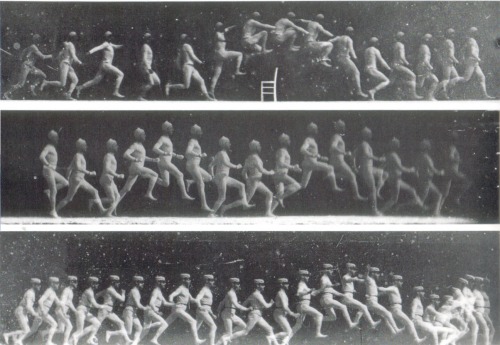
    Prior to the invention of photography, printed works on how humans should move in a given way and for a given task are uncommon and, generally, somewhat complex. The image I have in my head is the epochal work of the somewhat forgotten Etienne Marey, who in the 1870’s created what was essentially the world’s first “slow motion” device1. One iteration of Marey’s apparatus was basically a long series of ganged cameras recording a motion for a Marey12 simple task at a given time frame and presented on a continuous strip of photographic paper, sort of like a motion picture with the camera speed set at three frames per second. The resulting images were phenomenal and showed people for the first time the exactness of all manners of simple motions–motions that no longer looked so “simple” once all of its aspects could be studied from captured photographic evidence.  Even the act of hopping over a small stool or bending to pick up a bucket of water were enormously revealing in a way like Robert Hooke’s Micrographia displayed the great detail and complexity of the seemingly simple fly.  Perhaps the most famous of Marey’s series of images was that of a galloping horse, which also for the first time revealed what exactly the horse’s legs were doing and proving that almost every painter in the history of art represented the galloping horse incorrectly. But Marey doesn’t actually fit the mold of directing the motions of people for a particular instructional purposes, though he does of course photographically reveal hundreds of actions that led to a revolutionary understanding of the body-in-motion.  This is why I’ve chosen him as the limiting point for this category. (And just for the record I’m not sure when the first book on the movement of animals–not including hunting/trapping books–comes into being.)
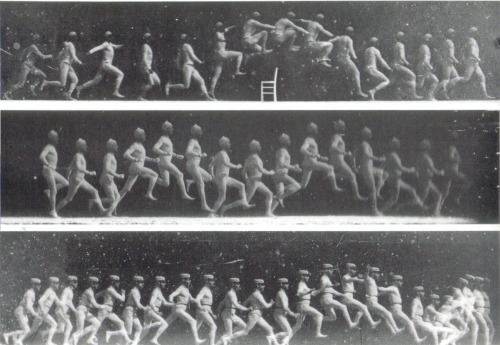
    Early works directing people on how to move are not terribly common. There are general works on table manners, the appearance at royal courts, religious ceremonies, maneuvers for armies in combat, sword fighting, parades for triumphs and adulations, funeral rites, and so on. 

    For this first installment I’d like to look at two ends of the spectrum for displaying motion instructions clearly. The first is a book by Fabian von Auerswald, whose Ringer kunst: funf und Achtzig Stücke2, published in 1539 in Wittenberg, is one of the earliest books printed on the art of wrestling.  It was printed by Hans Lufft3,the man who Wrestling 2
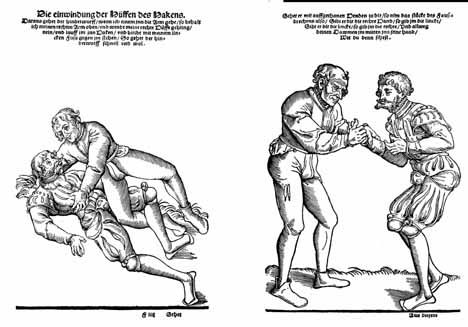
    was also responsible for printing Martin Luther’s translation of the Bible a few years earlier. 

    I like the images in this book, elegantly produced by Lucas Cranach–they also present the more-elderly author (frequently shown with a sly grin) demonstrating his wrestling moves to his students. Overall it seems to me that it was an excellent (if not fluid) presentation of how to direct body motions.

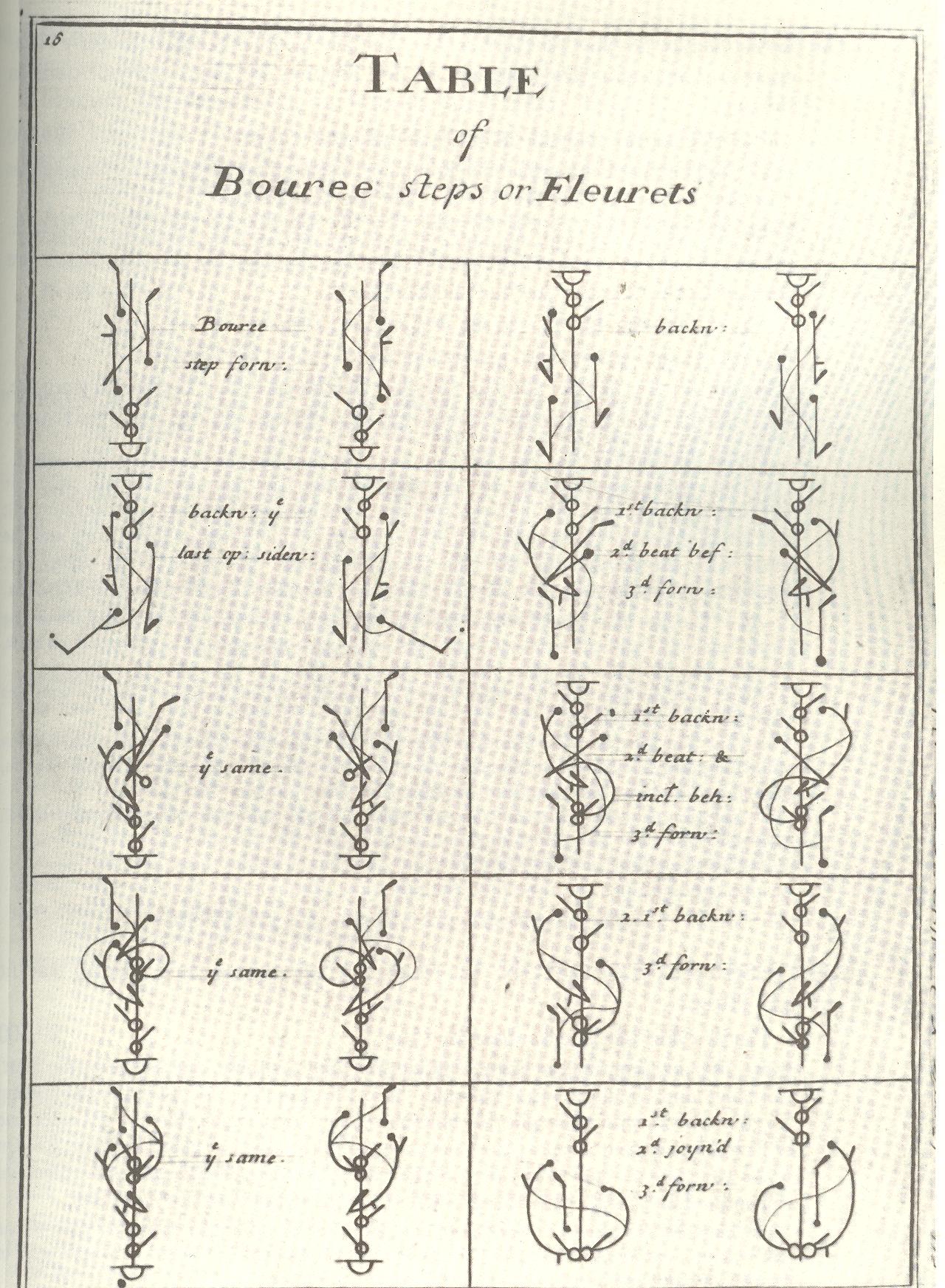
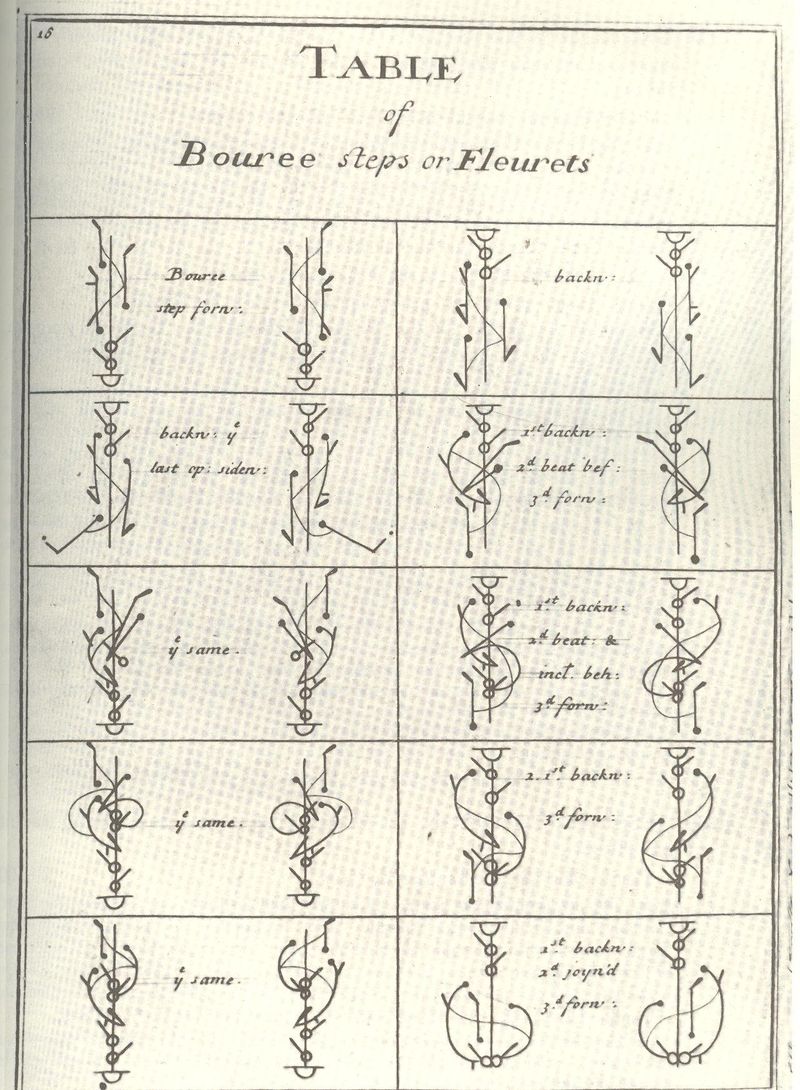
    Not so quite as direct, or simple, or lucid, or useful, is Raoul Feuillet’s publication of Pierre Beauchamp’s Orchesography4 , a work published first in 1700  (and then in English in 1706) and dedicated to instructing people on the movements of the dance.  It was a good idea, though more useful to folks in the future than for his contemporaries.  The book was a spatial geography of dance–the motion (feet and arms, both) was written in a similar fashion as musical notation, though not nearly as clearly.  The dancer was to hold the book and view the steps as they would be from above, holding the book always (!) pointed towards the “upper end” of the dance room.  (There were separate and complicated instructions showing how this was to be accomplished–imagine trying to perform the steps in a series of twirls, and keeping the book pointed “true north” so to speak.  Not easy.)

    As it turns out the work by Feuillet/Beauchamp may have been more important as a piece of dance archaeology because it was so terribly detailed; it may not have been an exemplar of teaching people how to dance, but it certainly was an iconic publication in recording the intricacies of dances that may otherwise have been lost to time. 

    s Blog--apr 7 dance
    Notes:

    1. I should also say that Marey was influenced by the work of Eadweard Muybridge’s photographs of motion—whom he credited of
    course—and who I think expanded upon and exceeded those achievements.

    2. The entire book located here; the translator writing here on
    the philosophical/linguistic aspects of the book.

    3. Beginning in 1534–the Luther Bible was printed in vast numbers by Luftt
    (and appeared in the millions over the years) and others; the same can
    not be said of the Auerswald book, which appeared in a small edition and
    is quite rare today. It was in this edition that (in addition to much else) is found in Romans 3:28 the controversial “alone”: “thus, we hold, then, that
    man is justified without the works of the law to do, alone
    through faith”

    4. The full title:  Orchesography; or, The art of dancing by characters and demonstrative
    figures. Wherein the whole art is explain’d; with compleat tables of
    all steps us’d in dancing, and rules for the motions of the arms,
    &c. Whereby any person (who understands dancing) may of himself
    learn all manner of dances. Being an exact and just translation from the
    French of Monsieur Feuillet. By John Weaver, dancing master
    .

    ·Posted by :

    ·in:

    —

  • An Enormously Modest Proposal–Toilet Paper as a Social Medium, 1932

    JF Ptak Science Books LLC  Post 998

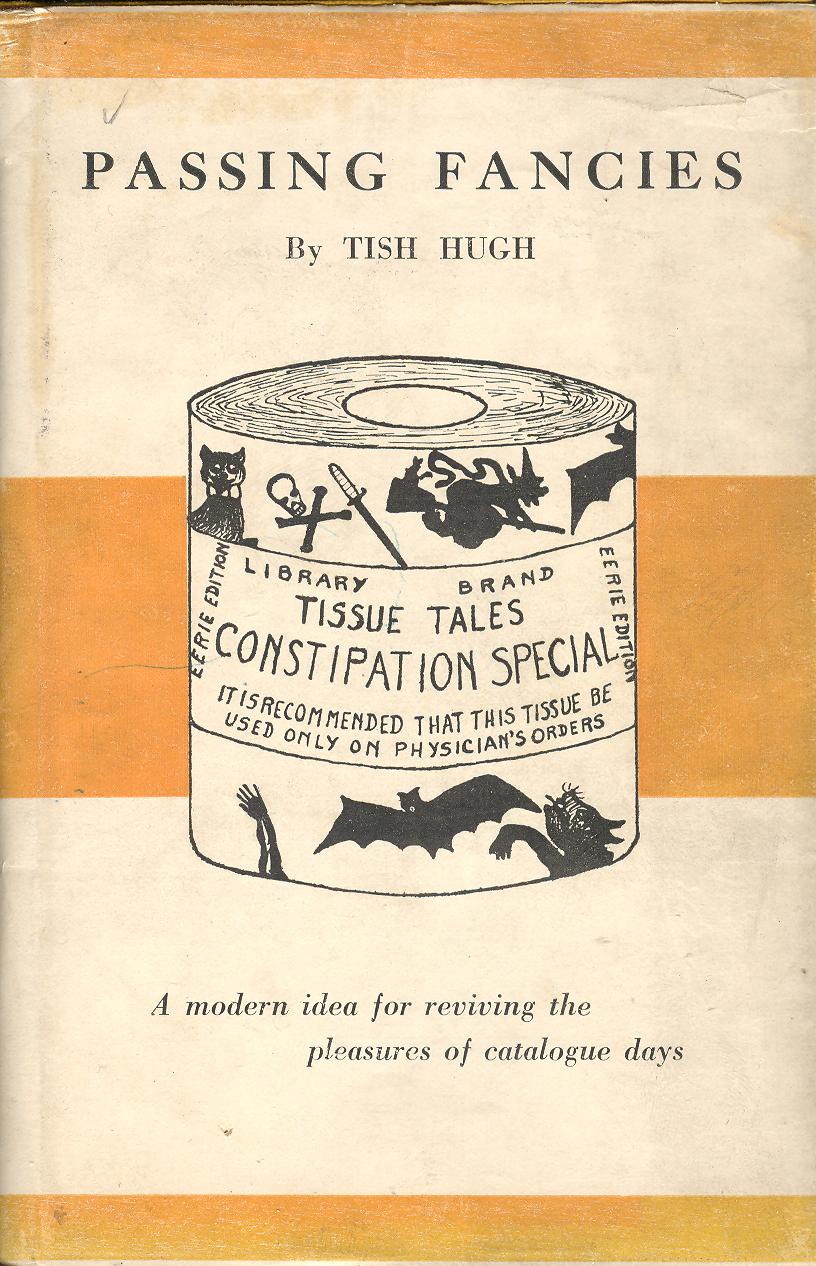
    In the days before the well-rubbed catch-phrase “social media” was thunk, and in the days long passed the era of twice-daily postal delivery and four daily editions of newspapers, a man named Henry M. Robinson–writing as “Tish Hugh”– wrote a small book proposing toilet paper publishing/social interface.

    Blog--april 4 toilet paper tp

    Passing Fancies, published in 1932, extols the virtues of spending “alone time” with a passive interactive medium.  He rues the days that mail order catalogues were replaced by toilet tissue as a medium of cleanliness conveyance, saying something to the effect that a great deal was lost replacing the pages of goods-for-sale with plain whitish tissues.

    And so to the rescue of the lonesome and bored goes Mr. Robinson, who suggests that toilet tissue be sold imprinted with newspapers, novels, biographies, historical fiction, and so on.  They would be vertical issues of your favorite reading material, including magazines, everything included–except food advertisements.  Mr. Robinson notes that olfactory memories of reading food advertisements while “actively engaged” could lead to “disastrous”  associations with the advertised product.  

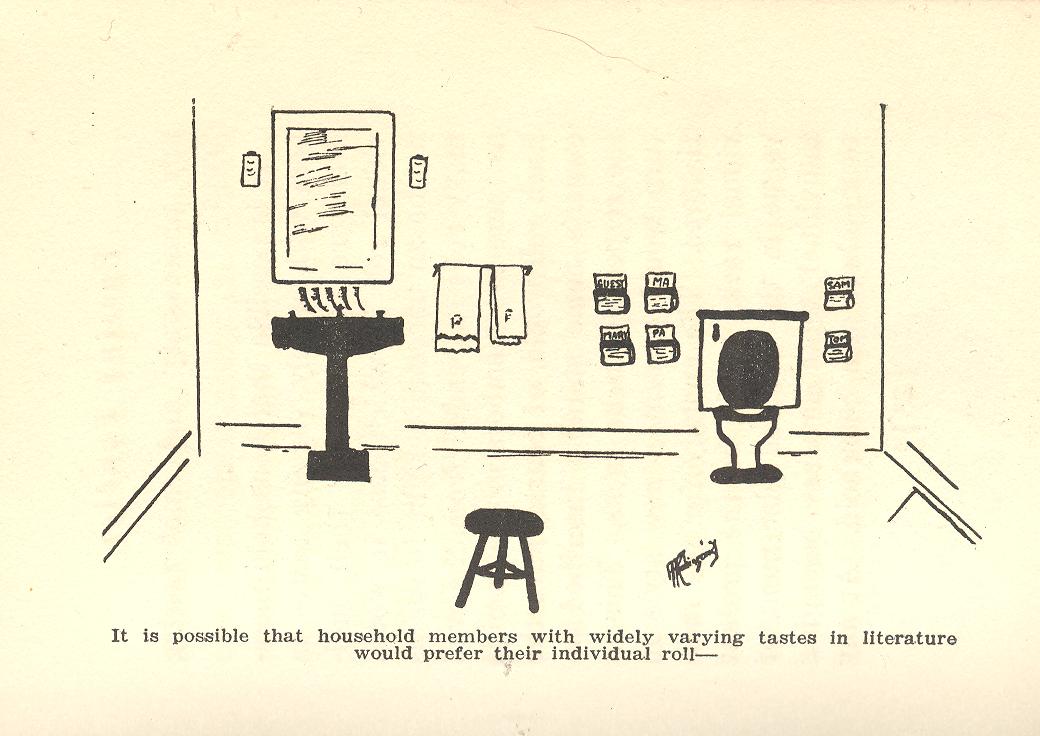
    Also suggested in the slim and stubby book’s 32 pages:  multiple-rolled bathrooms, with tissue rolls for individual family members according to their interests.  

    It is a somewhat interesting proposal, and evidently may very well be among the earliest to suggest a deeper commodification of toilet paper as a delivery system for the written word.  The aspect for earlyness for this idea seems a little shaky, as toilet paper as a mass-produced (and available) item was already at least fifty years old by 1934, but sometimes it takes a long time for something that looks obvious to take effect.  Perhaps it took so long in this case because it wasn’t a particularly good idea.

    I am positive that Mr. Robinson paid no attention to the critics or reviewers of his work. If so he could always have paraphrased the stout assessment and response made by the musician Max Reger to one of his (harsher) critics: ‘I am sitting in the smallest room in my house,” he wrote, .
    ”I have your review in front of me. Soon it will be behind me.”

    (Earlier in this blog I wrote a post on the most important innovation in the history of the prolongation of human life–the flush toilet.)

    Blog--april 4 toilet paper multi

    ·Posted by :

    ·in:

    —

  • People Panoramas

    JF Ptak Science Books LLC 

    I’ve made a number of posts here about images-within-images, art found inside art, the increasing discovery as you look more and more closely at a complex scene. . Generally they deal with the inconsequential, ephemeral depictions of people in architectural engravings; tonight it is straight-out people panoramas with an exercise in zooming in to smaller sections of a large mass, and finding new less-vast subsets and their unexpected detail. 

    Boxing

    BoxingT1
    BoxingT1 detail center
    BoxingT1 detail 2

    Harvard-Yale Football
    Bos--harvard-yale--smallT1

    Bos--harvard-yale--smallT1 detail

    Miami Swimming Scene, 1925
    Miamibathing1921T1

    Miamibathing1921T1 det 1

     
    Democratic National Convention for 1928

    Demconv1928t1

    Demconv1928t1 det

    Republican National Convention 1920

    RNC1920t1
    RNC1920t1 detail

    Galveston, 1909

    Galveston 1909
    Galveston 1909 detail

    ·Posted by :

    ·in:


  • America Co-opts Canadian Flying Saucer Program, 1954.

    JF Ptak Science Books LLC  Post 997 

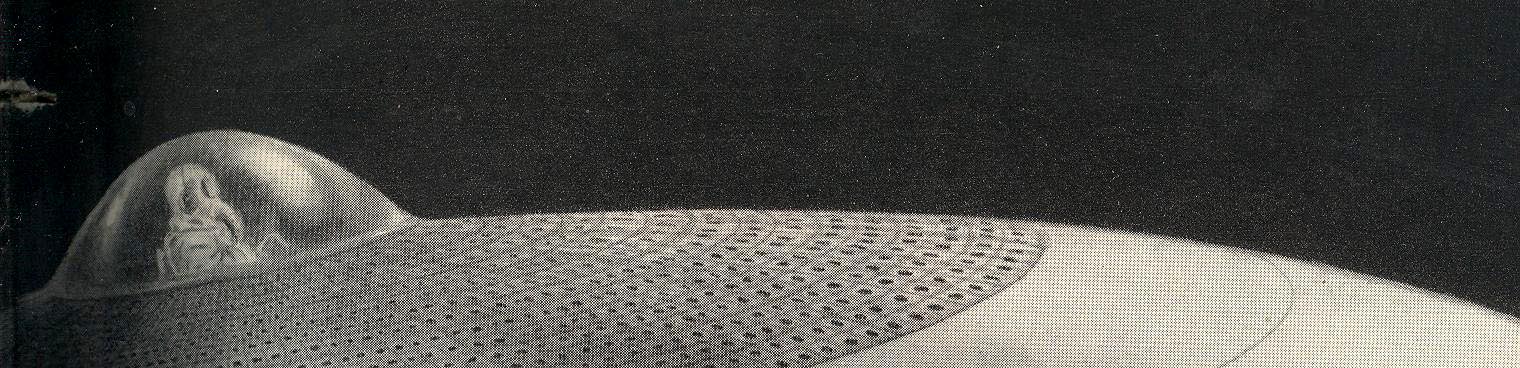
    Blog--april 1--saucer pilot
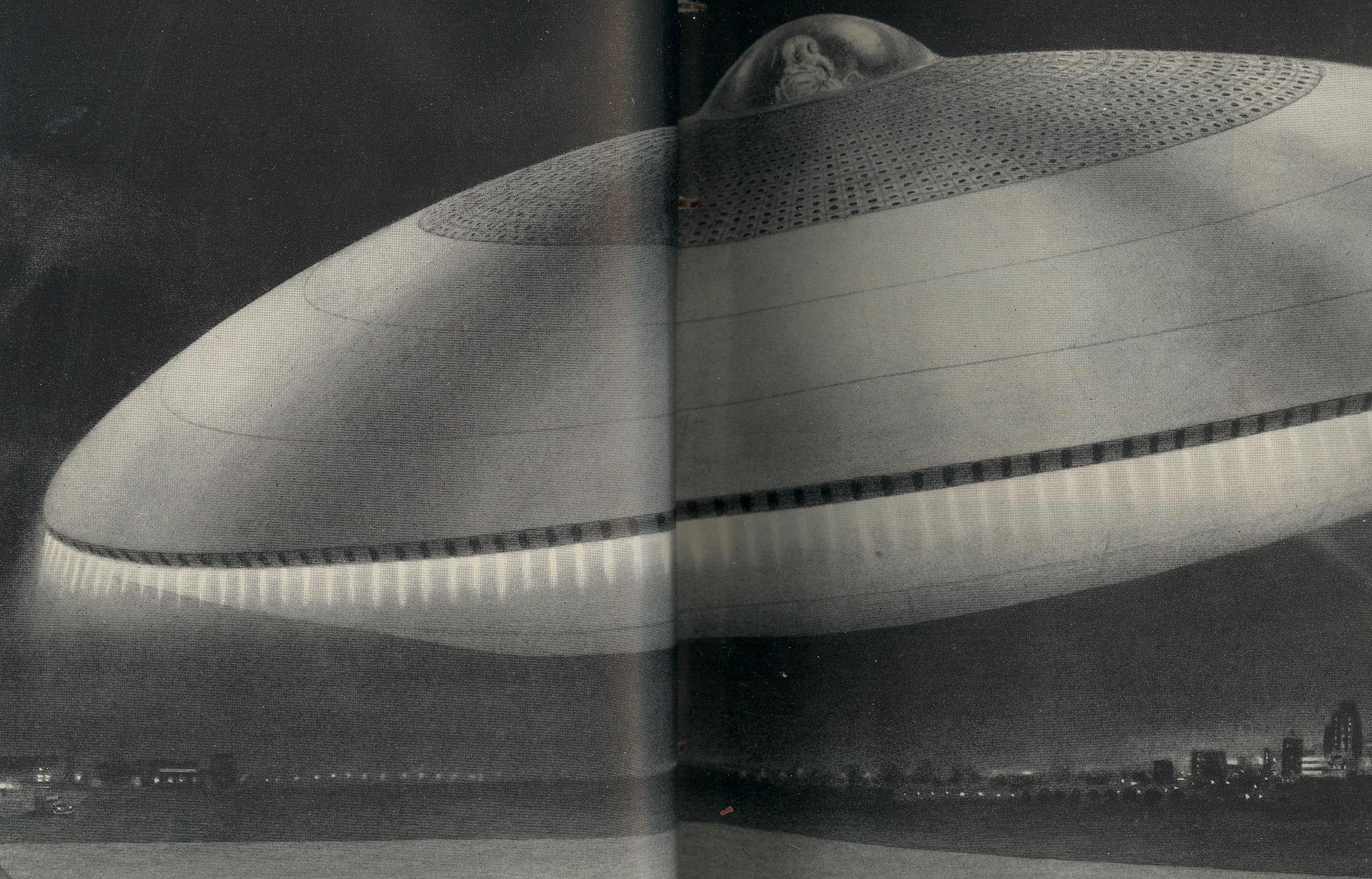
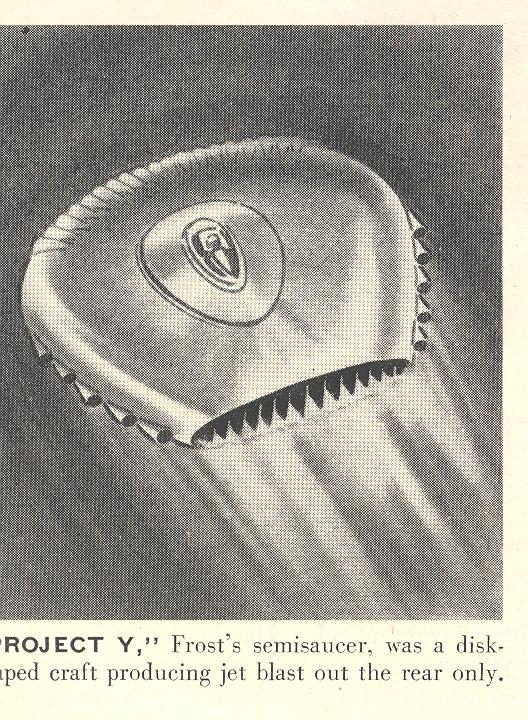
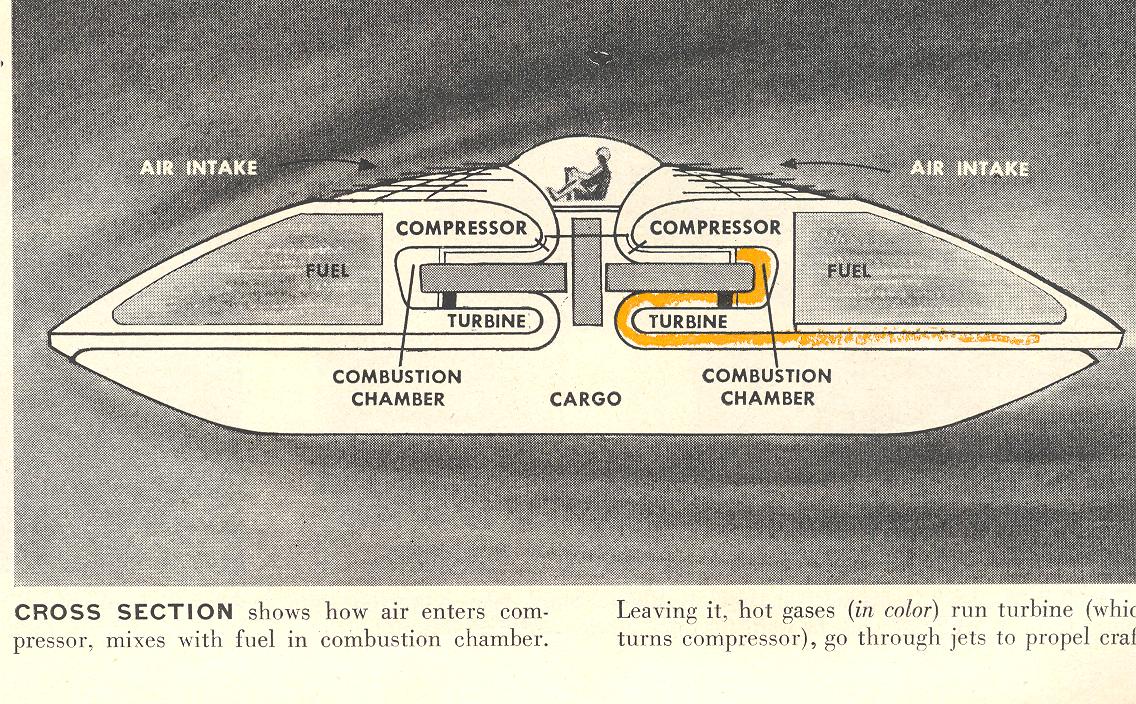
    “Fling Saucers” weren’t ten years old by the time that John C.M. Frost–an engineer from De Haviland–came up with the idea of re-fitting his swooping-shovel shaped idea for a rocket plane with a saucer-shaped one.  He worked hard on his idea, spending some $400,000 on the project–Canadian.  Frost was in Ontario and working for the government before the government stopped working for him, abandoning the undertaking (called “Project Y”) just as the United States became interested in it.  

    Blog--april 1--saucer

    There are numerous reports around the web on this aircraft, so I’ll just provide a couple of starter links here and little commentary.  What I was most intrigued by in this whole affair of producing a 2,500 mph hovercraft was that instead of having a U.S. Air Force star somewhere on the aircraft the thing could’ve been running around with a red Maple Leaf.  

    Blog--april 1--saucer semi

    Don’t get me wrong, I love Canada–went to school there, I did–but the idea of a combat-ready flying saucer with the maple leaf on it is just completely, well, wrong. 

    Blog--april 1--saucer det


  • The Exploding Dots of Falling Dominoes: Vietnam, 1954

    JF Ptak Science Books LLC  Post 996

    This story is more about Ho Chi Minh’s capture of French silk than about anything else–it is a peep into the future following the end of the French endgame in Vietnam, which came abruptly with their defeat at the Battle of Dien Bien Phu in 1954.

    Blog--april 1 detail

    [Detail/larger image below.]

    The siege there started on the 13th of March, and lasted 57
    days, until May 7th, 1954. The
    commanding general of the Viet Minh forces, Vo Nguy Giap, achieved an enormous
    victory over the French—the first time a guerrilla force readjusted itself into
    a conventional force to defeat a Western army. It was the end of the line for the French military involvement there and it just so happened to be
    the beginning of Vietnam as an object on the American foreign policy event horizon.

     Just a week after this notice appeared, Dwight Eisenhower made his domino
    speech:

    “Finally, you have broader considerations that might follow what you would
    call the “falling domino” principle. You have a row of dominoes set
    up, you knock over the first one, and what will happen to the last one is the
    certainty that it will go over very quickly. So you could have a beginning of a
    disintegration that would have the most profound influences.conference…”

    Vietnam was supposed to be one of those dominoes.  Evidently all of the dominoes were the same size regardless of the size or international presence of the country.  It was also the same sort of domino even if had appealed for American recognition of its democracy-laced post-WWII government. And it was a domino still even if the United States had helped fashion the events that necessitated the movement of that country toward domino-hood.  No matter.  The U.S. decided to back the French in reclaiming their war-lost possession, in spite of the fact that the French were still doing business during the war with the Japanese occupying force in Vietnam, and in spite of the fact that the French re-armed Japanese troops to help fight against the “insurgent” forces of Ho Chi Minh.  It was an ugly decision, and I suspect FDR was just too sick to deal with it properly. 

    Nine years later, the French had finally been soundly defeated and Vietnam thought that it had finally gained independence.  Not so. 

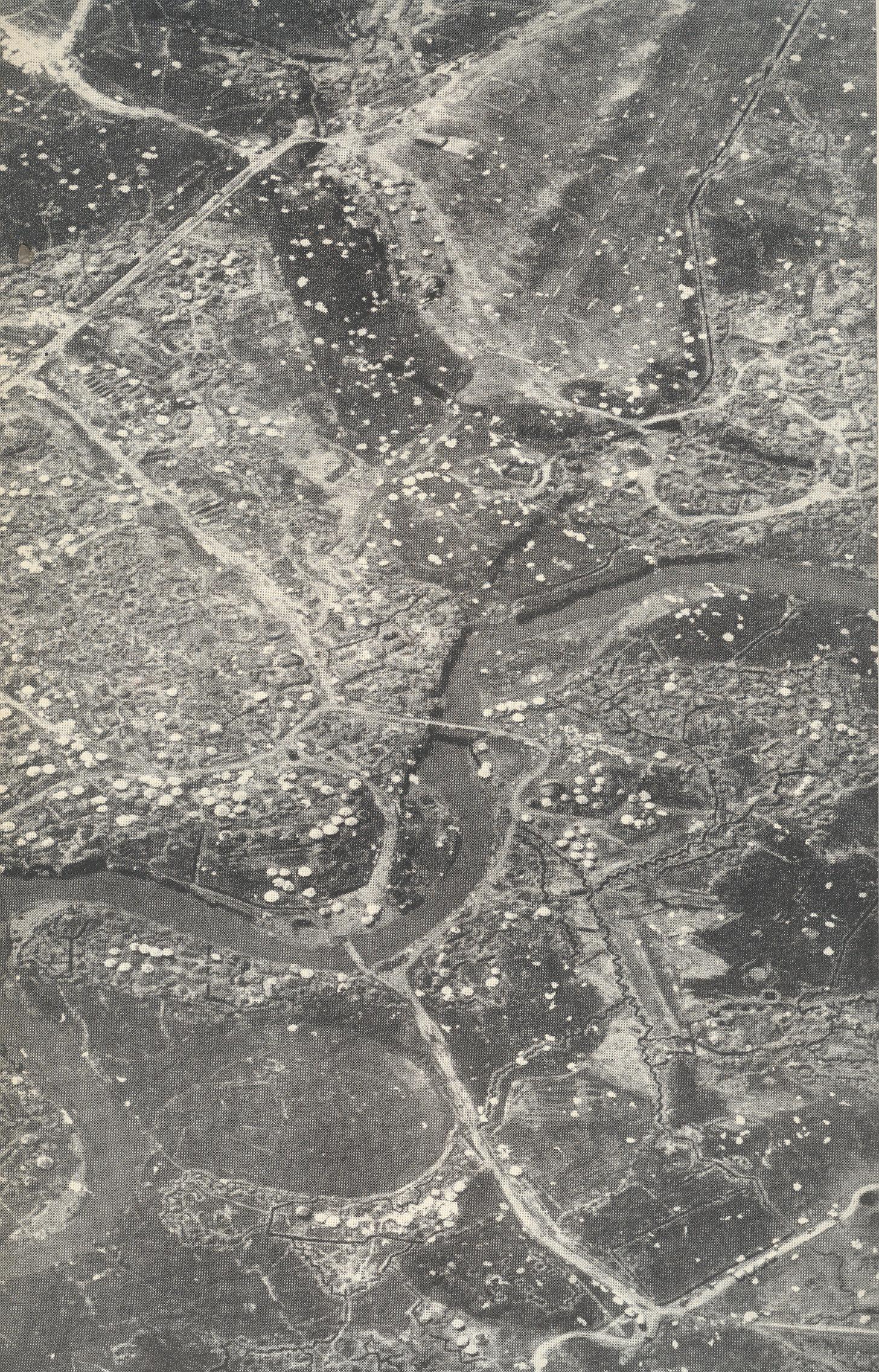
    The picture here is of dots–the field of battle at Dien Bien Phu, littered with silk parachutes–cargo dropped by the French air force to the defenders of the garrison….most of which, evidently, fell well outside the French-controlled perimeter and into the hands of the attacking Vietnamese army.  These were the exploding dots of the falling domino.

    Blog--april 1 

    If these dots stood for something, they could stand for the coming wave of death and misery, a graphical representation of what was to come over the next 25 or so years.

    I reckon there to be about 500 parachutes/dots in this picture.
    Each of these dots could be assigned a number, each representing a gross statistic for the war, from  1950 to 1975:

    U.S. forces killed in action:  100/dot (58,000 killed)

    U.S. forces wounded in action: 300/dot  (313,000)

    Army of the Republic of Vietnam, killed in action:  500/dot (263,000)

    Army of North Vietnam, killed in action:  2,000/dot (1.1 million killed)

    Civilian deaths, North & South Vietnam: 4000/dot (2 million killed)

    Civilian deaths caused by North Vietnam during the war: 300/dot

    Civilian deaths caused by “North” Vietnam, postwar consolidation and reeducation: 1,000/dot

    Civilian deaths caused by the U.S.: 175/dot

    All deaths for the war, 1950-1975: 8,000/dot (using a figure of 4 million).


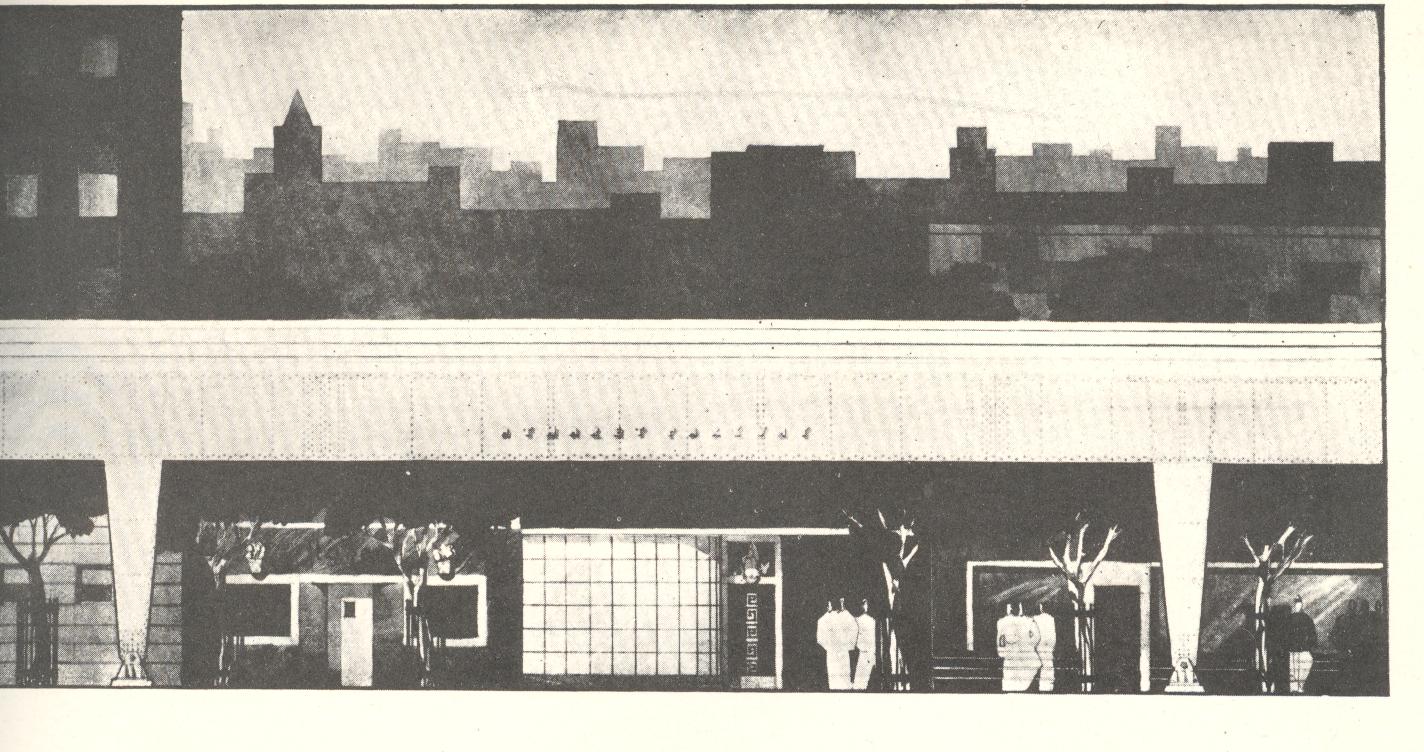
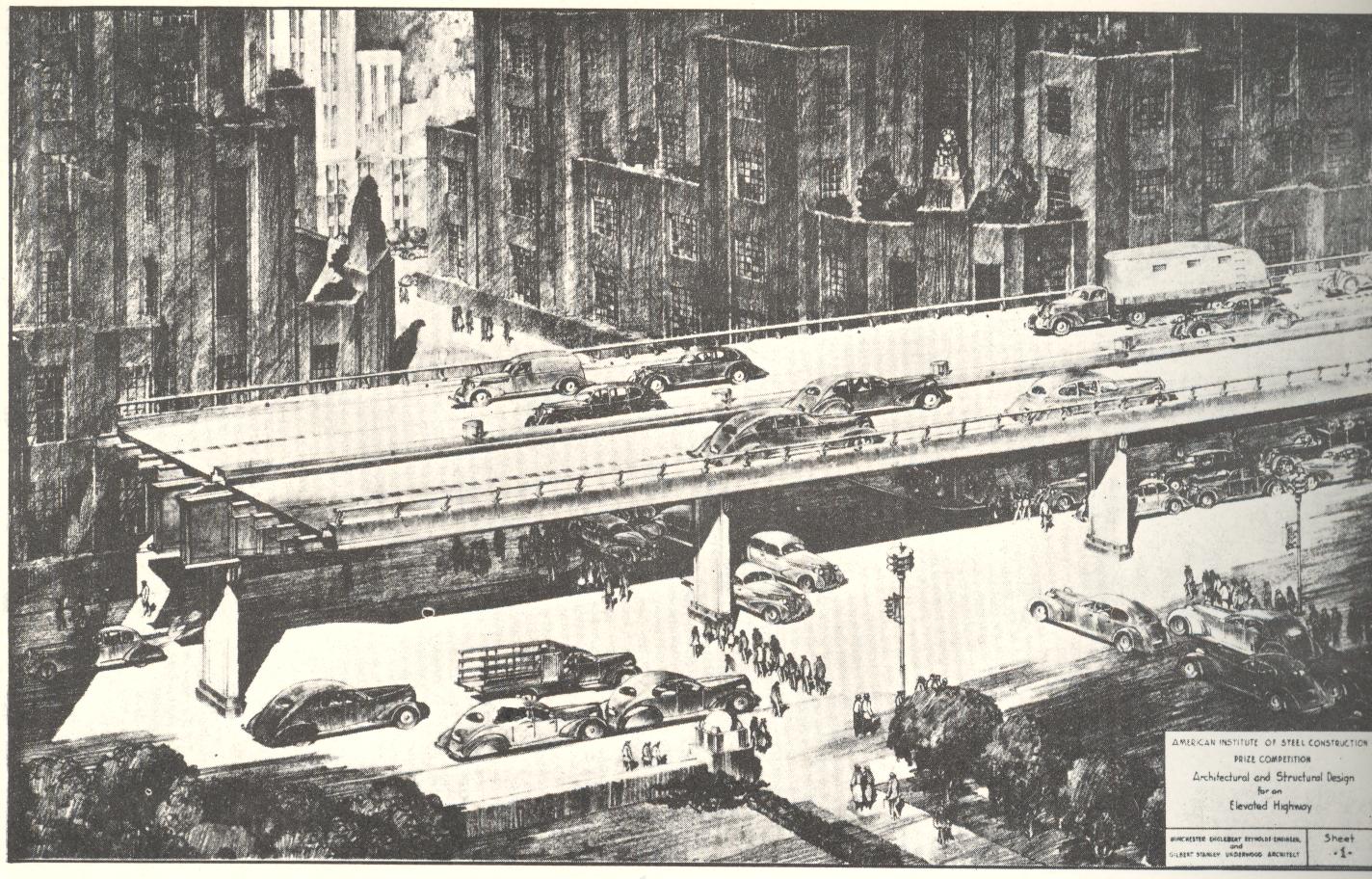
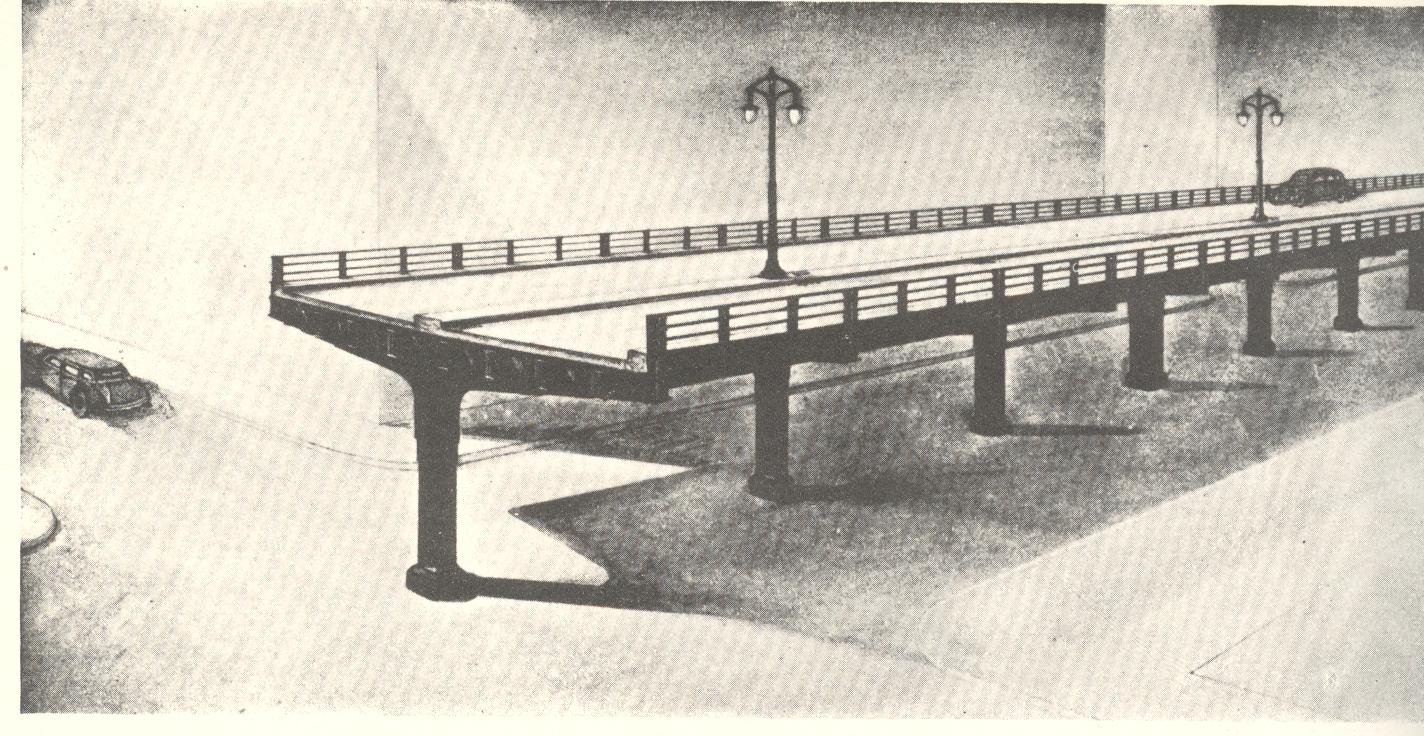
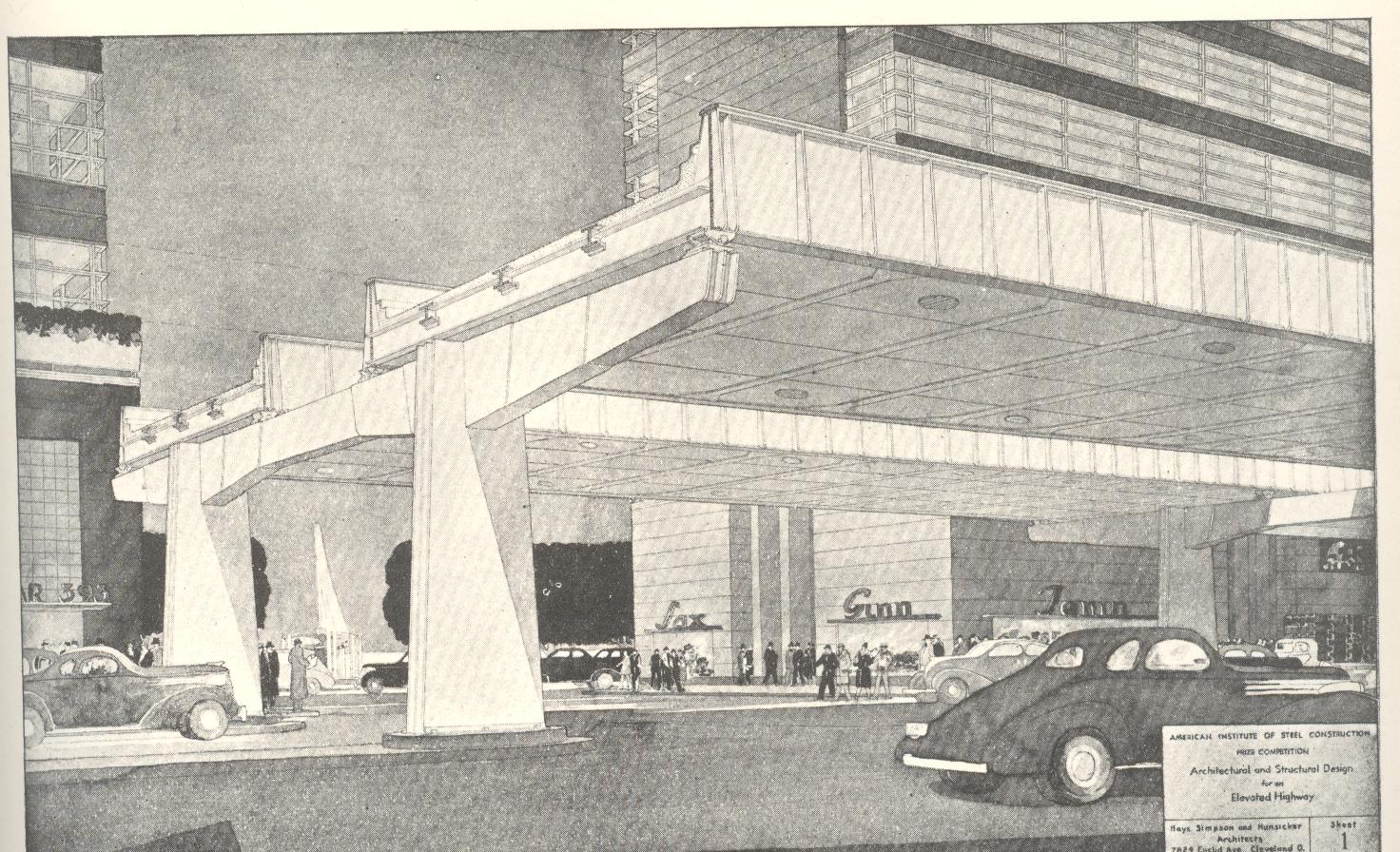
  • The Big Lonesome: Masterpieces of Architectural Loneliness–Elevated Roadways

    JF Ptak Science Books LLC  Post 994

    [This post part of a long and continuing series on Blank, Missing and Empty Things, #54]

    Blog--mar 31--lonesome 1
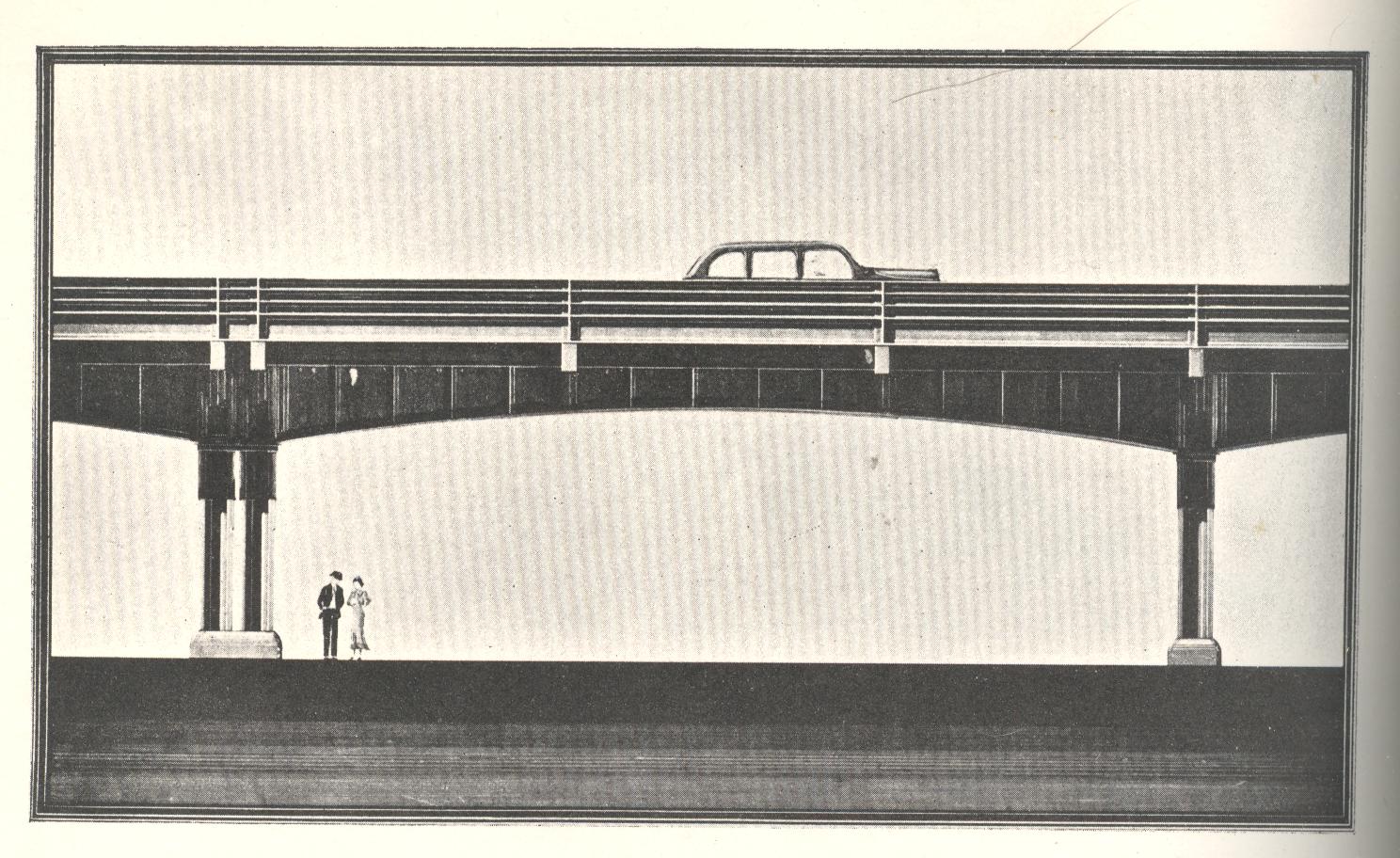
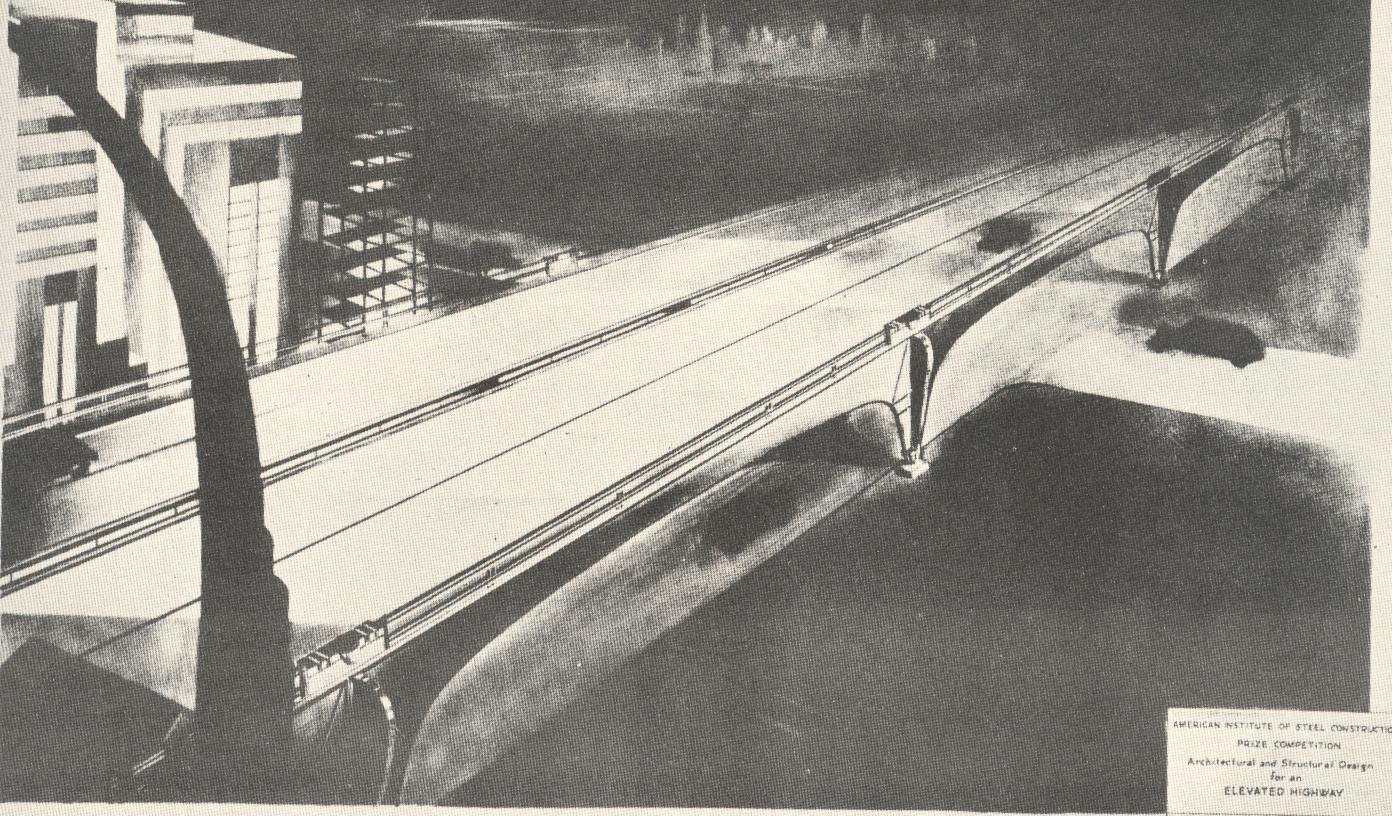
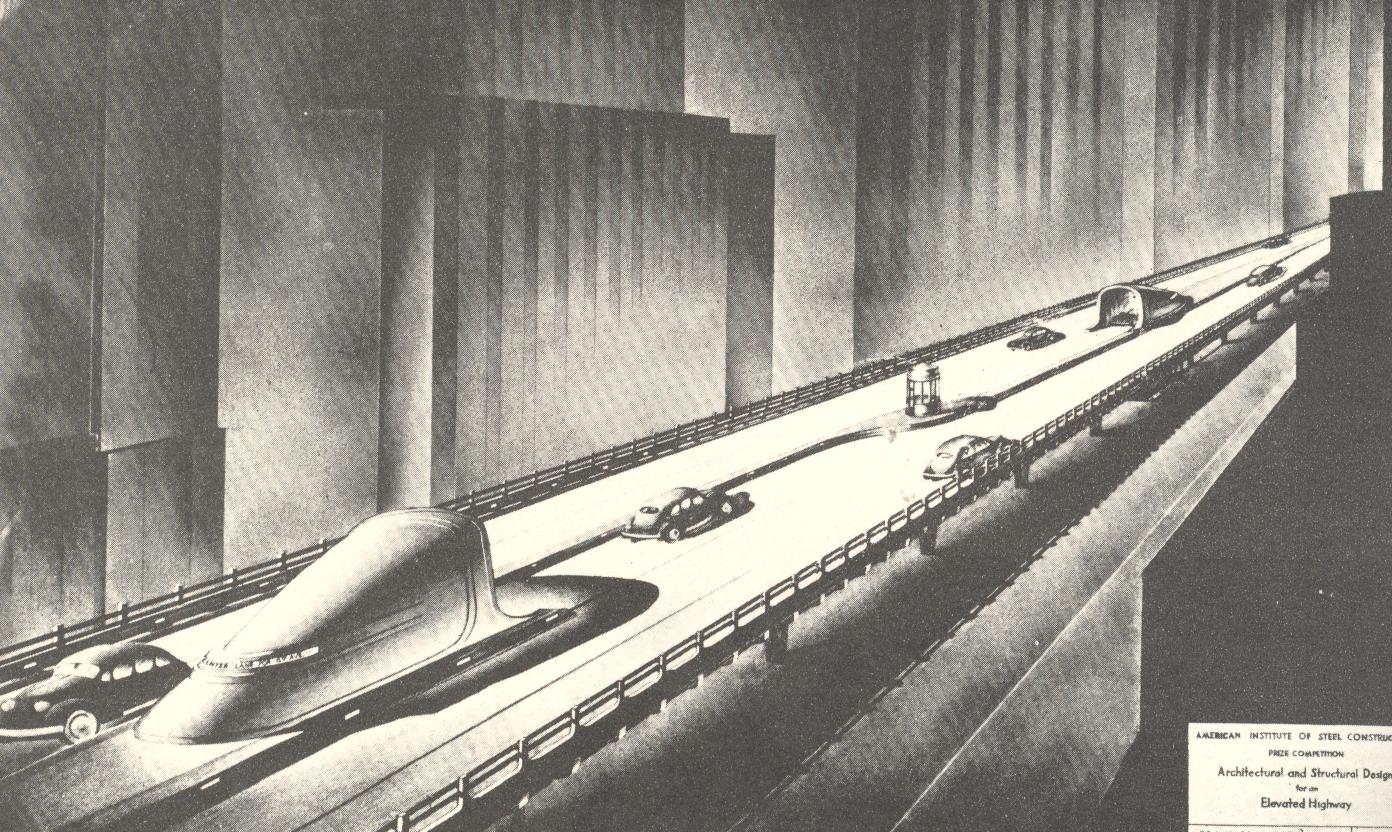
    If Edward Hopper was a practicing member of the American Institute of Steel Construction and was a civil engineer, he may have rendered his creations much in the same curious way as  those seen below.  I found these designs in an obscure publication, Prize Designs Submitted in the Elevated Highway Competition for 1938, and I found them to be utterly fantastic, lost bits of artistic expression and strong emotion sucked into a vortex of automotive steel and concrete.  They are just superb examples of found art that seems to play utterly against the purpose of the object, and do seem masterpieces in an unusual (and instantly-created) genre of “Unintentionally Cross-Expressive Art”.  They have a feel of Outsidery-Edwardy-Hoppery to them–they feel cold, a wet chill, with a coppery audio quality to them…images that make you want to go home and sit in a comfortable chair.

    Blog--mar 31--lonesome 2 

    And not only are they lonesome; they are also foreboding:

    Blog--mar 31--lonesome 3
    Blog--mar 31--lonesome 4
    Blog--mar 31--lonesome 5
    Blog--mar 31--lonesome 6
    Blog--mar 31--lonesome 7

    Magnificent! And all once hidden away, but no longer.


  • Primitive De Luxe versus Civilized No Lux

    JF Ptak Science Books LLC  Post 992

    I’m
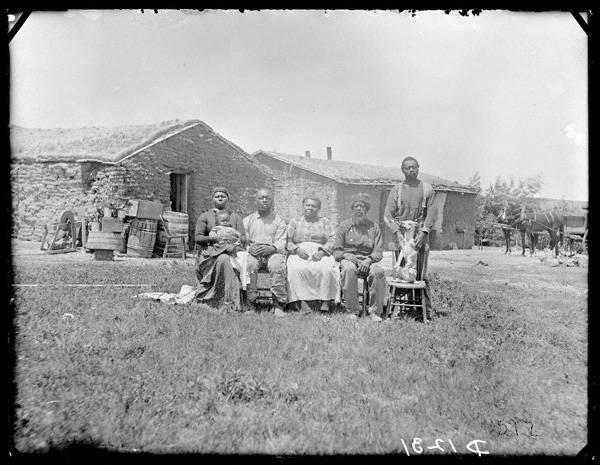
    not sure exactly what Solomon Butcher told his subjects when he photographed them
    outside of their frontier houses out there in the Great
    Plains
    in the 1880’s.  His spectacular
    portraits included not only the family of the house, but in many cases, everything
    that the family owned.  Possessions were
    an

    Butcher

    encumbrance making your way across the country in the mid/19th century,
    especially if you didn’t have very many to begin with.  These families—the first generation in their
    mostly sod-built houses—would’ve been farmers scratching out a minimum trade
    and decent subsistence.   City/town goods
    would’ve been not-usual in these circumstances, and evidently whatever it was
    they had of these things wound up outside, displayed around the house and on
    the roof, when Mr. Butcher arrived in his photographer’s wagon. 

    (Who
    was it, I wonder, who came up with the initial idea of displaying all of the
    family’s possessions:  did Butcher set
    out with that idea, or did it happen spontaneously?  I wonder what it was the families thought as
    Butcher was packing up his equipment, his horse fed, his cameras stowed away,
    climbing up onto the driver’s bench.  Did
    they wait until he was a spot on the horizon to put away their things?  Did they gather everything up as Butcher
    gathered up his own material, or did they just wait for the stranger to
    disappear before pulling the family back together? Sitting their surrounded by
    the things that they owned, did these families feel a quiet pride, or were they
    embarrassed have their pictures made together with their frontier opulence? I
    suspect that the idea for display did not begin with the families.)

    On
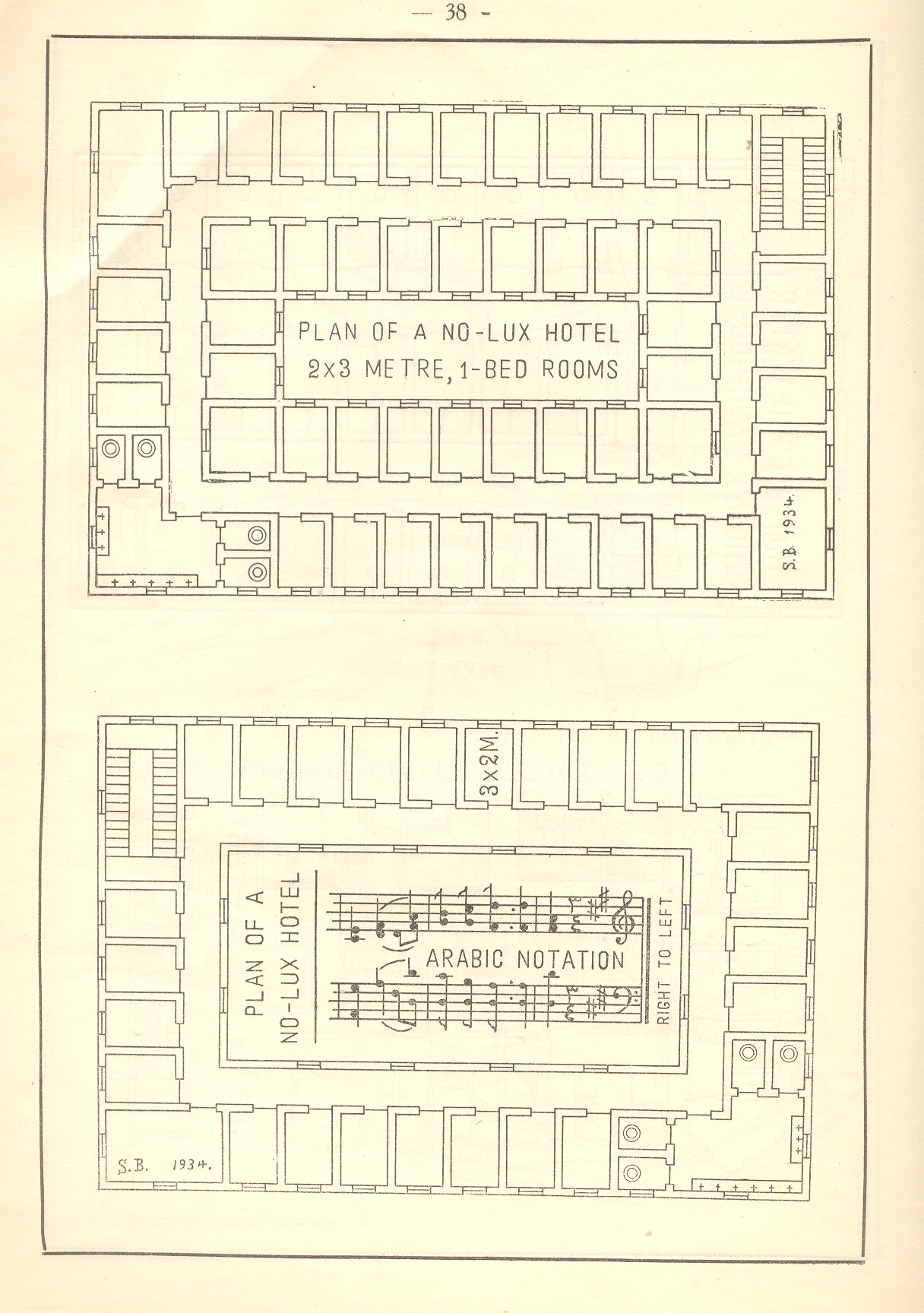
    another part of the luxury spectrum is this floor plan for a “No-Lux Hotel”, a 2×3
    metre/room place for folks to stay cheaply/inexpensively.  There were 50 
    rooms packed into a 36×24 metre footprint,

    Mar 30 no lux

    leaving precious little room
    for hardly anything else, like hallways (which seem very narrow), stairways
    (actually a singular, as there is but one) and bathrooms (one with 8 sinks and
    four toilets per floor). 

    The
    center of the structure seems curiously blank in the top plan.  The bottom one is confounding, a mysterious
    mystery:  why on earth would there be
    musical notation written backwards (via “Arabic Notation”) in the center of the
    plan?  No doubt the architect was on the iconoclastic
    side to have included such a thing; but its inclusion no doubt meant something
    to the author, though it is now lost to his/her dust.  Pity. 

    “Lusux”
    is Latin for something like “extravagance”. 
    “De luxe” appeared in France
    in 1928 or so for the first time to describe this added opulence in a word of
    its own, though there is a certain geology to the idea.  A luxury might well be a spice on a camping
    trip, or a back-up aircraft to the family helicopter.  Perhaps it was an extra sink in a cheap hotel,
    or a violin for the kids in a house that stood by itself in 10-square-mile
    solitude. At least the multi-floored Hotel No-Lux had a stairway.


  • On the Subjugation of Women: a review of some posts

    JF Ptak Science Books LLC

    I wanted to collect some of the posts on this blog on this subject as it seems as though I really don’t have a category for it in the archives…

    What Goes into Making Human Robot Girls 

    https://historyofideasblog.com/thesciencebookstore/2010/01/what-goes-into-making-human-robot-girls-1941.html

    First Thing to Do is to Find Some Men:  How to Get a Boy-Date, 1941

    https://historyofideasblog.com/thesciencebookstore/2010/01/the-first-thing-is-to-find-some-men-how-to-get-a-boydate-1941.html

    How to Look Smart, or Pretty, but Not Both

    https://historyofideasblog.com/thesciencebookstore/women-history-of/

     Maintaining Women as a Subclass: Major Reinforcements from
    Minor Non-sequitors

    https://historyofideasblog.com/thesciencebookstore/2009/10/maintaining-women-as-a-subclass-reinforcements-from-minor-nonsequitors.html

    Missing Pieces of Women: Pope Joan and the Proper Girl of
    the Ladies Home Journal

    https://historyofideasblog.com/thesciencebookstore/2010/01/missing-pieces-of-women-pope-joan-the-proper-girl-of-the-ladies-home-journal.html

    How
    FDR Made Women (1) Nervous and thus (2) Older. An Appeal to Vote Republican,
    1936

    https://historyofideasblog.com/thesciencebookstore/2010/01/how-fdr-made-women-1-nervous-and-thus-2-older-an-appeal-to-vote-republican-1936.html

    The Coming Sex War of 1919

    https://historyofideasblog.com/thesciencebookstore/2010/01/the-coming-sex-war-of-1919.html


  • Primer for Londoners on being Bomber by Nazis, July 27, 1940.

    JF Ptak Science Books LLC  Post 990

    [Also see my The Bombing of Britain in the Illustreite Zeitung, July 1940 post; also here.]

    Mar 28 bo,bing london 4 cratewr

    The
    Battle of Britain was an air battle begun weeks after the surrender of France (22 June 1940) in preparation for the Nazi
    invasion of England.  Hitler and the High Command believed Britain to be
    vulnerable2, and surrenderable, or at the least could be convinced not to interfere
    in the rest of the war.  But plans were
    made for the invasion—an invasion which could only be successful (it was reasoned)
    if there was complete naval or aerial superiority. The naval part was out of
    the question, especially since the Nazis had suffered such losses in the
    Norwegian campaign. The Luftwaffe was another story, and so the operation began. 

    Mar 28 bo,bing london 1

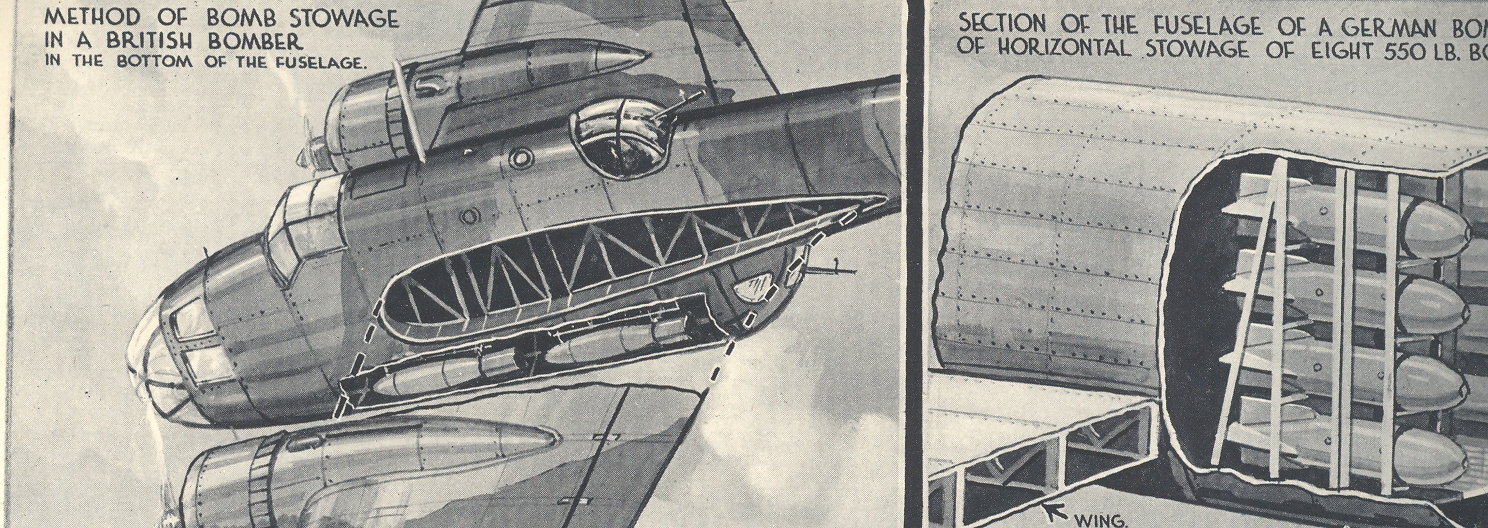
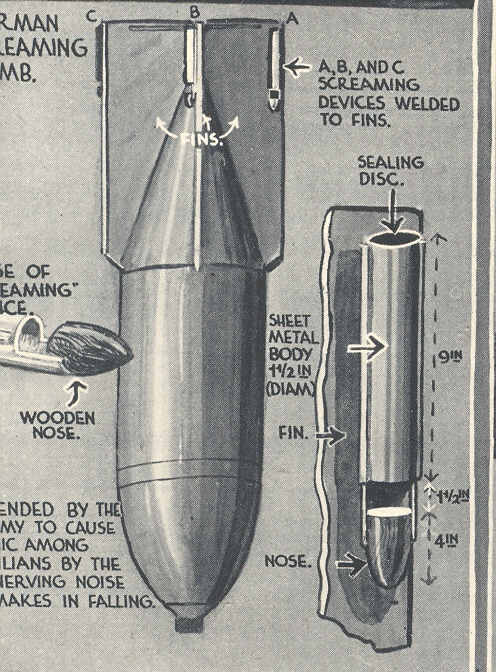
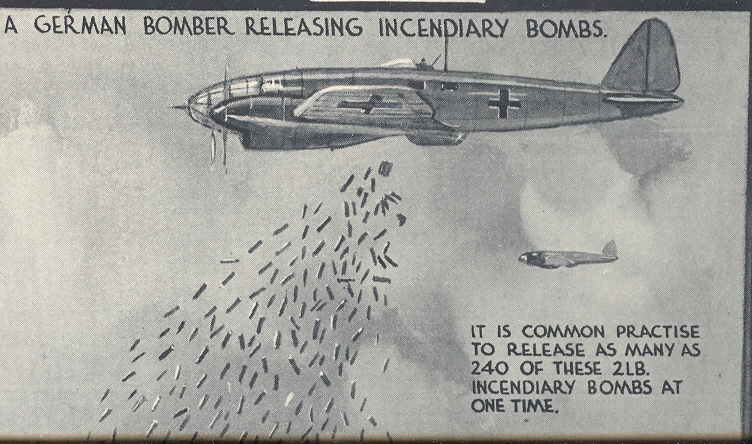
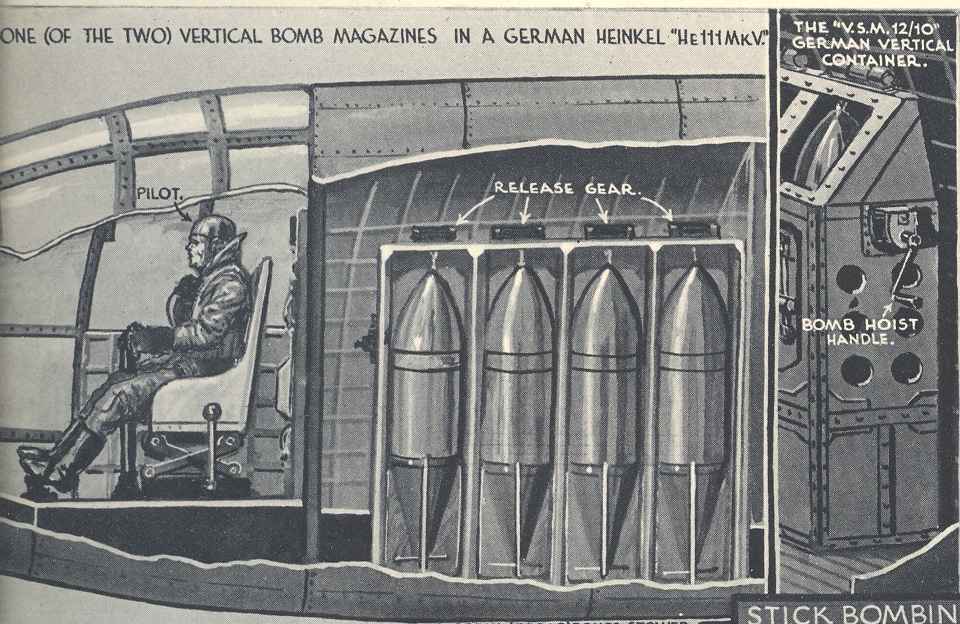
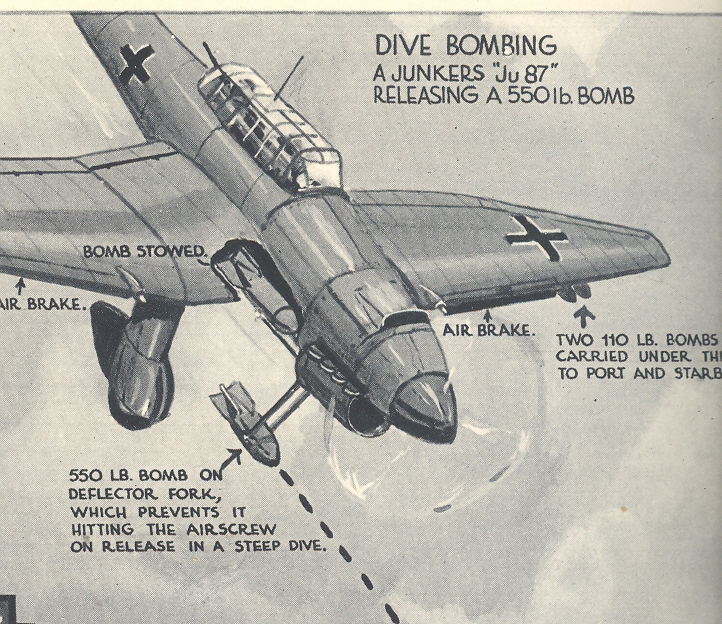
    The Illustrated London News published
    this pictorial introduction to Nazi bombing on 27 July 1940, just weeks after
    the campaign began.  At this point in the
    war the Luftwaffe operations were delegated to coastal installations and
    aircraft industries.  Mar 28 bo,bing london 2

    The terror bombing
    against citizens in cities—which was an idea not born here but rather 20 odd
    years before—wouldn’t begin for some months. 
    In the meantime, and at this early part of the campaign against England, the
    British citizenry was introduced in a very proper way how the bombing was being
    carried out.  IT really does seem to be
    to be a very constructive, non-alarmist, cogent distribution of information to
    the general public about the potential for massive devastation.  

    Mar 28 bo,bing london 5  

    Notes:

    1.
    By the summer of 1941 the campaign was largely over, the Nazi effort doomed. England:
    1,023 fighters: 376 bombers, 148 coastal command aircraft for a total of
    1,547 aircraft and  544 pilots and aircrew killed.  There were also
    27,450 civilians killed and 32,138 wounded.  The Germans
    lost 873 fighters and 1,014 bombers for a total of 1,887 aircraft and 
    2,500 pilots

    2. The plan ‘Directive No. 16; On the Preparation of a Landing Operation
    against England’
    read, in part, as follows:

    Mar 28 bo,bing london 6

    “Since England, despite
    its militarily hopeless situation, still has not shown any signs of being
    prepared to negotiate, I have decided to prepare a landing operation against England and, if
    necessary, carry it out. The objective of this operation is to eliminate the
    English home country as a base for the continuation of the war against Germany…”

    “Included in these preparations is the bringing about of those preconditions
    which make a landing in England
    possible;”

    Mar 28 bo,bing london 7

    “a) The English air force must have been beaten down to such an extent
    morally and in fact that it can no longer muster any power of attack worth
    mentioning against the German crossing…”