A Daily History of Holes, Dots, Lines, Science, History, Math, Physics, Art, the Unintentional Absurd, Architecture, Maps, Data Visualization, Blank and Missing Things, and so on. |1.6 million words, 7500 images, 4.9 million hits| Press & appearances in The Times, Le Figaro, Mensa, The Economist, The Guardian, Discovery News, Slate, Le Monde, Sci American Blogs, Le Pont, and many other places… 5000+ total posts since 2008.

Category: Art History

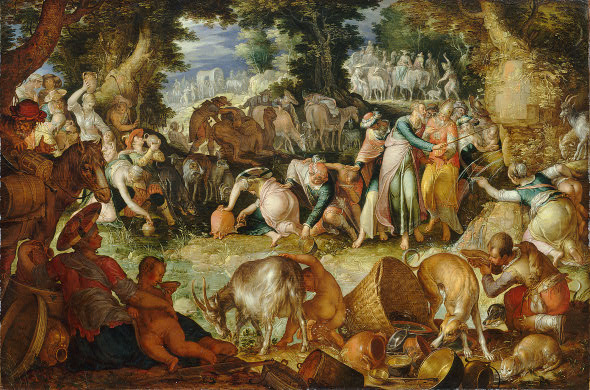
  • History of Anticipation #2: Nothing. Moses and the Rock.

    JF Ptak Science Books

    During the Exodus Moses and the Israelites were often  in deep, mortal danger—perhaps none more
    dangerous as when they ran out of water. 
    Moses’ leadership (and safety) came under question (Exodus 17:4), with
    Moses crying out to the Creator that he needed help, and that his people were
    about ready to stone him.  The answer
    came quickly, with Moses directed to strike a rock with his staff, the
    resulting action bringing water/a stream from the rock (Exodus 17:5-6). 

     April 18 moses

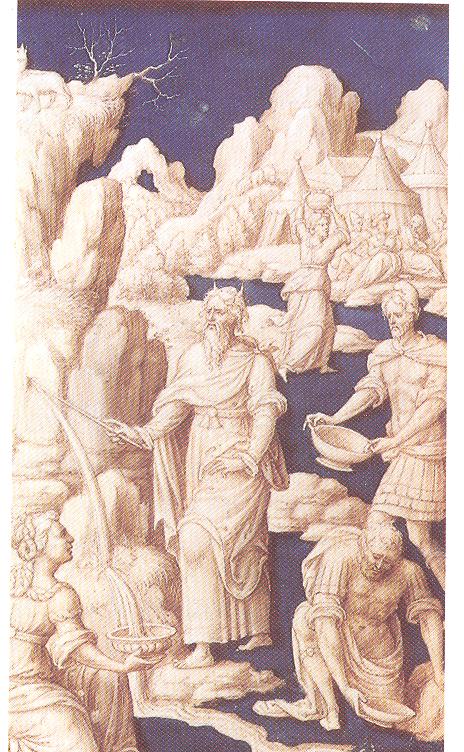
    And that’s what is going on here in this little scene from a
    15th century (unfortunately unspecified) French Bible. The rare use
    of almost all white set against a blue background gives the whole a
    marble-like, lifeless effect—which seems to mirror the sense of nothingness in
    the Israelites reactions to the great miracle. 
    Their prayers were answered, but their anticipation of fulfillment and the
    act itself goes emotionally unregistered.

    Moses also looks removed, gently touching the rock with a
    rod which s very lightly controlled by a mostly-open hand—his bearing is one of
    great lightness. 

    This scene is often repeated and represented throughout the
    history of art, though usually with more (or actually, “some”) emotional
    quality.  When the scene is depicted with
    little emotion it seems usually to be a small piece of art, a touchstone,
    showing just the head of Moses/the rock/the staff, a bit of simple visual
    shorthand to remind eh viewer of the story (as in the work by Giotto in 1305).  Generally though the scene is shown in high
    drama, as with the work of Joachim Anthonisz Wtewael (1664), Abraham Blaemaert
    (1596), Nicolas Poussin (1649), and many others. Sometimes in some very early
    work the woodcutters show Moses wielding his staff over his head, getting ready
    it seems to crack the rock open. Bu not here, not in this image—the emotion of
    the scene has been literally whitewashed away…it is beautiful, but it is a cold
    beauty of nothing.

    (Wtewael, below).

    April 18 moses wtewael


  • Controlling Time & Motion: Visualizing Directions for Human Movement #1.

    JF Ptak Science Books LLC  Post 1000

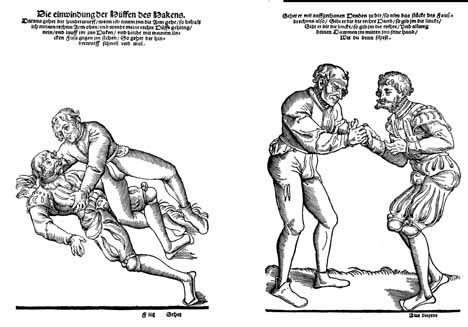
    I came to this post backwards. My primary interest was the frontispiece portrait of the author of a 1539 book on wrestling, showing the somewhat long-in-tooth author with scraps of tuffy hair and a coy knowing grin–an unusual portrait, presented by the master Lucas Cranach.  I looked further into the book and discovered that the well-illustrated document pictured varieties of wrestling moves, all demonstrated to students by the author, who most of the time was shown with this knowing grin, gripping and flipping and immobilizing his younger subjects. What slowly came into my head while looking at this book was how concise and instructive the images were, and that the whole was a great tutorial on wrestling motion, and the presentation of instruction on specific motions in general. 

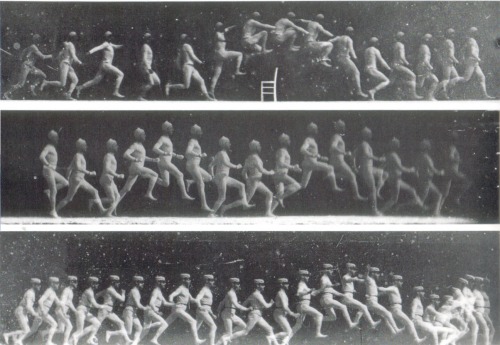
    Prior to the invention of photography, printed works on how humans should move in a given way and for a given task are uncommon and, generally, somewhat complex. The image I have in my head is the epochal work of the somewhat forgotten Etienne Marey, who in the 1870’s created what was essentially the world’s first “slow motion” device1. One iteration of Marey’s apparatus was basically a long series of ganged cameras recording a motion for a Marey12 simple task at a given time frame and presented on a continuous strip of photographic paper, sort of like a motion picture with the camera speed set at three frames per second. The resulting images were phenomenal and showed people for the first time the exactness of all manners of simple motions–motions that no longer looked so “simple” once all of its aspects could be studied from captured photographic evidence.  Even the act of hopping over a small stool or bending to pick up a bucket of water were enormously revealing in a way like Robert Hooke’s Micrographia displayed the great detail and complexity of the seemingly simple fly.  Perhaps the most famous of Marey’s series of images was that of a galloping horse, which also for the first time revealed what exactly the horse’s legs were doing and proving that almost every painter in the history of art represented the galloping horse incorrectly. But Marey doesn’t actually fit the mold of directing the motions of people for a particular instructional purposes, though he does of course photographically reveal hundreds of actions that led to a revolutionary understanding of the body-in-motion.  This is why I’ve chosen him as the limiting point for this category. (And just for the record I’m not sure when the first book on the movement of animals–not including hunting/trapping books–comes into being.)

    Early works directing people on how to move are not terribly common. There are general works on table manners, the appearance at royal courts, religious ceremonies, maneuvers for armies in combat, sword fighting, parades for triumphs and adulations, funeral rites, and so on. 

    For this first installment I’d like to look at two ends of the spectrum for displaying motion instructions clearly. The first is a book by Fabian von Auerswald, whose Ringer kunst: funf und Achtzig Stücke2, published in 1539 in Wittenberg, is one of the earliest books printed on the art of wrestling.  It was printed by Hans Lufft3,the man who Wrestling 2

    was also responsible for printing Martin Luther’s translation of the Bible a few years earlier. 

    I like the images in this book, elegantly produced by Lucas Cranach–they also present the more-elderly author (frequently shown with a sly grin) demonstrating his wrestling moves to his students. Overall it seems to me that it was an excellent (if not fluid) presentation of how to direct body motions.

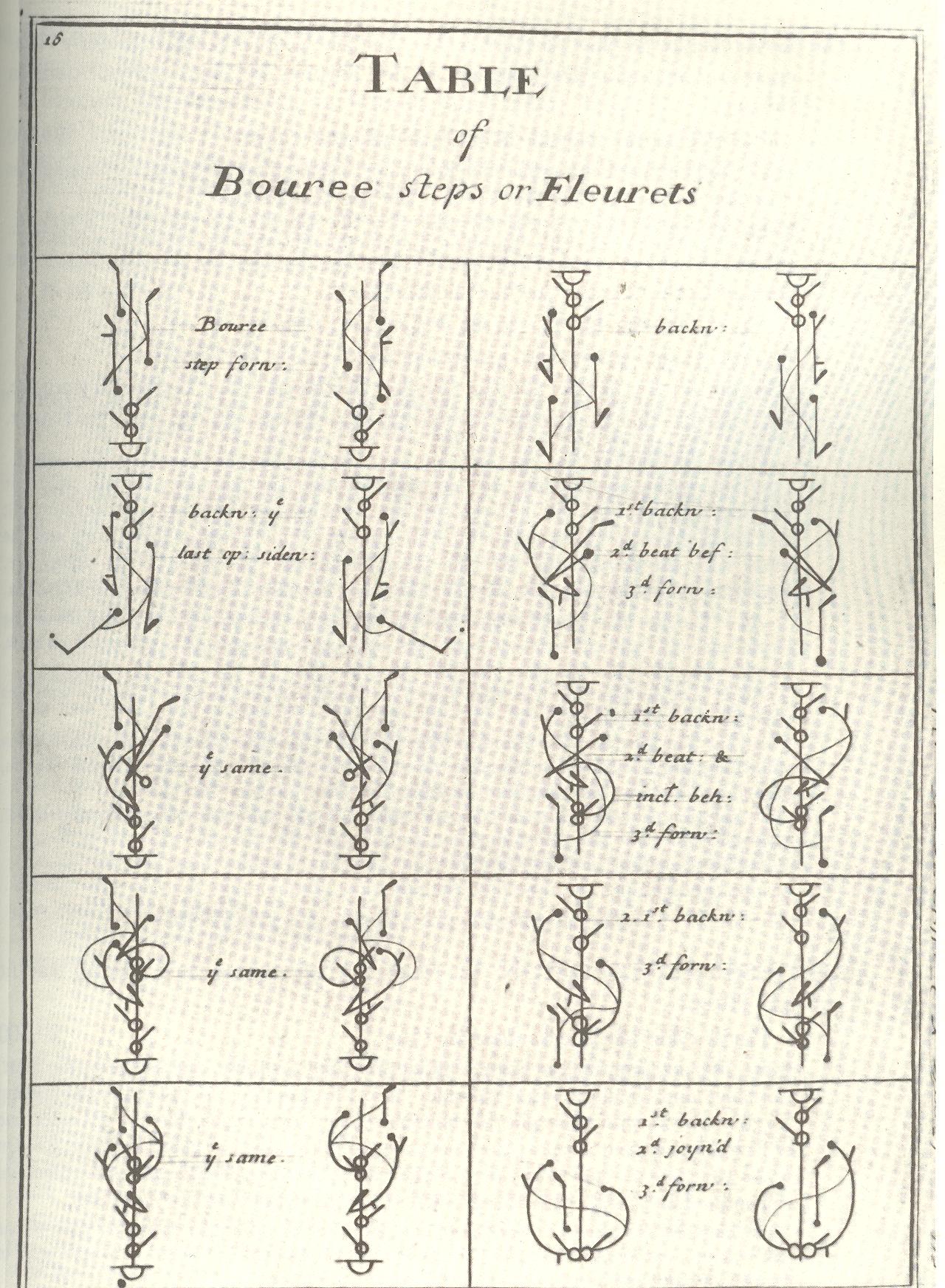
    Not so quite as direct, or simple, or lucid, or useful, is Raoul Feuillet’s publication of Pierre Beauchamp’s Orchesography4 , a work published first in 1700  (and then in English in 1706) and dedicated to instructing people on the movements of the dance.  It was a good idea, though more useful to folks in the future than for his contemporaries.  The book was a spatial geography of dance–the motion (feet and arms, both) was written in a similar fashion as musical notation, though not nearly as clearly.  The dancer was to hold the book and view the steps as they would be from above, holding the book always (!) pointed towards the “upper end” of the dance room.  (There were separate and complicated instructions showing how this was to be accomplished–imagine trying to perform the steps in a series of twirls, and keeping the book pointed “true north” so to speak.  Not easy.)

    As it turns out the work by Feuillet/Beauchamp may have been more important as a piece of dance archaeology because it was so terribly detailed; it may not have been an exemplar of teaching people how to dance, but it certainly was an iconic publication in recording the intricacies of dances that may otherwise have been lost to time. 

    s Blog--apr 7 dance

    Notes:

    1. I should also say that Marey was influenced by the work of Eadweard Muybridge’s photographs of motion—whom he credited of
    course—and who I think expanded upon and exceeded those achievements.

    2. The entire book located here; the translator writing here on
    the philosophical/linguistic aspects of the book.

    3. Beginning in 1534–the Luther Bible was printed in vast numbers by Luftt
    (and appeared in the millions over the years) and others; the same can
    not be said of the Auerswald book, which appeared in a small edition and
    is quite rare today. It was in this edition that (in addition to much else) is found in Romans 3:28 the controversial “alone”: “thus, we hold, then, that
    man is justified without the works of the law to do, alone
    through faith”

    4. The full title:  Orchesography; or, The art of dancing by characters and demonstrative
    figures. Wherein the whole art is explain’d; with compleat tables of
    all steps us’d in dancing, and rules for the motions of the arms,
    &c. Whereby any person (who understands dancing) may of himself
    learn all manner of dances. Being an exact and just translation from the
    French of Monsieur Feuillet. By John Weaver, dancing master
    .

    ·Posted by :

    ·in:

    —

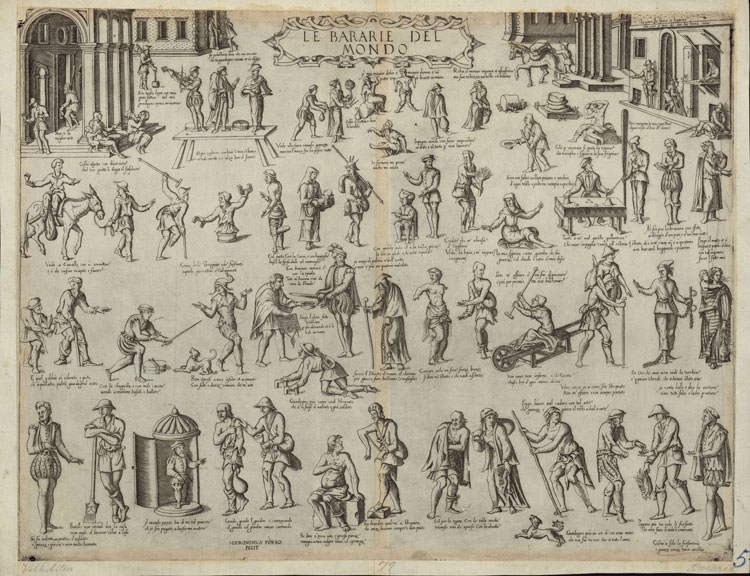
  • Popular Culture Imagery–16th Century Street People (Fools, Musicians and Pregnant Women and more)

    JF Ptak Science Books LLC Post 970

    Le
    barbarie del
    mondo,
    by Hieronymous Porro (fl
    1574-1604), depicts Italian street
    people collected under the unkind general heading of  “barbarism of the world”. I misread the description of the actions of the people in the print
    (found at the University
    of Texas
    website below) as “Making
    a living doing unnecessary tasks of nothing”—a harsh appraisal of the efforts
    of people who have nothing trying to make a little bit of change for bread, though it does describe the general sentiment of the print, wrong or not. Though the
    written descriptions are slightly kinder than this, the depictions of the social
    unfortunates was certainly not. 

    Mar 10 porro

    The people described in this image–the collection of unfortunates,a veritable museum of social “outcasts”–include fools, street laborers, merchants, the disabled, prostitutes, destitute women (with children), musicians, street performers, flagellants, religious zealots, and general beggars, not to mention what must’ve been alley dwellers, street-sleepers and the homeless.

    Not too much different from today. What makes this image remarkable to me is that it makes these generally invisible people visible, gathered together in one image.  Generally these people would be used occasionally as found objects, tertiary depictions in larger, grander artworks showing grand structures or town views, the people used to show scale, and the artist taking some small liberty by employing street people as the scale units rather than landed strollers. (See here for an example.) Holbein, de Hooghe, Bruegel–masters of the large gathering and crowds, did not attempt a solitary image to the underclasses’ underclass.

    [Source:  Harry Ransom Humanities Research Center, University of Texas, Austin.]


  • Popular Culture Images–The Long Road, Allegories of Life’s Stages

    JF Ptak Science Books LLC  Post 969

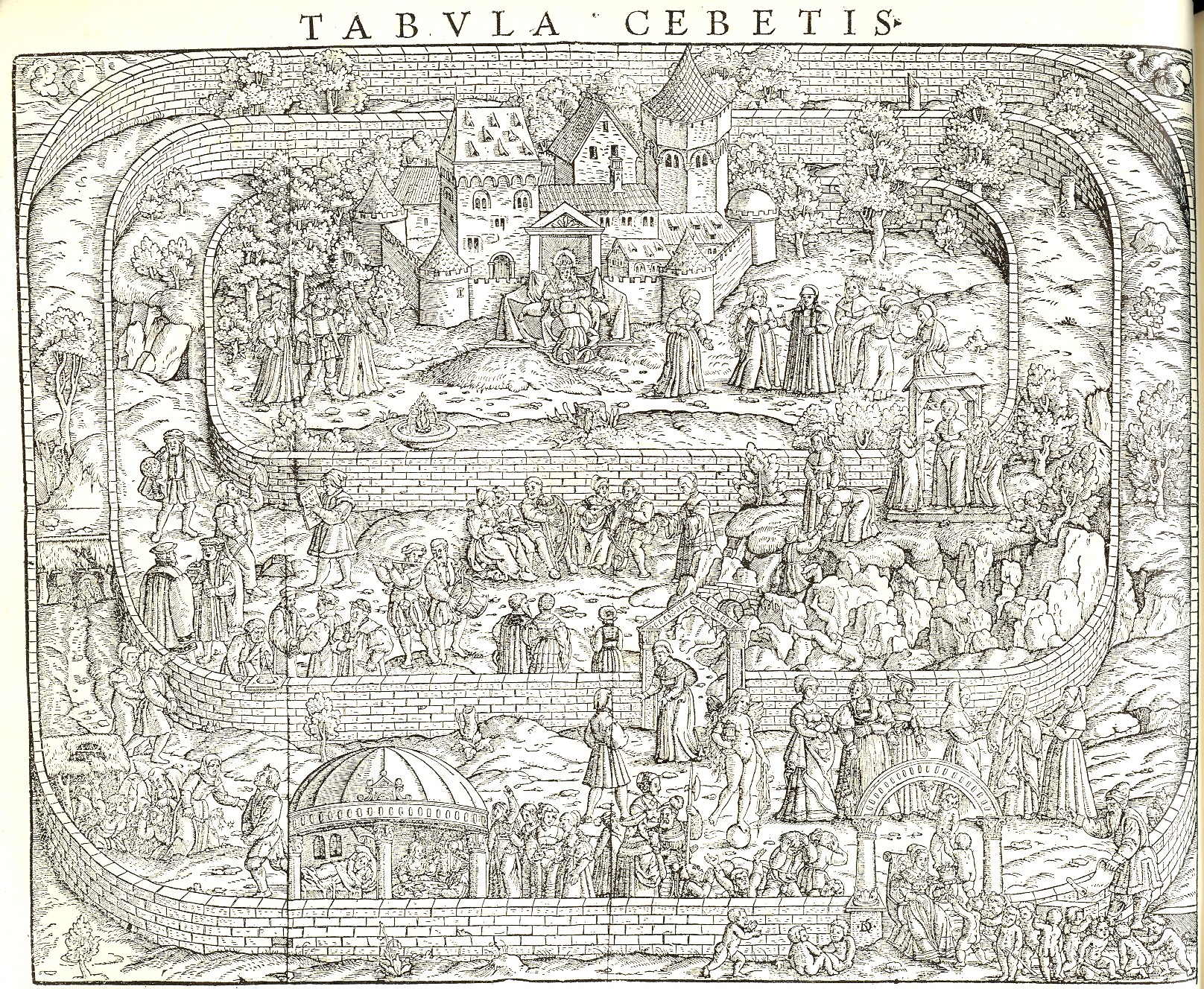
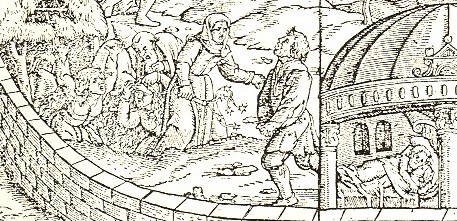
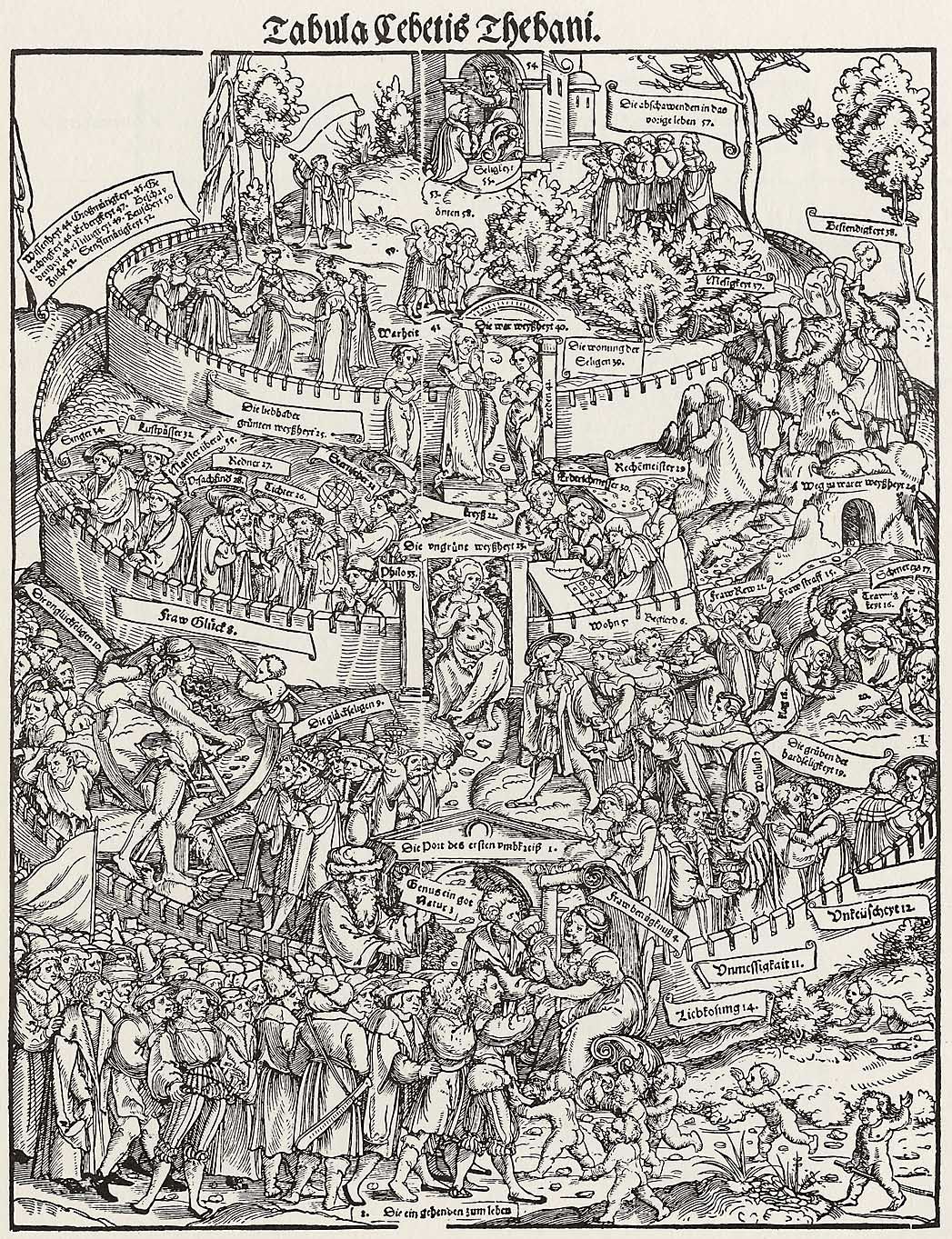
    This remarkable woodcut appears in Epictetus’ Enchiridion (1563), and is one in a long history of images portraying the moral life of humanity.  The longitudinal study of birth, corruption, vice, penance, achievement, want, lewdness, cowardice, sloth, and a penetrating multiple visits of the seven deadlies was intended to show the rough rode that lay ahead of us all on the way to the crowning glory.

    The full image appears below, with details following:

    Mar 9 life

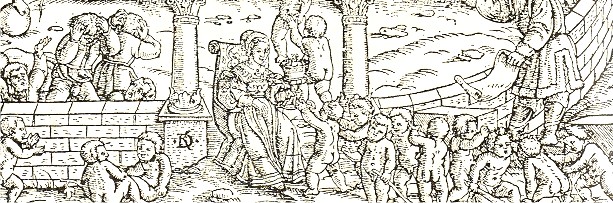
    This is a detail from the lower right, showing the beginning of life, an abundance of babies, with the foot of Fortuna seen at upper left, she observing (or not) the toddlers’ advances along the walls of life. 

    Mar 9 life beginning 

    The achievements of middle life are clearly seen:

    Mar 9 life middle age

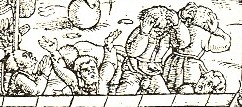
    As are the temptations of immoral life and the sins that await:

    Mar 9 life punishment

    Unfortunate sinners turned away at the foot of Fortuna:

    Mar 9 life punishmen2t

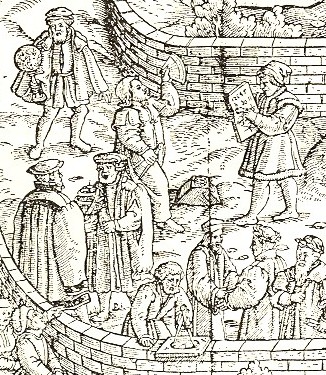
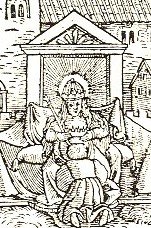
    And at the end of the journey, following the three concentric walls leading to finality:

    Mar 9 life end2t 

    This image looks a little suspect, but when you look at other woodcuts of the Tubula you can see this action a little more clearly (and from the side)–and what they reveal is Mother Church rewarding the supplicant with a crown.  This is more clearly seen below, in the 1551 versin of teh morality play by Johann Kramer (and published in Munchen);

    Mar 9 tabula

    The interpretations of these images areas varied as each of their characters, the details of which can be explained one way one day, and another the next; the morals and the end-tale stay the same. 

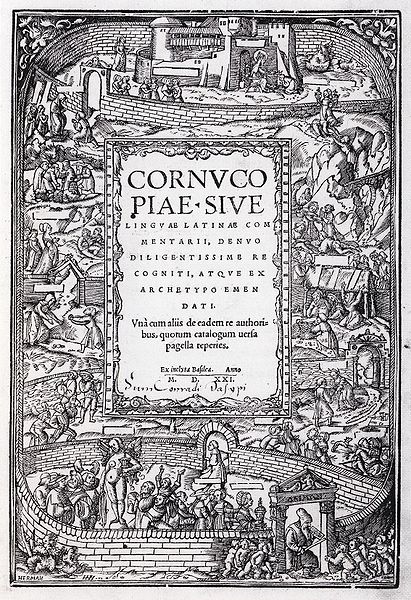
    Another example, this one from 1521 and after a work by Hans Holbein:

    Mar 9411px-Tabula_Cebetis_B,_woodcut_after_Hans_Holbein_the_Younger

    ·Posted by :

    ·in:

    — — —

  • The real Alice in Wonderland: Plus Alice in Miniland and Guinness Stout

    JF Ptak Science Books LLC Post 966Alice Liddell det

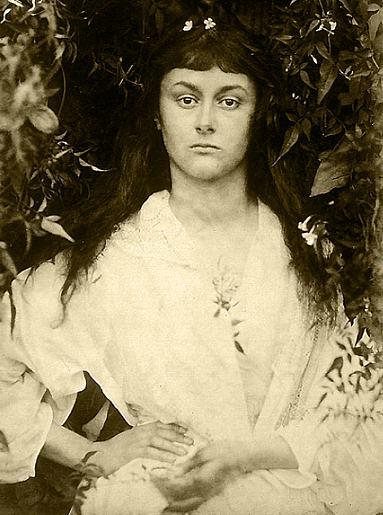
    Now that the new Tim Burton Alice film is out, let’s not forget that there was a real Alice on which Lewis Carroll’s Alice was based.  She looks, well, pretty formidable. (Alice Liddell.)


    Alice Liddell

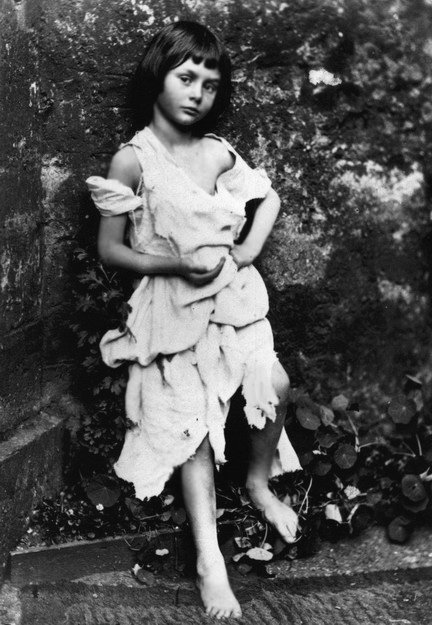
    A photo by Carroll of Alice at a younger age.  In spite of his logic and math and Snark and Alice, Carroll’s “artistic” photos of children are pretty creepy to me. 

    Alice_Liddell_2

    ·Posted by :

    ·in:

    — —

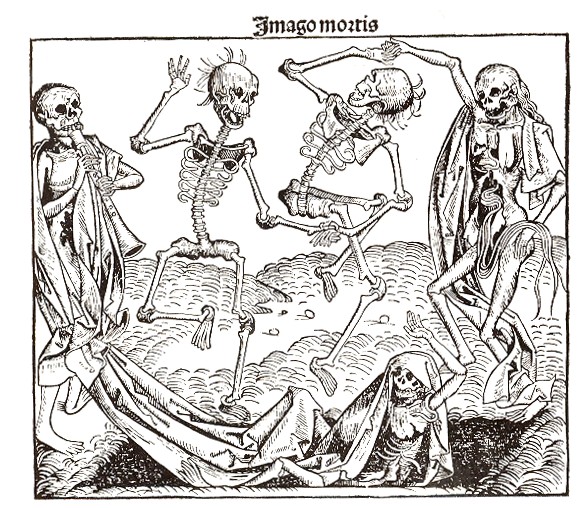
  • Imago Mortis: Immortal and Post Mortem Hair

    JF Ptak Science Books LLC  Post 958  Blog Bookstore

    Death hair2

    I think that in the contest of hair between mortality and immortality, never-ending time wins.  This sentiment is based on seeing many images representing death and time over the years, not many of which I can not now produce on demand to make my argument a little more plausible, but, well, no matter.  Two examples will suffice for now.

    The first example stands for many of its type: it is titled “Imago Mortis”  (the World of Death) and appears in Hartmann Schedel’s Liber chronicum (more commonly known as the Nuremberg Chronicles), one of the greatest illustrated (or certainly the most lavishily illustrated)  books of the 15th century.  Printed by Anton Koberger in Nuremberg on 12 July 1493, the Liber chronicum was basically just that, a walk through the known and imagined knowledge of the mid-Renaissance with the great humanist Schedel acting in the role of conductor.  There’s certainly much of interest and disinterest in this book; Schedel was not afraid to make a guess (and even a wild one) when facts didn’t fit or were unavailable.  (For example, he famously re-used the same view of a city to illustrate different cities.) 

    Death hair

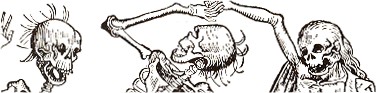
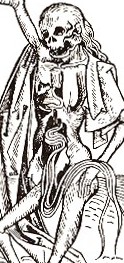
    The Imago Mortis here is more like the Dance of Death, a subject visited many times by many great artists over a Death hair3 period of 500 years or so.  But my interest right now is only in the hair; particularly the hair of the figure at far right, whose (her?) hair seems to be not only flowing down her spine but through it and her ricase as well, spilling out in front of her across her pelvis. 

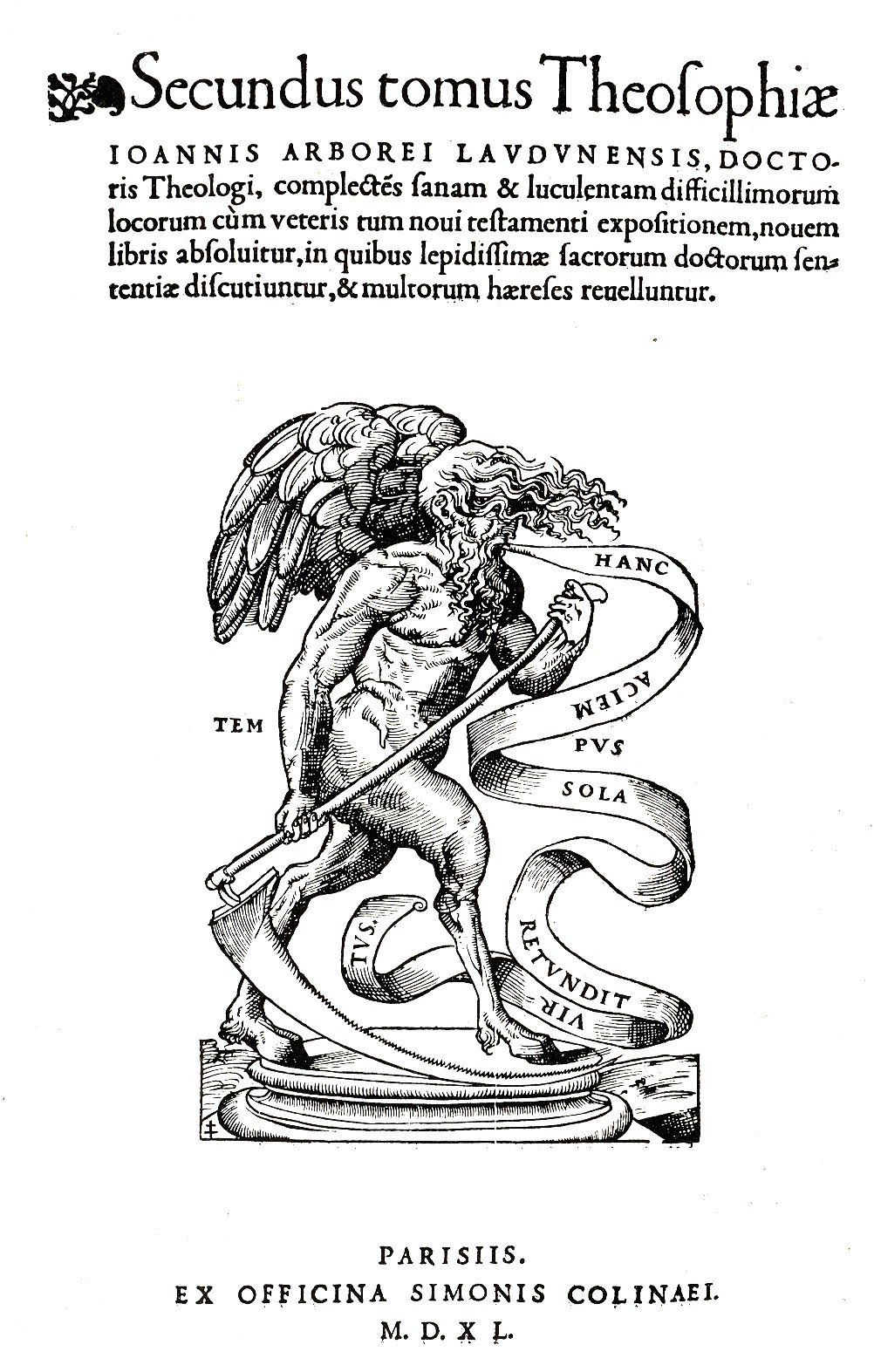
    Blog 12 4 time hairI’ve written earlier in this blog on the second  woodcut image: it appears as the printer’s mark (of Simonem Colineum, or Simon de Colines) in the
    second volume of Johann Arboreus’ Theosophia, complectens difficillorum…, which
    was printed in Paris
    in 1540. 

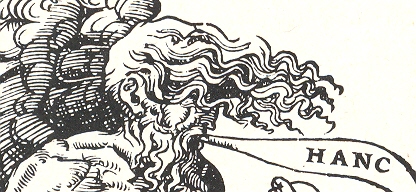
     Time isn’t very pretty here, and is made to seem a little
    Satanic, what with cloven hooves and the legs of some animal, strong torso and
    swift wings—the hair hiding the eye(s) completes a picture of damnable doom,
    and of whatever end we’re coming to. 
    Except for the righteous, though not quite: the word balloon describing
    Time’s spoken admonition is “Hanc Aciem Sola Retundit Virtus”, which means “only
    good deeds dulls the blade”.  That doesn’t
    necessarily mean “stops” the blade, which is bothersome.  I think that if someone were coming for me I’d like the blade as sharp as could be…

    I think the winner is Time, whose hair–although not quite as long as that of the dead–is far more luxurious, which at the end of the day carries it.  Also, Time’s hair is connected to a scalp; I don’t know what the deads’ hair is connected to.

    https://historyofideasblog.com/a/6a00d83542d51e69e2012876116274970c-pi


  • Seeing Vision: Examples of Light and Sight, Personified

    JF Ptak Science Books LLC  Post 976


    (On seeing the morning’s rising sun): “Looks like light to
    me.” SpongeBob SquarePants


    “All the fifty years of conscious brooding have brought me
    no closer to answer the question, ‘What are light quanta?’ Of course today
    every rascal thinks he knows the answer, but he is deluding himself.”  A. Einstein

    “Are not gross bodies and light convertible into one
    another, and may not bodies receive much of their activity from the particles
    of light which enter into their composition?” I. Newton, Opticks,
    1704, Query 30.

    Mar 12 #51

    Depicting the capacity of sight and nature of light has been
    both an easy and a knotty problem in the history of science. Over the
    successive theories on the basis of light the artistic presentation of the
    phenomenon has been generalized (generally) in a very simple way:  by straight lines.  There’s certainly nothing wrong with that,
    the lines are just parenthetic place-holders suggesting direction, not actual
    descriptors of what light “looks” like.

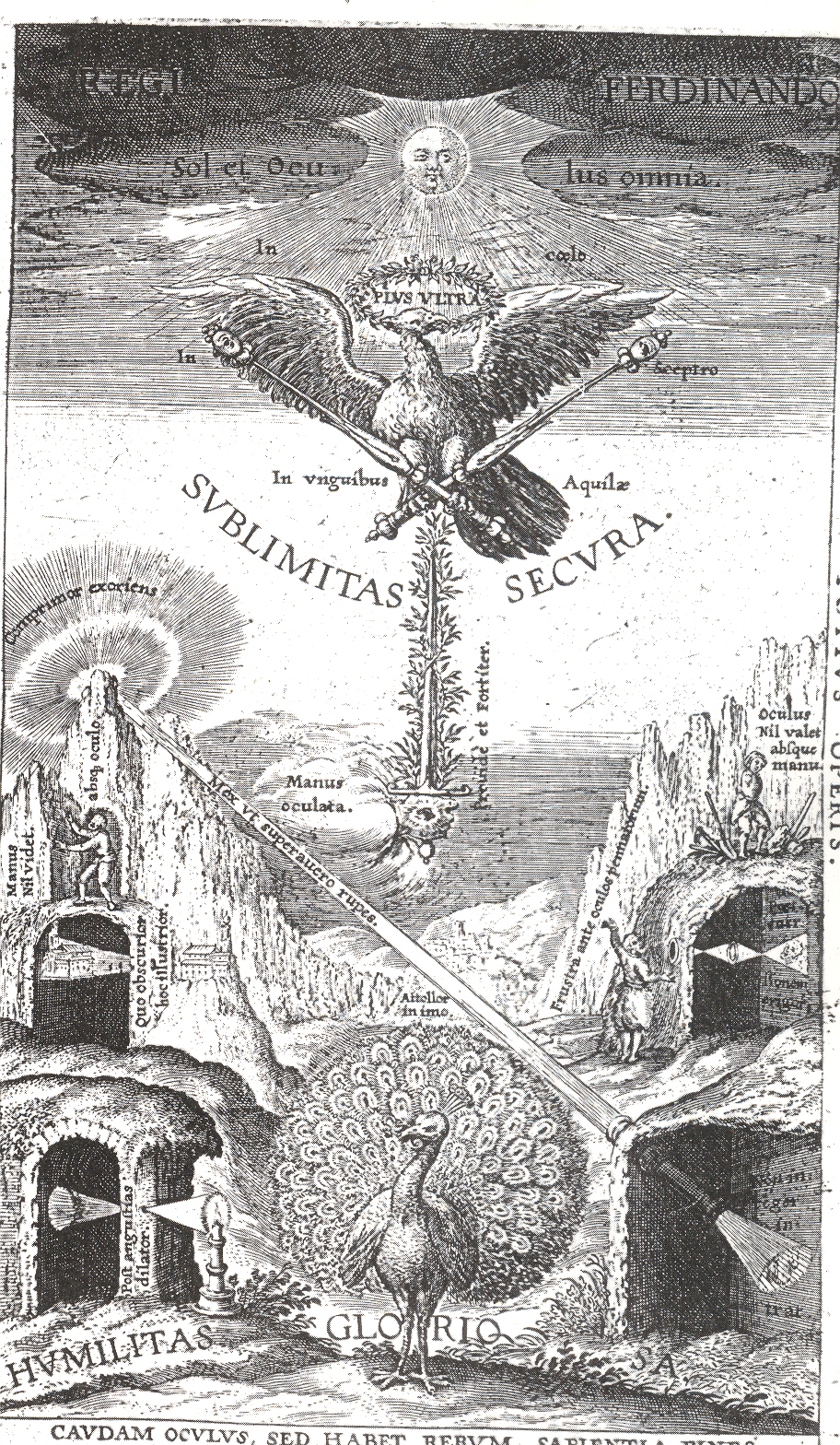
    There are literally hundreds if not thousands of images printed 1550-1850 to call upon to make this point, and I’ve selected but a few.  The first belongs to Jesuit astronomer Christoph Scheiner and which appeared in his  Oculusm hoc est: fundamentum opticum...,printed in Innsbruck in 1619. His work is an out-and-out landmark in the history of optics,  physiological optics and ophthahlmometry, and provided a springboard for two generations following him, not the least of whom was Rene Descartes. The illustration above is the book’s frontispiece, and features four camera obscuras demonstrating four principles of the eye, the middle ground of which is a beam of light 

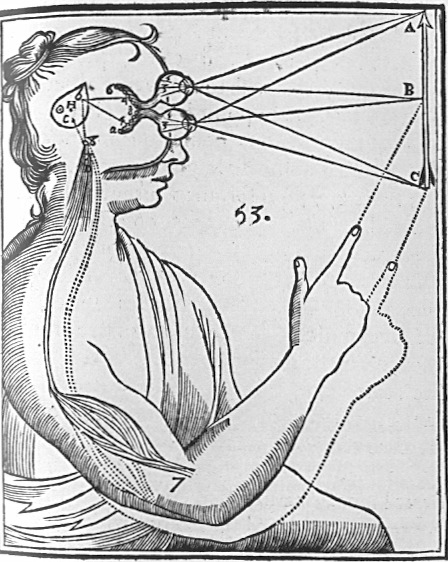
    Rene Descartes depicted the interpretation (in his  Principles of Philosophy of 1644) of light and its physiological reaction in the brain as follows:

    Cartesian_Vision

    the lines of sight depicting binocular vision, observed (and compressed) by the eye’s “particles” and processed by the pineal gland which in turn manipulate the “fluids” in the control of nerves and muscles. 

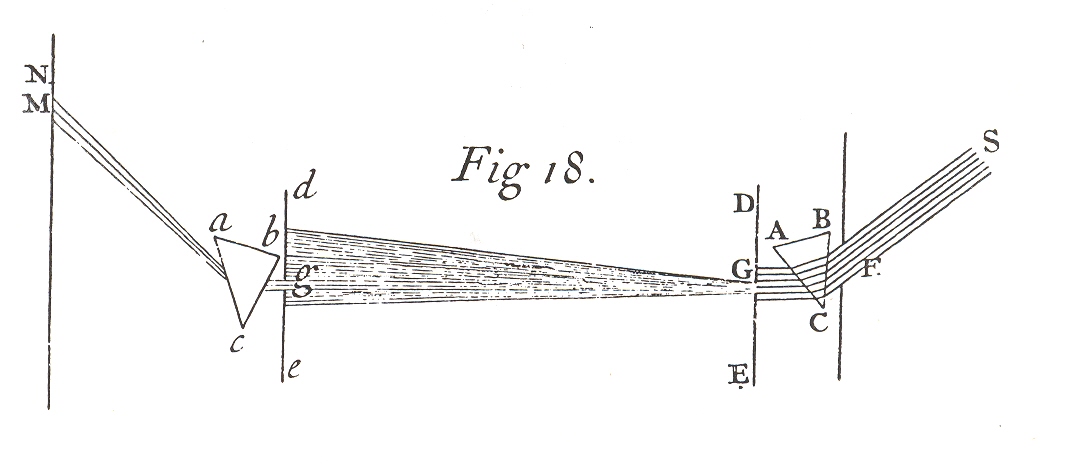
    Another example of even greater fame than the iconic image by Descartes is that of the diagram showing the connection between color and its reflective index by Isaac Newton, appearing in his Opticae of 1706.

    Mar 12 newton 

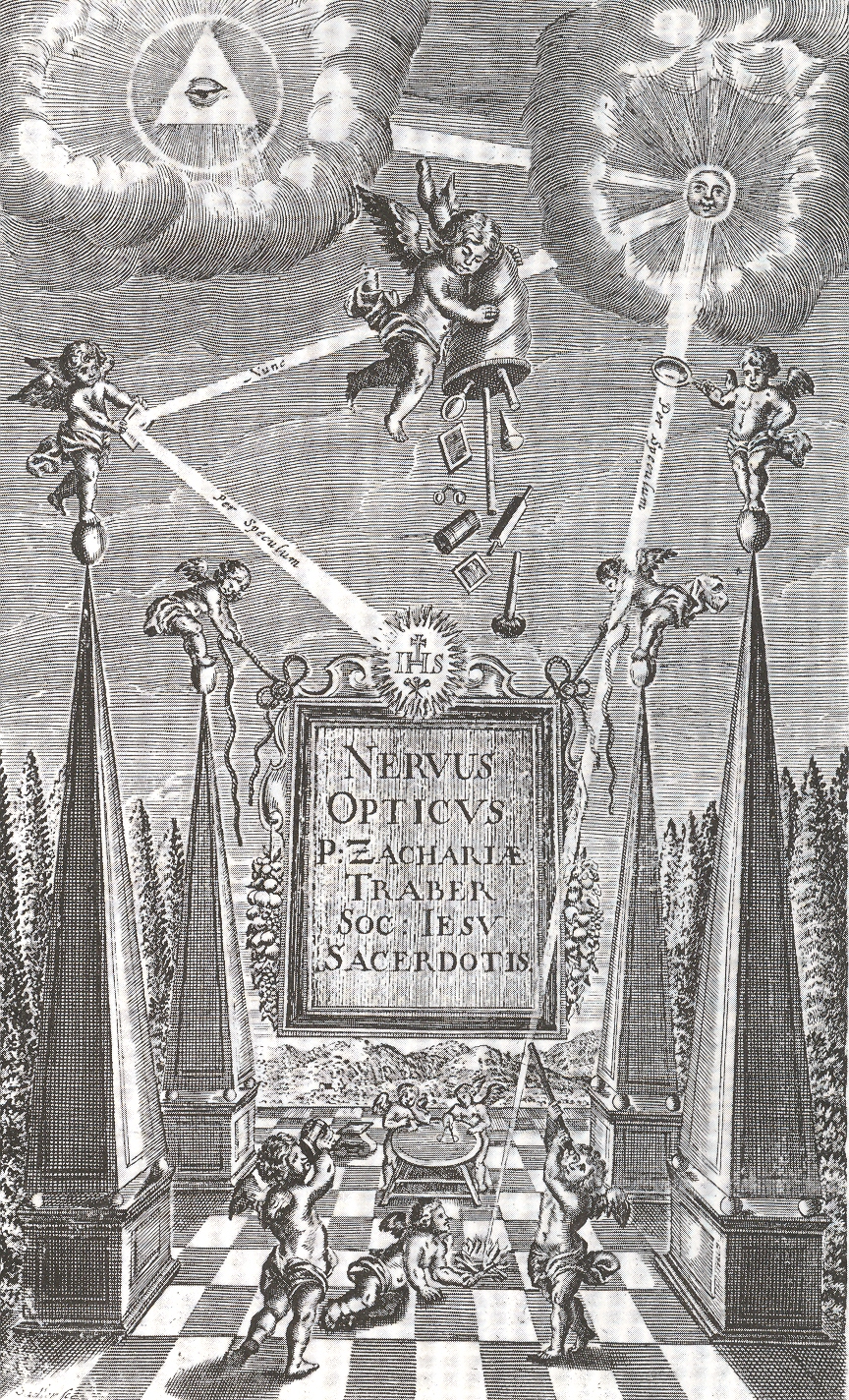
    Another fine example comes from Zacharias Traber’s (1611-1679) beautifully illustrated classic of optics (and physiological optics) , Nervus Opticus sive Tractatus Theoricus..., published in Vienna in 1690.  Traber is a great collector and synthesizer of the work done during and before his time, using the work of Descartes, Kepler, Schott, Kircher, Scheiner and Aguilon (for example), and then further implementing their ideas especially in the areas of color theory  and light refraction.  The image certainly reflects Jesuit Traber’s religious training, depicting the holy source of light (originating with the almighty force) which directs it to the sun; the light then is left to the inquisitive and playful hands of cherubs who reflect and magnify it, as well as use it to start a fire (from the condensing lens) and observe it through a telescope. The main cherub empties a sack containing a number of different optical tools, no doubt for the playful brethern beneath. 

    Mar 12 trauber 

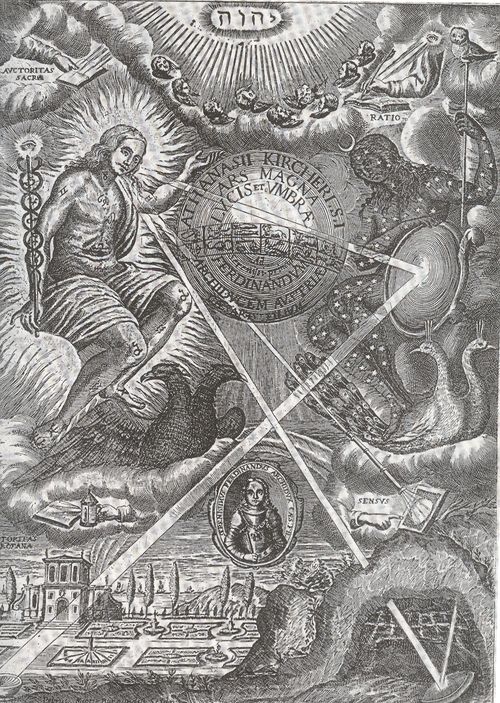
    And then of course there is the great, unstoppable, polymathic and sometimes incorrect Jesuit Athanasius Kircher.  This image appears in his masterwork Ars Magna lucis et umbrae, printed in Amsterdam in 1671, which deals with light and shadow, optical illusions, color, refraction, projection and distortion, sundials, mirrors, as well as astronomical subjects. Most of these subjects are clearly seen in the engraved frontispiece to the work (below), the source of all of the “rays” of light coming from the godhead, relayed through a telescope, reflected from a mirror, and gathered in a camera obscura. 

    Mar 12 kirch 

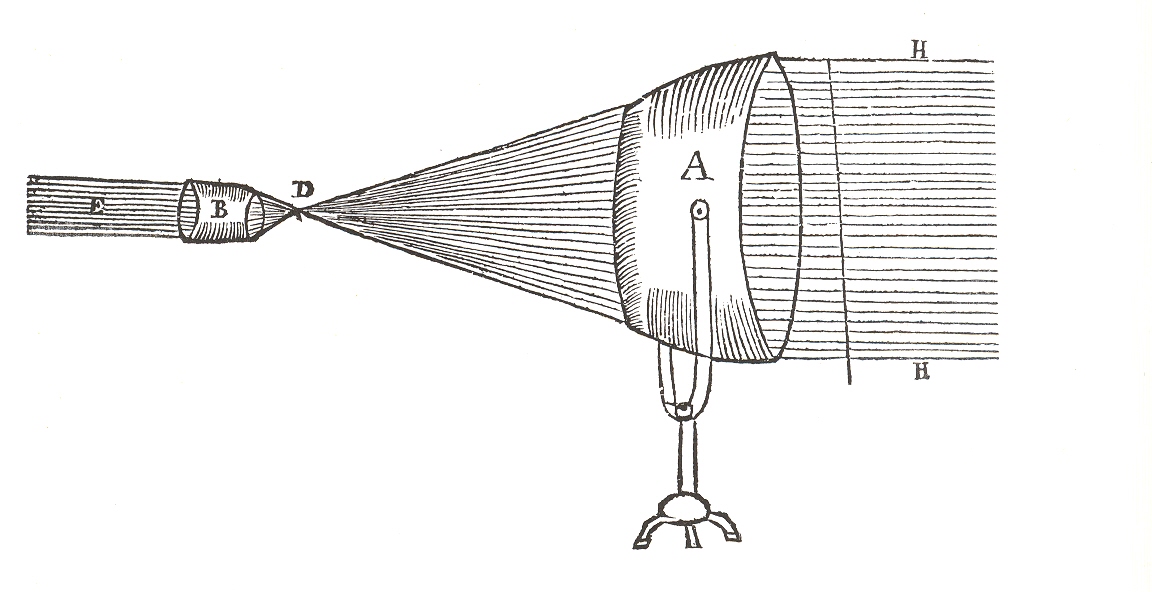
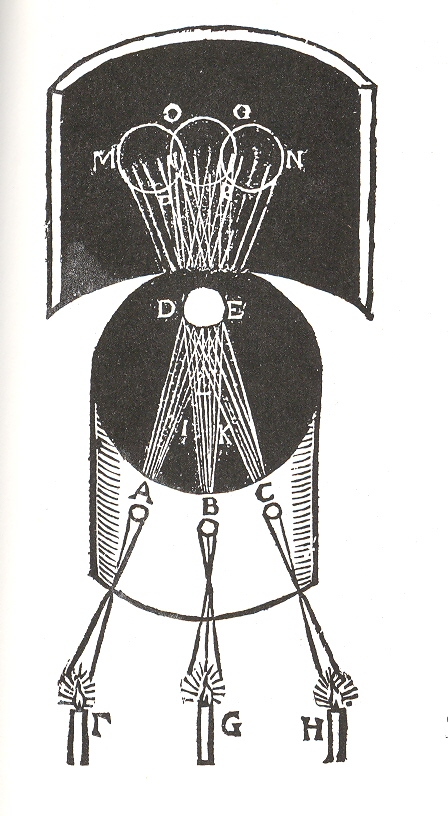
    Other interesting images from the Kircher include this spotlight.

    Mar 12 krirch detail long

    Mar 12 krirch black detail


  • Layers of Influence: Dante’s Inferno and Pozzo’s Perspective

    JF Ptak Science Books LLC  Post 934

    I’ve
    written several times in this blog about unusual perspectives in antiquarian
    images—namely, views looking straight up and straight down.  They really don’t exist, much, in the
    post-Daedalus pre-flight days, what with given the difficulty of fabricating non-cartographic
    images from the ground.  

    Next
    on what might seem to be a very obvious list of non-obvious interests are images
    with layers, levels, sections, plans, projections…sideways columnar views, locating objects
    in space and time. But mostly looking at things straight-on, ad then showing
    their relational layers.  As it turns
    out, these sorts of creations aren’t very much seen in the pre-modern
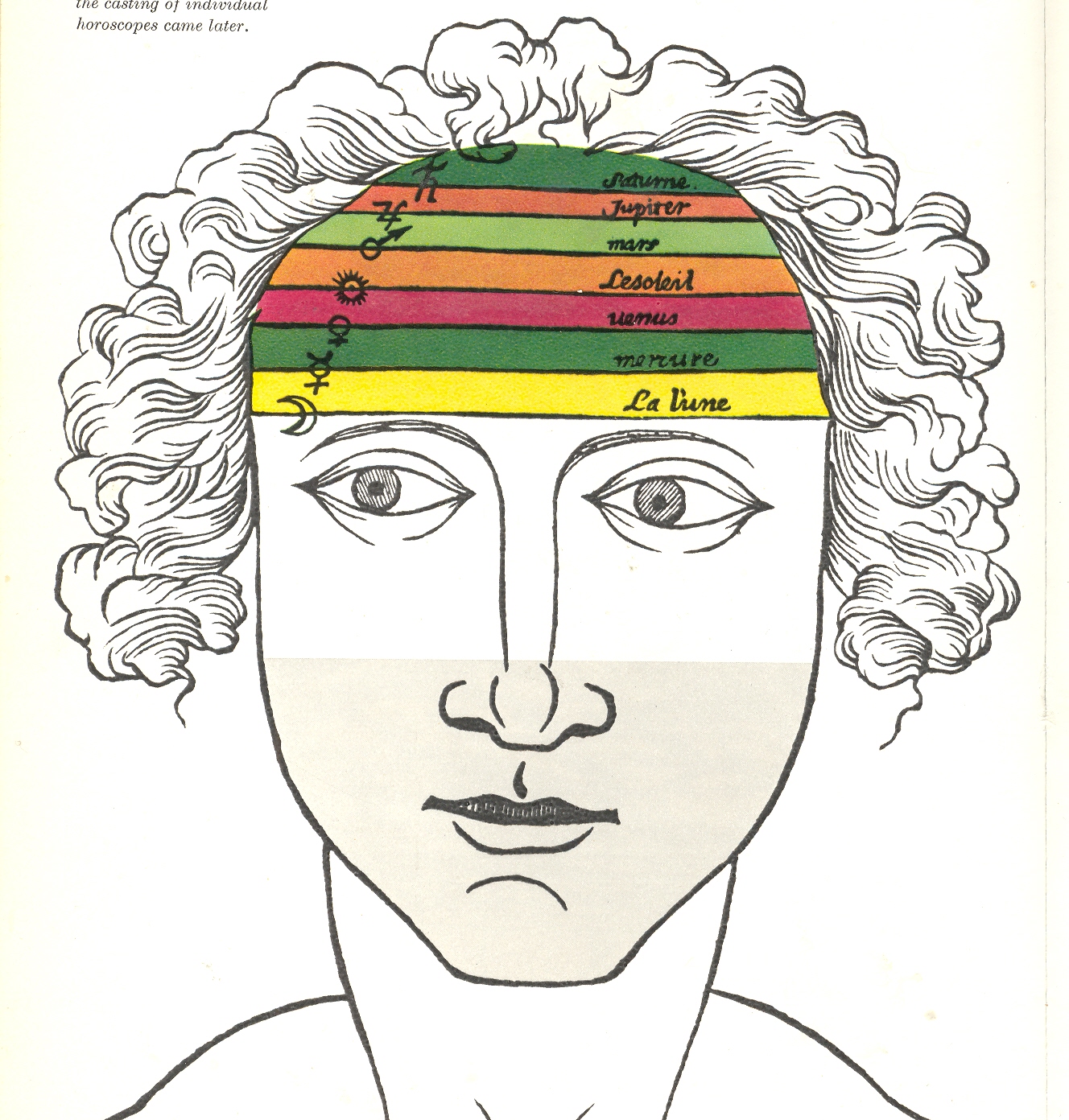
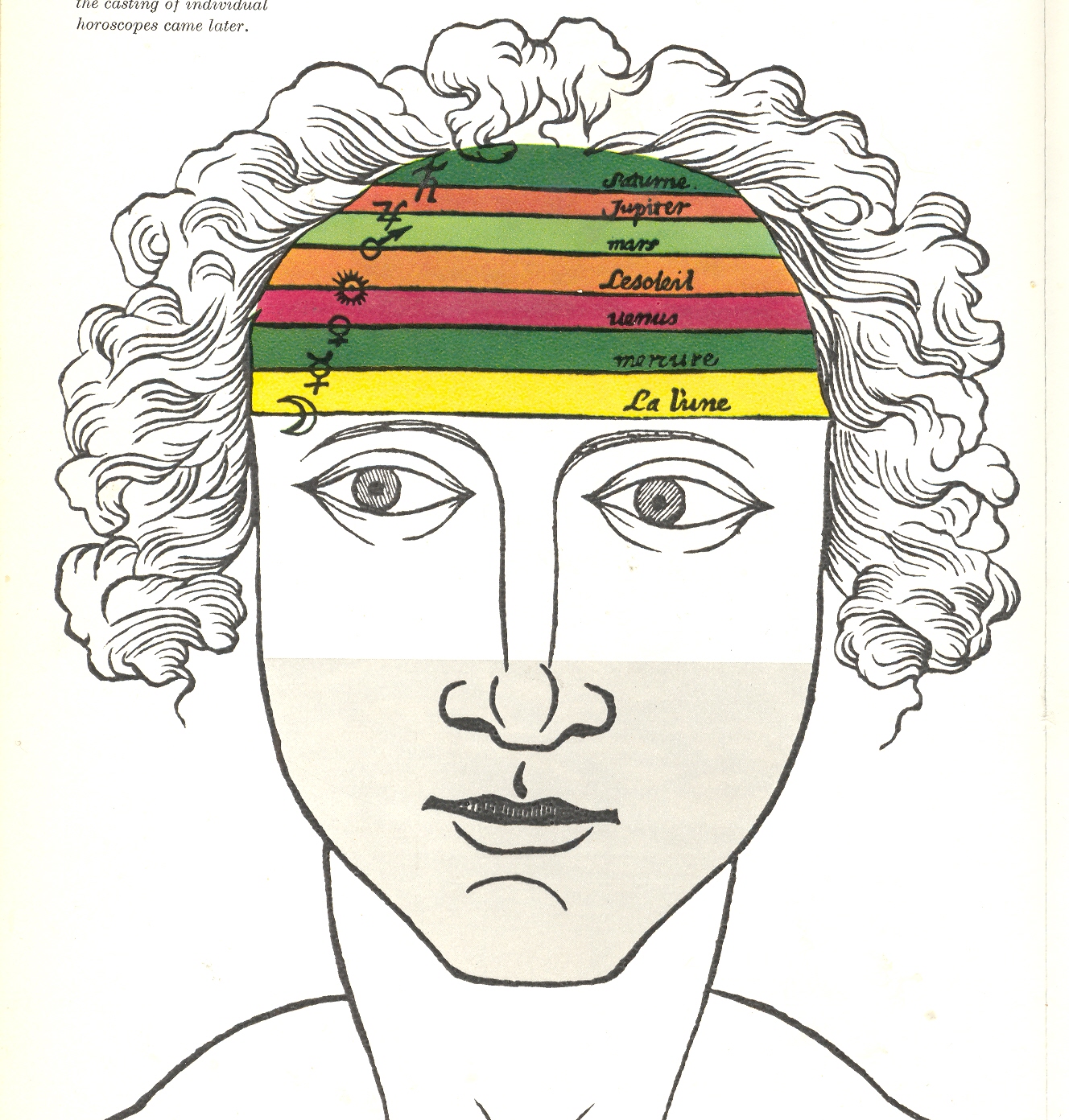
    geological era (say, prior to the 1790’s).This is a good example, an astrological man, showing the influence of the planets (and sun and moon) on the different layers of the brain:

    Blog--feb 9--arstro man Blog--fe 9--mole map


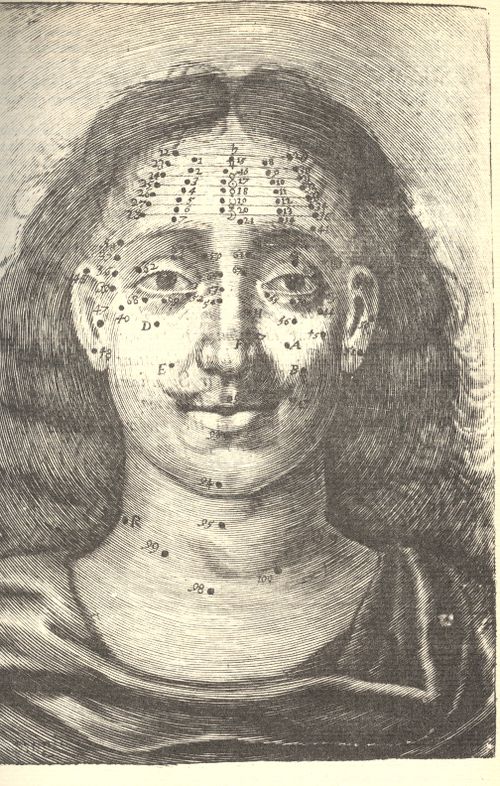
    Differentiated, say, from Richard Saunders’  Mole-map man,  (right) where facial (and etc.) moles were used as maps to determine some sort of specific actions on the organs underneath (and also by a tea-leaf divination, where the mole lines were connected and disconnected, and interpreted, according to the needs/whims of the observer):

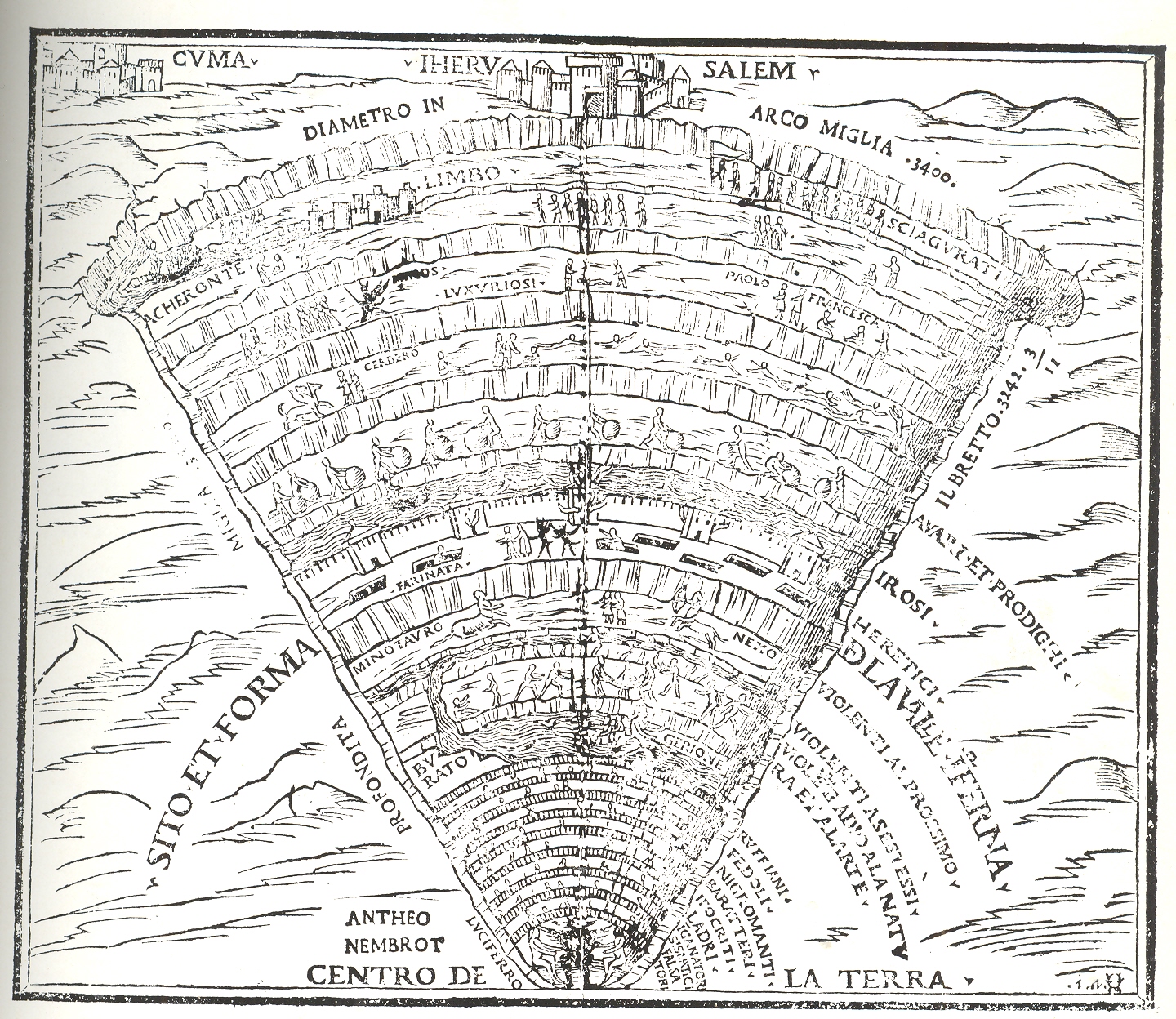
    The classic sort of image may be something like this fantastic depiction of the Inferno of Dante (shown here in the Comedia published in Venice by Gregorio de Gregoriis in 1515:

    Blog--feb 9--dante

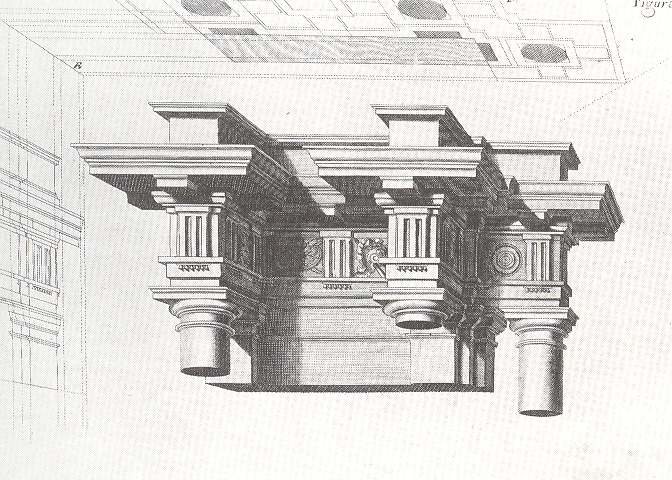
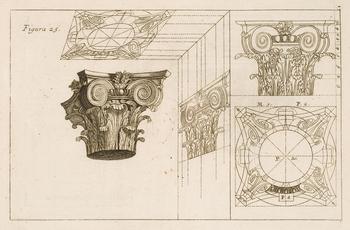
    The fantastic Jesuit Andrea Pozzo published results of his researches on perspective in his Perspectiva pictorum et architectoru (1693), explaining how he was able to compellingly, unbelievably  represent three-dimensional images on two-dimensional spaces, this image showing plan and projection and profile, effectively giving you a three-dimensional cross section of the architectural element:

    Blog--feb 9--pozzo column 

    And again:

    Blog--levels--pozzi column 

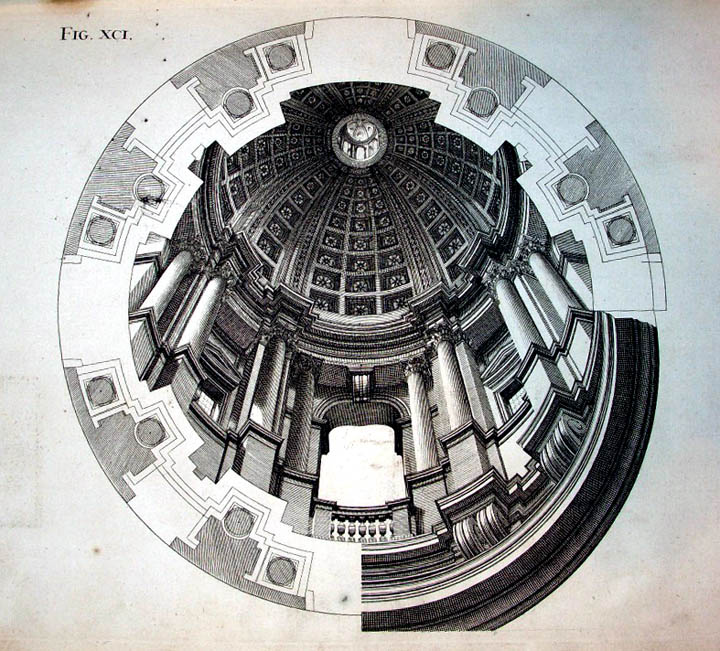
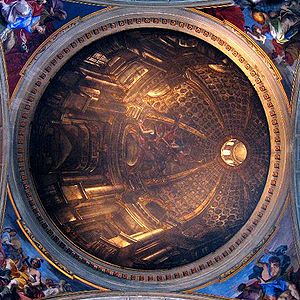
    And of course his masterpiece displayed, which is an engraving showing the plan of a flat ceiling of St. Ingacio in which he painted his magnificent trompe l’oeil masterpiece:

    Blog--levels--pozzi dome 

    Pozzo color

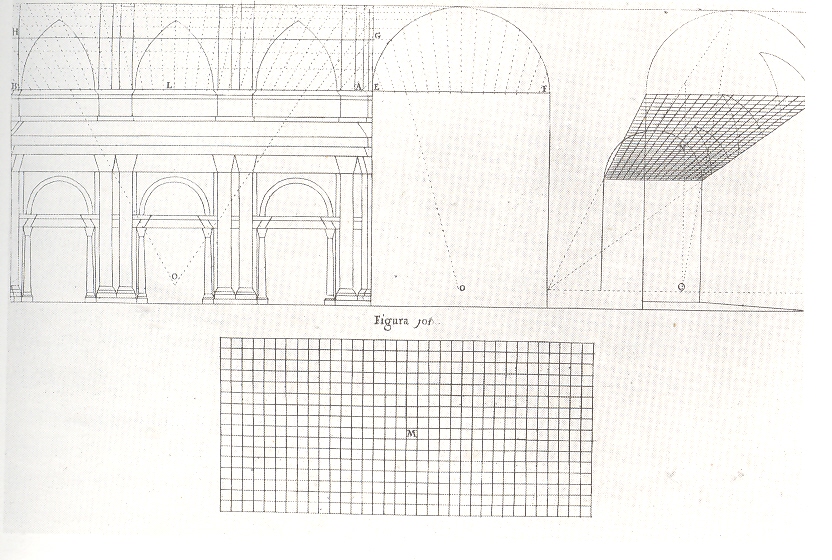
    Also in a way appropriate to this ramble is the explanation diagram by  Pozzo’s found in Martin Kemp’s The Science of Art, Optical; Themes in Western Art from Brunelleschi to Seurat, showing the imaginary depth of a deeply illusory painting on a (basically) flat ceiling surface:

    Blog--feb 9--pozzo ceiling

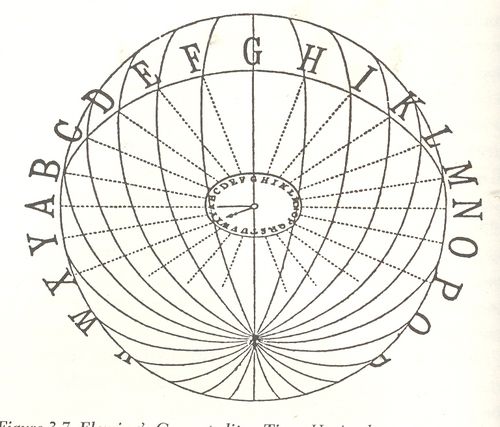
    Also in consideration for this area is Sir Sandford –the inventor of Standard Time–Fleming’s wonderful idea for a G-o’clock world, a same-time-everywhere planet, with his 1879 diagram illustrating the earth-penetrating time principles so:

    Blog--feb 9--fleing clock(Image source: “Time-reckoning and the selection of a prime
    meridian to be common to all nations” in the Proceedings of the Canadian Institute, Toronto, 1879 published by Copp, Clark)

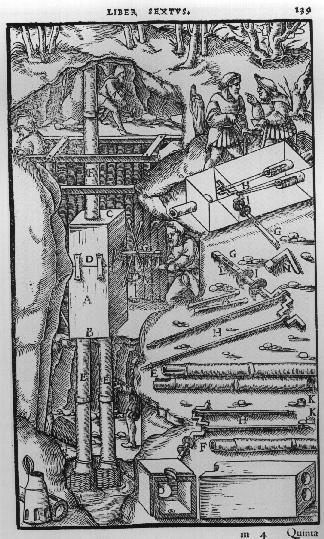
    Agricola’s De Re Metallica (from the first Latin edition f 1556) displays many interesting cross sections of Renaissance mines:

    Agricola 

    There’s much more to come in this area, of course–this is just what I had time to deal with this afternoon, though the this task is much more complicated in the 18th century world than in the 19th, when we find cross sections of the earth and  the oceans. But I’ll close here, with all faults.


  • Boullee, Lequeu and Ledoux: Reposts of Two Musical Slideshows

    JF Ptak Science Books LLC  &   Blog Bookstore

    (1) The Fantastic Self-Portraits of the Visionary Architect, Jean-Francois Lequeu

    I guess it is easy to want to call M. Lequeu (1757-1825 (?)) an outsider, though
    he was hardly that.

    He was an exceptional talent who was exceptionally well-trained (and who won
    the highest awards offered by his school), and started out in a staid and
    brilliant way, a successful draftsman in his own right, and student of
    Scoufflot, helping to design ancient-inspiration buildings for the super
    rich. He was at the pinnacle of the drafting trade, though not so on the
    designing end.  Along came the Revolution
    and away went his architectural career—he wound up a surveyor and a
    cartographer until his retirement in 1815, after which he enters social and
    historical oblivion, until he finally dies in total obscurity ten years later
    (or so, the date is unclear).  His post-revolutionary vision was as
    phenomenal as his success in selling his ideas were dismal.  Well, this is
    really a cheap shot—his imagination was shockingly large, enormous, his designs
    fantastic and beautiful, and completely unexpected, and they seemed to grow
    larger/loftier and more interesting as time wore away at him. But he was far in
    front of the curve so far as popular (public) opinion was concerned.  Even among the other visionaries of the time
    (like Ledoux and Boullee) it was Lequeu who staked out the furthest reaches of
    architecture, and also with great depth and virtuosity.

    I think that as Lequeu was cleaved away, cell by cell falling through the
    floorboards of his single rented room, he reached further into time and deeper
    into space than almost any architect of that hundred-year period.   I
    also think that he was very well aware of his genius being seen as pure
    eccentricity—his half-dozen or so self portraits are among the most reaching
    that I’ve seen (in the pre-modern era). 

    If Lequeu’s visions existed at all in the world of French architecture it
    was in the Deep Underground—a place that he may have founded.  He was certainly, at the very least, its
    geologist.

    His
    self portraits are striking, but perhaps not so much more so than those
    by Rembrandt–he was certainly exploring modes of expression (Raphael’s
    series of engravings on the emotion of the human face is a good example
    of this study)–Lequeu though seems to always manage to suggest that he
    is an observed inmate somewhere.  There is a great undercurrent of
    “otherness” and great remove to them–something that makes places the
    self portraits into a different–empty, lonely–class.

    (2) Etienne Boullee, Images with Music

    I’ve been collecting images by some of  the great, visionary
    architects of 18th century France:  Etienne Boullee (1728-1799),
    Claude-Nicolas Ledoux (1736-1806) and the semi-impossible Jean-Jacques
    Lequeu (1737-1825).  It was a tough time for these architects to see
    far into the future at the time of the Revolution, as people who were
    even less deserving than these men lost their heads.  In any event I’ve
    compiled a short three minute video exhibiting some of their works,
    using the music of Wim Mertens for Peter Greenaway’s love poem to M.
    Boullee called The Belly of an Architect. 
    I couldn’t but help using this music in this context, sorry to say–it
    just goes perfectly with these images.  (Also, I’ve written about M.
    Ledoux here.)


  • Red Sky in the Renassiance: the Reverse of Geometry

    JF Ptak Science Books LLC  Post 913

    What
    if our eyes worked in the “opposite” way? 
    What if we somehow broadcast the lines of reality from our eyes1 rather
    than receive photonic emissions from the physical world, that we didn’t specify
    the wavelength and frequency of light, and that somehow electromagnetic rumblings
    in the “visual range” didn’t apply to our sense of sight?
    Blog jan 17 francke

    This
    would certainly make for an interesting  existence
    if somehow the elements around us weren’t necessarily so.  Perhaps this is sort of replacement reality
    is just what has been going on in the entire history of humans, altering the
    landscape to make it more suitable for our existence, a long history of
    painting the physical landscape with something more “suitable”, an
    individualized creation. 

    This
    all came up wondering about this fantastic sky, produced 475 years before
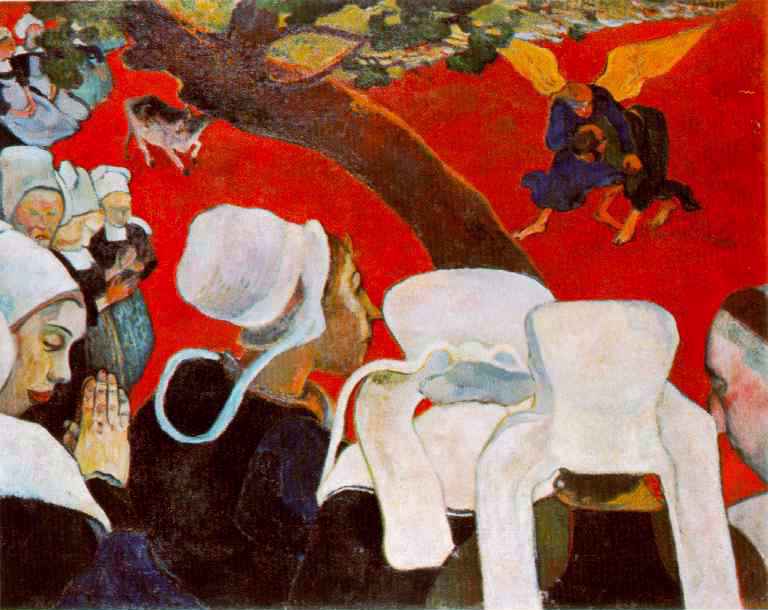
    non-representational art and 455 years before Gauguin started applying big blankets of red2 :  it seems to me
    in a distant impression that it is a representation of vision that is more a projector
    than a camera..  The end result of this
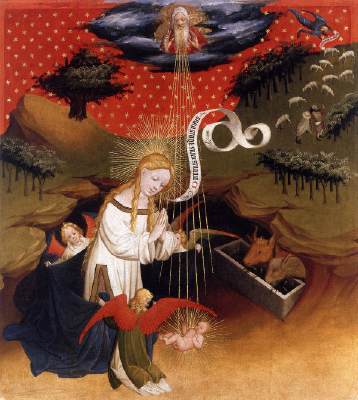
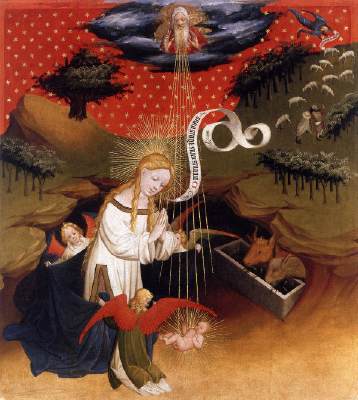
    emission and wayward thought is the fabulous red sky in the painting Nativity by Master Francke3 (ca.
    1424-1436) is a fantastic red sky with lustrous stars.

    The
    painting is otherwise filled with the common reliables of Renaissance iconography
    concerning the nativity:  the place of “birth”
    (a stable or barn-like building, also sometimes appearing as a classical ruin
    or cave), a flock of sheep, a stand of trees, and the watch sensate gazes of the near by
    beasts.  Mary is ecstatic in the same ways
    that Joseph is usually not—to me, he usually seems pretty detached from the
    whole deal, lost in another space.  The
    baby Christ is again just a little man (and not a baby) laying there on the barren
    ground.  [I’ve wondered about Joseph’s
    detachment:  perhaps the whole scene is
    nothing but mysterious, a complexity far removed from his reach and
    understanding, a notion of an act that is so phenomenal that there is no
    retrievable reaction for it, and so he looks away.  Later on in the history of Mary and Joseph,
    and deep into the 19th century when the Immaculate Conception—that is,
    the sexless conception of Mary the mother of Christ which she would later accomplish
    for her own baby—the issue of Joseph’s own virginity comes up, mounting the
    confusion no doubt in Joseph’s already-full head.]

    But
    back to the sky:  certainly skies and
    backgrounds of pure gold and blue painted by the masters in Sienna
    and Florence
    abound during this time, but red is quite unusual.  The sky is accented by the terrific red of
    the wings of the angels and more softly so in the hair of the (long-fingered) Madonna. 

    There
    is also the issue of the hole in the sky, revealing the large-handed Creator with glimpses
    of the alternate, higher, existence visible in the background, a taste of the
    alpha (or omega?) part of the long arch of Earth-borne humanity.

    Notes

    1.The discussion of optics and vision is one of the most spectacular conversations ever held in the history of science and philosophy (along with “time”, “motion” and “the void”.  I think that Leonardo would’ve come closest in relatively-modern times to understanding vision if he had the real capacity of dissecting the eye (which in spite of many approaches to experiment) would always go flat, leaving him with an unsatisfying mess.

    In Aristotle’s Physics (Book II, Part II) we find the following fascinating thought:

    “Similar evidence is supplied by the more physical of the branches of mathematics, such
    as optics, harmonics, and astronomy. These are in a way the reverse of geometry. While
    geometry investigates physical lines but not qua physical, optics investigates
    mathematical lines, but qua physical not qua mathematical”

    A classical position of the emission theory of optics is stated by Hero in his Definitions:

    “Optics does not deal with physical questions and does not study whether given rays
    flowing out from the eyes go forth to the boundaries of objects or whether images that are
    detached go forth from corporeal objects [and] enter the eye along a rectilinear path or
    whether the intervening air is stretched or contracted by the ray-like pneuma from the
    eye. It is only concerned whether, at each reception (of an image) the right direction of
    movement or tension is maintained as well as the requirement that the convergence to a
    point occurs at an angle when objects are seen that are larger or smaller than the eye.”

    (My thanks to Dr. Kim Veltman for these quotes from her Continuity and Discovery in Optics and Astronomy, Studies on Leonardo da Vinci http://www.sumscorp.com/books/contin/title.html)

    2. I had Gauguin’s 1888 “After the Sermon/Jacob Wrestling the Angel” in mind for an example of this.
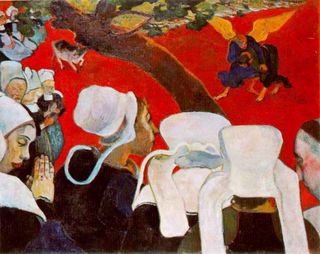
    Gauguin.sermon

    3. Master Francke active (c. 1424 –
    36 ), Nativity, in the Kunsthalle, Hamburg; oil on oak,
    39×35 inches.
    Hamburg, Kunsthalle. “German painter who worked in Hamburg, where in 1424 he painted a huge altarpiece for the company of merchants who traded with England, the so-called ‘Englandfahrer Altar’, originally placed in their chapel in the Johanniskirche (remnants in Hamburg, Kunsthalle). When closed, the double-winged altarpiece displayed four scenes from the life of S. Thomas Becket, the patron saint of the company, above four scenes from the life of the Virgin (e.g. Nativity;).
    Opened, the altarpiece showed scenes from the Passion of Christ.
    Francke was a leader of the northern German version of International
    Gothic
    . He had close links with French book illumination (he may
    have worked in
    Paris for some time) and the
    paintings of the
    Rhineland, especially those
    of
    Conrad van Soest
    , though it is not known where he received his training.”

    Other Nativity scenes as follows:
    ·Posted by :
    ·in:

    — — —