A Daily History of Holes, Dots, Lines, Science, History, Math, Physics, Art, the Unintentional Absurd, Architecture, Maps, Data Visualization, Blank and Missing Things, and so on. |1.6 million words, 7500 images, 4.9 million hits| Press & appearances in The Times, Le Figaro, Mensa, The Economist, The Guardian, Discovery News, Slate, Le Monde, Sci American Blogs, Le Pont, and many other places… 5000+ total posts since 2008.

Author: JF Ptak

  • Alpha & Omega Department: Omega, Heat Death, and Speculative Fiction, 1893

    JF Ptak Science Books   Post 1514

    “The more the universe approaches this limiting condition in which the entropy is a maximum, the more do the occasions of further change diminish; and supposing this condition to be at last completely attained, no further change could evermore take place, and the universe would be in a state of unchanging death.”–R. Clausius, 1868

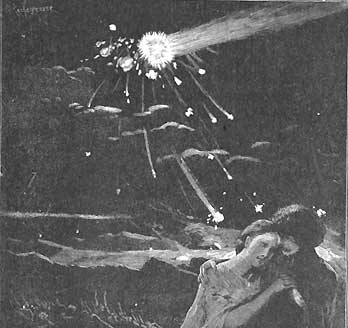
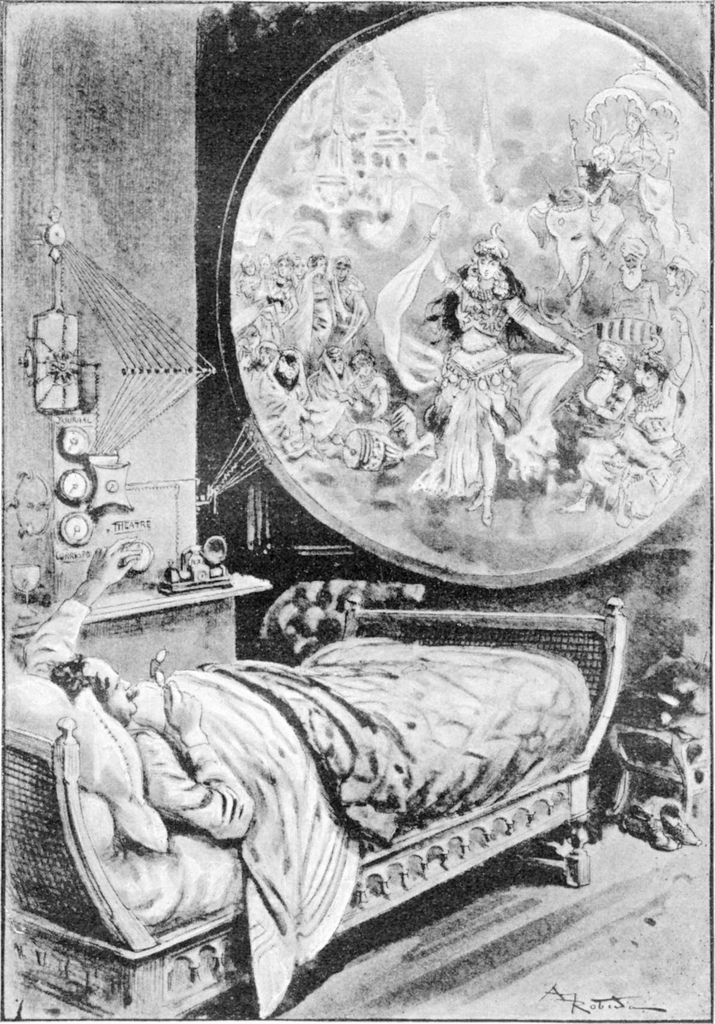
    Flammarion heat death (this will be the end)

    I wonder about the appearance of the Second Law of Thermodynamics (the Entropy Law) and its influence on creative, speculative literature.  Its really about the juicier two-word interpretation–Heat Death–that I wonder about, along of course with the 1st and 2nd laws, and its influence on relating the story of the end of the world, the destruction of the Earth, the depletion of the universe.  One can see the possibilities of the of the ideas of the fourth dimension in the creation of modern art and their influences on people like Picasso and Duchamp, even though that influence took decades (in the case of Marey to actually “appear” in art.  Where was the influence of entropy in literature?

    The business of “heat death” and the Second Law is of course necessarily based upon the First Law of Thermodynamics (and the work of the beautiful Hermann von Helmholtz in 1847), and which finds an outline of a home in the early work of Sadi Carnot (in 1824, on mechanical energy loss) and more comfortable foundations in the work of  James Joule  (in 1843),  Rudolf Clausius (in 1850) and William Thomson1 (in 1852, “On a Universal Tendency in Nature to the Dissipation of Mechanical Energy”).  The Second Law belongs to Rudolf (“Santa”) Clausius, whose 1850 paper in the Annalen der Physik begins the establishment of  the “the most universal regulator of natural activity known to science”, an idea solidified in his 1854 paper (in the same journal), where the concept of “entropy” is introduced though the name not actually used (a slightly complex history of the word, to be sure, though it makes its appearance, finally, in an 1865 paper). 

    Von Helmholtz famously establishes the death of the sun in a popularly-written 1854 paper (at about another 20 million years) which is a fantastic/superlative philosophical something happening there five years before the Origin of Species, establishing that at some point in the not-horribly-distant future that the sun would be extinguished, and that a sooner point the Earth would go, too.  Thomson would do about the same in another popular journal in 1862, saying:

    “The result would inevitably be a state of universal rest and death, if the universe were finite and left to obey existing laws. But it is impossible to conceive a limit to the extent of matter in the universe; and therefore science points rather to an endless progress, through an endless space, of action involving the transformation of potential energy into palpable motion and hence into heat,  than to a single finite mechanism, running down like a clock, and stopping for ever.  (Thomson, William. (1862). “On the age of the sun’s heat“, Macmillan’s Mag., 5, 288-93; PL, 1, 394-68.)

    It would seem very heady stuff, this scientifically-based  end-of-all-life-and-everything-else  thinking.  But it really doesn’t seem to have taken hold in any literary sense, at least not in a big way until the work of one of the most fertile popular thinkers of the second half of the 19th century.  Camille Flammarion (26 February 1842—3 June 1925), an astronomer, scientific editor and sci-popularizer of vast proportions,  an author of some 50 books, produced a fantastic end-of-the-universe story in his La Fin du Monde, published in 1893.  Again, this is decades after the big scientific pronouncements on the subject.  But afterwards, in the space of just a few years this sort of thinking, this megaland of fictional science writing would take itself away by leaps and bounds, unlike perhaps any other period in literature. (What is probably the first treatment of post-apocalypse Earth in speculative fiction–excluding religious writing and speculation–comes in 1885 with the novel  After London by Richard Jeffries.) For example  in 1895 there was Wells’ Time Machine, Tsiollkovsky’s Dream of the Earth and the Sky and the Effects of Universal Gravitation, and Lowell’s pinch in the eye, Mars, not to mention Verne’s Le Moteur. In 1897 there was Morris’ The Well at the World’s End and Well’s The Island of Dr. Moreau, plus more realistic but nevertheless bombing-bastic things like Tracy’s Final War. Then by 1898 there was Edison’s Conquest of Mars by Serviss, and the great The War of the Worlds, again by the very busy Wells. I wonder where this spculation was in the 1860’s and 1870’s?

    I really don’t know the answer to that.  Just like I don’t know why the photographs of Marey–though very widely circulated–didn’t seem to have an influence in artistic space for 30 or 40 years.  Unless of course I’m missing a big piece of the history of speculative fiction….

    http://botaniq.org/wp-content/uploads/2010/10/la_fin.jpg 


    File:La Fin du monde-34.jpg


    File:La Fin du monde-18.jpg


    “Presently the earth is only an invisible point among all the stars, because, at this distance, it is lost through its infinite smallness in the vicinity of the sun, which itself is by far only a small star. In the future, when the end of things will arrive on this earth, the event will then pass completely unperceived in the universe. The stars will continue to shine after the extinction of our sun, as they already shone before our existence. When there will no longer be on the earth a sole concern to contemplate, the constellations will reign again in the noise as they reigned before the appearance of man on this tiny globule. There are stars whose light shone some millions of years before we arrived … The luminous rays that we receive actually then departed from their bosom before the time of the appearance of man on the earth. The universe is so immense that it appears immutable, and that the duration of a planet such as that of the earth is only a chapter, less than that, a phrase, less still, only a word of the universe’s history.” — Camille Flammarion, Le Fin du Monde (The End of the World)

    I should point out that in addition t being an astronomer, Flammarion held some very colorful ideas about the possibilities of life on other worlds–near ones, at that.  He was evidently much take with the “discoveries” of Percival Lowell, claiming that a superior Martian race had been trying to communicate with Earth “for years” but without success.  See this NYT article from 1907:   “Martians Probably Superior to Us; Camille Flammarion Thinks Dwellers on Mars Tried to Communicate with the Earth Ages Ago”. New York Times. November 10, 1907. “Prof. Lowell‘s theory that intelligent beings with constructive talents of a high order exist on the planet Mars has a warm supporter in M. Camille Flammarion, the well-known French astronomer, who was seen in his observatory at Juvisy, near Paris, by a New York Times correspondent. M. Flammarion had just returned from abroad, and was in the act of reading a letter from Prof. Lowell.” At about the same time Flammarionpredicted that the world would be destroyed by a mysterious seven-tailed comet, causing panics–again, from 1907: “Flammarion’s Seven Tailed Comet”. Nelson Evening Mail. 30 July 1907. 

    Notes

    1. Thomson, William. (1951). “On the Dynamical Theory of Heat, with numerical results deduced from Mr Joule’s equivalent of a Thermal Unit, and M. Regnault’s Observations on Steam.” Excerpts. [§§1-14 & §§99-100], Transactions of the Royal Society of Edinburgh, March, 1851; and Philosophical Magazine IV. 1852, [from Mathematical and Physical Papers, vol. i, art. XLVIII, pp. 174]  Thomson, William (1952). “On a Universal Tendency in Nature to the Dissipation of Mechanical Energy” Proceedings of the Royal Society of Edinburgh for April 19, 1852, also Philosophical Magazine, Oct. 1852.
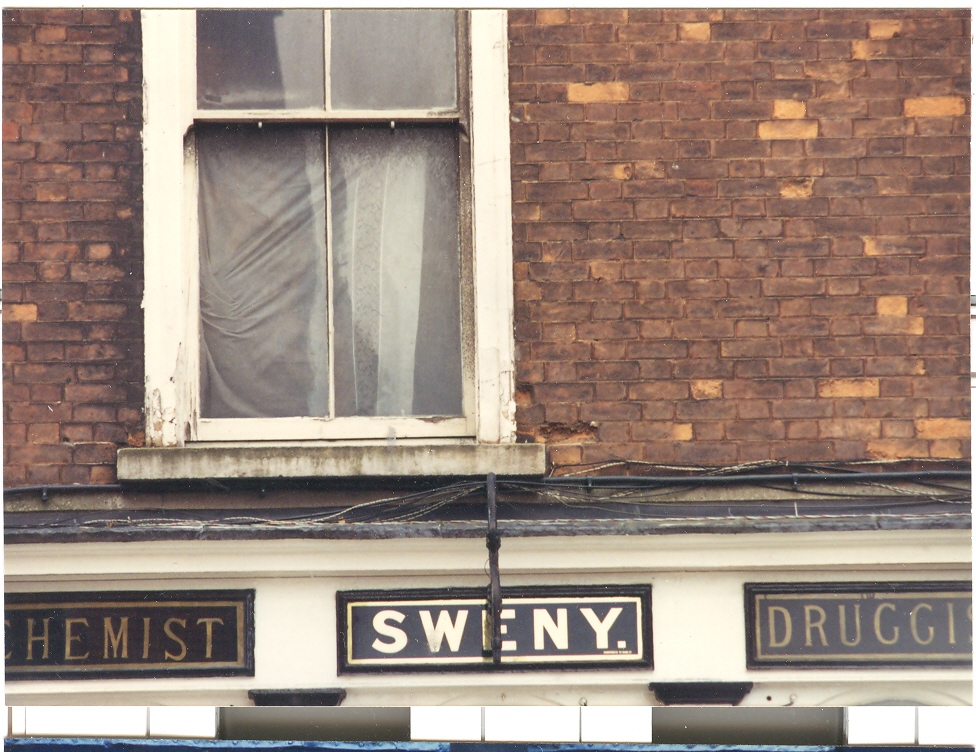

  • Bloomday Memory: Lemon Soap and Gorgonzola Cheese

    Here’s the lead on a short post I made a few years ago on a Dublin tour:

    I just came across these image that I made on a trip to Dublin some years ago.  Carrying the bags for my wife, Patti Digh, who was actually working there, I described my own work by going on a Ulysses tour. It was Sweny’s and Davy Byrnes (seems like two e’s are missing there, no?)  that I liked the most–particularly so for the chemists, because it looked as though nothing major had happened in there in a hundred years, or at least that was the sense of the smalish creaking shop…===blog==aug 13==barynes

    ·Posted by :

    ·in:


  • One of the Most Beautiful Books in the History of Holes

    JF Ptak Science Books   Post 1513

    Pound-for-pound, hole-for-whole, this well may be the most beautiful book ever written on holes–it is at the very least one of the most beautiful botanical works ever published, which is saying a lot.  The point about the holes though is that they are mostly simply there; the author (and no one yet on the face of the planet at that time) didn’t and couldn’t understand their function as “cells”. 

    Stephen Hales (1677-1761)1, a long-lived medically-trained,  amateur scientist and clergyman from Kent, was  a pioneering plant physiologist whose widespread interests and experimentation established fundamental areas of that science, and whose overall impact on that field was not to be surpassed by any other individual for hundreds of years.  Among his momentous discoveries was his realization that the flower was the sexual organ of plants, which lead to a reorganization of thinking on the life of plants and propagation. 

    These images come from his Anatomy of Plants, which was published in 1682–the first of which (below)  shows a terrifically-sectioned piece of a vine stem, presented laterally-horizontally-laterally.  (Grew’s monumental work was more or less begun in 1672 with the publication of his The Anatomy of Vegetables Begun, a smallish 200+ page book illustrated with three images, and then incorporated his An Idea of a Phytological History Propounded (1673), and The Comparative Anatomy of Trunks (1675)  and ten years more of work and careful observation into  the Anatomy, which is a folio-size volume of 83 spectacular engravings and which runs 350 or so pages.)  In the work it is obvious that Hales was familiar with the micro-appearance of cells–as was Anton van Leeuwenhoek and of course Robert Hooke, who basically found and named the things in his Micrographia of 1665–but they what they were seeing were the thickened walls of dead cells, and could not have any understanding of what we think of as “cells” today.

    Minor point, really, given the overall importance of the work, which was perhaps among the most important publications (including the works by Fuchs, Caesalpino, Malpighi, Ray and  the 1483 Theophrastus) in the history of botany from Gutenberg’s invention and deep into the 18th century. 


    Makers of British botany, Plate 7 (plate from Grew's Anatomy) - right figure.png

    ·Posted by :

    ·in:

    — —

  • A Terribly Short Illustrated Note on the History of Pocket Protectors

    JF Ptak Science Books   Quick Post

    In a flexible spirit of fun, and since this blog is after all is spawned from a science bookseller site, I offer the following few examples of pocket protectors culled from reports of the U.S. Patent Office. 

    1890’s


    ·Posted by :

    ·in:


  • A History Blank, Empty and Missing Things #77–Blank Enumerators in Sand, Pebble and Dust Computers

    JF Ptak Science Books   Post 1512

    Reisch c
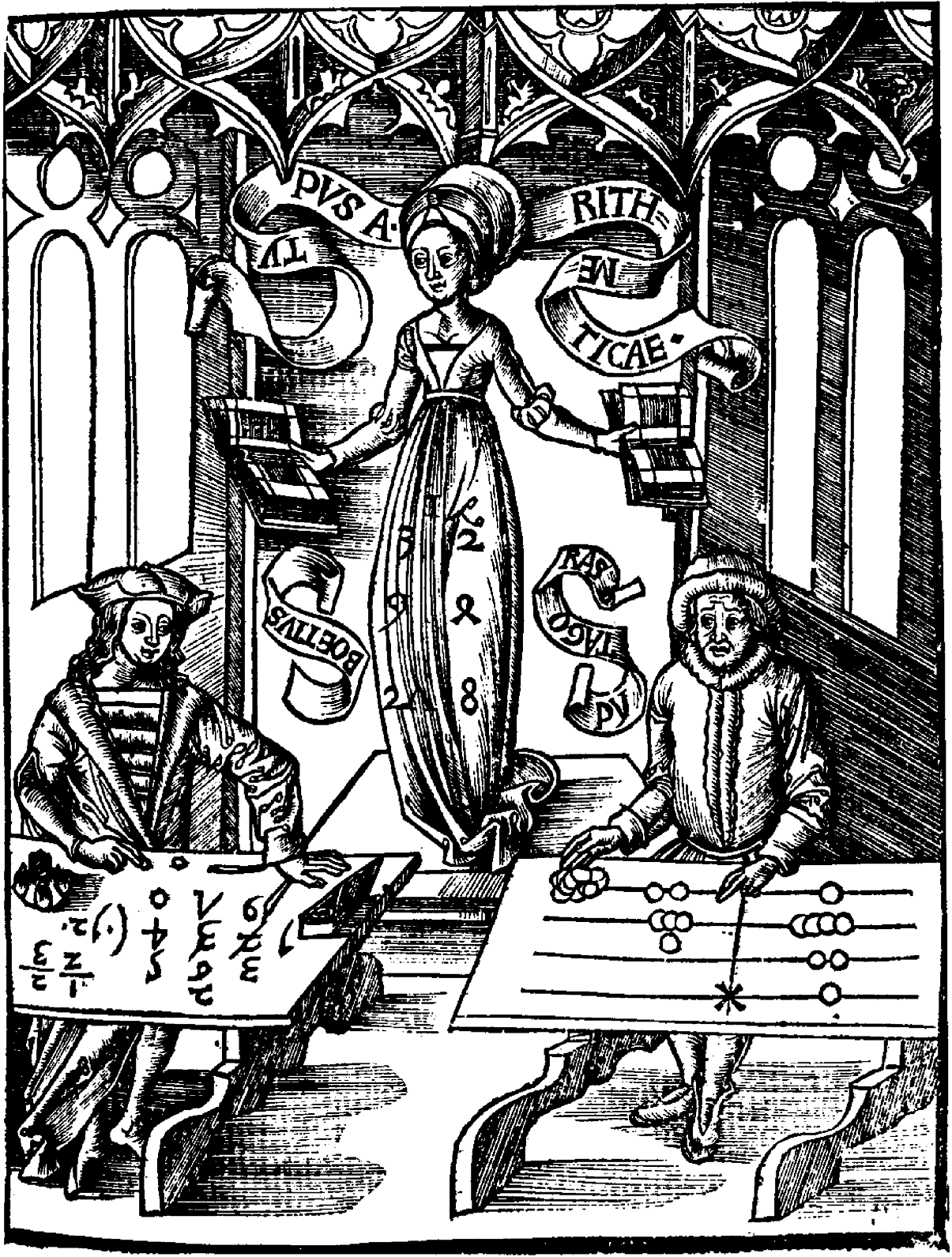
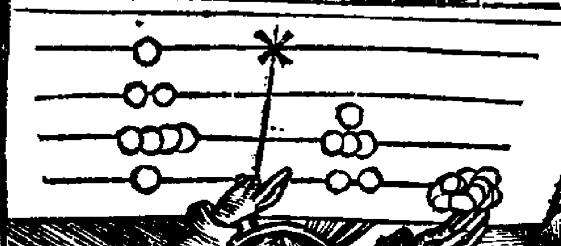
     This is a short note on the blank nature of the “checkers”, the place-holders, the missing numbers, of ancient computing machines,  the counters (jetton, or jeton1) used in early/ancient arithmetical reckoners, the material pieces used to aid in addition and multiplication “devices”. These bits were sometimes pebbles or shards of pottery or rocks, and placed on the ground with a grid drawn in dust, or in sand, or on any surface that could hold a line.  There are fancier and more permanent types of these instruments, as we see in the right side of this iconic woodcut image from a 1503 universal compendium of knowledge–a simple wooden table with incised counting lines, with the jettons being blank disks.

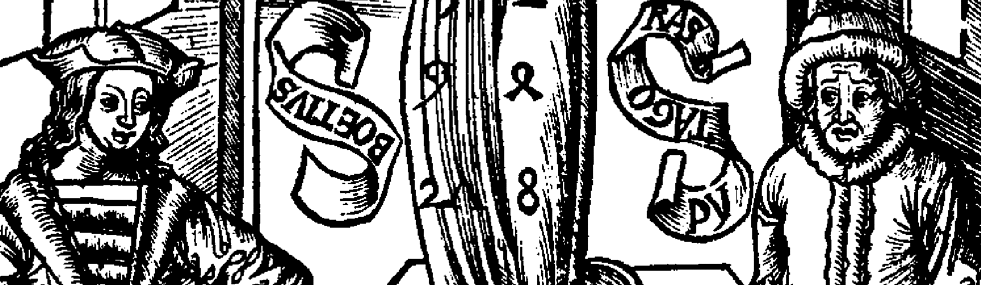
    The book that this  beautifully-illustrated counting board is found is in Gregor Reisch’s  Margarita Philosophica,  and depicts (amidst much else in the greatly humanist volume) representations of the mathematicians Boethius and Pythagoras working math problems on the given tools of their day. (The Reisch book is remarkable: it is basically a Renaissance encyclopedia of general knowledge, divided into twelve books:  grammar, dialectics, rhetoric, arithmetic, music, geometry, astronomy, physics, natural history, physiology, psychology,  and ethics.)  We can see in his expression that Boethius, on the left, is rather enjoying himself, knowing the superiority of his system of counting, which was the the Hindu-Arabic number notation–he definitely has a sly, self-appreciating smile on his face.  Pythagoras, working with the old counting table, definitely looks worried, or at least unhappy, unsettled.  Never mind that Pythagoras (570-495 b.c.e., none of whose works exist in the original, another sort of entry in our Blank History category) was at a definite disadvantage in the calculating department, being dead and all that for hundreds of years before the Arabic notation was more widely introduced in the West, probably being introduced by Pisano/Fibonnaci in the 12th century.  But it does fall to Boethius, the smirker, to have introduced the digits into Europe for the very first time, deep into the history of the Roman Empire, in the 6th century. 

    The numerical stand-ins in the Reisch book with which Pythagoras worked were blank, coin-like slugs used as placeholders, and would be used in place of rocks or pebbles or whatever other material was at hand. It is interesting to note that the Latin expression, “calculos ponere”, which basically means “to calculate”or “to compute”, is more literally translated into  “to set counters” or “to place pebbles” (upon a counting board) or to set an argument2,  which is exactly what some of the Roman daily reckoners would do at their work. And also used, in this case, by the unhappy Pythagoras. 

    Reisch

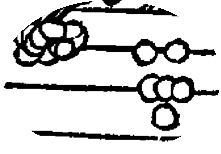
    Here’s a small close-up of the blanks:

    Reisch b
    The problem that the Pythagoras-person was working on (flipped 180  degrees) shows him adding the numbers 1241 and 82.  A jetton occupying the the top of the mark on the counting board, counting as one unit of 1000; followed by two units of hundreds; four tens; 2 on the ones.  The other number interestingly keep one jetton in between two lines, signifying an easy wade of enumerating 5 of any one kind, in this case depicting 8 tens units, coupled with two ones., thus making the number 82.)

    Reisch d

    For an excellent explanation of the many and varied methods of ancient calculations see the article by Steve  Stephenson3 on how ancient computers worked, found in the IEEE Global History Network site,  here. 

    It is a simple observation, but interesting to me nevertheless, that there was so much about these early counting systems that even though extremely useful they were also highly ephemeral–the counting boards being  inscribed in dust or sand or dirt, the counters/numerical placeholders being blank disks or pebbles or pottery shards–and so so much of the counting world depended on so little.

    Notes

    1. I should point out that these markers seem to have been decorated more often than not–its really just those items that appear in the Reisch book that I am addressing.   On jettons, in general, see here ;  also,  Jetons, Their Use in History.

    2. See Jen  (1998, April 25). “Roman Counting Instruments”, in The Math Forum at Drexel University. Also see Karl Mennigner’s  (1969) Number Words and Number Symbols: A Cultural History of Numbers, a big, academic/coffee table book on the history of numbers.  Also in general, see: Barnard, Francis Pierrepont, (1916). The Casting-Counter and the Counting-Board, A Chapter in the History of Numismatics and Early Arithmetic. Oxford University Press, London.

    3. This is a deep and nicely-explained effort looking at the development and different sorts of these instruments, as well as how they functioned.  Regarding the Reiwch woodcut, Stephenson says:

    1. Pythagoras has his abacus oriented with a vertical median line;
    2. The lines are equally divided so the same number of jettons can be accommodated on either side of the median line;
    3. The top horizontal line is marked with an X, (perhaps) to indicate the unit line; and
    4. On the right side of the abacus is a jetton in a space, all other jettons are on horizontal lines.

    On pp.313-314, Prof. Barnard describes and quotes from Legendre, François, 1753. L’Arithmétique en sa perfection, Paris, pp. 497-528, Traité de l’arithmetiqué par les jetons:

    It was permissible to set and to work the jettons of the sum without using the spaces [between lines], … But it was much more convenient to anyone who was expert at the practice, and less confusing to the eye, to reduce the number of jettons by using the spaces.


  • A History Blank, Empty and Missing Things #76–the American Bison Extermination Map

    JF Ptak Science Books   Post 1512

    Part of this blog’s series on Blank, Empty and Missing Things.  (My thanks to Blanche McCallister for setting me on this path this morning.)

    “A disgrace to the American people in general, and of the government in particular.”  “The men who killed bison for their tongues and who shot them from railroad trains were murderers.”–William T. Hornaday, on the extermination of the American bison, particularly in the 1870’s.

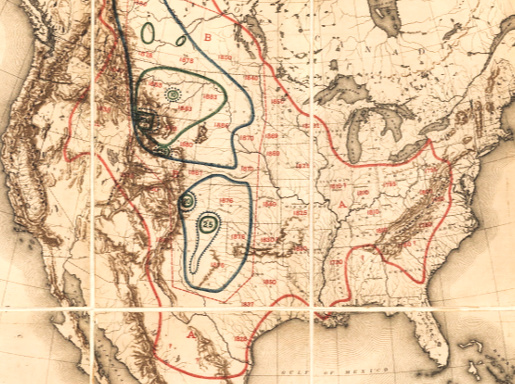
    William Temple Hornaday was an early–and probably a founding–member of the American conservation movement, and was also director of the National Zoological Park. He wrote a tremendously bitter and accurate report for the U.S. National Museum in 1894 on the extermination of the American bison, an absolute head-shaker, detailing the history of the bison in North America and its destruction at the hands of sportsmen, hunters, mindless dolts and many others who massacred tens of millions of the animal (“murdered” is the word Hornaday uses constantly).  To put the whole issue in perspective, Hornaday issued a famous map showing the shrinkage of the North American bison herd, setting out the enormity of the issue instantly on one piece of paper, a summary of hundreds of pages of bad stories and big numbers.

    Maps Hornaday


    Hornaday Map legend (1)

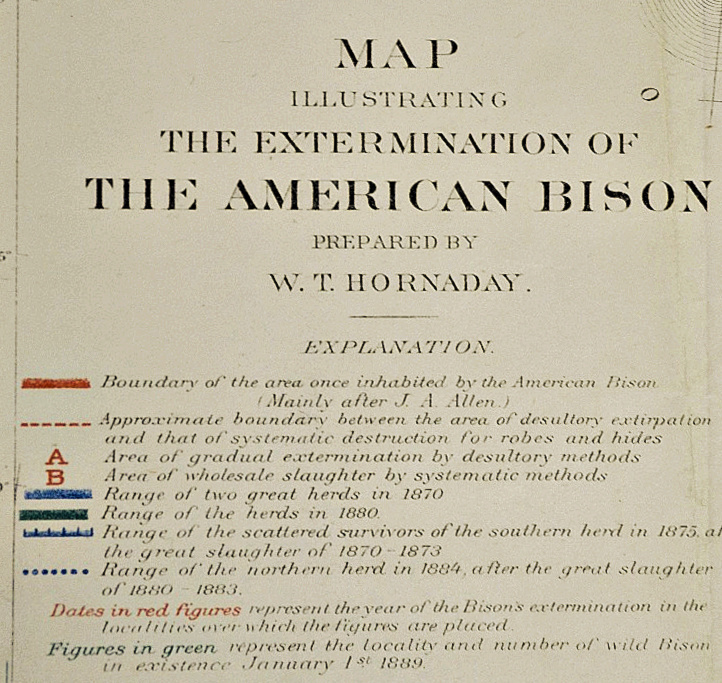
    And the legend

    [William T.Hornaday,  “Map Illustrating the Extermination of the American Bison”.  published in the 1886-1887 Report of the National Museum, Washington, D.C. entitled The Extermination of the American Bison, and printed by the ubiquitous Government Printing Office in 1894.  This full text version comes from the Library of Congress site.]

    The map certainly provides a real context to the numbers collected by Hornaday–numbers so big that it is hard to put them in any perspective.  For example, for the year 1873, the Atchison, Topeka and Santa Fe Railroad carried out 250,000 bison robes, 2.7 million pounds of bones and 1.6 million pounds of meat.  Generally the robe count was estimated at being about 1/6 of all the bison killed, so of the 1.2 million of taking this train ride in this one year (of aggravated annihilation) there was 1.6 million pounds of meat.  Now the refrigerated car was available at this time, so it was possible for meat to be transported to market, like 100 million pounds worth, but that was not of interest to anyone.  Not really.  Except of course for the bison tongue, which was sometimes the only thing removed froma  slaughter of thousands.  The tongue was a delicacy, and sold for 50 cents.  Just for the record, bison calf skins were sold for 50 cents, as well; adults were $1.25.  (Fifty cents in 1873 would be what the lowest-paid cowboy would be paid per day, half a dollar to the guy at the tail end of the cattle herd, the dust-eater.)  Over a three year period for the same railroad, 1872-4, there were 450,000 robes shipped, plus 2.2 million pounds of meat, and 16 million pounds of bones.  Again, this is about a pound-per-bison of meat, not even the weight of a tongue.

    Hornaday records the murder and murderers, repulsed at his findings–his revulsion comes through, as does the overwhelming lesson of carelessness and stupidity in dealing with the American landscape, and the creatures that lived on it. 

    The iconic photographs of bison skulls awaiting shipment are incredible, but I think it is the Hornaday map that gives the entire issue an overall correspondence to the magnitude of the destruction.


    And here’s a map of one of the last bison hunting expeditions, this undertaken for specimens for the National Museum, showing the enormous, continent-covering herds reduced now to individual dots on a large landscape.

    Image 192 of 208, The extermination of the American bison.    

  • Duelling Propulsion Systems: Patents for Swinging on a Swing, Sushi Boats and Retro-Pseudo-Mayan Space Ships

    JF Ptak Science Books   Quick Post in the Questionable Quidity series

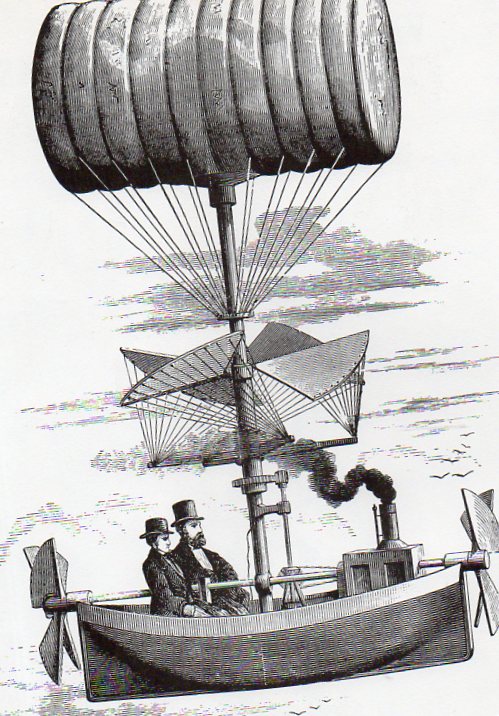
    I came across these bits looking for spacecraft propulsion systems, and was surprised to find so many, well, “questionable” applications of brain power and time. Sushi boats for lazy eaters? Non-proto-Mayan naive electromagnetic spacecraft?  Swinging (on a swing)?

    I thought the swinging patent was a joke; it seems not to be.  Isn’t this like, say, patenting walking by using shoes?

    The least and the most one might say for the sushi boat is that it is powered by water, though I’m not entirely sure what else there is to be said; seems a little close to being a trough for my taste, though I have to admit that I’ve never had an experience where I pluck my food froma  moving object.  Perhaps if the little boats were on fire it would be more attractive?  Or if there were submarines? 


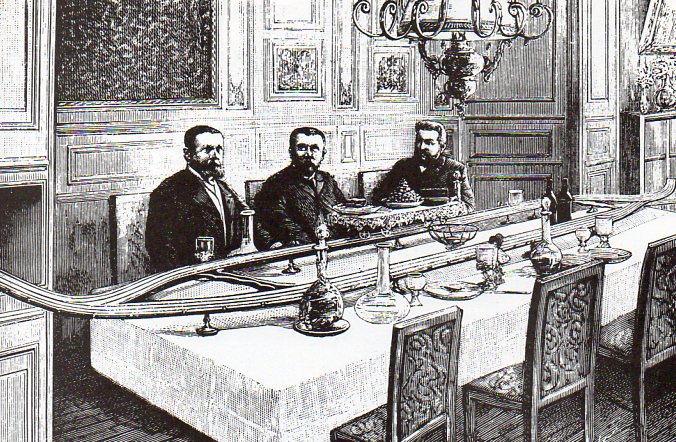
    An earlier version of this idea from 1887, showing the use of “midget electric trains” “at the kitchen and dinner-table of M. Gaston Menier”–somehow this is a little more appealing, though the prospect of eating on a miniature railway track is not all that appetizing:

    Propulsion536

    This is an interesting variation of the two bits above, though (surprisingly!) there is no food involved:


    Propulsion531

    Back to sushi:   evidently a much bigger idea than I gave it credit for: 


    And from America:


    There were many other novel and noble efforts in the area of propulsion, particularly in the late 19th century, a few lovely examples of which can be seen here: 

    Propulsion532


    Propulsion533

    Propulsion534


    Propulsion535


  • An Alphabet of Fire–Night-time Telegraphy, 1800 vs. the 1991 Pen Ashtray

    JF Ptak Science Books     Post 1510

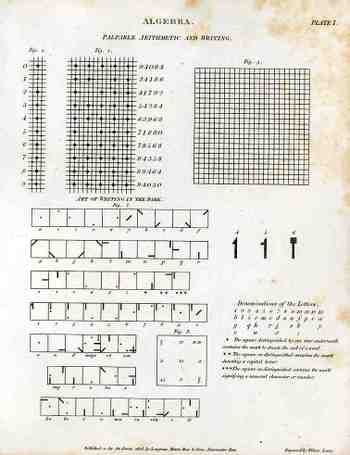
    Blog1sept_6_palpable514

    This curious illustration appears in forty-five volume Cyclopedia of  Abraham Rees (published 1795-1820), displaying a system for communicating over distances at night.  When this part of the Cyclopedia was printed in 1808, the electrical telegraph as we now it was still 37 years away from coming into being–45 years from being somewhat well-used.  Before this time (visual) communications over long distances at night were limited to just these sorts of means–lighted semaphores, hand-held torches, that sort of thing.  Signaling at sea at night was somewhat different at this time and didn’t include anything remotely close to the alphabet.  So the rather complex system that we see at left is extremely uncommon–it seems also very cumbersome to put into effect. 

    Unfortunately I don’t have the text volume that would explain then entire system and implementation, so I’m going to guess that there was a large, powerful light source that was covered by a tight, black, covering tablet that would eliminate nearly all light leakage.  The symbols for each letter of the alphabet (and numerals) would be cut out from another tablet that would fit over the face of the light source, placed between the blank and the light.  To transmit a letter the user would then simply remove the blank covering tablet to reveal the light broadcast by the hole or slit in the tablet underneath.  The blank would then be placed back, a new tablet for a new letter placed underneath, and the process would begin again:  blank (dark); letter (light); blank (dark); letter (light), and so on to the end of the message.   I guess the distance at which these symbols could be seen would be dependent on light source, atmospheric conditions, ad so on.  The way that the letters are made into symbols seems to me very intelligent, so that you distinguish the differences from an appreciable distance.  I like it–its an elegant idea.  (Well, maybe it didn’t work in this manner, but it seems to make sense to me.)

    One can only imagine what the early 19th-century mind would think if they saw this sort of fire-writing device, and how the progress of the history of technology came to produce such a thing:


    Now, does someone look at the pen ashtray and think, “I NEED one of those!”, or what?   To me it represents one of those representatives in the Humans-are-as-Soft-as-Soup category.

    Here’s another sort of fire writing, more literal and of course much less applicable, unless you were recording the writing with a stop-action camera:


  • How Fish and a Dog Nearly Prevented the Publication of Newton’s Principia

    JF Ptak Science Books    Post 1508

    Well, not really, no.  But sort of–when you open up the Big Book of Big Discovery, and go to the “N” section, and read about the Principia, the fish and the dog will at least be there.

    The story of Edmond Halley and his wide importance in getting Isaac Newton to write what may be among the most supreme efforts in the history of science is very well known.  In pursuit of an answer to an excellent question put to him and Robert Hooke by Sir Christopher Wren in a London coffeehouse, Halley pursued his answer to the very doorstep of Newton, right to Cambridge, in a personal visit.  Newton of course knew the answer and knew more than the question, as his response provoked some of the deepest thoughts in the history. The answer to Wren’s question involved something much bigger than what he knew, and it took Newton to recognize the elemental issue at play. Of course the answer would require a lot of collected observations and accurate data, which Halley could certainly provide via John Flamsteed (who was the founder of the Greenwich Observatory, and the first astronomer royal of England), but the answer involved the ability to do the calculations in a fundamentally different way.  It was the genius of Newton through and through that made the Principia (the full title by the way being Philosophiæ Naturalis Principia Mathematica, which is Latin for “Mathematical Principles of Natural Philosophy”), the Essential Book, but without the intercession and data provided by Halley, the whole deal gets a little muddy.

    I can imagine that Hooke, who even though had come to the top of Newton’s s-list, knew how he could answer the question, and knew that it was Newton that he needed to see, but he just couldn’t do it.  As a matter of fact the Hooke/Newton business would get a little deeper as the Principia came closer to publication, with Hooke claiming some priority and influence in the ideas forming Book III–a claim that nearly prevented Newton from publishing that section of the work–but Halley again stepped in and smoothed the matter over, at least for the sake of publication.  Hooke though didn’t let go, and neither did Newton, whose ultimate revenge over Hooke was by living significantly longer. 

    He was prodded into publishing by Halley, who flattered and beguiled and pushed and preened and all the rest, skillfully managing the spectacular and difficult Newton, pressing him to completion.  It might be said, I think, that had Halley not been there to press Newton along, the Principia might not have been written at all, and we would know Sir Isaac for other things, but perhaps not for his great masterpiece. 

    Aside from Halley’s insistence, there was also the issue of money and getting the Principia printed, and even though the Royal Society had given its imprimatur1 on Newton’s project and had agreed to see it published, the publication was not necessarily a done deal.. The Royal Society hadn’t gotten gotten over its disastrous investment in Francis Willoughby’s History of Fishes (1686)2–an expensive edition with beautiful illustrations, a project that they funded but which just didn’t sell.  And so the Society was a little gun shy, and tight.  As a matter of fact, Halley was at the time under consideration for the position of subordinate clerk, and was to receive a salary of 50 pounds (a substantial amount for the time) but was to be paid in copies of Willoughby’s book, which was evaluated as one pound per copy (so Halley would make 50 copies of the Willoughby book for his work, per year).  But Halley guaranteed to pay for the publication of the Principia, paying for the thing out of his own pocket. 

    Luckily Halley wasn’t dependent upon his income as clerk, having inherited a legacy as well as a number of productive properties from his father3.  Halley had at least an inheritance of 150-200 pounds from his father’s estate, not including 60 pounds that he received every year before his father died.  In addition to the cash was “property in several parishes in the city of London, including 13 houses in Winchester Street, two others on Canon Street…[others]…and the Dog Tavern.” Halley was making enough money from the property investments to live a comfortable life, plus he had his own sources of income, plus he was living in a house without payment, also inherited from his father.  Halley was comfortable.

    There was evidently one piece of property that was a major source of trouble to Halley’s father and which it seems for a time threatened the stability of the family’s legacy–the Dog Tavern.  But the elder Halley–also named Edmond–overcame those issues and held onto his other properties without major liabilities, and was able to make his bequest to the younger Halley, who was then (after much else happens) able to proceed funding the publication of the Principia.4

    Notes:

    1. Following the Halley visit in 1684 (August)  Newton would send his  De motu off to the Royal Society (received 10 December) ; after two and a half years of work on  28 April 1686 Newton’s sent the Principia, Book I to the Royal Society, which on 19 May decided to publish it and which liscensed the book (via Samuel Pepys, the President of the Royal Society) on 30 June. 

    2. The book was actually completed by John Ray following the death of Willoughby.

    3. That  information comes from an article I read yesterday which sparked this post (Cook, Alan (07/01/1991). “Edmond Halley and Newton’s  Principia. Notes and records of the Royal Society of London,  45 (2), p. 129}, Cook determining through his own careful research that Halley had ample funding to take care of the Principia (and also why it might have taken Halley so many months to make his trip to Cambridge, rather than just heading off to see Newton straight away from his coffeehouse meeting with Wren and Hooke). 

    4. After it was all said and done, it looks as though the entire printing (300-400 copies, including 100 copies for presentation) of the first edition of the Principia cost under 100 pounds.  Part of this cost was offset because a number of copies were sold as sheets that were to be bound by the purchaser.  The second edition of 1713, with a print run of about 700 copies, cost 117 pounds.  It is interesting to note that the prices paid for copies of the first edition of the Principia didn’t reach their astronomical proportions until the last decade or so, when lovely copies might demand a million dollars or more.  A.N.L. Munby (Munby, A N L (10/01/1952). “The Distribution of the First Edition of Newton\’s \’Principia\’”. Notes and records of the Royal Society of London (0035-9149), 10 (1), p. 28) determines that he average price for the 17 copies of the Principia sold during the 1930’s at auction was about 50 pounds, and that a signed presentation copy made 1 pound (!!) at auction in 1894.  Munby makes a good observation that the copy of the Principia for the Learned Gentleman’s library in days gone by wouldn’t necessarily have been the first edition, but the best edition, which would’ve made that the third edition of 1726. 


    See also: 


    ·Posted by :

    ·in:

    — —

  • The Eyes of Hank Quinlan–Touch of Evil, 1958

    JF Science Books    Quick Post

    Hank Quinlan: Come on, read my future for me.
    Tanya: You haven’t got any.
    Hank Quinlan: What do you mean?
    Tanya: Your future is all used up. –from Touch of Evil, 1958  (Hank was played by Orson Welles; Tanya, his once-upon-a-time squeeze, by Marlene Dietrich.)

    http://parallax-view.org/wp-content/uploads/2008/10/touch-of-evil-quinlan1.jpg

    This has been one of my all-time favorite films, though I don’t want to actually see the thing too often.  It is sharp as glass, with hardly any grays in sight, mostly oblique black and white, giving the film a very “removed” feeling, cold, isolating.  Orson of course is a magnificent beast, the enormous shell of a spent bully with virtually nothing left to move around except for his undulating fat and a sliver of power, wielding that jiggly memory with eyeballs so puffy and dead that I do not know to this day how he achieved that pus-y look.  His entrance into the film is remarkable–big black car door opens, and the gigantic Orson pulls himself out, his pig-bristle slough-eyed face way too close to the camera for comfort.

    It is an odd movie, but just about every still you see from the thing is like a stand-apart photograph, a movie composed of 55,000 individual images.

    http://www.moviezeal.com/wp-content/uploads/picture-2-300x256.png


    Badge of evil The screenplay was written by Welles, though it may have been influenced by a novel by Whit Masterson (actually a pseudonym for another pseudonym, Wade Miller, which was the entity of Robert Wade and William Miller, which is entirely  too much rigorous hidenness for such a modest effort) called Badge of Evil (1956).  This doesn’t matter; the whole deal about the film is the brain behind the staging and filming, which belonged of course to Mr. Welles. 

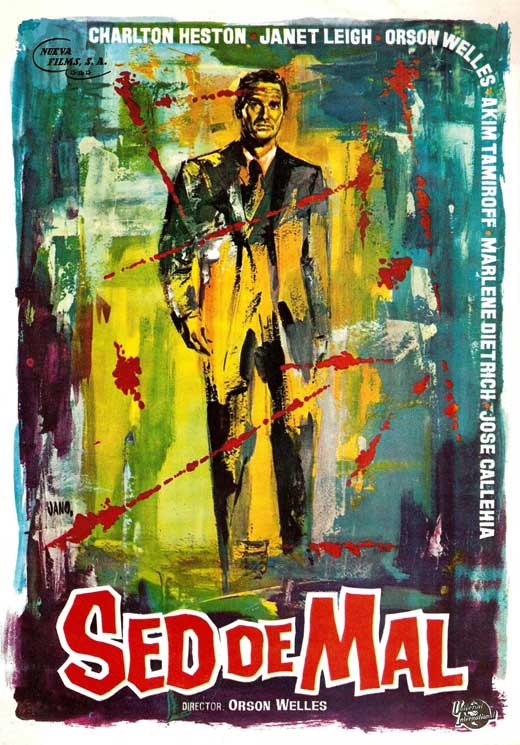
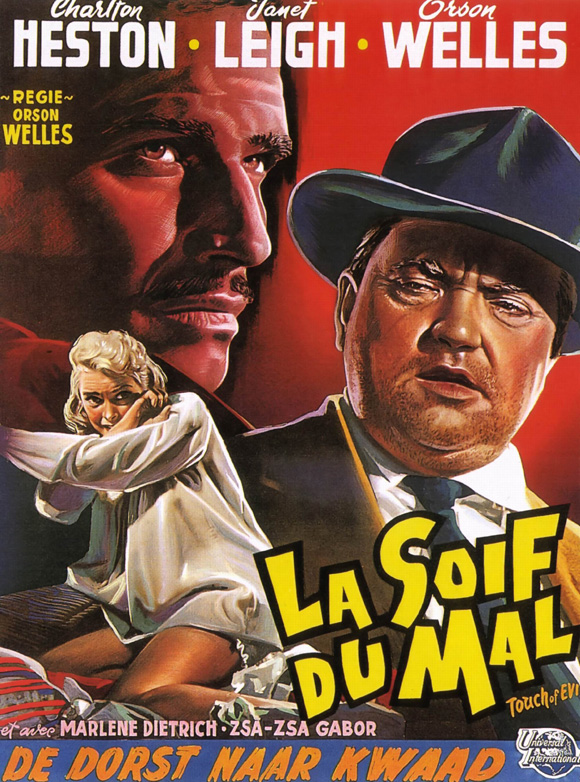
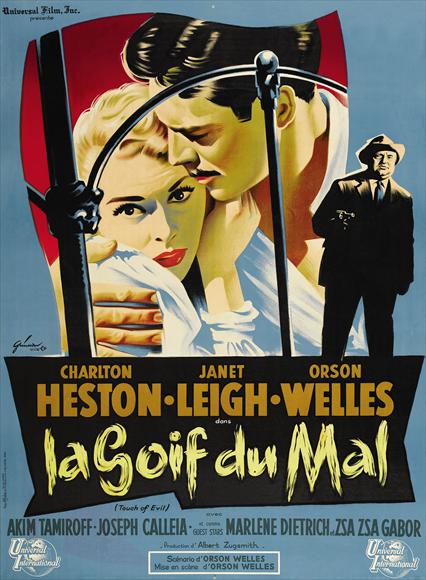
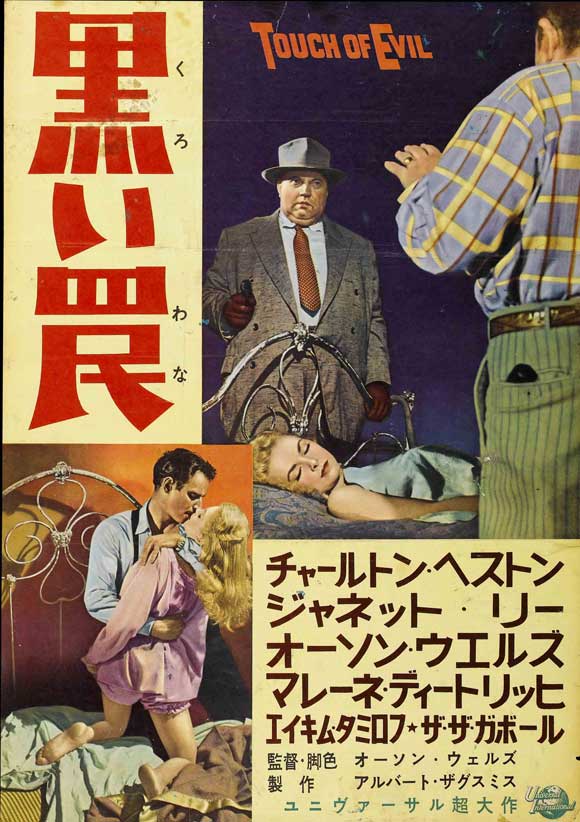
     All I really wanted to do with this piece today was post a variety of Touch of Evil movie posters.  Here they are:

    http://upload.wikimedia.org/wikipedia/en/f/fe/Touch_of_Evil_restored.jpeg

    This isn’t the entrance I was talking about–can’t find it–but this view of Orson is pretty good (comes at about 3:30):


    Touch-of-evil-movie-poster-

    Touch-of-evil-movie-poster-1958 d
    Touch-of-evil-movie-poster-1958

    Touch-of-evil-movie-poster-1958-
    Touch-of-evil-movie-poster-1958-g
    Schwartz: Well, Hank was a great detective all right.
    Tanya: And a lousy cop.
    Schwartz: Is that all you have to say for him?
    Tanya: He was some kind of a man. What does it matter what you say about people?