A Daily History of Holes, Dots, Lines, Science, History, Math, Physics, Art, the Unintentional Absurd, Architecture, Maps, Data Visualization, Blank and Missing Things, and so on. |1.6 million words, 7500 images, 4.9 million hits| Press & appearances in The Times, Le Figaro, Mensa, The Economist, The Guardian, Discovery News, Slate, Le Monde, Sci American Blogs, Le Pont, and many other places… 5000+ total posts since 2008.

Author: JF Ptak

  • George and Archie: Two Misty Names in Making Everything Into Nothing. Hiroshima, 1945.

    JF Ptak Science Books   Post  1523
    http://upload.wikimedia.org/wikipedia/commons/thumb/9/93/Tibbets-wave.jpg/300px-Tibbets-wave.jpg

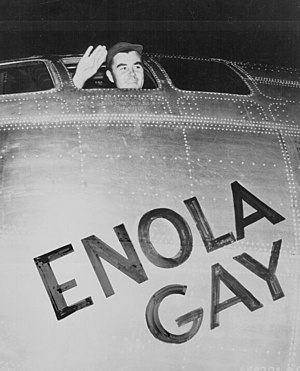
    The names of Col. Paul Tibbets and the Enola Gay are instantly recognizable, instantly placeable in the history of the twentieth century.  Fact is though that Tibbets didn’t pilot his (well, Capt. Robert A. Lewis’)1 B-29 all the way to Hiroshima and back, and wasn’t at the controls when the bomb was released.  Tibbets (also known as “Old Bull”) shared some of the tactically flawless mission with his co-pilot  Capt. Lewis, and also with George.  Well, its actually “George”,  the personified names for the autopilot of the aircraft, and I guess on the long road to splitting the atom it doesn’t matter much who did what at the final moments, especially if you were on the ground in Hiroshima. 

    It was Tibbets who flew the Enola Gay most of the way, through perfect skies, nothing to stand in the way of the aircraft and the completed mission–no Japanese fighter aircraft to haunt and hunt, and no anti-aircraft coming from the ground, at least not at their  low altitude.2 “George” was at the controls at 0815 on 6 August 1945–Tibbets would take control of the plane as the bomb fell away3, ripping the plane into a steep bank in trying to put as much distance between the aircraft and the bomb in the 43 or so seconds that they had before the explosion. Everything else about the bomb and the mission at the moment of release was controlled by a human–except for the flying of the aircraft. “

    “Archie”4 is the other name not so much remembered on this morning.  This was the name given to the apparatus (there were actually four of them on the bomb) that would initiate the final arming sequence for the MK1 bomb, “Little Boy”, one of a component of a fusing system that triggers the firing system.  It was a nicer handle I guess than its official name, which was AP-13.

    Notes:

    1.  Lewis was the original pilot of the aircraft until Tibbets was chosen to lead the mission against Hiroshima.  Tibbetts was named on 5 August and acted very quickly to get a painter to paint a name on the fuselage of B-29 82–so quickly that the guy who painted Tibbets’ mother’s name on the plane had to be pulled out of a baseball game to do the job.  When Lewis saw it, saw his plane with “Enola Gay” on it, he reacted badly, as he was mighty pissed.  He confronted Tibbets about it, but the Colonel informed the Captain that there was nothing to discuss. 

    2. Intelligence reported that the only antiaircraft resistance that could be expected were from heavier guns, which also happen to be very ineffective at the low altitude at which the Enola Gay flew.  This also benefited another aspect of the flight plan, which was fuel consumption–coming in low meant a big fuel savings, which in this case was very important because of the enormous load that the aircraft was hauling. 

    3. The Enola Gay would climb at last to 31,000 feet to release the bomb, which exploded at about 1980 feet above the ground. 

    4.  An interesting document from General Groves sums up the Archies nicely:  “Memorandum dated 24 August 1944 to Major General L. R. Groves from R. N. Brode, subject: Personnel with Radar Experience. According to the latter, the APS-13 was originally called the “Charlie” and those units to be adapted to atomic bombs were to be rigged to operate at selectable frequencies between 250 and 500 megahertz. By 1 January 1945, the “Archies,” with a “natural” range of 405 to 435 MHz, could be tuned between 325 and 485 MHz.  (“Interim Report Archie Frequency Range,” Lt. Leo Gross, 1 January 1945)–The History of U.S. Electronic Warfare, by Alfred Price, Association of Old Crows, Alexandria, Virginia, 1984, p. 232.”

    “By the spring of 1944, the APS-13 “tail warning device” was under study for use as a radar fuse. Originally designed to warn a pilot of another aircraft approaching the rear of his plane, the “Archie” had an effective range of about 2,000 to 2,500 feet.” Source: The Swords of Armageddon: U.S. Nuclear Weapons Development since 1945, Chuck Hansen, September 4, 1995, vol. VIII, pp. 3-45.

    And more:

    “Four “Archies” were used on each bomb, with a network of relays so that when any two of the units signaled, stored current was sent into the detonators (one on the MK I and 32 on the MK III). The antennas for the “Archies” were attached to the sides of the bomb casings.

    “A barometric pressure-sensing switch closed when the bomb passed 7,000 feet; the bombs were dropped from altitudes between 31,000 and 32,000 feet. A bank of clock-operated timer switches, started by arming wires pulled out when the bomb was dropped, closed 15 seconds after release to prevent the “Archies” from being triggered, in case of baroswitch short-circuit, by radar signals reflected from the delivery aircraft.

    “The arming and firing sequence for the first two atomic bombs was (1) 15 seconds after release, when the weapon had fallen 3,600 feet, the timer switches closed part of the firing circuit; (2) at an altitude of 7,000 feet, the barometric switch closed another part of the firing circuit and allowed electrical current from batteries in the bomb to charge a number of capacitors and turn on the radar fuses; (3) at an altitude of about 1,800 feet, radar signals emanating from the “Archies” and reflecting from the ground completed the last part of the firing circuit and triggered the detonation signal.”
  • The Geology of Hair

    JF Ptak Science Books   Quick Post

    “The geological formations of the globe already noted are catalogued thus: The Primary, or lower one, consists of rocks, bones or mired mules, gas-pipes, miners’ tools, antique statues minus the nose, Spanish doubloons and ancestors. The Secondary is largely made up of red worms and moles. The Tertiary comprises railway tracks, patent pavements, grass, snakes, mouldy boots, beer bottles, tomato cans, intoxicated citizens, garbage, anarchists, snap-dogs and fools“. (Ambrose Bierce, from the entry “Geology” in The Devil’s Dictionary.)

    AS it turns out, the geology of replaced hair, of hair lost, hair forgotten, is rather sedimental.  Its a surface category only, with so little underneath, so little actual “geology”, that the underneath part is almost on top. The only thing that seems to have any geological depth to it in the history of toupees is the part, which in most cases doesn’t even exist.


    And of course the Trumpian Flip:

    ·Posted by :

    ·in:

    —

  • On the Use of Blood, Bone and Guts -and- the Man Who Painted Dead Chicken Feet

    JF Ptak Science Books  Quick Post–possible revulsion factor

    I was looking for something else–mortality rates in Canada for a post on the value of a dead human body in 1860–when I found this book on the use of discarded goods and raw byproduct, a sort of early recycling effort.  The work was by Edwin Lankester, and it is called The Uses of Animals in Relation to the Industry of Man; Being a course of lectures delivered at the South Kensington Museum (published in London by Robert Hardwicke in  1860), and the initial data that caught my attention was this:


  • The Steampunk God and the non-Computer Internet, 1865

    JF Ptak Science Books   Post 1521

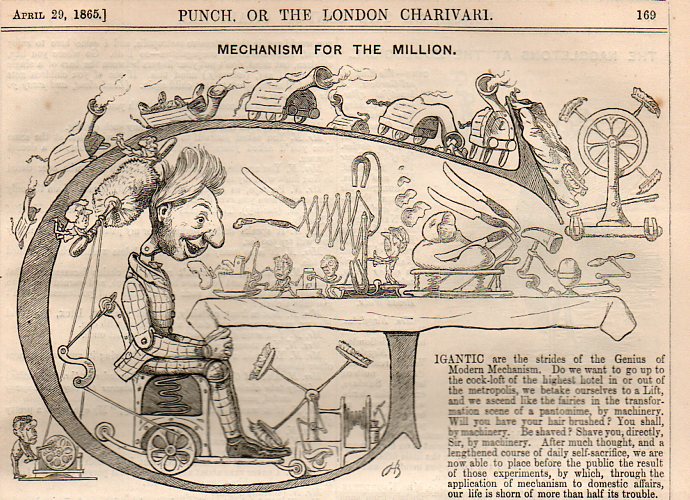
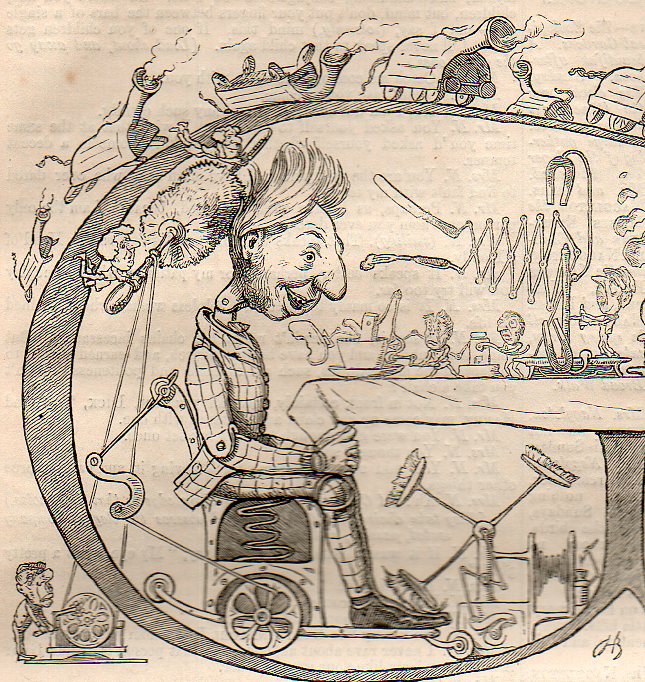
    In the weeks following Lincoln’s assassination (14 April 1865) the editors of Punch, or the London Charivari printed this arresting image of an imagined near-future:

    Mechanism545

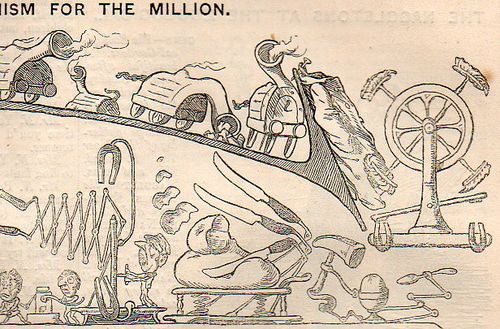
    And what the future holds is this: the automatic hydraulic teapot (already “sugared and milked”), automatic boot and clothes brushing, auto bread-cutting, carving, cork drawing, sweeping, letter writing, reading…”all done by machinery”.  “We shall cook by machinery; we shall have our mashed potatoes by machinery.”

    There is no specification about how all of this was going to happen–I’d be very interested about the automatic “letter writing and reading” would be,  particularly when we read in the next paragraph, that “Mr. Babbage’s Calculator is a mere mechanical infant to our gradually matured inventions”.   The article continues: “From thinking of machinery we shall at last arrive at thinking by machinery, and Man himself shall be, as presented in this initial etching, a mere machine.”

    We see in the image that there are all manner of automatons pleasing the seated (mechanical) man, though they are all powered by steam, or friction, or by magnets, all existing power sources and almost everything being doable at that point in time. 

    And the detail:

    Mechanism547  And this:

    Mechanism546

    There is a suggestion of a “Finding Fault Machine” but this goes barely beyond its mention–except to say that it would destroy something and become our next “Infernal Engine”.  I initially liked the sound of the title of this machine, though it quickly started to seem like a god machine to me–something that could and would have the ability to find faults in things, and then, I guess “correct” them in some sort of Steampunk God way. I’m not very educated in the world of speculative/science fiction to determine how early people began to imagine constructing their own supreme deity, though it seems to me that this must be considered an early effort.  I do have large doubt that the Steampunk God is what these folks were talking about since it would most probably be a blasphemy, but there is certainly room to reach that conclusion.

    The idea of a popular machine that was somehow associated with either Babbage’s (1791-1871) difference engine or analytical engine (which was a programmable machine that would function with punch cards) and automated or mechanical reading and writing is very intriguing.  It is unsure whether the editor was crediting the future with a machine that would provide the imagination behind writing, or provide an instrument that would record thoughts and creativity directly to some medium as they occurred, or what have you.  It is an interesting idea left very open-ended to the reader, which remains so even to the modern eye, because what happens with statements like this is that they get back-filled with whatever current technology exists.  In 1865, the other innovations depicted for the future were mainly driven by steam, and perhaps this automated writer/reader would be too, something very primitive by our standards today, perhaps some sort of small steam engine that would help dip a quill into an ink pot….or perhaps it was simply something as exotic as a pen with endless ink.  But I think if you look hard enough at the statement it is possible to see something like an internet.

    And there were 19th-century something-like-an-internet things being imagined, if you can imagine the internet as an entity not created by a computer network, since the “computer” as we know it would not exist for these inventive folks (below) for another 50 or 75 years. 

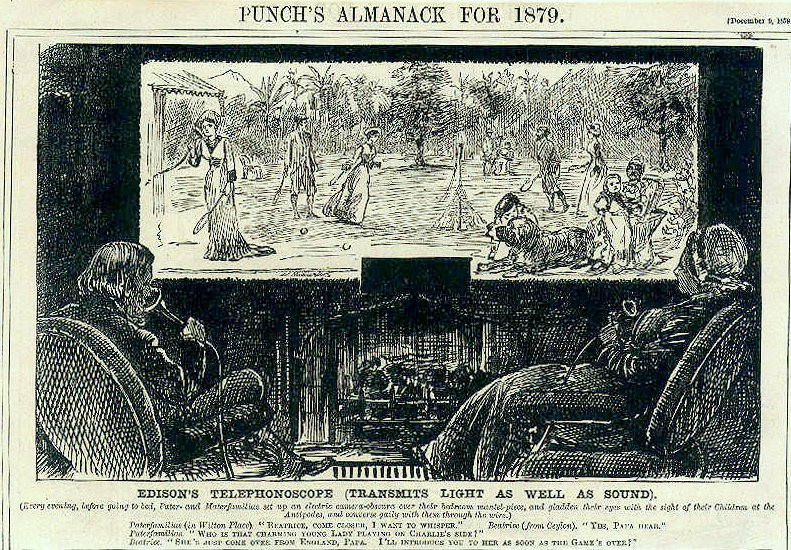
    Edison’s was there, of course, imaging a communication device that would show live-action events in which two remote parties could see and talk to one another.  A version of his Telephonoscope: appeared in Punch’s Almanack for 1879 and was aimed at the imagination and experience of only the classes of leisure and privilege:

    File:Telephonoscope.jpg

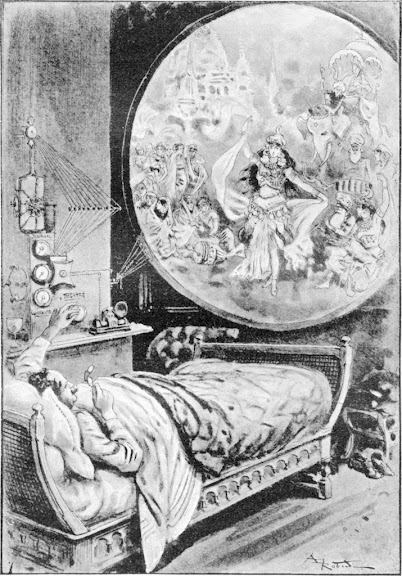
    There is also a device like this that appears in Albert Robida’s Le Vingtieme Siecle:  la Vie Electrique (1890) , which is  an odd but very nicely illustrated look into the future of 1955–most of which has come to pass.

    http://www.gloubik.info/livres/robida/images/robida-06.jpg

    http://cultureandstuff.com/wp-content/uploads/2011/05/levingtiemesiecle.jpg

    Another sort of live-action and direct communication device was depicted in Camille Flammarion’s La Fin du Monde (1893):

    I think though that the most interesting part of Punch’s view of the future must lie in the possible creation of the creator of the universe. 


  • Facial Fat and Breast Support

    JF Ptak Science Books   Quick Posts

    I didn’t quite know what to do with this bugger, but it seems so special in and of itself that I thought it deserved to stand alone.  I have seen other things like this, as in the post  made two days ago on the history of enormous bras, that used stone-age implements in the patent (see below).

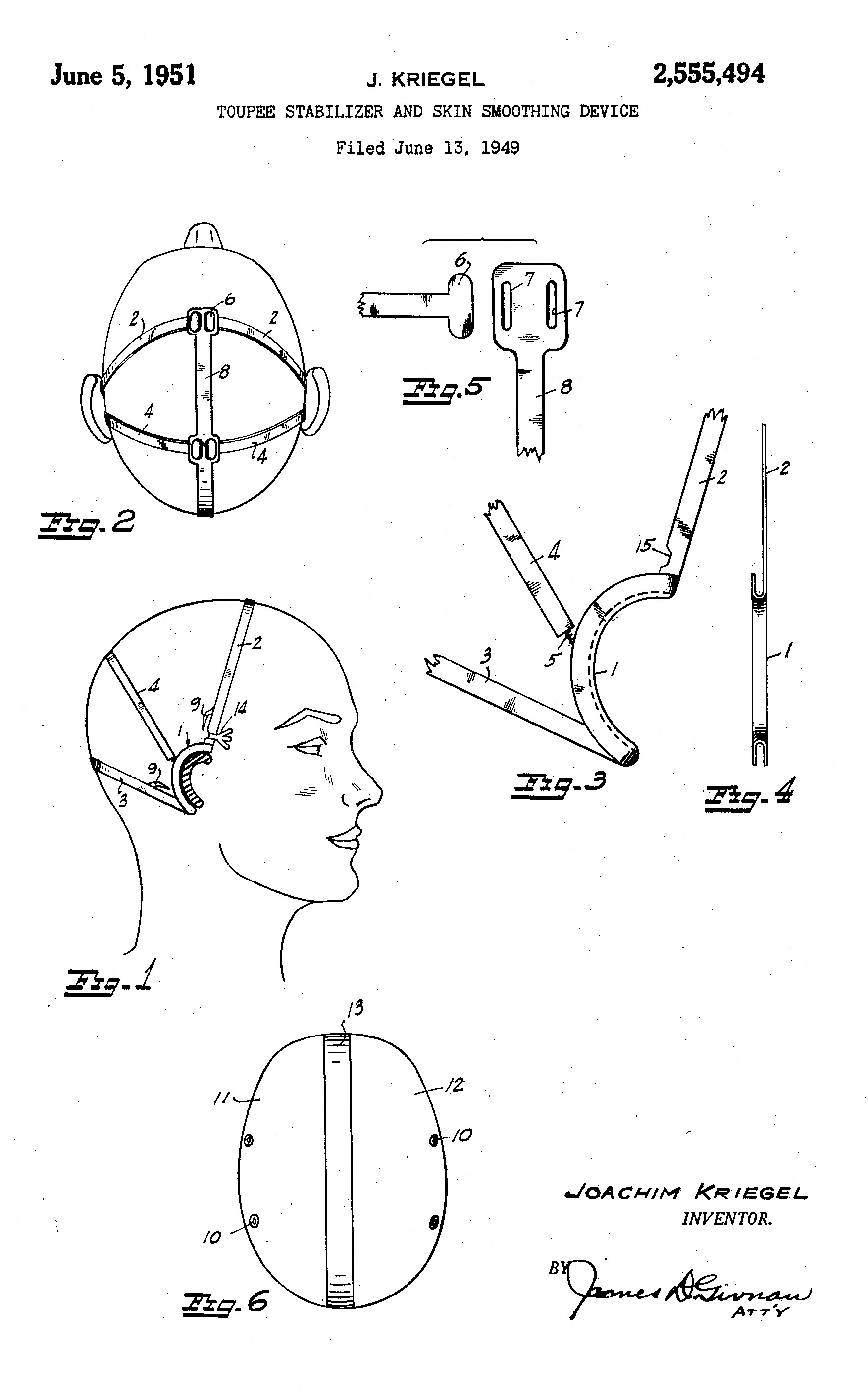
    This toupee adherer, the thing to which a toupee would be attached, also served as a facial splint–a splint for face fat, the device described as being capable of pulling back the looseness of age.  


    Patent--head bra title full

    It seems as though waking up in the morning au natural might be a bit of a shock. 


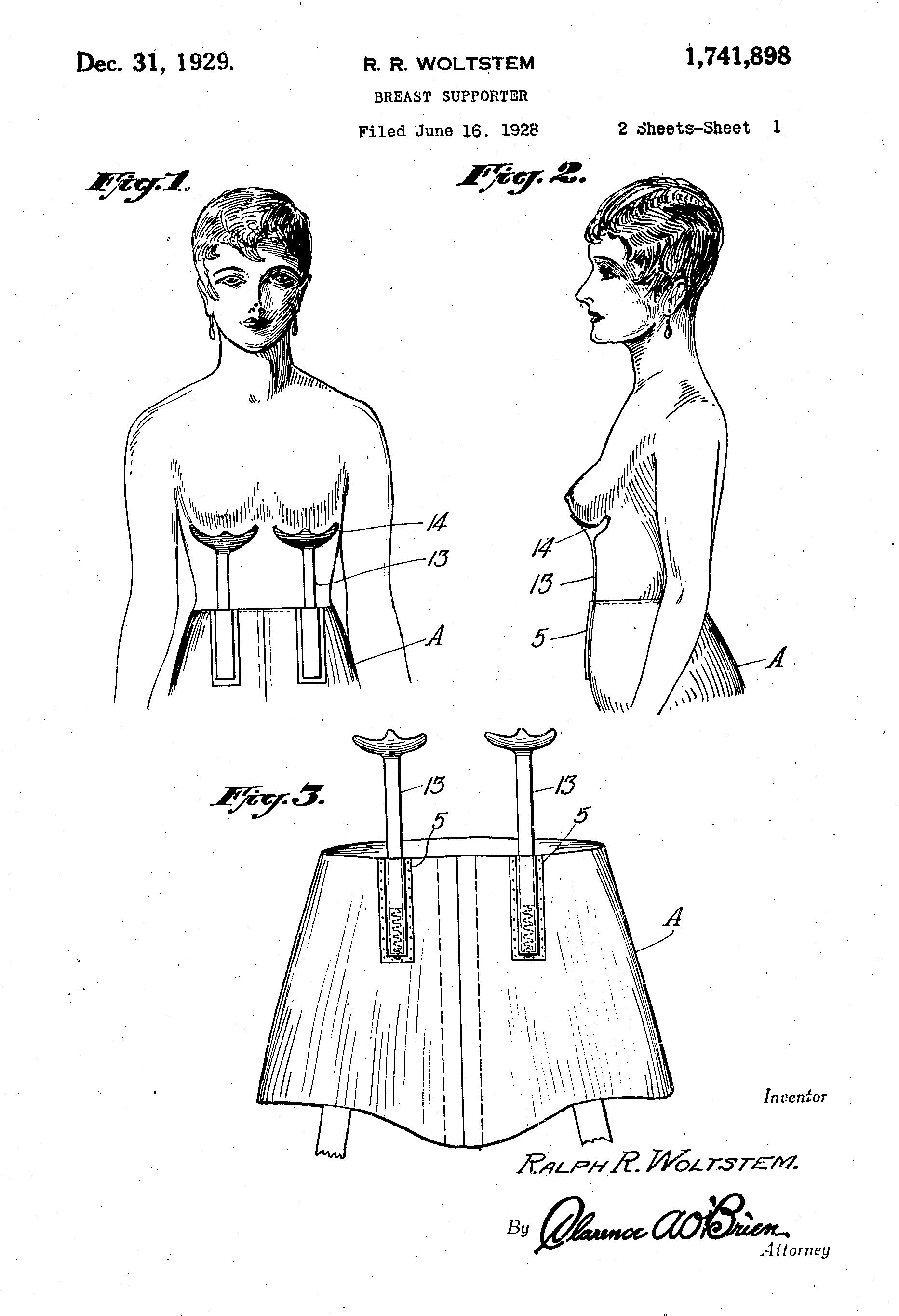
    Here’s another prehistoric bit, this on breast support:

    Patent bra


  • Shooting Dodos, Square Holes/Round Bits, the non-Future of Movies, and the Race Where Everyone Wins

    JF Science Books   Post 1519

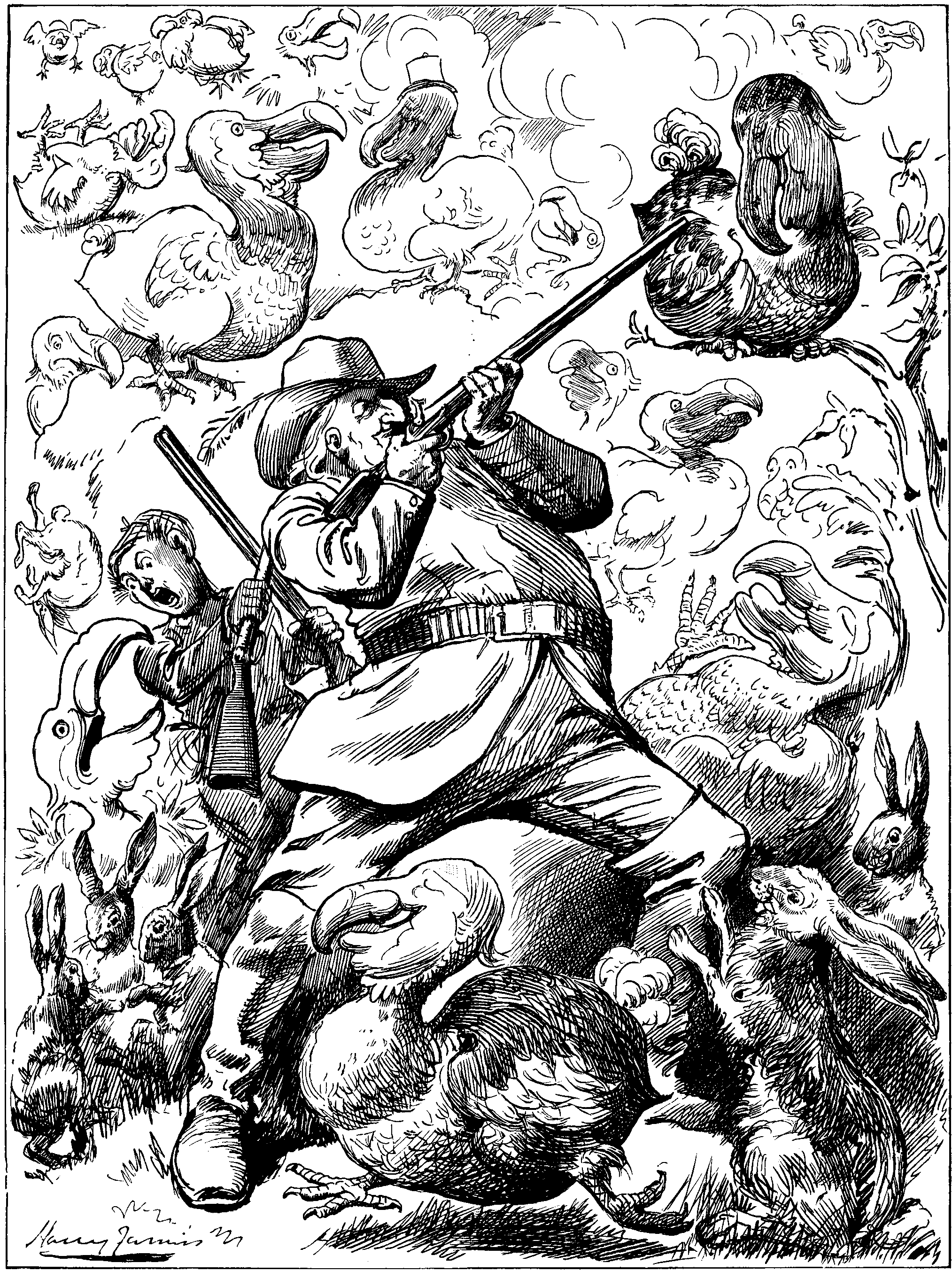
    In a world where everyone wins and no one loses, why can’t we cut a square hole with a round bit.  Or vice versa? Well, we can of course, its all just a matter of perspective.  The image (below) that started this thought thread down the rabbit hole is of a member of Great Britain’s ruling class, Sir William Houghton, appeared in Punch magazine in 1890 as an illustration in a debate over hunting rights for hares and other small critters, in what seems to have been an attempt to further control the access of the wide working class to certain freedoms.  To be honest I  haven’t looked at this debate, and I’m not sure why the liberal Sir William is shooting Dodos as rabbits, but the image–independent of what it was intended to represent–seems to be the inside-out, or the reverse-inside-out of what had been the situation with the bird. It would look “wrong” even if you didn’t know the history of the flightless and basically defenseless creature being hunted to extinction, standing in the place of the rabbit. It has an oddness to it, like a very high-pitched tone that floats above a piece of music, a slightly pungent odor coming from a nicely-executed painting. Perhaps it is the  the sense of expectation being thrown off just a bit with something like the unexpected-expected. 

    And then of course there’s the rabbit hole connection.  And Alice.  And the Dodo.


    From Report of Debate on Hares Preservation Bill, June 26.—”They (the other Members of Parliament) could not go out and kill 300 Dodos,”—but evidently he (Sir W.V. HARCOURT) could, and here he is—caught in the act…  [He reminds me of a peeing stallion–one of the most majestic poses a horse can strike]

    Lewis Carroll’s Alice gets right down to business in her adventures in Wonderland, right from chapter one (“Down the Rabbit Hole”), only a few hundred words into the story1–down she goes.  In one very memorable scene (in a book composed of memorable scenes) Alice meets a Dodo bird (which scholars say is a play on the stuttering Carroll’s real name, Dodgson, or Do-do-ogson), and <things happen> after which the Dodo suggests a “Caucus Race”, being a play on the legislative process in which the Dodo-shooting Sir William participated above. 

    File:De Alice's Abenteuer im Wunderland Carroll pic 10.jpgThe deal with the Caucus Race was that there was no set course, necessarily, for any one racer–everyone would run their own course as they chose; so in a self-defined course with no competitors and no rules, racing a race that the race liked, it would be hard to lose. Carroll writes:

    “First it marked out a race-course, in a sort of circle, (`the exact shape doesn’t matter,’ it said,) and then all the party were placed along the course, here and there. There was no `One, two, three, and away,’ but they began running when they liked, and left off when they liked, so that it was not easy to know when the race was over. However, when they had been running half an hour or so, and were quite dry again, the Dodo suddenly called out `The race is over!’ and they all crowded round it, panting, and asking, `But who has won?’

    “This question the Dodo could not answer without a great deal of thought, and it sat for a long time with one finger pressed upon its forehead (the position in which you usually see Shakespeare, in the pictures of him), while the rest waited in silence. At last the Dodo said, `EVERYBODY has won, and all must have prizes.”

    The rabbit hole was made by the cylindrically-gifted rabbit, though in Carroll’s world the rabbit could’ve been a square, a cube or cube2-something.  Or of course the rabbit could’ve made a square hole, or square-squared hole, which probably would’ve been more to Carroll’s taste, approaching a very early thought on square2.  But people in the three-dimensional world had been working on making square holes with round bits, though coming  a bit after Carroll’s time, as in this example:

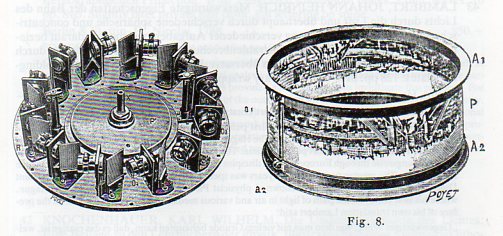
    The device at the bottom of the drill was made to follow and then restrict its cutting motion to that of a square, the device (considerably less wide than the diameter of the bit) cutting and scraping the round hole into a square.  Which in its own way reminds me of a motion picture depicted on a polygon, in a movie theatre for example, which began in a somewhat different way, filmed on a circular surface, or at least in one aspect of it. Auguste and Louis Lumiere began the new mass-medium, illustrated here from their Nouvel Appareil Photographique Panoramique Reversible le Photorama (which was printed in Lyon in 1895/6)

    Lumiere544

    The Lumieres claim for “first” as cinematographers is better understood in terms of the motion pictures being a new mass medium.  Whereas other inventors and experimenters were earlier–like chronophotography devices constructed by  Eadweard Muybridge, Étienne-Jules Marey and Ottomar Anschütz, which all produced forms of moving pictures in the decade prior to the Lumieres, but were decidedly not for public consumption.  The work of these men, as with that of Thomas Edison’s Kinetoscope (1891), was intended for scientific and academic consumption; or with the case for Edison, at least, for the amusement of the wealthy classes, as well as for educating the children of the rich. There were certainly others who worked in this area in the 1890’s, but none really fashioned an interest to their invention for the use of one-and-all as did the Lumieres.

    Which gets us back to our square rabbit hole.  Soon after the Lumiere’s introduced their fabulous new invention, they decided that there was no future whatsoever in the motion picture as a new medium, and abandoned it.  They undoubtedly felt a little bit like the square peg in the round hole of the needs of art, and moved on. 

    ___________

    Notes:

    1. “There was nothing so very remarkable in that; nor did Alice think it so very much out of the way to hear the Rabbit say to itself, `Oh dear! Oh dear! I shall be late!’ (when she thought it over afterwards, it occurred to her that she ought to have wondered at this, but at the time it all seemed quite natural); but when the Rabbit actually took a watch out of its waistcoat- pocket, and looked at it, and then hurried on, Alice started to her feet, for it flashed across her mind that she had never before seen a rabbit with either a waistcoat-pocket, or a watch to take out of it, and burning with curiosity, she ran across the field after it, and fortunately was just in time to see it pop down a large rabbit-hole under the hedge.”–Alice’s Adventures in Wonderland, Lewis Carroll.

    It is highly probable that no artist who ever depicted a Dodo actually saw one. 


  • Are You Smarter than a 5th Grader (1879)?

    JF Ptak Science Books  Quick Post–thanks to Andy Moursund for digging this up

    This sample examination for students in the Washington, D.C. public school system appeared in the Fifth Report of the Board of Trustees of Public Schools of the District of Columbia, 1878-79, and seems to me a  great head’s-up/wake-up call to any and all.  It was sent to me by my friend Andy Moursund (owner of the great Georgetown Bookshop in Washington, D.C.), and makes me wonder how well adults in 2011 would perform on the exam.  Luckily for us moderns there’s a lot of subject grading that could go on here, so the true results of such a thing taken today would be a private affair–but people would understand exactly where they stood in relation to a 10-year-old in a public school, 132 years ago.


    WASHINGTON, D. C. PUBLIC SCHOOLS

    QUESTIONS FOR THE ANNUAL EXAMINATIONS, 1879

    INSTRUCTIONS.—The sheet of paper to be written upon must be so place that the widest margin will be at the top of the page, and the narrow space for numbers of the questions on the left.  Marginal lines have been ruled, and the writing should not extend beyond these.  The number of the question should be written in the narrow space between the vertical ruled lines.   Each subject should be written only once, on the upper line, near the middle of the first page, and the name of the pupil should be written to the right of ti, on the same line. A line should be left blank after the subject, and after each answer.  Not more than one subject should be written on any page.  The pages used for each subject should be numbered from one upward, and the number should be written near the upper outer corner of the page, but inside the marginal line.

    In arithmetic give the work in full, and before the answer write Ans. No credit will be allowed if the work is not given.  When a subject is finished, take the work to the teacher’s desk.  Pains should be taken with expression, arrangement, penmanship, and neatness in the written work, as it will be preserved in the office of the Superintendent, and be subject to inspection; but the work must not be copied.

    ——————–


    FIFTH GRADE.


    JUNE 2.


    GEOGRAPHY. (Two credits each.)

    1. What are the principal mineral products of the United States, and where is each found?
    3. Which are the five leading nations of Europe.
    5. Give a brief description of the Sahara.
    8. Of what does the Chinese Empire consist?
    10. Make the diagram and draw the outline of South America.

    MUSIC (Two credits each.)

    1. How many sounds in the scale?
    2. Write the numeral names of the scale; also the syllables used in slugging the scale.

    JUNE 3.


    ARITHMETIC (Three credits each.)

    1. What is prime number; least common multiple; complex fraction;
    3. Write the six propositions showing the effect on the value of a fraction of multiplying and dividing the numerator and denominator.
    5. If 323 1/5 yards of cloth cost $33.45 ½, how much will be gained on each yard by selling the cloth for $45.13?

    PHYSIOLOGY. (Two credits each.)

    1. Describe the heart.
    2. Describe the larynx.
    3. How is air changed by respiration?

    JUNE 4.


    GRAMMAR.  (Two credits each.)

    1. Define the words “subject” and “predicate,” as used in a sentence.  Give an example, showing a simple subject and a compound predicate.
    4. What parts of speech have person and number?
    9. Name the adjectives, adverbs, prepositions, and conjunctions in the following sentence:
           The arose about this time a man named Cromwell, of incredible depth of understanding,
        strict integrity, and unwavering resolution.

    DRAWING (Five credits each.)

    Blank form for drawing furnished to the pupil, containing the following instructions:

    1. To the pupil: Draw without ruling or measuring from the copy placed before you. (Time allowed, 20 minutes.)
       To the teacher: Put upon the board one of the vase forms on page 15 of the drawing book.
    2. To the pupil: Draw the quatrefoil 4 inches in diameter, and put in it from memory any design you have made.  (Time allowed, 40 minutes.)

    SOURCE: Fifth Report of the Board of Trustees of Public Schools of the District of Columbia, 1878-79.  

    ·Posted by :

    ·in:


  • Half-a-Hell Alphabet: U.S. Gazetteer and American “Hell” Lust, “B” to “U”

    JF Ptak Science Books   Post 1517  (With thanks to Dick Carlson for prompting this skip-along)

    http://cinemaelectronica.files.wordpress.com/2010/06/botticellismapofdantesinferno.jpg

    [Hell of Botticelli]

    In spite of the nature of the name,”Hell” appears in frothy, popular abundance in the U.S. Gazetteer.  I suspect that most of the naming was crustily done, and perhaps some were made in spite or jest–but a fair number of them must have been named for the sake of accuracy.  Mostly the names are for geographical bits like a canyon, or swamp, bend, landing, gap, lake, creek, neck, pond, bar, gate, hill, basin or pool–the vast majority of them having to do with water more so than flat-out heat or desert. Hell doesn’t always stand alone:  there are Upper and Lower Hells, Screaming Hells, Merry Hells, and of course Whole- and Half-Hells.

    There’s a peculiar minority that give Hell as the name to uncommon places, like a cemetery; but what I don’t really understand are the few that reach down low, like Hell Street School (Mahoning County, Ohio) and (though less so) the Hell Creek School (Garfield County, Montana).  At least “creek” gives a watery lessening to the firey name–Hell Street, like Hell’s Kitchen, just doesn’t sound so great. 

    There are Hells aplenty in the Gazetteer, Old Hell and New Hell, Hell for Certain and Hell for Sure–I wonder now how many other places in the United States are named for the things that one must do to gain admittance to the Lake of Fire?

    And so:

    Bar, Old Hell.

    Bay, Hell Hole Bay Wilderness (Berkeley County, SC)

    Canyon, Hell. (Millard County, CT)

    Cat, Hell Cat Bay (Putnam County, FL)

    Creek, Hell (Roswell County, KS)

    For Certain Creek, Hell (Leslie County, KY)

    For Sure Lake, Hell.  (Fresno, CA)

    Gap, Hell.  (Goshen, NY)

    Gate, Hell. (NYC)

    Hole, Hell (El Dorado County, CA)

    Hollow, Hell. (New London County, CT)

    Landing, Little Hell (Martin County, SC)

    Lower Hell Hole (Placer County, CA)

    Neck, Hell. (Glouchester county, VA)

    Old Hell Bight (Wayne County, GA)

    Pocosin, Hell. (Onslow County, NC)

    Point, Hell (Burke County, GA)

    Pond, Little Hell.  (Burke County, GA)

    Screaming Hell Pond  (Fayette County, WVa)

    Swamp, Half-Hell (Brunswick County, NC–I believe this one)

    Tank, Little Hell  (Jeff Davis County, TX)

    and of course

    Upper Hell for Certain School, (Leslie County, KY)

    ·Posted by :

    ·in:

    —

  • Darwin, the Movie “Tremors” and the Attack of Giant, Human-Heritage-Eating Worms, 1881

    JF Ptak Science Books   Post 1517

    In the last year or so of his life, Mr. Darwin (who died 19 April 1882, aged 73) published a work that was somewhat outside his main thrust in publishing for the preceding 25 years or so–a work that proved to be quite popular, evidently selling at a better clip than the Origin of Species of 1859.  

    http://www.astrolabium.be/IMG/jpg/img10.jpg

    This was a book on mould, and earthworms. 

    The formation of vegetable mould, through the action of worms, published in  London (in October)  by John Murray in 1881, actually went through a number of printings, with more than 7,000 copies sold by the end of 1882.  It is a delightful book, and I can well picture the Old Man at Downs, studying the Worm Stone, thinking deeply about these little dirt-eating bits of nature, thinking about their actions on the landscape and what it meant over Very Long Periods of Time.  The book of course is a tour de force, a lovely piece of thinking.  It was also the target of this popular, anti-intellectual stab at the man’s work, a cartoon appearing in the satirical Punch magazine for 1881, decrying The Descent of Man for bringing the lofty human down to less lofty heights, and then stating that Darwin’s newest reached even lower and into the very muck.  Well that certainly wasn’t the reach of this work, which was a pretty straightforward affair hailing back to Darwin’s early interests in geology, returning to a subject of moulds which he had published on in 1839 and 1840.  Punch did take a stab at Darwin, trying to open up a hole into which the man might follow his worms, but of course that dog just wouldn’t hunt.

    Formation... is just a very smart book, with fantastic observations and ideas.  And it hasn’t much to do with getting Man muddy. Or dirty, for that matter.

    On the other hand….

    http://3.bp.blogspot.com/_WkKZJVG5wTk/TCRgu4bhEQI/AAAAAAACl-k/vPXu6kJS-cA/s1600/tremors-poster.jpg


  • A Terribly Short Note on the History of Bras, U.S. Patent Office, 1892-1930

    JF Ptak Science Books  Quick Post

    Most of the following  relate U.S. patent reports on brassieres–for shaping, reducing, electrifying, supporting, warming and preventing “breast cake”–but I’ve added a few other associated undergarment creations. It seems that there was so very much “underneath”sections to the bodies of the dressed woman during this time that there could scarcely be any room for anything on top of them.  There was just so much fabric and texture and belts and straps and loops and metal and fasteners and looseners and ties and wraps that, once the onion was peeled, there was nothing left but peel, which may well have been the overall societal message draped over women during this period of time.

    Garter Attachment, 1892

    Simple Underwear, 1893


    Armpit Armor, 1893


    Brassiere & Corset and More, 1898


    Brassiere, 1899