JF Ptak Science Books Post 1502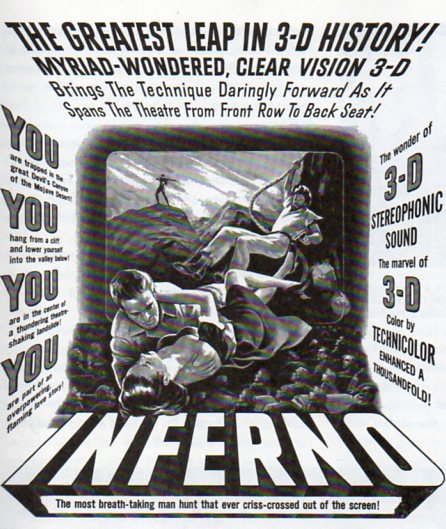
A note dragging together–against their will–the movie Hypercube, Homer Simpson, Marcel Duchamp, Jimmy Neutron, Emile Jouffret, Filippo Marinetti, Paolo Uccello and Edwin Abbott. Warning: this might not work.
We saw a movie the other night, Cube 2, Hypercube, which I think is meant to be Cube2, but I honestly think that the title didn’t appear that way because not that many people (?!) would know how to “pronounce” the little superscript floaty “2”. The movie was pretty interesting, telling the story of a group of people “imprisoned” in a large, sterile cube with a door on each face that opened into an identical cube, and on and on into a Borgesian infinity-hell. At one point the people are theorizing on the nature of the Cube, winding up with someone saying that they might all be in a fourth spatial dimension.
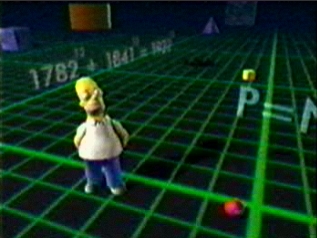 It brings up a pretty well-worn thought about visualizing a different dimension, and then it occurred to me that the only general-population folks who seemed to be most at ease with this idea were cartoon characters: and since I am a father of children, a Father of Children, I am very well familiar with recent cartoon history. Homer Simpson, for example, slips from his two-dimensional world into what was supposed to a three dimensional world, and he seems perfectly comfortable. (The equation in the background, 1782^12 + 1841^12 = 1922 ^12 is correct for the first nine digits, but not for the last thirty. Plus, since the product of odds is odd, and the product of evens are even, the sum of even and odds is odd, so the answer must be wrong. But close. And really, really good for little Homer.) Timmy Turner (Fairly Oddparents) and Jimmy Neutron (of the show bearing his name) switch worlds,one going 2-to-3 D and the other the other way ’round, with both being perfectly comfortable in their new space.
 Of course the issue of imagining a three-dimensional shape in a two-dimensional world is pretty knotty if you are not having a cartoonist draw out your brain’s interpretations of the world. The great classic of this is Edwin Abbott’s Flatland, an 1884 book about a two dimensional world of shapes that encounters a dot that grew concentrically and outwardly, a dot expanding and then contracting itself in a series of circles, morphing until it appeared as a new and revolutionary form rising from the plane of Flatland, evolving into a new thing, a Sphere. The folks in Flatland had a hard time with it.
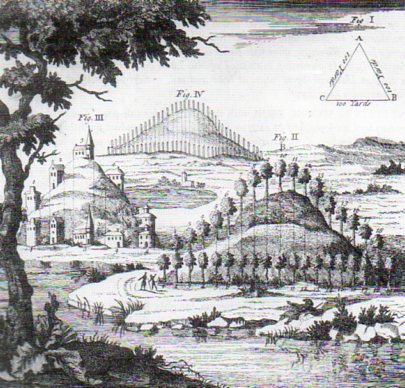
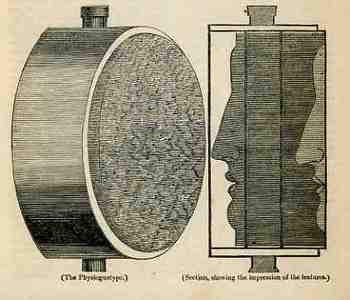 Depicting a third dimension in a two-dimensional space is tough, the whole deal being rediscovered in perspective only relatively recently in the history of human thought, being only about 600+ years old. (In quasi order perspective is brought to the West by Cimabue, the Isaac Master, Giotto, Duccio, Maso, Avanzo, Lorenzetti, Donatello, Ghiberti, Fra Angelico, and so on, not the least of whom would include our beautiful Paolo Uccello.) Giving real “flavor” to the extra dimension was still quite difficult, even in the 19th century. In the “Spirit of Discovery” section of the British weekly magazine The Mirrour of Literature, Amusement, and Instruction for 22 October 1836 there is a short notice on the “physiognotype”, “a machine for taking casts, lately invented by a gentleman in Paris”. We’re accustomed to these devices now as they’ve been for sale in toy shops for decades—but in 1836 it was a real breakthrough for making instantaneous three-dimensional models of small things. In 1836 there really wasn’t any simple way of producing a direct, proportional model like this in 3-D except for encasing it in plaster and then casting from that mold. Two-dimensional modeling was easier, and there were numerous devices constructed for this purpose as people pursued the still-hot rage of physiognomic forecasting, with simpler means (like shadow portraits) being hundreds of years earlier. (Photography remember is still three years away from being announced and another few years from being sort o
 f accessible to middle-class folks.)
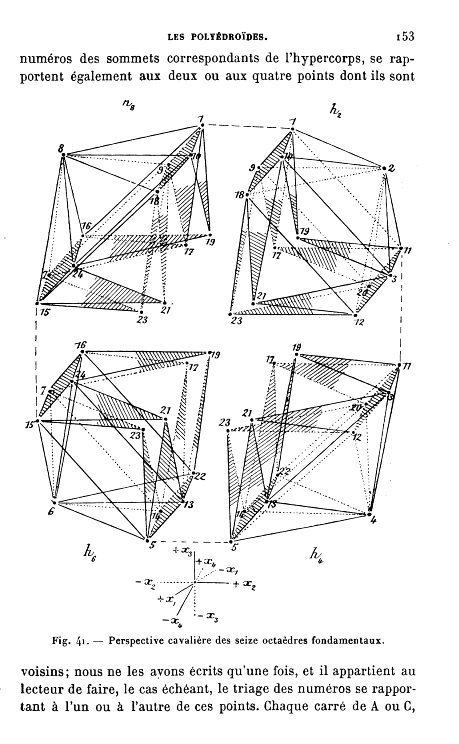
Imaging the fourth dimension was more a product of mathematics than of art, with people like Emile Jouffret1 getting to it a little before Marinetti and Duchamp and the squirrely Picasso did. (Thinking on the fourth dimension goes back as far as Kant, at least, and the real work begins in the first half of the 19th century2.)
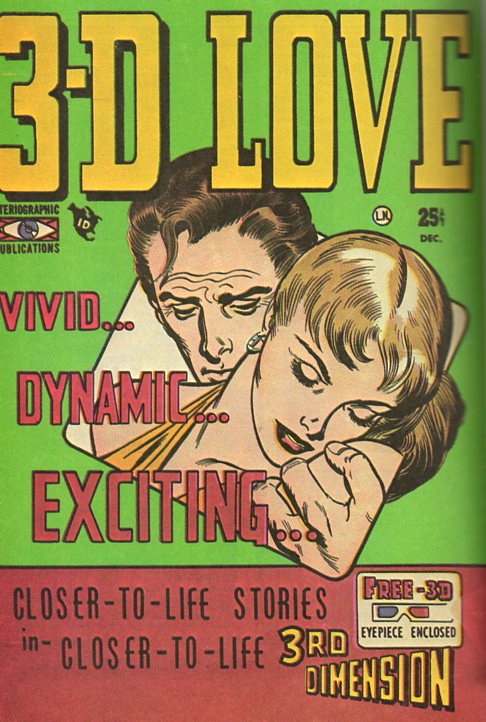
But it seems as though the cartoon (like Homer, above) and comic book characters have a much easier time with this added-dimension issue, using it to full advantage without muss or fuss, and certainly without any philosophical commentary. Their reach across the aisles of the 1952 Rexalls and other general merchandise emporia with enough floor space for a revolving magazine 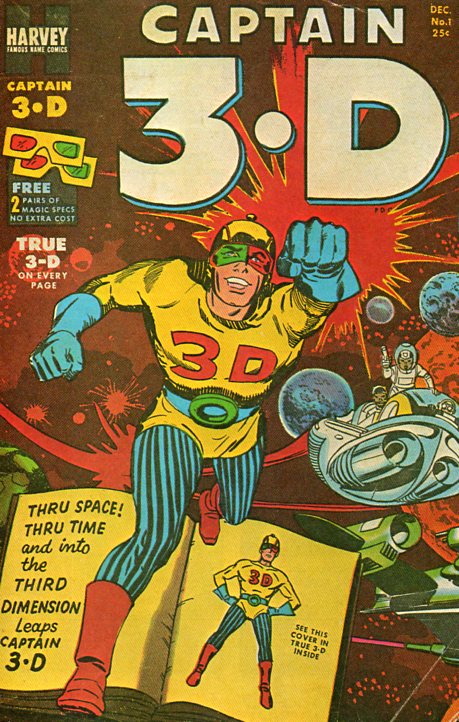 stand was straight into the heart of the common reader, filling them with the hope/fear of their two-dimensional explorations into what they called their 3-D 3D 3.D Three Dee world, selling “closer-to-life stories in closer-to-life 3rd Dimension”.
It seems that the same might be true for 3-D movies as well, the characters busting out into a new dimension (sometime fully aware of it) without a care or riddle, the main effect of finding the new spatial dimension sitting squarely in the minds of the observers, who are already in that dimension and reacting to somethingf with a surprising surprise of seeing a familiar thing in its proper context.
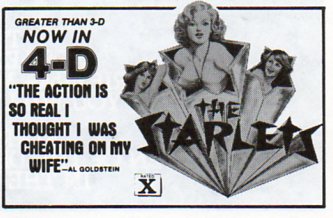
I’d love to know what that fourth spatial dimension looks like, as promised by The Starlets…or maybe not.
Notes:
1. Jouffret, E. Traite Elementaire de Geometrie a Quartre Dimensions et Introduction a la Geometrie a n-Dimensions. Paris: Gauthier-Villars, 1903. 1st edition. ! 215pp. and Jouffret. Melanges de Geometrie a Quatre Dimensions. 220pp. Paris: Gauthier-Villars, 1906. 1st edition. (Perhaps one of the most classic works of the late 19th and early 20th c on imaging the fourth dimension–certainly well known to the Cubists and Futurists, I’m certain that it sparked any number of ideas in the art world.)
2. The first major work arrives with Hermann Grassmann’s “Die Lineale Ausdehnungdlehre” (Theory of Linear Extensions) in 1844 (and the subsequent translations of the work as well as original work by Arthur Cayley); followed by Ludwig Shclafli (1814-1895) “Theorie der vier flachen….” (Theory of Continuous Manifolds, 1852 but not published until 1906), Riemann’s 1854 speech (which was not published until 1867 and which appeared translated by William Kingdom Clifford in Nature in 1873, G.F. Rodwells “On Space of Four Dimensions” (Nature, May 1873), Dodgson/Carroll‘s Through the Looking Glass (1872) deep references, Zollner “On Space of Four Dimensions”
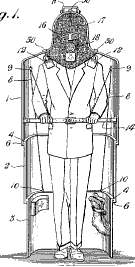
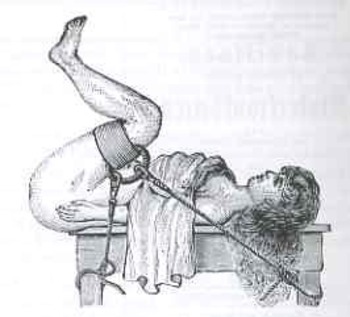 This leads to another uncomfortable image. At first glance I thought it was part of a delivery procedure, but it turns out that this was the rigging for a woman undergoing a gynecological examination. The woodcut appears in the first volume of Sammelband von 7 Kleinschriften zu gynakologischen Spezialthemen, 1858-1901, and more exactly in the contribution by Ludwig Neugebauer on an examination with a “speculum bivale l’ecarteur vaginal a trios branches…” published in 1884. I know that the prissy prejudices brought about with the coming of Queen Victoria in 1837 still had another 17 years to go at this point, which could explain why, perhaps, a doctor would want an aid in helping a woman maintain an examination position without him having to touch his patient, but, well, just look at the massiveness of the restraints! Also, the woman’s arms are *inside* the ropes—not down, not holding the ropes, but inside the binding, restrained. Either way, it isn’t good, treating the woman—in either case of pregnancy or obstetric examination—as the inferior vessel.
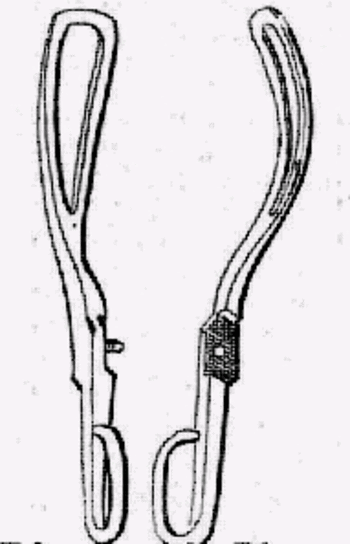 though everyone today knows what these things are, the Chamberlens kept them a secret from the inquisitive medical world for more than a century. Their instrument was shrouded—literally!—in secret(s), used under cover, with ceremony, conveyed to the delivery area in a box and brought out with no witnesses. The Chamberlens felt their invention to be their own, for their own particular use and monetary gain, and the rest of the world be damned, and at least three generations (grandfather, father, son) kept the family secret. If their family could not be in charge of such a delivery then there would be no use of their extraordinary invention. This of course would save their income from being chipped away by other physicians or midwives or whatever competent person could be found to utilize the forceps—their economic gain coming at the cost of (savable but imperiled) pregnant women who would either pay the Chamberlens for aid in their breeched births or, well, probably die. To what degree this revolting behavior damaged other people can not be calculated. I’m not even sure about how to translate this into something more recognizable—would it be like Robert Koch keeping his isolation of Bacillus anthracis (1877), or tuberculosis bacillus (1882) a secret? Or Wilhelm Roentgen shrouding his discovery in secrecy somehow? (I know, I know, this is impossible.) Or isolating a secret, proprietary cure for cancer?