A Daily History of Holes, Dots, Lines, Science, History, Math, Physics, Art, the Unintentional Absurd, Architecture, Maps, Data Visualization, Blank and Missing Things, and so on. |1.6 million words, 7500 images, 4.9 million hits| Press & appearances in The Times, Le Figaro, Mensa, The Economist, The Guardian, Discovery News, Slate, Le Monde, Sci American Blogs, Le Pont, and many other places… 5000+ total posts since 2008.

  • Some Mars Items


    Henri Jules A. Perrotin (1845-1904 and Louis Thollon, 1829-1887) . “Observation des canaux de Mars; “Lettre de M. Perrotin à M. Faye.” In: Comptes rendus hebdomadaires des séances de l’Académie des sciences de Paris, vol  106 , #20,  pp. 1393–1394. Offered in the original weekly issue, removed from a larger bound volume, without the outer wrappers. $On Hold

    Perrotin’s (mostly remembered I think because of his excellent use of the Cornu apparatus in establishing the best speed of light numbers until Michelson) communication establishes that the great canals (“canaux”) he observed and reported to the Academy in 1886 were still there, as expected and as hoped for and celebrated by Schiaparelli. There were also three other rather significant observational findings:

    First, a continent had disappeared. “Clearly visible two years ago, it no longer exists today” he wrote ( “Nettement visible, il y a deux ans, il n’existe plus aujourd’hui.”). A flood, “or something else” (“Cette inondation ou autre chose…”) could well be a periodic occurrence that did away with the land mass.

    Second, there is a new arrival of a canal 20-degrees in size just north of the disappeared/extinct continent (“…au nord du continent disparu…”).

    Third, there was a sort of canal that suddenly appeared on the North Pole ice cap, connecting the two seas on either side of the pole. (“…sur la tache blanche du pôle nord, d’une sorte de canal qui semble relier, en ligne droite, à travers les glaces polaires, deux mers voisines du pôle”).

    Perrotin really doesn’t have that much to say about what caused anything, mostly restricting himself to his observations–except, as we see above, he wonders about a periodic flood.


    Lockyer, J. Norman. “La Planete Mars”, in Review Scientifique (Rose), volume 50, #17, 22 October 1892, pp 513-520, with two views of Mars, two orbital maps, and a map of the Martian surface showing “double” canals. Offered in the original weekly issue, removed from a larger bound volume, without the outer (rose-colored) wrappers. Good copy. $Oh Hold

    [I didn’t find the English version of this paper until I finished my write up—the French version is mostly but not entirely a translation of Lockyer’s “The Opposition of Mars” in the 8 September issue of Nature (the journal edited by Lockyer)].

    Lockyer starts off the essay by giving respect and credit to the work of Schiaparelli for his diligent observational duties on Mars. He does find it unfortunate though that the term “canali” of Schiaparelli has caught the popular tremor by being translated as “canals” and so “imply the idea of human work”(“Ce mot qui, en italien comme canalis en latin, signifie canal, chenal ou conduite, fut malheureusement traduit par le mot canal, qui implique l’idée de travail humain”). Lockyer discusses some of the “wonders” (“merveilles”) that are related by Schiaparelli’s new work, which includes the doubling and un-doubling of some canals, depending upon the season.

    Lockyer again addresses the current fascination with new discoveries on the planet, though he says they are based on misinterpretations, the general public thinking that the gigantic changes taking place on the planet were the result of actions undertaken by Martians/inhabitants (“l’intervention de ses habitants”) whereas Lockyer clearly believes that this is not the case.

    After a discussion of the possibility of communicating or messaging with Mars and the best time in the orbits for such a thing, Lockyer provides a rather lengthy summary of proposals of two means of interplanetary communication suggested by Francis Galton and Haweis—the former communicating or signaling by reflected sunlight during the day and the later by electric light at night (“M. Galton se sert donc de la lumière solaire et travaille dans le jour; M. Haweis, lui, propose l’emploi de la lumière électrique et opérerait la nuit”). (There were numerous other plans that seem to have captivated or at least diverted some other very bright minds, including Amos Dolbear and Charles Cros, and earlier with J. von Littrow and C.F. Gauss) such Mars was much on the minds of the general population in 1892, seeing in that year the publication of Camille Flammarion’s La Planete Mars et ses conditions d’habitabilite, and then ever more so three years later with Percival Lowell’ Mars followed in two years H.G. Wells’ blockbuster The War of the Worlds.)

    But then Lockyer draws in the speculative reins and asks the reader to consider why Galton and Haweis are reacting so—and that is because the canals of Mars can be seen by some as signaling systems, that Martians are somehow trying to tell us that they are up there. Of course they are doing that with canals that are enormous—1600 kilometers long and 320 kilometers wide. AND that they structures occasionally double, and then reduce, which means that, perhaps, Martians are filling in the canals from time to time, and then digging them out again. (“Mais il est temps de revenir aux observations récentes qui ont donné naissance aux idées que nous venons d’examiner, idées basées sur cette supposition qu’il est de toute évidence que les Martiens nous font des signaux en creusant des « canaux » de 1600 kilomètres de longueur et 320 kilomètres de largeur, puis en les doublant et en y ajoutant de nombreux signaux lumineux. L’opinion publique, persuadée que les changements qui ont été observés récemment sur la planète sont dus à l’intervention de ses habitants — idée basée, nous le verrons tout à l’heure, sur la fausse nterprétation d’un mot — s’est trouvée amenée tout naturellement à admettre que ses habitants avaient entrepris des opérations gigantesques…”)

    In any event, Lockyer’s look at Mars is pretty inclusive and sober…
    ·Posted by :

    ·in:

  • Social Planning and the Great Depression (1929-1932)

    Bureau PersonnelConferences on Economic, Social, Ethical Planning, presented by the Bureau of Personnel Administration (420 Lexington Ave, Room 1745, NY). Offset printed, staple bound. 11X8.5” sheets. Four sections. 67 parts, about 450 leaves.

    Provenance: Library of Congress, being a gift from the publisher. Very Good condition with two LC “surplus duplicate” stamps on two of the sections’ opening page.

    Note on availability: I can find a number of entries for the individual papers in this series, though usually only one or two institutions listed as having them; I cannot find a collection of the papers anywhere in WorldCat/OCLC. Given the way these were produced and printed, and the absence of any collected form of them, I believe that this collection is pretty scarce. $1250

    At first blush the titles for the components of this series look a bit deadly-boring. Looking just a bit deeper, what we have here is some of the intellectual background for the recovery from the just-begun Great Depression. The very first conference listed below falls nearly on Black Tuesday (October 29, 1929), the beginning of the Stock Market crash and the Depression (which took a few years to become the “Great” Depression”). The second series spans much of the presidential campaign period for 1932 and the deepening of the Depression; the third series takes place during that incredible period between the end of the election and the inauguration of FDR and about two thirds of the incredible Hundred Days (as well as the new threat to Europe from the newly-ensconced Hitler, and Japan in China); and the fourth series covers the newly-introduced “New Deal”. Several of FDR’s “Brain Trust are among the contributors (Berle and Tugwell), as well as many others who would have major roles in the administration. The great majority of the contributors were leading thinkers of the 1930’s (for example, Morris R. Cohen, whose name may not be remembered now but who was  professor of philosophy at CCNY from 1912 to 1938 and who helped make that place “the Proletarian Harvard”, .and who taught at U Chic, Columbia, Cornell, Stanford, Yale, and Harvard, and widely acknowledged as a leading thinker).

    ·Posted by :

    ·in:

  • A Really, Really Good Radio Show (1938-1941)


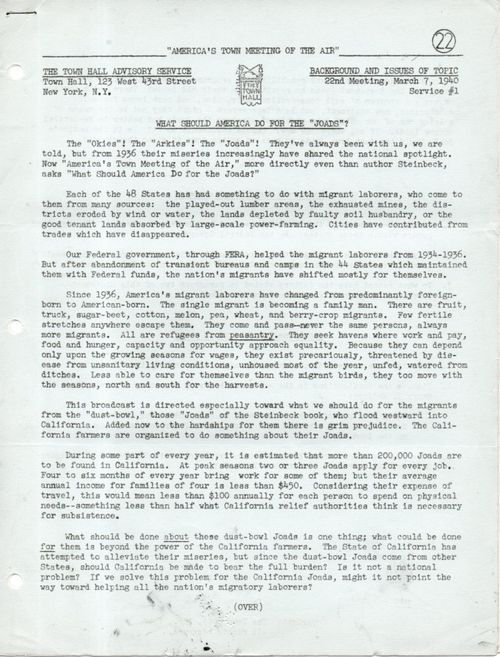
    America’s Town Meeting of the Air. 1938-1941. 58 issues. 11×8.5″. Each issue 3 leaves, or 6pp, offset printed, stapled in upper left corner.  Provenance:  Pamphlet Collection of the Library of Congress.   $1500

    • This is an incomplete run, though I can find no other evidence of any substantial number of these publications are held in any institution, though there is an entry in WorldCat for the NYPL having a collection of “miscellaneous pamphlets”. The 102 WorldCat/OCLC listings are almost entirely for individual pamphlets. VG condition.

    It turns out that I own a good stack of guideline publications for what was America’s first news talk show: “America’s Town Meeting of the Air”, produced by the Town Hall Advisory board between 1935 and 1955. (“The NBC Radio Network program America’s Town Meeting of the Air was an early form of electronic “townhall” democracy–perhaps the very first such electronic forum. In May of 1935 the program began what would become a 21-year run. In later years the program would be broadcast on the ABC network.”–Social Security Administration, https://www.ssa.gov/history/1935radiodebate.html) The format of the broadcasts pitted two prominent experts in a debate of some aspect of public policy. The program was unique for its time in that it also featured questions from both the live audience and from the listening audience around the country. It was a weekly show, and in general–at least for the 90 examples I have for the 1938-1941 period)–each broadcast came with a three-sheet guideline. The first sheet was a general statement of the show’s interest–for example, “What Shall We Do With the Joads?”, for March 7, 1940 (the Joads being the family in the Steinbeck mega-epic The Grapes of Wrath). These intro pages are usually very concise, very well written, logical, and provocative.

    The second sheet is really what surprised me so–a bibliography and suggested reading for the discussion.  That means that before the radio program was broadcast the producers provided listeners a handy sheet with material to read so that they could better follow the discussion–this seems truly exceptional by today’s sub-standards of a great chunk of radio political discussion, where volume/noise dictates correctness over recognized references. I wondered before looking at the list if The Grapes of Wrath would be there, because, well, it wasn’t necessarily a popular read everywhere in spite of the book’s critical reception. It was there, along with (shockingly) Dorothea Lange and Paul Taylor’s (her husband) An American Exodus;  Carey McWilliams’ Factories in the Field the Story of Migratory Farm Labor in California; and You Have Seen Their Faces, by Erskine Caldwell and Margaret Bourke-White (described as “the Southern sharecropper in photographs and prose”).  Actually all of the books and articles are given a similarly very-short description like this, in spite of their Great Classic status of today–the photographs by Bourke-White and Lange and McWilliams and their accompanying texts are really nothing short of masterpieces, difficult and challenging exposes of a national tragedy –and here they are, suggested reading for listeners of a radio talk show.


    ·Posted by :

    ·in:

  • Fine Art Nouveau Design (1887)

    HABERT-DYS, J[ULES-AUGUSTE] – Fantaisies Decoratives. Documents pour servir a la decoration des Faiences, Meubles, Tissus, Bijoux, appartements, etc. …. Quarante-huit planches renfermant environ deux cents motifs.  Paris, Librairie de l’Art, n.d. [1887-8] .  48 superb chromolithograph plates by Gillot, greatly influenced by the Japanese style and in a very accomplished art nouveau air, all heightened with gold, on cream paper, mounted on heavy white paper. Folio,  (4) pages,  title and list of plates.

    This copy bound in library cloth (the original issued in parts in portfolio), with each plate mounted on cloth tabs.  The spine of the book has been damaged with tears on the upper portion–one of which is 6″ long– but the plates are FINE.  $900  (There were subsequent editions of this work that seem to have appeared in 1904/1908/1910, all of which seem to have had no more than 32 plates. I have seen the plates offered individually from $25-$200/each.)

    The following description of the lithographs from the Fantisies Decoratives at the Tides Institute and Museum of Eastport from 2009:

    “By 1886, Habert-Dys was a well-respected designer and illustrator, but the main problem for him, in terms of posterity, is his subtle style. Without seeing the originals, his work is not striking enough to attract attention and no reproduction can do justice to the delicate, beautiful, details and colors that he incorporates into his designs. The Fantasies Decoratives, published in 1886, was a one-year project with forty-eight lithographs issued in twelve parts. The colored gravures, many containing gold, were printed on “papier du Chine” by noted lithographer, Charles Gillot (1853 – 1903), whose work was so respected that his lithographs were called “Gillotypes”.

    “The intricate patterns, featuring birds, animals, flowers, fish, insects, shellfish, and frogs, were designed for ceramics, plates and dishes, textiles, wallpaper, vases, and jewelry. In these exquisite creations, Habert-Dys adopted many elements of Japanese influence (Japonisme), which reflect the late nineteenth century’s fascination with Japanese art. The Fantasies Decoratives also contain elements of line and curve that later became an intrinsic characteristic of the next major movement in the art world, Art Nouveau.”


    ·Posted by :

    ·in:

  • The First Comprehensive Presentation of the Mathematical and Physical Ideas of Einstein (1921)

     Wolfgang Pauli. Relativitätstheorie. Sonderabdruck aus der Encyklopädie der mathematischen Wissenschaften. Mit einem Vorwort von A. Sommerfeld. Verlag und Druck von G.B. Teubner, Leipzig & Berlin, 1921. First edition. 9.75”x6.5”, pp iv, (539)-775. Paper covered boards, cloth spine. The printed cover is good and bright; the printing on the spine is mostly dulled to the point where you can barely read the title. A Very Good copy of a not-common and important, rock-solid book.  $200

    “Felix Klein was then publishing the Encyklopädie der mathematischen Wissenschaften, a monumental compilation that was to examine the current state of science from all sides. Leading scholars—mathematicians and physicists—were contributors. Klein had requested Sommerfeld to write an article on relativity theory for the Encyklopädie. Sommerfeld ventured to entrust the task to Pauli…(Sommerfeld revealed admirable courage and insight in letting a student in his fourth semester write this important article.)”

    “Pauli soon completed a monograph of about 250 pages [the book offered here], which critically presented the mathematical foundations of the theory as well as its physical significance. He took thorough account of the already very considerable literature on the subject but at the same time clearly put forth his own interpretation. Despite the necessary brevity of discussion, the monograph is a superior introduction to the special and general theories of relativity; it is in addition a first-rate historical document of science, since, together with H. Weyl’s Raum, Zeit, Materie(“Space, Time, and Matter”), it is the first comprehensive presentation of the mathematical and physical ideas of Einstein, who himself never wrote a large work about his theory.”

    “Sommerfeld was elated by this performance and wrote to Einstein that Pauli’s article was “simply masterful”—and so it has remained to the present day. Pauli showed here for the first time his art of presenting science, which marks everything he wrote.”

    “In Sommerfeld’s institute Pauli also became acquainted with the quantum theory of the atom. He wrote in his Nobel lecture:

    While, in school in Vienna, I had already obtained some knowledge of classical physics and the then new Einstein relativity theory, it was at the University of Munich that I was introduced by Sommerfeld to the structure of the atom, somewhat strange from the point of view of classical physicist, accustomed to the classical way of thinking, experienced when he came to know of Bohr’s “basic postulate of quantum theory” for the first time.”

    All of the above from the Complete Dictionary of Scientific Biography (online). 

    ·Posted by :

    ·in:

    —
  • Good and Early Questions on the Daguerrian Process (1849)

    Claudet, Antoine Francois Jean “Mr. Claudet’s Researches on the Theory of the principal Phaenomena of Photography in the Daguerreotype Process”, in  The London, Edinburgh and Dublin philosophical magazine and journal of science. Series 3, volume 35, July-December 1849. 8vo, viii, 552pp, with the article on pp 374-385. Bound in half-calf with nicely marbled boards, the boards having the oval gilt stamp of the “Society of Writers to the Signet”. Front hinge cracked. Red and black spine labels; the small oval leather label identifying the volume number is missing. Very Good copy, otherwise. $350

    Antoine Francois Jean  Claudet, (1797-1867), began experimenting with Daguerreotype in 1840, and soon became photographer in ordinary to the Queen, being among the very first to practice Daguerrian portraiture in London. . He was very innovative and successful, and contributed many inventions and improvements in the cause of early photography, and was one of the first to use the collodion process.  “.

    “French photographer and scientist, active in England. He became an influential London portrait photographer at his Adelaide Gallery studio, licensed by the inventors to practise both the daguerreotype and the calotype. Claudet’s earliest significant technical contribution, in 1841, was in greatly increasing the sensitivity of the daguerreotype plate, thus reducing exposure times and making the process much more suitable for portraiture. In 1851 he moved to Regent Street, where he also began using the wet-plate process. Claudet published prolifically on photography, vision, and the photographic representation of sculpture. He was also one of the foremost early practitioners of stereoscopic photography, inventing a folding stereoscope and other devices. Many of Claudet’s impressive photographs survive, but his collection of historical photographic incunabula was destroyed by fire after his death.”– The Oxford Companion to the Photograph

    Claudet asks and answers the following important questions:

    • “Although the Daguerreotype process has during the last ten years been investigated by a great number of philosophers, and brought to a considerable degree of perfection by a still greater number of practitioners, it may appear surprising that the principal phaenomena upon which this new art is founded, are still enveloped in a mysterious darkness.

    1. What is the action of light on the sensitive coating?
    2. How does the mercurial vapour produce the Daguerreotype image?
    3. Which are the particular rays of light that impart to the chemical surface the affinity for mercury?
    4. What is the cause of the difference in achromatic lenses between the visual and photogenic foci? why do they constantly vary 2
    5. What are the means of measuring the photogenic rays, and of finding the true focus at which they produce the image?

    Also (among many other contributions) in the volume are:

    • Hamilton, William Rowan. “Sir W. R. Hamilton on Quaternions; or on a New System of
      Imaginaries in Algebra” and “Sir W. R. Hamilton on Quaternions; or on a New System of Imaginaries in Algebra (continued)”;
    • Hargreaves, C.J. “Mr. C. J. Hargreave’s Analytical Researches concerning Numbers”;
    • Becquerel, Antoine. “M. Becquerel on the Development of Electricity in the Act of Muscular Contraction”
    • Forbes, James David (pioneer in the study of glaciers). “Prof. J. D. Forbes on an Experiment to determine the Earth’s Density”
    • Grove, William R. “Mr. W. R. Grove on the Effect of surrounding Media on Voltaic Ignition “
    • “The Rev. B. Bronwin on the Theory of the Tides “ and “Rev. B. Bronwin on the Theory of the Tides (continued)” and “The Rev. B. Bronwin on the Theory of the Tides (concluded)”;
    • Lubbock, John W. “Sir J. W. Lubbock on Shooting Stars”


    ·Posted by :

    ·in:

  • An Electric Light, 1849

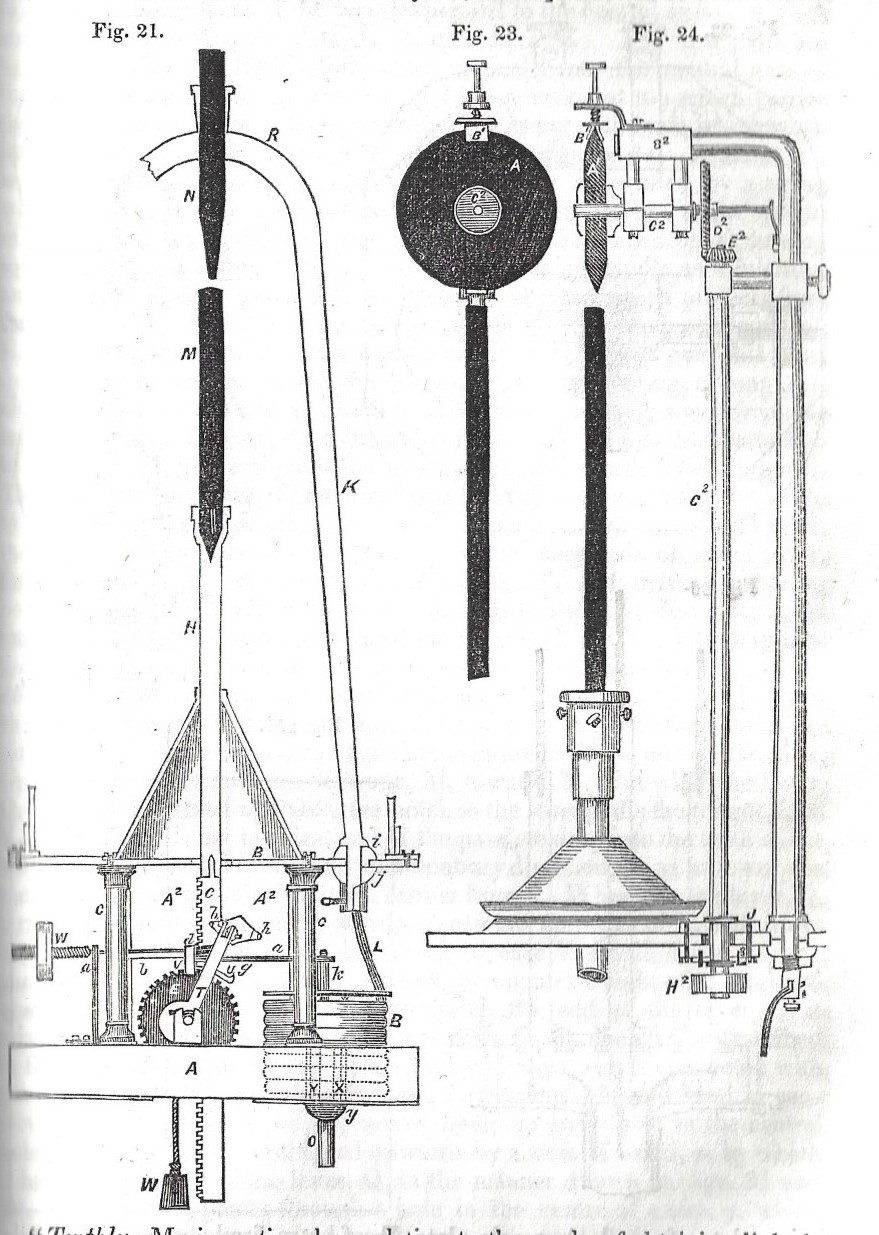
    (William E. Staite), “Specification of Staite’s Patent Electric Light, [Patent dated July 13, 1847—specifications enrolled July 13, 1848.]” in the “Specification of English Patents sections, in Journal of the Franklin Institute of the State of Pennsylvania, devoted to the Mechanical Arts, Manufactures, General Science, and the Recording of American and other Patented Inventions, printed in Philadelphia at the Franklin, 1849; volume 17, third series, whole no. 47, pp 263-268, with 8 small woodcut figures of the apparatus. Offered in the volume of 498pp. Half-calf and marbled boards, raised bands, gilt dentelles. Good/VG condition, with a ghost-appearance of a spine label at bottom and rubbing along spine edges, ex-library stamps on title page, and a large (and not very attractive) bookplate. Crisp copy. $150

    JFI 1849 electric light Staite“W.E. Staite (1809-54) and W. Petrie (1821-1904) were pioneers of electric lighting who received little recognition for their work. Although a satisfactory self-regulating arc lamp was developed, commercial success was not achieved owing to their reliance on primary batteries as the only source of power. Numerous demonstrations were given throughout England, and serious interest in their system of electric lighting was shown by railway companies and dock authorities. The death of Staite in 1854 brought to an end these early attempts to use electricity for illumination.” And: “The pioneers…were finally defeated by the limitations and the expense of the primary cells which were their only source of electrical energy. —“Staite and Petrie: pioneers of electric lighting”, G. Woodward, in IEE Proceedings A – Physical Science, Measurement and Instrumentation, Volume: 136 , Issue: 6 , Nov. 1989.

    Also in this volume:

    Richad Clarke Burleigh, “Specifications…for Certain Improvements in Artificial Light”, pp 98-102;

    Robert Bunsen and Lyon Playfair, “Report on the Gases evolved from Iron Furnaces, with reference to the Theory of the Smelting of Iron”, pp 268-279, 338-344,387-393, and concluded in the next volume;

    George Buchanan, “On the Strength of Materials as Applicable to the Construction of Wrought Iron Bridges.–On the Traverse or Cross Strain”; 223-230;

    J.F.W. Herschel, “Description of a Lunar Rainbow”, p 123;

    Thomas Ewbank, “On the Paddles of Steamers…” pp 42-50, 107-114;

    and many others on railroads, bridges, steam, and so on.


    ·Posted by :

    ·in:

  • Railroads, Canals, Scientific Instruments, and Mechanical Food Production (1833)

    Richard Trevithick, “For Improvements on the Steam Engine, and its Application of Steam Power to Navigation, and to Locomotion”, in “Journal of the Franklin Institute of the State of Pennsylvania, devoted to the Mechanical Arts, Manufactures, General Science, and the Recording of American and other Patented Inventions”, edited by Thomas P. Jones, printed in Philadelphia at the Franklin, 1833; volume 16 (New Series vol 12), pp 111-112, in the volume of 438pp. Half-calf and marbled boards, raised bands, gilt dentelles. Very nice condition with a ghost-appearance of a spine label at bottom; ex-library stamps on title page. Very clean and crisp. $150

    Includes much else of interest, for example:

    A.D. Bache, “Experiments Made on the Navigation of the Chesapeake and Delaware Canal by Steam…”, pp 361-373;

    Robert Hare, “Apparatus for Transferring a liquid from a carboy, or cask, to bottles especially useful in the case of sulphuric acid…”, pp 226-228 (with two woodcuts of the instruments);

    William Scoresby, “On the Deviation of the Compass; with examples of its fatal influence in some melacholy and dreadful shipwrecks”, pp 40-43 and 121-124.

    “Undulating Rail-way” and “The Undulating Rail-way”, pp 45-52;

    Michael Faraday, “Practical Prevention of Dry Rot in Timber”, pp 346-351;

    E. Galloway, “On the Application of Steam, expansively, in Cornish Steam Engines”, pp 273-277 and 337-341;

    James Walker and A. Burges, “Report on the Sate of Blackfriars Bridge”, pp 283-286 and 342-346

    “Biscuit Making Machinery”,

    “Steam Carriages”, “Selections from (David) Brewster’s Optics”

    ·Posted by :

    ·in:

  • Bessemer, “On the Manufacture of Malleable Iron and Steel”

    Henry Bessemer, “On the Manufacture of Malleable Iron and Steel”, In: Journal of the Franklin Institute, edited by Thomas P. Jones, volume 69, third series, vol 39; 444pp, 4 plates. The Bessemer is on pp 193-198, with two two plates. It further states the case of Bessemer’s groundbreaking paper of 1856 of nearly the same name. Half-calf, with attractive marbled boards, raised bands, gitld entelles. Condition: ex-library though faintly, with a ghost of a call slip on the spine bottom, bookplate, and stamps on the title page. The book was very little used. Very solid, crisp, and clean copy. VG $150

    Also in this volume:

    William Fairbairn, “Experimental Researches to Determine the Density of Steam at All Temperatures”, pp 17-20.

    “Locomotives on Common Roads”, pp 370-377. (Interestingly the article ends on the discussion of tolls on such vehicles based on number of wheels, speed, and “general construction”).

    Samuel McElroy. “On the Brooklyn Pumping Engine”, pp 361-370;

    Alexander Stephen Wilson, “On a System of Moving Bodies”, pp 342-345;

    Piarron de Mondesir, “The Sewerage of Algiers”, pp 145-155, 217-226 (with folding plan), and 289-296;

    J. Bennett, “Aerometry. Translated from the Hydraulics of D’Aubuisson de Voisins”, pp 124-132, 186-192, 234-241;

    Alexander Allen, “An Improved Method of Retarding and Stopping Railway Trains”, pp 78-80, with a small inset woodcut of the braking system).


    ·Posted by :

    ·in:

  • A Drawing of an Early Modern Propeller (1855)

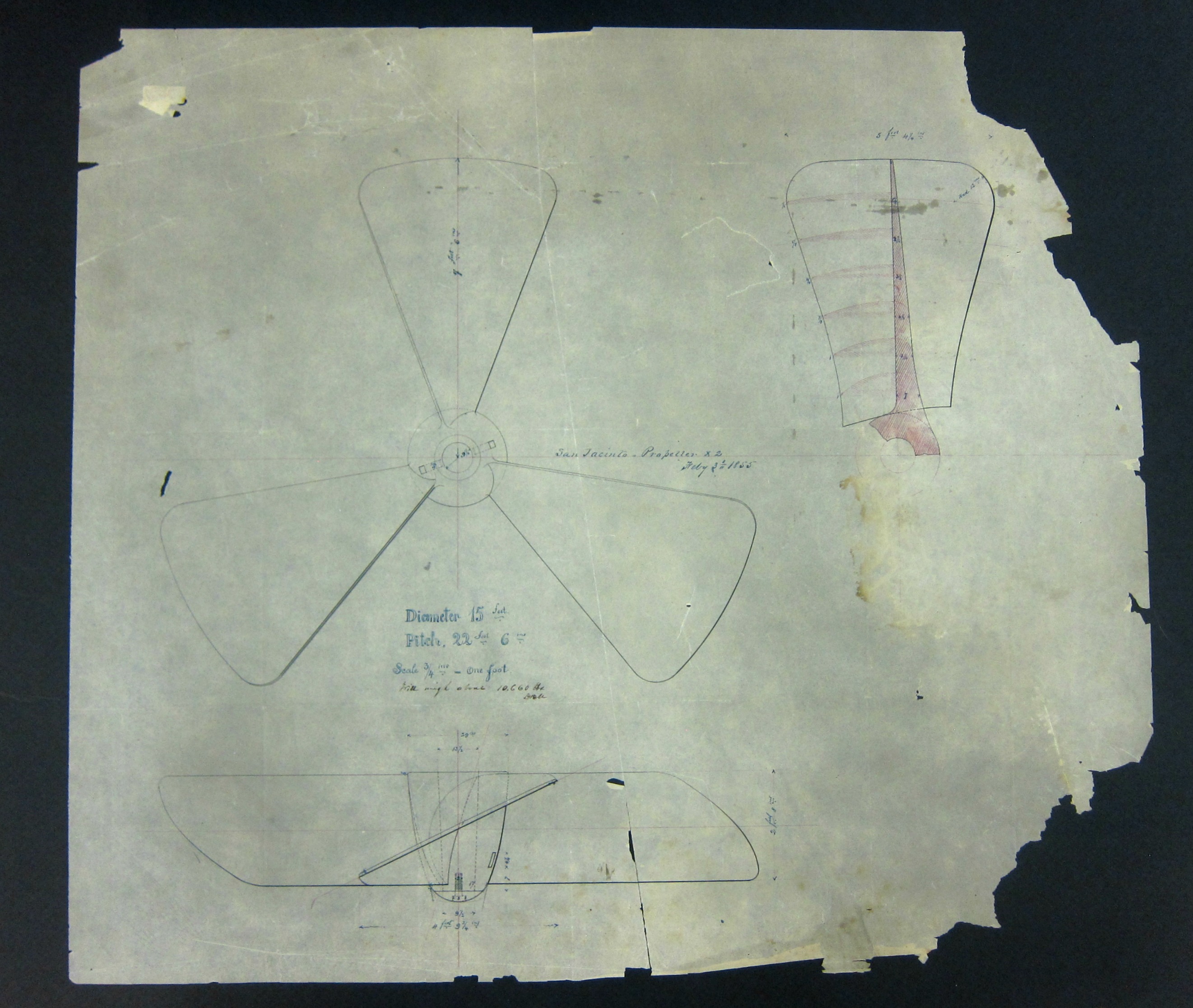
    The U.S.S. San Jacinto–Propeller, Feb 3, 1855.
    New York, 1855. 20″x16″.  Manuscript drawing in pen and ink, on thin onion (?)  paper, by the engineer John F. Shearman.  Fair condition, with substantial chipping in the right corners, though without any loss to the drawing. The paper is fairly fragile and extremely thin. Unique. $1750

    This is an extremely early engineering drawing of a modern propeller, executed only a dozen years or so after the creation of the modern screw propeller by John Ericsson. Shearman’s creation is devoid of the extra blades that appeared on the edges of the fans of Ericsson’s first attempts, and as ultimately adopted as the standard response to this knotty fluid dynamics problem. The propeller pictured here was for the USS San Jacinto, a mail packet that ran along the west coast in the 1850s until it was sunk operating as a blockade runner for the Confederate States in 1864. It was a pretty large propeller–more than 15 feet in diameter–and moved the ship it was attached to more than 22 feet for every revolution of the blade.

    Shearman San Jacinto full 10 megs

    The  USS San Jacinto was an early screw frigate in the United States Navy, and was named for the San Jacinto River, of importance during the Texas Revolution. She is perhaps best known for her role in the Trent Affair of 1861…see more here from Wiki. 

    Shearman was an engineer who worked at the Brooklyn Iron Works, Roslyn Navy Yard (New York) and a number of other places, practicing his trade from ca. 1845 through 1888.

    Name: USS San Jacinto
    Builder: New York Navy Yard
    Laid down: August 1847
    Launched: 16 April 1850
    Commissioned: late 1851/early 1852
    Fate: Ran aground, 1 January 1865
    General characteristics
    Type: Steam frigate
    Tonnage: 1,567 long tons (1,592 t)
    Length: 234 ft (71 m)
    Beam: 37 ft 9 in (11.51 m)
    Draft: 16 ft 6 in (5.03 m)
    Depth of hold: 23 ft 3 in (7.09 m)
    Propulsion: Steam engine, screw propeller
    Speed: 8 knots (15 km/h; 9.2 mph)
    Complement: 278 officers and enlisted
    Armament: • 2 × 8 in (200 mm) guns
    • 4 × 32-pounder guns

    ·Posted by :

    ·in:

  • Games from 3C (ca. 1960)


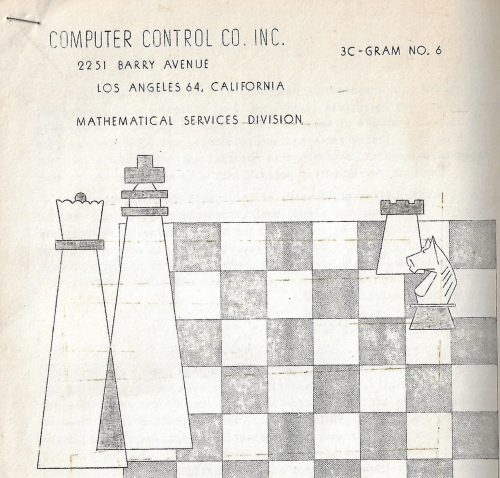
    Classic Games–Instruction manuals printed by Computer Control Co., Inc. (3C), of Los Angeles Ca., creators of the DDP series (of some fame) and in business from 1953-1966 until it was bought up and out. All are 11×8.5″, offset printed, and staple bound at top left. These publications were called “#C-Gram No. ___” . I have four of these and have no idea how many others there were, though there were at least six, as these are numbers ?, 2,3,6.  Included are: 
    “Spider”, 4pp; “NIM”, 4pp ;”Go”, 11pp; and “Kriegspiel”, 6pp. All are in about VG condition. Scarce bits of computer-related ephemera.  $75/all

    3C games


    ·Posted by :

    ·in:

Recent Posts

Archives

Categories