A Daily History of Holes, Dots, Lines, Science, History, Math, Physics, Art, the Unintentional Absurd, Architecture, Maps, Data Visualization, Blank and Missing Things, and so on. |1.6 million words, 7500 images, 4.9 million hits| Press & appearances in The Times, Le Figaro, Mensa, The Economist, The Guardian, Discovery News, Slate, Le Monde, Sci American Blogs, Le Pont, and many other places… 5000+ total posts since 2008.

  • An Electronic Simulation of Economic Systems, 1952

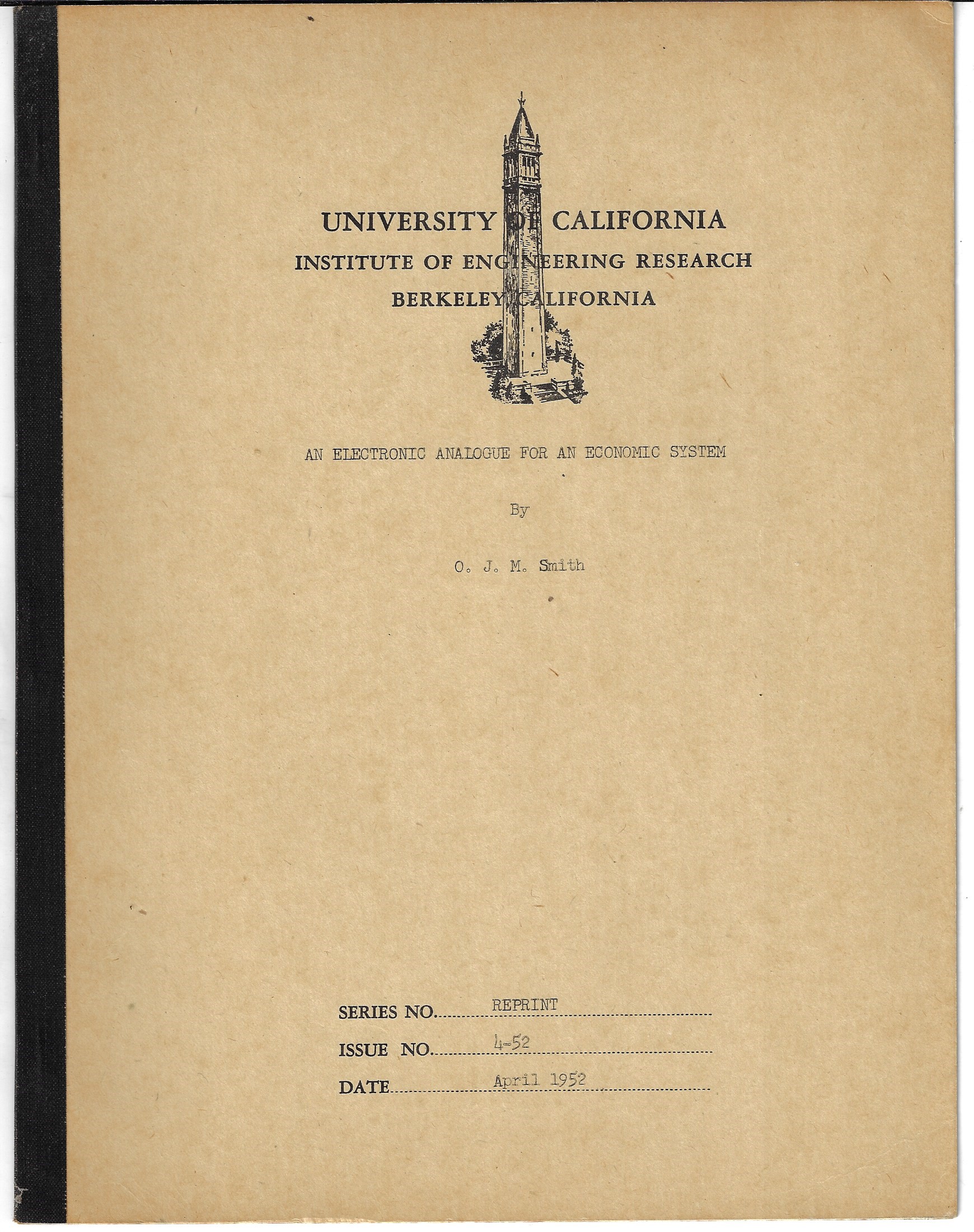
    Otto J.M. Smith, H.F. Erdley. “An Electronic Analogue for an Economic System.”  11×8″, 5pp. Stiff wrappers, with (original) cloth-adhesive spine cover. Fine copy. SOLD 

    • Reprint: Electrical Engineering ( Volume: 71 , Issue: 4 , April 1952 ) The cover reads: University of California, Institute of Engineering Research, Berkeley, California.
    Computer analogue economic “Abstract: A macrodynamical economic system is simulated with electronic circuits to study the effects of various parameters on stability. Included in the circuit are the delay between the investment of money and the production of goods, the time constant of depreciation, the distribution of manufactured goods, increase of capital goods, and national consumption.”

    “As early as 1892, Irving Fisher recommended the use of hydraulic analogies “not only to obtain a clear and analytical picture of the interdependence of the many elements in the causation of prices, but also to employ the mechanism as an instrument of investigation and by it, study some complicated variations which could scarcely be successfully followed without its aid” (1892, p. 44). It was not until 1950, however, that the first hydraulic analogues of economic systems were constructed. Phillips (1950) used machines made of transparent plastic tanks and tubes through which colored water was pumped to depict the Keynesian mechanism of income determination and to indicate how the production, consumption, stocks, and prices of a commodity interact. Electrical analogues were used to study models of inventory determination (Strotz et al. 1957) and to study the business cycle models of Kalecki (Smith & Erdley 1952), Goodwin (Strotz et al. 1953), and others.”–Encyclopedia dot com

    “Otto J.M. Smith A [long-time] professor at the University of California, Berkeley, developed the Smith Predictor in about 1957. His model-based control strategy enables a controller to predict the future effect of its present efforts and react immediately to those predictions.”–“Leaders of the Pack: From the plant to academia, InTech’s 50 most influential industry innovators”, by Jim Strothman, August 2003, ISA dot org See “Ways of Thinking, Ways of Seeing: Mathematical and other Modelling…” edited by Chris Bissell, Chris Dillon, chapter 7, “Visualizations for Understanding Complex Economic Systems”.
    ·Posted by :

    ·in:

  • Papers on Electricity, Railroads, and Bridges (1848)

    Robert Hare, “Objections to the Theories Severally of Franklin, Dufay, and Ampere, with an Effort to Explain Electrical Phenomena, by Statistical, Undulatory, Polarization”. In: Journal of the Franklin Institute, edited by Thomas P. Jones, volume 45, third series, vol 15, 1848; 474pp, 2 plates, pp 188-199 and 264-277. Half-calf, with attractive marbled boards, raised bands, gilt dentelles. Condition: ex-library though faintly, with a ghost of a call slip on the spine bottom, bookplate, and stamps on the title page. The book was very little used. Very solid, crisp, and clean copy. VG $175

    From the summary of the concluding half: “The theories of Franklin Du Fay and Ampere are irreconcilable with the premises on which they are founded and with facts on all sides admitted. A charge of frictional electricity or that species of electric excitement which is produced by friction is not due to any accumulation nor to any deficiency either of one or of two fluids but to the opposite polarities induced in imponderable ethereal matter existing throughout space however otherwise void and likewise condensed more or less within ponderable bodies so as to enter into combination with their particles forming atoms which may be designated as ethereo ponderable.”

    Also included:

    “A Description of Col. Long’s Composite Bridge…” pp 202-206, with a plate and pp 258-264.

    Staite, “New Mode of Lighting by Electricity”, pp 445-6;

    Faraday, Michael. “On the Use of Gutta Percha in Electrical insulation”, pp 446-8;

    “On the Theory of Dew” (translated elements of two papers from Melloni and Arago from October 1847), pp 52-60.

    …and numerous other papers.


    ·Posted by :

    ·in:

  • Photography, Southern Railroads, and an Artificial Hand (1845)

    Claudet, Antoine.  “The Progress and Present State of the Daguerreotype Art”, pp 45-51, 113-118. In: Journal of the Franklin Institute, edited by Thomas P. Jones, volume 12, third series, vol 12; 441pp, 2 plates. Half-calf, with attractive marbled boards, raised bands, gilt dentelles. Condition: ex-library though faintly, with a ghost of a call slip on the spine bottom, bookplate, and stamps on the title page. The book was very little used. Very solid, crisp, and clean copy. VG $250

    ”If the daguerreotype had been invented before the art of painting, then we should have never doubted its accuracy, and we should not have thought we were deceived or taken by delusion. The daguerreotype plate is etched by nature, exactly (though in a more perfect manner), as is the plate of copper…by the ingenuity of the engraver.” (p 48)

    George Cayley, “Description of an Artificial Hand” with “Method of Making an Artificial Hand, that will forcibly grab substances of various sizes…” pp 57-63, with three woodcut illustrations of the device.

    Report of the Engineer in Chief of the Georgia Railroad and Banking Company…” p 85-91, 149-153;

    “Report on the Atmospheric Railway” 153-156;

    “First Annual Report of the Directors of the South Carolina Railroad Company…”p 156-164, 231-236.

    Faraday, “Anastatic Printing”, pp 143-144 (and “Anastic Printing”, pp 63-64, 2 plates).

    Thomas Guffy, “Description of the Great Britain Iron Steam Ship, with Screw Propeller; with an Account of the Trial Voyage”, pp 289-296, 361-366.

    ·Posted by :

    ·in:

    —
  • Four-Part report on the Proposed Panama Canal, 1846

    “Extracts from the Report of Napoleon Garella, an Engineer appointed by the French Government to survey the Isthmus of Panama…”, (“Line and Principal Features of the Proposed Canal”), pp 18-24, (“Survey of the Isthmus of Panama”) 73-85, 143-154, 217-225. In: Journal of the Franklin Institute, edited by Thomas P. Jones, volume 12, third series, vol 12; 441pp, 2 plates. Half-calf, with attractive marbled boards, raised bands, gilt dentelles. Condition: ex-library though faintly, with a ghost of a call slip on the spine bottom, bookplate, and stamps on the title page. The book was very little used. Very solid, crisp, and clean copy. VG $200

    People were thinking big thoughts about a canal in Panama even in the first half of the 19th century, as we can see in this series of four papers. No doubt the information was useful to those who completed the famous and infamous Panama Railway, which spanned the isthmus at 47 miles and connected the oceans, and was completed in 1855 (about a half-century before the canal). The cost in human lives of this undertaking was incredible: anywhere between 5,000 and 20,000 workers lost their lives, making it one of the deadliest of modern tech projects.

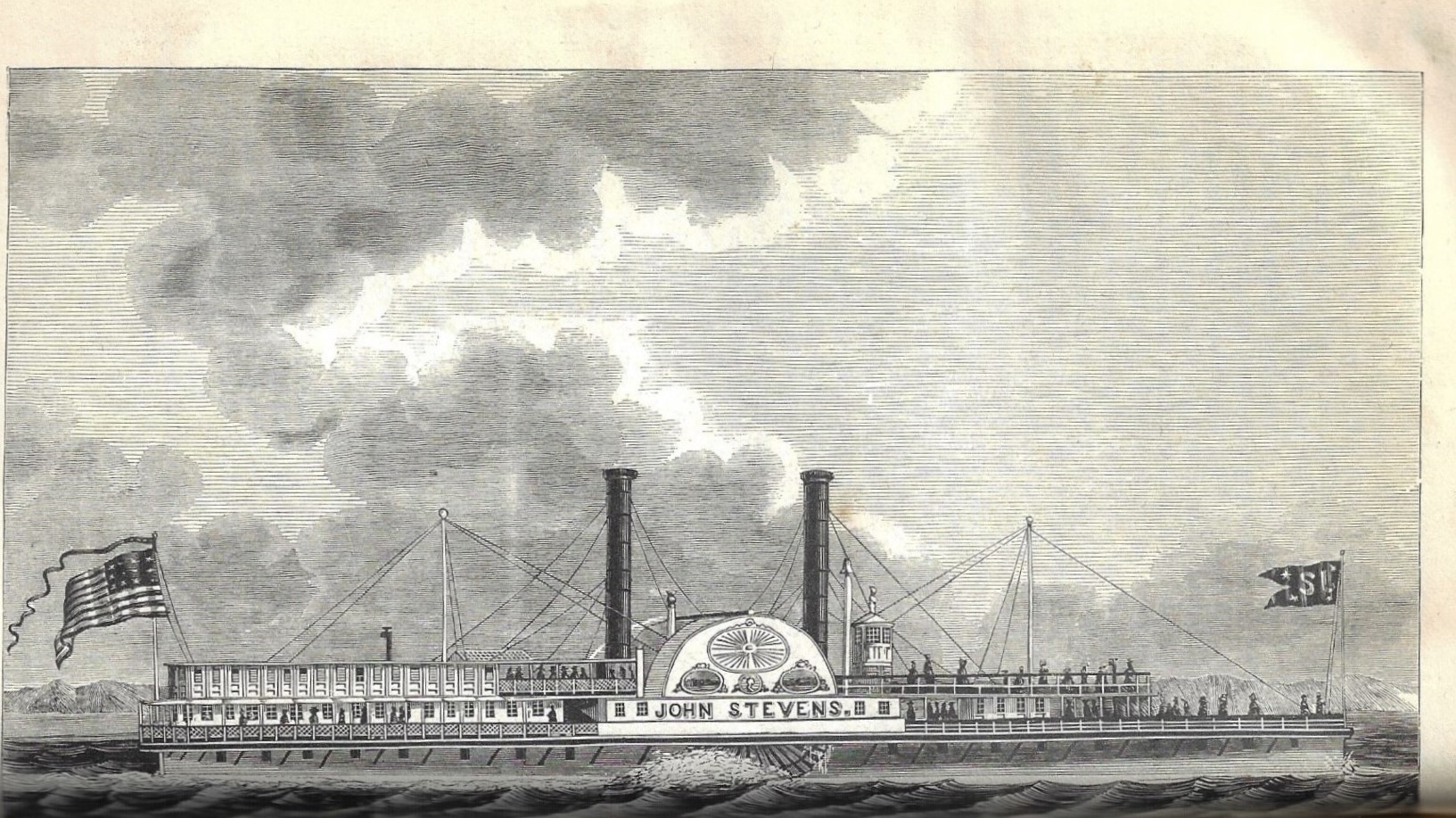
    JFI 1846 John Stevens

    Also of interest in this volume:

    “Description of the Iron Steamer “John Stevens”, 334-336, with a lovely full page plate of the 245′ ship;

    Morse, S(amuel) and B.R. Stevens, description of a patent for an improvement in Daguerreotype Impressions (one para), page 258;

    (Saxton, Joseph). “Description of an Automatic Dividing Machine, arranged for use in the Coast Survey Office”, pp 258-261, with a double-page plate showing the plan and elevation of the machine;

    “On some Products of Chinese Manufacture collected by Jules Itier, Chief Inspector of customs” pp 281-284;

    “Biram’s patent Anemometer, for Measuring the Velocity of the Wind, the Current of Air in Mines, &c.”, pp 143-144, with a small woodcut of the device.

    …and many dozens of other papers.


    ·Posted by :

    ·in:

  • Very Early Railroading Papers (1830)

    (Early Railroading) Journal of the Franklin Institute, Philadelphia, published by the Franklin, 1830. Vol 6, 430, 8pp. Half calf, marbled boards. Some amount of scuffing on the spine, though the gilt impressions are very legible. Ex-library copy, with stamps on the title page, and a remnant of a paper label on spine bottom. Near-VG copy. $200

    “Account of the Liverpool and Manchester Railway”, December 1830, pp 409-419. Also: a map of the railway is misbound (I suspect) in the November issue, 1830, appering opposite pg 305. Longish report on the “first locomotive-hauled railway to connect two major cities, and the first to provide a scheduled passenger service”. Part of the paper is a description of a run on he L+M, which had made its inaugural run on 15 September, just months earlier. (The first run was an enormous event, the PM there for great festivities. 10 years later there would be 1775 miles of track, and then by 1850 a total of 6200 miles in Britain.)

    “(T)he world is a branch line of the pioneering Liverpool–Manchester run.”– former British Rail chairman Peter Parker.

    And:

    S.H. Long. “On the Principles which should govern the location and construction of Rail-roads”, pp 178-193.
    Also in this volume these two fascinating reports:

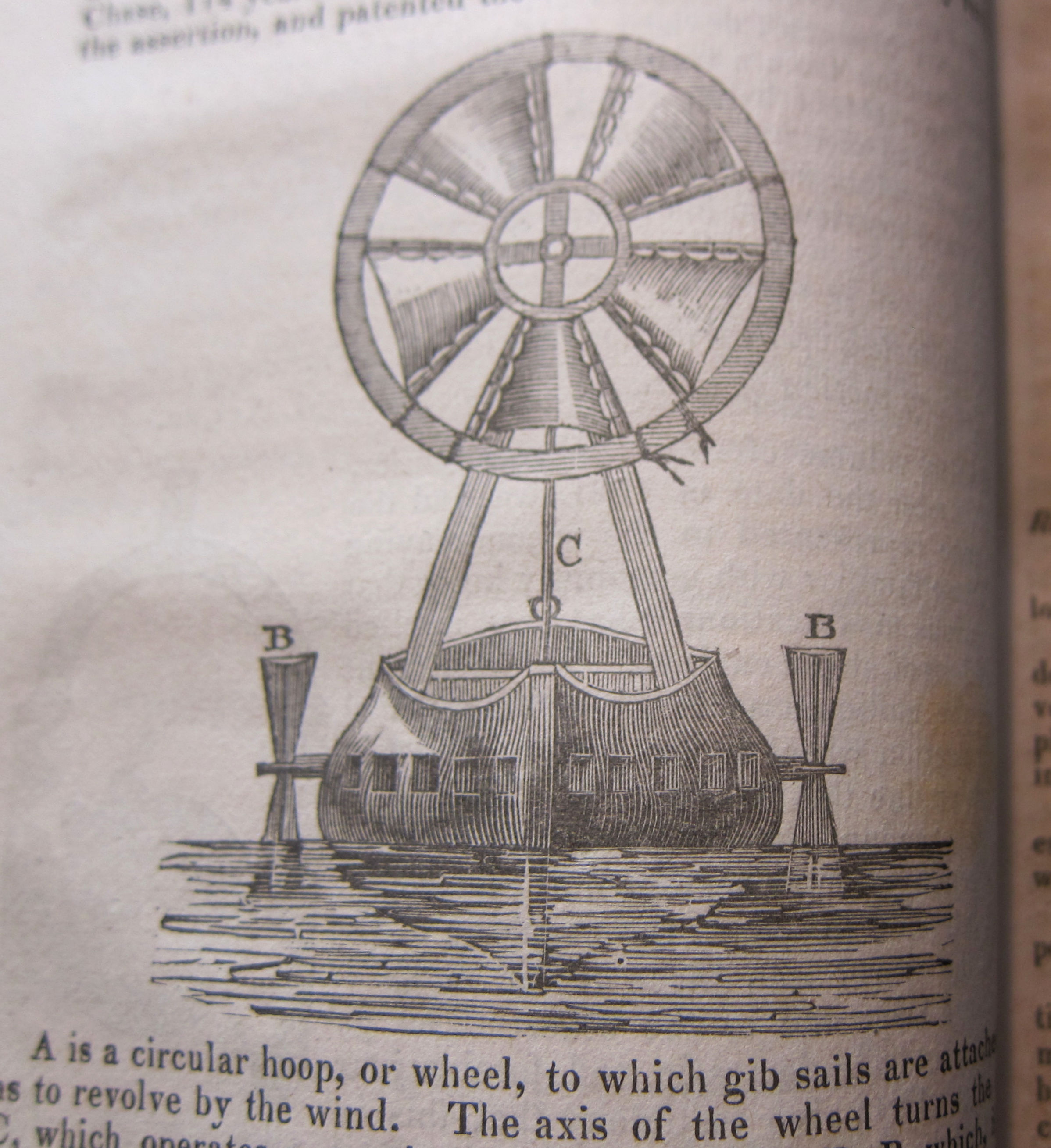
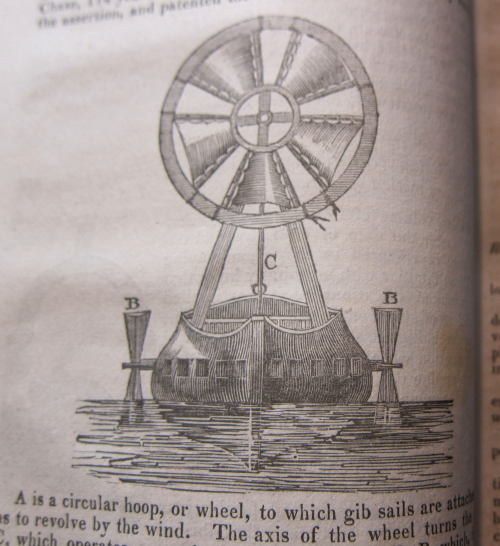
    “On the Construction of a vessel moved by the force of wind, and propelled directly against it”, July, page 40, with an inset woodcut.

    JFI 1830 circular fan sail

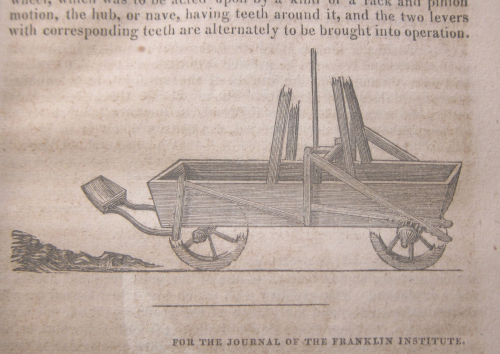
    “A self-loading cart propelled by wind”, p 40-1, with small woodcut illustration.

    JFI 1830 self shovel wagon

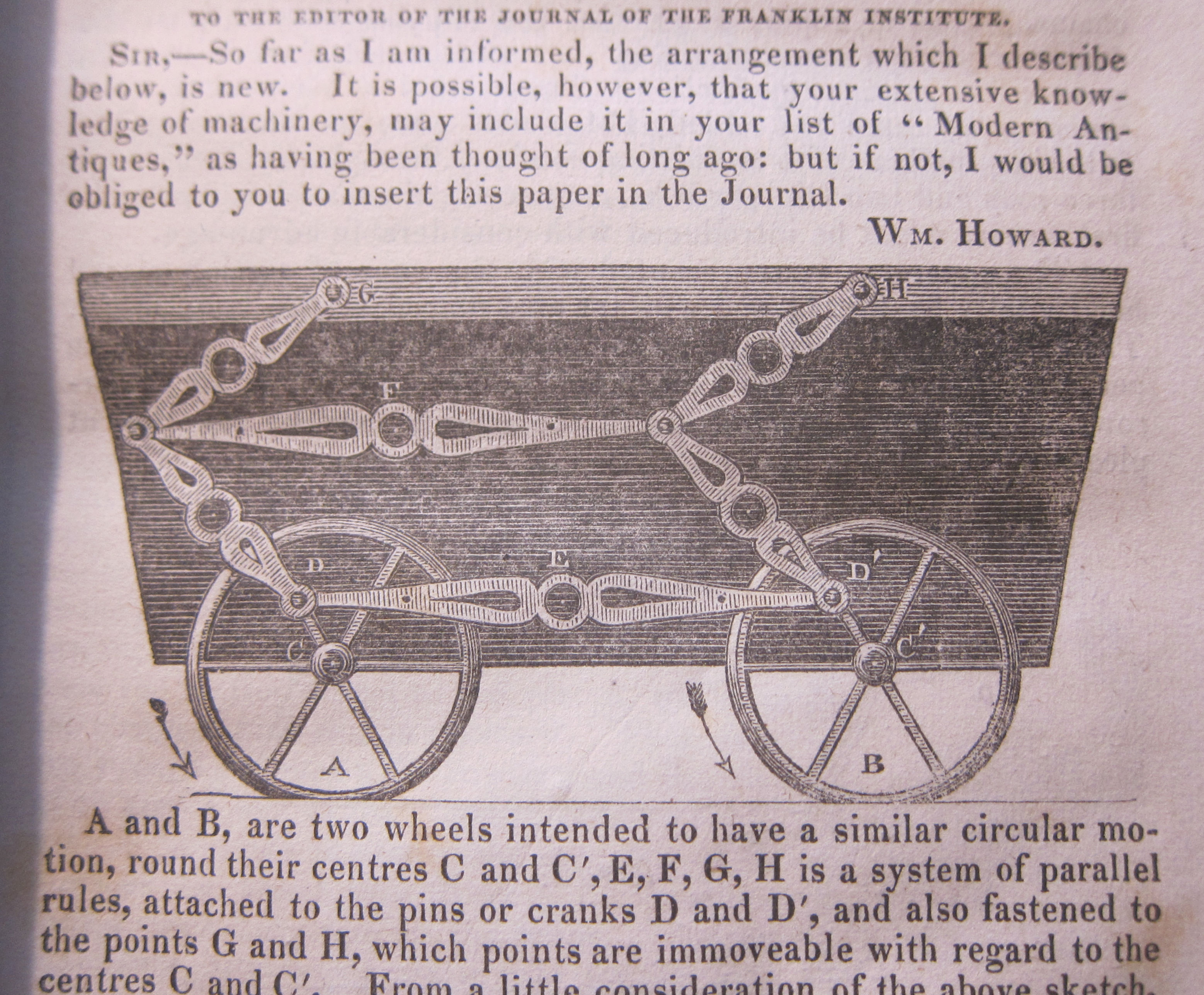
    Howard, William. “New method of communicating circular motion in a lateral direction”, pp 37-38, with small woodcut;

    JFI 1830 Wagon circular motion

    McDowell, John. “Economical mode of transmitting motion”, pp 38-9, with small woodcut.  

    There are many dozens of other papers plus a hundred or so patent reports (with sort comments by the editor).


    ·Posted by :

    ·in:

  • A Very Early Photography-Related Publication (1837)

    Draper, John William. “Experiments on Solar Light”, in Journal of the Franklin Institute, Philadelphia, vols 19 and 20, 1837 (full year). Half calf and marbled boards. 9.5×6”, 490pp (8 plates), 442pp (2 plates). Condition: Scuffing and wear to spines though the gilt stamped titles are quite legible—the volumes seem to have received some use over the years. Ex-library, with stamps on the title page. The textblock is crisp and strong. Good copies. $500

    Draper articles appear in four parts and comprising 36pp with 3 plates: vol 19, June, pp 469-479, plate; vol 20, July, August, October , pp 38-46, 114-125, 250-253 (two plates).

    Also in volume 20: a significant report:

    (Samuel Morse.) “Electro-Magnetic Telegraph”, pp 323-325. Here the editor relates a successful experiment by Morse transmitting the message “Successful experiment with Telegraph”, with his one-wire (conductor) recording telegraph. (This is pre-Morse code, so the words were transmitted via numerals found in a telegraphic dictionary.)

    There is also a report on the first Russian railroad, as well as the book review of the first American edition of Lyell’s Principles of Geology.

    This is the pioneer Draper’s first paper containing sections relating to the photographic arts, though it seems to have been not much noticed or referenced, the best early ref to it coming from Draper himself. The paper appeared in four parts over two volumes of the Journal of the Franklin Institute in 1837, parts of it being published three years later in 1840 in the Philosophical Magazine, where Draper’s ideas seem to have been more widely recognized. Draper wrote in the PM:

    • “Most of these have been published in the Journal of the Franklin Institute of Philadelphia; but as they do not appear to have been noticed in England, I will ask the favour of a page or two of your excellent Magazine, to give my testimony on a subject, which now appears to excite so much interest.”

    On the 1837 appearance and the work in general, The Complete Dictionary of Scientific Biography contributes:

    • “As early as 1837, while still in Virginia, [Draper] had followed the example of Wedgwood and Davy in making temporary copies of objects by the action of light in sensitized surfaces. When the details of Daguerre’s process for fixing camera images were published in various New York newspapers on 20 September 1839, Draper was ready for the greatest remaining challenge, to take a photographic portrait. A New York mechanic, Alexander S. Wolcott, apparently won the race by 7 October. But if Draper knew of this, he persisted in his own experiments and succeeded in taking a portrait not later than December 1839. His communication to the Philosophical Magazine, dated 31 March 1840, was the first report received in Europe of any photographer’s success in portraiture. The superb likeness of his sister Dorothy Catharine, taken not later than July 1840, with an exposure of sixty-five seconds, seems to be the oldest surviving photographic portrait. In the busy winter of 1839–1840, Draper also took the first photograph of the moon and launched, in a very modest way, the age of astronomical photography.”


    ·Posted by :

    ·in:

    —
  • Letters by Leeuwenhoek, 1688

    [Leeuwenhoek, Antoine van.] “Vervolg der brieven &c. Suite des lettres de M. Leeuwenhoek a la Societe Royale de Londres, 1688.” Jean Le Clerc and Jean Cornande de al Crose, Bibliotheque Universelle et Historique de l’annee M.D.C. LXXXVIII, Amsterdam; Wolfgang, Waesberge, Boom, & van Someren. 1689. Volume 11. (first edition?), including October-December 1688; 5.5”x3”; (vi), (xIV), 553, (27), (6)pp. Bound in full vellum. There is a very detailed plate of microscopic drawings in some copies after page 168; this copy does not have the plate and there is no evidence to say it was ever there. This has been observed by others.

    The Lueewenhoek references appearing on pp 164-8 includes “Den Waarchtingen Omloop des Bloeds & c. La Vraie Circulationdu sang…” CONDITION: the vellum on this copy is somewhat worn and has a 2” tear through the joint though only affecting the vellum and not the binding itself. GOOD copy only.

    A review in French of an installment of the published letters to the Royal Society (in Dutch, at Amsterdam, by Boutesteyn in 1688) of Antoine van Leeuwenhoek.  $350

    “Leeuwenhoek made his most important discovery early in his scientific career, in 1674, when he recognized the true nature of microorganisms…conclud(ing) that the moving objects that he saw through his microscope were little animals. He recorded these observations in his diary, and two years later, in a letter of 9 October 1676, communicated them to the Royal Society, where they caused a sensation…Leeuwenhoek subsequently described, in about thirty letters to the Royal Society, many specific forms of microorganisms, including bacteria, protozoa, and rotifers, as his incidental discovery of ciliate reproduction…It was through letters—more than 300 of them, written to private scientists and amateurs in both Holland and other countries—that Leeuwenhoek made his work known… he was indebted to the Royal Society of London for the publication of his views, and 190 of his letters are addressed to that body.”—Complete Dictionary of Scientific Biography, online, Leeuwenhoek section. 

    On the Bibliotheque: “Like its great rival, Pierre Bayle’s Nouvelles de la re´publique des lettres, it [the Bibliotheque.] was a source of information and means of communication for members of the nascent Republic of Letters. It was also one of the remote ancestors of the modern academic journal, though much less specialised than most of its successors.”J.R. Milton, “Locke’s Publications in the Bibliothèque Universelle et Historique”, British Journal for the History of Philosophy, 05/2011, Volume 19, Issue 3__+__ Editors and contributors included: Jean Le Clerc et Jean Cornande de al Crose, vols 1-9; Jean Le Clerc, 10, 12, 14-19; Jean Cornand de La Crose, vol 11; Charles le Cene and Jean Le Clerc, vol 13; Jacques Bernard and Jean Le Clerc, vol 20; Jacques Bernard, vols 24-5. The journal was published every 4 months in vols 1-3; every 3 in 4-19, and then twice a year for 20-25.


    ·Posted by :

    ·in:

  • The “Does-All” Computer Program, ca. 1962

    JF Ptak Science Books 

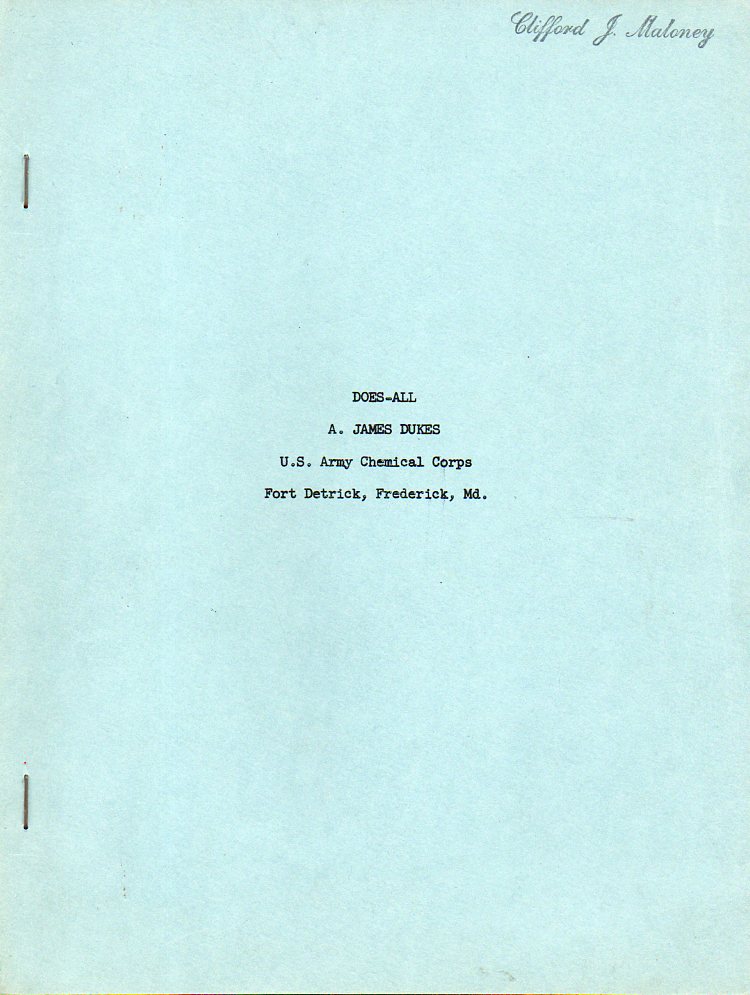
    Computer does-all916 A. James Dukes. Does-All.  U.S. Army Chemical Corps, Fort Detrick, Maryland.

    This 11×8 inch mimeographed/stapled publication does not have a date of publication, but as near as I can determine it was assembled in the early 1960’s.  It does mention several computers by name, the last of which,. the LARC, was suggested in 1960. 

    39pp(+3pp).  Fine condition. Rare. (No copies located in WorldCat.) $125

    There was no program called the “Does-All”.  This was an ironic suggestion for the name of a program to illustrate this rather lengthy introduction to computers (hardware and software) written by Mr. Dukes of the U.S. Army Chemical Corps at Fort Detrick. He has a very light pen and a good sense of humor, and writes with a great deal of clarity, and given the time period and his place of business (!) I’d say it was about the funniest intro to compsci that I’ve seen in the relatively early stuff. Dukes spends the first dozen pages or so on the hardware, with the remainder dedicated to writing programs–the writing is filled with insight and analogies.

    Charming, really.  

    Notes:

    Before it became more of a household name in popular movie culture Fort Detrick started out as Detrick Field (1931-1946), and then became Camp Detrick (1943-1956), and then on to Fort Detrick (U>S. Army Medical Command, plus dozens of other commands based there). When this pamphlet was printed Detrick was the seat of the U.S. bio-weapons program (1943-1969).  


    ·Posted by :

    ·in:

  • Interior Open Spaces in Cities and Reduction of Poor Health and Crime (1883)

    Timothy Newell, M.D. The Sanitary, Physical, and Educational Advantages in Interior Open Areas in Large Cities. A Paper read Before the American Public Health Association. Boston, Press of Rockwell and Churchill, 1883. 9×6 inches, 11pp. Original wrappers. Provenance: Brown University, and then the Library of Congress. Small “LC” perforated stamps on title and last page; LC surplus/duplicate rubber stamp on rear wrapper. Good copy. NO COPIES located in WorldCat/OCLC  $150

    On the efficacy and use of park and open spaces in cities for the good of the health of the population.

    Referred to as “a valuable paper” in the Report of a Conference on Charities and on Other Subjects Pertaining to the Prevention of Suffering, Pauperism, and Crime, published by the Charity Organization Society of Baltimore City, 1887.

    Among  [Newell's]  published   papers are:   "What Changes Does Physiology Demand in  our School
    System ?" read before the American Social Science Association at Saratoga, in 1876, and published in
    the Sanitarian; as chairman of  a committee on school  hygiene, of  the  Rhode  Island  Medical
    Society in 1875, he made a full report with  a series of resolutions, which were copied into several sani-
    tary journals   and  commented;   "Interior  Open Spaces in Large Cities," read before the American
    Public Health  Association.   He is also the  author of several  pamphlets  published  annually  for  ten
    years  by the Public Parks Association,  and is author of  the  "Cyclopedia of Domestic Medicine  and
    Hygiene," Bradley &  Woodruff,  Boston, 1890, a volume of 700 pages and 200 illustrations.”
    --Physicians and Surgeons of America (Illustrated), a Collection of Biographical Sketches of the
    Regular Medical Profession. 1896.

    ·Posted by :

    ·in:

    —
  • The Krakatoa Eruption, September 1883

    The eruption of Krakatoa–three very contemporary accounts from Nature, September-October 1883.

    “The Java Upheaval”, in: Nature, 6 September 1883, pp 443-4 in the weekly issue of pp 433-456.  Also includes a half-page map of the area of the Krakatoa eruption, which occurred about two weeks earlier on 27 August.  Original issue, removed from a larger bound volume.  Very clean and fresh. 3 issues: $150

    • “The most powerful volcanic eruption in recorded history occurs on Krakatau (also called Krakatoa), a small, uninhabited volcanic island located west of Sumatra in Indonesia, on this day in 1883. Heard 3,000 miles away, the explosions threw five cubic miles of earth 50 miles into the air, created 120-foot tsunamis…”–Wikipedia

    Also with:

    • “Scientific Aspects of the Java Catastrophe”, in Nature, 13 September 1883, pp 457-458 in the weekly issue of pp 457-480. Original issue, removed from a larger bound volume.
    • “The Java Eruption” in Nature, 11 October 1883, page 577 in the issue of pp 561-584. Very nice copy, except that ther is a small half-inch x inch jagged piece missing in the bottom margin of p 579. Original issue, removed from a larger bound volume.

    Also contained in this 6 September issue: Francis Galton’s important paper in “visual kinsip” , “Arithmetic Notation of Kinship”,  a letter to the editor, p. 435.  (“MANY writers have endeavoured to devise a simple method of describing the various forms of kinship, which, when expressed verbally, are cumbrous and puzzling in the highest degree. I suspect, however, that if we had always been as familiar with the binary system of arithmetic as we are with the decimal, that the facilities afforded by a numerical system of kinship would have been so obvious…”  And from History of Anthropology blog:  “Francis Galton was a major champion of the algebraic approach to representing genealogies, and solicited the help of the mathematician Alexander MacFarlane to that end— while Bronislaw Malinowski acidly criticized such abstract symbolism as a bloodless technique. These early attempts at mathematical systematicity foreshadow later 20th century computational analysis of kinship; Galton’s interest in binary systems in particular anticipates computer modeling of social and genetic networks. “– (histanthro dot org)

    ·Posted by :

    ·in:

  • Computer Ephemera, M.I.T., Whirlwind, 1953


    Compsci MIT Summer Program MIT _2_Digital Computers and their Applications
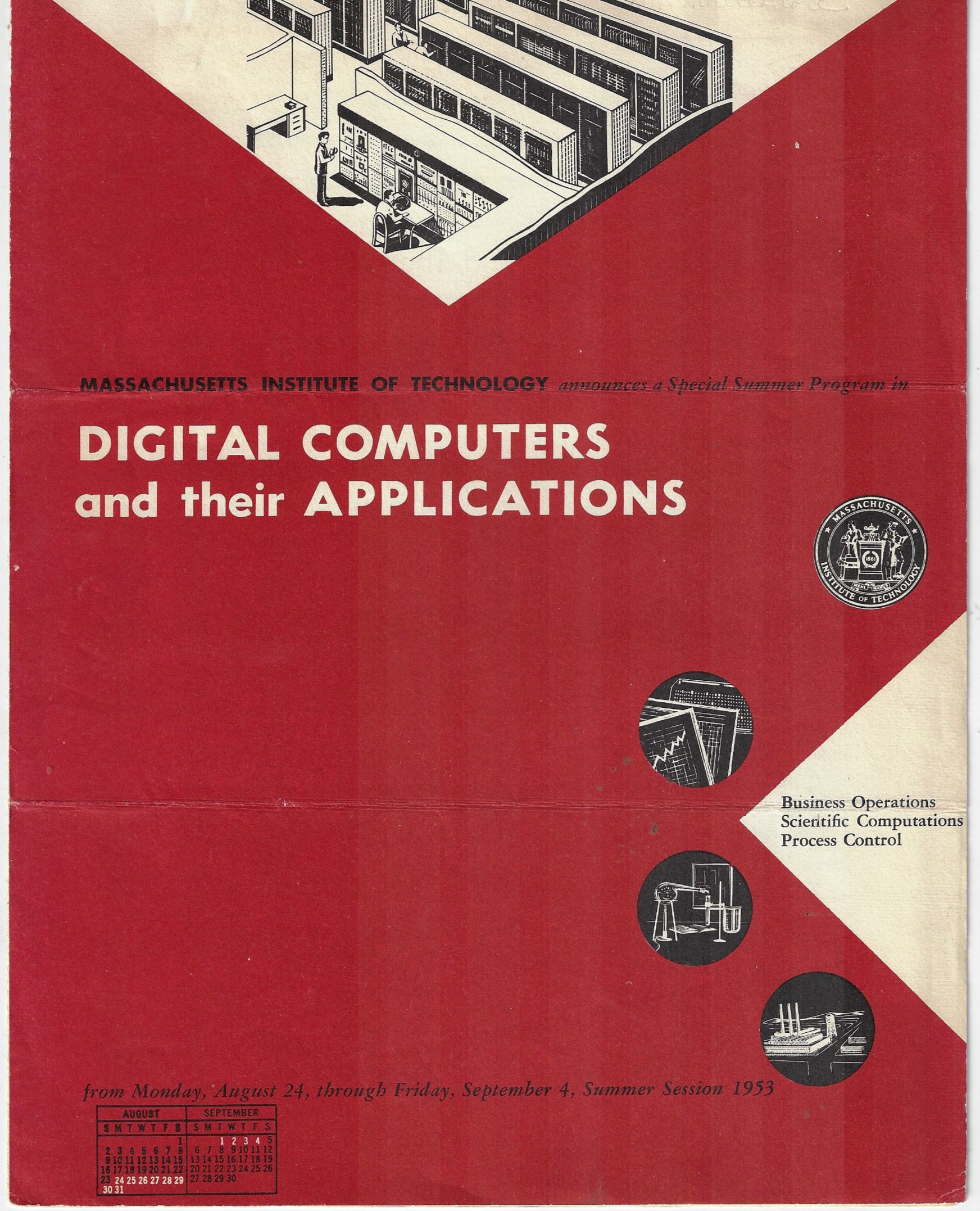
    , Special Summer Program. Massachusetts Institute of Technology. Business Operations, Scientific Computations, Business Control. August 24-September 4, 1953.

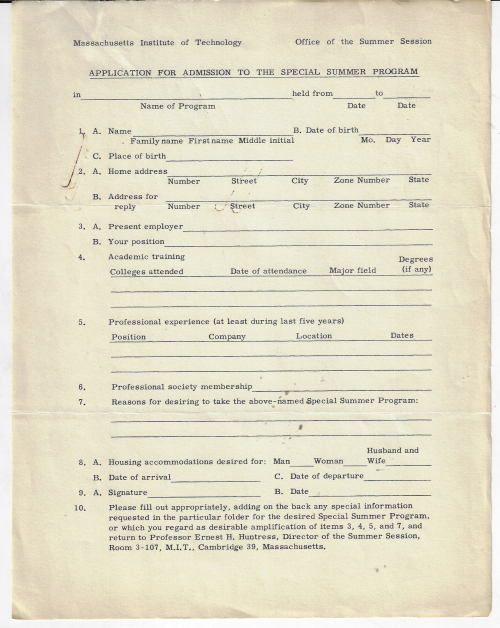
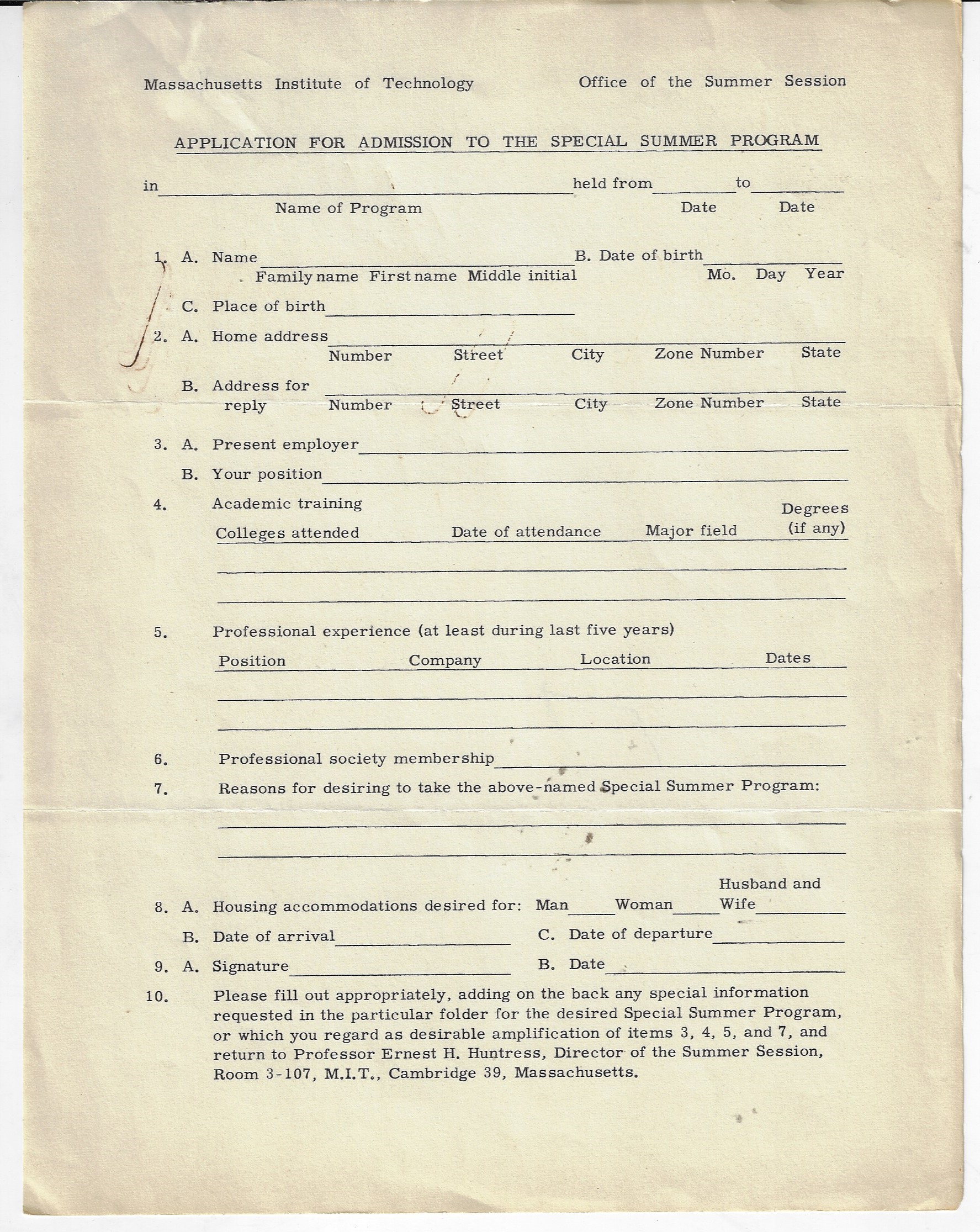
    10”x8” , 6pp, printed on one sheet, tri-folded. With: detached single sheet “Application for Admission to the Special Summer Program”. Very Good condition. Scarce piece of computer/MIT ephemera.  $125

    The staff includes the great pioneers M.V. Wilkes and Jay W. Forrester with the summer members working on the Whirlwind I. 


    Compsci MIT Summer Program MIT _1_

    ·Posted by :

    ·in:

Recent Posts

Archives

Categories