A Daily History of Holes, Dots, Lines, Science, History, Math, Physics, Art, the Unintentional Absurd, Architecture, Maps, Data Visualization, Blank and Missing Things, and so on. |1.6 million words, 7500 images, 4.9 million hits| Press & appearances in The Times, Le Figaro, Mensa, The Economist, The Guardian, Discovery News, Slate, Le Monde, Sci American Blogs, Le Pont, and many other places… 5000+ total posts since 2008.

  • An Harmonic Analyzer, 1916

    JF Ptak Science Books   

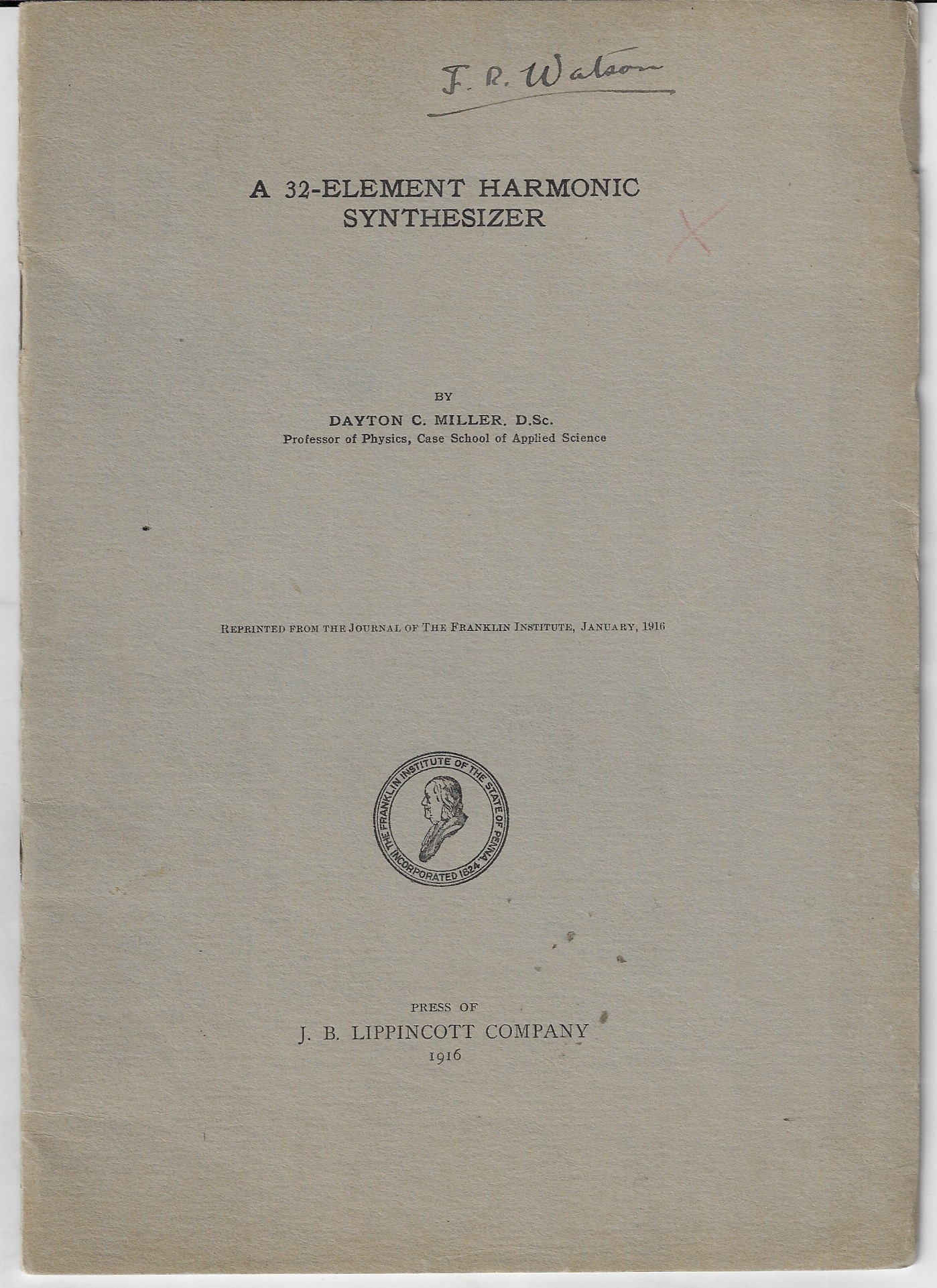
    Miller, Dayton C. A 32-Element Harmonic Synthesizer.  Offprint: Journal of the Franklin Institute, January 1916; printed by Lippincott Company, 1916. 9″x6″, pp 51-81, with illustrations.  Original wrappers. Fine condition. Original owner’s name on the front wrapper.  $150

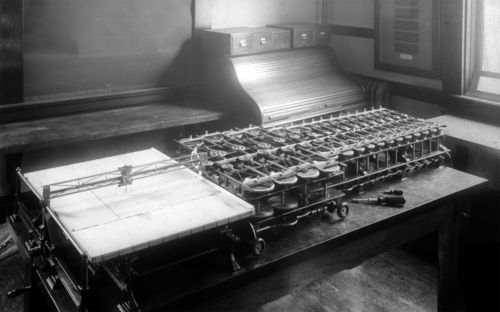
    It isn’t really an onomatopoeia, but the harmonic synthesizer at least feels like itself in the mouth as the two words are spoken. try it: h a r m o n i c   s y n t h e s i z e r.  The name does feel as though it touches the boundaries of most of the mouth, and that is basically what this analog computer does, analyzes sound, and record it in lovely waves (the plotter on the left in the photo).   http://www.phys.cwru.edu/ccpi/Harmonic_synthesizer.html

    It is also a beautiful machine. The one above is by Dayton Miller of Case Western Reserve, and it is described in a 1916 publication from the Journal of the Franklin Institute. 

    Miller harmonic analuyzer

    32_component_synthesizer

    “As described on the Case Western Reserve University website, “Lord Kelvin’s harmonic synthesizer is basically Henrici’s harmonic analyzer in reverse. Originally designed as a tide predictor in 1873, the system can combine numerous component waves—in some devices, up to 64 separate components—into a single curve. It is based on the earlier pin-and-slot device, which produces simple harmonic motion with the turn of a crank.”

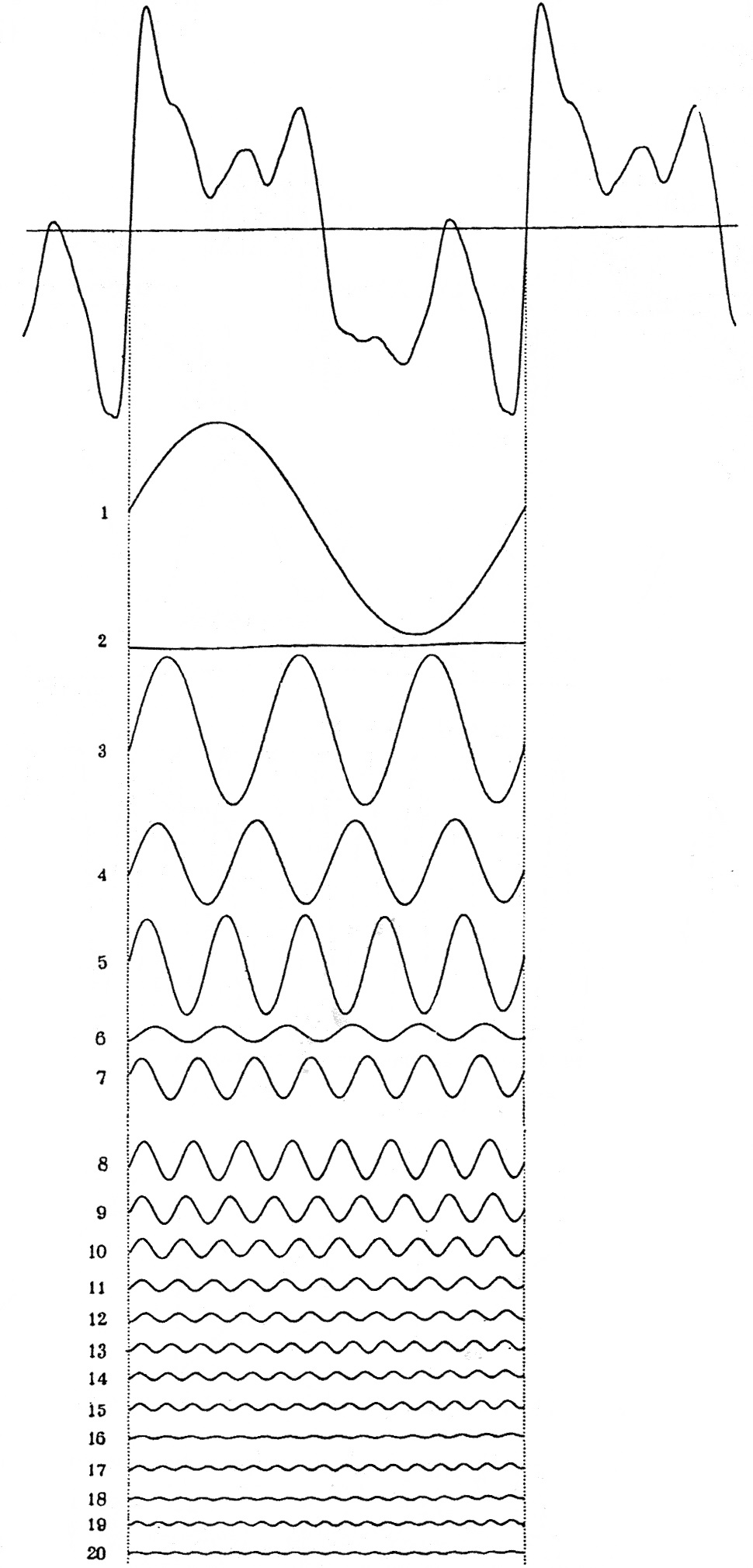
    And one of the results as it appeared on page 73 of the Journal of the Franklin Institute,  a curve representing the sound wave from a clarinet and twenty of its harmonic components: 

    32--big--Harmonic_synthesizer_diagram

    “The version used by Dayton Miller was designed and built in the laboratory and instrument shop of the Physics Dept. of the Case School of Applied Sciences. It consisted of 32 rotating pin-and-slot devices (see diagram below), each of which produced simple harmonic motion with a specified amplitude and phase; these 32 elements controlled the motion of a single cable that traced out the combined wave with a stylus and sliding drafting table. It was used by Dayton Miller to check the results produced by the harmonic analyzer against the original phonodeik curve…” http://www.phys.cwru.edu/ccpi/Harmonic_synthesizer.html

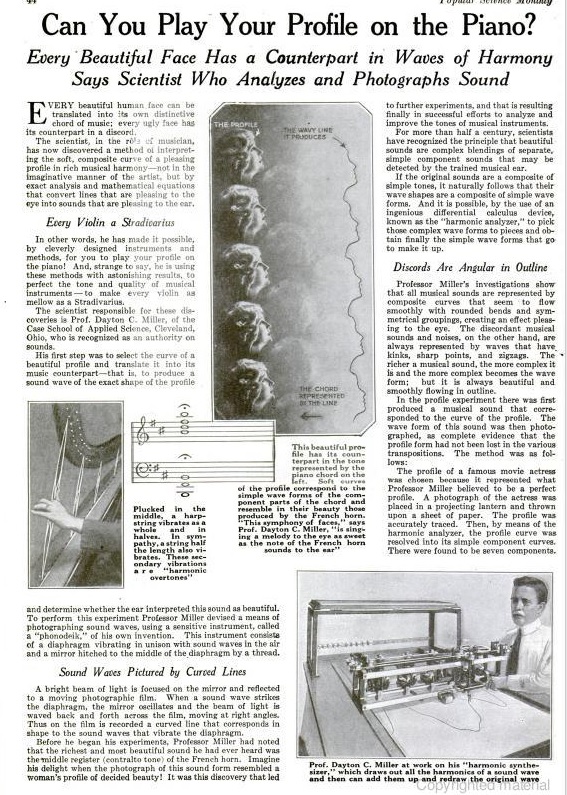
    And from the magazine Popular Science for Augusat, 1921, we find the following article:

    Dayton harmonic

    [Source:  Google Books]


    ·Posted by :

    ·in:

  • An Apparatus for Calculating Efficiency (1883)

    C. Vernon Boys, “Meters for Power and Electricity”, in Nature, 14 June 1883, vol 28 #711, pp 162-5 in the weekly issue of pp 145-168.  Original self-wrappers, removed from a larger bound volume. Crisp and clean copy. $95  This is from Boys’ lecture at the Royal Institution, March 2, 1883.  

    C. Vernon Boys (1855-1944) was a British physicist and fine experimentalist and contributed this exemplary instrumentation article which appeared in the journal Nature (14 June 1883), when the no-longer new-ish journal rapid-published the breaking and thoughtful science news of the day every week.  Generally articles in the early decades would seldom range over two pages–of course, the pages were dense, and in two columns, with usually 80 lines per column and ten words per line, so each page could be filled with 1600 words, which is four times the general length of a novel.  In any event Boys’ article ran five columns, or about 5,000 words, which is a fairly meaty article.  

    From Gaston Tissandier’s Popular Scientific Recreations (1883):

    Mr. C. Vernon Boys has exhibited and described a very ingenious new 
    integrating machine of his invention, and its application as a measurer of the 
    electric energy in the circuit of an electric lamp or a dynamo-electric motor. 
    Mr. Boys' mechanical integrator belongs to the class termed tangent machines, 
    and consists essentially of a small disc or wheel running along the surface of 
    a drum or cylinder. When the wheel runs straight along the drum parallel 
    to its axis there is no rotation of the latter, but when the wheel is inclined 
    to the axis the drum rotates, and the integral is represented by the amount 
    of rotation. Continuous action is secured in giving the drum a recipro- 
    cating motion along its axis, so that when the wheel has travelled to one end 
    of the cylinder it can travel back again. The new integrator is especially 
    adapted for measuring forces which are either delicate or variable. It is 
    applied by causing the varying force to be measured to vary in a correspond- 
    ing manner the inclination of the wheel to the axis of the rotating cylinder.

    Some of Boys’ papers on calculating and measuring machines include:

    • “An integrating machine.” Proceedings of the Physical Society of London, 4:199–206, 1881.

    • “On a machine for solving equations.”Proceedings of the Physical Society of London, 7:355–360, 1885.

    • “A new analytical engine.” Nature, 81(2070):14–15, 1909

    • “Apparatus for calculating efficiency.” Proceedings of the Physical Society of London, 5: 28–35, 1882a.

    • “On integrating and other apparatus for the measurement of mechanical and electrical forces.” Proceedings of the Physical Society of London, 5:8–28, 1882b

    ·Posted by :

    ·in:

  • The Matter of Space, 1883


    Charles Morris. “The Matter of Space”, in Nature, in the weekly issue of  February 8, 1883. pp 349-351.

    And with A.S. Herschel’s three-part paper in support of Morris:

    • “The Matter of Space”, in Nature, March 15, 1883, pp 458-460; and
    • “The Matter of Space II”, pp 504-506 in the weekly issue of March 29, 1883, and
    • ““The Matter of Space”, issue of July 26, 1883, pp 294-7 in the weekly issue.

    “Besides meteoric astronomy, Herschel was interested in many branches of physical science, and became a member of the Physical Society of London in 1889 and of the Society of Arts in 1892. He contributed frequently to Nature,an article on “The Matter of Space” in 1883 being specially noteworthy. “

    • Together: 4 papers, as described above, all from two volumes of Nature, 1883, removed from a larger bound volume, without their original wrappers.  Very Good condition.  $125 for the group.

    “Professor Alexander Stewart Herschel (5 February 1836 – 18 June 1907) was a British astronomer.. Although much less well known than his grandfather William Herschel or his father John Herschel, he did pioneering work in meteor spectroscopy. He also worked on identifying comets as the source of meteor showers.The Herschel graph, the smallest non-Hamiltonian polyhedral graph, is named after Herschel due to his pioneering work on Hamilton’s Icosian group.”–Wiki

    [Charles Morris] “contributed frequently to Nature, an article on ‘The Matter of Space’ in 1883 being specially noteworthy.  –Dictionary of National Biography, 2nd supplement; also see his obituary in  Monthly Notices of the Royal Astronom. Soc, Feb. 1908.

    “Mr Charles Morris on the pre nebular condition of matter: Others again suppose matter to be present everywhere throughout space. This view has been ingeniously advocated by Mr Charles Morris in an article on The Matter of Space which appeared in Nature February 8 1883. The hypothesis of an ether specially distinct from matter he considers to be a gratuitous assumption and one of the last surviving relics of eighteenth century science and unless it can be proved that highly disintegrated matter is positively incapable of conveying light vibrations there is no warrant for assigning this duty to a distinct form of substance. But that matter exists in outer space in the same conditions as in planetary atmospheres he thinks is improbable. Its duty as a conveyor of radiant vibrations seems to require a far greater tensity and its disintegration is probably extreme. Assuming matter throughout the universe here as condensed spheres and there in outer space as highly rarified substance the atmospheric envelopes of the spheres he considers will gradually shade off into the excessively rare matter of mid space. “–Stellar Evolution and Its Relations to Geological Time, p. 75 by James Croll

    Also in the March 29 issue is a fine article by G.H.  Darwin, “On the Formation of Mudballs” (similar to the natural formation of snowballs). Wonderful!

    ·Posted by :

    ·in:

  • Weather Prognostics and Weather Types, 1883

    Ralph Abercrombie, “Weather Prognostics and Weather Types”, in Nature, 2 August 1883, pp 330-334 in the weekly issue of pp 313-336. Includes two charts and three weather maps. Offered is the weekly issue, removed from a larger bound volume. Nice copy. $50

    This is an abstract of Abercrombie’s paper with Marriott “On Weather Prognostics” and “On Certain Types of British Weather” for the Meteorological Society. See: Tor Bergeron, “Synoptic Meteorology: An Historical Review” in Pageoph, Vol. 119 (1980/81), Birkhauser Verlag, Basel 1981. See p 451, particularly for Abercrombie’s use of the Ley cyclone model. “It should particularly be noticed that C. Ley’s model also gives the essence of the three-dimensional structure of a frontal low as we know it to-day…In this respect his model is a true forerunner to E. Palmen’s three-dimensional model of the flow in a mature cyclone published in 1931. ..” Abercrombie also references our old friend Boys Ballot in regards to his meteorological law.

    ·Posted by :

    ·in:

  • A Pre-Marconi (?) Plan for Wireless Communication (1893)

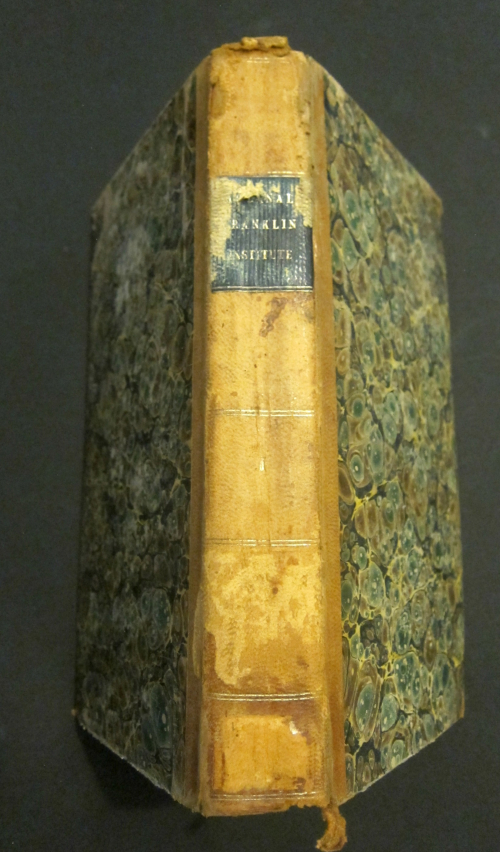
    Nikola Tesla, “On light and other high frequency phenomena”, in Journal of the Franklin Institute, vol 136 #1, July-December 1893. The Tesla article appearing in six sections” pp 1-19, 81-98, 161-177, 259-279, 351-360, and 401-412. Altogether 93pp with 34 text illustrations. Offered in the full volume of 482pp (plus a number of folding maps and tables at the end for Pennsylvania weather records. Condition: bound in half-calf with considerable scuffing to the spine; also, the rear board is nearly detached. This is an ex-library copy, with stamps on the title page as well as a bookplate. Good, sturdy copy, with some good and attractive life left in the binding. $650

    • “This was a lecture delivered before the Franklin Institute, Philadelphia, February 24, 1893, and before the National Electric Light Association, St. Louis, March 12, 1893, republished many times after publication in the Journal of the Franklin Institute, July, Aug., Sept., Oct., Nov., Dec. 1893.”

    “What Tesla described in this lecture should be taken to be the foundation of radio engineering, since it embodied the following principles and ideas of fundamental importance, namely: the principle of adjusting for resonance to get the maximum sensitivity in a selective reception, inductive link between the driver and the tank circuit, an antenna circuit in which the antenna appears as a capacitive load…”–“Nikola Tesla and his Contributions to Radio Development”, in History of Wireless, by Tapan K. Sarkar, Robert J. Mailloux, Arthur A. Oliner, 2006; chapter 5. Wiley-IEEE Press.

    “In February 1893 Tesla delivered a third lecture on high-frequency currents before the Franklin Institute in Philadelphia and repeated it in March at the National Electric Light Association in St. Louis. In the first part of the lecture he described a ‘method of conversion of low fiequency AC or DC current into high-frequency currents, all based on using spark gap discharge’. Just as in the previous two lectures he performed again many experiments with high frequency currents and various resonant circuits, illustrating that the current can pass through an open circuit consisting of a coil connected to a terminal of a generator and an insulated plate. Today specialists can easily build circuits used in these experiments but in 1893 they were fascinating and novel. The most significant part of this lecture refers to a system for “transmitting intelligence or perhaps power, to any distance through the earth or intervening medium”.

    Sarkar then quotes Tesla from the lectures:

    “On wireless energy transmission, Tesla made the following remark in the demonstration of high frequency driven motors by a single wire:

    • ‘It is quite possible, that such ‘hot wire” motors, as they might be called, could be operated by conduction through the rarefied air at considerable distances. Alternate currents, especially of high frequencies, pass with astonishing freedom through even slightly rarefied gases. The upper strata of air are rarefied, To reach a number of miles into space requires the overcoming of difficulties of a merely mechanical nature. There is no doubt that with the enormous potentials obtainable by the use of high frequencies and oil insulation luminous discharges might be passed through many miles of rarefied air, and that, by thus directing the energy of many hundreds or thousands of horse-power, motors or lamps might be operated at considerable distances from stationary sources’.”

    “Before passing on to consider the final phase of wireless communication, as represented by Marconi, mention must be made of one other pioneer, Tesla, who worked perhaps in a less spectacular manner than those who gained a certain amount of publicity. Tesla ’s early efforts are often overlooked, and it is only fair that his name should be mentioned so that he may share in the credit due to the early investigators. TesIa experimented early in the problem of transmitting energy without wires. In February 1893 he advanced a plan of wireless transmission and expressed his conviction in a lecture at the Franklin Institution that “it certainly is possible to produce some electrical disturbance sufficiently powerful to be perceptible by suitable instruments, at any point of the earth’s surface” –Ellison Hawks, Pioneers of Wireless, London: Methuen & Co. Ltd, 1927, found in Sarkar “Nikola Tesla and his Contributions to Radio Development”, in History of Wireless.

  • A Pre-Foucault Gyroscope (1852) in 1818

    Johann Gottlieb Bohnenberger, “Beschreibung einer Maschine, welche die Gesetze der Umdrehung der Erde um ihre Axe, und der Veranderung der Lage der Erdaze zu erlautern dient”, in Annalen der Physik, series I volume 60, 9th section, article V, 1818 last quarter 1818.  The paper occupies pp 60-71, and is illustrated with one small figure on plate 1.  (There was an earlier publication of this article in 1817 in a very obscure journal, otherwise this is the first appearance of the invention in a major publication.) 

    Offered in the full volume 60 of the Annalen, 475pp, with three plates (including a hand-colored map). Bound together with the very scarce (pinkish) outer wrappers. Bound in half cloth and marbled boards (ca. 1935). Ex-libris Deutsche Akademie der Luftfahrtforschung, then Wright Patterson Field Library (USAF), then Library of Congress.  Library markings:  small gilt-stamped “Akademie der Luftfahrtforschung”, page edges stamped “Wright Field Library/Dayton, Ohio” on top and bottom.  Scarce item. $350

    “Johann Gottlieb Bohnenberger (1765-1831) was a Professor of physics, mathematics, and astronomy at the University of Tübingen, Germany, as well as the scientific head surveying officer of the Kingdom of Württemberg. He made not only significant contributions to introducing modern geodesy in Germany but also constructed various physical instruments. The “Machine of Bohnenberger” is considered to be the first gyro with cardanic suspension and forms the precursor of J.B.L. Foucault’s Gyroscope of 1852…”, Jörg Friedrich Wagner (University of Stuttgart), in “The Origin of the Gyroscope: The Machine of Bohnenberger”.

    And this description of the apparatus from Pike’s illustrated descriptive catalogue of optical, mathematical and philosophical instruments: 

    • “Bohnenberger’s Machine. — This apparatus (see figure 146 below) consists of three movable rings,A,B,C, mounted on a stout base. The two inner rings are mounted on pivots; those on the smallest ring at right angles to the middle one; in the smallest ring is supported a metal ball, having a roller on one of its pivots; around the roller a string may be wound, and when pulled off a rapid rotary motion may be given to the ball. This motion may be given with the axis in any position required, and when communicated, the ring supporting the ball will resist considerable effort to alter its position, and whatever way the instrument may be turned, its axis will continue to maintain the position it had when set in motion, illustrating the inertia, or that property of matter which resists any change of state, whether of rest or motion.” —Benjamin Pike, Jr. Pike’s illustrated descriptive catalogue of optical, mathematical and philosophical instruments : manufactured, imported, and sold by the author, with the prices affixed at which they are offered in 1856. Found on page 142, illustrated by figure 146 and sold for 5 bucks, which could’ve bought you a month of lodging at a decent hotel in Manhattan in 1850.


    • This volume also contains: Friedrich Stromeyer (1776-1835), “Ueber das Kadmium”, pp 193-210. This is a report on cadmium, a discovery he made at the same time as C.S. Hermann, who reported his results in the preceding volume (though in the same year) of the Annalen, in “Noch ein schreiben über das neue Metall”. Annalen der Physik, volume 59, 1818.


    ·Posted by :

    ·in:

    —
  • Pioneering Electrical Engineering Effort (1855)

    J. M. Gaugain, “Notes sur un appareil electrique qui fait fonction de soupage”, in Comptes Rendus, Paris, vol. 40, #12, p. 640-2; 19 March, 1855. Removed from a larger bound volume, containing the full weekly issue of pp 597-648. Lacks the original outer wrappers.

    Offered with: “Note sur la stratification de la lumiere electrique”, same volume, pp 1036-7, offered in the original weekly issue, removed from a larger bound volume, lacking the original wrappers.  The two: $150

    On the first paper: “Experiments with low-pressure glow discharges started very early in the electrical art. Most of them were in small diameter glow tubes, often in the form called Geissler tubes. The first recognition of the fact that such a glow tube having its two electrodes of different size was capable of rectifying the oscillating current from an induction coil appears to have been that of Gaugain in 1855.”–”Development of Gas Discharge Tubes”, J.D. Cobine, in Proceedings of the IRE, May 1962.

    Also see GWA Dummer, Electronic Inventions 1745-1976, pg 40, 1855. “Experiments with low-pressure glow discharges started very early in the electrical art…the first recognition of the fact that such a glow tube having its two electrodes of different size was capable of rectifying the oscillating current from an induction coil appears to have been that of Gaugain in 1855…”

    ·Posted by :

    ·in:

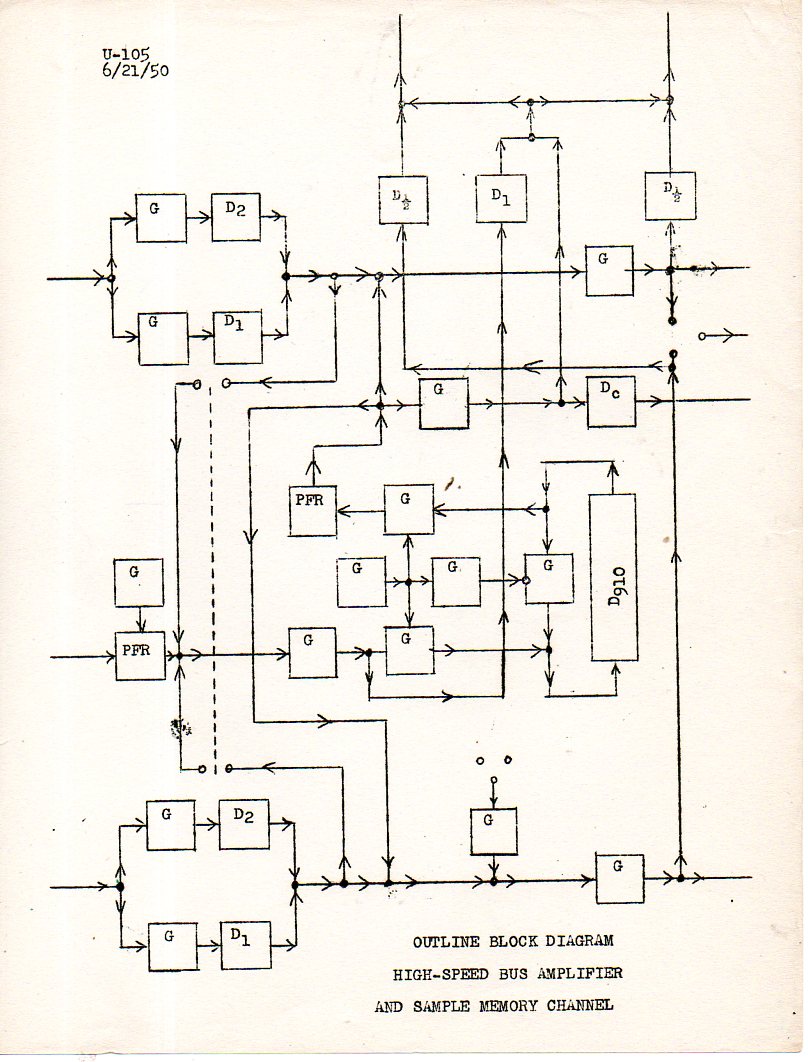
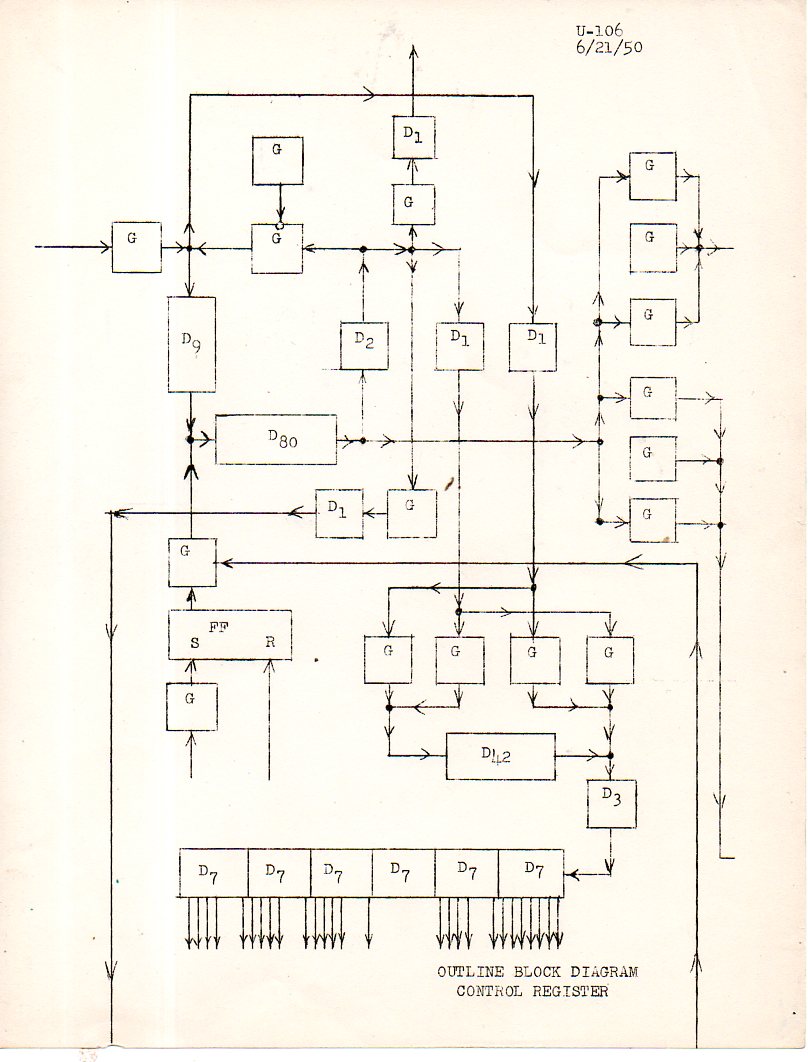
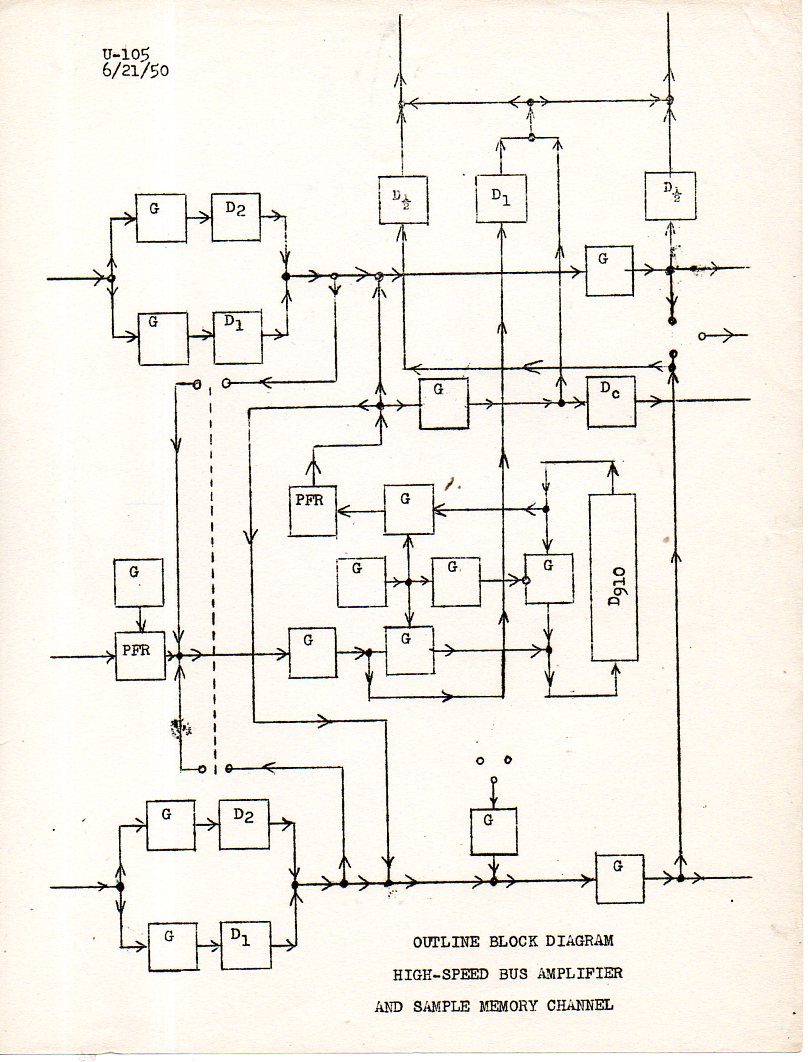
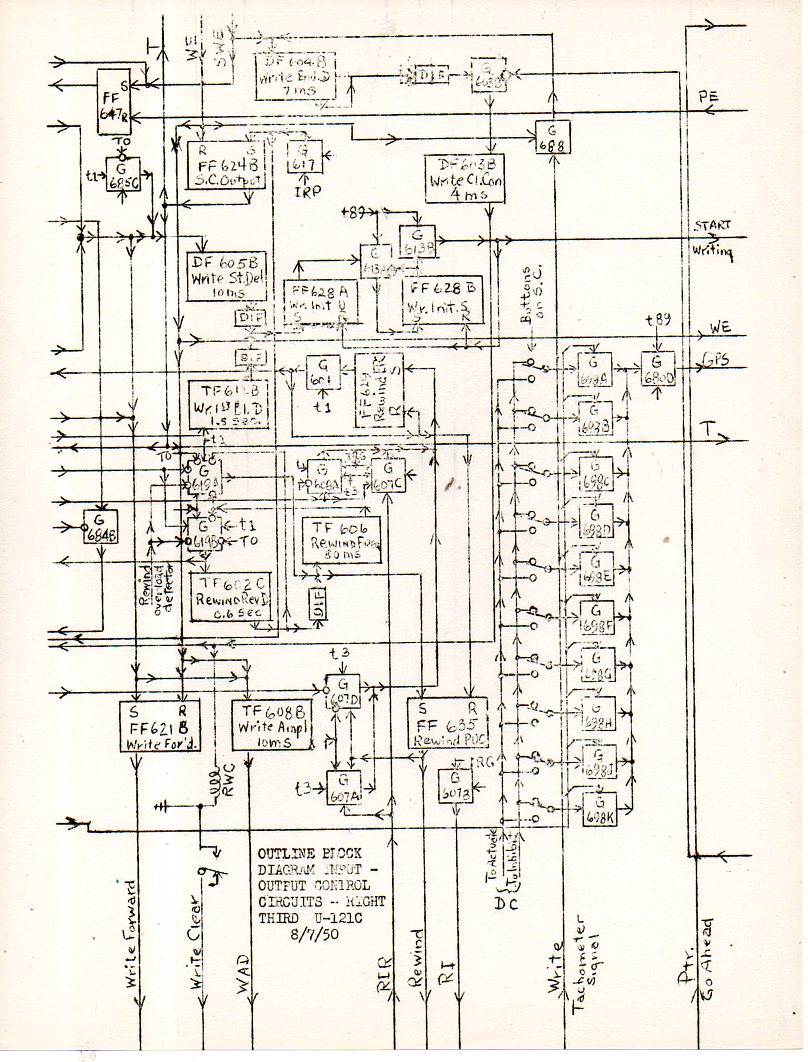
  • Rare Block Diagrams for the UNIVAC (1950)


    The UNIVAC (Universal Automatic Computer) was the first commercially-available electronic computer, and the first computer to handle both numeric and alphabetic information, produced by Remington Rand, and  came into working service at the Bureau of the Census in 1951.  It was designed by John Mauchly and Pres Eckert Jr, who also worked together in the design and construction of the first digital computer, the Electronic Numerical Integrator and Computer (the famous ENIAC). The UNIVAC was a Big Boy: 25’x50′, with 5,600 tubes, and 18,000 crystal diodes–given its workhorse nature and general success, by 1957 there were 46 UNIVACs in operation. 

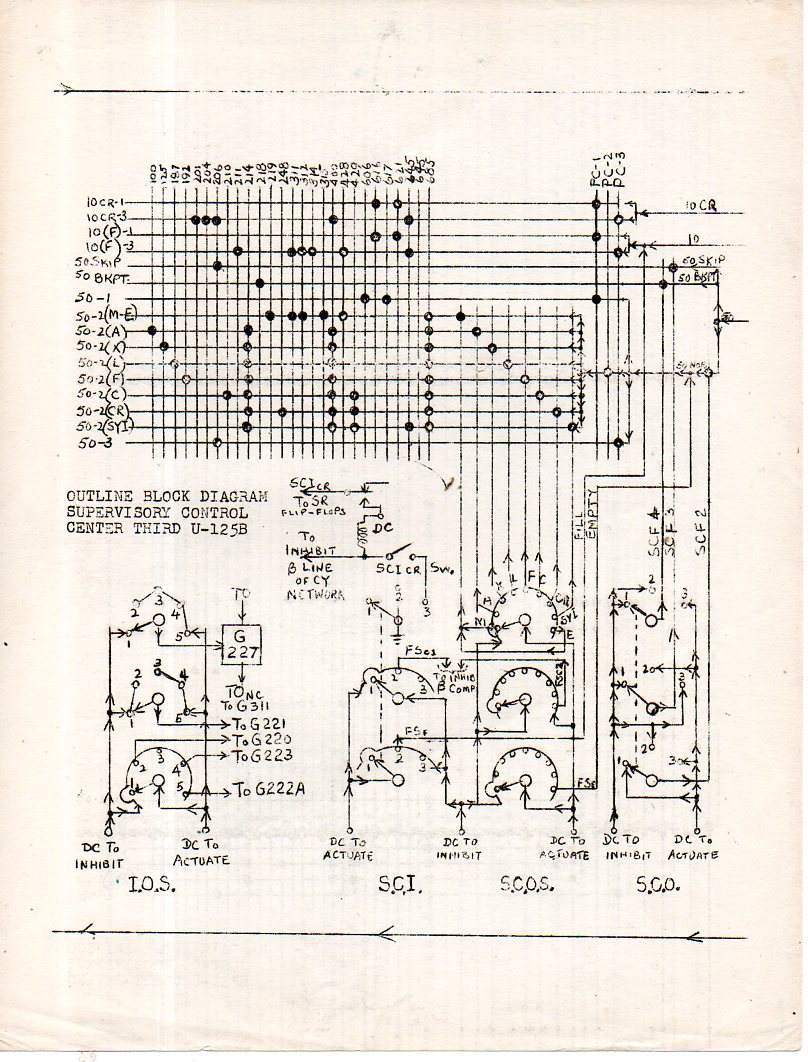
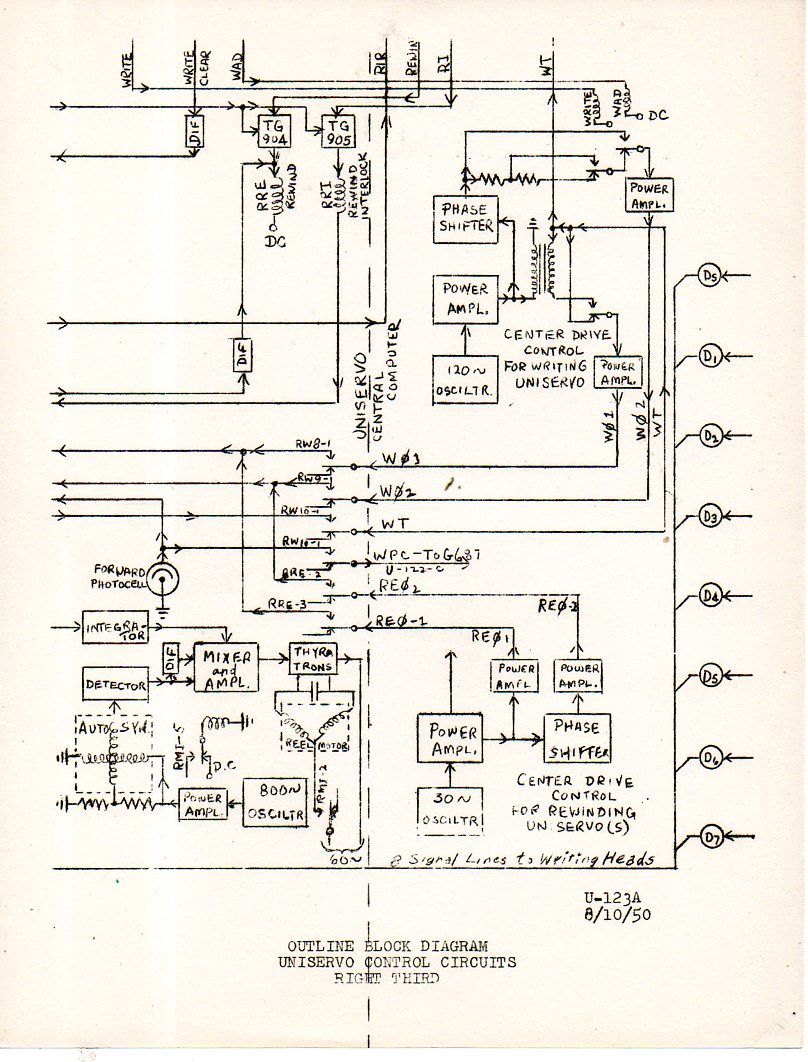
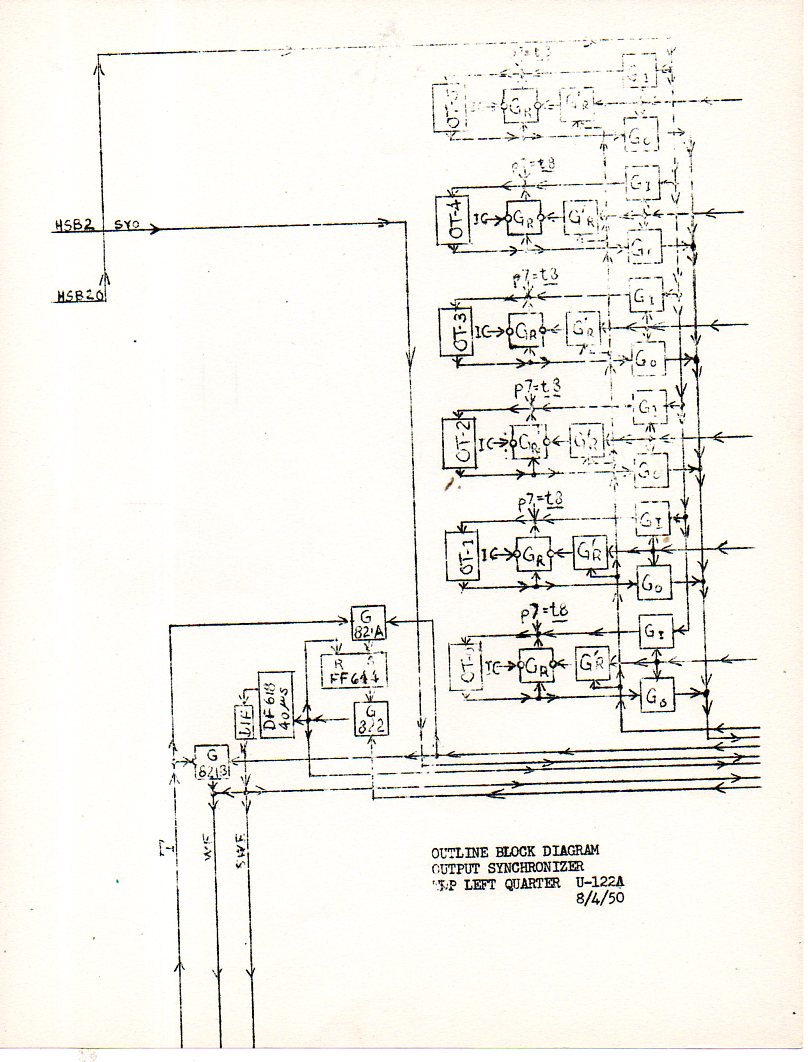
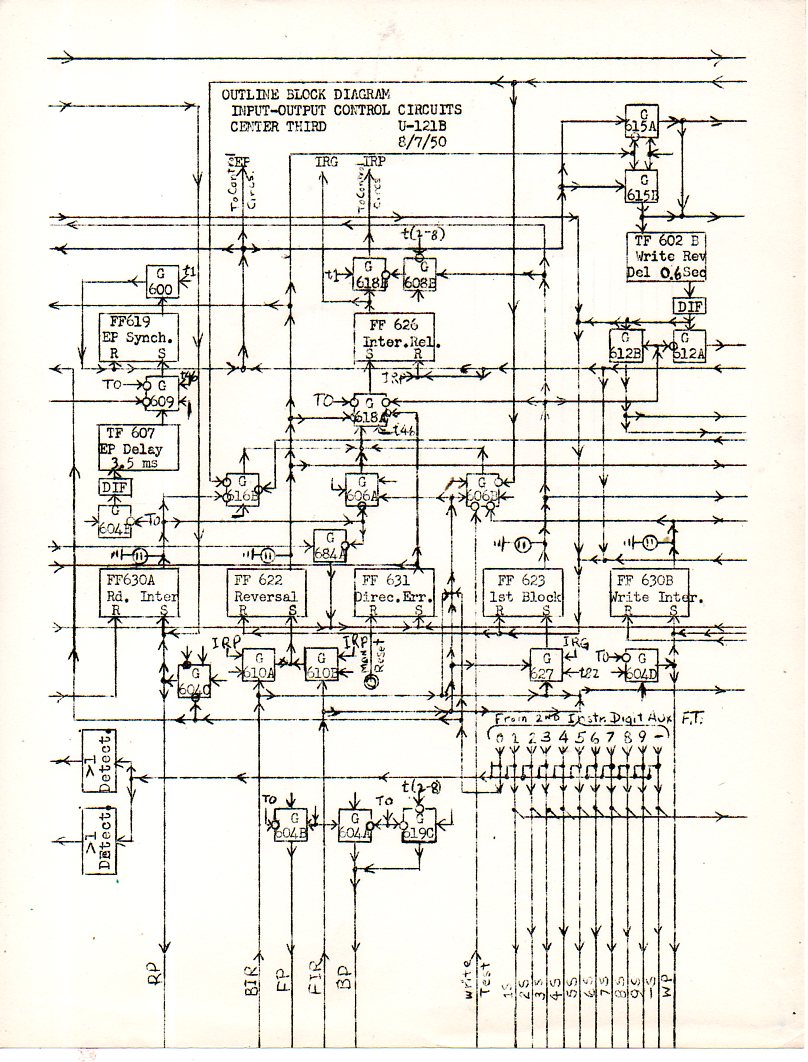
    The following are working block diagrams of sections of the UNIVAC, produced by some sort of early offset process in 1950, slightly before the computer came to its working life.  I have a number of sections of the computer represented in this way, but not the entire machine–but what is here may be of interest to historians of computer science.

    18 sheets representing seven sections of the computer: SOLD

    Including:

    MullendoreBlock diagrams497

    [Supervisory Control Panel]

    • 1.  The Supervisory Control Panel (2 sheets of 3, including center and left third, both undated but assumed to be 1950 like all of the others. [Shown above]

    • 2.  Uniservo Control Circuits. 3 sheets of 3.  All dated 8/10/50.

    MullendoreBlock diagrams503

    • 3.  Output Synchronizer. 4 sheets of 4.  Dated 8/1/50 through 8/4/50.

    MullendoreBlock diagrams502

    • 4.  Input Synchronizer.  4 sheets of 4.  Dated 8/1/50 to 11/9/50. 

    MullendoreBlock diagrams500

    • 5.  Control Register.  1 sheet of 1.  6/21/50.

    MullendoreBlock diagrams499

    • 6.  High Speed Bus Amplifier and Sample Memory Channel.  1 sheet of 1. 6/21/50

    MullendoreBlock diagrams500

    • 7.  Input-Output Control Circuits, 3 of 3 sheets,  8/7/50

     MullendoreBlock diagrams504

    ·Posted by :

    ·in:

  • Superior Single-Sheet Guide to Major Characteristics of Leading Computers, 1956

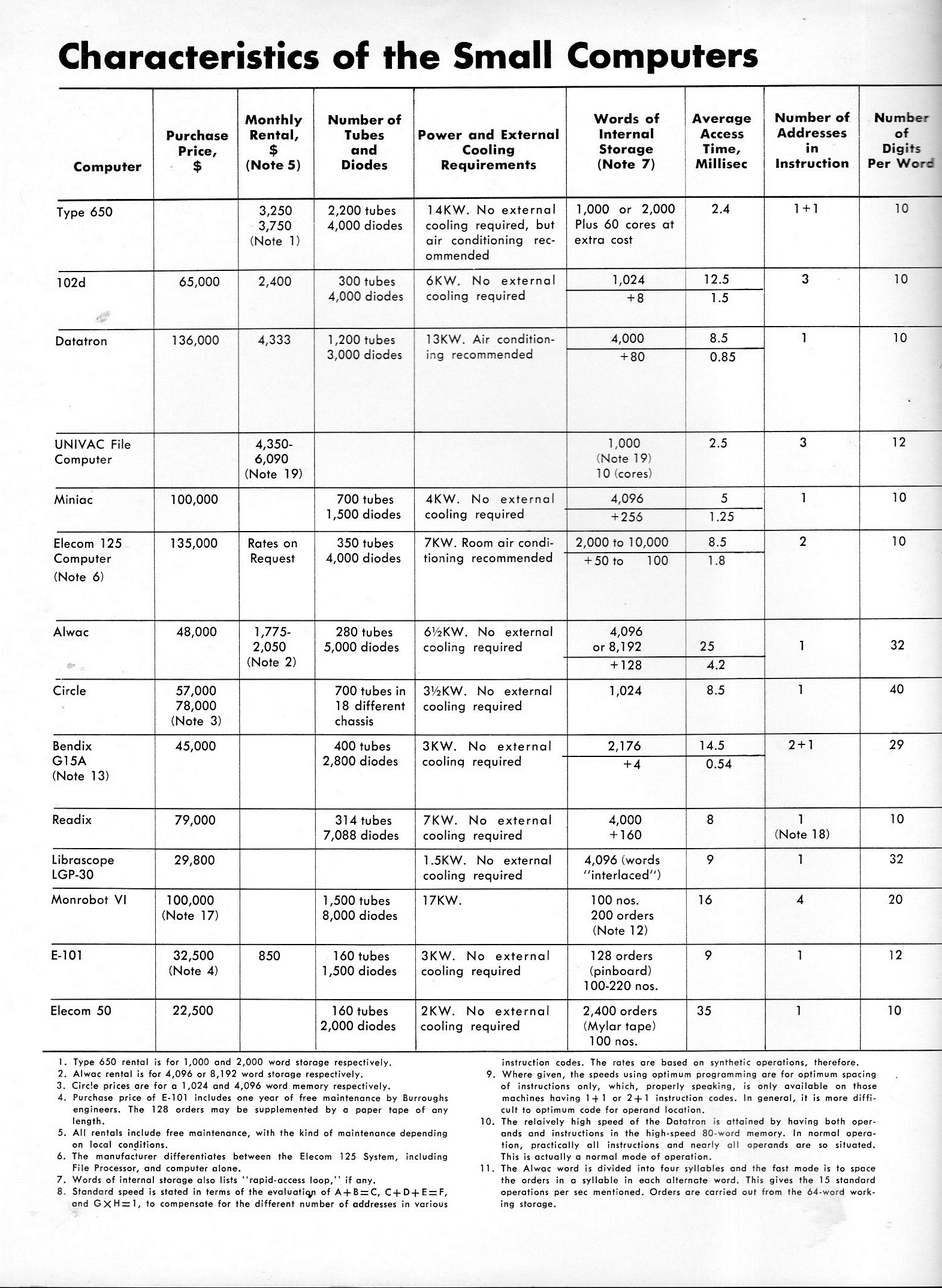
    A.J. Perlis and John Carrs  Characteristics of the Small-Scale Computers. 11×8”, 4pp. Product Engineering-Project Design Digest, offprint, “Mid-October”, 1956. The article first appeared in Control Engineering, March 1956. 

    This pamphlet looked innocent enough, 12″ tall and one folded piece of paper, and published in 1956, but there was a lot more to the simple publication than you’d expect from something so modest. The authors–John W. Carr III and Alan J. Perlis–were heavy hitters, and so I really wasn’t very surprised to see what they had done “inside”, though I was impressed and happy to see the data. Displayed on the 11″x16″ sheet of paper are 15 data points on 14 computers, many of them classic/famous:  the 650 IBM, UNIVAC, Elecom, Alawac.  (Remember that when you’re looking at purchase price and monthly rental amounts that the 1956 dollar is equal to about $8.70 in 2015 dollars, so that $3275/month for the 650 would be about $30k.  The $136k for the Datatron is about a million today.)   

       Perlis794

  • On the Accidental Production of Colors in Photographs (1859)

    Palmer, “Palmer’s Patent Arm and Hand” a 4pp illustrated patent review in Journal of the Franklin Institute, Philadelphia, vol 67 (third series vol 37), February 1859, pp 114-118, with a full page plate (illustrated here) and three large text illustrations. Offered in the full volume of 448pp. Bound in half-calf and marbled boards, the spine being rubbed and chaffed. Ex-library, with the shadow of a call number label at spine bottom, plus large bookplate, and library stamps on title page. Overall, a solid Good copy, with a fresh and crisp text. $145

    Also appearing in this volume:

    Henry Fox Talbot, “Improvements in the Art of Engraving”, pp 193-197. (William Henry Fox Talbot (1800-1877) was among the earliest of the photographic pioneers, or pre-pioneers, as he asserted priority of his photographic method for 1835 when Daguerre revealed his own (very different) method in 1839. Talbot (or Fox Talbot)  was also a practitioner of the art, publishing a stone-cold and revolutionary work of photographically illustrated books, The Pencil of Nature.)

    W.O. O’Brien, “Canals and Canal Conveyance”, pp 16-26 and 73-80;

    M. Muguet, “Accidental Production of Colors in Photographs”, pp 126-7, translated from Cosmos. This seems an interesting note in the early history of color photography, though there is no mention of any work being done by any others in this field. (“M Muguet states to the French Academy the circumstances under which he obtained natural colors in a stereoscopic picture of ruins covered with ivy. Each glass plate had been exposed twenty seconds the sun shining brilliantly and on developing I was astonished at finding the color strongly developed the ivy was represented by a deep green tint some old timber of trees by a brown the stones by a gray all with colors in the highest degree varied. Fixing did not alter them but in drying they lost their brilliancy with the exception of the green which has remained as decided as at first. In taking a second picture the same effect was produced but with less strength…In reference to this communication of M Muguet to the Academy Paris M Bertsch reminded the hearers that every photographer had frequently observed that when the development of a positive was arrested at a certain point and the picture placed upon a black ground effects were obtained which imitated the natural color very well….”)

    1859 is a big year in the history of science, but there is no mention (nor was this the place for mentioning most of what is to follow) of Darwin, Huxley, Maxwell, Riemann, Kirchhoff, or Cayley.

    ·Posted by :

    ·in:

    —
  • Early Photography in Journal of the Franklin Institute, 1839-1841

    Photography, 1839

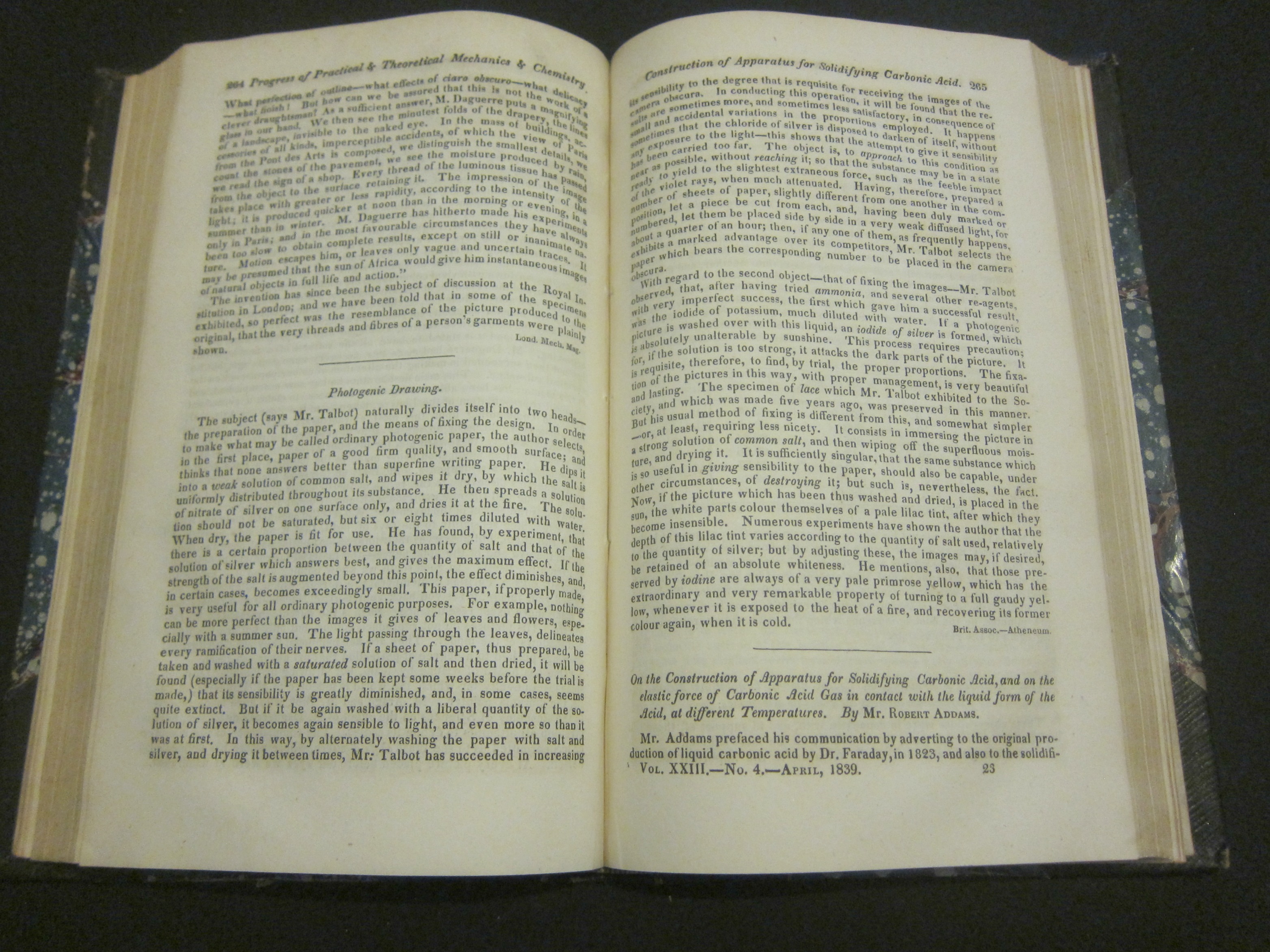
    (Daguerre and Fox Talbot) “Photogenic Drawing” followed by “Photogenic Drawings” in The Journal of the Franklin Institute, Vol. XXIII, April, 1839, No.4, pp. 263-265 (about 1500 words). Bound in half-calf and marbled boards.There are two shadows left on the spine bottom from call numbers; there are also some library marks and a stamp on the front cover, otherwise this is a very nice copy. $750

    The first paper gives an account (taken from the London Mechanical Magazine), occupying pp 263-4, of the Daguerre process; the second, pp 264-5, gives an account of the Fox Talbot method as it first appeared in the British Association/Athenaeum.
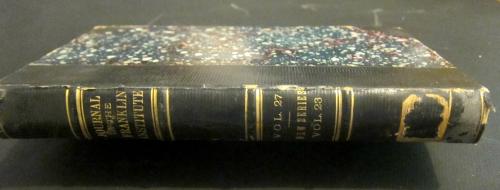
    JFI 1839 Jan

    These I believe are among the earliest of U.S. journal references for  two of the earliest photographic processes—the Fox Talbot method was much different from the Daguerre though much less known and certainly underappreciated as it was arguably the superior.

    Also in this volume: John C. Trautwin, “Some remarks on the Internal Improvement of the South”, pp 10-22, with a nice (hand-colored) folding map. AND a lovely plate of Eastwick & Harrison’s “Improved Locomotive Engine” AND a two-part paper on Espy’s Theory of Centripetal Storms, AND Col. Reid’s “Law of Storms Examined”, and much else.
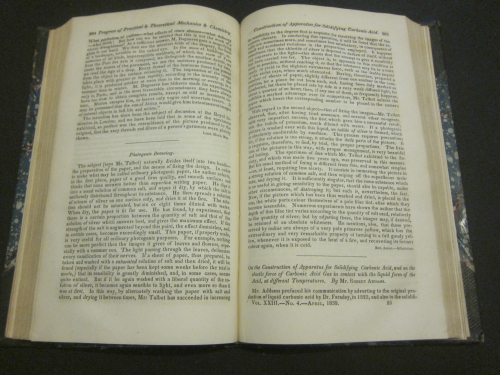
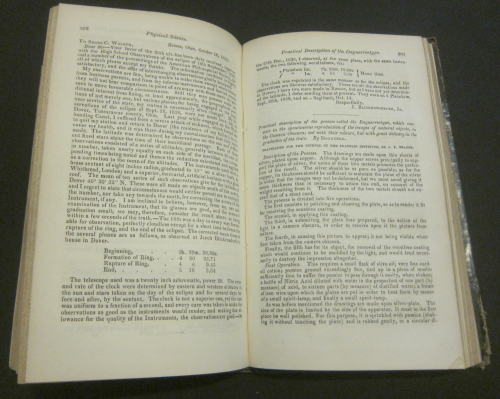
    JFI 1839 Jan text
    JFI 1839 Jan text

    • “This early period of photography cannot be passed over without mention of the name of Henry Fox Talbot of England He was a man of many sided scientific character and an independent investigator in the photographic field prior to Daguerre’s discovery and therefore not inspired by it to investigation. In 1839 January 31st he read a paper before the Royal Society entitled “Some Account of the Art of Photogenic Drawing etc” embodying a practical process on paper based on the abandoned process of Wedgewood and Davy which he improved and also completed by fixing the pictures although imperfectly…”–, JFI, Dec 1899, vol 148, p 4 11.


    Photography, 1839

    “Invention of Photogenic Drawings”, p.208, from Mechanic’s Magazine; 

    “Light Drawb Pictures”, pp 208-9, Mechanic’s Magazine;

    “The Daguerrotype Explained”, pp 209-210 (“A.D.B.”, Alexander Dallas Bache).

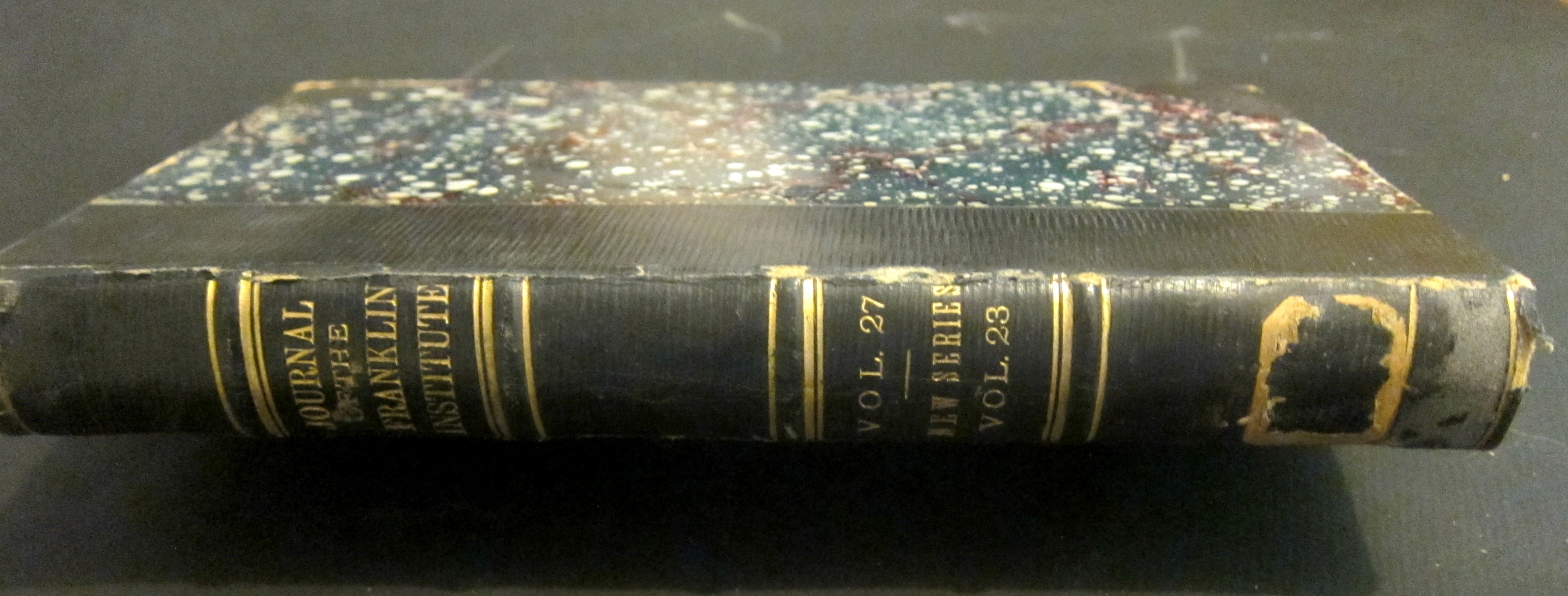
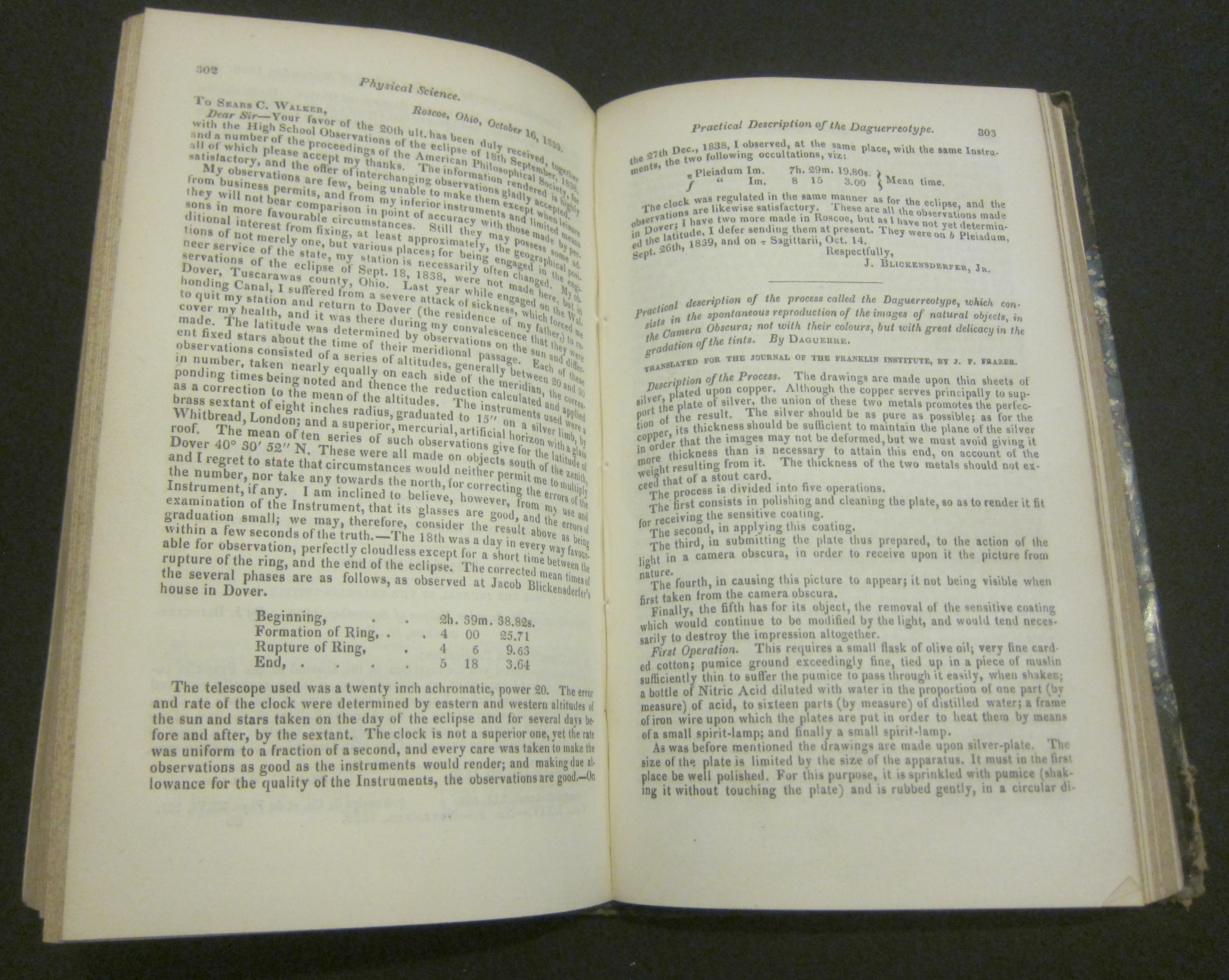
    All in the September, 1839 issue of Journal of the Franklin Institute, printed in Philadelphia by the Institute, 1839. The entire volume offered, volume 28 (new series vol 24) , (442pp). Bound in half-calf and marbled boards. The spine is scuffed and chipped at head and toe, and the front board is detached. Also, this is an ex-library copy, with stamps on the title page. All that said, the text is fresh and crisp. A GOOD copy, only. $600

    Bound with:

    Daguerre. “Practical description of the Process called the Daguerreotype, which consists of the spontaneous repductions of the images of natural objects, in the Camera Obscura…” In the November issue of the same volume, pp 303-311, with four drawings in text.

    All of these are very early journal publications on the new art of photography.
    JFI 1839 July _1_

    • “A scientific friend having kindly sent to me, from Paris, a paper containing the authorized explanation of the process of M. Daguerre, which has attracted so much attention, I have made an abstract of it, which is at your service. The condition under which M. Daguerre received a pension from the French Government was, that he should make all the steps of his process public. His communication was first made confidentially to a Committee of the Institute, and M. Arago, acting as their organ, states that some of the steps of the process are not explicable by known laws…”–from “The Daguerrotype Explained”

    Photography, 1840

    (Early Photography) “The Daguerreotype”, long paragraph on p 142 on the “great obstacle to the use of M. Daguerre’s photogenic process, is the great difficulty of preserving the pictures when completed…” in Journal of the Franklin Institute, Philadelphia, printed by the Institute, 1840. Offered in the volume of 430pp.

    There’s also a second very short notice on the daguerreotype on p 285 regarding a “curious use” for the instrument: making a landscape photo with a crowd of people in it all of whom need to stand still for five minutes.

    Condition: calf-backed marbled boards. The calf is pretty scruffy and rubbed, and the front joint is half cracked; also the hinges are both starting; lastly this is an ex-library copy with stamps on the title page. All that said, the text is crisp and clean. Overall, just a GOOD copy. $150

    Also included is this description of an early optical machine in the genre of motion pictures:

    • Description of an Optical Machine exhibited by Rd. Roberts of Manchester, to the Members of the British Association…1835 pp 221-223, 4 figures in text.
      “Trepiscope: an optical machine made by the late Richard Roberts of Manchester and first shown at the meeting of the British Association at Dublin in 1835… The machine being turned by hand or by power will cause the card on the disc to revolve from 6,000 to 40,000 times a minute on viewing the revolving disc through the eye hole the printing on the card can be read with ease and distinctness. The time given for one view of the card does not exceed the 150,000 th of a second when the disc is revolving at the highest speed ..Catalogue of the Special Loan Collection of Scientific Apparatus at the South Kensington Museum…, 1876, #979 p 140.

    Also including: M. Arago, “History of the steam engine, with a reply to the criticisms to which the first publication of the article gave rise”, pp 145-148; William Whewell, “New theory of the tides”, pp209-210.

    Photography, 1841

    “Photogenic Drawing” In: Journal of the Franklin Institute, edited by Thomas P. Jones. Philadelphia, printed by the Franklin Institute, 1841. Volume 31 (Third Series, Vol 1), pp 59-60 (about 450 words) in the volume of 429pp. Half-calf, with marbled boards. . Ex-library copy, with ghost imprint of two small rectangles of Dewey call numbers on the spine, plus bookplate, and a blindstamp owner stamp on the title page. Spine is somewhat scuffed and rubbed, and and in general a bit tatty. Good condition, only. $200

    “Professor Schafthaeutl of Munich described his mode of obtaining photogenic drawings resembling those of Mr [Henry Fox] Talbot where the lights are represented by shadows and also two new methods of procuring drawings similar to those of the Daguerreotype in which the lights and shades are represented as in nature The first is on paper prepared as follows…”

    This is the only mention of photography or Daguerre in this first half of 1841 in the JFI.
    JFI 1841 Jan June
    JFI 1841 Jan June

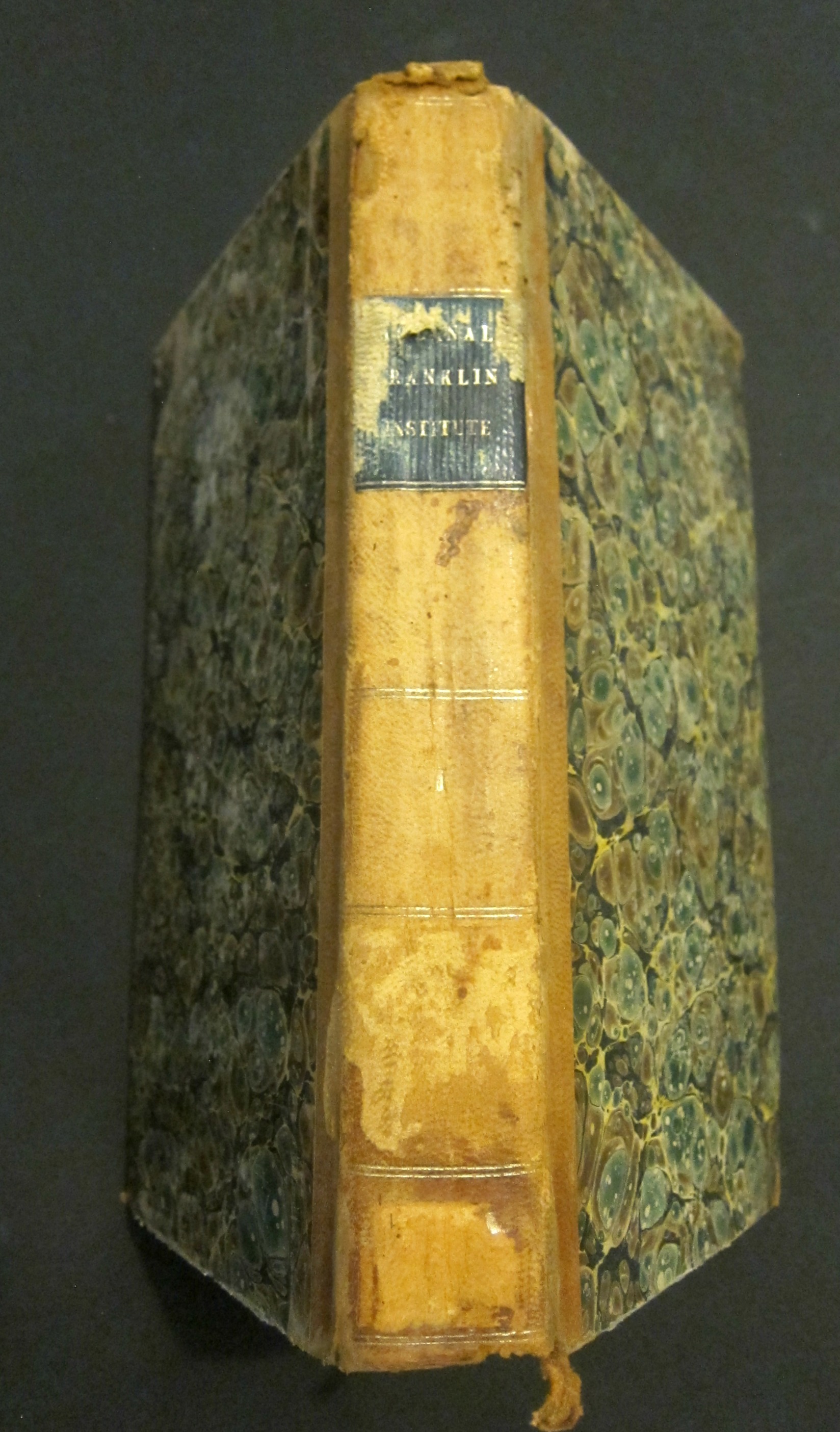
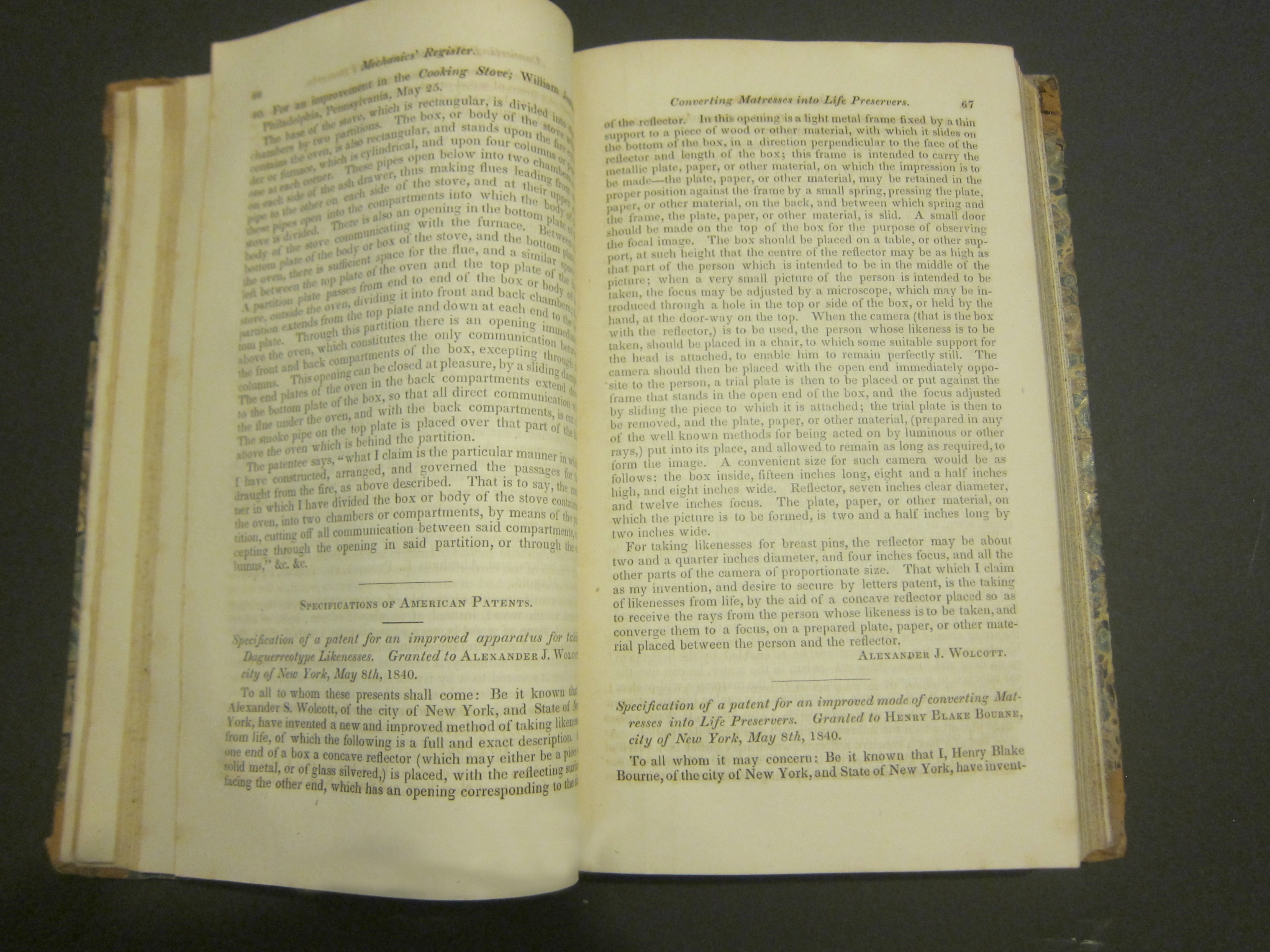
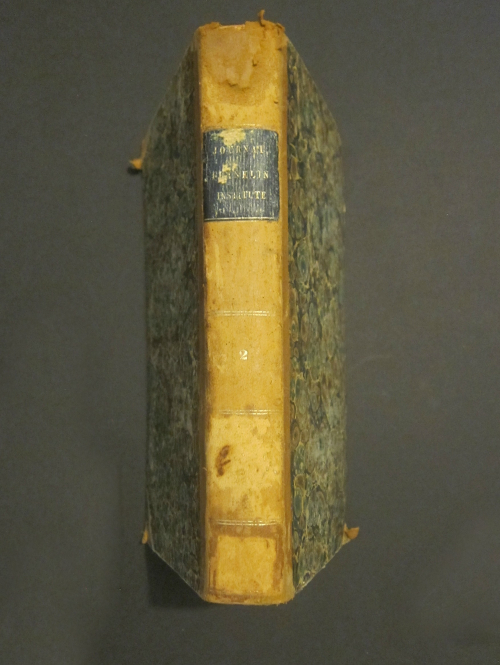
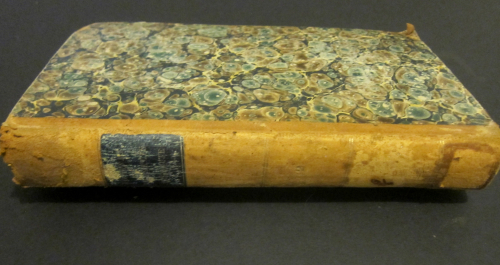
    WOLCOTT, Alexander J. Specifications of a patent for an improved apparatus for taking Daguerreotype Likeness. Granted to Alexander J. Wolcott, city of New York, May 8, 1840. In: Journal of the Franklin Institute, edited by Thomas P. Jones. Philadelphia, printed by the Franklin Institute, 1841. Volume 32 (overall), Third Series,vol II. The article occupies pp 66-7 in the issue of 430pp. Bound in half calf and marbled boards. Ex-library copy, with ghost imprint of two small rectangles of Dewey call numbers on the spine, plus bookplate, and a blind stamp owner stamp on the title page. Spine is somewhat scuffed and rubbed, and and in general a bit tatty. Good condition, only. $600

    Mr. Wolcott, a great but perhaps obscure name in the very early history of photography, had a very busy 1840—and it is a good thing, as the poor man would die young at 40 just four years later. In March of that year he and a partner would open the first U.S. Daguerrian Parlor in NYC, and evidently the world’s first commercial daguerreotype gallery. (John Hannavy, Encyclopedia of Nineteenth-Century Photography.)
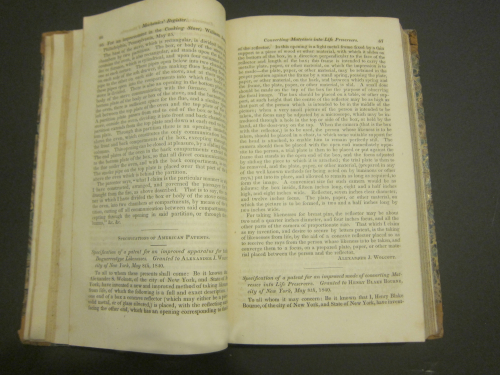
    JFI 1841 WOlcott 3

    A few months later, on May 8th, 1840, Wolcott would be granted the first patent in the United States in photography (US Patent No. 1582) —this is the subject of the article from the Franklin Institute that is being sold (above). The patent was for a variation of the Daguerre process, using a mirror instead of a lens. The great factor introduced by the new process was reducing the amount of sitting/posing time by about 75%, to somewhere in the 5-9 minute range.

    “I, Alexander S. Wolcott…have invented a new and improved method of taking likenesses from life” Wolcott begins in the article, and then proceeds in a very compact way to describe the camera and the entire process. It is one of those articles that announces so much using so few words (600 or so, I reckon).
    JFI 1841 Wolcott 2
    JFI 1841 Wolcott 2

    ·Posted by :

    ·in:

Recent Posts

Archives

Categories