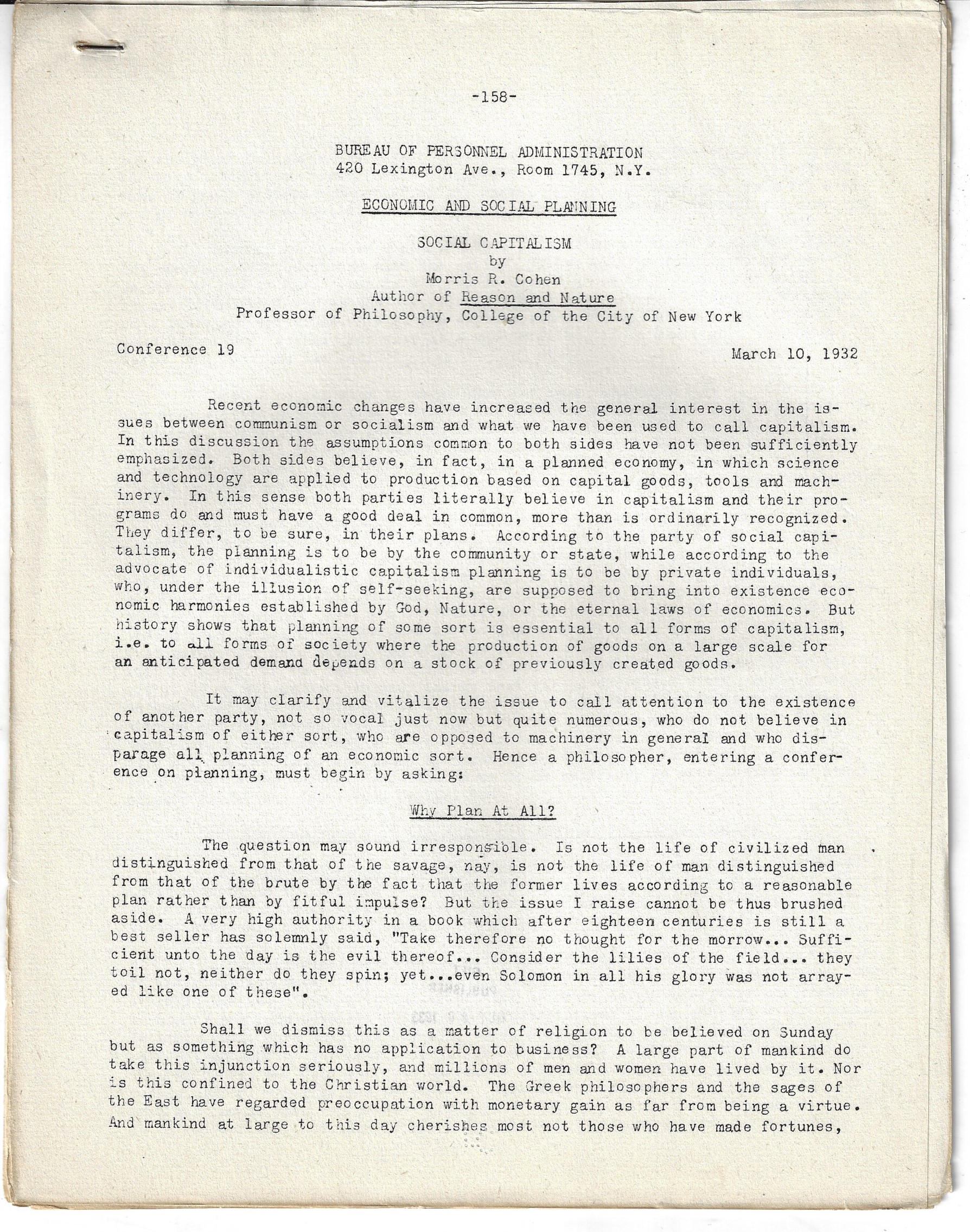
 Conferences on Economic, Social, Ethical Planning, presented by the Bureau of Personnel Administration (420 Lexington Ave, Room 1745, NY). Offset printed, staple bound. 11X8.5” sheets. Four sections. 67 parts, about 450 leaves.
Provenance: Library of Congress, being a gift from the publisher. Very Good condition with two LC “surplus duplicate” stamps on two of the sections’ opening page.
Note on availability: I can find a number of entries for the individual papers in this series, though usually only one or two institutions listed as having them; I cannot find a collection of the papers anywhere in WorldCat/OCLC. Given the way these were produced and printed, and the absence of any collected form of them, I believe that this collection is pretty scarce. $1250
At first blush the titles for the components of this series look a bit deadly-boring. Looking just a bit deeper, what we have here is some of the intellectual background for the recovery from the just-begun Great Depression. The very first conference listed below falls nearly on Black Tuesday (October 29, 1929), the beginning of the Stock Market crash and the Depression (which took a few years to become the “Great” Depression”). The second series spans much of the presidential campaign period for 1932 and the deepening of the Depression; the third series takes place during that incredible period between the end of the election and the inauguration of FDR and about two thirds of the incredible Hundred Days (as well as the new threat to Europe from the newly-ensconced Hitler, and Japan in China); and the fourth series covers the newly-introduced “New Deal”. Several of FDR’s “Brain Trust are among the contributors (Berle and Tugwell), as well as many others who would have major roles in the administration. The great majority of the contributors were leading thinkers of the 1930’s (for example, Morris R. Cohen, whose name may not be remembered now but who was professor of philosophy at CCNY from 1912 to 1938 and who helped make that place “the Proletarian Harvard”, .and who taught at U Chic, Columbia, Cornell, Stanford, Yale, and Harvard, and widely acknowledged as a leading thinker).