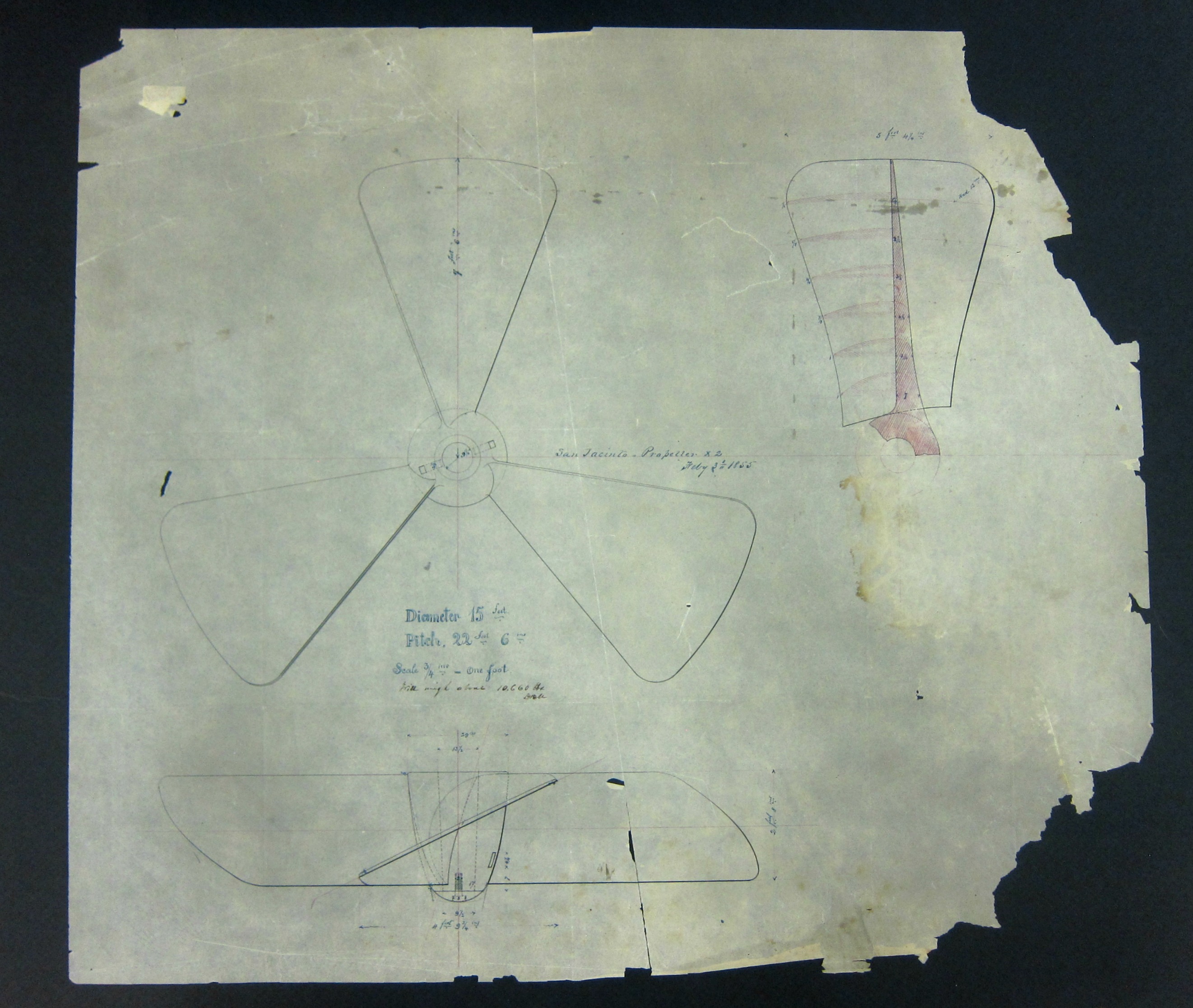
The U.S.S. San Jacinto–Propeller, Feb 3, 1855.
New York, 1855. 20″x16″. Manuscript drawing in pen and ink, on thin onion (?) paper, by the engineer John F. Shearman. Fair condition, with substantial chipping in the right corners, though without any loss to the drawing. The paper is fairly fragile and extremely thin. Unique. $1750
This is an extremely early engineering drawing of a modern propeller, executed only a dozen years or so after the creation of the modern screw propeller by John Ericsson. Shearman’s creation is devoid of the extra blades that appeared on the edges of the fans of Ericsson’s first attempts, and as ultimately adopted as the standard response to this knotty fluid dynamics problem. The propeller pictured here was for the USS San Jacinto, a mail packet that ran along the west coast in the 1850s until it was sunk operating as a blockade runner for the Confederate States in 1864. It was a pretty large propeller–more than 15 feet in diameter–and moved the ship it was attached to more than 22 feet for every revolution of the blade.
The USS San Jacinto was an early screw frigate in the United States Navy, and was named for the San Jacinto River, of importance during the Texas Revolution. She is perhaps best known for her role in the Trent Affair of 1861…see more here from Wiki.
Shearman was an engineer who worked at the Brooklyn Iron Works, Roslyn Navy Yard (New York) and a number of other places, practicing his trade from ca. 1845 through 1888.
| Name: | USS San Jacinto |
| Builder: | New York Navy Yard |
| Laid down: | August 1847 |
| Launched: | 16 April 1850 |
| Commissioned: | late 1851/early 1852 |
| Fate: | Ran aground, 1 January 1865 |
| General characteristics | |
|---|---|
| Type: | Steam frigate |
| Tonnage: | 1,567 long tons (1,592 t) |
| Length: | 234 ft (71 m) |
| Beam: | 37 ft 9 in (11.51 m) |
| Draft: | 16 ft 6 in (5.03 m) |
| Depth of hold: | 23 ft 3 in (7.09 m) |
| Propulsion: | Steam engine, screw propeller |
| Speed: | 8 knots (15 km/h; 9.2 mph) |
| Complement: | 278 officers and enlisted |
| Armament: | • 2 × 8 in (200 mm) guns • 4 × 32-pounder guns |