A Daily History of Holes, Dots, Lines, Science, History, Math, Physics, Art, the Unintentional Absurd, Architecture, Maps, Data Visualization, Blank and Missing Things, and so on. |1.6 million words, 7500 images, 4.9 million hits| Press & appearances in The Times, Le Figaro, Mensa, The Economist, The Guardian, Discovery News, Slate, Le Monde, Sci American Blogs, Le Pont, and many other places… 5000+ total posts since 2008.

  • The “Beneficial Exercise” of Walking the Trail of Tears (1838)

    Executive Documents 1-9,  including executive document #2, Message From the President of the United States to the Two Houses of Congress, at the Commencement of the Third Session of the Twenty-Fifth Congress.  Printed by Thomas Allen, Washington D.C., 1838. The 9 documents (22,619,56,111,55,116,1556,22,4,24pp)  1072pp. rebound in cloth. Provenance: Library of Congress, with their rubber stamp on front LC endpapers; the title and other printing on the spine mostly faded away, though some of the numerals are highlighted in pen.  Not beautiful, but all intact, and very sturdy, highly usable. $300 

    “…strong men, women, boys and girls, not only capable of marching twelve or fifteen miles a day, but to whom the exercise would be beneficial.”  —General Winfield Scott, military leader in charge of the removal of the Cherokee nation, 1838, on the benefits of enforced marching of men, women and children over an 800-mile course.

    Most people are familiar with the story of the Trail of Tears, the epic tragedy of the “removal” of a class of people—the Cherokee Indians in this case—from their homes in the east to a new land appropriated for them in Indian Territory (present-day Oklahoma). (In the Cherokee language, the event is called Nu na da ul tsun yi (the place where they cried), another term is Tlo va sa (our removal).) The Cherokees were given the ultimatum to leave their homes in Georgia, Texas, Tennessee, Alabama and North Carolina, doing so in the period from 1836 to 1839—the first part of the exodus was prompted by the U.S. Government but not necessarily enforced. The later part, however, in the spring of 1838, was absolutely enforced, with General Winfield Scott arriving on the scene with 7,000 U.S. Troops to round up the last of the remaining Cherokees and take them—by force if necessary—to Indian Territory.
    Cherokee Scott 1838

    There were approximately 12,0001 Cherokees left in the east by the time of Scott’s arrival—by the time their enforced march to the west was completed, around 4,000 Cherokees would be dead.

    The ease with which this re-settlement was partially removed from the broader moral and ethical implications of marching 12,000 men, women and children an 800 miles west in the fall and winter of 1838/9 was accomplished with abstract language in the government reports describing the affair.

    For example, smothered in the thousand pages of the executive documents printed by Thomas Allen for the U.S. government of the 25th Congress, 3rd session, 1838 of  nine documents printed in volume one is document #2, “Message of the President of the United States to the Two Houses of Congress….”, and in there resides a 94-page section called “Report of the Commissioner of Indian Affairs” (occupying pp 410-506), and in that section is the compelling sub-document, “Emigration of Indians”. It is there that we find the clinical appraisals of the government efforts to scoop the Cherokees up and deposit them far west. For example, we are told that “(an) aggregate of 18,000 Cherokees…have ceased to live east of the Mississippi during the Spring, Summer and Autumn”, this after General Winfield Scott had “collected them”. Removing an entire Indian tribe had been a simple matter of that tribe no longer living there anymore, having been “collected” by the Army and “emigrated” to points west.

    The “collection” part is told elsewhere and often and more brilliantly than I can relate here—it is the material of a deep national tragedy. Suffice to say presently that 16,000+ people were herded together at bayonet and gunpoint, given scant opportunity to collect themselves, and then brought together in concentration camps to await the arrival of the last of their tribe. After that, most were marched in stages to Oklahoma, through bad weather of all descriptions—from drought to rain to high heat and bitter cold—sometimes encamped in stockades to wait for river levels to rise and fall, allowing dysentery and other diseases to come into the population and take hold. 4,000 people would die along the way–each mile would wind up killing five  people, one death per every 1,000 feet.

    The section on the emigration of the Indians is alternately heart-breaking and infuriating. There is a series of correspondence between John Ross, representing the leadership of the Cherokees, and General Winfield Scott, regarding the mechanics and monetization of removal. The Cherokees at this point make every attempt to accommodate their pending future with dignity and humility, acquiescing on almost all government points in what I think were the hopes of gaining a few extra necessities for the people making the trip. Generally, the requests were rejected. Coffee and sugar were at one point presented to Scott as a necessary—Scott refused, saying that the disbursements for the removal had already been made, even though all of the monies were coming from government funds allocated to the Cherokees for the lands they were having stolen on the heals of their exit.

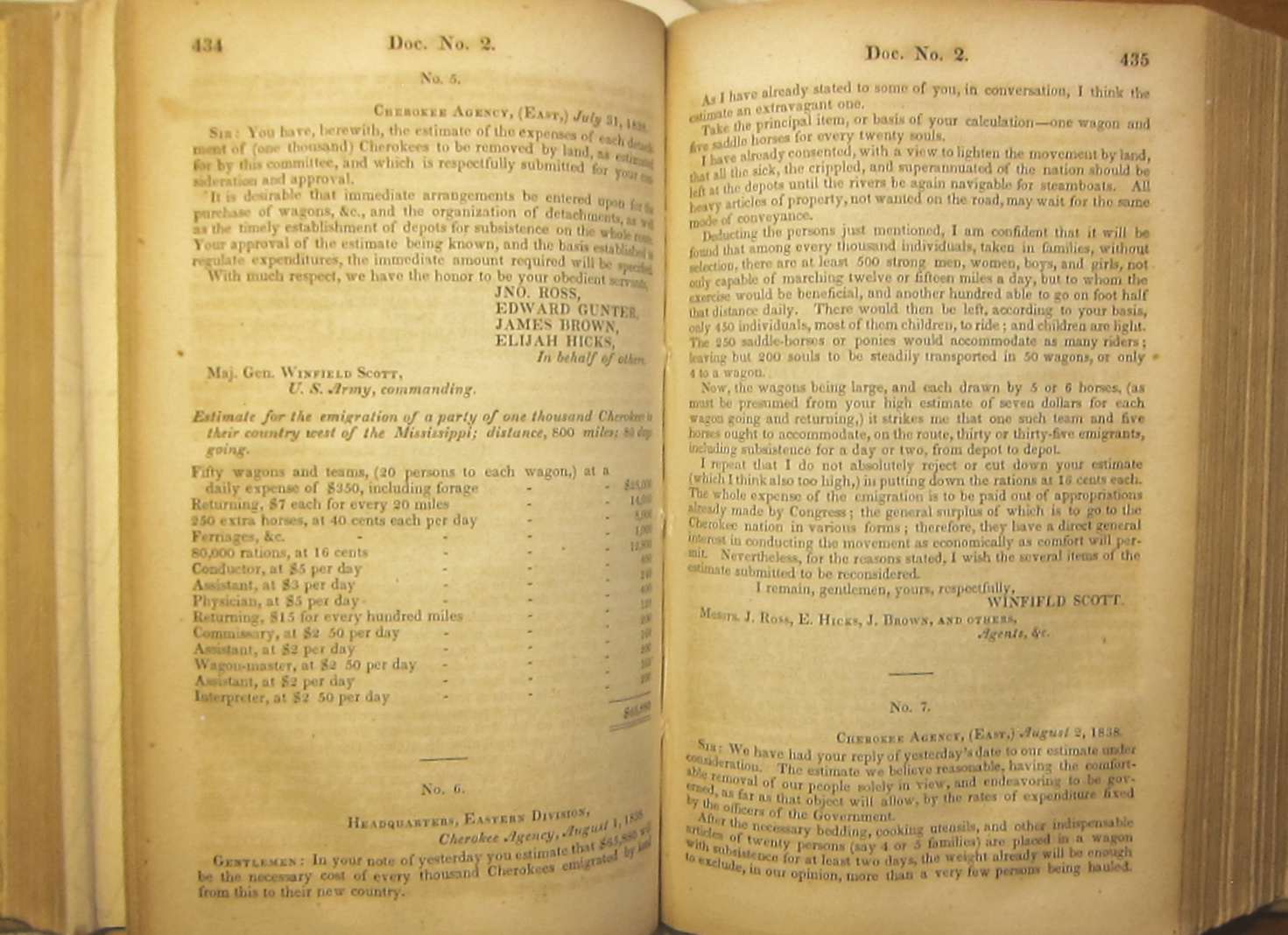
    Another particularly infuriating example of misogynistic governmental neutral-speak—a towering example, really, an incredible, unspeakably-wrong statement—occurs on page 435 in a letter from Scott to John Ross et alia. In response to a request from Scott for extra wagons to help transport the young and the old and possessions and food, Scott refuses. He refutes the estimated expense of $65,000 per every 1000 Cherokees for the entire trip of 800 miles (over 80 days), regarding the estimation of this need as “extravagant”:

    “As I have already stated to some of you in conversation I think the estimate an extravagant one. Take the principal item or basis of your calculation one wagon and five saddle horses for every twenty souls. I have already consented with a view to lighten the movement by land that all the sick the crippled and superannuated of the nation should be Heft at the depots until the rivers be again navigable for steamboats. All heavy articles of property not wanted on the road may wait for the same mode of conveyance.”

    He continues to his incredible statement quoted above:

    “Deducting the persons just mentioned I am confident that it will be found that among every thousand individuals taken in families without selection there are at least [of the 1000-person figure quoted above] 500 strong men women boys and girls not only capable of marching twelve or fifteen miles a day but to whom the exercise would be beneficial and another hundred able to go on foot half that distance daily. There would then be left according to your basis only 450 individuals most of them children to ride and children are light. The 250 saddle horses or ponies would accommodate as many riders leaving but 200 souls to be steadily transported in 50 wagons or only 4 to a wagon.”3

     And just to set the record straight on this, we are talking about 800 miles of marching, in weather good and bad, over a period of many months (and sometimes extending to a year).
    ·Posted by :

    ·in:

  • A Map of the Slender Aspects of Transoceanic Broadcasting (1935)

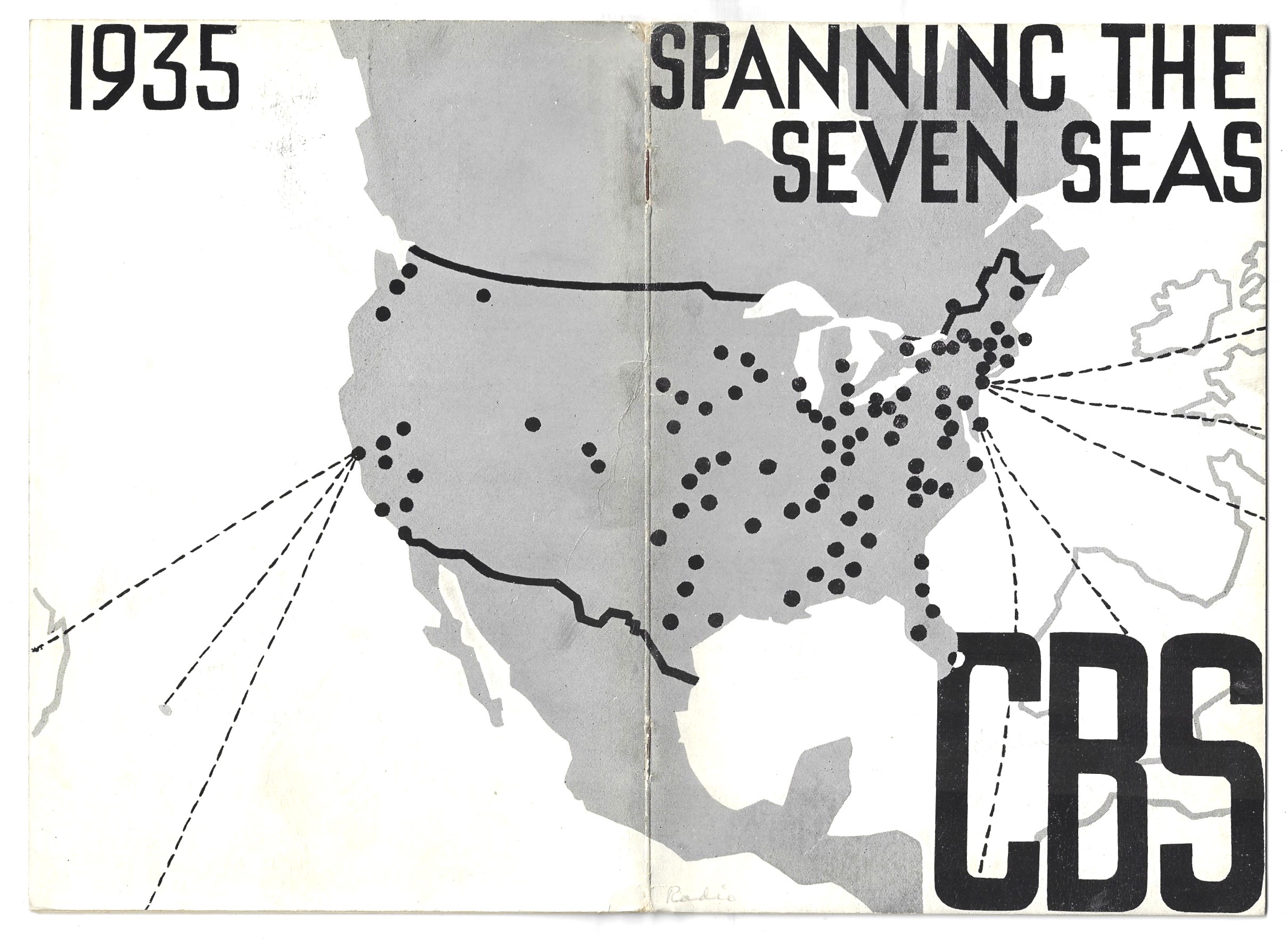
    RADIO, Intercontinental. CBS. Spanning the Seven Seas, a resume of Inter-Continental Broadcasting in 1935. Published by the Central Broadcasting System, London, 1935. 8” x 5”, 11pp. Original decorated wrappers. VG condition. Provenance: Library of Congress with their stamp. $75 

    Books covers CBS map

    Curiously there is only ONE copy located by WorldCat (Bibliothek der Stiftung Deutsches Technikmuseum,Berlin).

    This pamphlet discusses the CBS (at that time the world’s largest radio network)”affiliates and partners, and the new increase in transoceanic relays (with the “result that all five [sic] of the continents have at various times been linked to each other”). At this point CBS was only about eight years old, starting with 22 station in 1928 and then going over the 100 mark by the late 1930’s.

    The cover (front and back) is a revealing insight into the early days of transoceanic radio communication.


  • Radio Studio Acoustics (1948)

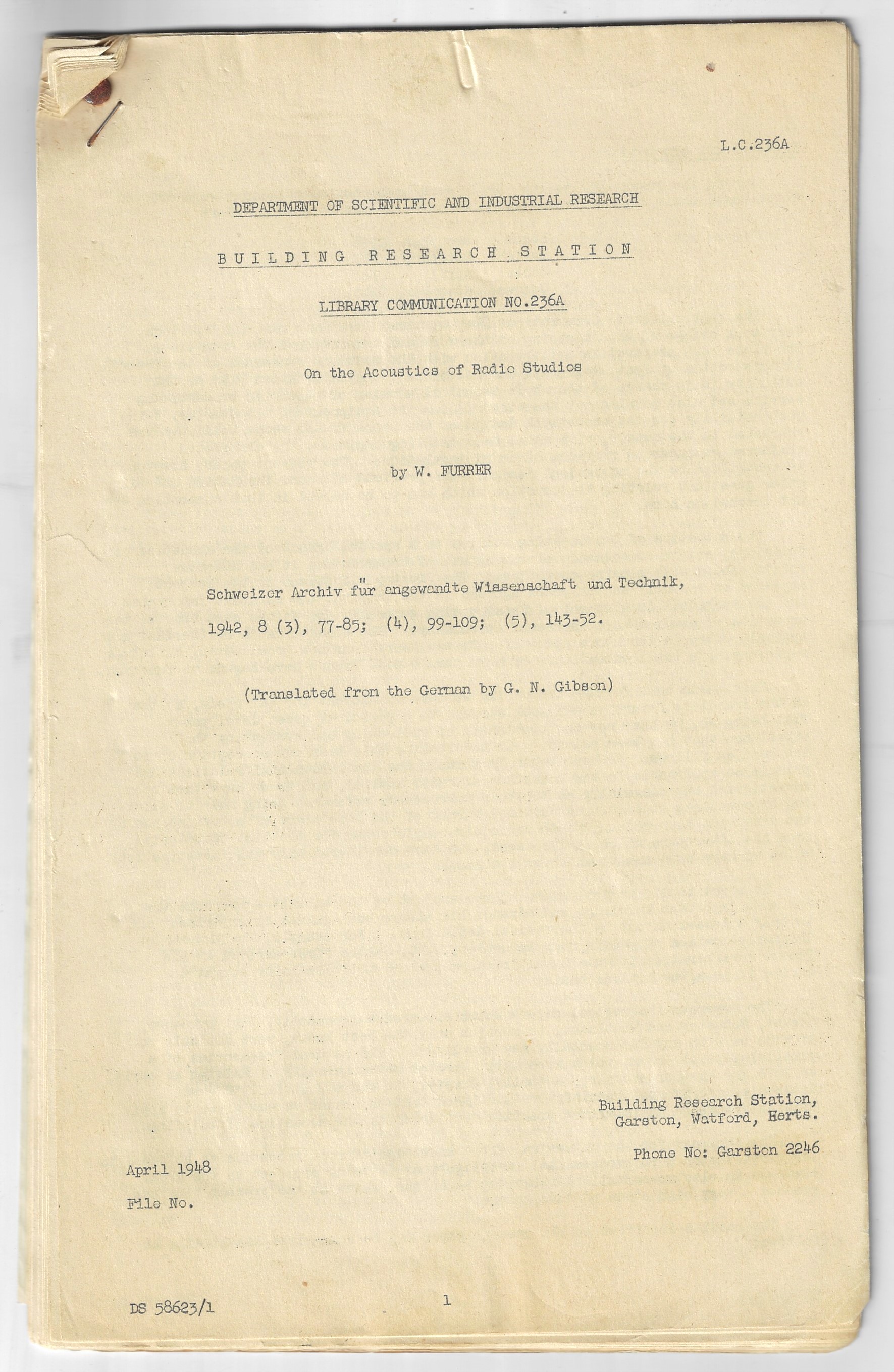
    Acoustics radio stationW. Furrer, On the Acoustics of Radio Studios. Department of Scientific and Industrial Research, Building Research Station, Library Communication No. 236A. Printed at BRS, April 1948. 13” x 8” 35 VERY full pages of text and tech discussion, plus 4 large photographic sheets, and one sheet with 4 pasted-on photos. Staple and brass-punch bound. Very Good condition. Scarce, relatively early technical discussion on the subject.

    Translated from the German by G.N. Gibson from “Schweizer Archiv fuer angewandte Wissenschaft und Tecnik 1942, vol 8 # 3,4,5.

    NO copies located in WorldCat for a stand-alone English translation of the original.

    ·Posted by :

    ·in:

    —
  • Acoustical Measurements in British Concert Halls (1950)

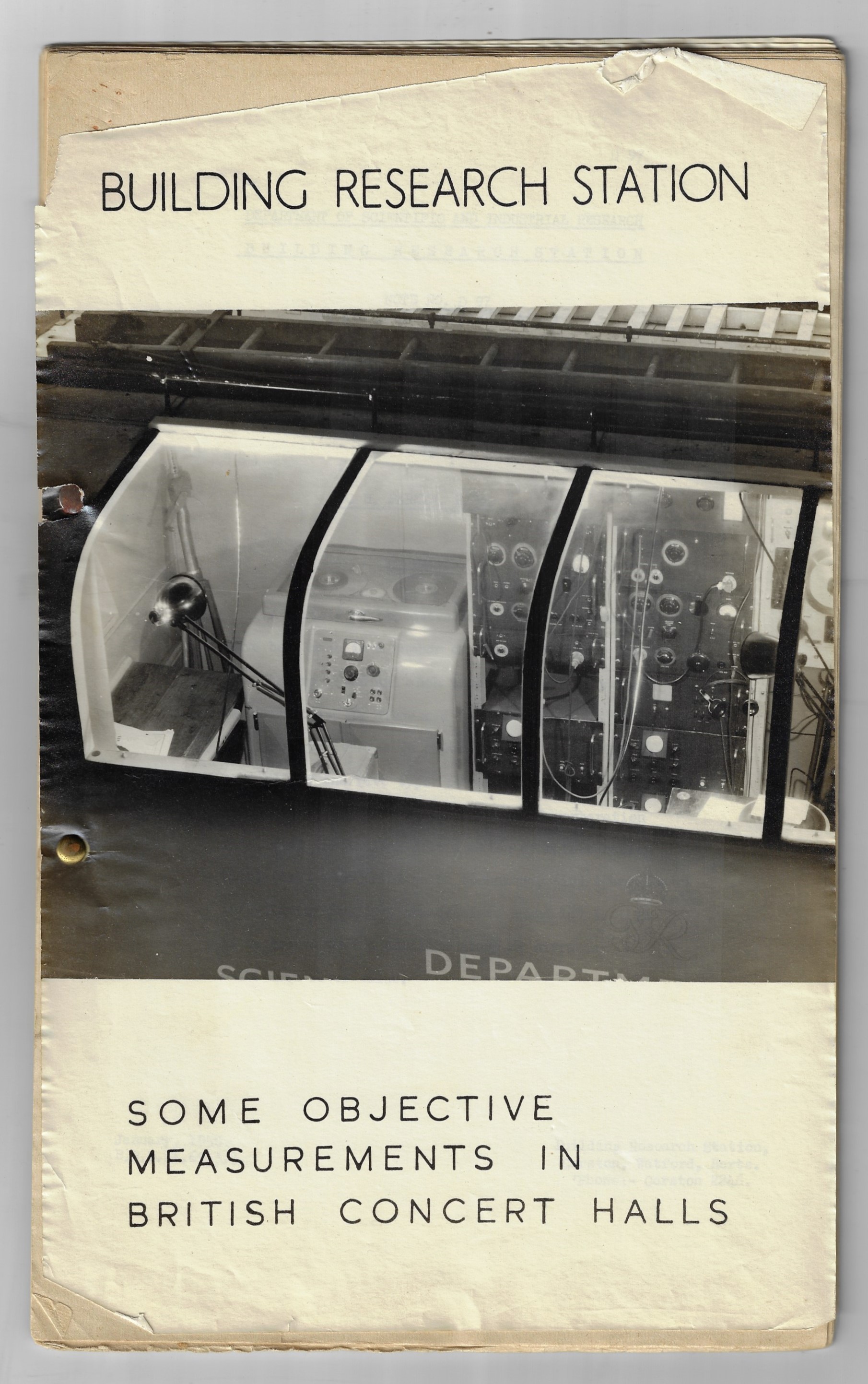
    Acoustics music hallsP.H. Parkin. Some Objective Acoustical Measurements in British Concert Halls, Department of Scientific and Industrial Research, Building Research Station. January 1950, Building Research Station. 13”x8”, 14 leaves of text, followed by 6 lvs of plans and profiles of Empress Hall, Usher Hall (Edinburgh), St. Andrews (Glasgow), Peoples Palace, Liverpool New Philharmonic, and Royal Albert, with these followed by 7 lvs of graphs of reverberation times for each hall. Bound with two brass pressure tacks. Original wrappers, the front being an original photo on photo paper. Condition: the front wrapper has pulled away from one of the brass fixtures, and has various chips and old folds around the edges (which you can see and enlarge in the accompanying photo)–clearly this was not the sort of material to use as a cover to the report. Other than that, the oversized publication is in VG condition. $200

    “Peter Hubert Parkin had a long career in an advisory role at the Building Research Establishment. His formative concert experience was at the Royal Festival Hall in London. He was the co-author, with Henry Robert Humphreys, of Acoustics, Noise and Buildings (London, 1958)..”–University of Southampton website

    “Peter Parkin has achieved world fame and recognition from his qualities as an engineer, scientist,, and acoustic consultant”–Journal of the Acoustical Society of America, 4 June 1998

    “Building Research Establishment (BRE) is a centre of building science in the United Kingdom, owned by charitable organisation the BRE Trust. It is a former UK government national laboratory that was privatised in 1997. BRE provides research, advice, training, testing, certification and standards for both public and private sector organisations in the UK and abroad. It has its headquarters in Garston, Hertfordshire, England, with regional sites in Glasgow, Swansea, the US, India, the Middle East and China.“–Wikipedia on he “Building Research Establishment”

    “BRE is a world leading, multi-disciplinary, building science centre with a mission to improve buildings and infrastructure, through research and knowledge generation.”–from the BRE website

    ·Posted by :

    ·in:

  • The Discovery of the Pion (1947)

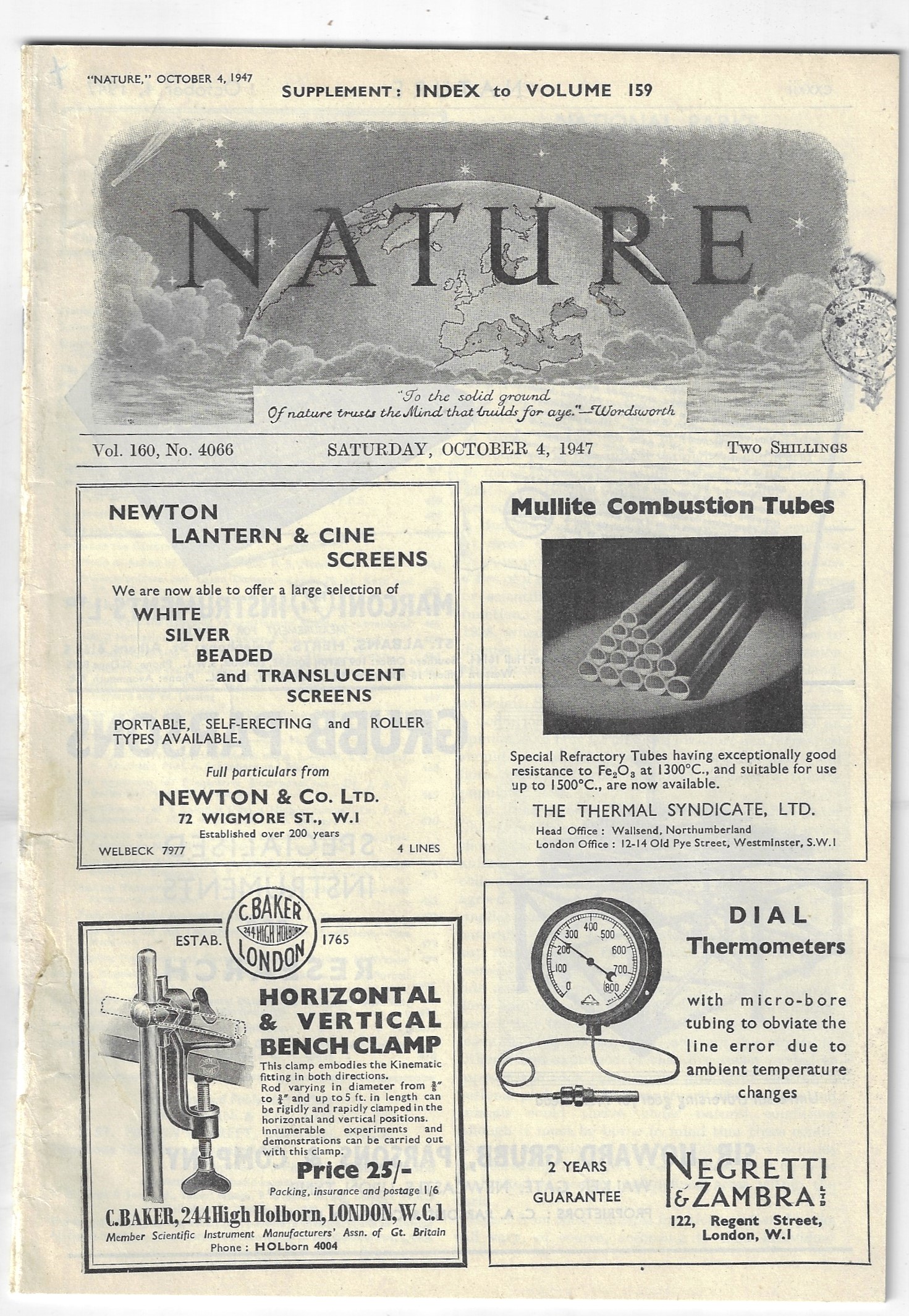
    Nature 1947 DW PionM.G. Lattes, G. P. S. Occhailini, and C. F. Powell , “Observations on the tracks of slow mesons in photographic emulsions”, in Nature, 160 No. 4066 pp. 453–456, October 4, 1947, with photos, tables, and graphs. Original wrappers. Almost invisible professional repair to front wrapper, otherwise fine. Confirmation of the discovery of the Pion. $250

    “1947 was the year of the pion…In February of that year, Cecil Powell and Giuseppe Occhialini reported[on Nature 159, 186–190] the observation of six star-like patterns in emulsions exposed to cosmic rays. Powell’s group had finally found the Yukawa particle, predicted in 1935 to be the carrier of strong force inside the atomic nucleus. In fact, Don Perkins pipped them to the post with the publication of a single, similar star-like event just two weeks earlier. Later in the year, another paper from Powell’s group [the paper offered here] announced the first observation of pion decay to a muon — the particle picture was beginning to take shape.”–From NATURE’S “Physics Portal” on the discovery of the pion.

    From the paper: “In recent experiments, it has been shown that charged mesons, brought to rest in photographic emulsions, sometimes lead to the production of secondary mesons. We have now extended these observations by examining plates exposed in the Bolivian Andes at a height of 5,500 m., and have found, in all, forty examples of the process leading to the production of secondary mesons…”

    ·Posted by :

    ·in:

    —
  • John A Wheeler Geons In Physical Review 97 No 2 Pp 511536 January 15 1955 Original Wrappers The Edges Of T

    John A. Wheeler,  “Geons”, in Physical Review, 97 No. 2 pp. 511–536, January 15, 1955. Original wrappers, the edges of the covers of which are somewhat sunned; also there’s a large-ish owner’s name stamped on the front cover. VG copy. $175
    “In theoretical general relativity, a geon is an electromagnetic or gravitational wave which is held together in a confined region by the gravitational attraction of its own field energy. They were first investigated theoretically in 1955 by J. A. Wheeler, who coined the term as a contraction of “gravitational electromagnetic entity”–Wikipedia, “Geons”

    ·Posted by :

    ·in:

  • “Are Mesons Elementary Particles?” (1949)

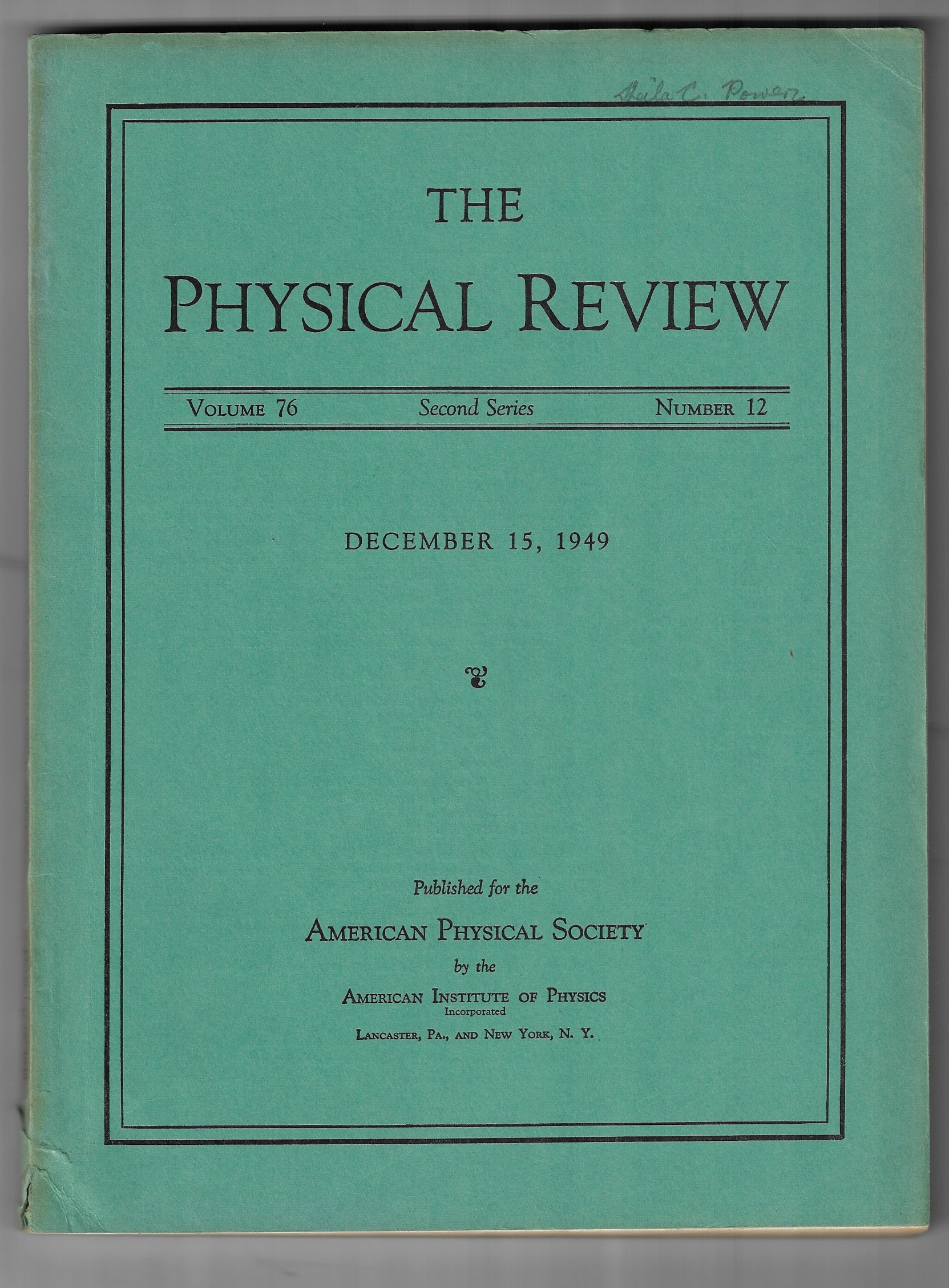
    PR 1949 DW Fermi YangEnrico Fermi and C.N. Yang.  “Are Mesons Elementary Particles?” in Physical Review, vol 76 No. 12 pp. 1739-1743, December 15, 1949. Original wrappers; there is some sunning around the cover edges and spine; also some wear along the spine bottom. A solid, near-FINE copy.

    “From the introduction to the paper: “In recent years several new particles have been ~ – discovered which are currently assumed to be “elementary, ” that is, essentially, structureless. The probability that all such particles should be really elementary becomes less and less as their number increases. It is by no means certain that nucleons, mesons, electrons, neutrinos are all elementary particles and it could be that at least some of the failures of the present theories may be due to disregarding the possibility that some of them may have a complex structure. Unfortunately, we have no clue to decide whether this is true, much less to 6nd out what particles are simple and what particles are complex. In what follows we mill try to work out in some detail a special example more as an illustration of a possible program of the theory of particles…”  Fermi and Yang answer that the meson is not an elementary particle.

    • This is the copy of Sheila C. Power [Tinney], with her name (signed?) at top right front cover. 

    From the Royal Irish Academy: “Erwin Schrödinger described [Power] as among the ‘best equipped and most successful of the younger generation of theoretical physicists in this country’,”

    (“Power”)…went to the University of Edinburgh to work on a doctorate [under Max Born]…and worked with him on the stability of crystal lattices, and was awarded a Ph.D. by Edinburgh in 1941. She is believed to be the first Irish woman to receive a doctorate in the mathematical sciences….In 1941 she was appointed to an assistant lectureship in UCD, at the age of 23, and also held a part-time fellowship in the Dublin Institute for Advanced Studies (DIAS). A year later, she was the only woman attending an international colloquium in the institute, at which the Nobel prize winner Paul Dirac lectured on quantum electrodynamics. From September 1948 to June 1949 she took leave of absence to go on a fellowship to the Institute for Advanced Study in Princeton, New Jersey, where she worked on aspects of nuclear physics…”–Royal Irish Academy website

    ·Posted by :

    ·in:

  • Ralph Alpher A Neutron Capture Theory Of The Formation And Relative Abundance Of The Elements In Physical Review 74 N

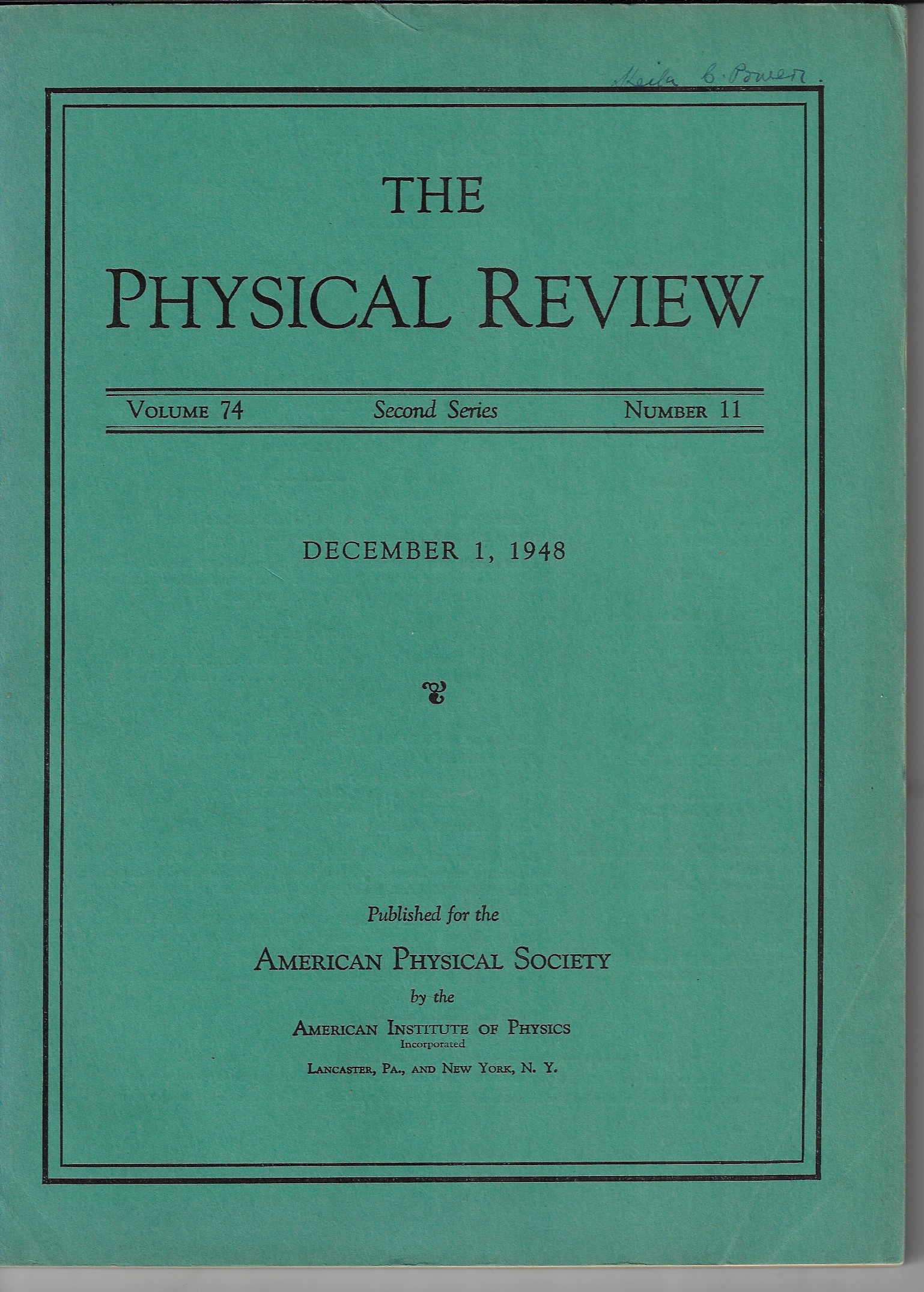
    PR 1948 DW AlpherRalph Alpher, “A Neutron-Capture Theory of the Formation and Relative Abundance of the Elements”, in Physical Review 74 No. 11 pp. 1577–1589, December 1, 1948.Original wrappers; old fold in the corner-right-bottom of the front cover, a near-fine copy. $250

    This is Alpher’s doctoral dissertation touching on some of the thinking  for the great αβγ Alpher/ Bethe/ Gamow paper, “The Origin of the Chemical Elements”, (Physical Review 73 (1948), 803, also available from this store] in which Alpher and Gamow suggested that the light elements were created by hydrogen ions capturing neutrons in the hot, dense early universe.”–Wikipedia (“Big Bang Nucleosynthesis”)

    “From 1944 through 1955, he was employed at the Johns Hopkins University Applied Physics Laboratory… In 1948 he earned his Ph.D. in Physics with a theory of nucleosynthesis called neutron-capture, and from 1948 onward collaborated with Dr. Robert C. Herman (Ph.D. in Physics, 1940, Princeton University, under E. Condon), also at APL, on predictions of the Cosmic Microwave Background Radiation.”—Wikipedia (“Ralph Alpher”)

    • The copy of Sheila C. Power [Tinney], with her name (signed?) at top right front cover. 

    From the Royal Irish Academy: “Erwin Schrödinger described [Power] as among the ‘best equipped and most successful of the younger generation of theoretical physicists in this country’,”

    (“Power”)…went to the University of Edinburgh to work on a doctorate [under Max Born]…and worked with him on the stability of crystal lattices, and was awarded a Ph.D. by Edinburgh in 1941. She is believed to be the first Irish woman to receive a doctorate in the mathematical sciences….In 1941 she was appointed to an assistant lectureship in UCD, at the age of 23, and also held a part-time fellowship in the Dublin Institute for Advanced Studies (DIAS). A year later, she was the only woman attending an international colloquium in the institute, at which the Nobel prize winner Paul Dirac lectured on quantum electrodynamics. From September 1948 to June 1949 she took leave of absence to go on a fellowship to the Institute for Advanced Study in Princeton, New Jersey, where she worked on aspects of nuclear physics…”–https://www.ria.ie/news/dictionary-irish-biography-public-engagement-stem-education/100th-anniversary-birth-sheila

    ·Posted by :

    ·in:

  • Hendrik Casimir And Dirk Polder The Influence Of Retardation On The London Van Der Waals Forces In Physical Review 7

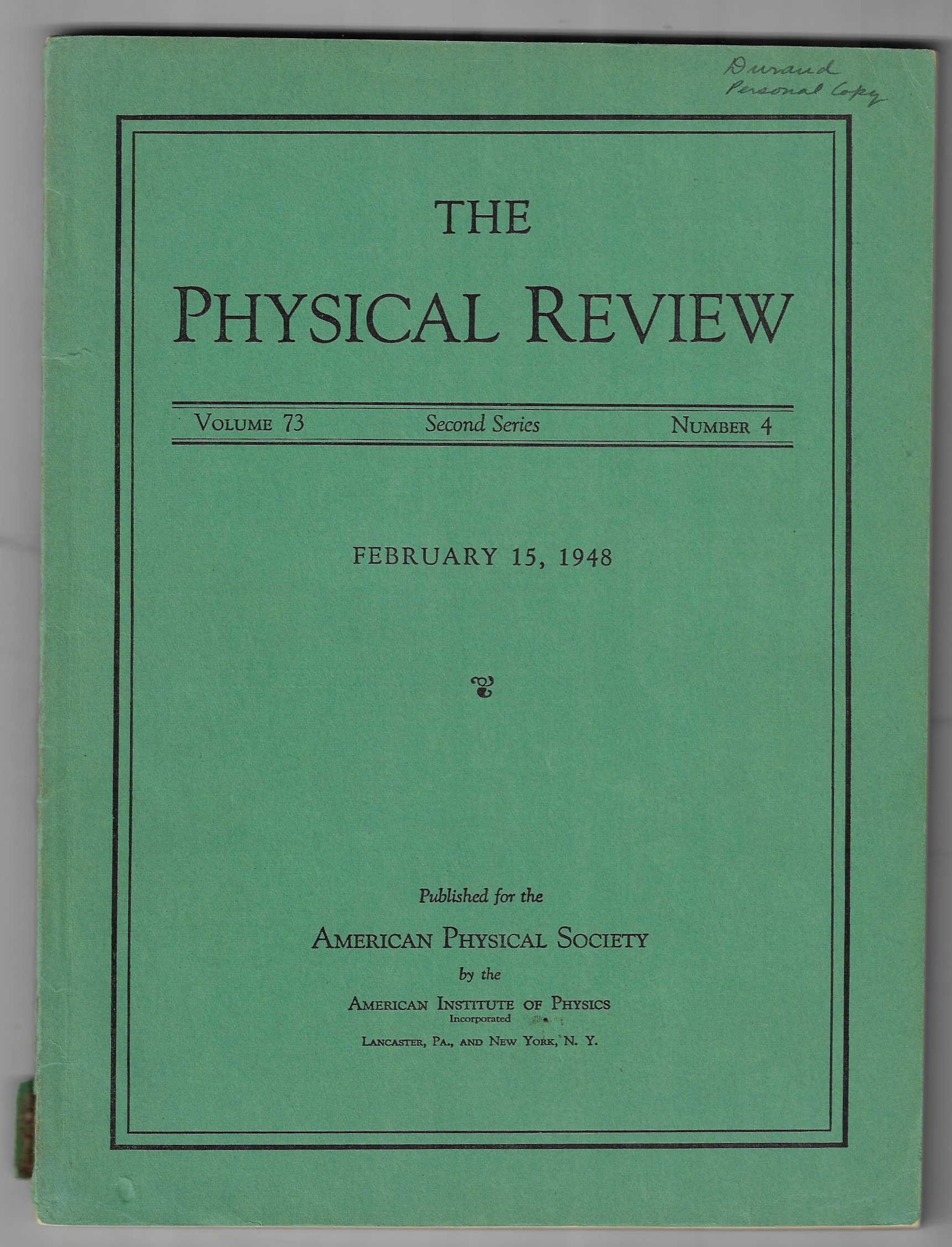
    PR 1948 DW Casimir Hendrik Casimir and Dirk Polder, “The Influence of Retardation on the London-van der Waals Forces”, in Physical Review 73 No. 4 pp. 360–372, February 15, 1948. AND in the same issue: Julian Schwinger, “On Quantum-Electrodynamics and the Magnetic Moment of the Electron” pp. 416–417. Original wrappers. Owner’s name (“Durand” on front cover, spine sunned; bottom piece of spine covering splitting; otherwise a fine copy. $175

    Introduction of the Casimir Effect: “In quantum field theory, the Casimir effect and the Casimir–Polder force are physical forces arising from a quantized field. They are named after the Dutch physicist Hendrik Casimir who predicted them in 1948 [this paper]. The Casimir effect can be understood by the idea that the presence of conducting metals and dielectrics alters the vacuum expectation value of the energy of the second quantized electromagnetic field. Since the value of this energy depends on the shapes and positions of the conductors and dielectrics, the Casimir effect manifests itself as a force between such objects.”–Wikipedia entry for “Casimir Effect”.

    This significant paper in the history of QED (reproduced in full in Schwinger’s own colelction of important papers in Quantum Electrodynamics”) begins “Attempts to evaluate radiative corrections to electron phenomena have heretofore been beset by divergence difficulties, attributable to self-energy and vacuum polarization effects…”

    ·Posted by :

    ·in:

  • Julian Schwinger Quantum Electrodynamics Ii Vacuum Polarization And Self Energy In Physical Review Vol 75 No 4 Fe


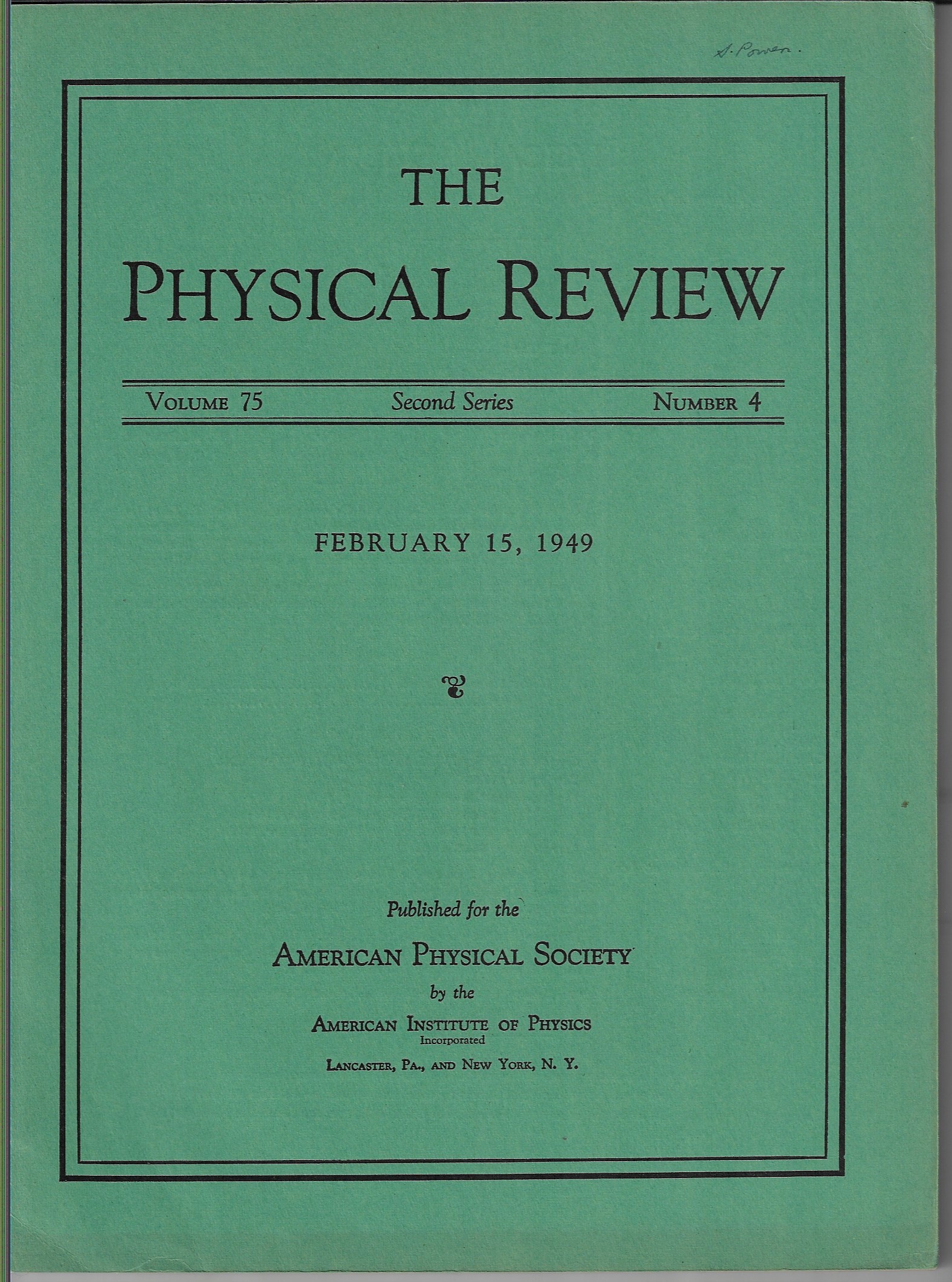
    PR 1949 DW SchwingerJulian Schwinger, Quantum Electrodynamics II. Vacuum polarization and self-energy. In: Physical Review, Vol. 75, No. 4, February 15, 1949 pp 651-679. Original wrappers. Fine copy. $250

    This is the second paper (of three) of Schwinger’s great and Nobel Prize effort (shared with Richard Feynman and Sin-Itiro Tomonaga in 1965 “for their fundamental work in quantum electrodynamics, with deep-ploughing consequences for the physics of elementary particles” ) in the renominalization of QED.

    • The copy of Sheila C. Power [Tinney], with her name (signed?) at top right front cover. 

    From the Royal Irish Academy: “Erwin Schrödinger described [Power] as among the ‘best equipped and most successful of the younger generation of theoretical physicists in this country’,”

    (“Power”)…went to the University of Edinburgh to work on a doctorate [under Max Born]…and worked with him on the stability of crystal lattices, and was awarded a Ph.D. by Edinburgh in 1941. She is believed to be the first Irish woman to receive a doctorate in the mathematical sciences….In 1941 she was appointed to an assistant lectureship in UCD, at the age of 23, and also held a part-time fellowship in the Dublin Institute for Advanced Studies (DIAS). A year later, she was the only woman attending an international colloquium in the institute, at which the Nobel prize winner Paul Dirac lectured on quantum electrodynamics. From September 1948 to June 1949 she took leave of absence to go on a fellowship to the Institute for Advanced Study in Princeton, New Jersey, where she worked on aspects of nuclear physics…”

    https://www.ria.ie/news/dictionary-irish-biography-public-engagement-stem-education/100th-anniversary-birth-sheila

    ·Posted by :

    ·in:

    —
  • The Ward-Takahashi Effect (1951)


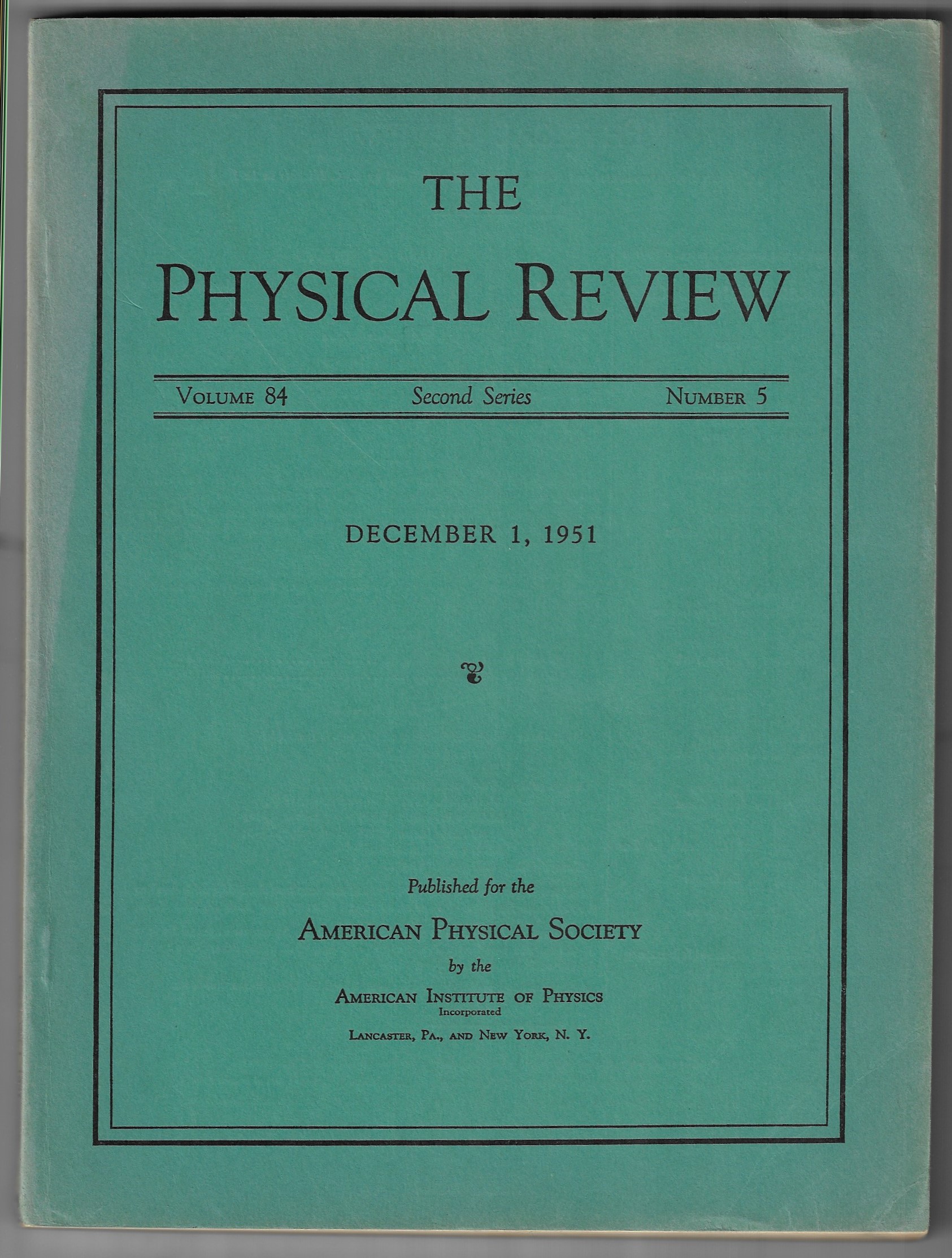
    PR 1951 DW Ward takahaashiJohn Clive Ward, “Renormalization Theory of the Interactions of Nucleons, Mesons, and Photons” in Physical Review 84 No. 5, December 1, 1951, pp 897-902 in the issue of pp 869-1078. 
    Original wrappers. Spine and cover edges all considerably sunned; also, there’s a small chip out of the bottom of the spine; also, there’s a little bump art top right corner.  VG $150

    “In quantum field theory, a Ward–Takahashi identity is an identity between correlation functions that follows from the global or gauge symmetries of the theory, and which remains valid after renormalization. The Ward–Takahashi identity of quantum electrodynamics was originally used by John Clive Ward [this paper]and Yasushi Takahashi to relate the wave function renormalization of the electron to its vertex renormalization factor F1(10), guaranteeing the cancellation of the ultraviolet divergence to all orders of perturbation theory. Later uses include the extension of the proof of Goldstone’s theorem to all orders of perturbation theory. The Ward–Takahashi identity is a quantum version of the classical Noether’s theorem, and any symmetries in a quantum field theory can lead to an equation of motion for correlation functions. This generalized sense should be distinguished when reading literature, such as Michael Peskin and Daniel Schroeder’s textbook from the original sense of the Ward identity.”–Wikipedia (“Ward-Takahashi Identity”)

    ·Posted by :

    ·in:

Recent Posts

Archives

Categories