A Daily History of Holes, Dots, Lines, Science, History, Math, Physics, Art, the Unintentional Absurd, Architecture, Maps, Data Visualization, Blank and Missing Things, and so on. |1.6 million words, 7500 images, 4.9 million hits| Press & appearances in The Times, Le Figaro, Mensa, The Economist, The Guardian, Discovery News, Slate, Le Monde, Sci American Blogs, Le Pont, and many other places… 5000+ total posts since 2008.

  • “Possible Example of the Annihilation of a Heavy Particle” (1954)

    ROSSI, Bruno  H. S. Bridge, H. Courant, H. DeStaebler, Jr. “Possible Example of the Annihilation of a Heavy Particle” in Physical Review, 95 No. 4 pp. , 1101-1103, August 15, 1954). Original wrappers. Condition: the spine has been repaired, and there’s a name on the front cover. A very nice copy. Solid VG. $250

    This is the report on first tentative sighting of an antiproton annhilation. “In 1954, a team led by Italian physicist Bruno Benedetto Rossi (1905–1993) observed an unusual cloud chamber event in which a singly charged particle decayed into three photons whose energies totaled more than the proton rest energy, the signature of an antiproton annihilation.”

    “Rossi…was an Italian experimental physicist. He made major contributions to particle physics and the study of cosmic rays. A 1927 graduate of the University of Bologna, he became interested in cosmic rays. To study them, he invented an improved electronic coincidence circuit, and traveled to Eritrea to conduct experiments that showed that cosmic ray intensity from the West was significantly larger than that from the East. During World War II, Rossi worked on radar at the MIT Radiation Laboratory, and he played a pivotal role in the Manhattan Project, heading the group at the Los Alamos Laboratory that carried out the RaLa Experiments. After the war, he was recruited by Jerrold Zacharias at MIT, where Rossi continued his pre-war research into cosmic rays. In the 1960s, he pioneered X-ray astronomy and space plasma physics. His instrumentation on Explorer 10 detected the magnetopause, and he initiated the rocket experiments that discovered Scorpius X-1, the first extra-solar source of X-rays.–Wikipedia
    ·Posted by :

    ·in:

    —
  • On Wormholes (1955)

    WHEELER, John A. “Geons”, in Physical Review, vol 97 #2, pp 511-536 in the issue, printed by the American Physical Society, January 15, 1955. Original wrappers are somewhat darkened around the front cover edges; owner’s name on front cover, otherwise a FINE copy. $350 

    First appearance of a diagram of a “wormhole”–the coining of the term would come later in 1957 by Whweeler and Meissner. (The word appears for the first time in English in Shakespeare Lucrece   “To fill with worme-holes stately monuments” in 1594—this is not what Wheeler had in mind.) The “geon” (“gravitational electromagnetic entity”) is the word used for “wormhole” here, building on the “bridige” (Einstein-Rosen bridge that I think is mentioned in the last Avenger’s universe movie!) idea built by Einstein and Nathan Rosen in 1935 as a means to connect two different points in space-time, and also on the work of Hermann Weyl (“Feld u. Materie” in AdP 65(14) 541-563 1921,) and the still-earlier work in the Phys Zeit 1916 by Ludwig Flamm who theorized on this idea in terms of what we would call a “white hole”.

    [Wormhole: “…is a speculative structure linking disparate points in spacetime, and is based on a special solution of the Einstein field equations solved using a Jacobian matrix and determinant. A wormhole can be visualized as a tunnel with two ends, each at separate points in spacetime (i.e., different locations or different points of time). More precisely it is a transcendental bijection of the spacetime continuum, an asymptotic projection of the Calabi–Yau manifold manifesting itself in Anti-de Sitter space. –Wikipedia]

    ·Posted by :

    ·in:

  • First proposal for the construction of a Laser (“Light Amplification by Stimulated Emission of Radiation”) (1958)

    Arthur Schawlow and Charles Townes, “Infrared and Optical Masers” in Physical Review, American Physical Society, 112 No. 6 pp. 1940–1948, December 15, 1958. Original wrappers; there’s a little damage to the spine; name stamped on front cover. VG $350

    First proposal for the construction of a Laser (“Light Amplification by Stimulated Emission of Radiation”).

    “It wasn’t until the 1940s and 1950s that physicists found a use for the concept [stimulated by Einstein in 1917], even though all that was required to invent a laser was finding the right kind of atom, and adding reflecting mirrors to fortify the stimulated emission process by producing a chain reaction. Charles Townes had worked on radar systems during World War II. After the war ended, he turned his attention to molecular spectroscopy, a technique that studies the absorption of light by molecules. Just like radar, molecular spectroscopy bombards the surface of molecules with light and analyzes the scattered radiation to determine the molecule’s structure. But the technique was limited by the wavelength of the light produced: in this case, the microwave regime of the electromagnetic spectrum. Townes noticed that as the wavelength of the microwaves shortened, the more strongly the light interacted with the molecules, and the more one could learn about them. He thought it might be possible to develop a device that produced light at much shorter wavelengths. The best way to do this, he thought, would be to use molecules to generate the desired frequencies through stimulated emission. Townes mentioned the idea to a colleague (later his brother-in-law), Arthur Schawlow, who proposed that the prototype laser be fitted with a pair of mirrors, one at each end of the lasing cavity. Photons of specific wavelengths would then reflect off the mirrors and travel back and forth through the lasing medium. By doing so, they would in turn cause other electrons to relax back into their ground states, emitting even more photons in the same wavelength. So only photons in the selected wavelength and frequency range would be amplified. The two men wrote a paper [this paper] detailing their concept, published in the December 1958 issue of the Physical Review, although they had yet to build a working prototype. They received a patent for their design two years later–the same year that the first working laser was built by Theodore Maiman at Hughes Aircraft Company.”–”Einstein Predicts Stimulated Emission”, August-September 2005 (vol 14 #8), APS This Month in Physics History.

    ·Posted by :

    ·in:

  • Confirming the Theory of the Antiproton (1956)

    CHAMBERLAIN, Owen. “Example of an Antiproton–Nucleon Annihilation” , in Physical Review, vol 102 No. 3 pp. 921–923, May 1, 1956. Single issue with original wrappers. Name on front cover, tiny split at bottom of spine, otherwise fine. $350

    • Offered with Robert Hofstadter, “Elastic Scattering of 188 MeV Electrons from Proton and the Alpha Particle” same issue, pp. 851–85.
    • Offered with Müller and Bahadur, “Field Ionization of Gases at a Metal Surface and the Resolution of the Field Ion Microscope” , same issue, pp.624-631.

    “Chamberlain provides definitive evidence of the annihilation of a proton, the confirmation of the discovery of the antiproton. Hofstadter calculates the size of a proton. Muller and Bahadur describe the first viewing of an atom. “ $350

    • “Owen [as he had everyone call him, “students and colleagues alike”] had first become interested in looking for antiprotons during a visit to Brookhaven National Laboratory in the summer of 1953. He thought that antiprotons must exist, but he was really turned on to the chase when he heard that Maurice Goldhaber had bet Hartland Snyder $500 that they did not exist. In an oral history completed in 2000, Owen stated, “Well, I have great respect for Maurice Goldhaber as a physicist, and I suspect he made the bet when he was a little drunk, but even when drunk, Maurice Goldhaber is a good physicist. So if someone of the stature of Maurice thought maybe antiprotons didn’t exist, then this was a real spur to showing that they did. And I think it was at that moment that I decided: ‘By Jove, this is what I want to do.’ ”

    The experiment itself was simple and elegant. Antiprotons were produced when the proton beam in the Bevatron struck an internal copper target. Since the antiprotons were negatively charged, the machine’s magnetic field bent them out of the Bevatron’s circular orbit into an external beamline where their charge, momentum, and velocity were measured.After about a month of intermittent data taking, the group was able to report in September 1955 the unambiguous observation of antiprotons. The Nobel Prize followed in 1959.”–”Physics Today”, 59/8, August 1, 2006, pg 70, obituary for Chamberlain.

    ·Posted by :

    ·in:

    —
  • Nobel Prize in Physics effort (1979)

    SALAM, Abdus and Clive Ward, “Electromagnetic and Weak Interactions” in Physics Letters 13, pp. 168-171, in the volume of 368p. Bound in a deep blue cloth; two stamps on the title page, otherwise this is a very fine copy. Nobel Prize in Physics for this work in 1979. $300

    • First attempt at at a synthesis between electromagnetism and the weak interaction (1500+ citations].

    [Reprinted in  “Selected papers of Abdus Salam”, editor A. Ali et al., p. 210-213;  “Gauge theory of weak and electromagnetic interactions”, editor C. H. Lai, p. 181-184.]

    “One of the recurrent dreams in elementary particles physics is that of a possible fundamental synthesis between electromagnetism and weak interactions. The idea has its origin in the following shared characteristics: 1) Both forces affect equally all forms of matter-leptons as well as hadrons. 2) Both are vector in character. 3) Both (individually) possess universal coupling strengths. Since universality and vector character are features of a gauge-theory these shared characteristics suggest that weak forces just like the electromagnetic forces arise from a gauge principle…”–in “Chronology of Milestone Events in Particle Physics” (online).

    “Beginning in the late 1950s, Salam’s group at Imperial had become perhaps the most active of the groups working in gauge theories during a period in which quantum field theories had been displaced by another approach, the S-matrix model. While many theorists were looking toward this latter method in the hopes of avoiding the seemingly intractable difficulties that had begun to arise with field-theoretic calculations, Salam believed that a more “fundamental” explanation would have to come from invoking the standard perturbation method for quantum field theory. This conviction, shared by his collaborators at Imperial, was transmitted to his students. In 1964 the group started a research program on gauge theories. The aim of this program was to find the mathematical group of transformations that left “invariant” the laws that rule an interaction: The question was whether or not the interaction depended on certain physical properties of the particles, such as electric charge or other “quantum numbers.”The aim was to find symmetry groups that showed that interactions that seem essentially different are just manifestations of a more general one, such as in the electromagnetic theory, in which Salam’s goal was to unify electromagnetic and weak interactions.” —Complete Dictionary of Scientific Biography online.

    ·Posted by :

    ·in:

  • Bjorken J And S L Glashow Elementary Particles And Su4 In Physics Letters 11 Pp 255257 In The Volume Of 368Pp

    BJORKEN, J. and S. L. Glashow , “Elementary particles and SU(4)”, in Physics Letters 11 pp. 255–257, in the volume of 368pp, 1964. Bound in blue cloth. A lovely copy. $300

    • Reprinted in  J. L. Rosner, New Particles. Selected Reprints, Stony Brook, Am. Ass. of Physics Teachers (1981) 15.
    • “Proposal for the existence of a charmed fundamental fermion; First prediction of a Charmed Quark “ and

    “Recently, models of strong interaction symmetry have been proposed involving four fundamental Fermion fields ψ>i and approximate symmetry under SU(4). Mesons are identified with bound states iψ>i and baryons with bound states i ψ>j ψ>k. In this note we examine a model of this kind whose principal achievements are these: a mass formula relating the masses of the nine vector mesons and predicting a ninth pseudoscalar meson at 950 MeV, a description of weak interactions including all selection rules except the nonleptonic Δ I = 1 / 2 rule, and a significant “baryon”-lepton symmetry. A new quantum number “charm” is violated only by the weak interactions, and the model predicts the existence of many “charmed” particles whose discovery is the crucial test of the idea. (Extracted from the introductory part of the paper.)–cited in “Chronology of Milestone Events in Particle Physics” (online).

    ·Posted by :

    ·in:

  • Linde Andrei Eternally Existing Self Reproducing Chaotic Inflationary Universe In Physics Letters B 175 Pp 39540

    LINDE, Andrei. “Eternally Existing Self-Reproducing Chaotic Inflationary Universe”, in Physics Letters B 175 pp. 395–400 in the volume of 502pp, 1986. With the front wrapper of each of the four issues bound in. $300

    “Linde proposes “eternal chaotic inflation.” In 1983, Andrei Linde had demonstrated that quantum fluctuations could begin inflation without the highly unlikely condition of a high plateau in the energy potential hill, and he named the result “chaotic inflation.” In 1986, Linde extended his theory to include the notion of eternal inflation. When begun, “eternal chaotic inflation” would continue to grow in random (chaotic) ways through other quantum fluctuations, and thus be eternal. This theory remains the standard model of inflation more than 20 years after its conception.”–David Wenner, History of Physics Collection.

    Abstract: “It is shown that the large-scale quantum fluctuations of the scalar field cp generated in the chaotic-inflation scenario lead to an infinite process of self-reproduction of inflationary mini-universes. A model of an eternally existing chaotic inflationary universe is suggested. “

    ·Posted by :

    ·in:

  • Amaldi Ugo With Wim De Boer And Hermann Furstenau Comparison Of Grand Unified Theories With Electroweak And Strong Coupl

    AMALDI, Ugo with Wim de Boer and Hermann Furstenau: “Comparison of Grand Unified Theories with Electroweak and Strong Coupling Constants Measured at LEP”, in Physics Letters B 260 pp. 447–455, 1991, published by North Holland. Nicely bound in blue cloth, with two owner stamps on title page. A FINE copy. $225

    • Abstract: “Using the renormalization group equations one can evolve the electroweak and strong coupling constants, as measured at LEP, to higher energies in order to test the ideas of grand unified theories, which predict that the three coupling constants become equal at a single unification point. With data from the DELPHI Collaboration we find that in the minimal non-supersymmetric standard model with one Higgs doublet a single unification point is excluded by more than 7 standard deviations. In contrast, the minimal supersymmetric standard model leads to good agreement with a single unification scale of 1016.0±0.3 GeV. Such a large scale is compatible with the present lower limits on the proton lifetime. The best fit is obtained for a SUSY scale around 1000 GeV and limits are derived as function of the strong coupling constant. The unification point is sensitive to the number of Higgs doublets and only the minimal SUSY model with two Higgs doublets is compatible with GUT unification, if one takes the present limits on the proton lifetime into account. “

    This is a significant paper (cited over 2200 times) that showed that unification between strong, weak and electromagnetic forces can occur through suppersymmetry.

    The paper begins: ““Since LEP–the powerful electron-positron collider at CERN, Europe’s laboratory for particle physics–has begun operating, physicists have got some hint that, indeed, all forces might have been unified during the very first moment of the creation of the universe, the Big Bang, when particles supposedly interacted with each other at energies well above 10-16 GeV…”

    See also: Peter Rodgers, Super symmetry, on the Nature site, Nature’s “Milestone 13”, in Nature Physics 4, S13 (2009)

    ·Posted by :

    ·in:

  • Early and Important Work on the Atmosphere (1803)

    DALTON, John. Five papers in: Annalen der Physik, volume 15, 1803, Rengerschen Buchhandlung, 1803. (vi), 504pp, 4 folding plates. Cloth-backed marbled boards.  The full volume offered with the scarce original wrappers, bound-in.  Black cloth; dark marbled boards with cloth tips.  Ex-libris Deutsche Akademie der Luftfahrtforschung, then Wright Patterson Field Library (USAF), then Library of Congress.  Library markings:  small gilt-stamped “Akademie der Luftfahrtforschung”, page edges stamped “Wright Field Library/Dayton, Ohio” on top and bottom. Very good condition. $750

    • “Versuche über die Expansivkraft der Dämpfe von Wasser und andern Flüssigkeiten, so wohl im luftleeren Raume als in der Luft”, p 1-24;
    • “Versuche über die Verdünstung”, pp 121-143;
    • “Meteorologische Beobachtungen angestellt zu Manchester”, pp 197-205
    • “Versuche und Beobachtungen angestellt, und zu beurtheilen, ob die Menge von Wasser gleich ist, welches die Flüsse und die Verdünstung fortführen. Und etwas über den Ursprung der Quellen”, pp 249-277.

    The four papers in two sections (9 & 10) of volume 15 of the Annalen, all translated from Dalton’s “Experimental Essays on the Constitution of mixed Gases on the Force of Steam or Vapour from Water and other Liquids in different Temperatures both in a Torricellian Vacuum and in Air on Evaporation and on the Expansion of Elastic Fluids by Heat” in Memoirs of the Literary and Philosophical Society of Manchester, volume 5/2). These are the first appearances on the Continent of this significant work. 

    Also in this volume:

    Dalton: “Versuche und Beobachtungen, angestellt, um zu beurtheilen, ob die Menge des fallenden Regens und Thaues der Menge von Wasser gleich ist, welches die Flüsse und die Verdünstung fortführen. Und etwas über den Ursprung der Quellen”, section 11, pp 249-277;

    Chladni, “Chronologisches Verzeichnis der mit einem Feuermeteor niedergefallenen Stein- und Eisenmassen, nebst einigen Bermerkungen”, section11, pp 307-328 (a chronology of meteor falls inm support of his theory that meteorites were of cosmic rather than atmospheric origin).

    AND:

    Poisson, Simon Dennis. “Berechnung der Bewegung eines Körpers, der von der Oberfläche des Mondes fortgeschleudert wird”, pp 329-339. (One of Poisson’s first published papers.)

    ·Posted by :

    ·in:

  • Juvenile Delinquency in Great Depression Seattle, 1937

    Carbon Copy of an Unpublished WPA-sponsored Work?

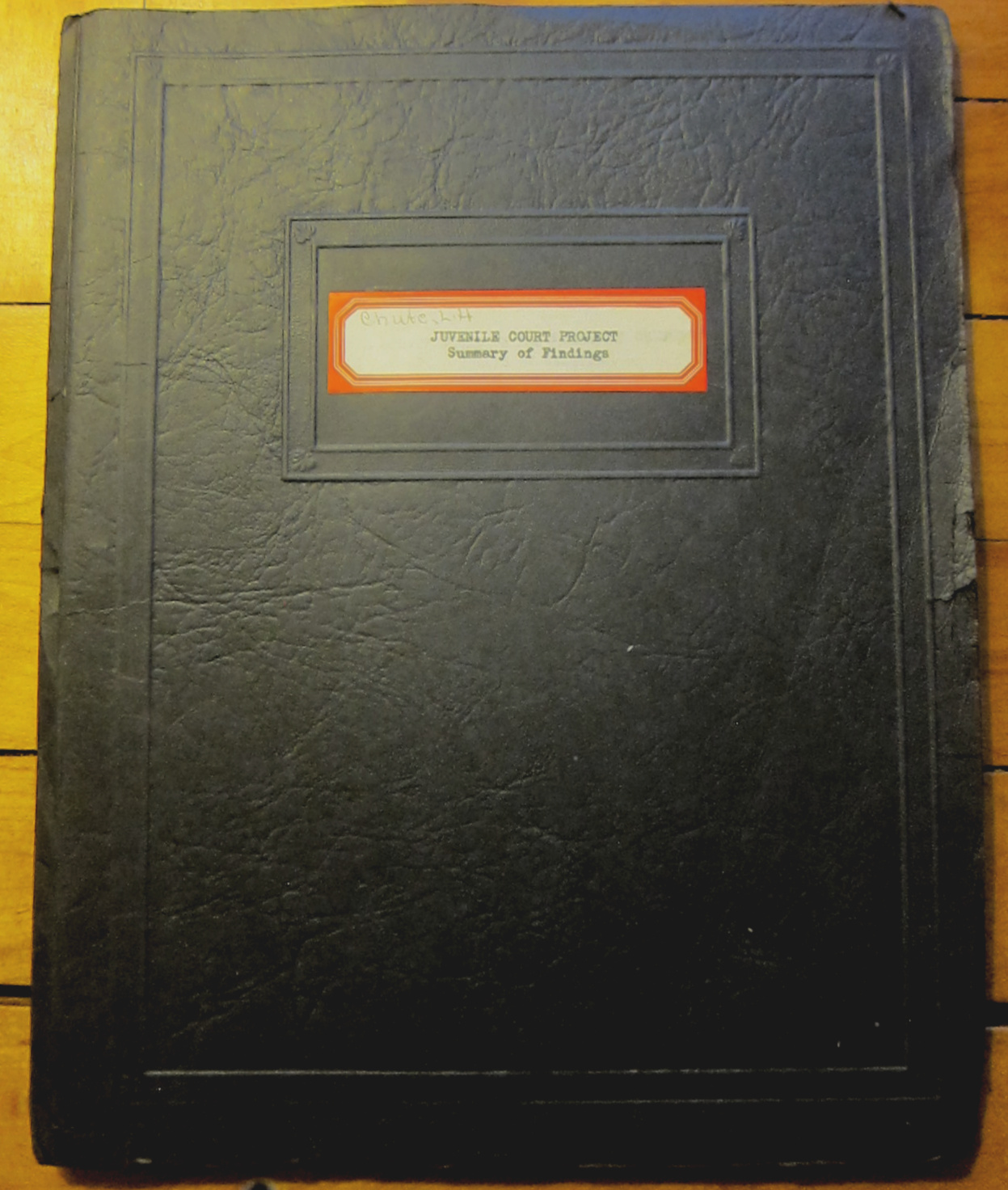
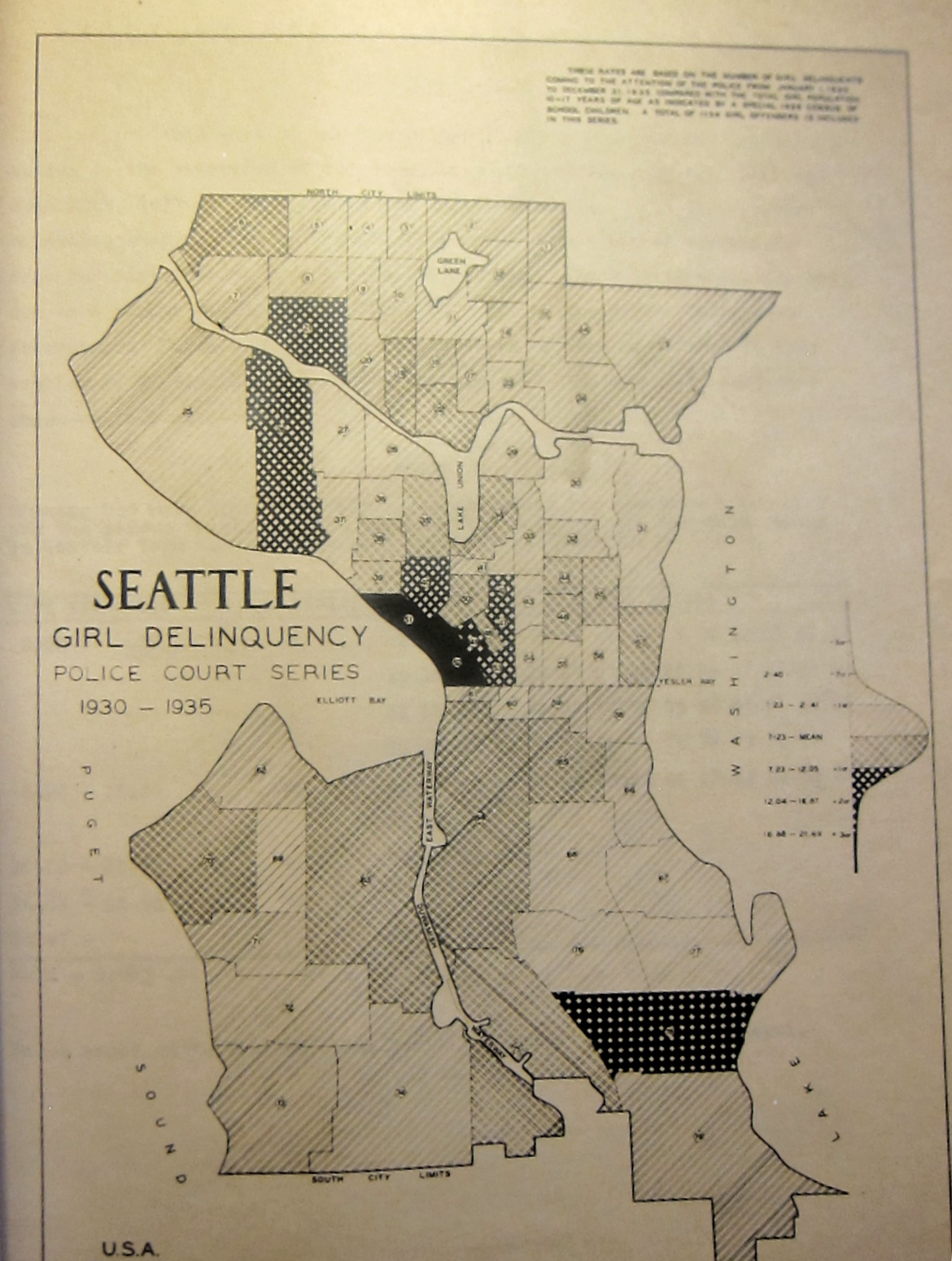
    Seattle juvenile DelinquentLionel H. Chute, Juvenile Court Project, Summary of Findings.  No place of publication; y Lionel H. Chute, “Supervisor, W.P.A., Project #4171”, December 13, 1937.11”x 8.5”, 15 leaves of text, with 5 full-page maps followed by 4 folding maps (16”x11”). The maps all seem to be photographs (on photo stock) of the base maps. VG condition. $250

    This seems to me to be a carbon copy from the typed original, home-bound in a manila report cover with three brass push-clips (which purchased for 5 cents from the University books store according to a sticker on the rear wrapper).

    Provenance: Library of Congress, with their 6mm perforated “LC” on the title, a rubber stamp rear of title identifying receiving the report in February 1938, and the LC surplus stamp on front free fly. Also included are carbons of the LC card catalog card. The paper used in the report has the University of Washington watermark.

    I can find no reference to this work in WorldCat, nor do searches in the relevant databases produce anything for it, nor for Mr. Chute. This seems entirely produced by the author, funded by the WPA, and may never have been published.

    There’s a LOT of data in this work which I suspect would be an interesting and fact-filled look at the situation in Seattle just before the mini-depression sparked into life inside the Great Depression.  

    Seattle Juvenile map

  • Paying for Prisoner Labor, 1937

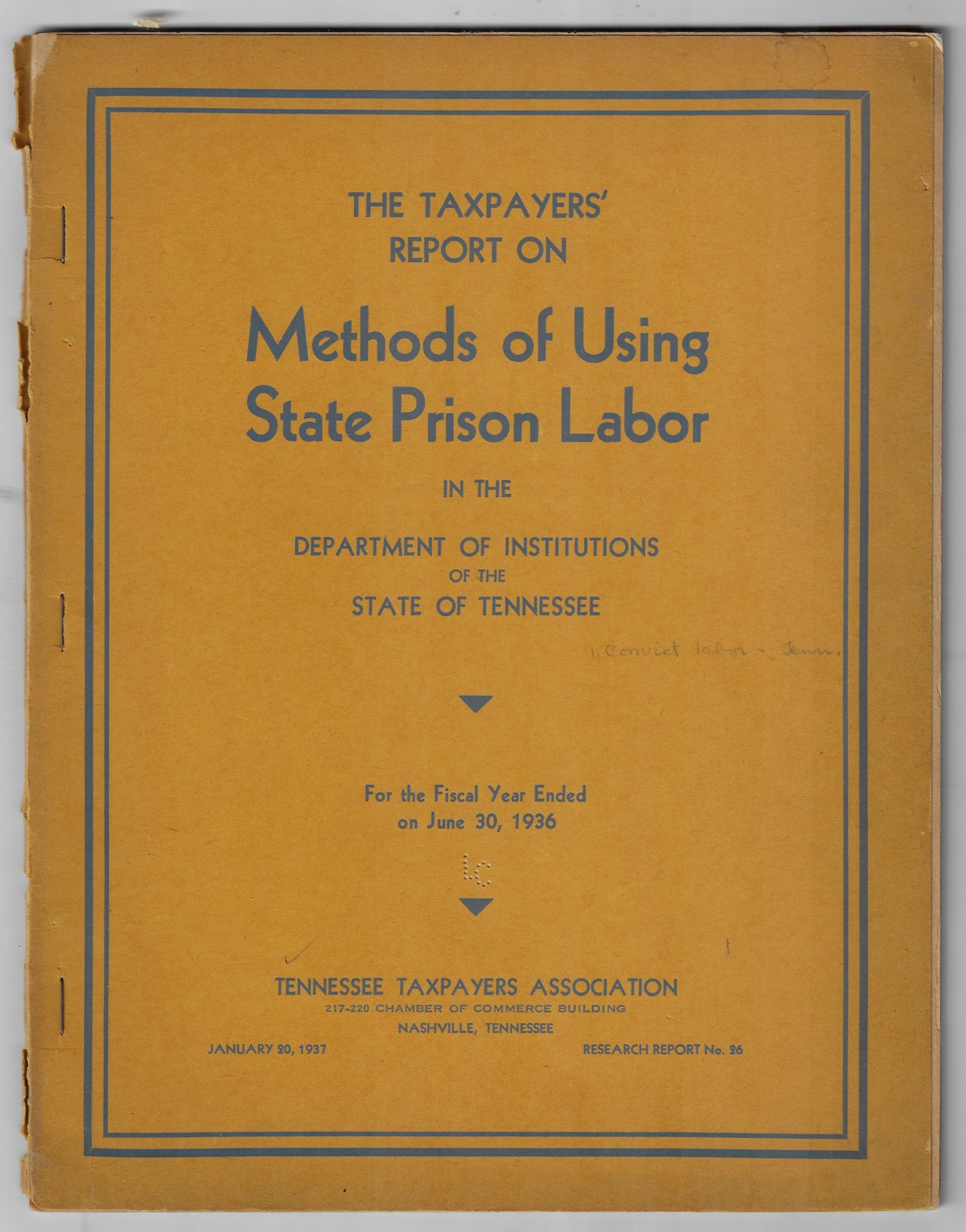
    Americana tennessee prison laborThe taxpayers’ report on methods of using state prison labor in the Department of institutions of the state of Tennessee, for the fiscal year ended on June 30, 1936.  Nashville, Tenn., Tennessee taxpayers association, 1937. 2 p.l., 40 p. 28 x 22 cm. Original wrappers, staple-bound. Provenance: Library of Congress, with their 6mm perforated “LC” in the front cover and their surplus rubber stamp on the rear cover.  $200

    • Only 3 copies (Duke, Rhodes (Memphis), and the LC) located in WorldCat.

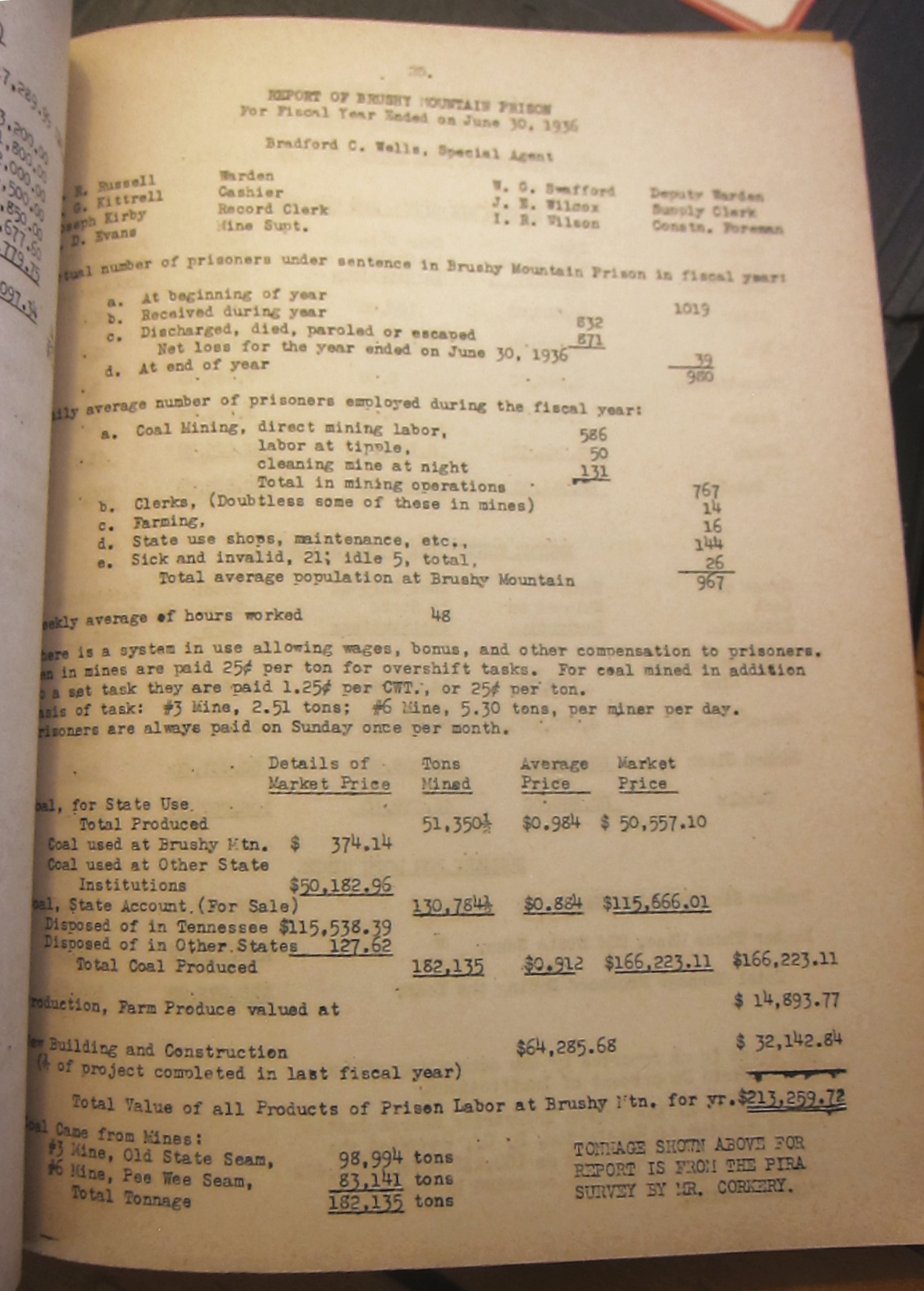
    There’s a lot of interesting stuff in here: for example, a cursory look reveals that of the 980 inmates at the Bruahy Mountain Prison 967 of them were at work with a weekly average of 48 hours. Here’s where they worked: 767 in a coal mine in a coal mine (586 “direct coal mining”, 50 at the tipple, and 131 cleaning the mines at night); clerks , 14; farming, 16; state use in maintenance, 144.

    It looks like the prisoners were paid 25 cents per ton of coal mined (this after some other measure was met, presumably this is where the “free labor” came in), with an average daily production of 5 tons or what may have been $1.25 per day (about 15 cents/hr or about half the minimum wage) times six days a week times four means that they may have made $30/month for moving about 140 tons of coal. This is about what someone would make per month with the C.C.C.  It is worth noting that today prisoner laborers in Tennessee make between 10 cents and on dollar an hour (with the state minimum wage at $7.25)–the 15 cents an hour from 1937 is equal to about $2.35 in 2018 dollars accounting for inflation via the Bureau of Labor Statistics.

    The total coal production for the Brushy prisoners was 182,000 tons for which they were paid $213,000—the numbers here sort of work out…I’m not sure how to interpret this. I don’t see where the prison makes a share of the proceeds in my brief browse.

    Tennessee Prison Labor _1_

    ·Posted by :

    ·in:

Recent Posts

Archives

Categories