A Daily History of Holes, Dots, Lines, Science, History, Math, Physics, Art, the Unintentional Absurd, Architecture, Maps, Data Visualization, Blank and Missing Things, and so on. |1.6 million words, 7500 images, 4.9 million hits| Press & appearances in The Times, Le Figaro, Mensa, The Economist, The Guardian, Discovery News, Slate, Le Monde, Sci American Blogs, Le Pont, and many other places… 5000+ total posts since 2008.

  • Introducing the Raman Effect and the Geiger-Muller Counter (1928)


    LANDSBERG, Grigory and Leonid Mandelstam, “Eine neue Erscheinung bei der Lichtzerstreuung in Krystallen”, in the whole volume of Die Naturwissenschaften, vol 16, 1928,  p. 557. AND offered with: Hans Geiger and Walther Müller, “Elektronenzählrohr zur Messung schwächster Aktivitäten” in the same vol 16, pp. 617–618. Volume 16 contains 1,201pp and is in a lovely half-leather binding with leather tips. Fine condition. $350

    Russian physicists G. S. Landsberg (1890-1957) and L. I. Mandelstam (1879-1944) describe in this paper their discovery of the Raman effect—discovered virtually simultaneously by Chandrasekhar Venkata Raman (1888-1970), though the two did not share in the Nobel Prize awarded to Raman in 1930. (Why? “As for Landsberg and Mandelstam, they had published their results after Raman’s were in print. In addition, their paper cited previous works by Raman; although these corresponded to articles that had been published prior to Raman’s March 1928 Nature article detailing his discovery, these references perhaps confused the Nobel Committee and led them to believe that the Russians’ work did not represent an independent and simultaneous discovery. Moreover, Landsberg and Mandelstam did not at first publish their results of scattering at a shifted frequency; instead they gave an oral presentation at a conference in Moscow in April 1928 based on their measurements, which were taken in February of that year. By the time they submitted their results in May 1928 and published them in July, 16 papers had been published on the Raman effect, many by Raman and his colleagues. Still, many Austrian, German and Russian physicists felt strongly that credit should be shared. They refused to adopt the name “the Raman effect,” and referred instead to “combination scattering” or “the Smekal-Mandelstam-Raman scattering.” In 1931, K.W.F. Kohlrausch, an Austrian physicist, gave his book a title that recognized both Smekal and Raman: Der Smekal-Raman Effekt.”–Barry R. Masters, “C.V. Raman and the Raman Effect” in the Optical Society’s “Optics and Photonics News” (March 2009).

    AND with:

    The second paper in this volume is the announcement of the invention of the Geiger-Muller counter, by it inventors. “The Geiger–Müller tube or G–M tube is the sensing element of the Geiger counter instrument used for the detection of ionizing radiation. It was named after Hans Geiger, who invented the principle in 1908,[1] and Walther Müller, who collaborated with Geiger in developing the technique further in 1928 to produce a practical tube that could detect a number of different radiation types.” –Wikipedia

    ·Posted by :

    ·in:

  • Godel’s Classic and Important Papers on the Continuum Hypothesis (1938-9)

    Gödel , Kurt. “The Consistency of the Axiom of Choice and of the Generalized Continuum-Hypothesis”, in Proceedings of the National Academy of Sciences, vol 24, pp.556-557, 1938, in the volume of 572pp.

    Offered with:

    _____. “Consistency-proof for the Generalized Continuum-Hypothesis”, in Proceedings of the National Academy of Sciences, vol 25 pp. 220-224, 1939, in the volume of 661pp. Both first editions, and uniformly bound in brown cloth, nicely imprinted in gilt (with the full name of the journal, which is unusual given its length). There are some rubbed places on the covers and along spine bottom, making those areas a light shade of brown. Small 6x8mm perforated stamp on title; the text is in very fine condition. Overall, a solid near-Fine on both volumes. $2500 for the pair

    • These works are arguably Gödel ‘s next most important contributions next to the incompleteness theorems, which are arguably mathematical logic’s most important achievement in the 20th century.

    Hilbert famously put forward a list of 23 important questions in mathematics, 10 of which were presented at the International Congress of Mathematics in Paris in 1900. The very first of these questions was the continuum hypothesis, a problem simply stated: “…how many points on a line are there? Strangely enough, this simple question turns out to be deeply intertwined with most of the interesting open problems in set theory, a field of mathematics with a very general focus, so general that all other mathematics can be seen as part of it, a kind of foundation on which the house of mathematics rests. Most objects in mathematics are infinite, and set theory is indeed just a theory of the infinite.”–Juliette Kennedy, “Can the Continuum Hypothesis Be Solved?”, 2011, on the IAS website.

    “In 1935 Godel had made the first breakthrough in his new area of research: set theory. During May and June 1937 he lectured at Vienna on his striking result that the axiom of choice is relatively consistent. That summer he obtained the much stronger result that the generalized continuum hypothesis is relatively consistent; and in September 1937 John von Neumann, an editor of the Princeton journal Annals of Mathematics, urged him to publish his new discoveries there. Yet Gödel did not announce them until November 1938, and then not in the Annals but in a brief summary communicated to the Proceedings of the National Academy of Sciences.”–Complete Dictionary of Scientific Biography.

    On the continuum Hypothesis: “Cantor believed the continuum hypothesis to be true and tried for many years to prove it, in vain (Dauben 1990). It became the first on David Hilbert’s list of important open questions that was presented at the International Congress of Mathematicians in the year 1900 in Paris. Axiomatic set theory was at that point not yet formulated. Kurt Gödel proved in 1940 that the negation of the continuum hypothesis, i.e., the existence of a set with intermediate cardinality, could not be proved in standard set theory. The second half of the independence of the continuum hypothesis – i.e., unprovability of the nonexistence of an intermediate-sized set – was proved in 1963 by Paul Cohen.”–Wikipedia

    On Gödel , in general: “The character and achievement of Gödel, the most important logician since Aristotle, bear comparison with those of the most eminent mathematicians. His aversion to controversy is reminiscent of Newton’s, while his relatively small number of publications — each quite precise and almost all making a major contribution—echo Gauss’s motto of “few but ripe.” Like Newton, he revolutionized a branch of mathematics—in this case, mathematical logic—giving it a structure and a Kuhnian paradigm for research. His notebooks, like those of Gauss, show him to be well in advance of his contemporaries. While Newton made substantial efforts in theology as well as in mathematical physics,…”–Complete Dictionary of Scientific Biography


    ·Posted by :

    ·in:

  • Korea and the Paris Peace Conference (1919)

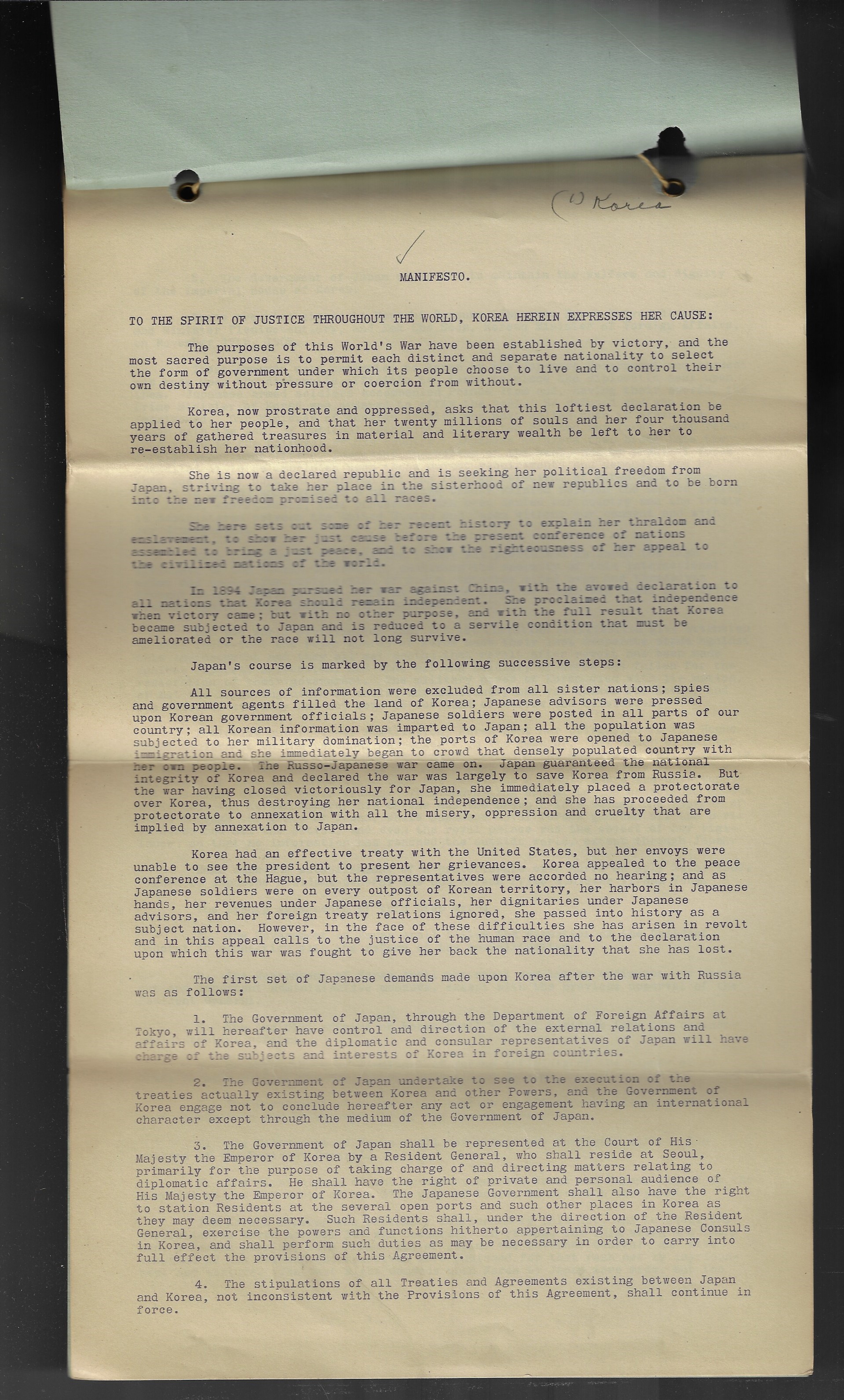
    Korea Paris Peace Conference _2_Young L. Park, Manifesto to the Spirit of Justice Throughout the World, Korea Herein Expresses her Cause… 14”x 8.5”, [1919], 4 leaves, offset, about 2500 words. Bound with a silk tie at top. Condition: very good , though it was folded in quarters, horizontally, leaving three creases throughout the document. That said, it probably saved the document from being destroyed or damaged given how tall and relatively flimsy it is. Provenance: “Pamphlet Collections”, Library of Congress. Scarce—only one copy located in WorldCat (Johns Hopkins). SOLD

    This is a strong argument from Young L. Park (of the United Asiatic Society, of Detroit), addressing members to the Paris Peace Conference (also known as the Versailles Conference, 1919-1920) in which he wrote on the inequality and oppressive nature of Japanese expansion into and control of Korea, and that the outcome of redistribution of former colonial territories following WWI should include the liberation of Korea. But Park and Korea would soon learn that those discussions were limited to colonies of Europeans defeated in the war, and the issue of Korea would not be of concern at the conference. (For example the conference would create the British Mandate of Palestine and in the creation of Iraq, Syria, Lebanon and Jordan as nation states.)

    “Korea, now prostrate and oppressed…(should) be left to re-establish her nationhood. She is now a declared republic and is seeking her political freedom from Japan…(and to be released from “enslavement”). It is all pretty strong language, nestled even as it is in halting official discourse in its plea to member nations of Conference.

    Korea Paris Peace Conference

    ·Posted by :

    ·in:

  • Chandrasekhar Subrahmanyan On A New Theory Of Weizsaker On The Origin Of The Solar System In Reviews Of Modern Physics Am

    CHANDRASEKHAR, Subrahmanyan. “On a New Theory of Weizsaker on the Origin of the Solar System”, in Reviews of Modern Physics, American Physical Society, vol 18/1, January 1946,  pp 94-102 in the issue of pp 1-149.  Original wrappers. Fine copy. $200

    “A Nobel Laureate [awarded in 1983 “for his theoretical studies of the physical processes of importance to the structure and evolution of the stars”] honored for his extraordinarily wide-ranging contributions to physics, astrophysics, and applied mathematics, Chandrasekhar is well known for his discovery of the limiting mass (Chandrasekhar limit) of a star that could become a white dwarf.”–Complete Dictionary of Scientific Biography, online. 

    “In 1938, Weizsäcker developed a theory on the formation of the Solar System, based on considerations regarding the unequal share of lighter and heavier elements in the Sun and the Solar System’s terrestrial planets….According to the theory, the Sun and its planets evolved from a gas cloud made up of 99% hydrogen and helium, and 1% of heavier elements. Some 10% of the cloud remained around the Sun as an extensive atmosphere during an initial phase, and the 1% of heavier elements within this 10% of the total mass of the cloud would tally with the fraction of roughly 1% that the planets contribute to the mass of the Solar System today….”–Wikipedia

    Also: a 2pp paper of corrections by Einstein and E.G. Straus “The Influence of the Expansion of Space on the Gravitation Fields Surrounding the Individual Stars”, pp 148-9.  

    ·Posted by :

    ·in:

    —
  • The Universe “Before”: Two Papers by Alexander Vilenkin

    (1)  Alexander Vilenkin, “Cosmological Density Fluctuations Produced by a Goldstone Field”, in “Physical Review Letters” 48 No. 1 pp. 59–61, January 4, 1982. Original wrappers, with a repaired spine; rubber stamp on title page. Near-fine. $300

    “Russian physicist Alexander Vilenkin (born 1949) argued in this paper (cited more than 1100 times) that the universe could have tunneled from “nothing,” eliminating the requirement for the pre-existence of empty space.” The tunneling state is the first state that exists.–David Wenner, History of Physics, the Wenner Collection.

    “A cosmological model is proposed in which the Universe is created by quantum tunneling from “nothing” into a de Sitter space. The tunneling is described by a de Sitter—Hawking—Moss instanton. After the tunneling, the model evolves along the lines of the inflationary scenario. It is argued that at any time there exist parts of the Universe which are still in the de Sitter phase, while other parts have already recollapsed. This model does not have a big-bang singularity and does not require any initial or boundary conditions.”–Abstract from American Physical Society

    Alexander Vilenkin,in an interview for the Tufts U website comments (for another, later, paper on 2003) on the state of the universe in the “before” time: “We looked at three possible scenarios—all of which, by the way, were suggested by the ancient Hindus 3,000 years ago. In one scenario, which the Hindus called “the eternal universe,” multiple beginnings are happening in different places. In scientific cosmology, this more or less corresponds to an idea called eternal inflation. In this case, the universe is expanding very fast, and then Big Bangs happen here and there. These Big Bangs are localized, in bubbles. As these bubbles—each containing a discrete universe—are driven apart, space opens up between them, where new bubbles are created. We live in one such bubble. [All of these universe-containing bubbles make up what cosmologists call the multiverse.] __+__Another idea is a cyclic universe, one that expands, collapses and then starts over again.__+__The third possibility, and the main focus of this paper that I wrote with my student, Audrey Mithani, is the emergent universe, a static universe that sits forever and then somehow bursts open and starts expanding. The Hindus called this “the cosmic egg.” You need some mechanism that will trigger this event, but that’s doable.” AND continuing: “I cannot really claim that I understand the beginning of the universe. We have a picture which kind of makes sense, which I think is an achievement. Because, if you think about it, you say, “OK, what happened before the Big Bang, before inflation?” It seems you can keep asking these questions and the answer is impossible.

    But this quantum creation from “nothing” seems to avoid these questions. It has a nice mathematical description, not just words. There’s an interesting thing, though; the description of the creation of the universe from nothing is given in terms of the laws of physics. That makes you wonder, where are these laws? If the laws describe the creation of the universe, that suggests they existed prior to the universe. The question that nobody has any idea how to address is where these laws come from and why these laws in particular? So there are a lot of mysteries to keep us working.”

    (2) Alexander Vilenkin, “Birth of Inflationary Universes” in “Physical Review D” 27 No. 12 pp. 2848–2855, June 15, 1983. Back repaired. Stamp and stickers on front wrapper. $300

    “Eternal inflation” (new inflation that continues indefinitely) was proposed in 1982 and 1983 by Steinhardt Alexander Vilenkin (born 1949). In eternal inflation, multiple regions of simultaneous inflation create “bubble” or “pocket” universes, each of which creates new inflation, a process that continues ad infinitum. In this theory, our universe is only one of an infinite number of pocket universes that are eternally being created by the continuation of the inflation that created our universe.”–David Wenner, History of Physics, the Wenner Collection.

    “A cosmological model is proposed in which the Universe is created by quantum tunneling from “nothing” into a de Sitter space. The tunneling is described by a de Sitter—Hawking—Moss instanton. After the tunneling, the model evolves along the lines of the inflationary scenario. It is argued that at any time there exist parts of the Universe which are still in the de Sitter phase, while other parts have already recollapsed. This model does not have a big-bang singularity and does not require any initial or boundary conditions.” Abstract via American Physical Society.


    ·Posted by :

    ·in:

    —
  • Bell John On The Problem Of Hidden Variables In Quantum Mechanics In Reviews Of Modern Physics Vol 38 Pp 447 45

    BELL, John. “On the Problem of Hidden Variables in Quantum Mechanics” in “Reviews of Modern Physics” vol 38 pp 447-452, July, 1966 and “A Proposed Solution of the Measurement Problem in Quantum Mechanics by a Hidden Variable Theory” by David Bohm and J. Bub, in the same volume and issue, pp. 453-475, 1966). Volume bound in cloth and boards with sticker on spine and stamps on front paste down, first free endpaper and verso of title page; otherwise fine with no marks. $350

    “In a paper (Bell 1966—this paper) that was written before the one in which Bell’s theorem first appeared, but, due to an editorial mishap, was published later, Bell raises the question of the viability of a hidden-variables theory that reproduces the statistical predictions of quantum mechanics via averaging over better defined states that uniquely determine the result of any experiment that could be performed. In this paper he examines several theorems that had been presented as no-go theorems for theories of this sort, and supplements them with one of his own…”–Stanford Encyclopedia of Philosophy, “Bell’s Theorem”

    “John Bell: this is one of two famous papers [this one with 2800+ citations] by John Bell on hidden variables in quantum theory. It was published in 1966 but written two years earlier. It demonstrates that John von Neumann’s “no hidden variables theorem” (1936) is incorrect. Bohm and Bub propose an experiment to test hidden variables.”– “The demonstrations of von Neumann and others, that quantum mechanics does not permit a hidden variable interpretation, are reconsidered. It is shown that their essential axioms are unreasonable. It is urged that in further examination of this problem an interesting axiom would be that mutually distant systems are independent of one another. “–abstract via Researchgate.

    ·Posted by :

    ·in:

  • Riccardo Giacconi Et Al Evidence For X Rays From Sources Outside The Solar System In Physical Review Letters 9 No 1

    Riccardo Giacconi et al, “Evidence for X-Rays From Sources Outside the Solar System”, in Physical Review Letters, 9 No. 11 pp. 439–443, December 1, 1962. Original wrappers. Fine copy. $300

    “Giacconi (b. 1931) announced the discovery of X-rays emissions from the Scorpius constellation thousands of times as energetic as its emissions in the visible spectrum – the first cosmic X-ray source…thus putting (x-ray astronomy) on the map”–David Wenner, The History of Physics Collection, entry on X-Ray Astronomy.

    Giacconi shared the 2002 Nobel prize in Physics “for pioneering contributions to astrophysics, which have led to the discovery of cosmic X-ray sources.”

    ·Posted by :

    ·in:

  • Chambers Rg Shift Of An Electron Interference Pattern By Enclosed Magnetic Flux In Physical Review Letters 5 No 1 P

    CHAMBERS, R.G. “Shift of an Electron Interference Pattern by Enclosed Magnetic Flux” in Physical Review Letters 5 No. 1 pp. 3–5, July 1, 1960. Original wrappers, very nice condition save for some rusting to the staples. Near-fine. $225

    “(Description) of the first demonstration of through observation of electron beam interference patterns where classical physics would predict none.”–David Wenner, The Physics Collection (“The Aharonov–Bohm Effect” entry. “The Aharonov–Bohm effect is a quantum mechanical phenomenon, not predicted by classical physics, that allows an electrically charged particle to be affected by an electromagnetic field even where the strength of the field is zero (e.g., when enclosed by a conductor).)

    “The first claimed experimental confirmation was by Robert G. Chambers in 1960, in an electron interferometer with a magnetic field produced by a thin iron whisker, and other early work is summarized in Olariu and Popèscu (1984). However, subsequent authors questioned the validity of several of these early results because the electrons may not have been completely shielded from the magnetic fields. An early experiment in which an unambiguous Aharonov–Bohm effect was observed by completely excluding the magnetic field from the electron path (with the help of a superconducting film) was performed by Tonomura et al. in 1986.”–Wikipedia, “ Aharonov–Bohm”.


    ·Posted by :

    ·in:

  • The White Hole (1916)

    CAYLEY, Arthur. “Memoir on the Theory of Matrices” and “A Supplementary Memoir on the Theory of Matrices” in Philosophical Transactions of the Royal Society of London, two extracts bound together, as follows: “Matrices” , Vol. 148 (1858), pp. 17- 37; “Supplementary Memoir”, Vol. 156 (1866), pp. 25- 35. Fine condition, bound in beautiful leather and boards of the period, offered with title page and individual title pages for each paper.  $850

    Cayley (1821-1895) introduced matrices to simplify the solution of simultaneous linear equations, along with matrix functions such as addition and multiplication, and the concepts of matrix calculus.. Cayley is responsible for another branch of algebra over and above invariant theory, the algebra of matrices. The use of determinants in the theory of equations had by his time become a part of established practice, although the familiar square notation…and although their use in geometry, such as was provided by Cayley from the first, was then uncommon. (They later suggested to him the analytical geometry of n dimensions.) Determinants suggested the matrix notation; and yet to those concerned with the history of the “theory of multiple quantity” this notational innovation, even with its derived rules, takes second place to the algebra of rotations and extensions in space (such as was initiated by Gauss, Hamilton, and Grassmann), for which determinant theory provided no more than a convenient language. Cayley’s originality consisted in his creation of a theory of matrices that did not require repeated reference to the equations from which their elements were taken. In his first systematic memoir on the subject …he established the associative and distributive laws, the special conditions under which a commutative law holds, and the principles for forming general algebraic functions of matrices. He later derived many important theorems of matrix theory. Thus, for example, he derived many theorems of varying generality in the theory of those linear transformations that leave invariant a quadratic or bilinear form. Notice that since it may be proved that there are n(n + 1)/2 relations between them, Cayley expressed the n2 coefficients of the nary orthogonal transformation in terms of n(n – 1)/2 parameters. His formulas, however, do not include all orthogonal transformations except as limiting cases .”–Complete Dictionary of Scientific Biography, online.

    ·Posted by :

    ·in:

    —
  • Andrews Thomas The Bakerian Lecture On The Continuity Of The Gaseous And Liquid States Of Matter Being An Extract From Ph

    ANDREWS, Thomas. “The Bakerian Lecture: On the Continuity of the Gaseous and Liquid States of Matter”, being an extract from Philosophical Transactions of the Royal Society of London 159 pp. 575-590, 1869. Extract in fine condition, bound beautifully in leather and boards. $500

    In this paper, Irish chemist Thomas Andrews (1813 – 1885) defined the concepts of critical temperature and critical pressure, and was the first to note the phenomenon of critical opalescence.

    “Andrews is best known for his studies on the continuity of the gaseous and liquid states, and in particular for his discovery of the critical temperature of carbon dioxide in 1861. His researches formed the subject of the Bakerian lectures for 1869 and 1876; a further paper was published posthumously in 1887. The first printed account of his work appeared as a result of a communication from Andrews to W. A. Miller, who published it in his textbook(1863). After a graphic description of the appearance of carbon dioxide in a state intermediate between gas and liquid, he concludes “that there exists for every liquid a temperature at which no amount of pressure is sufficient to retain it in the liquid form” (in W. A. Miller, Elements of Chemistry, 3rd ed. [London, 1863], I, 328–329). He expressed the full implications of his discovery some ten years after his first experiments when, in 1871, he wrote: “We may yet live to see, or at least we may feel with some confidence that those who come after us will see, such bodies as oxygen and hydrogen in the liquid, perhaps even in the solid state” (Scientific Papers, p. Ix). “–Complete Dictionary of Scientific Biography, online.

    ·Posted by :

    ·in:

  • Brabent John M Terminal Observations On Antiprotons In Physical Review Vol 101 No 1 Pp 498501 January 1 1956

    BRABANT, John M. “Terminal Observations on Antiprotons”, in Physical Review, vol 101 No. 1 pp. 498–501, January 1, 1956. Original wrappers. Previous owner’s name on the front cover, otherwise fine. $250

    • First tentative sighting of a proton-antiproton annihilation, an important confirmation of the discovery of the antiproton.

    ·Posted by :

    ·in:

    —

Recent Posts

Archives

Categories