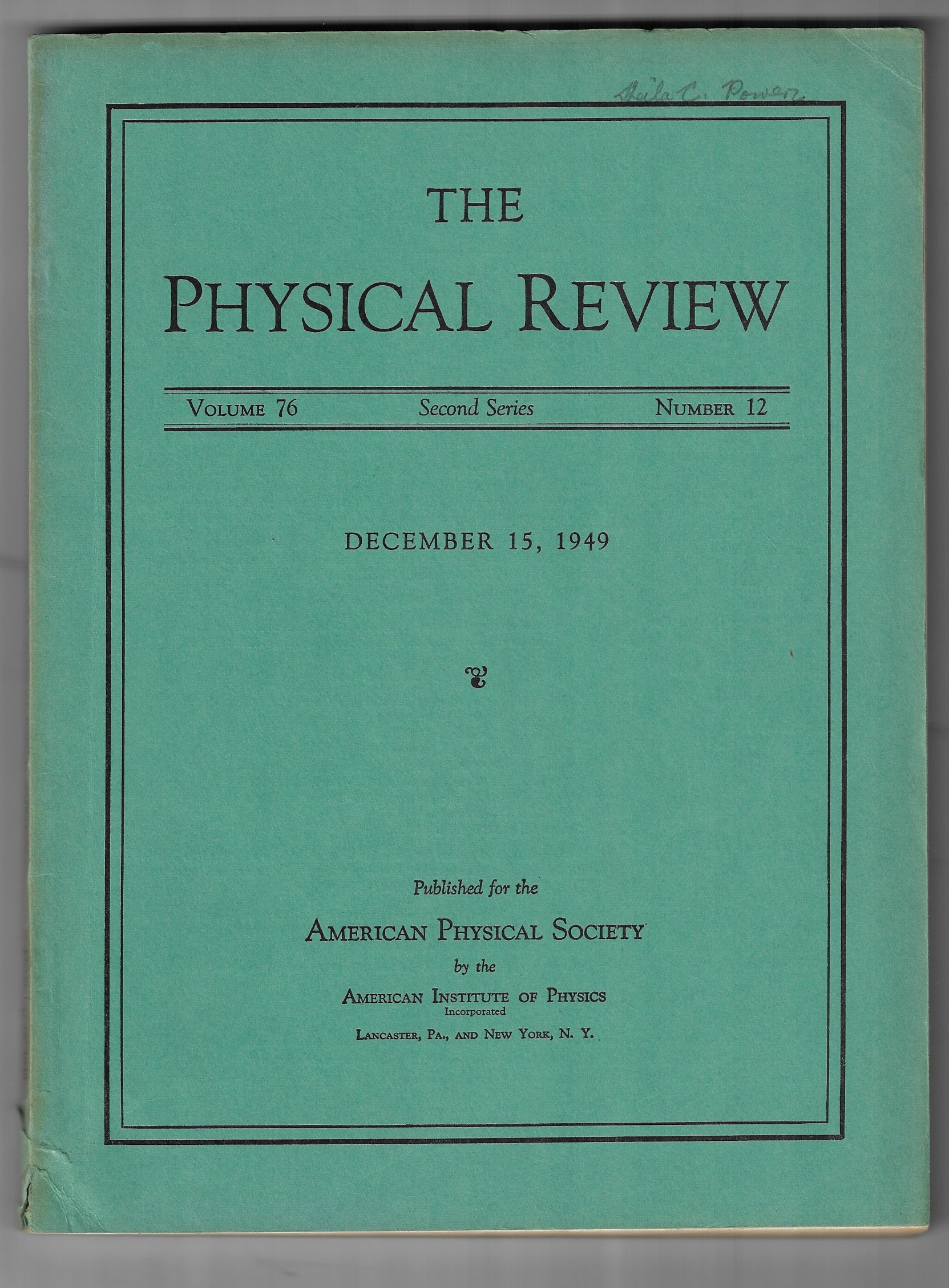
 Enrico Fermi and C.N. Yang. “Are Mesons Elementary Particles?” in Physical Review, vol 76 No. 12 pp. 1739-1743, December 15, 1949. Original wrappers; there is some sunning around the cover edges and spine; also some wear along the spine bottom. A solid, near-FINE copy.
“From the introduction to the paper: “In recent years several new particles have been ~ – discovered which are currently assumed to be “elementary, ” that is, essentially, structureless. The probability that all such particles should be really elementary becomes less and less as their number increases. It is by no means certain that nucleons, mesons, electrons, neutrinos are all elementary particles and it could be that at least some of the failures of the present theories may be due to disregarding the possibility that some of them may have a complex structure. Unfortunately, we have no clue to decide whether this is true, much less to 6nd out what particles are simple and what particles are complex. In what follows we mill try to work out in some detail a special example more as an illustration of a possible program of the theory of particles…” Fermi and Yang answer that the meson is not an elementary particle.
- This is the copy of Sheila C. Power [Tinney], with her name (signed?) at top right front cover.
From the Royal Irish Academy: “Erwin Schrödinger described [Power] as among the ‘best equipped and most successful of the younger generation of theoretical physicists in this country’,”
(“Power”)…went to the University of Edinburgh to work on a doctorate [under Max Born]…and worked with him on the stability of crystal lattices, and was awarded a Ph.D. by Edinburgh in 1941. She is believed to be the first Irish woman to receive a doctorate in the mathematical sciences….In 1941 she was appointed to an assistant lectureship in UCD, at the age of 23, and also held a part-time fellowship in the Dublin Institute for Advanced Studies (DIAS). A year later, she was the only woman attending an international colloquium in the institute, at which the Nobel prize winner Paul Dirac lectured on quantum electrodynamics. From September 1948 to June 1949 she took leave of absence to go on a fellowship to the Institute for Advanced Study in Princeton, New Jersey, where she worked on aspects of nuclear physics…”–Royal Irish Academy website