A Daily History of Holes, Dots, Lines, Science, History, Math, Physics, Art, the Unintentional Absurd, Architecture, Maps, Data Visualization, Blank and Missing Things, and so on. |1.6 million words, 7500 images, 4.9 million hits| Press & appearances in The Times, Le Figaro, Mensa, The Economist, The Guardian, Discovery News, Slate, Le Monde, Sci American Blogs, Le Pont, and many other places… 5000+ total posts since 2008.

Category: Technology, History of

  • An Episode in the History of Holes: Electricity, Punched Cards and the Computer, 1878.

    JF Ptak Science Books  Post 1382 [Part of our series in The History of Holes.]
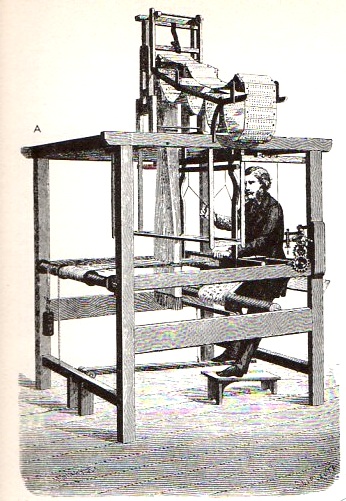
    Jacquard loom142 Kepler saw music in his study of planetary motions; Newton saw it too in relation to optics and the foundation of color–I wonder if the early people working with punched cards and tape saw a similarity between horizontal versions of their work and musical scales as well?  Did Jacquard or Hollerith see something through their holes to points beyond?  Well, I doubt the later, though there is no doubt that there are true relationships between music and the work of Kepler1 and Newton.  Perhaps one could make a score by arranging the punched holes of computer tape or a series of Jacquard loom cards, though they have less a relationship to what we identify as music than transcribing hundreds of resting pigeons as notes on a five-line utility pole.

    The idea of automatic control comes way before M. Jacquard (1752-1734) and the punched cards that he used to control his loom (which began about 1805), though I must say that Jacquard’s man-in-the-machine design does have a great, far-reaching elegance to it.  Even in his own field here were predecessors: Jacques de Vaucanson, for example, and Basile Bouchon (1725) and M.F Falcon (1728).  But it was with Jacquard that the idea of the punched card for design control took hold, and just seven years after the loom was introduced there were more the 10,000 Jacquard machines in operation in France alone. 

    Alfred Barlow2 wrote a splendid history of weaving in 1878, and in that books later pages–and I suspect much overcome with the recent developments in the electrical field (not the least of which were the newly invented light bulb and telephone)–Mr. Barlow waxes considerably on the application of electricity to the Jacquard process:

    He writes, “It is scarcely to be wondered at that men acquainted with the application of electricity to telegraphy and other purposes should have believed it equally serviceable in some of the operations of weaving.  As it might be expected, the Jacquard apparatus seemed to offer and excellent opportunity for the needles [reading the holes ion the loom punch cards] to be worked, not by the direct pressure of a card, but by the connecxion of a series of electro-magnerts.  By this means it was believed that paper may be substituted fir the cards, and the magnets might operate upon the needles through the perforations in the paper, or by passing a current of electricity through the medium of a metallic conducting surface on a sheet of paper or cloth representing the design to be woven, and thereby acting without the use or need of perforations.” (Pages 424-5)   It was certainly a capital idea.  Barlow may have been referencing the work of Alexander Bain and his punched-tape telegraph of 1841, though he does not mention him specifically.  Barlow does mention several inventors from the 1850’s who managed to make improvements with electricity in Jacquard-style machines, though none with the great effectiveness which he described here.  The real, great advancement in computation waited for quite some time, even beyond the great innovations of Hermann Hollerith (who began his tabulating successes in the 1880’s, coming into international recognition with his work on the 1890 U.S. Census.  But Barlow’s imagination here is quite full,  and just a little beyond his time. 

    [This work by Barlow is available for purchase here.]

    Notes

    1. Kepler used the ratios between the velocities of the planets at their closet and furthest distances from the sun to construct musical intervals, which do work.  What an enormously encompassing feeling this must have been to set the motions of the celestial spheres into polyphonic tones that fit right inside the octave!  Newton’s seven colors could be set side-by-side with seven notes of the octave, color in music, giving them the notes A, B, C, D, E, F and G. 

    2.  The excellent Mr. P.J. Mode first brought this reference to my attention 15 years ago.  The work:  Barlow,m Alfred:  The History and Principles of Weaving by Hand and by Power.  London; Sampson & Low, 1878, xii, 443, iv pp, illustrated throughout with text illustrations. 


  • Engineering Art: Cross Sections of the HMS Olympic (1909) and Mauretania (1906)

    JF Ptak Science Books  Post 1382

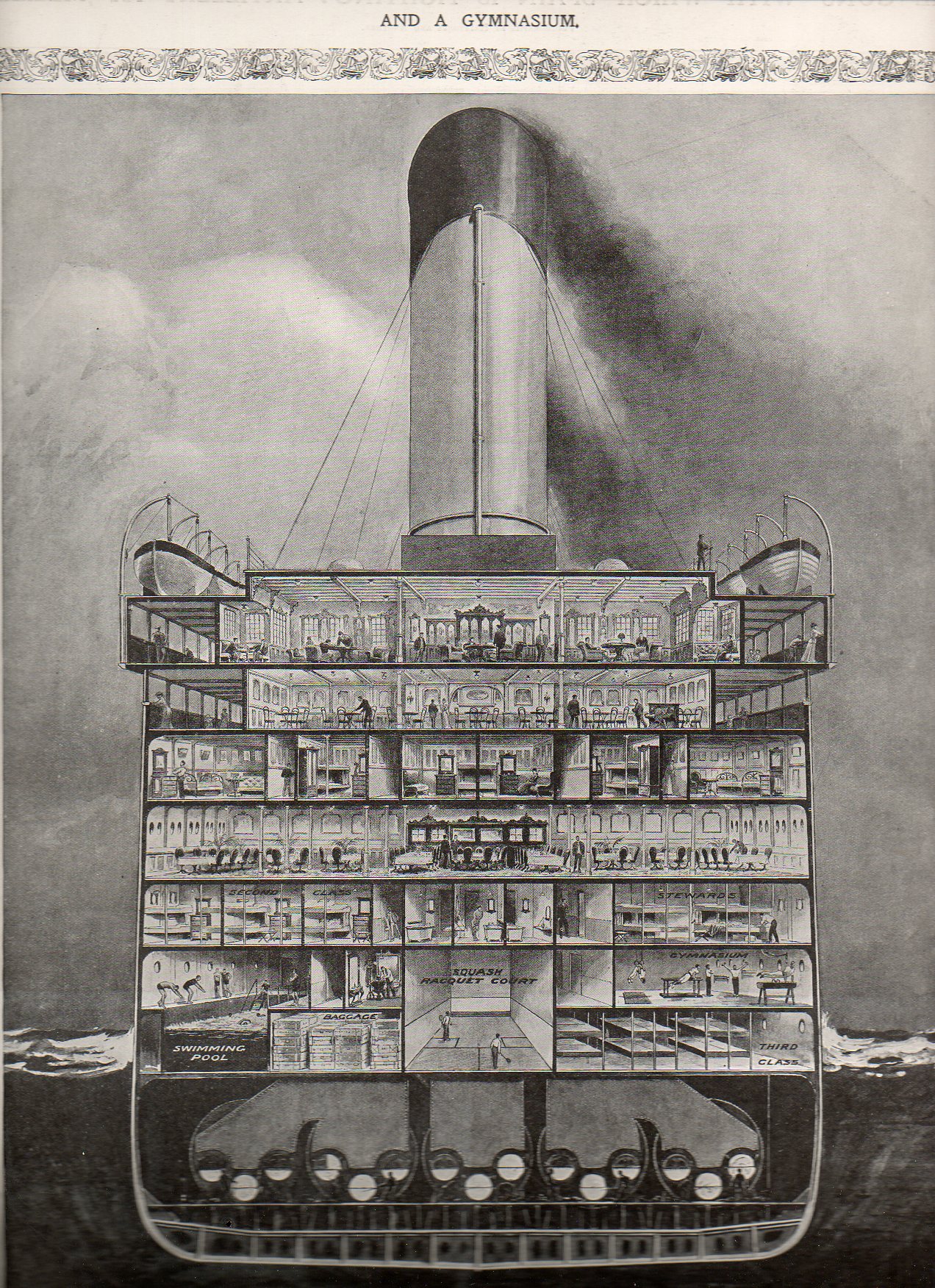
    “...And a Gymnasium.”

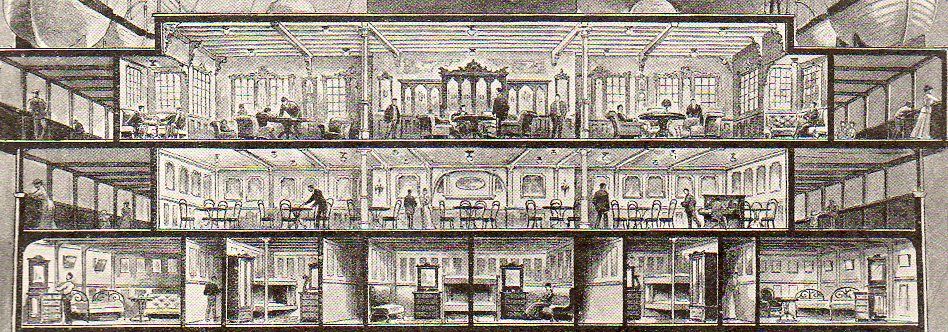
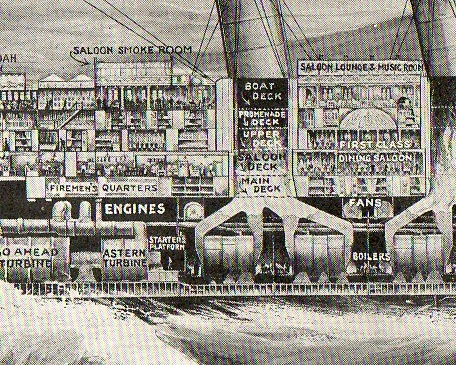
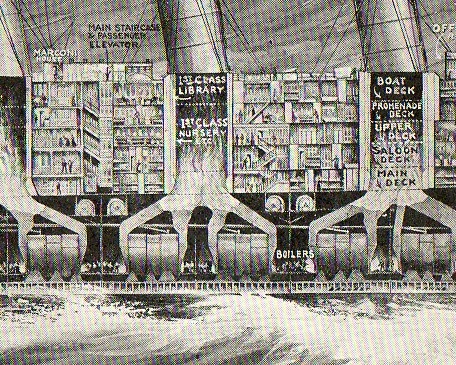
    Resting comfortably in-between this blog’s Cross Sections and Looking-At-Things-Straight-On series is this straight-on cross section of the midship section of the HMS Olympic.

    Cross-sectionship131
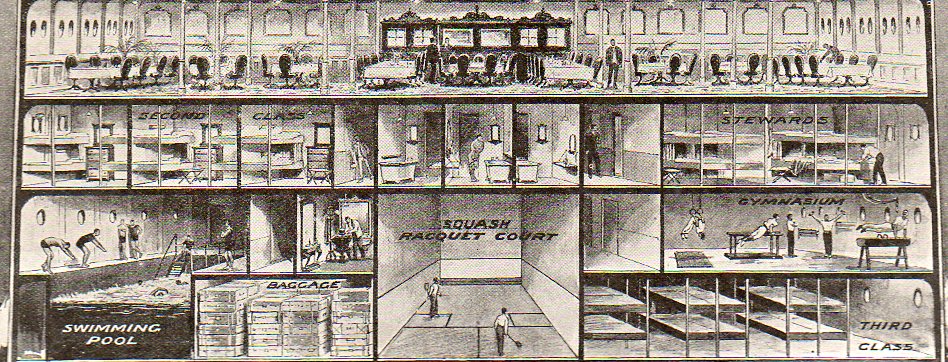
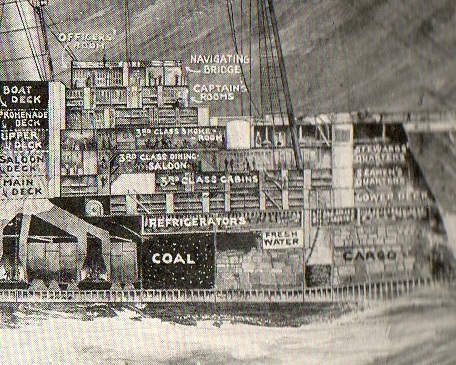
    This cross section appeared in the 14 August 1909 issue of The Illustrated London News, just six months or so after she was laid down. The Olympic was finished in 1911 and sailed through until 1935, a considerably much-longer career than her two sister ships, the Titanic and the Britannic.  The Titanic of course was launched in 1911 and went down on 12 April 1912; the Britannic lasted a little longer, though this ship never really had much of a career, launched just before the beginning of WWI and then used immediately as a hospital ship, striking and being sunk by a mine in 1916.  The three ships were beasts, about 882 feet long and about 53,000 tons displacement. The viewer certainly gets a good idea of the scope of the ship from this image.   [The original image of the Olympic and also of the Mauretania are available for purchase from our blog bookstore.]

    Cross-sectionship132
    Cross-sectionship133

    Third class looks pretty rustic, a no-bones approach to ocean travel, stuffed into the space next to the squash courts and under the gym. 

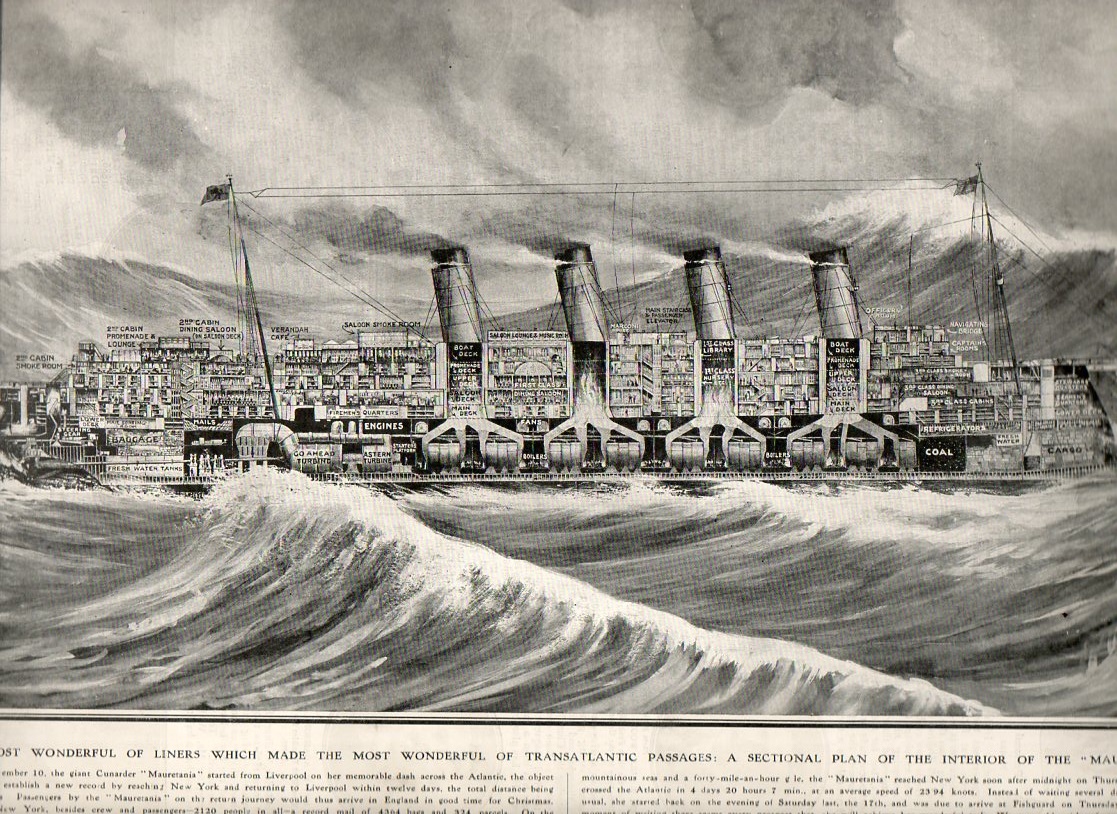
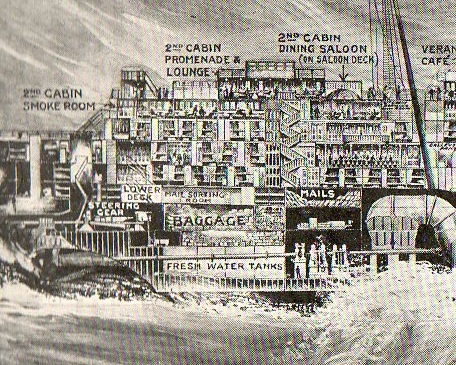
    Next comes the HMS Mauretania, again form The Illustrated London News right at the time of its record-setting speed attempt to cross the Atlantic in November 1907.  The ship was long (almost 800 feet) and about the fastest ocean-going ship in the world,. crossing and re-crossing the Atlantic in 12 days.

    Cross section mauretannia137

    Cross section mauretannia138
      Cross section mauretannia139
    Cross section mauretannia140

    Cross section mauretannia141


  • A Note on Some Important Punches of Post-War America, 1952. The IBM 519.

    JF Ptak Science Books  Post 1379

    “Gang punches, summary punches and reproducing punches….such are the guts and glory of all good punch dreams”–No one, ca. 1957. 

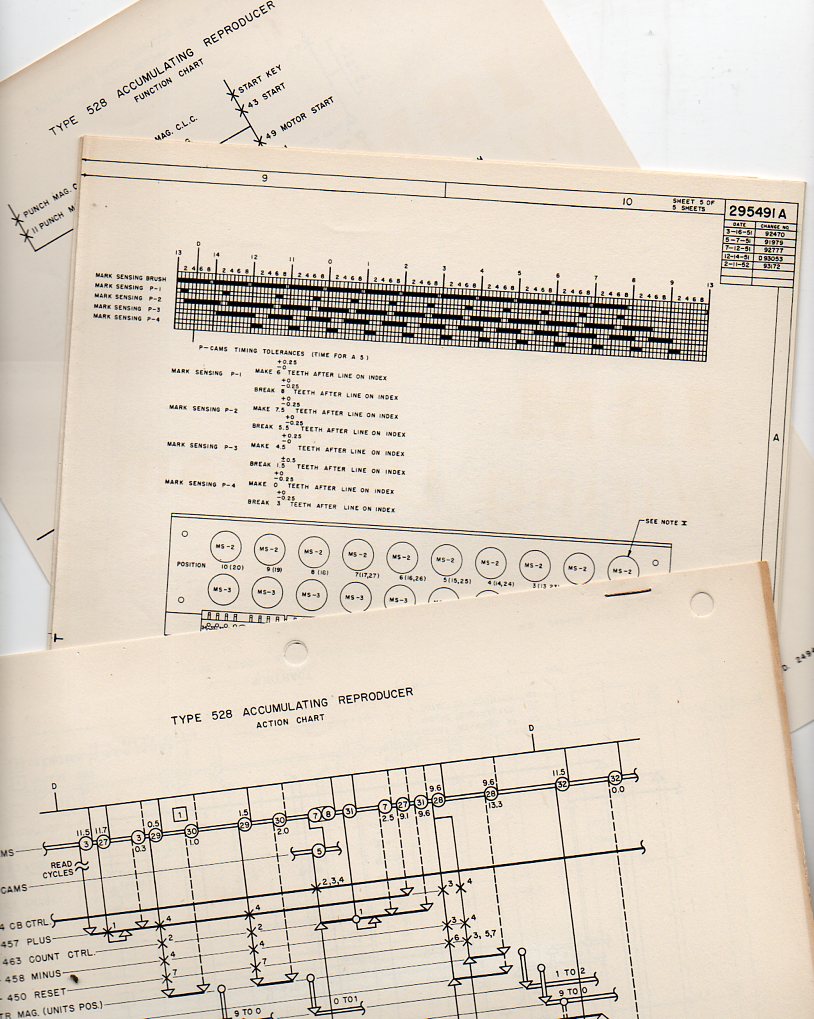
    IBM 519121 This story has to do more with Jacquard than with Marciano.  One of the mainstays of the pre-computer computer room, the ubiquitous instrument as prevalent then as the desktop is now, was the unit record machine,  which operated with punched cards for program entry and data storage. This machine–like the IBM Type 5191 Electric Document-Originating Machine (1952) described below–functioned to read and reproduce the mainstay of the calculating instrument of the 1930’s to the early 1950’s.  

    Their functions included lots of punching:  gang punch, which would produce a large number of identically punched card; reproducing punch,   which “could reproduce a deck of cards in its entirety or they might just reproduce selected fields…a payroll master deck might be reproduced at the end of a pay period with the hours worked and net pay fields blank and ready for the next pay period’s data. Computer programmers who created their programs in the form of punched card decks used these to make backups”; a  summary punch, which were attached to tabulating machines and could punch new cards with details and totals from the tabulating machine;  and the mark sense reader, “which could detect pencil marks on ovals printed on the card and punch the corresponding data values into the card”.

    The IBM 519 was one such punching machine, sitting in command of vast legions of data that had previously been exceptional if not impossible to corral.  Improvements like this, these sorts of technological breakthroughs, allowed for the nervous system of the second industrial revolution to occur.  Of course one needed electricity, and then the machines that would be powered by them, and then the distribution capacities to get the electricity to the millions of end-users who would in turn purchase the new electrical goods–all of this was necessary.  However, without the ability to get this electricity paid for by it subscribers, without the power company being able to collect revenue, this stuff doesn’t happen.  And the way that the power company collects is by sending out an ocean of bills, which means that the ocean needed to be controlled in some way, all of the data handled and audited, which means that there was a new, mechanical way of dealing with the vast transfer of data.  And that’s where machines such as the Grunts and Gruffs come in. Like the 519.  IBM 519122

    (These IBM manuals are available for sale at our blog bookstore, here.)

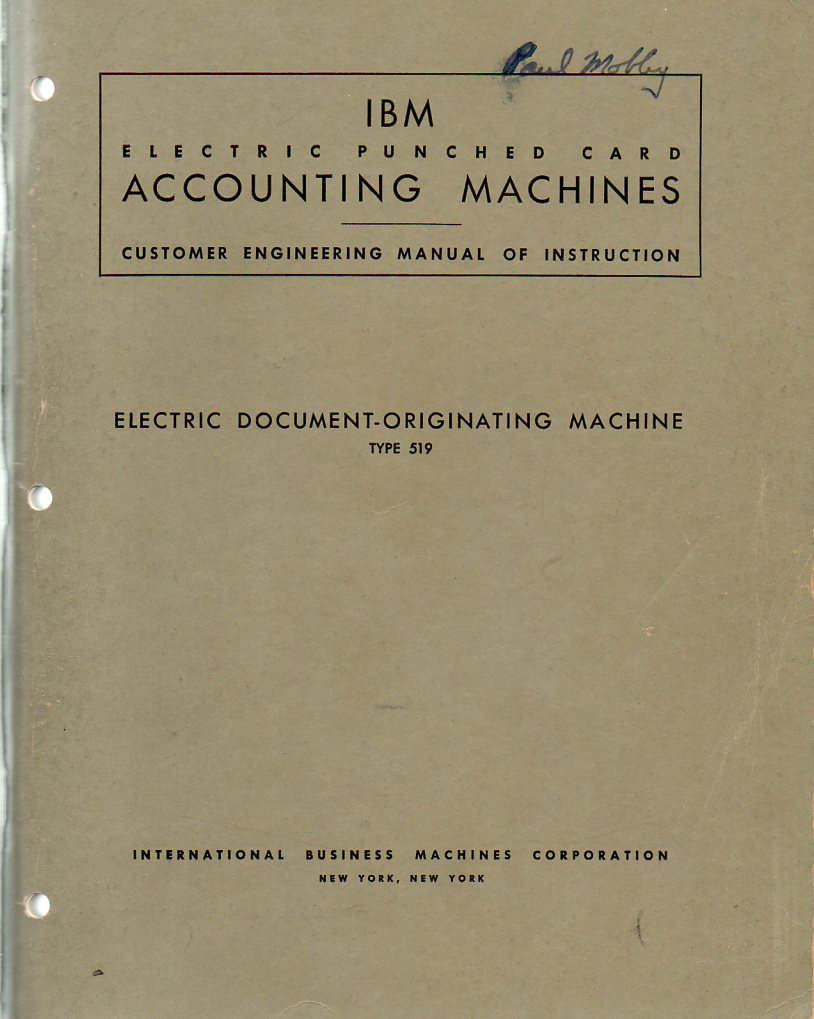
    This thought bubbled to the top while I was looking through a user’s manual for the 519, an updated 1952 version of the first edition of 1943. It is a beautiful work, filled with all of the information that a user would need to operate the machine as well as the specs necessary for the engineer to maintain the thing.  It was bound in a heavy, plasticized flexible cover, intended for wear and tear, and also came with an additional six pamphlets ,mostly wiring diagrams, one of which–the wiring diagram for the 519–unfold its 11 inch height out to five feet in length, a gorgeous panorama of organized and directed electricity.  It has two mates,a pair  not quite as long–four feet or so–in the wiring diagram for the 519’s reproducing punch,  lovely things in and of themselves. 

    The documents just have a satisfying feel ot them, manuals for maintenance and repair for machines that could be maintained and repair.  IF they were still needed, I’m sure that they would be running today. 

    Notes:

    1. “Early computer installations used punched cards for program entry and storage. A typical corporate or university computer lab would have a room full of keypunch machines for programmer use. An IBM 407 Accounting Machine might be set up to allow newly created or edited programs to be listed (printed out on fan-fold paper) for proof reading. An IBM 519 might be provided to reproduce program decks for backup. The 519 could also punch sequential numbers in columns 73-80 of COBOL or Fortran program decks. Those languages and others did not use those columns; the use of only 72 columns is a convention tracing back to the IBM 704 computer’s card reader, the 711, which could only read 72 columns (selectable by a plug-wired control panel). An IBM 80 series sorter would be used to put things back in order if a sequenced deck was dropped. A quicker, but less effective, protection against dropped card decks was drawing a diagonal line across the top of the deck with a marking pen.”–from Wiki on the IBM 519.”

    And from WorldLingo comes this:

    “The IBM 519 Electric Document Originating Machine, introduced in 1946, was the last in a series of unit record machines designed for automated production of punch cards. It could reproduce all or parts of the information on a set of cards; copy the information from a master card onto a group of detail cards; printing up to eight digits on the end of the card; compare two decks of cards, punch summary information provided by an accounting machine. It could operate at 100 cards per minute.”

    “Optional features allowed the 519 to read pencil marks on cards and punch the data they contain, and to number cards consecutively. The 519 was programmed by wiring a removable control panel. IBM called the operation of converting cards marked with pencil marks into punched cards “mark sensing.” Mark sensing allowed a person to enter data to be used in punched-card data processing without using a key punch machine. It was used for tasks like recording long distance calls and meter readings. Unlike other types of IBM unit record equipment, the 519 fed cards face down 12 edge first. The advantage of this was worn out decks from other equipment (which fed cards face down 9 edge first), having frayed 9 edges would still feed reliably through the reproducer, allowing a fresh copy to be made.”

    2.  The Electric Document-Originating Machine Type 519, IBM Electric Punched Cards Accounting Machine, Customer Engineering Manual of Instruction.  IBM, NYC: 1952.  1×8 inches,  124pp, illustrated. 


  • Miss Atomic Bomb: the A-Bomb in Popular Culture–Comics, Cakes and the Will of God

    JF Ptak Science Books   Post 1425 
    Follow Me on Pinterest


    I’ve written dozens of posts on this blog about atomic bomb history and where the bomb has shown up in popular culture.  This installment is on the bomb in very popular culture

    Miss Atomic Bomb is an icon of some sort for the relationship of the bomb with society, or, perhaps the bomb and Vegas, which is where this picture was taken. I guess there are reasons to put pretty women in front of computers (in the 1950’s/60’s), cigarettes and automobiles–why not with The Bomb?

    Atomic Bomb Miss
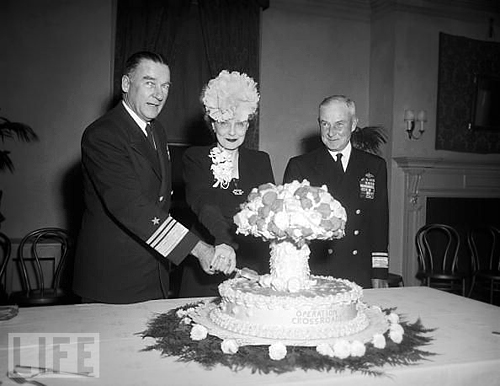
    The atomic cake (with matching headware):

    Atomic cake

    The caption to this story from Life magazine (1946) reads: “U.S. Navy Vice Admiral William H. P. Blandy, his wife, and Rear Admiral Frank J. Lowry cut a cake made in the shape of a mushroom cloud at a reception for Operation Crossroads, November 6, 1946.”  Actually Blandy was an early (August 1945 or thereabouts) forward thinker about how to deal with the U.S. owning the bomb and  international control.  I have little doubt that he probably thought that the cake was a bad idea, but, well, he did what he needed to do.

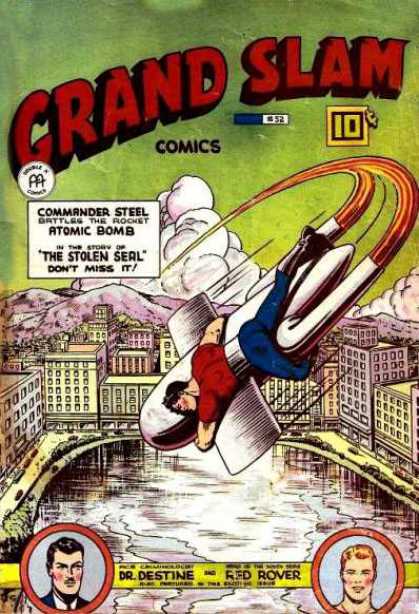
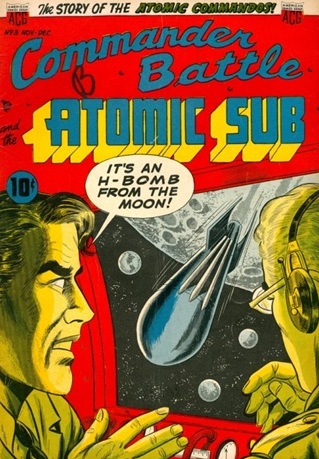
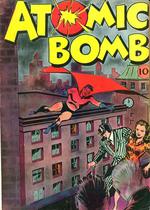
    There were all sorts of comic book adventures dealing withe the atomic bomb, right from the very beginnig (as it seems the earliest of them appears a month after the Hiroshima bombing).  These are just a few examples with the a-bomb on the comic’s cover(s):

    Atomic andy

    Atomic grand slam
     
    Atomic  h bomb from moon

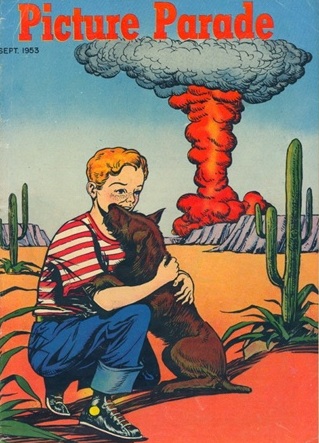
    AtomicbombBizarro–I don’t know the story of this image in Picture Parade, only having the cover graphic–perhaps that’s enough, perhaps we don’t need anything more, perhaps the backstory would spoil a perfectly bizarre image with something perfectly benign.  Or perhaps not. 

    Atomic bomb biazzaro
    Bizarre but for different reasons–a pocket-sized ball bearing patience game. Tokyo is included as a target for this game but in actuality was not considered atomic-bomb-worthy, mainly because it was decimated,  blanketed with a firebombing  that destroyed a host of the city just weeks before the first blast. (On March 9-10, 1945, 339 B-29’s dropped 2000 tons (4 million pounds, about 496,000 bombs) of the incendiary M-69 on Tokyo.  Two initial passes were made on the city, marking a large, burning “X” in the city.  Each plane had the capacity to cover a drop area of 350 feet by 2000 feet, which means a much greater area was affected. The citizens of Tokyo met their ends with buckets of water and brooms in defense. Hours later fifteen square miles of the city were destroyed.  In the months prior to Hiroshima and Nagasaki, 66 cities were bombed with M-69, killing about a million people, and wounding more.)  Fresh cities were needed for the atomic weapons so that there effectiveness could be judged against a palette of a normal. intact city, and not one that had been previously attacked. 

    Atomic Bomb dexterity game
      And still more bizarre, when you combine all of the aspects of the race to the bomb with the race to god and the people who would believe such a thing.  This advertisement belonged to a mail order religico empire builder, Frank B. Robinson, (1886-1948), who claimed himself to be a prophet of god, had conversations with the Creator, and in general used whatever was of interest in the newspapers to drive interest in his ministry by mail.  It looked like his creation–Psychiana–wasn’t much more than a feel-good, self affirming, positive-thinking enterprise driven by a man with a personality big enough to be on speaking terms with the god, who in the ad below somehow was selling “the atomic power of the spirit of god in us”  because we are composed of atoms.

    Atomic bomb thankgod

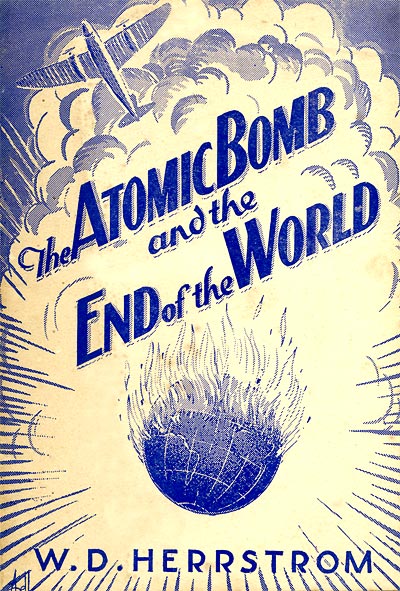
    And of course on the other end of this:

    Atomic_bomb_end_of_world

    This is an example of a host of end-of-the-world, post apocalypse movies (and books, and short stories, and so on) made to scare and entertain.  Judging from the trailer the more-modern television series Jericho owes a lot to Ray Milland. 
    Atomic panic-in-year-zero

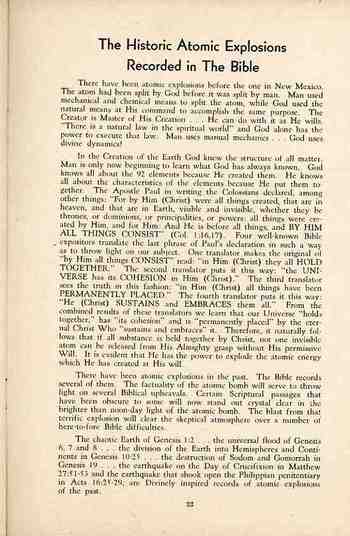
    Mel Morris  published God’s Atomic Bomb  in 1945, which means he must’ve worked a little feverishly to pump up his bible prophesy and history to include the new atomic weapon to replace whatever else he had been using as a prophecy for end of times.  (As it turns out, “God’s Atomic Bomb” was more tempest and disaster in the bible, and not (whew!) the bomb itself.  Though as we’ve learned from scientologists and the sort-of creative mind of Ron Hubbard, a civilization came to the earth thousands of years ago and pummeled it with “atomic bombs” and other nastiness, polluting humans for milennia to come.  But that’s another story–suffice to say that Morris found many dozens of examples of “God’s Atomic Bomb” being used in the deep biblical past, and that the use of the real atomic bomb in 1945 was pre-ordained, and not without its figurative historical counterparts.  I’m not sure why any of this was necessary outside of proving to some small minority that these preachers could at least be contemporary and topical. 

    Blogsept_2_atomic_bomb_god_2txt483

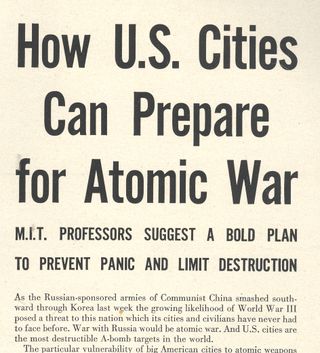
    The following is not the worst idea regarding the survival of nuclear holocaust, though it is an extremely bad one.  (Atomurbia, which makes the entire country a suburb to itself and therefore nothing, and which I write about below, is perhaps the worst idea that I have seen on combating the Soviet menace.)   But this one, which appeared in Life magazine in 1950, does come close, setting up post-attack suburbs (for “refugees”) and which takes some pre-attack city planning into some account.  There is a lot of planning for people in cars to make their way out of the city, which reminds me of the evacuation maps of Washington D.C. (which were still being handed out in the early 1980’s), which sends people on their way east and west depending upon the last digit of their car’s license plate being an odd or even number. 

    Atomic city plan war

    ==Blog July 27=wiener left

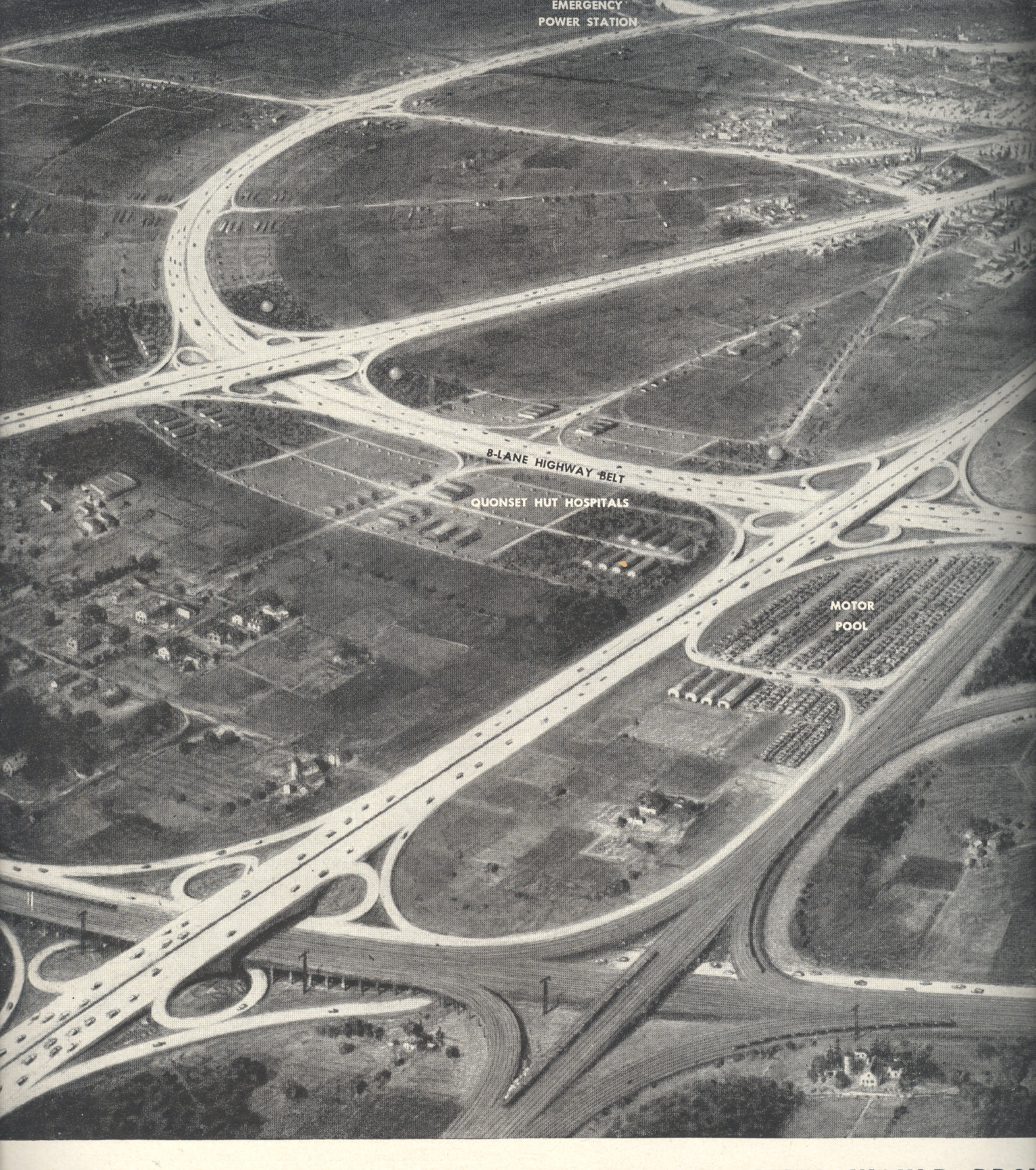
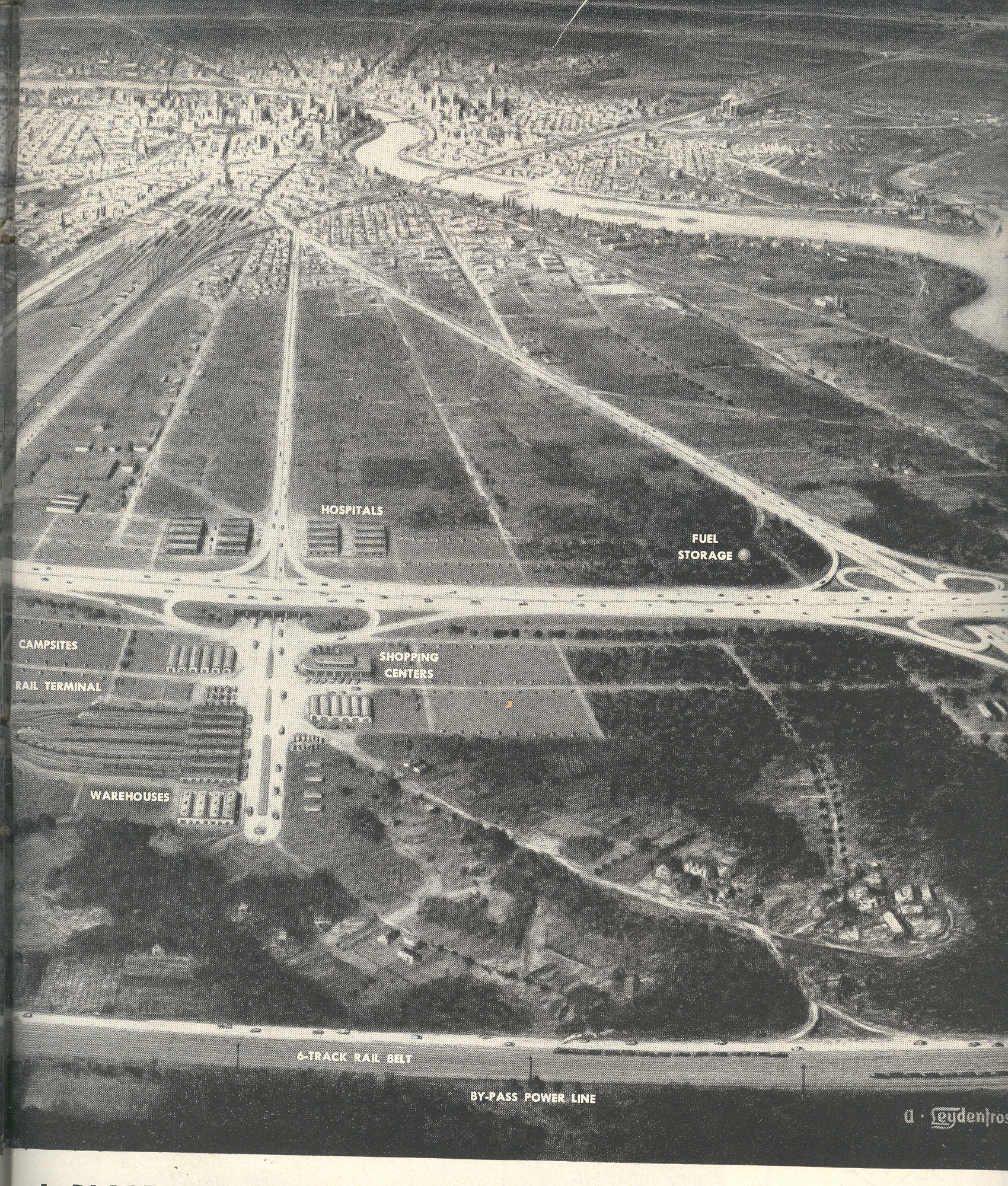
    One reaction to impending Doomsday was to construct concentric outer highways around metropolitan areas, “life belts around cities (which) would provide a place for bombed-out refugees to go”. In the birds eye view provided here, we see the plan in action, the main parts of which are an 8-lane “express” highway belt 10 miles away “from the built up edges of the city” , and a 6-track railway belt five miles further out, these accompanied by various feeder arms stretching straight-away from downtown.  In between the two outer rings would be land that would be kept free of development, so that farms and tent cities could be constructed after the attack. There would also be major collections of hospital and fuel depots in the greenbelt area.  Infrastructure would already be in place (gas and electricity, supplied with power from who-knows-where).   Shopping centers and a giant “motor pool:” would also already be in place, waiting for the Doomsday clock to strike midnight. 

    ==Blog July 27=wiener right

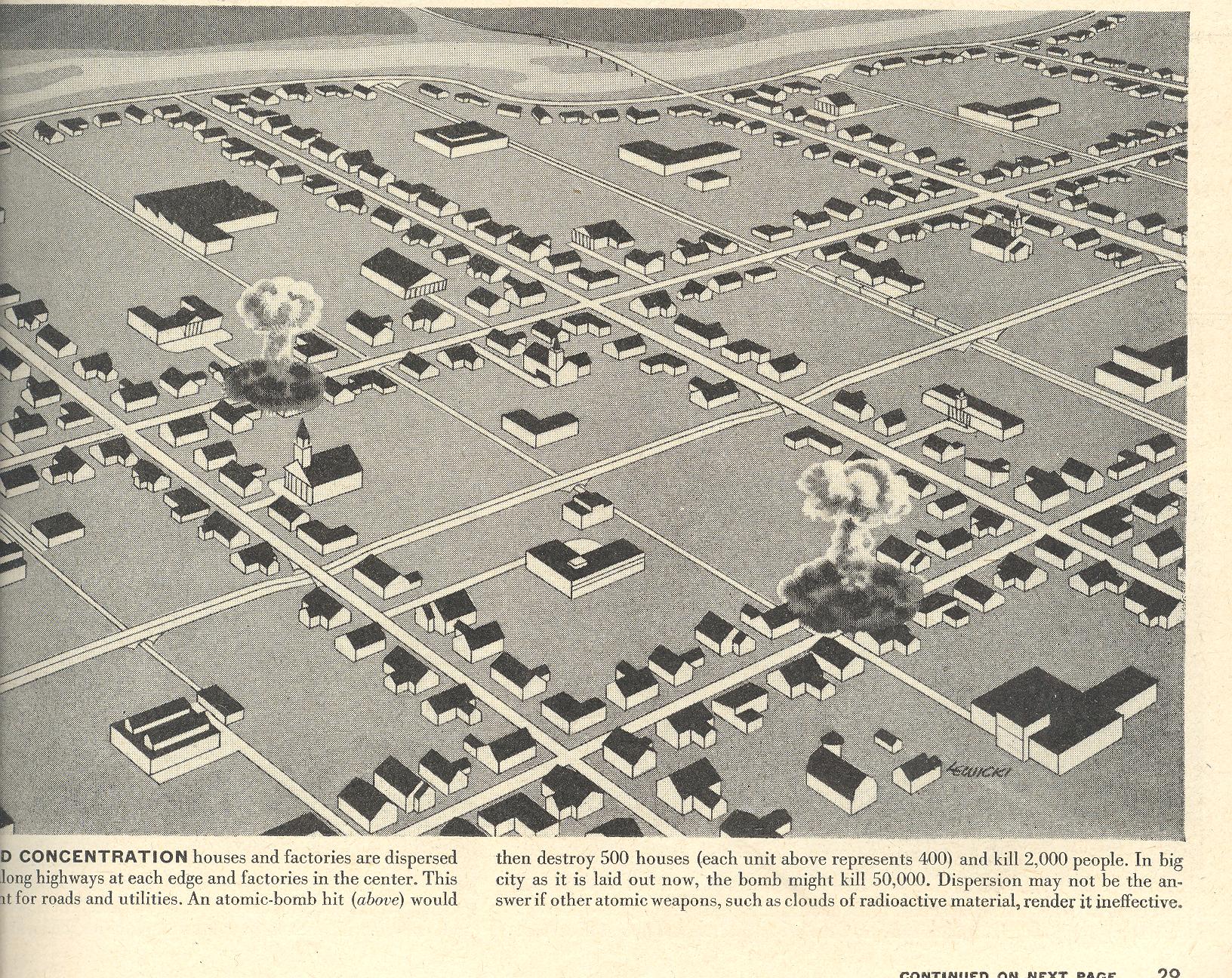
    This idea of city planning was one of many offering the prospect of safety from nuclear attack by spacing out the population of the United States so that the Soviet Union wouldn’t have enough nuclear warheads to take everyone out.  It called for the redistribution and resettlement of virtually everyone in the country, and is one of the most spectacularly bad ideas that I have come across in this field.  (I wrote about it earlier in this blog, here.)

    1-may 3-atomic 4

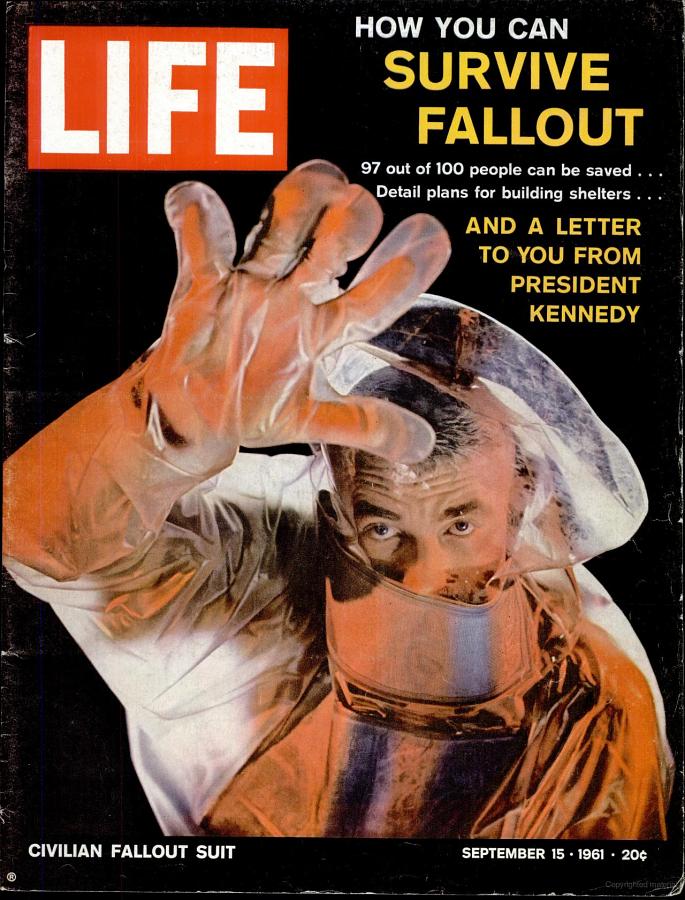
    This issue of Life offered the possibility of hope that 97% of the American population could survive a nuclear attack by the Soviet Union. It was a hard sell of a bad idea of insane optimism.

    Books_004


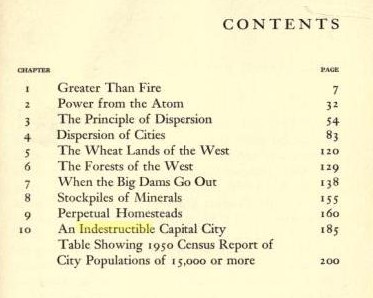
     Sylvian Kindall’s Total Atomic Defense (published by a very severely right-wing publisher in 1952) is one of a series of books made for a deceived American population, offering the general reader both fear and hope, often from the same, exact source. But Kindall has a  somewhat diffident approach, offering his belief that the country and its population can largely  survive an all-out nuclear waBlog--untinkable tpr–intact.  Chapter 10 tells the remarkable story of how to make the captial city of America atom-bomb proof, mostly by digging it into the side of a mountain.

     
    Blog--unthinkable


    Again, this is just the barest touch of the top of a huge pile of such stuff–and I’ve not even mentioned duck-and-cover films.


  • Little Pieces and Superb Design: Rockets, Canons, and other Boom Boom

    JF Ptak Science Books  Post 1420

    Artillery285

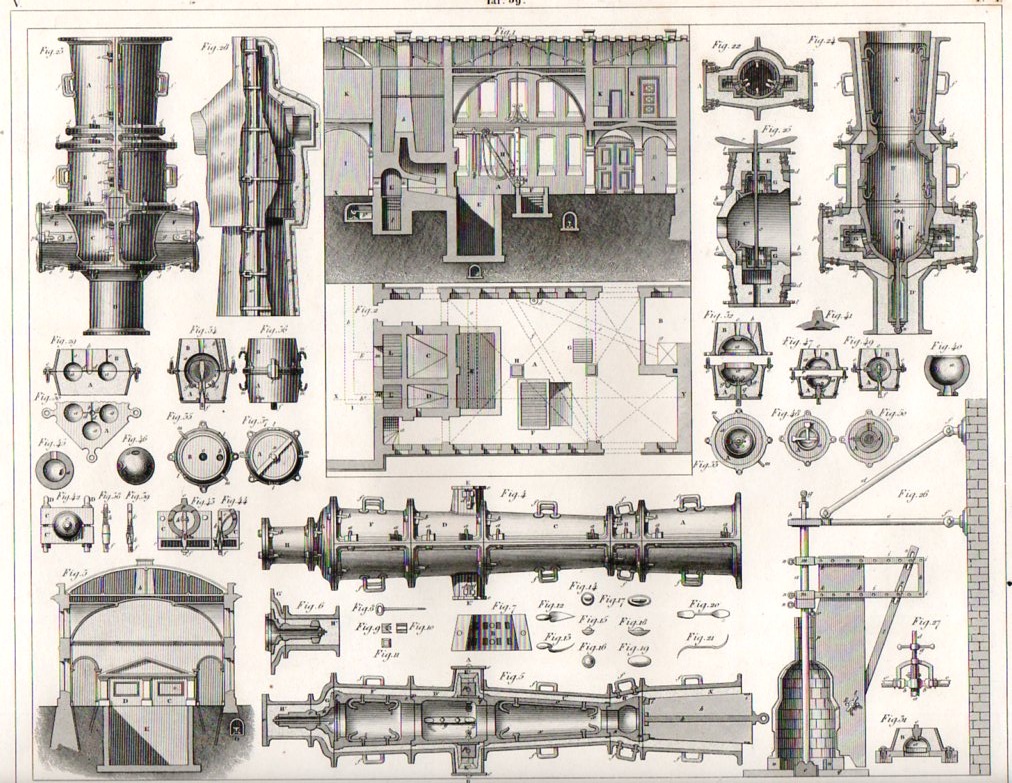
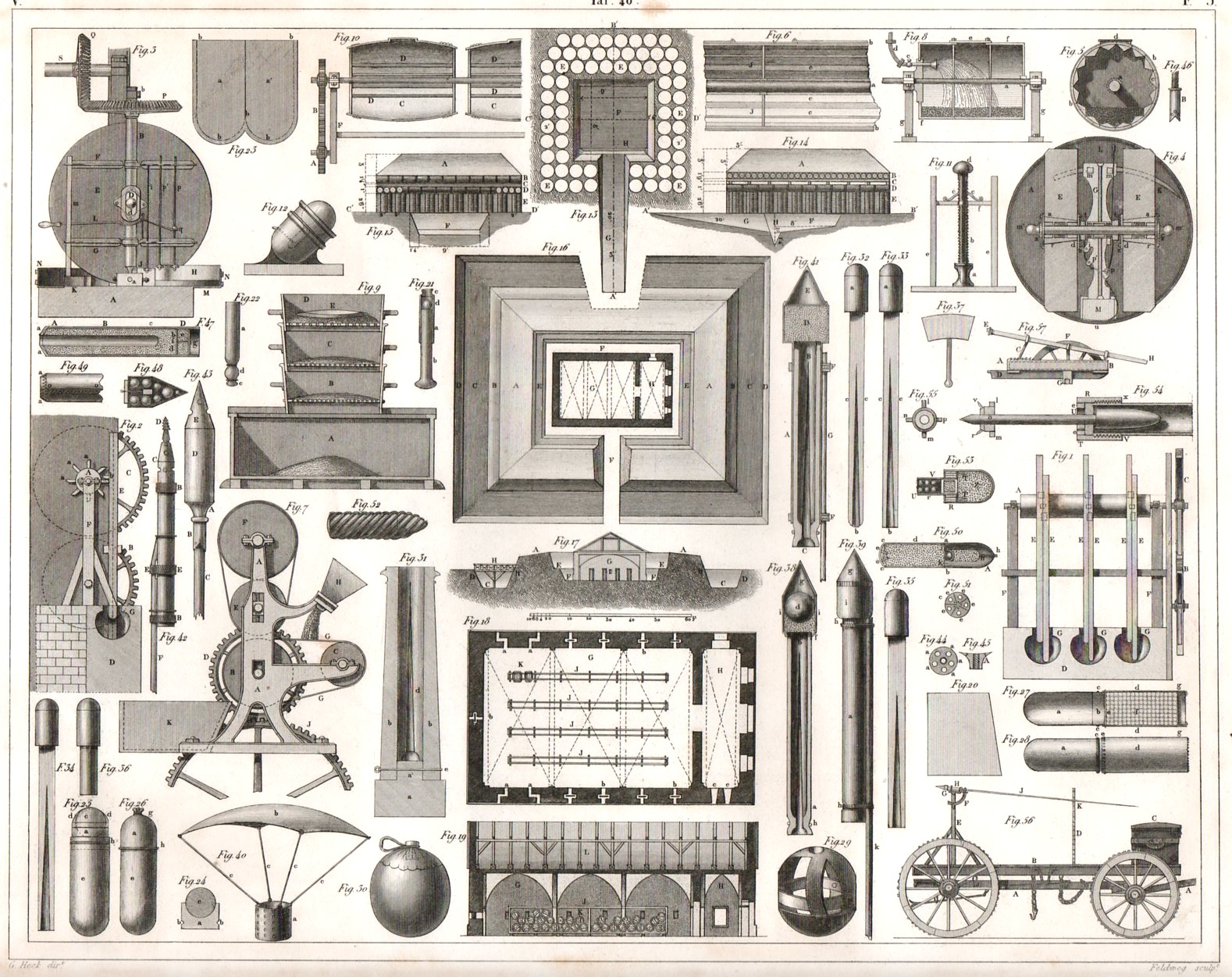
    The Iconographic Encyclopedia of Johan Georg Heck (printed 1851)  turns out to be perhaps one of the best designed books of its type in the nineteenth century.  Seemingly no  matter how much diverse information is hosted per page, whether the items number in the dozens or over a hundred,  the artist managed to distribute them with such grace and apparent ease that it is an absolute pleasure to see it all arranged before you. 

    Take for example the following two engravings of artillery fabrication of the early/mid 19th century.  There are 49 complex images on this first  piece of 11×8-inch paper (above), and yet there seems to be also a lot of white space.  It is a full but not crowded display of superb craftsmanship–it is also all very interesting. (Both are available for purchase from our blog bookstore.)

    To start, the main figures at top-center shop the plan and elevation of a workshop for casting canons, and we can clearly see the main furnace (“A”) for the big guns, surrounded by smaller auxiliary furnaces for smaller pieces.  Off to the side we see “K”, which is the drawing room and also the place where the director of the plant would live. Underneath it all in section we see various pipes and drains used to take away water and ash.  The structure on the lower right is for forming the business end and the purpose of the canon or mortar–namely, the ammo, and in particular, the pattern mold of a 50-lb mortar.  The long vertical pole at left used to place he liquid metal under pressure in the hearth, the ball being at the very bottom center.

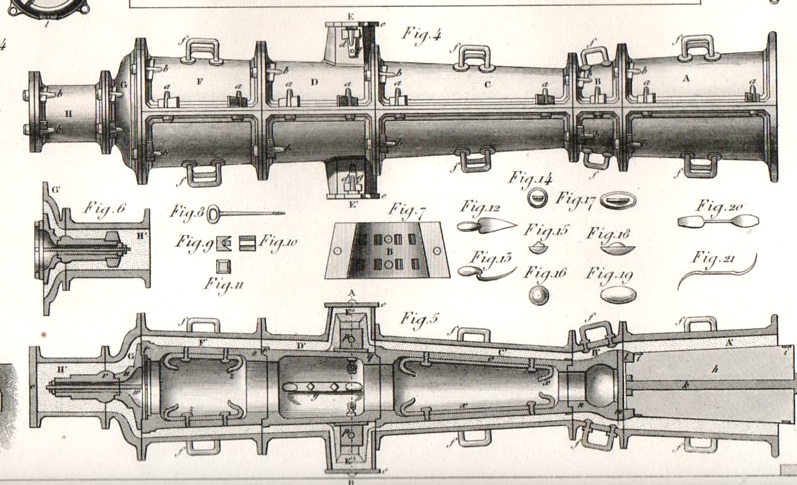
    I’ve enlarged figures 4 and 5 to show the particulars of a canon (dry sand) mold, #4 being the exterior of the mold and #5 showing a cutaway so that one could see the six-ponder canon that was being formed inside.

    Artillery286

    There is just so much in this image that a more knowledgeable person could easily go on for pages describing each and every bit. 

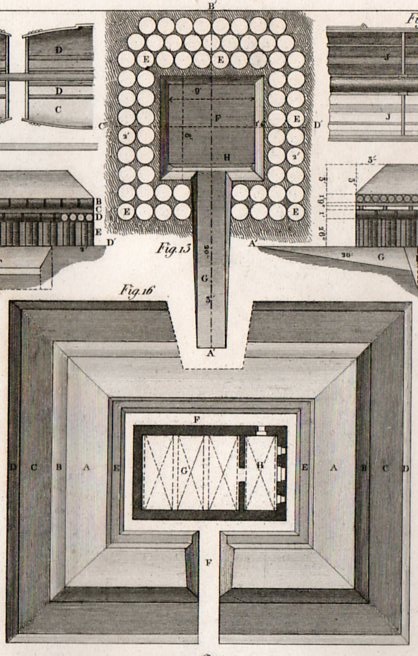
    The second image displays cartridges and (in general) fireworks–military pyrotechny.  What strikes me right away in this image are the five architecturals in the running vertically down the middle of the sheet.  They show what to do with gunpowder once it has been manufactured, which is an important consideration on handling and safety prior to it being used in battle–the first plan shows a field magazine, while the other four show the disposition of the construction of a permanent magazine, which show plenty of ventilation as well as massive walls which are in turn sunk into the earth and surrounded by ramparts.  It also seems that the roofing is huge, built no doubt to accommodate an earth filler.  Each of the barrels carried a hundred pounds of powder, so there was considerable interest not to allow the magazine to blow up, and if it did, to have the blast go mainly skyward. 

    Artillery287

    Some other items of interest in the second engraving include the incendiary devices (at bottom, #s 29+30),  signal rockets (#s 32,33,34,35), and the Congreve rocket, (#40 and #52,  which is much bigger and meant to be fired on the enemy, it being an incendiary); #53 is another Congreve, but this one scatters grenades as it is in flight. 

    Artillery288

    There’s a lot that can be described here but it goes a little beyond what I wanted to do with this post–it is also a lot beyond what I know about the subject.


  • Horses in the Sciences: Proving Nothing and Something

    JF Ptak Science Books   Post 1419   [Dedicated to our primum mobile family horse person, Emma Digh Ptak.]

    Horsepower281

    The history of horses in the sciences is not a very wide subject area, though I’d like to look at a few instances in which they help to prove both something and nothing–particularly in the third case below, when the “nothing” was a very big “something”. 

    First, in the history of horsepower (and such an odd history it is, having somewhat and famously to do with billing issues for steam powered engines) there is a certain restricted high-percentage element that are just no-go, unworkable ideas.  Some of them served as the basis for further and deeper thinking,and some of them were simply far ahead of the technical abilities of their times. 

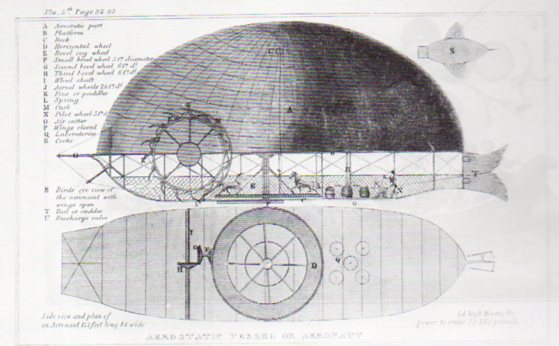
    In 1825 Edmond Genet1 published an interesting book (Memorial on the upwards forces of fluids and their applicability to several arts, sciences and public improvements) which in and of itself is a milestone in a number of different technical aspects–one part of it though sensationally and beautifully elevates itself to the Not-Quite-a-Good-Idea-at-Almost-Any-Time Department.

    Horsepower282
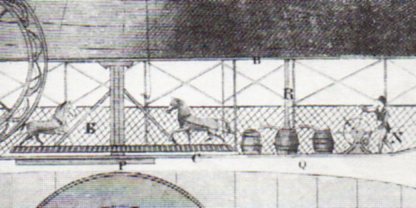
    “The actual plans of Genet’s airship called for a balloon shaped to resemble the rounded back of a large fish and containing about 1,023,000 cubic feet of hydrogen gas, with a platform or deck fastened beneath. Two horses, moving on a revolving wheel on this platform, were to provide the power for operation of a pair of large, silk-covered aerial wheels, while the rudder in imitation of a fish tail was intended “not only to steer the machine, but also to supply it with an additional force of propulsion”. –Genet in his Memorial…

    One thing that makes Genet’s work so impressive is that as a result of it he applies for and is granted the first patent made in the U.S. for a flying machine.  The flying machine he presented in his work though is a little problematic:  the canopy and the machine itself are not at all drawn to scale, and their size and breadth are lost a little in that under-representation.   I’d say that the figures in the drawing should be half of what they are, given that the flying machine was 132′ long and 46 feet wide (and 54 feet high), and the canopy was to be filled with a million cubic feet of helium.  The thing was a beast, and was supposed to be blessed with the capacity for lifting 72,000 pounds2.   The horses were along for the forward propulsion, moving two large paddle wheel-type wheels on either side of the airship.  It just doesn’t look right.

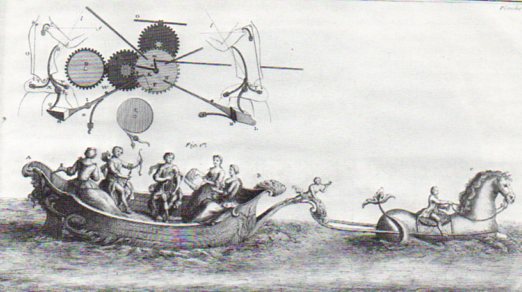
    Next is a tempting mechanism, an inset living inside a larger engraving depicting a mode of transport not-so-tempting.  It comes from Colonel Jean-Gaffin Gallon’s (1706-1775) Machines et inventgions approuvees par l’Academie Royale des Sciences....published between 1735 and 1777, and poetically covers its subject over a 111-year span from 1666 to 1777.   The massive work was illustrated with nearly 500 engravings covering all manner,shapes and description of technological invention and advancement, not the least of which was the first illustrated description of Pascal’s logic machine.  Amid all of this vast wealth of potentially revolutionary achievement,. I pluck out this equine example of possible nothingness: 

    Horsepower280

     which I am just not sure about, not having the text.  I can only hope that the horse was some sort of imaginary mechanical something, given its task and its size.  From the looks of its neck and the rider and the length of the horse, if it was a living thing it would have been gargantuan. 

    Here’s an appearance in the Gallon work (from 1735) of another, mechanical, horse that was used for stage productions, and which seemed fairly articulated:

    And thirdly, there is this, perhaps the most famous image of horses in the history of scientific illustration:

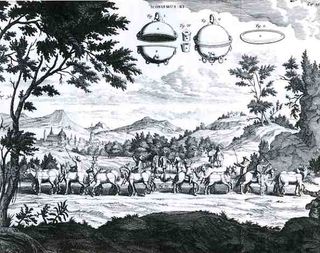
    Mantegna vacuum von guer

    This beautiful illustration is from one of the greatest experimental physics books of the 17th century, coming as it does from Otto von Guericke’s  Experiemnta nova (ut vocantur) Magdeburgica de vacuo spatio (Amsterdam, 1672).  (In another minute department, this one is also I guess the greatest book ever written by a Mayor of anywhere (as von Guericke (1602-1886) was mayor of Magedeburg for 33 years).)  The image shows the greatest of von Guericke’s efforts, and one of the greatest (or most important) experiments in experimental science–the dramatic demonstration of the vacuum, showing here that teams of horses could not pull apart two halves of an evacuated sphere, and of course the efficacy of air pressure operating against it (um, the vacuum). The “floating” bits in the sky were an exploded view of the sphere that was the subject of the experiment. 
                   
    What was more important though, and what the general reader today might easily miss, was that von Guericke created something that many scientists and philosophers said didn’t, and couldn’t, exist:  the vacuum.  In modern times, Copernicus depicted the universe as a vast void; Descartes came in the back door (following the ancient and interesting though incorrect theory of Aristotle), not liking the idea very much, and claiming that such empty space couldn’t exist.  Von Guericke provided the proof that the vacuum, that nothing, did exist.

    As a matter of fact the issue of nothingness was very contentious, with the concept of its possibility and the display of a vacuum not achieved until this effort by von Guericke, with his team of horses tugging away at the essence of nothing.

    NOTES

    1.  Genet is best remembered in American history as “Citizen Genet”, at least far more so than that being remembered for gentleman farming or his work in aerostatics and invention.  “Edmond Charles Genet had tried to recruit American volunteers to serve in the armies of Revolutionary France and to outfit American privateers to fight against the British. Despite President Washington’s orders for him to desist from his high-handed appeals to the American public, he continued the same practices until he was forced from office. Washington permitted him to remain in this country as a private citizen, saving him saving him from the possibility of being guillotined for his failure.” So writes the great historian of Science I Bernard Cohen.  It wasn’t altogether true though that it was Washington who saved Genet; his being allowed to remain in the U.S. was strongly pursued and lobbied by Alexander Hamilton, Genet’s greatest detractor/enemy/nemesis in Washington’s cabinet.

    2. By contrast, the Wright I Flyer (the famous first-flight airplane of 1903) had a wingspan of 40 feet, weighed 625 pounds and sported a 12 horsepower, 170 pound  engine (and which by the way was all produced for about a thousand dollars–not nothing, but not a lot).


  • The Almost-Tomorrow Department: Radio-Vision, 1928.

    JF Ptak Science Books  Post 1415

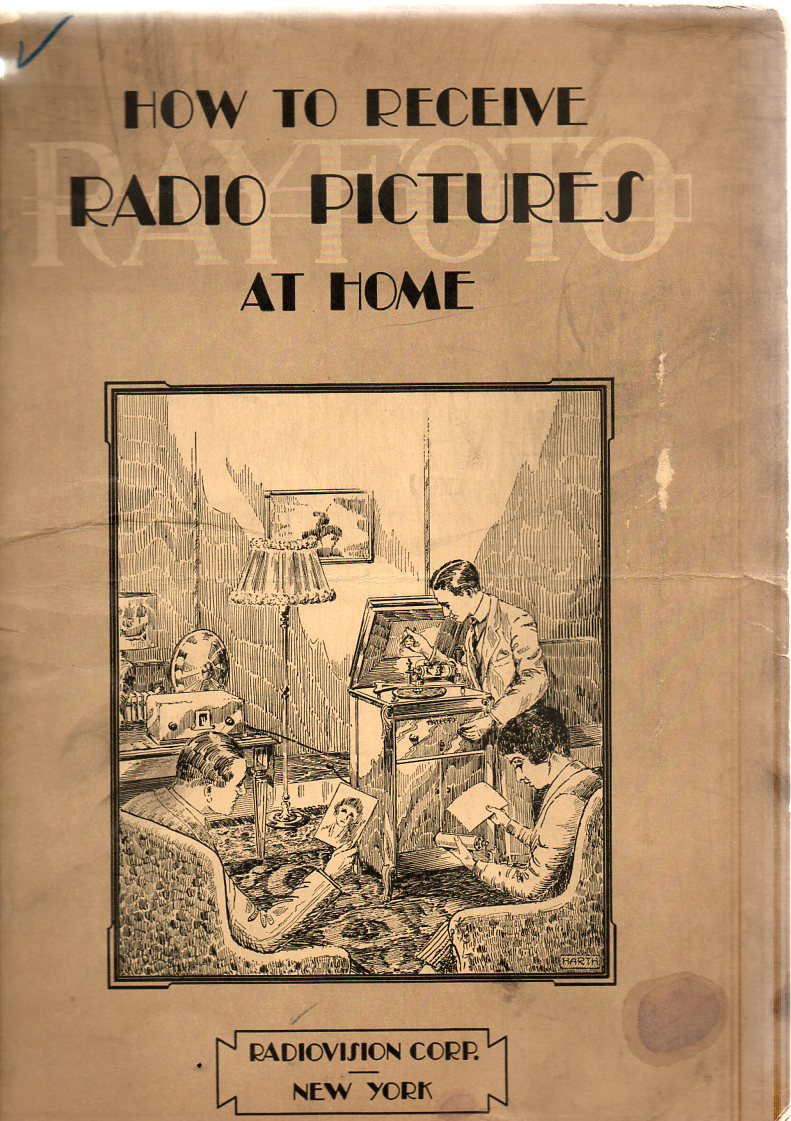
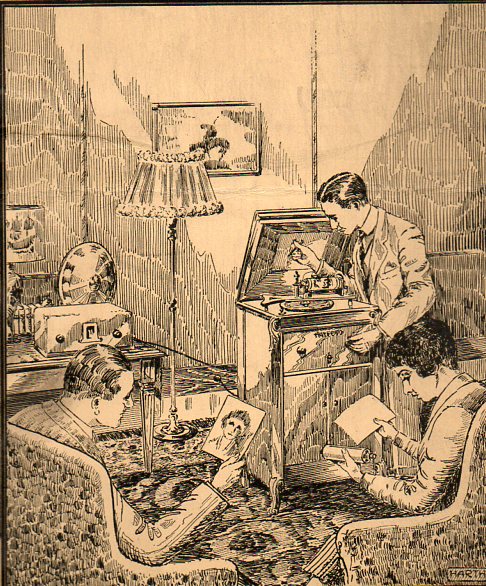
    Radio vision258 Tomorrow seemed to be almost there to readers of this pamphlet, what with the idea of looking at pictures relating to the radio broadcast you were listening to looming before a slightly disbelieving mind.  The fact of the matter though is that this breakthrough by Mr. Austin G. Cooley1–basically attaching what we would know today as a fax machine to a radio cabinet which would receive and print images relating to the show being heard–was rubbing up mightily against the real wave of the future, the television. (The original is available here at our blog bookstore.)

    Mr. Cooley’s invention of the Rayfoto just didn’t quite fit the demands that would soon be established and met by television.  The idea of practical television goes back a fair way2, at least to Arthur Korn in the late 1890’s, which much work being done on both broadcast television and facsimile transmissions.  But tv was definitely a high scent in the air when Cooley published his Rayfoto pamphlet in 1928–as a matter of fact, this was the same year in which the first television license was granted (to Charles Jenkins, W3XK).  And just two years later the BBC would begin regular television broadcasts, while also in 1930 Mr. Jenkins initiated another television-first, the t.v.commercial. 
    Radio vision259

    “No greater thrill awaits the radio experimenter than receiving his first picture through the ether…Not many months will pass before picture broadcasts will be a part of every radio broadcast”–A. Cooley, 1928

    So the time was definitely note ripe for Cooley’s idea as an image supplement to radio, though it did have other possible applications–like the “fax” delivering newspapers to your home–though they are not listed in the pamphlet. 

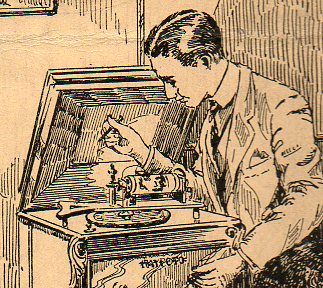
    What we see here the drum of the apparatus (we don’t see the three-tray developer/fixer wet set-up inside the apparatus), one of the listeners retrieving an  incoming vision-image, something that evidently took quite some time, depending on the image and the ways in which the developing trays have been set.  Dark images might’ve taken the entire length of a 15-minute broadcast to transmit and print; other, simpler efforts took less time.

    Radio vision260
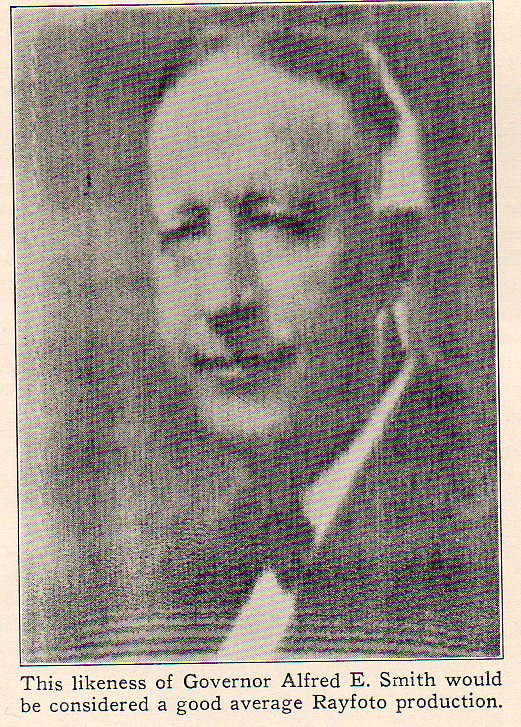
    Here’s an example of a successful, medium-quality image that one could expect using Cooley’s Rayfoto system:

    Radio vision261
    It doesn’t look like much now, and maybe it wouldn’t’ve looked like much to people familiar with the new television.  But even a grainy, static image accompanying a voice performance is a fabulous thing when compared with never having seen anything like it before, never having had such an experience, if even only as a novelty.

    _______

    Notes:

    1. Cooley,  Austin G.  How to Receive Radio Pictures at Home.  New York:  Radiovision Corp,  1928.  1st edition.  26pp, 2 folding blueprints  4to.   This unusual publication describes the construction and use of an apparatus which would receive broadcast (facsimile) images that would be used to illustrate radio transmissions/shows.  The idea (in this form of illustrating radio shows) at this date would be reduced to almost-nothingness once television entered the picture in the next year or so.  Still, it was an elegant idea to illustrate the spoken word.
    This system was offered by Austin G. Cooley (1900-1993), inventor of the Rayfoto system, “the first authentic radio picture apparatus”. This was a very early attempt at mass entertainment via a mechanical medium that proved ineffective by 1929/1931 against the advances of television. (The radiovision method was something like a facsimile device, offering a static image every now and again, and was completely outclassed by the moving image).

    2. Followed by Paul Nipkow’s rotating discs in the earliest part of the 20th c, then by Vladimir Zworkin’s iconoscope (1923), Charles Jenkins and John Baird’s television of 1924, and then of course by Philo Farnsworth’s 1928 image dissector.


  • Display of Information: What a Dreadnougth was Worth in Airplanes, 1911

    JF Ptak Science Books  Post 1408   [Display of Quantitative Information series]

    Info display dreadnought237

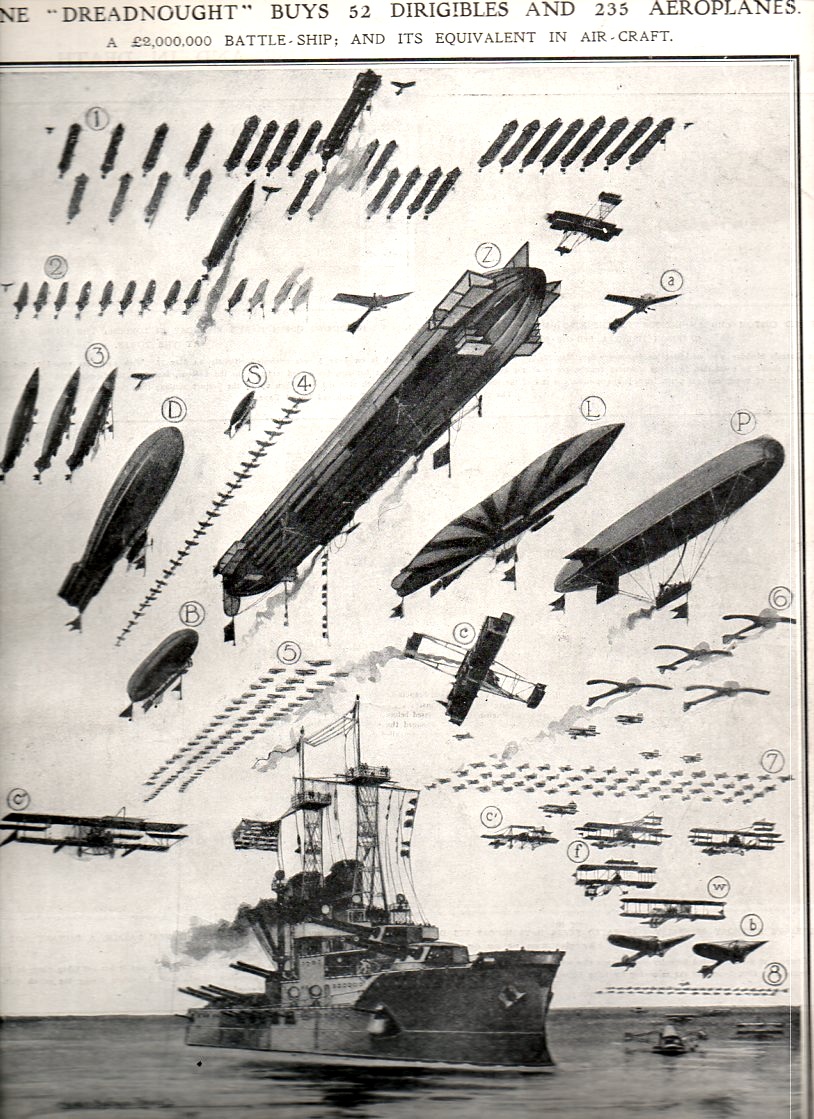
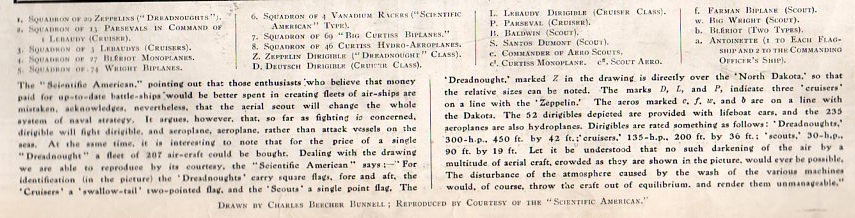
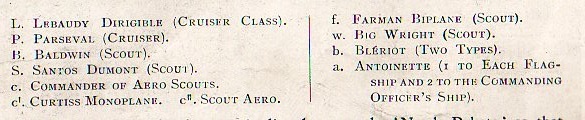
    There’s nothing quite so satisfying as seeing a representation of quantitative data like this where the graphical displays are flying.  “One Dreadnought Buys 52 Dirigibles and 235 Aeroplanes” is a full-page diagram appearing in the 3 June 1911 , making a very strong point that in the new air-age 2 million pounds for one battleship buys a lot of aircraft.  Of course this is a British journal and the ship is flying an American flag–the image originally appeared in the Scientific American just a short while before this publication, and so it also enumerates American and international aircraft, making for a lovely representation of a broad range of airplanes filling up the same sky.  (This image is available for purchase from our blog bookstore, here.)

    Info display dreadnought238
    Info display dreadnought239
    Info display dreadnought240


  • Elegant, Lightweight Steam-Powered Vehicle, 1877

    JF Ptak Science Books  Post 1407

    Steam car232

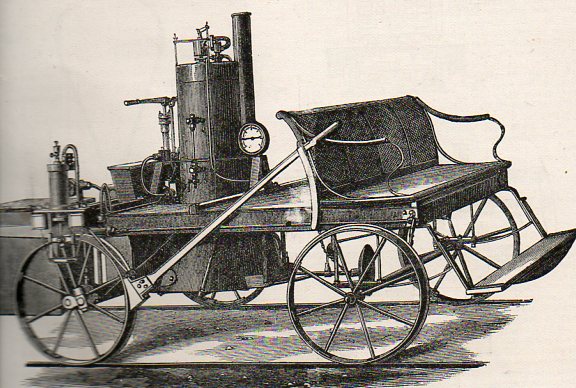
    This lovely steam-powered trolley looks as though it was just <this> close to being lifted off of its tracks and placed on the street for tooling around town.  Of course part of the reason why Joseph Green Cooke’s trolley was so lightweight1 is because it was traveling on rails, which meant the surface over which it would be propelled was smooth and predictable, unlike the streets that it would have to use to makes its way through a town.  Uneven, choppy, bumpy roadways would mean that the vehicle would have to be more sturdy; more sturdy means more weight, more weight means bigger engine, and so on.  So instead of this relatively light 1,200 pound vehicle you might wind up with something at 5,000 pounds, or more–at least in 1877’s mindset. (The issue of Scientific American is available here.)

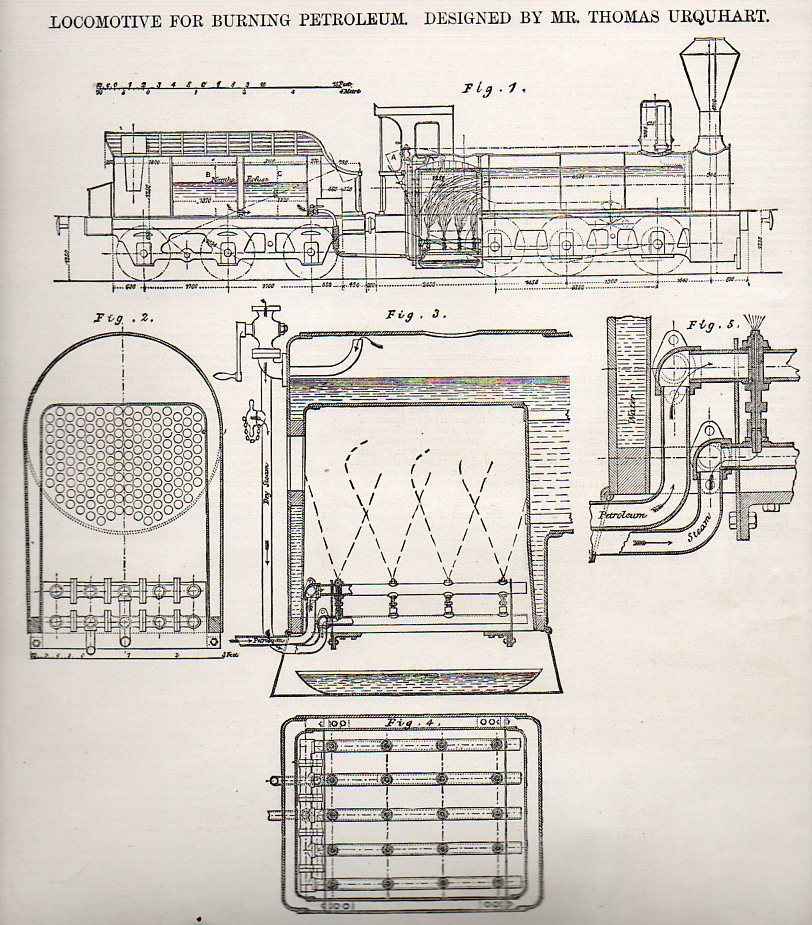
    The lighter vehicle would come before the end of the decade, but it had mostly to do with getting away from the steam engine to the lighter gasoline engine2.  It is serendipitous and perhaps ironic that the illustration facing the steam trolley is for the gasoline-burning train locomotive engine of Thomas Urquhart, who developed it for the Grazi-Tsaritsin Railway (Russia), which converted all of its 143 engines to this method by 1885.  When the pages of the magazine are closed, the two images lay one on top of the other. 

    Steam car234

    Notes:

    1. Earlier efforts at putting mobile steam-powered vehicles on the road stretches back into the very dim pre-automobile with the behemoth of Nicolas Joseph Cugnot, which strained its way along French streets as early as 1869….it also in the first recorded automobile accident, which caused enough trouble and damage and injury to scare away development money.  There were engines that were considered “portable” traction devices in the earliest part of the 19th century (by Trevithick and Tuxford, among others) , though they were not mobile–the “portable” part was that they could be moved (at all).  The movable, working traction machine (“tractor”) would begin to make its appearances in the 1860’s, though these were generally major pieces of machinery, locomotives on wheels. 

    2. Thanks to Gottlieb Daimler’s 1885 prototype, and Karl Benz’s 1886 patent for the gas-fuled car, and of course to the Charter Gasoline Engine Company of Illinois, whose work in the mid/late 1880’s brought about the production of several gas-powered traction engines in 1889.

    From the Western Review of Science and Industry, 21 December 1876: STEAM TROLLY. “Mr. Joseph Green Cooke, the locomotive and car superintendent of the  Oude and Kohilkunde Railway, has constructed a steam troll}” or carriage, the object of which is to enable resident engineers to inspect their tracks,  bridges and works with rapidity


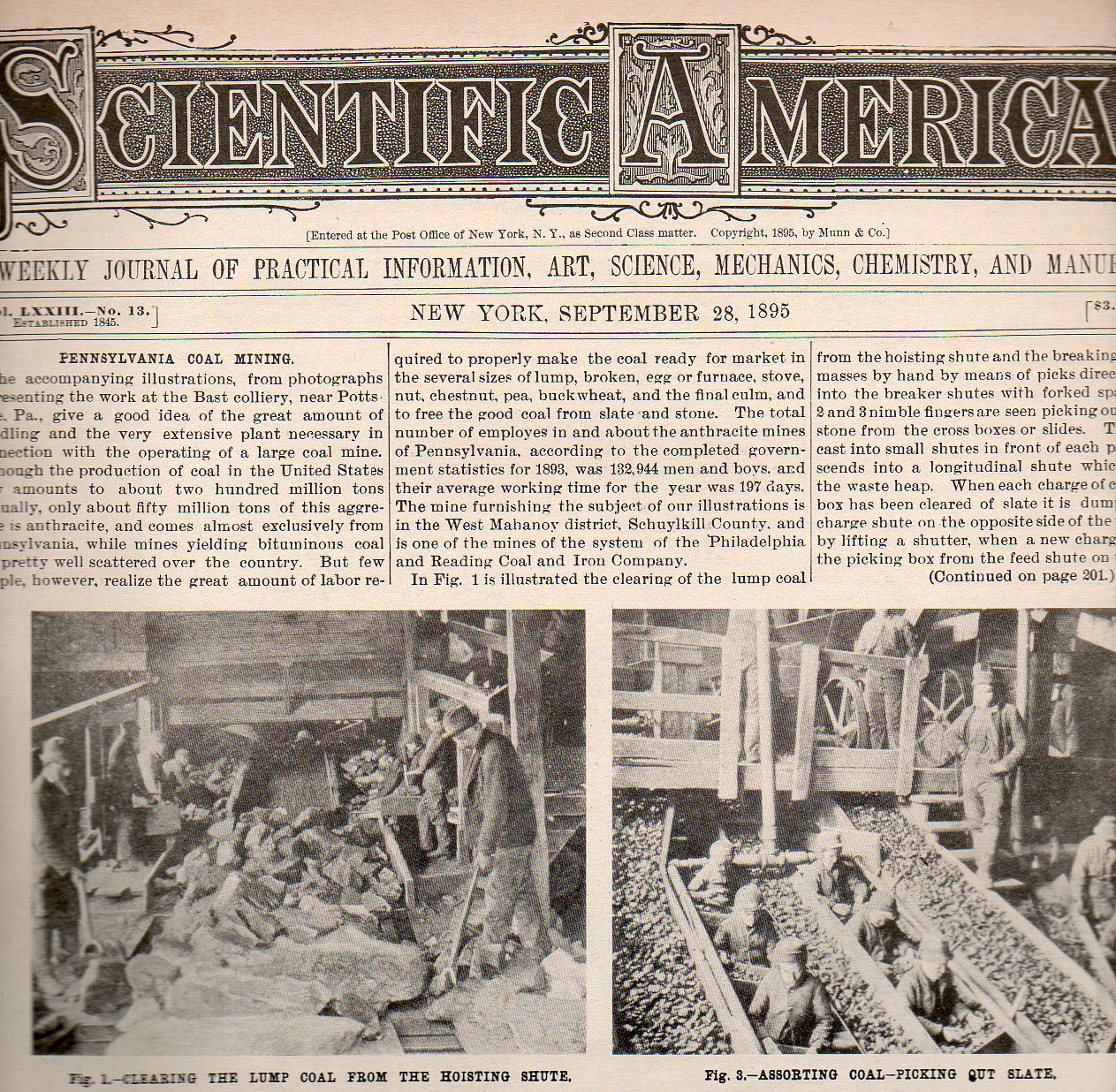
  • Coal Boys, 1895

    JF Ptak Science Books   Post 1406Coal boys230

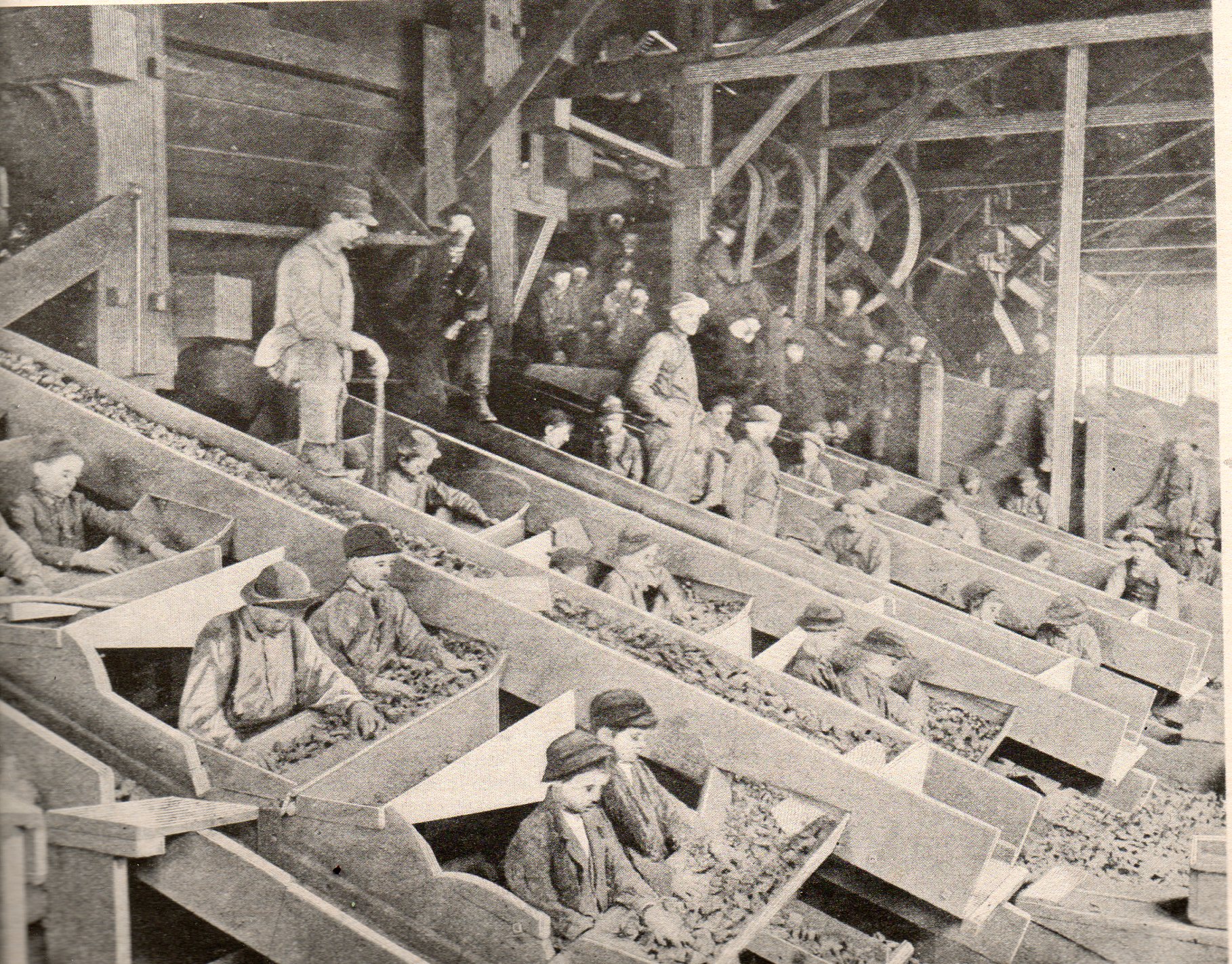
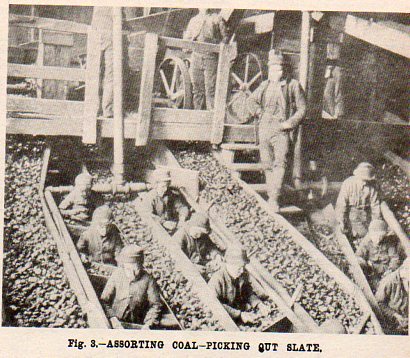
    Here’s a series of social documentarian photographs that partially illustrate the true position of the “coal boy” out in Pennsylvania in September, 1895.  Somehow it sounds, perhaps, a little romantic, summoning images of small children running around with sacks of coal as though it was a newspaper or marshmallows or something.  That such a chore was left to children in the 40-million-ton anthracite coal industry in Pennsylvania is a testament to something–the savings of cents-per-hour for the kids to do the task rather than  an adult, or, well, is there an “or” to this?  I don;t think so.  I think that it all came down to shaving hog hairs from the paychecks of adult workers. 

    The story appeared in the Scientific American for 28 September 1895–it was not an investigative journalism piece on the working conditions of children, just a simple report on what the children were doing.  We’re still years away in 1895 for any real legal assistance to protect children as workers or to require them to be in school. 

    Coal boys231

    Coal boys229

    Coal boys227