A Daily History of Holes, Dots, Lines, Science, History, Math, Physics, Art, the Unintentional Absurd, Architecture, Maps, Data Visualization, Blank and Missing Things, and so on. |1.6 million words, 7500 images, 4.9 million hits| Press & appearances in The Times, Le Figaro, Mensa, The Economist, The Guardian, Discovery News, Slate, Le Monde, Sci American Blogs, Le Pont, and many other places… 5000+ total posts since 2008.

Category: Technology, History of

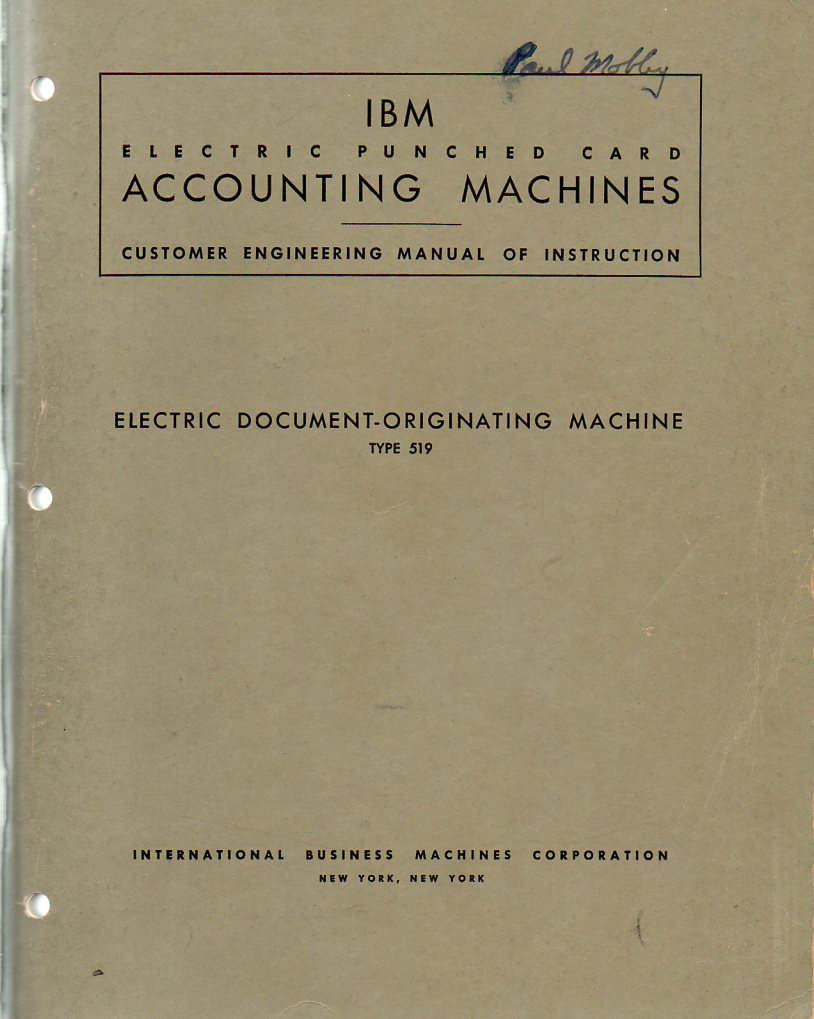
  • A Note on Some Important Punches of Post-War America, 1952. The IBM 519.

    JF Ptak Science Books  Post 1379

    “Gang punches, summary punches and reproducing punches….such are the guts and glory of all good punch dreams”–No one, ca. 1957. 

    IBM 519121 This story has to do more with Jacquard than with Marciano.  One of the mainstays of the pre-computer computer room, the ubiquitous instrument as prevalent then as the desktop is now, was the unit record machine,  which operated with punched cards for program entry and data storage. This machine–like the IBM Type 5191 Electric Document-Originating Machine (1952) described below–functioned to read and reproduce the mainstay of the calculating instrument of the 1930’s to the early 1950’s.  

    Their functions included lots of punching:  gang punch, which would produce a large number of identically punched card; reproducing punch,   which “could reproduce a deck of cards in its entirety or they might just reproduce selected fields…a payroll master deck might be reproduced at the end of a pay period with the hours worked and net pay fields blank and ready for the next pay period’s data. Computer programmers who created their programs in the form of punched card decks used these to make backups”; a  summary punch, which were attached to tabulating machines and could punch new cards with details and totals from the tabulating machine;  and the mark sense reader, “which could detect pencil marks on ovals printed on the card and punch the corresponding data values into the card”.

    The IBM 519 was one such punching machine, sitting in command of vast legions of data that had previously been exceptional if not impossible to corral.  Improvements like this, these sorts of technological breakthroughs, allowed for the nervous system of the second industrial revolution to occur.  Of course one needed electricity, and then the machines that would be powered by them, and then the distribution capacities to get the electricity to the millions of end-users who would in turn purchase the new electrical goods–all of this was necessary.  However, without the ability to get this electricity paid for by it subscribers, without the power company being able to collect revenue, this stuff doesn’t happen.  And the way that the power company collects is by sending out an ocean of bills, which means that the ocean needed to be controlled in some way, all of the data handled and audited, which means that there was a new, mechanical way of dealing with the vast transfer of data.  And that’s where machines such as the Grunts and Gruffs come in. Like the 519.  IBM 519122

    (These IBM manuals are available for sale at our blog bookstore, here.)

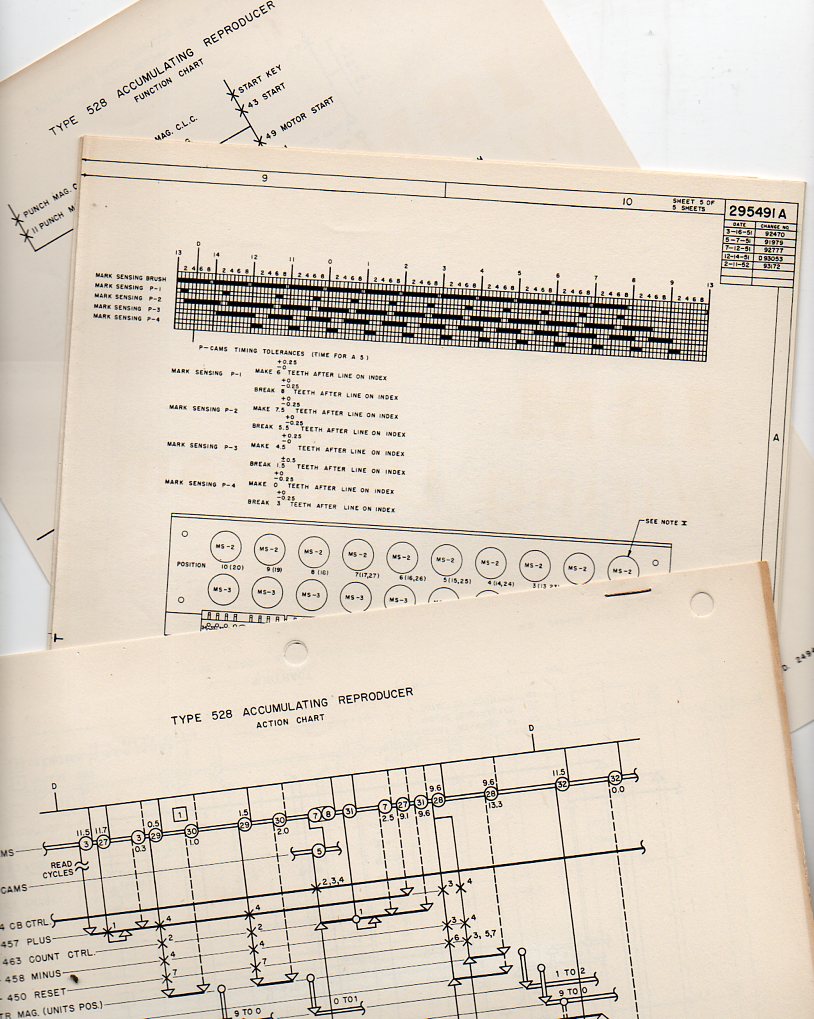
    This thought bubbled to the top while I was looking through a user’s manual for the 519, an updated 1952 version of the first edition of 1943. It is a beautiful work, filled with all of the information that a user would need to operate the machine as well as the specs necessary for the engineer to maintain the thing.  It was bound in a heavy, plasticized flexible cover, intended for wear and tear, and also came with an additional six pamphlets ,mostly wiring diagrams, one of which–the wiring diagram for the 519–unfold its 11 inch height out to five feet in length, a gorgeous panorama of organized and directed electricity.  It has two mates,a pair  not quite as long–four feet or so–in the wiring diagram for the 519’s reproducing punch,  lovely things in and of themselves. 

    The documents just have a satisfying feel ot them, manuals for maintenance and repair for machines that could be maintained and repair.  IF they were still needed, I’m sure that they would be running today. 

    Notes:

    1. “Early computer installations used punched cards for program entry and storage. A typical corporate or university computer lab would have a room full of keypunch machines for programmer use. An IBM 407 Accounting Machine might be set up to allow newly created or edited programs to be listed (printed out on fan-fold paper) for proof reading. An IBM 519 might be provided to reproduce program decks for backup. The 519 could also punch sequential numbers in columns 73-80 of COBOL or Fortran program decks. Those languages and others did not use those columns; the use of only 72 columns is a convention tracing back to the IBM 704 computer’s card reader, the 711, which could only read 72 columns (selectable by a plug-wired control panel). An IBM 80 series sorter would be used to put things back in order if a sequenced deck was dropped. A quicker, but less effective, protection against dropped card decks was drawing a diagonal line across the top of the deck with a marking pen.”–from Wiki on the IBM 519.”

    And from WorldLingo comes this:

    “The IBM 519 Electric Document Originating Machine, introduced in 1946, was the last in a series of unit record machines designed for automated production of punch cards. It could reproduce all or parts of the information on a set of cards; copy the information from a master card onto a group of detail cards; printing up to eight digits on the end of the card; compare two decks of cards, punch summary information provided by an accounting machine. It could operate at 100 cards per minute.”

    “Optional features allowed the 519 to read pencil marks on cards and punch the data they contain, and to number cards consecutively. The 519 was programmed by wiring a removable control panel. IBM called the operation of converting cards marked with pencil marks into punched cards “mark sensing.” Mark sensing allowed a person to enter data to be used in punched-card data processing without using a key punch machine. It was used for tasks like recording long distance calls and meter readings. Unlike other types of IBM unit record equipment, the 519 fed cards face down 12 edge first. The advantage of this was worn out decks from other equipment (which fed cards face down 9 edge first), having frayed 9 edges would still feed reliably through the reproducer, allowing a fresh copy to be made.”

    2.  The Electric Document-Originating Machine Type 519, IBM Electric Punched Cards Accounting Machine, Customer Engineering Manual of Instruction.  IBM, NYC: 1952.  1×8 inches,  124pp, illustrated. 


  • Miss Atomic Bomb: the A-Bomb in Popular Culture–Comics, Cakes and the Will of God

    JF Ptak Science Books   Post 1425 
    Follow Me on Pinterest


    I’ve written dozens of posts on this blog about atomic bomb history and where the bomb has shown up in popular culture.  This installment is on the bomb in very popular culture

    Miss Atomic Bomb is an icon of some sort for the relationship of the bomb with society, or, perhaps the bomb and Vegas, which is where this picture was taken. I guess there are reasons to put pretty women in front of computers (in the 1950’s/60’s), cigarettes and automobiles–why not with The Bomb?

    Atomic Bomb Miss
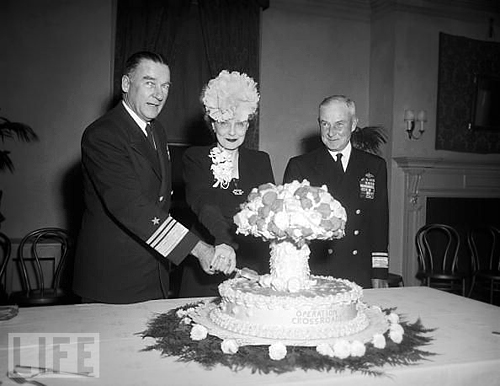
    The atomic cake (with matching headware):

    Atomic cake

    The caption to this story from Life magazine (1946) reads: “U.S. Navy Vice Admiral William H. P. Blandy, his wife, and Rear Admiral Frank J. Lowry cut a cake made in the shape of a mushroom cloud at a reception for Operation Crossroads, November 6, 1946.”  Actually Blandy was an early (August 1945 or thereabouts) forward thinker about how to deal with the U.S. owning the bomb and  international control.  I have little doubt that he probably thought that the cake was a bad idea, but, well, he did what he needed to do.

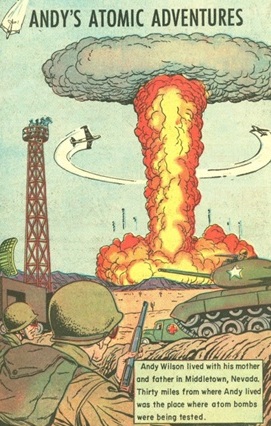
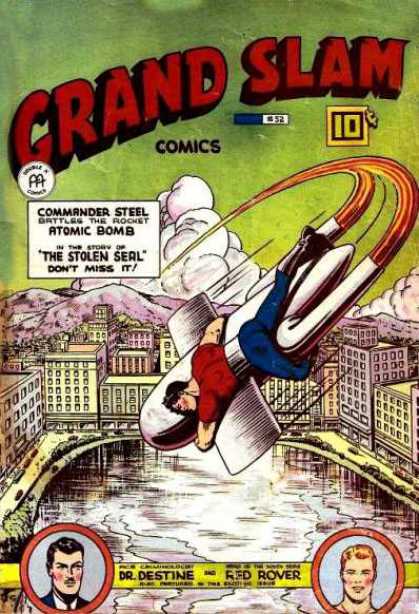
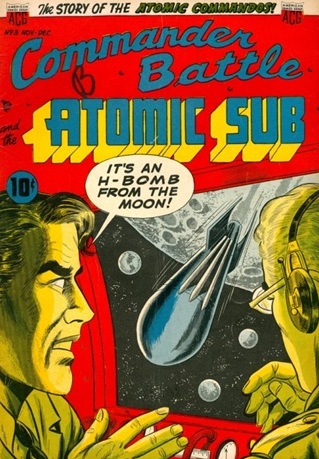
    There were all sorts of comic book adventures dealing withe the atomic bomb, right from the very beginnig (as it seems the earliest of them appears a month after the Hiroshima bombing).  These are just a few examples with the a-bomb on the comic’s cover(s):

    Atomic andy

    Atomic grand slam
     
    Atomic  h bomb from moon

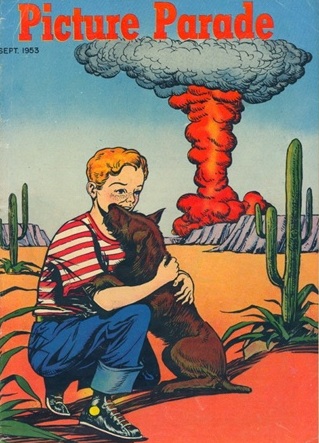
    AtomicbombBizarro–I don’t know the story of this image in Picture Parade, only having the cover graphic–perhaps that’s enough, perhaps we don’t need anything more, perhaps the backstory would spoil a perfectly bizarre image with something perfectly benign.  Or perhaps not. 

    Atomic bomb biazzaro
    Bizarre but for different reasons–a pocket-sized ball bearing patience game. Tokyo is included as a target for this game but in actuality was not considered atomic-bomb-worthy, mainly because it was decimated,  blanketed with a firebombing  that destroyed a host of the city just weeks before the first blast. (On March 9-10, 1945, 339 B-29’s dropped 2000 tons (4 million pounds, about 496,000 bombs) of the incendiary M-69 on Tokyo.  Two initial passes were made on the city, marking a large, burning “X” in the city.  Each plane had the capacity to cover a drop area of 350 feet by 2000 feet, which means a much greater area was affected. The citizens of Tokyo met their ends with buckets of water and brooms in defense. Hours later fifteen square miles of the city were destroyed.  In the months prior to Hiroshima and Nagasaki, 66 cities were bombed with M-69, killing about a million people, and wounding more.)  Fresh cities were needed for the atomic weapons so that there effectiveness could be judged against a palette of a normal. intact city, and not one that had been previously attacked. 

    Atomic Bomb dexterity game
      And still more bizarre, when you combine all of the aspects of the race to the bomb with the race to god and the people who would believe such a thing.  This advertisement belonged to a mail order religico empire builder, Frank B. Robinson, (1886-1948), who claimed himself to be a prophet of god, had conversations with the Creator, and in general used whatever was of interest in the newspapers to drive interest in his ministry by mail.  It looked like his creation–Psychiana–wasn’t much more than a feel-good, self affirming, positive-thinking enterprise driven by a man with a personality big enough to be on speaking terms with the god, who in the ad below somehow was selling “the atomic power of the spirit of god in us”  because we are composed of atoms.

    Atomic bomb thankgod

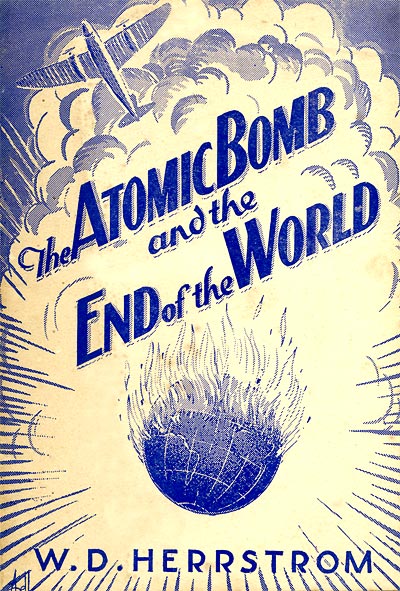
    And of course on the other end of this:

    Atomic_bomb_end_of_world

    This is an example of a host of end-of-the-world, post apocalypse movies (and books, and short stories, and so on) made to scare and entertain.  Judging from the trailer the more-modern television series Jericho owes a lot to Ray Milland. 
    Atomic panic-in-year-zero

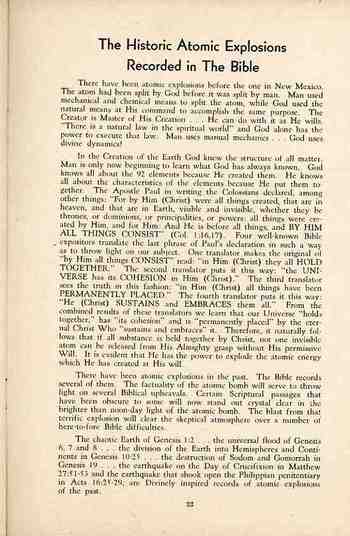
    Mel Morris  published God’s Atomic Bomb  in 1945, which means he must’ve worked a little feverishly to pump up his bible prophesy and history to include the new atomic weapon to replace whatever else he had been using as a prophecy for end of times.  (As it turns out, “God’s Atomic Bomb” was more tempest and disaster in the bible, and not (whew!) the bomb itself.  Though as we’ve learned from scientologists and the sort-of creative mind of Ron Hubbard, a civilization came to the earth thousands of years ago and pummeled it with “atomic bombs” and other nastiness, polluting humans for milennia to come.  But that’s another story–suffice to say that Morris found many dozens of examples of “God’s Atomic Bomb” being used in the deep biblical past, and that the use of the real atomic bomb in 1945 was pre-ordained, and not without its figurative historical counterparts.  I’m not sure why any of this was necessary outside of proving to some small minority that these preachers could at least be contemporary and topical. 

    Blogsept_2_atomic_bomb_god_2txt483

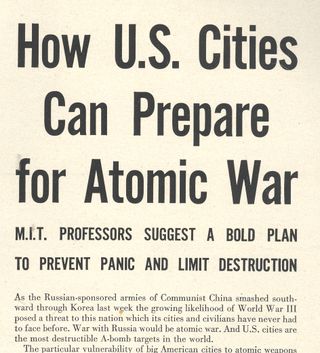
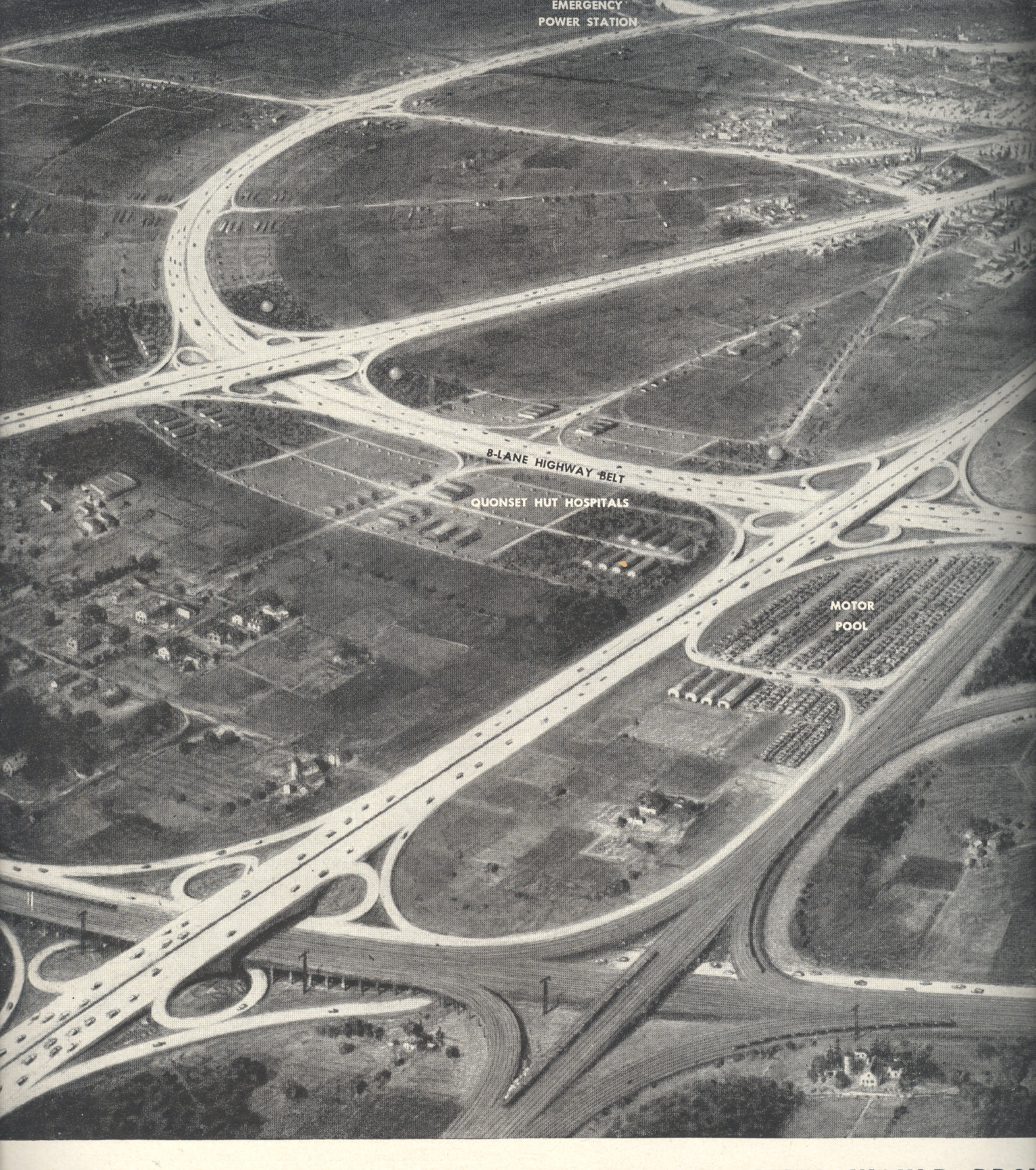
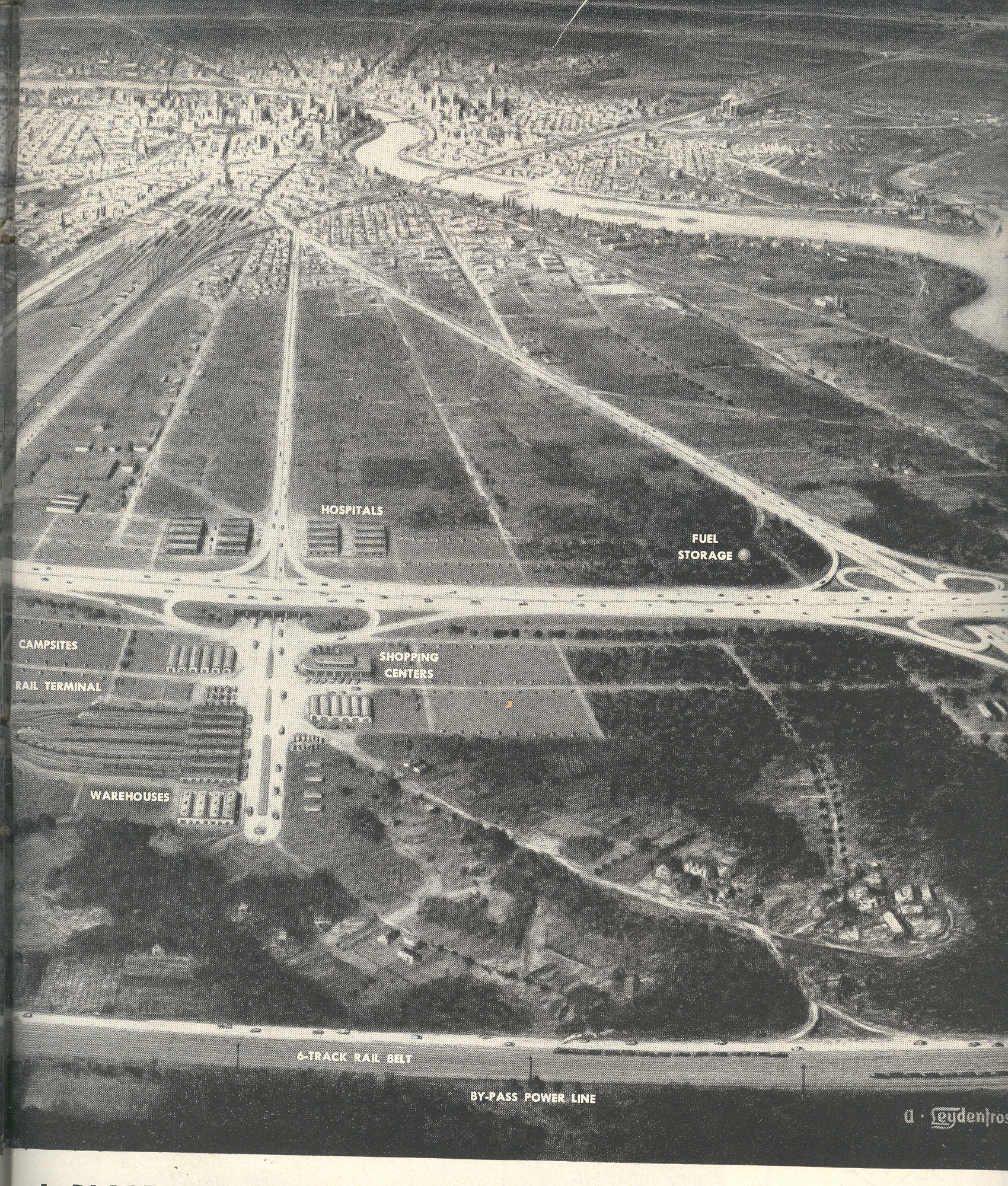
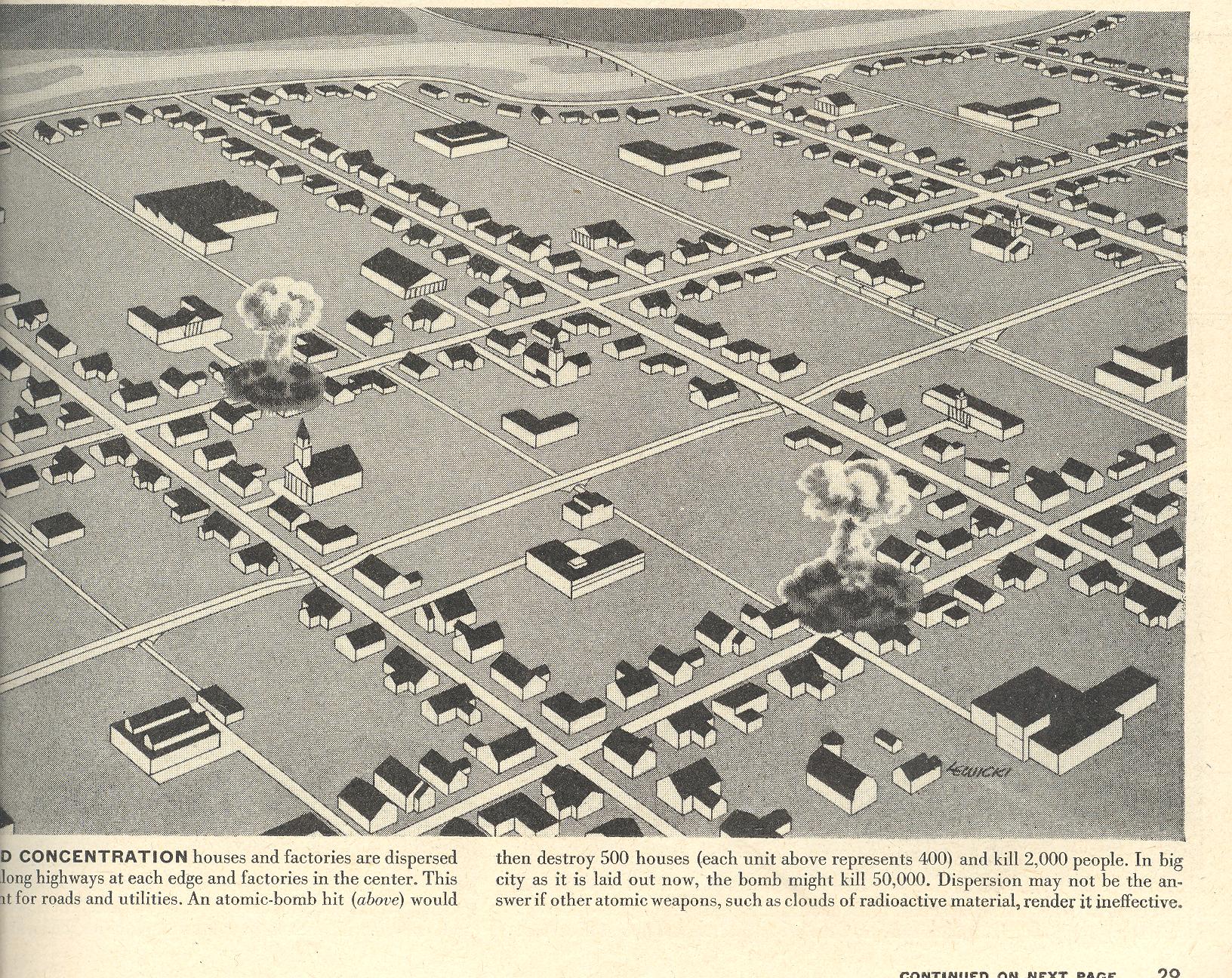
    The following is not the worst idea regarding the survival of nuclear holocaust, though it is an extremely bad one.  (Atomurbia, which makes the entire country a suburb to itself and therefore nothing, and which I write about below, is perhaps the worst idea that I have seen on combating the Soviet menace.)   But this one, which appeared in Life magazine in 1950, does come close, setting up post-attack suburbs (for “refugees”) and which takes some pre-attack city planning into some account.  There is a lot of planning for people in cars to make their way out of the city, which reminds me of the evacuation maps of Washington D.C. (which were still being handed out in the early 1980’s), which sends people on their way east and west depending upon the last digit of their car’s license plate being an odd or even number. 

    Atomic city plan war

    ==Blog July 27=wiener left

    One reaction to impending Doomsday was to construct concentric outer highways around metropolitan areas, “life belts around cities (which) would provide a place for bombed-out refugees to go”. In the birds eye view provided here, we see the plan in action, the main parts of which are an 8-lane “express” highway belt 10 miles away “from the built up edges of the city” , and a 6-track railway belt five miles further out, these accompanied by various feeder arms stretching straight-away from downtown.  In between the two outer rings would be land that would be kept free of development, so that farms and tent cities could be constructed after the attack. There would also be major collections of hospital and fuel depots in the greenbelt area.  Infrastructure would already be in place (gas and electricity, supplied with power from who-knows-where).   Shopping centers and a giant “motor pool:” would also already be in place, waiting for the Doomsday clock to strike midnight. 

    ==Blog July 27=wiener right

    This idea of city planning was one of many offering the prospect of safety from nuclear attack by spacing out the population of the United States so that the Soviet Union wouldn’t have enough nuclear warheads to take everyone out.  It called for the redistribution and resettlement of virtually everyone in the country, and is one of the most spectacularly bad ideas that I have come across in this field.  (I wrote about it earlier in this blog, here.)

    1-may 3-atomic 4

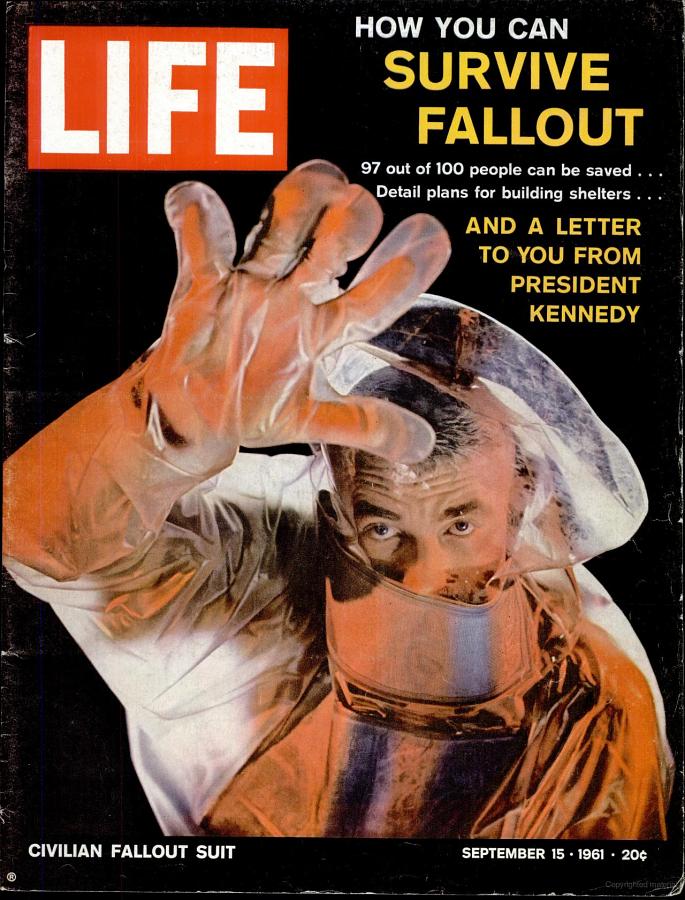
    This issue of Life offered the possibility of hope that 97% of the American population could survive a nuclear attack by the Soviet Union. It was a hard sell of a bad idea of insane optimism.

    Books_004


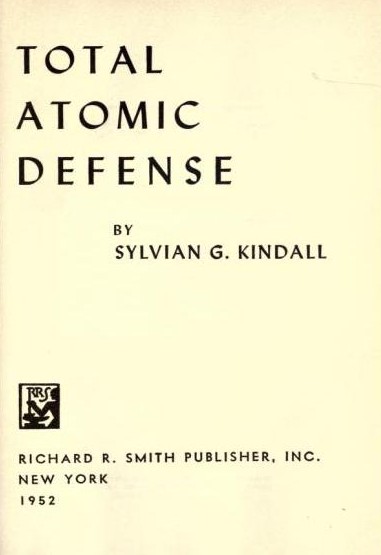
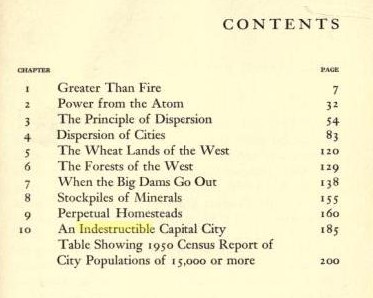
     Sylvian Kindall’s Total Atomic Defense (published by a very severely right-wing publisher in 1952) is one of a series of books made for a deceived American population, offering the general reader both fear and hope, often from the same, exact source. But Kindall has a  somewhat diffident approach, offering his belief that the country and its population can largely  survive an all-out nuclear waBlog--untinkable tpr–intact.  Chapter 10 tells the remarkable story of how to make the captial city of America atom-bomb proof, mostly by digging it into the side of a mountain.

     
    Blog--unthinkable


    Again, this is just the barest touch of the top of a huge pile of such stuff–and I’ve not even mentioned duck-and-cover films.


  • Little Pieces and Superb Design: Rockets, Canons, and other Boom Boom

    JF Ptak Science Books  Post 1420

    Artillery285

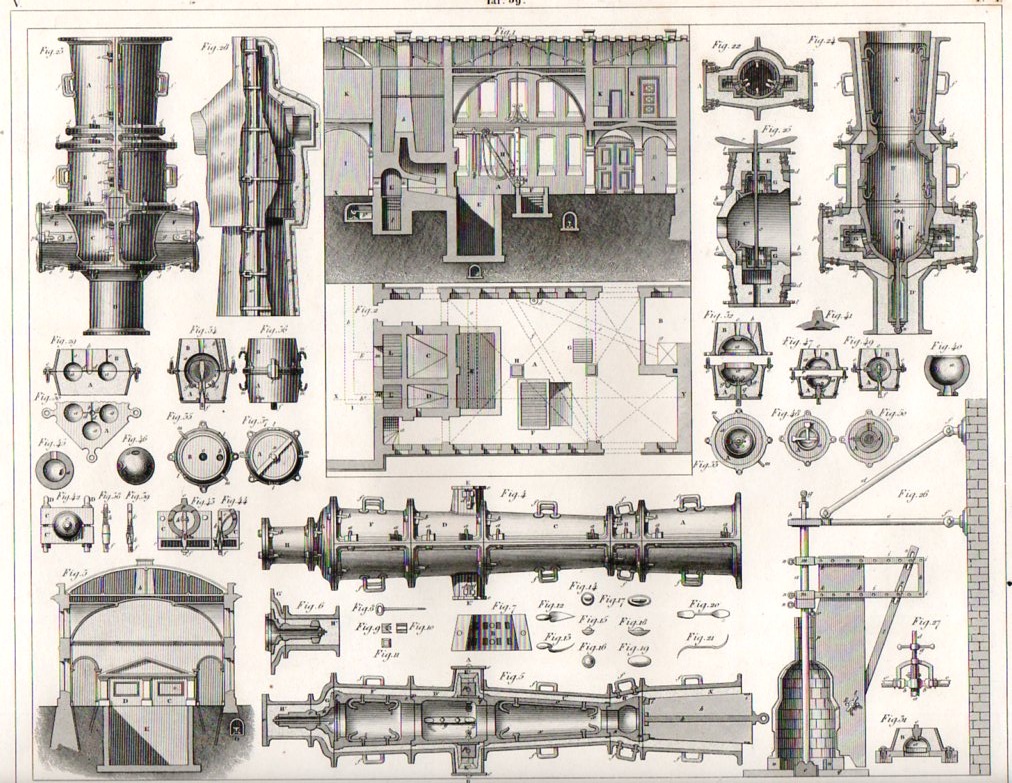
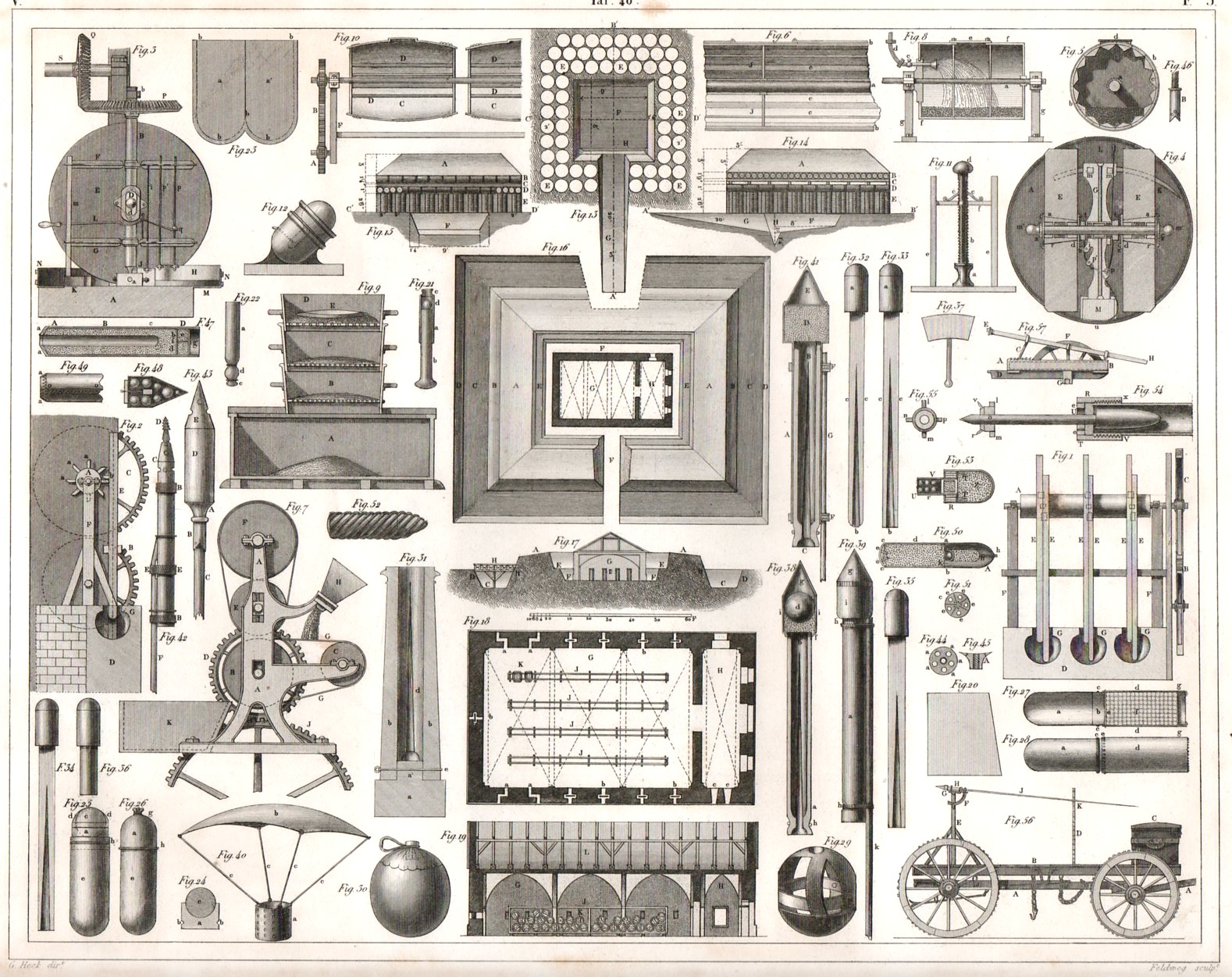
    The Iconographic Encyclopedia of Johan Georg Heck (printed 1851)  turns out to be perhaps one of the best designed books of its type in the nineteenth century.  Seemingly no  matter how much diverse information is hosted per page, whether the items number in the dozens or over a hundred,  the artist managed to distribute them with such grace and apparent ease that it is an absolute pleasure to see it all arranged before you. 

    Take for example the following two engravings of artillery fabrication of the early/mid 19th century.  There are 49 complex images on this first  piece of 11×8-inch paper (above), and yet there seems to be also a lot of white space.  It is a full but not crowded display of superb craftsmanship–it is also all very interesting. (Both are available for purchase from our blog bookstore.)

    To start, the main figures at top-center shop the plan and elevation of a workshop for casting canons, and we can clearly see the main furnace (“A”) for the big guns, surrounded by smaller auxiliary furnaces for smaller pieces.  Off to the side we see “K”, which is the drawing room and also the place where the director of the plant would live. Underneath it all in section we see various pipes and drains used to take away water and ash.  The structure on the lower right is for forming the business end and the purpose of the canon or mortar–namely, the ammo, and in particular, the pattern mold of a 50-lb mortar.  The long vertical pole at left used to place he liquid metal under pressure in the hearth, the ball being at the very bottom center.

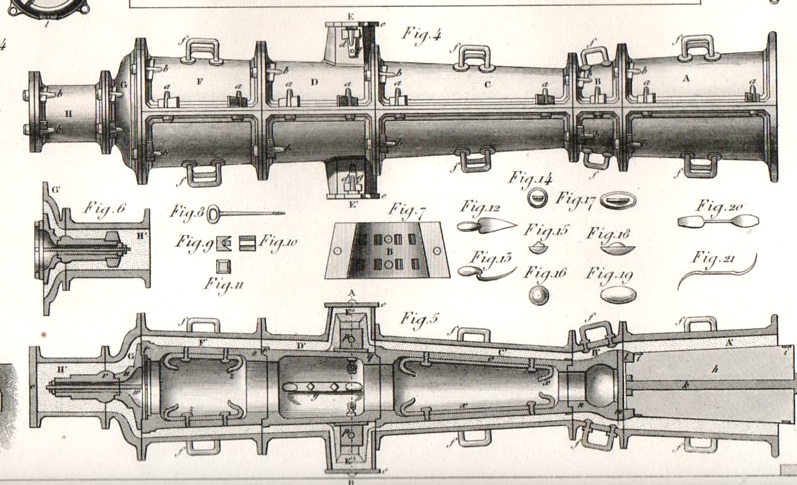
    I’ve enlarged figures 4 and 5 to show the particulars of a canon (dry sand) mold, #4 being the exterior of the mold and #5 showing a cutaway so that one could see the six-ponder canon that was being formed inside.

    Artillery286

    There is just so much in this image that a more knowledgeable person could easily go on for pages describing each and every bit. 

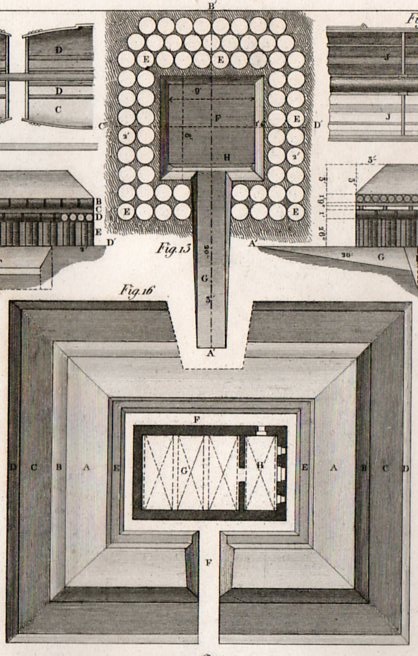
    The second image displays cartridges and (in general) fireworks–military pyrotechny.  What strikes me right away in this image are the five architecturals in the running vertically down the middle of the sheet.  They show what to do with gunpowder once it has been manufactured, which is an important consideration on handling and safety prior to it being used in battle–the first plan shows a field magazine, while the other four show the disposition of the construction of a permanent magazine, which show plenty of ventilation as well as massive walls which are in turn sunk into the earth and surrounded by ramparts.  It also seems that the roofing is huge, built no doubt to accommodate an earth filler.  Each of the barrels carried a hundred pounds of powder, so there was considerable interest not to allow the magazine to blow up, and if it did, to have the blast go mainly skyward. 

    Artillery287

    Some other items of interest in the second engraving include the incendiary devices (at bottom, #s 29+30),  signal rockets (#s 32,33,34,35), and the Congreve rocket, (#40 and #52,  which is much bigger and meant to be fired on the enemy, it being an incendiary); #53 is another Congreve, but this one scatters grenades as it is in flight. 

    Artillery288

    There’s a lot that can be described here but it goes a little beyond what I wanted to do with this post–it is also a lot beyond what I know about the subject.


  • Horses in the Sciences: Proving Nothing and Something

    JF Ptak Science Books   Post 1419   [Dedicated to our primum mobile family horse person, Emma Digh Ptak.]

    Horsepower281

    The history of horses in the sciences is not a very wide subject area, though I’d like to look at a few instances in which they help to prove both something and nothing–particularly in the third case below, when the “nothing” was a very big “something”. 

    First, in the history of horsepower (and such an odd history it is, having somewhat and famously to do with billing issues for steam powered engines) there is a certain restricted high-percentage element that are just no-go, unworkable ideas.  Some of them served as the basis for further and deeper thinking,and some of them were simply far ahead of the technical abilities of their times. 

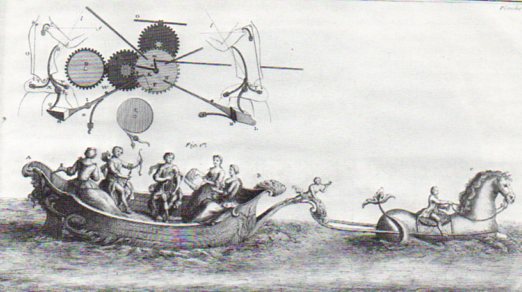
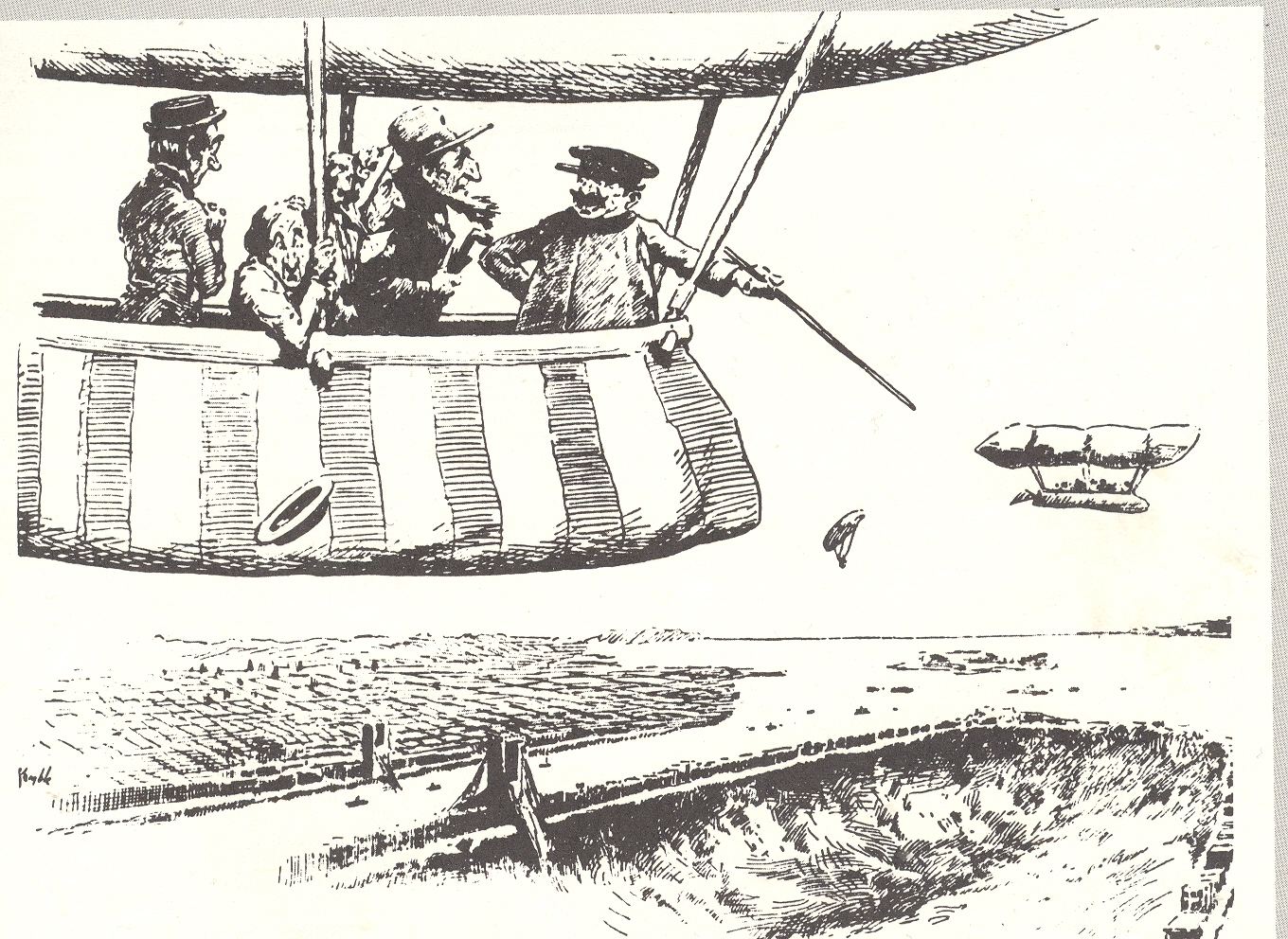
    In 1825 Edmond Genet1 published an interesting book (Memorial on the upwards forces of fluids and their applicability to several arts, sciences and public improvements) which in and of itself is a milestone in a number of different technical aspects–one part of it though sensationally and beautifully elevates itself to the Not-Quite-a-Good-Idea-at-Almost-Any-Time Department.

    Horsepower282
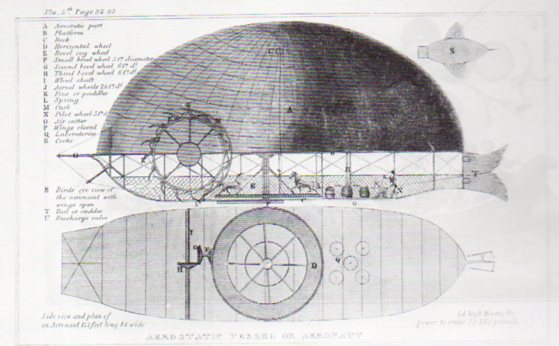
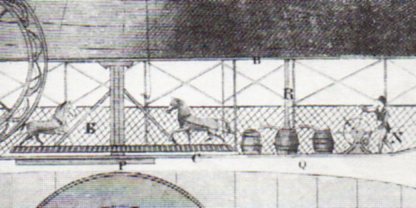
    “The actual plans of Genet’s airship called for a balloon shaped to resemble the rounded back of a large fish and containing about 1,023,000 cubic feet of hydrogen gas, with a platform or deck fastened beneath. Two horses, moving on a revolving wheel on this platform, were to provide the power for operation of a pair of large, silk-covered aerial wheels, while the rudder in imitation of a fish tail was intended “not only to steer the machine, but also to supply it with an additional force of propulsion”. –Genet in his Memorial…

    One thing that makes Genet’s work so impressive is that as a result of it he applies for and is granted the first patent made in the U.S. for a flying machine.  The flying machine he presented in his work though is a little problematic:  the canopy and the machine itself are not at all drawn to scale, and their size and breadth are lost a little in that under-representation.   I’d say that the figures in the drawing should be half of what they are, given that the flying machine was 132′ long and 46 feet wide (and 54 feet high), and the canopy was to be filled with a million cubic feet of helium.  The thing was a beast, and was supposed to be blessed with the capacity for lifting 72,000 pounds2.   The horses were along for the forward propulsion, moving two large paddle wheel-type wheels on either side of the airship.  It just doesn’t look right.

    Next is a tempting mechanism, an inset living inside a larger engraving depicting a mode of transport not-so-tempting.  It comes from Colonel Jean-Gaffin Gallon’s (1706-1775) Machines et inventgions approuvees par l’Academie Royale des Sciences....published between 1735 and 1777, and poetically covers its subject over a 111-year span from 1666 to 1777.   The massive work was illustrated with nearly 500 engravings covering all manner,shapes and description of technological invention and advancement, not the least of which was the first illustrated description of Pascal’s logic machine.  Amid all of this vast wealth of potentially revolutionary achievement,. I pluck out this equine example of possible nothingness: 

    Horsepower280

     which I am just not sure about, not having the text.  I can only hope that the horse was some sort of imaginary mechanical something, given its task and its size.  From the looks of its neck and the rider and the length of the horse, if it was a living thing it would have been gargantuan. 

    Here’s an appearance in the Gallon work (from 1735) of another, mechanical, horse that was used for stage productions, and which seemed fairly articulated:

    And thirdly, there is this, perhaps the most famous image of horses in the history of scientific illustration:

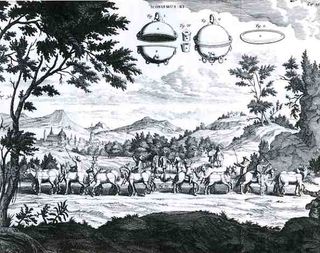
    Mantegna vacuum von guer

    This beautiful illustration is from one of the greatest experimental physics books of the 17th century, coming as it does from Otto von Guericke’s  Experiemnta nova (ut vocantur) Magdeburgica de vacuo spatio (Amsterdam, 1672).  (In another minute department, this one is also I guess the greatest book ever written by a Mayor of anywhere (as von Guericke (1602-1886) was mayor of Magedeburg for 33 years).)  The image shows the greatest of von Guericke’s efforts, and one of the greatest (or most important) experiments in experimental science–the dramatic demonstration of the vacuum, showing here that teams of horses could not pull apart two halves of an evacuated sphere, and of course the efficacy of air pressure operating against it (um, the vacuum). The “floating” bits in the sky were an exploded view of the sphere that was the subject of the experiment. 
                   
    What was more important though, and what the general reader today might easily miss, was that von Guericke created something that many scientists and philosophers said didn’t, and couldn’t, exist:  the vacuum.  In modern times, Copernicus depicted the universe as a vast void; Descartes came in the back door (following the ancient and interesting though incorrect theory of Aristotle), not liking the idea very much, and claiming that such empty space couldn’t exist.  Von Guericke provided the proof that the vacuum, that nothing, did exist.

    As a matter of fact the issue of nothingness was very contentious, with the concept of its possibility and the display of a vacuum not achieved until this effort by von Guericke, with his team of horses tugging away at the essence of nothing.

    NOTES

    1.  Genet is best remembered in American history as “Citizen Genet”, at least far more so than that being remembered for gentleman farming or his work in aerostatics and invention.  “Edmond Charles Genet had tried to recruit American volunteers to serve in the armies of Revolutionary France and to outfit American privateers to fight against the British. Despite President Washington’s orders for him to desist from his high-handed appeals to the American public, he continued the same practices until he was forced from office. Washington permitted him to remain in this country as a private citizen, saving him saving him from the possibility of being guillotined for his failure.” So writes the great historian of Science I Bernard Cohen.  It wasn’t altogether true though that it was Washington who saved Genet; his being allowed to remain in the U.S. was strongly pursued and lobbied by Alexander Hamilton, Genet’s greatest detractor/enemy/nemesis in Washington’s cabinet.

    2. By contrast, the Wright I Flyer (the famous first-flight airplane of 1903) had a wingspan of 40 feet, weighed 625 pounds and sported a 12 horsepower, 170 pound  engine (and which by the way was all produced for about a thousand dollars–not nothing, but not a lot).


  • Why I Like Pictures

    JF Ptak Science Books  Post 1369

    Hooke--flea


    Printed images are interesting in that they exist at all, at least in pre-modern (ca.1900) times. When you think of the total amount of time that humans have been thinking–like the possibilities of all total ideas for all people for the past, say, 10,000 years—and think about the 10×10^9 neurons firing for everyone all the time, and the numbers of books and pamphlets and journals and such printed before 1900, the access to the archive of the human condition looks a little paltry compared incomprehensible amount of good thinking that has gotten away. (Humans haven’t helped themselves all that much in this regard, given the deep, long, wide history of the planned destruction of libraries throughout time.) 

    There are more stars than books. Lots more—10^22 stars versus 1.3×10^8 books (or the stuff that an odd Google study classified as “books” for their scanning and advertising appetites). There’s also bacteria and other microorganisms alive in/on the human flora than books (and blood cells too for that matter). Until the 18th century (and really into the 19th) the practical means of producing a book were set to restrictive, upper-class access. For most of human history the ability to even record a thought on transportable material was a deep issue; getting it reproduced somehow was extraordinarily difficult, especially if you belong to the not-yet-existent working class. Even if we just consider works that are 1455-1800 era the illustration was not a common thing, which is odd to me since it seems the image could show in less space what was being described in the text (and for argument’s sake here we’ll just say that production facility for the illustration and a page of text were equal). I have a funny feeling that if you weighed all of the pages of text against all pages of illustration in all books published from1455-1800, illustration would be enormously, fabulously outweighed.

    Which is why in my mind “pictures” are so interesting—they are rare, and so that when they were published they were deeply considered objects.

    All this changes though in the nineteenth century when production facilities increase, costs go down, the finished product is available more cheaply to a growing class of people who work for a living and have a disposable income. Newspapers and magazines begin for real in this century, paper costs go down, ability to print at high speeds goes up, and suddenly there exists an addition to the concept of “disposables” —information commodities. For the first time a mass of material is produced to be replaced in the next day or week, disposable reading material. There are more images reproduced and distributed in this century than in the entire history of man on earth. Of course all of this look like nothing, today, now that almost everyone in the U.S. (at least) can be their own publisher/producer of original or found work, which means of course that people in 2086 will look back oat our abilities as we do on the 19th century. And so it goes.

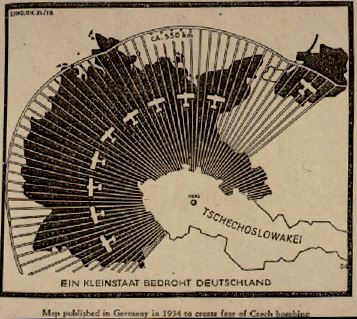
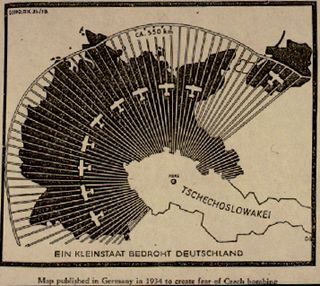
    This is why I like pictures—they’re comparatively rare, and the tell as much of a story as you will allow. I enjoy scientific and technical images as much as anything, for their dreamy amount of detail and revolving possibilities of 3-D display and such; maps too, for pretty much the same reasons (and that one usually doesn’t memorize them, at least not the detailed ones). Of particular interest on this blog has been maps-with-a-purpose, particularly  cartographic propaganda, like this 1937 Nazi-published map showing the “danger” posed by the Czechoslovakian air force to Germany.  Blog jan 3 czech airIt is a graphic representation of the Big Lie, an element of design intended to transmit an idea to a reader who really doesn’t need to do so, being able to get the idea of the the data being presented in the map in one quick visual.
    The scientific images demand that you see the difference with what came before to truly appreciate them—one of my favorite examples of this is Robert Hooke’s engraving of a magnified flea. The microscope was brand new, and this image, which appeared in Hooke’s magisterial,epochal work Micrographia1, presented as much of a new world to people in 1665 as Galileo’s reporting in Siderus on the massive number of new stars that he had seen with the telescope he used to look up rather than just across. People would have had no idea that such a magnificently detailed creature such as this flea existed, as they simply couldn’t see it. Same too for the stars, which (with the exception of Brahe’s Nova and such) had been seen to be “perfect”, an harmonious fixed number, though a relatively simple innovation using materials that had been around for centuries brought a new world to bear. (One is tempted to say that in his new, massive book that Hooke included “only” 38 images; but one has to remember that Hooke did all of the drawings by himself, and actually rushed the book into print as he sensed a market for it which combined nicely for his need for money..Hooke was correct about the market for the book.)

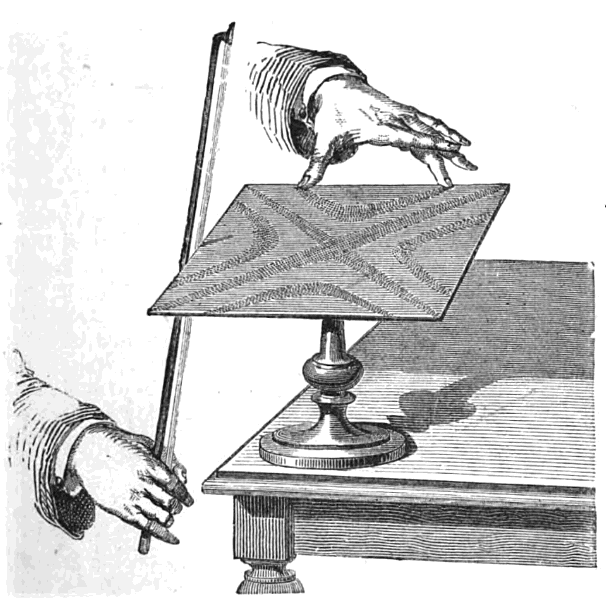
    The purpose of some scientific images are difficult to identify when faced with them for the first time and out of context, but once rectified they can be beautiful renderings of complex relationships, like Ernst Chladni’s patterns of vibration revealed to us via sand on metal plates (in his Discovery of the Theory of Pitch, 1787), and the Weber brothers’ exacting drawings of wave forms  (from 1825) (and shown below, respectively).
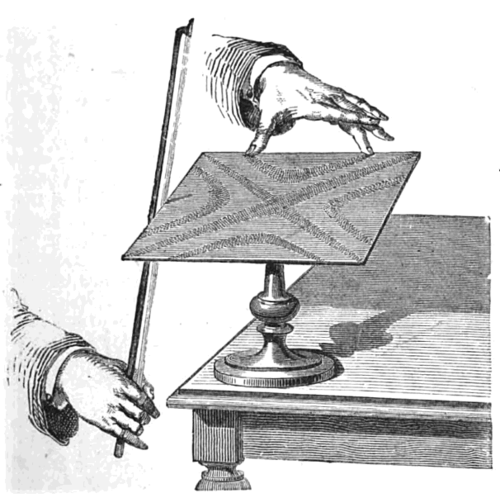
    Bowing_chladni_plate

     
    Adding mercury to mercury: the sensational drawings by the Weber brothers as they observed the changing wave fronts made by a drop of mercury into a pool of mercury:
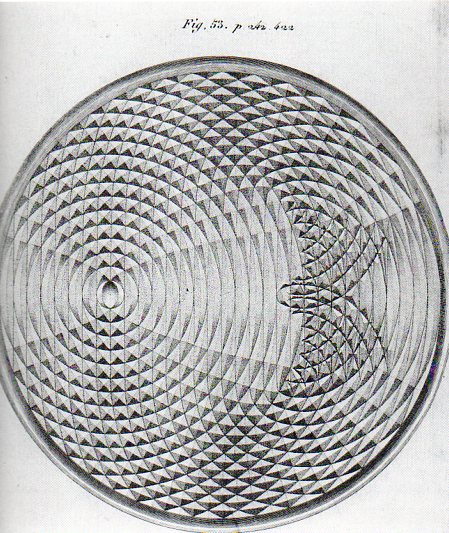
     
    Weber acoustics461

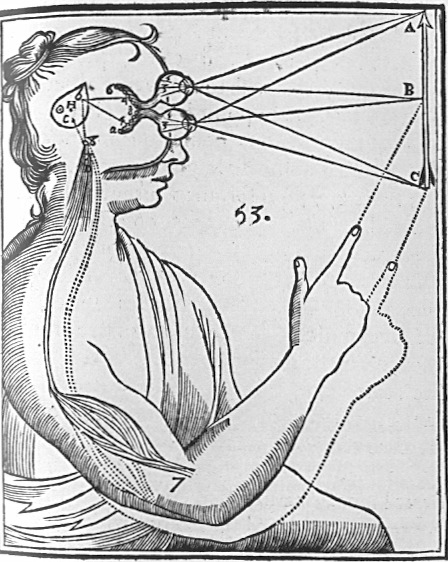
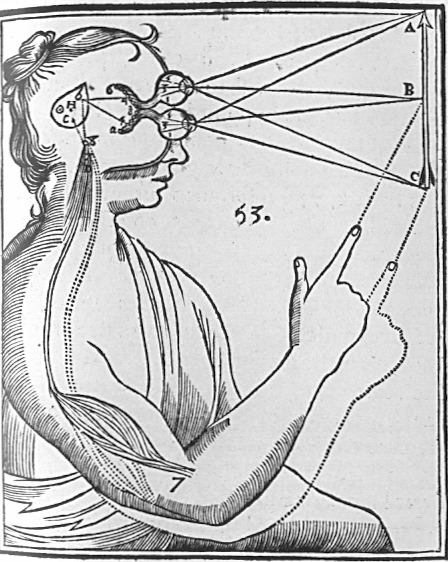
    Rene Descartes depicted the interpretation (in his  Principles of Philosophy of 1644) of light and its physiological reaction in the brain in this iconic image, as follows:
    Cartesian_Vision

    the lines of sight depicting binocular vision, observed (and compressed) by the eye’s “particles” and processed by the pineal gland which in turn manipulate the “fluids” in the control of nerves and muscles. 

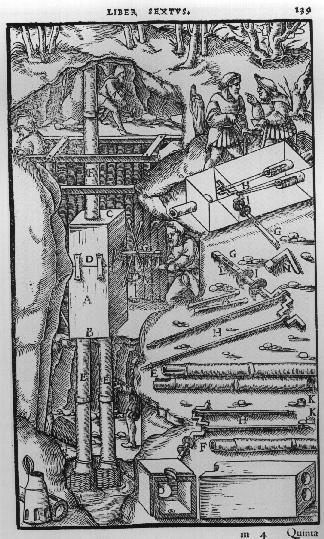
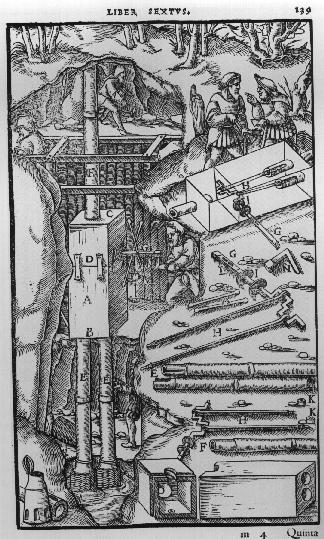
    Agricola’s De Re Metallica (from the first Latin edition f 1556) displays many interesting cross sections of Renaissance mines:
    Agricola

    There is so much more, and it may be possible that there were millions of pages of illustrations during our time period.  Harvey’s demonstration of the flow of blood in the human body pictured by fingers and a forearm (in his On the Motion of the Heart and Blood, 1628), Descartes’ analysis of how the human eye “sees” (An Analysis of the Eye, 1637), Agricola’s cross sections showing how to construct mines (1556), Scheiner’s illustration of the apparatus he built to observe sunspots (1611),  Borelli’s study of the mechanics of the human body (1680), Rosalind Franklin’s x-ray photograph of DNA (used by Watson and Crick to depict the structure of DNA), Thomas Young’s illustration of light-wave interference (1803)

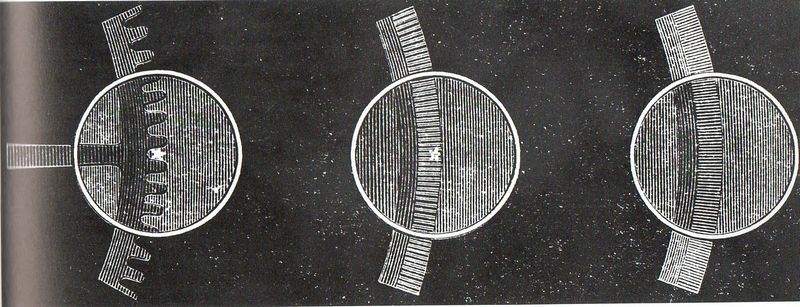
    Then there are the pictures of the interior of the Fizeau apparatus as it captured the velocity of light so:
    Aaa-light fiz gears158


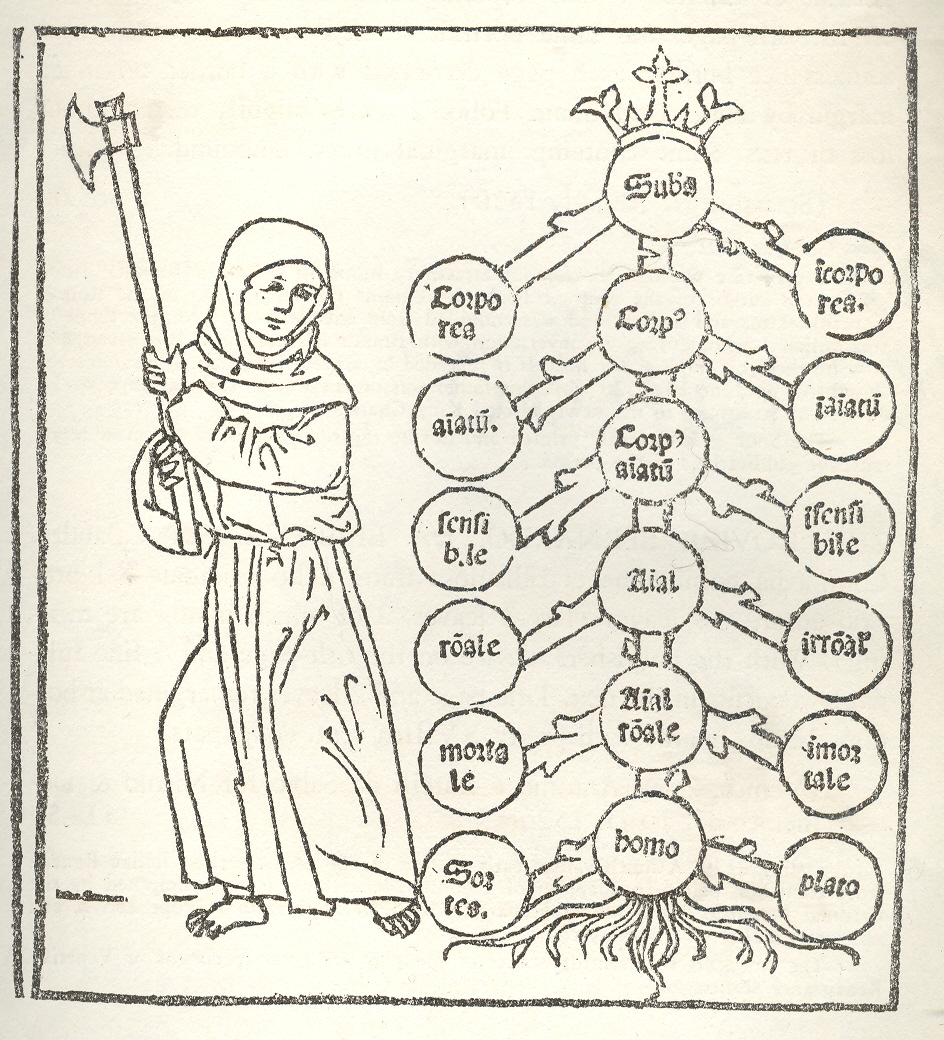
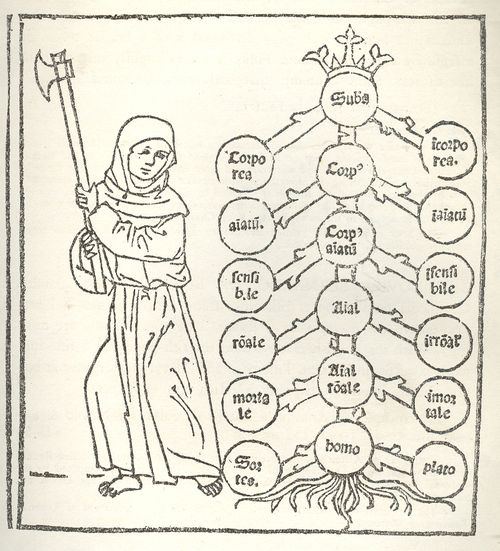
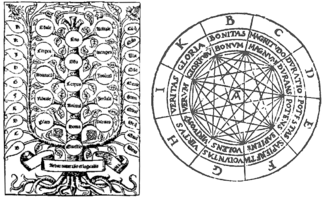
    Classifying images, like this of Porphyry’s (logic) Tree and Raymond Lull’s diagrams of life and decision, are in constant appearance for centuries, excellent ways to provide method and organization to large quantities of information and for problem solving. While not exactly a generator in the sense of Jorge Borges’ Library of Babel or Jonathan Swift’s take on Lull’s writing machine, the antiquarians did produce very interesting, elegant, beautiful ways of story information and ordering information.  The Tree of Porphyry is far more concise–an abbreviation–compared to the infinitely expanding hexagonal rooms filed with books and attendant librarians in  Borges’ universe. 
    1--logic tree

    The Ars Magna/Thinking Machine of the 13th century Lull (also known as Ramon, Raimundo and Raymond, Raimundus and Raymundus Lull, Lully and Lullus and Lulio), was the ultimate organizer of how sentences can be made and knowledge produced/uncovered (particularly if you want to please the logic of the church and the Creator), and which was also written about, described and worried-over by Borges.  There are many other early figures in this category to be sure (Lewis Carroll, William Jevons, and even in a way Mr. Venn, not to mention Leibniz and his calculator,  and all of the changes in scientific method and (English/Dutch) mathematical concentration on applied mathematics of the 17th century that made thinking about the industrial revolution possible.
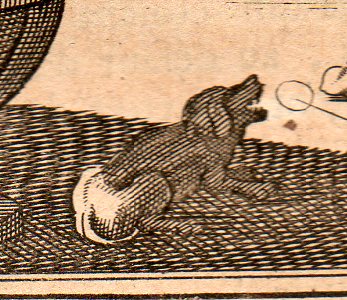
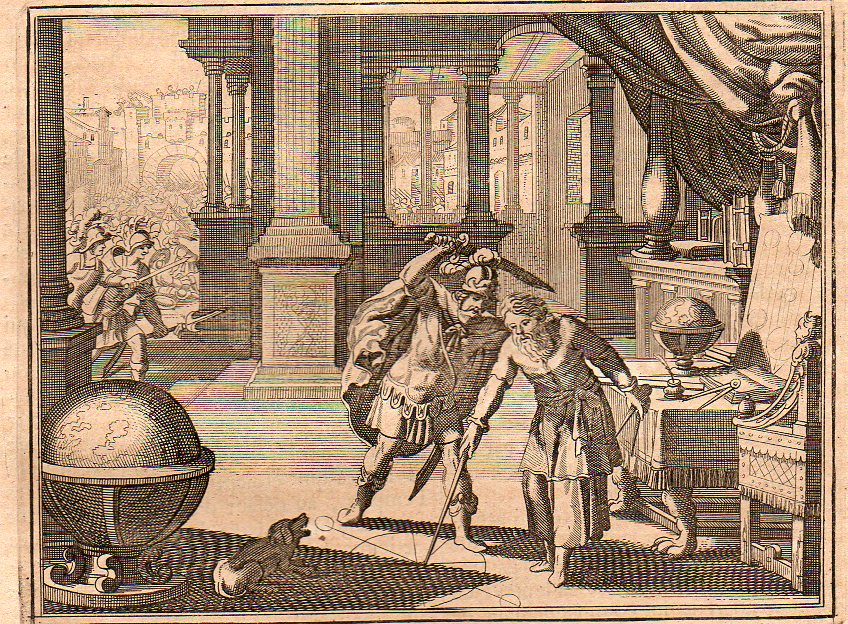
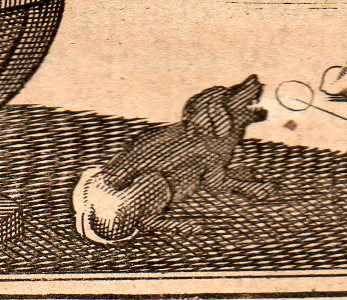
    Images of ebb and tide, of cause and effect, of bones inscribed in clouds and solids manufactured of gas, of the steps of discovery, of the integral drawing of the integral pieces, of cross sections detailed enough so that you too could build your own locomotive, or guide yourself through a paper transverse dissection of the human brain–this is the great essence of images. It is interesting to look at these things forensically, to identify all of their components and articulate the symbolism, to look at the image cautiously, judiciously–sometimes this just results in insights into the artist who may have been tired and was working through just another piece of drudgery and tried to make their work a little more entertaining.  This doesn’t add much to the understanding of the event, but it does give the scene a fullness,  like, for example in this image of the killing of Archimedes from  Histoire Universelle published by the ubiquitous Peter van der Aa in Amsterdam at the turn of the 18th century–it falls in line with many of its comrades of this event  in that it depicts the tragedy in the second before it occurred.  One thing it has that other scenes do not–a barking dog.  Maybe it belonged to Archimedes, maybe not.  But there was a dog depicted here, and it was barking at the scene, probably barking at the man about to stab the mathematician, which means it would’ve been the mathematician’s dog.  But Archimedes certainly didn’t hear the dog if he couldn’t be interrupted by the battle outside his door or the Roman who yelled at him to turn.
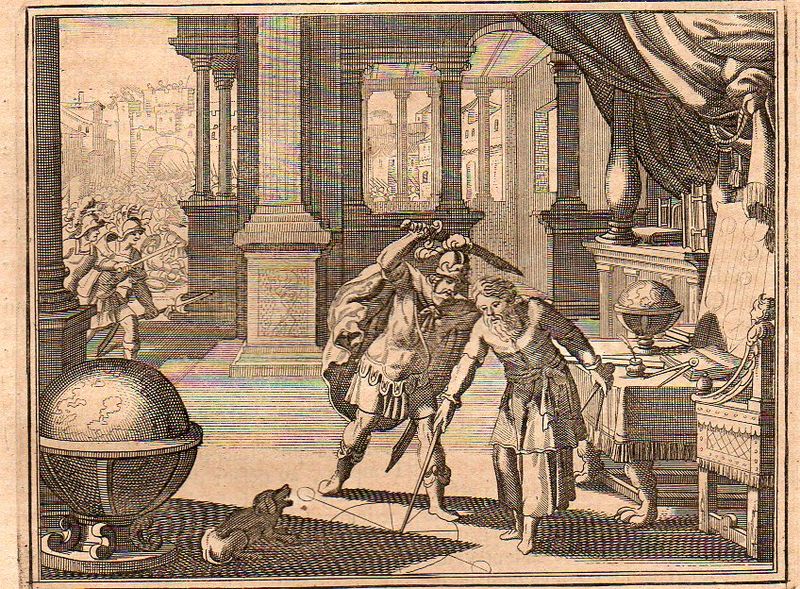
    Archimedes 1705348 

    Archimedes dog 1705349


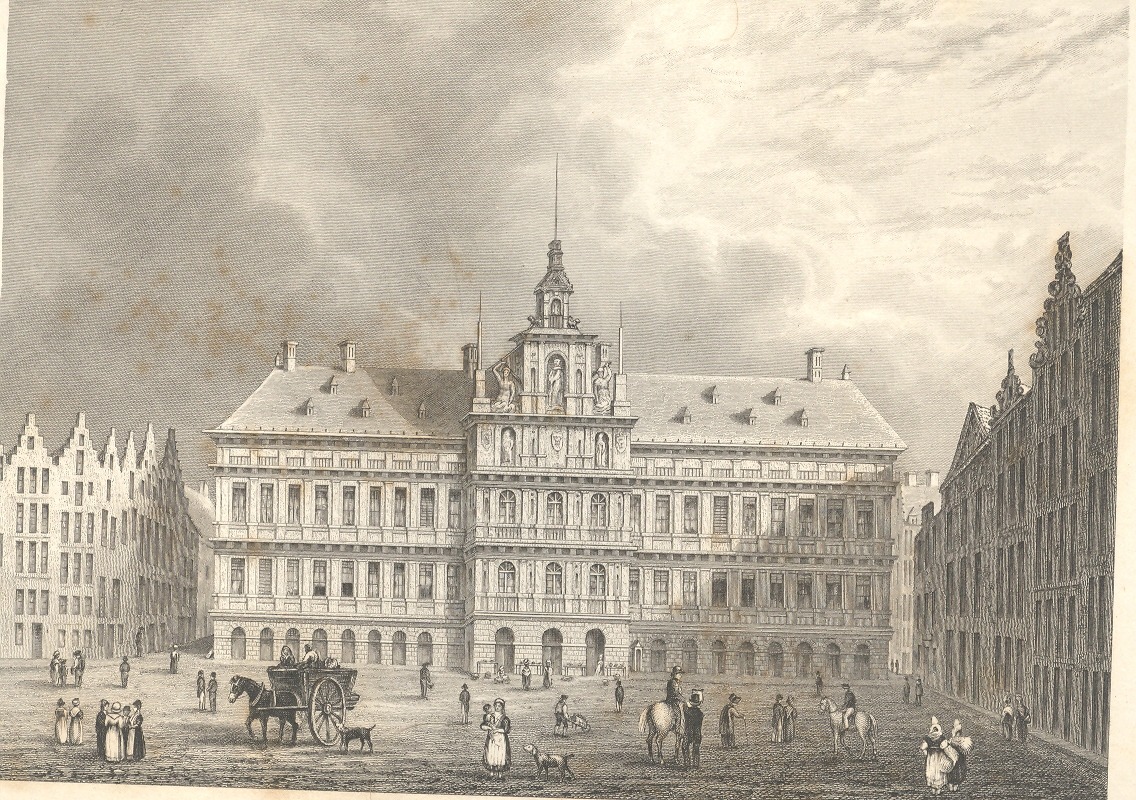
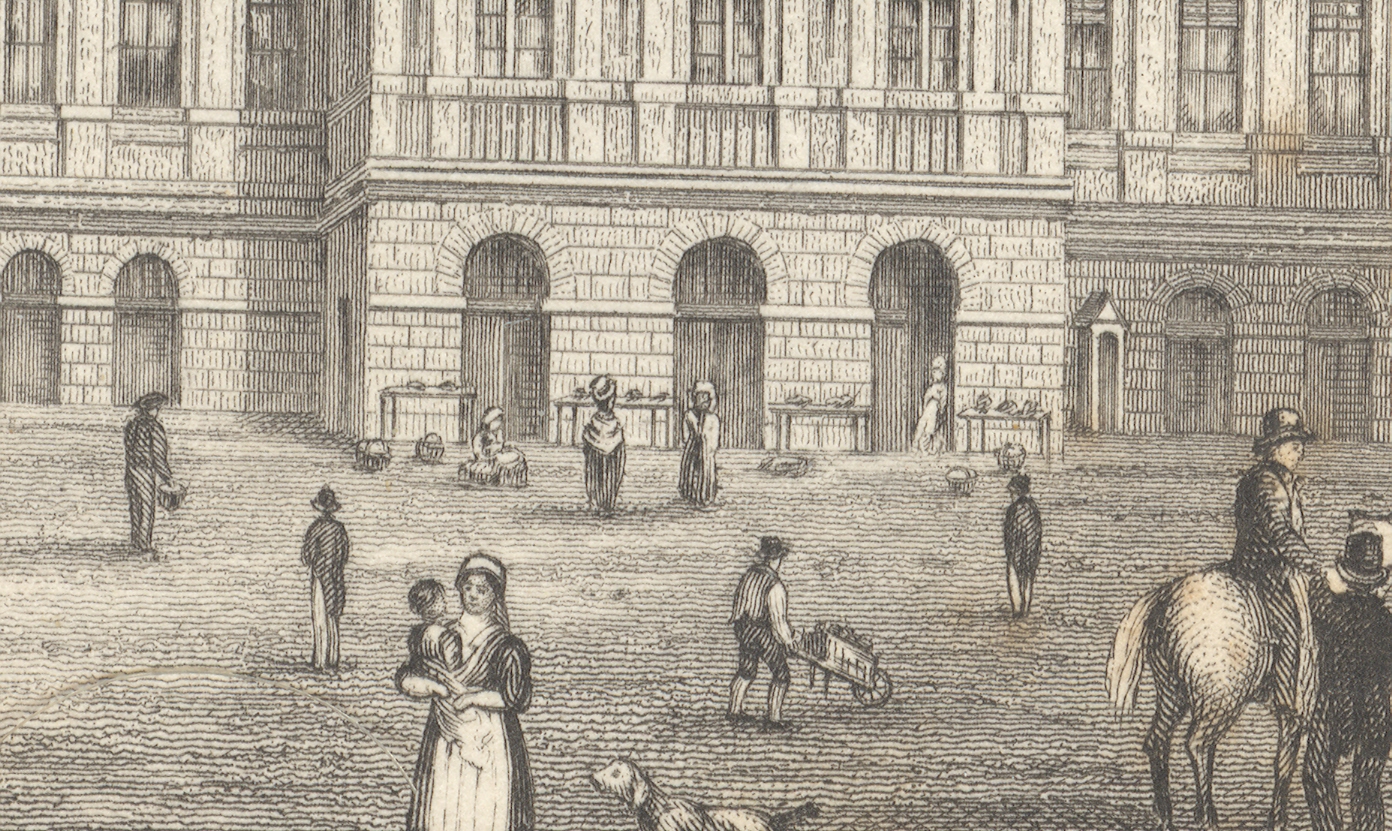
    This blog is written and illustrated around the very loose idea of “the history of ideas”, and is quite image-driven–there are probably about 5,000 pictures reproduced here now, a wide selection of illustrated thinking in the sciences and many other fields.  This includes one classifications of an image series that really don’t exist—I mean they were images intended for one purpose but for the passage of time (and sometimes removing them from context) they become something completely different, entirely new, providing unintentional insights into their artists and times.  I find exploring in images this way to be fascinating, noticing the semi-hidden and/or unnecessary, extravagant, extra-necessary bits that were intentionally placed by the artist, as in this example of Archimedes’ dog, or with the characters that are sometimes found as “filler” and which are basically wholly unrelated to the intention of the illustration.  For example in this application of the imaginary forensic arts microscope, we see this series of pictures of a standard view of the town hall of Antwerp; but what we see advancing under magnification is a very interesting set of occupations displayed in absolutely minute detail.

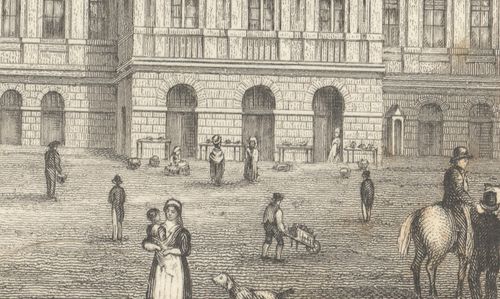
    First, the majority of the engraved image, followed by a close-up of the center of the building (the three doorways), and then by a closer view still of doorway three:
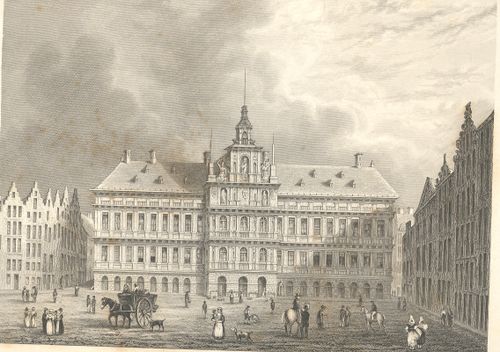
    +++looking closely

    +++looking closely detail

    The truly interesting bit here is barely observable in the original; but, under magnification, we see a very rich and minuscule “engraved photograph” of a slice of daily commerce and street life in Antwerp.  If you look at the central entrance to the town hall you can see three main (and large) doorways, and if you look clos+++looking closely detail2er still, you’ll see something leaning against the portal at right.
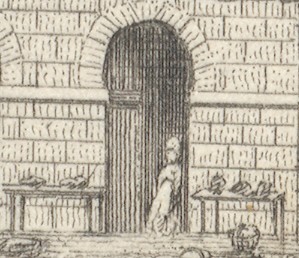
    Extraordinarily, what the artist snuck into the original is a tiny (2mm) figure watching over several tables of her (fruits?/vegetables?) ware, waiting for a customer. There doesn’t seem to be much interest in her stuff, currently, and she has allowed herself a little relaxation, leaning against the doorway.  I’ve found this sort of extremely minor subject matter and its ephemeral connection to the larger work at hand to be just fascinating.  I wonder why such detail would be added–why would the artist, or engraver, take such care and interest in such minor visions.  Perhaps this is just what was at hand on the days the artist fleshed out his work; perhaps it was the work of the engraver, alone, incising yet another semi-boring architectural image; desperate for a little artistic activity, adding some interesting, almost-invisible touches, here and there.  Perhaps no one would ever really notice them, but whoever was responsible for adding such incredible, extra-dimensional details would certainly enjoy knowing they were there, recognized or not.

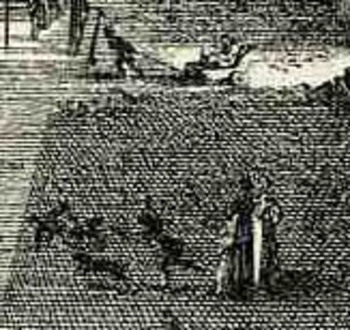
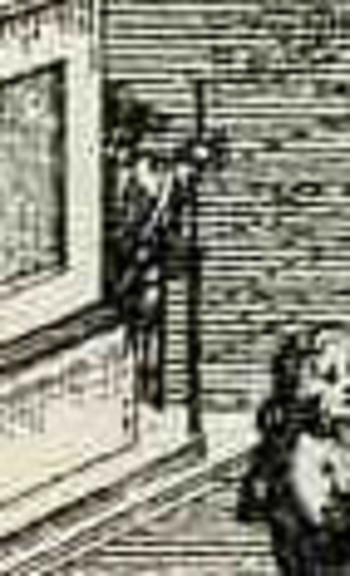
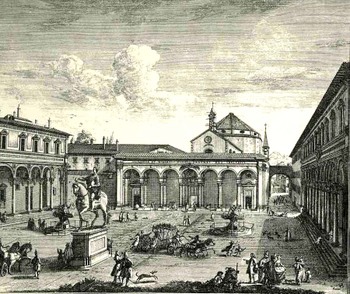
    Another good example is found in Guiseppe  Zocchi,Veduta della Piazza della SS Nunziata Statua Equeftre di Ferdinando Primo, Fonti, e Loggie Lateral,shows more good work with the possibilities of ephemeral populations, where among the many details we see an invalid being pulled in a small cart, and a half-obscured  man with a staff leaning against the back of the monument.  And of course there’s much more–you just need a little magnification to see the human element of the artwork. 
    Bloglooking_closely_1_96123

    Bloglooking_closely_1__carriage_2

    Bloglooking_closely_1__man_caneAt the end of the day one of the most enjoyable of all image classifications for me  are the classifications of image series that really don’t exist—I mean they were images intended for one purpose but for the passage of time (and sometimes removing them from context) they become something completely different, entirely new, providing unintentional insights into their artists and times. They are also on the outer-edge of being pre-Outsdider Outsider art.  One of my favorite examples in this genre is this 1941 pamphlet which isn’t so much “interesting” as it is interestingly illustrated, where all of the semi-coherent  interest resides, the text having left coherence far behind, somewhere, in it own intergalactic dust. When I first encountered it this was the only instance that I had ever seen of New York City floating in space with the Earth floating happily in the background–now I’ve collected at least three other extra-New-York-City’s-in-space in the last few years. 
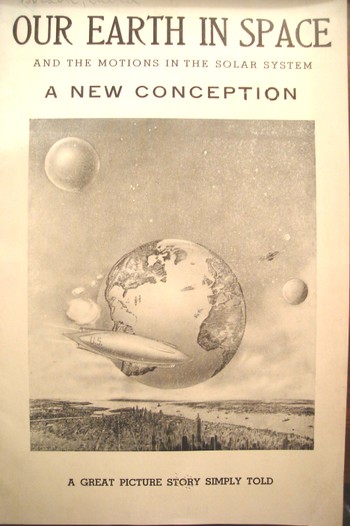
     

    Dsc04543


    This is also a nice example of extra-NYCs, where there are several other instances, balancing out the larger collection of the opposing missing-NYCs, like this 1902 example showing the city sunken and out-of-sight, disappeared under its own weight:
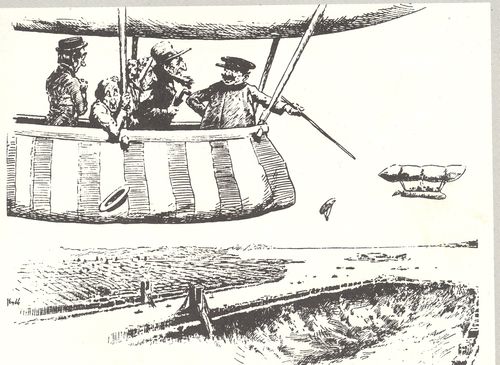
    3--nyc gone

    There’s also the sub- or  supra-category of extra-Earths department, where I have at least five other examples, including this remarkable effort by Victor Segno of Los Angeles, who in 1929 published this fantastic image depicting extra-human empty alien souls being dropped on the earth to repopulate the place after it had been cleared out by “brain waves”.

    And so I guess that would be the perfect place to exit this short appreciation of pictures. 

    ____

    Notes.

    1.  As Hooke states at the end of the 28-page introduction  to the work: …”it is my hope, as well as belief, that these my Labours will be no more comparable to the Productions of many other Natural Philosophers, who are now every where busie about greater things; then my little Objects are to be compar’d to the greater and more beautiful Works of Nature, A Flea, a Mite, a Gnat, to an Horse, an Elephant, or a Lyon.”.

  • Children, Artillery and the Geometry of Cannon Fire

    JF Ptak Science Books  Post 1366

    Cannons ha003

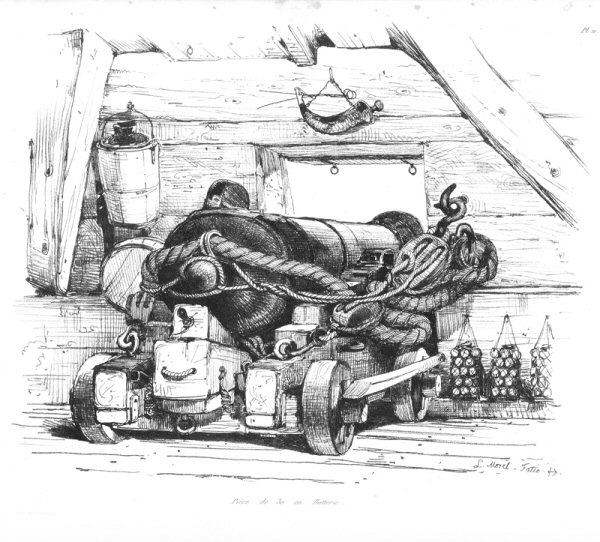
    There were many integral components to firing a cannon on a ship, not the least of which were the Powder Boys, the small, young, semi-strong kids who would run the gunpowder from a below-decks armory to whatever gun deck was needed.  It was a relatively simple procedure, filling up a longish tube (cannon  derived from the Italian  cannone–or large tube–which came from the Latin canna from the Greek  kannē , meaning something like a reed or any similar hollow thing) with gunpowder and then cannonball/shot and then wad, then causing the gunpowder/propellant to ignite and throw the ball.  Basically, that was it, though you needed to maintain the cannon, aim it, and so on (don’t forget to first swab the bore from unexploded gunpowder so you don’t blow things up!).

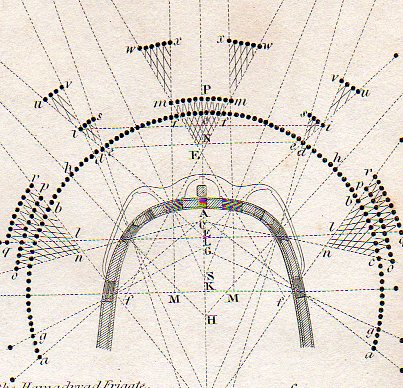
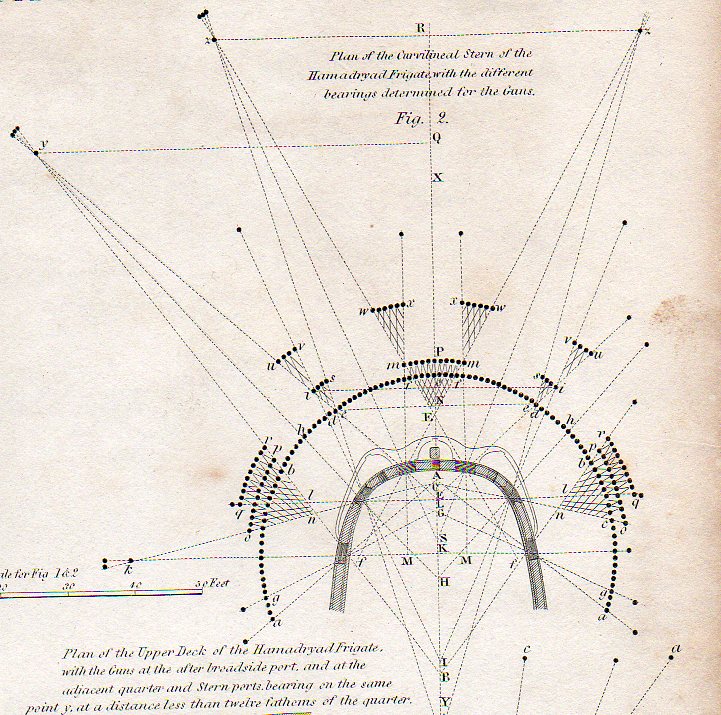
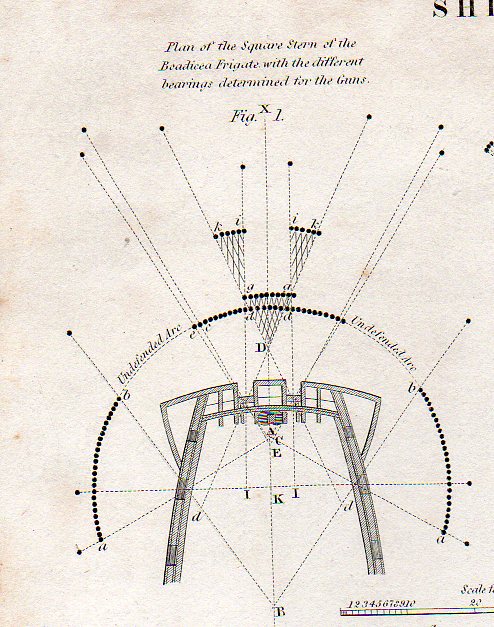
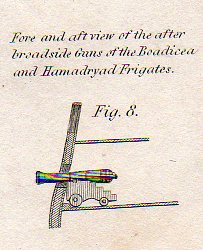
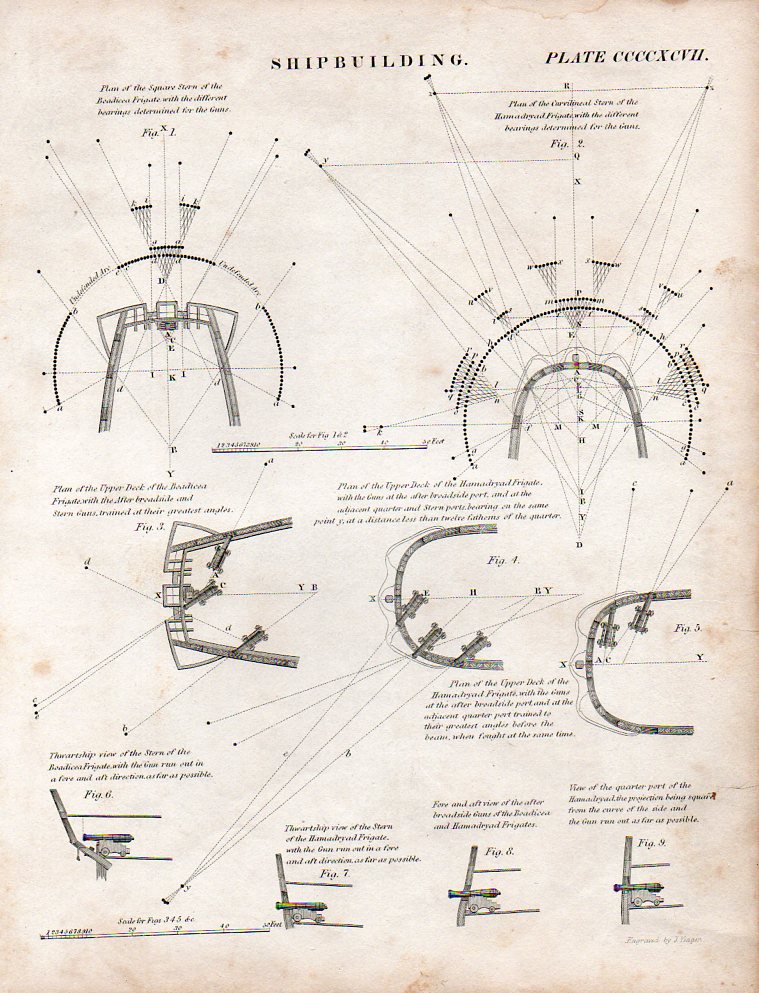
    The (first)  image above of found modernist/semi-dadaist artwork comes form 1812 and was found in Rees’1 Encyclopedic Dictionary from the article on “Shipbuilidng”   and illustrates the ways in which the stern of a ship can be outfitted with cannons–actually, the sterns of the HMS Bodiceae (28 18-pounders)  and HMS Hamadryad  (36 guns). Also by this time cannons had been carried on naval ships for nearly four hundred years, while the first cannons appeared on the ground in Europe another few hundred years before that. 

    Cannons ha002


    In the third detail (below) we see the coverage of the four cannons placed in the stern of the Bodicae, mainly pointing out its weaknesses, showing the undefended arc, which comprises about 1/3, or about 60 degrees of the defensive posture.  The Hamadryad on the other hand shows 100% coverage of the 180+ degrees of attack possibilities shown, along wioth secondary and teriary areas of fire coverage covered by mor ethan one gun.

    Cannons b004

    A fine,tiny detail from the full engraved sheet:

    Cannons little005 And the full sheet, available at our blog bookstore:

      Cannons001

    This is pretty much all that was needed to fire a cannon, except the men of course.

    File:Antoine Morel-Fatio pl10.jpg

    NOTES:

    1.   I’ve written about before here, just enter “Rees” in the google box and there will be a dozen or so other posts.

  • History of Anticipation–a Note on Not Discovering Deep Sky In England (pre-Galileo)

    JF Ptak Science Books  Post 1365

    “‘Tis all in pieces, all cohaerennce gone”–John Donne1

    I wonder why it was that the telescope didn’t get trained at the sky in Great Britain.  Its one of those “things/non-events” when everything is in place for something very big to happen, when the pieces are there and sorted, when the theory has been thought out, when the practical applied work has been done–and then, a turn-away is made, a drifting occurs, and the big thing doesn’t happen.  A deep reluctance sets in–and since it is the anniversary of Darwin’s (and Lincoln’s) birthday, it seems natural to include Darwin in a history of anticipation category, since it took him so very long to come to enough of a comfort level to actually publish his Big Idea, and that seems to have been done on the intersession of an editor and thought leader (Huxley) and the fact that someone else was going to beat him to publication (Wallace).
    But what I’m talking about here is John Dee’s work with “perspective glasses”–the telescope–in the 1560’s and 1570’s and the idea of which he writes about in his Description of Caelestiall Orbes, thirty full years before Galileo’s epochal Sidereus Nuncius of 1611.

    The promise of the telescope is also seen in the work of Dee’s pupil Thomas Digges (half of the Digges’ brother scientific team, the other brother being Leonard), who writes of it in his Alae sue Scalae MAthematicae, 1573; and again in the Treatise on the A treatise on the properties and qualities of glasses for optical purposes, according to the making, polishing, and grinding of them by WIlliam Bourne (see here) where among other things claims to have uised his instrument to see things seven miles away (beautifully put so “not only discovered things farre off, read letters, numbered pieces of money…but also seven myles of declared what hath been  doon at that instante in private places”, meaning that he was able to discern print at some distant and to also see what would have been private things from an unthinkably distant distance)2. 

    And as Marjorie Nicholson  observes in Science and Imagination (Cornell, 1956), this point is again made by yet another Englishman, Thomas Hariot, who is best remembered today for his beautiful and early work on the American southeastern coast, published in 1691 (A Briefe and True Report of the New Found Land of Virginia), in which he describes his own telescope, “a perspectiue glasse whereby was shewed manie strange sightes”. 3

    It seems though that among all of this accomplishment that the telescope–as had been the early case with Galileo, and who had also overcome the instrument’s horizontal hold–was used laterally, more an instrument for navigation and the field commanders of armies.  Why it was not pointed to the sky, I do not know, but it does seem as though Donne’s words were waiting more for Galileo than for anyone else. 

    Notes:

    1.  This is from Donne’s AN ANATOMY OF THE WORLD, Wherein,by occasion of the untimely death of Mistress Elizabeth Drury, the frailty and the decay of this whole world is represented THE FIRST ANNIVERSARY:
    “And freely men confess that this world’s spent,
    When in the planets and the firmament
    They seek so many new; they see that this
    Is crumbled out again to his atomies.
    ‘Tis all in pieces, all coherence gone,
    All just supply, and all relation…

    2. Bourne did come very close, but his work was to stay in manuscript and not published, even though he was a known scientific quantity in his day (and found in the  Philosophical Magazine, 1839):

    3. A Briefe and True Report of the New Found Land of Virginia : of the Commodities and of the Nature and Manners of the Naturall Inhabitants : Discouered bÿ the English Colonÿ There Seated by Sir Richard Greinuile Knight In the ÿeere 1585 : Which Remained Vnder the Gouerenment of Twelue Monethes, At the Speciall Charge and Direction of the Honourable Sir Walter Raleigh Knight Lord Warden of the Stanneries Who therein Hath Beene Fauoured and Authorised bÿ Her Maiestie and Her Letters Patents / This Fore Booke Is Made in English by Thomas Hariot seruant to the Aboue-Named Sir Walter, a Member of the Colonÿ, and There Imploÿed in Discouering ; CVM GRATIA ET PRIVILEGIO CÆS. MATIS SPECIALIi. Francoforti ad Moenvm, Typis Loannis Wecheli, Svmtibvs Vero Theodori de Bry anno CIC IC XC. Venales Reperivntvr in Officina Sigismvndi Feirabendiii

    he entire text, with the tremendous John WHite illustrations, is located here.

    On page 27 we see:
    “Most thinges they sawe with vs, as Mathematicall instruments, sea compasses, the vertue of the loadstone in drawing yron, a perspectiue glasse whereby was shewed manie strange sightes, burning glasses, wildefire woorkes, gunnes, bookes, writing and reading, spring clocks that seeme to goe of themselues, and manie other thinges that wee had, were so straunge vnto them, and so farre exceeded their capacities to comprehend the reason and meanes how they should be made and done, that they thought they were rather the works of gods then of men, or at the leastwise they had bin giuen and taught vs of the gods. Which made manie of them to haue such opinion of vs, as that if they knew not the trueth of god and religion already, it was rather to be had from vs, whom God so specially loued then from a people that were so simple, as they found themselues to be in comparison of vs. Whereupon greater credite was giuen vnto that we spake of concerning such matters.”


  • Technical Drawing: an Early, Convict-Powered, Revolving Turret Ship

    JF Ptak Science Books   Post 1364

    Technical drwg--revovl turret circular540

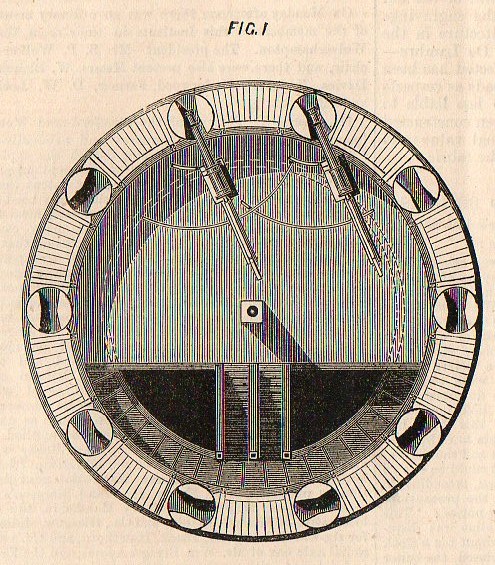
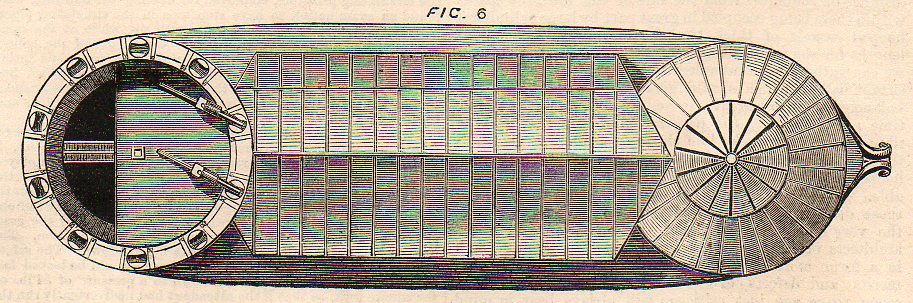
    This image (from the The Engineer for 30 October 1874) shows a plan of the top floor of a revolving battery designed by M. Baltard in 1831 (and which is available at our blog bookstore).  This idea is probably ancient, though it really only had major technological legs by the 19th century. Even though Baltard is given some fair credit for the modern rediscovery of the revolving turret–and in this short article he is given premier status–there were earlier engineers at work before him.  For example, in the earliest part of the 19th century Col. John Stevens designed a saucer-shaped floating battery that was supposed to be able to fire in any direction; T.R. Timbly–slightly after Baltard–applied in the U.S. Patent Office in June 1843 for a device he called a “metallic revolving fort”.  Then came the great John Ericsson–very long on accomplishments but very short now in modern memory, he is also one of those memorialized men in marble in DC for whom people have almost no modern recognition–who in 1854 produced an “impregnable battery revolving cupola”, which led to his great innovation on the Monitor.  And as we recall, the Monitor’s defeat of the Merrimack in Hampton Roads in 1861spelled the coming end of the wooden ship of the line–metal ships with mounted revolving turrets fore and aft would prove entirely too far superior to the 19th century wooden ship.

    Technical drwg--revovl turret537

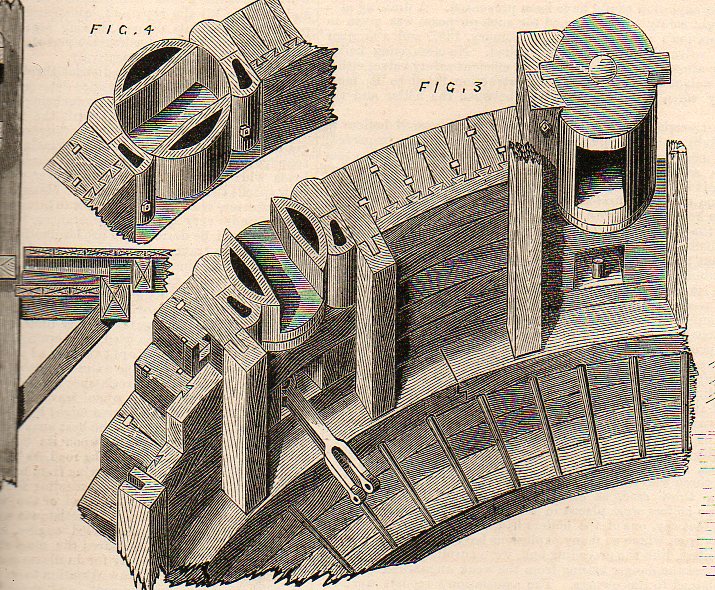
    What we are seeing in the first engraving is the top floor of a two-story fortification–roof removed–showing the floor plan of the battery.  The walls and roof were stationary; the floor was not.  The two cannons were located on a revolving floor and were moved by turning the floor (basically) to one of the open firing windows (embrasures) a detail of which is above. When the barrel of the canon was pulled out of this opening, it was turned closed to prevent any fire coming into the fort.

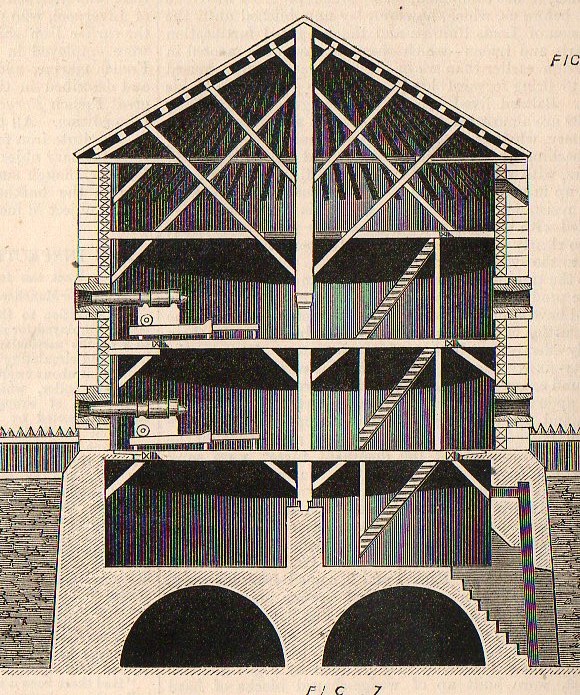
    The engraving below shows a cross-section of the two-turret land structure.

      Technical drwg--revovl turret535

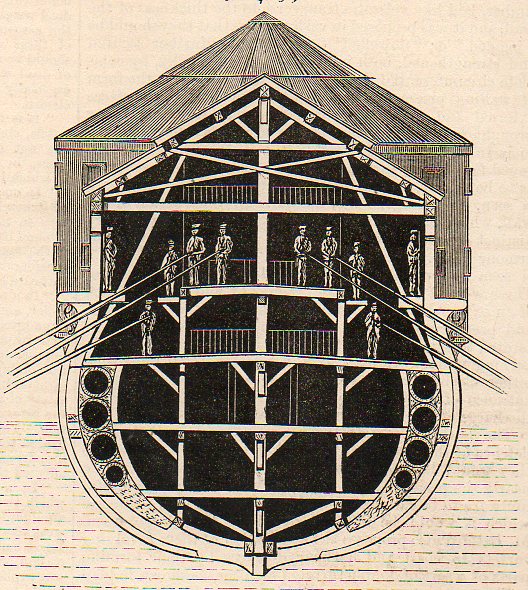
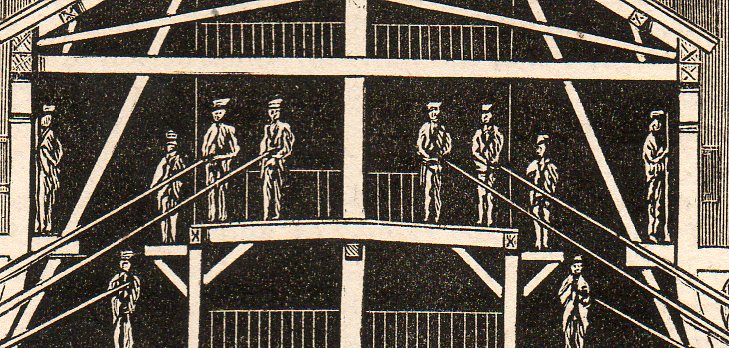
    The engraving below shows the idea of the land fortification shipboard, one revolving turret fore and aft. It turns out that the engine for the vessel was human, the engineer calling for “either” convicts (forcats) or soldiers to row to move and position the boat

      Technical drwg--revovl turret536

    And a detail we can clearly see the long sweep oars:

    Technical drwg--revovl turret big detail538

    And the turrets on the ship, the pre-Monitor-style ship:

    Technical drwg--revovl turret big detail539

    I assume that the boat was being used for coastal or harbor defense, or at least something very close to land, and was really more a floating, positioning battery than a boat.  Seems to me though that after everything was said and done, after all the work was accomplished and the boat built, that making the whole thing dependent on sticks of wood was a fatal flaw. 


  • Technical Drawing–Superb Shadowing, Shipboard Cannons, 1887

    JF Ptak Science Books   Quick Post

      Shadow ship 515

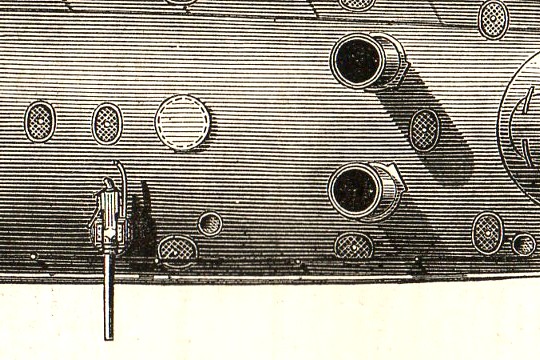
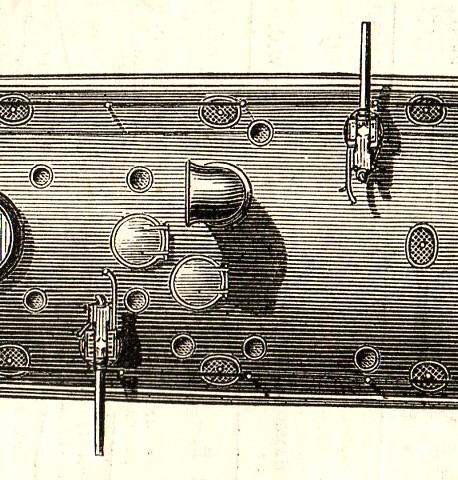
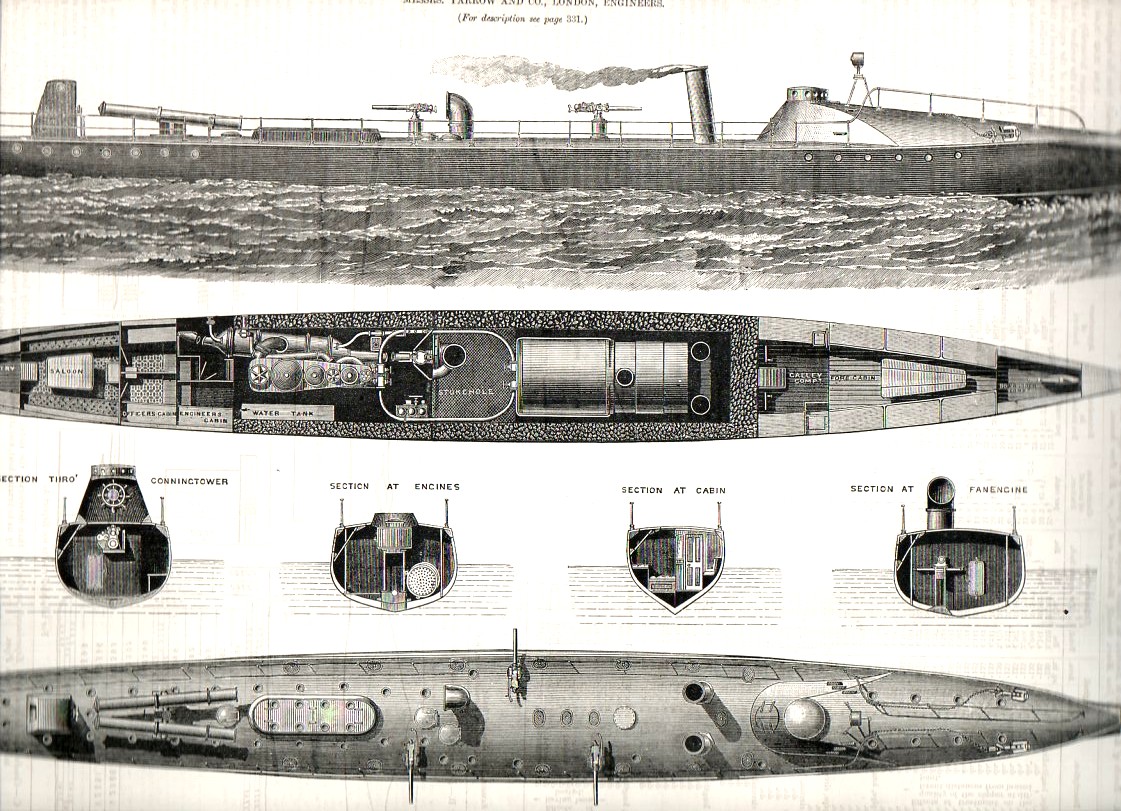
    Horace may have said “Pulvis et umbra sumus” (“We are but dust and shadow”)- and meant it, but the artist working here on this ship would definitely have replaced “dust” with “metal and wood”.  The details above and below are two very small bits (each about a half-inch long or so)  from a 15-inch long engraving of a Spanish torpedo boat, and published in The Engineer on 21 October 1887.  The workmanship is superb and the sense of design to me is absolutely glorious–the entire image of the plan of the ship is below. [The original is available from our blog bookstore.]

    And another detail:

    Shadow ship 516


    Shadow ship 513


  • Technical Drawing–Superb Shadowing, Steamship Boilers, 1880.

    JF Ptak Science Books  Quick Post

    Boiler511

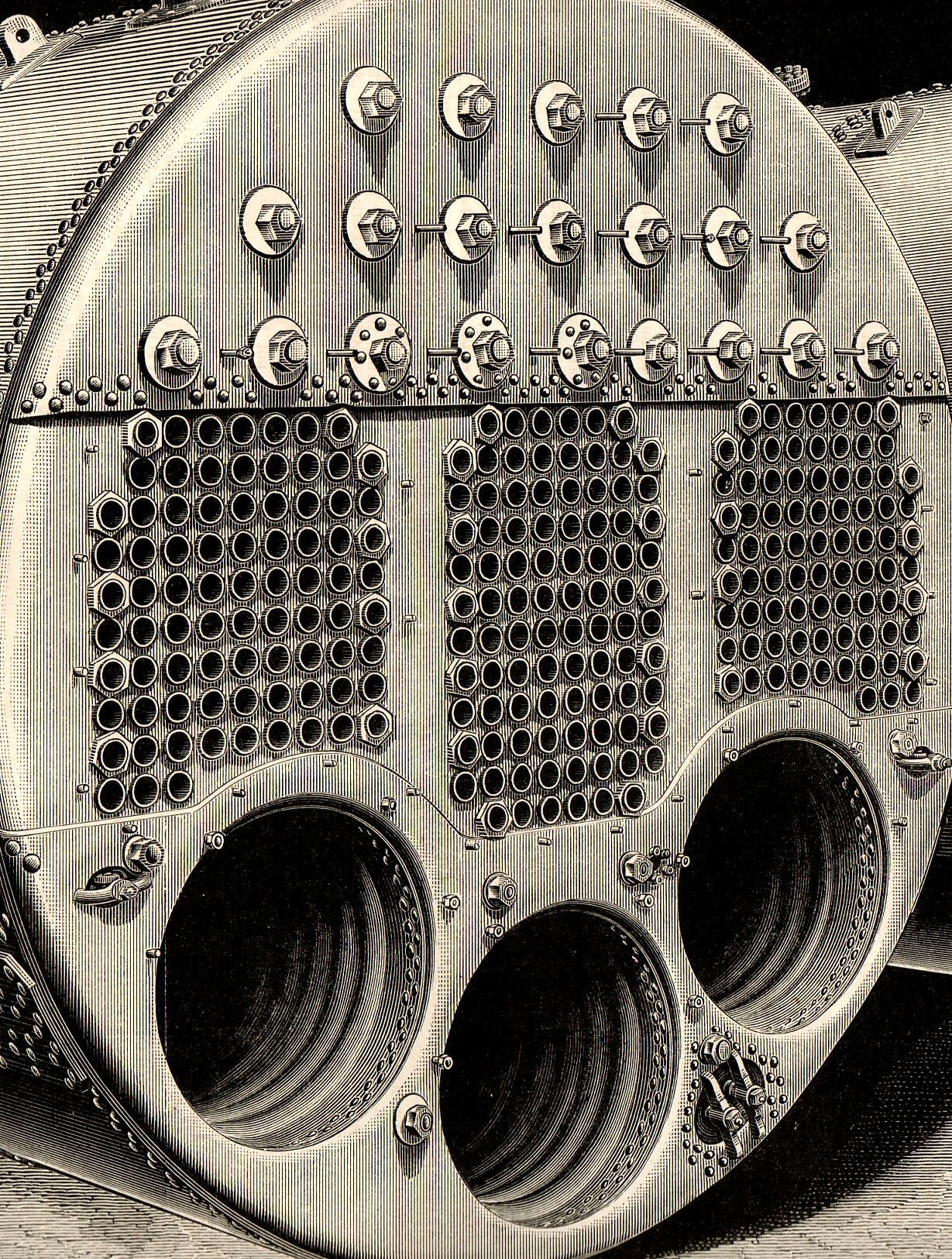
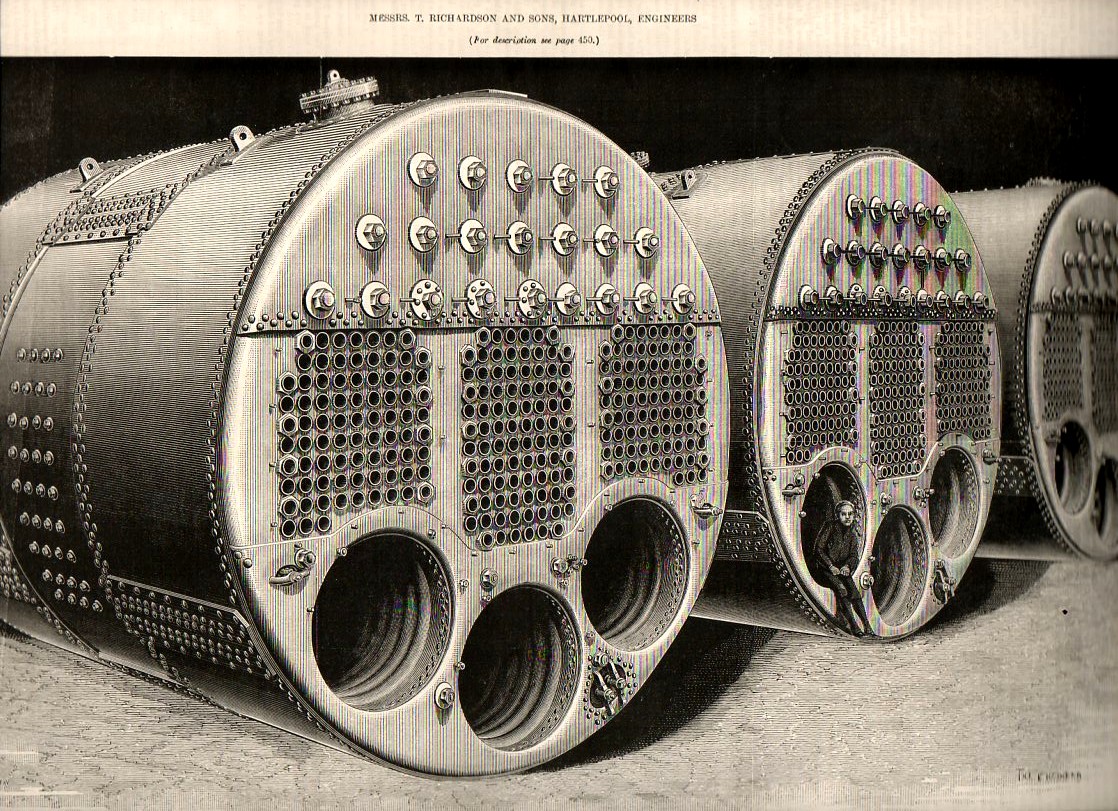
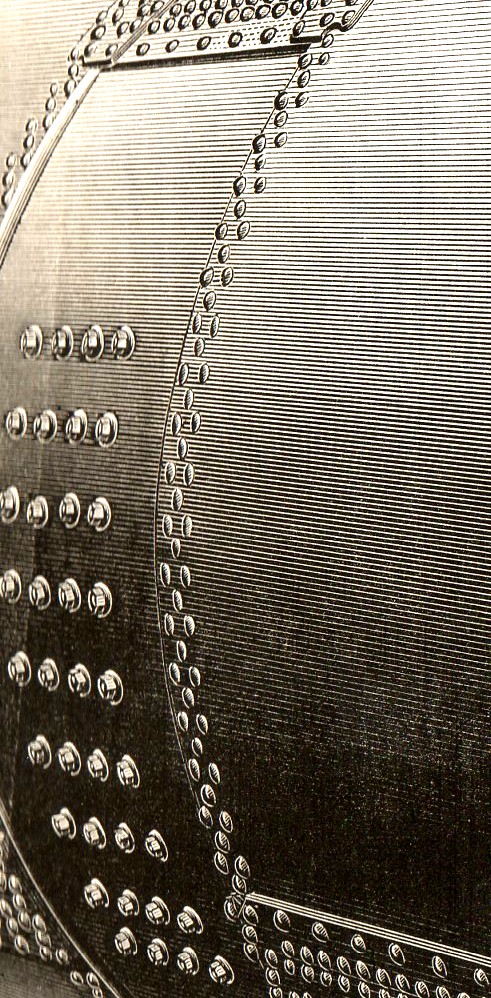
    This is another in a beginning series on superior draftsmanship in rendering technical, physical and biological objects.  The image–boilers for the RoyalMail  Steamshp Roslin Castle, published in The Engineer on 30 November 1880–is a very contained complexity, beautifully shadowed.  [The original is available for purchase at the blog bookstore.]

    Which is a detail from this:

    Boiler510

    And from which also comes this detail:

    Boiler512