A Daily History of Holes, Dots, Lines, Science, History, Math, Physics, Art, the Unintentional Absurd, Architecture, Maps, Data Visualization, Blank and Missing Things, and so on. |1.6 million words, 7500 images, 4.9 million hits| Press & appearances in The Times, Le Figaro, Mensa, The Economist, The Guardian, Discovery News, Slate, Le Monde, Sci American Blogs, Le Pont, and many other places… 5000+ total posts since 2008.

Category: Technology, History of

  • Electro-LUXurious, 2: Electrical Anti-Masturbation Device for Horses,1894

    JF Ptak Science Books   Quick Post

    This is the second in a new series of posts on interesting, early applications of electricity, most of which are taken from the archives of the U.S. Patent Office. 

    Electrical Anti-Masturbation Devices for Horses, 1894


    Be it known that I, Geoger. King, residing at Dallas, in the county of Dallas and State of Texas, have invented a new and Im5 proved Electrical Appliance, of which the following is a specification.

    My invention relates to an electric appliance, adapted for use on stallions, to stop and cure the habit of masturbation, and such invention consists; in the peculiar and novel combination of parts, hereinafter fully described in the specification, and particularly pointed out in the claims, reference being had to accompanying drawings in which—

    Figure 1 is a perspective view of the appliance. Fig. 2 is a similar view thereof with the upper plate detached, to illustrate the electric generating devices, and Fig. 3 is a view illustrating the appliance as applied to the animal. Referring to the accompanying drawings, A indicates a suitably constructed box or receptacle, preferably of the shape shown, the side and end walls a a’ of which are formed of hard rubber or some other non-conducting material.   B indicates the bottom plate of brass or other metal, which projects beyond the end walls a’, as at ~b b, and provided with slots VV as shown.  C indicates the electric generating devices which are held in the box A, and which may be of any well known construction:, one terminal of which contacts with the lower plate…


  • History of Falling: Parachutes as Aerial Minefields and Pilots’ Escape Vehicles

    JF Ptak Science Books  Post 1466

    Lots of these images have to do with walking and falling, walking and falling at the same time, walking and catching yourself from falling over and over again, but in general that walk is only one step, so far as parachutes go. 


    The parachute has certainly been around for a long time–from ancient times if you squint your eyes hard enough–though it appears that it was in the Renaissance that the idea was taken more seriously as a practicable thing:  at  least it was first depicted then.  Here for example is a form of falling that was seen as flying (Homo Volens or Flying Man), in this depiction of parachute-use by Fausto Veranzio  Fausto (1551–1617) in his book of technological marvels called Machinae Novae (1595).  Of course Leonardo left a footprint here as well, and before Veranzio.

    File:Homo Volans.jpg

    More convincing and potentially beneficial parachutes were constructed for balloon escapes/aviator descents in the 19th century, as seen with the work of André-Jacques Garnerin (1769-1823), who was the inventor of the frameless parachute (a framed version seen below).  

    File:First parachute2.jpg

    And in all that time of development through the nineteenth century, it still took another eight or nine years or so after the Wright’s flights to have employed the idea for pilots of the modern airplane.  There was a series of varied “firsts” of leaving an aeroplane by parachute in 1911 and 1912, the earliest of which involved the pilot of an aircraft to fly with his parachute in his lap, then throwing the whole thing from the plane with the pilot following. Parachute history during this time, like 1910-1920, is a little complicated, filled with fits and starts, mostly not very successful, and most of them of a quality and dependability to make you want to land your aircraft even if you were flying only smoke and flame.

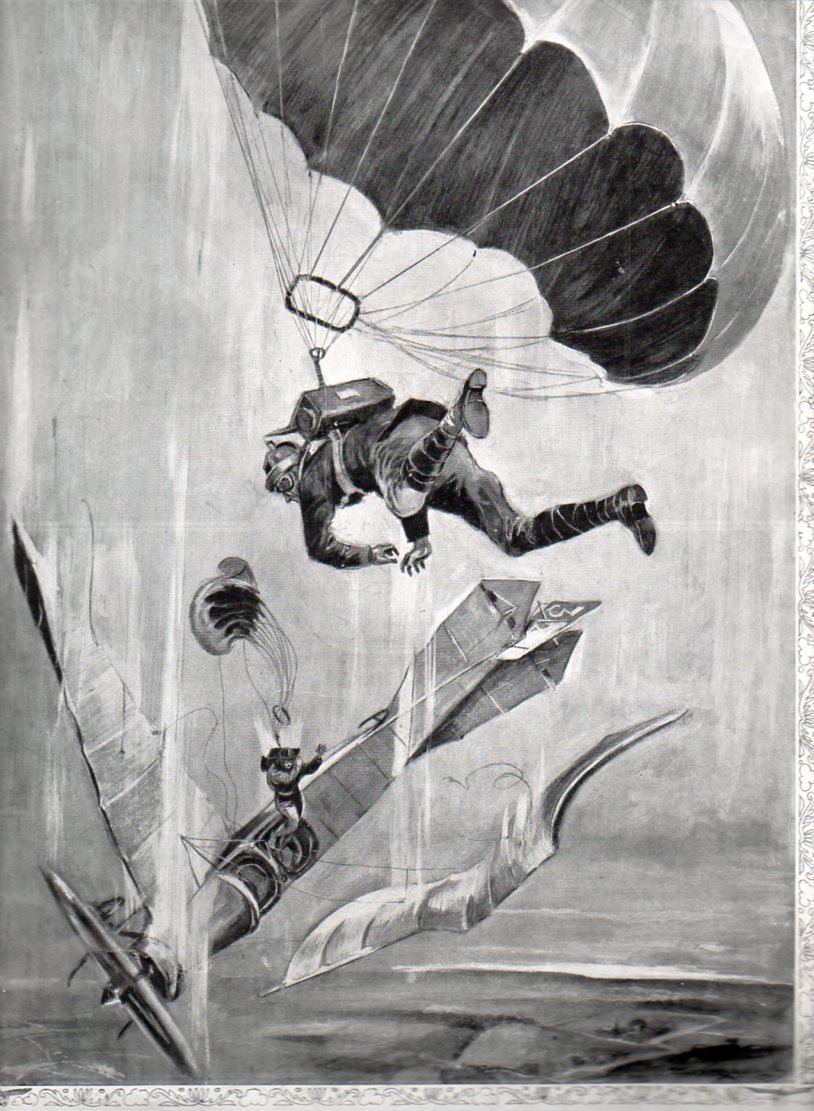
    The image below seems to depict the 1912  exploits of the American and British inventors who at about he same time developed a parachute that could be worn in a box on the aviator’s back, contained in a box with a removable panel.  It was a very heady development, and the whole idea–seen here in the pages of The Illustrated London News for 28 September 1912–must have seemed like science fiction to the casual reader, the caption beginning

    Parachute bomb454

    “…our illustration appears to be somewhat fantastic…”  The ripchord, one of the most important elements of a parachute, didn’t get introduced into the fray until about 1916, and the real utility of the parachute doesn’t seem to be developed until 1920 or so.  In the meantime, the whole business of flying was pretty much being done without a safety net, so to speak. 

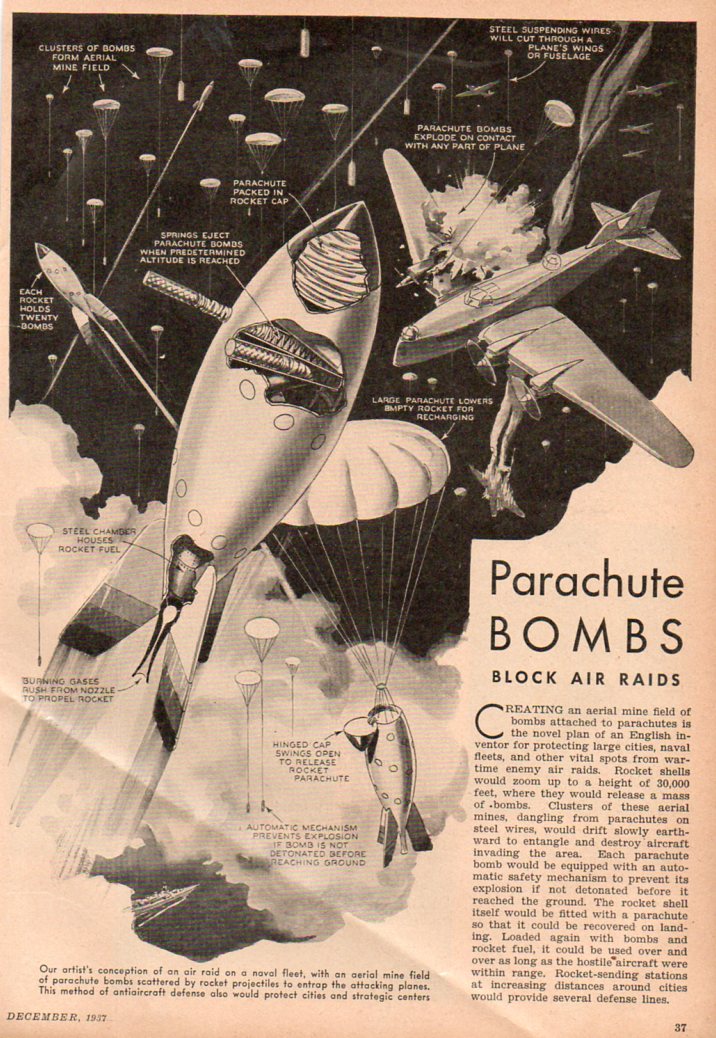
    But what I realloy wanted to get to in this post is something that did look “somewhat fantastic” to the readers of its day, as it does to me now:  parachute bombs.  As a late-night, five-martini idea it looks great, especially in 1937.  But the fact of the matter is that it does look like a bar stool plan similar to barrage balloons if barrage balloons were smaller, higher, fell and had bombs.  One element of surprise though may have been what would happen to the great percentage of these bombs that were fired above and floated back down to Earth with their warhead still attache to the parachute and unexploded.  The article states that the warhead would be disabled

    Parachute bomb453

    before it hit the ground, but then what?  I suspect that there would be thousands of these buggers littering the land/cityscape, which means that there would have to be an equivalent of an ambulance corps riding around finding, collecting and hauling these things off.  Seems like a non-started to me.  Plus there would be far more effective anti-aircraft elements developed very soon after this, not to mention the terribly significant mathematical and technical developments that would go into the fire control issue of the weaponry. ( But that’s another story, another long story, dealing with how to get aircraft out of the air–there’s some very sophisticated AA weaponry produced during WWI, s decade and a half before these parachute bombs, that would seem to make these things a bad afterthought.)


  • Is this the Most Lovely Image of a Woodshop Ever Made?

    JF Ptak Science Books    Quick Post

    Plumier420

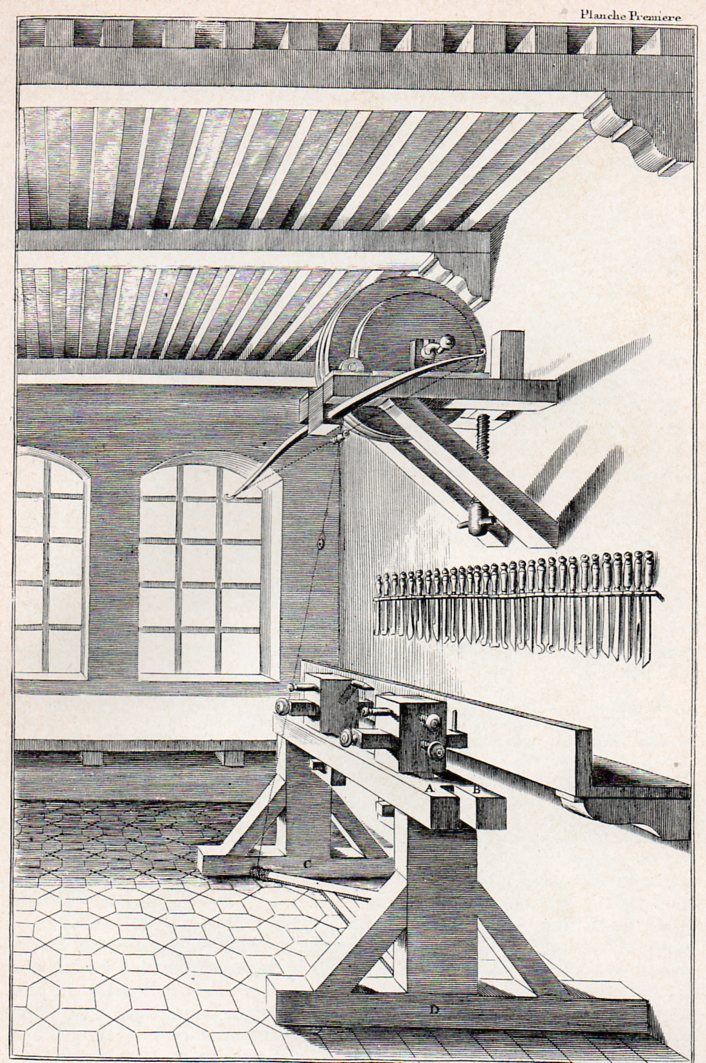
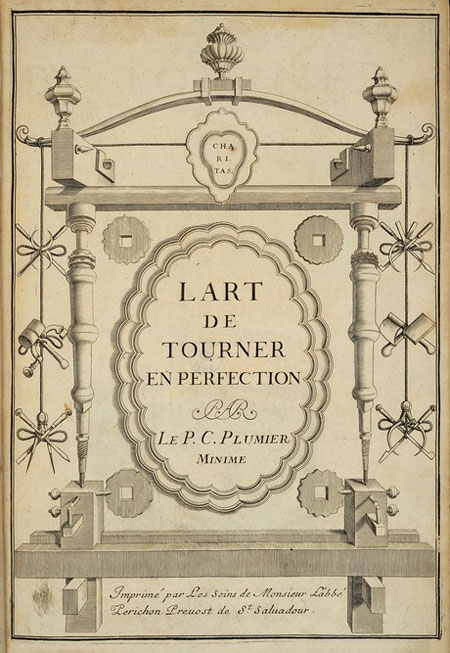
     The turner’s workshop, from Charles Plumier’s L’Art de Tourner, ou de Faire en Perfection Toutes Sortes d’Ouvrages au Tour...and published in 1701.  It is spartan except for a large selection of in-place tools, and I can just about hear the room’s echoes.  The title page for the work is also quite lovely, a piece of airy/baroque, featuring elements of the turner’s trade as ornamentation.  


    Plumier b
    As it runs out M. Plumier’s beautful fascination with turning was only a side-attraction to his life’s work, which was botany.  Plumier published a number of significant works with a particular emphasis on the botany of America, including:  Description des plantes de l’Amérique (Paris, 1693) and Nova plantarum americanarum genera (Paris, 1703-04), “with 40 plates; in this work about one hundred genera, with about seven hundred species, were redescribed”.  “At a later date Linnæus adopted in his system, almost without change, these and other newly described genera arranged by Plumier. Plumier left a work in French and Latin ready to be printed entitled Traité des fougères de l’Amérique (Paris, 1705), which contained 172 excellent plates. The publication Filicetum Americanum (Paris, 1703), with 222 plates, was compiled from those already mentioned….At his death Plumier left thirty-one manuscript volumes containing descriptions, and about 6000 drawings, 4000 of which were of plants, while the remainder reproduced American animals of nearly all classes, especially birds and fish.” (Quoted parts from the Catholkic Encyclopedia.)

    ·Posted by :

    ·in:

    —

  • A Vision of the Future: Filling Up Manhattan, 1887

    JF Ptak Science Books   Quick Post

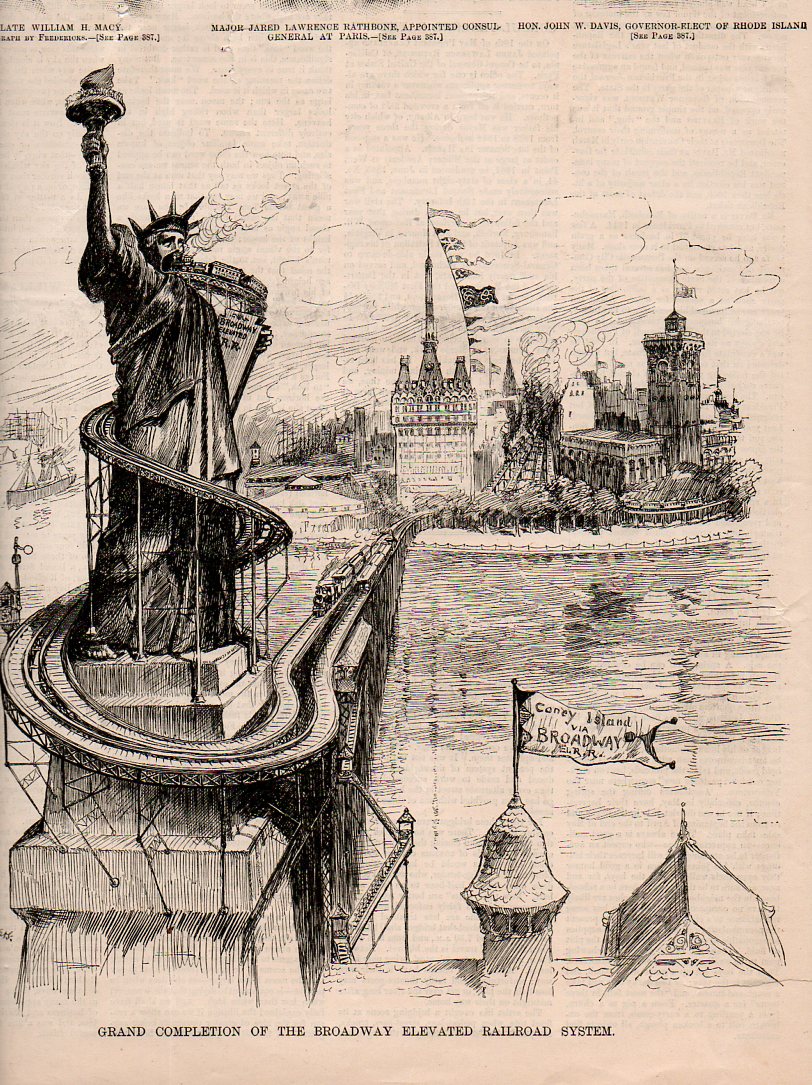
    This peep into a possible future appeared in Harper’s Weekly on 18 May 1887.  It is the work of artist W.A. Rogers and depicts a filling-up lower Manhattan, complete with broad avenues lined by elevated trains whose reach evidently knows no bounds. The new elevated subway winds its way across the harbor to Liberty Island, where it wraps itself around the feet and up the body of the newly-dedicated Statue of Liberty (opened in October of the previous year).  In the foreground is the cupola of a transit station with a fluttering flag advertising “Coney Island via Broadway”–I’m not sure what this is all about, as the placement of the island has nothing to do with anything except making a point in the cartoon. 


    Statue liberty407


  • Seeing into the Vast Future, 21 Years Hence: Futurama, 1939

    JF Ptak Science Books  Post 1461

    Futurama 9
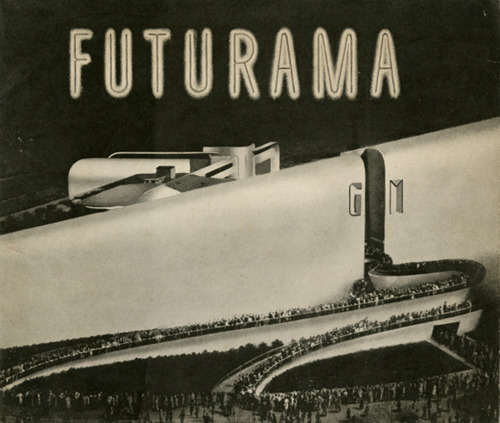
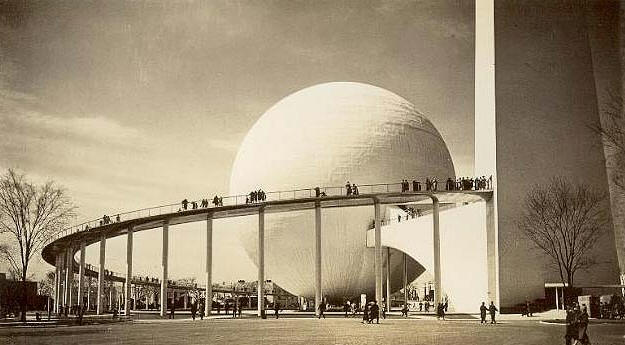
    The 1939 World’s Fair in NYC famously exhibited a spherical attraction that exhibited a semi-robotic display of what the future would be like–a future that was only 21 years away, in 1960.  There would be an enormous amount of weight on the shoulders of 1960, given what the World’s Fair had to say about it in 1939.  Few things were very right, and many of course were necessarily wrong–but that must be the case when looking into the short-ended future with a monstrous amount of anticipation.  That–and since this was a feel-good celebration–nobody was talking about the world war that had already started. 

    Futurama 07

    Futurama 06
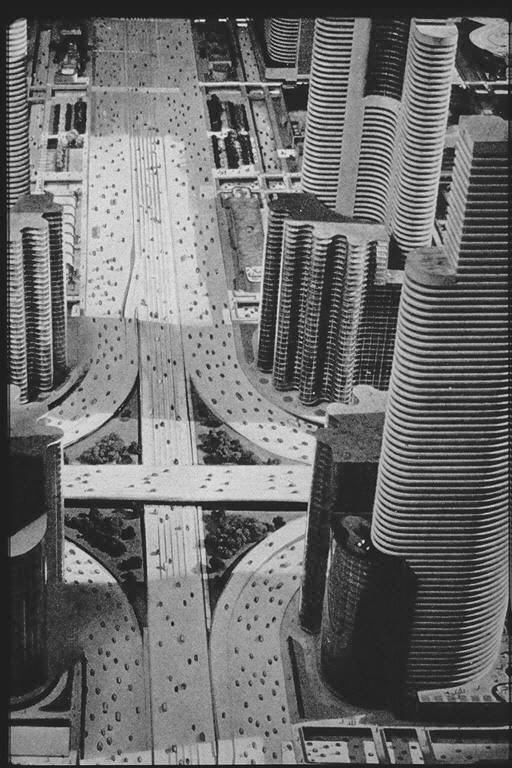
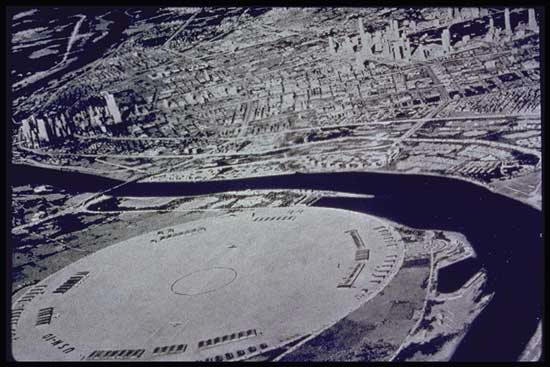
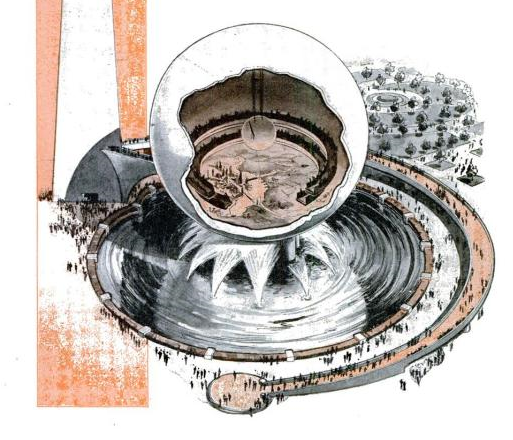
    One thing is for sure–the pavilion’s creator, General Motors, did foresee that highways and automobiles will be in high demand up there in the tomorrowland of 1960.  The display was designed by the fantastic Norman bel Geddes, who actually expanded on his superhighway theme in the next year with his book Magic Motorways (which can be read here).  Anyway people were very excited by the whole affair–waiting in line for a few hours, winding their way through the pavilion to take their seats in a circular gallery overlooking a vast and complex assemblage of miniature societal models, the seating arena rotated to give the viewers views of the entire display.  More than 26 million people saw the display over a six month period.

    Perisphere04
    Perisphere_cutaway
    26 million is a big number.  Futurama drew as many people in six months as the three New York City baseball teams (the Yankees, Giants and Dodgers) brought in for almost the entire decade.  It is also equal to all of the deaths suffered by the Soviet Union during WWII. 

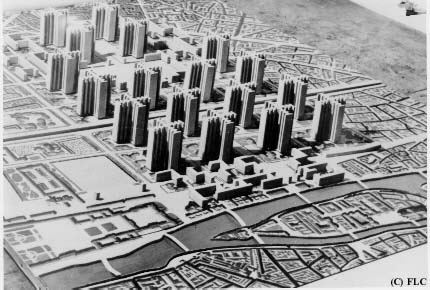
    I guess this was as good a vision as any–or at least it didn’t seem to involve very much planning outside the new automatic automobile nervous system that would leech into the life-blood of the country.  Other planned visions of the future do not look quite so good.  For example, Le Corbuser’s demolition of central Paris to make way for his Soviet apartment block reconstruction in his Voisin Plan (1925):

    Plan Voisin - Paris
    Again, this is not a wholesale look into the future, just the resurfacing of one of the world’s greatest cities.

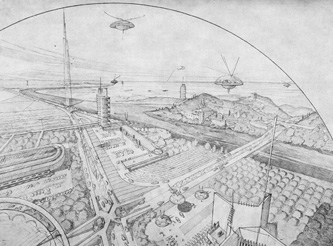
    A man with a little bigger vision, Frank Lloyd Wright, saw a heavier future in his Broadacre CIty:

    Broadacre City 2 I’m not sure how these domed cities worked.  B. Fuller had an idea like this for central Manhattan that I wrote about earlier in this blog, but his idea escaped me too. 


  • Monumentally Large (1400′) Wind Turbine, 1932

    JF Ptak Science Books   Quick Post

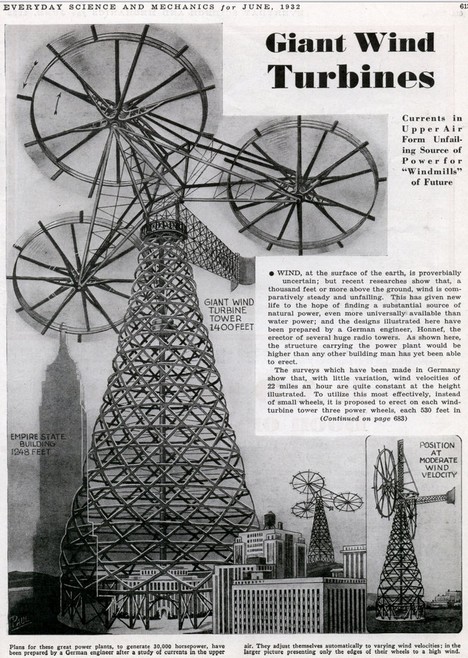
    Here’s a big idea:  a fantastically oversized, super-heavyweight wind turbine from 1932.  This monster was 1400 feet tall, fully 700 feet taller than the tallest modern wind turbine.  Actually, by conjecture, it looks as though the wind collecting units (or blades, or whatever these things are) might be 250′ long just by themselves, forming collecting space over 500 feet wide.  So that’s six blades at 250′ each per collecting unit, times three.  18 250′-foot long blades per structure.  It feels as though you could ride this thing to the Moon.  I have no idea how much the structure weighed.

    Giant-turbines
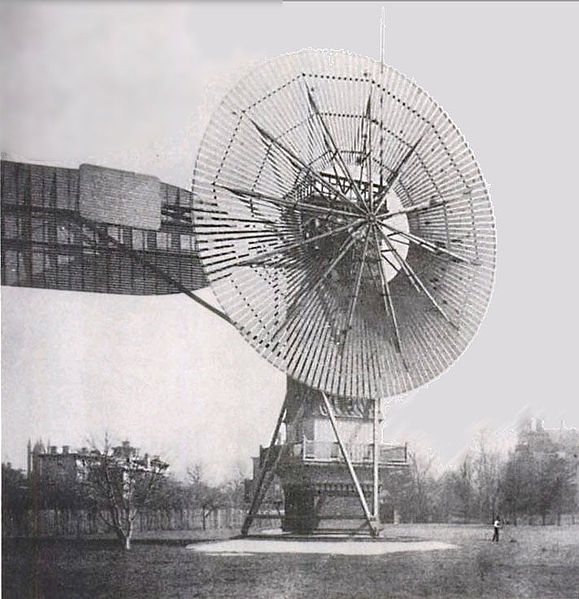
    For comparison’s sake, here’s a photo of the first successful wind turbine:

    579px-Wind_turbine_1888_Charles_Brush

     Charles F. Brush’s 1887 accomplishment, built in Cleveland (Ohio) was 60 feet tall and weighed 4 tons.  The beast above would have single blades that were four times the size of this entire structure. (Or thereabouts–the 60′ tall thing doesn’t look quite right in this photo, seems to be somewhat taller.)


  • A Monumental and Fantastically Bad Idea: Draining the Mediterranean

    JF Ptak Science Books   Post 1460 

     “Simply the thing I am shall make me live.”–from Jorge Luis Borges, “Shakespeare’s Memory”
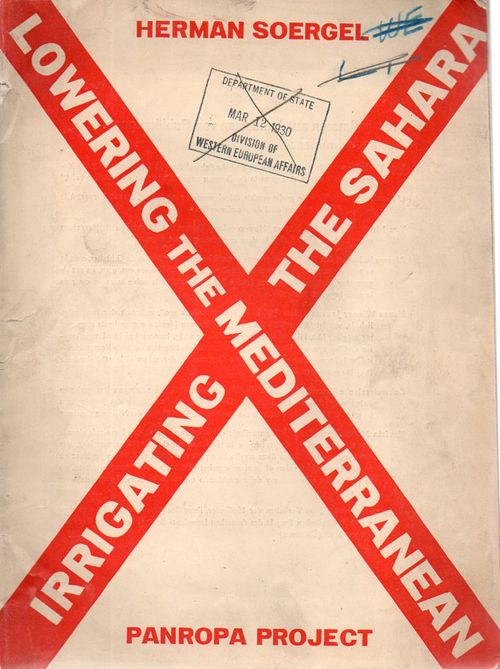
      Soergel403
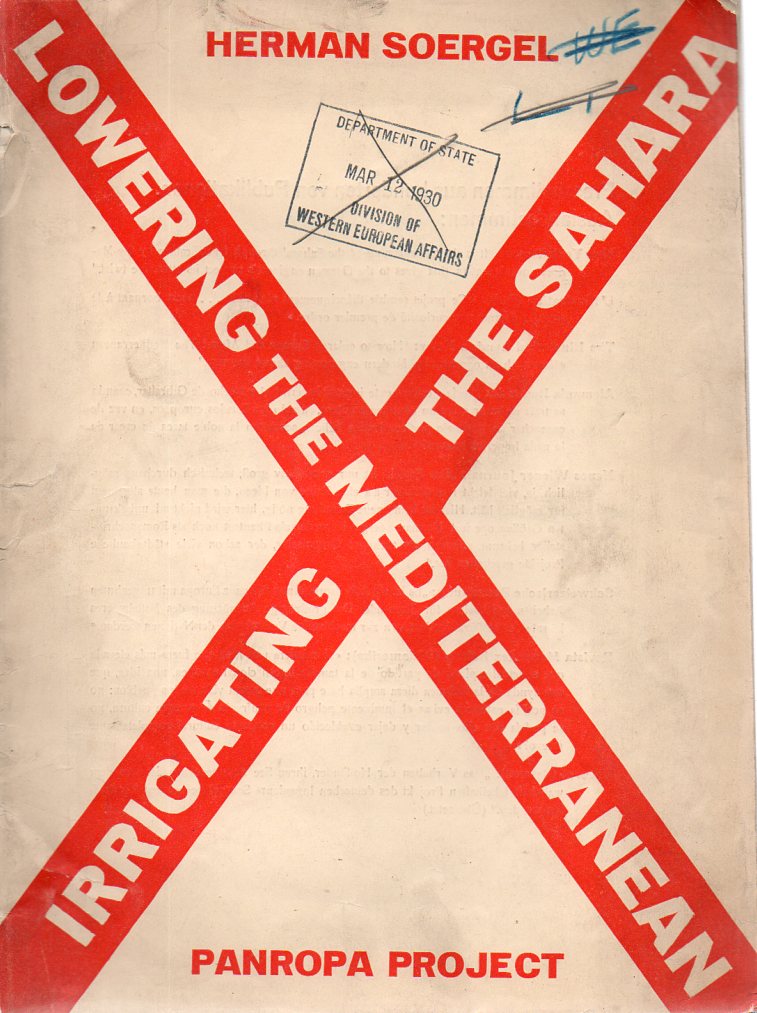
    It would be a Purgatory, or worse, to suddenly wake up one morning with another person’s memory–worse yet than to have wished it, only to find that you didn’t want it at all.  This evidently works out with memories high and low, though it is tempting to want to wish to see what the inspiration looked like for one idea located in a particular memory.  Or maybe not.  But I am curious about when and here the author of the pamphlet above got his idea, and what it looked like to him–did he hear or see or smell something that prompted the inspiration for this reverse-monumental jolt, something that may well be one of the worst engineering ideas of the 20th century? [This pamphlet is available for purchase at our blog bookstore, here.]

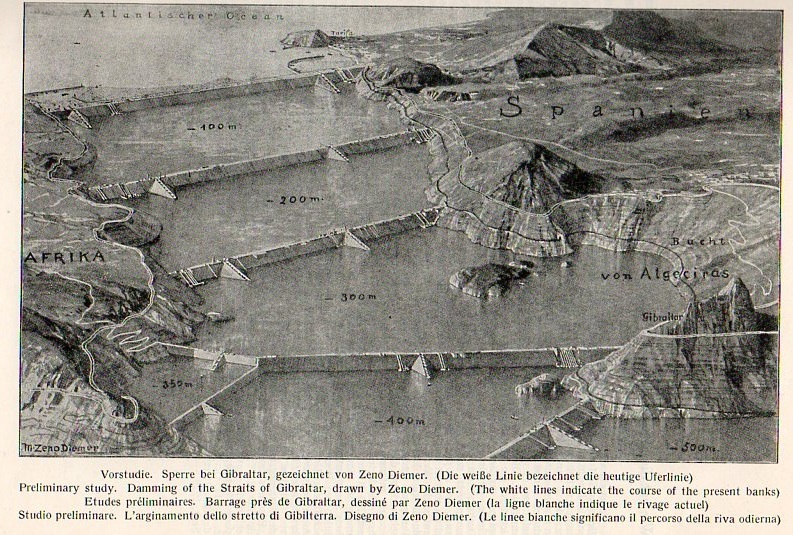
     It is interesting to pursue a loose thought like this to its not-necessarily logical end.  Such is the case with the self-styled Paneuropic ideas of Hermann Soergel (1885-1952), the author of the above. Soergel was a Bauhaus architect and author of a number of works on design and far more ethereal, floating-castle ideas. His most spectacular contribution—incubated in the mid-1920’s and still clinging by its fingertips as an idea among some current thinkers—was to put a dam across the straights of Gibraltar.  The dam would generate electricity of course, but most importantly to Soergel, it would also empty an enormous amount of water (lowering the sea by 200 metres)  from the Mediterranean leaving vast new expanses of land to be developed and colonized over generations into the future.  The water of course would have to go somewhere, and that somewhere was the Sahara Desert, somehow in its wake creating farmable and productive lands. Soergel was creating a certain, very wide, fantastical future of uncertain monumental prospects.
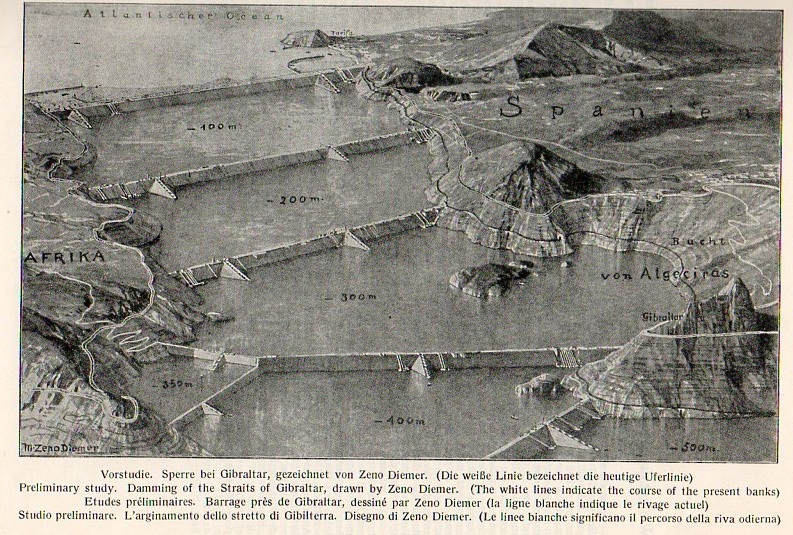
    Soergel405
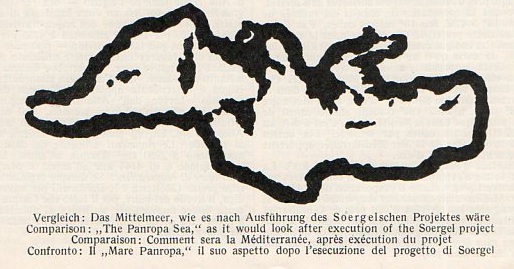
    A “brief outline” of the idea was published in this four-language pamphlet, Lowering the Mediterranean Irrigating the Sahara (Panropa Project), which was published by J.M. Gebhardt in Leipzig in the very bumpy year of 1929. (The Weimar years in Germany were already into deep bumpiness; the rest of the world would follow suit in October of that year.)  To be fair, Soergel didn’t plan on emptying the entire Mediterranean, just a bunch of it–at least enough to be able to rename it.
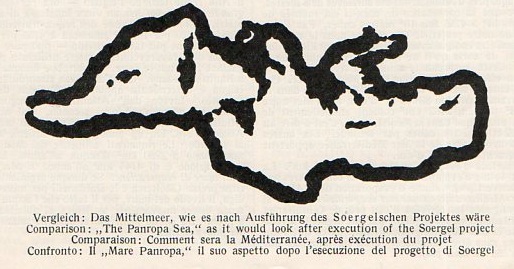
    Soergel404
    [Here’s a map of the new Mediterranean, or the Mediterranean that would be made to go away.  As you can see at this point Sicily and Italy become enormous, and the Greek Islands are combined to form one large land mass–this last bit alone is enough to form total and complete reisstance to this idea. Also at this stage perhaps 150 or so miles of new lands have been reclaimed from the sea all along its former borders–more so in Turkey.  There is no mention as yet of any new islands that are formed in the sea water’s wake.]  As it turns out Soergel thought that this plan would add at least 660,000 KM2 to the base of the surrounding countries of the Mediterranean, or roughly the equivalent of the combined land masses of Italy and Germany.  Having the sea pulled back from hundreds if not thousands of seaside towns and cities would no doubt be a “problem”, for them; but that doesn’t matter to Soergel, as they were inferior thoughts to the grand idea of emerging a new continent.  Great bog (and a good simulation with a powerful computing capacity) only know how the changes in the Mediterranean would affect the climate–well, that in combination with the thousands of new square miles of inland sea and canals in the previous Sahara desert.  There are of course many other problems. 

    The master plan at work was that the world would be divided into three economic spheres in the future, all beginning with the letter “A”:  American, Asia, and the new land to be created by Soergel, “Atlantropa”, which was the former Europe expanded into the new dry beds of the Mediterranean and North Africa.  And also of course Egypt, which would be covered with “thousands” of canals and become semi-submerged by the new borders of the meandering sea.  This would be the way for Europa t==Blog July 21==shakespeares memorieo compete with the rest of the world in the future. 
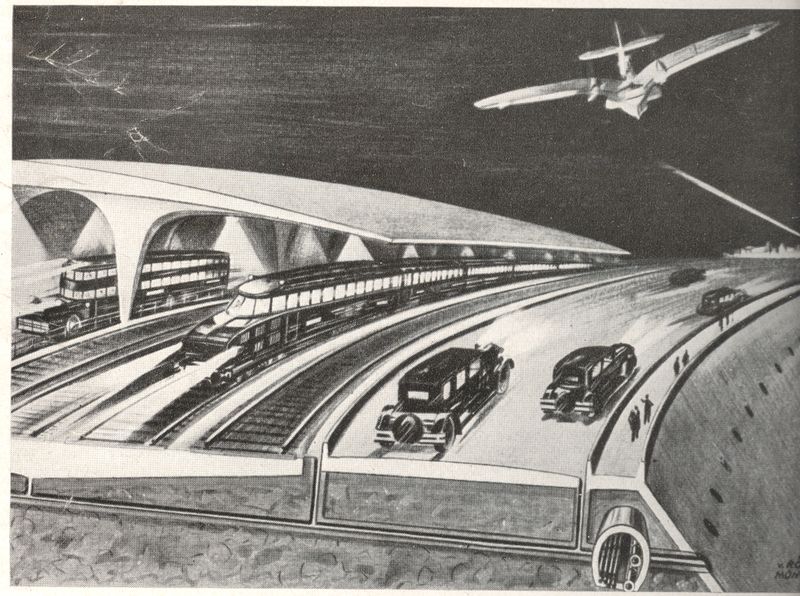
    [I should point out that the image above comes from the Illustrierte Zeitung (Leipzig) for August 1931, and is a drawing by an artist named “AS. Christ” depicting a cross section of one of the bridge/dams of Soergel’s Panropa’s ideas.]

    Perhaps it is actually three steps to get from the idea of damming up the straits of Gibraltar to the osmosis of Shakespeare’s memories into someone else’s brain—a squinting acquiescence of the middle touch being the brilliant Jorge Luis Borges.  You see it was in the Argentine master’s last published story, “Shakespeare’s Memory”, that we meet Herr Soergel (as Hermann Sorgel) again.  But so far as I can remember Soergel exists only as a fictional character, with no reference to his real-life self.  In this wonderful story, Soergel inherits the memories of William Shakespeare—these bits come to him slowly but surely, until they start to conflict with his own memory, and things get difficult.  The man with Shakespeare’s memories winds up phoning strangers on the telephone, giving them away at random, until Soergel is left with his own mind again.  Superior as Bill’s memories were, they still weren’t Hermann’s, who wanted his own life back in the end. 

    And so from the titanic, pan-europic technodream of Bauhausian Hermann Soergel to the dead brains and living memories of William Shakespeare, all through the fingers of the beautiful Jorge Luis Borges.  

    I’m sorry to report that at the end of it all, near the end of the pamphlet, Soergel releases his opinion on the political importance of his project.  And yes, his aim was to form an alliance between the new PanAmerica (of the “three Americas” with the new Pan-European African Union to thwart “the yellow peril” which “arises from the racial antipathy of India, China and Japan.  Soergel writes that “the fate of occidental civilization…will be settled on the Mediterranean”. 

    After it is all said and done, perhaps the best reiew of the work by Soergel is provided by the graphic designer who put the Big Red X on the cover of his work.  It fits. 


  • Standardizing Precision and Beautiful Technical Prints: Ramsden’s Dividing Engines

    JF Ptak Science Books   Post 1452.223221 and a quarter

      Ramsden386

    I like the idea of having something called a Dividing Engine–perhaps it would divide seeds, or complex problems, or simple problems, or perhaps it would divide division. 

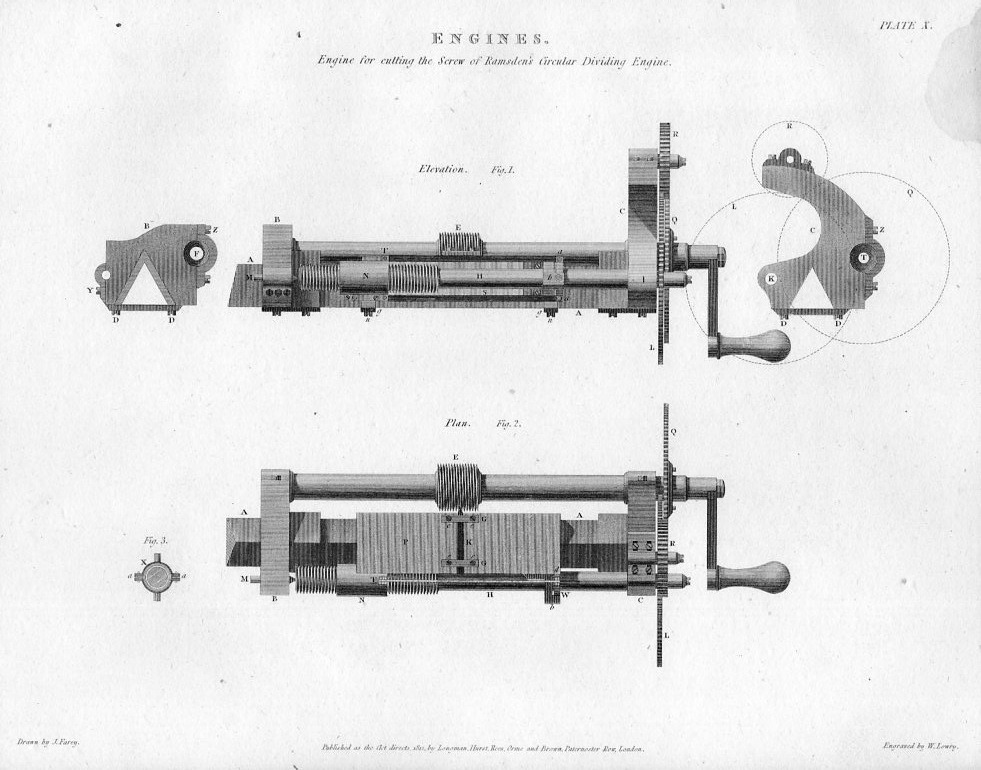
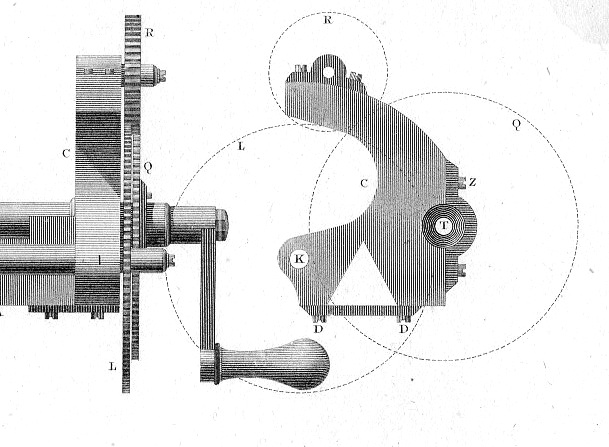
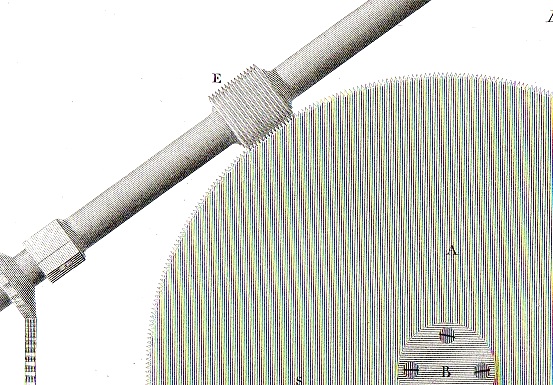
    What it really refers to here is a precision tool that whose effects were extremely wide felt but about which we don’t really hear about today.  This is the dividing engine of Jesse Ramsden,and Englishman who invented a circular instrument that would incise precise values on precision instruments like surveying compasses, delineate the linear and circular scales of measuring instruments used in astronomy and navigation,   Before Ramsden, the engraved marks on instruments would have been made by each individual manufacturer, each of those depending on marks that they made in the past, generations of such things in a line, over and over, a quite individualized effort, necessarily dependent upon the precision of each manufacturer. In 1777 Ramsden produced an instrument1 of exception precision that was correct and fine and dependable2. [The image above was found in Abraham Rees’ monumental Encyclopedic Dictionary…, and is entitled “Engine for cutting the screw of Ramsden’s Circular Dividing Engine” and was published in 1814.  Below is a detail of the plan for the winding of the gear works. In order for his machine to work at such a high degree of accuracy the component parts must also have been of a very high calibre–to that end Ramsden developed what is essentially the modern screw cutting lathe from which he manufactured the gear works for his Straight and Circular Dividing Engines.3]

    Ramsden387
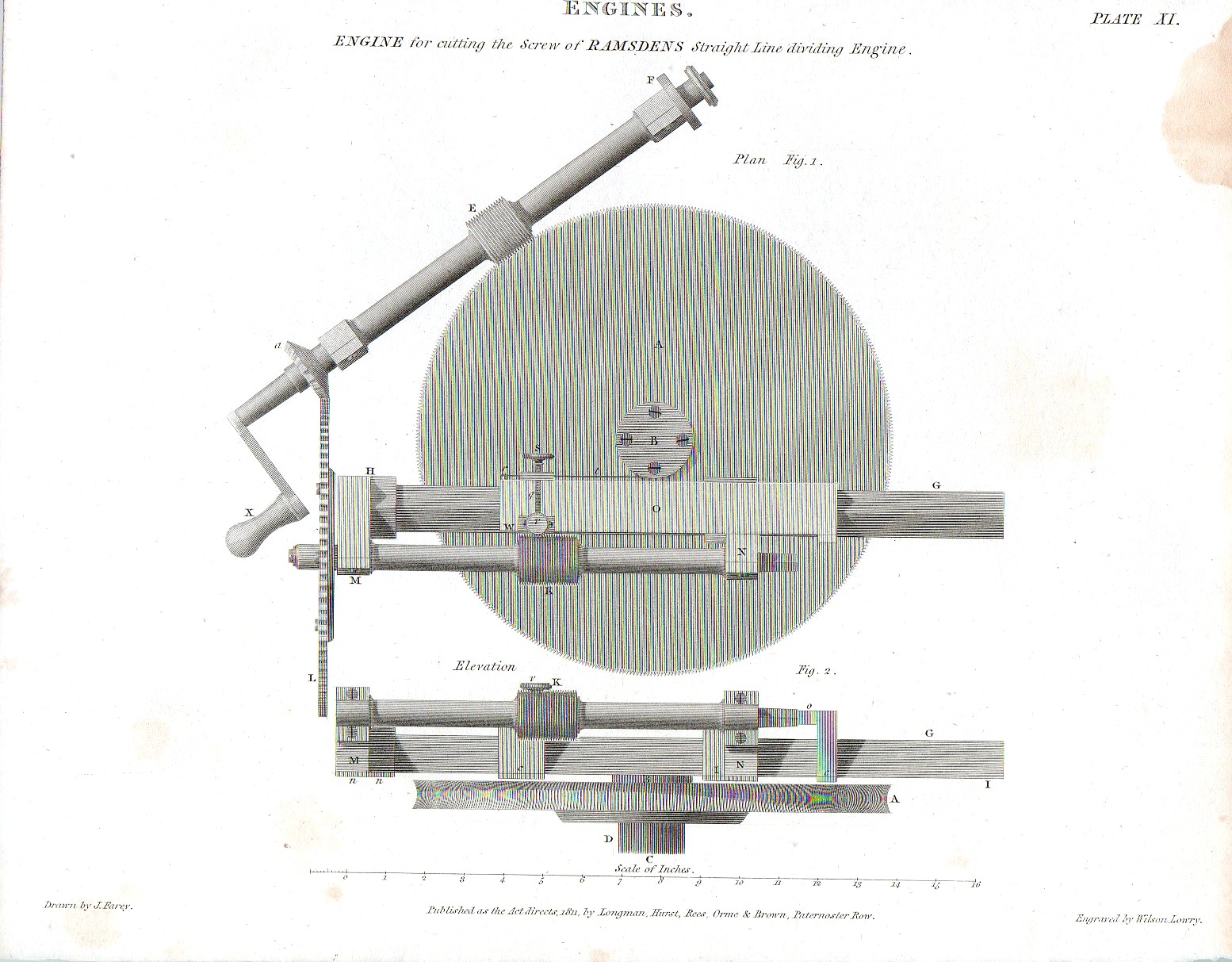
    And then there was the “Engine for cutting the Screw of Ramsden’s Straight Line Dividing Engine”, which is an absolutely gorgeous piece of drawing.  A person could crawl all over this image in varying degrees of microscopic inspection and find all sorts of beautiful internal images, a large example appears here:

    Ramsden388

    And its fantastic detail:

    Ramsden389

    Basically though Ramsden’s inventions were key additions to the developing scientific technologies of the Industrial Revolution, integral improvements necessary for integral improvements. 

    Notes:

    1.  He published a Description of an Engine for dividing Mathematical Instruments in 1777.

    2. “The dividing engine was simple to operate. The instrument being divided was fixed to a large wheel on top of the engine. When the treadle was pressed, the wheel and the instrument were turned through a fixed angle. Then with the right hand, a cutting tool guided by a system of swinging links was used to mark the instrument scale. The process was repeated until the complete scale had been divided. Although this was many times faster than hand-dividing, it was backbreaking work having to lean over the engine to work on a small instrument.”-“Dividing Engine.” Smithsonian National Museum of American History. americanhistory.si.edu/collections/navigation/object.cfm?recordnumber=694508

    3. From WIki–“The first truly modern screw-cutting lathe was likely constructed by Jesse Ramsden in 1775. He appears to have been the first person to put a leadscrew into actual use (although, as Leonardo’s drawings show, he was not the first person ever to think of the idea), and he was the first to use diamond-tipped cutting tools.[2] His device also included a slide rest and change gear mechanism. These form the elements of a modern (non-CNC) lathe and are in use to this day. Ramsden was able to use his first screw-cutting lathe to make even more accurate lathes. With these, he was able to make an exceptionally accurate dividing engine and in turn, some of the finest astronomical, surveying, and navigational instruments of the 18th century.


  • Stylizing a Sameness in Early Flight Images

    JF Ptak Science Books  Post 1438

      Space flight379 Space flight378

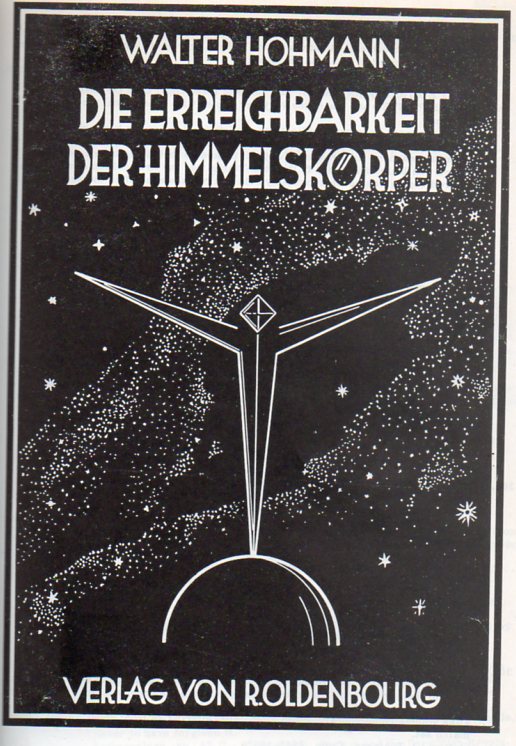
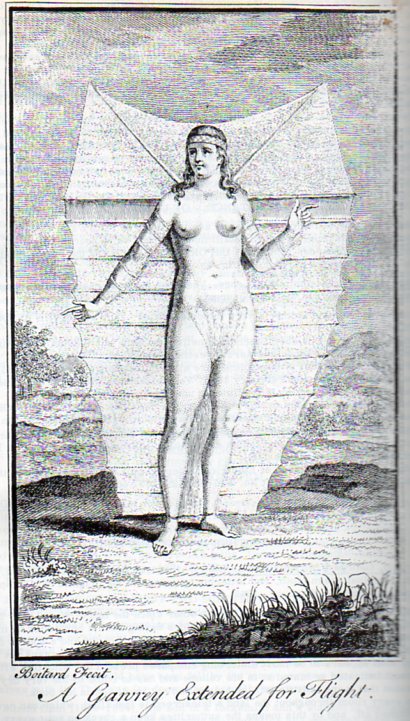
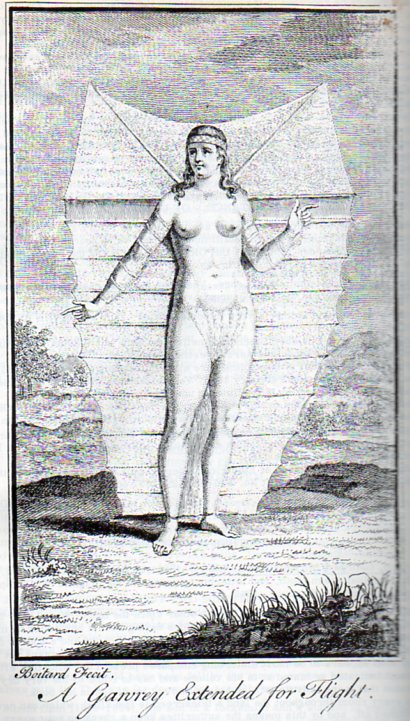
    I found these elements of sameness in design, spanning prehistoric flight and prehistoric space flight eras, separated by 170 years or so, and they just seemed fascinating.  The first, by Boitard for Robert Paltock’s (or Pultock, 1697–1767) The Life and Adventures of Peter Wilkins, a Cornish Man, Relating Particularly, His Shipwreck near the South Pole; his Wonderful Passage thro a Subterraneous Cavern into a kind of New World, his there Meeting with a Gawry or Flying Woman, was published in London in 1751 pictures the flying woman from the title (which also pretty much sums up the Robinson Crusoe-like story.  Wilkins does become shipwrecked and then has an extraordinary adventure underground at the South Pole–which is interesting in and off itself, to set the stage at the South Pole, since the exploration of Antarctica is really a 20th century endeavor.  (The first accurate summation of Antarctica as a continent isn’t made until Charles Wilkes’ expedition in 1839/40.)

    Space flight378

    The flying woman is striking, especially for the mid 18th century:  she is quite lovely, muscular, and tall, and has her limbs attached to a flying/gliding canopy which seems as though it would be operated in a way in which the people of that time thought birds to fly. 

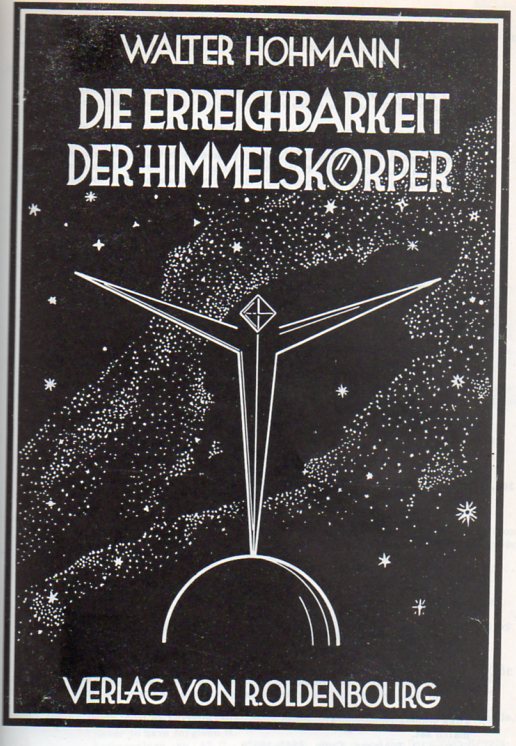
    The associated image is Walter Hohmann’s prescient work on rockets and rocket flight, Die Erreichbarkeit der Himmelskoerper, Untersuchungen ueber das Raumfahrtproblem, which was published in that great heyday of German flight engineering, in 1925.  It was published very soon after the important work of Hermann Oberth2, whose style, illustration and design are closely aligned. It is very interesting to note here that Hohmann (and Oberth) both suggested using teh Earth’s gravitational field to orbit the spacecraft and then slignshot it off into space, rather than to try to simply lift of from Earth and then go directly into space. 

    Space flight379

    Notes:

    1. Biographical Dictionary of English Literature was not impressed by it saying: “The description of Nosmnbdsgrutt, the country of the flying people, is a dull imitation of Swift, and much else in the book is tedious.

    2.  Oberth’s book, Die Rakete zu den Planetenraum was printed in 1923 by the same publisher as Hohmann, and was a cornerstone study of the issue of interplanetary space travel–the first of its kind, really, to address the full theoretical and practical aspects of rockets and space flight.  Oberth–who wrote this at age 28–could not submit the work for his thesis because of its advanced treatment of a little-known subject.


  • Strange Things in the Sky Department: the Suburbs

    JF Ptak Science Books   Post 1434

    A continuing thread on this blog (this post is a good example) has surfaced unusual thing that have been found floating in the sky in prints, photographs and ideas:  there have been “extra Earths”, holes leading to heaven, massive stone tetrahedra, swimming pools, hangars, airports, downloaded aliens from extra moons, flying Woolworth buildings, and much else (not limited to 19th century balloon-hoisted horses, here). Today’s unusual thing to be found in the sky is the suburbs.

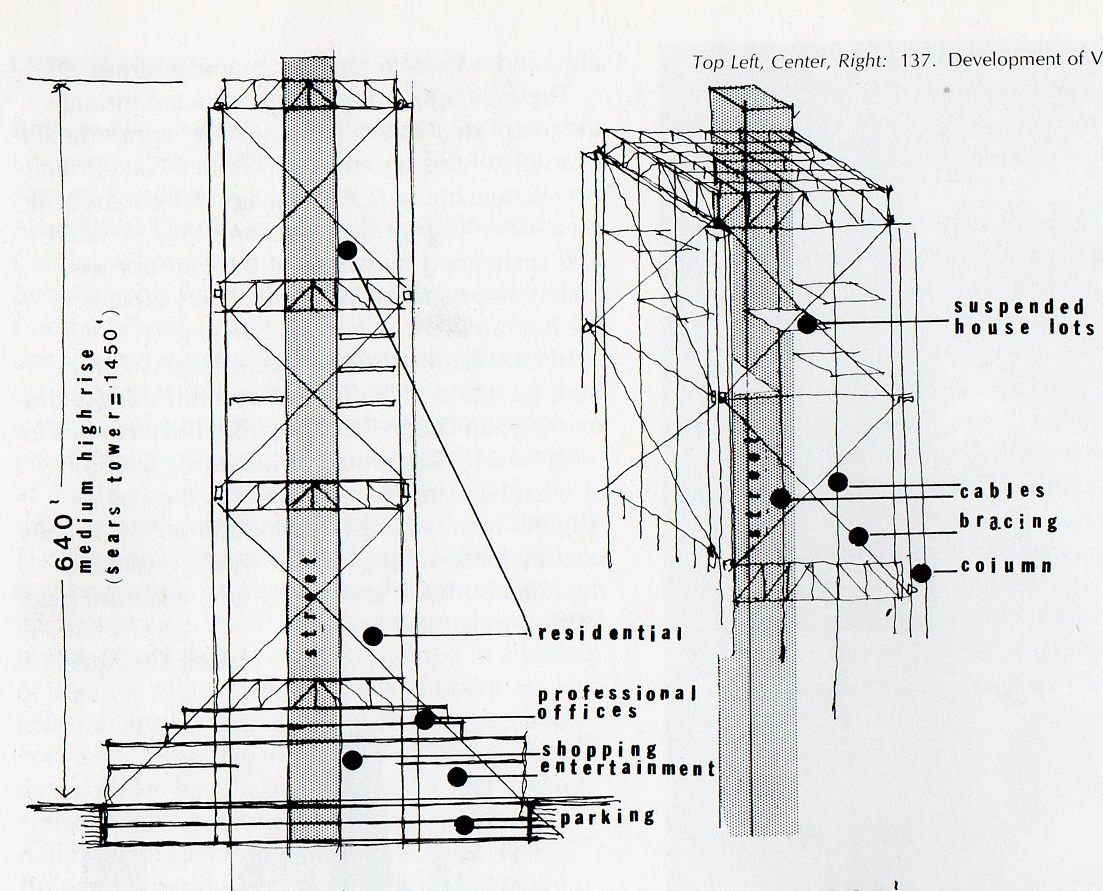
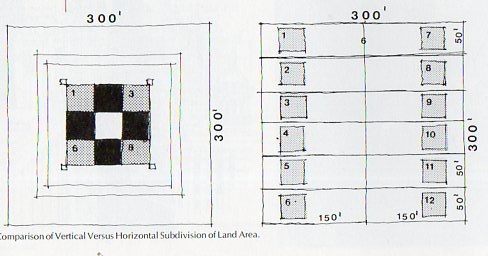
    The Romanian architect Harlan Georgesco came up with an idea to prevent suburban sprawl from making one city out of the land from San Diego to San Francsico–put the suburbs in the sky.  The story is in the wonderful Unbuilt America by Sky and Stone under the subheading “Relocation of Los Angeles”, where they quote Mr. Georgesco saying that the sprawl of a plan to develop 300×300 foot “horizontal plots” in a larger scheme of an endless horizon of such housing could be made into “vertical tracts”.

    Vertical suburbs360

    The vertical tracts of 300×300 feet (90,000 square feet or about two acres) oe chunks thereof would be suspended via “steel in tension” (giving the Golden Gate Bridge as an example of this system) in a structure 640 feet tall, which is labeled as a “medium high rise”).  (I should point out that the WTC was 208′ square.)

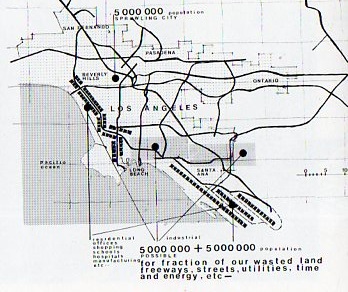
    Mr. Georgesco’s proposal called for a total reorganization of dwelling life in California–he was thinking of housing 5 million people in this way.  The little squares on his map (below) shows the emplacement of colonies like this vertical city. 

    Vertical suburbs362

    It seems to me that as a futurist the architect’s plans contained an abundantly fatal flaw in assuming the construction of suburban houses on a platform 600′ tall.  To be concerned with waste by stacking cul de sacs one on top of one another seems to miss the point, some. 

    Vertical suburbs361

     Notes:

    I would be curious to know about Mr. Georgesco’s life in Romania during the 1939-1945 period.  He certainly became successful and accomplished, though the period in Romania was–lightly put–complicated.  Starting out the war as a neutral, Romania moved quickly to be an ally of the Nazis, participating in Barbarosa, and over the next 3 years lost hundreds of thousands of soldiers, and civilians.  And of course there was a participation in the Holocaust.  By 1944 the King of Romania was able to lead a revolt and Romania joined the war on the Allied side, declaring war on Germany.  They were almost immediately overtaken by the Soviets, who would stay for quite a long time.  When the Soviets arrived, they basically “took” the Romanian army (of 130,000 men or so) back to the Soviet Union–the vast majority never to return.  Mr. Georgesco left in ’47.