A Daily History of Holes, Dots, Lines, Science, History, Math, Physics, Art, the Unintentional Absurd, Architecture, Maps, Data Visualization, Blank and Missing Things, and so on. |1.6 million words, 7500 images, 4.9 million hits| Press & appearances in The Times, Le Figaro, Mensa, The Economist, The Guardian, Discovery News, Slate, Le Monde, Sci American Blogs, Le Pont, and many other places… 5000+ total posts since 2008.

Category: Technology, History of

  • Hearing Patterns in Gases, 1894

    JF Ptak Science Books   Post 1530

    I was about to start a new series of posts on the History of Lines , something left out of this blog, oddly, given the different posts on the History of Dots and the History of Holes (and the History of Blank and Empty Things).  A lot of that–the History of Lines business–has to do with the interpretation of things on paper:  heart rate, “brain waves”, the motion of a bumble bee, navigation, and of course, words.  (The great Kickapoo tracker Famous Shoes  in Larry McMurtry’s Streets of Laredo, one of the Lonesome Dove tetralogy, found that the one thing he couldn’t track in this world were the marks on the pages of a book.)

    But I was distracted by the idea of seeing something in a different context, of associating something with a sense experience far beyond its origin, and so the History of Lines will wait just a little–something just a little beyond seeing some electrical function of the brain inscribed as a long line on a skinny piece of paper.  What I found was this–the invention of Mr. E. Hardy, whose “Formenephone” detected the presence of combustible fire-damp or any other gas in mines, and which would then emit sounds on the accompanying (small) organ pipe.  The apparatus would actually vibrate more rapidly as the gas content of the air increased.  At the time (the notice of the invention appearing in the Scientific American Supplement #945 for 10 February 1894) the only other means of detecting these gases was by the change of the glow of a candle. 

    Perhaps this is in a way like the application of musical notes to the numbers pi or tau, though actually useful.

    I’ll return to the History of Lines tomorrow.

    Notes:

    Formene, or marsh gas, is a “hydrocarbon which produces chloroform when the hydrogen in it is replaced with chlorine, loses hydrogen and yields anthracene”.


  • H-Bomb Wipes out Brooklyn. And Chicago. And New York.

    JF Ptak Science Books  Post 1527          Part of the Atomic and Nuclear Weapons series

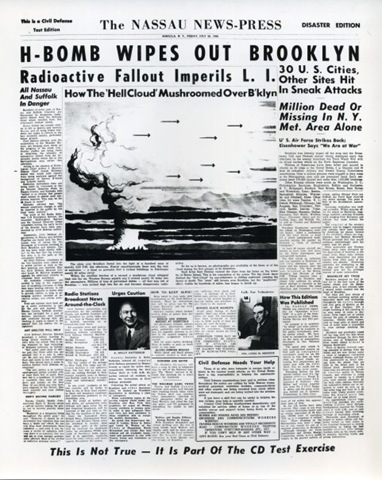
    Wipe out Brooklyn

     [Source:  Conelrad blog and also at the website]
    I stumbled on this bombing of Brooklyn article at the excellent Conelrad website–it is an excellent addition to my slight collection of vintage depictions of American cities being nuked.  As part of the necessary scare tactics in the pursuit of the arms end of MAD, the destructive power of these weapons were shown against a background that Americans could readily understand.  Thinking of atomic and then nuclear holocaust in terms of multiple units of Hiroshimas and Nagasakis was one thing–showing the effects of these weapons on an American grid was something else.

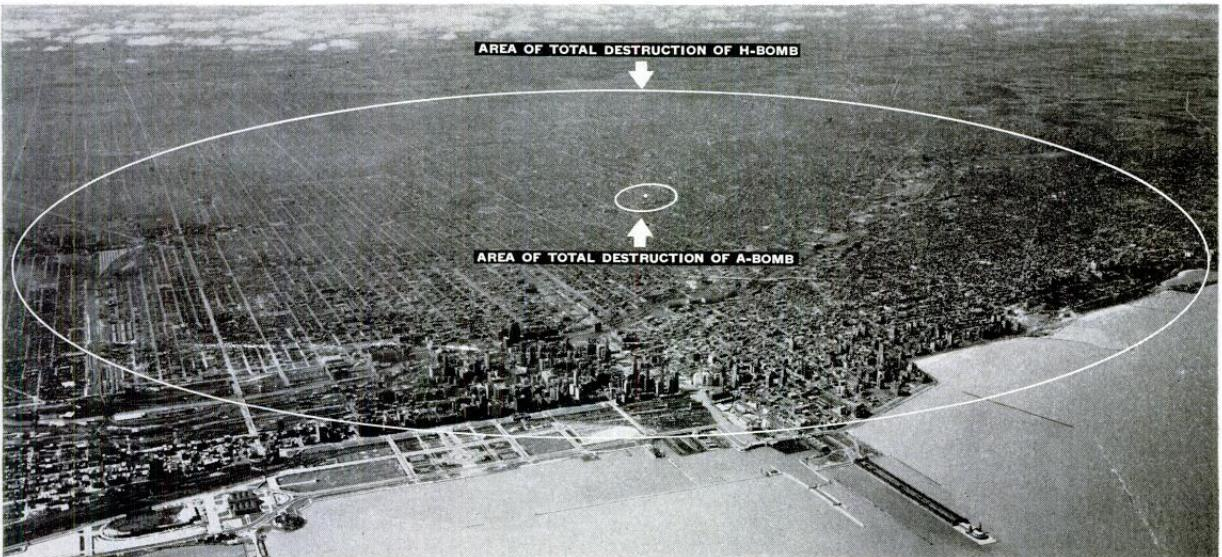
    This next  graphic shows the difference in destructive capacity of an atomic bomb (small circle beneath an air-burst detonation) and a hydrogen bomb (the large circle showing area of total destruction, which in this case would be about 50 square miles) on the city of Chicago.

    Wipe out chicago
    [Source:  LIFE Magazine, 30 Jine, 1950]

     The next image is much like the preceding, only showing a profile of Manhattan and the difference between the explosions of a Hiroshima bomb and a hydrogen bomb (of 20 megatons).

    http://bioinfo.mbb.yale.edu/~mbg/fun/both-bombs.gif

    [Source: BioInformatics Lab, Yale  http://bioinfo.mbb.yale.edu/~mbg/fun/both-bombs.gif]]

    But don’t worry, even if the Chicago and Brooklyn and New York and so on were destroyed, the U.S. Navy would survive, which would  be either great or horrible if you were a sailor:]

      H-Bomb  WIpe out NAvy
    And as usual, the point is made with one weapon being detonated, rather than the x-number that would actually be deployed.  Depicting, say, 10 weapons being used against these cities–while being a more accurate portrayal of what nuclear war might look like–might have looked like something beyond the usefulness of propaganda. 


  • FearNaughtia Coffins: Life Detectors, Escape Ladders, Breathin’ Pipes and Premature Burial

    JF Ptak Science Books   Post 1526

    I’ve written here before on the wonderful book by Jan Bondeson, Buried Alive, the Terrifying History of our Most Primal Fear 1(Norton, 2001) and on the difficulties of determining death in the 19th century, and the various ways that people sought to deal with and sidestep the possibilities of premature burial.  In continuing those posts I’d like to add the following  drawings from hopeful reports of the U.S. Patent Office, some of which really didn’t make that much applicable sense, but, well, you can patent just about anything if it hasn’t already been patented. 

    These coffins were constructed to allow their occupants to ring or telephone or telegraph or signal with smoke or light and so on should the dead respond to their lost life while buried.  As I point ou tin the earlier (linked) post, determining death was a difficult task in the 19th century, so there wsa a legitimate fear-of-being-buried-alive concern.  OF course, the best way yo determine death would be to allow the supposed-dead to lay out for three days at the end of which the body became a corpse and putrefy–the decay part was the true determiner of death. WHy people had to bury the dead into a coffin and be placed underground faster than the three days is a mystery, particularly if there were so many people who lived in fear of waking up in an underground coffin. 

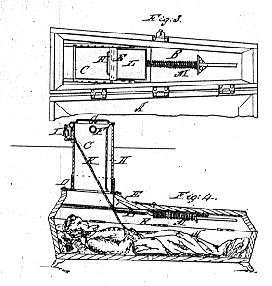
    And so to the solutions, the first of which was brought to the world by Franz Vester of beautiful Newark, New Jersey.  Well, Newark was probably beautiful when this patent was granted in 1868, and maybe this idea seemed so, too.  Here’s what would happen if a dead body awoke in Vester’s safety coffin:  their hands were attached to a rope that would be connected to a top-side bell, and the not-deceased would tug on it for all they were worth.  After that, a sliding door above the face would be moved, and the coffin’s occupant was then supposed to pull themselves up to a short laddered tunnel that was connecting the living world from the sleep-of-worms-world.  Were there problems?  Yes, of course, but so far as it has been recorded no person ever saved themselves suing this coffin, in spite of Vester’s very strenuous exercises to promote his invention.

    http://www.americanartifacts.com/smma/life/g13.gif

    [Image source:  American Artifacts, via VanVleck]

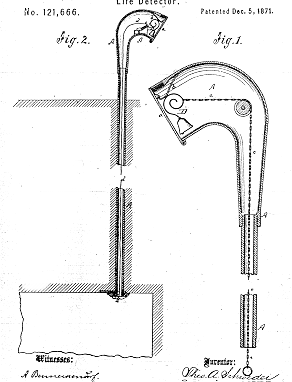
    A few years later from just downthe road in Hoboken, Theodore Schroeder and Hermann Wuest were granted a patent for another rope-activated sounding device.  The 1871 patent revealed what was pretty much a common thread to come–rope, hands, bell.  Theoretically, if the dead awoke they would tear away at the bell until the prefect or whomever arrived to dig them out.  The pair from Hoboken added a few tweaks here and there–one that allowed a release of fresh air into the coffin, and another which used an electromagnetic deice to replace the hand engine.  I’m not sure how long someone can last in a coffin underground, but it can’t be very long at all.  Why someone would think that adding an air vent to a coffin where the dead have been underground for a few days already doesn’t seem to make much sense, except to the coffin manufacturers. 

    http://www.americanartifacts.com/smma/life/g1.gif


    The next example comes from the beautifully-named Albert Fearnaught, who although not from mid-Jersey patented a device again using a rope around the wrist of the dead, this time though the rope was attached to a spring-loaded device that would release a flag when activated from below. 

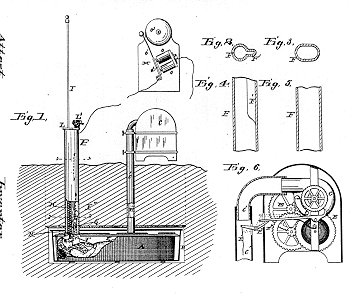
    This next (1885) patent has a slight variant on the rope-hand solution:  the string-finger. Well, there was also some electromagnetic stuff involved, but basically the string on the finger of a moving not-dead-corpse would activate an electric bell and yadda yadda yadda people would come to help and release.  The added extra here, the clear-coat undercoating, is a device that would allow the folks topside to peer down and see the face of the interred, and whether or not it was animated, I guess. 

    http://www.americanartifacts.com/smma/life/g4.gif

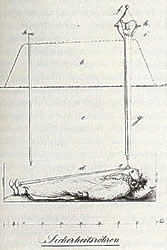
    Hubert Deveau evidently had grown tired of all of these hand/finger-operated back- from-the-dead resurrection devices, and constructed (in his patent of 1894) a relatively simple groundskeeper-alerting-breathing-device combo–a pipe that could be moved up by the head of the person int he coffin which would in turn activate a spring-something that would keep the pipe poking-up above the ground.  It would deliver fresh air to the buried, and would evidently be a warning sign to the cemetery man that something was afoot, underfoot.

    Funny thing her is that most of the systems I looked at for this post involved a single device to release the prematurely-buried–it seems to me that there should have been at least one back-up system in case the main apparatus failed.  I mean, if you’re going to become intensely psychotic, why would you then depend on one thing to get you out of your buried coffin?  And that one thing is, basically, a rope.  What if the thing failed?  I’m just saying that I expected to see a little more comfort juice applied to these solutions than I saw. 

     And why current radio talk show fearmongers like Glenn Beck isn’t all over these things, I don’t know–they Fearnaughts for just about everything else…

    Notes:

    1. A fine article on patent remedies for premature burial can be found here: “Signals from the Grave, Early Patents for Detecting Life in Buried Persons”, by Richard Van Vleck, in American Artifacts, issue 45, July 1999. 


  • Electro-LUXurious 11: Medical Electrifying-Liquid Injector, 1862

    JF Ptak Science Books   Quick Post

    This is the fourth in a new series of posts on interesting, early applications of electricity, most of which are taken from the archives of the U.S. Patent Office.

    I’m not sure exactly what Mr. Paige was trying to do with this electrical implement of his–he writes:

    which to my mind means that he is passing a “medicine” over or into some part of the body and while doing so either passes a charge through the liquid or provides a small series of shocks to the affected area so that it hurries the treatment along a little faster, or with more efficacy, or something.  Whether this is a topical application, or a delivery to an open wound, or to an incision is not altogether clear to me. As is generally the case with these things, the inventor is given the luxury in the patent report of not having to say what the thing they have invented actually “does” after describing how it is that the machine will “do” it. 


  • Electro-LUXurious 9: Combination Medical Apparatus and Alarm System, 1892.

    JF Science Books   Quick Post

    This is the fourth in a new series of posts on interesting, early applications of electricity, most of which are taken from the archives of the U.S. Patent Office.

    I am uncertain why there should be a combination bell/alarm and electrical stimulation medical device wrapped up in one small wooden package, but here it is.  Certainly there was no explanation for the need for the bell, or alarm; but then again, there wasn’t an explanation on what this thing did to the body (or soul, or whatever) either–that was not the job of the patent report, which tells the reader how the thing works, but not necessarily what it does. Of course this is just finding fault with a small bit of nonsense wrapped up in a larger chunk of junk…perhaps it was all just distraction.  In the larger world of electrical vapor baths, vacuum coffins, electrical hair, automatic tongue pullers, and so on, what difference could one extra bell make?


  • Electro-LUXurious 8: Electrical Medical Cane, 1899

    JF Ptak Science Books   Quick Post

    This is the eight in a new series of posts on interesting, early applications of electricity, most of which are taken from the archives of the U.S. Patent Office.  Unlike the general post in this blog, many of the Electro-LUXurious post images and documentation can be presented without commentary.

    I thought at first when I found this “electric cane” that there would be a light source or something embedded in the hanle.  There is a small light bulb inside the handle, but there are no lenses, no glass; just metal caps.  It turns out that this is a medical cane, an electrical unit with brass or copper barrels to be held in the hands or applied to various areas of the body for electrical stimulation. 


  • Electro-LUXurious 7: Electric Hair Brush with Stimulator Sponges, 1899

    JF Ptak Science Books  Quick Post

    This is the seventh in a new series of posts on interesting, early applications of electricity, most of which are taken from the archives of the U.S. Patent Office.  Unlike the general post in this blog, many of the Electro-LUXurious post images and documentation can be presented without commentary.


    And then there’s this beauty from 1912:


  • Electro-LUXurious 5: Alpha and Omega Casket and the History of Death

    JF Ptak Science Books   Post 1491

    This is the fifth in a new series of posts on interesting, early applications of electricity, most of which are taken from the archives of the U.S. Patent Office.  Unlike the general post in this blog, many of the Electro-LUXurious post images and documentation can be presented without commentary.

     It has not been an easy job over the centuries in determining whether a person was alive or dead, and dead as in really truly dead, absolutely so.  Consider how this would be done in case of coma and such in the days before the stethoscope, when doctors and medical people would use cones and other hearing apparatus to help the wizened old practitioner hear with their deteriorated hearing, listening for signs of life with an inferior instrument and Burial premature limited auditory capacity.  (The stethoscope wasn’t invented until 1816 by Rene Laennec–who produced a monaural device much like a primitive hearing horn made of solid wood—which was a vast improvement over no stethoscope at all, by again was very crude compared to early 20th century devices.) There is little wonder about the tales of horror of premature burial (as with Poe) and the spate of burial devices where–of the dead suddenly became not so, awakening in the coffins underground, that they could activate one of the many ingenious life-saving devices to alert someone to come and dig them up. (There were also patented designs that would deliver air to the coffin as well as have an accessible ladder to the surface.)
    The most fool-proof way of determining death in the 19th century was to leave the body alone for three days or so to see if it began to putrefy–this was the method proposed by Christian August Struwe, among others, who advocated the construction of special hostels for the dead (“Leishenhauser”), where they, the supposed dead, would lie in state for the period of time necessary for putrefaction.  This was also among the most elegant solutions given limited technological capabilities, especially when compared to nipple-pulling, scalding, tongue-yanking and of course the infamous tobacco smoke enema (seen below).

    What I am getting to though in the Electro-LUX series is the coffin/life-determination box, a sort of all-in-one affair where a body could be both determined to be dead and buried in the same thing, one of the few (?) medical devices that after performing its job be used as a coffin for its patient.  It is an alpha & omega bit, supposedly sparking to life the pre-dead if they were alive, or serve as the taxi to eternity for those who were truly and most sincerely dead.

    I’m having a bit of fun with this, but the issue of what constitutes being “dead” is still somewhat contentious–the issue was much larger 150+ years ago, when the philosophical/physical/biological questions were still very wide open, still. 


    Here are some other examples of determining whether a person was dead, or not, all taken from  Jan Bondeson’s delightful Buried Alive, the Terrifying History of Our Most Primal Fear (Norton, 2001):

    –Christian Friedrich Nasse’s Thanatometer was a long thermometer  that was inserted into the stomach, supposedly measuring a core body temperature that would determine if life was possible (and published in 1841);

    –The (Englishman’s) Barnett scalding death cure, which recommended burning the skin of the arm to see if it blistered (no blister/no life);

    –the German Middeldorph invented a heart flag, a needle device that would be thrust into the heart, which if functioning would trigger something or other that would cause a flag to be released at the top of the needle (a very Victorian and visual one, this);

    –Christian August Struwe’s interesting Lebenspruefer (1805) was an electrical device that delivered a dual shock to the eye and lip, the logic here being that if the person was still alive that there would be a resulting twitch;

    –the nameless tobacco enema, which blew smoke…(delivered in the beginning by breath through a tube and improved later to replacing the lips with a bellows, this secondary improvement by Antoine Louis2 and furthered by Dr. P.J.B. Previnaire’s much more powerful anal tobacco furnace.  [Now there’s three words I’ve never strung together before].)1

    –Leon Collongues believed that he could hear the capillary functions of a possibly-dead person’s fingers if placed in his ear;

    –Jules Antoine Josat2 invented a nipple-pincher (“pince-mamelon”) life-rejuvenation device, operating on the assumption that a deeply sedated person could not resist a strong pinch of the nipple and would have to wake up if alive.

    Perhaps the most spectacularly extension of the nipple-pincher was the tongue-pulling idea of Dr. J.-V. Laborde3 (1830-1903), a research physician with wide credentials, who reasoned that a continued regimen of advanced and strenuous pulling of a patient’s tongue would over time bring them back to life if alive.  This is what leads us to the point of this post:  Laborde established a mortuary, and in this mortuary, where the dead were waiting to die, he employed a man whose job it was to pull the tongues of these bodies.  In the misty picture of all of this that is painted in my mind’s eye, the fellow working his way from body to body pulling their tongues with a heavy pincer seems far worse than nipple squeezing or even being an anal smoke blower, though to choose between the three in a twisted Purgatorial mandate would be hard to so.  Although the nipple pincher wasn’t replaced by anything mechanical, the smoke blower was (by a powerful bellows), and so was our friend the tongue puller, who after complaining of the boredom of his task was pushed aside by an electrical device. 

    Notes:

    The text for the patent report, below:

    1. From the Bondeson book, page 156:

    “Antoine Louis had also proposed another method of testing life, or at least stimulating the vital spark in the apparently dead person: with a powerful bellows, he administered an enema of tobacco smoke. One of the pipes of this remarkable apparatus was thrust into the anus of the apparently dead person; the other was connected, by way of a powerful bellows, to a large furnace full of tobacco . Such enemas of tobacco smoke were thought to be very beneficial and were used to try to revive not only people presumed dead but also drowned or unconscious individuals. In 1784, the Belgian physician P.J.B. Previnaire was given a prize by the Academy of Sciences in Brussels for a book on apparent death, which described and depicted an improved bellows for enemas of tobacco smoke, which he called Der Doppelblaser. These enemas were regularly used well into the nineteenth century, particularly in Holland; modern science has discerned no physiological rationale for their use, except the pain and indignity of having a blunt instrument violently thrust up one’s rear passage must have had some restorative effect.”

    2.  Josat.  From Weird Universe.net I found the following, quoting Death and Sudden Death, by Paul Brouardel and F.L. Benham:

    “Josat invented a pair of forceps with claws, with which he proposed to pinch the nipples of persons whose death has to be ascertained. Josat obtained the first prize of the Academy, but Briquet, repeating the same tests on the hysterical subjects under his care, proved that they did not react under Josat’s forceps any more than the dead.”

    3.  M. Laborde won a 2500 franc prize for his innovation in 1894 (as reported by the Revue scientifique.  He sounded like an interesting man:  according to the British Medical Journal (in reporting his death 25 April1903) upon his own death in that year Laborde: “as a freethinker had a civil ceremony; as an hygienist was cremated; as a member of the Societe Mutuelle d’Autopsie willed his body to be dissected; as an anthropologist willed his brain to be preserved at the Anthropological Museum…” Some of Laborde’s works include   Le traitement physiologique de la Mort. And Les tractions rythmées de la langue, moyen rationnel … de ranimer la fonction respiratoire et la vie … Avec … dessins, etc  And:  La traitement physiologique de la mort (Paris , 1894) And: La signe automatique de la mort reelle (Paris, 1900). And  “Les Tractions Rhythmees de la Langue”, VIII, pp. 76 ff, ed. 2, Paris, 1897, and VIII, 2d part, pp. 406-510. And commented upon in some number, for example:  Le Traitement physiologique de la mort par les tractions rythmées de la langue. Le tracteur lingual automatique Laborde, by Alix Hache.

  • Electro-LUXurious 4: the Curative Electric Chair, Complete with Apparatus for the Treatment of the “Depending Organ”, 1891

    JF Ptak Science Books   Quick Post

    This is the fourth in a new series of posts on interesting, early applications of electricity, most of which are taken from the archives of the U.S. Patent Office.

    J(osephus) C. Chambers, the patentee of the apparatus below, was the owner of Chambers’ National Lightning Protection Company (Newport, Kentucky), and held a number of patents relating to lightning rods, electrical insulators, a telephone apparatus (1881), and a number of associated bits of techno. I’m not exactly sure what this device, below, did, except that it seems like a low-voltage quack-medical electric chair.

    The first patent drawing, below, shows a view of the chair and at front, looking backwards towards the  “ornamented” wooden cabinet that contained the guts of the machine, with the seat (which would have a metallic, conductive surface) removed.  You would place your hands on the two capital “H” pads that seem to be just below the two drawers; your feet would go on the two “h” pads at bottom. 

    The drawing below references how the various swinging arms and such can be maneuvered to reach any part of the body.  Mind you now the inventor doesn’t actually state what this electrical treatment “does”, only how you apply it and the technical stuff behind the machine. Also ir is not a solitary experience–there would be another person operating the controls on the top of the wooden case.

    I wondered about the cup (“J”), and thought, well, maybe that’s not what I think it might be for…but it is, waiting there to treat “the depending organ”.


    The U.S.  Patent Office report reads as follows:

    United States Patent Office.

    JOSEPHUS C. CHAMBERS, OP DETROIT, MICHIGAN.
    ELECTRICAL MEDICAL APPARATUS.

    SPECIFICATION forming part of Letters Patent No. 445,636, dated February 3, 1891.

    Application filed April 21,1890, Serial So, 348,911, (So model,)

    To all whom it may concern:


  • Electro-LUXurious 3: Anti-erection “Body Wear” 1889

    JF Ptak Science Books  Quick Post

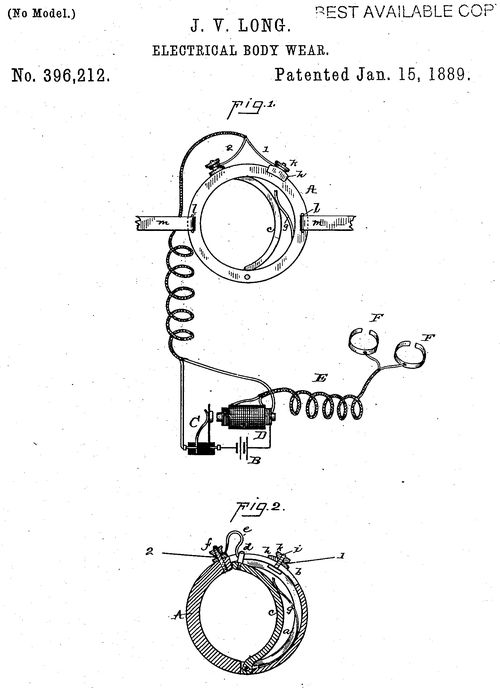
    Electrical Anti-Erection “Body Wear”  1889

    This is the third in a new series of posts on interesting, early applications of electricity, most of which are taken from the archives of the U.S. Patent Office.  Unlike the general post in this blog, many of the Electro-LUXurious post images and documentation can be presented without commentary. 

    Patent anti erection


    [Source: Google Patents, http://www.google.com/patents/US396212]