A Daily History of Holes, Dots, Lines, Science, History, Math, Physics, Art, the Unintentional Absurd, Architecture, Maps, Data Visualization, Blank and Missing Things, and so on. |1.6 million words, 7500 images, 4.9 million hits| Press & appearances in The Times, Le Figaro, Mensa, The Economist, The Guardian, Discovery News, Slate, Le Monde, Sci American Blogs, Le Pont, and many other places… 5000+ total posts since 2008.

Category: Technology, History of

  • H-Bomb Wipes out Brooklyn. And Chicago. And New York.

    JF Ptak Science Books  Post 1527          Part of the Atomic and Nuclear Weapons series

    Wipe out Brooklyn

     [Source:  Conelrad blog and also at the website]
    I stumbled on this bombing of Brooklyn article at the excellent Conelrad website–it is an excellent addition to my slight collection of vintage depictions of American cities being nuked.  As part of the necessary scare tactics in the pursuit of the arms end of MAD, the destructive power of these weapons were shown against a background that Americans could readily understand.  Thinking of atomic and then nuclear holocaust in terms of multiple units of Hiroshimas and Nagasakis was one thing–showing the effects of these weapons on an American grid was something else.

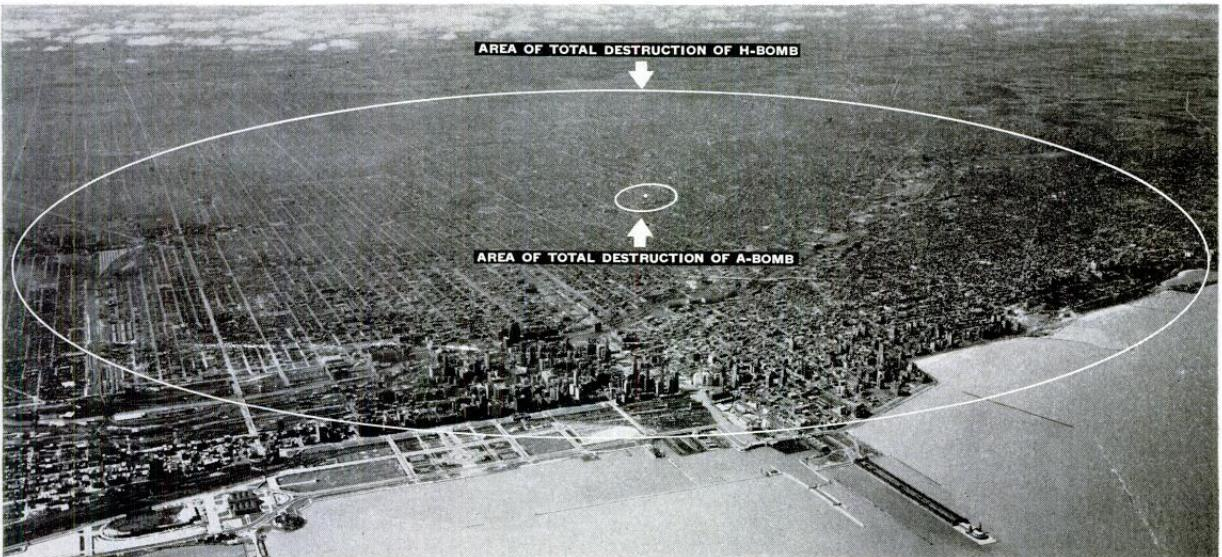
    This next  graphic shows the difference in destructive capacity of an atomic bomb (small circle beneath an air-burst detonation) and a hydrogen bomb (the large circle showing area of total destruction, which in this case would be about 50 square miles) on the city of Chicago.

    Wipe out chicago
    [Source:  LIFE Magazine, 30 Jine, 1950]

     The next image is much like the preceding, only showing a profile of Manhattan and the difference between the explosions of a Hiroshima bomb and a hydrogen bomb (of 20 megatons).

    http://bioinfo.mbb.yale.edu/~mbg/fun/both-bombs.gif

    [Source: BioInformatics Lab, Yale  http://bioinfo.mbb.yale.edu/~mbg/fun/both-bombs.gif]]

    But don’t worry, even if the Chicago and Brooklyn and New York and so on were destroyed, the U.S. Navy would survive, which would  be either great or horrible if you were a sailor:]

      H-Bomb  WIpe out NAvy
    And as usual, the point is made with one weapon being detonated, rather than the x-number that would actually be deployed.  Depicting, say, 10 weapons being used against these cities–while being a more accurate portrayal of what nuclear war might look like–might have looked like something beyond the usefulness of propaganda. 


  • FearNaughtia Coffins: Life Detectors, Escape Ladders, Breathin’ Pipes and Premature Burial

    JF Ptak Science Books   Post 1526

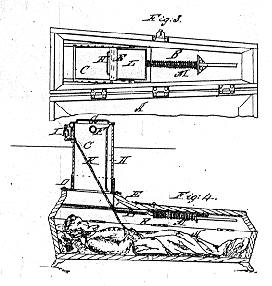
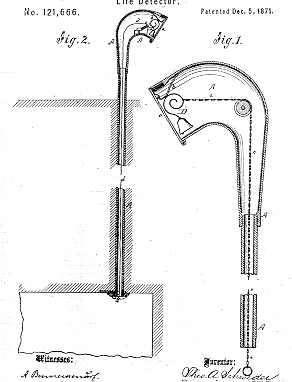
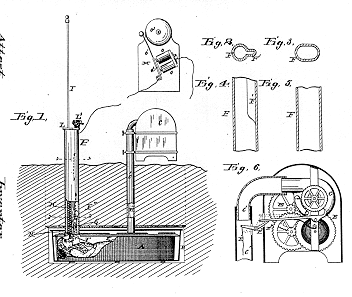
    I’ve written here before on the wonderful book by Jan Bondeson, Buried Alive, the Terrifying History of our Most Primal Fear 1(Norton, 2001) and on the difficulties of determining death in the 19th century, and the various ways that people sought to deal with and sidestep the possibilities of premature burial.  In continuing those posts I’d like to add the following  drawings from hopeful reports of the U.S. Patent Office, some of which really didn’t make that much applicable sense, but, well, you can patent just about anything if it hasn’t already been patented. 

    These coffins were constructed to allow their occupants to ring or telephone or telegraph or signal with smoke or light and so on should the dead respond to their lost life while buried.  As I point ou tin the earlier (linked) post, determining death was a difficult task in the 19th century, so there wsa a legitimate fear-of-being-buried-alive concern.  OF course, the best way yo determine death would be to allow the supposed-dead to lay out for three days at the end of which the body became a corpse and putrefy–the decay part was the true determiner of death. WHy people had to bury the dead into a coffin and be placed underground faster than the three days is a mystery, particularly if there were so many people who lived in fear of waking up in an underground coffin. 

    And so to the solutions, the first of which was brought to the world by Franz Vester of beautiful Newark, New Jersey.  Well, Newark was probably beautiful when this patent was granted in 1868, and maybe this idea seemed so, too.  Here’s what would happen if a dead body awoke in Vester’s safety coffin:  their hands were attached to a rope that would be connected to a top-side bell, and the not-deceased would tug on it for all they were worth.  After that, a sliding door above the face would be moved, and the coffin’s occupant was then supposed to pull themselves up to a short laddered tunnel that was connecting the living world from the sleep-of-worms-world.  Were there problems?  Yes, of course, but so far as it has been recorded no person ever saved themselves suing this coffin, in spite of Vester’s very strenuous exercises to promote his invention.

    http://www.americanartifacts.com/smma/life/g13.gif

    [Image source:  American Artifacts, via VanVleck]

    A few years later from just downthe road in Hoboken, Theodore Schroeder and Hermann Wuest were granted a patent for another rope-activated sounding device.  The 1871 patent revealed what was pretty much a common thread to come–rope, hands, bell.  Theoretically, if the dead awoke they would tear away at the bell until the prefect or whomever arrived to dig them out.  The pair from Hoboken added a few tweaks here and there–one that allowed a release of fresh air into the coffin, and another which used an electromagnetic deice to replace the hand engine.  I’m not sure how long someone can last in a coffin underground, but it can’t be very long at all.  Why someone would think that adding an air vent to a coffin where the dead have been underground for a few days already doesn’t seem to make much sense, except to the coffin manufacturers. 

    http://www.americanartifacts.com/smma/life/g1.gif


    The next example comes from the beautifully-named Albert Fearnaught, who although not from mid-Jersey patented a device again using a rope around the wrist of the dead, this time though the rope was attached to a spring-loaded device that would release a flag when activated from below. 

    This next (1885) patent has a slight variant on the rope-hand solution:  the string-finger. Well, there was also some electromagnetic stuff involved, but basically the string on the finger of a moving not-dead-corpse would activate an electric bell and yadda yadda yadda people would come to help and release.  The added extra here, the clear-coat undercoating, is a device that would allow the folks topside to peer down and see the face of the interred, and whether or not it was animated, I guess. 

    http://www.americanartifacts.com/smma/life/g4.gif

    Hubert Deveau evidently had grown tired of all of these hand/finger-operated back- from-the-dead resurrection devices, and constructed (in his patent of 1894) a relatively simple groundskeeper-alerting-breathing-device combo–a pipe that could be moved up by the head of the person int he coffin which would in turn activate a spring-something that would keep the pipe poking-up above the ground.  It would deliver fresh air to the buried, and would evidently be a warning sign to the cemetery man that something was afoot, underfoot.

    Funny thing her is that most of the systems I looked at for this post involved a single device to release the prematurely-buried–it seems to me that there should have been at least one back-up system in case the main apparatus failed.  I mean, if you’re going to become intensely psychotic, why would you then depend on one thing to get you out of your buried coffin?  And that one thing is, basically, a rope.  What if the thing failed?  I’m just saying that I expected to see a little more comfort juice applied to these solutions than I saw. 

     And why current radio talk show fearmongers like Glenn Beck isn’t all over these things, I don’t know–they Fearnaughts for just about everything else…

    Notes:

    1. A fine article on patent remedies for premature burial can be found here: “Signals from the Grave, Early Patents for Detecting Life in Buried Persons”, by Richard Van Vleck, in American Artifacts, issue 45, July 1999. 


  • Bad Ideas Department: Attack Islands and the Invasion of England, ca. 1800

    JF Ptak Science Books   Post 1525 (Continuing, in a way, an earlier post.)

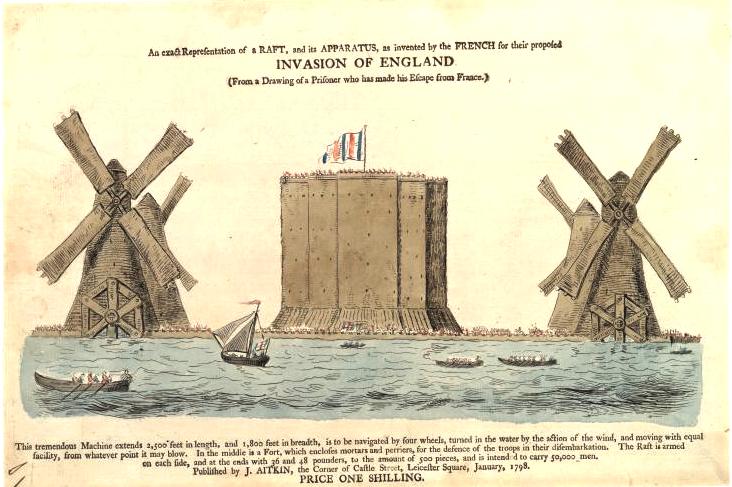
    Sometimes bad ideas aren’t really so until they are very, very big–and then put in water.  These are some examples of what was probably a propaganda campaign on a disturbing, Twilight Zone-y invitation to imagination of a French invasion of England at about the time of Napoleon.  Napoleon I.  England had been invaded before, but not by the wily Corsican.

    The first apparatus of war was a monumental thing, and was displayed for the world in this engraving, printed ca. 1798-1801.  An exact representation of a raft, and its apparatus, as invented by the French for their proposed invasion of England, printed in London by J. Atkin, portrayed the monster:  2500′ x 1800′, with a enormous stone fortification that seems to have been about 500×500′, the thing was powered by four water turbines driven by 550′-tall windmills, it was supposed to be capable of supporting 500 36- and 48-pounder canon, plus 50,000 troops.  It looks like it was built for calm water. 

    Invasion of England

    This next beast wasn’t quite so beastly as the first beast, a beast to the monster.  This was the St. Malo seacraft, a thing designed in 1791 that was supposed to be 600×33 feet, supporting the same 500 canon as above, and would transport 15,000 troops.  The added feature here–in addition to the windmill-driven engines, was a bomb-proof central structure, which I guess held the troops in safety as the ship was bombarded from the shore.

    Raft st malo

     The unlikely craft below, even though it looks not nearly as large as the preceding two craft, actually carried more troops (60,000) and more canon (600) than the ship.  I’m not at all impressed that the design we’re  looking at here could support a tenth of those numbers.  But, on the other hand(s), if it wasn’t going to be built and never existed, it really doesn’t matter that the scale was all mess up.  [Image source:  Low Tech Magazine.]

    http://krisdedecker.typepad.com/.a/6a00e0099229e88833012875609248970c-pi

    This satirical print shows a French invasion force making its way to England above and below the channel–there are attack balloons as well as a considerable atta-Chunnel. 

    http://krisdedecker.typepad.com/.a/6a00e0099229e888330120a65fa66b970b-pi

    [Image source:  Low Tech Magazine.]
    The truth of the matter is probably closer to the images below than they were to the massive attack-islands that are pictured above.

    File:My ass in a bandbox-Robert Holborn.jpg


    File:Conversation across the water.jpg


  • Strange Things in the Sky Department: Floating Ships, Cities, Airports

    JF Ptak Science Books   Quick Post

    This is a  continuation of a  series of posts in the Strange Things in the Sky Department. 

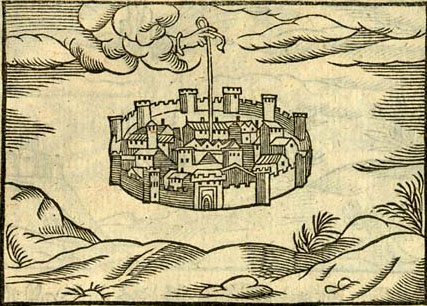
    This image of St. Augustine’s City of God shows the Primum Mobile holding the walled city (Rome, or Romish) aloft, the artist distinguishing it from the earthly city:

    http://iamyouasheisme.files.wordpress.com/2010/09/heavenly-city.jpg

    Strange things sky Perspective drawing

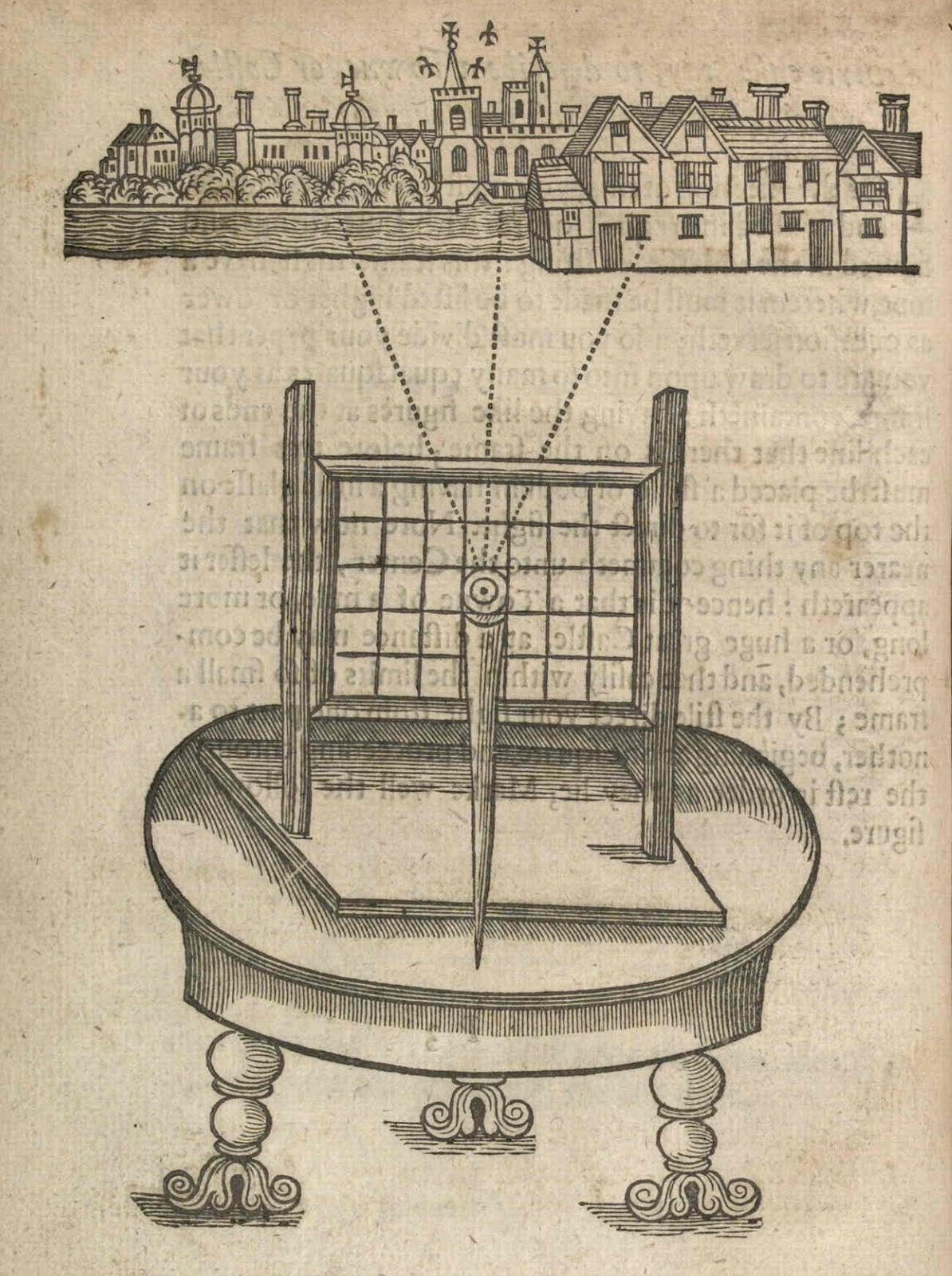
    Perspective drawing apparatus, from  John Bates’ encyclopedic The Mysteryes of Nature and Art : Conteined in foure severall Tretises, the first of Water Workes, the Second of Fyer Workes, the third of Drawing, Colouring, Painting, and Engraving, The fourth of divers Experiments, as wel serviceable as delightful: partly collected, and partly of the Authors Peculiar Practice, and Invention, printed in London ” for Ralph Mab and are to be sold by Iohn Jackson and Francis Church at the Kings armes in Cheapside 1634″.   [Source: the fabulous Bibliodyssey blogsite.]   This was a book that Isaac Newton owned and worked from when he was a teenager, using its useful recipes and instructions to build a number of bits, prankish and practical.  (This city isn’t actually floating, of course–it just looks that way.)

     [airwonder_1929_11_frpaul.jpg]

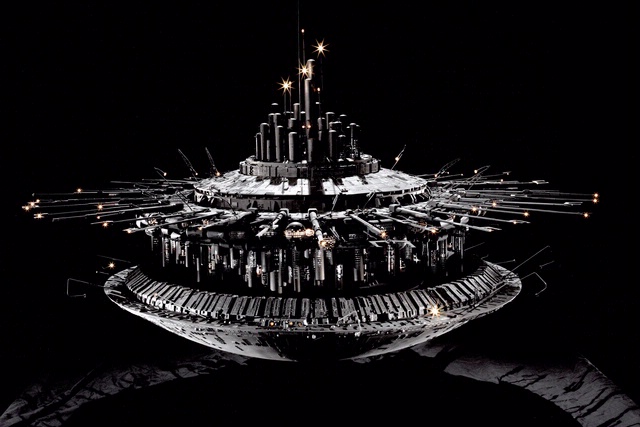
    Here’s a semi-famous illustration that appeared earlier in this blog–perfect here to offset the older “floating cities”.  This one depicts a floating or hovering or anti-gravity-something installation of a future Manhattan, existing peacefully above its former Earth-bound base, now overgrown with nature.  The New Manhattan Air Island is many square miles of buildings, and reminds me of the mothership from Close Encounters of the Third Kind. 

    http://www.nasm.si.edu/webimages/640/WEB10041-2003_640.jpg

     I just don’t know the story behind this image, though perhaps it is…well, I don’t know.  There’s a whole lot of things that it could be, but then there’s the Tall Ships on the top of mountains of ice and the air-breathing skaters in the foreground…I don’t know: 

    Strange things in sky  saturn


    Science Wonder Stories ship in sky

    [Source: http://pulpcovers.com/tag/sciencewonderstories/]

     And this in a sort-of opposite way to the above, a disembodied sitter in a very articulated space:

    Science wonder stories seated floating

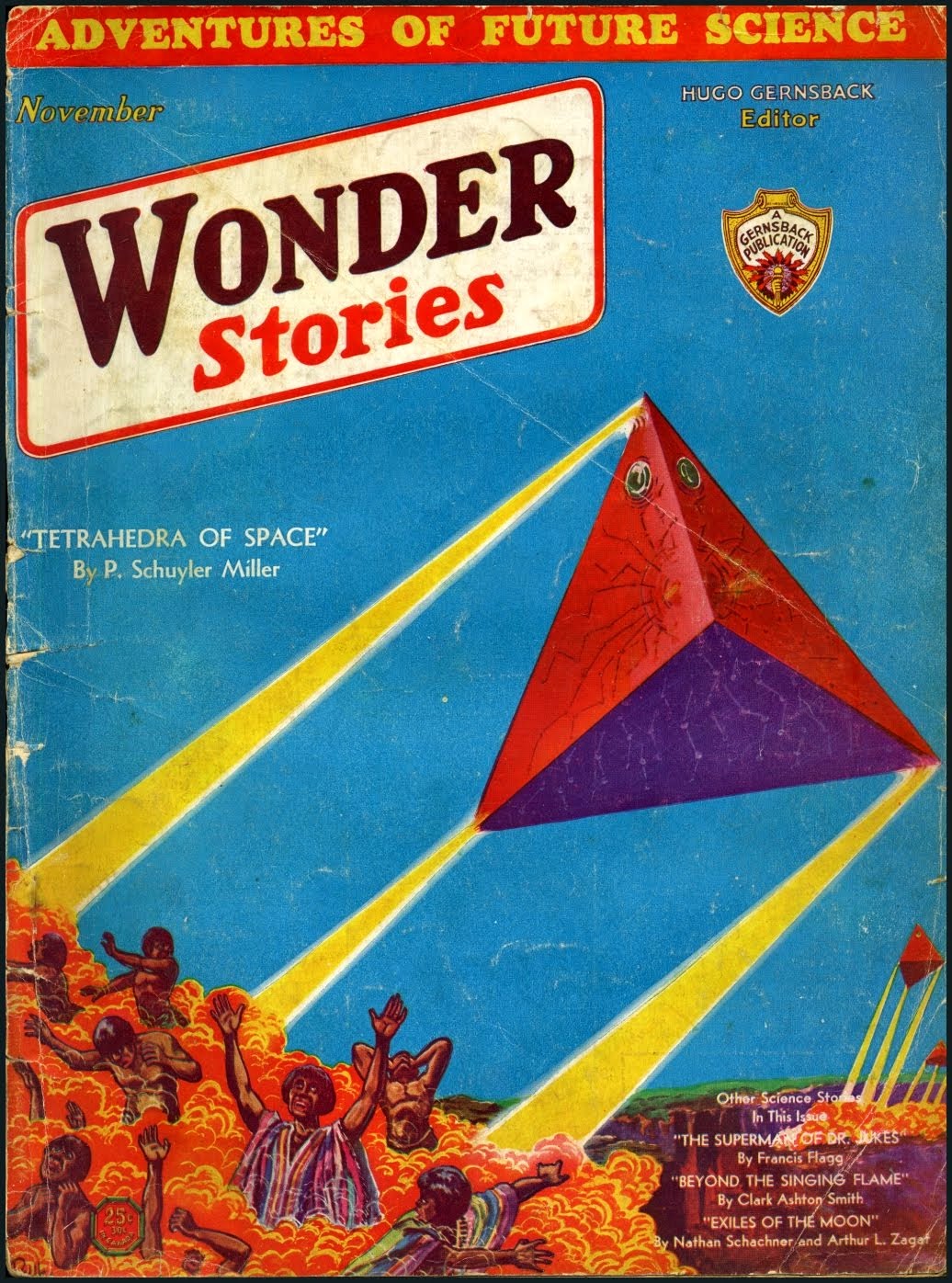
     I’m not sure what to make of these buggers, though it is very creepy looking…,perhaps its the bad-blue sky that just sets everything off badly:

    Wonder stories cubic triangles

    This image from yet another ubiquitous Gernsback publication and shows (another!)  floating airpad/port for whatever sort of hovering vehicle that approaches.  Interestingly there are a number of skydivers using unisuitwhich probably seems pretty attractive to skydivers today.  Also the roof decorations are unexpected!


    Airwonder_1929_09_frpaul


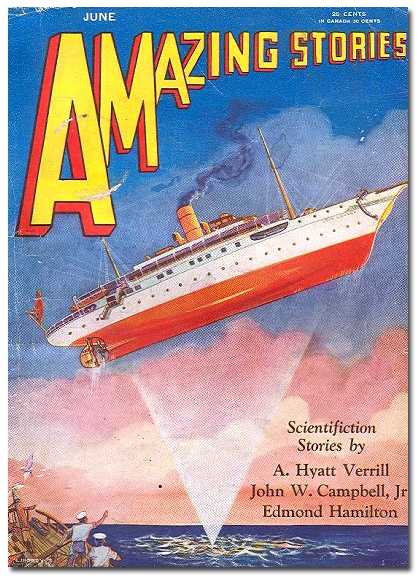
    Amazing stories floating ship

    [Source: http://thatsmyskull.blogspot.com/2007/11/ocean-liners-in-sky.html]

    WOnder stories upside down floating ship


  • George and Archie: Two Misty Names in Making Everything Into Nothing. Hiroshima, 1945.

    JF Ptak Science Books   Post  1523

    http://upload.wikimedia.org/wikipedia/commons/thumb/9/93/Tibbets-wave.jpg/300px-Tibbets-wave.jpg

    The names of Col. Paul Tibbets and the Enola Gay are instantly recognizable, instantly placeable in the history of the twentieth century.  Fact is though that Tibbets didn’t pilot his (well, Capt. Robert A. Lewis’)1 B-29 all the way to Hiroshima and back, and wasn’t at the controls when the bomb was released.  Tibbets (also known as “Old Bull”) shared some of the tactically flawless mission with his co-pilot  Capt. Lewis, and also with George.  Well, its actually “George”,  the personified names for the autopilot of the aircraft, and I guess on the long road to splitting the atom it doesn’t matter much who did what at the final moments, especially if you were on the ground in Hiroshima. 

    It was Tibbets who flew the Enola Gay most of the way, through perfect skies, nothing to stand in the way of the aircraft and the completed mission–no Japanese fighter aircraft to haunt and hunt, and no anti-aircraft coming from the ground, at least not at their  low altitude.2 “George” was at the controls at 0815 on 6 August 1945–Tibbets would take control of the plane as the bomb fell away3, ripping the plane into a steep bank in trying to put as much distance between the aircraft and the bomb in the 43 or so seconds that they had before the explosion. Everything else about the bomb and the mission at the moment of release was controlled by a human–except for the flying of the aircraft. “

    “Archie”4 is the other name not so much remembered on this morning.  This was the name given to the apparatus (there were actually four of them on the bomb) that would initiate the final arming sequence for the MK1 bomb, “Little Boy”, one of a component of a fusing system that triggers the firing system.  It was a nicer handle I guess than its official name, which was AP-13.

    Notes:

    1.  Lewis was the original pilot of the aircraft until Tibbets was chosen to lead the mission against Hiroshima.  Tibbetts was named on 5 August and acted very quickly to get a painter to paint a name on the fuselage of B-29 82–so quickly that the guy who painted Tibbets’ mother’s name on the plane had to be pulled out of a baseball game to do the job.  When Lewis saw it, saw his plane with “Enola Gay” on it, he reacted badly, as he was mighty pissed.  He confronted Tibbets about it, but the Colonel informed the Captain that there was nothing to discuss. 

    2. Intelligence reported that the only antiaircraft resistance that could be expected were from heavier guns, which also happen to be very ineffective at the low altitude at which the Enola Gay flew.  This also benefited another aspect of the flight plan, which was fuel consumption–coming in low meant a big fuel savings, which in this case was very important because of the enormous load that the aircraft was hauling. 

    3. The Enola Gay would climb at last to 31,000 feet to release the bomb, which exploded at about 1980 feet above the ground. 

    4.  An interesting document from General Groves sums up the Archies nicely:  “Memorandum dated 24 August 1944 to Major General L. R. Groves from R. N. Brode, subject: Personnel with Radar Experience. According to the latter, the APS-13 was originally called the “Charlie” and those units to be adapted to atomic bombs were to be rigged to operate at selectable frequencies between 250 and 500 megahertz. By 1 January 1945, the “Archies,” with a “natural” range of 405 to 435 MHz, could be tuned between 325 and 485 MHz.  (“Interim Report Archie Frequency Range,” Lt. Leo Gross, 1 January 1945)–The History of U.S. Electronic Warfare, by Alfred Price, Association of Old Crows, Alexandria, Virginia, 1984, p. 232.”

    “By the spring of 1944, the APS-13 “tail warning device” was under study for use as a radar fuse. Originally designed to warn a pilot of another aircraft approaching the rear of his plane, the “Archie” had an effective range of about 2,000 to 2,500 feet.” Source: The Swords of Armageddon: U.S. Nuclear Weapons Development since 1945, Chuck Hansen, September 4, 1995, vol. VIII, pp. 3-45.

    And more:

    “Four “Archies” were used on each bomb, with a network of relays so that when any two of the units signaled, stored current was sent into the detonators (one on the MK I and 32 on the MK III). The antennas for the “Archies” were attached to the sides of the bomb casings.

    “A barometric pressure-sensing switch closed when the bomb passed 7,000 feet; the bombs were dropped from altitudes between 31,000 and 32,000 feet. A bank of clock-operated timer switches, started by arming wires pulled out when the bomb was dropped, closed 15 seconds after release to prevent the “Archies” from being triggered, in case of baroswitch short-circuit, by radar signals reflected from the delivery aircraft.

    “The arming and firing sequence for the first two atomic bombs was (1) 15 seconds after release, when the weapon had fallen 3,600 feet, the timer switches closed part of the firing circuit; (2) at an altitude of 7,000 feet, the barometric switch closed another part of the firing circuit and allowed electrical current from batteries in the bomb to charge a number of capacitors and turn on the radar fuses; (3) at an altitude of about 1,800 feet, radar signals emanating from the “Archies” and reflecting from the ground completed the last part of the firing circuit and triggered the detonation signal.”


  • The Steampunk God and the non-Computer Internet, 1865

    JF Ptak Science Books   Post 1521

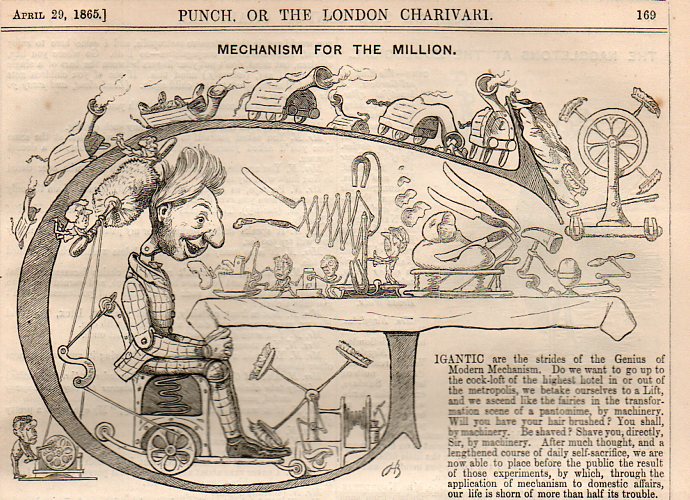
    In the weeks following Lincoln’s assassination (14 April 1865) the editors of Punch, or the London Charivari printed this arresting image of an imagined near-future:

    Mechanism545

    And what the future holds is this: the automatic hydraulic teapot (already “sugared and milked”), automatic boot and clothes brushing, auto bread-cutting, carving, cork drawing, sweeping, letter writing, reading…”all done by machinery”.  “We shall cook by machinery; we shall have our mashed potatoes by machinery.”

    There is no specification about how all of this was going to happen–I’d be very interested about the automatic “letter writing and reading” would be,  particularly when we read in the next paragraph, that “Mr. Babbage’s Calculator is a mere mechanical infant to our gradually matured inventions”.   The article continues: “From thinking of machinery we shall at last arrive at thinking by machinery, and Man himself shall be, as presented in this initial etching, a mere machine.”

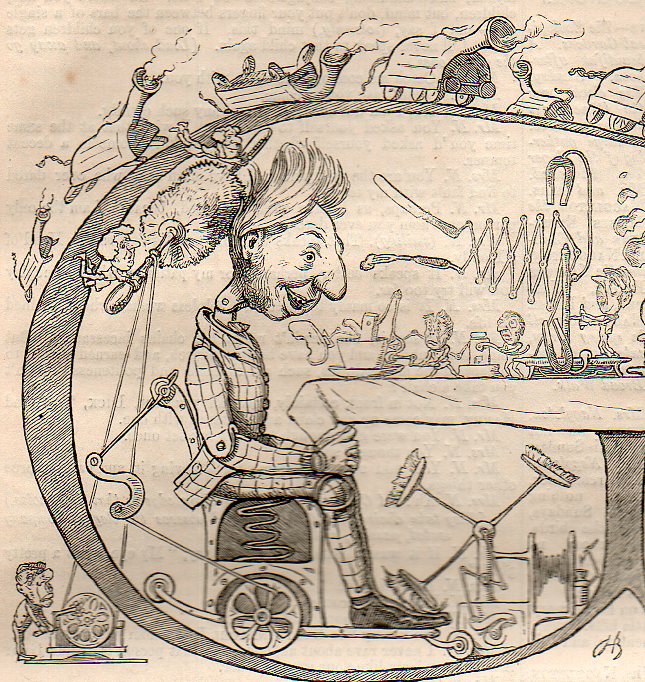
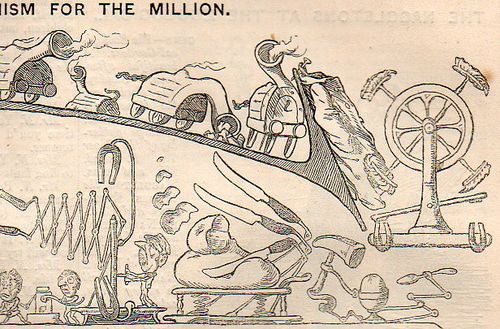
    We see in the image that there are all manner of automatons pleasing the seated (mechanical) man, though they are all powered by steam, or friction, or by magnets, all existing power sources and almost everything being doable at that point in time. 

    And the detail:

    Mechanism547  And this:

    Mechanism546

    There is a suggestion of a “Finding Fault Machine” but this goes barely beyond its mention–except to say that it would destroy something and become our next “Infernal Engine”.  I initially liked the sound of the title of this machine, though it quickly started to seem like a god machine to me–something that could and would have the ability to find faults in things, and then, I guess “correct” them in some sort of Steampunk God way. I’m not very educated in the world of speculative/science fiction to determine how early people began to imagine constructing their own supreme deity, though it seems to me that this must be considered an early effort.  I do have large doubt that the Steampunk God is what these folks were talking about since it would most probably be a blasphemy, but there is certainly room to reach that conclusion.

    The idea of a popular machine that was somehow associated with either Babbage’s (1791-1871) difference engine or analytical engine (which was a programmable machine that would function with punch cards) and automated or mechanical reading and writing is very intriguing.  It is unsure whether the editor was crediting the future with a machine that would provide the imagination behind writing, or provide an instrument that would record thoughts and creativity directly to some medium as they occurred, or what have you.  It is an interesting idea left very open-ended to the reader, which remains so even to the modern eye, because what happens with statements like this is that they get back-filled with whatever current technology exists.  In 1865, the other innovations depicted for the future were mainly driven by steam, and perhaps this automated writer/reader would be too, something very primitive by our standards today, perhaps some sort of small steam engine that would help dip a quill into an ink pot….or perhaps it was simply something as exotic as a pen with endless ink.  But I think if you look hard enough at the statement it is possible to see something like an internet.

    And there were 19th-century something-like-an-internet things being imagined, if you can imagine the internet as an entity not created by a computer network, since the “computer” as we know it would not exist for these inventive folks (below) for another 50 or 75 years. 

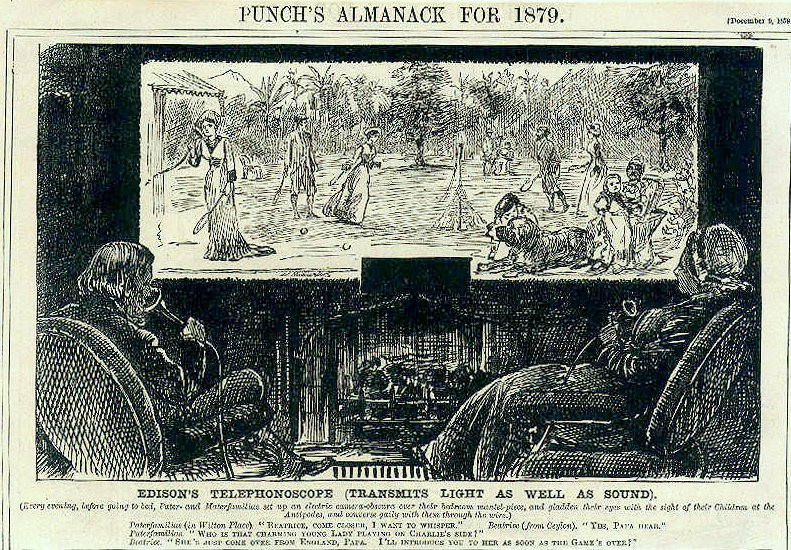
    Edison’s was there, of course, imaging a communication device that would show live-action events in which two remote parties could see and talk to one another.  A version of his Telephonoscope: appeared in Punch’s Almanack for 1879 and was aimed at the imagination and experience of only the classes of leisure and privilege:

    File:Telephonoscope.jpg

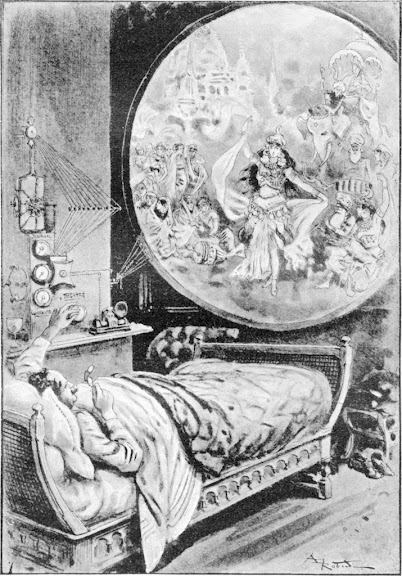
    There is also a device like this that appears in Albert Robida’s Le Vingtieme Siecle:  la Vie Electrique (1890) , which is  an odd but very nicely illustrated look into the future of 1955–most of which has come to pass.

    http://www.gloubik.info/livres/robida/images/robida-06.jpg

    http://cultureandstuff.com/wp-content/uploads/2011/05/levingtiemesiecle.jpg

    Another sort of live-action and direct communication device was depicted in Camille Flammarion’s La Fin du Monde (1893):

    I think though that the most interesting part of Punch’s view of the future must lie in the possible creation of the creator of the universe. 


  • Facial Fat and Breast Support

    JF Ptak Science Books   Quick Posts

    I didn’t quite know what to do with this bugger, but it seems so special in and of itself that I thought it deserved to stand alone.  I have seen other things like this, as in the post  made two days ago on the history of enormous bras, that used stone-age implements in the patent (see below).

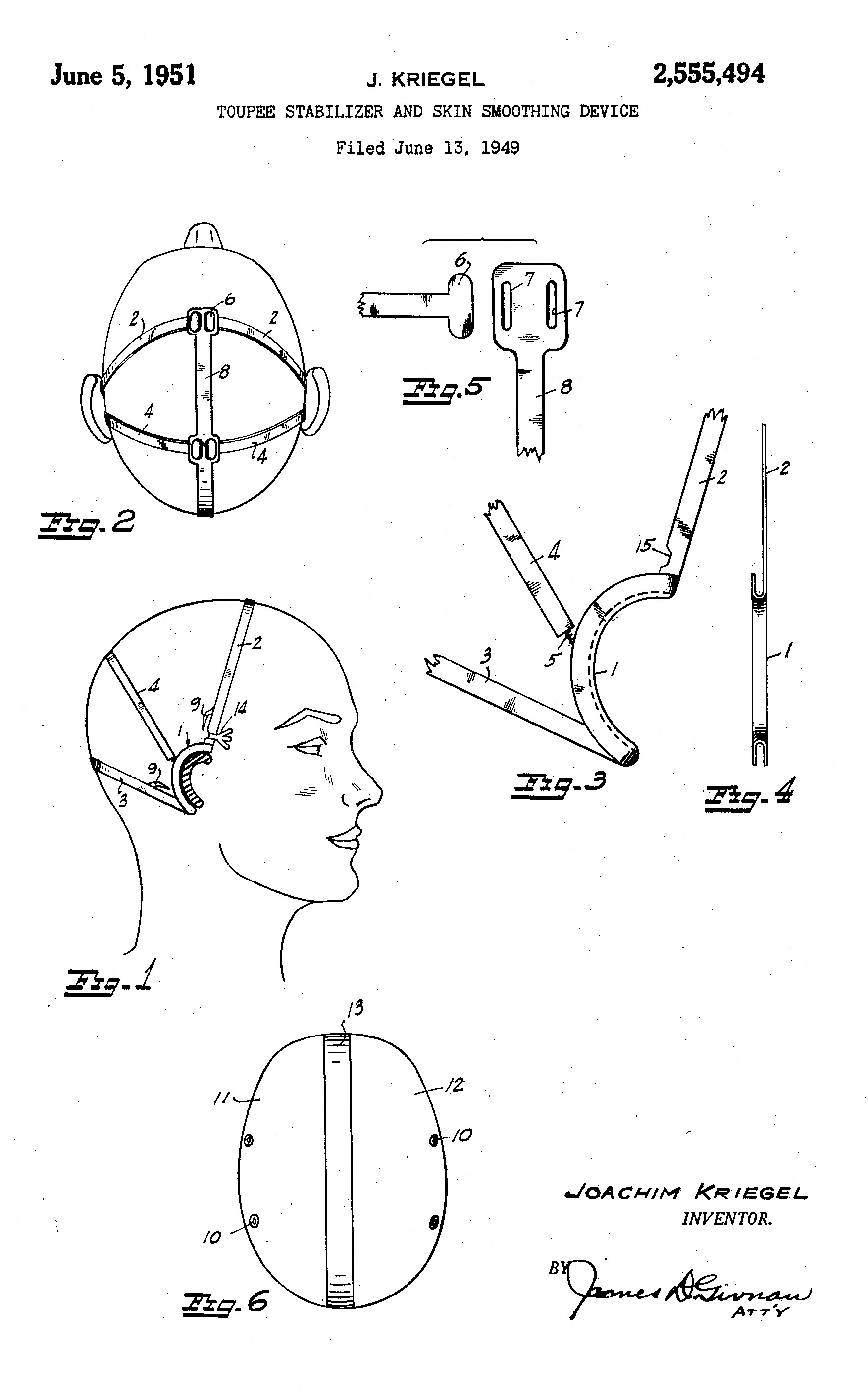
    This toupee adherer, the thing to which a toupee would be attached, also served as a facial splint–a splint for face fat, the device described as being capable of pulling back the looseness of age.  


    Patent--head bra title full

    It seems as though waking up in the morning au natural might be a bit of a shock. 


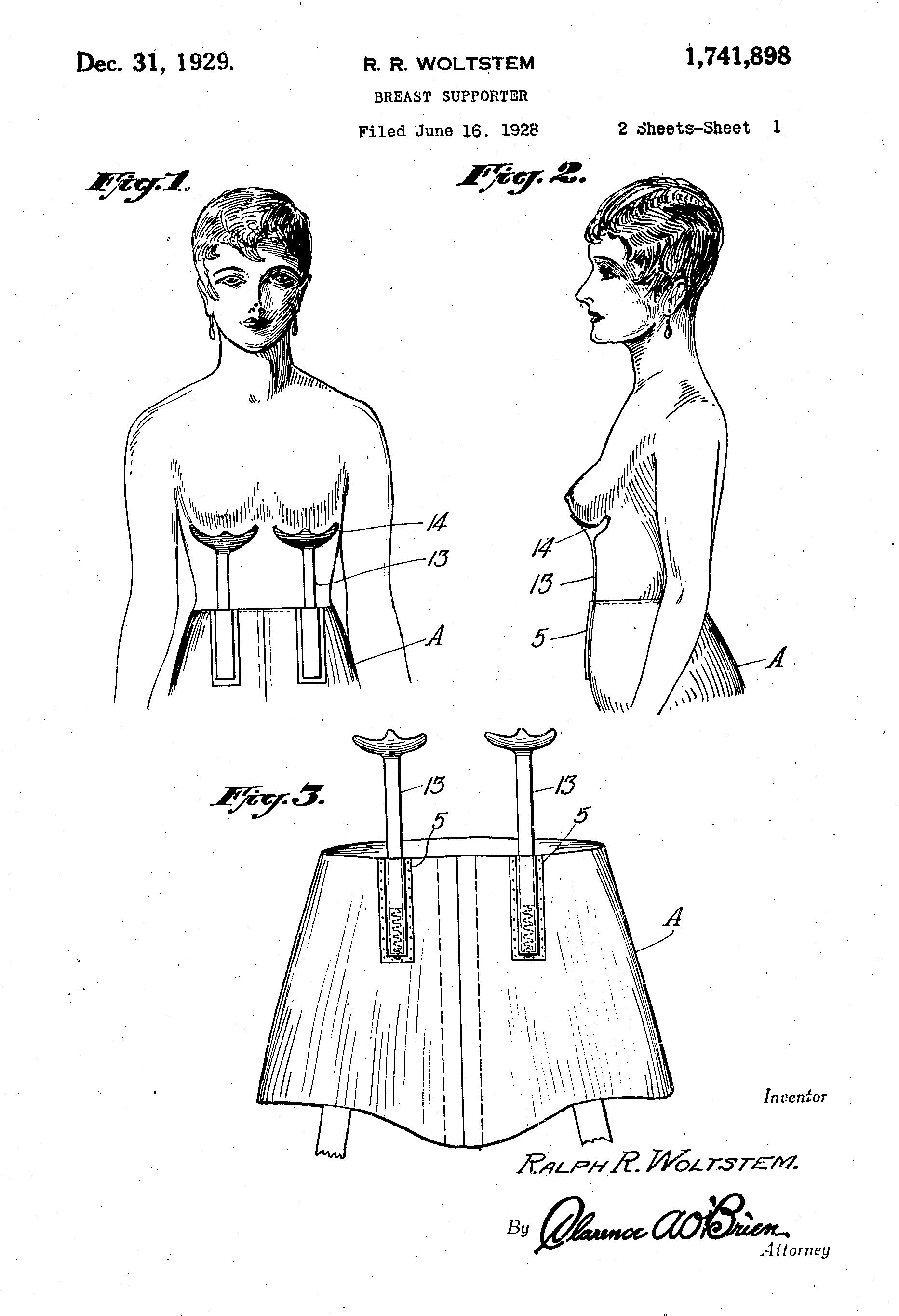
    Here’s another prehistoric bit, this on breast support:

    Patent bra


  • A Terribly Short Note on the History of Bras, U.S. Patent Office, 1892-1930

    JF Ptak Science Books  Quick Post

    Most of the following  relate U.S. patent reports on brassieres–for shaping, reducing, electrifying, supporting, warming and preventing “breast cake”–but I’ve added a few other associated undergarment creations. It seems that there was so very much “underneath”sections to the bodies of the dressed woman during this time that there could scarcely be any room for anything on top of them.  There was just so much fabric and texture and belts and straps and loops and metal and fasteners and looseners and ties and wraps that, once the onion was peeled, there was nothing left but peel, which may well have been the overall societal message draped over women during this period of time.

    Garter Attachment, 1892

    Simple Underwear, 1893


    Armpit Armor, 1893


    Brassiere & Corset and More, 1898


    Brassiere, 1899


  • Duelling Propulsion Systems: Patents for Swinging on a Swing, Sushi Boats and Retro-Pseudo-Mayan Space Ships

    JF Ptak Science Books   Quick Post in the Questionable Quidity series

    I came across these bits looking for spacecraft propulsion systems, and was surprised to find so many, well, “questionable” applications of brain power and time. Sushi boats for lazy eaters? Non-proto-Mayan naive electromagnetic spacecraft?  Swinging (on a swing)?

    I thought the swinging patent was a joke; it seems not to be.  Isn’t this like, say, patenting walking by using shoes?

    The least and the most one might say for the sushi boat is that it is powered by water, though I’m not entirely sure what else there is to be said; seems a little close to being a trough for my taste, though I have to admit that I’ve never had an experience where I pluck my food froma  moving object.  Perhaps if the little boats were on fire it would be more attractive?  Or if there were submarines? 


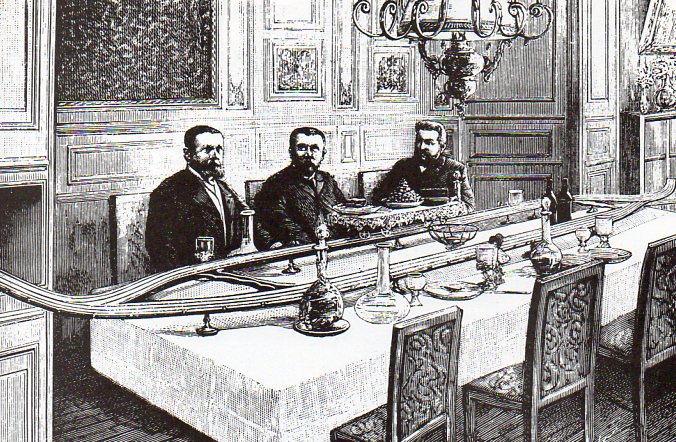
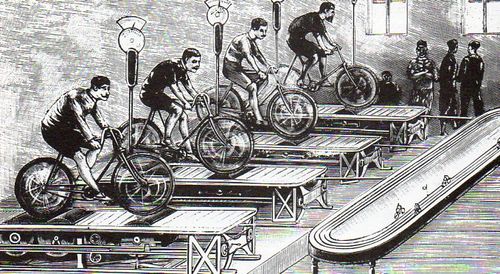
    An earlier version of this idea from 1887, showing the use of “midget electric trains” “at the kitchen and dinner-table of M. Gaston Menier”–somehow this is a little more appealing, though the prospect of eating on a miniature railway track is not all that appetizing:

    Propulsion536

    This is an interesting variation of the two bits above, though (surprisingly!) there is no food involved:


    Propulsion531

    Back to sushi:   evidently a much bigger idea than I gave it credit for: 


    And from America:


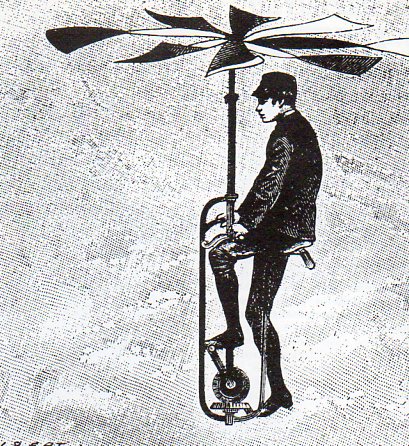
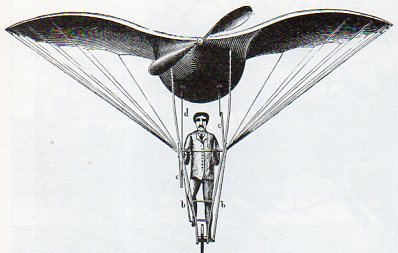
    There were many other novel and noble efforts in the area of propulsion, particularly in the late 19th century, a few lovely examples of which can be seen here: 

    Propulsion532


    Propulsion533

    Propulsion534


    Propulsion535


  • Steampunk Baseball Patents, 1875-1910

    JF Ptak Science Books  Post 1504

     When I think of old-timey baseball, the images of roomy woolen uniforms, cigars-on-trains, daytime games, underpaid stars, heavy baseballs, and, um. “colorful” nicknames spring to mind. And back in there, eighty or a hundred years ago, baseball has had its minor league steampunk days, much like most other things: sporty adventures filled with outsized protective bits, simple things turned into fancy mega-geared complexities, over-the-top metal extrusions, steely encumbrances, and over-thought subtleties turned into under-thought necessaries.

    Take for example the following baseball glove from 1905.  The sport was four or five decades old at this point, yet there was a person, still, who came up with an idea for a baseball mitt so bad that it must’ve burnt the pen used to draw it.  Not only does the glove make it very difficult for the player to run, but also makes it rather difficult for anything else to happen, too.

    I’m not sure when the first batting practice cages appeared (much like I can never remember when the first pinstripes appeared, or the real year for the first players with numbers on their backs), but this one from 1909 seems rather early, and comes complete with derby-and-sports-coated pitcher:

    I do like this swinging apparatus, perhaps more for the idea of it, or the design, than anything else:

    And this is quite lovely:  a paper dispenser for home plate, so that the base could always be easily seen by all involved.  The paper was located underneath the base, and pulled across for new paper when dirty.  Why the umpire couldn’t just sweep it clean with their little umpire brushes like they do now, I don’t know:

    This series of diagrams for a night game lighting system (1904) are lovely things in themselves, particularly the second drawing (“figure 3”):

    \

    I have a sort spot for any sort of movable, paper calculator, calculating anything:  the gas mileage for a 1960 Rambler, air speed calculators for planes, effects of nuclear explosions, and of course a multi-disc baseball game schedule calculator (1909):

    This gorgeous beast was a heavy, wooden apparatus for a full-scale solitary baseball game, much like its predecessor table-top varieties, only bigger, much bigger:

    The full-scale environment above came with an automatic pitching device, seen below, a fantastic thing, and beautiful in its gear-y complexity:

    For some reason this glove reminds me of cake (1895):


    As much as I wanted this to be a full-size robo-pitcher, it wasn’t:  it is though a lovely little version of a pitching robot, a toy with what looks like real staying power:

    This is just a good idea, though it would be hard to store these things if you went to 20 or 30 games a year for a few decades:

    These are simply terrific drawings, though the glove looks very cumbersome (1895):


    Its interesting to see that in just a decade-and-a-half that the baseball glove is starting to look like something more modern:

    The proposal for bases with bells in them might’ve seemed helpful to the non-baseball-person inventor, but, well, it really wasn’t, but the idea gets a complete-and-total pass since it came a year before the Centennial:

    This is interesting to me as I can’t recall if I knew how long baseballs have been stitched in the same way, or how long the seams of the ball have been in the predictably same pattern from ballclub to ballclub–and I still don’t.  This is an 1876 proposal for a baseball ball covering, different from what we know–I don’t know much about the history of the ball itself: