A Daily History of Holes, Dots, Lines, Science, History, Math, Physics, Art, the Unintentional Absurd, Architecture, Maps, Data Visualization, Blank and Missing Things, and so on. |1.6 million words, 7500 images, 4.9 million hits| Press & appearances in The Times, Le Figaro, Mensa, The Economist, The Guardian, Discovery News, Slate, Le Monde, Sci American Blogs, Le Pont, and many other places… 5000+ total posts since 2008.

Category: Technology, History of

  • Prometheus Unbound; or, the Triumph of Science in Olympus (1879)

    JF Ptak Science Books   Post 1571

    The wonderful Punch, or the London Chiarivari strikes again for the year 1879.  The quick-browse is seldom complete, as I’ve witnessed again and again; 1879 revealed several fantastic images that were posed to this blog last week (here, for the Technology Museum of the Future and also here for Thomas Edison’s Anti-Gravity Underwear and Kite Babies), and as it turns out just a few pages away, there existed a larger, two-page illustration that was again on the triumph of science, and which I missed completely, twice.

    The message in this cartoon is the glory of “science”, which was flying very high indeed in the newly-electrified times of 1879.  Dominating the image is Mr. Punch himself, holding the electrical sun in one hand, illuminating everything.  To his right, Mars and Heracles stand before an enormous cannon, with different reactions; Bacchus sits astride a barrel of coffee of all things with Pan enjoying a short cup of Joe, while in the lower left corner Hades himself is making a photograph of Eros (?), an hourglass slung across his back, finally coming to grips with capturing change.  In the right corner at bottom is a young man who is intent perhaps on reporting on the situation via a handy public telephone–such things didn’t yet exist in 1879, the telephone being just three years old, but the artist thought enough of its future power to add it into this scene of the triumph of science and technology over the panoply of gods and demigods.

    On the right ide of the image the gods make no further advance against science and technology.  Ares-as-workingman is puzzled by the giant Nasmyth hammer, with the Cyclops in the background a little more concerned, disbelieving what their eye told them.  Poseidon is shuttled away in the lower left, accompanied by what looks to be a weeping mermaid., hustled to the exit by a torpedo, a diver in a deep sea suit, and what I think is a special life-preserving inflatable suit.  In the middle of the image we see two women dressed in legal and academic garb, looking determined before a finicky Hermes; and above them, lording over it all, is a very dissatisfied Zeus, and a headache-y Hera.

    Since the image is entitled “Prometheus Unbound, or Science in Olympus”, I guess that Zeus must be reacting to electricity as the unbound Prometheus, a modern version of a kind power given to humankind via electricity.  It is this new Prometheus that is the undoing of the god’s retreat.

    Overall, this is a very plain Victorian view in the trust of science and technology to lead in all things, even the very basis of much of European mythology.   [I hope that I haven’t abused the mythology too much.]

  • History of Lines–Naive Rivers and Trees, 1670

    JF Ptak Science Books   Quick Post in the History of LInes series.

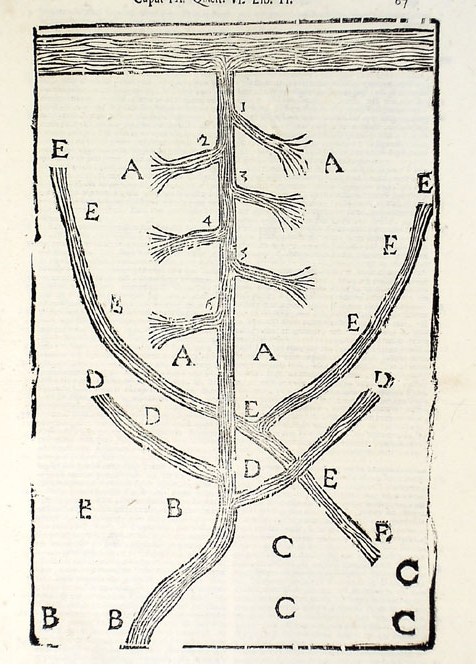
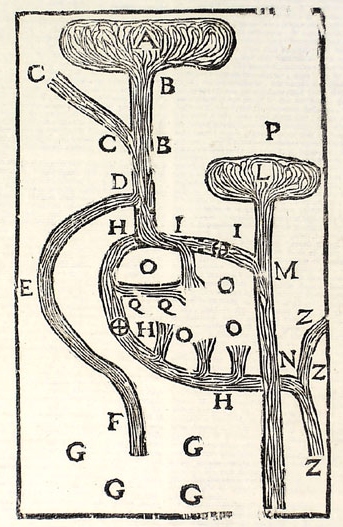
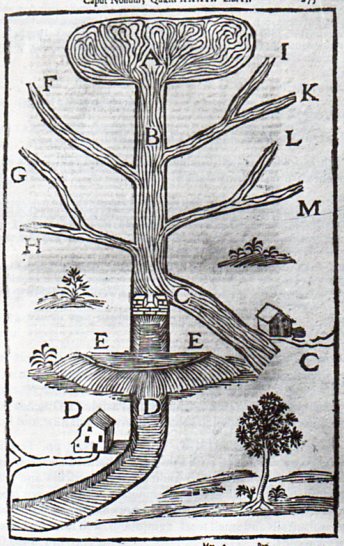
    River629 This lovely river/tree appeared as a woodcut in Franciscus Maria Pecchius’ Tractatus de Aquaeductus, which was printed in 1670-1673.  It actually is nothing of the sort, as it depicts the construction of a dam in a busy river and forms part of a four volume work on the building of aqueducts–ranging from the selection of sites, to financial considerations and of course engineering and materials studies.  Pecchius’ work was the standard of its day, and it also was the cornerstone work on the (Roman) law of such things, presenting a jurisprudence that stretched back a thousand years.

    But the way that the flow of the river is represented makes the image look very much like a tree, in a lovely, naive way.  It might seem a horrible sleight to a work of this importance, but, well, sop it goes–the images, removed from their appropriate context, take on a life of their own…

    River aquaduct 2
    River aquaduct 3


  • The Division of Technology: Different Forms of Social Media Debate, 1893

    JF Ptak Science Books  Quick Post

    Phonograph 1893


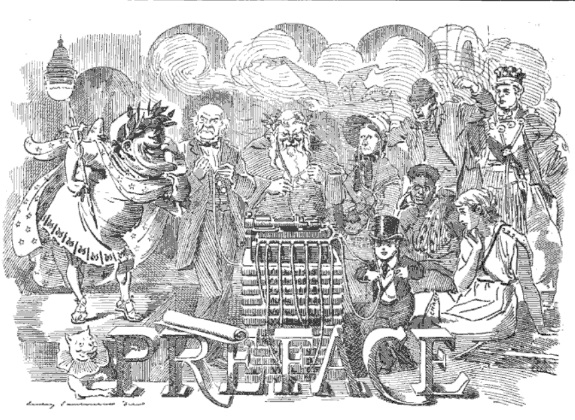
    I found this image flipping through an issue of the London Punch for 8 July 1893.  It shows a group of people gang-listening to a phonograph, with Mr. Punch holding court. The phonograph was already into its third decade (invented by Mr. Edison in 1877 with the patent granted in 1878) and was becoming massively popular, with the prices for the machine and the wax cylinders that powered the interest dramatically falling so that it was within reach of the working middle class.

    The image was used as a header illustration to the opening of the new volume for the second half of the year, and was an introduction to the table of contents for the 300-odd pages that followed, and its legend reads in part:

    “The Penny Phonograph,” pursued Mr. Oracle Punch, “is now prodigiously patronised. For the popular penny you can hear an American band, a Chevalier coster ballad, the ‘Charge of the Light Brigade,’ a comic song by ‘Little Tich,’ or a speech by the Old Man eloquent. No; for the latter I believe they charge twopence. That is fame, my Pantagruelian Premier…”

    You can sense that Mr. Punch is more than a little wincing with his faint praise.  He does take exception to the lightness of the experience, as well as the cost.  He contends in a way that we experience today that the printed media–his own magazine, a “Funograph”– is more complete and the real voice of wisdom: 

    “But in my Funograph—charge the unchangeable Threepence—you can hear the very voice of Wisdom and Wit, of Humanity and Humour, of Eloquence and Essential Truth, of Music and of Mirth!

    And while Mr. Punch might seem to be talking about the phonograph, he is addressing his own Punch: 

    “Sweet lady,” responded the Oracle, with gentle gravity, “there is guidance here for all who will listen; heavenly Charity and diabolic Anarchy, eloquent Statesmanship and adventurous Enterprise, scared Capital and clamorous Labour, fogged Finance and self-assertive Femininity; for the motley and many-voiced Utopia-hunters who fancy they see imminent salvation in Imperial Pomp or Parochial Pump, in Constitutional Clubs or County Councils, in Home Rule, Primrose Leagues, or the Living Wage, in Democracy or in Dynamite, in High Art or Mahatmas, in Science or in Spooks. Take your places, Ladies and Gentlemen! Charity first, if you please, with Father Christmas to her right, leaving room for the little New Year on her left. Listen all, and learn by the various voices of that many-cylindered, marvellous Funographic Machine…

    Advances in the technology of communication have always caused debate–the availability of the printed book was going to make obsolete storytellers and theater, the telegraph would end letter- and book-writing, the telephone would end the telegraph and letter writing and decreased the collective intelligence by shortening the time of thought in communication, the radio would end the telegraph and letter writing and the theater and perhaps books, the television would end radio and etc., vast increases in social media will end privacy and reflective time, and so on.  The advances certainly did doom the form of communication that they trumped, mostly, though what they did to the actual communications part was change it, not end it.   And although Punch wasn’t saying that the phonograph was going to do away with anything at all, he was saying that he felt it inferior.  And for you to buy his magazine.

    The last bit on the ruminations of the impact of social media on privacy and reflection is something that I do believe to be real, and this in spite of all that I know about the history of change in communications; but here I think the medium might have so much “message” that there might not be any at all, given the enormous amount of data units that can be delivered into our consciousness and the limited amount of time for perception (let alone understanding).  And  this is just the beginning, the most primitive stages of vast and pervasive communication.

    And as I write this I wonder if I’m not sounding like a sniffy somebody writing about the impact of the telephone in 1880.


  • When the “Standard” Wasn’t So–Flying Upside Down, 1913

    JF Ptak Science Books   Post 1565

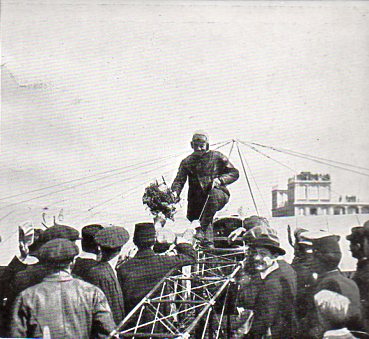
    Nearly everything that we have or use or see today was at one point “new”; standard practices, commonly used implements or technologies or ideas were at some point a breakthrough, wholly uncommon, completely non-standard. This thought struck me while breezing through an issue of The Illustrated London News for September, 1913, and seeing the following headline:

    Aeroplane upside down626

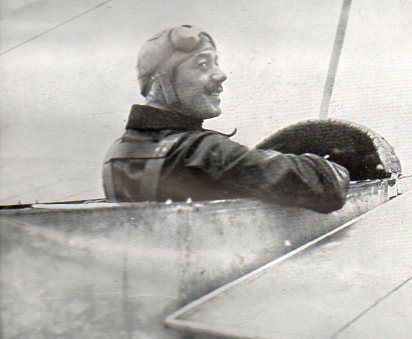
    The Wright Brothers made their powered flight in 1903, and  it is a testament to the difficulty of performing  upside-down flying that it took nearly 10 years to accomplish.  And so it happened, Adolphe Pegoud (1889-1915) accomplishing the feat 21 September 1913–he was greeted everywhere as a pioneer and a hero.  Flying upisde down, looping he loop (the distinction of “first to do this belongs to the Russian Nesterov who performed it in Kiev about a month earlier), doing the tail-slide, performing the vertical S, were all major feats, and all performed by Pegoud during this month of high activity.  But the people who seemed to take the quickest and most particular interest in these “stunts”  were the military folks, who instantly recognized the application of the maneuvers for aerial combat.  And as quickly as they saw that the maneuvers needed to learned for offensive purposes, they recognized that they must be mastered for defensive reasons, as well.  

    Aeroplane upside down625

    Aeroplane upside down624

    Aeroplane upside down623

    New York Times reported on Pegoud so:  (via The Daily Planet at the Smithsonian Air and Space):

    “Pégoud prepared a Blériot monoplane fitted with a Gnome engine and advised half a dozen friends of his plan. They did their utmost to dissuade him, but he invited them to witness the performance, and this morning at the Juvisy aerodrome he climbed into the machine and rose. At the moment of his departure he was by far the calmest person present.

    He rose to a height of 3,000 feet and then turned the nose of the machine earthward. For 200 feet it fell like a stone. It then turned inward till it was flying on its back, after which it rose perpendicularly upward. Then it completed the circle by regaining its normal flying position, having accomplished an apparent impossibility.

    The aviator came again to earth absolutely self-possessed. When he alighted from the machine his first remark was “I wished I had gone another thousand feet up. Then I could have done it twice.”

    The issue of Sciewntific American for (October, 1913)

    1913 Scientific American October 18-Pegoud;Siberian Mam
    Image Source: Pionnaire GE
    Long ago Sir Thomas Browne mused on what it was that the Sirens’ song might have been, trying to imagine and capture a source of vast imagination; it is equally complicated trying to understand how something we take so deeply for granted today was absorb when it was seen for the first time. 

  • A Technical Museum of the Future, 1879–a Note on the History of Normalcy

    JF Ptak Science Books   Post 1563

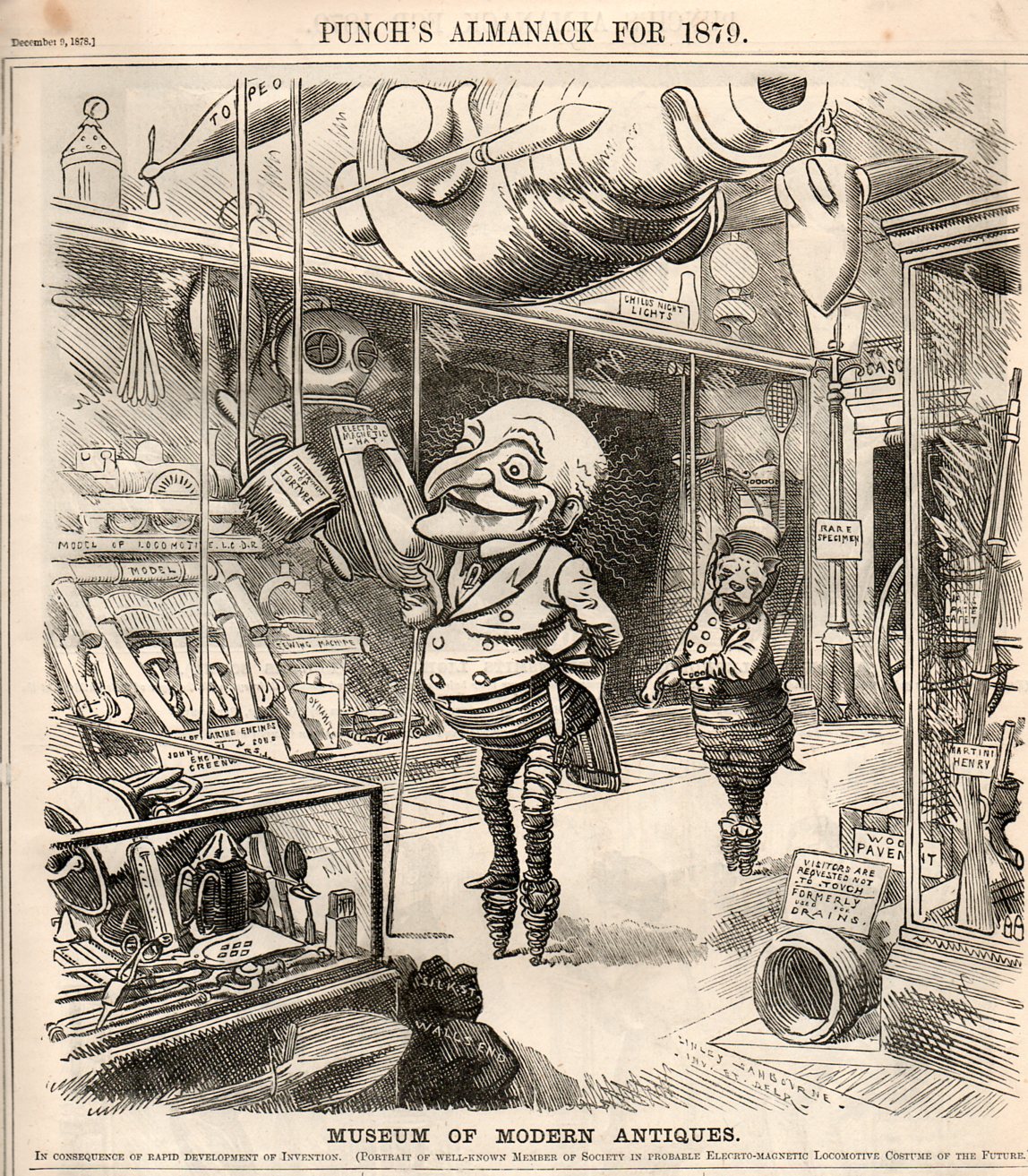
    Yesterday I wrote a blog post on Thomas Edison’s anti-gravity underwear, a satirical series of images that appeared in Punch magazine in 1879.  The leading image of the Punch almanac for that year carried forward the electrical possibilities of the day, and featured Mr. Punch himself, strolling via some odd electromagnetic transportation device through a museum in the near future of the technologies of 1879 since put to a rusty bed, surpassed by the expanding newness.

    Now I’d like to take a bit of a closer look at the future “antiquarian” bits found in that museum. 

    First, the image in whole: 

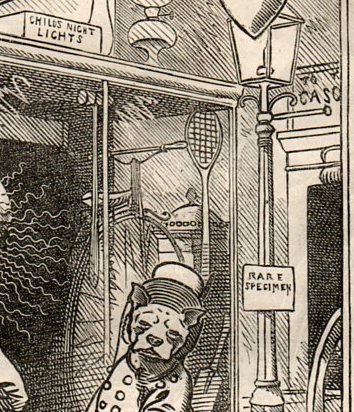
    Edison electric621Some of the modern conveniences to be left behind to the dust of the antiquarians and the curious included  “childs night lights” (which would surely have been a luxury few could have had available to them in 1879), a street lamp powered by gas (which was even then giving off the stench of death owing to the newly-arrived electric light), a tennis racket, and a rather tall bicycle.  All of these would actually be dramatically changing (except perhaps for the tennis racket)  and substantially so, within the next decade-and-a-half.

    Edison electric621 bike
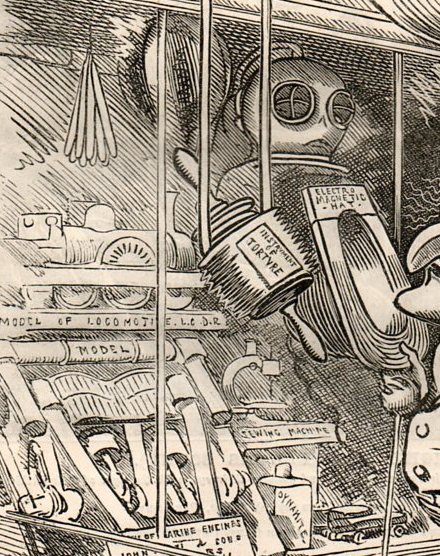
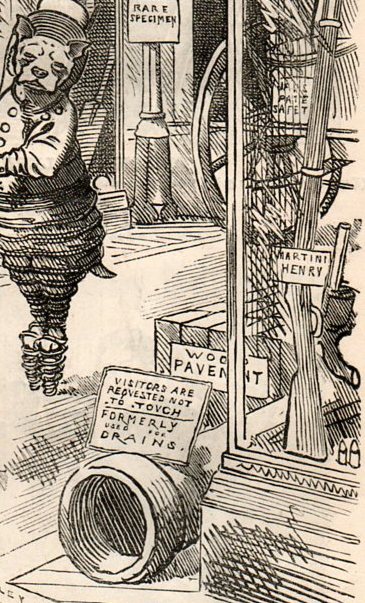
    In the background we see a curious cabinet containing a deep-sea diving suit, candles, a boxing practice ball, a patent of a steam locomotive, another model of a propulsion system for a ship, a sewing machine (already in its third decade) and a box of dynamite (still relatively new at this time, having been patented in 1867).  I am not sure what the “:instrument of torture” is.)

    Edison electric621 deep sea
    The Henry (repeating) rifle was also still fairly new on the scene in 1879, having been around since the late 1850’s but not really produced in any numbers until after the Civil War in 1866)

    Edison electric621 guns

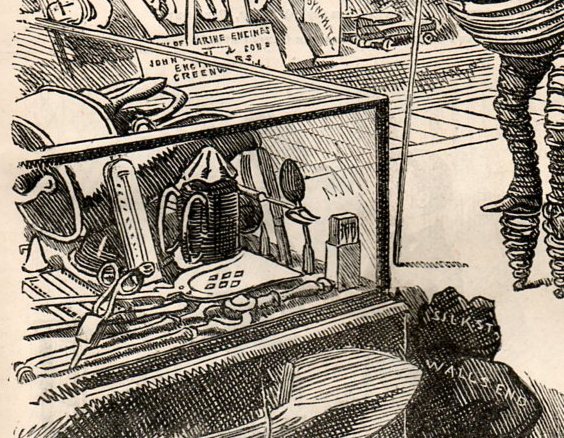
    Perhaps most disturbing to the large percentage of viewers is this last detail of the glass case int eh foreground, which displays the average, everyday stuff that made a household work–a spoon, a thermometer, lantern, fireplace buddies, and even a candle snuffer.  I imagine that people wondered–in 1879–what, exactly, would take the place of these staples?  Better yet perhaps are the objects on the floor, labelled “Silk St” and “Walls End”.  I take this bits to be chunks of coal, and the “Walls End” to be Wallsend, a coal and industrial community (grown up at the end of Hadrian’s Wall).  Maybe that is the most disturbing element of all, to think that coal would some day be replaced–we have similar feelings today, 131 years later, about just this business with coal.

    Edison electric621 household

    I guess the point of all of this is the fickle nature of change, or not-change, and how comfortable surroundings and objects can become quickly not-so in a short period of time.  This would fit nicely into this blog’s developing “History of Normalcy” series. because it really does establish the utterly transient nature of the idea of “normal”.


  • What Was the Strategic Cost of the V-1 and V-2 to the Nazis?

    JF Ptak Science Books   Post 1551

    One of the defensive weapons in the Allies’ arsenal during WWII may have been the V-1 and V-2.  This sounds horrible to say, and I don’t mean this application intentionally, of course–but the production of the V-1 and V-2 was something that could have caused the Nazis the equivalent production of something like thousands (dozens of thousands?) of fighter aircraft–a part of the Luftwaffe that he Allies didn’t need to shoot down because they were never built.  As horrible as it sounds, the V-1 and V-2 may have been the far greater thing to choose from in the production of multiple evils.

    The Vengeance Weapon was a great-ish achievement of the Nazi regime, intended to strike enough fear and destruction in London and other cities and to render them a shambles, an effort that was thought would bring the Brits to their knees.  What happened, though, was this:  that in all of the raids and bombings at the hands of the V-weapons, much of the attack was lost to going off-course, unable to find their gigantic target.  Over time, the V-1 and V-2  terror weapons did kill 9,000 people  or so in the U.K. in their  raids from 1944 and 1945, wounding 25,000  and destroying 20,000+ houses. Over 11,000 of the V-weapons were fired by the Nazis:  more than 9,100 V-1s were fired at Britain (with 2,500+ hitting London), while 1,115 V-2s were launched.   They were terrible weapons, and they killed many people–overwhelmingly a civilian population–but they performed nowhere near their strategic intentions. 


    These totals for the entire campaigns of the V-1 and V-2 rockets  are less than those of a single large raid by Bomber Command, sometimes less than one mission, on one night.  The massive expense involved in producing the V-1 and V-2 weapons could well have been used to fabricate 5 or 10 or perhaps 25 thousand fighter planes.  Fighter planes that could have been used in the war on offensive and defensive procedures. That’s 25,000 fighter aircraft that never flew for the Luftwaffe, never terrorized anyone, never flew in defense of German cities, never had to be shot down. (Assuming of course that the Germans would have had the fuel to power them.)

    They were terrible weapons–the V-1, in particular, made a very dirty, nasty sound, that was a terrifying experience to hear.  When the sound of the engine stopped, the bomb fell.  Long, throaty, deathly gurgle,then silence, then explosion.  The V-2s came in mostly silently, a masked death, but in so doing also somewhat mollified a significant psychological terror weapon.

    Perhaps I am way off base with this, but the V-weapons seem to me to have cost the Nazis far more than they gained.  Of course if they had been able to produce an order of magnitude–or more–of the weapon and delivered it more effectively, then perhaps it becomes a different story.  It would have been a different story too if the Germans had had any reliable intelligence on the effectiveness of the weapos so that they could have adjusted their flight, and if Ultra had not existed, and so on down that ridiculous rabbit hole of speculation.  But my own idea remains that the V-weapons were not as horrific as other things could have been had those resources been allocated differently. 


  • History of Lines: Complicated Simplicity and Marconi’s Lines of Communications

    JF Ptak Science Books  Post 1547   [Part of the History of Lines series.]

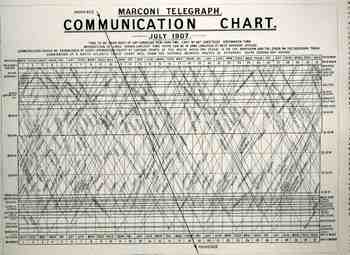
    This is an illustration of the approximate times and places that ships at sea could expect to be able to communication with each other by the relatively new invention of wireless telegraphy. (We’re talking about Marconi here and just very briefly; this is not the place for the discussion of what he did or didn’t “borrow” from his predecessors and contemporaries such as Heinrich Hertz, Oliver Lodge and Nikolai Tesla.  He at the very least however owed all of them at least an enormous helping of gratitude, and probably more.  Then there’s Marconi’s very conservative technical continuation in the field which is confusing and interesting.  And finally but not the least of all of the stuff about Marconi is his comfort and support of the Fascist regime in Italy, where Marconi became a member in 1923, escalating in his fame through the party ranks to have none other than Benito Mussolini serve as the best man in his second wedding.  But as I said that’s all for another day.) It appeared in The Illustrated London News for 7 September 1907,surrounded by an article on Obelia in the “Science Jottings” section of the magazine.  This chart isn’t
    1blog_oct_13marconi_at_sea816

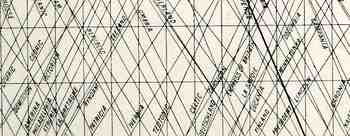
    quite as complicated as it seems, really: all you need to do is follow one line from the top to the bottom.  Simply put, each diagonal line represents a specific ship (all of which are named) and their positions as they make their ways across the North Atlantic ocean; each intersection represents the time and place that two ships can communicate via wireless with one another.  So, for example, the Empress of Britain will on its six-day voyage be able to communicate at least 26 times with other ships for news and information.

    What this seems to me to be is the supplemental efforts of the ocean-going ships

    1blog_oct_13marconi_at_sea817

    to the newly established trans-Atlantic radio-telegraphic company and installation opened by Marconi in October 1907.  Even though the first transatlantic communication is celebrated as having taken place in 1901, the performance, even in 1907, was still spotty.

    Again, I’m just after this for the image 


  • Aerial Bombing Accuracy Calculator, WWII

    JF Ptak Science Books  Post 1545

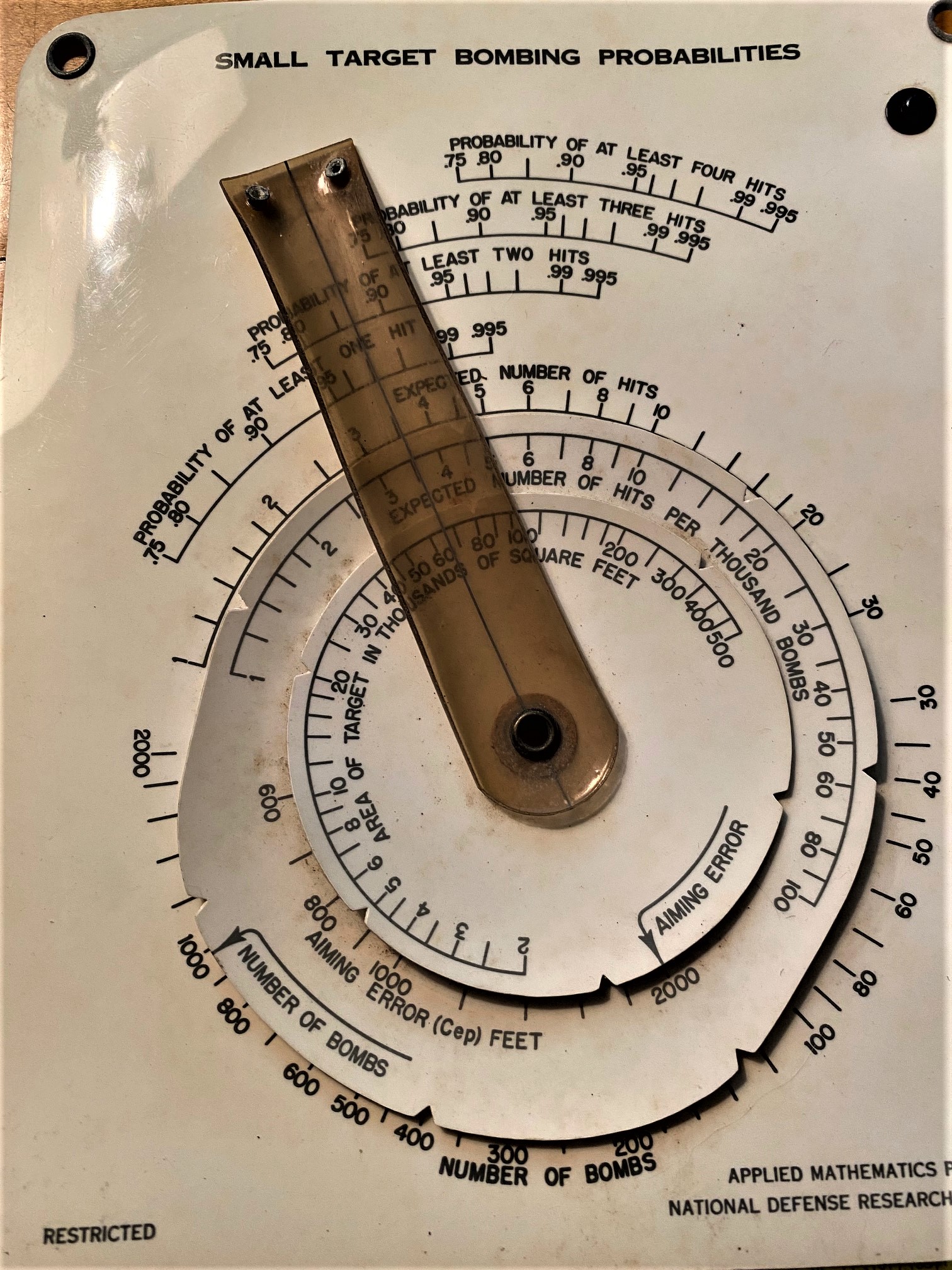
    IMG_5402I found this object in my paper-calculators box (moveable disk calculators made of paper, two going back to A. Kircher in the 1660’s)—I’m not sure why it was there as it is not paper, though it is an interesting calculator.

    [Images are greatly expanded in click mode.]

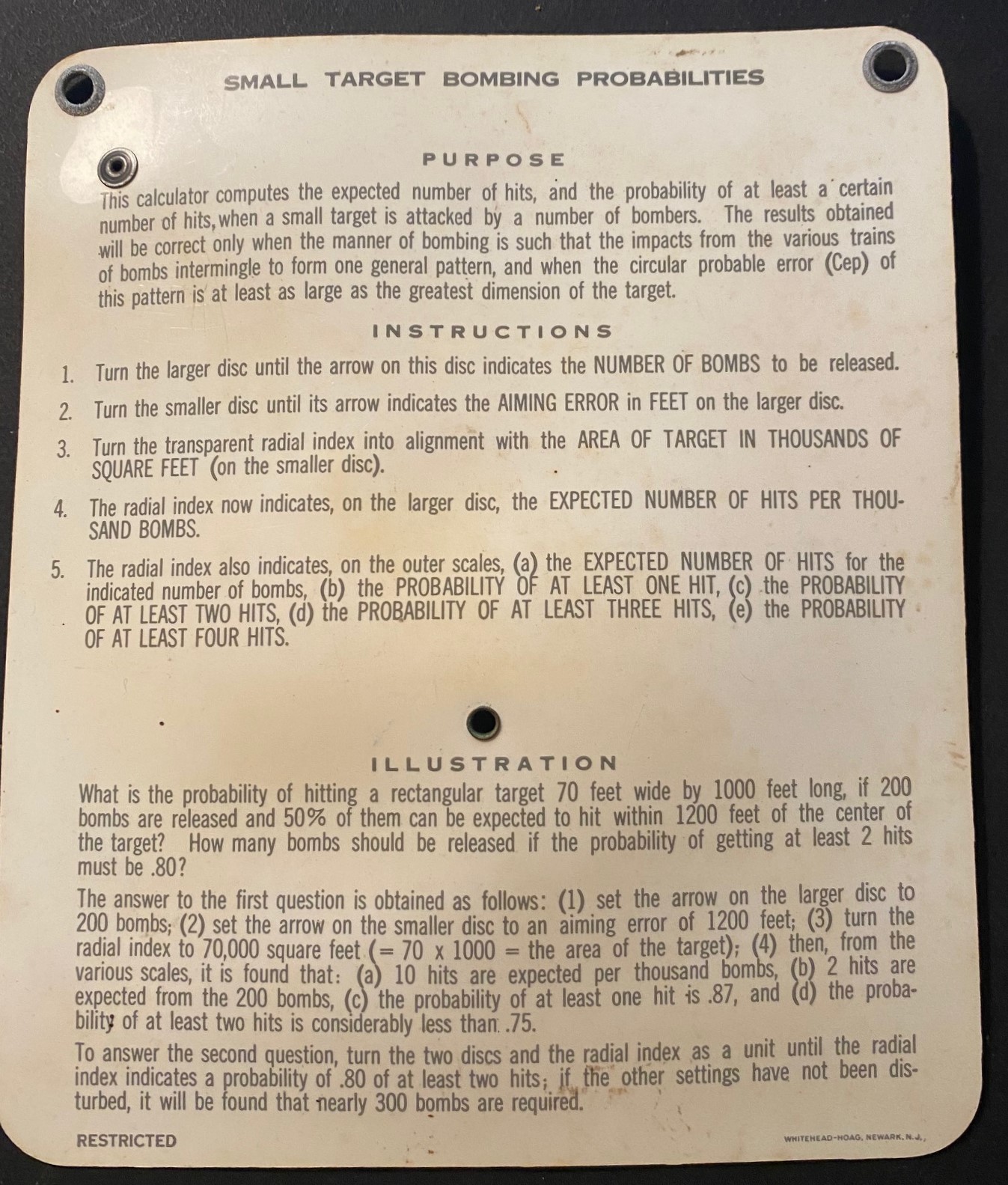
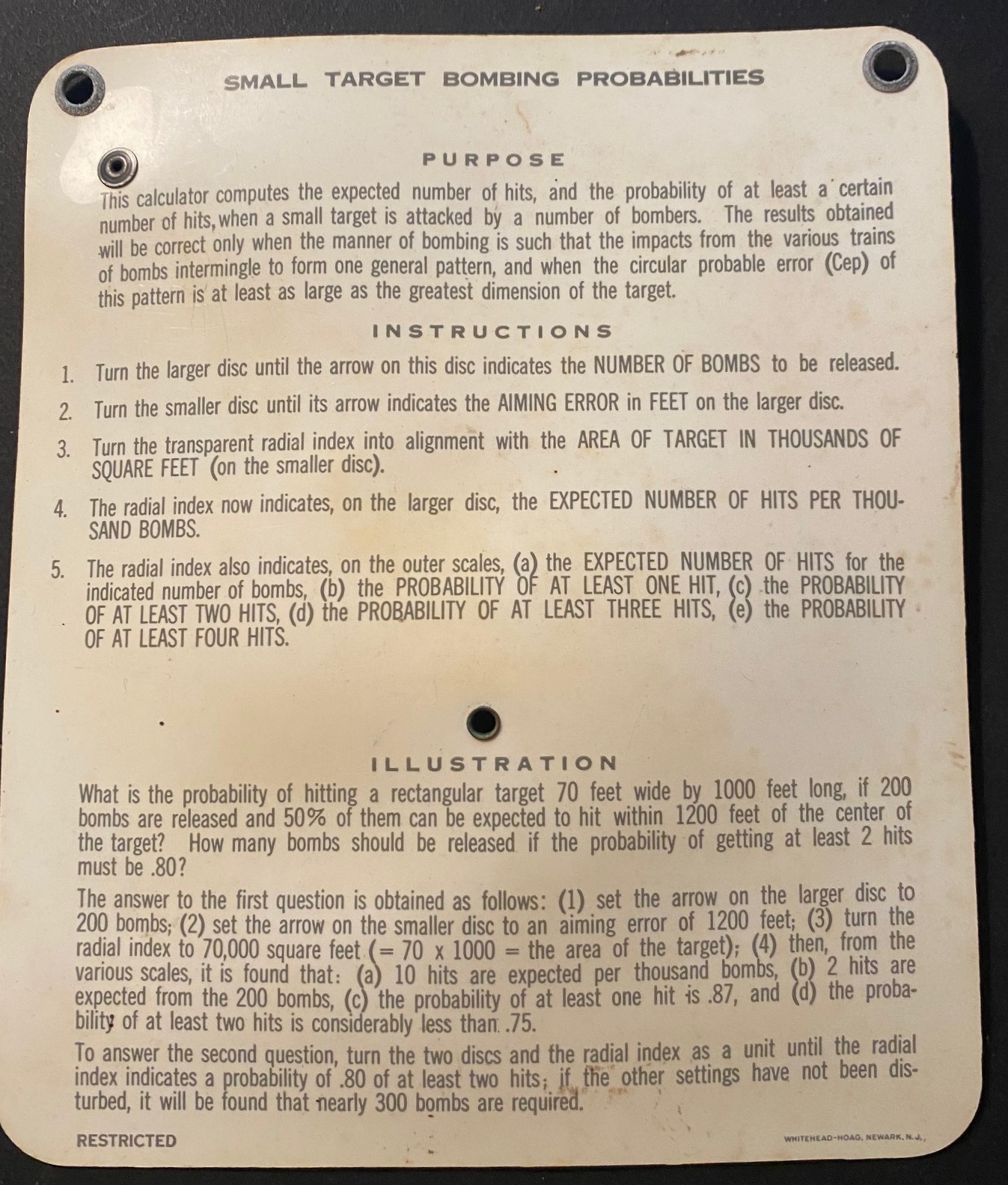
    I learned a big lesson from it.   The “Small Target Bombing Probabilities” calculator was issued by the little-known (in the popular sense) Applied Mathematics Panel of the National Defense Research Council (NDRC)1 in the early 1940’s during WWII. 


    IMG_5403Marked “Restricted”, it calculated the number of bombs that would successfully be delivered given (1) the number of bombs, (2) the “aiming error”, and (3) target size. It would then generate results for “(a) the expected number of hits for the indicated number of bombs”, (b-e) the probability of at least one hit to four hits.

    What is a little surprising to me was the number of bombs that didn’t find their target. For example, a 65,000 square foot target bombed with 1000 bombs and an aiming error factor of 2000 feet could expect to land 3-4 bombs on the target, with an 88% chance of landing at least two hits, 75% chance of landing three hits, and about 50% of landing at least four hits.  And so the necessity of large numbers of planes dropping a large number of bombs.  

    Notes

    1. The establishment of the NDRC was announced so: “It is announced by Science Service that the following committee has been appointed in the United States to correlate “scientific research on the mechanisms and devices of warfare”: — Nature 146, 191-191 (10 August 1940).

    “Members included: Dr. Vannevar Bush (chairman), president of the Carnegie Institution of Washington, formerly dean of the faculty of engineering at the Massachusetts Institute of Technology; Prof. Richard C. Tolman (vice-chairman), dean of the graduate school and professor of physical chemistry and mathematical physics at the California Institute of Technology; . Dr. Irvin Stewart (secretary), formerly Federal Commissioner for Communications and chairman of the Committee on Scientific Aids to Learning; Rear Admiral Harold G. Bowen, director of the Naval Research Laboratory, Anacostia, D.C.; Conwiy P. Coe, U.S. Commissioner of Patents; Dr. Karl T. Compton, president of the Massachusetts Institute of Technology, formerly professor of physics at Princeton University; Dr. James B. Conant, president, formerly professor of organic chemistry, Harvard University; Dr. Frank B. Jewett, president of the Bell Telephone Laboratories; Brigadier General G. V. Strong, assistant chief of staff, U.S.”


  • Mark Twain: Bra and Blank Book Patenter

    JF Ptak Science Books   Quick Post

    Samuel Clemens (1835-1910), who became Mark Twain in 1863 and then mostly stayed that way, had a great mind and was a superb writer and story teller–he wasn’t necessarily a great inventor, however.  In the ear;y sea of his great achievements, in 1871–just after the publication of his first real best-seller, Innocents Abroad, 1869)–Clemens applied for and was granted a patent for a bra clasp.  I don’t know if it is the bra clasp, or not, but for whatever reason Clemens pursued this interest all the way to the end. 


    In the year after the publication of Roughing It, and three years before the publication of The Adventures of Tom Sawyer, Clemens patented–essentially–a blank book. It was a special book/holder for the very-popular practice of scrap booking, and it seems rather ironic that someone who filled up so many books with words would get a patent for the sale of books that didn’t have any.   Curious.


  • Hearing Patterns in Gases, 1894

    JF Ptak Science Books   Post 1530

    I was about to start a new series of posts on the History of Lines , something left out of this blog, oddly, given the different posts on the History of Dots and the History of Holes (and the History of Blank and Empty Things).  A lot of that–the History of Lines business–has to do with the interpretation of things on paper:  heart rate, “brain waves”, the motion of a bumble bee, navigation, and of course, words.  (The great Kickapoo tracker Famous Shoes  in Larry McMurtry’s Streets of Laredo, one of the Lonesome Dove tetralogy, found that the one thing he couldn’t track in this world were the marks on the pages of a book.)

    But I was distracted by the idea of seeing something in a different context, of associating something with a sense experience far beyond its origin, and so the History of Lines will wait just a little–something just a little beyond seeing some electrical function of the brain inscribed as a long line on a skinny piece of paper.  What I found was this–the invention of Mr. E. Hardy, whose “Formenephone” detected the presence of combustible fire-damp or any other gas in mines, and which would then emit sounds on the accompanying (small) organ pipe.  The apparatus would actually vibrate more rapidly as the gas content of the air increased.  At the time (the notice of the invention appearing in the Scientific American Supplement #945 for 10 February 1894) the only other means of detecting these gases was by the change of the glow of a candle. 

    Perhaps this is in a way like the application of musical notes to the numbers pi or tau, though actually useful.

    I’ll return to the History of Lines tomorrow.

    Notes:

    Formene, or marsh gas, is a “hydrocarbon which produces chloroform when the hydrogen in it is replaced with chlorine, loses hydrogen and yields anthracene”.