A Daily History of Holes, Dots, Lines, Science, History, Math, Physics, Art, the Unintentional Absurd, Architecture, Maps, Data Visualization, Blank and Missing Things, and so on. |1.6 million words, 7500 images, 4.9 million hits| Press & appearances in The Times, Le Figaro, Mensa, The Economist, The Guardian, Discovery News, Slate, Le Monde, Sci American Blogs, Le Pont, and many other places… 5000+ total posts since 2008.

Category: Technology, History of

  • Things-out-of-Place Department: Books in Anatomies and Bridges in Impressionist Paintings

    JF Ptak Science Books   Post 1478

    I’ve been making a few entries over the last few days on antiquarian anatomy books, and wonder now about books in anatomies. I’m not certain what the appeal is, but it has a strange and immediate affinity for me to bridges in pre- and early Impressionism, a direct line to these bridges and to the other technological and engineering entities that were depicted in these canvases.  I’m not sure what the connection is to the two outside of the obvious verb-y part of “bridge”, but there seems to be an innate connection between the two, for me.  Somehow the book shouldn’t be of interest to the lifeless and dissected cadaver, but it is, and images of the two together turn up here and there in the history of anatomical illustration.  As much as the anatomist and artist work together to try to remove their subject from the confines of a book so that their work is freer and more accessible to the reader, to remove the illustrations from the pages of the book in which they appear, they do sometimes employ the image of the book to make a more prosaic and allegorical point.And as the object of design and wonder and beautiful geometry, one might think of the bridge as a object in Impressionist paintings from that movement’s earliest periods would be not quite the sort of thing that would be the subject of as many paintings as they were.  The unnatural angles of their supplementary parts  seem to make them not quite the fit for the early Impressionists.  But they were, and probably so for their 90-degree assaults on the natural landscape. 

    Perhaps what I think of the aesthetics of the treatment of bridges during the Renaissance, and the adoration of the Rialto and Pone Vecchio and all the rest, just wouldn’t make their way to the Impressionists’ canvases. But of course basically most ot them did paint bridges–Seurat, Cezanne, Van Gogh (a fantastic, small stone-and-wood miniature drawbridge), Derain, Pissarro, Renoir (the Pont-Neuf), Marquet, Sisley and of course and perhaps most famously, Monet (Charing Cross, Giverny, and all the rest)–all painted bridges.  I guess the bridge is just a shorthand for the representation of engineering and technology in general in Impressionism, which to my eye seems quite strong. 

    But getting back to books in anatomies:

    Ontleding des menschelyken lichaams by Govard Bidloo and Gerard de Lairesse

    Govard Bidloo approached the issue of the book in a most unusual fashion, making it appear as though the dissected hand and forearm were emerging from a semi-opened book, the long index finger coming to a pointing pose, suggesting perhaps that the viewer take heed of what is contained in the work. The image appers in Bidloo’s Ontleding des menschelyken lichaams (or Anatomia Humani Corporis) and was printed in Amsterdam (at what may have been the pinnacle decade of Dutch book publishing) in 1690; the book was illustrated by Gerard de Lairesse (1640-1711), a leading light in the Golden Age of Dutch painting, and perhaps one of the most famous painters alive there after the death of Rembrandt. There’s all manner of symbolism going on here, but what I like the most is the little crutch under the cadaver’s hand’s thumb. 
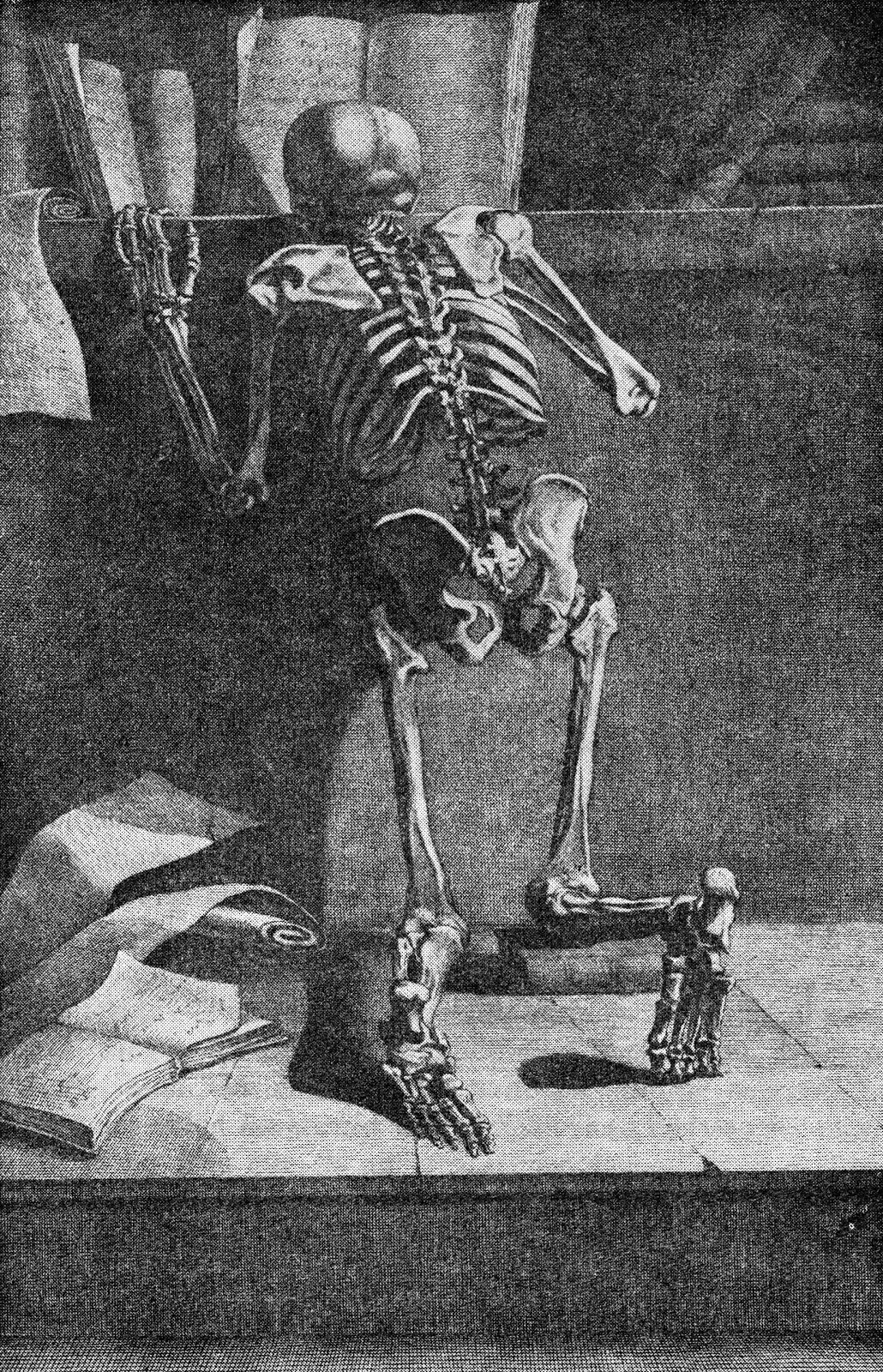
    Jacques Gamelin’s Nouveau reueil d’osteologie et de myologie, dessine d’apres nature (1779)  places skeleton and books togehter again, though this time their can be little doubt about the overall message that the designer and author tried to send to their readers. 

    Int he long run, and I guess in the short run as well, neither the bridge in Impressionism nor the book in anatomies is quite so much out-of-place as they are simply unexpected.

    Note:

    Van Gogh’s bridge at Arles–not an essential image whatsoever for this post–I just like the bridge. Van Gogh painted the bridge four times in oil and once in watercolor, all in a very short time.  (His stay at Arles was about 444 days, during which he made about 200 paintings, being some of his greatest work.

    Vincent Van Gogh Miscellaneous Buildings Technology Modern Age Impressionism Neo-Impressionism


  • Precursor to Zombie-Phone-to-Deadsville: the Telephone Medical Metal Detector “X-Ray”

    JF Ptak ScienStructure513ce Books  Post 1495

    Did President Garfield Die Because of Metal Bed Springs?

    Thomas Edison famously took advantage of a naive reporter, telling the young man that he was working on an invention that would allow a person to telephone dead people–a story that was reported as true, and one which Edison (both thoroughly disgusted and joyful) helped to perpetuate to the day he died by simply not discussing the issue. (This story appears on this blog here.)

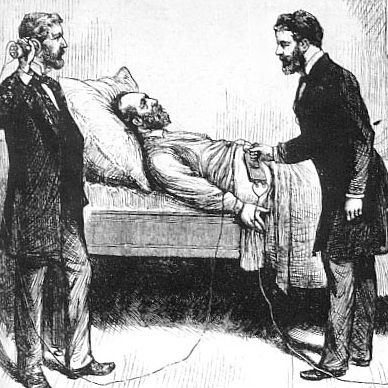
    Much earlier, only five years after Alexander Graham Bell first patented and published his invention of the telephone, the device was used by Bell to do some very early electrical medical imaging.  The new President of the United States, James Garfield, had been shot by Charles Guiteau in Baltimore and Potomac Railway Station (on 2 July, 1881, after a lengthy period of semi-abstract stalking and planning) Station in Washington, D.C., receiving fatal wounds in July and which would cause his death later in September.  The problem was that at this point in the history of surgery it was  difficult to locate bullets in the body, becoming more so if the bullet took a non-straight course through the wounded.  Normally, in 1881, a doctor could for example use a device called  a Nelaton probe, a thin porcelain device (as opposed to most other probes, which were metallic) to help locate the embedded bullet.  But given the nature of Garfield’s wounds, this was just not applicable, and the bullet escaped recognition from this and other probes.

    Bell enters the scene with an electromagnetic invention, the induction balance, which he created to detect interference on a telephone line.  In the process of experimentation Bell recognized that the balance could be disturbed if the metal and battery-fueled probe came into contact with a piece of metal.–basically, the device was a medical metal detector. Bell resolved to use the device on Garfield, passing the probe along the President’s body while another person listened to a telephone ear piece for the telltale “click” of a proximate metallic object.

    Bell telephone garfield
    Bell was not successful with this, or at least not so at this time, and the President died, succumbing to an infection, finally.  But Bell was able to perfect this instrument, something that stayed in use as the principal means of detecting metal objects in the body, and was about as fine an instrument as could be expected, though it was completely eclipsed by the revolutionary machines brought about by Wilhelm Roentgen’s discovery of X-Rays in 1895.  And as it just so happens, the first surgical case in which the x-rays were used was for a case involving a shotgun wound. 

    Finally, one of the reasons why Bell’s instrument didn’t quite work on President Garfield is that Garfield’s bed had a metal box spring, which very well might have played havoc with Bell’s instrument.  Perhaps if there was no metal in examining area, Bell’s device might’ve worked. 

    Notes:

    An earlier and more crude device had been invented by Wilhelm Heinrich Dove (1803-1879, a German physicist and early meteorologist) though I am not sure that it comes into play with Bell’s apparatus at all.

    From Harper’s Weekly, 13 August 1881:

    “The experiments made by Professor Alexander Graham Bell with the view of determining by the aid of the electric current the location of the bullet in the President’s person were of the most interesting nature. The possibility that a time might come when it would be necessary to make incisions at once for the removal of the bullet, without consuming precious time for further consultation, gave to the experiments an importance which added greatly to their interests.”

    “An apparatus known as the induction balance had been used by Professor Bell in analyzing metals. This instrument, modified so as to impart to it the highest degree of sensitiveness, was used in the search for the leaden ball. Its nature is such that it is not easily understood except by electricians. It consists of a battery, two coils of insulated wire, a circuit-breaker, and a telephone. The ends of the primary coil are connected with a battery, and those of the secondary coil are fastened to the posts of the telephone. This latter connection renders audible any faint sound produced by the circuit-breaker, or any change in the pitch of that sound. The coils may be so placed in their relationship to each other that no sound is made by the circuit-breaker. They are then said to be balanced, and the wires are extremely sensitive to the disturbing presence of any other piece of metal. A bullet like that with which the President was shot, before it was flattened, will, when placed within two and one-half inches of the most sensitive point on the pair of coils, cause a faint protest against the disturbance to arise in the telephone. A flattened bullet of the same bulk, when presented with its flat surface toward the coils, will make its presence felt at a distance of nearly five inches. When its sharp edge is turned toward the plane of the coils, no sound is produced beyond the distance of one inch.”

    “With these facts in view, the experiments to locate the position of the bullet in the President’s body were begun. The patient was bolstered up in bed, and he watched the proceedings with mute interest. His physicians stood around. Professor Bell stood with his back toward the President, holding the telephone to his ear, while Mr. Tainton, Professor Bell’s assistant, moved the coils over that portion of the abdomen where the leaden ball was thought to be imbedded. When the sensitive centre of the instrument was immediately over the black and blue spot that appeared shortly after the President was wounded, Professor Bell said, “Stop! there it is.”

    “The experiment was repeated several times — once with Mrs. Garfield listening at the telephone; and she told the President when the coils had been brought to the spot where the presence of the bullet had previously caused the delicate instrument to give forth a singing sound. From these tests it was inferred that in any event the bullet was less than five inches from the surface, and that if it was only slightly flattened, or if its edge was turned obliquely toward the surface, it might be much nearer to the skin. The conclusion reached was that if it should become necessary to remove the bullet at any time, this might be speedily accomplished by two quick cuts with the surgeon’s lancet.”


  • Really, Really Big Plans: Filling in the East River and Parts of NYC Bay, 1911-1916

    JF Ptak Science Books   Post 1470

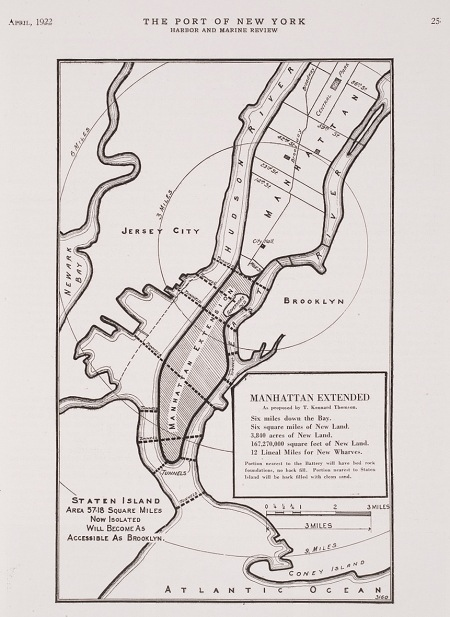
    Last week I wrote a post on  Herman Soergel’s  plan for extending the landmass of the countries around the Mediterranean Sea by damming the straits of Gibraltar, lowering the sea and irrigating the Sahara–an original, interesting but not very good idea, filled with briney cultivation and racial politics. In the past on this blog I’ve written about other city plans–and in particular, for New York City–that have involved floating Manhattan into the harbor, or filling up large chunks of the Narrows, or floating the city on an enormous anti-gravity platform, and so on. Some of those plans were real, some science fiction, and some were plainly beyond both.  The plan presented above is another monster, but at least this one could work, if not for the doing of it, and the expense. And the will.

    NYC Really Big
    But the bottom line, according to the engineer doing the thinking on this project, Kennard Thomson, would supposedly net the city a cool billion dollars after everything was said and done, and that would be 1916 dollars–that was equal to about 5% of the American GDP (!) in 1916, which would be about $400 billion in terms of 2010 GDP.  I’m not sure how Thomson came up with this very big/very round number, though it must have been done for effect–I can just imagine him standing before a smokey room filled with civil engineers talking about his massive plan for enlarging NYC and throwing out the billion-dollar figure, watching the cigars glow red in exhaled disbelief.

    Thomson did know what he was talking about–he was a busy (and “leading” according to the NYT) Manhattan civil engineer of stature, working on the Canal Barge and being the principal engineer for the Municipal and Singer buildings, for example–and his project seems to be well within the scope of possibility.  Their sensical aspects however are, well, questionable. 

    Here’s the story–around 1911, while examining proposals to repair and extend New York’s wharves, Thomson came upon the idea–a magnificent, fabulous idea–of adding new wharves by adding new lands to the city.  In short, the overall plan was to fill in the East River (!!) and reclaim the new land for city living,  dam Hell Gate,  construct a New East River (from Flushing to Jamaica Bay),  extend the tip of Manhattan Island from the Battery to within a quarter-mile of Staten Island (!), create a new 40-square-mile island between Sandy Hook and Staten Island, extend the Jersey shoreline, add two new Manhattan-sized appendages to the east shore of Staten Island, and more.  All of this would be connected by various new bridges and roads and tunnels, as well as a 6-track elevated railway that would circumnavigate the city.  The purpose of all of this would be to add 100 miles of new docks, an enormous amount (“50 square miles of reclaimed land”) of new land and the capacity for NYC to house 20+ million people, all of which would be worth a billion dollars. 

    Thomson really meant “really” in the title for the proposal. There have been reclamation projects undertaken in New York Bay since then of course, and I think that virtually all of what Thomson talked about could be done.  I think it would be a very interesting project for a class of some sort to undertake an estimation of what such a thing would cost today (and I would guess to duplicate the idea in real terms now would take up a sizable chunk of the GDP).  Maybe all of this will make sense at some more future point. 


  • Electro-LUXurious 15: Electroplating the Human Dead, 1891

    JF Ptak Science Books   Quick Post

    This is the 15th installment of a new series on United States Patent Reports on electrical quackery and unsubstantiated bric–a-brac from the newly-electric world of the period of 1870-1900–the following is a little outside the norm, being French, but I couldn’t resist it. 

    Electropunk electro the dead
    When a picture just isn’t enough…

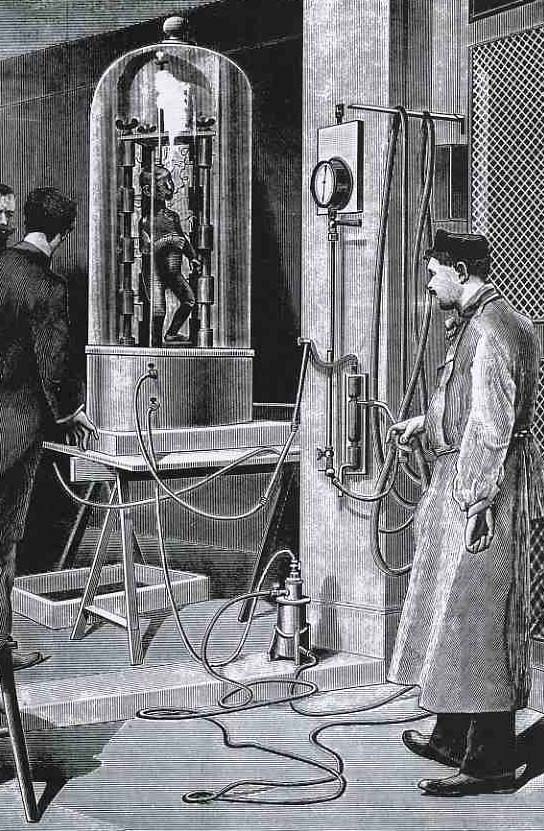
    And while we’re at it, let’s consider the work of Dr. Varlot (of the Paris Hospital) in electrocuting the dead.  Actually, what he proposed was another pretty gruesome use of electricity, though this one didn’t make promises of miraculous cures, or execute anyone.  Varlot proposed to “metalize” the dead (as we see in this very unsettling image of a child being electroplated) for, well, some purpose, purpose unknown.  It just seems and seemed like a bad idea, all the way around–a poster child for Bad Ideas everywhere. The medical uses of an electroplated baby seem very limited, and I can’t imagine anyone wanting to do such a thing to a dead child of their own.  It is wrong on every level.

    The engraving comes from Leonard de Vries, Victorian Inventions” (1971), who quotes the original source (the Scientific American for 1891) with this description of the procedure:

    “Dr Varlot, a surgeon in a major hospital in Paris, has developed a method of covering the body of a deceased person with a layer of metal in order to preserve it for eternity.  The drawing illustrates how this is done with the cadaver of a child.  The body is first made electrically conductive by atomising nitrate of silver on to it.  To free the silver in this solution, the object is placed under a glass dome from which the air is evacuated and exposed to the vapours of white phosphorous dissolved in carbon disulphide.  Having been made conductive, the body is immersed in a galvanic bath of sulphate of copper, thus causing a 1 millimetre thick layer of metallic copper to be deposited on the skin.  The result is a brilliant red copper finish of exceptional strength and durability.”

    Another method of electroplating the dead (in 1934) is discussed in the interesting blog, Quigley’s Cabinet, here. 


  • Electro-LUXurious 14: The Happy Electric Chair, 1890

    JF Ptak Science Books   Quick Post

    This is the 14th installment of a new series United States Patent Reports on electrical quackery and unsubstantiated bric–a-brac from the newly-electric world of the period of 1870-1900.

     The history of the electric chair is odd, and ironic.  The “electric chair” that we think of first when we hear the phrase is actually the “electrocution chair”, and it comes into being after the introduction of the medicinal electric chair, which was designed as a palliative, electrical ointment of sorts for people with virtually any form of physical complaint.  Thomas Edison introduced the notion of the lethal use of punitive electricity in a brilliant if not diabolical ploy, suggesting in 1888 that Hew York State  pursue the new procedure of executing its condemned via the use of an electrified recliner, using the Westinghouse AC system–and thereby forcing the association of his competitor Westinghouse’s  electricity with electrocution in the mind of the general public. (I can only imagine being a Westinghouse exec and waking up to that bit of Edisonian showmanship; there’s an earlier post on this blog here that discusses the electric chair in more detail.)

    These chairs below are good examples of the earlier quack/medicinal sparking loungerettes, even if they are dated a little later (1890). 


  • Electro-LUXurious 12: Electrical Casket Vacuums

    JF Ptak Science Books   Quick Post

    This is the 12th installment of a new series United States Patent Reports on electrical quackery and unsubstantiated bric–a-brac from the newly-electric world of the period of 1870-1900. 

    This extraordinary device was an experiment in the further purification of the American way of death.  The casket was fitted with an electrical heating element which–after viewing of The Departed was completed–would be activated to heat a soft metal, which would seal the casket.  After this, the casket would be pumped to “form a vacuum” so that there would be no further deterioration of the deceased.  There seem to have been at least a dozen different designs for these caskets from 1880 to 1950 or so, each building on some hope and prayer for the benefits of the dead not deteriorating, for whatever that was worth. 


  • Electro-LUXurious 13: Electrical Baths, 1877-1890

    JF Ptak Science Books   Quick Post

    This is the 12th installment of a new series United States Patent Reports on electrical quackery and unsubstantiated bric–a-brac from the newly-electric world of the period of 1870-1900. 

     Let’s state as a given that some things are real, and some things aren’t.  There is a very broad history of things believed to be real but weren’t, or aren’t–I’m not sure what the percentage of those things would be in the overall Scheme of Things, whether the things-that-aren’t outnumber the things-that-are, or not.  It does seem ready for a Dr. Seussian treatment, though. 

    Thomas Edison (in)famously fooled a reporter into thinking that he was creating a phone to the dead, an unintentional hoax that he allowed to fester for as long as he (Edison) lived; H.L. Mencken wrote a fictitious story about the history of bathtubs, a humorous piece, really, that turned out to be a satire on the way things are perceived and published, as the story took on a life of its own as factual, reported as true to this day even though Mencken stated immediately afterwards that it was a joke. 

    And then there are the real things that aren’t–not really–and look (and sound) that way.  Such is the case with these fabulous electric baths, below.  As is what seems to be the custom with patent reports (from this period, anyway), the inventor needed to thoroughly explain how the invention was made to function, while not actually addressing what that function was. This was lucky for the inventor and manufacturer, though not necessarily so for the consumer.  Had these electrical quack devices worked, the introduction of electric hair, electrically-induced mega-bowels, sharp eyes, pretty teeth, accelerated masculinity, relaxed femininity, spine straighteners, beard growers, inner-secret-strength enhancers, and so on, would’ve produced a nation of ________ brought about the miracle of electricity.

    In this vein, here are a few examples of electric baths, including one with one of the scariest drawings of a person I’ve ever seen in a patent report:


  • Electro-LUXurious 11: Medical Electrifying-Liquid Injector, 1862

    JF Ptak Science Books   Quick Post

    This is the fourth in a new series of posts on interesting, early applications of electricity, most of which are taken from the archives of the U.S. Patent Office.

    I’m not sure exactly what Mr. Paige was trying to do with this electrical implement of his–he writes:

    which to my mind means that he is passing a “medicine” over or into some part of the body and while doing so either passes a charge through the liquid or provides a small series of shocks to the affected area so that it hurries the treatment along a little faster, or with more efficacy, or something.  Whether this is a topical application, or a delivery to an open wound, or to an incision is not altogether clear to me. As is generally the case with these things, the inventor is given the luxury in the patent report of not having to say what the thing they have invented actually “does” after describing how it is that the machine will “do” it. 


  • Electro-LUXurious 9: Combination Medical Apparatus and Alarm System, 1892.

    JF Science Books   Quick Post

    This is the fourth in a new series of posts on interesting, early applications of electricity, most of which are taken from the archives of the U.S. Patent Office.

    I am uncertain why there should be a combination bell/alarm and electrical stimulation medical device wrapped up in one small wooden package, but here it is.  Certainly there was no explanation for the need for the bell, or alarm; but then again, there wasn’t an explanation on what this thing did to the body (or soul, or whatever) either–that was not the job of the patent report, which tells the reader how the thing works, but not necessarily what it does. Of course this is just finding fault with a small bit of nonsense wrapped up in a larger chunk of junk…perhaps it was all just distraction.  In the larger world of electrical vapor baths, vacuum coffins, electrical hair, automatic tongue pullers, and so on, what difference could one extra bell make?


  • Electro-LUXurious 8: Electrical Medical Cane, 1899

    JF Ptak Science Books   Quick Post

    This is the eight in a new series of posts on interesting, early applications of electricity, most of which are taken from the archives of the U.S. Patent Office.  Unlike the general post in this blog, many of the Electro-LUXurious post images and documentation can be presented without commentary.

    I thought at first when I found this “electric cane” that there would be a light source or something embedded in the hanle.  There is a small light bulb inside the handle, but there are no lenses, no glass; just metal caps.  It turns out that this is a medical cane, an electrical unit with brass or copper barrels to be held in the hands or applied to various areas of the body for electrical stimulation.