A Daily History of Holes, Dots, Lines, Science, History, Math, Physics, Art, the Unintentional Absurd, Architecture, Maps, Data Visualization, Blank and Missing Things, and so on. |1.6 million words, 7500 images, 4.9 million hits| Press & appearances in The Times, Le Figaro, Mensa, The Economist, The Guardian, Discovery News, Slate, Le Monde, Sci American Blogs, Le Pont, and many other places… 5000+ total posts since 2008.

Category: Perception

  • Map of Newsboy Work Violators, 1915–Child Labor & Child Scavengers

    JF Ptak Science Books   Post 1330 [Part of a developing series in the History of Normalcy]

    “There is work that profits children, and there is work that brings profit only to employers. The object of employing children is not to train them, but to get high profits from their work.” — Lewis Hine, 1908


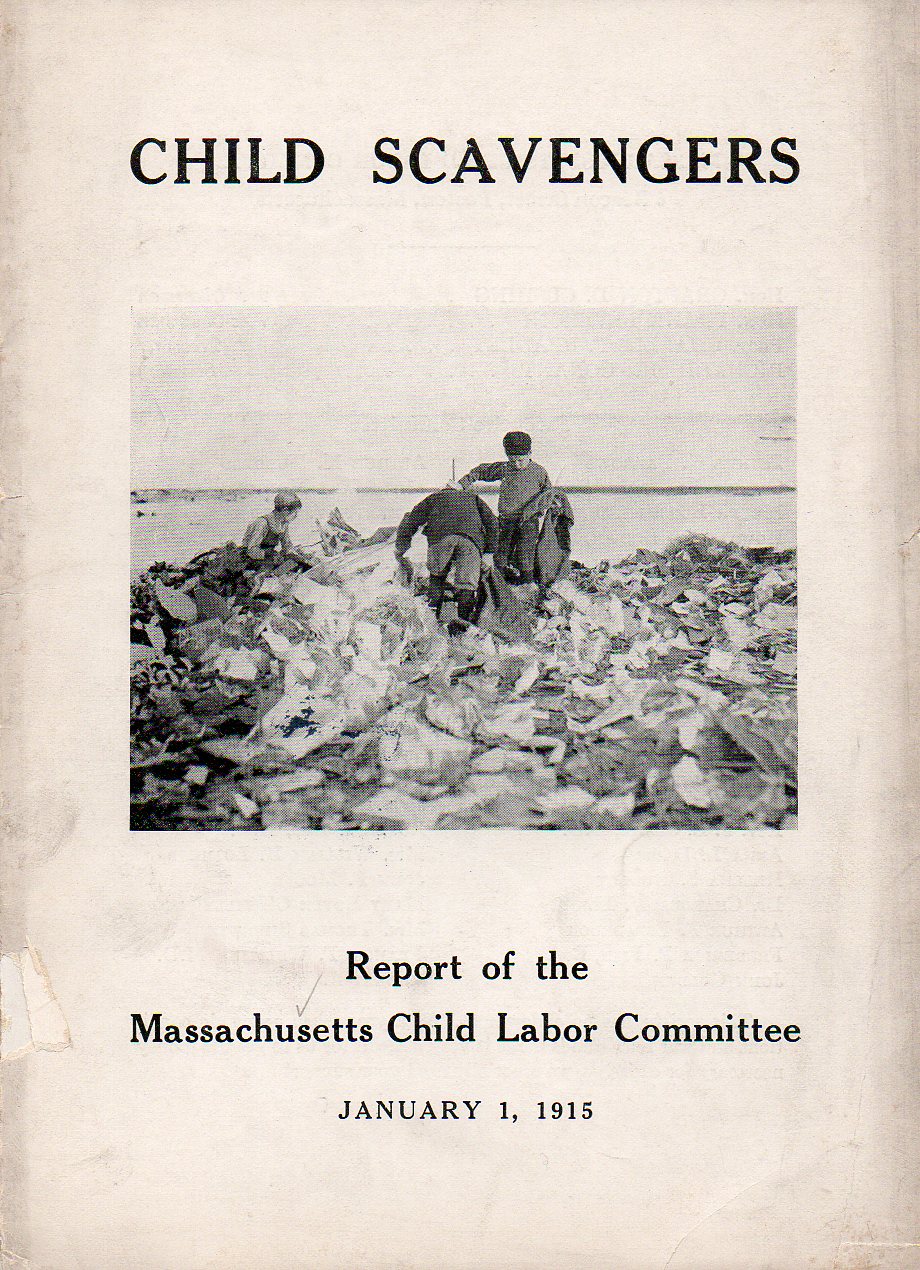
    As rudimentary as the title of this pamphlet seems, it isn’t really quite so, not really completely in the column of not having child laborers and exploiting children.  There is a degree of exploitation allowable–yes it was a different time–and the map that I’ve plucked from this work shows the extent of rough-edging of the law that was tolerated.  The authors weren’t so much concerned that there were 2500 newsboys in Boston-proper hawking newspapers morning/noon/night, but rather that they found over a third of them weren’t wearing their Newsboy Selling Badge when confronted.  And it wasn’t that they were under-aged–just that they were badgeless. 
    Child scavengers362

    On the other hand, the Massachusetts Child Labor Law Committee cited unidentified “critics” (and I don’t doubt that there were many) saying that “children don’t work enough nowadays, and that child labor laws have left nothing for children to do, especially in the cty where there are no chores”. (This work is available for purchase from our blog bookstore.)

    And they did do a study of child scavengers, reporting that in “one dump in a Massachusetts city fifty-five children from five to fourteen years old were moving slowly over an acre of rubbish…” The authors report (unfortunately without reference) that in one Boston school distict of 2,128 children that 125 of them “do this work”, and that 500 children in Boston “are so engaged”.  This didn’t include the children who “gathered refuse” from martketsm freight yards, and ash barrells”  or who were sent out collected odd bits of dropped wood and coal. 

    Child scavengers map363

    But the fact of the matter is that these folks were just knocking at the big door of child labor reform, a big piece of which would come into being in the next year (1916) with the Keating-Owens Act, which began the strict reulation of child labor, defining what the terms “labor” and “child” were. (The act restricted minig occupations to children 16 and over, and for 14 years of age for the manufacturing industries; no night work was any longer permitted, and the work day was limited to eight hours.  This was the reform, so one can imagine what the labor was like before this legislation.) In 1890 there were something like 1.5 million children in the workforce, a figure which was raised to 2 million by 1910, and which was nearly halved (because of awareness and federal oversight) by 1920.

    Lewis Hine (1874-1940)–who gives us the quote to lead this short post–was a school teacher and sociologist  who was extremely aware of the plight of the children around him–well, children, and immigrants, and laborers; people without voices, or representation, poor working people.  He was a pioneering photographer whose images of these classes of people were revoltuionary, a tremendously important documentarian of a societal symptom that was pretty much misdiagnosed, or at least was chosen as something to not be seen.  That was hard to do when you had actual photographs of the grim situaiton. 

    Trodd-lewis-hine-01

    This could’ve been my grandmother. At about this same time. 

    File:AddieCard05282vLewisHine.jpg

    Hine also made some of the most  iconic labor images in American history, a vastly underappreciated heroic figure duirng his lifetime.




  • Alphabet of Retro-Vision Women –1940’s/1950’s

    JF Ptak Science Books   Post 1329

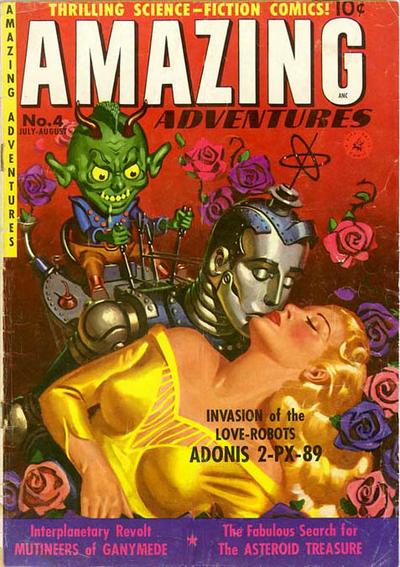
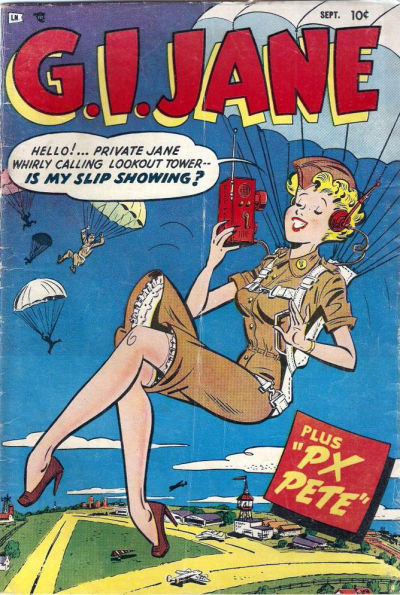
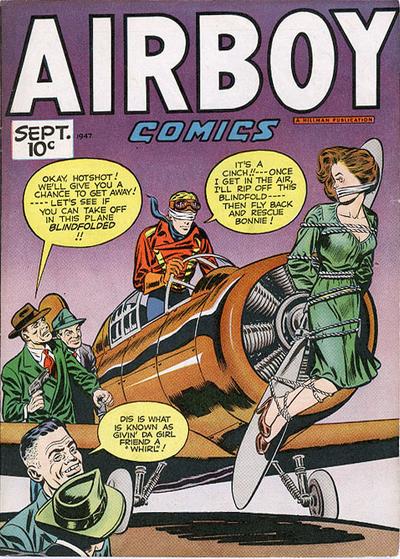
    In a continuing series of odd alphabets (Occupational Alphabet, Action Alphabet and a Touch of Evil, Alphabet of Giants)  that I’ve posted to this blog I offer this, a collection of covers of paperback novels, pulps, mystery magazines, true loves, romance, and of course astonishing science fiction.  That these are considered “Golden Age” is interesting–I understand the overall feel of what “Golden Age” is supposed to mean, though the messages in the images (even exclusive of their texts) are definitely not-so-golden from where we sit in 2011.

    I think that looking at this sort of material is important when considering the fleeting history of normalcy, and that these images help to define what was popularly considered to be the edge of “normal” for that time. 

    A is for Ambidextrous

    Grrlz--mopsy


    B is for Blonde

    Grrls--blonde phanom

    C is for Complete Love

    Grrlz--true love

    D is for Dumb

    Grrl--PearlE is for Effortlessness

    Grrlz--date with judyF is for Future (Love)

    Grrls--love robot

    G is for GI Jane

    Grrls--gi janeH is for Hope

    Grrlz--ghost love

    I is for Insist

    Grrlz--power-girl_super

    J is for Junk

    The Golden Age of Science Fiction: A Pulp Primer, Pt. 2

    K is for (amazon) Knights


    The Golden Age of Science Fiction: A Pulp Primer, Pt. 2

    L is for Lonely

    Grrlz--girl love beach alone

    M is for My, Mine, Maybe

    Grrlz--secret mariage

    N is for Night

    http://www.advertisingarchives.captureweb.co.uk/images/trueimages/30/52/96/72/30529672-1.jpg

    O is for Out

    Rêve d'Opium by UnklNik

    P is for PopularGrrlz--p for popularity
    Q is for Queer (“Society’s Greatest Curse”)  In 1959–the year this book was published–the gay issue outranked nuclear holocaust, civil rights, the Cold War, and everything else according to the cover copy.

    http://upload.wikimedia.org/wikipedia/commons/a/a6/Thirdsex_bookcover_1959.jpg

    (Couldn’t not include this one, possibly the first of its genre when published in 1950, and which over time has sold – 4 million copies.)

    womens_barracks

    R is for Rope

    Grrl--phantom lady
       

    S is for Soalr is for Sun

    Grrls--sun girl
    T is for Temptation

    Grrlz--reform skool

    U is for Under (the Whip)   [See STRANGE SISTERS for more.]

    V is for Venus

    Grrlz--venus

    W is for Whirling

    Grrl--tied to propeller

    X is for X-Ray


     Z is for Zzzzzs


  • The Importance of Mistakes: Kircher’s Table of Transformations, 1664

    JF Ptak Science Books   Post 1325

    The great semi-mystifying polymath Athanaseus Kircher (1602-1680) lived for a long time and filled his life with ideas and words,  producing dozens of books during his time on Earth, some of which were never published even though written, some manuscripts lost forever. His was a massive output of extraordinary breadth.  He wasted little time what I can see, writing on a spectacular range of subjects, enlightening people, confusing people, generating great theories and some bad ideas. 

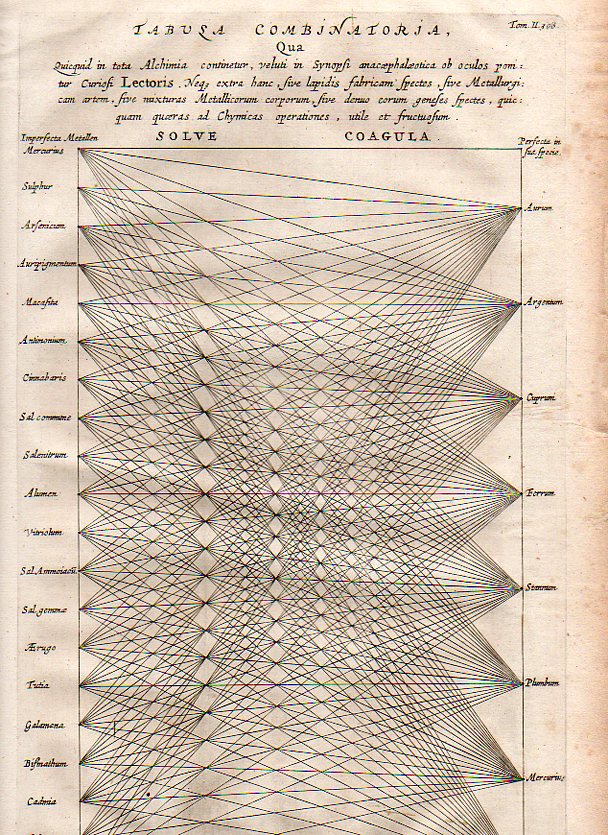
    The image below comes from his Mundus Subterraenus, published in 1664, and which was concerned mainly with geology and the theory of the Earth.  He postulated the structure of the interior of the Earth, the origin of heat, the source of the tides, the composition of light, and of course the existence of the Virgin Mary in amber.  There was also a fair amount of work on one of his side interests that populated a number of hs works, alchemy and the search for the organization of materials. 

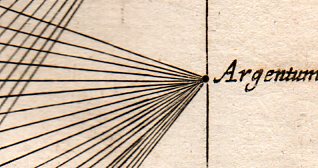
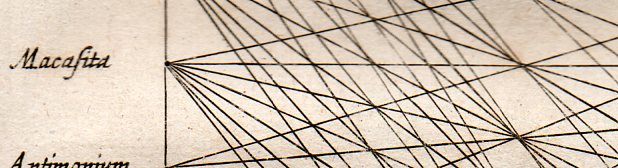
    This image, “Tabula Combinatoria” (combinatory table or table of combinations) was an attempt to classify the alchemical transformation of metals and nonmetals via solve and coagula (mediante igne solvuntur et coagulatur),  of solution and coagulation, a Curiosi Lectoris of  Chymicas operationes, in a search for the key to all transformations, the prima materia. [The original erngraving is available from our blog bookstore, here.]

    Kircher as I said exceeded his learning and logic all throughout his life, usually with positive results to us here in his future; but in this case, his alchemical quest–like the million words and countless hours and lead-based brain damage undertaken by Sir Isaac–proved to be a dry hole.  But dry holes like mistakes in general are not necessarily without importance–they are valueless if and only if nothing comes of them, or nothing is recognized in i n the method of leading to the mistake, or if by our using the mistake it didn’t allow you to pursue something else.  Science life is filled with almost nothing but error to the observer–it is our job to do something with the stuff that doesn’t work. 

    Kircher tabula345
     [the image is continued but trailed off of my scanner.]

    Kircher tabula b346

    Kircher tabula c347


  • An Unexpected “Discovery” in Correspondence to Santa, 1871

    JF Ptak Science Books

    Blogsanta121 I do love Santa. 
    And I know a little about him; but when I looked closely at this wood engraving of the man hard at work something struck me as very unusual to my Santa experience.

    The image is from 31 December 1871–coming after Christmas for some reason–and it is one of the very earliest depictions of the most universally recognized form of Santa. It was created (his image that is,  of course) by the incredibly prolific and almost-entirely socially responsible (except for Catholics and the Irish) Thomas Nast.  Nast created this standard, iconic image of Santa–plus the Republican elephant, the Democratic donkey, the Tammany tiger, and many more iconic public images. 

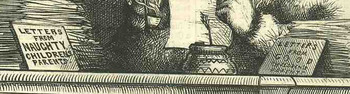
    In fairly famous and often used images I had never noticed that the letters that Santa is reading are being taken from the piles on his desk–but the letters are not written by children, but rather were sent by the parents.

    Is this end-of-the-year grading? Were the “naughty” children being ratted out by their parents?  Does Santa really need to be told all of this?  And who on earth really is deserving of a lump of coal, anyway?  I’m guessing though that this was simply a warning cartoon to children, saying to them that they’d better well be good or a letter will be going out from Mom and Dad to Santa in the afternoon mail

    This might make more make more sense if the cartoon wasn’t published five days after Christmas but appeared before the holiday. Perhaps it is perfectly placed–tis would’ve been the first issue of the weekly magazine after the holiday, so reminding children to be good after a Christmas in which they might not have received what they wanted may have been caused by their behavior.  And since part of Nast’s social power came from depicting events that were of interest to the working class and the poor and making them intelligible to the illiterate, where the cartoon/caricature could speak without words and make themselves understood, it might’ve been the case where parents would show the image of Santa to the kids and then tell them about the letter part to try and codify a different behavior in the new-coming-Christmas season. 

    Blogsanta121detail

    These questions aside, the lesson yet again for me is to look very closely when looking at complex images like this—especially when you think that you already know what you’re looking at…


  • Jackson Pollock’s Fractals

    JF Ptak Science Books    Rapid Post

    Thinking about the “evolution” of music, I came to the 1940’s and 1950’s , and then to Jackson Pollock, and then to thinking about how his artwork evolved, and then, about how it might have truly evolved in a classic sense, like an evolutionary period.  None of this made much sense to me until I started thinking about the representation of Pollock fractally–and then things started to get interesting.  Could this work come about, again, as a result of the evolution of fractals?

    Obviously the Pollock drips aren’t self-same, not easily observably, anyway–but what about statistically, especially under magnification?  

    It turns out that someone has taken a look at this: Richard P. Taylor, et al, in “The Construction of Jackson Pollock’s Fractal Drip Paintings”1This team concludes that–after analyzing paintings and films of Pollock painting them–“the painting process that…Pollock used a remarkably systematic method capable of generating intricate patterns that exhibit fractal scaling criteria”.  

    I’ve never been comfortable with mid-century modern, but I must say that this Ollock/fractal business is interesting to think about, though I’m not sure it has anything to do with art. 

    Notes:
    1. Found in: Johnson, Colin G. Romero Cardalda, Juan Jesus.  “Introduction: Genetic Algorithms in Visual Art and Music–a Supplement”,  Leonardo, Volume 35, Number 2, April 2002, pp. 175-184 (Article)

    Here’s another interesting book: The Art of Artificial Evolution: A Handbook on Evolutionary Art and Music by Juan Romero and Penousal Machado (Editors)bSpringer – Natural Computing Series Hardcover: 458 pag

    The introduction to the Johnson ‘02 Leonardo article: “Leonardo has a long tradition of publishing work at the mutual frontier of art and science. We are pleased to present in the pages of Leonardo a special project that


  • An Alphabet of Giants, Part II–Under and Over the Volcano with Rabelais

    JF Ptak Science Books Post 1278
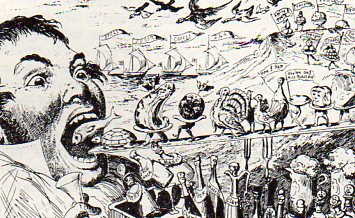
    Gluttony127
    Rabelais may be that man who lived under/in/over the volcano.

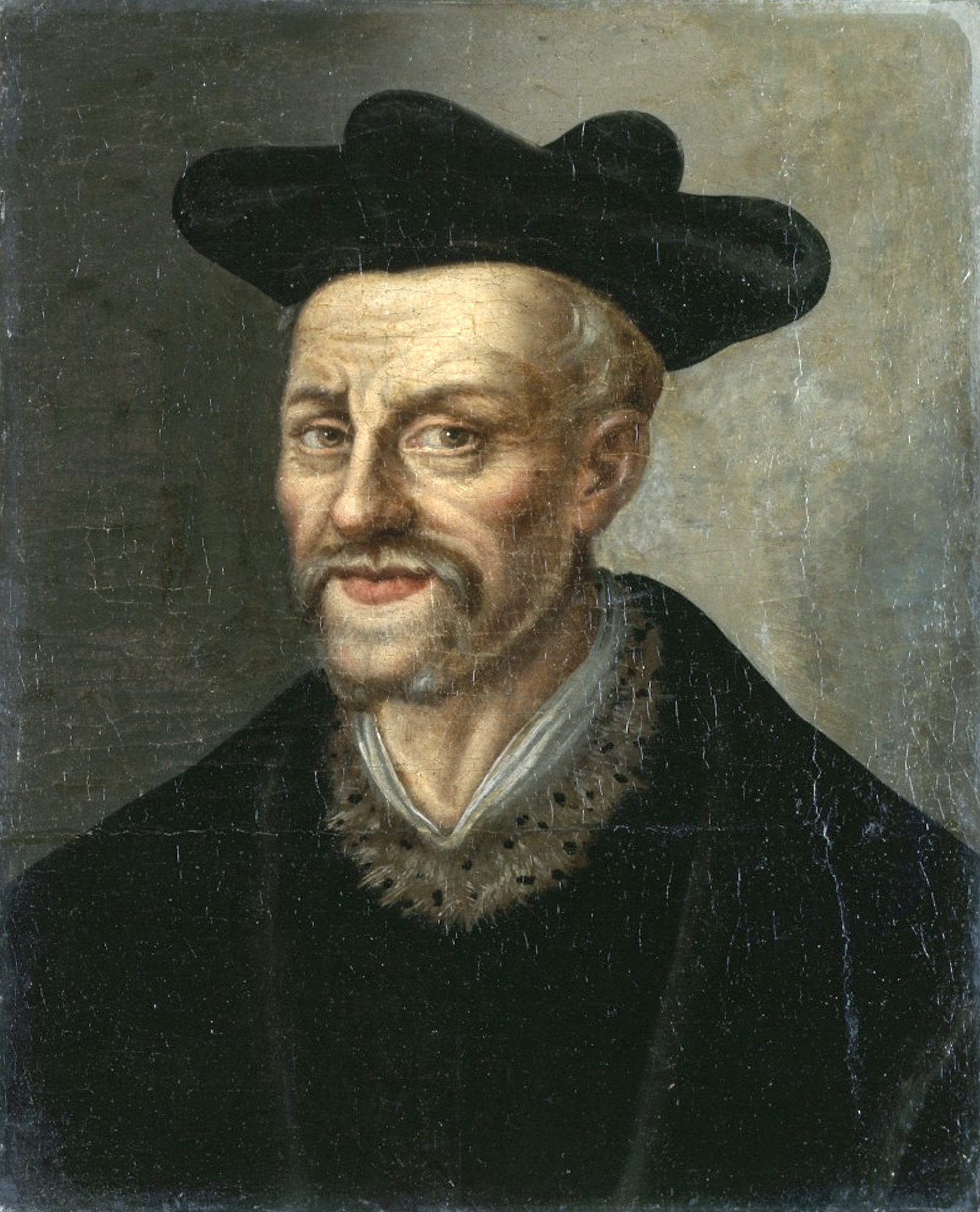
    Francois Rabelais (1490-1553, writing under the anagram Alcofribas Nasier)   was perhaps as gigantic a man in spirit, need, want and appetite as his greatest creations, Gargantua and Pantagreul, and may well be the greatest ex-monk of ex-monks, a bubbling Renaissance Humanist.  I’m not saying that Rabelais spent 11 months in the womb or smoothed his hair with a 900′ comb or drank the milk of 17,000 cows like his creation Gargantua,  but he did have a staggering appetite for life.  He ate life as Honore de Balzac ate food.  Rabelais seemed to know no boundaries, and neither did Balzac, who would typically eat a hundred oysters,  twelve lamb cutlets, a duckling, partridges, fish, fruits, assorted vegetables, coffee, liquor, liquer, wine and so on, at one sittng.  Every day. Nor did Rabelais  necessarily drink like Eugene O’Neill or F.Scott or Edgar Poe or Hart Crane or Jack London or Dylan Thomas, though he did drink beond the boundaries.Thomas, though he did drink beyond the boundaries.

    One of my favorite writers–George Orwell–didn’t have much use for Rabelais, repulsed by his abuses, but that was to be expected.  So it goes.

    File:Francois Rabelais - Portrait.jpg

    The beginning and end of Epitaph for Rabelais, by Peirre de Ronsard:

    If anything can sprout
    From  a dead man  rotted out,
    And  if further generation
    Arises  from stagnation,
    A  grapevine will  surely take birth
    From  the belly and  the girth
    Of  good Rabelais, who  contrived
    Always  to drink while  alive…

    All you who  pass his grave,
    Be  you nobleman  or knave,
    Hang  cups on  this, his shrine
    To  vessels and sparkling wine;
    Hang  sausages and ham:
    For  if he  still has sensation,
    His  soul prefers potation
    To  lilies as a gift,
    And wine  gives a better lift


  • An Alphabet of Giants, Part 1.

    JF Ptak Science Books   Post 1250

    “There were giants in the earth in those days; and also after that, when the sons of God came in unto the daughters of men, and they bare children to them, the same became mighty men which were of old, men of renown.” Genesis 6:4-5 (KJV).

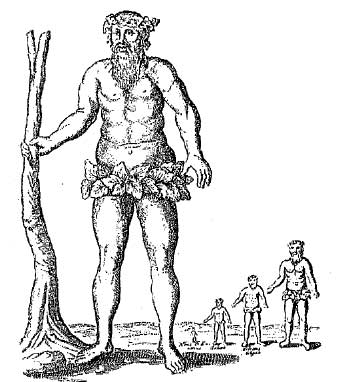
    Our dog Blue is a giant Jack Russell Terrier–mix.  He’s a Jack St. Bernard/Jack Russell–a St. Jack–and at 50+ pounds is either a Giant Jack or a mini St. Bernard.  He behaves like the St. Bernard.  One wonders about the mechanics of the thing–similar to Mr. Gulliver in Jonathan Swift’s A Voyage to Brodbingnag (1727), in which the hero (or anti-hero) though he is disgusted by the gigantic women of the place nevertheless seeks and accomplishes some sort of romantic union with the handmaidens of the giant queen.  And this all puts me in the mind of giants–actually, I’d like to put together an Alphabet of Giants, with this being the beginning. And to start at the beginning is Athanasius Kircher–the incredible Kircher, who produced thousands of pages of excellent analysis and cutting-edge technical/physical thinking as well as hundreds of pages of highly imaginative scientificiana–and his generic giant, featured in Mundus Subterraneus in 1646.

    Giants have certainly been around for a long time, though imaging that imagination is less ocmmmon early on in the history of the illustrated book. 

    There’s no lack of giants in ancient mythologies and legends–the Hindu Daitya, Mohamed’s depiction of a 100-foot-tall Adam, the Greek Antaeus (the children of Heaven and Earth, of Uranus and Gaea), the sleepy Encedladus, the Nephialim, and so on.  One of the most glorious of the big people stories is the  beautifully-named Gigantomachy, in which the gods of Olympus engage in an enormous confrontation with Chaos and Aleyoneus. The “good” (though not very) guys win.

    There’s actually about half-an-alphabet residing just within the Greek Titans (Atlas, Crius, Cronus, Coeus, Gaia, Hyperion, Iapetus, Mnemosyne, Oceanus, Phoebe, Prometheus, Rhea, Theia, Themis, Tethys), but I’d like to expand this if I can. A fuller, more diverse listing of giants and giant-groups follows: Anakim (Jewish mythology, references in the Old Testament), Argus Panoptes (Greek mythology), Bestla (Norse mythology), Cyclopes (Greek mythology), Daityas (Hindu mythology), Epimetheus (Greek mythology), Fachan (Celtic mythology), Gargantua and Pantagruel, Gigantes (Greek mythology), Gog and Magog (Jewish mythology), Goliath (Book of Samuel of the Bible), Hecatonchires (Greek mythology), Iovan Iorgovan (Romanian mythology), John Henry (American folklore), Jotuns (Norse mythology), Kaour (Celtic mythology), Menoetius (Greek mythology), Nimrod (Jewish mythology, OT), Oni (Japanese folklore), St Christopher (Roman Catholic saint),Talos (Greek mythology), Titans (Greek mythology–Atlas, Crius, Cronus, Coeus, Gaia, Hyperion, Iapetus, Mnemosyne, Oceanus, Phoebe, Prometheus, Rhea, Theia, Themis, Tethys), Zipacna (Mayan mythology).

    For the most part I’ve stayed old with these images, except for the 50-Foot Woman, the Giants are generally not from the modern fantasy/sci fi gernre. 

    So, Part 1:


    A. ALICE. John Tenniel’s Alice in Lewis Carroll’s Alice’s Adventures in Wonderland.

    File:Alice par John Tenniel 05.png


    A. Arthur.  King Arthur’s Giant.

    File:Walter Crane King Arthur and the Giant Book I, Canto VIII.jpg

    B.  Beanstalk Giant. Jack and the Beanstalk, John D. Batten 

    File:Page 59 illustration in English Fairy Tales.png


    B. Bunyan, Paul.  By Allen Lewis.

    Frontispiece from Paul Bunyan (woodcut illustration by Allen Lewis)

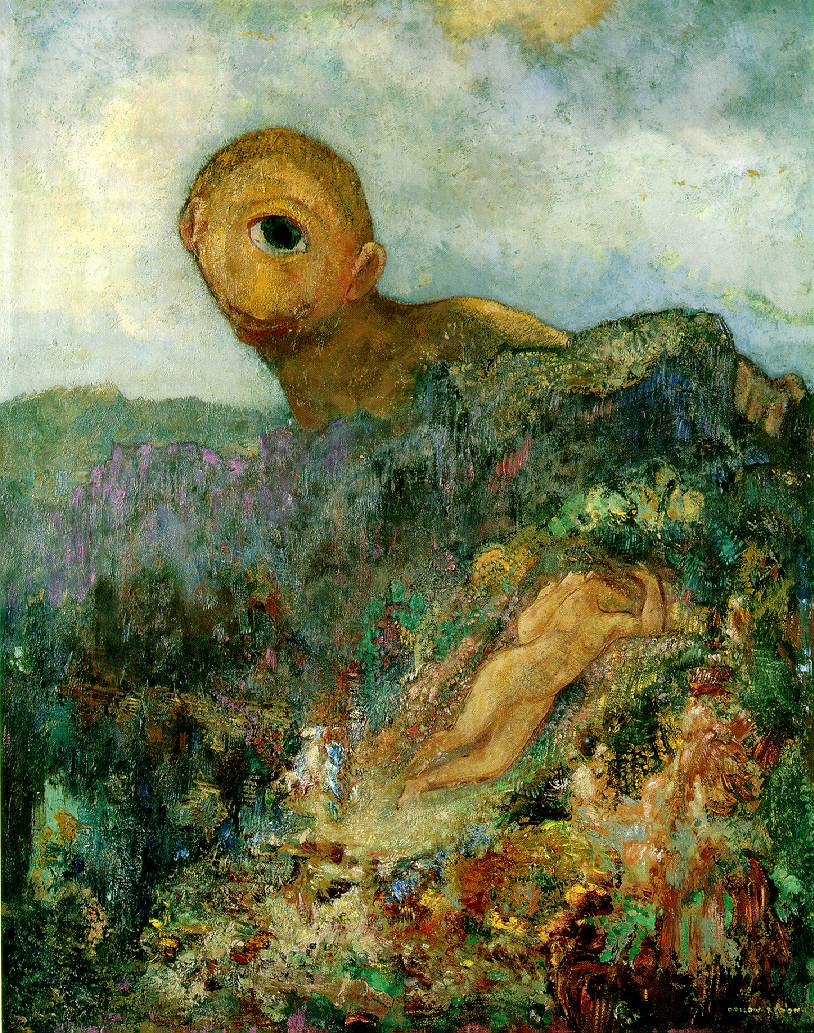
    C. Cyclopes.  By Ordilon Redon.

    .

    File:Redon.cyclops.jpg
    E. Ecclesia.   “Ecclesia”, or the depiction of Church as the Bride of Christ is a representation of a woman giant, and is seen in  Scivias, by St. Hildegard of Bingen  (1098-1179).

    File:Meister des Hildegardis-Codex 002.jpg

    F. Fatna. The giants Fafner and Fasolt seize Freyja in Arthur Rackham‘s illustration of Richard Wagner‘s Der Ring des Nibelungen

    File:Giants and Freia.jpg


    G. Gargantua
    http://www.gargantua.eu/gargantua.jpg
    G. Gigantomacy.  By Perin del Vagas.

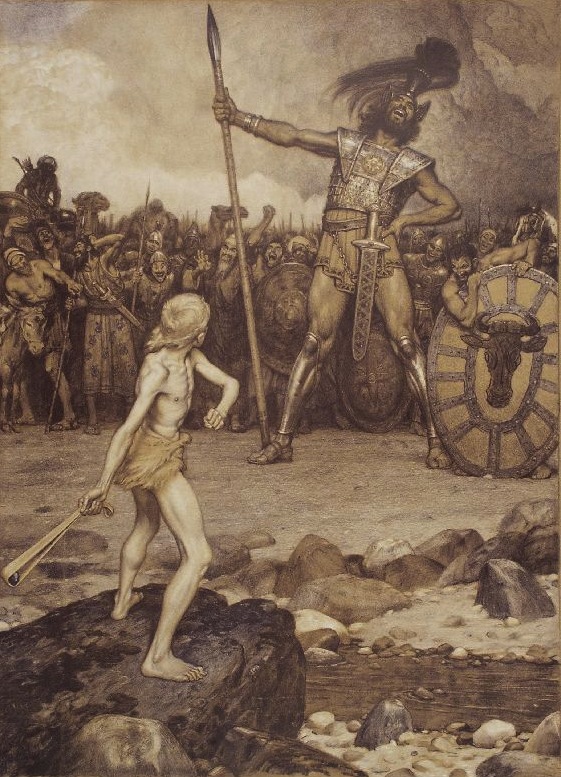
    G. Goliath. Osmar Schindler’s David with Goliath.

    File:Osmar Schindler David und Goliath.jpg

     K.  The Kraken.

    http://bogartswisconsin.com/images/kracken8.jpg

    O. Oni (Japanese folklore.)

    P. Pantegruel.

    http://dramapessoal.files.wordpress.com/2008/01/rabelais-pantegruel-by-francois-desprez-10.jpg?w=460


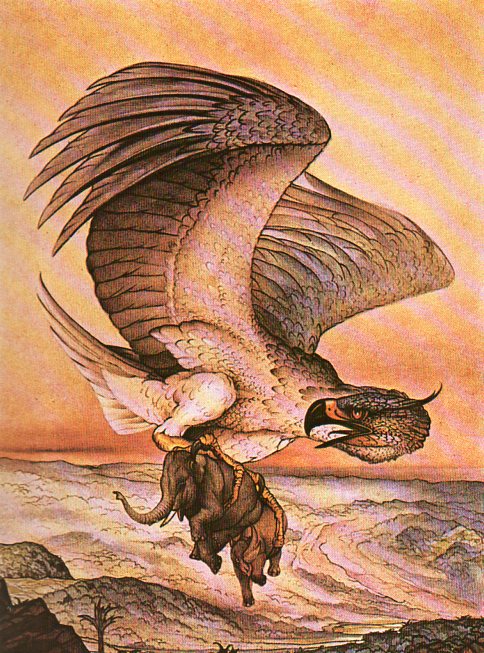
    R.  Rukh.  “The Rukh which fed its young on elephants”, by E.J. Detmold. For The Second Voyage of Sinbad the Sailor from The Arabian Nights, 1924.

    Giant--rokh944

    W. Woman, 50-Foot.

    Women don’t often appear though as giants–at least until modern times.

    Z. Zeus.

    Zeus and three Gigantes, drawing based on the Zeus Pergamon Altar.


  • Structure for Wide Thinking–Walter Gropius’ 1942 Design/Exercise Book

    JF Ptak Science Books  Post 1247

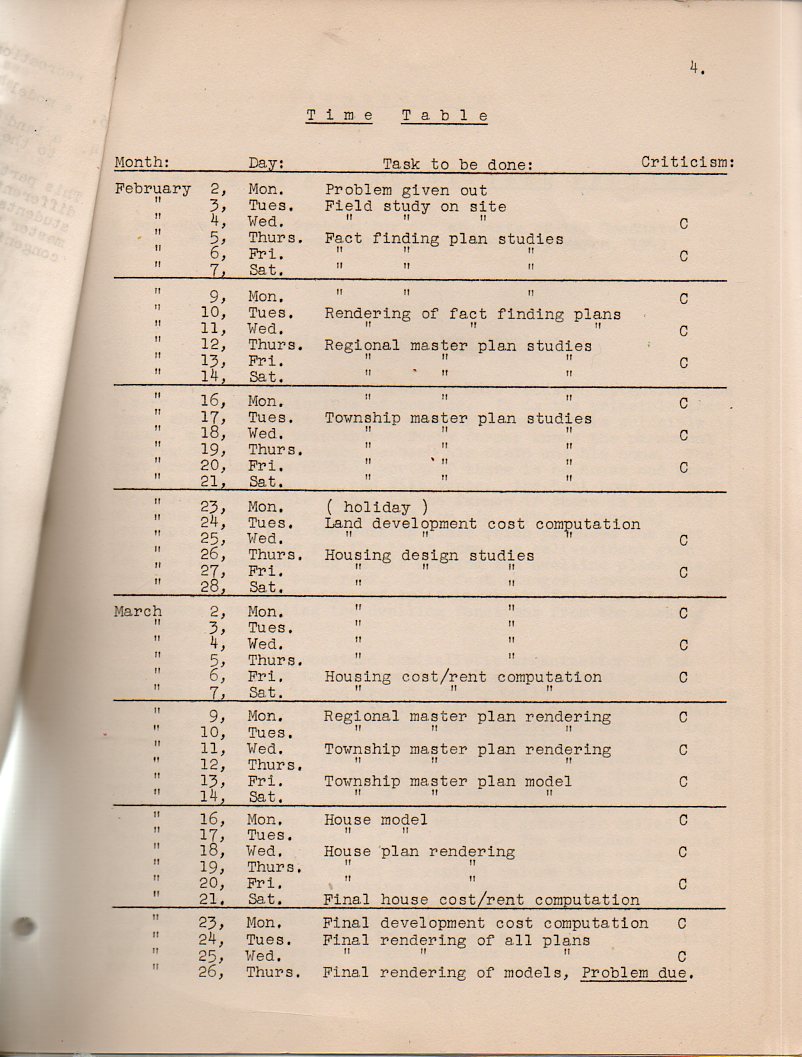
    Walter Gropius (1883-1969, founder of the Bauhaus School and one of the principle builders of modern architecture) and Martin Wagner (1888-1957) were thinking of a new type of “town”, of a different sort of settlement for people, when they wrote this exercise instructional for their Harvard course. Housing as a townbuilding1 problem, written during the war in 1942, was intended to be an exercise (or  “problem”), a case to be studied by the students in the departments of landscape architecture and the graduate school of design at Harvard. The class opened with this rare2 pamphlet as a basis for course work, given to the students on 2 Feb 1942, with the problem’s answers expected to be on Gropius desk five weeks later.  Gropius and Martin put a tough, wide-ranging, landscape-changing question and expected answers in a very short period of time, though they definitely had a very structured plan and approach to dealing with massive implications of their exercise.  The theory was outlined there in the paper, of course, and was expanded much more fully in class.  And then there was this: a full page of datelines and expectations, a way of dealing with a large problem in logical chunks, adding up the answered bits, and then delivering a larger answer at the end and on time. 

    Gropius table899
    [The original work is available at our blog bookstore.]

    I’m not an architecture or design historian, so much of this paper was a little lost on me–but I could definitely appreciate the way in which the great Gropius outlined the process of problem-thinking and solution for his students.  This may be the part of this paper that I liked the most. 

    In  “The Walter Gropius House Landscape: A Collaboration of Modernism and the Vernacular”3 (published in the  Journal of Architectural Education, 1984, 57 (3), p. 39) Eric F. Kramer wrote:

    “Sounding similar themes in a 1942 joint studio problem for landscape and architecture, Walter [Gropius] wrote of the inspiration of the vernacular landscape and of integrating with existing systems: ‘Such a landscape invites the artist planner to observe and preserve its variety of aspects, and to invent a settlement pattern that .ts into its natural beauty. Fortunately our forefathers have already traced out a settlement pattern that fits very well into the landscape.’ Gropius–the grand master builder and master teacher–set out the problem and the solution”.

    There are of course major statements in city-building and human resettlement in this work, but for now, I’m still concentrated on the Bauhaus-founder’s outline for problem solving.   

    Notes

    1.  The full title: Housing as a townbuilding problem; a post-war housing problem for the students of the Graduate School of Design, Harvard University, February-March, 1942.

    And in that publication Gropius writes: “When we speak of ‘new townships’ we think of a new type of human settlement “, with a redefined vision of what a “town” means, using an idea of “reception basins” for spheres of cities as centers of culture, art and commerce “and our open country as furtherer if an industrialized agriculture and of forestry and recreation”. (page 21).  And all of that to be manufactured along the lines of “planned super-highway systems, one branch of which is to go through New England region and will supposedly cut through the towns of Weston and Weyland”.–Gropius and Martin.

    2. This copy was in the Office for Emergency Management; only  six other copies have been found and these in excellent collections: MIT, Harvard Special Collections, Harvard College of Design, Cornell, Columbia and the NYPL (Special Collections).  So the publication is pretty scarce, and given its method of printing and distribution, it looks like not many survived, though it is difficult to say how many were actually printed.  In any event, few survived.

    3. The abstract of this paper is helpful: “The Walter Gropius House Landscape A Collaboration of Modernism and the Vernacular”. “The Gropius house landscape is a potent physical manifestation of the design debates of its era. The landscape is an element of both mediation and integration forging a reciprocal and evenhanded relationship between architecture and site. Shaped by modern architectural sensibilities translated to the landscape and developed at a moment when landscape architecture was struggling to .nd a modernist inspiration and voice, it is an object lesson in the development of a modernist landscape architecture in America…”   
    “In these studio problems, Gropius consistently encouraged students to find new form in the functional requirements of modern times and yet to integrate with existing systems through an understanding of their own functionally driven evolution.”


  • Looking Inside Out–Ernst Mach’s pre-Escher Image

    JF Ptak Science Books   Post 1243

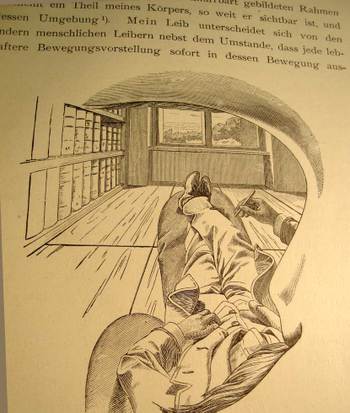
    MachbookI cannot think of another illustration by a scientist or philosopher who attempts to explain their own–literal, interior,physical–view of the world and then offer what this looks like to the reader from inside his own head, looking out through his own eye.  That’s exactly what Ernst Mach is doing right here on page 15 of his influential book Die Analyse der Empfindungen, the fourth German edition (“The Analysis of Sensations and the Relation of the Physical to the Psychical”)  (Jena, 1903)
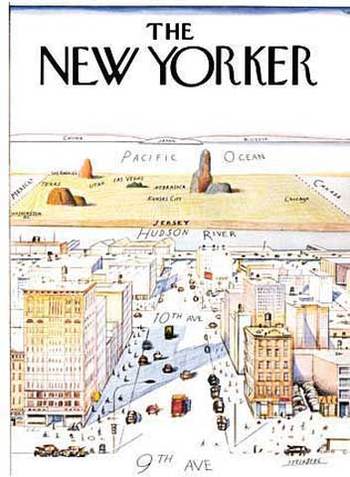
    There is nothing in this world for Mach that is not admissible to the human brain that is not empirically verifiable–that is, the world is nothing but awash in sensation and that sensation itself forms part of the experience of, well, experience. I’ve actually never been interested in the philosophy of science, and this is one of the reasons why.  Nevertheless I boldly break through my own prejudices to enjoy this phenomenally original image, drawn from the inside of Mach’s working mind, looking out through his eye socket, over his mustache, under his eyebrow, around his nose, out across his body and then leaping into the rest of the world.  I think he does make his point about the essentialSteinberg_352 nature of the observer. And much like the classic Steinberg New Yorker cartoon of the world view of the New Yorker (of course this includes only Manhattan), I know some number of people who have transposed their bodies much like Herr Mach into the Steinberg map–except that their worldview ends basically at the Hudson River (Mach’s feet) with the rest of the world being the sliver out there beyond the river (Mach’s window) until you go 359 degrees around the world to get back to the East River (and back inside Mach’s noggin).  It is an unusual world view to have, but someone has to have it so that we can at least identify it so. 
    I just like the picture.   


  • Finding Unseen Things In and From the Air

    JF Ptak Science Books  Post 1131

    Seeing more deeply--air weather det853

    Finding the hard-to-find, the invisible, the “hidden”, is an essential aspect of, well, mostly everything.  Whether it is Newton separating light with a prism to find its constituents, or Hooke investigating the formerly quasi-real microscopical world to reveal worlds within worlds, or Galileo using his telescope to quash the ideas of the unaided-eye-visible night sky as an unaltering perfection of creation, or Roentgen seeing through his wife’s skin, or Fraunhoefer finding the complex spectrum, or Henry Draper determining a chemical constituent of the sun, or the invention of the zero or negative numbers or subtraction, of finding Black Holes or other planets or the remnants of the Big Bang, or (Kandinsky) finding the nonrepresentational aspect of art, or Duchamp finding in an upturned urinal that art had no boundaries…the list goes on and on.

    One aspect of this “finding something in nothing” business that is interesting to look at because it is so local and discernible–and recent–is in air navigation and detection.  And I’ll do this using a series of excellent illustrations from The Illustrated London News, all of which are from the 1927-1938 period. 

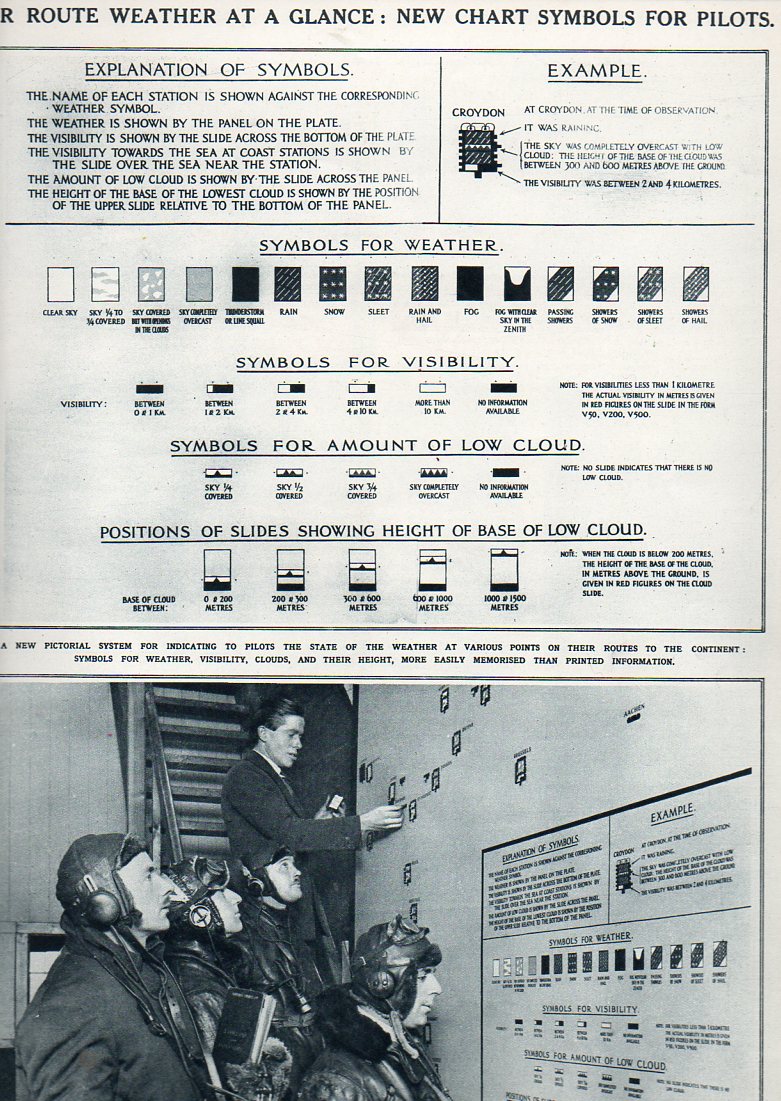
    The first is relatively simple, at least simple from here in the year 2014, which shows four pilots being briefed on weather conditions with a aerial chart for conditions along intercontinental routes.  The placement of these symbols represented a vast improvement over the earlier systems of readying pilots for what weather lay ahead, if indeed there were any communications at all.  This represents an early look at a codification of conditions and expectations for air travelers–a display of new and important data in 1927. 

    Seeing more deeply--air weather852
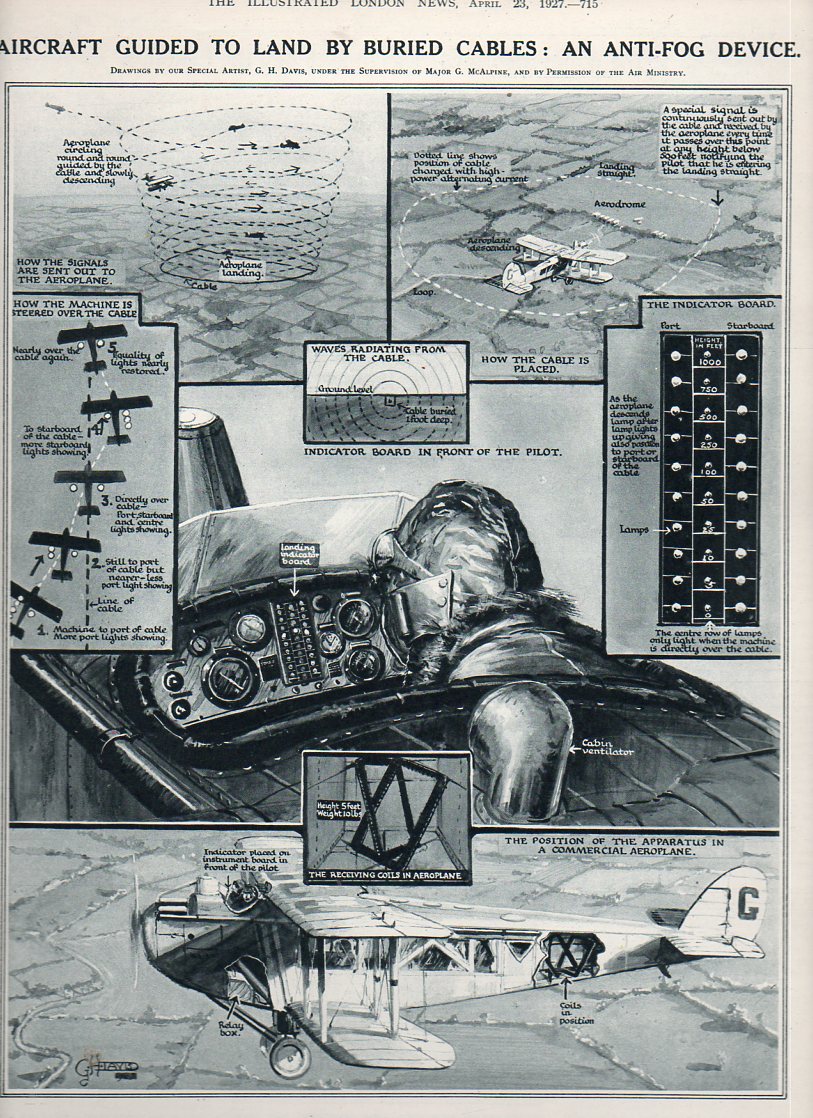
    Next is a brilliant device for assisting pilots to land in foggy and dark conditions–actually on how to find the ground safely.  In 1927 (again) a RADAR-like system was put into place on aircraft that involved receiving the signals of an ac-pulsed buried electrical cable that surrounded an airport.  The receiver (seen here on the flight panel of the pilot in an open-air cockpit) would be read to reveal proximity of the airport, the pilot making wider and then closer spirals in descent until his was basically within the buried airport cables and thus able to land.

    Seeing more deeply-anti-fog855
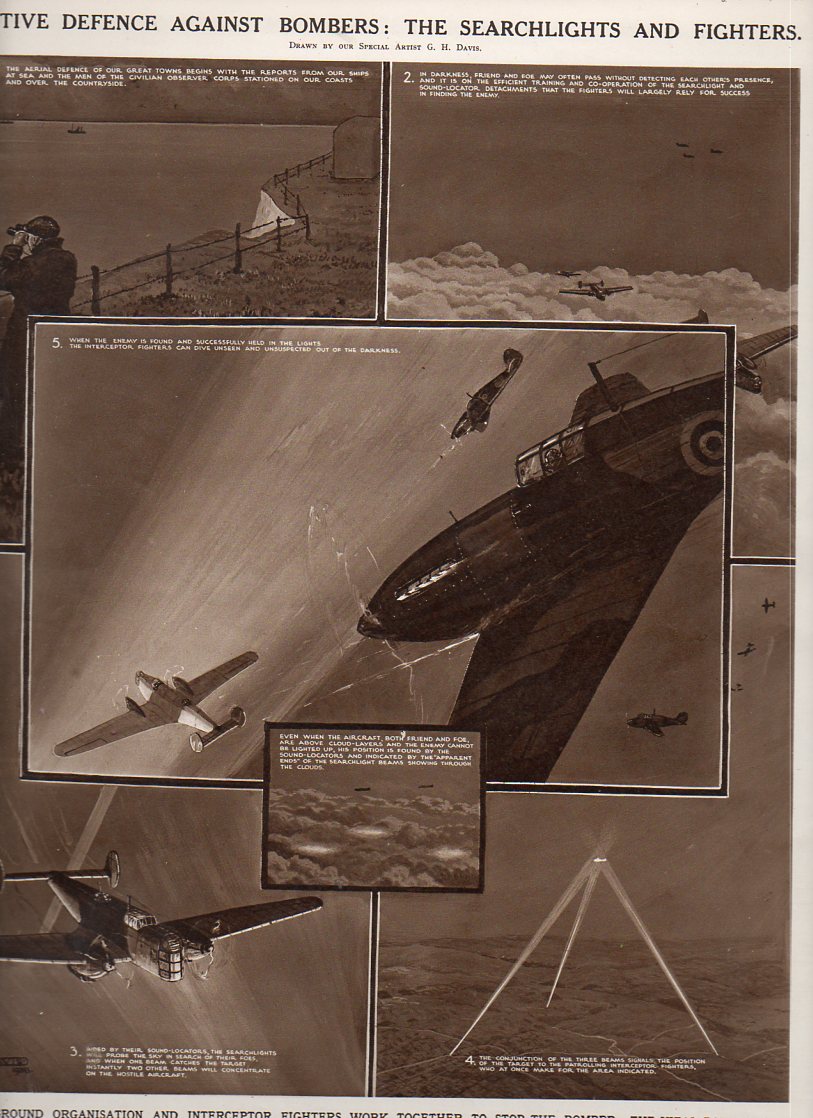
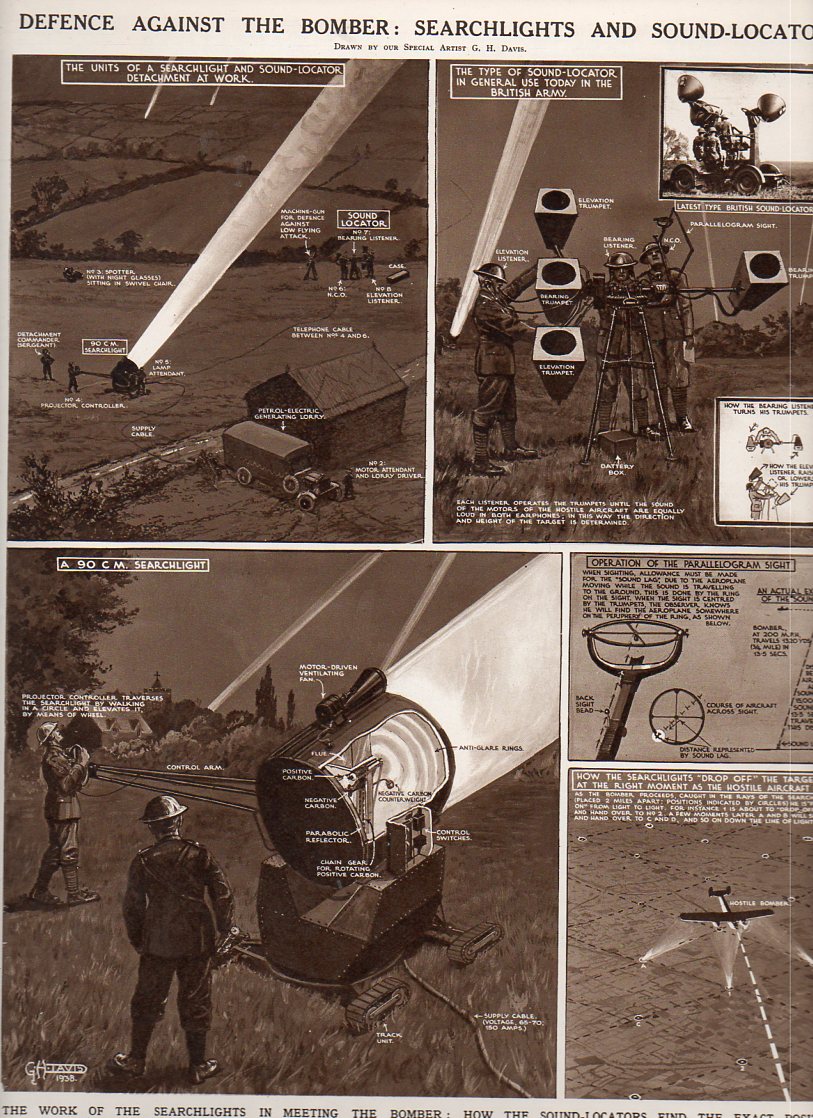
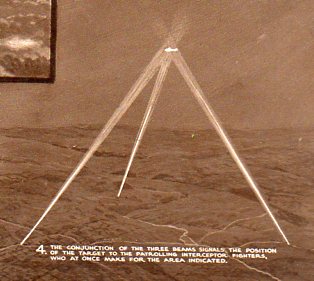
    Prior to WWII RADAR1 was somewhat functional but still in development, and as we see in this set of 16 July 1938 illustrations, the key methods for finding enemy aircraft at night (in order to shoot it down of course) was an audio-visual method, using “sound-locators” to find the approaching bombers and then spotlights to illuminate and track them to their destruction.  

    Seeing more deeply-searchlight856

    Seeing more deeply-defence against bomber854

    These images represent some idea of the state of the art of being able to find things–like the ground at night or approaching enemy aircraft–in the 1927-1938 period, all of which would be drastically changed in just the next two years.

    Seeing more deeply-searchligh detail857

    NOTES

    1. RADAR was coming very close to being developed in the early 1930’s–and in 1935 the process of experimentation and implementation was at a peak.  The development of this new technology was an international property, though perhaps no one owned it more in this period than the British, with Watson Watt giving his experimental ideas on RADAR to the Air Ministry on 12 February 1935 in a secret report titled “The Detection of Aircraft by Radio Methods”. Int his years alone there was feverish work being done by  Rudolf Kühnhold (Scientific Director at the ‘Kriegsmarine  Nachrichtenmittel-Versuchsanstalt) who in 1933-1935 established a RADAR-hunting company called Gesellschaft für Elektroakustische und Mechanische Apparate, or “GEMA”; there was also elements of the Royal Navy, Telefunken, Standard Elektrik Lorenz, Philips Company’s  (of Eindhoven, Netherlands) Natuurkundig Laboratorium, the Research Office of Nippon Electric Company, and even in the Soviet Union (until the key figures involved were murdered in Stalin’s purges–this one distinguished from others and referred to now as The Great Purge– of 1937), the French Compagnie Générale de Télégraphie Sans Fil (CSF), and  the Italian Regio Instituto Electrotecnico e delle Comunicazioni (RIEC, Royal Institute for Electro-technics and Communications) to name a few.  The United States of course had been long working on the project, at least since 1922 at the NRL, with considerable private (and federally funded) work done by RCA

    .
    Whipping ahead into WWII a very significant “battle of the beams” began between the U.K. and Germany, especially during the Battle of Britain, involving countermeasures, espionage, propaganda and false-positives in regards to the use and development of radio-based tracking and detection–the U.K. particularly making use of this technology in a wide-spread air defense system.  But it was in the United States in 1940 (and really by the U.S. Navy) that RADAR got its name (for RAdio Detection And Ranging) as well as its great impetus for development and deployment.