A Daily History of Holes, Dots, Lines, Science, History, Math, Physics, Art, the Unintentional Absurd, Architecture, Maps, Data Visualization, Blank and Missing Things, and so on. |1.6 million words, 7500 images, 4.9 million hits| Press & appearances in The Times, Le Figaro, Mensa, The Economist, The Guardian, Discovery News, Slate, Le Monde, Sci American Blogs, Le Pont, and many othr places… 5000+ total posts since 2008.

Category: Perception

  • How Fish and a Dog Nearly Prevented the Publication of Newton’s Principia

    JF Ptak Science Books    Post 1508

    Well, not really, no.  But sort of–when you open up the Big Book of Big Discovery, and go to the “N” section, and read about the Principia, the fish and the dog will at least be there.

    The story of Edmond Halley and his wide importance in getting Isaac Newton to write what may be among the most supreme efforts in the history of science is very well known.  In pursuit of an answer to an excellent question put to him and Robert Hooke by Sir Christopher Wren in a London coffeehouse, Halley pursued his answer to the very doorstep of Newton, right to Cambridge, in a personal visit.  Newton of course knew the answer and knew more than the question, as his response provoked some of the deepest thoughts in the history. The answer to Wren’s question involved something much bigger than what he knew, and it took Newton to recognize the elemental issue at play. Of course the answer would require a lot of collected observations and accurate data, which Halley could certainly provide via John Flamsteed (who was the founder of the Greenwich Observatory, and the first astronomer royal of England), but the answer involved the ability to do the calculations in a fundamentally different way.  It was the genius of Newton through and through that made the Principia (the full title by the way being Philosophiæ Naturalis Principia Mathematica, which is Latin for “Mathematical Principles of Natural Philosophy”), the Essential Book, but without the intercession and data provided by Halley, the whole deal gets a little muddy.

    I can imagine that Hooke, who even though had come to the top of Newton’s s-list, knew how he could answer the question, and knew that it was Newton that he needed to see, but he just couldn’t do it.  As a matter of fact the Hooke/Newton business would get a little deeper as the Principia came closer to publication, with Hooke claiming some priority and influence in the ideas forming Book III–a claim that nearly prevented Newton from publishing that section of the work–but Halley again stepped in and smoothed the matter over, at least for the sake of publication.  Hooke though didn’t let go, and neither did Newton, whose ultimate revenge over Hooke was by living significantly longer. 

    He was prodded into publishing by Halley, who flattered and beguiled and pushed and preened and all the rest, skillfully managing the spectacular and difficult Newton, pressing him to completion.  It might be said, I think, that had Halley not been there to press Newton along, the Principia might not have been written at all, and we would know Sir Isaac for other things, but perhaps not for his great masterpiece. 

    Aside from Halley’s insistence, there was also the issue of money and getting the Principia printed, and even though the Royal Society had given its imprimatur1 on Newton’s project and had agreed to see it published, the publication was not necessarily a done deal.. The Royal Society hadn’t gotten gotten over its disastrous investment in Francis Willoughby’s History of Fishes (1686)2–an expensive edition with beautiful illustrations, a project that they funded but which just didn’t sell.  And so the Society was a little gun shy, and tight.  As a matter of fact, Halley was at the time under consideration for the position of subordinate clerk, and was to receive a salary of 50 pounds (a substantial amount for the time) but was to be paid in copies of Willoughby’s book, which was evaluated as one pound per copy (so Halley would make 50 copies of the Willoughby book for his work, per year).  But Halley guaranteed to pay for the publication of the Principia, paying for the thing out of his own pocket. 

    Luckily Halley wasn’t dependent upon his income as clerk, having inherited a legacy as well as a number of productive properties from his father3.  Halley had at least an inheritance of 150-200 pounds from his father’s estate, not including 60 pounds that he received every year before his father died.  In addition to the cash was “property in several parishes in the city of London, including 13 houses in Winchester Street, two others on Canon Street…[others]…and the Dog Tavern.” Halley was making enough money from the property investments to live a comfortable life, plus he had his own sources of income, plus he was living in a house without payment, also inherited from his father.  Halley was comfortable.

    There was evidently one piece of property that was a major source of trouble to Halley’s father and which it seems for a time threatened the stability of the family’s legacy–the Dog Tavern.  But the elder Halley–also named Edmond–overcame those issues and held onto his other properties without major liabilities, and was able to make his bequest to the younger Halley, who was then (after much else happens) able to proceed funding the publication of the Principia.4

    Notes:

    1. Following the Halley visit in 1684 (August)  Newton would send his  De motu off to the Royal Society (received 10 December) ; after two and a half years of work on  28 April 1686 Newton’s sent the Principia, Book I to the Royal Society, which on 19 May decided to publish it and which liscensed the book (via Samuel Pepys, the President of the Royal Society) on 30 June. 

    2. The book was actually completed by John Ray following the death of Willoughby.

    3. That  information comes from an article I read yesterday which sparked this post (Cook, Alan (07/01/1991). “Edmond Halley and Newton’s  Principia. Notes and records of the Royal Society of London,  45 (2), p. 129}, Cook determining through his own careful research that Halley had ample funding to take care of the Principia (and also why it might have taken Halley so many months to make his trip to Cambridge, rather than just heading off to see Newton straight away from his coffeehouse meeting with Wren and Hooke). 

    4. After it was all said and done, it looks as though the entire printing (300-400 copies, including 100 copies for presentation) of the first edition of the Principia cost under 100 pounds.  Part of this cost was offset because a number of copies were sold as sheets that were to be bound by the purchaser.  The second edition of 1713, with a print run of about 700 copies, cost 117 pounds.  It is interesting to note that the prices paid for copies of the first edition of the Principia didn’t reach their astronomical proportions until the last decade or so, when lovely copies might demand a million dollars or more.  A.N.L. Munby (Munby, A N L (10/01/1952). “The Distribution of the First Edition of Newton\’s \’Principia\’”. Notes and records of the Royal Society of London (0035-9149), 10 (1), p. 28) determines that he average price for the 17 copies of the Principia sold during the 1930’s at auction was about 50 pounds, and that a signed presentation copy made 1 pound (!!) at auction in 1894.  Munby makes a good observation that the copy of the Principia for the Learned Gentleman’s library in days gone by wouldn’t necessarily have been the first edition, but the best edition, which would’ve made that the third edition of 1726. 


    See also: 
     

    ·Posted by :

    ·in:

    — —

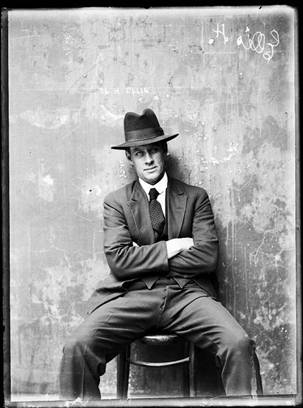
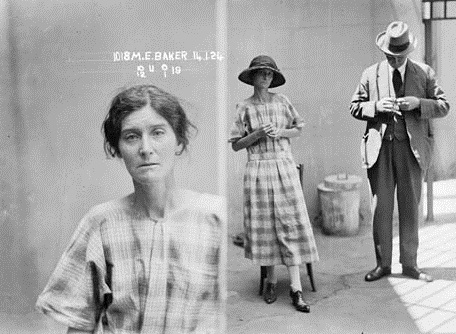
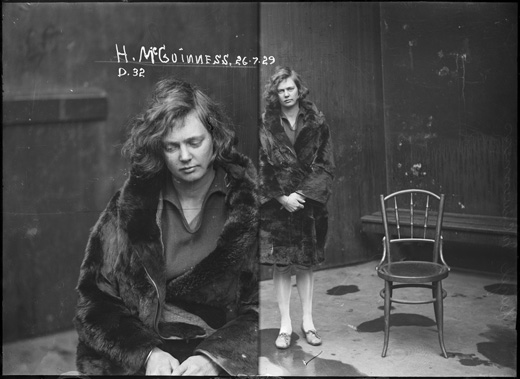
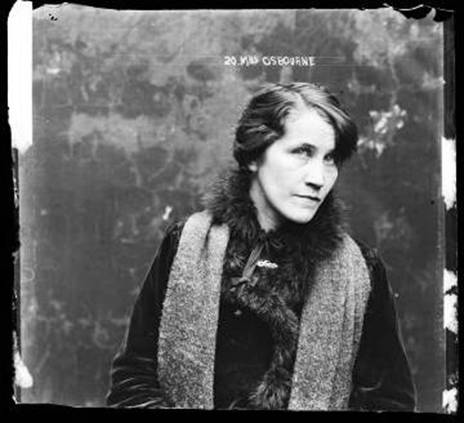
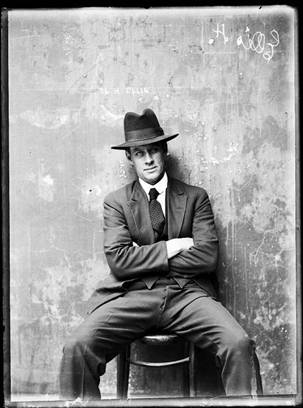
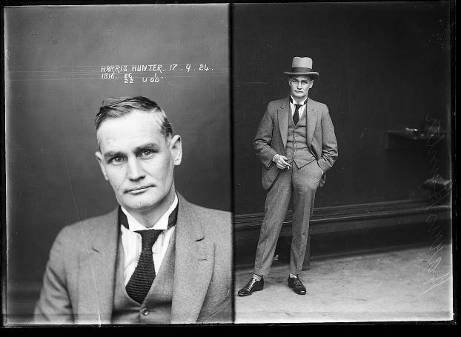
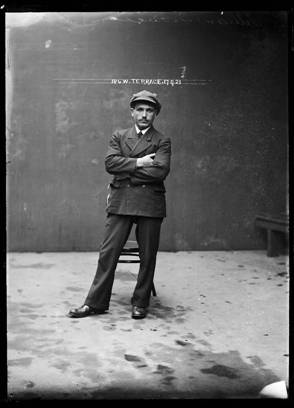
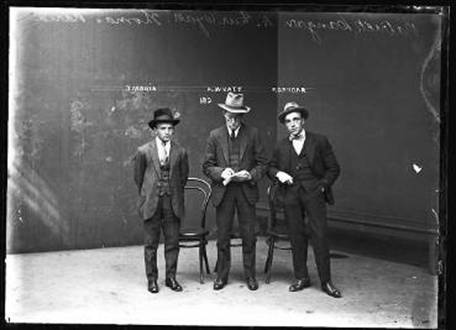
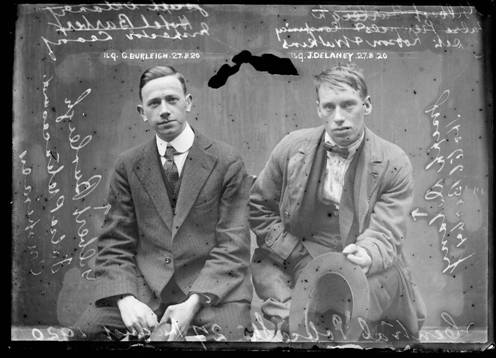
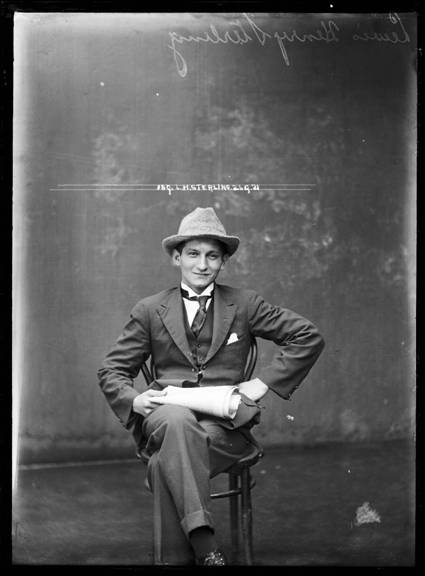
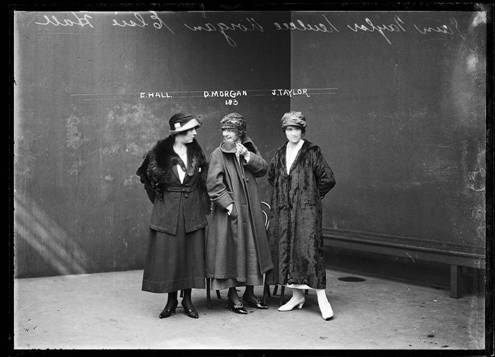
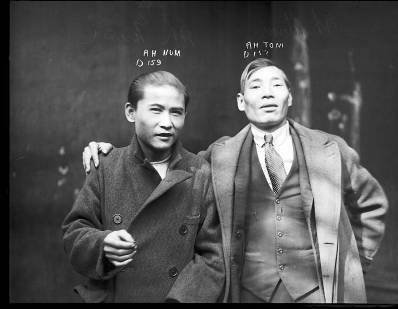
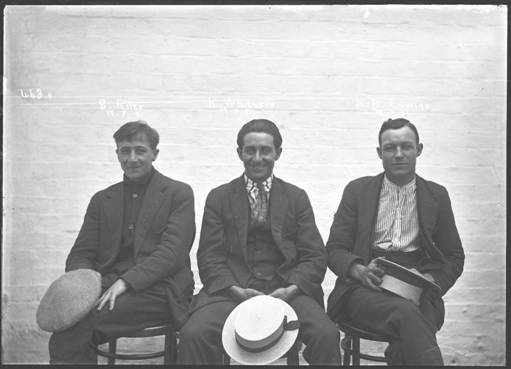
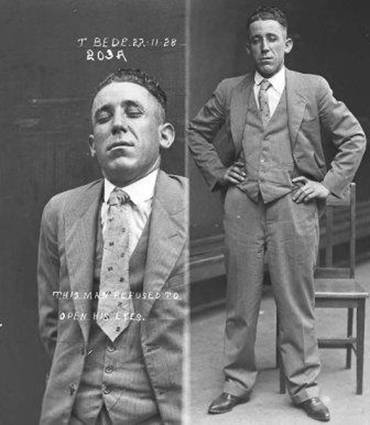
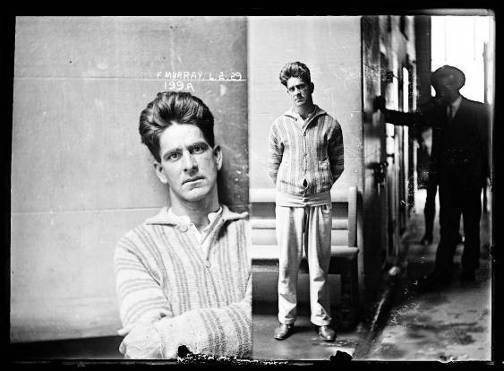
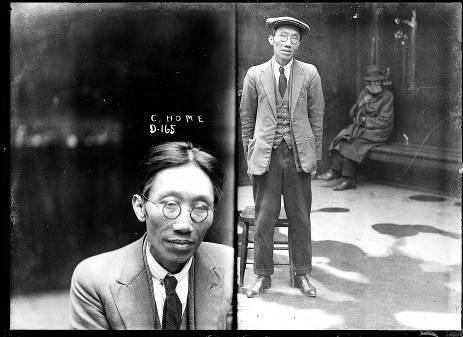
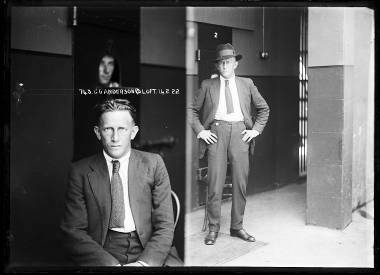
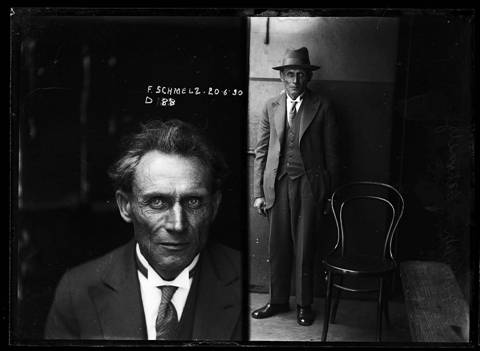
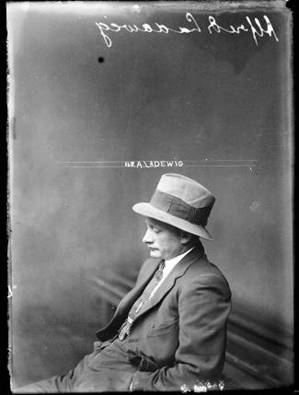
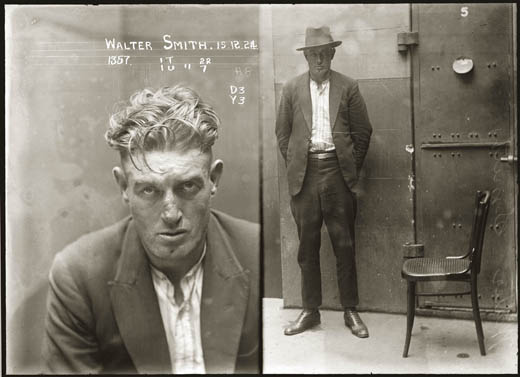
  • Picturing Naive-Disturbia: the Spectacular Loneliness of Australian Mug Shots

    JF Ptak Science Books   Quick Post

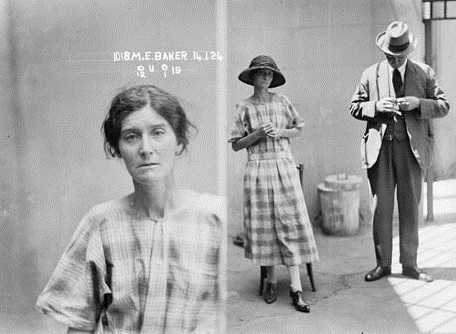
    For a thorough discussion of the series see the excellent article “Public eye, private eye: Sydney police mug shots, 1912-1930”, by Peter Doyle, in  Scan Journal (vol 2 number 3 December 2005)

      Australian mug shots

     Australian mug shots 1

    23

    11

    Aussie mug shot 2

     
    Aussie mug shot 2b

    Early-sydney-mug-shots-4

    4

     6

      Early-sydney-mug-shots-21

    10

    12

    13

    14


    Then there are photos like this, below, where the annotations become part of the art of the image:


    15


    16


    17


    18


    19


    20


    21


    22


    Early-sydney-mug-shots-11


    24

    .

    25


    26


    27


  • When 2-D LOVE is 3-D LUST: Picturing another Spatial Dimension is Easier if you are Homer Simpson

    JF Ptak Science Books   Post 15023-d521

    A note dragging together–against their will–the movie Hypercube, Homer Simpson, Marcel Duchamp, Jimmy  Neutron, Emile Jouffret, Filippo Marinetti, Paolo Uccello and Edwin Abbott.  Warning: this might not work.

    We saw a movie the other night, Cube 2, Hypercube, which I think is meant to be Cube2, but I honestly think that the title didn’t appear that way because not that many people (?!) would know how to “pronounce” the little superscript floaty “2”.  The movie was pretty interesting, telling the story of a group of people “imprisoned” in a large, sterile cube with a door on each face that opened into an identical cube, and on and on into a Borgesian infinity-hell.  At one point the people are theorizing on the nature of the Cube, winding up with someone saying that they might all be in a fourth spatial dimension. 

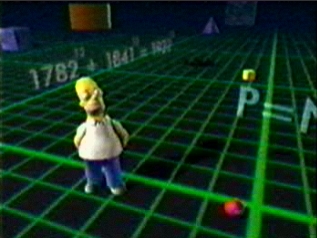
    3dHomer It brings up a pretty well-worn thought about visualizing a different dimension, and then it occurred to me that the only general-population folks who seemed to be most at ease with this idea were cartoon characters: and since I am a father of children, a Father of Children, I am very well familiar with recent cartoon history.  Homer Simpson, for example, slips from his two-dimensional world into what was supposed to a three dimensional world, and he seems perfectly comfortable.  (The equation in the background, 1782^12 + 1841^12 = 1922 ^12 is correct for the first nine digits, but not for the last thirty.  Plus, since the product of odds is odd, and the product of evens are even, the sum of even and odds is odd, so the answer must be wrong. But close.  And really, really good for little Homer.) Timmy Turner (Fairly Oddparents) and Jimmy Neutron (of the show bearing his name) switch worlds,one going 2-to-3 D and the other the other way ’round, with both being perfectly comfortable in their new space.

    3-d Of course the issue of imagining a three-dimensional shape in a two-dimensional world is pretty knotty if you are not having a cartoonist draw out your brain’s interpretations of the world.  The great classic of this is Edwin Abbott’s Flatland, an 1884 book about a two dimensional world of shapes that encounters a dot that grew concentrically and outwardly, a dot expanding and then contracting itself in a series of circles, morphing until it appeared as a new and revolutionary form rising from the plane of Flatland, evolving into a new thing, a Sphere.  The folks in Flatland had a hard time with it.

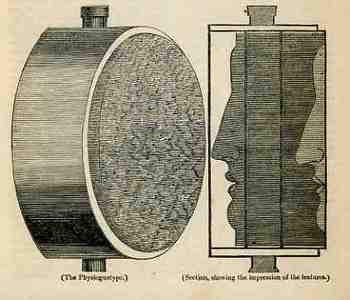
    Blogphysiog320Depicting a third dimension in a two-dimensional space is tough, the whole deal being rediscovered in perspective only relatively recently in the history of human thought, being only about 600+ years old. (In quasi order perspective is brought to the West by Cimabue, the Isaac Master, Giotto, Duccio, Maso, Avanzo, Lorenzetti, Donatello, Ghiberti, Fra Angelico, and so on, not the least of whom would include our beautiful Paolo Uccello.)  Giving real “flavor” to the extra dimension was still quite difficult, even in the 19th century.  In the “Spirit of Discovery” section of the British weekly magazine The Mirrour of Literature, Amusement, and Instruction for 22 October 1836 there is a short notice on the “physiognotype”, “a machine for taking casts, lately invented by a gentleman in Paris”.  We’re accustomed to these devices now as they’ve been for sale in toy shops for decades—but in 1836 it was a real breakthrough for making instantaneous three-dimensional models of small things.  In 1836 there really wasn’t any simple way of producing a direct, proportional model like this in 3-D except for encasing it in plaster and then casting from that mold.  Two-dimensional modeling was easier, and there were numerous devices constructed for this purpose as people pursued the still-hot rage of physiognomic forecasting, with simpler means (like shadow portraits) being hundreds of years earlier.  (Photography remember is still three years away from being announced and another few years from being sort o3-d519f accessible to middle-class folks.)
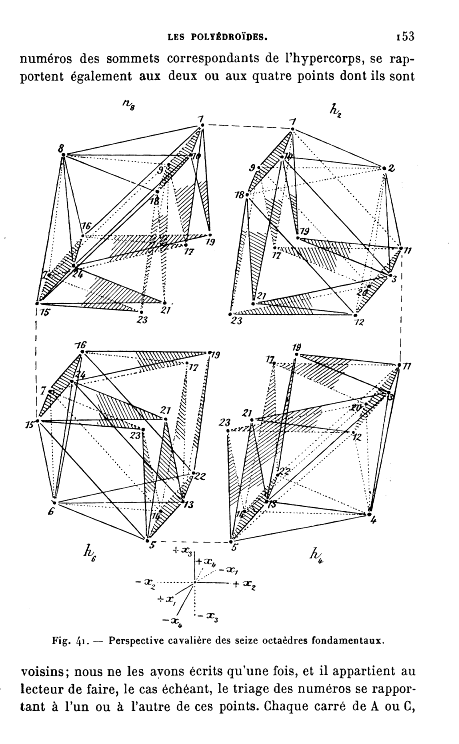
    Imaging the fourth dimension was more a product of mathematics than of art, with people like Emile Jouffret1 getting to it a little before Marinetti and Duchamp and the squirrely Picasso did. (Thinking on the fourth dimension goes back as far as Kant, at least, and the real work begins in the first half of the 19th century2.)

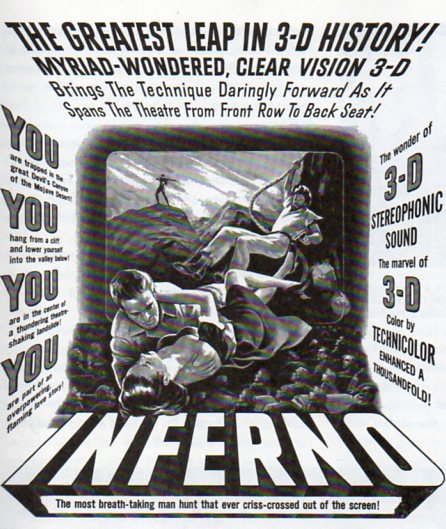
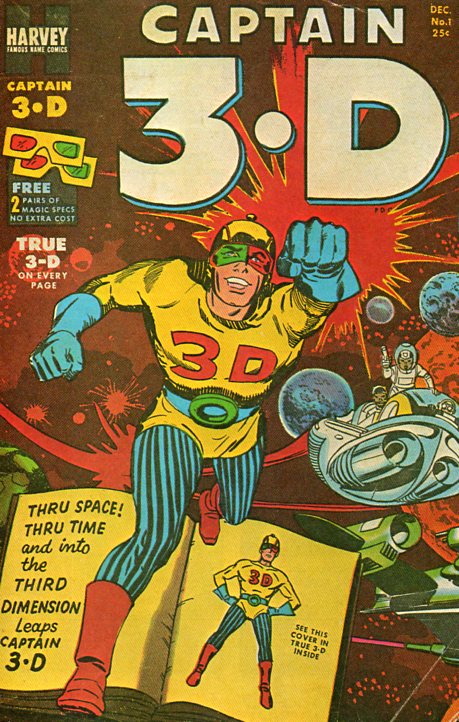
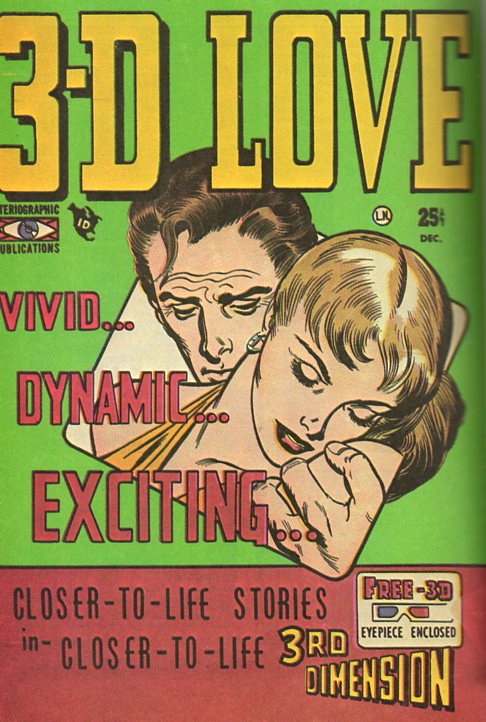
      But it seems as though the cartoon (like Homer, above) and comic book characters have a much easier time with this added-dimension issue, using it to full advantage without muss or fuss, and certainly without any philosophical commentary.  Their reach across the aisles of the 1952 Rexalls and other general merchandise emporia  with enough floor space for a revolving magazine 3-d520 stand was straight into the heart of the common reader, filling them with the hope/fear of their two-dimensional explorations into what they called their 3-D  3D  3.D  Three Dee world, selling “closer-to-life stories in closer-to-life 3rd Dimension”. 

    It seems that the same might be true for 3-D movies as well, the characters busting out into a new dimension (sometime fully aware of it) without a care or riddle, the main effect of finding the new spatial dimension sitting squarely in the minds of the observers, who are already in that dimension and reacting to somethingf with a surprising surprise of seeing a familiar thing in its proper context.

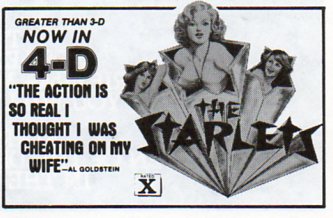
    I’d love to know what that fourth spatial dimension looks like, as promised by The Starlets…or maybe not.

    3-d524

    Notes:

    1. Jouffret, E.  Traite Elementaire de Geometrie a Quartre Dimensions et Introduction a la Geometrie a n-Dimensions. Paris:  Gauthier-Villars,  1903.  1st edition. ! 215pp. and   Jouffret. Melanges de Geometrie a Quatre Dimensions.   220pp. Paris:  Gauthier-Villars,  1906.  1st edition. (Perhaps one of the most classic works of the late 19th and early 20th c on imaging the fourth dimension–certainly well known to the Cubists and Futurists, I’m certain that it sparked any number of ideas in the art world.)

    2. The first major work arrives with Hermann Grassmann’s “Die Lineale Ausdehnungdlehre” (Theory of Linear Extensions) in 1844 (and the subsequent translations of the work as well as original work by Arthur Cayley); followed by Ludwig Shclafli (1814-1895) “Theorie der vier flachen….” (Theory of Continuous Manifolds, 1852 but not published until 1906), Riemann’s 1854 speech (which was not published until 1867 and which appeared translated by William Kingdom Clifford in Nature in 1873, G.F. Rodwells “On Space of Four Dimensions” (Nature, May 1873),  Dodgson/Carroll‘s  Through the Looking Glass (1872) deep references, Zollner “On Space of Four Dimensions”


  • The 47 Sins of Isaac Newton, as Recorded by Himself

    JF Ptak Science Books     Post 1498

    “Nabed Efyhik
    Wfnzo Cpmfke’”–Issac Newton, ca. 1660

    So begins this extraordinary work known as the Fitzwilliam Manuscript1:  Isaac Newton’s name, plus for words on two lines, which the Newton scholars suspect to be a key to a cipher.  It was purchased at a Sotheby auction by Maggs Brothers in 1936 for £180, and within the month found itself in the Fitzwilliam Museum.  What makes it fantastic–aside from having some mathematical/physical work by Sir Isaac in its 5,000 or so words–is the almost impossible inclusion of a list of what Newton could remember of the sins that he had committed.  He finds 47 transgressions within his memory.

    It seems to me that listing the sins of people is nearly as old as writing, since the  absolutely overwhelming aspect of that practice is describing sin in general or, of course, the sin of others.  Or the judicial end, the sins of people have been listed and judged many millions of times for billions (or whatever) of offenses.  And certainly the listing or provocation or announcement of sin has been endless fodder for entertainment in the forms of story telling, theatre, novels, and so on.  Then, too, there’s all of the religious indictment and beseeching for proclaiming sins for atonement. On the individual level for a living human, a famous person, it is extremely uncommon to find a highly personal listing like this, even whispered as they were into a notebook, Sir Isaac I am sure thinking as though this was almost as good as writing the sins in dust.  I wonder how he would feel, seeing people discussing them, like this? 

    This transcribed list comes from the fantastic Newton Project,2 site.

    Newton (1642-1727) writing in about 1662 (and about 20 years old), and who was at Cambridge for a few years already, just prior to what was perhaps his most astonishing period of creativity, (and with the time of the Plague, just a few years in the future):

    “Before Whitsunday 1662. 

    “[Note:  Whitsunday,  the Sunday of the feast of Whitsun (or “White Sunday”) or Pentecost int he Christian liturgical year, celebrated/observed seven weeks past Easter, the celebration too of summer, and the descent of the Holy Spirit on Christ’s disciples (Acts of the Apostles chap 2.) ALSO Newton at this point is 20 years old.]

    Vsing the word (God) openly
    Eating an apple at Thy house
    Making a feather while on Thy day
    Denying that I made it.
    Making a mousetrap on Thy day
    Contriving of the chimes on Thy day
    Squirting water on Thy day
    Making pies on Sunday night
    Swimming in a kimnel on Thy day
    Putting a pin in Iohn Keys hat on Thy day to pick him.
    Carelessly hearing and committing many sermons
    Refusing to go to the close at my mothers command.
    Threatning my father and mother Smith to burne them and the house over them
    Wishing death and hoping it to some
    Striking many
    Having uncleane thoughts words and actions and dreamese.
    Stealing cherry cobs from Eduard Storer
    Denying that I did so
    Denying a crossbow to my mother and grandmother though I knew of it
    Setting my heart on money learning pleasure more than Thee
    A relapse
    A relapse
    A breaking again of my covenant renued in the Lords Supper.
    Punching my sister
    Robbing my mothers box of plums and sugar
    Calling Dorothy Rose a jade
    Glutiny in my sickness.
    Peevishness with my mother.
    With my sister.
    Falling out with the servants
    Divers commissions of alle my duties
    Idle discourse on Thy day and at other times
    Not turning nearer to Thee for my affections
    Not living according to my belief
    Not loving Thee for Thy self.
    Not loving Thee for Thy goodness to us
    Not desiring Thy ordinances
    Not long {longing} for Thee in {illeg}
    Fearing man above Thee
    Vsing unlawful means to bring us out of distresses
    Caring for worldly things more than God
    Not craving a blessing from God on our honest endeavors.
    Missing chapel.
    Beating Arthur Storer.
    Peevishness at Master Clarks for a piece of bread and butter.
    Striving to cheat with a brass halfe crowne.
    Twisting a cord on Sunday morning
    Reading the history of the Christian champions on Sunday

    Since Whitsunday 1662

    Glutony
    Glutony
    Vsing Wilfords towel to spare my own
    Negligence at the chapel.
    Sermons at Saint Marys (4)
    Lying about a louse
    Denying my chamberfellow of the knowledge of him that took him for a  sot.
    Neglecting  to pray 3
    Helping Pettit to make his water watch at 12 of the clock on Saturday night

    Notes:

    1. From the website of the Newton Project (described following): “Miscellaneous notebook containing Newton’s accounts for 1665-9, a series of increasingly complicated mathematical problems, and a highly revealing personal confession. At Whitsun 1662, Newton compiled a list of all the 47 sins he could remember having committed in his life, from stealing cherries to “threatning my [step]father and mother … to burne them and the house over them”. The accounts section charts the beginning of his study of alchemy in 1669, with purchases of books, materials and a furnace to equip the makeshift laboratory he set up in the grounds of Trinity College.”

    2. The Newton Project is the work of  Professor Rob Iliffe  (Director, AHRC Newton Papers Project) and Scott Mandelbrote (Fellow & Perne librarian, Peterhouse, Cambridge). 


  • Searching for Structure: Triangles and Trees

    JF Ptak Science Books  Post 1494

    Structure512

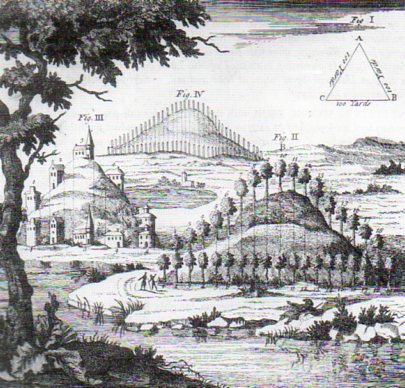
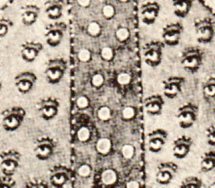
    It was this lovely engraving from Richard Bradley’s A General Treatise of  Husbandry and Gardening..., printed in London in 1721/2, that brought up the issue of structure in creation, and how that issue was in one way approached by the new tool in the scientific toolchest, the microscope. 

    “…the Contrivances of the Almighty Creator is as visible in the meanest Insect of Plant, as in the greatest Leviathan or the strongest Oak.  To touch upon all the Wonders this Instrument shews us would be infinite”–William Molyneux, on the microscope, in his A Treatise of Dioptricks in Two Parts (1692, quotation fro the second edition of 1709 via Marjorie Nicholson’s Science and  Imagination, Cornell, 1956.

    The question that the microscope—newly introduced and popularized by Robert Hooke in 1665 and Anton van Leeuwenhoek in 1674–was so able to address at this time was the question of the structure of things, and whether the Almighty Creator allowed for unrestrained creativeness or if the cosmos was subject to patterns and forms.  The microscope was so tremendously nimble that it allowed its observers the luxury of finding “correct” answers on either/both sides of the issue, that arguments could be well made and sustained for variety and regularity. But of course all found the reason for either end of the argument deeply seated in the e hands of god, as seen in the lovely quote below by the great early microscopical popularizer, Henry Baker1. 

    But this is just the tiniest bit of a nod at the question of structure in the history of science, a search for the relationships between, well, things small and large:  atomic, molecular, cellular, organism, population, ecosystem,solar system, universe.  The issue of structure may be the only issue–perhaps if you were made to select one question to have answered, automatically, an answer for everything, it might be this issue of how things stand in relations to one another.

    Which gets us to this 1721 engraving of a tree-covered hill, following the designs of a human creator, a re-animator of the natural landscape according to a theory of beauty, part of which hangs in the form of a triangle  in the right-hand upper corner.  A three-sided strategy of the relationships in nature, provided by a human vision. A very small  appreciation of an attempt to recognize the relationships between things, and in this case, the beauty of trees and hills. 

    Notes:

    1.  “The first Part of this Treatise discovers in the Particles of Matter composing Salts and saline Substances, Properties whose amazing Effects would surpass all human Belief or Conception, were we not convinced of their Truth by the strongest ocular Demonstration. That beautiful Order in which they arrange themselves and come together under the Eye, after being separated and set at Liberty by Dissolution, is here described and composed but one kind of figure, however simple, with Constancy and Regularity, we should declare it wonderful: What must we then fay, when we see every Species working as it were on a different Plan, producing Cubes, Rhombs, Pyramids, Pentagons, Hexagons, Octagons, or some other curious Figures peculiar to itself; or composing a Variety of Ramifications, Lines, and Angles, with a greater Mathematical Exactness than the most skilful Hand could . draw them?”

    “Sensible of my own Ignorance, I pretend not to account how this is done: all I know is, that Chance or Accident cannot possibly produce Constancy and Order, nor inert Matter give Activity and Direction to itself. When therefore these Particles of Salts are seen to move in Rank and File, obedient to unalterable Laws, and compose regular and determined Figures, we must recur to that Almighty Wisdom and Power which planned out the System of Nature, directs the Courses of the Heavens and governs the whole Universe.”  — Original, shorter quote of Henry Baker in his Employment of the Microscope (1753) found in Nicholson’s book; the above, longer version is from the 1764 (and second) edition, found here.


  • An Image Addition to a Series of Posts on the Antiquarian Publication of Artwork by Children

    JF Ptak Science Books   Quick Post

    Part of this blog’s series on The Antiquarian Publication of Children’s Artwork

    Continuing an earlier post on the Great Rarity and Sublimity of Antiquarian Artwork by Children

    I have found another small bit to add to the few posts I’ve made on this blog concerning the wide, vacant spaces of antiquarian publications of children’s artwork.  Its a small bit, but every bit is very difficult to come by:

    Childrens art507   Childrens art508


    I think that I can safely say that artwork by children does not make very many appearances in Western art prior to the 20th century–published images just don’t appear.  Nor do the originals–considering the ephemeral nature of the effort at art by children, their work just don’t seem to survive.  Some of that reason–particularly in America–was the scarcity of materials for kids to produce art with: paper was not inexpensive, and neither brushes and paints.  Crayons, invented for chubby and reachy fingers, were not invented for the mass market until 1903.  (Crayola sold eight crayons in a box for a nickel.  The colors?  Black, brown, blue, red, purple, orange, yellow, and green.)   Then of course the artwork would have to be saved, somehow, for generations.  As much as it would be fascinating to find artwork done at age four by your great-great grandparents, it would have to survive the cleansing tendencies of four generations of clean-up.  End result:  there’s just not that much antiquarian chldrens’ art floating around…

    (Continue reading here.)

    ·Posted by :

    ·in:

    — — —

  • Nazi Propaganda on Propaganda: on British “Atrocity Propaganda” (1938/9)

    JF Ptak Science Books   Post 1490

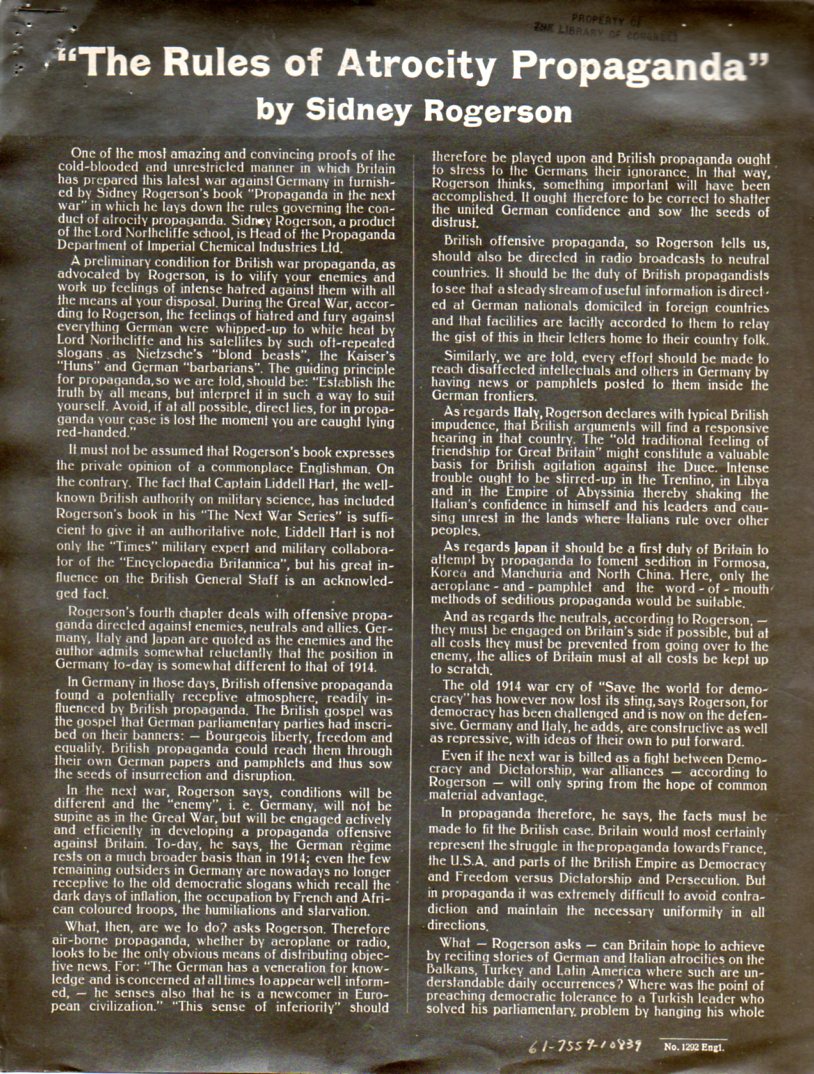
    As a small cog in the machinery of the Nazi Big Lie, this short sheet (supposedly written by a ” Theodore Kesselmeier”1), outlines a campaign of British anti-Nazi psychological warfare, and was written around 1938/9.  It is written in a book review format whose aim was the 1938 publication by Sidney Rogerson2,  Propaganda in the Next War, which was an alert (described as “brilliant” by John A. Pollard in The Public Opinion Quarterly for Autumn 1945) to the British government to establish central coordinating offices for information and communication for what the author felt to be the impending war with Germany.  In many ways Rogerson was responding to an enormous flood of information coming out of Germany about its own impending future, from the election and seizure-of-power by Adolf Hitler, to books like Ewald Barnse Raum und Volk im Welkriege (translated into Germany Prepares for War) of 1933, and on and on, a growing high tide that was without end. (Even from the most base popular study of Germany’s desires, for example, looking at every issue of the Illustriete Zeitung (Leipzig) from 1933 to 1939 as I have done, it is overwhelmingly obvious that Germany was preparing for the next war.  ThNazi propagandae case is made constantly and boldly in the magazine, which served in a way as Germany’s version of LIFE magazine.) [This item is available for purchase through our blog bookstore, here.]

    But the “reviewer” finds  the Rogerson work insulting and militaristic, hateful; an attack upon Germany.  He/they write(s) that the book is an offense, and part of an effort of  “the cold-blooded and unrestricted manner in which Britain has prepared this latest war against Germany”.  This part is odd because even at this late date, and given what the knew about the German war aims, Great Britain had done very little about preparing for war even until Munich. 

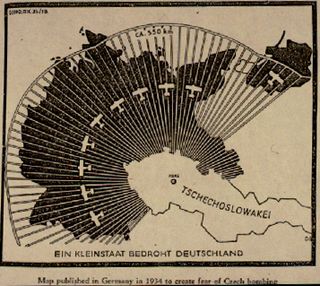
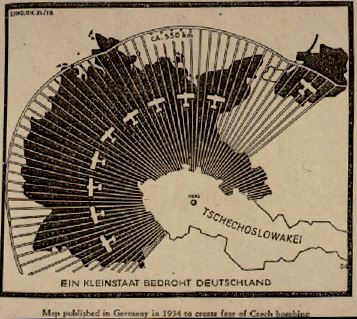
      I have aNazi prop number of these propagandistic pieces that came out of Germany at this time, some of which have been written about on this blog, and it seems no surprise now to see how many of them paint Germany as a victim of the war aims of the countries nearby:  Poland and Czechoslovakia were both presented as late as 1938 as having designs on Germany. This is just one of many examples of Nazi propaganda on propaganda, issues of lies within lies to the secret house of even-more-inner lies.  For example, this incredible map showing the Czech threat to Germany, above [source] and the shrinking  pamphlet, left [source].


               Rogerson496


    [page 2 is in the “continued reading” section, below.]

    Notes:

    1.  I suspect that “Kesselmeier” was the nom de plume of a section of writers laboring away in the dream factory of the psych-ops part of the Nazi war machinery.  It is much easier to produce reports when you have an entire group of people working on the project without need for the benefit of proof–or, for that matter–of truth. 

    2. Rogerson’s entry in Who’s Who:  “Publicity and Public Relations Consultant and author. Born 22nd of October 1894. Son of the Reverend S. Rogerson. B.A. in Modern History 1916; Served in the European War;

    ·Posted by :

    ·in:

    — — —

  • Strange Things in the Sky Department: the Sky-borne Seat of All Wisdom in the 12th century

    JF Ptak Science Books   Post 1486

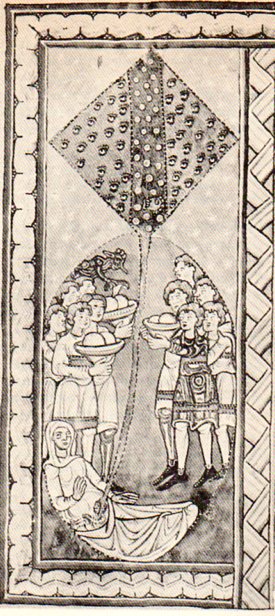
    Hildegard of Bingen (ca. 1098-1179) was a polymathic religious visionary1, composer and writer who was a well-know intellectual whose work attracted the attention of people at all levels, not the least of which were several popes  In one version of the manuscript of her 150,000-word work, Scivias (Scito vias Domini, or “Know the Ways of the Lord” ) we find the following illumination, which is basically an image of the object that contains the nameless stuff of the human soul:

    Sky strange hildegard492
    The image above—from the Wiesbaden manuscript and unfortunately only in a black-and-white, and found in Charles Singer’s From Magic to Science (1928)2–shows Hildegard’s vision of the soul entering the body. (There’s a wide range of opinion concerning how much influence Hildegard had on these images—some say that she sketched out the outlines, or directed the illuminator, or had some sort of hand in the construction of the image, all with varying levels of involvement.3)

    Sky strange hildegard493

    It is an extraordinary thing, trying to represent what gives the human-ness to people as seen from a 12th-century perspective, and in Hildegard’s version/vision it is the soul, the very essence of the birth and death cycle of human nature.  It is resident as we see within a special place in the sky, the “the wisdom of god” (Singer page 226), and it passes from the vault of heaven into the fetus while still within the mother’s womb.  It is in this square, evidently, that the essential matter of the creator can be found, and within that structure can be seen the essence of the stuff of human nature that is about to pass into the developing fetus through the tube-like connection. As Singer writes, quoting (loosely?) from the manuscript: “down this [the tube] there passes into the child a bright object, described variously as ‘spherical’ and as ‘shapeless’ which ‘illuminates the whole body’ and becomes or developes into the soul.” (Singer, p. 226).

    In the frontispiece to another ms of Scivias, we see Hildegard herself sitting and making a sketch on a wax tablet (a sort of Medieval chapbook, or hornbook, or slate/charcoal sketchpad that could be reused), showing that the images she created were the product of a higher source, of light from another metaphoric vault:

    Strange sky--hildegard

    Notes

    1. Hildegard said that she had these vision,s from a very early age, beginning at about 3.

    2. This manuscript was removed from Wiesbaden during WWII and “sent to Dresden for safekeeping”, where it subsequently “disappeared”. “Destroyed” is more like it, as Dresden of course was the scene of an enormous firebombing campaign in the last days of the German involvement of WWII. There are still hopes that the ms lives somewhere in someone’s grandfather’s attic, perhaps taken in the third week of February 1945 as war booty, and then forgotten. “You guys burnt the place down, turned it into a single column of flame. More people died there in the firestorm, in that one big flame, than died in Hiroshima and Nagasaki combined.” –Kurt Vonnegut, Jr

    3. Historian of science Charles Singer and medical anomaly writer Oliver Sacks have both made strong cases for Hildegard to have been a migraine sufferer, though they do explicitly state that given that as the case it does not necessarily affect the vision that she had.

    As found in the Wikiu article on Scivias:” Some authors, such as Charles Singer, have suggested that the characteristics of the descriptions of the visions and the illustrations, such as bright lights and auras, imply they may have been caused by scintillating scotoma, a migraine condition.[25] Oliver Sacks, in his book Migraine, called her visions “indisputably migrainous,”[26] but stated that this does not invalidate her visions, because it is what one does with a psychological condition that is important.[27] The resemblance of the illuminations to typical symptoms of migraine attacks, especially in cases where it is not precisely described in the text, is one of the stronger arguments that Hildegard herself was directly involved in their creation.[28]

    It has also been suggested that the visions may have been due to hallucinogenic components present in ergot, common in that area of the Rhineland, at certain times of the year.[29]”

    The contents of Scivitas:


  • Famous Folks Leaning

    JF Ptak Science Books Quick Post

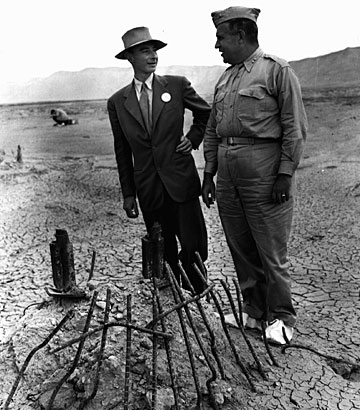
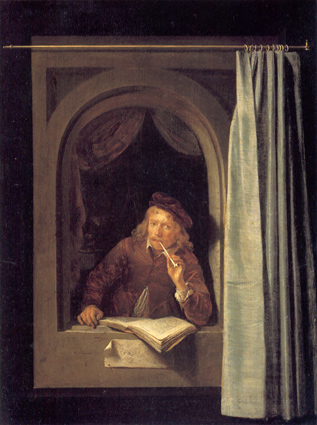
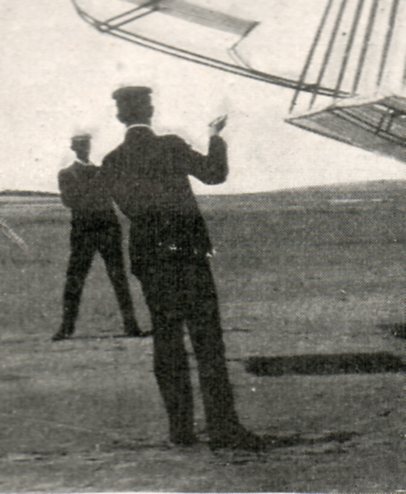
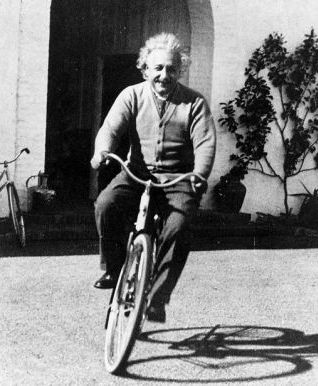
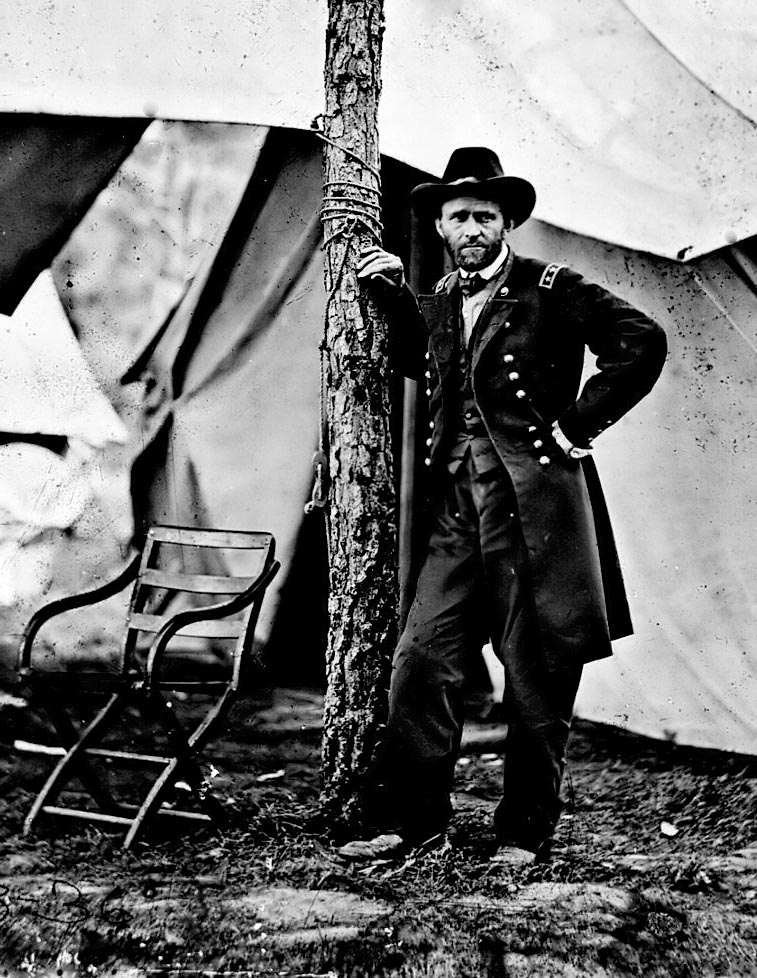
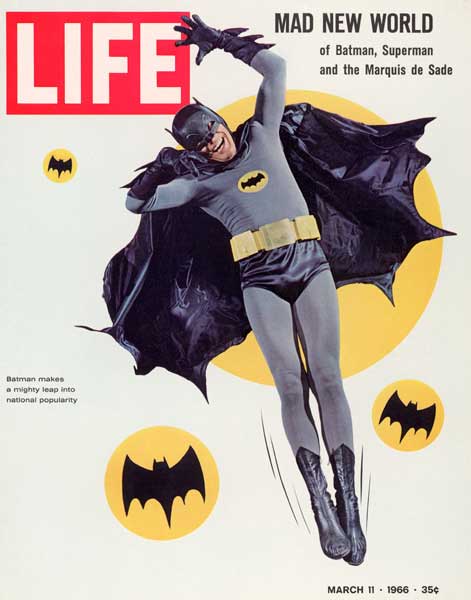
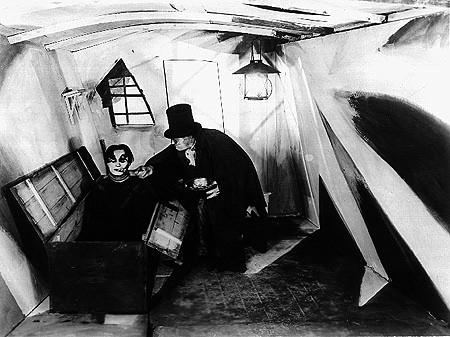
    Leaning, Oppenheimer I’m going to have to keep this category open while other famous leaners pop into my head.  For right now, presently, right at this moment, I’ve only a few,  but I’ve managed to break the leaning category into two segments:   leaning, without aid; leaning, with aid (or leaning against or on something).  Also for completely arbitrary reasons I’m excluding entire genres of people who must necessarily find themselves  leaning for one reason or another: speed skaters, sailboat racers, acrobats, gymnasts, yoga folks, speed bike racers, rollerderbyists, and people leaning away from the dead or some other font of pity, and so on. No Medieval or Renaissance anatomist drones “leaning” into their cadavers with sharp tools (as in Mondino’s directing a dissection from the late 15th century), or the endless peasants leaning into their farm tools as they work or catch a quick nap in the images creLeaner douated by the Breughels, nor any series of Adams and Eves leaning hard into their bleak future after having accepted the bait that doomed humanity, leaning first towards and then away from the Great Fall.   I just want relatively unexplained leaning, or leaning for the fun of it.  And of course no leaning Towers of Pisa–and no lounging, as in the image of Man in the creation of man scene in the Sistene Chapel.  And  no half-body leaning, as with say the images of all of those portraits that were so beautifully done by Gerrit Dou, featuring his subjects playing with trompe l’oeil and perspective, leaning a bit out of windows, outwards towards the viewer, or kids blowing bubbles leaning against open windowsill (as in this from Frans van Mieris)  or Jean-Baptiste-Siméon Chardin, The Soap Bubble (1739).

    I’m just looking for people leaning, for no good reason.  (First up was Robert Oppenheimer leaning away from the not-understood General Leslie Groves.)

    Wilbur (?) Wright, 1901:

      Wright brother full 1901490
    Albert Einstein, California, 1935:

    Leaning--einstein

    General Ulysses Grant, 1863:

      Leaning ulysses
    Batman, 1966 (but seriously, Heath Ledger’s Joker wound up doing a tremendous amount of leading in that movie):

    Leaning batman

    Leaning joker

    And speaking of the leaning Joker, there’s always Dr. Caligari, who lives in a leaning world:

    Leaning caligari

    I’d love to hear from others who might have suggestions for other leaning people!


  • The Other Miracles of 1905–Winsor McCay, Little Nemo and Subversive Dreamscapes

    JF Ptak Science Books  Post 1453

    Okay, to be fair no one has ever had a year like Einstein’s annus mirabilis of 19051 perhaps no one has really ever come close–he defines the incomprehensibly high achievement for a single (less than) 365-day time span. There was other stuff going on in 1905–Ernest Starling2 introduced the term “hormone”, Vagn Ekman produced a beautiful paper on the mathematics of ice drift in the Arctic Sea and the ocean’s responses to different sorts of winds, Eduard Zirn performed the first cornea transplant, Ejnar Hertzprung3 published his famous diagrams, Henry Gruppy empirically established the manner of plant dispersal in the Pacific region4, Maurice Frechet’s groundbreaking work in topology, and Henrui Poincare and Howrd Ricketts and Oswald Veblen and so on. And the Wasserman test.  It was a pretty bountiful year–and this was just in the sciences and maths.

    And then there was the Russian Revolution (of 1905).

    But also back there in 1905 Winsor McCay was having a terrific year–this was the man who revolutionized the comic strip.  McKay may have been the Einstein of his field, and his work I think may still be the standard bearer for high excellence and creativity.  It was in 1905 that he began his Dreams of a Rarebit Fiend and also the crowning masterpiece of the medium, Little Nemo in Slumberland.  Nothing had really quite been seen like that before, two newspaper strips that were filled with vision and elegance and weirdness and the bizarre, beautiful stories illustrated on one sheet of paper, of great imagination and a wide stretch of subversiveness. They so captivated the readers of the time that McCay went off on illustrative lecture circuits, found movie (in their relative infancy) versions of his work, and performed in vaudeville venues along with Charlie Chaplin and W.C. Fields.

    And then he created the animated cartoon. 

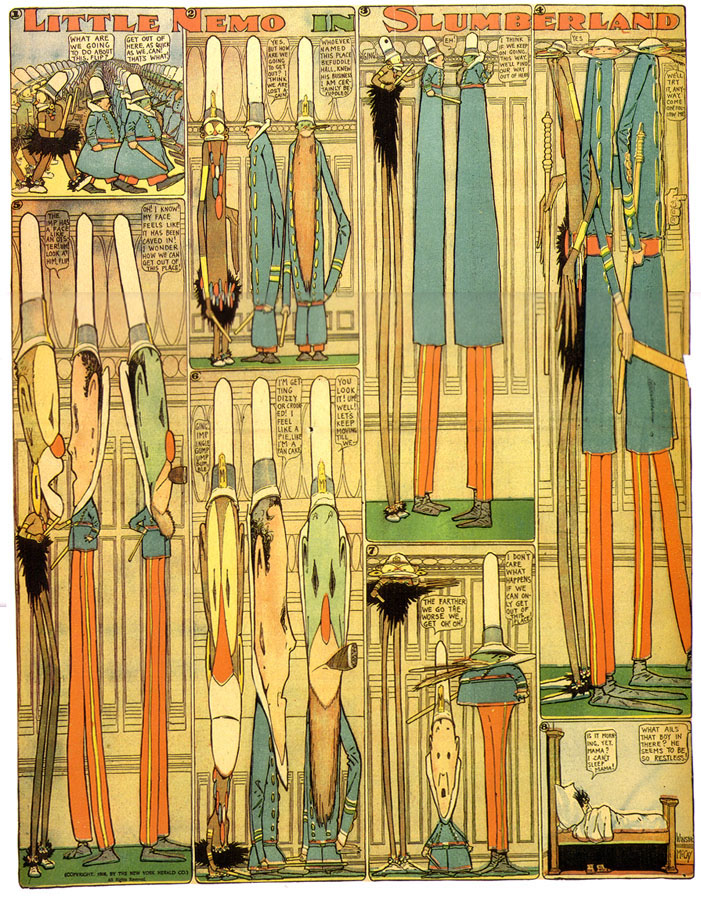
    Here’s a page of Little Nemo:

    Little_nemo_1908
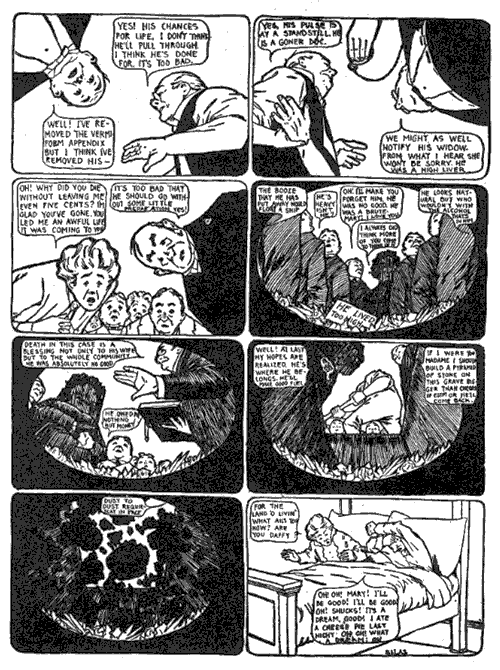
    And another of the Rarebit:

    Rarebit_fiend
    I guess you can get the picture of what McCay brought to the world–examples of his work are all over the web, and have been published in eight (?) volumes of reprints.  This was a particularly sumptuous time for this sort of story telling, but this is not the place to talk about anyone else, not really. (Okay–one very high talent is the seldom heard Rodolphe Topffer, but that’s another story.)

    And a very early Rarebit movie (which takes a little while to get moving):

    And another, this an animated cartoon from 1921–it doesn’t have anything to do with McCay in 1905, I just like its motion, and also because McCay is the father of the animated cartoon:

    Can anyone say “Up”?

    And then of course there’s Gertie, the first animated cartoon:


    Notes:

    1.”Über einen die Erzeugung und Verwandlung des Lichtes betreffenden heuristischen Gesichtspunkt” Annalen der Physik 17: 132–148;  “Über die von der molekularkinetischen Theorie der Wärme geforderte Bewegung von in ruhenden Flüssigkeiten suspendierten Teilchen” Annalen der Physik 17: 549–560; Zur Elektrodynamik bewegter Körper” Annalen der Physik 17: 891–921; “Ist die Trägheit eines Körpers von seinem Energieinhalt abhängig?” Annalen der Physik 18: 639–641.

    2.  “On the Chemical Correlation of the Functins of the Body”, not only defining the term but clarifying the hormone’s function.

    3. Hertzsprung, “Zur Strahlung der Sterne”, with another paper of the same name later in 1907. 

    4.  Observations of a Naturalist in the Pacific Between 1896 and 1899, the second volume, entitled Plant Dispersal, is where (surprise!) he discusses plant dispersal.  But the really cool thing here is that he figured out that there were a lot of seeds that floated here and there in/on the Pacific, going place to place, finding out how long they could stay afloat, and so on.  It was fantastic!


    ·Posted by :

    ·in:

    — — —