A Daily History of Holes, Dots, Lines, Science, History, Math, Physics, Art, the Unintentional Absurd, Architecture, Maps, Data Visualization, Blank and Missing Things, and so on. |1.6 million words, 7500 images, 4.9 million hits| Press & appearances in The Times, Le Figaro, Mensa, The Economist, The Guardian, Discovery News, Slate, Le Monde, Sci American Blogs, Le Pont, and many othr places… 5000+ total posts since 2008.

Category: Perception

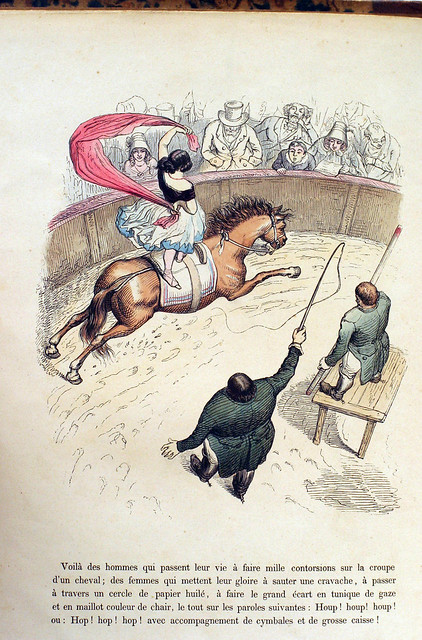
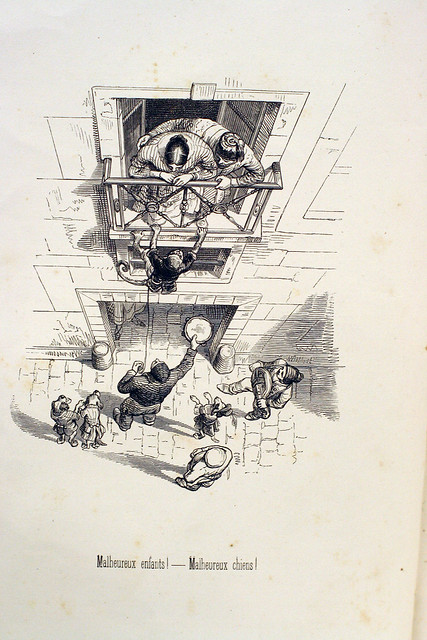
  • Unusual Antiquarian Perspective–Directly Above and Oblique. J.J. Grandville, 1844

    JF Ptak Science Books   Quick Post

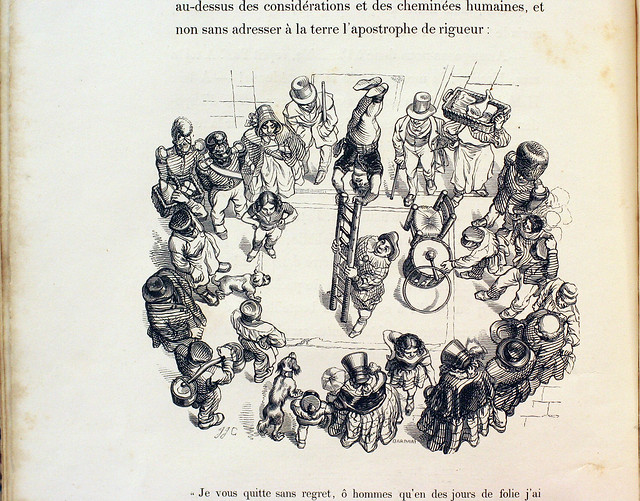
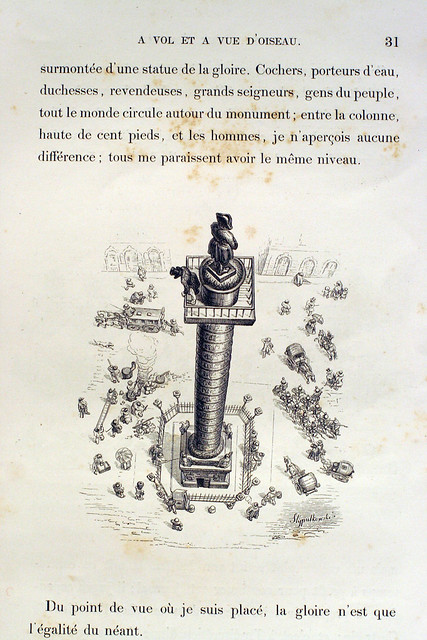
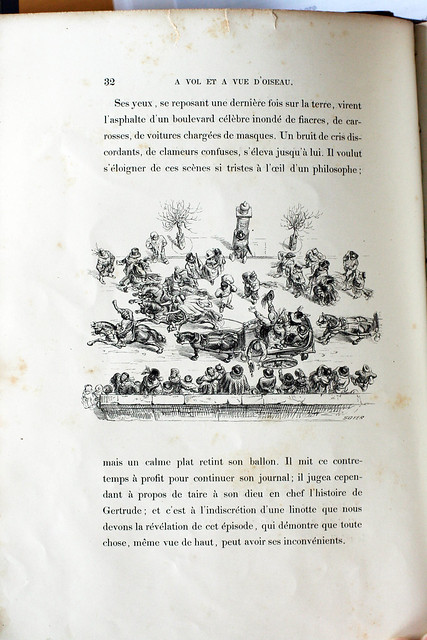
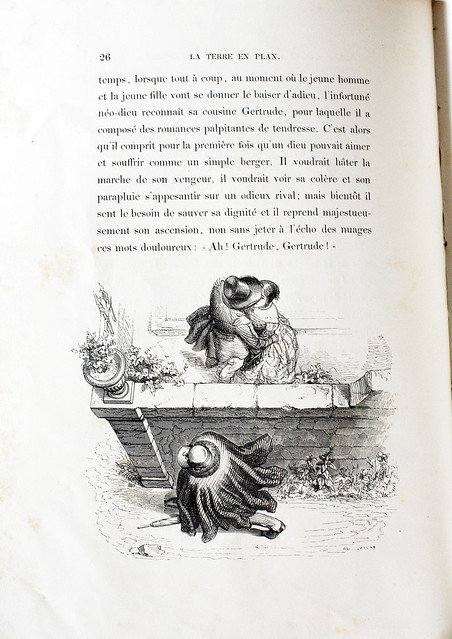
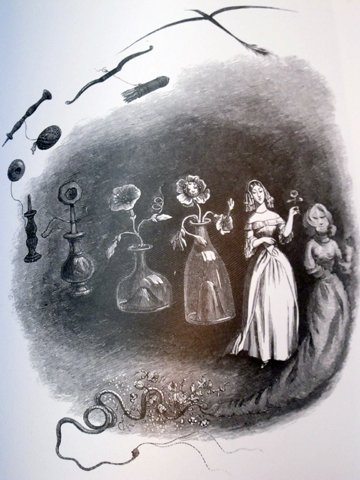
    This is the fourth installment in as many days (starting here) on the artwork of the great proto-Surrealist, J.J. Grandville.  Today’s quick post (again from his Un Autre Monde, 1844) isn’t so much fantastical as the other work pictured here, but it is subtly unusual.  It is my experience in looking at prints and other artwork for the last 30 years or so that antiquarian images looking straight and directly down froma  height are very unusual–so too for the next thing closest to it, looking down from a slightly oblique angle.  Grandville does this often in his work, and I think gives another insight into a brain that was just seeing (most) things differently.  [Here’s a link for some posts on looking straight down, here and here, for example.]

    photo

    photo
    photo
    photo
    photo
    photo


  • The Ship of Fools, In Praise of Folly, and Intelligent Dischord: Brant, Erasmus, and Geiler, 1497-1515

    JF Ptak Science Books  Post 1788
    Bloggeilership186
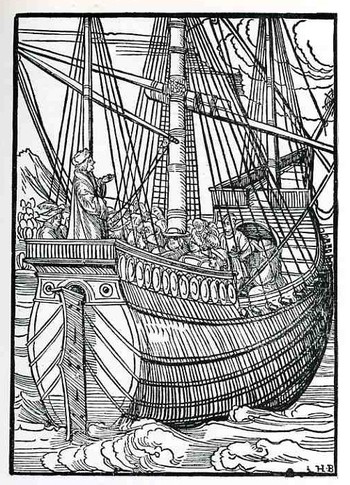
    Johann Geiler von Kayserberg’s Navicula Penitentie (Augsurg, printed by Johann Ottmar, and printed in 1511) is a remarkable book in many ways, but what I’m concerned with here is the fantastic woodcut illustrating the title page.  The book itself is a collection of penitential sermons against moral corruption in his Strassburg community—the sermons won him wide respect and some considerable fame as an orator, writer and theologian—but it is the woodcut of the ship (I’m sorry to reveal) that distracts me more.  It is evidently the earliest depiction of a fully-rigged and outfitted ship, with great and accurate detail, far beyond what had been published in the previous 50 or so years of movable type printing.  Presumably what we are seeing is Geiler preaching to ship full of what seem to be clerical/clergy folks rather than sailor—clearly Geiler is approaching the upper class here in the ship and not the working man. 

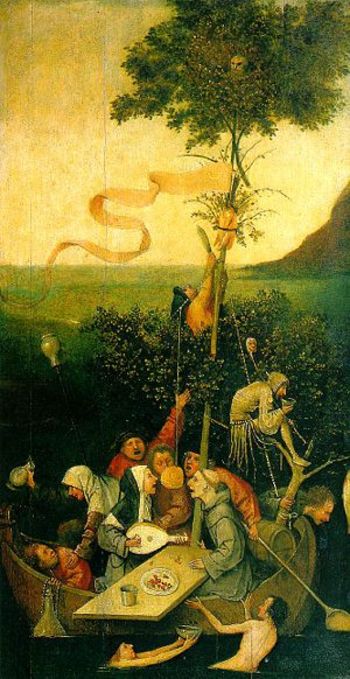
    I think that Geiler had Sebastian Brant’s 1494 Ship of Fools in mind when the great Hans Burgkmair (the “H.B” who signed this work of art) produced this seafaring image for him.  Also Geiler’s publication date of 1511 is shared with Erasmus’ fantastically influential (and leading-to-the-Protestant-Reformation) book The Praise of Folly. (It was written very quickly, in about a week, and centered around conversations he had with his good friend Sir Thomas More; the Latin title of the book is a bit of a wink and a nod to More, Moriae Encomium.)  The Fool, the Feast of the Fool, the Feast of the Beasts and so on were all very old institutions that allowed and tolerated the caricature and criticism of church and power structure officials—and this at a time in the Middle ages and Renaissance when such free speech by non-Fool types was strictly unacceptable.
    Brant_books
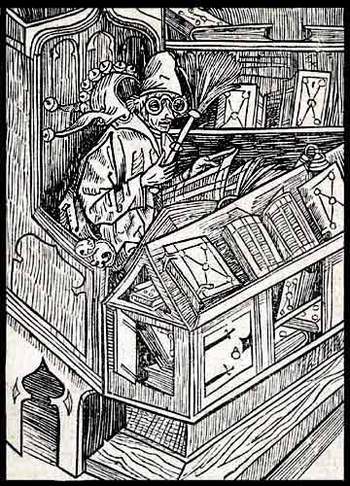
    In the same work by Brant (“Of Useless Books”, thankfully found with all 117 of the images from the work at the University of Houston library  ) we find the following image of the sage Fool.shorn of his headdress, sitting in the library, wearing glasses, and reading, surrounded by disheveled books that were clearly being used and consumed by the supposed clown. To me it shows the substantiation of the wisdom of the free-thought folly speech of the Fool, who, although clothed ridiculously, was a thoughtful, careful, well-read individual whose message much resembled the messenger. 

    The images in Brant’s book are so singular and many of the titles so captivating I’ve included many from the list from Houston’s table of contents, below: 


    Of Useless Books the Haintz-Nar-Meister
    Of Beggars Albrecht Dürer
    Of Good Counselors the Haintz-Nar-Meister
    Of Bad Women Albrecht Dürer
    Of Greed the Gnad-Her-Meister
    Power of Fatuity Artist unknown
    Of Newfangled Ways the Haintz-Nar-Meister
    Of Star-Gazing Albrecht Dürer
    Of Old Fools the Haintz-Nar-Meister
    Wanting to Know All Regions the Gnad-Her-Meister
    Of Training Children Albrecht Dürer
    Not Wanting to be a Fool Albrecht Dürer
    Of Trouble-Making Albrecht Dürer
    Not Understanding Raillery Albrecht Dürer
    Not Following Good Advice Albrecht Dürer
    Wanting to Escape Consequences of Evil Albrecht Dürer
    Of Bad Manners Artist unknown
    Not Providing in Advance Albrecht Dürer 
    Of True Frienship Albrecht Dürer
    Ship_of_fools_bosh_2
    Quarreling and Going to Court Albrecht Dürer
    Disdain of the Holy Scriptures the Gnad-Her-Meister
    Of Crude Fools Albrecht Dürer 12 Of Hasty Fools Artist unknown
    Of Becoming a Cleric Albrecht Dürer
    Of Wooing Albrecht Dürer
    Of Great Boasting the Haintz-Nar-Meister
    Of Arrogance Toward God Albrecht Dürer
    Of Gamblers the Haintz-Nar-Meister
    Of Foolish Plans Albrecht Dürer
    Of Oppressed Fools Albrecht Dürer
    Of Gluttony and Rebelling Albrecht Dürer
    Highwaymen and Lawyers Albrecht Dürer
    Of Useless Death the Haintz-Nar-Meister
    Foolish Messengers Artist unknown
    Of Serving Two Masters the Haintz-Nar-Meister
    Of Cooks and Waiters Albrecht Dürer
    Of Much Babbling the Haintz-Nar-Meister
    Of Peasants’ Squandering Albrecht Dürer 2
    Of Finding Treasure Albrecht Dürer 7
    Contempt of poverty Artist unknown
    Not Practicing What You Preach the Haintz-Nar-Meister
    Of Persisting in Good Albrecht Dürer
    The Teaching of Wisdom Albrecht Dürer
    Not Preparing For Death Albrecht Dürer
    Of Overestimating One’s Fortune
    Of Too Much Care the Haintz-Nar-Meister r
    Of God’s Plagues and Punishments Albrecht Dürer
    Of Unnecessary Wishes the Haintz-Nar-Meister
    Of Foolish Trading Albrecht Dürer
    Of Useless Studying Albrecht Dürer
    Of Jabbering in the Choir Albrecht Dürer
    He Who Judges Others Albrecht Dürer
    Of Overbearing Pride Albrecht Dürer
    Of Seeking Postponement Albrecht Dürer
    Expecting Inheritance Albrecht Dürer
    Of Guarding Wives Albrecht Dürer
    Giving and Regretting It Albrecht Dürer
    Fools, Far, Near, and Forever Albrecht Dürer


  • From Blood Flow to Little Nemo–Sequential Illustrations of Ideas and Stories

    JF Ptak Science Books  Post 1786

    It is intriguing to see ideas are communicated when drawn as a series of events on a single piece of paper–a single-panel, progressive illustration showing the sequential development of an idea.  This thought struck me while looking at some of the work of J.J. Grandville (above, “Les Metamorphoses du sommeil”, from his book Un Autre Monde, a proto-surrealist work printed in 1844) ) and caused me to think about how old this idea might be, how far back it stretched into the sciences and literature.  And right now, I really don’t have the answer.

    Again, what I’m thinking about is a single-sheet describing an action or thought–not like what might be the earliest example of the “comic book” the Histoire de M. Vieux Bois (1827) by Rodolphe Toepffer (Geneva, 1799–1846) but more like Little Nemo in Slumberland, by Winsor McKay (the following example from 1905).  The difference between the two in composition is simply that McKay in his Sunday comics efforts would develop the story on a single sheet of paper, so that you are in a way watching the story unfold as a motion picture would; and in the case of Toepffer, the story is told more in a conventional graphic novel way–in a book over dozens or hundreds of pages, with one illustration per page.  (I wonder about including Egyptian and Mixtec hieroglyphics, but I don’t think that they apply.)

    File:Little Nemo moon.jpg

    What seems like an early ready-made example of the sequential imaging of an idea on one piece of paper might be from the great William Harvey’s  De Motu Cordis et Sanguinis in Animalibus (On the Movement of the Heart and Blood in Animals), which was printed in 1628, and which in an iconic display shows Harvey’s demonstration of blood operating in a closed system, and circulated by the heart, and undergoing a “a motion in a circle”.

    Image from Exercitationes Anatomicae

    [Source:  this image from Exercitationes Anatomicae, De Motu Cordis & Sanguinis Circulatione.. Rotterdam: Arnoldus Leers, 1660..]


  • Geology of Images: Finding Pre-biotic, Neo-Dadaist Images in Antique Astronomy Prints

    JF Ptak Science Books  Post 1768Astro mictroscope--6b943

    Sometimes when you look hard enough you will see (if not actually “find”) what you’re looking for; determined to  make a discovery, you can sometimes force yourself into believing that what you’re seeing is what it was that was needed to be seen .

    The  microscopical world of astonomical antiquarian prints is an interesting one–and in some ways, modern ways, are  on the Robert Hooke/Micrographia magnitudes for the remarkable magnified worlds that their detail reveal–but mostly right now I’m interested in the odd/beautful designs that are hidden in larger scientifc engraved presentations.

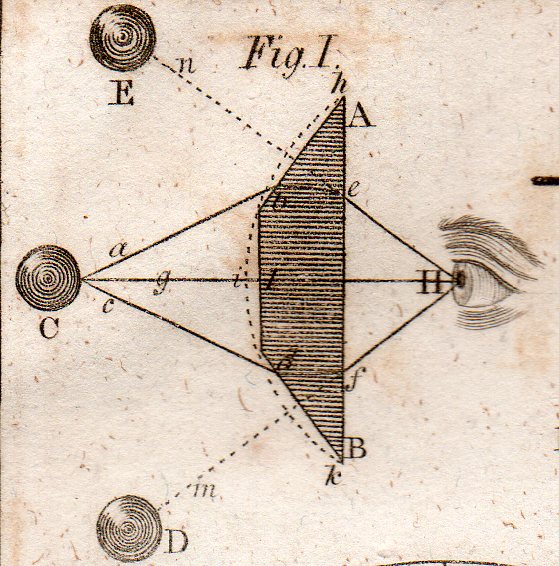
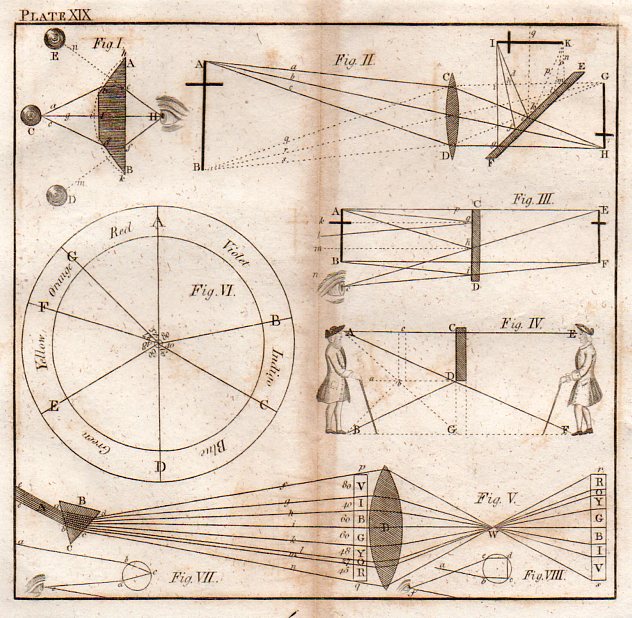
    Astro mictroscope--6942 [Even in fairly famous scientific images lke the one above–explaining the rainbow–there are all manner of unexpected artistic finds outside of their significant scientific contributions.]

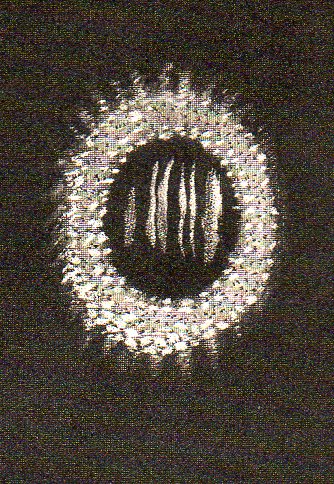
    These images from the title of this post, on the other hand, are just simply “there”–all you need is a little magnification and some sharp vision, and the things come to life.  When looking hard at these images and seeing the teaming non-representational artforms that swim through so many of them it seems remarkable to me that these things weren’t seen as art before Kandinsy finally “discovered” this  artform in 1911.

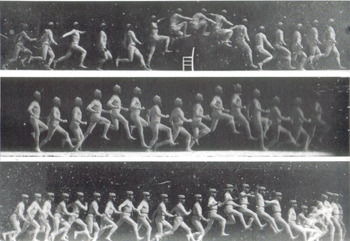
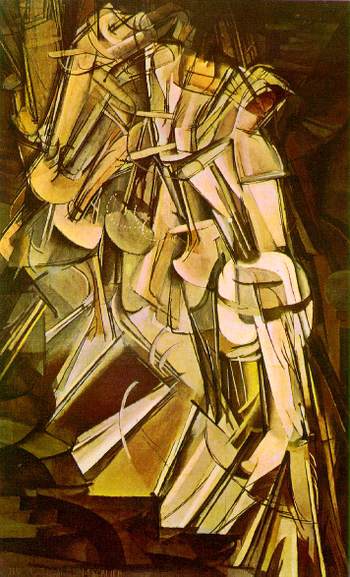
    (For example Mr. Marey produced a very remarkable Nude descending-like series of photographs 40 years before Duchamp–but the Marey images were observed scientifically, and I’m unaware of anyone who ever wrote an artistic appreciation of that work before 1900.  [Marey left, Duchamp right.] But that is another story.)

    Blogfeb_22mareyBlog_feb_22_nude

    For us today with almost 100 years of Kandinsky/Klee/Duchamp/Braque/Malevich under our belts it is relatively easy to see the artfullness of the pieces and bits of these engravings–not so a hundred-plus years ago, and harder yet for 200+. 

    For example, there are some things that take on an absolutely pre-biotic flavor, like material that we’d come to see a half-century ago, as in these details from an 1850’s  French lithograph on nebualae:

    Astro mictroscope--3b931


  • In Closing: “a Kiss from Your Beethoven”. Artistic and Literary Valedictions from the Master.

    JF Ptak Science Books   Post 1663
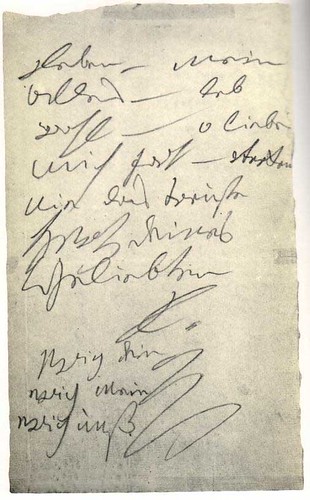
    http://farm4.static.flickr.com/3072/2554654204_1d32764d1b.jpg

    On how to end a letter.

    I’ve read pieces of Thayer’s Beethoven, and parts of the Conversation Books (the collections of rough notebooks that visitors used for written communication with the Master (1770-1827) once his hearing got too far away from him), as well as pieces of his journals and letters–which seem to me to be the most interesting part of reading about the man.  I find his writing style to be formal but surprisingly easy, and I’m continually enchanted by his valedictions–the way in which he signed-off a letter.  The man could leave you with a nice thought, especially in the way where he would begin his last sentence and incorporate that in his closing:

    (1795–to Franz Wegeler)  “I shall come to you myself and throw myself into your arms, imploring you to restore my lost friend, and you will give yourself to me, to your penitent, affectionate, never-forgetting,/ Beethoven once again”

    The sentiments seem fast and genuine and seem to be out-of-place with the man’s big, semi-unsure handwriting, which looks as though his efforts were accompanied by grunts while writing.  But his letters are really quite beautiful things, and a very interesting read; and as I said, the way in which he sent his letters off into space, the way he closed them, is exceptional and artistic.

    And so some examples:

    (1787)  “Your obedient servant and friend/”

    (1793)  “Your true and admiring friend/”

    (1793)  “Think occasionally of your still true and admiring friend/”

    (1794–to Schenk) “Farewell, and do not entirely forget your/”

    (1795–to Franz Wegeler)  “I shall come to you myself and throw myself into your arms, imploring you to restore my lost friend, and you will give yourself to me, to your penitent, affectionate, never-forgetting,/ Beethoven once again”

    (1798)  You will find Schuppanzigh here as well and the two of us will tease, cuff and shake you to your heart’s delight, a kiss from your Beethoven…

    (1800–to Wegeler)  “Always rely on the love as well as the friendship of your BEETHOVEN”

    (1800)  “Sometimes recall your truly admiring/Beethoven”

    (1800, to Franz Anton Hoffmesiter) ) “I hope that we shall often have occasion to assure one another how truly you ar emy friend and how I am/Your brother and friend/L v. Beethoven.

    (1800)  “Always rely on the love as well as the friendship of your/”

    (1800–to Pastor Amenda)  “Now, farewell, my dear kind friend! If by any chance I can serve you here, I need not say that you have only to command me. Your faithful and truly attached/”

    (1800–to Wegeler) “Rest assured of the love and friendship of your/”

    (1800–to Pastor Amenda) “Farewell, beloved, good, and noble friend! Ever continue your love and friendship towards me, just as I shall ever be your faithful/”

    (1801) “With great respect, I am your devoted/”

    (1802) “If you should think of any favor I might do you here, it goes without saying that you yourself will at once inform/Your faithful, truly affectionate, Beethoven”

    (1802) “Farewell, my dear, faithful Wegeler, rest assured of the love and friendship of your/”

    (1802)  “Even unto death, your faithful/”

    (1806) “Remain well disposed towards your friend/”

    (1807) “Farewell and do not forget your true friend/”

    (1808) “Friend Beethoven embraces you all”

    (1808)  I embrace you with all my heart and am your faithful friend/”

    (1809–to Zmekskall) “I come without any card from you, but I hope you will not on that account discard me. Yours truly–most truly, L. V. BEETHOVEN”

    (1810–to Wegeler)  “Think of me with kindness, little as I apparently deserve it. Embrace your dear wife and children, and all whom you love, in the name of your friend,/”

    (1810–to Zmeksall) “Ever remain my friend, as much as I am yours,”

    (1816–to G. Del Rio) “God, however, directs all things; so my position may undergo a favorable change, when I shall hasten to show you how truly I am, with sincere esteem, your grateful friend, / “

    (1817) “We have the honor to remain, most astounding Lieutenant-General! your devoted/GENERALISSIMUS” (Beethoven sometimes signed himself this way.)

    (1820, to Therese Makfatti)  “Think of me, and gladly, forget my follies, rest assured: no one can wish your life to be more carefree, even more cheerful than I do, even if you should feel no concern at all for your most devoted devoted servant and friend/Beethoven”

    (1824–to B. Schott’s sons) “In greatest haste, with greatest urgency and yet with the greatest brevity, your / “

    (1824–to Nageli) “I embrace you as one of the wise men of Apollo, cordially yours /”

    (1825–to a copyist) “Well, look after yourself. A thousand thanks for your devotion and kindness t me.  I hope you will not be punished for them. / Yours, with love and friendship, / “

    (1825–to Karl van Beethoven, his dead brother’s son and legal ward, and legacy of a complicated relationship) “May God grant my wishes, for never again shall I be capable of suffering on your account./ Unfortunately your father/or rather not/ Your Father”

    (1826–to Tobias Haslinger)  “With the most reverential reverence and fidelity, yours, / “

    (1827–to B. Schott’s sons) “Pity your devoted and respectful friend, / “

    (1827–to Pasqualati) “May Heaven bless you generally and for your affectionate concerns, / With your respectful,/ suffering Beethoven”

    (1810, to Archduke Rudolph)  “Well, it really makes me laugh to think how Your Imperial Highness consider me even on this occasion; for this, assuredly, my whole life long I shall remain, Your most obliging servant, /”

    One of the valedictions in the “series” of letters to his famous and as-yet-unknown2 “Immortal Beloved” in July 1812 goes so:

    “be calm – love me – today – yesterday – What yearning with tears for you – you – you my life – my everything – farewell – oh continue to love me – never misjudge the most faithful heart of your Beloved/ L”

    and also:

    (1807, to Josephine Brunsvik) “never misjudge the most faithful heart of your beloved L”

    And of course he could start a letter, too, as we can see here in his start of the towering love letter to his Immortal Beloved (above):

    “My angel, my everything, my very self. – only a few words today, and in pencil (with yours) – I shall not be certain of my rooms here until tomorrow – what an unnecessary waste of time – why this deep grief, where necessity speaks – can our love exist but by sacrifices, by not demanding everything. Can you change it, that you are not completely mine, that I am not completely yours? Oh God, look upon beautiful Nature and calm your mind about what must be – love demands everything and completely with good reason, that is how it is for me with you, and for you with me – only you forget too easily, that I must live for myself and for you as well, if we were wholly united, you would not feel this as painfully, just as little as I would – my journey was terrible…”  

    But we’ll leave the beginnings to another post.


  • Some Lincoln Ephemera: Audio of the Voice of J.W. Booth, the Last Man to See Lincoln Shot (& on TV), and the Last Man to See Lincoln Dead

    JF Ptak Science Books  Quick Post  

    What did the voice of John Wilkes Booth sound like?  There are certainly a  number of testimonies to what his voice was like, but since he died a dozen years before it was possible, really, to have his voice recorded, nothing exists for us to listen to of him.  One could though stretch credulity a bit and say that he perhaps sounded similar to his brother Edwin–another actor–and there are recordings of him speaking.  So, by long extension, this may be what John Wilkes sounded like. 

    Edwin Booth:

    Somewhat related is this, a 1956 appearance on the television program “I’ve Got a Secret” by Mr. Samuel J. Seymour, who’s secret was that he was a witness to John Wilkes Booth assassination of Abraham Lincoln.  He was five years old at the time and his abiding memory was being concerned for the man who fell onto the stage from the balcony. Seymour evidently died two months later from complications of a fall he took while traveling to appear on the show.

    In another vaguely related historical bit, the last person to see Abraham Lincoln did so in 1902.  There had been a number of attempts to steal the body of the president–one of which came very close to completion–and so in the final move of Lincoln’s body to a burglar-proof resting place on 20 September 1902 his coffin was opened.  John Bowlus was there, and he related what he remembered as a nine-year-old boy viewing Lincoln 37 years after his death.

    Bowlus stated:

    “I can see his face as if it were yesterday,” Bowlus recalled. “Even in death he was an awe-inspiring figure.” A boy of 14 at the time, Bowlus said he had stood on tiptoe and gazed, awestruck, on the majestic features of Lincoln, almost too afraid to peer into the glass-topped casket. “The body was almost perfectly preserved,” Bowlus remembered. “The face was darker… he lay with his head and shoulders and tips of his hands visible where they were crossed on his chest.” It was awe-inspiring, almost frightening,” he said. “The beard appeared to have grown longer, but the dignity of the great man could almost be felt through the air-tight casket which had preserved his body,” Bowlus said. –“The Last Man to See Lincoln”, by Lance J. Herdegen, [source].

    I looked for a recording of Robert Todd Lincoln (who died in 1926) but could not find none.

    And just for the sake of it, a list of early recordings of U.S. Presidents:

    ·Posted by :

    ·in:

    — —

  • Floating River, Lonely Tree: a Little Bit on the Aloofness of Things in Renaissance Illustration

    JF Ptak Science Books   Post 1651
     
    Malory870  

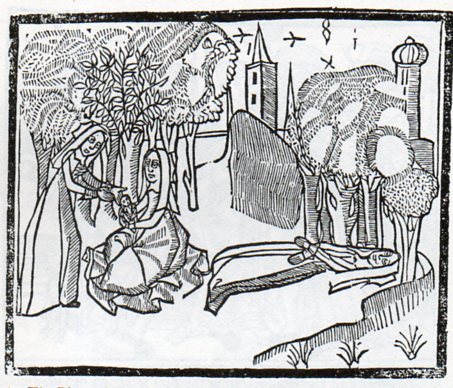
      Sir Thomas Mallory (c. 1405 – 14 March 1471), translated and compiled a collection of mostly 14th century romances regarding King Arthur known and published as the  Le Morte Darthur/Le Morte d’Arthur.  It  was first published by the great William Caxton in 14851and became quite popular,  being reprinted with additions and corrections in 1498 by William Claxton and then again by Wynkyn de Worde (in 1529). It is, in its way, beautifully illustrated, or at least interestingly illustrated–I can’t really say for sure if the woodcuts were done with great care or not.  But their effect is significant, and, whether naive or not or careless or not or simply at the artistic limit of its executor or not, the images do have their own peculiar beauty.  One that struck me in particular was this, 


    Malory869
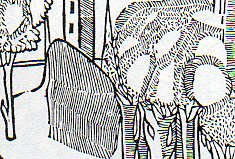
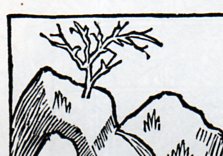
    the “floating river”, an out-of-perspective element of a very stationary world, a controlled chaos-ness in a static landscape.  I’m not sure what is going on with the trees, if the blankness is a part of reflected light, or if it is a representation of spaciousness between the limbs, or if they are simple wormholes in the woodblock.  Everything in the image seems to have its own sphere, locked into their own environment, existing apart from everything else.

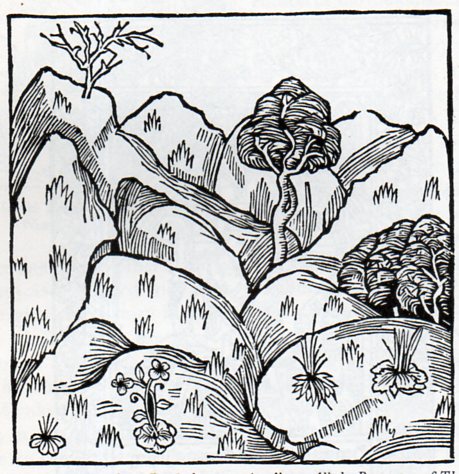
    I see the same issue with many other such works, bits dropped into place in a scene or landscape, all making their way into the viewer’s mind on their own, not really a part of a cohesive whole.  This may have been the intent, or again it may have rubbed up against the outer limit of what the artist (and their tools, and medium, etc.) was able to actually produce.  Here’s another example:

    Lonely tree872:

    Lonely tree871
    Its another lovely, lonesome image of separates from the beautifully-named book by Bartholomaeus Anglicus All the Properytees of Thyings, which was published in Westminster in 1495 (and also known as De proprietatibus rerum, also translated as On the nature of things, or On the properties of things), and which was originally written around 1225).  The book was a bestiary, a marvelous encyclopedia, a collection of all things as known in the 13th century–it would be interesting to represent all that is know today and compact it into a workable, logical, usable (printed !) book of a thousand pages.  The question of organization of knowledge would be the key, of course, and how to make one flow to another complementarily as practicable…it would be an interesting project (for someone else) to try and arrange the basis of human knowledge in a finite space like that.  The author of the book above organized his work as follows, in 19 books:  “god, angels, (including demons),   the human mind, or soul, physiology, of ages (family and domestic life), medicine, the universe and celestial bodies, time, form and matter (elements), air and its forms, water and its forms, earth and its forms including geography, gems, minerals,  and metals, animals, and color, odor, taste and liquids.”  The 2012 variety of categories would be somewhat different.

    Notes:

    1. This period, from say 1494 to 1525, was one of great creativity.  For example: 1494, Pacioli: Everything About Arithmetic, Geometry and Proportion; 1498,  Leonardo da Vinci: Last Supper; 1500, Michelangelo,  Pieta;  1504, Michelangelo: David and Bosch Garden of Earthly Delights; 1505, Leonardo Mona Lisa; 1506, work begun on St. Peter’s Basilica; 1508-1512 Michelangelo paints the Sistine Chapel; 1511, Erasmus, Praise of Folly;  1512: Erasmus, De Copia; 1513, Machiavelli  The Prince; 1516, More, Utopia; 1517, Start of the Reformation.

    Some samples of other bestiaries (compiled by The Medieval Bestiary):

    Hrabanus Maurus : De rerum naturis

    Isidore of Seville : Etymologies

    Lambert of Saint-Omer : Liber floridus

    Brunetto Latini : Li Livres dou Tresor

    Jacob van Maerlant : Der Naturen Bloeme

    Konrad von Megenberg : Das Buch der Natur

    Thomas de Cantimpré : Liber de natura rerum


  • The Weight of Humanity in Images on Book Covers

    JF Ptak Science Books  Post 1651

    Blogaugust_27_crowds_stand456

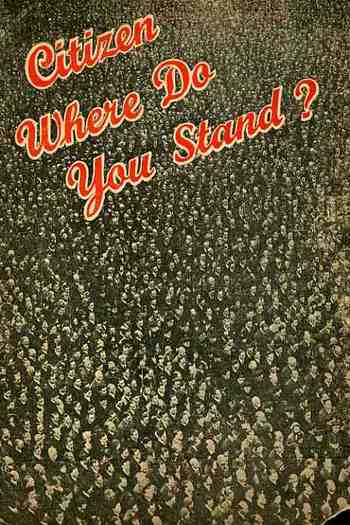
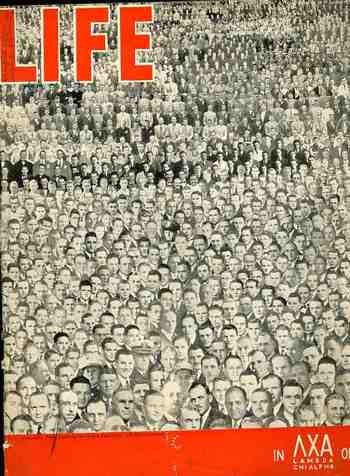
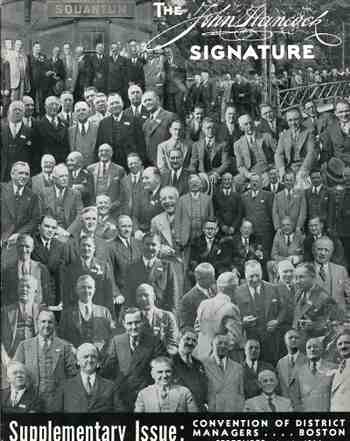
    I don’t often see covers of pamphlets featuring hundreds–or thousands–of people as a part of the design.  In my continuing role as finder and re-finder of things found I have re-surfaced four of these designs, and I feel I should post them before they’re captured in the un-finding process.  Again. Back to the design:  these are very striking, persuasive images, unavoidable in many ways, completely intriguing, beguiling.  People just have to look at these things.  Look:  I made a little experiment today placing ten  very interestingly-designed pamphlets on display, all with compelling and distinct merits, and including one with a big spread of humanity on the cover (the “Life” pamphlet. The very unscientific results is that people were generally first drawn to the complex people image, and stayed longer looking at it–by far–than any other image.  Perhaps its the same sort of reaction going on when you watch people walking in front of a mirror or reflective surface, with the vast majority of folks checking themselves out in it.  Maybe its just people looking for something familiar.  Maybe the faces are simply, strictly more interesting than just points o the page.  I’m not sure. 

    The first image is a one penny Labour Party publication coming from the National Executive Committee of the Labour Party, published in London in 1937; second is Life, the story of the fraternity lamda chi alpha, published around 1935; third, a program for the Liberal Party, published in London in c. 1938; lastly, fourth, a program for some course of semi-statistical study with the John Hancock life insurance company.  These beautiful designs were much more interesting than the very casual contents they covered, at least to me.

    Blogaugust_27_crowds_life459

    Blogaugust_27_crowds_socialist_mil4

    Blogaugust_27_crowds_hancock460


  • Anguissola and her Game of Chess, 1555

    JF Ptak Science Books   Quick Post

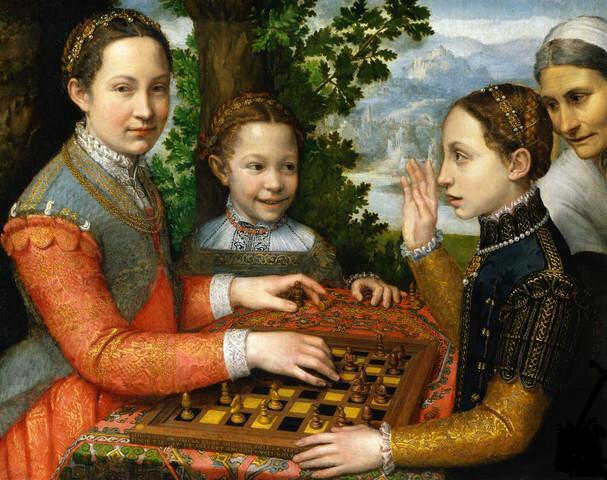
    “Anguissola has shown greater application and better grace than any other woman of our age in her endeavors at drawing; she has thus succeeded not only in drawing, coloring and painting from nature, and copying excellently from others, but by herself has created rare and very beautiful paintings.”–G. Vasari

    Chess game
    Sofonisba Anguissola is recognized as one of the leading women painters of the Renaissance, an interesting humanist who succeded in the face of restraint of prejudice.  She had great talent, obviously, and it seems as though that she gave a certain life to happy, common expressions in her subjects.  But what I focused on her in this chess game was how the player on the left got her bishop into the position at H1 with her pawn at G2. And why is the black square at H1?

    Also this:

    In his Libro de Sogni published in 1564, Lomazzo presents this following imagined conversation between Leonardo da Vinci, representative of modern painting, and Phidias, the artist from Antiquity:

    “I bring to your attention the miracles of a Cremonese woman called Sofonisba, who has astonished every prince and wise man in all of Europe by means of her paintings, which are all portraits, so like life they seem to conform to nature itself. Many valiant [professionals] have judged her to have a brush taken from the hand of the divine Titian himself; and now she is deeply appreciated by Philip King of Spain and his wife who lavish the greatest honors on the artist.”–An imaginary conversation between Phidas (representing the deep antiquity of art) and Leonardo da Vinci (as representative of the modern).  As seen in Giovanni Paolo Lomazzo (1534-1594), a busy mannerist painter and author of at least six books, including early and significant art criticism, in his  Libro de Sogni (1564, “The Book of Dreams”.


  • A History of Changing Sides, Part 1: a Half-Fascinating, Wholly-Horrible Biography of a Forgotten Man

    JF Ptak Science Books  Post 1642

    This is the first post in a new series on this blog on “changing sides”–that is, having a new allegiance, Adopting/acting on an something completely out of the mainstream of the personal experience, believing in the opposite of an established belief; to leave something, falling away or rejecting one thing for its opposite or something different, done with integrity or with the abandonment of honesty. 

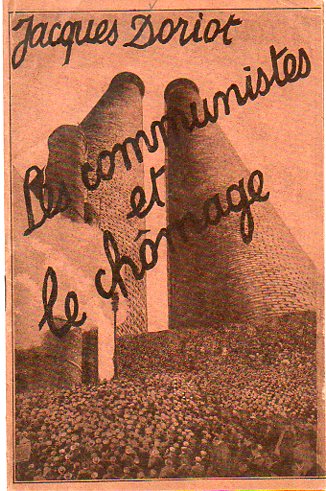
    Doriot953Jacques Doriot.That was the name on the pamphlet that I pulled out of a stack of pamphlets segregated for their cover art.  Les Communistes et le chomage was written by Doriot in the year after he became mayor of St. Denis, an ancient commune just north of Paris, in 1932.  That was years, of course, after Doriot returned home from being a POW of the Germans in WWI and found himself joining the French Communist Party (PCF), a group in which he rapidly succeeded.  HE went to jail for the violent protest of teh French occupation of the Ruhr, emerging into the political arena as mayor of St. Denis.

    At one point he was taken by the Communists, but a bitter debate erupted after which he was expelled from the Party (in 1934).  He abandoned thoughts of the communists and established a new ultra-nationalist Parti Populaire Français (PPF) in 1936.  From there things went downhill, but not yet downhill and on fire. 

    File:Bundesarchiv Bild 101I-141-1258-15, Russland-Mitte, Soldaten der französischen Legion, Fahne.jpg

    Doriot supported the idea of France becoming more like its Facsist neighbors Germany and Italy, and when the war rolled into existence in 1939, Doriot jumped on the foreign Fascist bandwagon.  In France.  He supported the occupation of the Nazi’s French occupation of the north, but when that proved to not be fascist enough for him, he toddled off to Paris where he found a better reception for his pro-Nazi sentiments among the Nazis themselves, what with the Vichy government providing too-soft a version of governance.  His transformation was in full blossom by that time, when in 1941–after having an Ezra Pound-like experience in espousing pro-Nazi beliefs on Radio Paris–he and Marcel Deat went almost all the way into the heart of the Fuhrer, creating the Legion des Volontaires Francais (LVF), which was a French force organized to fight with the Wehrmacht. (The French were hardly alone in this, with something like 350,000 soldiers in the Wehrmacht coming from places outside of Germany.  See the note below for troop strength numbers. 1 )

    Doriot954
    Not surprisngly the LVF was thrown into the Barbarossa meatgrinder, and was decimated, along with millions of German soldiers as well as more millions of Russian citizens and soldiers. (According to a wiki page, the LVF started out at regiment strength of about 2,400 when they went into battle in October 1941; by the spring of 1942, there were only two batallions left, comprising about 600-800 soldiers in total.2.) Doriot survived, and in what must have been the high point of his life, was awarded the Iron Cross in 1943. In coming back west he pursued other pro-Nazi activities, including what looks the support of German agents inside liberated France in 1944, which I think would leave an ordinary person completely vacant and a deranged one full of pride and fortitude.

    Somehow he made it almost to the end of the war, though had he survived it I am sure that he would have been visited with vengeance and retribution.  (It seems that most of the officers were tried and executed while the soldiers were either sent to jail or offered to work off their debt to the nation via service in the Foreign Legion.) Doriot was killed when the car he was driving in was strafed by a fighter plane on Washington’s birthday, 1945. 

    It is quite a remarkable, and horrible, little life that Doriot led, a life that actually has me feeling a little hollow as I write about it–very off-putting and upsetting in a dark, struggling way. 

    ·Posted by :

    ·in:

    — — —