A Daily History of Holes, Dots, Lines, Science, History, Math, Physics, Art, the Unintentional Absurd, Architecture, Maps, Data Visualization, Blank and Missing Things, and so on. |1.6 million words, 7500 images, 4.9 million hits| Press & appearances in The Times, Le Figaro, Mensa, The Economist, The Guardian, Discovery News, Slate, Le Monde, Sci American Blogs, Le Pont, and many othr places… 5000+ total posts since 2008.

Category: Perception

  • Reference Tool: Your Handy Guide to U.S. Patent Numbers

    JF Ptak Science Books   Quick Post

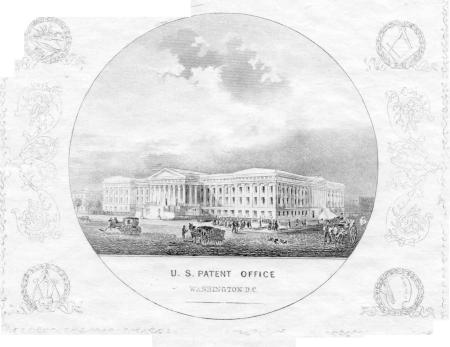
    Patent Office Print
    This is a simple tally of  American patent numbers and the years in which they appeared.  I’ve found this list handy from time to time and thought to repost it here.  It is a lot easier to have this series posted here than have to wrangle he data out of the occasionally labyrinthine U.S.P.T.O.:


    ·Posted by :

    ·in:

    — — —

  • Inside Looking Out: Ernst Mach vs. the Hudson River

    JF Ptak Science Books  Post 1913

    Machbook

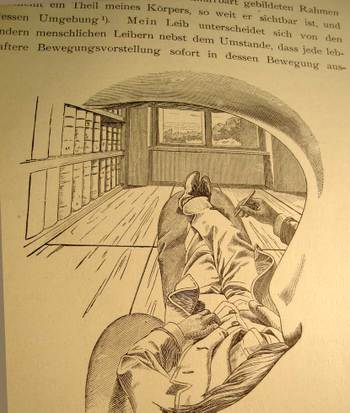
    I cannot think of another illustration by a scientist or philosopher who attempts to explain their own, literal, view of the world and then offer what this looks like to the reader from inside his own head, looking out through his own eye.  That’s exactly what Ernst Mach is doing right here on page 15 of his influential book Die Analyse der Empfindungen,  the fourth German edition (“The Analysis of Sensations and the Relation of the Physical to the Pyschical”, published in Jena in 1903).

    There is nothing in this world for Mach that is not admissible to the human brain that is not empirically verifiable–that is, the world is nothing but awash in sensation and that sensation itself forms part of the experience of, well, experience. I’ve actually never been interested in the philosophy of science, and this is one of the reasons why.  Nevertheless I boldly break through my own prejudices to enjoy this phenomenally original image, drawn from the inside of Mach’s working mind, looking out through his eye socket, over his mustache, under his eyebrow, around his nose, out across his body and then leaping into the rest of the world.  I think he does make his point about the essentialSteinberg_352
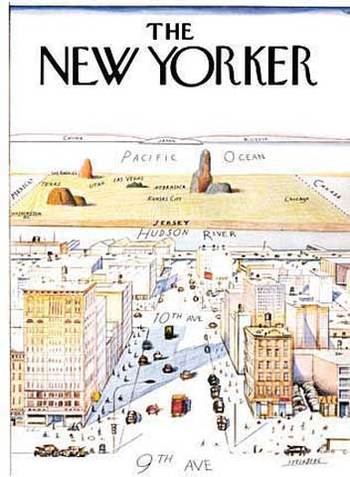
    nature of the observer. And much like the classic Steinberg New Yorker cartoon of the world view of the New Yorker (of course this includes only Manhattan), I know some number of people who have transposed their bodies much like Herr Mach into the Steinberg map–except that their worldview ends basically at the Hudson River (Mach’s feet) with the rest of the world being the sliver out there beyond the river (Mach’s window) until you go 359 degrees around the world to get back to the East River (and back inside Mach’s noggin).  It is an unusual world view to have, but someone has to have it so that we can at least identify it so. 

    I just like the picture.   

    (Section 10, describing this image,  with translation by C M Williams and Sydney Waterlow from the blessed Dover people in 1959):

    “The considerations just advanced, expressed as they have been in an abstract form, will gain in strength and vividness if we consider the concrete facts from which they flow. Thus, I lie upon my sofa. If I close my right eye, the picture represented in the accompanying cut is presented to my left eye In a frame formed by the ridge of my eyebrow, by my nose, and by my moustache, appears a part of my body, so far as visible, with Mach2_3
    its environment. My body differs from other human bodies – beyond the fact that every intense motor idea is immediately expressed by a movement of it, and that, if it is touched, more striking changes are determined than if other bodies are touched – by the circumstance, that it is only seen piecemeal, and, especially, is seen without a head. If I observe an element A within my field of vision, and investigate its connexion with another element B within the same field, I step out of the domain of physics into that of physiology or psychology, provided B, to use the apposite expression of a friend of mine made upon seeing this drawing, passes through my skin. Reflexions like that for the field of vision may be made with regard to the province of touch and the perceptual domains of the other senses.”


  • Looking Straight Down Department: Antiquarian Waterspouts

    JF Ptak Science Books   Quick Post   Some examples from the uncollected series on Looking Straight Down can be found here and here.

    I’ve been involved in this blog at retrieving and tabulating antique images that look straight down on something. Today I imagine that we all take these sorts of views for granted, what with satellite images and Google Earth and airplanes and all.  But in the pre-heavier-than-air era, seeing a published image that looked straight down from a height was quite rare. (And it needs to be strait down, not a bird’s-eye view.  Things are very different between looking obliquely from an airplane window onto a cityscape than skydiving directly down on top of it.)

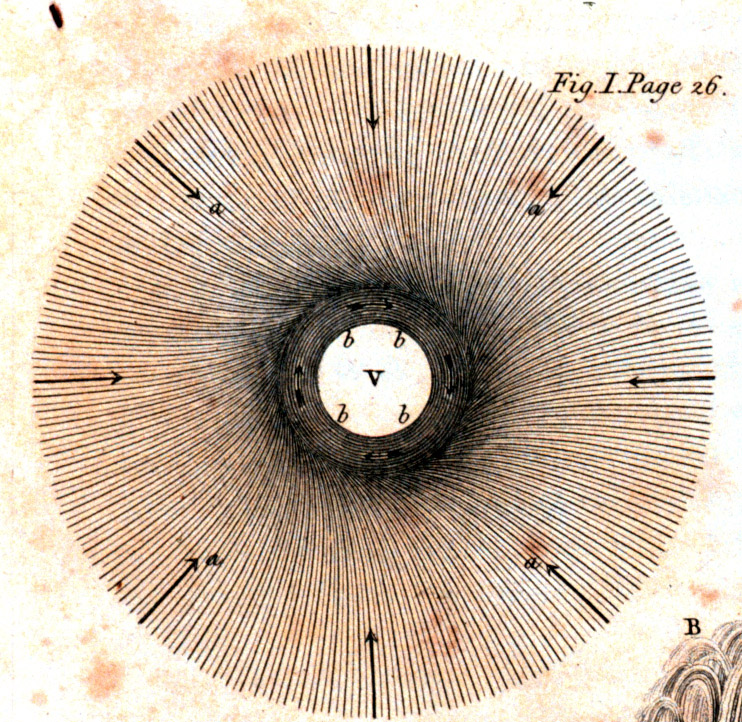
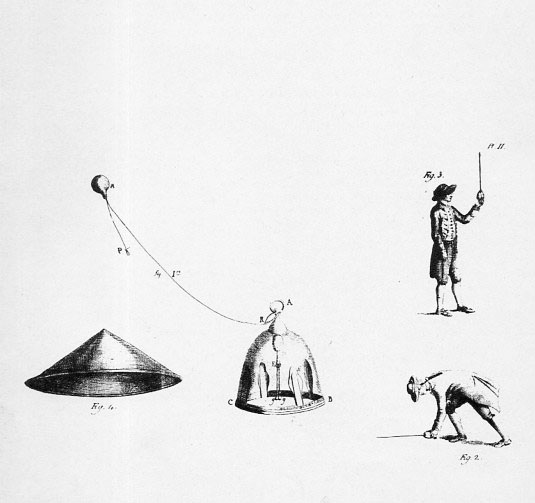
    Benjamin Franklin had long been thinking about waterspouts, going back at least to the early 1750’s, though he did not have an article about them in print until the appearance of “Physical and Meteorological Observations: Conjectures and Suppositions”  in the Royal Society’s Philosophical Transactions, LV (1765). The first image that I’ve been able to find of the waterspout occurs in 1774, though a prettier version of it is reworked a little, but with sharper delineations, in 1818:

    Waterspout detail

    Here’s the full image (with a magic square that related to another article in the volume):


  • Zoomology: Beautiful Ruination at the Beginning of Photography

    JF Ptak Science Books   Quick Post

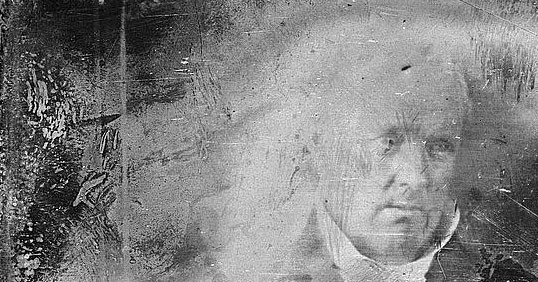
    This is a continuation of sort of this morning’s post, “Massive 500-Daguerreotype Mosaic“, though this one concentrates on the sumptuous ruination and decay that has occurred within and to some of these photographic images.  I’ve looked closely at only five of these images, and within each of these five images there are five more. And, if you manipulated the largest downloadable file of these (which range up to about 150 megs), there are five more within the five within the five. And all that before you start to imagine the artistic fantasies int he non-representational forms, and that before adding color.  So five is all that will be here, for the present.

    
    Ruination old dags detail 1


  • Mark Rothko, 1870: Unidentified Pre-Modern Found-Modernist Art

    JF Ptak Science Books   Post 1895

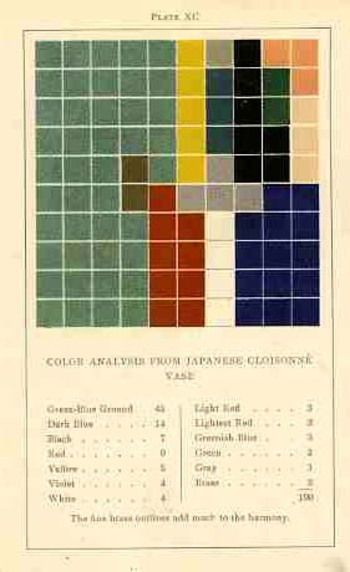
    This blog has long hosted a series of posts on “accidental” or “unintended” works of pre-modern modernist art found in displays of information and statistics in the sciences and mathematics, and even occasionally in art and design.  One such work–a 1904 triumph of accidental art issuing from an usunal work on color theory–belongs to an aesthetician named Emily Vanderpoel.  It is extraordinary in a narrower sense, and that extraordinary might not actually be positive for its original intent–the extra-intent of the book, what has come out of it for me, was something that was unintentionally accomplished by the author.  The images that she used to illustrate her color theory ideas–the basis of which are not really omprehensible to me–turn out to be artwork in themselves, a found art, the artistry of the images taking over the original intention for the arrangement of their color. She had introduced (though to no one, not really) a concept of beautifully arranged spatial color, artwork without a subject that could be recognized as any sort of natural object–non-representational art, finding publication several years before what is seen as the first inentional attempt at that genre, by Vassily Kandinsky in 1911. (Images below.) And when one strolls through the history of scientific illustration it becomes easier and easier to find such things, fabulous precursors to non-represnetational art, and Dadism, and Cubism and Surrealism. 

    Blogcolorvander_2poel_063These elements seem to be most populous in the illustrated sections of early encyclopediae, and dictionaries, and even encyclopedic dictionaries, where a number of different elements are displayed on the same page, different and generally unrelated images on the same engraved sheet, references for articles found in different parts of the book. 

    Here is a good example of that, with unintentional Surrealist images found in the image refernce pages of Horace Benedict de Saussure’s Voyages dans les Alpes….(published in Neuchatel in 1803):
    Unintentional surreal766
    [There are a number of other examples that I’ve written about on this blog:  here, for example, in “On the Paper Sculpting of Nothing”.]

    And then there are examples like Vanderpoel, where the entire image from one sheet is the pre-modernist image in question–to my experience this is the more uncommon occurrence. 

    Which brings us to today’s installment:  the infographic displays found in  Francis Walker’s  Statistical atlas of the United States based on the results of the ninth census 1870 with contributions from many eminent men of science and several departments of the government, which is the atlas of data to accompany the 9th Census of the United States, published in 1874.  This is a beautiful work, and a pioneering challenge.  Walker was one of the earliest to produce a statistical atlas, and was perhaps the earliest to display this huge and broad amount of data in so many different ways–it must have seemed a semi-miracle to see the information displayed so, like going froma  black & white television to color, or color to infared, and so on.  It may well have represented anentirely new way of looking at data.

     The first image (above) in this post is from the illustration showing proportions of the white/non-white population, and the following image shows a detail of that, offset against Mark Rothko’s 1959 Black on Maroon.

    Francis Walker’s statistical mapping, above, 1873; Mark Rotko,

    1959, below:  


     mark-rothko-black-on-maroon-1959

    [Black on Maroon (1959) by Mark Rothko, part of the Seagram mural series, via Tate Modern.]

    The first and third images are details from this full-page illustration:

    It is easy to see the similarities between the data display and the Rothko, though it would really not be within anyone’s power to identify the Walker diagrams as “art” in the modern sense for another five decades.  But it certainly seemed there, ready to be of influence and service, though I’m not aware offhand of artists being influence by these images as they were with, say etienne Marey’s photographs. I’m not sure that these statistics images ever came into the service of art in the beginning of the modern era.  And maybe that’s the biggest question here. 

    Sources:

    1. Guide to National Atlases: here.
    2. The Walker atlas for the 1870 census from the LC site: here.
    3. And an improvement on the Library of Congress presentation, by HandsomeAtlas (Brooklyn Brainery): here.


  • Vernacular Landscape–Found-Religious Signs, 1936

    JF Ptak Science Books   Quick Post

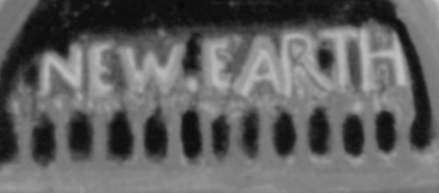
    New earth
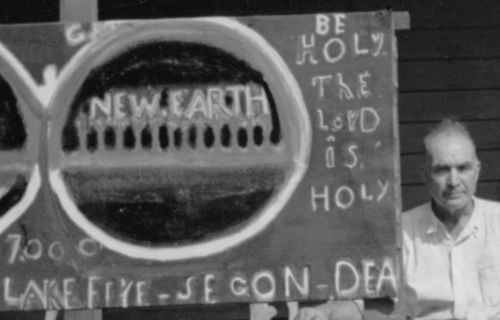
    Which is a detail from:

    FSA--signs--religious detail

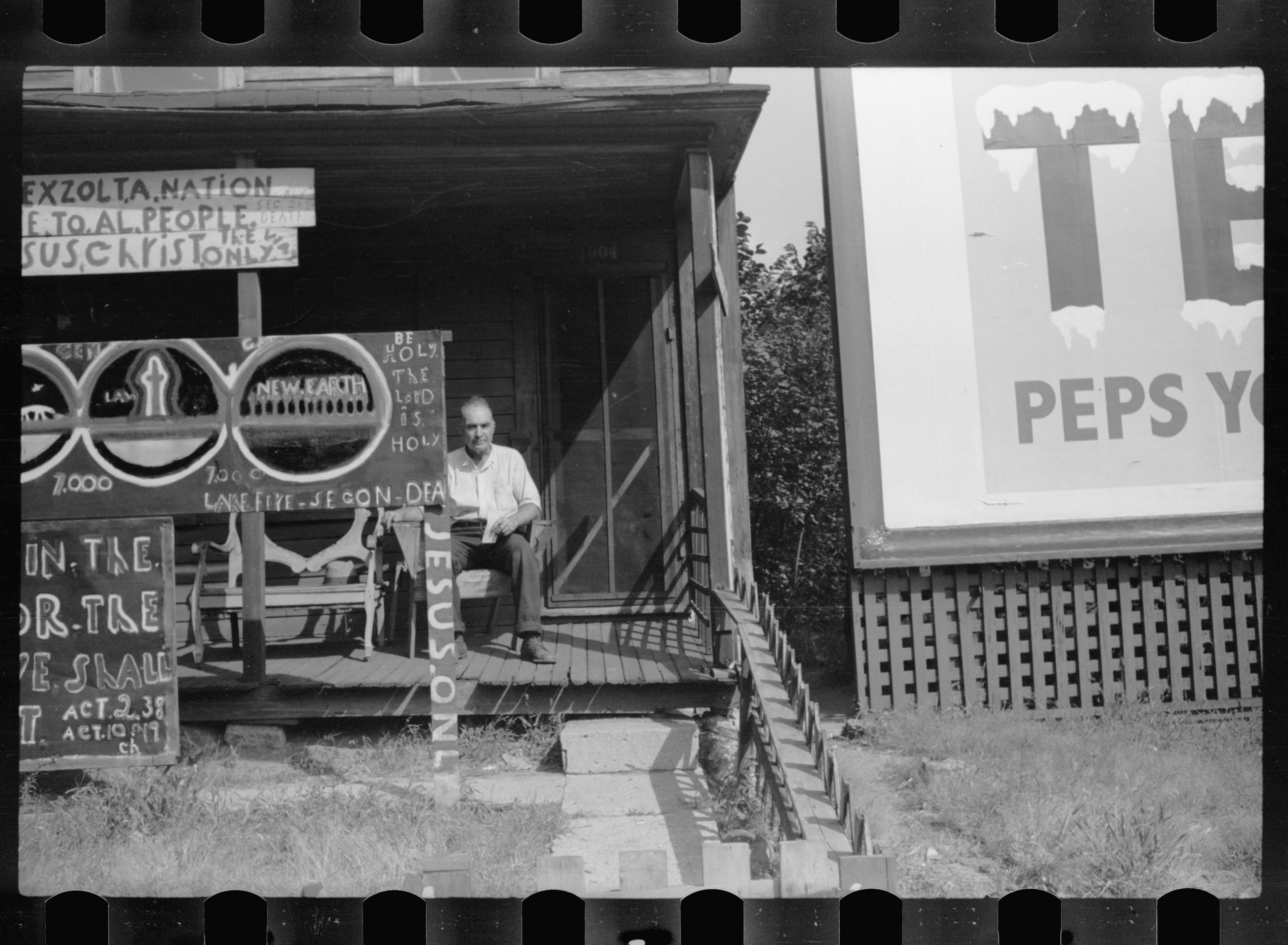
     Which itself is a detail from:

    FSA--signs--religious
    John Vachon; Religious Signs, Minnesota. 1936.

    Image, Source: digital file from intermediary roll film

     Vachon (1914-1975) was part (beginning in 1936) of one of the great groups of photographers in the history of American images: he worked for Roy Stryker in the FSA as part of the U.S. government’s attempt to record the good and ill of American poor.  That group included Esther Bubley, Marjory Collins, Mary Post Wolcott, Jack Delano, Arthur Rothstein, Walker Evans, Russell Lee, Gordon Parks, Charlotte Brooks, Carl Mydans, Dorothea Lange and Ben Shahn.  OF the many images recorded by Vachon, I liked the words in this one.


    ·Posted by :

    ·in:

    — — —

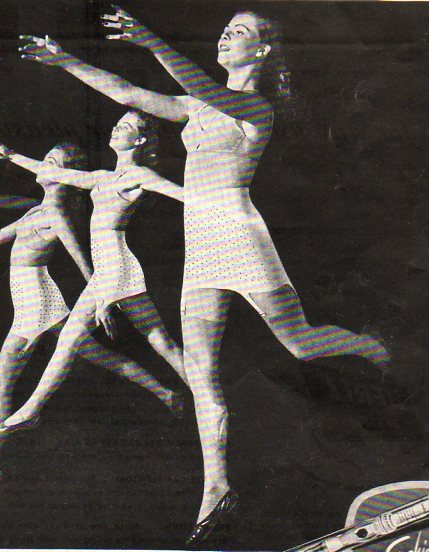
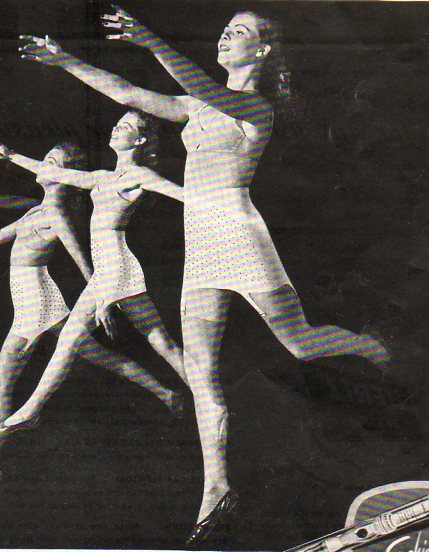
  • Girdle vs. Goedel: the Pink Ice Girdle Ballet of 1951 vs. Logic. Part I of the History of Holding Things In

    JF Ptak Science Books  

    Girdle--a det428[My thanks to Patti Digh for providing the idea for the Goedel part of this adventure into Playtex and Logic–she did so because (a) they fit together and (b) girdle/Goedel sounded almost identical to a woman who once lived in Munich!]   

    In the long history of Holding Things In, perhaps the newest of its
    members was upon us only recently. In the long, deep past we have held
    our breath, hidden our anger, stowed our emotions, and so on, but it was
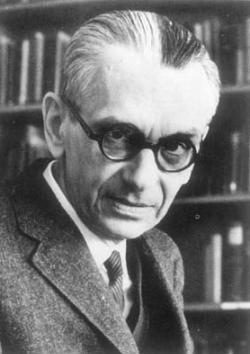
    only recently that we began to hold our bellies in.  One of the masters of Holding Things In for this period turns out to be the sublime logician and re-inventor of modern mathematics (by putting one piece of the great Hilbert to sleep), Kurt Goedel, who towards the mistakenly-self-engineered end of his life, Goedelheld on to everything, virtually–he organized and filed almost very piece of paper that he came into contact with at any level, became ever more reclusive, and at the end (due to his theories of people/institutions wanting to kill him) refused food and, of all things, water.  Surrounded by the smartest people on the planet (including his friends Einstein and von Neumann) up there at the Institute for Advanced Study at Princeton, Goedel withered away until he had almost no shadow. It is a bad irony that he could be so inconceivably unmovable and restrained while at the same time, and in the same life, offered such incredible newness to the maths–both ends of the mountain at the same time.

    1951, the year in which these girdle advertisements appeared in Life magazine, was also the year that Goedel present us with the Goedel  metric, and also in which he received (with Julian Schwinger) the first Albert Einstein award (and of course delivered his famous Gibbs lecture  “Some basic theorems on the foundations of mathematics and their implications”).

    The popular introduction of the girdle I think that
    this happened at about the same time for the sexes, only these
    conveniences were much more often advertised for women than they were
    for men.  Slender and non-existent waistlines for women were more of a cultural identifier
    than a slim-hipped man, and the ads for his cheaters appeared far less
    frequently than those for women.

    The first widespread appearance of the girdle for the sake of vanity must have occurred during the 19th century, or perhaps a little later is my best guess–but the first time the device began to appear for the common woman must’ve come around the time when there was time for leisure, or shopping, or of being seen in public in short intervals.  And that I believe is a Victorian-age invention.

    But the binder doesn’t come into fabulous presence until the distribution of mass population illustrated magazines, or I should say the advertisements that made these magazines possible:  production like LIFE (from which these 1951 images come) reached far more women than the popular older periodicals like Harper’s Weekly or other polite mid-19th century journals for women.  The advertisements were certainly more enticing, the possibilities more rewarding, and the girdle comfort levels far higher than their predecessors, and the availability of disposable income for women far greater–and so incidentals like the girdle became more greatly commodified, and moved into the “essentials” category. 

    The idea of these ads seem horribly revolutionary: on the one hand, the badly-named and hyphenated  Playtex product “Pink-Ice” squeezed women into new tight but  malleable molds, while at the same time promised some sort of ballet-like freedom because of it. Like the creeping (“two steps forward and one step back”) communism of the time, Playtex promised the possibilities of enhanced freedom through restrictive clothing (in a “peace through strength” vision).  In any event, and in spite all of what I just wrote, the pictures are kind of amazing.  

    [I’m well aware that this may be one of the worst things ever written about Kurt Goedel–the Renault Dauphine of Goedeliana.  But it doesn’t matter, because in all of his powers, Goedel could absolutely prove that g_d existed, and that  I don’t.]


  • Ancient “Spacecraft”: the Flavor of Moving Very Heavy Things a Long Time Ago

    JF Ptak Science Books    Post 1872

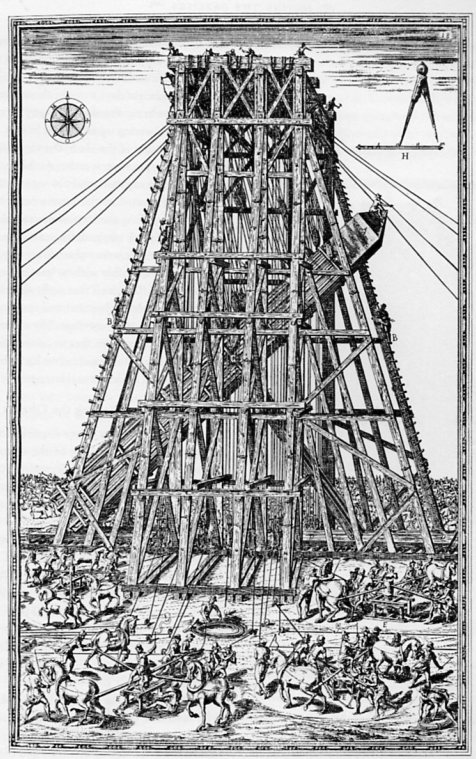
    Obelisk624
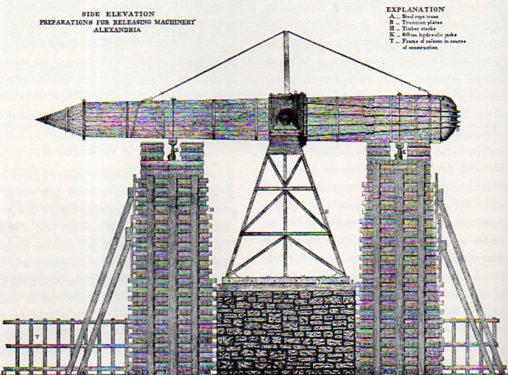
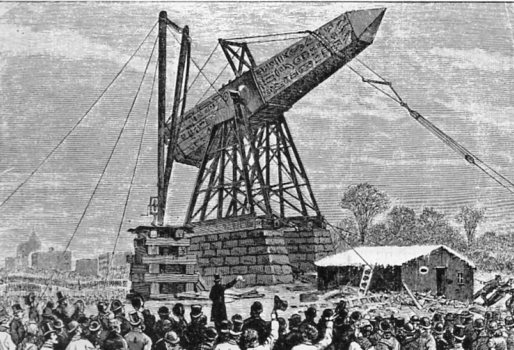
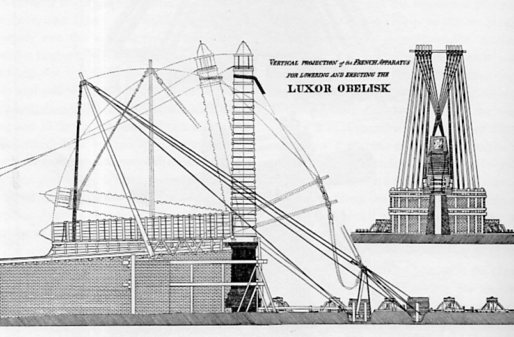
    This of course is not a story of ancient spacecraft, but it is about Very Large Things being manipulated in space in the days of steam and pre-steam engineering. It is hard to escape the “rocketship” interpretation, as some of the images, sculpted slightly out of context and cleansed of any identifying text and viewed with a squint, look as though they might be large booster rockets being readied for flight. They are of course images of some great and famous pieces of engineering–moving massive obelisks, and moving them in the 19th century and before.  And in the case of the Romans, and the original Egyptians, moving them way before our last millennium, moving 200- and 900-ton objects without benefit of very much at all. 

    Obelisk625
    Two of the great examples are the pair of obelisks that the Romans moved from Heliopolis to Alexandria, where they stood for another 2000 years.  Over time there was only one standing, and that one wasn’t doing so well by the end of the 19th century.  The fallen obelsik was taken to London in 1877; the other, the standing obelisk, was given to the United States by the Khedive of Egypt two years later, in 1879.  The man in charge of this second operation was Lt. Commander Henry H. Gorringe, U.S.N., who had the very tricky job of lowering the monolith, bracing it for transport by sea, fitting it out for a ship, and then transporting it to Central Park and raising it again.  He was able to accomplish this feat with the “fragile” 100-ton object in just a year.

    This next image is more classical and probably iconic, at least in the history of science world, and is found in the superb book by Domenico Fontana, Della Transportatione dell’Obelisco Vaticano (published in Rome in 1590 and again in 1604):

    Obelisk627

    Obelisk626They really do have a certain modern taste for interplanetary access, at least to me.  That aside, it is interesting to consider what this vastly heavy movement must’ve looked like to people long ago, when big machines with enormous powertrains (like this 1,200 ton capacity 300′-tall mobile crane)could be hauled into service to do their end in manipulating highly problematic and very heavy things in space.  To think of moving these very heavy objects with steam (or less) was a daunting task, and to see these images showing the progression of movement of these things must have been enormosuly satisfying.


  • The History of Normalcy and the Idea of the Center

    JF Ptak Science Books   Post 1855

    Where is the center?

    Where is the center of the Earth, of religion, of the United States, of the universe, of art, of consciousness, of seriousness, of complexity?

    The center of stuff throughout history has been an almost entirely shifting matrix, a collection of vortices coming from Jupiter’s strongbox–a three dimensional representation of the location of their shifting centers over time would make an interesting Fibonacci-like display, I think.
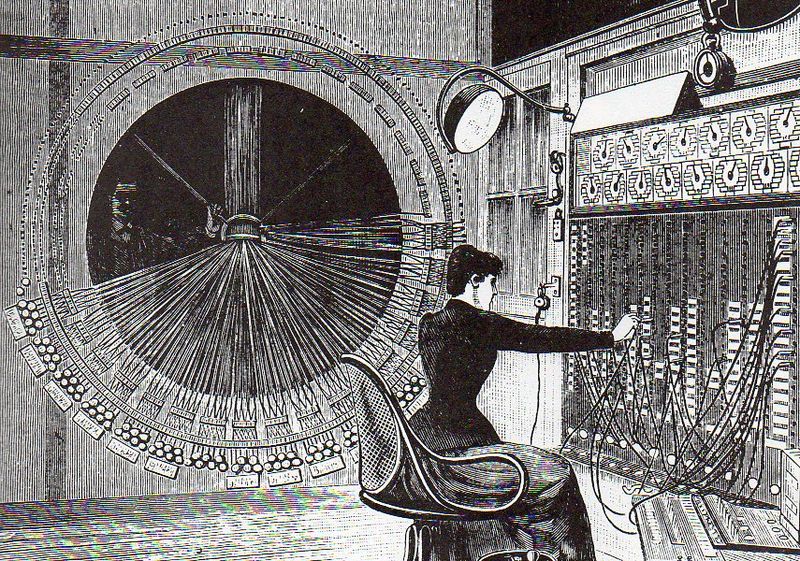
    Center--theatrephone567

    The question may seem meaningless at first, but people have long asked it of nearly everything within their experience, trying to find the center of their world and universe, of their selves, of their religion, of their country, of politics, of art and music, and on through the Encyclopedia of Things that Could Have a Center.

    Take for example the questions of where the center of the Earth, or solar system, or galaxy, or universe might be?  There have been answers to these question more often than not over time, though the answers have been shifting.  The center of the Earth has certainly stayed more-or-less constant over thousands of years, though the stuff in the center has been swarming with change, from being hollow, to being filled with magma, to being a solid magnetic core, to being occupied by Mole Men, to housing the seat of the Inferno, or to be simply located on the surface of the sphere at Jerusalem (as the old T-maps have shown for hundreds of years), and on and on.  Working backwards, the center of the universe has drastically changed over time–for thousands of years, it was assumed that the Earth was the center of all things, until it wasn’t (that beginning mostly with Copernicus, and then challenged with Galileo’s use of the telescope and his discovery of an order of magnitude more stars, etc.).  And then William Herschel beautifully represented the shape of the galaxy in 1782, placing our solar system in a far from central location.  The center of the universe’s fate changed along with that of the Earth, incredibly so beginning with the Big Bang and then with the possibilities of their being a universe without boundaries.  And then of course there’s multiple universe theories, and worm holes, and the space time continuum, which complicates things even further, making the discussion of a “center” pretty much nonsensical.
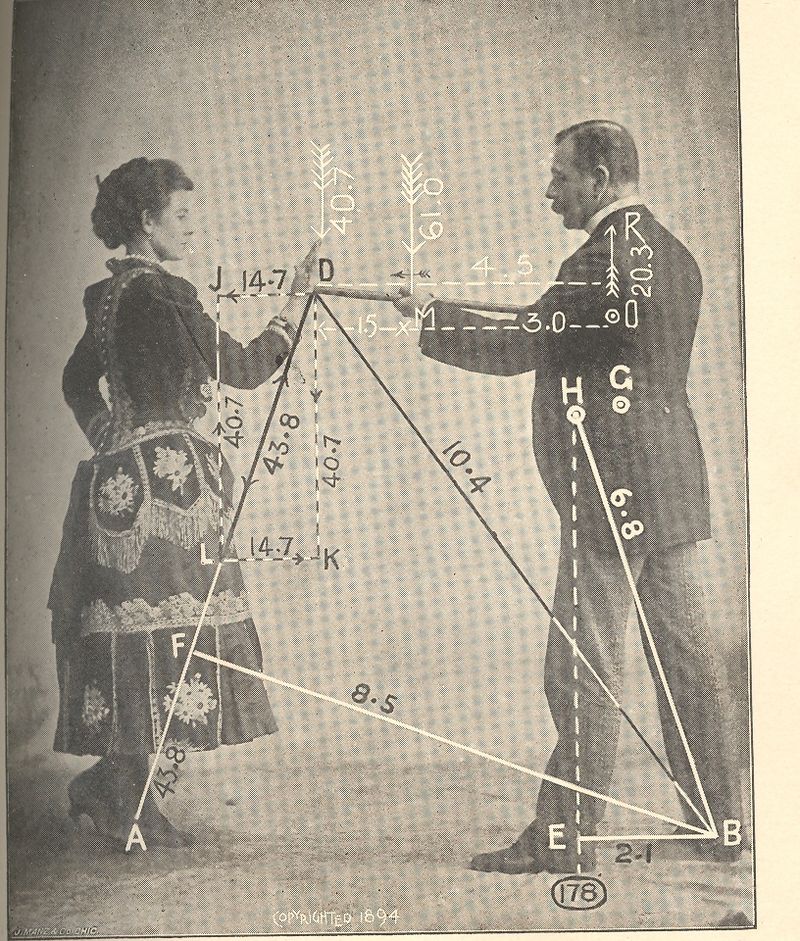
    Mar 23 center of levity cvr det 3

    Simpler things can be as complicated–where is the center of the United States?  If we measure the center for the lower 48 states, it will be different than if we included the two far-flung states, or protectorates like Puerto Rico. The geographical center is one thing; another might be where the population center might be–that has made a beautiful map published over time by the U.S. Census Bureau (Department of Commerce), showing the star of the center moving not-so-slowly westward into Ohio over the last 20 censuses or so.  And where is the heart of the country?  Where is the heart of the West?  Better yet, where is the center of the West (or North, or South, or Mid-West)?  To answer where the center of these places might be you’ve got to first locate where those geographical ideas begin and end, which for many is a tricky subject, making it a matter of opinion as to where the center of these places might be. 
                                       
    The center in art had been a findable thing for some time, though more recently people like the Impressionists and Kandinsky have shown that the center might not exist, and it might not exist along with anything that is recognizable as a form of nature, representation and the center falling away completely.  Perhaps this is like finding the center of a decade or year or month, or week or day or second.  The parameters keep getting both smaller and larger, the ability to measure halves of things or the center of a second growing almost incalculably small, small enough to reveal that in this Zeno-paradoxical way, that there is no center because there are no boundaries; getting half-way to something into infinity doesn’t tactually get you there. 

    The center of balance, the center of levity, of concern; the center of emotion–another center that has been mapped all over the human body, from the heart to the head to the limbic system to a confusion of freudian desires to an inelegant and intractable collection of stimuli   and response.  The center becomes more of a belief-but even there, center can have no more a constant than change.  The center of Christianity may be Christ (though it wasn’t always so, witness the Mary Cults through the first few centuries of Christianity), but then you have to understand which Christ it is coming from which Bible, the center becoming more a concern of interpretation and spread over many Christian groups than one solid center. And when you spread the field to include all religions and you expand the center notion to a primum mobile or collective or whatever, then the center gets very big—and in some religions, it is nothing but the center. 

    It seems to me that if the issue of finding the center of big and small things alike is difficult, then why does it seem so easy for people to determine and adhere (and sometimes to believe in at all costs) to expansive ideas like “normalcy”?
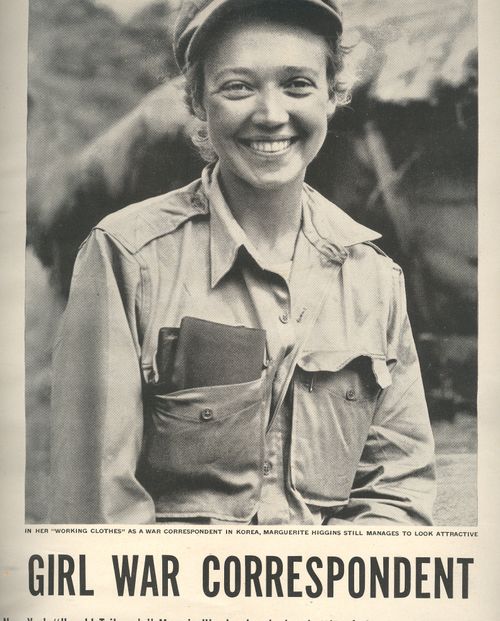
    Blog--May 24--girlA history of normalcy is one that looks at the things deemed to be “normal”, or standard, or acceptable at one time that became not so over the course of time.  Buying and selling human beings, women and their children being property of the husband, Chinese immigrants in America not have (any) legal rights, classification by skin color or sex or financial status or political belief are a few good candidates (among thousands) for this history.  It is an interesting proposition to think about—what things around you, or better yet, what thing you think or say or do, that look good and acceptable today might look embarrassing and unacceptable thirty years hence.  In 1935 one issue might’ve been accepting the codified behavior of treating women as less than equal of men, deserving less in the workplace (if they were in the workplace), less rights in the courts, less deserving of equality in general; by 1965, this viewpoint may have well been in the minority; by 1995 it begins to look fossilized; by 2025 it might well be unbelievable.  What are the issues of 2010 that could be the equivalent of the 1935 issue?

    I’m just wondering why it is that even when people cannot find the center of almost everything that has ever been, that a strict and damningly judgmental regimen of “normalcy” can be so easily instituted, and enforced? This especially since part of the code of adjudicated normalcy for one generation seems mostly gone by the next, that the important becomes trite, and the socially disgusting becomes acceptable.  Just  as the concept of the center becomes elusive, so too does the standardized idea of normalcy become vaprorous over time.
    ·Posted by :

    ·in:

    —

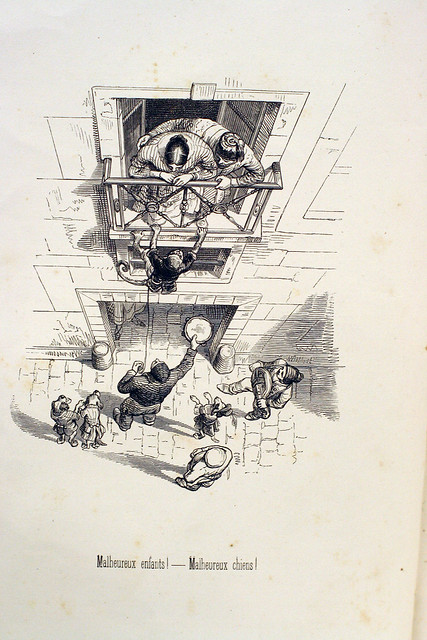
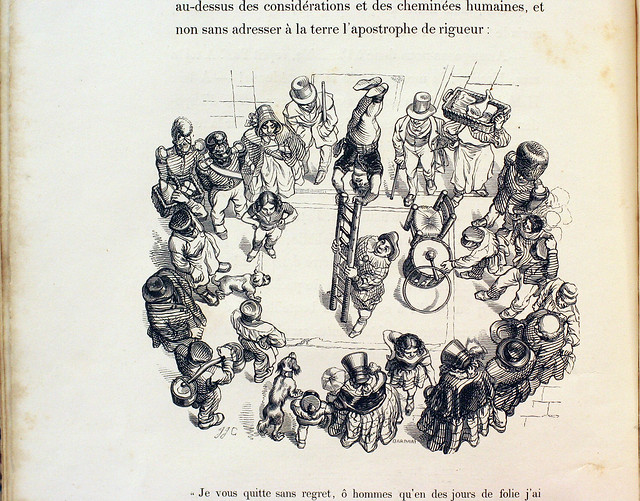
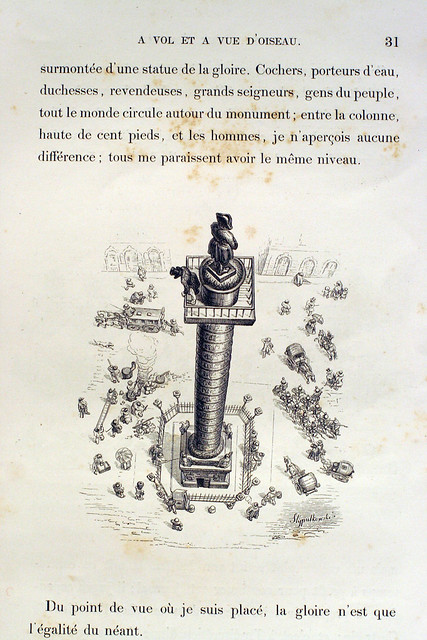
  • Unusual Antiquarian Perspective–Directly Above and Oblique. J.J. Grandville, 1844

    JF Ptak Science Books   Quick Post

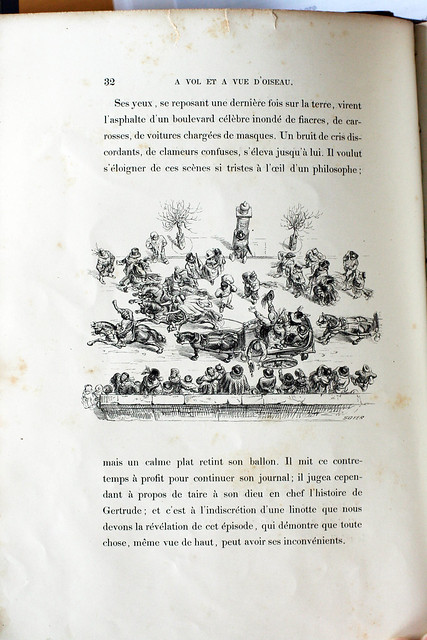
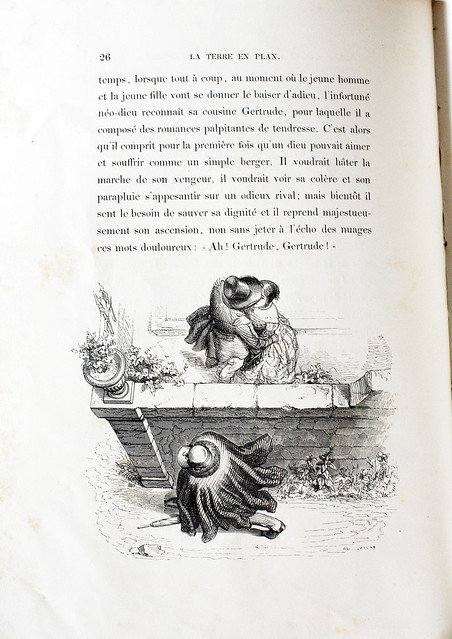
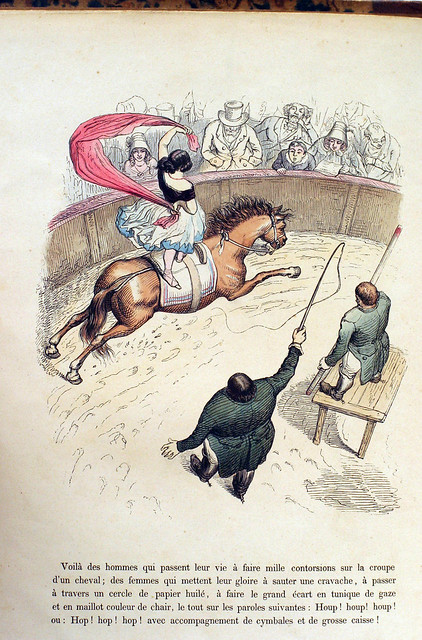
    This is the fourth installment in as many days (starting here) on the artwork of the great proto-Surrealist, J.J. Grandville.  Today’s quick post (again from his Un Autre Monde, 1844) isn’t so much fantastical as the other work pictured here, but it is subtly unusual.  It is my experience in looking at prints and other artwork for the last 30 years or so that antiquarian images looking straight and directly down froma  height are very unusual–so too for the next thing closest to it, looking down from a slightly oblique angle.  Grandville does this often in his work, and I think gives another insight into a brain that was just seeing (most) things differently.  [Here’s a link for some posts on looking straight down, here and here, for example.]

    photo

    photo
    photo
    photo
    photo
    photo