A Daily History of Holes, Dots, Lines, Science, History, Math, Physics, Art, the Unintentional Absurd, Architecture, Maps, Data Visualization, Blank and Missing Things, and so on. |1.6 million words, 7500 images, 4.9 million hits| Press & appearances in The Times, Le Figaro, Mensa, The Economist, The Guardian, Discovery News, Slate, Le Monde, Sci American Blogs, Le Pont, and many other places… 5000+ total posts since 2008.
[This is another in a long thread of posts on this site relating to shadows–simply enter “shadow” in the google search box at left for a listing.]
“Pulvis et umbra sumus” (“We are but dust and shadow”)– Horace
Depicting the capacity of sight and nature of light has been both an easy and a knotty problem in the history of science. Over the successive theories on the basis of light the artistic presentation of the phenomenon has been generalized (generally) in a very simple way: by straight lines. There’s certainly nothing wrong with that, the lines are just parenthetic place-holders suggesting direction, not actual descriptors of what light “looks” like.
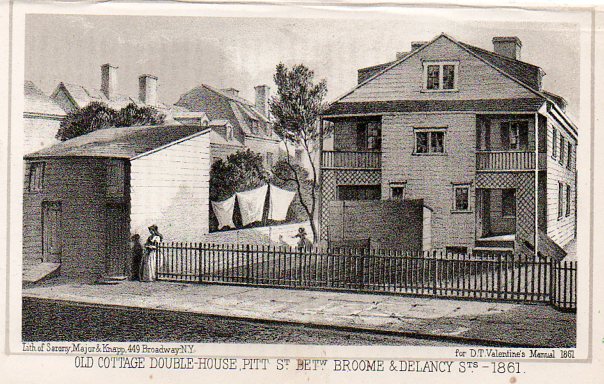
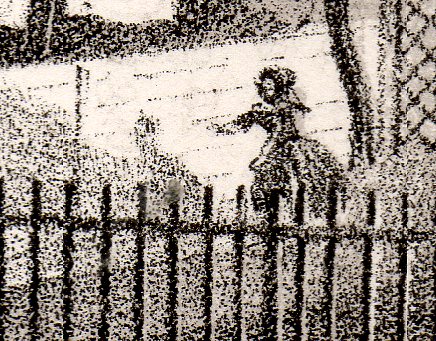
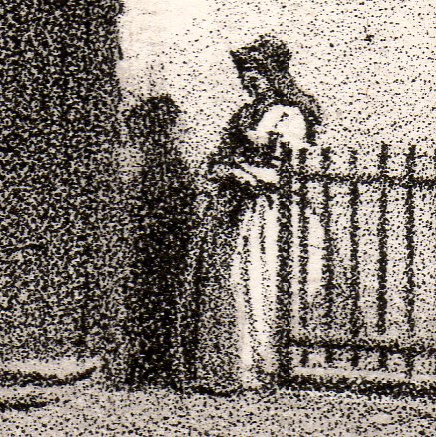
But what about shadows? Light and its effects are the basis of art, but what about light, “interrupted”? Or, really, how old is the depiction of the shadow in the history of western art? The shadow predates the modern re-discovery of classical perspective by a thousand years—little bits of shadows pop up here and there in deep antiquity, certainly way before Uccello and Alberti and the rest came along. On the other hand shadows do escape notice of many painters in the 15th century (and during the period of being very comfortable with the century-old realignment of perspective), which is odd, unless all of those works were depicting scenes at high noon or thereabouts. Which brings to mind this lithograph from one the 1861 edition of Valentine’s Manual for the City of New York. What strikes me is the low oblique angle of the sun–setting or rising–throwing the shadows of the two figures in the image very high up on the receiving surface. Odd things like this are interesting to me, and to be frank about it,. I’ve not noticed such a hard angle with shadow in too many prints.
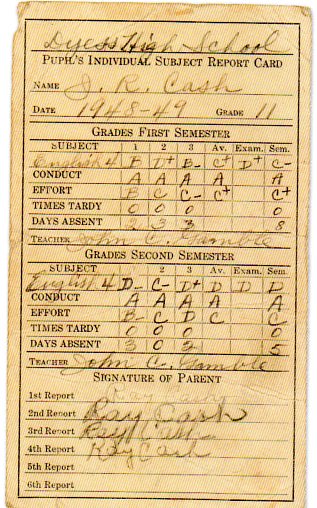
This great relic of Americana–the report card of Johnny Cash from Dyess High School in 1949 –is the stuff of deep emotion. It means that John R. Cash walked this (“Pupil’s Individual Subject Report Card”) English report card home to his parents for review, the 17-year-old wondering about how they might react to his not-great grades in English and “effort”. Or perhaps he wasn’t worried at all, perhaps he didn’t care. He missed very few classes, and was never late. He received straight A’s in conduct from his teacher, John C. Gramble.
[Image source: Cash, by the editors of Rolling Stone Magazine, 2007.]
So, the young Cash, who had grown up lyrical, with music and words swimming in his head, was unmoved by “English” (which was probably more like “composition” than what we think of it today) and was not interested in trying to overcome his disinterest, overly. Be that as it may, even though he was a D student, he was respectful of the class and teacher and classmates, always getting A’s in conduct.
Mr Cash signed the report card each time, and I suspect that he knew exactly what was going on with J.R. in spite of the grades.
Only six years later, in 1955, Johnny Cash had his first national hit in “Cry Cry Cry”.
And so where was Dyess High School?
As it turns out, Johnny Cash lived in a place in his early youth that owed its life to deep government intervention in the lives of its citizens. The short story is that people–almost entirely farming families–who had lost everything in the Great Depression and the resulting drought were given an advance1 of money to buy a house and land and a chance to start life anew. Ray Cash, Johnny’s father–born in 1897 in Rison, Arkansas–entered his family on the relief rolls and was one of 500 families selected to settle a 15,000 timber-cut swath of Arkansas bottom land up in the north-east corner of Arkansas in Mississippi County, basically due north of Memphis Tennessee just this side of the border.
The program brought to bear on this situation was the Federal Emergency Relief Agency (FERA), which was administrated on the national level by Harry Hopkins and in Arkansas by Alabama-born former teamster William R. Dyess. The farms and farmland was administered through the Rural Rehabilitation program, which under Dyess’ direction in Arkansas started the “Colonization Project No. 1″ in May 1934.
Ray Cash and family moved into House 266 on its 20 acres in 1936, one of five families selected from Cleveland County, and the same year in which Colonization Project No. 1 was incorporated as Dyess Colony. In a short period of time construction in the new Colony included “an administration building (and a )…town center (which) included a community bank, beauty salon/barbershop, blacksmith shop, café, cannery, cotton gin, feedmill, furniture factory, harness shop, hospital, ice house, library, theater, newspaper (the Colony Herald), post office, printing shop, service station/garage, sorghum mill, and school. Members of the colony often performed community tasks on a cooperative basis, though the farms were worked individually.”2 ________ Notes
* “Criteria for the all-white community included that applicants be destitute from the economic crisis, come from the lowest poverty level, be of “good moral background,” and that husband and wife each have the physical ability to clear the land and farm their acreage. Each farmer would draw a subsistence advance to buy twenty to forty acres of land and one of the new five-room houses, plus a mule, a cow, groceries, and supplies until the first year’s crop came in. All were expected to pay back the advance. The town would operate as a cooperative in which seed was purchased and crops were sold communally.”Encyclopedia of Arkansas History and Culture.
2. Encyclopedia of Arkansas History and Culture.
Dyess had population of 2500 in 1936, now a town of 550 or so. I cannot see any remnants of the wagon-wheel design of the farm houses that were built there in 1934/5 from Google satellite images.
An excellent reference for the movement of families into the Mississippi River bottomlands is The final frontiers, 1880-1930: settling the southern bottomlands, by John Solomon Otto.
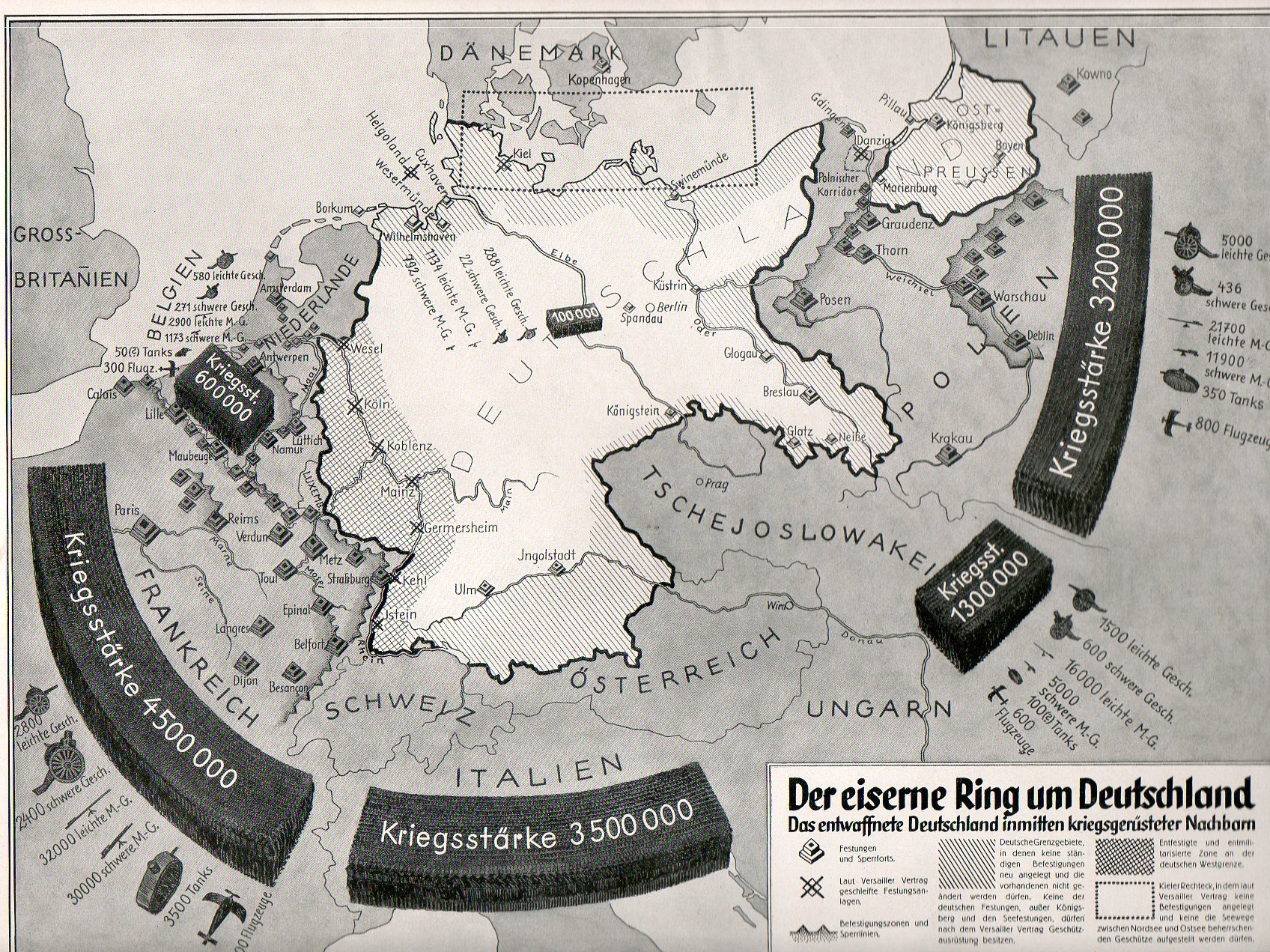
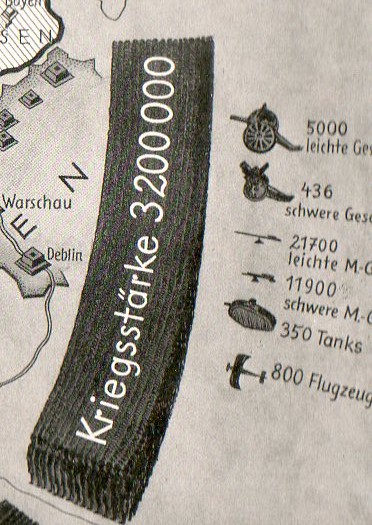
The newly-elected NSDAP government lost little time in putting forward a case to the German people that the Treaty of Versailles left Germany in a defenceless postion, surrounded by forboding armies and air foprces of its neighbors, the forces of France, Italy, Czecholovakia, Belgium and Poland forging a tight and formidible strangelhold on the weakened Germany. This image comes from the late November 1933 issue of the Illustrite Zeitung1 (Leipzig), and its relates to the casual and general reader the de-militarized and tenuous situation of the country–its design is effective enough so that the voice of he illustrations is well heard even if no on actually bothered to stop and read its legend–it was all about threat and impending doom, and the words for those emoptions weren’t necessary in this artwork.
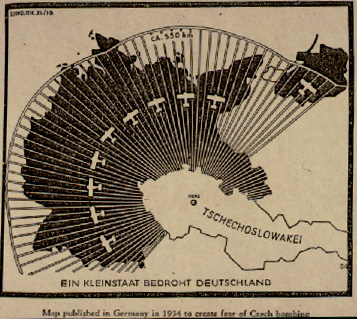
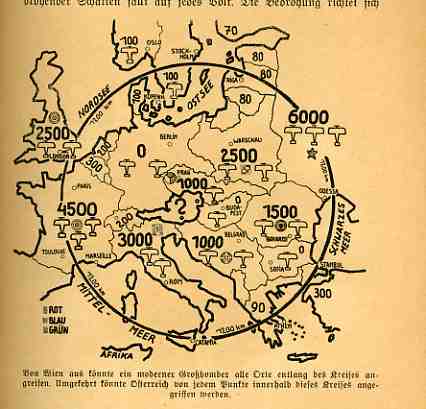
Campaigns like this were a first step in the Nazi consolidation of the public spirit, attempting to unify the population under Hitler and the NSDAP by presenting a threat so common that it could not help but to draw everyone into the big tent. This was a simple message of natural survival, a wide threat to the German state, a threat that was so simple and so devastating and so opaque that there would be virtually no resistence to unifying against it. (J.W. WHeeler-Bennet wrote about this in his superb and still-classic book The Nemesis of Power, the Germany Army in Politics, 1918-1945, published in 1954.)
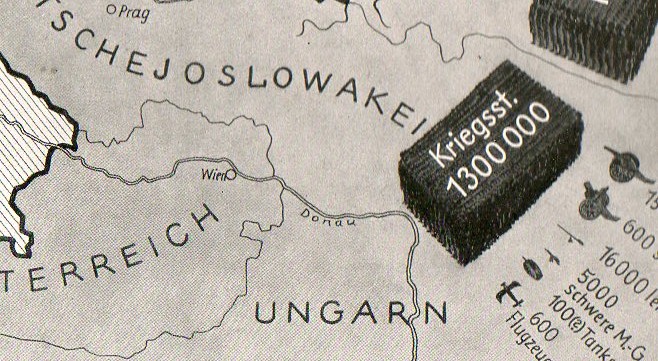
Here’s another example from about the same time, again showing the devastating effects of imagery–this displays the non-existent threat from Czechoslovakia:
And another, showing the encircling imagery again:
Getting back to the first image–curiously Great Britain and Russia don’t make the Enelmies Liest here, though in 1933 they certainly loomed as an enemy as much as any other. (Well, perhaps not neessarily so for the Soivet Union, but close.)
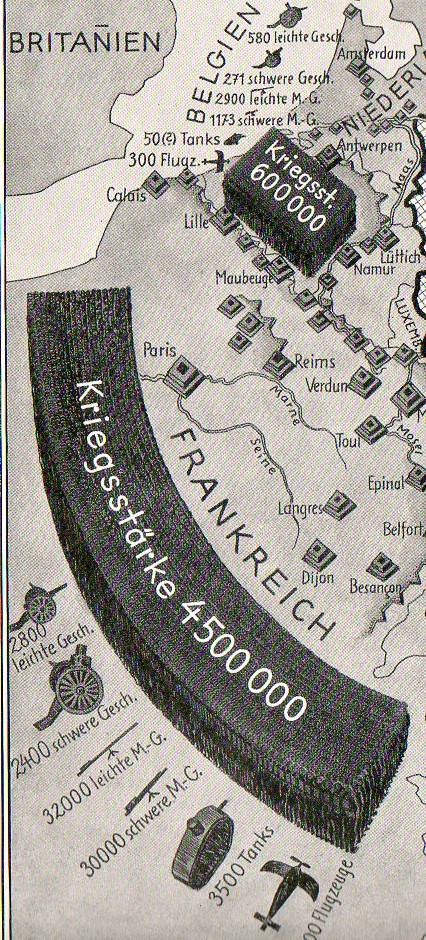
Someone who actually read the article and looked closer at the full-page ilustration would see the details of t he European threat, like this for France (and Belgium), with bloated figures for WWI-era ordnance and an extremely effectively articiulated represntation of what was seen as the standing army:
And this for Poland:
And of course, Czechoslovakia:
Among other things the signing of the Treaty of Versailles in 1919 limited the German armed forces to less than 100,000; limited the Navy to 15,000; prohibited the manufacture of submarines, armed aircraft, tanks, armored cars, Maxim guns and of course poison gas. There was assignment of guilt, heavy reparations (in what today would translate into something like a half-trillion dollars, without though translating buying power), and much more that was aimed at keeping Germany vanquished if not somewhat pastoral. Many have seen the Treaty as being the bridge and greatest impetus to WWII, an opportunity lost and squandered by the Allies–maybe so. A year after the end of the incredibly violent and ripping four-year onslaught in which millions were killed and so much destroyed it would’ve been difficult for all parties to the Treaty to have a great forward vision in how to best deal with Germany.
The Treay did provide a unifying front for Hitler; the Nazi Party using choice aspects of it in hearts-and-minds propagandizing methods like the one above: the military restrictions were true, but the portrayed threat of attack from Poland and Czechoslovkia and Belgium and Italy and even France were part of the building of the Big Lie. The “Big Lie” was something that Hitler identified in his 1925 Mein Kampf, and then used in his own terror campaigns–it is a lie so colossal and so impudent, so fantastic, that it is perceived as being true because no one would lie so gigantically. As George Orwell put it in his 1948 novel 1984, the Big Lie was “…to tell deliberate lies while genuinely believing in them, to forget any fact that has become inconvenient, and then when it becomes necessary again, to draw it back from oblivion for just so long as it is needed….” The perception of imminent threat was one of the starting points for the Big Lie; the mechanics and people behind the manufacture of the invasion, of the Treaty of Versailles, of the German economic meltdown, and so on was already laid down in Hitler’s ridciulous book, and much of that lay at the feet of the Jewish people.
But first the Nazis needed to address the issue of their entirely weak and vulnerable military position by proposing the threat from much of the rest of Europe, this in order to rail against Versailles and break the German obligations to non-militarism. The foundations for rebuilding the German war machine started in earnest in 1933; by 1935 most of the restrictions of Versailles had been broken, and Germany (which in 1933/4 had bene secretive about it) had gone public with its new obligations to itself (introducing the Luftwaffe to the rest of the world in March1935). Reactions from the Allies to generating the new war machine were weak, and Germany rolled right into WWII.
Notes:
1. I’ve written many times here about the Illustrirte Zeitung–it was basically the German equivalent of the Illustrated London News, Paris Match, and LIFE magazine, a better, mid-level weekly magazine that was well-written, very-well illustrated, approachable and affordable to folks of nearly all classes. It was an expedient way of sending across the government’s message from te beginning of the Nazi ouccpation of German politics.
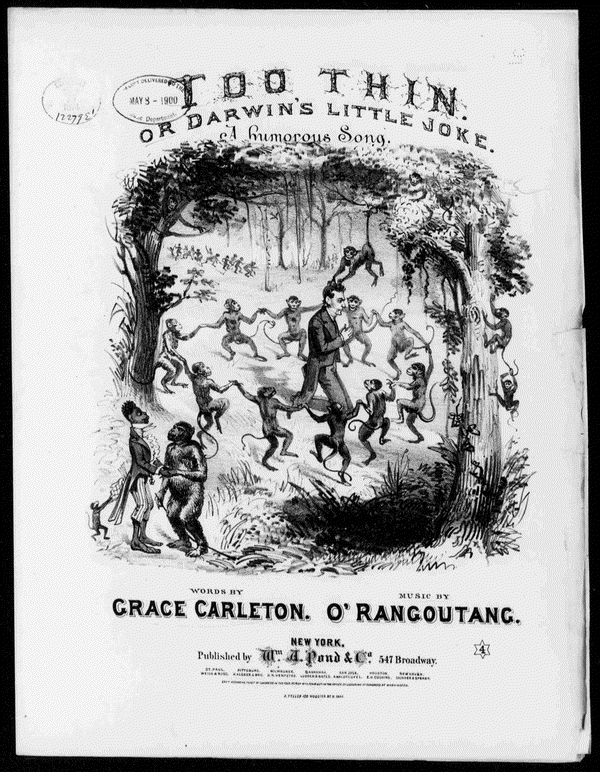
There are unending missing pieces for me in the works of the greats (literal “phantoms” in the Latin phrase for their collected works, “opera”), one of which came bubbling up reading the excellent piece by Michael Barton (Dispersal of Darwin blog) on Darwin in caricature. It put me in mind of Darwin and music, or, really, Darwin caricature in music In the 19th century. There doesn’t seem to be much to it, at least for the old stuff–there’s plenty of modern music, but it seems that there aren’t very many old notes. There is this example that I found at the Library of Congress site, though:
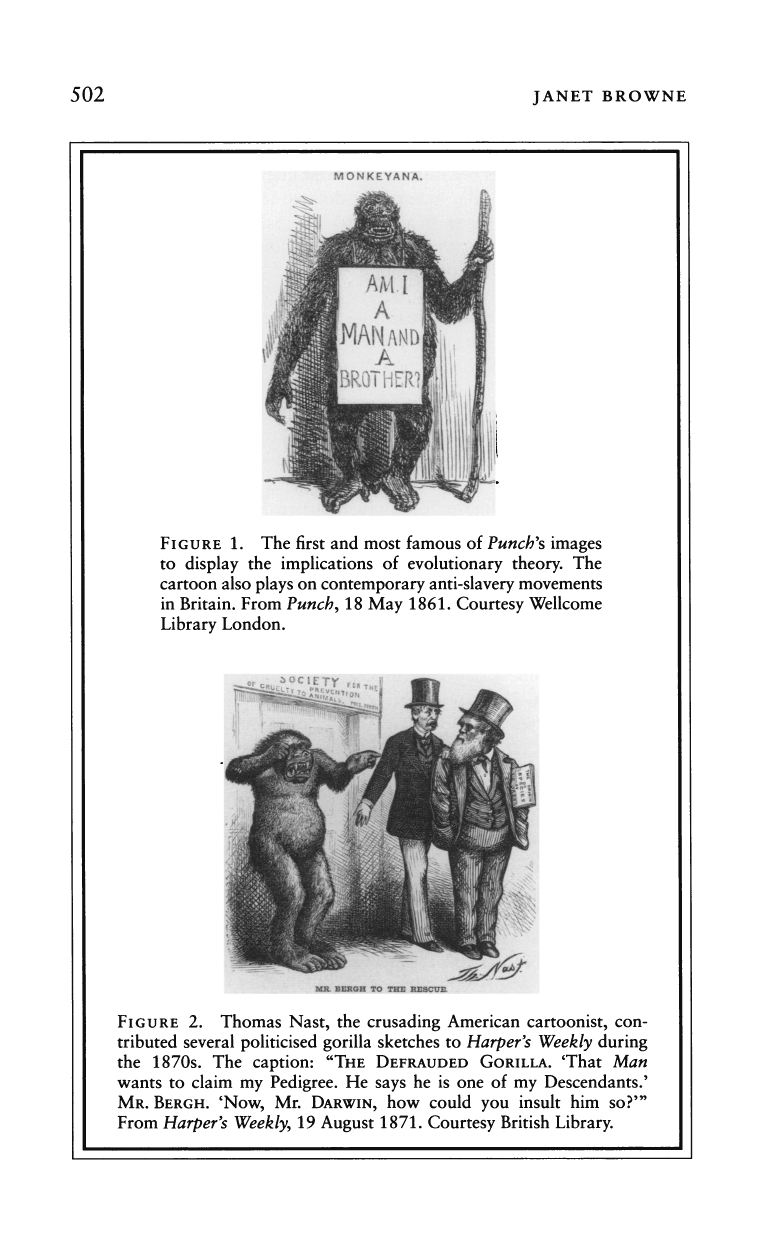
“Too thin; or, Darwin’s little joke by O’Rangoutang”published in New York by William A. Pond, 1874, which came 13 years after the appearance of the first Darwin caricature (in London’s Punch magazine, 14 May 1861, seen below).
This does bring up an interesting issue for me, though it is one frankly that I do not understand, about the relationship between Darwin and music. It is also somewhat related to an interest in Einstein and music, though for different reasons. With Einstein, it has bothered me a bit that he was seemingly uninterested in any of the new forms of music that appeared in the revolutionary period of 1895-1925. And, for that matter, Einstein’s artistic tastes were also quite classical and conservative. Given the enormous changes in the fields of music and art and literature, and that all entered revolutionary periods during this time, and that Einstein brought his own revolution to bear on the world during the same period, it is a little odd to me that his tastes were so restricted by an earlier time.
The issue with Darwin’s relationship to music is different, the tone-deaf Darwin applying his interest in music to the theory of sexual selection in animals and (perhaps) humans. This idea seems to have first made an appearance in a posthumously-published 1844 (“The Essay of 1844″) work in Francis Darwin’s Foundations of the Origin of Species, published in 1903, but more specifically in his Descent of Man (1871):
“The capacity and love for singing or music, though not a sexual character in man, must not here be passed over. Although the sounds emitted by animals of all kinds serve many purposes, a strong case can be made out, that the vocal organs were primarily used and perfected in relation to the propagation of the species. ” (Darwin, C. (1871) The Descent of Man . John Murray: London p. 587)
“All these facts with respect to music and impassioned speech become intelligible to a certain extent, if we may assume that musical tones and rhythm were used by our half-human ancestors, during the season of courtship, when animals of all kinds are excited not only by love, but by the strong passions of jealousy, rivalry, and triumph. From the deeply-laid principle of inherited associations, musical notes in this case would be likely to call up vaguely and indefinitely the strong emotions of a long-past age. As we have every reason to suppose that articulate speech is one of the latest, as it certainly is the highest, of the arts acquired by man, and as the instinctive power of producing musical notes and rhythms is developed low down in the animal series, it would be altogether opposed to the principle of evolution, if we were to admit that man’s musical capacity has been developed from the tones used in impassioned speech. We must suppose that the rhythms and cadences or oratory are derived from previously developed musical powers. We can thus understand how it is that music, dancing, song, and poetry are such very ancient arts. We must go even further than this, and, as remarked in a former chapter, believe that musical sounds afforded one of the bases for the development of language.” (Darwin, C. (1871) The Descent of Man . John Murray: London p. 593)
As I said, I’m not sure at all about where music lives in the works of Darwin, or, for that matter, where it lived in his head. It is interesting that music may play some role in the history of humans and animals, though it seems that Darwin had a distanced relationship with music itself. He would certainly listen–his wife was an excellent player–though it seems as though Darwin didn’t have a musical sinew in his body. I’m not saying that you have to be able to “bend” a soccer strike like Beckham in order to explain it; I’m just curious about the great man’s relationship to music. I’m afraid I haven’t anything more than questions on this.
Two interesting items for consideration:
Charles Kivy, Charles Darwin and Music, Journal of the American Musicological Society Vol. 12, No. 1 (Spring, 1959), pp. 42-48
Darwin in caricature: A study in the popularisation and dissemination of evolution Author: Browne, J. PROCEEDINGS OF THE AMERICAN PHILOSOPHICAL SOCIETY 12/2001 Volume 145 Issue 4 Pages 496 – 509
And the first caricature (I think) from the London Punch
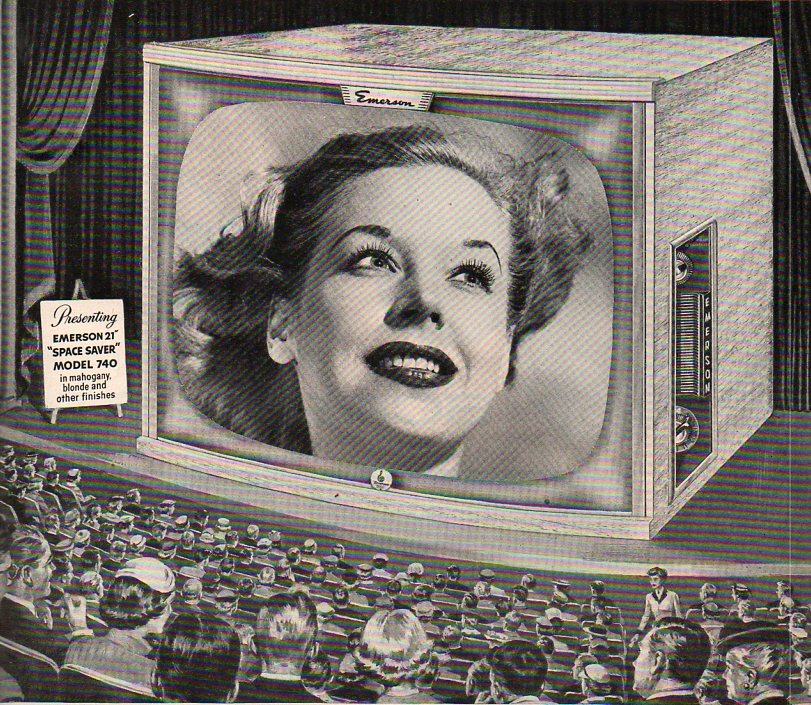
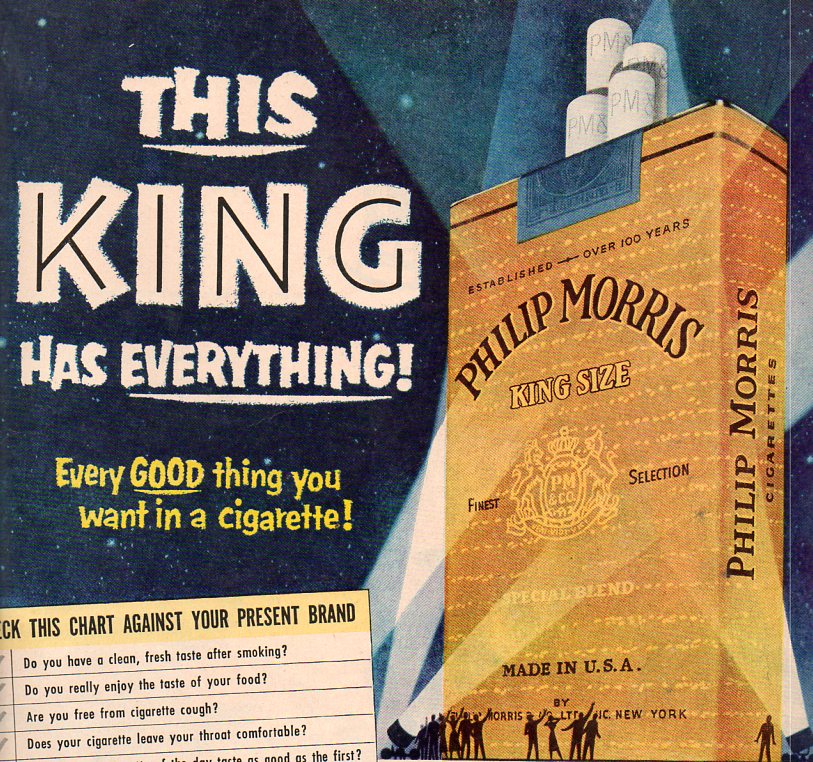
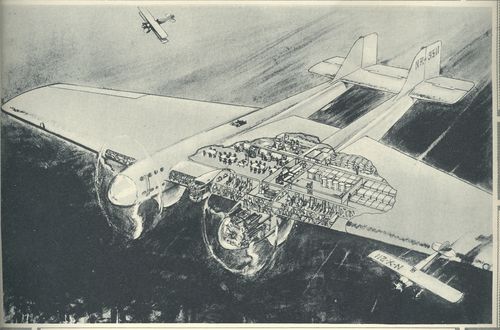
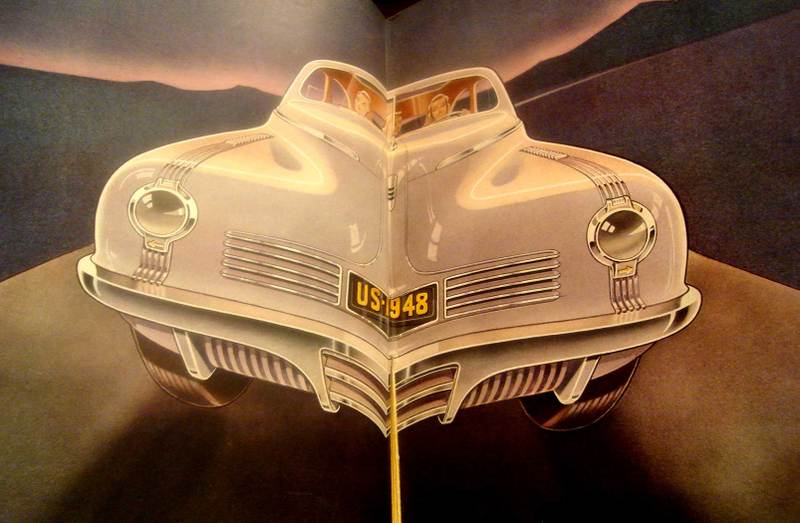
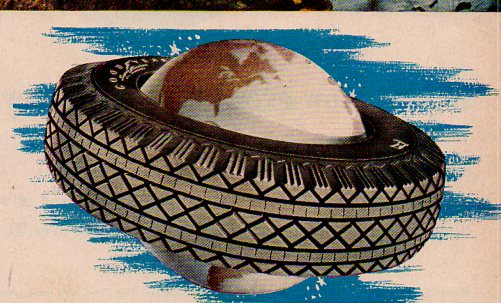
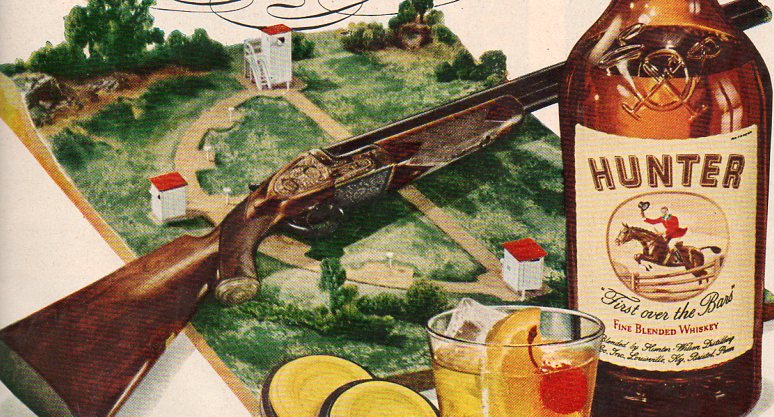
Rabelais’ Gargantua and Pantagruel, Hobbes’ Leviathan, the Buddha at Yungang (Shanxi) and Melville’s whale were all pushed to their competitive monsterous edges in the 1950’s, when you were more likely to think of The Bomb and creeping Communism before thinking back to any of these great representations. And it is also my general impression, having been paging through Life magazine for the 1950’s, that there are some other major, lesser heralds of gigantism, especially if you paid attention only to the advertisements. There were 1950’s colossal characters who were pale imitators of their earlier counterparts–the Amazing Colossal Man and Colossal Woman being two minor mirrors of older ideas–but they hardly contained the colossal ideas that were resident in the earlier creations. (Perhaps part of that is due to having just witnessed the demise of two enoromities in Hitler Stalin.)
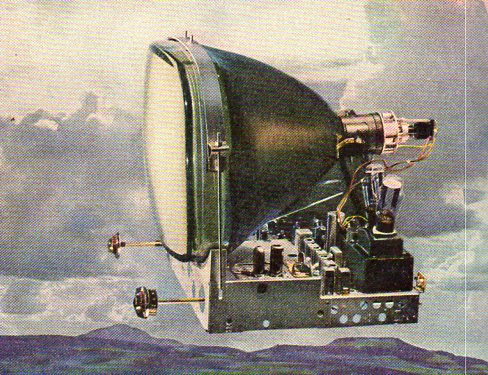
The new Pantegruels seem to have been television (completely victimizing
and nearly eradicating radio in its day), giant cars, liquor,
cigarettes, breasts, and, television, followed by television. There was
also the movies, with films filmed in super-spectro-pano-fabulism; and
of course there were the computers (the 1943 machine at Bletchley Park
was actually called the “Colossus” with Mark 1 and Mark 2 varieties,
which were actually less colossal than the other period colossi such as
the Harvard Mark I/IBM ASCC and ENIAC), which just now turning the
corner on “big” and getting faster/smaller/more powerful, and also
fulfilling the “Giant Brains” dream.
I’m not sure, but it feels right to say that there is a direct correlation to things getting both bigger and smaller as things got faster.
Anyway the new Colossuses/Colossi were hardly as attractive and had
virtually no literary value compared with their earlier Rabelaisical
counterparts or the giant 4th century BCE statue bearing that name in
the harbor at Rhodes. It is certainly true that the big things that
were imagined in the 20th century were beyond any conception of “big” in
the Western Canon of Big. (There are certainly great big things in
other cultures, say, in India for examples, where there are entities and
numbers so vast that there was nothing to compare them with in the
West. But that’s another story.)
And of course joining the gigantic cultures of guns and booze:
There is importance and elegance, grace, necessity in nothingness. That nothing happens is exceptionally important in almost all areas: the meaning of silences between notes and longer pauses in musical compositions, the essential aspect of timing in a comedic routine, the special place that one goes in meditation, the distinction of wide margins in a beautifully designed book (magic that hasn’t been remotely approached by Kindle & Co., though it said that they have their own hidden beauties), and sometimes just the place where ideas are born. The places for the beauty of nothing are endless.
The use of nothingness in art compositions an designs is of course essential–it is sometimes just a little odd to think of it as its own special, spatial element, as its own force of creation or design.
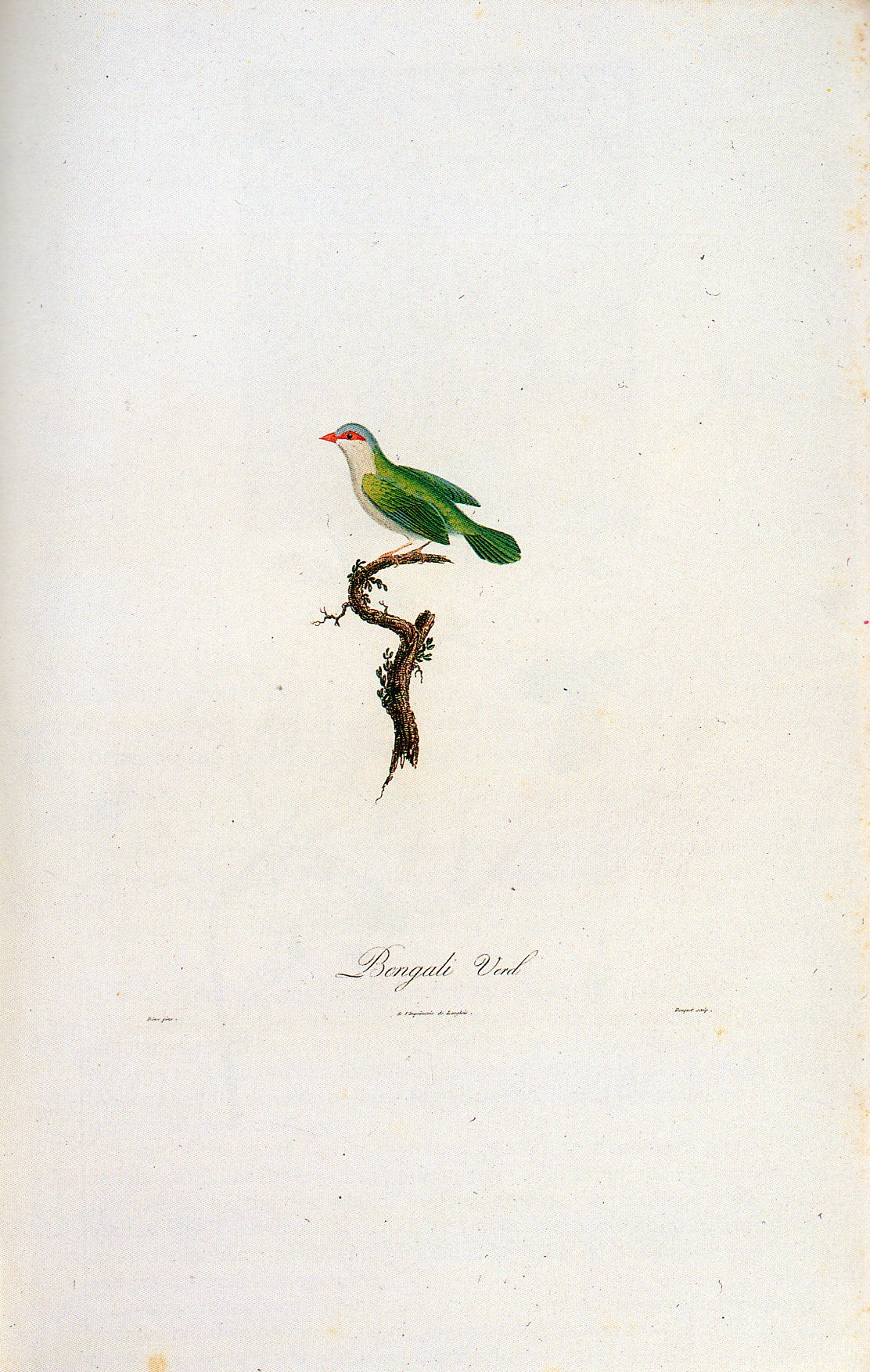
Take for example this beautiful use of not filling up space by Louis Jean Pierre Vielliot in his 1805 work on natural history:
It would be so easy to crop out these gorgeous margins, and so kill the power of this image–you’re left with the main ingredient of the effort, but without its necessity, or power.
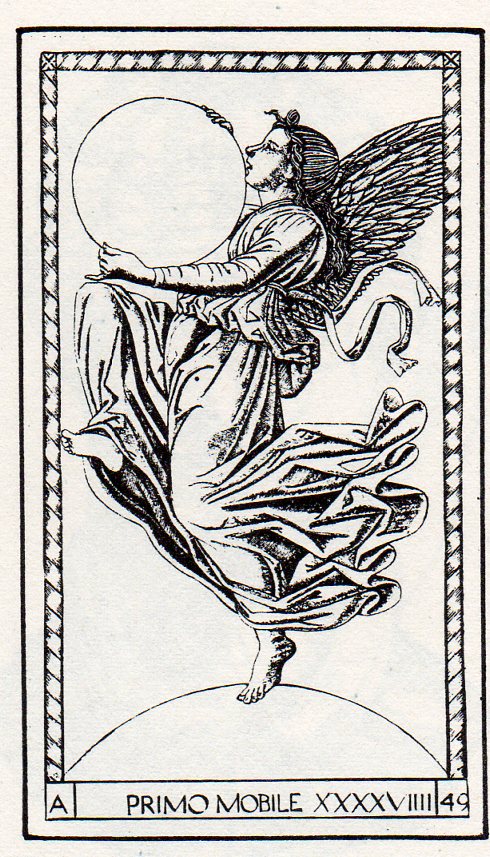
And of course there’s sometimes everything in nothing, seen here, with the universe in the hands of the Primum Mobile, (one image among 50 in a series known as the Mantegna Tarocchi,
drawn and engraved by artists unknown ca. 1465, though it was once
believed to be the work of the great master Andrea Mantegna (and later
the possible work of Bacci Baldini)). From my reading of this image, the universe is held in the hands of the primum mobile,
a spherical container of not-quite-nothing, waiting for the creator to
breathe life into it. The possibility of absolutely nothing was seen as
an impossibility, a perfect vacuum, a space of certain nothingness, was
a violation of theological belief. That the sphere existed was a proof
that–in the 15th century–you simply couldn’t have a container of
nothingness. The very presence of the sphere confirming that there was
something being contained by it.
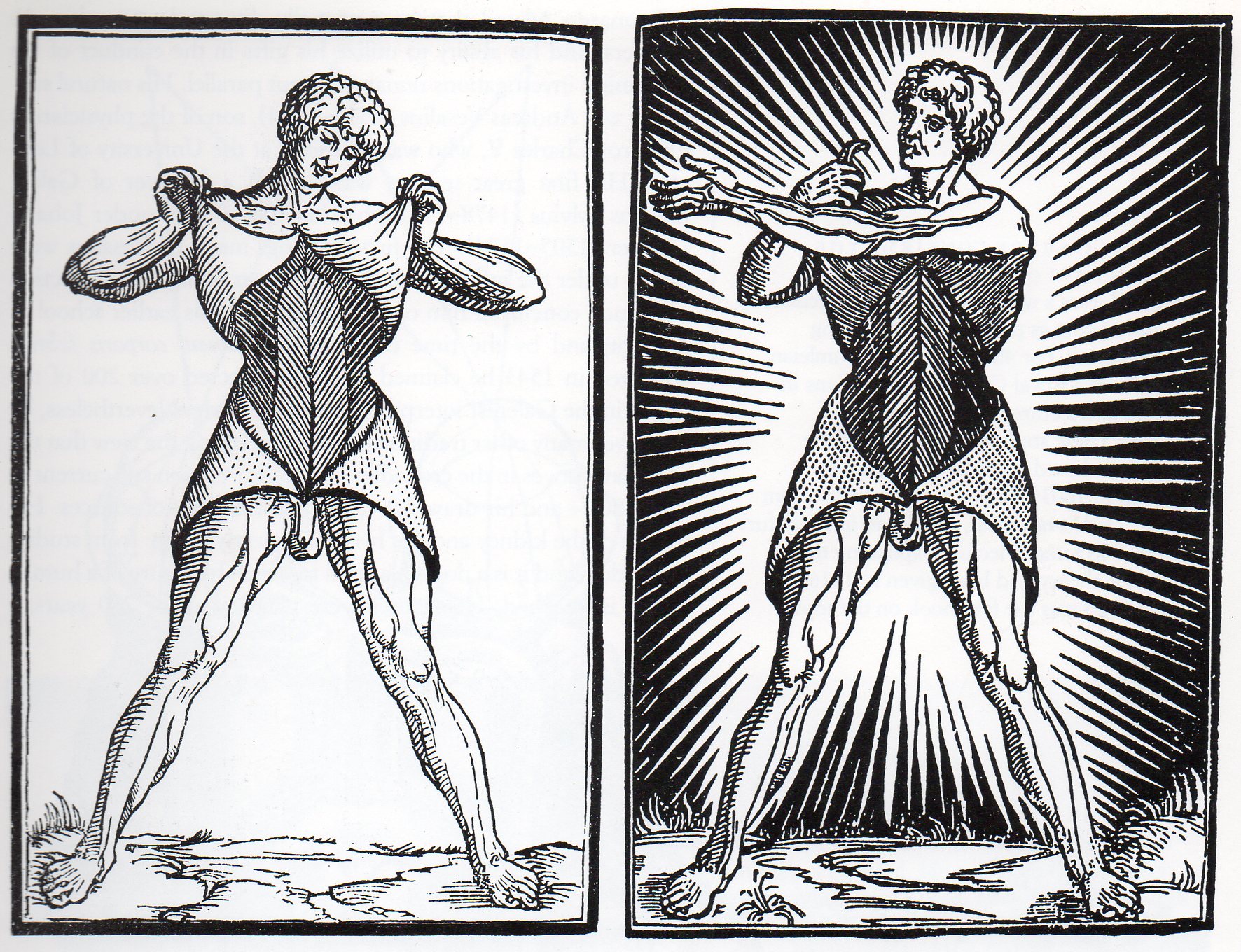
Here’s an excellent example of the use of nothing as a design force (from Berengario da Carpi’s Commentaria siper Anatomia Mundini, published in Bologna in 1521), where we see what is basically the same exact dissection, except for changes in the internal shading and of course the lightning bolt background. The simpler design is by far the superior.
It does take some confidence and courage sometimes to use big wide swaths of white, using complementary nothingness–and that’s a good thing. Sometimes too much “something” isn’t nearly as useful or important as a little bit of “nothing”.
JF Ptak Science Books [A note on an idea for a future post.]
Like my father before me, I grew up playing Cowboys and Indians. In many respects, that game was probably not all that far removed from the history that we learned in our school textbooks. Growing up in a myth and reading about other myths, its hard to disassociate yourself from the power of those words.
I was thinking about this earlier, finishing a post on 19th century American occupational alphabets, and thinking of the ways in which certain classes and types of people are represented–stereotypes, radical misstatement of the truth, and outright lies were sometimes included, and as they were being used to help a young child learn the alpha-beta, they also formed the core, a foundation, of a belief system simply through association and repetition–a twisted mess that very well might have taken decades to unravel.
In that light, I’d really like to see a history of propagandistic history as taught in American schools–that’s where early battles are fought, that’s where the power of words gain strength, and that’s where the basis of all future histories that threaten those introductory lessons come to a point of contention, if not conflict. The power of language finds its way into the young vocabulary, and has a hard time being removed.
Someone wrote a book about everything that they ever needed to learn was learned by kindergarten. That sort of education cuts both ways.
Whether it is an assault on the integrity of the biological sciences and general logic for textbooks to include “alternative” in the teaching of the formation of species and the world, or representing geological time that began in impossibly late stages in the development of the Earth and the Solar System, or glorifying the presidency of Ronald Reagan, it is the control of language that leads to the control of thought, and it is on textbooks that many of these battles are currently being fought. And have been fought.
If I had access, I would love to look at the following books, their titles suggesting a frontal assault on remedial and basic ideas of communication re-fitted to the place and time and people–language and definitions reconsidered to serve the purposes of a new user group. I’ve chosen these titles simply because of their titles, and also because I’m in the South. (And partially too because my wife’s great-great grandfather and three associated relatives fought in the Cause, against the Union, and that is part of their history.)
And so the books that I’d like to see:
Richard McAllister Smith unleashed quite a torrent over a few years: The
Confederate First Reader: Containing Selections in Prose and Poetry, as
Reading Exercises for the Younger Children in the Schools and Families
of the Confederate States (Richmond 1864) followed by The Confederate Primer (1863) and The Confederate Rhyming Primer [Or, First Lessons Made Easy. Designed as an Introduction to the Confederate Spelling Book] (Richmond: 1863) and The Confederate Spelling Book, with Reading Lessons for the Young, Adapted to the Use of Schools or for Private Instruction. (Richmond 1863).
Leverett, Charles Edward. The Southern Confederacy Arithmetic. By S. Lander, A. M.. Augusta: J. T. Paterson and Co., 1864.
There was also the very concerted effort by Mrs. Marinda Branson Moore, including The Dixie Speller. To Follow the First Dixie Reader, ( Raleigh: Branson and Farrar, 1864), The First Dixie Reader; Designed to Follow the Dixie Prime (Raleigh: Branson, Farrar and Co., 1863), followed by her The Geographical Reader, for the Dixie Children.(Raleigh: Branson, Farrar and Co., 1863), and her Primary Geography, Arranged as a Reading Book for Common Schools, with Questions and Answers Attached (Raleigh: Branson and Farrar, 1864).
Robert Fleming managed to really mix it up, and also to get all of it into the title of his book The Elementary Spelling Book, Revised and Adapted to the Youth of the Southern Confederacy, Interspersed with Bible Readings on Domestic Slavery. (Atlanta: Franklin Steam Printing House, 1863.)
Lemuel Johnson’s. An Elementary Arithmetic, Designed for Beginners: Embracing the First Principles of the Science. By L. Johnson. A. M., Professor of Mathematics at Trinity College (Raleigh: Branson and Farrar) published 1864
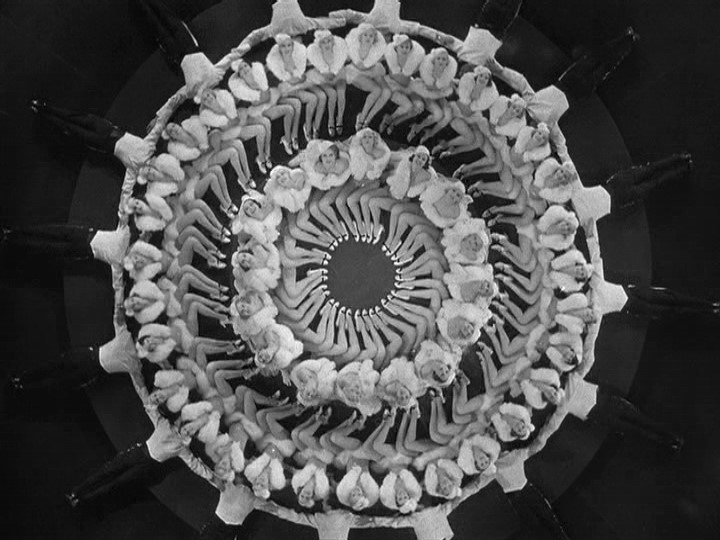
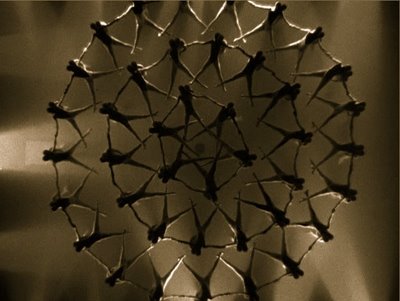
There’s a certain amount of Leggy Geometry going on in the many films of the great and often-troubled Busby Berkeley. Berkeley was about 38 when he came into great prominence as a choreographer for movies with music–they were grand and spectacular, intricate dances involving dozens, many times employing overhead shots looking straight down on a full-kaleidoscope productions. (A kaleidoscope mirrors the great majority of its displayed image; Berkeley mirrored almost nothing, And he didn’t really produce movie musicals per se, I think; those would come later with Fred Astaire and the like, where there were story lines and plots and associated happenings along with the terrific dancing and music. “Plot” was a throw-in with Berkeley, but everything else was just so grand that storyline really didn’t get in the way of entertainment.) The motion, the offset camera work, the constant motion, almost gives you the sensation of falling into a Phoenix Set. Between 1931 and the end of WWII, Busby choreographed more than 30 films, many of which are now considered high classics, his very name now associated with fabulous stage productions.
There’s a big dollop of natural history geometry in his work, as we can see by this selection of still images below. They’re tessellated (if you squint hard and make sure there are no margins) and fractal-like, very organic, very much looking like diagrams outlining the mathematical forms of nature. And they’re pretty.
[A continuation of sorts on an earlier post “Did Teeth Exist in the Renaissance? Art and the Toothy Smile, 1300-1600”]
Did more people in the U.S. laugh in 1924 than at any time in American history?
The mass-consumed smile, the social laugh, the pantomime, the big grin, the sly eye, the devilish smirk, the latent laugh, the absorbed chuckle, the impish grin, were all elements of the human comedy that were difficult to see in the theatrical realm. When performers were in front (or within, etc) a large audience, many subtleties of humor and comedy inherent in communal story telling that could be conveyed by facial expressions were simply lost. The culture of the magnified moment, especially in comedy, I think, was not discovered until the motion picture was invented. It was then, and then particularly with the invention of the closeup, that comedians were finally able to display the vast quiet parts of their craft, especially in fine pantomime. This sort of thing was just not visible in the performers on a vaudeville or burlesque stage. It was with the motion picture and the close-up that made the facial expressions as keen as and broadly appealing as slapstick, or the good-bad paradigm, or even The Chase.
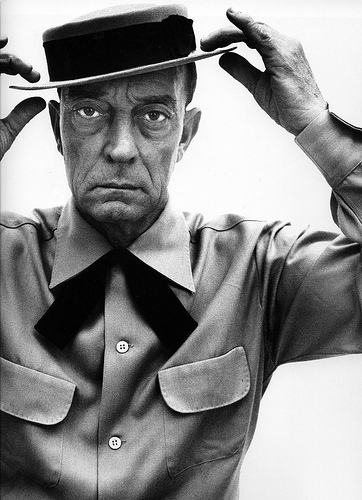
Fatty Arbuckle, Chester Conklin, Fred Sterling, Charlie Chaplain, Ben Turpin and especially Buster Keaton (whose facial expressions were exceptionally wide without really ever changing his expression) all came to greater prominence because of the close-up. There were more people from more different social and economic backgrounds seeing more comedy by more comedians–and seeing more of the comedians–than at any time in human history. And I guess we can infer that they were laughing more, because the output of comedies (Ben Turpin producing 150+ movies in one year alone, for example) continued to grow.
[I think that if you had to identify one single development that would allow the non-comedy to move to the top of the marquee was the invention of the serial–showing a series of episodes, which building one on the other, leading to a longer, intertwined story, developing characters and of course the audience, the returning audience.]
In the chicken-and-egg scenario, perhaps what moved the laughter forward more so than the close-up was standardization of motion picture practices, especially in the display department. That allowed movies to be more easily distributed, making for lower prices, more audience, more profit, more movies, more laughter (etc.).
Standardization is an interesting story, and as much as it seems to take the creative edges off of some things, it adds to it in other ways. “Standard Operating Procedure”, the codification of law/de jure, defining words in a consistent manner, having the same rails for all trains, establishing consistent screws threads, creating surgical procedures, developing prescription standards, having interchangeable parts for things like guns and cars and gin reapers, having standard weights and measures, and on and on, are all important things that allow us to not have to repeatedly recreate the daily bits and pieces of our lives. (Even the “little” improvements in this area can have enormous consequences, like, for example, the British Navy standardizing sailing blocks, which went a long way in ensuring ship operation and safety. Stuff like that seems like just a bit-and-piece, until you look at their long-term effects.
Anyway, I could very easily be all wrong about this laughter thing, but from where I sit this morning, its an interesting thing to think about.
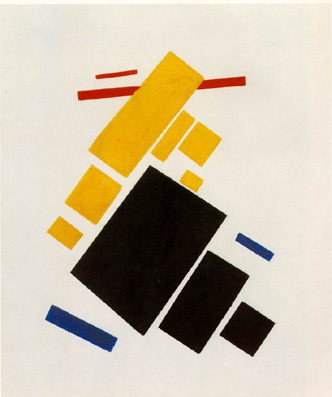
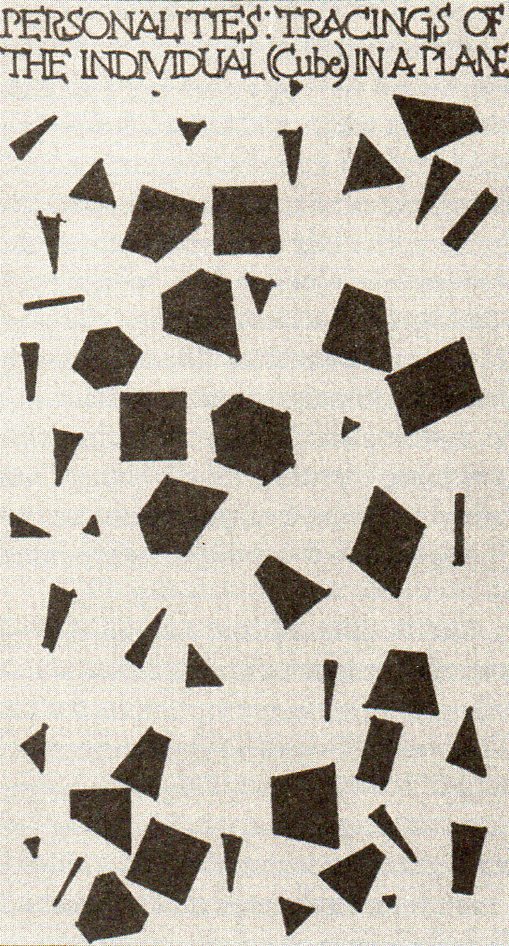
Is there room in the history of invented art to reconstruct cubist and abstract paintings by imaging the objects that could’ve passed through the canvases to leaves their geometric footprint? That is to say, if you took the Woolworth Building in NYC and passed it at an oblique angle through a large sheet of paper, and that paper was permeable enough and the building moving slowly enough to simply leave its “footprint” without tearing or deforming the surface of the paper, the resulting image may look a lot like figures in classic works in the history of art.
That is no revelation, really, as the Black Square or Airplanes Flying of Kasimir Malevich could’ve been made by every fourth item on your desk. But what is interesting to me would be the reverse of this process, where you take that black square and reverse-engineer it, extruding whatever figure it was that could’ve made the black square into its three dimensional counterpart.
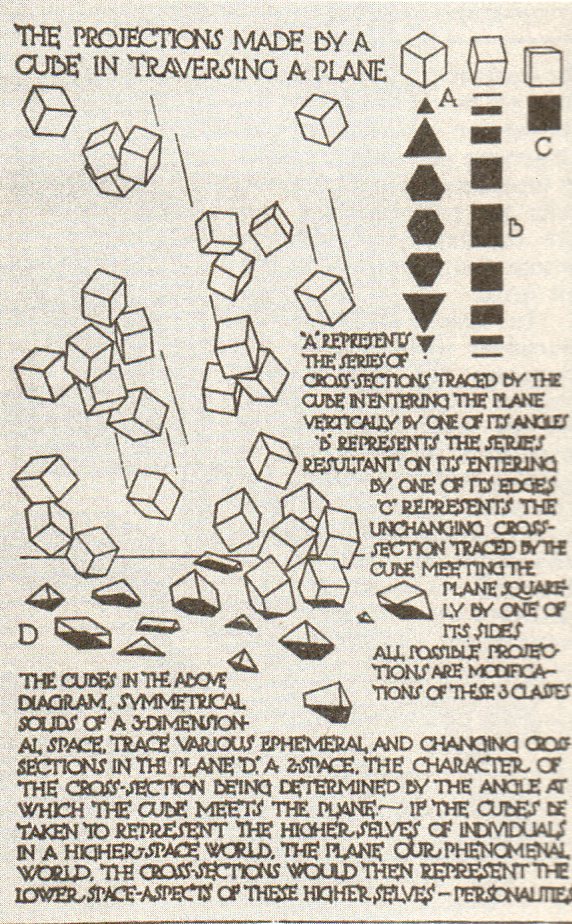
What comes immediately to mind for me in this regard is Claude Bragdon (1866-1946), (a New York-based architect with a long set of sleeves for writing in upper dimensional planes of Theosophy and reincarnation and other similarly squishy reaches) who wrote a few interesting books on the fourth dimension and objects and space, writing two of them at a very interesting period of t ime for the history of physics and art (1912 and 1913). The books are interesting enough, I guess, and seem to perhaps have had an influence on some influential artists of that time, but what is of interest here are tow illustrations.
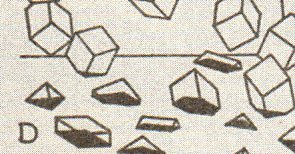
First is “the Projections made by a Cube in traversing a Plane” from Primer1, showing the impact (at different levels) of a cube falling through a plane. The second, “Personalities: Tracings of the Individual (Cube) in a Plane” from Man2, shows the “shadows” of the three-dimensional figures as they lived in their two-dimensional world. It comes close to the impact of the cubes above, but really only depicts what two-dimensional creatures would see of the three-dimensional beings inhabiting their Bragdonesque world.
I like the tracings more as impact points than 2-D renderings of 3-D objects, and in some ways they are very similar. (I have to say that I am surprised that given Bragdon’s expanse of taste and artistic ability that he didn’t arrange these images in an artistic manner–in that sense he entirely missed the boat on adding his own bit to the newly-formed Cubist world. He also reminds me of Emily Vanderpoel, who in her own way completely missed the new artform that she was serendipitously creating.)
So when I look at something like a Malevich or Mondrian or even (but less so) at a Duchamp (Bride), I find it interesting to manufacture the base of the something that plunged itself cleanly through their canvas, pulling it out again, giving it three dimensions, and incorporating the thing as a piece in a chessboard–the chessboard being the pieces that made the shapes in the canvases resulting in the Art Deco vs. Cubist/Suprematist Chess Set. It would be interesting to choose two representative canvases for either style and see if one (or a couple of ) object(s) could make all of the shapes in the two representative paintings, populating a chessboard with sameness.
The bottom line, then, is how different or similar would the extruded three-dimensional figures be that were responsible for this impact in a two-dimensional surface be?
(I am reminded too of Duchamp and John Cage sitting down to a game of chess and producing a musical composition via their moves, at Sightssoundsystems, a festival of art and technology in Toronto, 1968. In this way too an artwork could be made with each move in a game of pieces used to make iconic shapes in the history of art. “They did not speak. They did not sing, they remained, all of them, silent, almost determinedly silent; but from the empty air they conjured music. Everything was music…” Franz Kafka, Investigations of a Dog.)
Notes:
1..(Bragdon) A PRIMER OF HIGHER SPACE. (The Fourth Dimension). Rochester: Manas Press, 1913. 8vo, (12), 79pp, including 30 plates.Notes:
2.. (Bragdon) MAN THE SQUARE. A Higher Space Parable. Rochester: Manas Press, 1912. 12mo, 34pp, 9 illustrations.