A Daily History of Holes, Dots, Lines, Science, History, Math, Physics, Art, the Unintentional Absurd, Architecture, Maps, Data Visualization, Blank and Missing Things, and so on. |1.6 million words, 7500 images, 4.9 million hits| Press & appearances in The Times, Le Figaro, Mensa, The Economist, The Guardian, Discovery News, Slate, Le Monde, Sci American Blogs, Le Pont, and many other places… 5000+ total posts since 2008.

Category: History of Goodbye

  • Ghost March–Doughboys in London and Four Years of Mist, 1918

    JF Ptak Science Books   Post 1328

    .003%  That’s what I reckon this column of soldiers would represent of the total casualties of WWI.

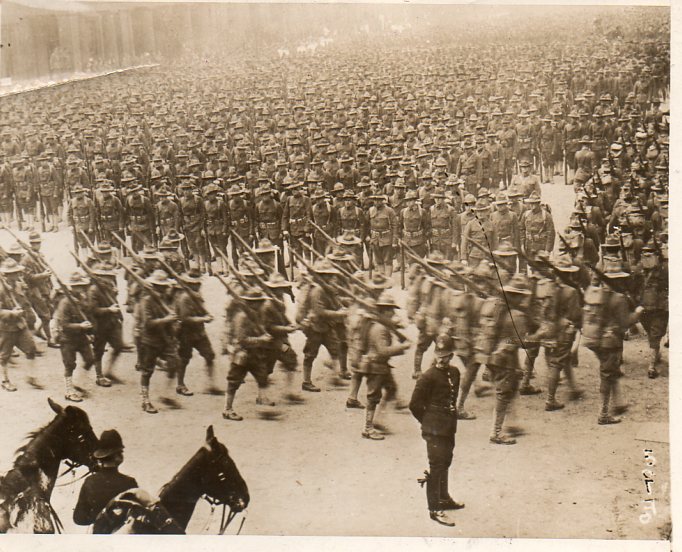
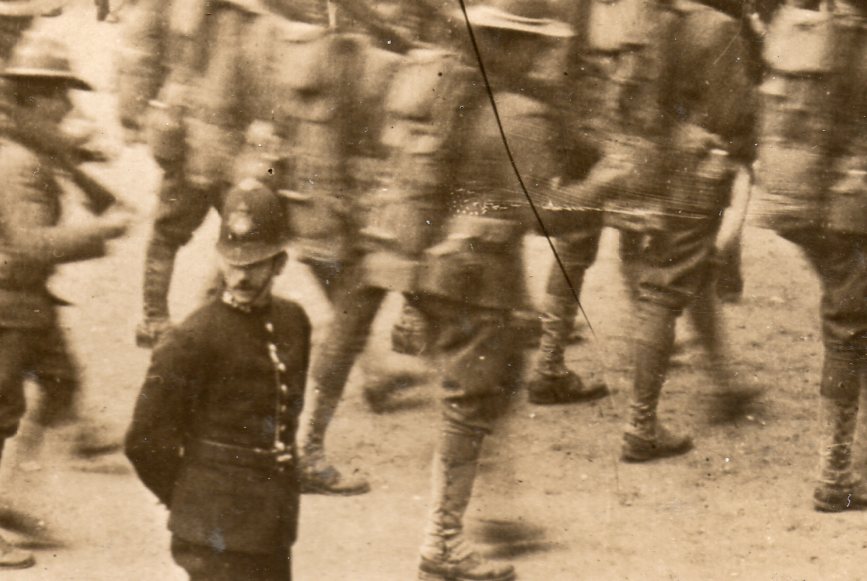
    Generally images like this are a virtual image-host for me, a bucket of ice cold water thrown onto a sizzling summer sidewalk, all sorts of ideas steaming from it.  But for photographs of Doughboys1 marching, especially assembling for parade, this one struck me a little more oddly than most, giving instant pause, making me concentrate on the haze, or dust, that allowed the columns of soldiers to blend into one another and fade, losing their boundaries with their mass receding into a dull blur. 
    Marching london 350

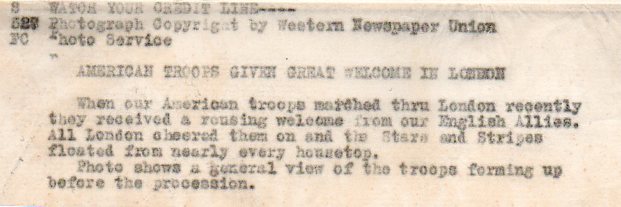
    The Western Newspaper Union was selling this image for insertion in newspaper or journal stories about the war, for a small use fee.  There were a few American organizations like Western Newspaper that were created to photographically cover the war, using pools of photographers who would distribute their work anonymously and which was available for common, general use for a small charge.  The photographs allowed out were certainly restricted and censored, though in my stash of these of objects (numbering about a thousand) I’d say that 10% of them look pretty edgy to my eyes.  Most of the action of war was not covered, but then again this aspect was still fairly technically difficult in 1918.  Images of pain were almost never allowed, and certainly not pain of Allied troops.  Aid stations were almost never covered as well, as were dead bodies, or at least those again of Americans or Brits or French or Canadian.  The imaging of the war was certainly under a fair amount of supervision and control. (The original is available for purchase through our blog bookstore. here.)
    Marching london det352

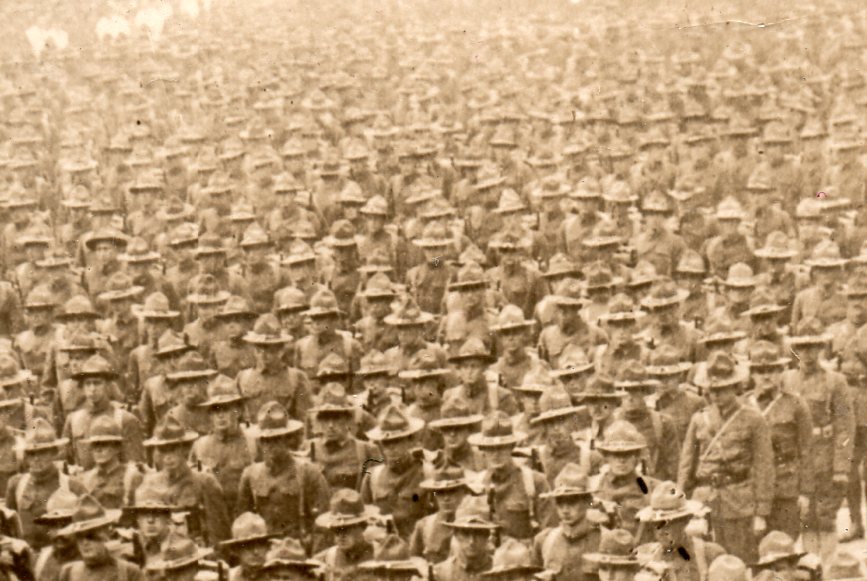
    The image shows American troops assembling for a parade through the streets of London before being deployed.  The mistiness of the composition looks like a statistic to me, these men standing for those who had come before and fallen.
    Marching london det353

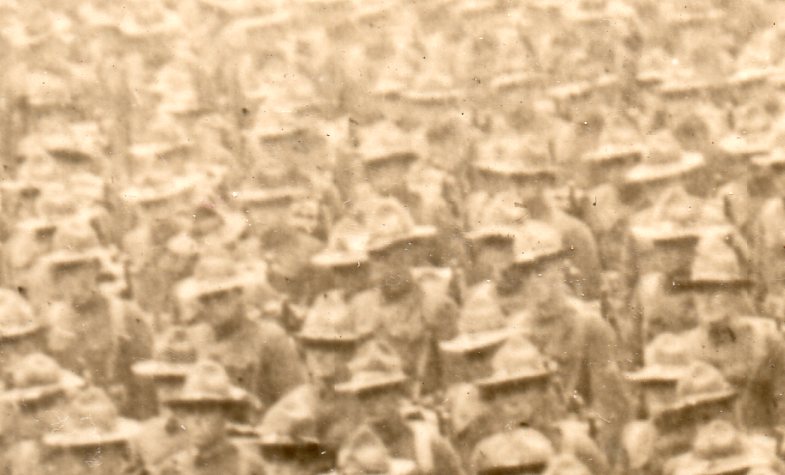
     The U.S. lost .13%  of its population to casualties (125,000 killed and 205,000 wounded) during the war–a war which by the time America got here had already been visciously fought for three years, costing dozens of millions of lives.  The figures for everyone else weren’t nearly so “fortunate” as the U.S.:  New Zealand’s 18,000/41,312 killed/wounded amounted to 1.6% of its population.  The U.K. lost 2.19% (964,000/1,663,000), Italy was 3.48% (650,000/953,000 plus 650,000 civilian casualties), while France suffered a 4.29% (1.4 million/4.27 mil) blow of its total population to war.  Things were worse on the other side:  Germany 3.82% (2 mil/2.4 mil plus 426,000 civilian deaths, and the Ottoman Empire 12% (400,000/771,000 plus 2.1 million civilian deaths.   Worst of all was the Ally  Serbia, suffering a catastrophic 16% loss of its population to war, including 275,000/725,000 plus 426,000 civilian casualties.  As gruesome as the numbers were, the Americans felt only a small percentage of the total sting of war–by 11 November, more than 21 million soldiers would have been wounded, with 9.7 million soldiers and 6.8 million civilians killed.  It was an enormous price.

    And that’s what I see in the mist of what may be something like 10,000 soldiers on display n this photograph.  .003%  That’s two of these columns every day, twice a day, for the entire 1550 or so days of the war.   
    Marching london cop351

    Marching london txt354

    Notes

    1.  The origin of the term “Doughboy” is unclear, or varied, or rich, but it is at least pretty oldm beginning around the time of the Mexican American War in 1846-1848–evidently when the soldiers marched through dry, tough terrain they wound up being covered by earth with the color of dough.  Doughboy.

  • Blank, Missing & Empty Things: German Soldiers, November 1918

    JF Ptak Science Books   Post 1305

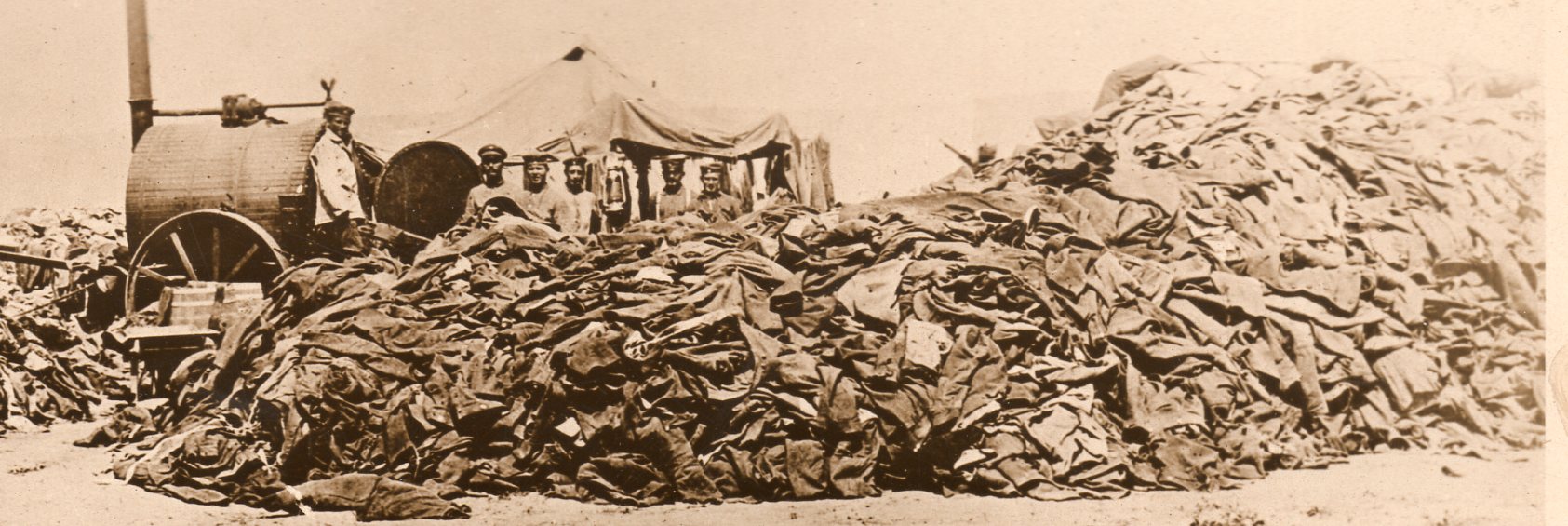
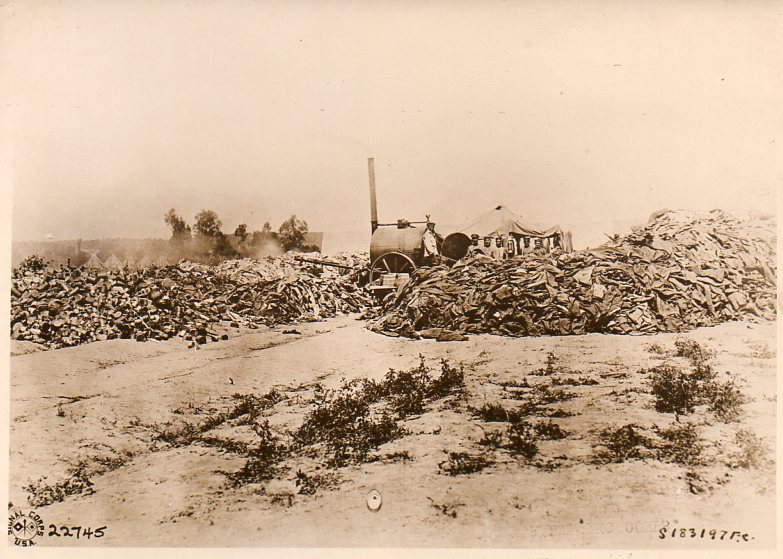
    This remarkable photograph is part of an archive of World War I Underwood & Underwood News Photo Service photographs I purchased many years ago.  It shows a pile of German soldiers’ uniforms–thousands of them–taken from German prisoners, the clothing headed for “cleaning and repair”. 

    World War I photos--empty uniforms287

    [This photo, along with mnay others, is available for purchase from our blog bookstore.]

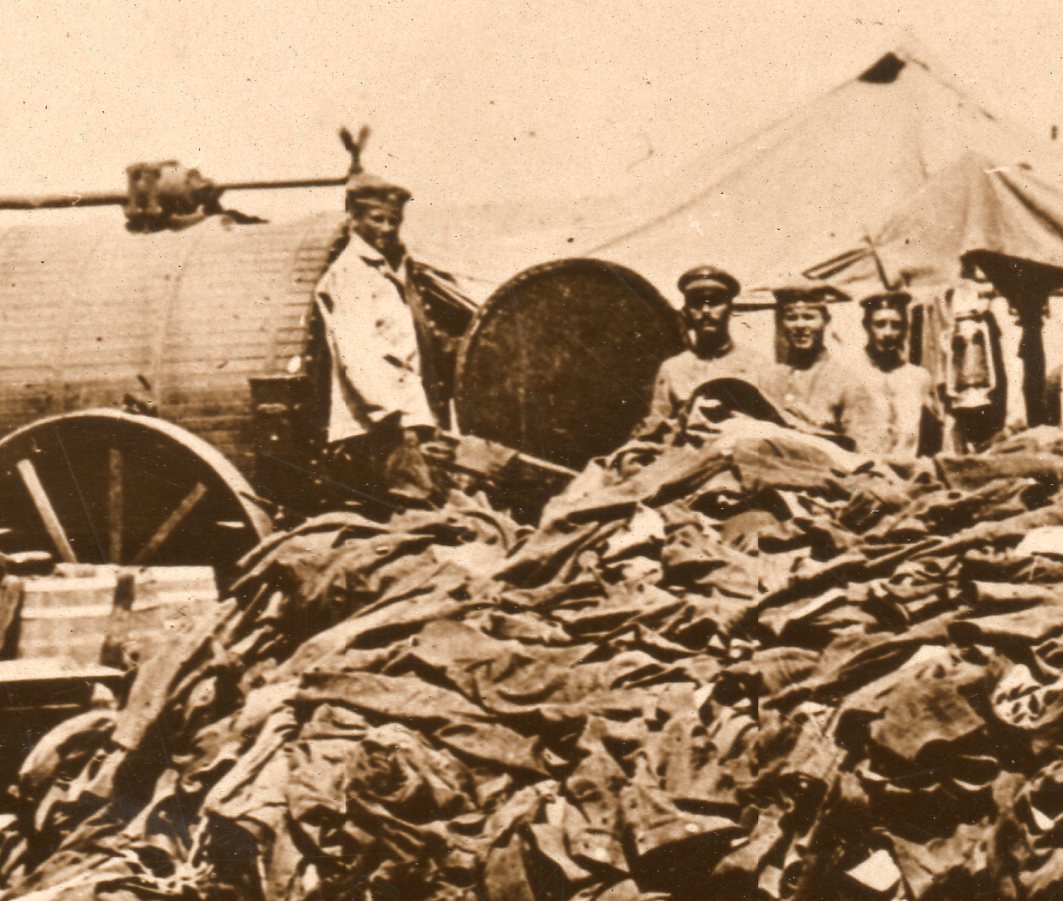
    I didn’t know before this that the uniforms were repaired–I can imagine the cleaning part, since the prisoners must wear something, and deep into the fifth year of the war it seems hardly the case that they would be given anything at all to wear except for what they were captured in. the cleaning part sounds logical too, especially as the cleaning was being done by the prisoners themselves (pictured here).  Clean clothing makes for more sanitary conditions in mass compounds for thousands of prisoners, and lowers cost for the health maintenance for the prisoners in the short and long run.  And so far as repairing goes:  attached buttons make for closed coats; closed coats allow prisoners to have a better chance at staying healthy in the coming cold months. Just ask Napoleon about the cost of thread on the buttons of his army’s overcoats in the march towards Moscow.  (The thread that wasn’t used cost very little; the cheaper thread that was used cost everything.)

    And the detail:

    World War I photos--empty uniforms det288
    And closer still:

    World War I photos--empty uniforms detb290
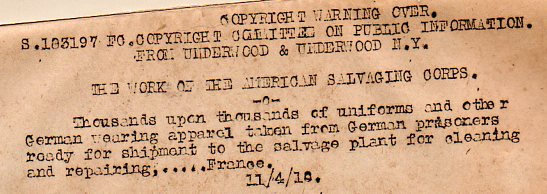
    And the text that was provided by the photo service company to be used along with the photo wen (or if) it was published. 

    World War I photos--empty uniforms txt289

    The cleaning and repairing went on, the prisoners kept coming in–even for those involved, the scent of the end of the war was in the air, though I doubt that the majority felt that it was only a week away. 


  • Reporting the Hiroshima Bomb the Day After, 7 August 1945. AND the First Graphic of NYC A-Bombed

    JF Ptak Science Books   Blog Bookstore  Post 1257 (continuing post 669)    Atomic and Nuclear Weapons Series

    ==Blog July 26=PM cvr bomb

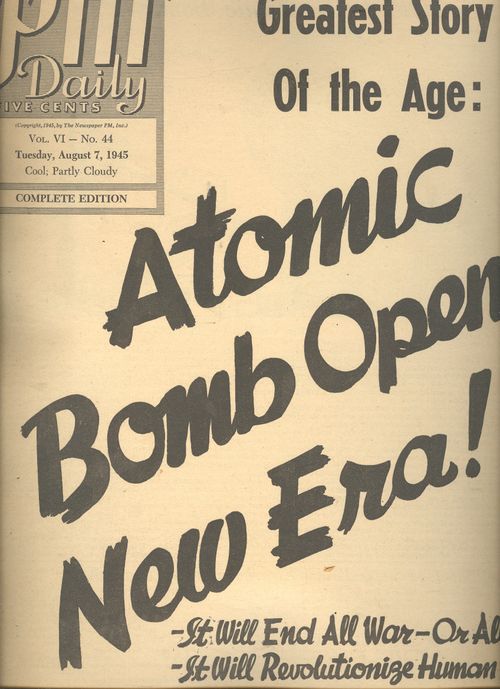
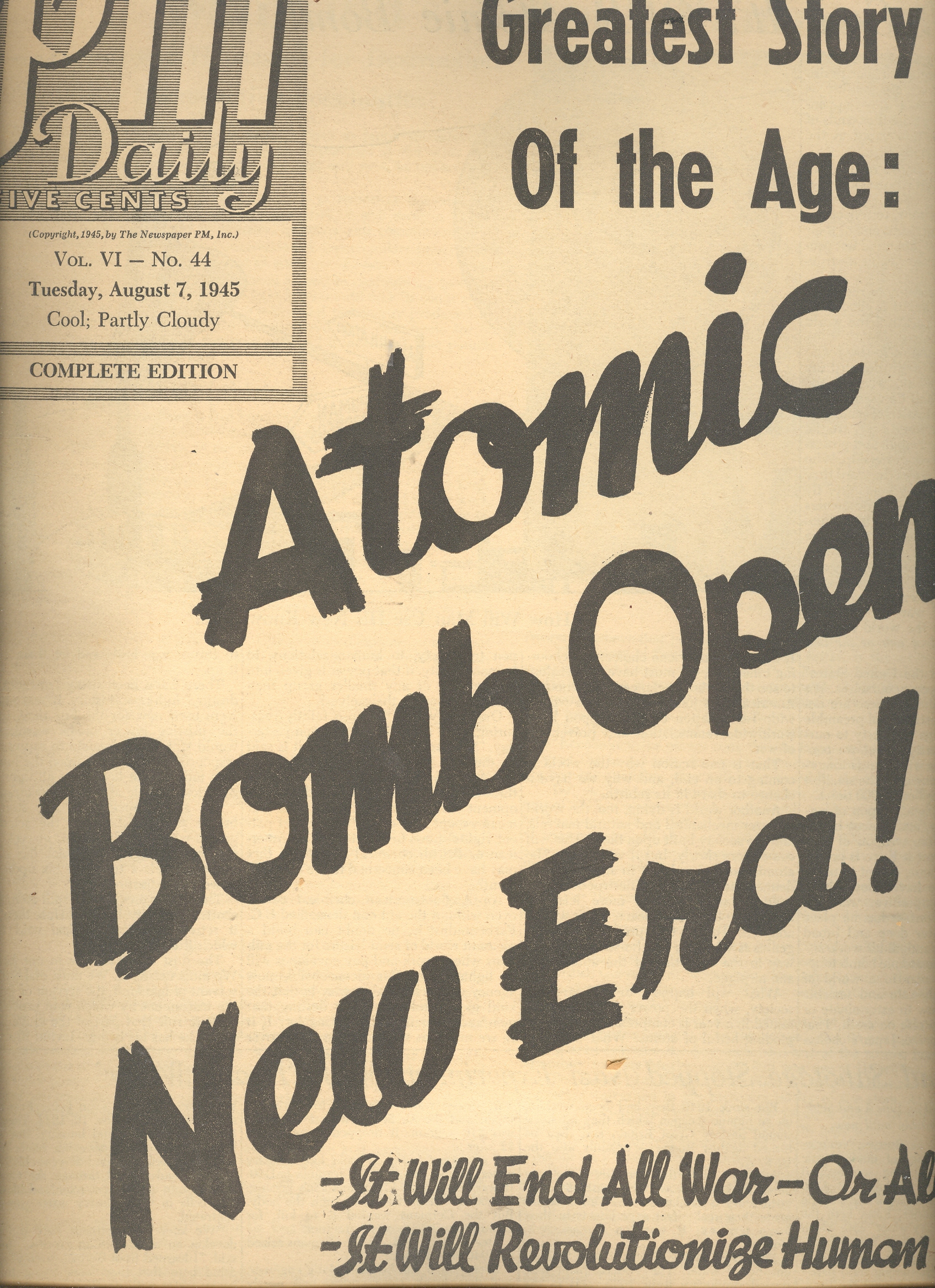
    The news coverage of the 6 August 1945 bombing of Hiroshima was covered in spectacular (all things and time considered) detail in the 7 August issue of the daily newspaper, PM.1  The entire issue of 12 pages (with no advertising2) was dedicated to the event—I have no idea, really, how they were able to put together this amount of good tough data so very quickly, nimbly and intelligently, as the bomb was detonated at Hiroshima only the day before. 

    It is odd how well the case is covered, and it is positively issued on the day after –it isn’t the case that it was issued for the week of 7 August and released on 13 August, which I thought was a possibility of explaining the deep coverage.  But there’s no mention of Nagasaki (which would come in two days), so I am certain that the coverage was all accomplished within 24 hours of the use of the weapon.  The newspaper distinguishes itself by not screaming something about the “Jap city” being wiped out (as so many other newspapers did), with its front page summarizing beyond the bomb.  (“It Will End all War—Or all Men” and “It Will Revolutionize Human Life” as sub-heads; the first being accurate, while the second being nearly so.) 

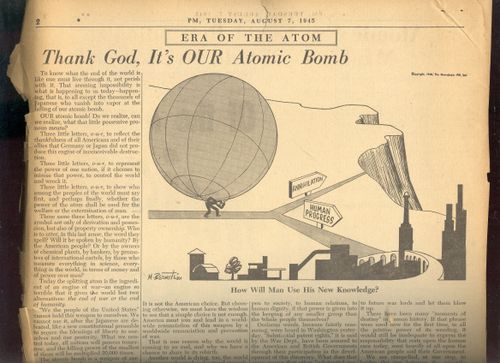
    The editorial, “Thank God its OUR Bomb”, by Irving Brant, is a lovely piece of thoughtful interpretation in the opening moments of the nuclear age. He writes: “America must join and lead in a worldwide renunciation of this worldwide renunciation and prevention of war”,and “What will happen to industry, to society, when the power of all the coal mined in a year is compressed into an exploding fistful of atoms?” And further:“There is no escape.  The split atom may shatter humanity, but not before then will it retreat into the physical void from which it came.  The dust of creation is in our hands.  We must master it.” Not bad stuff for having a few hours or so to think this  through. 


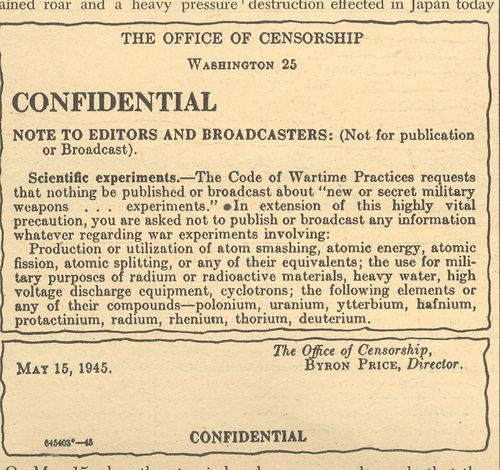
    ==Blog July 26=PM cvr bomb censor


    The other articles included “Bombs and Sabotage Stopped Nazi Experiment with Heavy Water”, “New Atomic Era Could Revolutionize Mankind’s Whole Manner of Life/Power Harnessed for Destruction Has Limitless Constructive Possibilities”, big two-page story “Stimson Reveals How Work on Bomb Was Organized”, “Bomb’s Death Range Believed to be 4 Miles”, “Four Scientists who Will Plan Postwar Uses of Atomic Energy”, “Harnessing of Atomic Power research Strengthens US Research”, “If a Piece of the Sun Were Placed on Earth”, “End Not Yet Truman Tells the Japanese”, and another 12 articles.

     ==Blog July 26=PM cvr bomb artoon

    There’s another baffling article “Steel Tower Vaporized in First Test”, discussing the shot at Alamagordo—it must have been the case that there was an enormous amount of material divulged by the government in the hours after the explosion at Hiroshima .  The work at Columbia is also chronicled, as is the personal life of the man in control, General Leslie Grove (and how completely in the dark his wife was, and so on). 

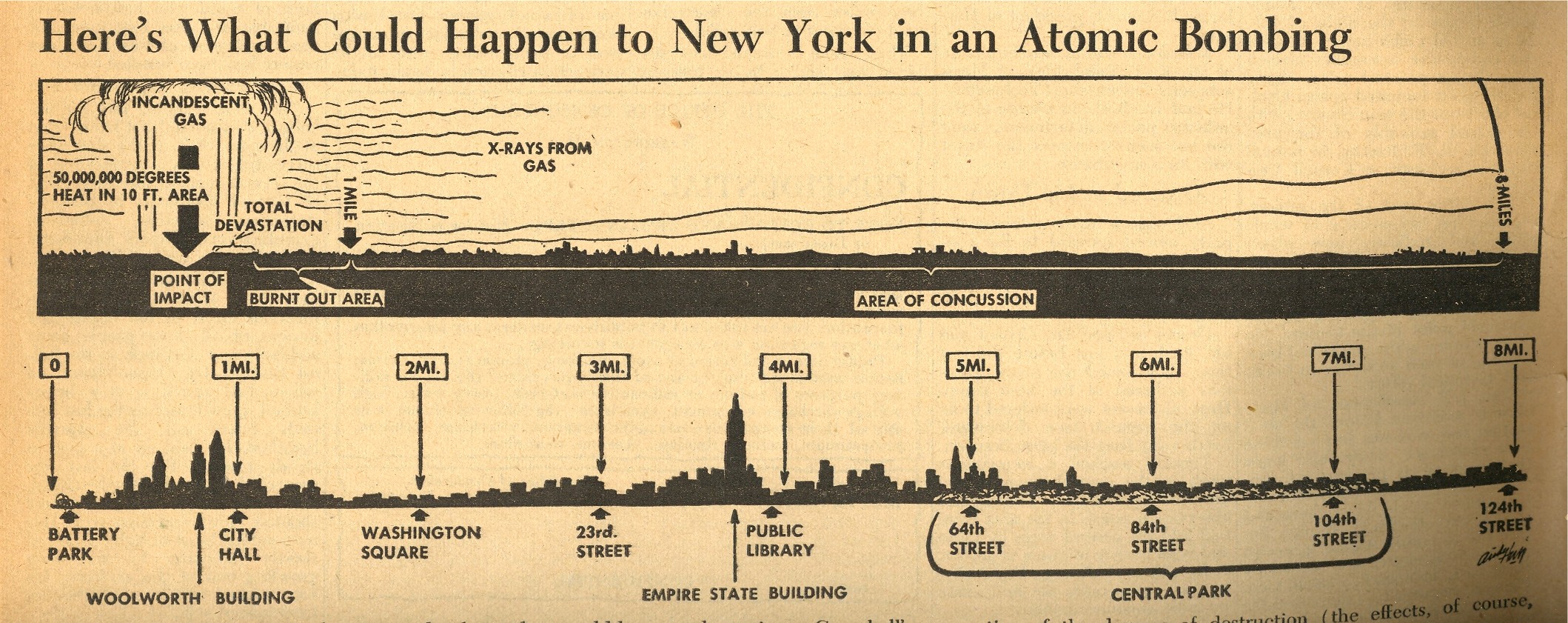
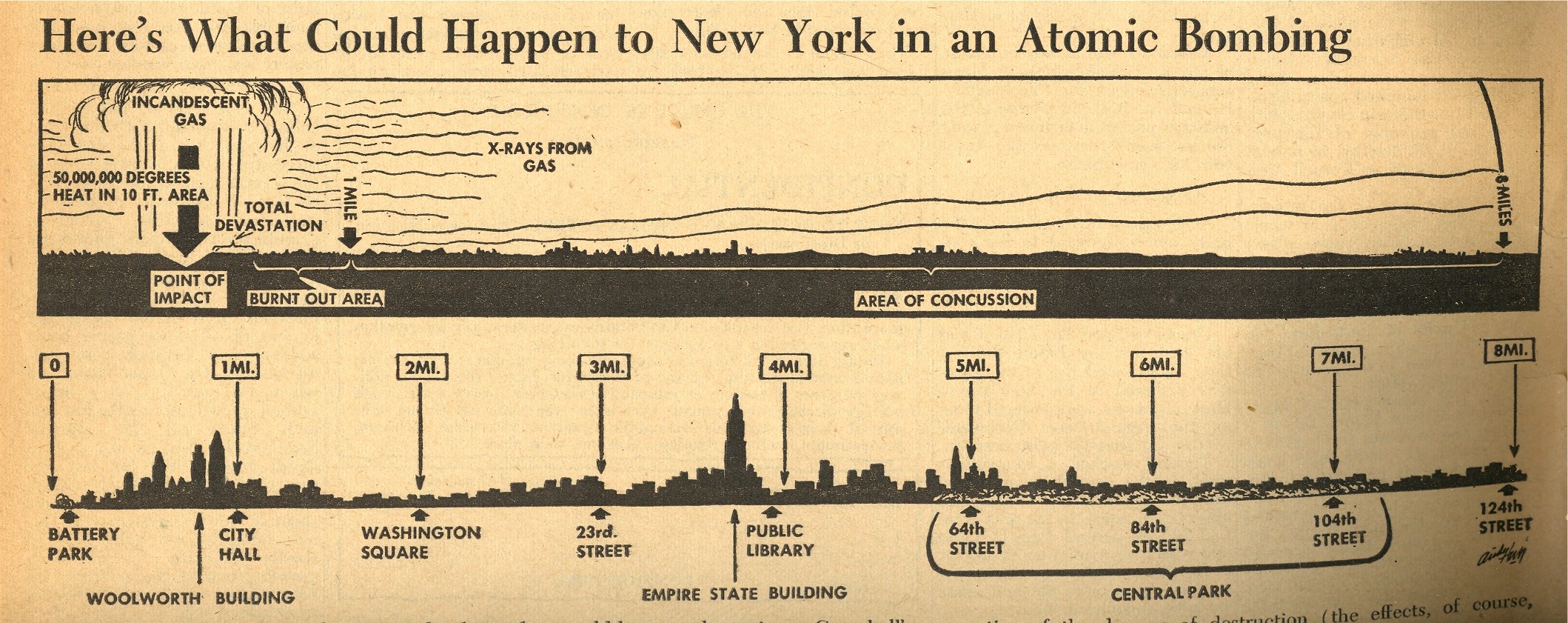
    One of the most interesting objects to me though is the small graphic on page 7 which shows what effect the Hiroshima atomic bomb would have if dropped on New York City—it was no doubt gigantically sobering to anyone who looked at it, and brought the power of the bomb and its destruction to a common, understandable point.  I’m not an historian of the first newspaper coverage of the bomb, but it strikes me that this may well be the first graphic to depict the effects of an atomic bomb exploded over NYC.

    ==Blog July 26=PM cvr bomb map
     

    In any event, the overall coverage of the event was stunning given the short amount of time to do the research, writing, and publication.  Truly a great effort. 

    Notes:

    1. PM (1940-1948) was a left-wing newspaper funded by Marshall Field III, and was home to excellent reporting.  See here for more details. Among the staff writers was I.F.Stone and staff photographers Margaret Bourke-White.  Other contributors included Heywood Hale Broun; James Thurber; (the great) Dorothy Parker; Ernest Hemingway; Eugene Lyons; Ben Stolberg; Malcolm Cowley; Tip O’Neill;and Ben Hecht.

    2. Actually, NO issue of PM had advertisements–it was entirely ad-free. (And even so it still came close to making money after 8 years.)

    PM‘s stated mission:

    PM is against people who push other people around.   PM accepts no advertising. PM belongs to no political party. PM is absolutely free and uncensored. PM’s sole source of income is its readers–to whom it alone is responsible.PM us one newspaper thayt can and dares to tell the truth.

    Theodore Geisel (Dr. Seuss) was a cartoonist for PM (see here for his War cartoons) as was the great Crockett Johnson.


  • The Discovery of America(ns), 1933: a Vast Understatement of the Condition of Native Americans.

    JF Ptak Science Books  Post 1256

    Nothing makes “discovery” itself than re-discovery, with the important element being “forgetting”.  Some important thnigs in the history of science have been “forgotten”, or not remembered, actually, little reported–like Mendel’s work on genetics and the re-discovery of penicillin.  And the flying shuttle.  And so on.

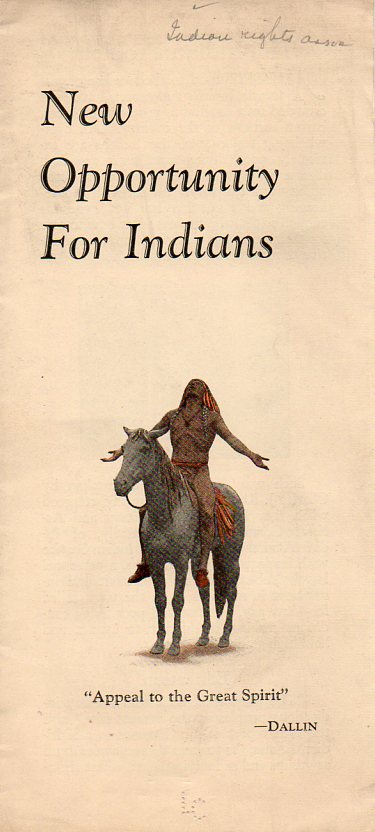
    Indian oppty011 This small pamphlet, New Opportunity for Indians (1933), may look like a solidified reverse misprint: “opportunity” rather than its plural, and singular “Indians” for its plural, and identifies what may be one of the most forgotten things in American history.  (The pamphlet is available at our blog bookstore.)

    The fact of the matter is that Native Americans had been basically forgotten during the last forty years or so, squandered away onto removed reservations with little support or money or time or effort. 

    In 1926 the Bookings Institution authorized a study of the condition of American Indians, with Lewis Meriam and his team responding with their report The Problem of Indian Administration in 1928.  It was the first statistical and analytical survey of its kind in eighty years (though the special volume of the 1890 census Indians Taxed and Indians Not Taxed comes close, though without a particular analytical thread) and was a general indictment of the government’s treatment of the Indian.

    We find most of the following in just the first dozen pages or so:
     –“the health of the Indians compared with that of the general population is bad.”(page 3) and that tuberculosis and trachoma were widespread, and infant mortality high.A major contribution was poor health facilities and the lack of Indian language understanding by the health care providers.
    –“The hospitals, sanatoria, and sanatorium schools maintained by the Service, despite a few exceptions, must generally be characterized as lacking in personnel, equipment, management, and design.”(page 9) And that “the government, through numerous on- and off-reservation health –“the most important single item affecting health is probably the food supply.”
    –“The income of the typical Indian family is low and the earned income extremely low.” (Page  4.)
    –“In justice to the Indians it should be said that many of them are living on lands from which a trained and experienced white man could scarcely wrest a reasonable living.” (Page 5. )
    –“The economic basis of the primitive culture of the Indians has been largely destroyed by the encroachment of white civilization.” (Page 6.)
    –Little attempt has been made to formulate a broad constructive program for the service as a whole, extending over a long term of years, and having for its goal the general improvement of economic conditions.” (Page 5)
    –“The survey staff finds itself obligated to say frankly and unequivocally that the provisions for the care of the Indian children in boarding schools are grossly inadequate.”(Page 11)

    And on and on.
           
    Perhaps the most important outcome of the Meriam report was the abandonment of the Dawes Act of 1887, which basically broke up tribal connections and lands, segregating individual families ad incorporating them as yet another American farming family.  Franklin Roosevelt’s Indian reorganization Act (1934) ended this practice and allowed for the organization of tribal government and incoporation of land trusts.

    But the fact that the Indians had been discovered, and discovered to have been rendered into such poor conditions, and that there was a general consensus to alleviate those conditions and provide better and more uniform health care and food (especially food) and education and tribal independence, it did not mean that getting the money for doing such things would be accomplished.

    In this slim pamphlet the outlines for helping Indians are described and failures acknowledged, though generally the planning was scant and rudimentary.  The pamphlet did identify “the first essentials tr a satisfactory home life are adequate food supply, proper clothing, and a comfortable shelter”. I think stopping at the “food supply” part would’ve been enough. 

    There was certainly an increase in money spent on health care, but the increase wasn’t much to speak of, not really.  The pamphlet states that “Indian Health Appropriations” topped out in 1911 at $40,000–or about $6/person/year.  The 1933 total was $3.2 million, but that still doesn’t spread out very thickly over 295,000 people. 

    In any event the pamphlet was not without hope, but that hope seemed to be all it had so far as implementing its new ideas for improvements and services.  In a small slug of a mention, “Crippled Services” it is noted that appropriations for the new years would be down $4 million dollars.  Unfortunately there is no figure of overall appropriations, so the figure doesn’t mean that much.  It did mean though to the author(s) of this pamphlet that even if there was no money there was hope.  Unfortunately “hope” doesn’t buy food.

    This pamphlet ends with a severe understatement: “the Indian problem is by no means solved either in education, health, making a living or providing a good home, much remains to be worked out”.  Indeed. 
                               
    The full Meriam report can be found here.


  • Bombing Britain, 1940–a View from the German Side

    Dsc04742_2 JF Ptak Science Books  Post 1241

    It is essential to look at objects from alternative angles, especially in science, in order to determine the correctness, or fitness, of a finding, or opinion.  Even when consolidating data or evidence regarding the confirmation of an established bit,  you may very well find other strands of loose data that could help illuminate even a well established or iconic societal “given”.

    That the war was not going well for the Allies in September 1940 is an understatement—and the chief allies at this point excluded the United States, happily now recovering from the Depression, and still a full 14 months away from entering the war. 

    Dsc04739 What is very weird to me is that after having looked at every issue of LIFE magazine at least three times  from the start to the end of World War II, that there are more advertisements using war images than there are images of the war itself.  This actually continues into the spring of 1942, when LIFE got really busy, the war got really messy, and people started really dying.  And frankly even the coverage of Pearl Harbor in no way lived up to what I thought the coverage of a photo-magazine like LIFE would be. This is not a scientific study.  It just strikes me as odd, or propagandizing, that there should be such relatively scant, or undervalued, coverage of the fighting when sanitized images of that same fighting were being used to sell socks and shaving cream and cigarettes and such.  I understand the power of hearts-and-minds campaigns, but this seemed so amateurish, boorish even, that it just didn’t approach the level of a psychological ploy to pacify an American public that had virtually no interest in attending the European Theatre. 
    This was not the case with the British equivalent of LIFE—the Illustrated London News.  Actually, I should say that LIFE is a dumbed-down version of the ILN, which was the world’s first illustrated magazine, and which began almost 100 years before LIFE was born.  The ILN covered the war like it was a war being fought in their front yards—and it was.  Dsc04741

    This was also not true of one of the principle German equivalents of these two weekly photo-imags, the Illustriete Zeitung (Leipzig).  There was a  lot of war coverage, though much more sanitized than even the very sanitary (pre-1943) versions of reality issued by LIFE and the ILN.  The Germans by and large did not use war or military images to sell common-sue, every-day consumables; it rather concentrated on the glories of battle, real and imagined, as well as using a very grandly flatulent palette to paint the image of Adolf Hitler.

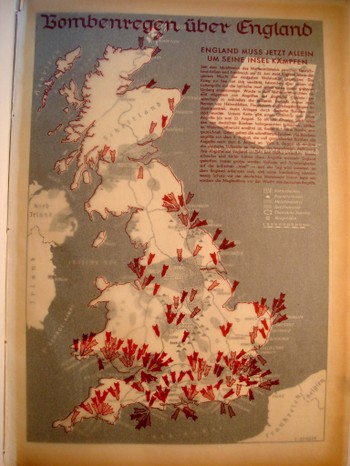
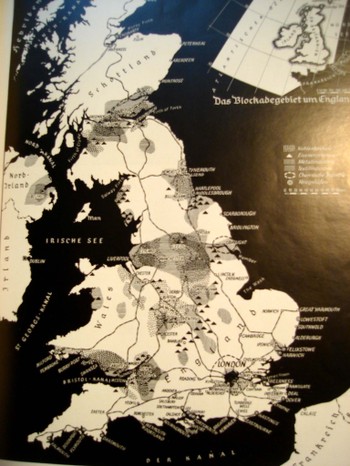
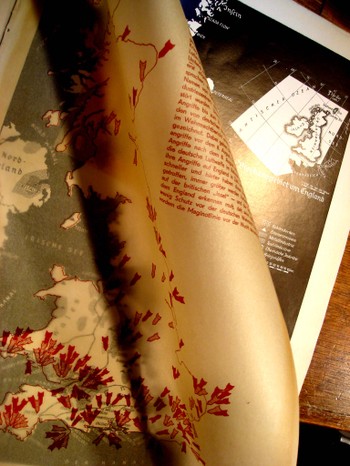
    What caught my eye was a map in the 5 September 1940 issue of the Zeitung.  (The cover woodcut illustration, by the way, is a sharpened point of the Roman standard bearer being used by the Fascist Mussolini government about to impale a running cat-thing that represented Somalia.  The Italians attrociously bombed innocent civilians in Somalia and Ethiopia with abandon and disdain.) On page 165 is a two part map, the upper part being a velum-like overlay, showing the German bombardment of England.  (“Bombenregen ueber England.  England muss jetzt allein um seine insel Kaempfen…” )  The template map is in stark black and white, showing locations of “war” industries, chemical plants, rubber works, textile plants, metal industries and gas works . The overlay shows the outline of the island with 150 or so bombs, imprinted with a color code to show what sort of industry it was intended for.  As you can see there was quite a cluster around London—I looked closely, and no one bomb was actually placed directly upon the outlined city of London. Suffice to say that no fool editor at the Zeitung was going to show their readers that German bombs were falling on a city. 

    Dsc04740 What this map shows me, outside of the propaganda aspect for its intended readers, is that the basic bits of the bombing campaign was actually true—that there was a whole crap-load of bombing going on, and going on quite well country-wide.  Certainly people in England knew this but knew it in chunks.  The Battle of England was being fought at this point, and the outcome was still undetermined—even though the Brits had the “ultra” and basically knew when the attacks were coming, and where.  But looking at this image of the bombing from a completely different, contemporary, and ENEMYsource hammered home the fact that England was being bombed, and bombed heavily, and that its future was in real doubt. 

    [This issue of the Illustriete Zeitung is is available for purchase from our blog bookstore.]


  • History of Goodbye Series: the Latrine Sarcophagus and the Slave Hangman

    JF Ptak Science Books   Post 1101

    Hangman-games I’m not so sure that it was the cold that kept Mathieu Leveille  in hospital for all of those years–as bad as hospitals would’ve been in Quebec in 1730–but I would rather have been there than at his work.       

    Leveille (1709-1743) was a slave bought for 800 pounds by the French ministers in New France (Canada), brought to the cold north from Martinique to do the job that they could find no man to do.  Or no competent man.  The history of executioners in New France–nearly from the very beginning of hanging people there beginning in the very early 17th century1–reads like a bad Italian farce sounds, filled with nothing but drunkards and incompetents, brawlers, muggers, crooks and thieves.  And the condemned–there are several accounts of men awaiting execution who were spared because the executioner had died (some from drunkenness), and there was no one there to kill them.  And so to fill the gap, the authorities offered the condemned the chance to live if they lived so as executioners.  I haven’t read any accounts of anyone turning down the offer, but I wouldn’t be surprised if that were so.

    The executioner in that society for the 1600-1750 period or thereabouts was not happily assimilated into society.  They found themselves–and their families–pariahs, living on the outskirts, or beyond the literal confines, of the city.  They were the last step in their judicial system, the great threat, the punishment with hellfire link to fearful retribution, that no one wanted to live next door to. 

    In the decades preceding Leveille’s arrival, there was a succession of horrorshow stories of executioners of drunk and low orders, two  selected from the list of the condemned, including incompetent sons of incompetent and drunken hangman fathers, as well as periods ion which the office simply could not be filled.  One of the executioners in this long list of doomed men was a Halifax hangman named “Tomahawk”, whose own body, after death, was stolen, paraded, and then dumped into the latrine of the old blockhouse where he once worked.  According to Howard Engel, in his Lord High Executioner, an Unashamed Look at Hangman, Headsman, and their Kind (1996), Tomahawk’s “bones could be seen by curious townsfolk for the next seventy years”.  At least the latrine at that time had been abandoned.

    Leveille was the beyond-pre-Dickensian solution to the judicial managerial problems in Quebec, the bright idea in a feathered cap of Jean-Frédéric Phélypeaux, comte de Maurepas (1701 – 1781), an ascendant French statesman recovering from disgrace.  On the heals of their latest bungle–a drunk imported from France to replace a drunken dead hangman and who maintained his drunkenness and sent back to France drunk–the judicial establishment listened to de Maurepas’ suggestion, and bought and then imported a black slave from Martinique to do the job.

    And that’s when Leveille’s story–no matter how bad it was for him in Martinique–gets worse.  He arrived in Quebec in 1733, and was almost immediately sent to the Hotel-Dieu.  (As it turns out, this is the first hospital in North America north of Mexico). I don’t know if he was told what was in store for him, or what he knew of the job, or what he did in Martinique.  It is established though that Leveille was sick on and off for the next ten years, finally dying there in the hospital in 1743.  Engel correctly assumes (I assume) that Leveille probably performed his job adequately for the powers that be to have spent so much attention on him, trying to have him finally recover. They even purchased a bride for Leveille, but he died just as she arrived. 

    I could imagine wanting, or needing, to spend as much ill- and off-time as possible, even in the grips of an ancient hospital.  The memory of sea spray  hitting Leveille’s face on the trip north from the Caribbean must’ve seemed like needles.

    The slave bride to the dead hangman was renamed Angélique-Denise and sold on the heels of Leveille’s death in 1743.

    Notes:

    1.  There was evidently an earlier semi-recorded hanging of a 16 year old girl, convicted of petty theft and punished.


  • Soldier’s Graves for Nurses Killed in Action, 1918

    JF Ptak Science Books   Post 1100

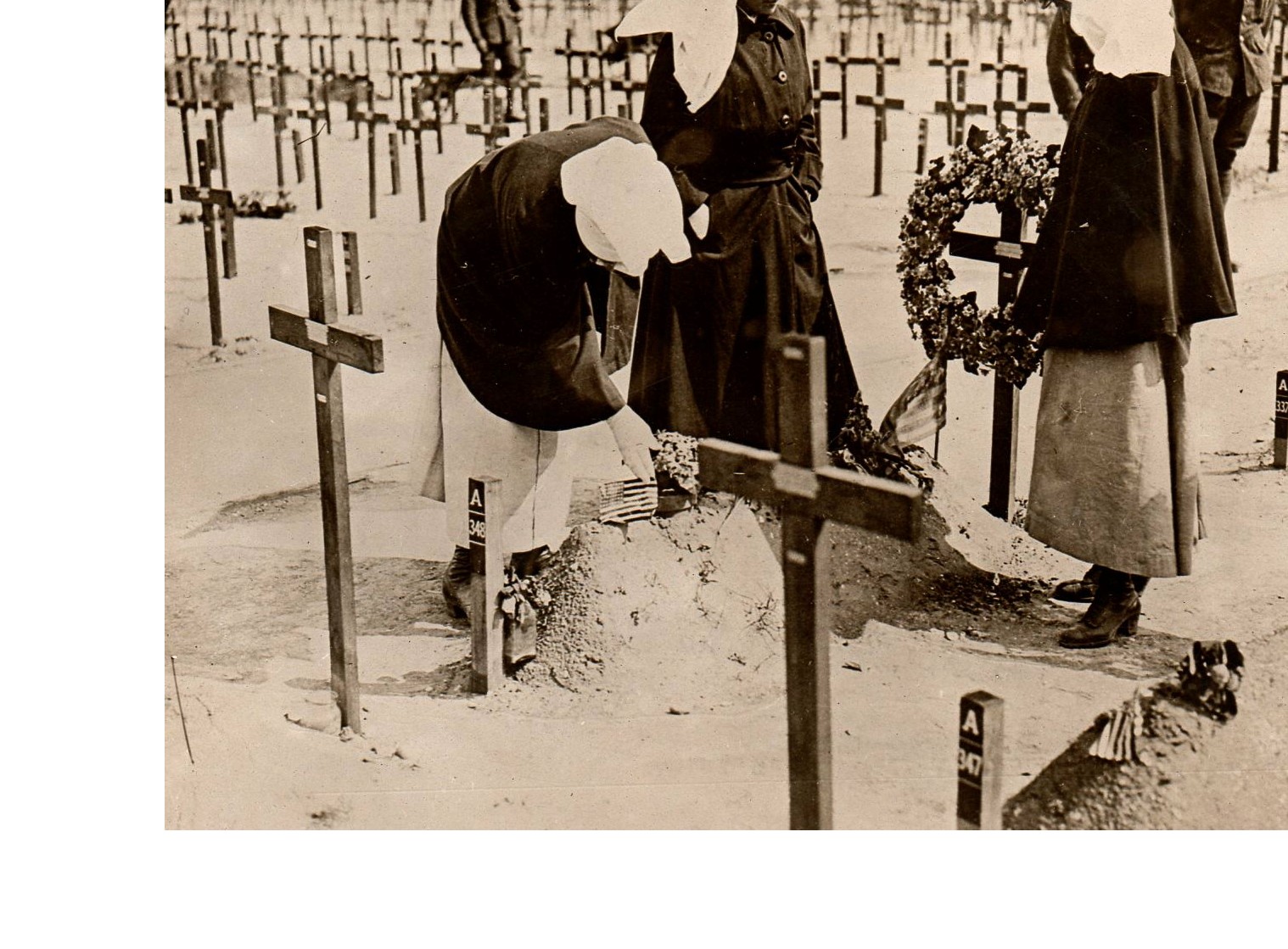
    I was very taken by this image, a photograph made of three Sisters on their way back from attending a funeral service for their compatriot, Sister Lowe, a fellow Canadian nurse killed by a German bomb dropped from an airplane in 1918.  It is from my collection of photo news service images, this one owned and distributed by Underwood & Underwood.  More often than not the photographs were accompanied by a sheet of brief text describing the image.  This photo text was dated 8 July 1918 and reads:


    Women--WWI sister 2259

    Women--WWI sister 4261
    “Another German victory manifested itself several weeks ago when Boche air flyers bombed a defenceless Canadian general hospital in France.  This Canadian Official picture shows Canadian Sisters preparing to return to their hospital after attending the funeral of Sister Lowe who died of wounds received during the raid. Note the grave of an American nurse who was killed during a previous air raid.”

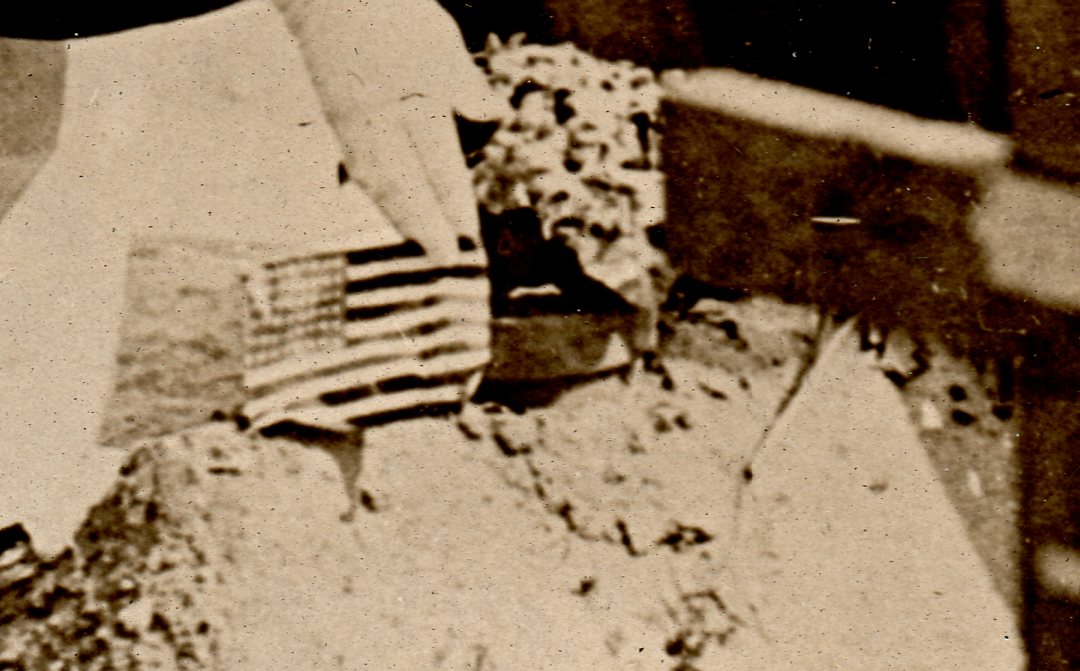
    They evidently stopped to pay their respects.  Its the tiny flags that got to me–I think they’re homemade.


  • The Revolutionary Importance of the Non-Cookie Toll House

    JF Ptak Science Books   Post 1121    

    Toll House339
    I think that in a way the introduction of the toll house was as a significant a development in the history of the industrial revolution as the toilet.  Without the toilet, you can’t really have a concentrated population to run industries–or at least without making everyone sick because of unsanitary and pestilential conditions. If you create the possibilities for having industries that employed 100 or so people, and had a bunch of them in a city setting, it wouldn’t much matter if you didn’t have the people to run them, and you can’t have the people far-flung and living apart if there’s no way for them to get to their work.  Concentrated living called for lots of innovation, and perhaps the most important of those was how to get rid of human waste. 

    Without good roads you can’t get your produced goods to a market outside of the one you’re in, isolating chances for growth and development.  If you have a good serviceable, dependable road to transport your stuff, then you have an expanded market; that means you can sell more, produce more, and theoretically charge less, which means you expand your consumer base, and on and on.  But that means you have to be able t depend on your road.  And a good road needs to be paid for.  And one of the chief ways of funding these early roads was by a toll, which called for a toll house and a little gate.  And a person to collect the money.  Merchants figured out very quickly that it was much cheaper to pay a toll to use a good road than it was to use a bad road for free and have to depend on the graces that it be maintained; and since the graces weren’t kind, there would be all sorts of repairs necessary because of the poor road: harnesses, wheels, wagons, horses, and the like, not to mention food and such that could spoil along the way, or goods damaged in transport. 

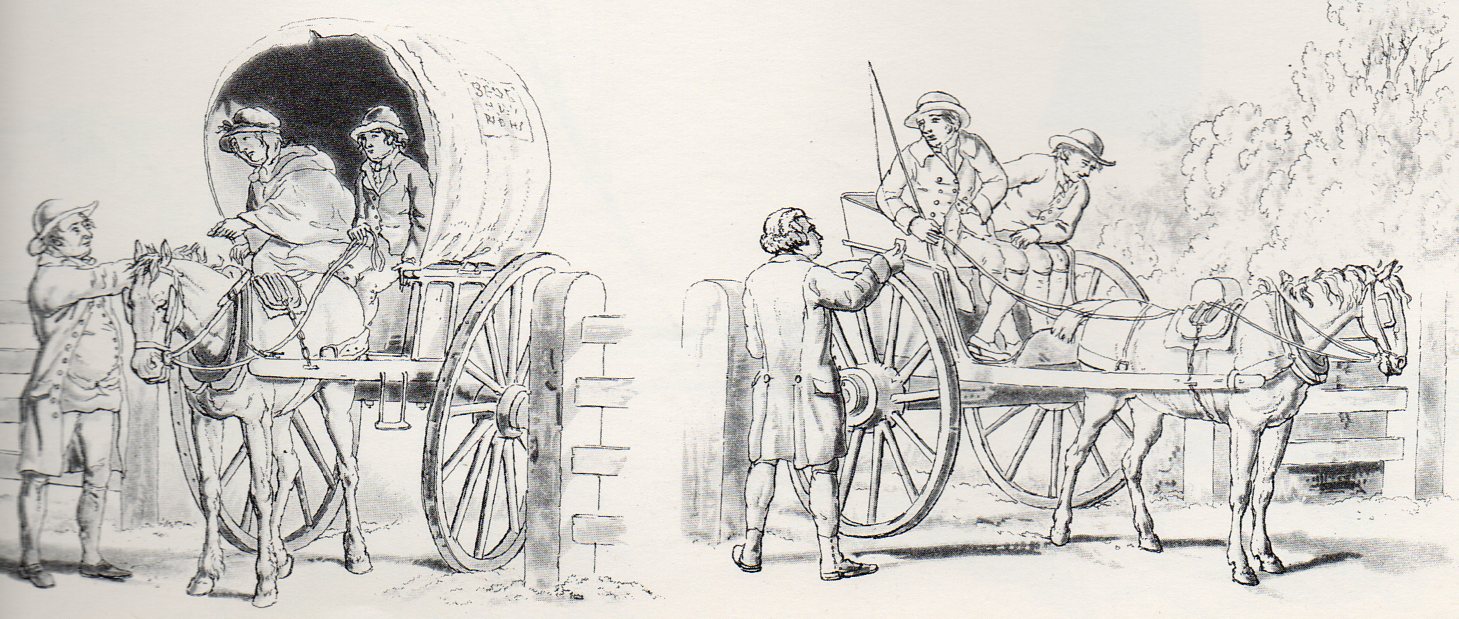
    This all comes up from looking at a curious book by WH. Pyne1, who provided a thousand or so images of “picturesque” (meaning “working or laboring) life that could be used by artists to populate more general images of landscapes or cityscapes or seascapes.  I’ll address this in a later post. It was several small pictures of toll houses that caused this thinking about the industrial revolution….pictures of things intended for gentle artists who may never have seen such sights in their life, and who might need to fit a curious little image of a gate-keep in their picture of some prosaic cow-filled landscape.

    In the 17th and 18th centuries the introduction of serviceable roads over old trails and bad roads that connected towns wound up expanding markets for farmers and cottage industries, lowering prices because of easier availability of the product, and creating more consumers.  And so on.

    I realize that this might very well be a “turtles all the way down” argument, but since I’ve already named one turtle in a post here, I might as well name two. 

    Notes
    1. William Henry Pane (1769-1843), Picturesque groups for the embellishment of landscape : in a series of above one thousand subjects : comprising the most interesting accessories to rural and domestic scenery, shipping and craft, rural sports, pastimes and occupations, naval, military and civil employments, implements of trade, commerce and agriculture, etc. , the whole forming an encyclopaedia of illustration of the arts, agriculture, manufactures, &c. of Great Britain  Publisher: London (Bedford Street, Covent Garden) : M.A. Nattali, 1845.


  • New York City: Attacked by Tentacled Flying Saucers, Giant Flying Snakes, Glaciers, and Mining Missile Space Aliens, 1929-1941

    JF Ptak Science Books   Post   1118

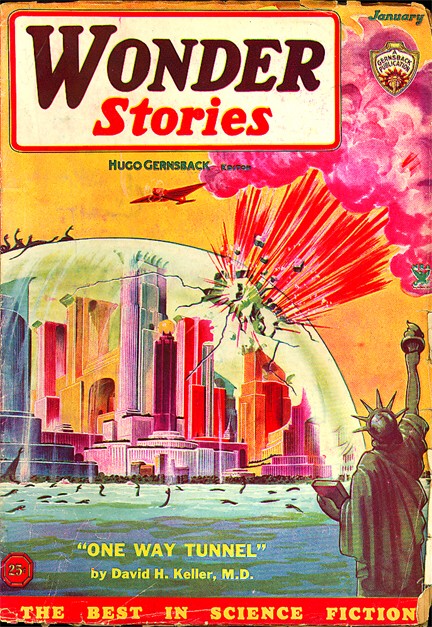
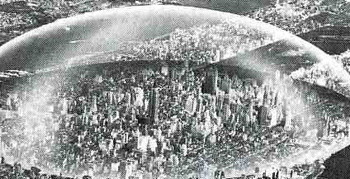
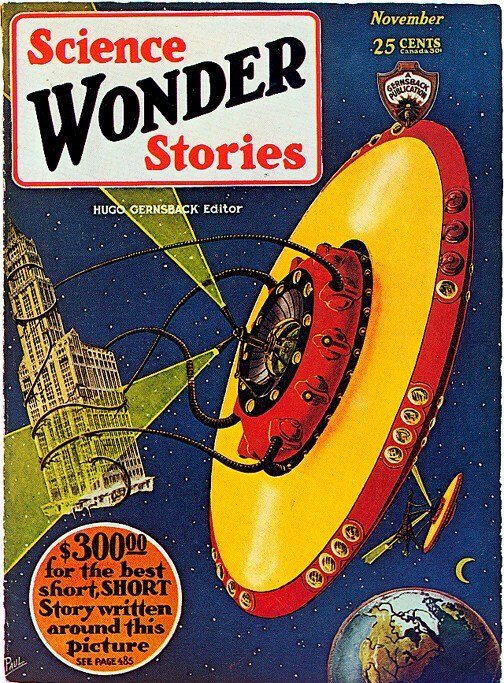
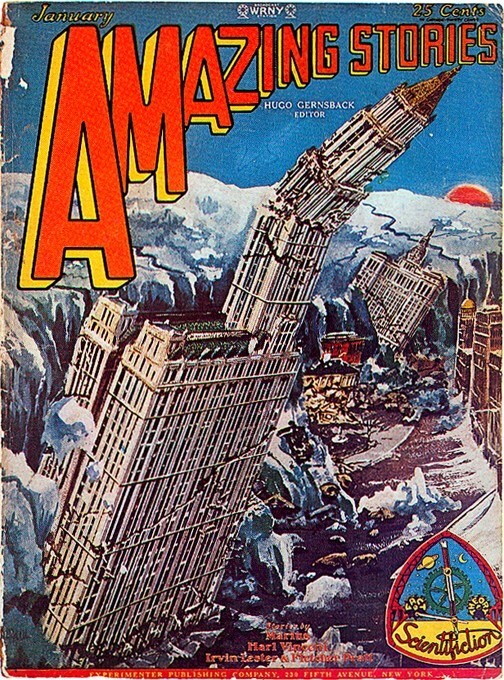
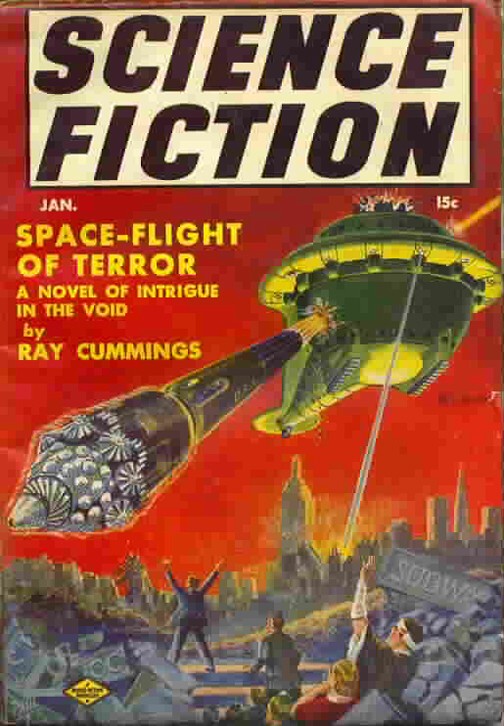
    This is a simple, non-analytical image dump for some in a continuing series on images of New York City in fantastical and improbable situations–there’s artwork that show the city being consumed by glaciers, drowned by the tide, ripped from the Earth and flung into the sun, floating in the sea, floating in space, sunken, and of course simply attacked by any number of different things, though most of those weren’t real.  There is of course the great unknown classic that I stumbled across–the duplicate NYC on a duplicate Earth orbiting the Earth ((?!) and pictured at the end of this post). I doubt that there’s enough for a dictionary of disasters, though there’s plenty for a Doomsday Book.

    For example the first image for this post shows a domed New York City–and in this scifi sub-classic,  like other major cities of the United States, NYC was suffering a catastrophic attack by winged snake monsters.  I don’t know why  the dome is exploding because the snakes don’t appear to be armed.

    NYC attacked

    This does remind me of an image from the mind of Buckminster Fuller, who
    came up with an extraordinarily bad idea to protect NYC against
    thermonuclear weapons. (Fuller’s dome appears here.)

    Big_archfuller_detail141 

    Then there’s this magnificent cover for November, 1929, featuring a tentacled flying saucer removing the Woolworth Building into outer space (as well as the Eiffel Tower by another brethern craft (the Earth appearing again, as nearly usual, without cloud cover):

    Woolworth

    And yet another destroyed Woolworth Building, this from January 1929, featuring an enormous glacier attacking the City:

    NYC destroyed--woolworth

    And this vision of a decimated NYC, coming at the hands of giant hovering mining/missile space aliens:

    NEw York City in Ruins

    And of course, the duplicate NYC on Extra Earth:

    Dsc04543


  • Strange Things in the Sky Department: Earth Bombarded from Mars

    JF Ptak Science Books   Post 1113

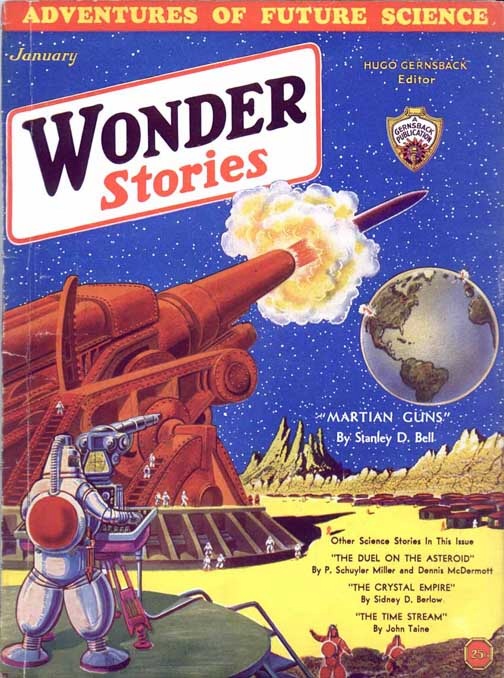
    Strange things in sky--martian guns
    Earlier in this blog I wrote about odd, extraterrestrial extra Earths–double Earths (like this, for example “Extra-Earth Humano-Alien Souls from Outer Space Repopulate Earth-Hell!”)–and then branched out to other strange things found in created skies.  This image would certainly classify:  its the cover art by the fabulous Frank R. Paul for Stanley D. Bell’s “Martian Guns” found in the January 1932 issue of Wonder Stories.  There’s really no way to determine how big the gun is except to say that it is probably “big”–there’s just nothing to place the thing in perspective, as the figures in the foreground, being Martian, don’t have a specific height.  They could be 6′ tall, or 60′–perhaps they’re only 1/10 of an inch tale, and the projectile they’re firing to the earth is so devastatingly powerful that size doesn’t matter.

    We also have no idea of the used to get the projectile/bomb moving–the nature of the explosive–but it is probable that the resulting muzzle flash wouldn’t look anything like what we’re seeing here.  This depends on the available bits in the microgravity, but I think all that you’d see as a result of firing canon would be a very bright flash of light, and here would be no smoke. Plus lots of other obvious stuff, like, well, the Martians, though at least the gun isn’t pointed directly at the Earth, which I think is just a function of fast work.  But no matter, this was 1932, and the specs don’t matter, as this is, after all, science affliction. 

    The destructive units are finding their targets, though; one seems to have found its mark around San Francisco, and another looks like it might be in France.   They’re easy to spot, made so for the reader, finding their thousand-mile high smoke plume in a cloudless atmosphere and all. 
    I’m sure it would’ve been an unsettling experience to the reader of the time.

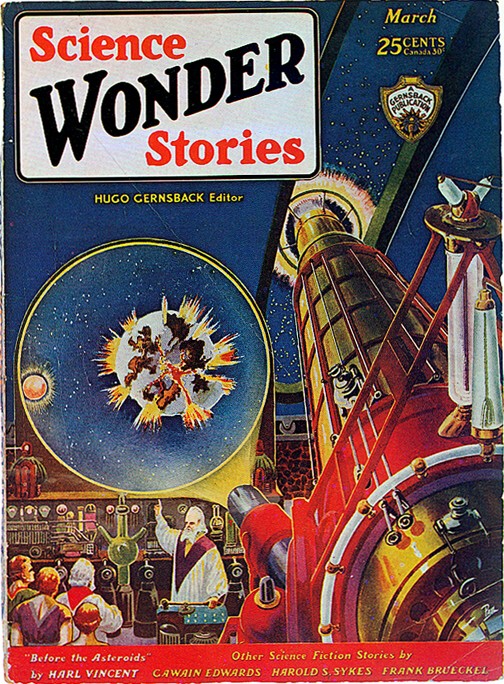
    Here’s another odd bit, this one seeming to show an exploding Earth–the “exploding Earth” subcategory of the “Strange Things in the Sky” category being among the rarest of these sorts of images. This comes from the January 1932 issue of Science Wonder Stories, from the “Before the Asteroids” article by mechanical engineer Harl Vincent (1893-1968).

    Big Gun

    I can’t find the text of the story, so I really don’t know if this is the Earth being detonated or whether it is an asteroid–I prefer it to be the Earth, and the exploding thing doesn’t look much at all like an asteroid.

    [Mr. Vincent had a nice way of turning a title, some of which include ”Creatures of Vibration, ”The Copper-Clad World” , “Vulcan’s Workshop” and Wanderer of Infinity” .]