JF Ptak Science Books LLC Post 707 Blog Bookstore
Nil sapientiae odiosius acumine nimio
(“Nothing
is more hateful to wisdom than excessive cleverness”), said by Poe in his “The
Purloined Letter” to be from Seneca1.
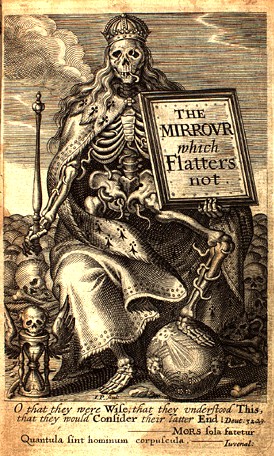
Several posts ago I made reference to Jean Puget de la
Serre’s wonderfully semi-vicious book The Mirrour Which Flatters Not (1639). Serre was hardly an oasis of negativity in
the early Enlightenment, writing as he was on matters epically moral—I must
admit that I was attracted to the title of this condemning and biting book, and
frontispiece illustration, which features a royal skeleton wormily seated in a field of skulls holding the mirror that awaits us all. But as it turns out—ironically, too, perhaps—in
the long parting salvo that seems to have been the crux of his book’s biscuit,
Serre’s translator, Thomas Cary, is one of the earliest English writers to use
the word “goodbye”. Why this was done, I
haven’t the foggiest notion—I do know that writers claim that this is a
contraction of the parting salutation of “god be with you”, but that’s all I know on the subject.
But it did cause me to think about the word “goodbye” and the whole concept of parting from something, or someone, and of change, and adventure , of something happening, flux, introducing or diminishing chaos. If it is anything at all, the idea of “goodbye” will probably not lead to boredom; ennui is a definite some-percentage possibility, but it is a direct promise of change for good or for ill or for nil.
And the best place I thought to start of looking at Goodbye is at the beginning, in the titles of books, where “Goodbye” or “Good-bye” makes infrequent appearances.
Goodbye to people: Mr. Chips,
Columbus, Picasso, Sister Disco, Mickey Mouse, Judge Lynch, Descartes. And Goodbye… to places:
They are of varying qualities. This is definitely judging a book by its
title, but I think I’d rather read Death
in Venice more so than Goodbye to
Venice, which sounds like it might be a Weekly Reader version of
Mr. Mann’s big/little write.
to things, not too many of which sound very appealing: Hangovers, Weight, Love, Sanity, Health,
Life. These are the books invisibly clamoring for
space and life at the 25-cent table at the library sale as they wait their turn to say “hello” to recycling.
titles that are Not Terribly Categorizable: Goodbye Girl, Say Goodbye, and of course Never Say Goodbye, and the lovely Goodbye Blue Monday (the rest of the
title of Vonnegut’s Breakfast of
Champions…). The Long Goodbye has always sounded languid and steamy and
the-ice-is-all-melted-y to me. Hello Goodbye just can’t seem to make up
its mind. So far as I can tell there are no books simply entitled Goodbye, nor has anything ever been on
bookseller shelves called Get Out,
though there is a book called Go Away. Hello Goodbye either can’t make up its mind or is welcoming Goodbye, which may or may not be a broken logical circuit.
everything else) when “goodbye” gets more expanded, less demanding, more diplomatic,
like, say , with Farewell My Lovely.
But that’s another story.
And so for this bit on the History of Goodbye, I use Mr. Graves, and say
Goodbye to All That.
Footnote
1. Evidently, it is not. By the
way, for all of the great amusement and entertainment taken from this great and
wise short story, Poe received a payment of $12 in 1845.