A Daily History of Holes, Dots, Lines, Science, History, Math, Physics, Art, the Unintentional Absurd, Architecture, Maps, Data Visualization, Blank and Missing Things, and so on. |1.6 million words, 7500 images, 4.9 million hits| Press & appearances in The Times, Le Figaro, Mensa, The Economist, The Guardian, Discovery News, Slate, Le Monde, Sci American Blogs, Le Pont, and many other places… 5000+ total posts since 2008.

Category: History of Goodbye

  • Strange Things in the Sky Department: When Worlds Collide (1933+1951)

    JF Ptak Science Books   Quick Post  Part of our Strange Things in the Sky Department

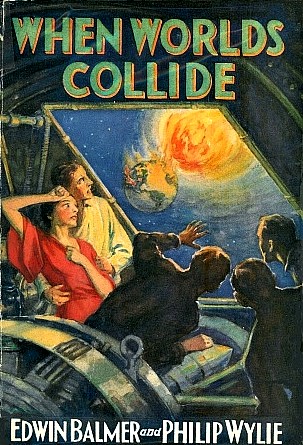
    When Worlds Collide wasn’t so much about another world colliding with the Earth–it was another star, a “rogue star”, that enters the solar system and heads directly towards the Earth.  Luckily for a selected few, a billionaire astronomer sees the thing coming and decides to construct a spaceship to populate a friendly “planet” near Alpha Centauri.  Oh well, its 1933, and perhaps anything was possible–after all, the Empire State Building (which is depicted in so many of these movie posters in a not-good way) was just finished in 1931, after two years of construction (!). 

    So the following are movie posters for the 1951 film version of the 1933 book–except for the first image, which is from the book.

    Strange sky--when worlds collide   


    http://www.mattfind.com/12345673215-3-2-3_img/movie/v/z/n/when_worlds_collide_1951_300x439_193460.jpg


  • On the Use of Blood, Bone and Guts -and- the Man Who Painted Dead Chicken Feet

    JF Ptak Science Books  Quick Post–possible revulsion factor

    I was looking for something else–mortality rates in Canada for a post on the value of a dead human body in 1860–when I found this book on the use of discarded goods and raw byproduct, a sort of early recycling effort.  The work was by Edwin Lankester, and it is called The Uses of Animals in Relation to the Industry of Man; Being a course of lectures delivered at the South Kensington Museum (published in London by Robert Hardwicke in  1860), and the initial data that caught my attention was this:


  • Alpha & Omega Department: Omega, Heat Death, and Speculative Fiction, 1893

    JF Ptak Science Books   Post 1514

    “The more the universe approaches this limiting condition in which the entropy is a maximum, the more do the occasions of further change diminish; and supposing this condition to be at last completely attained, no further change could evermore take place, and the universe would be in a state of unchanging death.”–R. Clausius, 1868

    Flammarion heat death (this will be the end)

    I wonder about the appearance of the Second Law of Thermodynamics (the Entropy Law) and its influence on creative, speculative literature.  Its really about the juicier two-word interpretation–Heat Death–that I wonder about, along of course with the 1st and 2nd laws, and its influence on relating the story of the end of the world, the destruction of the Earth, the depletion of the universe.  One can see the possibilities of the of the ideas of the fourth dimension in the creation of modern art and their influences on people like Picasso and Duchamp, even though that influence took decades (in the case of Marey to actually “appear” in art.  Where was the influence of entropy in literature?

    The business of “heat death” and the Second Law is of course necessarily based upon the First Law of Thermodynamics (and the work of the beautiful Hermann von Helmholtz in 1847), and which finds an outline of a home in the early work of Sadi Carnot (in 1824, on mechanical energy loss) and more comfortable foundations in the work of  James Joule  (in 1843),  Rudolf Clausius (in 1850) and William Thomson1 (in 1852, “On a Universal Tendency in Nature to the Dissipation of Mechanical Energy”).  The Second Law belongs to Rudolf (“Santa”) Clausius, whose 1850 paper in the Annalen der Physik begins the establishment of  the “the most universal regulator of natural activity known to science”, an idea solidified in his 1854 paper (in the same journal), where the concept of “entropy” is introduced though the name not actually used (a slightly complex history of the word, to be sure, though it makes its appearance, finally, in an 1865 paper). 

    Von Helmholtz famously establishes the death of the sun in a popularly-written 1854 paper (at about another 20 million years) which is a fantastic/superlative philosophical something happening there five years before the Origin of Species, establishing that at some point in the not-horribly-distant future that the sun would be extinguished, and that a sooner point the Earth would go, too.  Thomson would do about the same in another popular journal in 1862, saying:

    “The result would inevitably be a state of universal rest and death, if the universe were finite and left to obey existing laws. But it is impossible to conceive a limit to the extent of matter in the universe; and therefore science points rather to an endless progress, through an endless space, of action involving the transformation of potential energy into palpable motion and hence into heat,  than to a single finite mechanism, running down like a clock, and stopping for ever.  (Thomson, William. (1862). “On the age of the sun’s heat“, Macmillan’s Mag., 5, 288-93; PL, 1, 394-68.)

    It would seem very heady stuff, this scientifically-based  end-of-all-life-and-everything-else  thinking.  But it really doesn’t seem to have taken hold in any literary sense, at least not in a big way until the work of one of the most fertile popular thinkers of the second half of the 19th century.  Camille Flammarion (26 February 1842—3 June 1925), an astronomer, scientific editor and sci-popularizer of vast proportions,  an author of some 50 books, produced a fantastic end-of-the-universe story in his La Fin du Monde, published in 1893.  Again, this is decades after the big scientific pronouncements on the subject.  But afterwards, in the space of just a few years this sort of thinking, this megaland of fictional science writing would take itself away by leaps and bounds, unlike perhaps any other period in literature. (What is probably the first treatment of post-apocalypse Earth in speculative fiction–excluding religious writing and speculation–comes in 1885 with the novel  After London by Richard Jeffries.) For example  in 1895 there was Wells’ Time Machine, Tsiollkovsky’s Dream of the Earth and the Sky and the Effects of Universal Gravitation, and Lowell’s pinch in the eye, Mars, not to mention Verne’s Le Moteur. In 1897 there was Morris’ The Well at the World’s End and Well’s The Island of Dr. Moreau, plus more realistic but nevertheless bombing-bastic things like Tracy’s Final War. Then by 1898 there was Edison’s Conquest of Mars by Serviss, and the great The War of the Worlds, again by the very busy Wells. I wonder where this spculation was in the 1860’s and 1870’s?

    I really don’t know the answer to that.  Just like I don’t know why the photographs of Marey–though very widely circulated–didn’t seem to have an influence in artistic space for 30 or 40 years.  Unless of course I’m missing a big piece of the history of speculative fiction….

    http://botaniq.org/wp-content/uploads/2010/10/la_fin.jpg 


    File:La Fin du monde-34.jpg


    File:La Fin du monde-18.jpg


    “Presently the earth is only an invisible point among all the stars, because, at this distance, it is lost through its infinite smallness in the vicinity of the sun, which itself is by far only a small star. In the future, when the end of things will arrive on this earth, the event will then pass completely unperceived in the universe. The stars will continue to shine after the extinction of our sun, as they already shone before our existence. When there will no longer be on the earth a sole concern to contemplate, the constellations will reign again in the noise as they reigned before the appearance of man on this tiny globule. There are stars whose light shone some millions of years before we arrived … The luminous rays that we receive actually then departed from their bosom before the time of the appearance of man on the earth. The universe is so immense that it appears immutable, and that the duration of a planet such as that of the earth is only a chapter, less than that, a phrase, less still, only a word of the universe’s history.” — Camille Flammarion, Le Fin du Monde (The End of the World)

    I should point out that in addition t being an astronomer, Flammarion held some very colorful ideas about the possibilities of life on other worlds–near ones, at that.  He was evidently much take with the “discoveries” of Percival Lowell, claiming that a superior Martian race had been trying to communicate with Earth “for years” but without success.  See this NYT article from 1907:   “Martians Probably Superior to Us; Camille Flammarion Thinks Dwellers on Mars Tried to Communicate with the Earth Ages Ago”. New York Times. November 10, 1907. “Prof. Lowell‘s theory that intelligent beings with constructive talents of a high order exist on the planet Mars has a warm supporter in M. Camille Flammarion, the well-known French astronomer, who was seen in his observatory at Juvisy, near Paris, by a New York Times correspondent. M. Flammarion had just returned from abroad, and was in the act of reading a letter from Prof. Lowell.” At about the same time Flammarionpredicted that the world would be destroyed by a mysterious seven-tailed comet, causing panics–again, from 1907: “Flammarion’s Seven Tailed Comet”. Nelson Evening Mail. 30 July 1907. 

    Notes

    1. Thomson, William. (1951). “On the Dynamical Theory of Heat, with numerical results deduced from Mr Joule’s equivalent of a Thermal Unit, and M. Regnault’s Observations on Steam.” Excerpts. [§§1-14 & §§99-100], Transactions of the Royal Society of Edinburgh, March, 1851; and Philosophical Magazine IV. 1852, [from Mathematical and Physical Papers, vol. i, art. XLVIII, pp. 174]  Thomson, William (1952). “On a Universal Tendency in Nature to the Dissipation of Mechanical Energy” Proceedings of the Royal Society of Edinburgh for April 19, 1852, also Philosophical Magazine, Oct. 1852.


  • Questionable Quidity and the Road to Achieving a Faster and More Productive Smoking-Related Disease

    JF Ptak Science Books  Quick Post

    Cigarette manufacturers–like anyone other entity in business–want their clients to consume as much product as possible.  Or buy their goods as often as possible.  With that in mind I’m a little surprised that the Big Five never adopted any of the ideas shown below, all helping the smoker to get at their next cigarette as quickly as possible. For example, in the event hat there were no ashtrays around, several people patented their notions for in-the-cigarette-pack ashtrays, so that no matter where a person was, they could always clicks their ash and stow their butts back in the pack.   Of course, I’m sure that the Makers determined almost instantly that this concern affects perhaps an immeasurable percentage of smokers; if someone wanted (read “needed”) a cig, and there was no ash tray, they can just, well, smoke their cigarette and not use an ash tray. Or go outside.  OR something.  Or perhaps the manufacturers recognized that they could actually sell the idea to some of their smokers, but then realized instantly that carrying around ciggie waste is not attractive and perhaps a stinking mess.  Or they recognized that–like Lee Iaccoca fighting seat belts because it made cars look “unsafe”–having  place to deposit cigarette waste right there with the cigarettes might send a message to the consumer that their product is messy and in the end very unattractive.  Best leave the unattractive bits in a tray somewhere else.  Or of course share the end product of smoking enjoyment with others by leaving it on the ground.

    Then of course to remind consumers how useful the process of smoking is, there were other inventions that combined the products of this act with some other highly useful enterprise, like this cigarette lighter/pencil sharpener with what might have been a whistle attachment:


    And if you found yourself needing/wanting a smoke but didn’t have a free hand, there was always the following device, which allowed the consumer to smoke their stuff through a tube:

    Speaking to the humility of smokers was this device that allowed the user to extinguish their smoking product automatically, no matter what the size of the burning member, reminding the user that if they wanted to actually stop, they could:


    Again, another extension of the art of cigarette smoking and how useful smoking implements can be–the cigarette lighter with built-in flashlight:

    Cigarette lighter with built-in extinguisher:


    Pen with built-in cigarette lighter (1977):

    And another example of a very complicated instrument for extinguishing a cigarette, sending a message with I-don’t-know-what undertones:

    These are just some of the many glorious appendages to smoking and making it easier–many more can be found at the U.S. Patent Office, like all of the examples above. 


  • H-Bomb Wipes out Brooklyn. And Chicago. And New York.

    JF Ptak Science Books  Post 1527          Part of the Atomic and Nuclear Weapons series

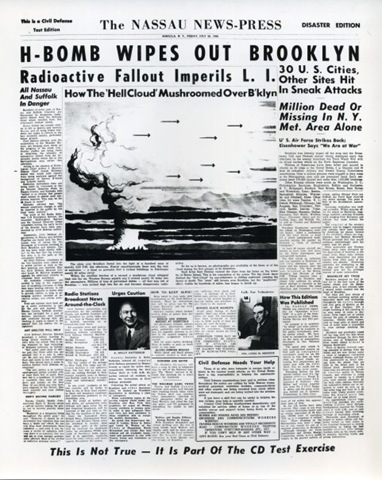
    Wipe out Brooklyn

     [Source:  Conelrad blog and also at the website]
    I stumbled on this bombing of Brooklyn article at the excellent Conelrad website–it is an excellent addition to my slight collection of vintage depictions of American cities being nuked.  As part of the necessary scare tactics in the pursuit of the arms end of MAD, the destructive power of these weapons were shown against a background that Americans could readily understand.  Thinking of atomic and then nuclear holocaust in terms of multiple units of Hiroshimas and Nagasakis was one thing–showing the effects of these weapons on an American grid was something else.

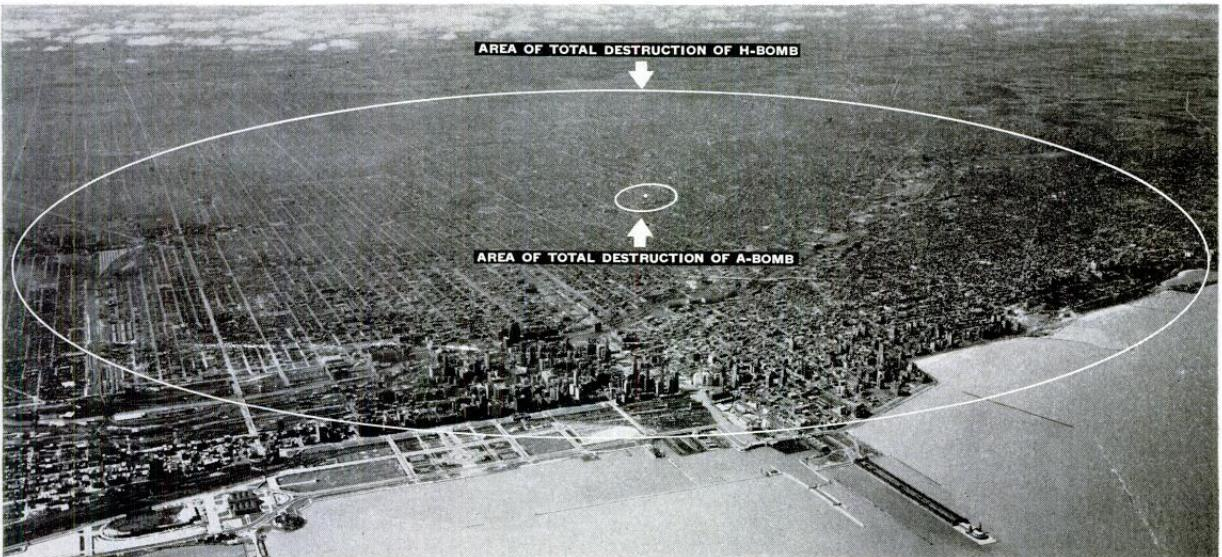
    This next  graphic shows the difference in destructive capacity of an atomic bomb (small circle beneath an air-burst detonation) and a hydrogen bomb (the large circle showing area of total destruction, which in this case would be about 50 square miles) on the city of Chicago.

    Wipe out chicago
    [Source:  LIFE Magazine, 30 Jine, 1950]

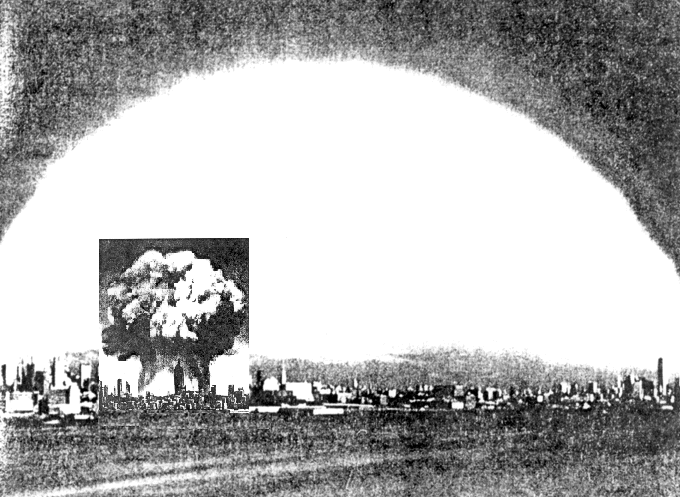
     The next image is much like the preceding, only showing a profile of Manhattan and the difference between the explosions of a Hiroshima bomb and a hydrogen bomb (of 20 megatons).

    http://bioinfo.mbb.yale.edu/~mbg/fun/both-bombs.gif

    [Source: BioInformatics Lab, Yale  http://bioinfo.mbb.yale.edu/~mbg/fun/both-bombs.gif]]

    But don’t worry, even if the Chicago and Brooklyn and New York and so on were destroyed, the U.S. Navy would survive, which would  be either great or horrible if you were a sailor:]

      H-Bomb  WIpe out NAvy
    And as usual, the point is made with one weapon being detonated, rather than the x-number that would actually be deployed.  Depicting, say, 10 weapons being used against these cities–while being a more accurate portrayal of what nuclear war might look like–might have looked like something beyond the usefulness of propaganda. 


  • Death Comes for the Book(printer & seller), 1499

    JF Ptak Science Books   Quick Post

    Death444
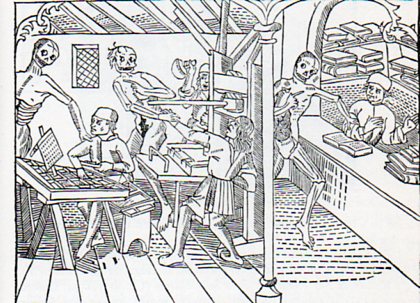
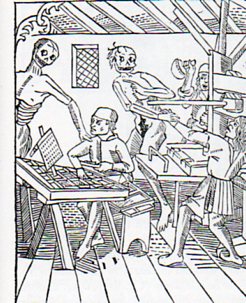
    This is intended to be a short mini-post on the end of printing, and the end of bookselling, such as we know it, or knew it–this image comes from 1499 (Le Grand Danse Macabre, Lyon), and tells us that death to these occupations is nothing new.  Of course when we speak of the death of the book nowadays we’re discussing something different–the death of the printed format.  But here in this print, which is also the first depiction of a mechanized book press, we see ironically that Death has come to claim its operators, or at least two of them.  The inkman in the background, the yelling third of a departing party of two, is spared for the time being.  Just as the reader is for the first time seeing this machine, they are also seeing Death in its in grim glory snatching away the machine’s main operators. 

    Death445

    The image and the functions of the people working the press are well described in the excellent history of all things books at the Bookn3rd website, here. 

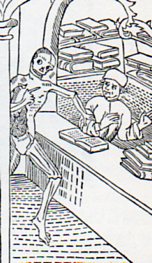
    Here’s Death coming for the bookseller–at least the man was reading at the time of the departure.  This is also a very early depiction of a book store, which again as the first visual information on such a place to the reader is wrapped around the visitation of the Great Inevitable. 

    Death446
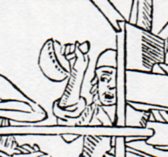
    The inkman, in thr background, screaming/shocked. 

    Death447


  • History of Normalcy Series: Warehousing Epileptic “Defectives”, 1912

    JF Ptak Science Books   Post 1450

    This series is meant to illustrate the very transitory, shadowy and basically non-existent nature of “normal”.

    “It is thus with regard to the disease called Sacred: it appears to me to be nowise more divine nor more sacred than other diseases, but has a natural cause like other affections. . .”–Hippocrates on epilepsy and recognizing it as just another brain disorder devoid of mysticism, about 2400 years ago.

    Epilepsy383 One stop in the history of normalcy is the perception of brain disorders, which is a long and complex history–very long in the case of epilepsy, its epidemiology stretching back thousands of years before Hippocrates.  It particular normalcy for the vast majority of that time was that people who exhibited the results of the disorder were cursed, or touched by the gods as holders of some possible divine inspiration, or touched by the gods as accursed and punished people, or bewitched (I wonder about the number of epileptics put to the flame during the Witch Hunt crazes), and so on.  The first pharmaceutical treatments for the disorder really didn’t come about until Emil Fischer and Bayer introduced phenobarbitol in 1902/04, which was able to calm the seizures of some people with epilepsy.  Until that point, most treatments were generally topical, plus the quack ingestives and various sorts of incantations, spells and prayers. 

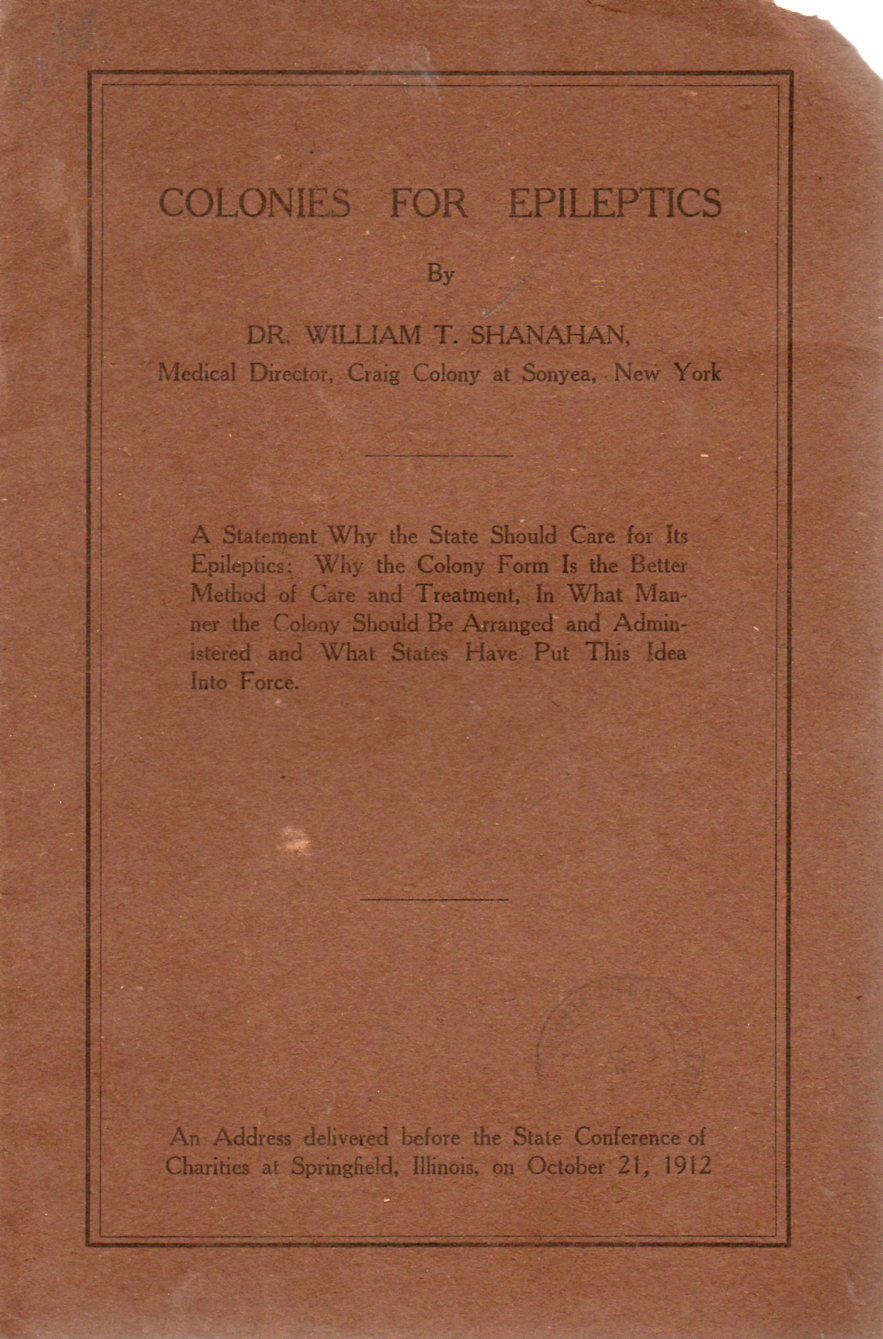
    In Dr. William T. Shanahan’s Colonies for Epiletpics, (the original available for purchase through our blog bookstore) written in 1912, the treatment of epileptics was seculsion, warehousing them in state asylums in the countryside.  Shananhan felt that the epileptic needed “its” own environment, “apart from the the defectives”–and by that he meant apart from the wide classification of people who did not fit the scheme of 1912 normalcy, like “morons, imbeciles, the insane, the sexual addict, the recurring syphlitic [and] the criminally insane…”.  Actually this as a good move in some cases–apart from the vocabulary–as epileptics were stored away in almshouses and prisons along with the criminal element and the hopelessly insane, and at least removed the epileptic from a different sort of horror and disgrace. 

    Dr. Shanahan’s aim was to remove the epileptic from society because they “couldn’t adjust to a life in the ordered community” and that holding a job for them was “impossible”–that plus what he saw as the need to protect society from the epileptic’s “progressive mental deterioration”.   He felt that “the great majority should be committed[to the epileptic colonies] as are the insane”, and also to remove them to these places “from a young age”, to an “institution for defectives”, there separated according to “sex and mental grade”. 

    Overall, though, it was Shanahan’s other aim to provide as “normal” a life for epileptics as could be arrived at, and outside of his trying to save society from them–at a time when the eugenics people were out castrating epileptics–, he was arguing that this method was the best of all possible worlds for people with this disorder.  He does however seem to be totally ignorant of any medical approach to dealing with epilepsy.

    By the way, there’s a very curious imprint on the back cover of this pamphlet showing who printed it and where.  I cannot recll ever having seen such a small thign, placed so centrally, in such an obvious place. Its obvious and present, yet tiny.  Here it is, before magnification:

    Epilepsy384

    And here is what the slug says:

    Epilepsy385
    Its just a very curious thing.


  • An Antiquarian Print Rarity: Depicting the Destruction of the Earth

    JF Ptak Science Books  Post 1439

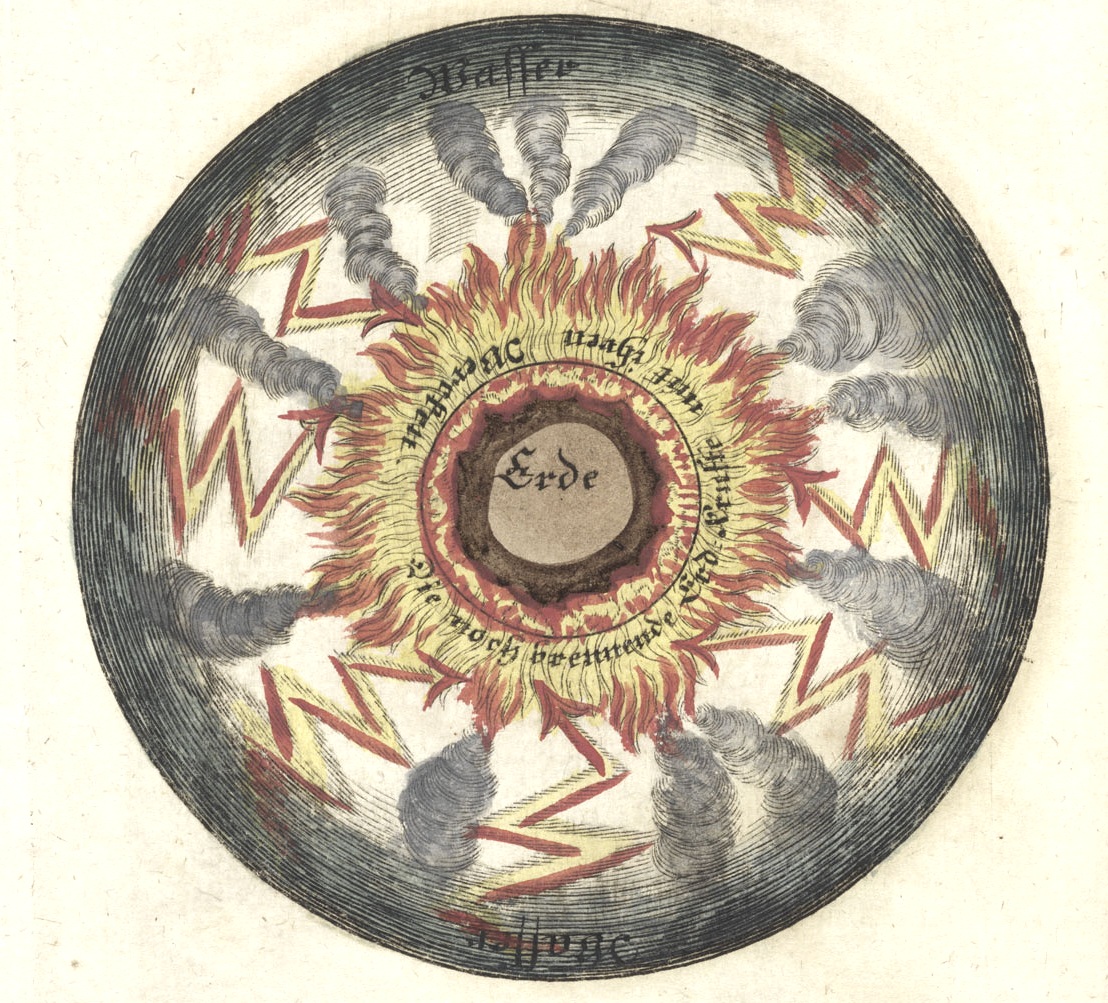
    There appeared earlier in this blog a bit on an engraving depicting an exploding Earth, one of a series of twelve images, eleven of which were unavailable at that time–not so anymore.  So an update to this post is happily made, starting with the exploding part (below), a nasty millennial vision steeped in a volcanological/geological/meteorological 18th-century primordial stew, the Earth in a sea of fire and blasted volcanoes, lightning striking from above:

      Frisch 5
    [All image sources:    Herzogin Anna Amalia Bibliothek, Weimar.]

    Hades, Heaven, Meru, Valhalla, Elysium, Olympus–the places at the end of the terrestrial road, the great emancipation. In some theological doctrines these places are reached collectively after the great conflict at the end of time; the end of days in the Old Testament, when the earth is devoured by holy vengeful wrath and reconstituted for godly comings –and-goings.

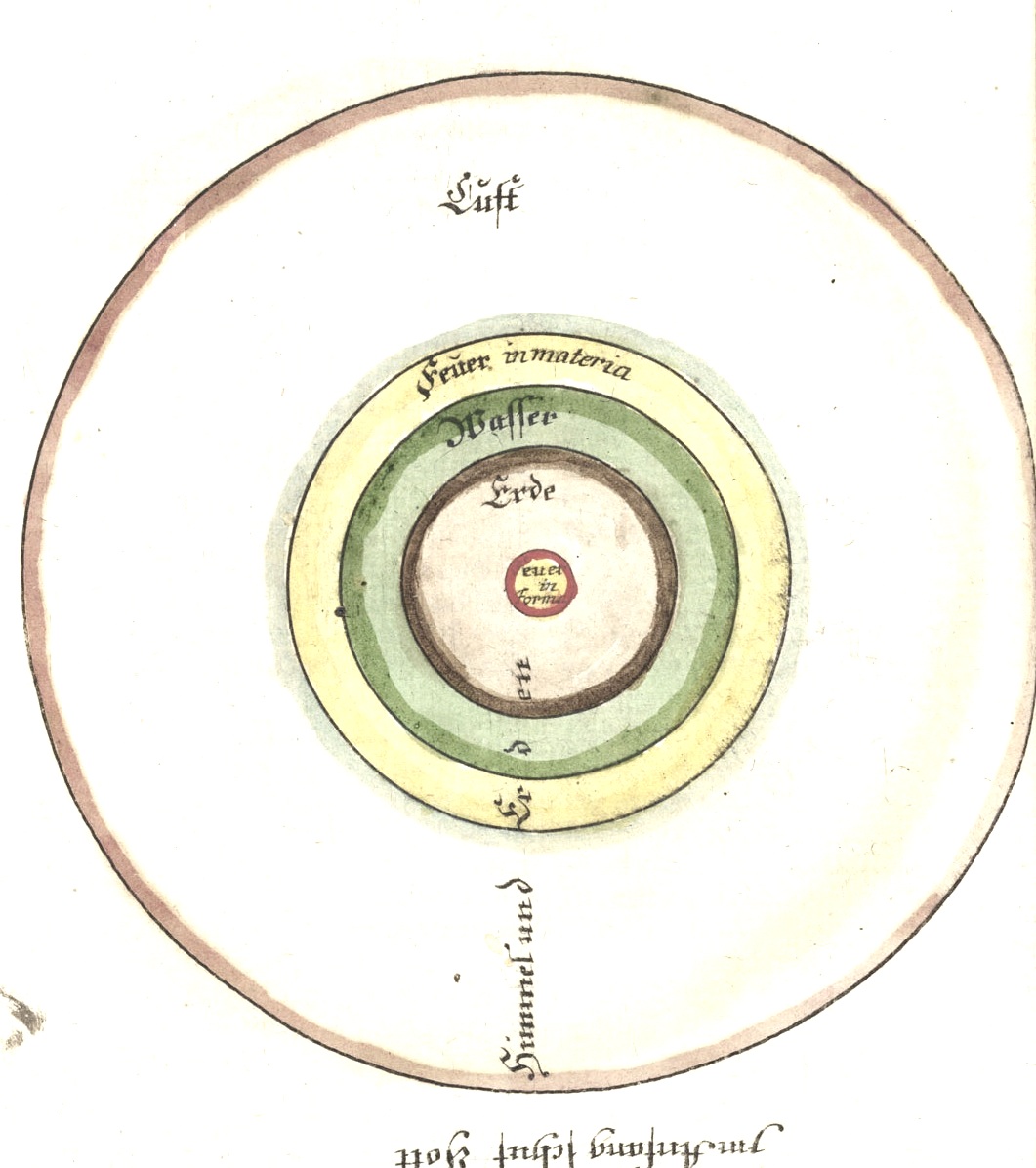
    This engraving is one of twelve found in a fine little book, the brainchild of clergyman/semi-scientist Jodocus Frisch (1714-1787), who delivered to the (un-) waiting world his vision of how the earth and heaven will come to an end, there at the end of days.   Die Welt im Feuer, Oder das Wahre Vergehen und Ende der Welt, Durch den letzten Sünd-Brand  (printed in Sorau by Gottlob Heboldm in 1746) is one of very few works that depict (in  illustration) the destruction of the Earth, and even though Frisch illuminates biblically-based theory, the idea of the earth exploding into bits in primordial fire and so on was extraordinary.  The images were done in four colors representing the four elements:  yellow, brown, green and white represented (respectively) fire, earth, water and air. In this image, we see the fire-centric earth encircled by a sphere of water, which is surrounded by a sphere of fire, which in turn is surrounded by a sphere of air,  with much bad stuff happening. 

    Not having the book in hand I’m relying on the  description of the Dutch bookseller Asher & Company, an old-line bookseller of very fine antiquarian works, which wrote the following descriptions of the other images in the book (and which appears for sale right now at their site):

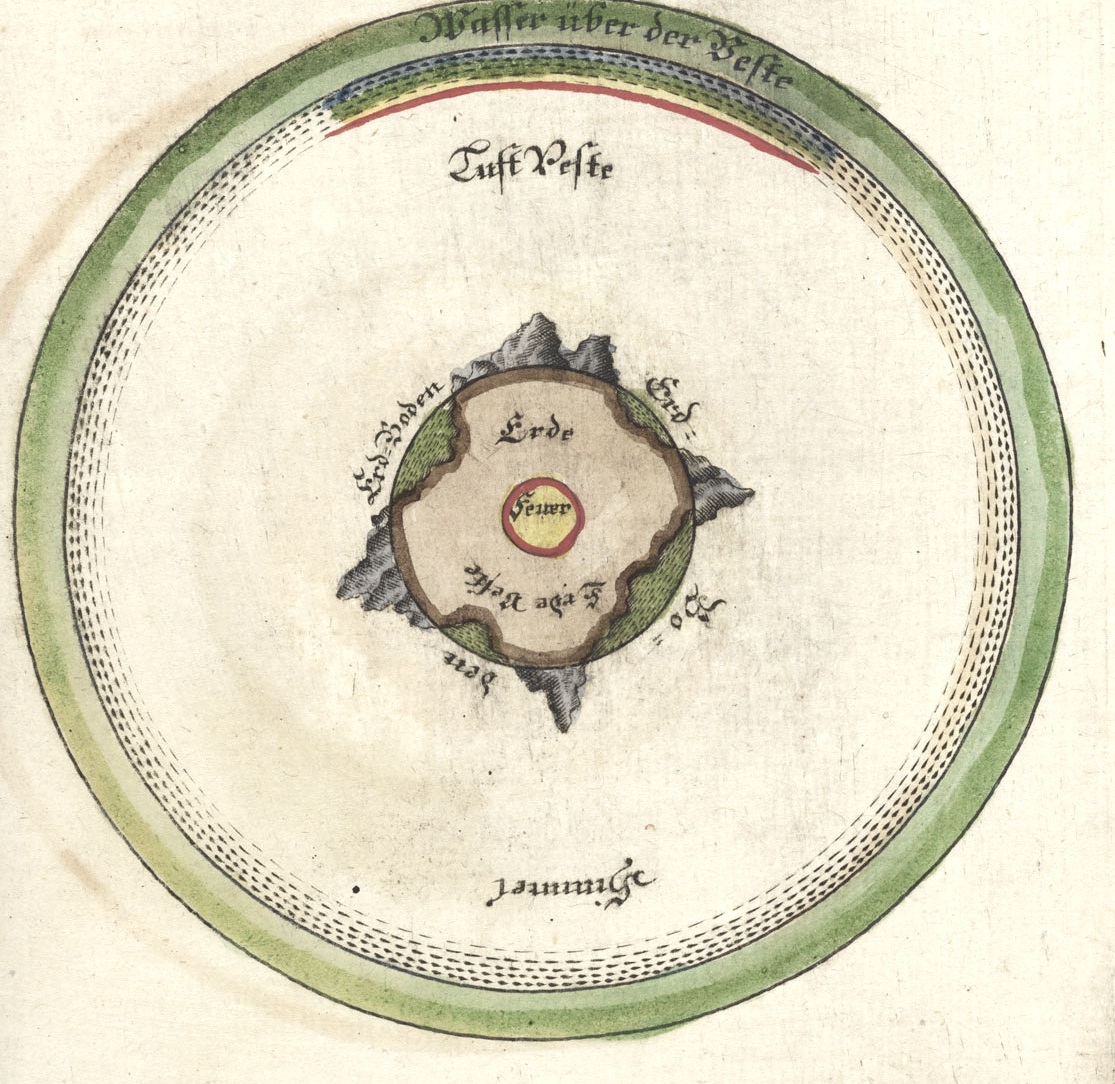
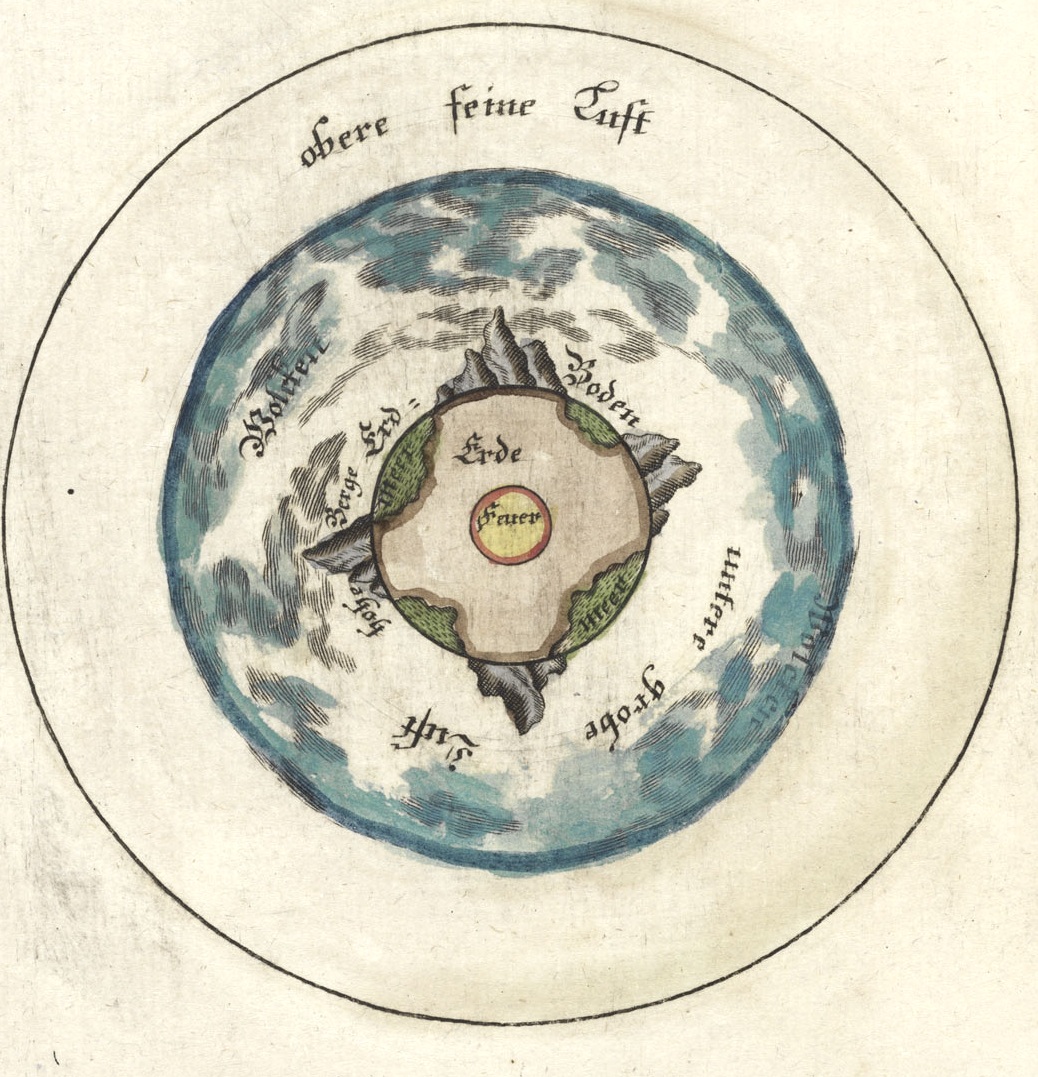
    “The second and third engravings show how the sphere of water disappeared after the torrential rains of the deluge, leaving the earth directly exposed to the sun. In the fourth and fifth engravings the earth is consumed by fire from within and without, demonstrating in what way the biblical prophecies about the destruction of heaven and earth may come to pass. Plates 6 and 7 depict the new heaven and earth that look entirely similar to plates 1 and 2, the first heaven and earth. Plates 8 and 9 show heaven and earth in their present state with precise specifications of what the biblical vocabulary names “heaven.” Plate 10 shows how the sphere of water breaks the rays of the sun in such a way that they shine on all parts of our planet in equal manner, wherefore all regions have a temperate climate. However without the tempering function of the sphere of water, the air focuses the rays of the sun in the equatorial zone.”

      Frisch 1 page 26

    The water of the great deluge now gone, revealing the land masses, plate 2:

    Frisch 2
     And so again, in plate 3:

    Frisch 3


  • The Weight of War–Bombing and Shelling During World War I and a Lesson in Orders of Magnitude

    JF Ptak Science Books  Post 1389

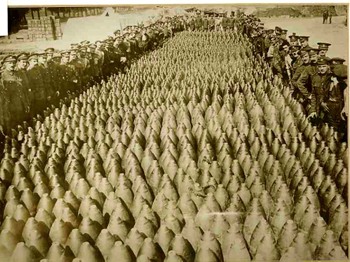
    Blogbomb_master This indelible image was made by an anonymous photographer for the Central News Service of New York City in 1918.  The Central News Service was a photographic supply house that would send requested photos to newspapers throughout the United States for publication as illustrations for  a story.  They would’ve been sent rolled in a tube  with a description of the image and with the stern warning to “Watch Your Credit Line”, making sure that once the newspaper had paid for the use of the photo that it also told its readers the source of the (agency) photographic.
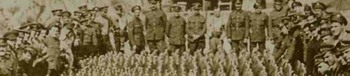
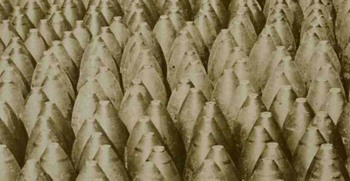
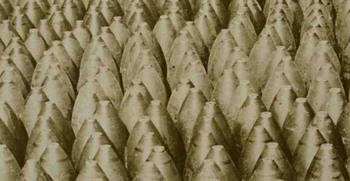
    The image is insatiable–it demands that you look at it and look at it long and hard, as it tries to give some sort of idea of the tremendous number of shells that were shot from canons by the just British against the Germans during the First World War..  There were something like one million tons of these fired against Germany; this picture represents about .001% ( of that total).  We see approximately 800 shells at two hundred pounds apiece, surrounded by a group of about 150 soldiers. 
    Blogbomb_detail_rear

    I looked very closely at this photograph.
    Of this single line of soldiers along the perimeter of the bomb cache, of the 150 of them, there are, it looks like, only five of them who have placed their hands on one of the bombs, and four of them are touching the fuse with just their middle finger.  It is an odd picture of restraint, these soldiers paying the weapons of mass destruction the respect of room.
    Blogbomb_detail_front

    I think that this is an extraordinary photograph of the testament of understatement and small, small percentages–even with this photo being so enormously graphic it still gives you absolutely no idea of how much explosive material was hurled back and forth, even knowing in your mind’s eye that this image represents something like FOUR ORDERS OF MAGNITUDE less than the total tonnage of bombs used.  By the British.
    Blogbomb_detail_front_2

    This difference in orders of magnitude is roughly equivalent to the difference in size between an ant and a human being, or between an amoeba and an ant, or between a human and one of the pyramids, or between the earth and the sun.  Basically, the shells in this photo meant nothing whatsoever to the total of shells used during the war.


  • A Romance of Swivel Chairs, 1945

    JF Ptak Science Books  Post 1376

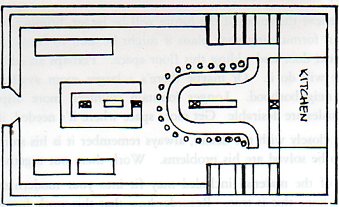
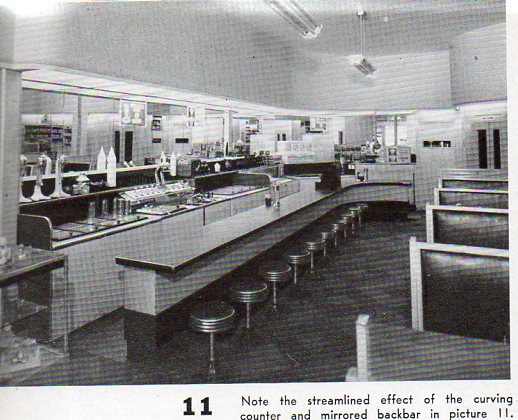
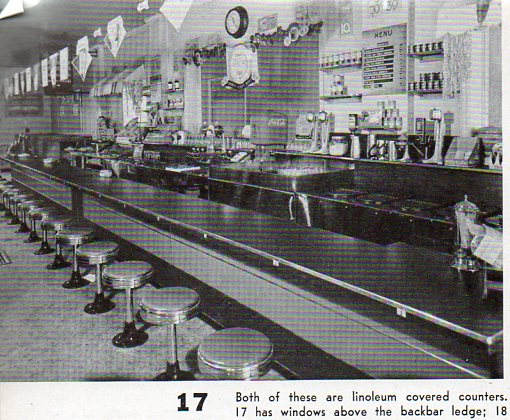
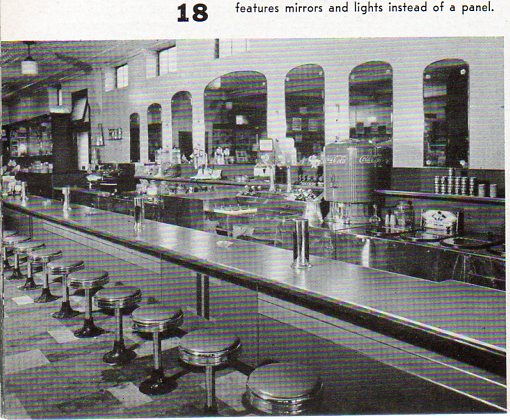
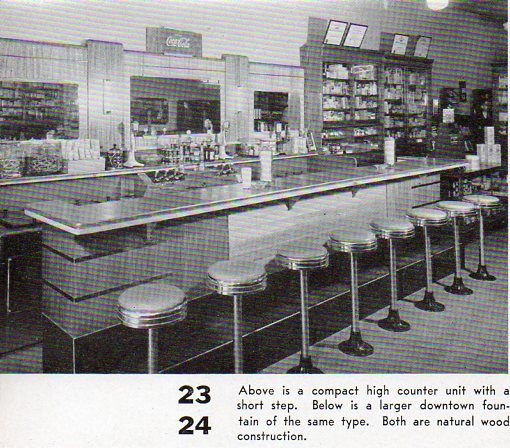
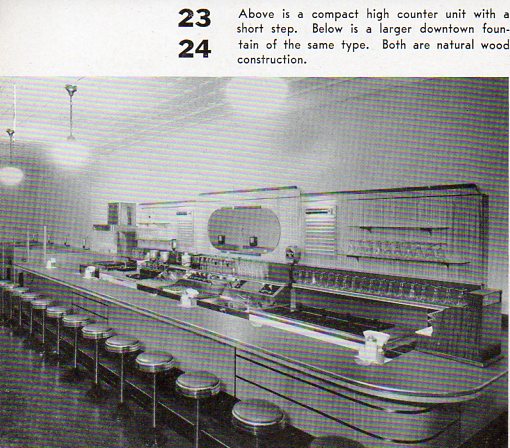
    Swivel chairs schematics099 The Borden Company–at one time the largest producer of dairy products in the U.S.– published the little pamphlet (Modernization Handbook) from which these pictures below are taken. Published in 1945, this slim work was meant to entice owners of luncheonettes and pharmacy/soda shops to upgrade their businesses, so that they could sell more product, so that they could buy more supplies from Borden.  Borden wasn’t offering financing, just supply-side friendly advice to the folks selling their goods.

    Swivel chairs091

    A large amount of this “modernization” had to do with swivel chairs/stools, chairs around a long lunch counter that stood to serve the maximum number of people in a small space in the minimum amount of time, all while giving the patron a maximum visual field to the other stuff for sale in the establishment.

    Swivel chairs093

    I’ve got to say that there is a long simple elegance to this–sitting at a table within sight of the person cooking your meal, check-to-jowl with probably-unknown fellow diners, getting your food quickly and probably freshly and with minimum fuss. There is definitely pleasantness seeing your food prepared before you, a better type of fast food, far removed to a comparatively superior land when compared to dealing with simple human interfacers between customer and the Conglomerate Cook of the modern fast-food behemoths.

     Swivel chairs094


    Swivel chairs097

    Swivel chairs098

    And if you were to turn around in your chair,  this is what you would see:

    Swivel chairs turn around103
    Swivel chairs turn around102
    Of course this was all about sales for Borden, and that’s fine, especially when the end result of the money-making idea produces the ultra-sweet highly anticipated sound of your plate sliding arorss the linoleum countertop.  Don’t forget your napkin.