A Daily History of Holes, Dots, Lines, Science, History, Math, Physics, Art, the Unintentional Absurd, Architecture, Maps, Data Visualization, Blank and Missing Things, and so on. |1.6 million words, 7500 images, 4.9 million hits| Press & appearances in The Times, Le Figaro, Mensa, The Economist, The Guardian, Discovery News, Slate, Le Monde, Sci American Blogs, Le Pont, and many other places… 5000+ total posts since 2008.

Category: History of Goodbye

  • Sequential Illustration and the Seven Stage Rule of Human Decay

     JF Ptak Science Books       Post 1910

    Among graduated indicators the semi-physical allocations of measurable units time must be the most significant–or at least in modern times, over the last few hundreds years, when the popular class was able to afford time-keeping devices so that they could have a greater appreciation and control over time past and future.  Simplified articulations of long periods of time is generally not a topic of illustration, however–art and illustration showing the development of a story is generally not a common occurrence in published form. 

    It is not terribly uncommon in ancient and early modern times, though.  Trajan’s Column is an excellent example of a sequential story, this told in stone; legends and myths and other stories are told in vases and friezes in Greece, and in various codices and altars in Mayan and Mixtec cultures. 

    But in more modern times the telling of the sequential stories in published form, again, is not a common thing.  Even the telling of the story of the development of, say, a tree or the  life cycle of a bird is just not a common occurrence, in spite of the more-popular appearance of graphical and expressive modes of displaying quantitative data in the mid-19th century. 

    http://www.internetmonk.com/wp-content/uploads/AdamAndEve_Garden_Lucas_Cranach.jpg

    Perhaps the most common of the early transitions in displaying these stories since the Renaissance have been in the telling of the lives of the Saints, or in the Passion of the Christ, or in the depiction of the legend of Adam and Eve (as in the work of Lucius Cranach, above).  There are interesting cycles showing the Christian mythic formulation of the creation of the world, as in the case of Thomas Burnet’s (illustrated title page to his)  Sacred History of the Earth  where there is a glorious seven-sphere display of the beginning and ending of our planet. 

    [Source, with full text, here.]

    I wonder though if one of the most popular and common sequential depictions of an important and shared story is that of the ages of man/people:  generally they show a pyramidal showcase of silhouettes or full-body portraits of one person as that body develops and decays over the major decades of a life.

    They would normally appear in a configuration like the following:

    File:The Stages of Life BM 1992 0125 31.jpg

    And earlier on, very famously, like so:

    File:Stages of Life by Bartholomeus Anglicus 1486.jpg

    (I’ve written about and identified these and other related depictions of the ages of man here.)

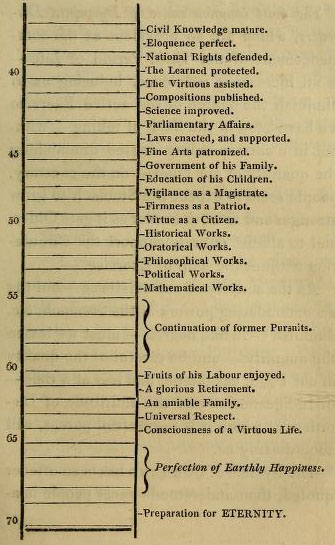
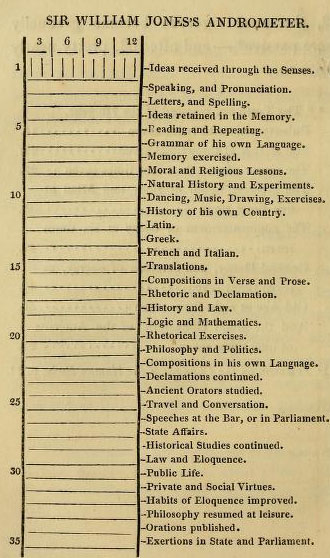
     I came to think about all of this again after reading an interesting post in the excellent Public Domain Review blog where I found this absolutely delightful “barometric” rendition of the stages of life, a sequential, top-to-bottom graphical display of the stages, but without illustration.  I cannot remember seeing such a “list” before, and was not familiar with the book from which it came (The art of invigorating and prolonging life, by food, clothes, air, exercise, wine, sleep, &c
    and peptic precepts, pointing out agreeable and
    effectual methods to prevent and relieve indigestion, and to regulate
    and strengthen the action of the stomach and bowels … : to which is
    added, the pleasure of making a will …

    which was printed in 1822 by Constable for Hurst/Robinson in London, the full text of which can be found at the Internet Archive). 
    Stages of life (a)

    Stages of life (b)

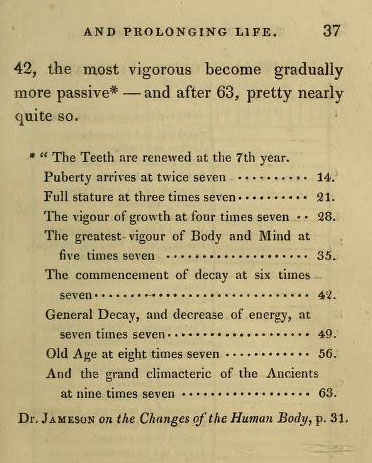
    And the “Rule of Seven” which precedes the longer list above:
    Stages of living rule of 7
    It is interesting to note that this was the fourth edition of this work, and that the end of the book, the very synopsis for ideas of full life and longevity, the whole is topped off by a chapter on happy-making and your personal will. 

    There were many admonishments that made and still make perfect sense found in these pages:  early to bed and early to rise sort of material.  Plain, but sensible.  Eating early. Dressing sensibly.  Eating (for the time) modestly. Interesting recipes. Pure air making for “a diverted mind”.  Good advice for the mature bookbuyers there in first quarter 19th-century England.  I imagine that most of those readers were no doubt born in the second-to-last decade of the 18th century, which means that their instructions on Daily Life business was from their parents who got their information from their parents, which means by 1822 much of the handed-down wisdom relating to diet and exercise was from the early 18th century.   Perhaps this work was the breath of fresh air that people needed, making it popular enough to find its was into at least four editions. (Also worth noting is that the average resting pulse rate for the readers of this book was said to be 60, which I think is lower than the American national average today.)

    There is of course a suffocating number of ill-advised recommendations, like for athletes, where the consumed foods should not include veal, lamb, pork, fish or cheese puddings, “or vegetables”, which leaves little room for anything besides red beef, which was to be had in quantities, including beef pudding, jellied beef, and “beef tea”. There was also a lot of beer and malt liquor drinking, with suggestions for “three pints of home-brewed” to be had with dinner, followed by three glasses of wine (‘the less, the better”)–then again, clean/drinkable water was a tough go at times, so beer was a common-enough stand-in.  All things being equal, the advice utilized whatever was the good data for the time. 

    The long list from birth to death of supposed and impending accomplishments is interesting particularly for the “decaying” part (which is outlined in the second chart) of life, where we find that at age 54 a person should be conducting their mathematical works, after which (from 55 to 60) one is relegated to pursuing “former works”.  (After all, the period of general decay according to the Rules of Seven chart begins at age 6×7.) And it is here that the creative life ends, because from this point to the preparation for eternity the life is spent enjoying one’s earthly works.

    In any event, I just wanted to point out the unusual nature of the “William Jones’ Andrometer”, which is a display of information that is outside my usual experience. 

    Note:

    I briefly considered including “logic trees” in this description, as they do tell a story, in a way.  ParticPorphyrysularly
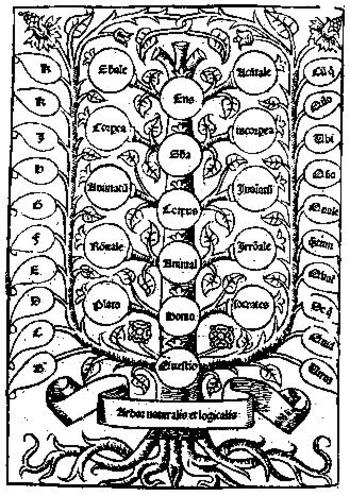
    Porphyry’s Tree came to mind (which was a classification in diagrammatic form on different kinds of being) and then Pacioloi’s summary of ratios from his Summa de arithmetica (1494). They do certainly represent a structured depiction of thought, but they are not a narrative, though they would provide the structure for one. Anyway, I’m convinced tonight at least that these diagrams don’t belong in the sequential illustration discussion.  (And in a weird way these diagrams enter the modern conversation so far as their overuse is concerned. Even in the Middle Ages the idea of the logic tree was being so over- and mis-employed that they would remind the modern reader of the “Top 15 (or whatever number) Photographs of Butterflies (and again, whatever he counted thing might be).)


  • The Sounds of Slavery: Slave Bells, 1830’s.

    JF Ptak Science Books   Quick Post

    Fresh from a short post on Richard Wagner writing and publishing an interesting piece on the future of music, and then months later writing a diabolically-bad and ruthlessly hateful pamphlet on Jewish people, I came to this–a pair of books with illustrations of another sort of ruthless control, this one mental, legal and physical.

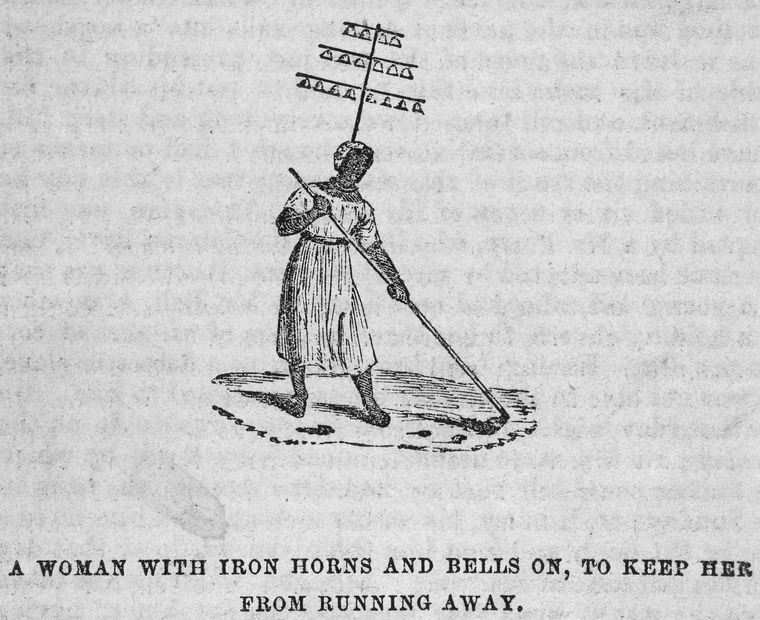
    Moses Roper‘s1(b. 1815-1891)  A Narrative of the Adventures and Escape of Moses Roper, from American Slavery, (Philadelphia: Merrihew & Gunn, 1838) details a life-long series of vast mistreatment, punishment and torture while a slave.  He was a mulatto, and of very fine and fair skin, and so endured a particularly hard treatment from a number of different masters, changing masters 17 times. But he escaped, finally (after more than a dozen attempts) and made his way from Florida to New York, and then ultimately to England.  His book has few illustrations, but those that are there are unforgettable.

    A woman with iron horns and bells on, to keep her from running away.
    [Source: New York Public Library Digital Collections, here.]
    Illustration
    [Source: Documenting the American South, here.]

    ·Posted by :

    ·in:

    —

  • An Alphabet of Australian Convict Mugshots, 1900-1920

    JF Ptak Science Books  Post 1797

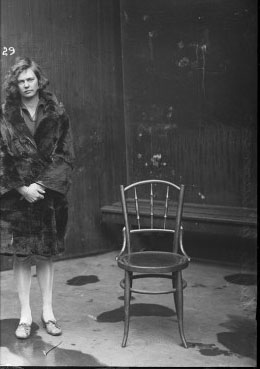
    These photographs are remarkable capsules of space and time–they hold the mostly-realized fates of their subjects, taken into custody in Sydney for crimes from prostitution to stealing to loitering to bigamy to murder and around and around. The poses are interesting in that there seems to be no unified way of making them, which means that most often the detained person had the opportunity to adopt whatever posed they pleased, given the emotional constraints of their situation.  Some are defiant, some at complete ease in front of the camera; others are completely distracted and scared, and embarrassed and guilty.  There also doesn’t seem to be a segregated point for making the photographs, tough there is a common-looking wall and hallway for some of them.  It would be interested to know if the Sydney police were making an editorial statement by placing their subjects in unflattering locations, like standing near a dripping faucet, or amidst trash, or in a garden, or in front of toilets.  In any event the range of emotions is remarkable, even for looking through only a few hundred of the more than 100,000 images that are on line here and there from the good folks in Sydney.     [The images below all started out their life at Sydney Justice and Police, and then used in parts by the following websites and blogs from which I harvested my selection below,:  Retronaut , the Independent,,  Live Journal   the Daily Mail, and the Historic Houses Front (which also has full-ish records for each photograph).  An interesting interpretation of many of the images can be found at SCAN.

    Analytically  interesting, an interpretative invitation.  Apprehensive? 


     BoredAustralian-criminals-15-520x378 guinness b


  • The Post-War Lives of the Nazis: Topf, Designer/Maker of the Auschwitz (and etc.) Crematoria

    JF Ptak Science Books  Post 1745

    The firm that produced crematroia for numerous Nazi death camps managed to stay in business in Wiesbaden  until 1963.

    What happened to the firm J.A. Topf & Sohn (of Erfurt), the company that supplied the mass incineration devices,  the crematoria, used by the Nazis at concentration and extermination camps (from 1939-1945) including Auschwitz-Birkenau, Buchenwald, Belzec, Dachau, Mauthausen and Gusen ?

    Well, in general, most of it dissolved, and the company’s CEO, Ludwig Topf, committed suicide in May 1945.

    Ludwig’s brother–Ernst-Wolfgang, 1905-1979–however, escaped prosecution and re-started the company in the late 1940’s, operating a crematorium business in Germany until the new Topf business went into bankruptcy in 1962. It sold mostly refuse/garbage grade incinerators, but, still, there it was.

    Topf liste

    [Circular for Topf describing the crematoria they constructed for the Nazis; of particular interest in this page is the entry for May 11, 1942, for a crematorium for ““continuousoperation corpse cremation oven for mass use”. Source: here.]

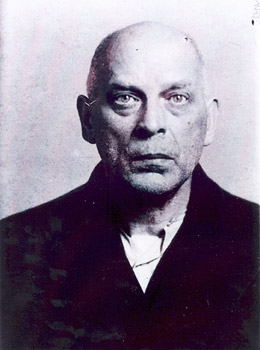
    Topf pruferThe leaders of Topf firm would argue after the end of the war that they did not know what the crematoria were really being used for, despite numerous visits for site inspection and repair to Auschqitz and Dachau. Karl Pruefer, the original designer of teh ovens, revealed on interrogation by Soviet officials just after the war that “I have known since spring 1943 that innocent human beings were being liquidated in Auschwitz gas chambers and that their corpses were subsequently incinerated…”  There can be little doubt that Topf knew exactly what was going on with their crematoria–in fact, at one point, Kurt Pruefer (pictured at left, in Soviet custody, undated, from Der Spiegel, Archiv) suggested that the use of his crematoria at the extermination camps actually saved lives by disposing of diseased corpses and preventing the spread of fatal diseases and epidemics.(The exact early reference was to preventing the spread of typhus in Buchenwald in 1939.  The Nazis adopted a practice in some of the mostly-Russian camps in the East of introducing typhus-laden prisoners into general population so that the disease would spread and aid in the extermination of the camp inhabitants.)

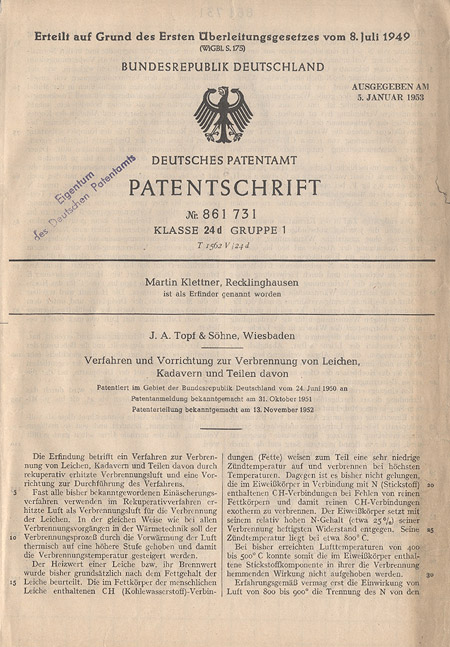
    Topf[Topf, still in business, 1953]

    The two Topf brothers claimed innocence for themselves and for their company; Ludwig committed suicide because he and his firm had done nothing wrong, and had felt beaten by lawless countries and did not intend to be taken captive by them; feeling that justifying his actions would be impossible, he killed himself  on 30 May 1945. The text from his suicide note is below.1

    The evidence against the firm was exceptional and substantial, an example of which (from the Nuremberg Trials, is seen below2), and their culpability overwhelming.  I’m not sure how Ernst -Wolfgang was able to survive the various net that he managed to wiggle through (unlike a number of other of the firm’s officials who wound up being captured by the Soviets and whisked away to cold justice far from Moscow), but he did; and not only that, but was able to start over in the business that he knew best, keeping it running until 1963, well into a time when it was recognized that the shell of buildings from his old business be kept intact as a memory to horror. 

    Notes

    1)  Farewell letter by Ludwig Topf, May 30, 1945 (excerpt, underlining in original) (from Topf und Sohne website)

       “If I have made the decision to evade arrest it is for the following reason: I have lost all belief in any law in this world now that my family has also done me so much wrong and harm. If I am arrested, the greatest of all wrongs will be done to me. I never consciously or intentionally did anything bad; instead it has been done to me.
    I was never cowardly – but I was proud. Handing myself over to the mercy or mercilessness of a foreign country is something I cannot do, because I have learnt the bitter lesson that there is no law and no decency left in this world. That is why I, as a decent person, today have one remaining opportunity to determine my fate as I see fit. And that means immediate departure from a world that in general has become unbearable, and in particular has persecuted and wronged me.”
    “If I ever believed that my innocence as far as the crematoria are concerned (and my brother is just as innocent) would be recognized and honoured, I would continue to fight for justification, as I always have until now – but I think people need a sacrifice. In which case the least I can do is provide it myself. I was always decent – the opposite of a Nazi – the whole world knows that. If I were still able to feel at peace in the heart of a family, the struggle would be worthwhile – but the Topf family that showed composure, integrity and self-confidence has ceased to exist. I was its sole representative as far as that was concerned. Indeed I am so alone that I have no need to ask anyone’s forgiveness, not even for a suicide.”

    2) From the Nuremberg Trials, Day 193, 2 August 1946 [Source, Yale University, Project Avalon]:

    “In the office records of the Auschwitz Camp there was discovered a voluminous correspondence between the administration of the camp and the firm of Topf and Sons. Among them the following letters:

    ” ‘I. A. Topf and Sons, Erfurt; 12 February 1943.

    ” ‘To Central Construction Of lice of SS and Police, Auschwitz.

    ” ‘Subject: Crematoria 2 and 3 for the camp for prisoners of war.

    ” ‘We acknowledge receipt of your wire of 10 February, as follows:

    ” ‘We again acknowledge receipt of your order for five triple furnaces, including two electric lifts for raising the corpses and one emergency lift. A practical installation for stoking coal WAS also ordered and one for transporting the ashes. You are to deliver the complete installation for Crematorium Number 3. You are expected to take steps to ensure the immediate dispatch of all the machines complete with parts.’ “

    “I omit the next document which deals with “bath-houses for special purposes” (gas chambers), and present to the Tribunal as Exhibit Number USSR-64 (Document Number USSR-64), a document which is appended to the report of the Yugoslav Government. This is a certified photostat of a document externally having all the official character of a business document from a “sound business firm.” The name of the firm is Didier-Werke. The subject of the correspondence-the construction of crematoria “designed for a large camp in Belgrade.” The document presented by me characterized the firm Didier as a firm with considerable experience in construction of crematoria for concentration camps and which advertised itself as a firm that understood the demands of its clients. For placing the bodies. into the furnace, the firm designed a special conveyer with a two-wheeled shaft. The firm claimed that it could fill this order much better than any other firms, and asked for a small advance, to draw up draft plans for the construction of a crematorium in the camp.


  • Not-Seen-Daily: Oscar Wilde in a Soldier’s Uniform, 1892.

    JF Ptak Science Books  Post 1744  [Part of the History of Goodbye series.]

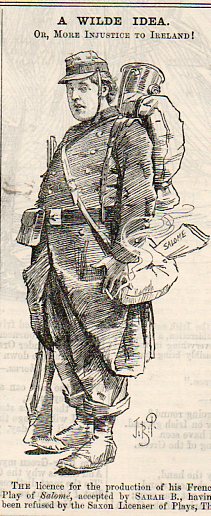
    Oscarwilde332There’s just so much in Punch magazine to pull out and have a think over.  This cartoon was poking fun at Oscar Wilde, sending him up in a French soldier’s uniform suggesting that he might have to serve if he exiled himself to France.  What had happened was that he had just written his play Salome, and in French, for production in Paris–unfortunately, there was a law in France prohibiting the portrayal of Biblical characters onstage, and so he ran into a large spot of bother..

    Wilde would wind up in France soon enough, but under tremendously changed circumstances, as the next eight years of his life would be mostly decline-and-fall, and then exploded in an exploding-hole, with nothing but Wilde-smoke remaining, and precious little of that.

    Wilde’s publishing career had started just four years earlier, really, with the appearance of The Happy Prince and Other Tales (1888).  He would enjoy major success over a period of five years, beginning in 1891 with The Picture of Dorian Gray, The Soul of Man Under Socialism, and Intentions, followed by Lady Windermere’s Fan, and Salome in 1892, A Woman of No Importancee  in 1893, the Importance of Being Earnest in 1894, and then, well, then came the beginning of the end.  After much success with his plays, everything would blow up in 1895 after Wilde decided to sue his lover’s father (the Marquis of Queensberry) for defamation received on February 18, 1895.  The suit went very badly, with Queensberry  acquitted on all counts in the course of a trial which dragged Wilde’s sexuality all the way through it.  Wilde was immediately arrested for gross indecency, was brought to trial within a month of the end of the Queensberry debacle (on April 26, 1895); he was crushed completely and found guilty on May 25, 1895, and sentenced to two years hard labor, which began immediately. 

    That was pretty much the end for Wilde., though he would write De Profundis in 1897 and The Ballad of Reading Goal in 1898. He would never see his two sons again, his mother would die while he was in prison, and his wife, too, would be dead in 1898.  Wilde was released from Reading Goal on May 19, 1897, and he would leave almost immediately for France, where he would spend the rest of his life.  A not-long life, as he would die a rather miserable death three years later, in France, on November 30, 1900. (He outlasted Queensberry, who died in January. His former lover, the Marquis’ son, Alfred Douglas, lived until 1945; he came to loathe and repudiate Wilde, rejecting their history.)

    So this cartoon was a little prescient, in a way–the near-future would find Wilde in France, though not in a France and not in a situation that Wilde could have possibly seen in 1892. 

    What lead to all of this bad business?  The Marquis was disgusted that his son was having a relationship with Wilde, and sought to put an end to it.  The end of it all came when the Marquis left his calling card addressed to an absent Wilde, “For Oscar Wilde, posing Somdomite [sic]”. And then everything for Wilde came apart, costing him his reputation and financial failure. 

    A rectangular calling card printed with "Marquess of Queensberry" in copperplate script.
    It doesn’t seem like much to hang your legal hat on, especialyl with a Marquis, but Wilde tried I guess to protect himself, and it cost him everything. Wilde won the laughs in his trial, but the prosecution won the case.

    ·Posted by :

    ·in:


  • Flying Mountains of the Diseased Dead: Offensive Weapons and the Black Death

    JF Ptak Science Books   Post 1740

    It is generally conceded that the introduction of the Plague1 into Europe in 1348 had its very terroristic beginning in the Genoese trade and port city of Caffa, the result of a series of various sieges and bad blood between them and their Mongol hosts.

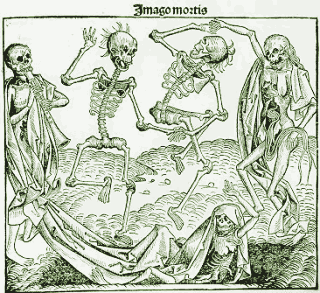
    Holbein-death


    The background to this confrontation is pretty extensive, with sieges laid to Caffa several times over a hundred year period.  The Genoese established themselves at Caffa (which today is the city of Feodosija, Ukraine) via and agreement with the Kahn of the Golden Horde (the remnants of the Mongol Empire of Genghis Khan), which was a seaside link that reached across Russia and into the Far East.  The city was besieged in 1308 due to diplomatic/trade/ethnic etc. unpleasantnesses, and the Genoese wound up firing and evacuating the city, only to be invited back again in 1312 with the acceptance f a new Khan.  A major city developed which by 1343 consisted of two concentric rings of fortress protecting a diverse population of 20,000.  But it was in this year that the second siege began, lasting four years, with the Genoese (having access to the sea and supplies and new military input) finding themselves with a string of victories against the Mongols.
     

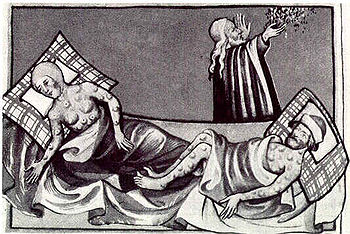
    The Mongols at this time were also laid low with what turned out to be the Black Plague. Anxious to share this disaster with the Genoese, they catapulted their fallen, diseased soldiers over the siege walls and into the Caffa, with devastating effect. The scene was recorded by the contemporary Gabrielem de Mussis  (the account found in Mark Wheelis’(U  Cal Davis) CDC article “Biological Warfare at the 1346 Siege of Caffa”), which begins “In the name of God, Amen. Here begins an account of the disease or mortality which occurred in 1348, put together by Gabrielem de Mussis of Piacenza” and continues: Black death

    “The dying Tartars, stunned and stupefied by the immensity of the disaster brought about by the disease, and realizing that they had no hope of escape, lost interest in the siege. But they ordered corpses to be placed in catapults and lobbed into the city in the hope that the intolerable stench would kill everyone inside. What seemed like mountains of dead were thrown into the city, and the Christians could not hide or flee or escape from them, although they dumped as many of the bodies as they could in the sea. And soon the rotting corpses tainted the air and poisoned the water supply, and the stench was so overwhelming that hardly one in several thousand was in a position to flee the remains of the Tartar army. Moreover one infected man could carry the poison to others, and infect people and places with the disease by look alone. No one knew, or could discover, a means of defense.

    “Thus almost everyone who had been in the East, or in the regions to the south and north, fell victim to sudden death after contracting this pestilential disease, as if struck by a lethal arrow which raised a tumor on their bodies. The scale of the mortality and the form which it took persuaded those who lived, weeping and lamenting, through the bitter events of 1346 to 1348—the Chinese, Indians, Persians, Medes, Kurds, Armenians, Cilicians, Georgians, Mesopotamians, Nubians, Ethiopians, Turks, Egyptians, Arabs, Saracens and Greeks (for almost all the East has been affected)—that the last judgment had come.

    “…As it happened, among those who escaped from Caffa by boat were a few sailors who had been infected with the poisonous disease. Some boats were bound for Genoa, others went to Venice and to other Christian areas. When the sailors reached these places and mixed with the people there, it was as if they had brought evil spirits with them: every city, every settlement, every place was poisoned by the contagious pestilence, and their inhabitants, both men and women, died suddenly. And when one person had contracted the illness, he poisoned his whole family even as he fell and died, so that those preparing to bury his body were seized by death in the same way. Thus death entered through the windows, and as cities and towns were depopulated their inhabitants mourned their dead neighbours.”

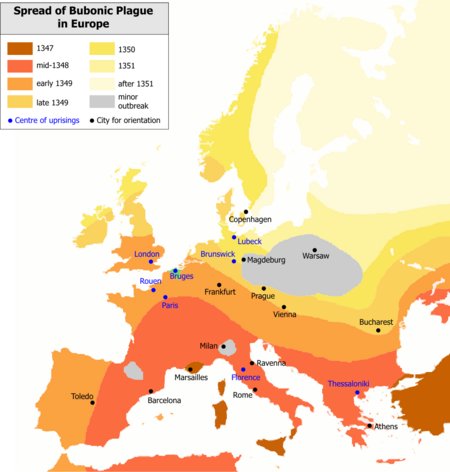
    The end result of the mountains of dead flying plague-ridden corpses was the retreat of the Genoese, who also brought back the disease to (at the very least) southern Europe, with spectacularly bad results, killing millions and millions of people. 

    Black plage map

    1) “The catastrophic pandemic has, generally been considered to have been plague, a zoonotic disease caused by the gram-negative bacterium Yersinia pestis, the principal reservoir for which is wild rodent.”–Wheelis

    Fuller quote, below, in continued reading:


  • Design and Undesign in Belief and Unbelief: Revivalism, Fasting and Flames

    JF Ptak Science Books  Quick Post

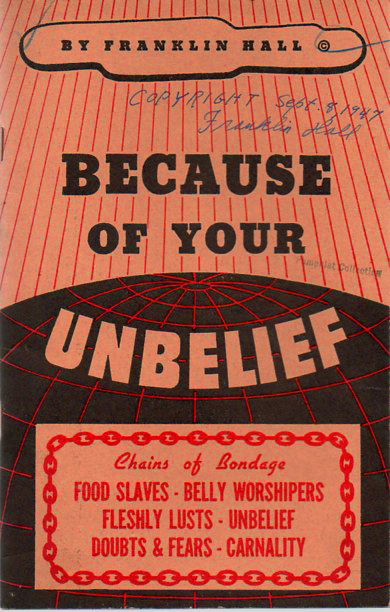
    I was looking through a stack of pamphlets here aiming to select something in red for St. Valentine’s Day, until I came upon this magnificently designed pamphlet by Franklin Hall, Because of Your Unbelief , Chains of Bondage, Food Slaves,m Belly Worshippers, Fleshly Lusts, Unbelieft, Doubts & Fears, Carnality.  I think though the attractiveness is in the pamphlet’s undesign–it has a distinct taste of revival-tentism to me, a message hammered out in a thumping repetitiveness and bass cadence. 

    Unbelief169
    The work has no title page, and starts with a foreword, and gets right into the message, which equates food and eating with a passage from the New Testament (Matthew 17:20, “And Jesus said unto them, Because of your unbelief: for verily I say unto you, If ye have faith as a grain of mustard seed, ye shall say unto this mountain, Remove hence to yonder place; and it shall remove; and nothing shall be impossible unto you.”)  Reading this for the first time, it seems to me that what Jesus is saying is that it doesn’t take much more than a mustard seed amount of faith to be able to move a mountain.  Which seems to be a great message on believing in something and having the confidence to achieve.  I’m not sure how it happens from there, but Mr. Hall gets right into the power of fasting (which is not an uncommon practice in the Old and New Testament so far as I can tell, though “fast” meant different things to different people), and that through fasting this “unbelief” in people can be revealed and blasted away. 

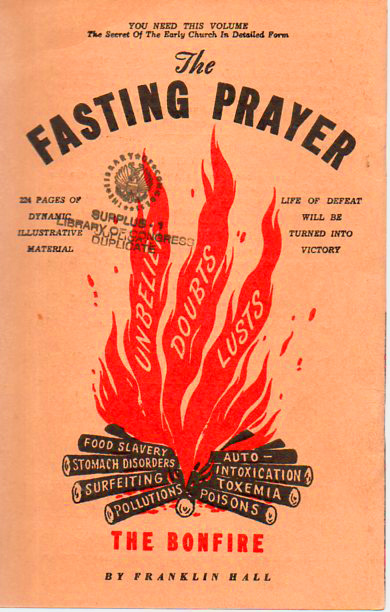
    Unbelief170
    As we see on the back cover,  in an advertisement for book of “224 pages pf Dynamic Illustrative Matieral” we see Fasting Prayer about to descent on the flames of unbelief, doubt and lust, fueled by “food slavery, stomach disorders, surfeiting, pollutions, auto-intoxication, toxemia and poisons”, perhaps insinuating that at the base of it all it is food that fuels unbelief.  Or not, I’m not sure.  But the entirety of the publication does have a very Elmer Gantryish aspect to it, to me.

    Mr. Franklin was also the author of Glorified Fasting, Because of Your Unbelief, and of course Atomic Power with God Thru Fasting and Prayer.

    ·Posted by :

    ·in:


  • Q: How Long Did the Classic Cowboy Age Last? A: Not very.

    JF Ptak Science Books    Post 1706

    The Cowboy West, from Ned Buntline to Raymond Chandler and Dashiell Hammett

    http://www.the-forum.com/books/images/ww756.jpg

    I imagine that there have been significantly more people who have played cowboys in literature, on radio, in movies, on the stage and on television than ever cowboyed in the West. This doesn’t include children who have played at “Cowboys and Indians” over the past 150 years. The time of the classic cowboy-in-all-his-glory was short—maybe two generation. Probably less.  And there weren’t that many people to fill in those positions in that short period of time. 

    Certainly there are cowboys to this day, but the cowboy of our mind’s eye—that iconic cowboy of the expanding, post-Manifest Destiny West—was a victim of the great rush to land privatization in the 1880s-1890s: barbed wire and other fences took the cowboy’s place. By 1895 there were more cowboys riding fences than herding cattle. As Faulkner wrote on the “last individual” in The Fable (page 204), “the cowboy was exterminated from the earth by a tide of men with wire-stretchers and pockets full of staples…”  Of course Faulkner also saw the cowboy set among horse dung and “oxidizing cans” of sardines and tomatoes–a gemeinschaft/gesellschaft thing.

    There are only 40 or 50 years that separate cowboys Texas Jack and Ned Buntline from the Chandler/Marlowe and Hammett/Spade modern detective West of San Francisco and Los Angeels, which is an extraordinary thing.  There weren’t cowboys stretching back forty years before Texas Jack, and there weren’t forty years that they stretched into the future from him, either.  The distance in time that the cowboy existed, all things considered, was short–from the Reconstruction free-roaming Texas cattle of 1866 to the appearance of barbed wire in the early 1870’s to the refrigerated railroad car of just about the same time to the endless farming non-frontier of the 1890’s, the cowboy enjoyed probably one full decade of not being molested by the present; the future caught up with them in  a quick hurry. 


  • A “Different” Sort of Posthumous Publication–the Books of the Dead

    JF Ptak Science Books     Post 1696

    Generally a posthumous publication sees a new book come to life after the author’s death,  In the case of Dante Gabriel Rossetti, a new book from him was brought into being literally from the hands of his seven-years-dead wife, Elizabeth Siddal.

    File:John Everett Millais - Ophelia - Google Art Project.jpg

    [Elizabeth Siddal was the model for Sir John Everett Millais’s Ophelia; she posed for many of the Pre-Raphaelite Brotherhood, and very often (and later obsessively and exclusively)  for Rossetti.]

    Elizabeth (1829-1862) was the great muse of Rossetti (a leading painter and one of the founders of the Pre-Raphaelitte Brotherhood), as well as to many painters–I imagine that she is depicted in hundreds of paintings.  But she may have had a taste for certain drugs, and may have been tubercular, and may have had an intestinal something, one or two or all may have caused her death at age 33. 

    The book was literally a book from the dead, though it had nothing to do necessarily like one of the real things, the true Book of the Dead that offered assistance to the newly dead in their trip to the ancient afterlife. Evidently a great guilt weighed on Rossetti for something he had done while Elizabeth lay dying, and to help conquer that great unquiet, the painter wrapped a manuscript volume of his poetry in her hair as she held the book in her hands, laying there very dead in her coffin.  The lid was closed, the coffin lowered into the ground,  and both were sent off into infinity.

    That infinity lasted seven years, interrupted by Rossetti’s animated alcohol- and drug-induced belief that–now convinced he could no longer paint–the poems in his wife’s hands were his way towards creativity.  Convinced that his painterly powers were gone, and that his writerly powers were going, the manuscript would help him get back on track.  It was the only copy of poems he had written over the years, and he hoped that their publication would (a) reassert his furious creativity with a successful book and (b) honor his dead wife.  And so a rat’s soup of demented needs conspired and the book was taken from the hands of Elizabeth after her exhumed coffin was opened–Mr. Rossetti not being present for the late-night and dark affair, unable to convince himself of the necessity of his presence.

    [Dante Gabriel Rossetti’s Beata Beatrix, featuring his wife Elizabeth as Beatrice Portinari, the character from Dante’s La Vita Nuova, completed the year after Elizabeth’s death.]

    The deed done, Poems was published in 1870, and I’m not sure what they accomplished.  Drugs and booze and some sort of wickedness of mind and a sacking of his health made for perfect conspirators to rid Rossetti of his talents, and he died a lingering death in 1882. It was said that he never overcame his grave robbing–I imagine not.

    http://upload.wikimedia.org/wikipedia/en/c/c9/Ms_eng_769.jpg

    One of the three surviving leaves of the book of poetry Rossetti stole from his dead wife’s coffin.

    And so it goes. In the end, everyone is dead.


  • On the Cost-Effectiveness of Killing: Poison Gas (1921) and Atomic Bombs (1945)

    JF Ptak Science Books   Post 1678

    Chemical warfare

    Atomic bomb eco detil

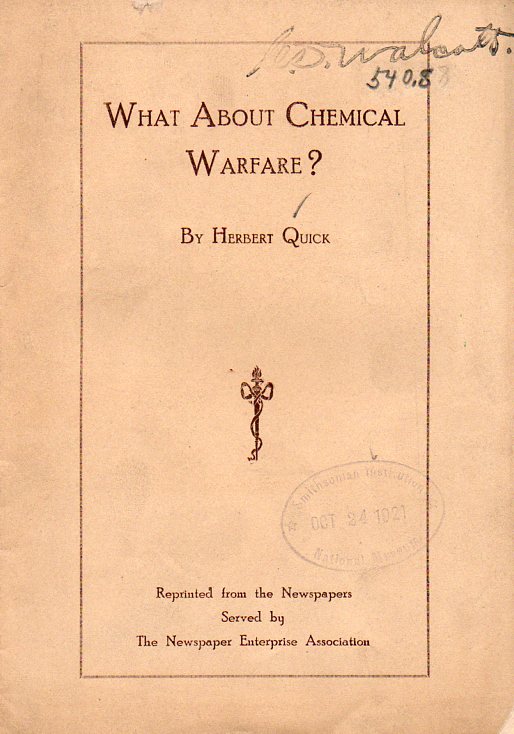
    Herbert Quick did a fair amount of thinking about the military use of poison gas, and it winds up, in the final analysis, thinking that it was tolerable.  What About Chemical Warfare? (published by the Newspaper Enterprises Association in 1921) is certainly a possible title for a Duck-and-Cover A-Bomb or You and Your Hormones kind-of-film–it has that certain stripe to it, bearing the certainty of wrongness that becomes more visible with each passing month.  (The pamphlet is available for purchase from our blog bookstore, here.)  But Mr. Quick took the slow boat around his issue, thinking about it a little long and out loud, before coming to his final conclusion in the chapter titled “Gas Warfare Cheapest and Most Effective Arm of Defense”.

    {See here for my post on Willis R. Whitney’s letter/proposal for establishing the American chemical warfare capacity, 1917.]

    He points out the enormous impact in the war effort that relatively small chemical corps played in WWI–something on the order of hundreths of one percent of all serving soldiers were employed in the combined chemical corps, saying “how small a body to produce such great results!” Which is true, assuming that by “great” he meant ‘widespread’, though it is unclear exactly what he was talking about.

    Mr. Quick (born in the first year of the American Civil War and dead four years after the publication of this pamphlet, writing evidently from the cushion of old age) does make a case for poison gas being not so inhuman as presented by most civilized people, pointing out both its high quick-death rate and survivability/recovery rates, which seems to be giving/taking at the same time. No matter:  “But woe to the army or nation that does not keep up with the times.  The Angel of Death will breathe in their faces” he writes. 

    The author alsoAir raid885 warns that though Germany was “stripped” of her war-making capacities, he thought it was not so of the industries necessary to produce poison gas. He points out that Germany can produce these munitions in secret, and that if any “militaristic nation conquers the world in the future”, it will be through the use of the poison gas it developed in secret. 

    Defense was also important:  “in the absence of efficient defense worked out beforehand, our great cities might be wiped out with gas bombs dropped from aircraft”.  Mr. Quick believes that protecting cities is possible, writing simply “preparation will prevent such a crisis”.  Indeed.  Unfortunately no ideas about this defensive posture were forthcoming, though he did bring himself around to writing about gas as a defensive tool.  Against looters. And rioters. And snipers.  “Gas puts the sniper in the power of his enemy” Quick writes, using the Marine action in Vera Cruz, Mexico, as a good example of where gas (“gas grenades”) would have come in handy.

    The bottom line is of course the bottom line, practically stating that poison gas as a weapon was indisputably more cost-conscious than anything else, by far, each dollar spent on chemical warfare being worth “from three to five hundred for the army”.  Poison gas services Quick says should be pursued, because “gas warfare cannot be stopped until all war is stopped”.

    Gas warfare “gives the educated, intelligent nations the advantages over the people of lower civilizations”.

    “When both sides are prepared it is much less inhumane than war with bullets and high explosives; but it means horrible annihilation to the army which is unprepared.”

    It is an interesting exercise to replace “poison gas” with other types of weapons, just to see how it reads.

    Mr. Quick was up and down in his treatment of poison gas and war, though almost entirely down.  One thing he didn’t see, that no one saw, really, was the use of a particular gas that was used to destroy millions of people, and which was developed quite in the open in Germany for many years, used for killing rats.  The Nazis simply used it instead on people.  No one saw Zyklon-B coming, and no one could have, even when they did.

    See also my post here on Hermann Goering and Zyklon-B.

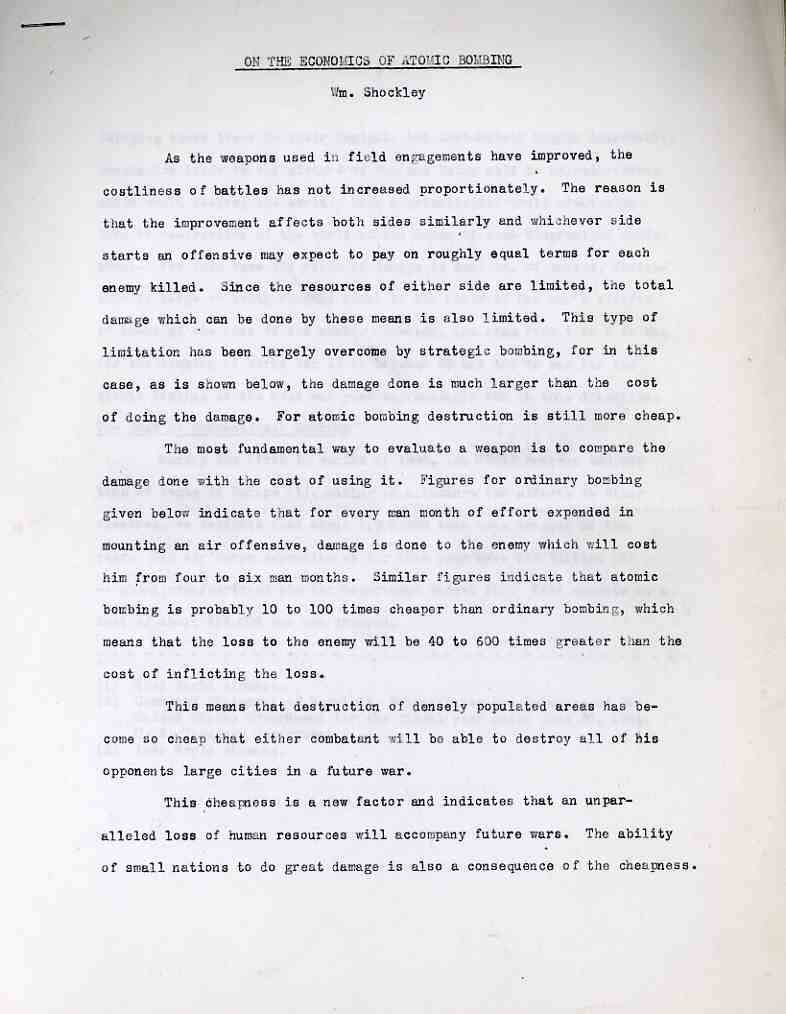
    William Shockley–a future Nobelist and probable weak member of a Nobel-team that invented the transistor and which included John Bardeen and Walter Brattain, or I should say rather a team of Walter Brattain and John Bardeen including William Shockley–sent forth a memo on the mathematics of destruction and the use of the atomic bomb.  He was part of a largish team working on what to do with the new technology once the bomb had been used and the war won.  (I’ve written more on this paper here.)

    Shockley atomic


    This paper was written towards the end of 1945 and is on five pages and runs about 1500 words, and is an extension of work he had already been doing for Henry Stimson with Quincy Wright on evaluating the combinations of casualties that would lead the Japanese to surrender.  He begins this paper with a logical statement of the issue of the economics of conventional and atomic bombing, ending with the sentence “For atomic bombing destruction is still more cheap”.  What Shockley is getting to is the overall cost of the amount of destruction caused per square mile, and the conclusion that he draws over these five pages is the destruction caused by the atomic bomb is 1/100th the cost of conventional bombing per square mile destroyed (“atomic bombing is probably 10 to 100 times cheaper than ordinary bombing”).

    Shockley also recognizes that the problem in the near future will be the increasing cheapness of producing atomic (and greater) weapons, and their developing accessibility to small nations.  “This cheapness is a new factor and indicates that an unparalleled loss of human resources will accompany future wars.  The ability of small nations to do great damage is also a consequence of the cheapness.”  He writes further that taking this thinking to its “logical conclusion”, that at some point in the future a single individual will be able to use this new technology to destroy the world.  The main point though that he was making in this line of thinking was the dispersion and proliferation of the new technology–that an arms race would occur, and that it would be dangerous, and that it could be very very bad.  Shockley has of course nothing to say about any of that or the implications of his finds as that was not his charge. 

    After figuring that the cost of destruction by the atomic bomb was about $600,000 per square mile (compared to $6,500,000 per square mile for conventional bombing), Shockley concludes that “since the atomic bomb art is in its infancy, we may well expect future economies of a factor of 10 in cost per square mile destroyed…”