A Daily History of Holes, Dots, Lines, Science, History, Math, Physics, Art, the Unintentional Absurd, Architecture, Maps, Data Visualization, Blank and Missing Things, and so on. |1.6 million words, 7500 images, 4.9 million hits| Press & appearances in The Times, Le Figaro, Mensa, The Economist, The Guardian, Discovery News, Slate, Le Monde, Sci American Blogs, Le Pont, and many other places… 5000+ total posts since 2008.

Category: History of Goodbye

  • A Curious Episode in the History of Sitting–Speed Chairs & Trainless Trains

    JF Ptak Science Books    Quick Post

    Sidewalk 997
    It may be that the history of human locomotion is the story of fast sitting.  Except for some of the earliest incarnations of powered movement, it seems one of the most significant engineering aspects moving a person forward is how that person should be carried in the vehicle.  And, well, it seems that in the vast majority of cases, the person is sitting. (There are of course exceptions, notably in say the standing of the engineer in the Tom Thumb when that locomotive set the land speed record;or the Wright Brothers’ powered aircraft, where the pilot was laying down; or say in a chariot powered by a team of horses. Even in some of the earliest versions of steam-powered tractors, the mammoths were steered by a standing operator. It seems though that in very quick order the operator in most of these vehicles find themselves in a seated position.)

    Sidewalk 998

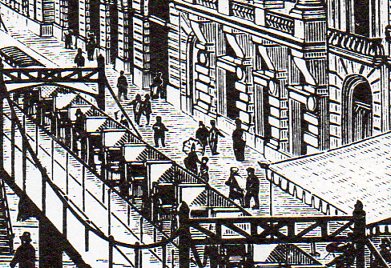
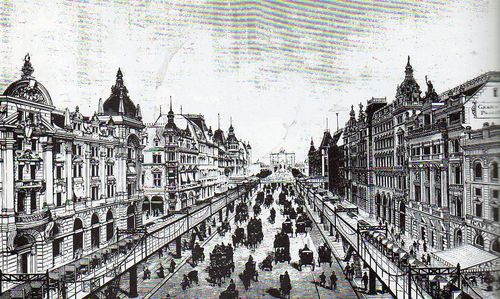
    A very curious application of moving seated humans is seen in this woodcut of a chaired walkway–for all intents and purposes, the pedestrians looking to use the moving sidewalk would have been offered a chair instead.  It seems as though as its base that this was a very simple form of an elevated subway or trolley, though without the train. 

    The moving seated sidewalk was the dreamchild of Alfred Speer (1823-1910), of Passaic, New Jersey, and it seems as though it might have been the first form of mass rapid transit in the city for which it was intended, which was NYC.  It stood fairly high in the opinions of some prominent New Yorkers (like Horace Greeley and Peter Cooper) when it was presented in the early 1870’s, and even passed the New York State Legislature in an act authorizing funding for the program in 1873 and 1874–but it was each time vetoed by Governor John Dix, and the people-moving dream ended there, right before the Centennial.  (See here for the New York Times obituary for Speer., and see All Ways NY blog for a longer look at Speer’s moving sidewalk, here.)

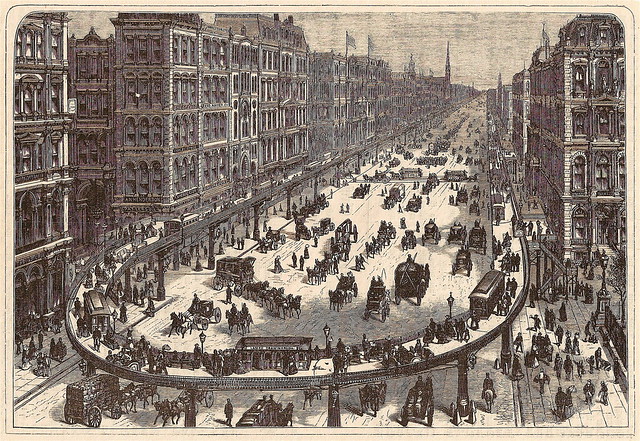
    Here’s another version of Speer’s idea, though this look more like a moving sidewalk, complete with trolley cars, all of which were stationary objects located on the moving walkway.  The idea of course was to free up the chaos and gridlock of the very busy areas of Broadway by placing a large chunk of the confusion on a moving second floor.  It seems as though it might have been a good half-year idea or so, and the $3.7 million dollar price tag might’ve been a hefty one if you calculated the cost per minute of relieved traffic. 

    photo

    [Picture source:  All Ways NY.]

    Mr. Speer seems to have let his vision go and settled down to a life of wine making.


  • The History of Goodbye series: The Open Door in Eden

    JF Ptak Science Books   Post 1656   (Part of the History of Goodbye series)

    The idea of there being a door to Eden is an interesting one to me–not just for the view of Eden from the outside looking in, but really for the view of the Un-Eden seen through the open door, looking out. Its a curious thing to imagine what the first view of the rest of creation would have looked like–maybe curiouser to imagine why there was a door or gate there to begin with.  A door in Eden could’ve meant only one thing–the exit.  There wasn’t anyone there to enter Eden, and certainly Adam and Eve weren’t going to go out and come back, so I guess the door was the Ultimate Fail exit portal. Just waiting. (Also there doesn’t seem to be any mention of a door in Genesis, so this would just be further artistic spin on another version of the Fall of Man, a story which spins out from a place far older than the Old Testament.)

    [Image source:  Cornell University collections.]

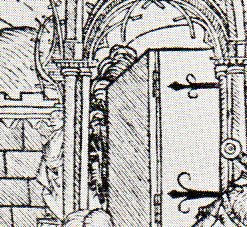
    The door/gate doesn’t seem to appear very often (to my memory and experience, anyway) but this image–a rather famous one from the great Nuremberg Chronicle (printed in 1493 by Anton Koberger) offers us a little clue, as well as a mystery.  We see the temptation of Adam and Eve on the right, and their expulsion because of their inability to reconcile the threat of pleasure on the left.

    The open door doesn’t really reveal too much, from what I can see.  Those blobs might be smoke, or bushes, or something symbolizing The Dark and Disappointment. There are some bits of the Un-Eden looming above that could be above the walls–like the mountain that look like a person sitting back with a book with a head tilted towards the sky–making the life outside seem as though it might not be so pleasant.

    Adam and eve expulsion984
    And then there’s the mystery of the statue by the door–the statue of a figure holding a book or tablet and clothed in robes, standing on a pedestal by the door, in profile.  As Adam and Eve were the only people, its hard to imagine who that statue might represent, because all of those other people come later. 

    Perhaps it was just a little creative largess from a woodblock cutter practicing or showing of their perspective skills into a piece of the block’s image that is largely hidden.  Perhaps it was the same cutter who gave such great detail and belief to the flowing robes of the angel threatening Adam and Eve with a sword–there is certainly more skill involved there than anywhere else in the print, so much so that it makes me think that there was a truly accomplished hand brought in for that piece of flourish on the anonymously-produced image.

    In any event, a door in the walls of Eden seems to me a curious and taunting device–an exit door without an entrance.

    Here are some open-door/gate/portal examples, below, though none really show anything through the portal:


  • Classifying Human Failures, 1487

    JF Ptak Science Books  Quick Post

    Penitence hell c

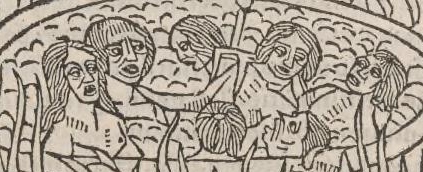
    This image was one of the promises to the readers of the Eruditorum Poenitentiale (printed in Paris by Antoine Cailhaut in 1487), a book of penitence, a manual for seeking forgiveness and avoiding sin, showing what end awaited those who would disappoint the Creator.  The work was a devotional of frailty, a register of sin, an insistent call to the things that could and will go wrong throughout the course of a human life, and what the costs of those shortcomings would be.  [Images from Bibliotechque St.Genevieve, here.]
    Penitence926

    ·Posted by :

    ·in:

    —

  • More of NYC Destroyed in Explorations of the Future–“The Last American”, 1889

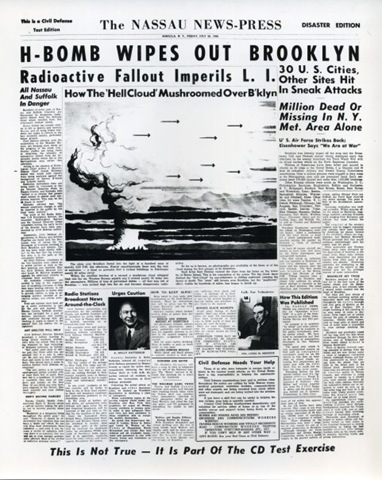
    JF  Ptak Science Books   Post 1615   Part of a series on destroyed New York City that includes New York City: Attacked by Tentacled Flying Saucers, Giant Flying Snakes, Glaciers, and Mining Missile Space Aliens, 1929-1941 and H-Bomb Wipes out Brooklyn, among others.

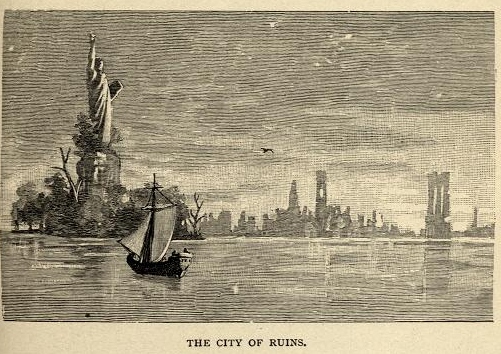
    NYC in ruins  statue lib
    John Ames Mitchell created quite a world for himself in 1889.  The world he saw in the year 2851 turns out not to support America, or Americans, seeing as how we ran out of luck and envy and possibility and Life.  It is slightly ironic that Mitchell (1844-1918) would write so much about dystopic views of America’s dead culture, as he was the creator and first editor of (the first) Life magazine, a journal dedicated to far less weighty matters (and an early popularizer of populist views of American culture by Dana and Rockwell). 

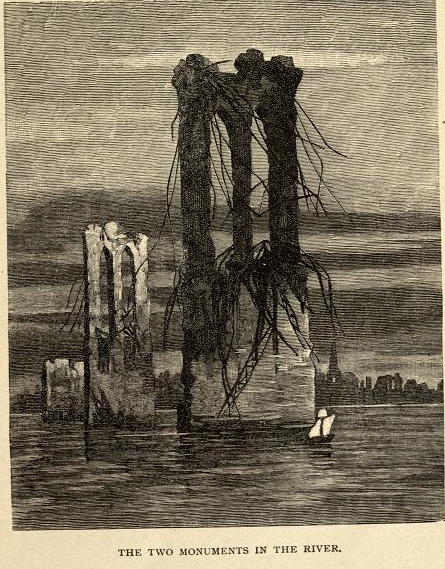
    NYC in ruinbs  Brooklyn bridge
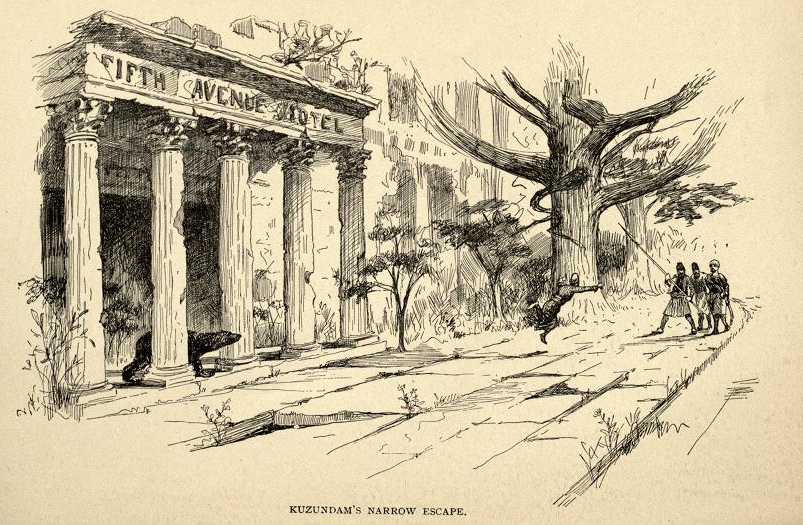
    The Last American (a slight book of 28 pages) is presented as the journal of a Persian explorer (Kahn-li)  a thousand years or so into Mitchell’s future, set off to explore the outer reaches of at-that-time known world, rediscovering the Americas, again.. Kahn-li was intrepid and accomplished:

    “…Curator of the Imperial Museum at Shiraz, and (a)uthor of ”’The Celestial Conquest of Kaly-phorn-ya” and of “Northern Mehrika under the Hy-Bernyan Rulers” The astounding discoveries of Khan-li of Dimph-yoo-chur

     have thrown floods of light  upon the domestic life of the Mehrikan people. 
    "He little realized when he landed upon that sleeping continent what a service he was about to render history,
    or what enthusiasm his discoveries would arouse among Persian archaeologists.
    Every student of antiquity is familiar with their history.
    "
    NYC in ruins  wall st
    The images of New York City in ruin, in advanced decline, in an imagined future of slow death, have always
    seemed haunting to me. The images in The Last American are drawn by the author, and in some later editions
    of the work are supplemented by occasional designs and a few extra images. But Mitchell's work is
    pretty impressive. And daunting.

    NYC DC

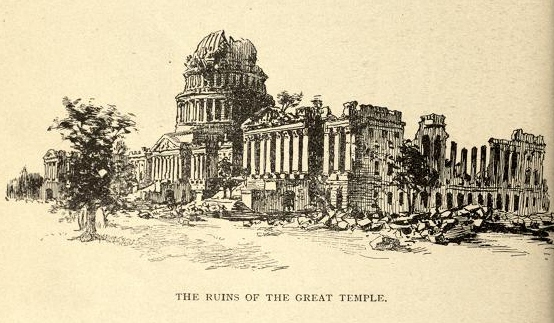
    Mitchell also has a nice way of showing how his explorers were trying to make sense of the ruins, figuring out what their intended uses were.  For example, the ruins of the Brooklyn Bridge were more a monumental temple, because the distance between the giant structures and the shore were (for them) to great a span for the things to be part of a bridge.  There’s some good, solid, imaginative imaging going on here. 


  • A Paris Made to be Destroyed–Sham Paris, 1917/18

    JF Ptak Science Books   Post 1613  (Post 656–expanded) 
    Follow Me on Pinterest


    Now this was a case in which you were given the result and had to find everything else for yourself.  — Sherlock Holmes in A Study in Scarlet

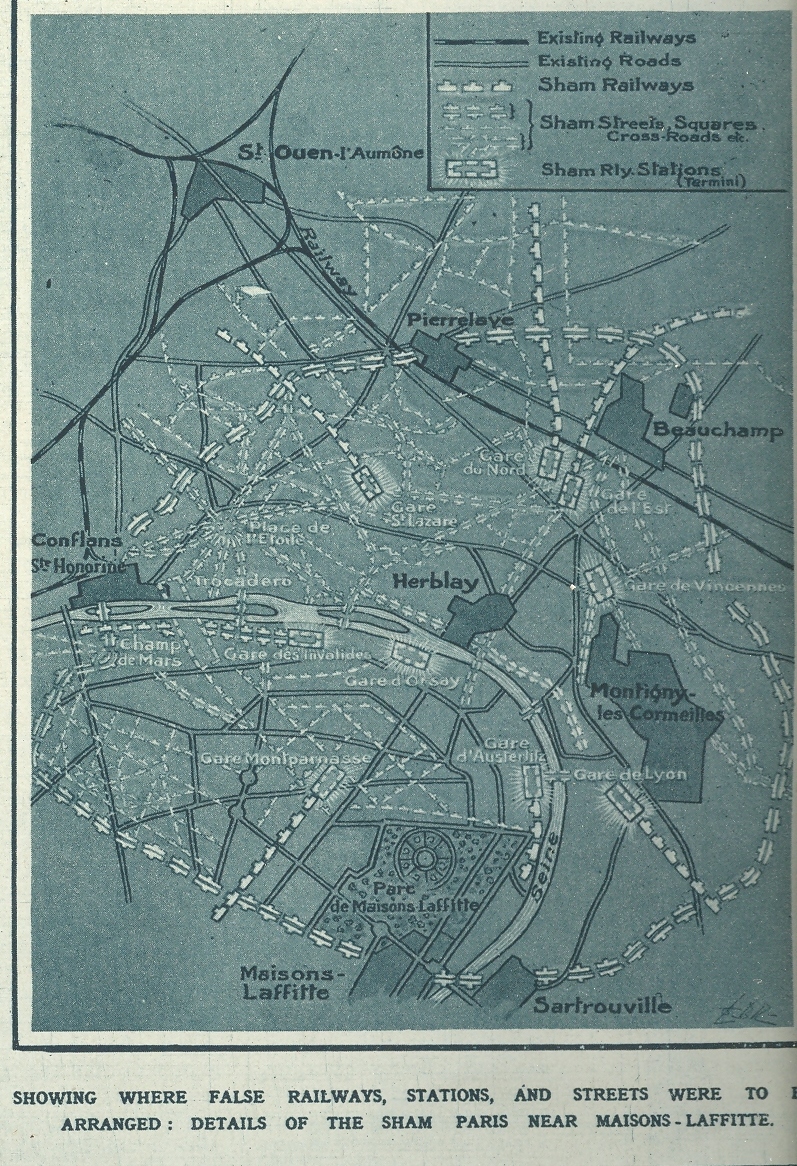
    There is no doubt a history that could be written on shadow cities, cities that were built to resemble other cities, cities constructed to serve as a deterrent or double, cities set to deceive, cities constructed to be experimented upon. Some were built ot be destroyed.  Like Paris–or “Sham Paris”. 

    Paris sham detail sham

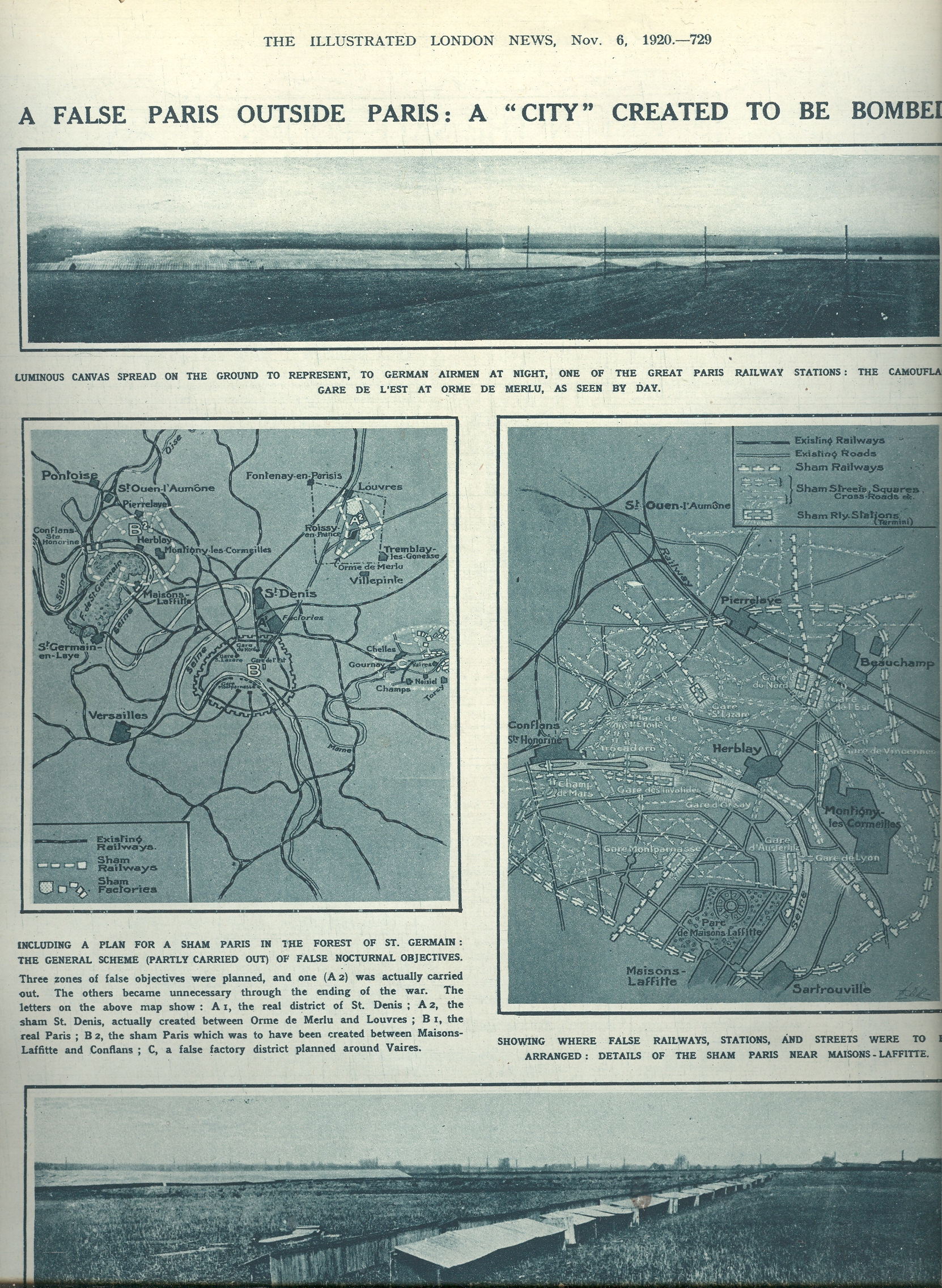
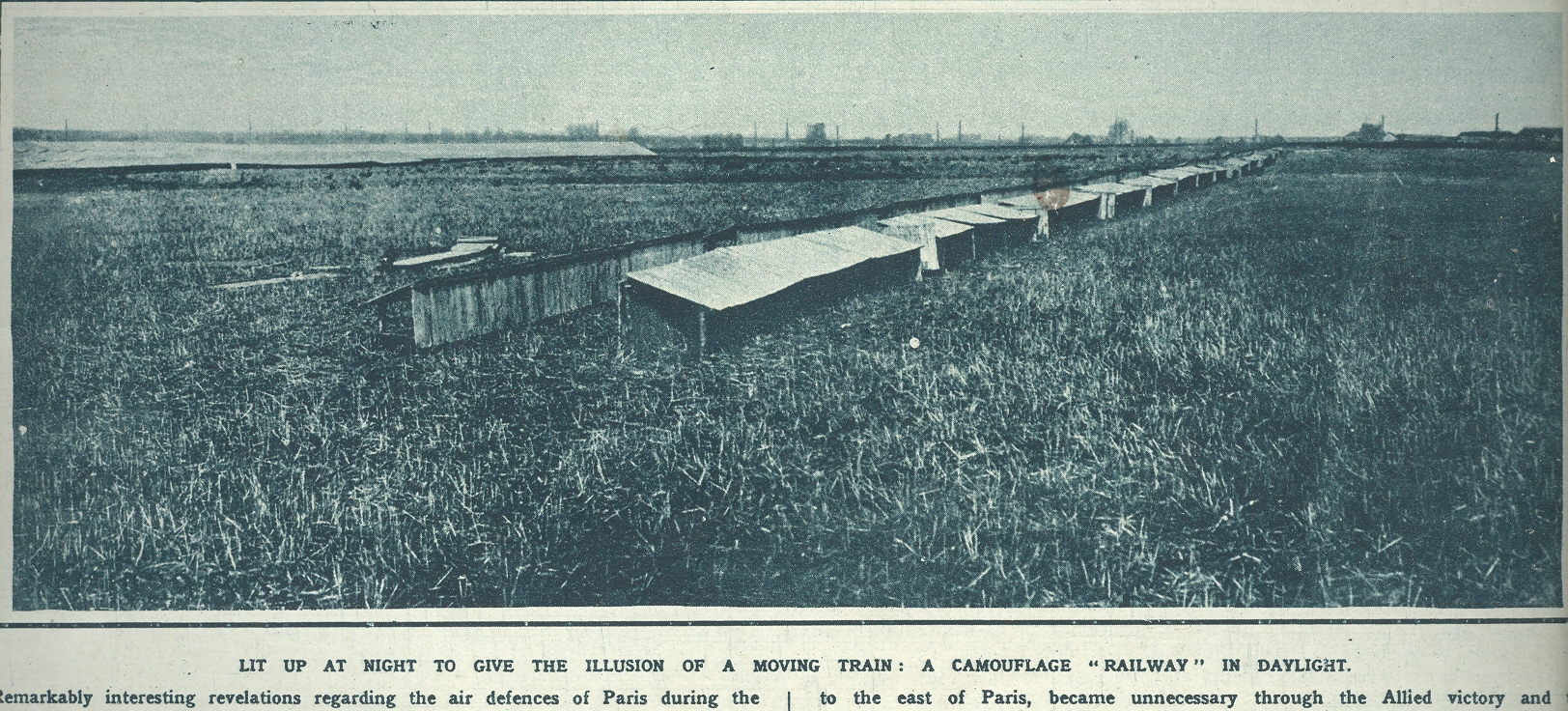
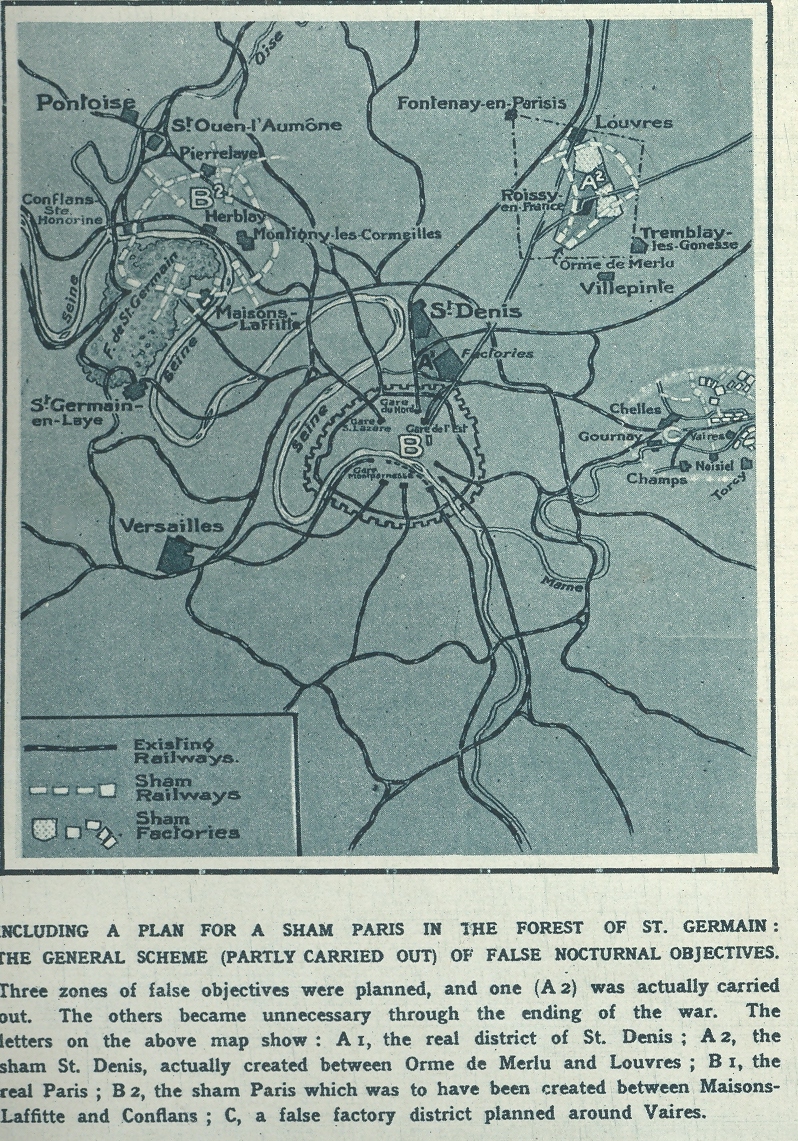
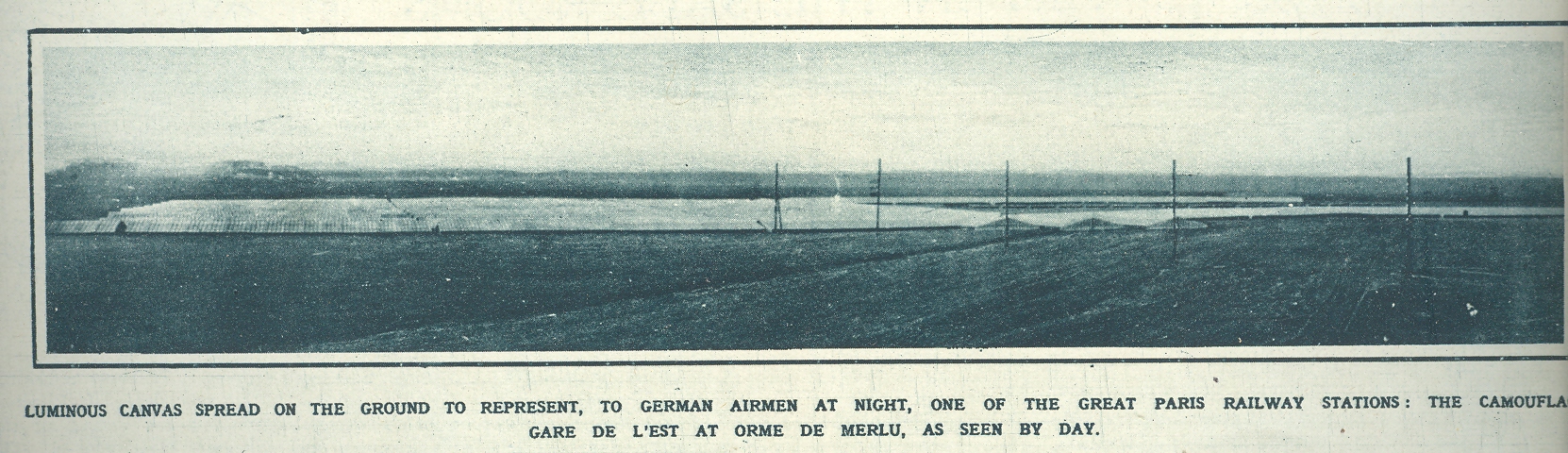
    Augustine cleaved two cities from one, the good and the doomed, in The City of God.   The powers that were in Paris at the end of World War I tried to do exactly that—to create a Sham Paris located on the outskirts of the real city—it was to be doomed, offered with confusing lights and displays that would disorient German aviators into bombing and destroying it rather than the real city. 

     Blo--june 18--paris overview

    Of course these were also the days of pre-RADAR, and of aviators simply holding a bomb by its fins and letting go once a target was in sight, so the possibility of causing this sort of dissonance was at least palpable. The planes held the pilot and a lot of fuel, and not much flight weight was devoted to bombs, so the bombing runs were necessarily quick and comparatively light (by standards of just a decade later).  So the idea of a Sham Paris might’ve, could’ve sort’ve worked, maybe; but not really.  It had a very strong, fatal, feculent (thank you for this word, Mr. Depp) air about it, like that misty doomsday smell that lifted the Maginot Line out of the earth and dumped it in the dim and stinking past. 


    Blo--june 18--paris long2

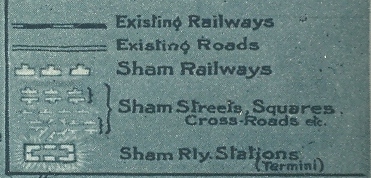
    The story of Sham Paris may have been “broken” in The Illustrated London News of 6 November 1920 in a remarkably titled photo essay, “A False Paris Outside Paris—a ‘City’ Created to be Bombed”.  There were to be sham streets lined with electric lights, sham rail stations, sham industry, open to a sham population waiting to be bombed by real Germans.  It is a perverse city, filled with the waiting-to-be-murdered in a civilian target.  Sham Paris seems to me like a reverse city.  And a reverse city in the manner of the cities created by the guilty Cain and Romulus—these two were murders who created cities; Sham Paris is a city of created murders to save the innocent.

    Paris sham detail
    Sham Paris was only partially constructed before war’s end in November 1918.  

    Paris sham 3

    (All images here are clickable and can be enlarged.)

    Blo--june 18--paris long


    Its important to distinguish Sham Cities from hidden cities, like Project Iceworm (the underground city built in Greenland) or Mt. Weather (the not-so-very-secret secure and safe bunker for the governing class in Bluemont, Virginia) and so on.  Sham Cities were definitely constructed for deception and/or destruction.  The next city we’ll take a look at:  Survival Town, Nevada.


  • On the Failures and Triumphs of Confederate Digestion: Diarrhea and Urine

    JF Ptak Science Books   Post 1611

    Let’s just say it:  the history of diarrhea is not pretty,  It has been a major killer throughout history (coupled with the sometimes historically-indistinguishable dysentery), wiping out perhaps hundreds of millions of people over human history.  Infectious diarrhea and dysentery is especially suited for crowded, cramped conditions with poor sanitary facilities and bad food, which makes armies a perfect place for those diseases to easily succeed.

    In the American Civil War diarrhea was a leading incapacitor and killing disease, perhaps chief among the diseases that killed more people than did the actual fighting.1  And perhaps no where else did it commit such great tragedy than in the ranks of the Confederate soldiers, who by and large had considerably less than the Union soldiers.  Poor sanitary facilities, bad food badly prepared, close living conditions, weeks/months of stationary encampment during the winter, would all add up to a disaster.  Since the Confederate records of medical treatment are far from complete, we have to look at those of the Union Army to get an idea of what happened with diarrhea–and there, more than 250,000 men were discharged for chronic diarrhea, or roughly 10% of the entire fighting force over the course of the war.  I think it is safe to assume that the Confederate numbers would be at least comparable and probably worse for a fighting force of approximately half that size, though I am unsure of how many of these actually were discharged.  The figures for soldiers suffering from diarrhea who were not killed by it or discharged for it probably ran over a million for both sides.  It would not be easy to overstate the vast impact that diarrhea had on these armies, and particularly for the Confederacy.

    On the side of success we have the story of gunpowder.  Or, rather, the failure in the production of industrial nitrates necessary for the production of gunpowder which was addressed by the Southern citizenry, and particularly the women of the South.  Absent the essential component of potassium nitrate, the Confederate states resolved to produce the stuff locally, in the old fashion. Urine (and water from cesspools, privvies, and so on) would be collected, and then (via one of many methods) would be sprinkled on straw or some other similar organic material (to keep the material moist but not wet); the stew would be covered and sunned and allowed to cook for some months at the end of which time the straw would be washed of the material formed on its top, and then dried.  The resulting salts produced by evaporation would be a form of saltpeter, or potassium nitrate, which provides the necessary O2 for combustion. 

    I know that it was at least considered customary and a rule of engagement for the Union and the Confederate soldiers to not shoot each other while attending nature’s call; I’m not so sure that this would be the case for the guys in the night waste wagons collecting privvy drawers and urine. 

    Just another small, necessarily savage bit in the history of killing. 

    Notes:

    1. The Union armies had from 2,500,000 to 2,750,000 men. Their losses, by the best estimates:

    Battle deaths: 110,070
    Disease, etc.: 250,152
    Total 360,222

            The Confederate strength, known less accurately because of missing records, was from 750,000 to 1,250,000. Its estimated losses:

    Battle deaths: 94,000
    Disease, etc.: 164,000
    Total

    258,000

    ·Posted by :

    ·in:

    —

  • The End of the World, Part 6–The Earth as a Bomb

    JF Ptak Science Books  Post 1601

    [I’ve written a number of times on this blog on the depiction of the end of the Earth–as it turns out, it is an uncommon subject for illustration before, say, 1950.  One in the series can be found here, with links to others.]

    Nd world maxim725
    Hiram Maxim–the inventor of the Maxim gun, almost-inventor of the light bulb, and general creative genius–wrote this article, “How the World Will End” around 1905.  He was a man with many answers to his own many questions, and here he Q-Aed himself about the end of the world.  He imagined the end coming in a number of different ways, one of which was set up by the Earth’s own mighty innards.  He imagined large-sale earthquakes and gigantic volcanoes, Krakatoa-sized volcanoes and then some, that would rend the Earth to pieces.

    Nd world maxim726
    But he starts that vision with a very odd inspiration, thinking about the power of the 1883 eruption of Krakatoa, and trying to equate the enormous explosive mission of the thing with something that was somehow doable, somehow understandable in human terms.  And what he comes up with is this–that if all the people in the world working  all time through all time in producing gunpowder and TNT, spending all of their time doing nothing but making explosives, that all of this gathered and ignited would approximate the energy of the Krakatoa eruption.

    Nd world maxim727
    He was wrong on this calculation, as smart as he was–I think just running some numbers in your head would put this thing to sleep.  But there wasn’t very much for him to compare Krakatoa to in 1905, or certainly nothing that he could compare it to that was produced by humans.  In our recent past, though–in a world that would be Maxim’s near-future–human beings have managed to manage Krakatoa-type releases of energy, namely in the form of nuclear weapons.  If we cobbled together 1,400 of the Hiroshima/Nagasaki bombs from August 1945 and detonated them at once, the amount of energy released would approximate Krakatoa.  This explosive force has since been rolled mostly into one bomb–the Tara Bomb, or Kuzka’s Mother–which was released into the world in a test shot in 1961.  That bomb was calculated to be a 50 megaton weapon, scaled down from its projected 100 megatons, and released 1.74×10¹⁷ J(oules), coming close to what some people have calculated the energy of Krakatoa to have been, at 8.4×10¹⁷J  (In a what-the-hell moment of calculation, someone reckoned the output per second of Star Trek’s U.S.S. Enterprise 1701-D to be 1.27×10¹⁹ J–an enormous number.)

    But it is an interesting form to fill up for a short scifi story.  Imagine a worldwide society which, for its entire existence, has done nothing but make the means for its own violent destruction, stockpiling fantastic amounts of explosives in a series of connected locations, waiting for the time in their history to end.  Imagine that generations would spend their time, doing nothing but producing the means for their own destruction that would come at some time.  The entire output of the combined civilizations banded together, branded for annihilation.  All working to a literal common end. 

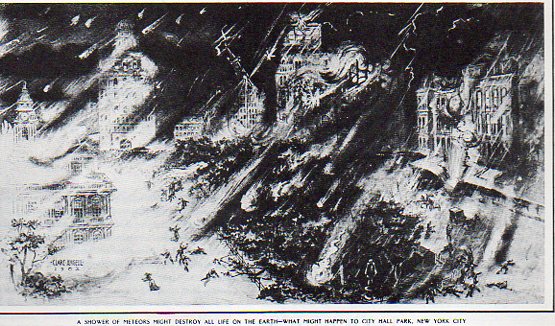
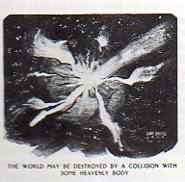
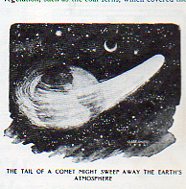
    Maxim saw other bits too in that firey end, as we see in the above illustrations:  for example, in the first image, we see the results of a meteor shower striking City Hall Park in New York City…a big “meteor shower”, a really big one.  Then there’s the possibility of a “collision with some heavenly body”, and of course the tail of a comet sweeping away the Earth’s atmosphere.  For all of his good thinking, though, I can’t get much past the image of societal bomb making…


  • H-Bomb Wipes out Brooklyn. And Chicago. And New York.

    JF Ptak Science Books  Post 1527          Part of the Atomic and Nuclear Weapons series

    Wipe out Brooklyn

     [Source:  Conelrad blog and also at the website]
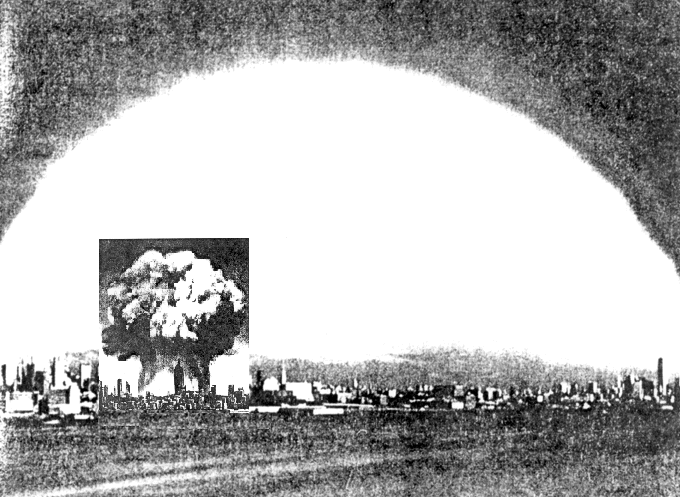
    I stumbled on this bombing of Brooklyn article at the excellent Conelrad website–it is an excellent addition to my slight collection of vintage depictions of American cities being nuked.  As part of the necessary scare tactics in the pursuit of the arms end of MAD, the destructive power of these weapons were shown against a background that Americans could readily understand.  Thinking of atomic and then nuclear holocaust in terms of multiple units of Hiroshimas and Nagasakis was one thing–showing the effects of these weapons on an American grid was something else.

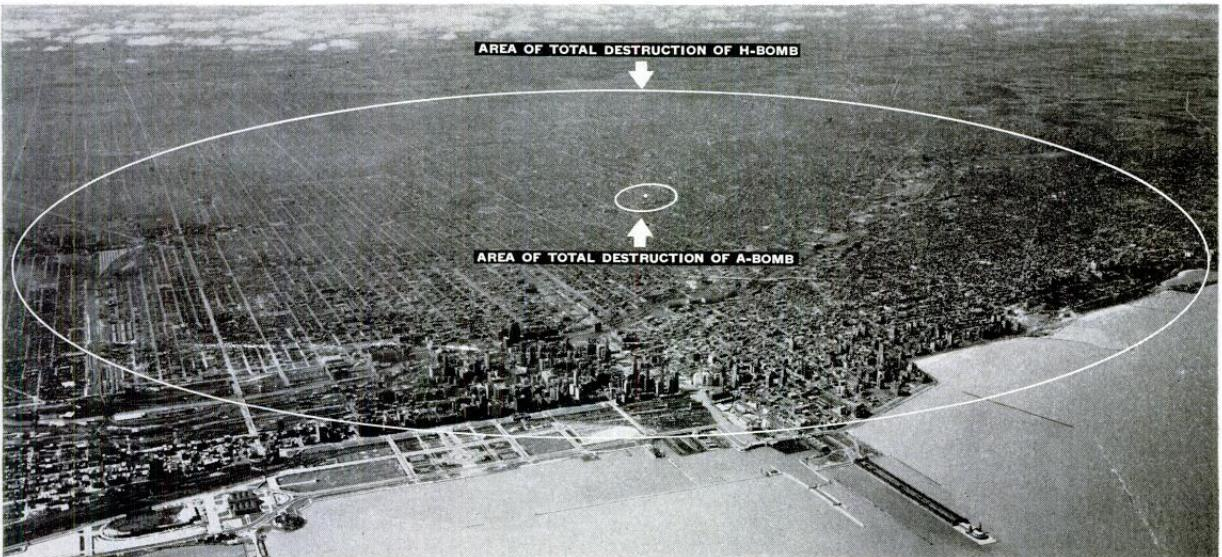
    This next  graphic shows the difference in destructive capacity of an atomic bomb (small circle beneath an air-burst detonation) and a hydrogen bomb (the large circle showing area of total destruction, which in this case would be about 50 square miles) on the city of Chicago.

    Wipe out chicago
    [Source:  LIFE Magazine, 30 Jine, 1950]

     The next image is much like the preceding, only showing a profile of Manhattan and the difference between the explosions of a Hiroshima bomb and a hydrogen bomb (of 20 megatons).

    http://bioinfo.mbb.yale.edu/~mbg/fun/both-bombs.gif

    [Source: BioInformatics Lab, Yale  http://bioinfo.mbb.yale.edu/~mbg/fun/both-bombs.gif]]

    But don’t worry, even if the Chicago and Brooklyn and New York and so on were destroyed, the U.S. Navy would survive, which would  be either great or horrible if you were a sailor:]

      H-Bomb  WIpe out NAvy
    And as usual, the point is made with one weapon being detonated, rather than the x-number that would actually be deployed.  Depicting, say, 10 weapons being used against these cities–while being a more accurate portrayal of what nuclear war might look like–might have looked like something beyond the usefulness of propaganda. 


  • FearNaughtia Coffins: Life Detectors, Escape Ladders, Breathin’ Pipes and Premature Burial

    JF Ptak Science Books   Post 1526

    I’ve written here before on the wonderful book by Jan Bondeson, Buried Alive, the Terrifying History of our Most Primal Fear 1(Norton, 2001) and on the difficulties of determining death in the 19th century, and the various ways that people sought to deal with and sidestep the possibilities of premature burial.  In continuing those posts I’d like to add the following  drawings from hopeful reports of the U.S. Patent Office, some of which really didn’t make that much applicable sense, but, well, you can patent just about anything if it hasn’t already been patented. 

    These coffins were constructed to allow their occupants to ring or telephone or telegraph or signal with smoke or light and so on should the dead respond to their lost life while buried.  As I point ou tin the earlier (linked) post, determining death was a difficult task in the 19th century, so there wsa a legitimate fear-of-being-buried-alive concern.  OF course, the best way yo determine death would be to allow the supposed-dead to lay out for three days at the end of which the body became a corpse and putrefy–the decay part was the true determiner of death. WHy people had to bury the dead into a coffin and be placed underground faster than the three days is a mystery, particularly if there were so many people who lived in fear of waking up in an underground coffin. 

    And so to the solutions, the first of which was brought to the world by Franz Vester of beautiful Newark, New Jersey.  Well, Newark was probably beautiful when this patent was granted in 1868, and maybe this idea seemed so, too.  Here’s what would happen if a dead body awoke in Vester’s safety coffin:  their hands were attached to a rope that would be connected to a top-side bell, and the not-deceased would tug on it for all they were worth.  After that, a sliding door above the face would be moved, and the coffin’s occupant was then supposed to pull themselves up to a short laddered tunnel that was connecting the living world from the sleep-of-worms-world.  Were there problems?  Yes, of course, but so far as it has been recorded no person ever saved themselves suing this coffin, in spite of Vester’s very strenuous exercises to promote his invention.
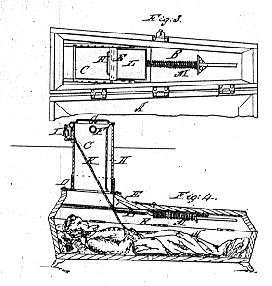
    http://www.americanartifacts.com/smma/life/g13.gif

    [Image source:  American Artifacts, via VanVleck]

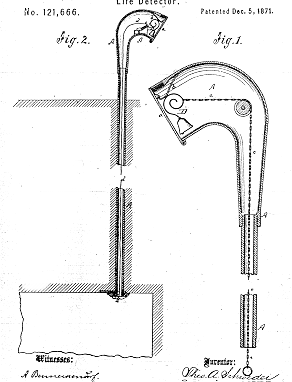
    A few years later from just downthe road in Hoboken, Theodore Schroeder and Hermann Wuest were granted a patent for another rope-activated sounding device.  The 1871 patent revealed what was pretty much a common thread to come–rope, hands, bell.  Theoretically, if the dead awoke they would tear away at the bell until the prefect or whomever arrived to dig them out.  The pair from Hoboken added a few tweaks here and there–one that allowed a release of fresh air into the coffin, and another which used an electromagnetic deice to replace the hand engine.  I’m not sure how long someone can last in a coffin underground, but it can’t be very long at all.  Why someone would think that adding an air vent to a coffin where the dead have been underground for a few days already doesn’t seem to make much sense, except to the coffin manufacturers. 
    http://www.americanartifacts.com/smma/life/g1.gif


    The next example comes from the beautifully-named Albert Fearnaught, who although not from mid-Jersey patented a device again using a rope around the wrist of the dead, this time though the rope was attached to a spring-loaded device that would release a flag when activated from below. 

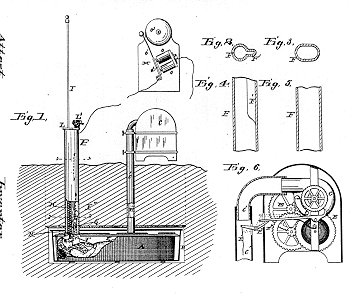
    This next (1885) patent has a slight variant on the rope-hand solution:  the string-finger. Well, there was also some electromagnetic stuff involved, but basically the string on the finger of a moving not-dead-corpse would activate an electric bell and yadda yadda yadda people would come to help and release.  The added extra here, the clear-coat undercoating, is a device that would allow the folks topside to peer down and see the face of the interred, and whether or not it was animated, I guess. 
    http://www.americanartifacts.com/smma/life/g4.gif

    Hubert Deveau evidently had grown tired of all of these hand/finger-operated back- from-the-dead resurrection devices, and constructed (in his patent of 1894) a relatively simple groundskeeper-alerting-breathing-device combo–a pipe that could be moved up by the head of the person int he coffin which would in turn activate a spring-something that would keep the pipe poking-up above the ground.  It would deliver fresh air to the buried, and would evidently be a warning sign to the cemetery man that something was afoot, underfoot.

    Funny thing her is that most of the systems I looked at for this post involved a single device to release the prematurely-buried–it seems to me that there should have been at least one back-up system in case the main apparatus failed.  I mean, if you’re going to become intensely psychotic, why would you then depend on one thing to get you out of your buried coffin?  And that one thing is, basically, a rope.  What if the thing failed?  I’m just saying that I expected to see a little more comfort juice applied to these solutions than I saw. 

     And why current radio talk show fearmongers like Glenn Beck isn’t all over these things, I don’t know–they Fearnaughts for just about everything else…

    Notes:

    1. A fine article on patent remedies for premature burial can be found here: “Signals from the Grave, Early Patents for Detecting Life in Buried Persons”, by Richard Van Vleck, in American Artifacts, issue 45, July 1999. 


  • Incontestable Oddness: Inflatable Puffy Shirts for the Dead & Coffins with Retractable Legs

    JF Ptak Science Books   Quick Post

    Some things that seem perfectly odd seem to take on another life, an extra life, when you put moveable things on it.  For example, coffins that have anything “retractable” seems a little much. As corpse receptacles, coffins as a box seem, I guess, an odd thing–scooping out a body’s innards and replacing them with packing, toxic preservative, gums, paint, glue, plastic, rubber, wire, pins, needles and such seem to be a little on the extreme side, especially when you are going to put that body into a hole in the ground and cover it with dirt.  What better thing than to enclose the corpse in a container so that the horrible idea will be further kept from deterioration?  Then there’s the container for the coffin, and the slumber vault cement liner, and so on. 

    This weirdness turns professional (to paraphrase the Good Doctor) when movable/retractable bits are added to the coffin.  In a long “is this really necessary?” list, one of the last/first would concern retractable legs on a coffin, or perhaps the retractable flower vases, or the inflatable puffy shirt.  There’s a strange sociological history going on in the thousands of death/corpse/funeral-related reports from the U.S. Patent Office, which will make it much easier for the anthropologists of the future to understand our present concerns with death, or life. 

    [Most of the following patent reports are entirely understandable by their titles.  The first in the list though needs a little explanatory help–this is a garment was made with numerous openings to accommodate different forms of corpse body shapers, including inflatable balloons, putty, clay and other material that would help the dead body look a little more not-dead.]

    [And then of course the explanation of the thing, which has a distinct federal-ese flavoring.]

    [I like this one because of the name association with the Norden bomb sight, a once-top secret improvement in delivering bombs dropped from planes, and which helped put many people into a coffin, if only figuratively.] />/>/>

    />/>