A Daily History of Holes, Dots, Lines, Science, History, Math, Physics, Art, the Unintentional Absurd, Architecture, Maps, Data Visualization, Blank and Missing Things, and so on. |1.6 million words, 7500 images, 4.9 million hits| Press & appearances in The Times, Le Figaro, Mensa, The Economist, The Guardian, Discovery News, Slate, Le Monde, Sci American Blogs, Le Pont, and many other places… 5000+ total posts since 2008.

Category: Art History

  • Jackson Pollock’s Fractals

    JF Ptak Science Books    Rapid Post

    Thinking about the “evolution” of music, I came to the 1940’s and 1950’s , and then to Jackson Pollock, and then to thinking about how his artwork evolved, and then, about how it might have truly evolved in a classic sense, like an evolutionary period.  None of this made much sense to me until I started thinking about the representation of Pollock fractally–and then things started to get interesting.  Could this work come about, again, as a result of the evolution of fractals?

    Obviously the Pollock drips aren’t self-same, not easily observably, anyway–but what about statistically, especially under magnification?  

    It turns out that someone has taken a look at this: Richard P. Taylor, et al, in “The Construction of Jackson Pollock’s Fractal Drip Paintings”1This team concludes that–after analyzing paintings and films of Pollock painting them–“the painting process that…Pollock used a remarkably systematic method capable of generating intricate patterns that exhibit fractal scaling criteria”.  

    I’ve never been comfortable with mid-century modern, but I must say that this Ollock/fractal business is interesting to think about, though I’m not sure it has anything to do with art. 

    Notes:
    1. Found in: Johnson, Colin G. Romero Cardalda, Juan Jesus.  “Introduction: Genetic Algorithms in Visual Art and Music–a Supplement”,  Leonardo, Volume 35, Number 2, April 2002, pp. 175-184 (Article)

    Here’s another interesting book: The Art of Artificial Evolution: A Handbook on Evolutionary Art and Music by Juan Romero and Penousal Machado (Editors)bSpringer – Natural Computing Series Hardcover: 458 pag

    The introduction to the Johnson ‘02 Leonardo article: “Leonardo has a long tradition of publishing work at the mutual frontier of art and science. We are pleased to present in the pages of Leonardo a special project that


  • A New Class of Scientific Image? Francis Galton and Synesthesia, Revisited

    JF Ptak Science Books  

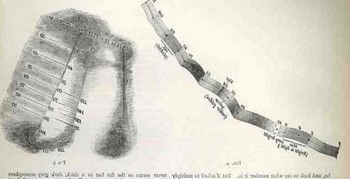
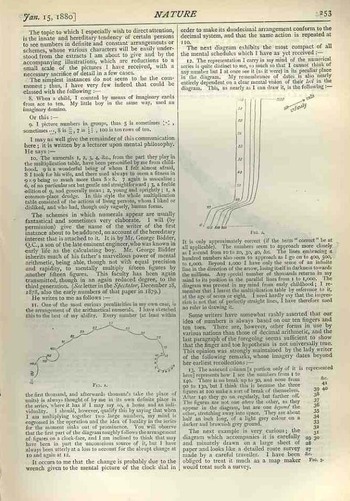
    A Quick Note on an Interesting Image: is this the First Published Illustration of the Mental Imaging of an Active Thought?

    Prestogalton_vis_closeup

    I asked this question in the eigth post on this blog, back in February 2008, almost a million words ago,  and it seems to me that the answer to this is “yes”.1  Now that I’ve done a bit of reading here and there, this illustration may well be among the first that tries to describe how a thought “looks” in the head of  a person doing arithmetical calculation. That is to say, of how the thought-image of this process “looks” to people.  “Special” people, according to Galton, who was actually writing what was also probably sciences first paper on synesthesia. I’m returning to this post now because I’m offering the original of this paper for sale., here. Enjoy.

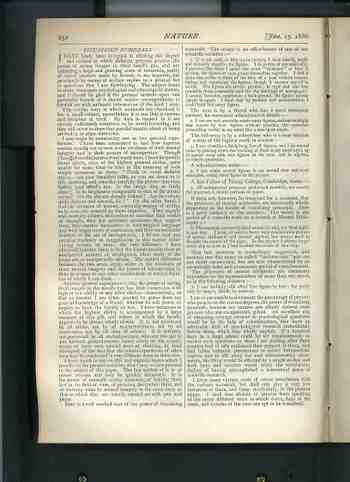
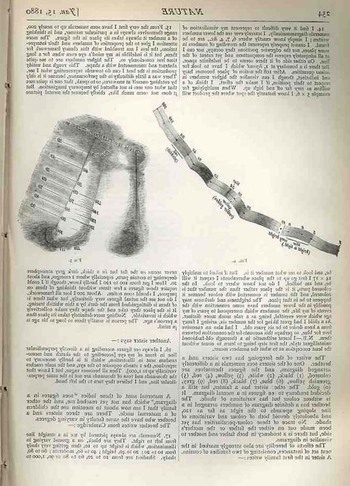
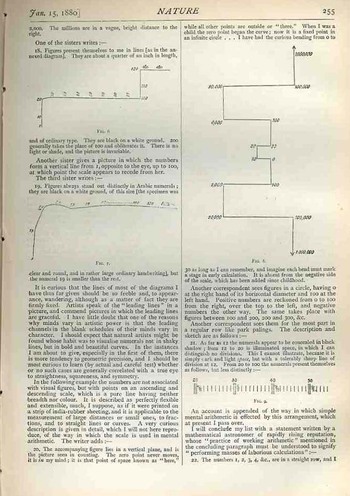
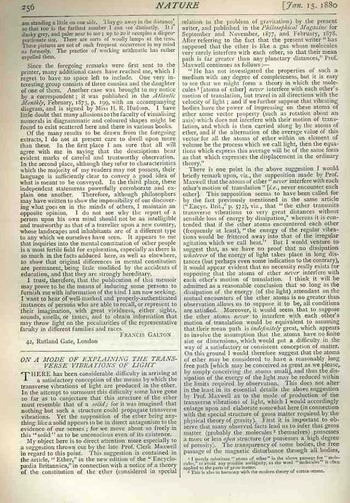
    I was stumbling through my collection of Nature (A Weekly Illustrated Journal of Science, London) magazine when I found a fantastic article by Francis Galton  (“Visualized Numerals”, Thursday, January 15, 1880) concerning (in one aspect)  the mental visualization of the act of doing mathematics. That is to say, what images people formed in their brains as they performed mathematical functions–this was even illustrated (!)

    Fascinating!  Scholars have pointed to this article as perhaps the earliest scientific effort on synesthesia , but what strikes me is how he tried to describe the intimate or logical function with the visualization of the act….I think that is what makes this effort so spectacular.

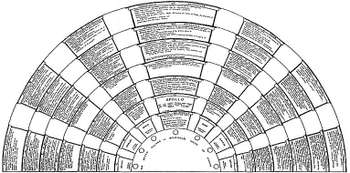
    I’m not associating memory devices (like the memory palaces of Matteo Ricci or Robert Fludd’s spectacular creations from his Ars Memoriae, or the beautiful schematic of Civlio Camillo’s memory theater,  for example which are more (basely speaking)
    visual aids for restructuring already-completed thought patterns) with this question; l I’m not so sure that it applies. These are more issues of phylogenic memory, and concerned with memetics and semitoics rather than the actual formation of an idea.

    Prestogalton_closeup_2

    People have certainly written on images in the mind before Galton–the question is if anyone has illustrated what they think this process looks like? I’m also not so sure if this directly relates to Aristotle’s elements/colors affirmation or Pythagoras’s numerals and colors or Scriabins music and color associations, or Cardano and his color/flavor and the planets associations….

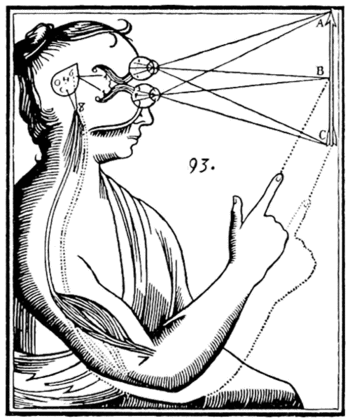
    I guess the question is—where does this image fall in the history of the illustration of abstract thought?  I’m not including famous examples of the physical aspects of sight as with Descartes etc; just the image of what people see in their heads as they are formulating thoughts and ideas.

    Galtoncamillo

    We’ll have more later.  I just wanted to put something up here as people have wanted to see the Galton article and Nature (1880) is not a terribly common thing to find. 
    Galtondescartes

    It would also be just plain wrong not to mention two things at this point—the works of Frances Yates , which is a gorgeous and insightful work on memory.  And secondly, I need to acknowledge the work of Barbara Stafford (University of Chicago) who for decades has produced the most beautiful and the most interesting works on what scientific images *are*. 

    Notes:

    1. See Scientific American, May 2003, page 53, which cites the Galton Nature paper as the first of its kind. Also see Scheuren, Fritz (08/01/2003). “History corner”. The American statistician (0003-1305), 57 (3), p. 189, which cites the SciAm article citing this.  Also Ramachandran, Vilayanur S (01/01/2006). “Hearing Colors, Tasting Shapes”. Scientific American (0036-8733), 16 (3), p. 76. And also Sacks, Oliver, (07/28/2003). “THE MIND’S EYE A NEUROLOGIST’S NOTEBOOK”. The New Yorker , 79 (20), p. 048. And lastly, Pinel, Philippe (06/01/2005). “Interactions between number and space in parietal cortex”. Nature reviews. Neuroscience (1471-003X), 6 (6), p. 435.There are many others who classify the Galton paper as the “first” in its field.

    For a good read in general on the basic papers in the history of synesthesia, see: Synaesthesia : classic and contemporary readings edited by Simon Baron-Cohen and John E. Harrison. Oxford, Blackwell: 1997, which includes the ground-breaking Galton paper.

    Here’s the entire article by Galton


    Presto018_4


    Presto019_2

    Presto020

    Presto021

    Presto022


  • First Photograph of a Smell, Revisited

    JF Ptak Science Books

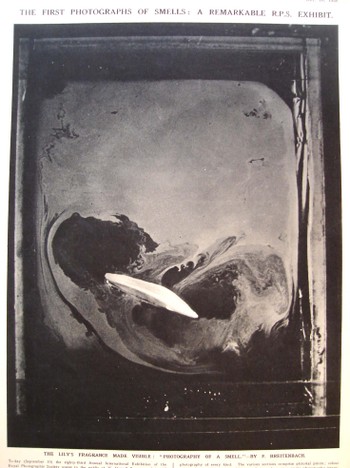
    It leaves me with such a cozy feeling to not find what I think is an obvious-but-odd phrase in Google.Dsc04716

     And that’s what happened with “the first photograph of a smell” (or “photograph of a smell” or odor, for that matter),  as shocking to the senses as it might be.

    There are long and interesting lists of firsts in photography: the first color photograph (Maxwell, 1867, but impermanent), the first photograph of a human face, the first photograph of the moon, the first photo of a planet, and so on, tirelessly, until we see how many derivations of “firsts” there are. (We can go from first photo of human to first photo of a human face to first photo of a human in motion to the first photo showing human hands to the old human recorded by photography tot eh first photo of a couple to the first photo of a human with a tool and on and on.) There is a shorter list of “first photographic non-photograph of a photograph” (?!) that I wrote about in an earlier (illustrated) post, but we won’t go there today.

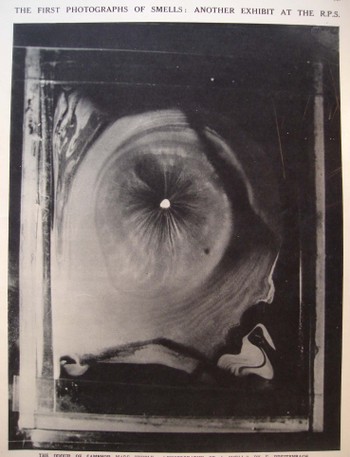
    Here is a “first” though that I think hasn’t been dealt with too terribly much: the first photograph of an odor.

    These beautiful images appeared in the 10 September 1938 issue of The Illustrated London News and were exhibited at the 83rd Annual International Exhibition of the Royal Photographic Society, and were made by H. Devaux (who evidently, according to the snippet of an obituary that I can see from Science magazine, was a plant physiologist and “pioneer of surface physics“Dsc04717
    who died in 1956). The note accompanying the photographs read: “The emission of an odor involves volatillisation of material. If an odiferous material is enclosed in a cell a few millimeters above a clean mercury surface, it is possible to collect on the surface of the mercury a monomolecular layer of the volatillising or odoriferous substance. If the mercury surface initially is covered with talc powder, the gradual formation of the monomolecules layer may be observed as the talc is gradually pushed away from the point immediately below the specimen of material.”

    The photos are that of the odors of a lily and of camphor. I don’t know which is which, and a good story could be made up for either photo belonging to either item. Needless to say, these images are as gorgeous as they are unexpected, especially considering that they were made in 1938.

    {Both images are avaialble for purchase from our blog bookstore.]

    FOOTNOTE:

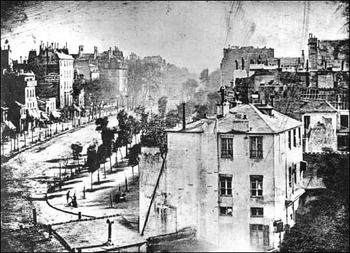
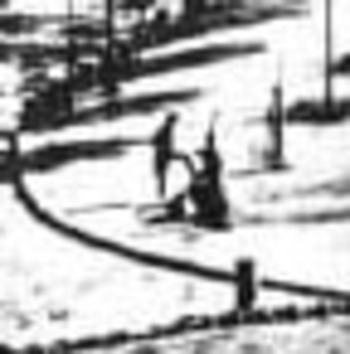
    I’d just like to add here the first photograph of a human being–well, actually, it is the first photograph that just happens to capture a human in the emulsion (discussed Blogoldest_human_photo_2 very nicely on the Doug’s Darkworld  blogsite.  Since the  exposure time was so terribly long for this image to be made, the moving people and horses and carriages on the street, all of the city-life bits, were necessarily spectral, invisible, to the photograph.  Only the stationary items were captured, and the only people captured here were two figures in the foreground, doing something or other that made them still for at least five minutes–long enough for their anonymous but famous photonic impressions to be captured.   Mr. Doug and others seem to think this is a man getting his boots shined–I agree.
    Blogoldest_human_photo_detail


  • Unusual Shadows in Prints, 1861

    JF Ptak Science Books   Post 1213

    [This is another in a long thread of posts on this site relating to shadows–simply enter “shadow” in the google search box at left for a listing.]

    “Pulvis et umbra sumus” (“We are but dust and shadow”)–    Horace       

    Depicting the capacity of sight and nature of light has been both an easy and a knotty problem in the history of science. Over the successive theories on the basis of light the artistic presentation of the phenomenon has been generalized (generally) in a very simple way:  by straight lines.  There’s certainly nothing wrong with that, the lines are just parenthetic place-holders suggesting direction, not actual descriptors of what light “looks” like.   

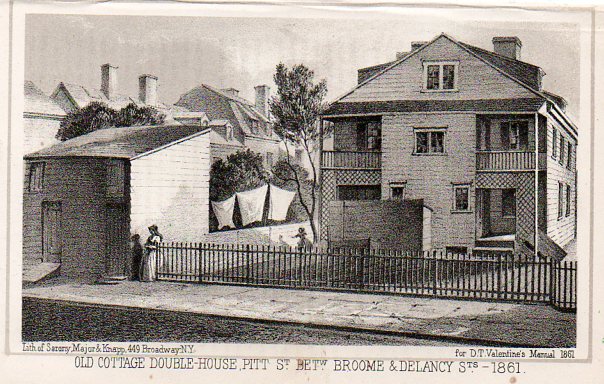
    Shadow valentine836
    But what about shadows? Light and its effects are the basis of art, but what about light, “interrupted”?  Or, really, how old is the depiction of the shadow in the history of western art?  The shadow predates the modern re-discovery of classical perspective by a thousand years—little bits of shadows pop up here and there in deep antiquity, certainly way before Uccello and Alberti and the rest came along.  On the other hand shadows do escape notice of many painters in the 15th century (and during the period of being very comfortable with the century-old realignment of perspective), which is odd, unless all of those works were depicting scenes at high noon or thereabouts.
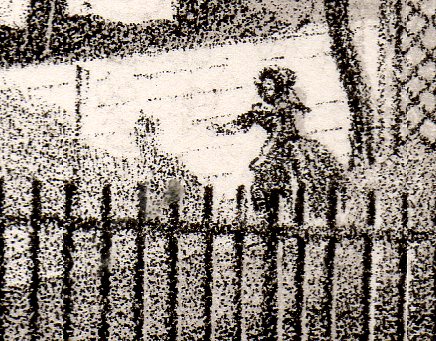
    Shadow valentine det girl837
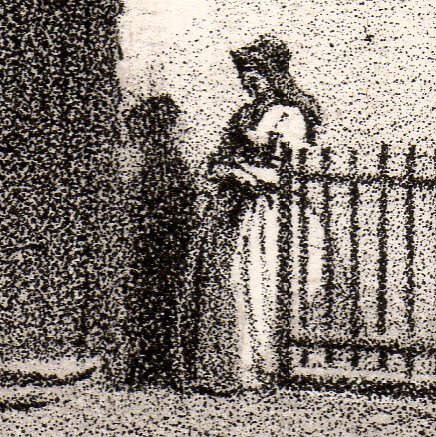
    Which brings to mind this lithograph from one the 1861 edition of Valentine’s Manual for the City of New York.  What strikes me is the low oblique angle of the sun–setting or rising–throwing the shadows of the two figures in the image very high up on the receiving surface. Odd things like this are interesting to me, and to be frank about it,. I’ve not noticed such a hard angle with shadow in too many prints.

    Shadow valentine detb girl838


  • Mr. Mole, the Stationary Busby Berkeley of Mass Crowd Installation Photographs, 1918

    JF Ptak Science Books Post 1185

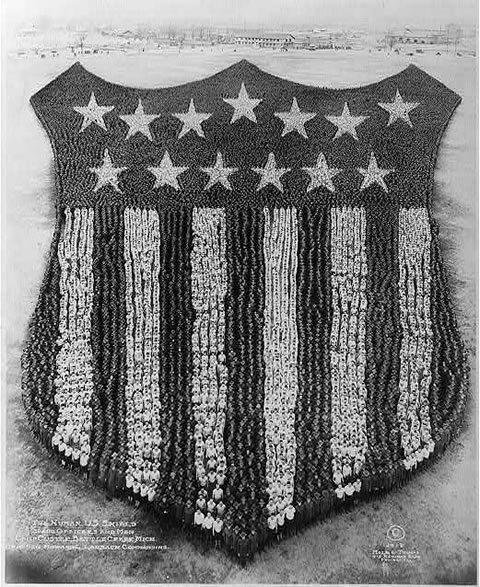
    I’ve long enjoyed these massively organized, captured moments of time and effort–large caliber photos of concentrated efforts of tens of thousands of people, all of their motion and utility directed to produce this one moment in time.  Perhaps the greatest practioner of this artform was Arthur S. Mole (1889-1983), the stationary Busby Berkeley of Big Organized Crowd Efforts (BOCE).  (He led an interesting life, coming from Scotland with his family to be part of a Utopian community led by John Alexander Dowie–a faith healing visionary, self-reported precursor to the second coming of Christ, and leader of the Christian Catholic Apostolic Church–at City Zion, Illinois. Dowie was a problematic man not without good and interesting qualities, though his to-the-death prayer duel with a rival visionary is an interesting story to be left for another time.)

    I’ve always enjoyed this photograph  in particular–it was made from a 70′-tall platform with a 11×14″ view camera using a wide angle and a deep oblique angle, along with 30,000 soldiers from Camp Custer, Michigan.   It was made in 1918 by Mole, along with the evident and very capable choreography of John D. Thomas, who was the Doctor of Persepctive and Motion for the pictures.

    [Note: most of the images below are extremely clickable/zoomable.]

    Arthur-mole-human-us-shield

    Most of the soldiers are used to make the field at the top of the stripes–so near as I can tell (from the resolution image that I had to work with), there are about 300 men in each stripe (except for the outer two), meaning that there between 3,000 to 5,000 in the collected stripes, which puts something like 25,000 troops in the stars and their field. The middle stripe I reckon to be 150′ long; my guesstimate for the star field is 600′ deep and 1250′ wide, making a triangular collection of men 750’x1250′. That takes a little bit of planning to accomplish to ensure that everything is kept in perspective, and which also means that a lot more folks are needed at the top of the constructed image than at the bottom.

    Another excellent example is this photo made of the U.S. Marine Corps emblem using 6,000 marines at Paris Island in 1920.

    http://redtreetimes.files.wordpress.com/2010/05/arthur-mole.jpg


  • The Invisible Influence of the Highly Visible? Comets and Meteors in Astrology

    JF Ptak Science Books   Post 1176

    “When beggars die there are no comets seen; The heavens themselves blaze forth the death of princes.” – Shakespeare.

    “Threatening the world with Famine, Plague and War: To Princes, Death! To Kingdoms, many Crosses; To all Estates, inevitable Losses! To Herdsmen, Rot; to Plowmen, hapless Seasons; To Sailors, Storms, To Cities, Civil Treasons!” De cometis by John Gadbury, London, 1665

    It is unusual to me that in the long history of early astrology, some of the greatest elements of the night sky–comets and meteors–are little used, perhaps even unuseful outside of adding flavoring to readings given the time and place of their appearance. They had been seen for milennia–appearing in Gilgamesh and the Book of Revelation for two samples– as prognostic of future events, John of Damascus and Aritotle and Ptolemy and Albumasar all writing about that quality.

    Comets 5564
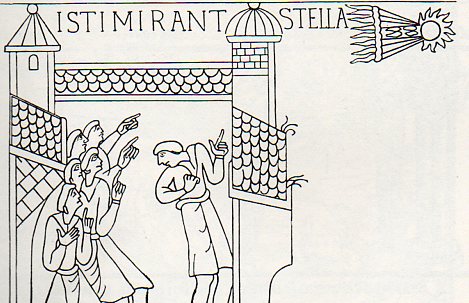
    [The Bayeux Tapestry illustrating the appearance of the comet of 1066, later to be known as Halley’s comet.]

    Comets and meteors didn’t really affect anything in the physical world, and in the astrological one their purpose was to perhaps predict a kingly death or the appearance opf warts on women. They were also seen by people like Aristotle to be atmopsheric events, living out their exsitence in close proximity to the Earth, incapable of having any undue affect on Earthly matters.  Meteors would appear and then disappear, comets were surprises and visible for just short amounts of time; the rest of the night sky remained the same, intact and unaltered after their appearances.  They were not understood, though they were seen by some as raging battles between forces of good and evil, personifications of the struggle between the angels of god and the elements of the devil. Meteors and comets were mysterious, unconquerable, unknowable, suspicious elements, and were evidently not useful to the early astrologers.

    Comets 1560
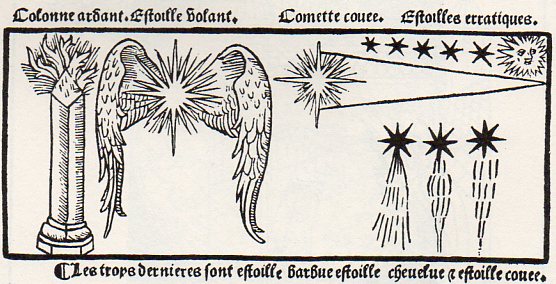
    [Nicolas Le Rouge, Le Grand Kalendrier et Compost des Bergieres, published in 1496 in Troyes. 

    The night sky is a mnemonic device, a place to store memory and a holder of the alphabet of myths and beliefs of all, a culture written large across the sky. Meteors and comets were not predictable, and could add nothing insofar as a consistent bit of storytelling was concerned, though they certainly created their own stories in each observed appearance; they could also add punctuation and exclamation to whatever constellation they appeared in. For example if one appeared in a juncture with Jupiter, a major event for royalty would possibly be foretold.   But as a permanent element to the visualization of the night sky, they had little power even though they seemed to be displays of fantastic energy and power in themselves.

    Comets 2561

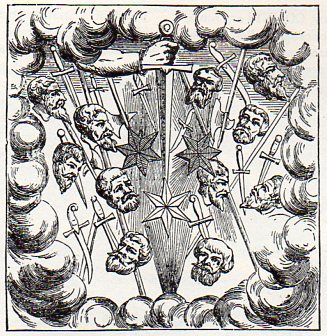
    [Amrose Pare illustrated the comet of 1528 in his Livres de Chirurgie (in a chapter titled “Des Monstres Celestes”), published in Paris in 1597. Even though Pare was a towering figure and great intellect, he still personified the wandering stars with human faces, with hair and beards, accompanied by swords and shields.  There were many other scholars who saw such things in comets and meteors, not the least of which was Maupertuis, who envisioned the tails as clusters of jewels; many others seeing many other things.

    Comets 3562
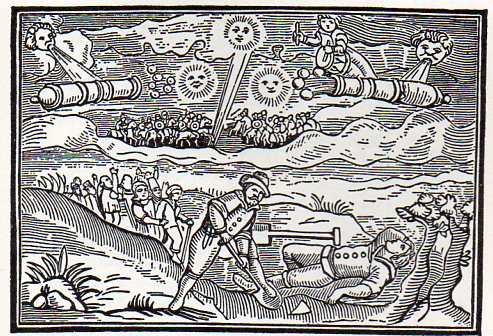
    [For some reason the celestial court, divided by sunlight and flanked by two other sources of light, have ofund it expedient to issue comets from the mouths of Heaven Canon.  I’m not sure what’s going on in the forground with the fellow working his spade next to the triangular blankness.  the man to his right seems to have been overtaken in fear (as have the group of people visible to the left over the shoveler’s shoulder).]

    Comets 4563

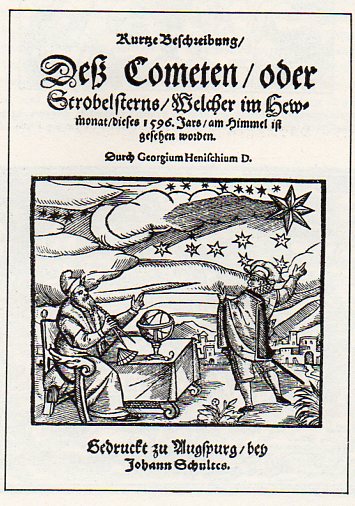
    [Halley’s comet appears again on the title page of this work by the Hungarian George Henischius, a prfoessor of rhetoric, mathematics and medicine at Augsberg.]


  • Artists in/and their Studios: Bacon, Braque, Kandinsky, and others.

    JF Ptak Science Books   Post 1175

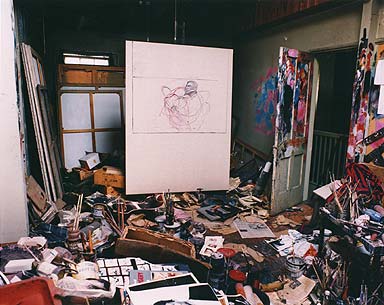
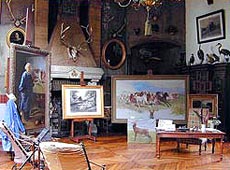
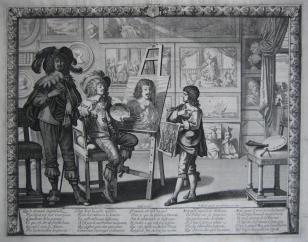
    I.m not sure what sent me scurrying around for images of artist’s studios–iniitally I was looking to see what was on the walls of the artist’s workspaces, but there were so many that it couldn’t be done in my allotted time.  For now I just want to simply post these images of 30 studios and continue later on as a page with more images and  detail on the artists.  For now, I’ve included images of the studios of Bacon, Bonheur, Bonard, Braque, Cezanne, Chagall, Derain, Chase, Friedrich, Kandinsky, Le Corbusier, Mondrian, Remington, Teixidor, Villon, and Vlaminck. (The majority of these images are drawn from Alexander Liberman’s The Artist in his [sic] Studio, 1960; there’s much of interest in that book, including vivid observations and descriptions.)  The other, older, images are depictions of the generalized artist’s workshop and studio.  Enjoy.

    Francis Bacon studio

      Studio--farancis bacon

    Rosa Bonheur studio

    Studio--rosa bonheur
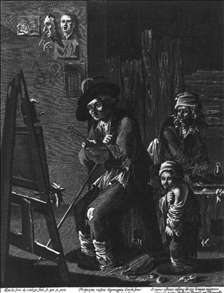
    Abraham Bosse, depiction of  a studio.

    Studio--abraham bosse
    Both, Andreas (depiction of a poor artist’s studio)

    The Poor Painter in His Studio


    ·Posted by :

    ·in:

    —

  • Footnotes in the Future–Swift, Lull, Borges and the End of Writing

    JF Ptak Science Books   Post 1155

    “The most ignorant person at a reasonable charge, and with little bodily labor, may write books in philosophy, poetry, law, mathematics, and theology, without the least assistance from genius or study.”   Jonathan Swift, in Gulliver’s Travels

    “Hell is the kingdom of the animal that swallows up the memory of all things… Between life and death there is no destiny except memory. Memory weaves the destiny of the world..”  Carlos Fuentes, Terra Nostra

    “A people without history/ is not redeemed from time, for history is a pattern of timeless moments” — T.S. Eliot, Four Quartets.

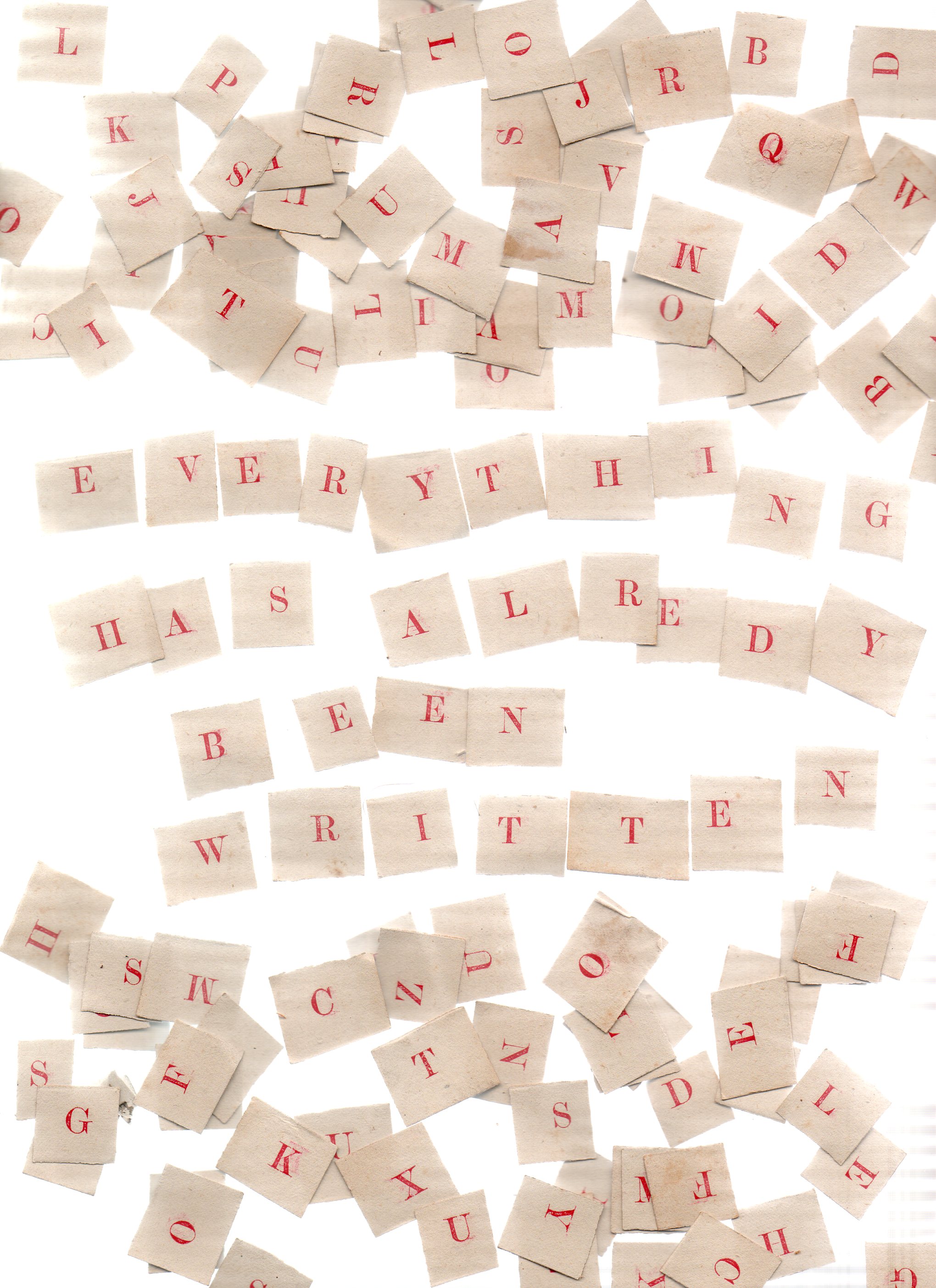
    The future history of writing–it will tell us–was already written before it was written.   In the future, when everything that can be written has been written and everything spoken has already been spoken, perhaps the first footnote in the history of already-done things will be to Jonathan Swift.  The experience belongs to us through Lemuel Gulliver1, who after surviving two trips (one to Lilliput in which Gulliver is twelve times the size of
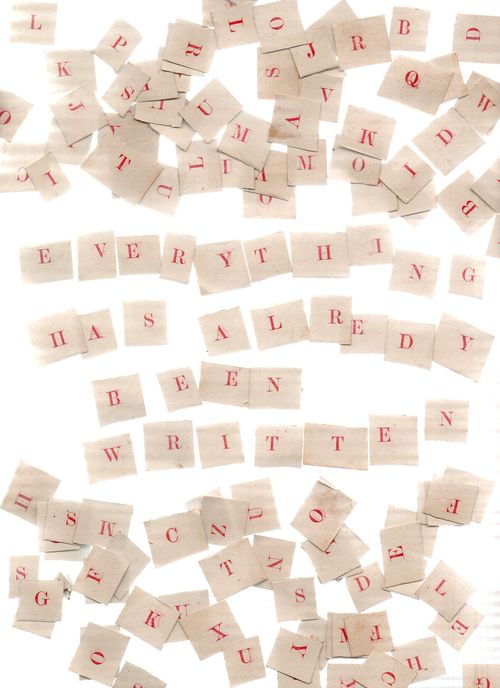
    Written468

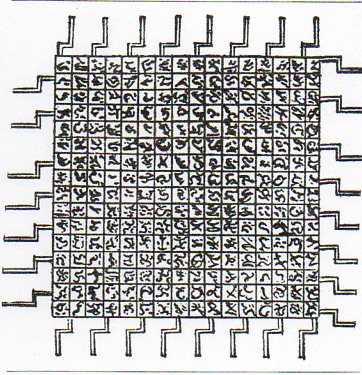
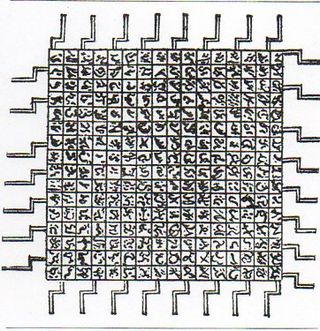
    everything else, and the second to Brobdingnag where he is one-twelfth the size of everything) comes to a third (of four2) in the land of Laputa.  It is here where he encounters a conversation machine that, when cranked, produces anything and everything, the known and unknown, the original and the copied, and have the thought and spoken
    word belong to the manipulator of the machine.  Everything that can be said is in that box, waiting to come.  The 20′ square was occupied by cubes with words on their sides, with 40 cranks and 40 handles and 40 operators to manipulate the mechanical vocabulary and associated scribes to record anything that made sense, and would be the springboard of “knowledge”operating without a manual or an intelligent primum mobile. (The image of the machine–which bears some resemblance to an integrated chip–appears in the third edition of Swift’s book, and as you can see is not a well-drawn thing, missing a row and a column and a crank here and there. A fuller description is found below.)
    Writtenc machine470

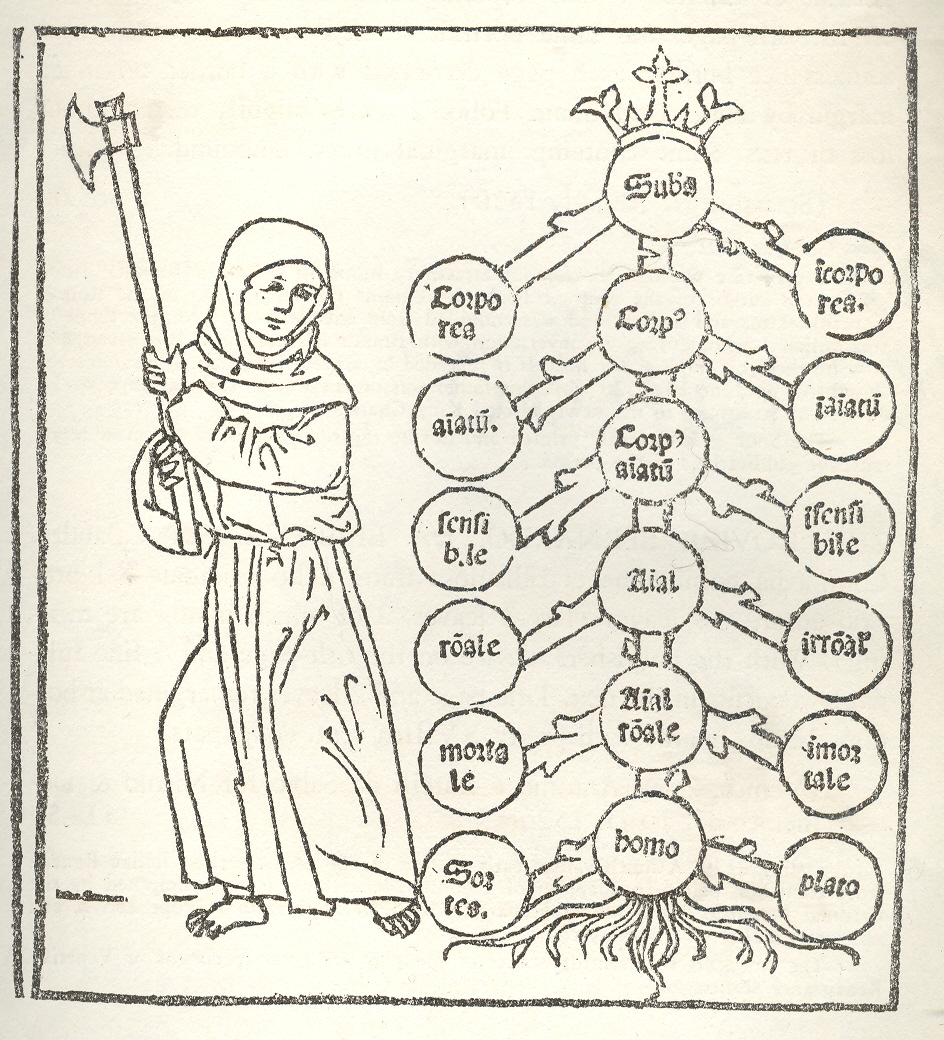
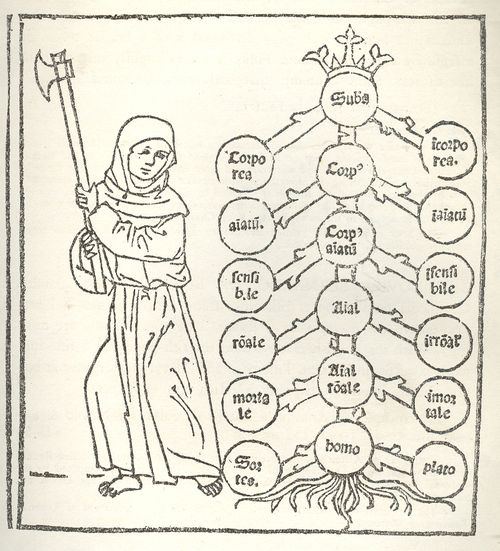
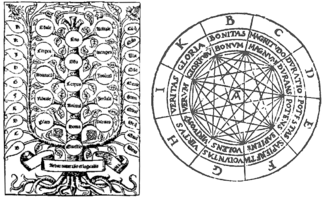
    The idea of a universal knowledge or an expanding, forever-library is very old, particularly if you expand the concept a bit to include Aristotle and the Tree of Porphyry3.  While not exactly a generator in the sense of Jorge Borges’ Library of Babel or the Swiftian machine, the ancients did 1--logic treeproduce very interesting, elegant, beautiful ways of story information and ordering information.  The Tree of Porphyry is far more concise–an abbreviation-compared to the infinitely expanding hexagonal rooms filed with books and attendant librarians in the Borges’ universe.  Or the Ars Magna/Thinking Machine of the 13th century Ramon Lull (also known as Ramon, Raimundo and Raymond, Raimundus and Raymundus Lull, Lully and Lullus and Lulio), the ultimate organizer of how sentences can be made and knowledge produced/uncovered (particularly if you want to please the logic of the church and the Creator), and which was almost certainly known to Swift (and which was also written about, described and worried-over by Borges4).  There are many other early figures in this category to be sure (Lewis Carroll, William Jevons, and even in a way Mr. Venn, not to mention Leibniz and his calculator,  and the changes in scientific method and (English/Dutch) mathematical concentration on applied mathematics of the 17th century that made thinking about the industrial revolution possible)), but that would be left to (at least) a longer post.  (The Lull wheel, below.)
                               

    How long will it take to digitize everything that has ever been written, or recorded, or composed? Several generations? Ten?  It may well come to pass in shorter time than we think; and when you compare this control of recorded human history to the centuries that will follow in developing “computers”, how can we possibly know what will become of all of it?  In the coming centuries and their attack on intelligence, when in the future the brain is a harvest of the computer, perhaps intelligence finally submits, and everything that can be done has been done, the progress of humanity snubbed to a stub. Or expanded exponentially.  It is such a tough call to make…

    Notes:

    1.  Jonathan Swift, Travels into Several Remote Nations of the World, in Four Parts. By Lemuel Gulliver, First a Surgeon, and then a Captain of several Ships.  1726.

    2. The third voyage was Part III. A Voyage to Laputa, Balnibarbi, Luggnagg, Glubbdubdrib, and Japan. The fourth finds humans as pets/inferiors in the island of the Houyhnhnms, a land of intelligent horses.

    3. The “tree” was a diagrammatic creation of a 3rd century Syrian mathematician/logician/philosopher named Porphyry who– much taken with Aristotle (and with the Categories in particular)– developed a systematic approach to the organization of thought in diagrammatic form.

    4. Borges J. L. (1999) ‘Ramon Lull’s thinking Machine’ in The total library: non-fiction 1922-1986 (Edited by) Weinberger, E., trans. Allen, E. Levine, S. J., and Weinberger, E. London, Penguin, on pp 155-160.

    It is interesting to note that Lull, who gave up everything to follow his calling into the church (and who was antagonized by the belief that his very act of missing his left-behind life to be a sin against god’s choice of him to follow his “career path”) was demonized by the church soon after his death, his works prohibited reading for hundreds of years.  He was resurrected in 1958 though on a path towards sainthood, a doctor of the church.  

    A description of the Swift machine:

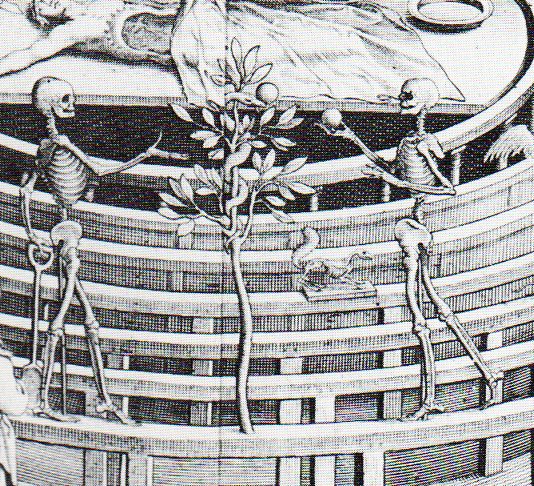
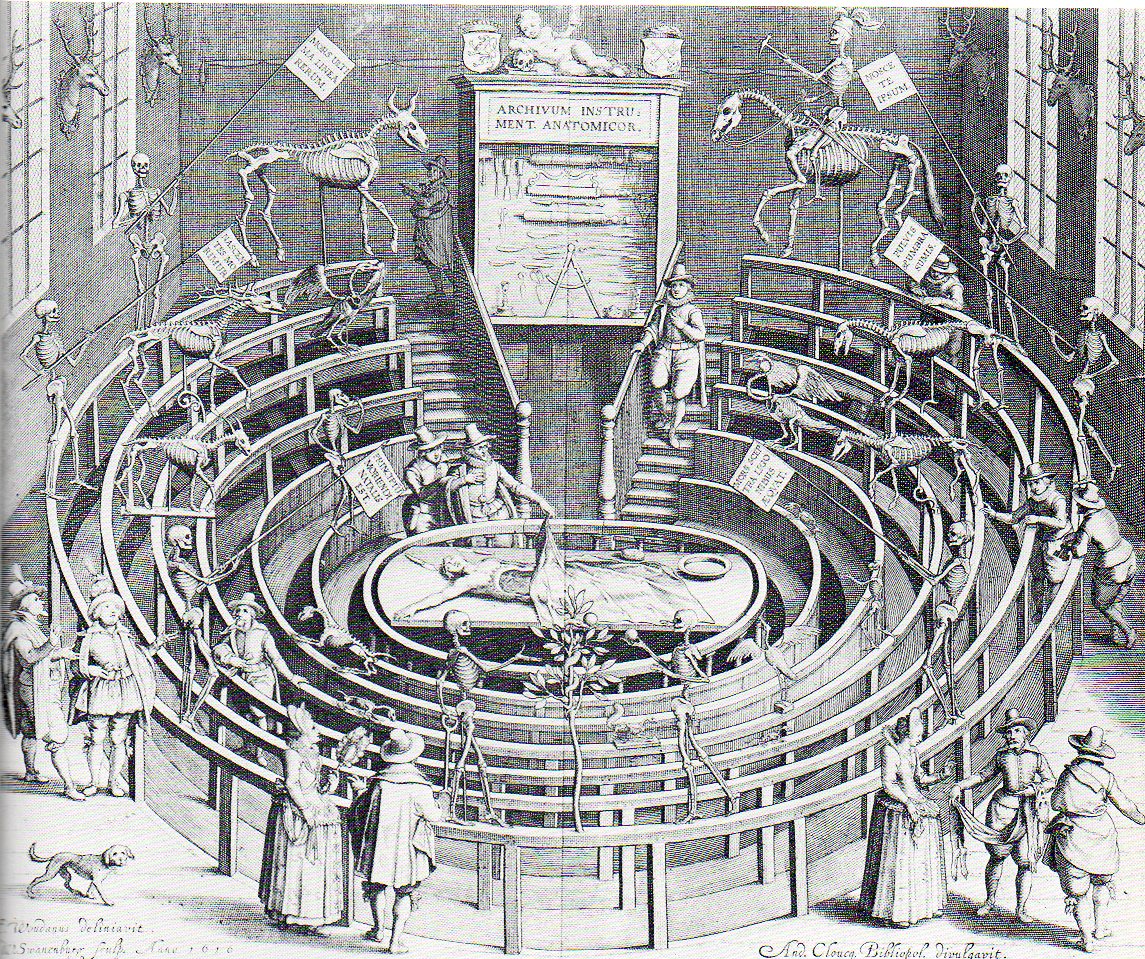
  • Comfortable Bones, the Skeletons of Adam and Eve–Dissecting a Dissecting Theatre Print, 1616

    JF Ptak Science Books  Post 1143

    “You can have it all, my Empire of Dirt”–Mr. Cash  “We are but dust and shadow”–Mr. Horace

    Can there be anything more comforting than for a believer to see the
    skeletons of Adam and Eve, the proof of the origins of all anxiety? 
    Probably not.  But their skeletons displayed in this engraving by
    WiIllem Swanenburgh (after

    Adam skeleton det389

     the painting by J.C. Woudanus) published in 1616 were recognized as pure iconographic ornament.  They decorated the last layer of the dissecting laboratory/pit, an immortal reminder of mortality–perhaps aggressively so, since people were there to watch other people take apart humans and animals and such, which would seem to be a nice reminder of the Big Sleep that awaits all. But no matter, they wer there, Eve with apple, Adam with spade (?), the tree with the forbidden fruit flourishing still around all of the bones, the snake surviving as well.

    Adam skeleton388
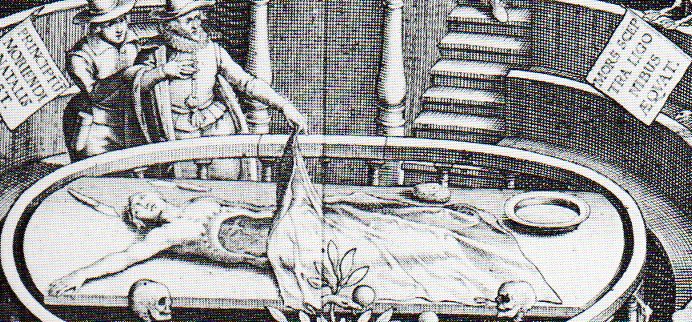
    Visitors to the dissecting amphitheatre here in Leiden were treated to a bone museum during the days in which the place was not being used for its main purpose, though we do see here that a cadaver is being semi-privately displayed, a burgher taking a reticent look (cloth held between thumb and index finger?) while the compatriot takes cover behind him. 

    Adam skeleton cadaver393

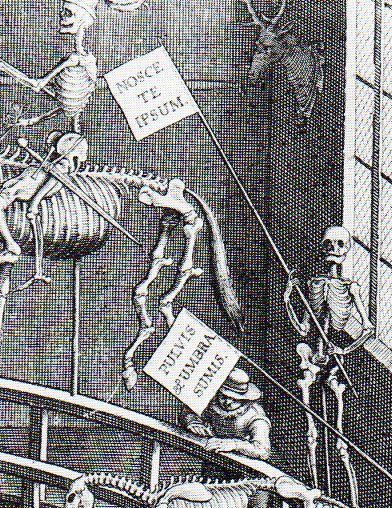
    There are plenty of other onlookers to this scene, though most of them are dead,.  It doesn’t prevent them from holding up sings/banners with messages for the living, though.  


    Adam skeleton signs391

    “Pulvis et umbra sumus” (“we are but dust and shadow”, Horace) hangs just above the head of the man who looks as though he might be anxiously fiddling with a mole.

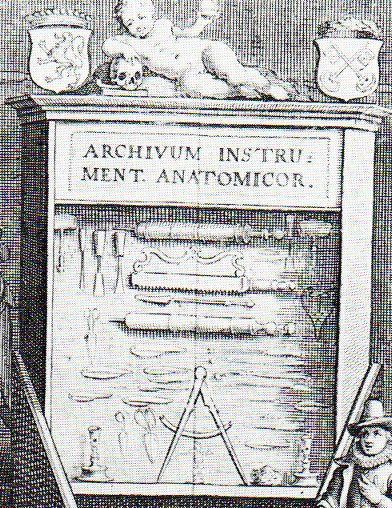
    The tools of the trade hang in an auspicious place, attracting only the attention of two horse skeletons.–scalpels, scissors, maws, a crowbar, a big backsaw-like device, and of course two giant syringes for drawing out “fluids”.

    Adam skeleton tools390 

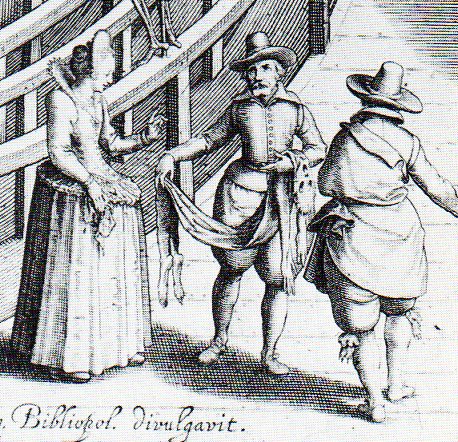
    Lastly, I couldn’t tell what the people were doing in the far right bottom corner until I magnified the image a bit–the man is holding the entire envelope of skin of a human, flayed in one piece.  What is it that they’re saying?  What does one say when offered an armful of skin?  The image of whole-body flayed skin isn’t terribly uncommon in 16th and 17th century anatomy books–except that they’re usually being held by the disectee, and not by a living/walking/talking person. 
    Adam skeleton people392


  • Bio-Mathematics in Busby Berkeley Musicals–Image Dump

    JF Ptak Science Books  Post  1133   

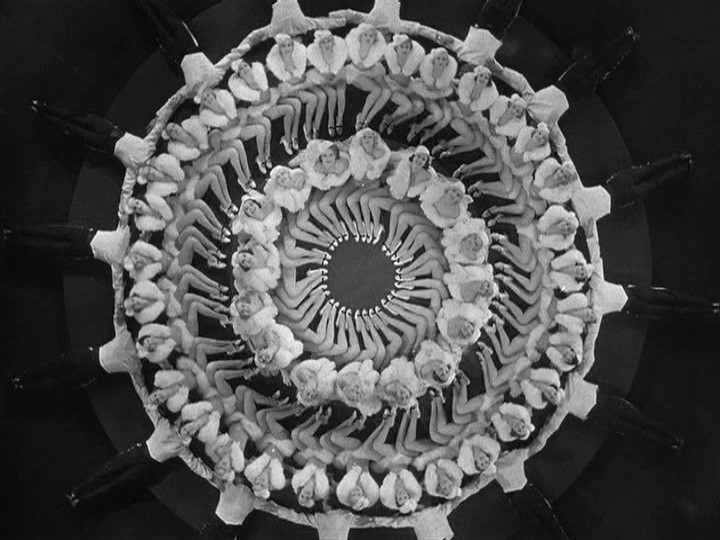
    There’s a certain amount of Leggy Geometry going on in the many films of the great and often-troubled Busby Berkeley.  Berkeley was about 38 when he came into great prominence as a choreographer for movies with music–they were grand and spectacular, intricate dances involving dozens, many times employing overhead shots looking straight down on a full-kaleidoscope productions.  (A kaleidoscope mirrors the great majority of its displayed image; Berkeley mirrored almost nothing, And he didn’t really produce movie musicals per se, I think; those would come later with Fred Astaire and the like, where there were story lines and plots and associated happenings along with the terrific dancing and music. “Plot” was a throw-in with Berkeley, but everything else was just so grand that storyline really didn’t get in the way of entertainment.)  The motion, the offset camera work, the constant motion, almost gives you the sensation of falling into a Phoenix Set.  Between 1931 and the end of WWII, Busby choreographed more than 30 films, many of which are now considered high classics, his very name now associated with fabulous stage productions.

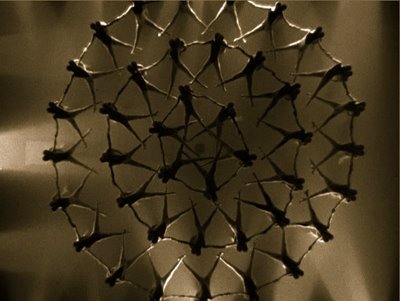
    There’s a big dollop of natural history geometry in his work, as we can see by this selection of still images below. They’re tessellated (if you squint hard and make sure there are no margins) and fractal-like, very organic, very much looking like diagrams outlining the mathematical forms of nature.  And they’re pretty.

    Berkeley 42 nd st 

    Berkeley h

    ·Posted by :

    ·in:

    — —