A Daily History of Holes, Dots, Lines, Science, History, Math, Physics, Art, the Unintentional Absurd, Architecture, Maps, Data Visualization, Blank and Missing Things, and so on. |1.6 million words, 7500 images, 4.9 million hits| Press & appearances in The Times, Le Figaro, Mensa, The Economist, The Guardian, Discovery News, Slate, Le Monde, Sci American Blogs, Le Pont, and many other places… 5000+ total posts since 2008.

Category: Art History

  • Strange Things in the Sky Dept.–Dante and Beatrice and the Vault of Stars

    JF Ptak Science Books    Post 1457

    There is a developing thread on this blog relating to strange things in the sky. Sometimes the images are extraordinary, impossible, beyond fiction:  multiple/duplicate Earths, flying buildings, horses in balloons, extra-human missing souls downloaded to the Earth from extra-Moons, and so on.  And at other times, the images are more subtle, questioning, ambiguous, as in the example of some 16th century prints that show the sky opening to reveal the Creator, who is in turn pictured against, say, a completely blank background, suggesting an enveloping nothingnesss of Heaven; or a field of beautiful stars filling a Renaissance sky of deepest red, at night.  A gigantic foot shown floating in the sky in a 17th century image might be ambiguous, and it also wildly so;  both it and the more subtle ambiguities–for example early representations of caves-over-mountains that give them an inside-out appearance–are welcomed sights.

    Perhaps some of the most beautiful of the Strange Things in the Sky department might belong to the skies of  Dante–they can be extraordinary, straightforwardly unusual and–when the narrative is presented pictorially–beautifully strange and with little ambiguity.  They are presentations of ideas of time and space, fantastic adventures in imaginary environments, as much an internal journey as Milton’s Paradise Lost is an external one1.

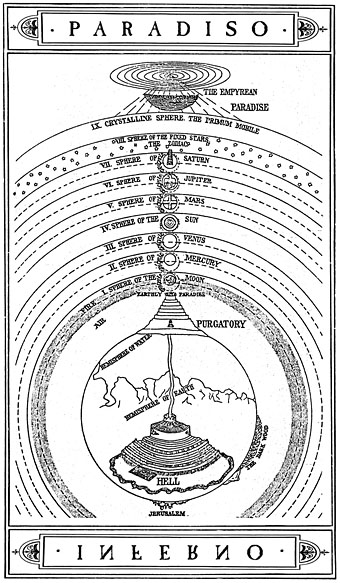
    Dante’s celestial exploration and the foundation that he provides have led to the possibility of an entire atlas of maps of paradise, hell and purgatory.  Here’s an interesting map2 constructed by Michelangelo Caetani (1804-1882) showing the structure of the Comnedia:
    Dante comedia
    I’ve presented this map just to give a context for the placement of the following images, though I do like the Caetani because it presents a good overview of the entire placement of Dante’s work, though necessarily having to leave out almost all of the detail of what is actually going on in each level. 

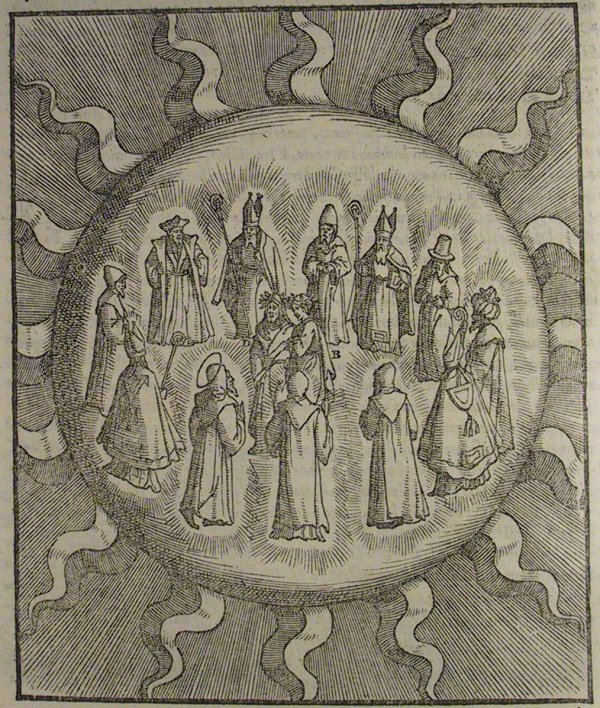
    Nearly all of the images below are from La comedia di Dante Aligieri con la nova espostione di Alessandro Vettlutello, published in Venice in 1544 by Francesco Marcolini (or Marcolino)3.  For the present collecting/browsing purposes I’m just going to go over the images lightly rather than try to launch into an ill-advised exegesis on a subject that I don’t know very well at all.
      Dante sun big
    In the Sphere of the Sun Dante and Beatrice among the wise and the learned, hearing them all (eleven) named so by Thomas Aquinas.  They include Albertus Magnus, Gratian, Peter Lombard, Solomon, Dionysius the Areopagite, Orosius, Boethius, Isidore of Seville, Bede, Richard of St. Victor, Siger of Brabant. Paradiso X
       Dante fixed stars
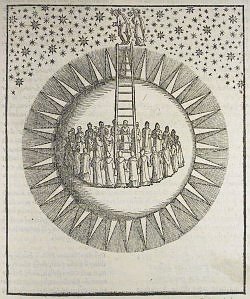
    Dante and Beatrice entering the sphere of the fixed stars, using a ladder of contemplation, mythically suggesting stairs and in this case a stairway to god. 
    Ante--empyrean

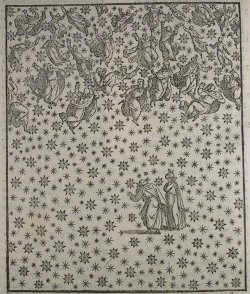
    The souls ascent to the Empyrean, with Dante looking down to see the Earth (“the little patch that makes us so vicious”), and to trace the (“mad”) voyage of Ulysses, and to see perhaps how far he has traveled (Paradiso XXVII).  Dante listens to St. Peter, and Beatrice, who describe the place, which is basically the mind of god and which is the envelope surrounding the final sphere:

             “The nature of the universe which holds
              The center still and whirls the spheres around it
              Takes from this region here its starting-point.
     
              “And here this heaven has no other where
              Than in God’s mind, where there flames up the love
              That spins it, and the power it pours down.
     
              “Light and love enclose it in one circle
              As it does all the rest, and this enclosing
              He alone who circles it can comprehend.

    Beatrice and Dante


    Beatrice and Dante together with Saint John and Saint James,  Paradiso XXV.

              “My body is still earth within the earth
              And will remain there with the rest until
              Our number equals the eternal tally.
     
              “Only those two lights who have ascended
              Wear their two robes here in the blessed cloister,
              And this word you shall bring back to your world.”
     

    Woodcut illustrating Paradiso II
    I couldn’t resist straying a bit to show this fantastic 1491 woodcut (published in Venice by Petrus de Plasiis) illustrating Dante and Beatrice surveying and then entering the Moon.  The scene is described in  Paradiso II:

              “Turned toward me, as glad as she was lovely,
              And said, “Direct your mind with thanks to God
             Who here has made us one with the first star.” –-[the Moon is described and identified as a star.]
     
              I thought we were enveloped in a cloud,
              Shining, solid, dense, and highly polished
              As a diamond struck by the sun would be.
     
              The timeless pearl took us inside itself
                In the same way that water can receive
              A ray of light while it remains intact”
    Again, my apologies to those among you who know Dante–I really was just trying to get at the luxuriant strangeness of these images and display them–much more so than talk about them. 

    Notes

    1. “The difference is that the visual phantasy bequeathed by Dante was mainly a congeries of intense and intricate symbolisms of his own personality,” Masson explains, “whereas that offered by Milton was mainly a sublime version of an independent objective tradition.” 12. David Masson, The Life ofJohn Milton: Narrated in Connexion with the Political, Ecclesiastical, and Literary History of His Time, vol. 6, 1660-1674 (1880; reprint, New York,
    1946), p. 522.

    2.  Michelangelo Caetani, La Materia della Divina Commedia di Dante Aligherie (1855).

    3..   Francesco Marcolini (or Marcolino), a typographer born in Forlì, also published the first book of cartomancy, or telling the telling of the future and fortune through the use of a deck of cards, in his 1540 Le sorti intitolate giardino d’i pensieri (“The oracle called garden of thoughts”).

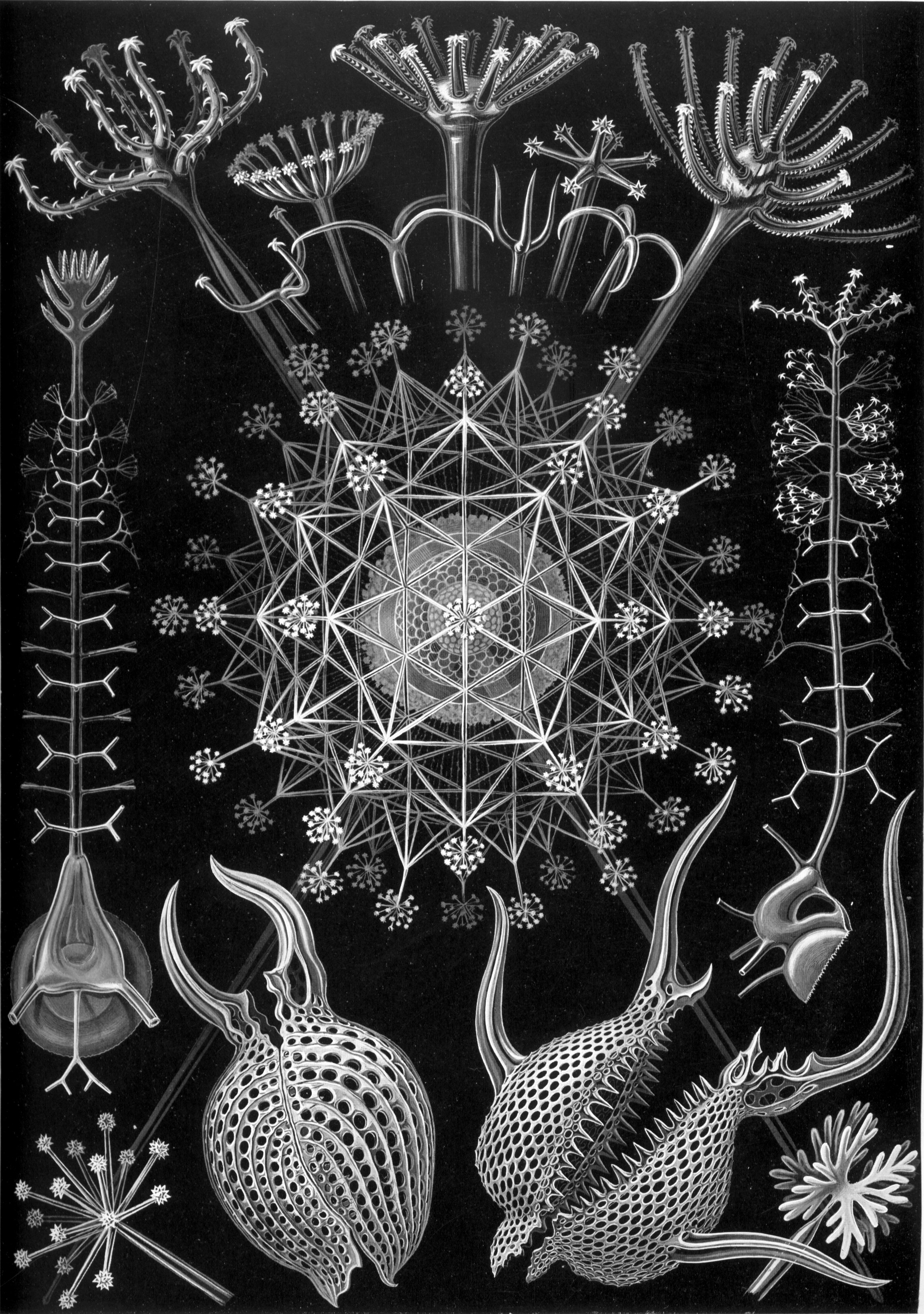


  • Beautiful Books: Haeckel’s Kunstformen der Natur, 1904

    JF Ptak Science Books    Quick Post

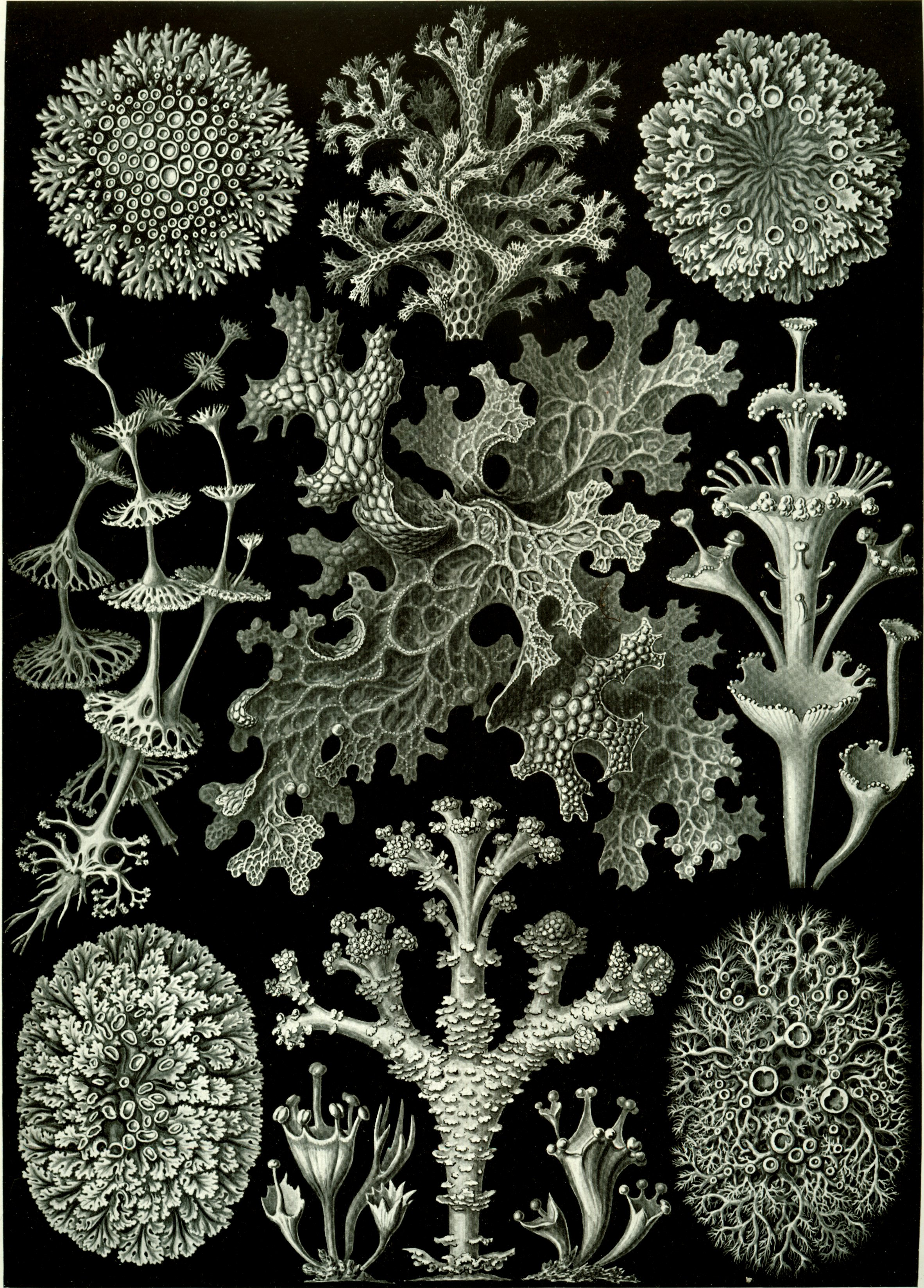
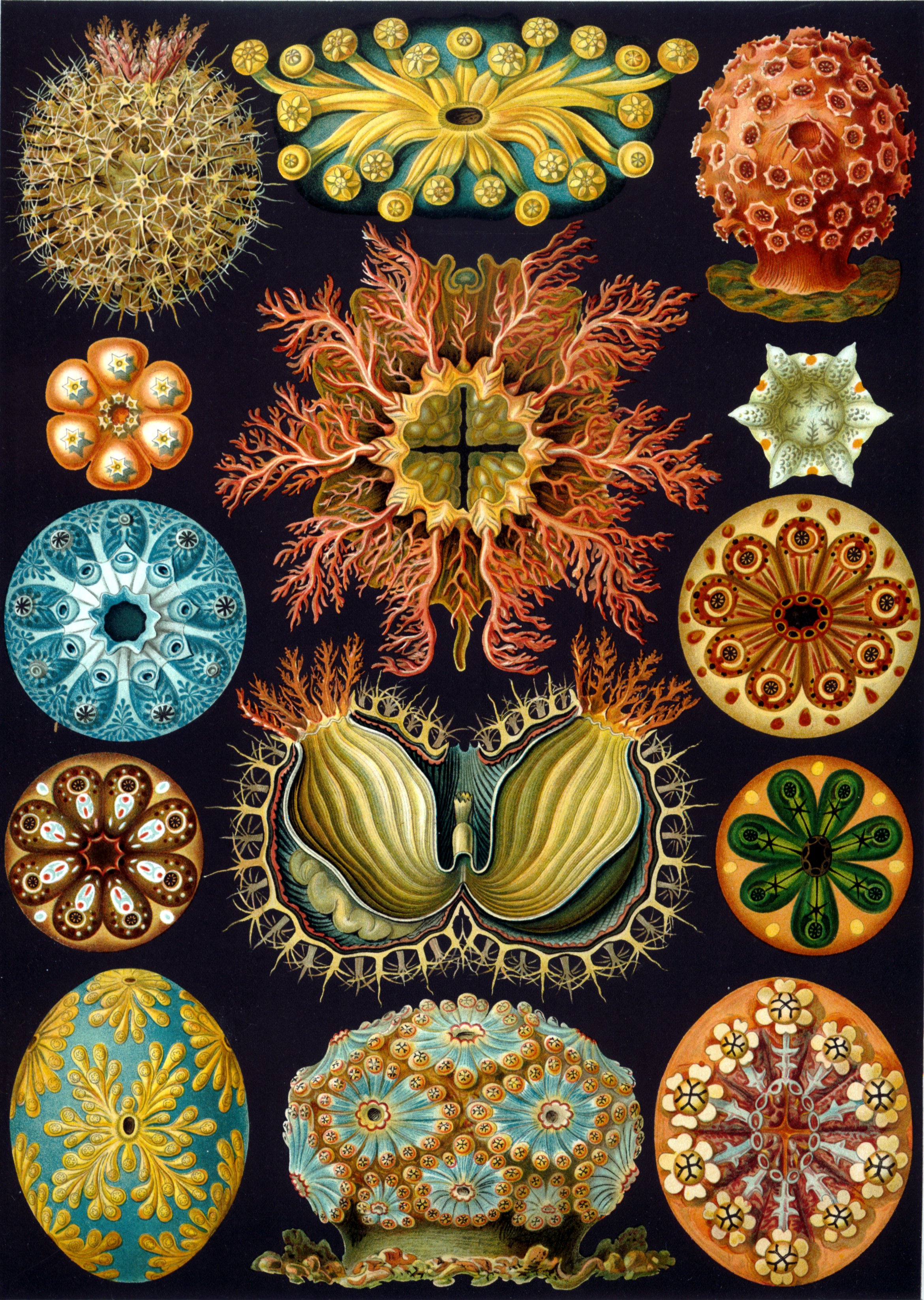
    In his long and vastly productive scientific life, Ernst Haeckel (1834-1919 ) produced this extraordinary work, Kunstformen der Natur, over a five year period from 1899 to 1904, a set of 100 images being  published in 1904 (though a result of a long lifetime of work).  Haeckel was a busy man working over a number of specialties, writing more than 40 books and a large number of  contributions to scientific publication.  He is perhaps best remembered early on in his career for a popular defense of Darwinism, writing Natürliche Schöpfungsgeschichte, (1868, nine years after the publication of the Origin, and translated into English as The History of Creation in 1876) which was a successful attempt to get Darwin’s complex ideas into public discussion.  But all I want to do here is to surface his Kunstformen, which evidently served as a sort of wish-book for the imagination among many modern artists. 

    And so to the examples:

    The phaeodaria:

    File:Haeckel Phaeodaria 1.jpg

    and another example of phaeodaria:

    File:Haeckel Phaeodaria 61.jpg

    The Lichenes:

    File:Haeckel Lichenes.jpg

    And the Stephoidea

    File:Haeckel Stephoidea edit.jpg

    And the ascidiae:

    File:Haeckel Ascidiae.jpg

    And some of the rest, which included all manner of other living things, big and small.  The micrscopic organisms (and black-and-white) to me are the most fantastic, though the renderings of jsut about everyhting in the work are superb, and their placement, the design of each plate, is just magnificent. 

    For a collection of excellent 300 dpi scans see here:  Kurt Stüber’s Biolib.  The following images are located here.

    ·Posted by :

    ·in:

    —

  • The Other Miracles of 1905–Winsor McCay, Little Nemo and Subversive Dreamscapes

    JF Ptak Science Books  Post 1453

    Okay, to be fair no one has ever had a year like Einstein’s annus mirabilis of 19051 perhaps no one has really ever come close–he defines the incomprehensibly high achievement for a single (less than) 365-day time span. There was other stuff going on in 1905–Ernest Starling2 introduced the term “hormone”, Vagn Ekman produced a beautiful paper on the mathematics of ice drift in the Arctic Sea and the ocean’s responses to different sorts of winds, Eduard Zirn performed the first cornea transplant, Ejnar Hertzprung3 published his famous diagrams, Henry Gruppy empirically established the manner of plant dispersal in the Pacific region4, Maurice Frechet’s groundbreaking work in topology, and Henrui Poincare and Howrd Ricketts and Oswald Veblen and so on. And the Wasserman test.  It was a pretty bountiful year–and this was just in the sciences and maths.

    And then there was the Russian Revolution (of 1905).

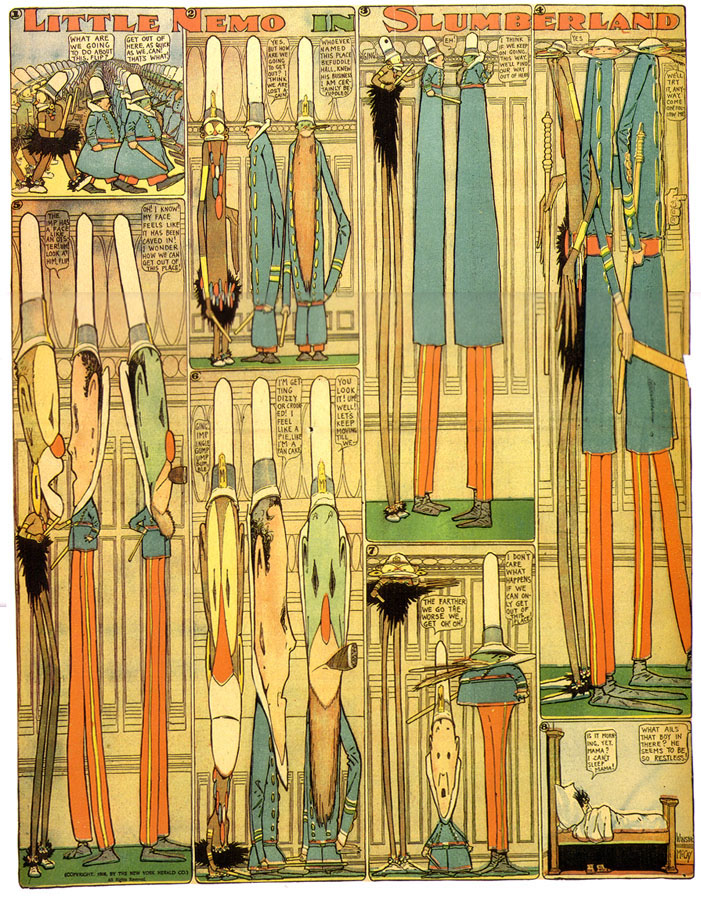
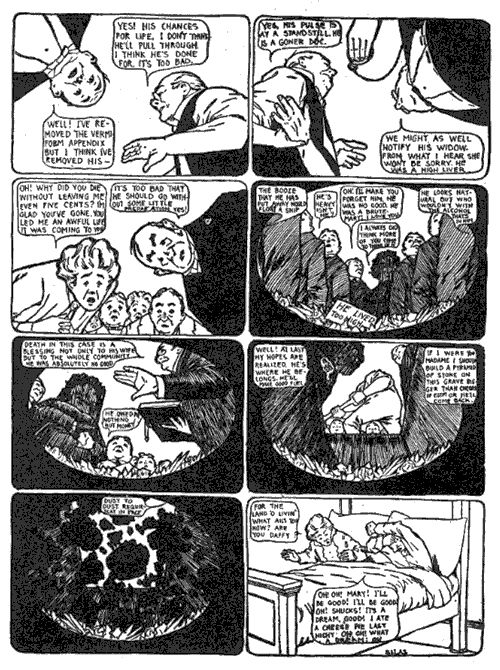
    But also back there in 1905 Winsor McCay was having a terrific year–this was the man who revolutionized the comic strip.  McKay may have been the Einstein of his field, and his work I think may still be the standard bearer for high excellence and creativity.  It was in 1905 that he began his Dreams of a Rarebit Fiend and also the crowning masterpiece of the medium, Little Nemo in Slumberland.  Nothing had really quite been seen like that before, two newspaper strips that were filled with vision and elegance and weirdness and the bizarre, beautiful stories illustrated on one sheet of paper, of great imagination and a wide stretch of subversiveness. They so captivated the readers of the time that McCay went off on illustrative lecture circuits, found movie (in their relative infancy) versions of his work, and performed in vaudeville venues along with Charlie Chaplin and W.C. Fields.

    And then he created the animated cartoon. 

    Here’s a page of Little Nemo:

    Little_nemo_1908
    And another of the Rarebit:

    Rarebit_fiend
    I guess you can get the picture of what McCay brought to the world–examples of his work are all over the web, and have been published in eight (?) volumes of reprints.  This was a particularly sumptuous time for this sort of story telling, but this is not the place to talk about anyone else, not really. (Okay–one very high talent is the seldom heard Rodolphe Topffer, but that’s another story.)

    And a very early Rarebit movie (which takes a little while to get moving):

    And another, this an animated cartoon from 1921–it doesn’t have anything to do with McCay in 1905, I just like its motion, and also because McCay is the father of the animated cartoon:

    Can anyone say “Up”?

    And then of course there’s Gertie, the first animated cartoon:


    Notes:

    1.”Über einen die Erzeugung und Verwandlung des Lichtes betreffenden heuristischen Gesichtspunkt” Annalen der Physik 17: 132–148;  “Über die von der molekularkinetischen Theorie der Wärme geforderte Bewegung von in ruhenden Flüssigkeiten suspendierten Teilchen” Annalen der Physik 17: 549–560; Zur Elektrodynamik bewegter Körper” Annalen der Physik 17: 891–921; “Ist die Trägheit eines Körpers von seinem Energieinhalt abhängig?” Annalen der Physik 18: 639–641.

    2.  “On the Chemical Correlation of the Functins of the Body”, not only defining the term but clarifying the hormone’s function.

    3. Hertzsprung, “Zur Strahlung der Sterne”, with another paper of the same name later in 1907. 

    4.  Observations of a Naturalist in the Pacific Between 1896 and 1899, the second volume, entitled Plant Dispersal, is where (surprise!) he discusses plant dispersal.  But the really cool thing here is that he figured out that there were a lot of seeds that floated here and there in/on the Pacific, going place to place, finding out how long they could stay afloat, and so on.  It was fantastic!


    ·Posted by :

    ·in:

    — — —

  • Unintentional Proto-Impressionist Photography, ca. 1863.

    JF Ptak Science Books   Quick Post

    Civil War Art b

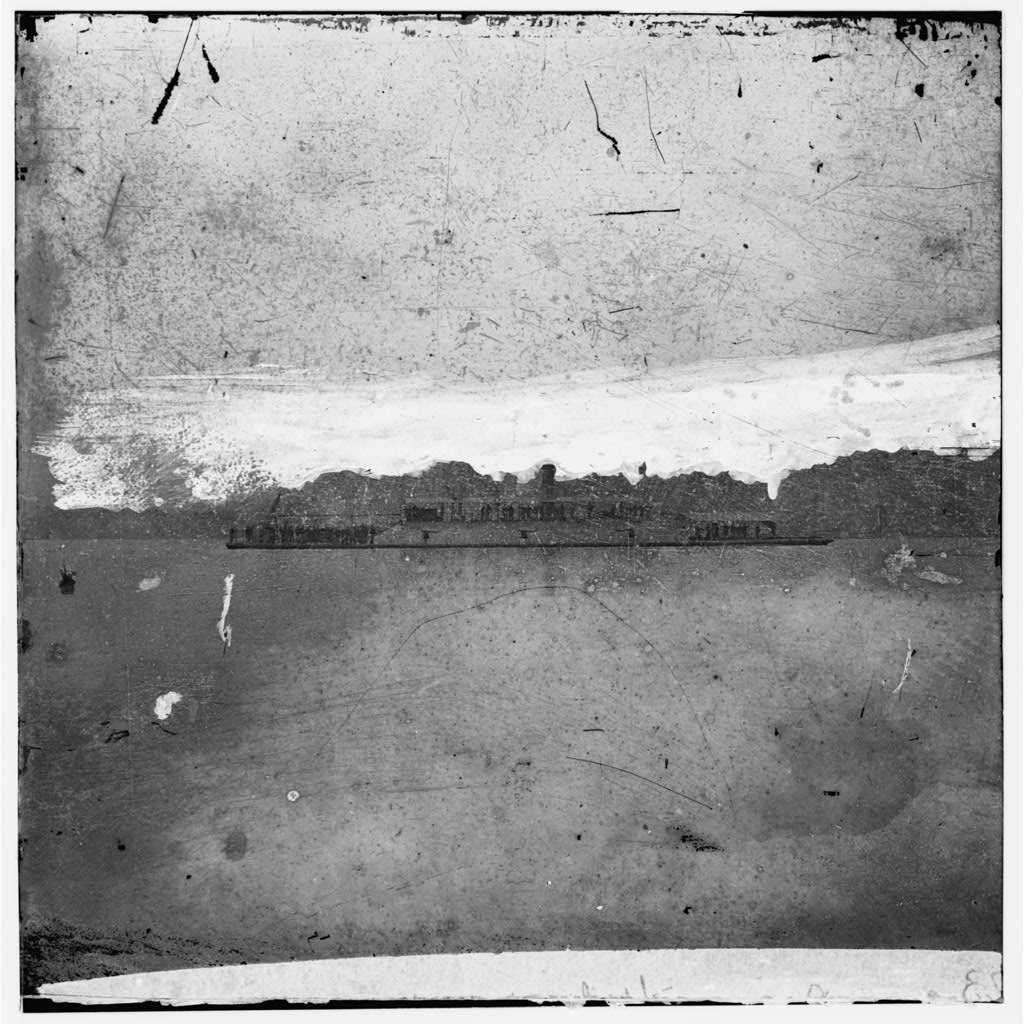
    There is a continuing categorized thread in this blog called “Unintentional Absurdist“; there is another which follows intentional efforts that wind up being unintentional pieces of modern art that have surfaced before their time.  This later category includes the inscrutable color theory pre-Cubist work of Emily Vanderpoel, the spirit drawings of Georgina Houghton, the absolutely impressionist paintings of Victor Hugo (see here for examples of their work)–all of which were decades ahead of movements that would become standards of art, those these people were generally left behind. 

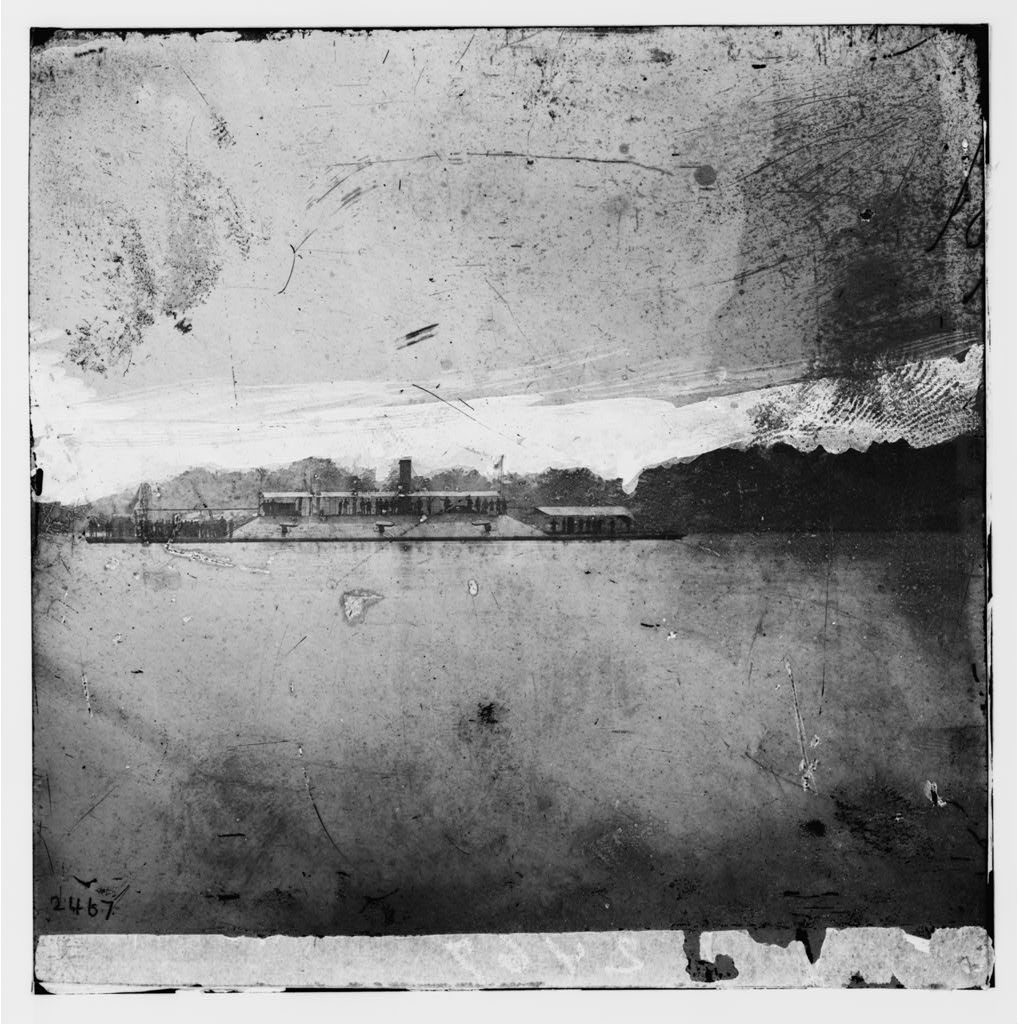
    In yet another flavor of this category is the unintended works which either in their whole or pieces seem to be very modern, like this half of a stereocard of the CSN ram Atlanta.  It was a documentary photograph that has perhaps printed not-so-well and which has suffered changes to it surface over time–the result of which though, in my head, has rendered a terrific pre-Impressionist Impressionist photograph.  I think it is beautiful.

    James River, Virginia. Confederate Ram ATLANTA after her capture.  Source; Prints andf Photographs Division, the Library of Congress.  

     Here’s the other half, complete with fingerprint:

    CIVIL WAR ART C


    ·Posted by :

    ·in:


  • An Antiquarian Print Rarity: Depicting the Destruction of the Earth

    JF Ptak Science Books  Post 1439

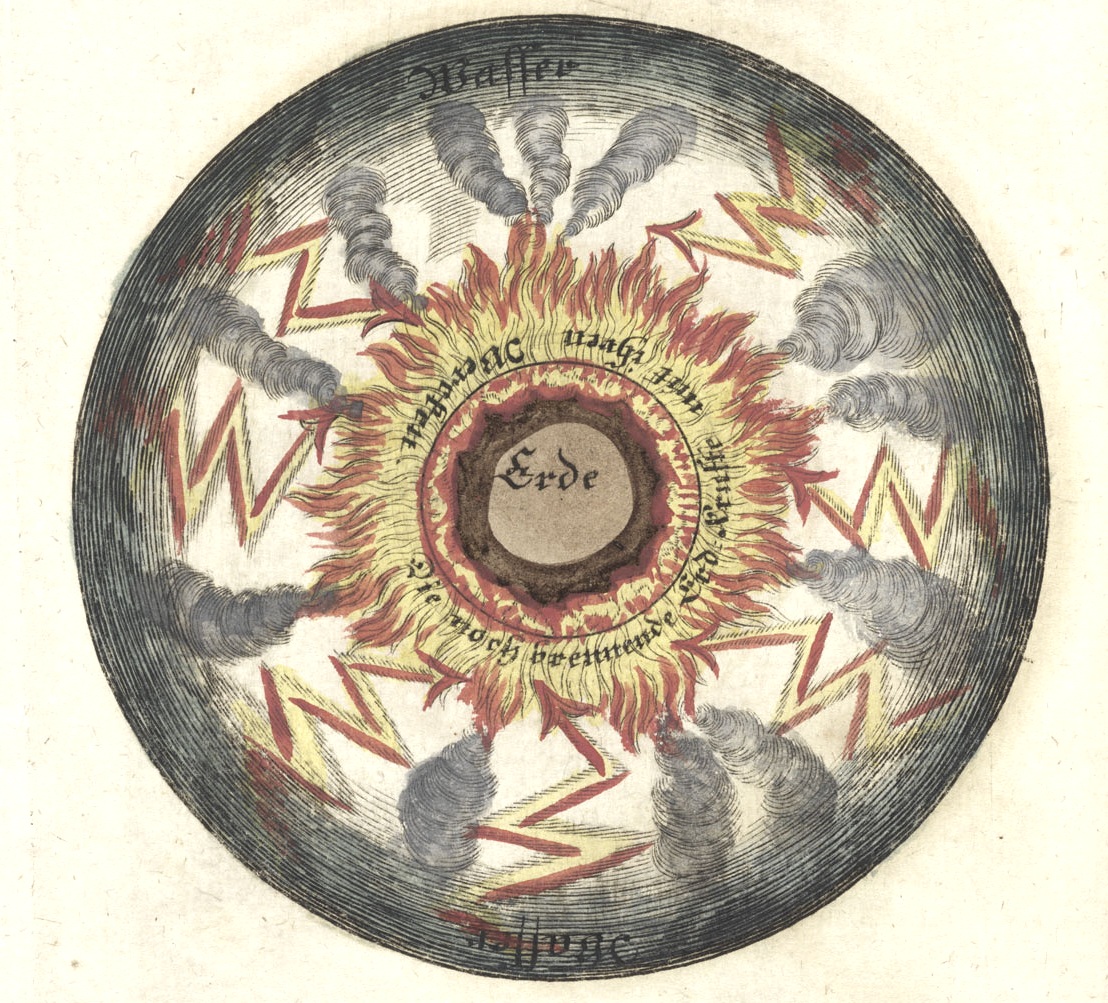
    There appeared earlier in this blog a bit on an engraving depicting an exploding Earth, one of a series of twelve images, eleven of which were unavailable at that time–not so anymore.  So an update to this post is happily made, starting with the exploding part (below), a nasty millennial vision steeped in a volcanological/geological/meteorological 18th-century primordial stew, the Earth in a sea of fire and blasted volcanoes, lightning striking from above:

      Frisch 5
    [All image sources:    Herzogin Anna Amalia Bibliothek, Weimar.]

    Hades, Heaven, Meru, Valhalla, Elysium, Olympus–the places at the end of the terrestrial road, the great emancipation. In some theological doctrines these places are reached collectively after the great conflict at the end of time; the end of days in the Old Testament, when the earth is devoured by holy vengeful wrath and reconstituted for godly comings –and-goings.

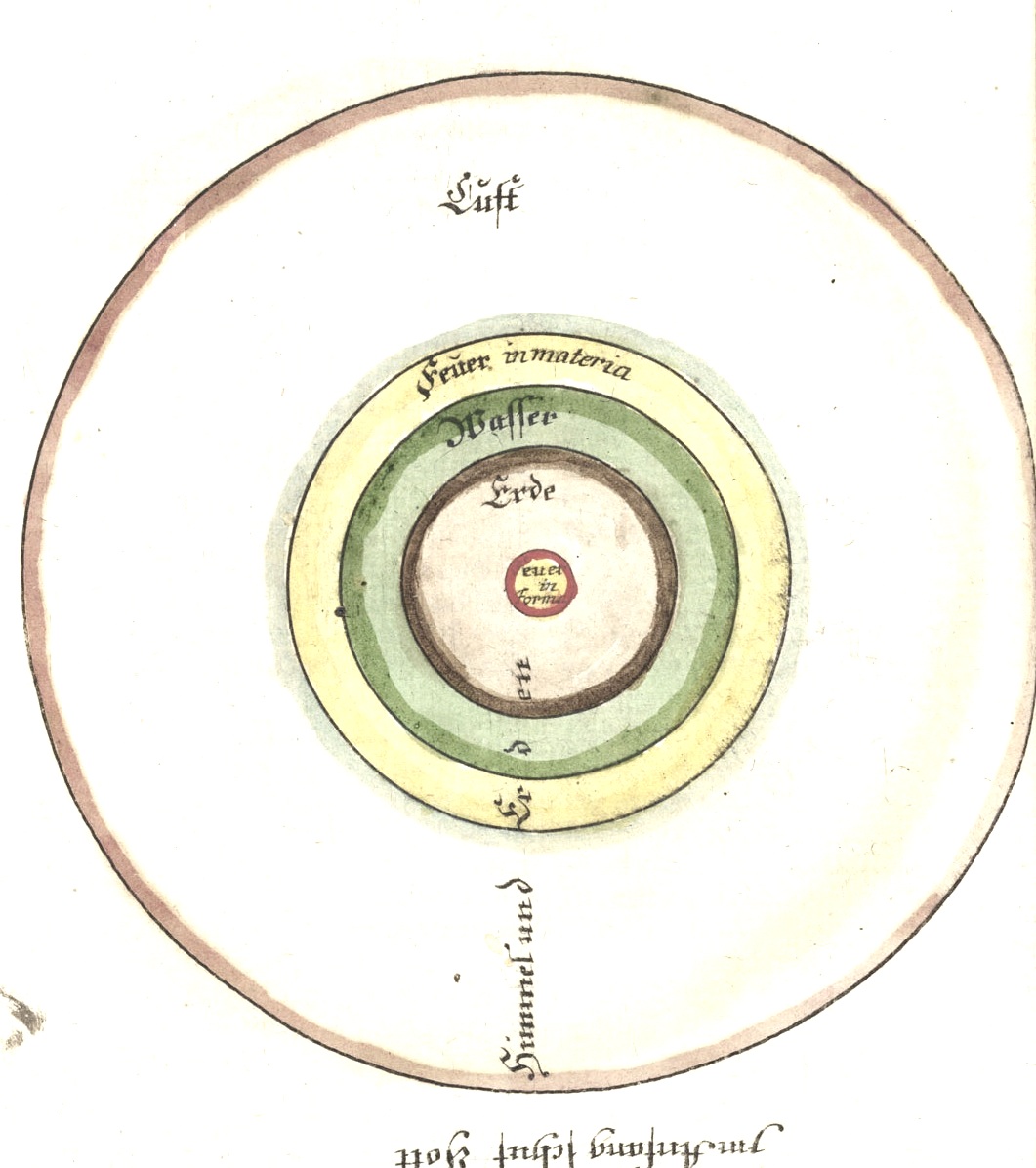
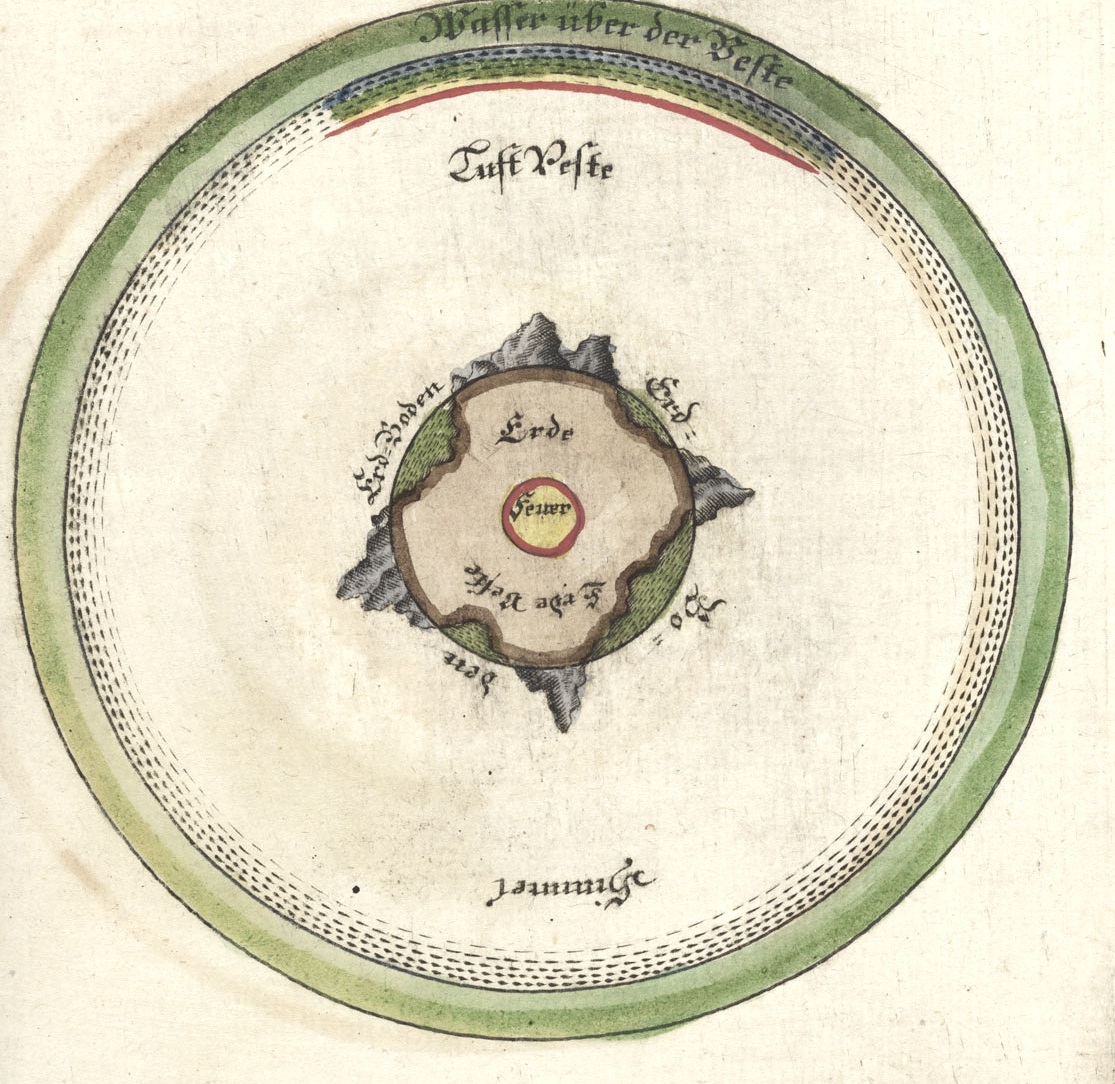
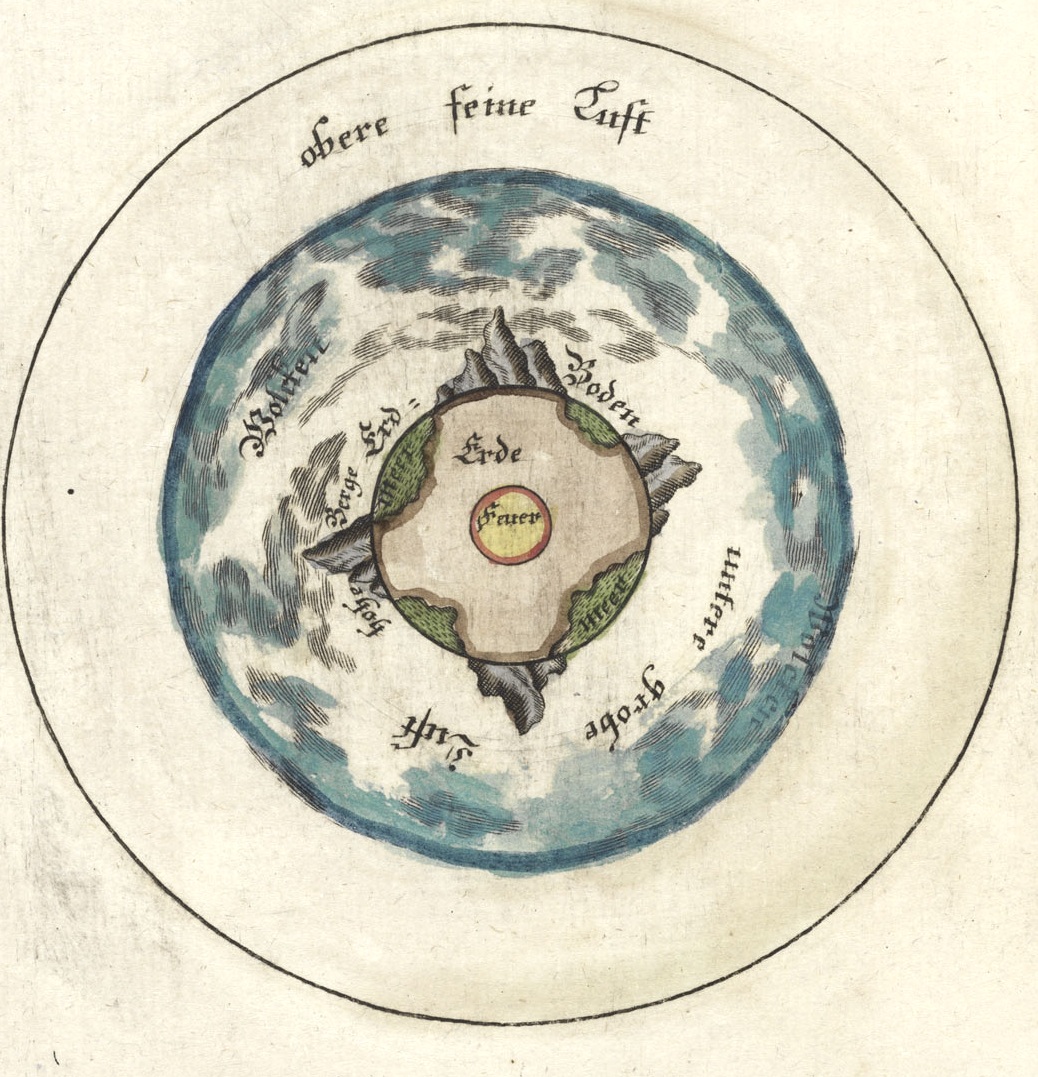
    This engraving is one of twelve found in a fine little book, the brainchild of clergyman/semi-scientist Jodocus Frisch (1714-1787), who delivered to the (un-) waiting world his vision of how the earth and heaven will come to an end, there at the end of days.   Die Welt im Feuer, Oder das Wahre Vergehen und Ende der Welt, Durch den letzten Sünd-Brand  (printed in Sorau by Gottlob Heboldm in 1746) is one of very few works that depict (in  illustration) the destruction of the Earth, and even though Frisch illuminates biblically-based theory, the idea of the earth exploding into bits in primordial fire and so on was extraordinary.  The images were done in four colors representing the four elements:  yellow, brown, green and white represented (respectively) fire, earth, water and air. In this image, we see the fire-centric earth encircled by a sphere of water, which is surrounded by a sphere of fire, which in turn is surrounded by a sphere of air,  with much bad stuff happening. 

    Not having the book in hand I’m relying on the  description of the Dutch bookseller Asher & Company, an old-line bookseller of very fine antiquarian works, which wrote the following descriptions of the other images in the book (and which appears for sale right now at their site):

    “The second and third engravings show how the sphere of water disappeared after the torrential rains of the deluge, leaving the earth directly exposed to the sun. In the fourth and fifth engravings the earth is consumed by fire from within and without, demonstrating in what way the biblical prophecies about the destruction of heaven and earth may come to pass. Plates 6 and 7 depict the new heaven and earth that look entirely similar to plates 1 and 2, the first heaven and earth. Plates 8 and 9 show heaven and earth in their present state with precise specifications of what the biblical vocabulary names “heaven.” Plate 10 shows how the sphere of water breaks the rays of the sun in such a way that they shine on all parts of our planet in equal manner, wherefore all regions have a temperate climate. However without the tempering function of the sphere of water, the air focuses the rays of the sun in the equatorial zone.”

      Frisch 1 page 26

    The water of the great deluge now gone, revealing the land masses, plate 2:

    Frisch 2
     And so again, in plate 3:

    Frisch 3


  • Stylizing a Sameness in Early Flight Images

    JF Ptak Science Books  Post 1438

      Space flight379 Space flight378

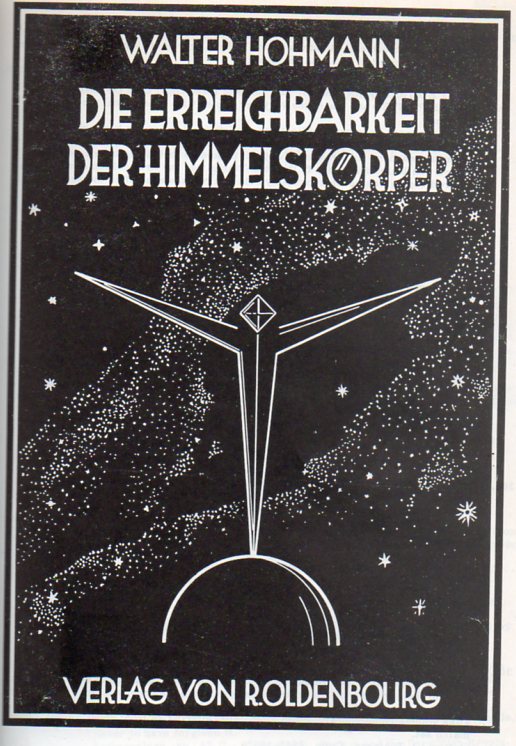
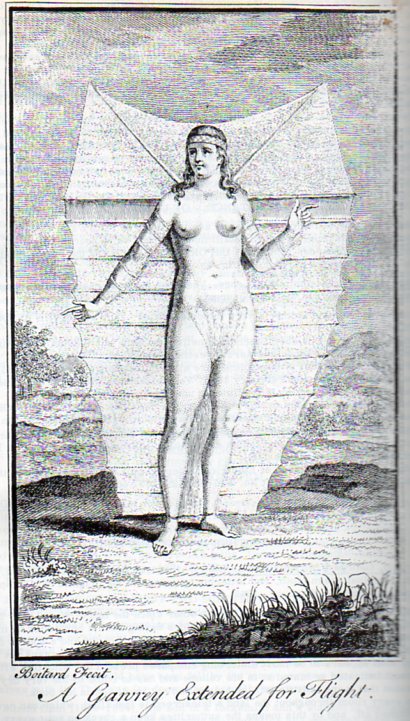
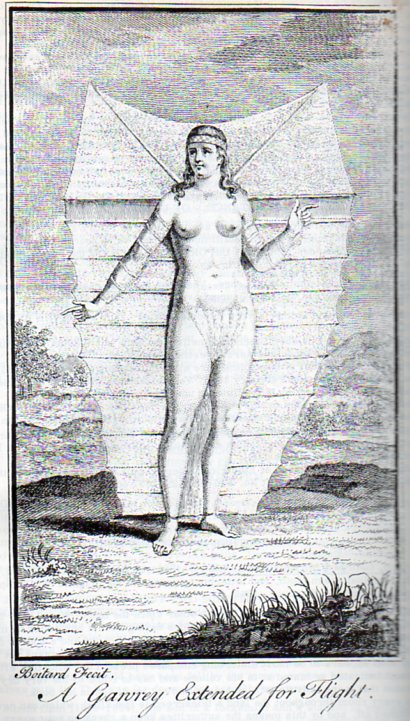
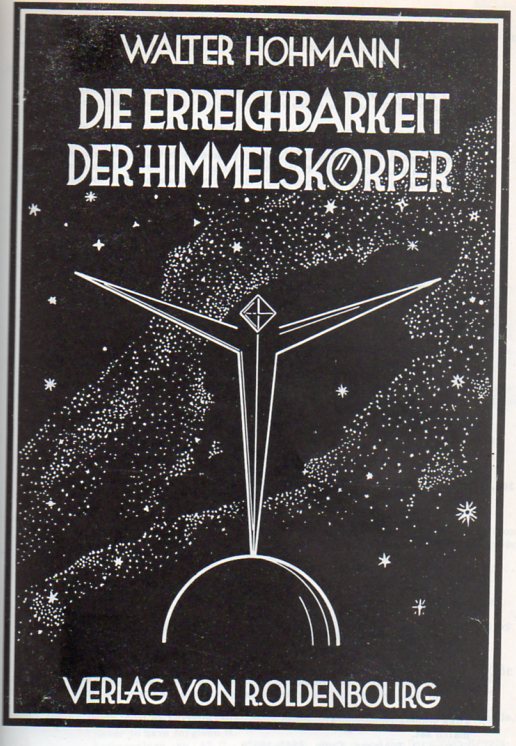
    I found these elements of sameness in design, spanning prehistoric flight and prehistoric space flight eras, separated by 170 years or so, and they just seemed fascinating.  The first, by Boitard for Robert Paltock’s (or Pultock, 1697–1767) The Life and Adventures of Peter Wilkins, a Cornish Man, Relating Particularly, His Shipwreck near the South Pole; his Wonderful Passage thro a Subterraneous Cavern into a kind of New World, his there Meeting with a Gawry or Flying Woman, was published in London in 1751 pictures the flying woman from the title (which also pretty much sums up the Robinson Crusoe-like story.  Wilkins does become shipwrecked and then has an extraordinary adventure underground at the South Pole–which is interesting in and off itself, to set the stage at the South Pole, since the exploration of Antarctica is really a 20th century endeavor.  (The first accurate summation of Antarctica as a continent isn’t made until Charles Wilkes’ expedition in 1839/40.)

    Space flight378

    The flying woman is striking, especially for the mid 18th century:  she is quite lovely, muscular, and tall, and has her limbs attached to a flying/gliding canopy which seems as though it would be operated in a way in which the people of that time thought birds to fly. 

    The associated image is Walter Hohmann’s prescient work on rockets and rocket flight, Die Erreichbarkeit der Himmelskoerper, Untersuchungen ueber das Raumfahrtproblem, which was published in that great heyday of German flight engineering, in 1925.  It was published very soon after the important work of Hermann Oberth2, whose style, illustration and design are closely aligned. It is very interesting to note here that Hohmann (and Oberth) both suggested using teh Earth’s gravitational field to orbit the spacecraft and then slignshot it off into space, rather than to try to simply lift of from Earth and then go directly into space. 

    Space flight379

    Notes:

    1. Biographical Dictionary of English Literature was not impressed by it saying: “The description of Nosmnbdsgrutt, the country of the flying people, is a dull imitation of Swift, and much else in the book is tedious.

    2.  Oberth’s book, Die Rakete zu den Planetenraum was printed in 1923 by the same publisher as Hohmann, and was a cornerstone study of the issue of interplanetary space travel–the first of its kind, really, to address the full theoretical and practical aspects of rockets and space flight.  Oberth–who wrote this at age 28–could not submit the work for his thesis because of its advanced treatment of a little-known subject.


  • The History of Dots: anti-Dots, Bubbles and Circles

    JF Ptak Science Books   Post 1433

    This blog’s series on the History of Dots needs to be folded into the History of Circles section–it seems that whenever I see interesting circles that I am seeing dots, and vice versa; and after all, aren’t circles just unfilled dots?  An anti-dot (or at least so in two dimensions)?  I like the idea, especially since one of the great and revolutionary ways in which particles were found was with the device pioneered by D.A. Glaser (Nobel physics, 1960), the bubble chamber, which through the use of superheated hydrogen (usually) it was possible to track electrically charged particles, often producing dots in their signatures.

    Which leads me to bubbles and anti-bubbles.  We all know what a bubble is–at least a physical one–but what about its opposite?  Its not quite that, really, though there are bubbles that are liquids surrounded by gas rather than the much more conservative and popular way.  And so it is this way that I came to the anti-dot, the circle, and then of course one of its three dimensional relatives, the bubble (and the sphere).

    Earlier in this blog I’ve written a few times about the speech and though bubble/balloon, which was a fantastic invention, enabling to make literal the thinking of the subjects in a painting (and seen probably for the first time in a printed book in 1523, in this work about Bruno Carthasisienna):

    0 blog feb 18 balloon599


    I’m sure that there must’ve been some number of people who regarded it as base and retrograde, that the view of a print or painting should by the art’s elements know what the characters might be thinking, and that by showing the specifics of thought, by boldly stating the thought or speech itself, that the experience is removed from the viewer’s imaginations.  Perhaps these thoughts were common to the people who considered the telephone as an affront to communication as an attempt to replace the written letter, and so on to fax to email to tweet and so on. 

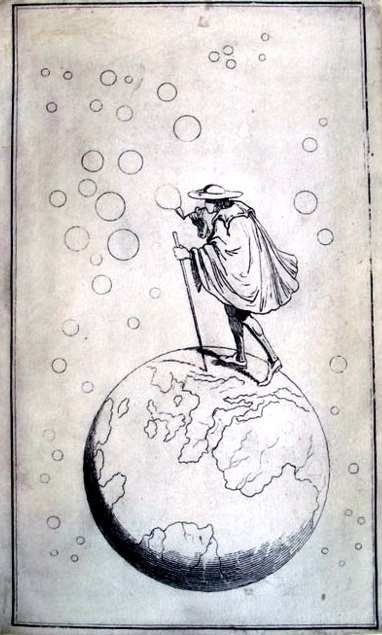
    I have no idea when the first bubble as a bubble appeared in print, though a gorgeous version of a bubble-maker is seen on the cover of another “first”:  the first full-cover illustration on the front cloth cover of a published book1, Sir Francis Bond Heads (1793-1875) Bubbles from the Brunnens of Nassau, which was published by in 1834 by John Murray of London, who 25 years later would publish Darwin’s Origin (where the word “bubble” by the way does not appear).

    Dots  bubbles princeton
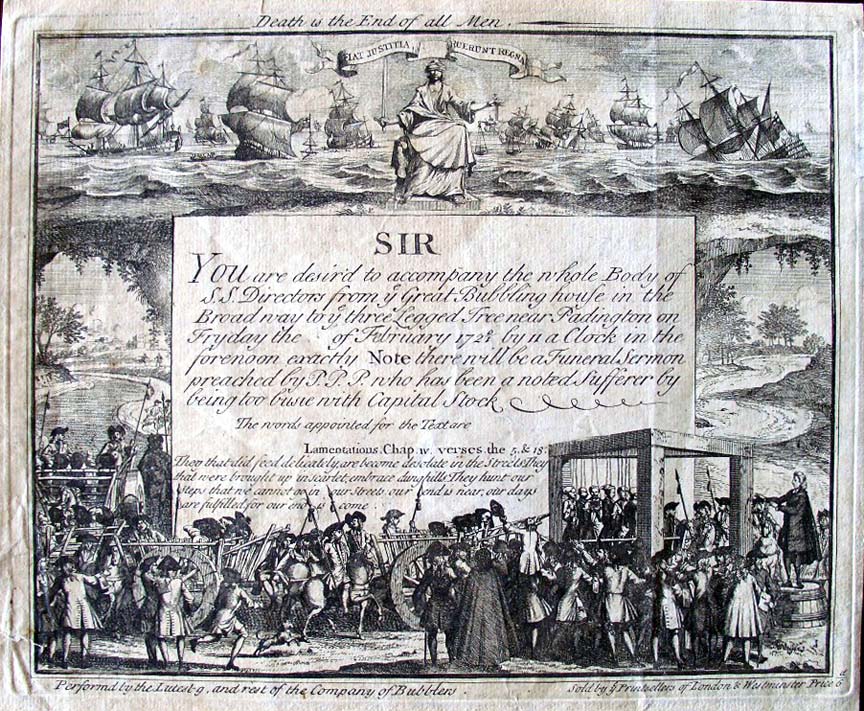
    There are many illustrations and paintings of people blowing bubbles–I’m not sure which one is the most famous but Gerit Dou (1613-1675) certainly comes to mind (with his Still Life with a Boy Blowing Bubbles).  Perhaps a ittle more unusual and also involving a great scientist is the economic bubble, which is the subject of this great print called “A Bubbler’s Funeral”.  An economic bubble is one in which the value of a share of stock in a company or interest becomes hyper-inflated, expanding outward until the price bubble found its pin, and once contact is made, the whole thing goes to shamble, and anyone left holding the enormously inflated stock finds themselves with a stock worth next to nothing. 

    Dots bubbler funeral
    This image was a satire on the Ages of Man, professing to be a ticket for a Bubblers funeral, and was in 1720 aimed at the directors of the South Sea Company, a notorious early 18th century bubble, which had just burst.  Many people lost fortunes in this, including the aged Sir Isaac Newton.   The invitation was for a funeral profession to  “accompany the whole Body of S.S. Directors from ye Bubbling house in the Broad way… to ye three Legged Tree near Padington on Fryday the of February 1720/1″.

    And so ends this first bot on folding the story of circles and bubbles  into this blog’s History of Dots.  I should point out that one of the great bubbles of the last hundred years or so imploded only a dozen yers or so ago–the dot coms. 

    I wonder if the History of Holes thread should also be folded in?

    Notes:

    1. From Princeton University:  “Ellen Morris puts it in anything way, “This period also produced the first full-cover designs: John Murray’s 1834 issue of Bubbles from the Brunnens of Nassau is reputedly the earliest publisher’s cloth binding with a full pictorial design on its cover.” (The Art of Publishers’ Bookbindings 1815-1915).


  • Death Comes for the Book(printer & seller), 1499

    JF Ptak Science Books   Quick Post

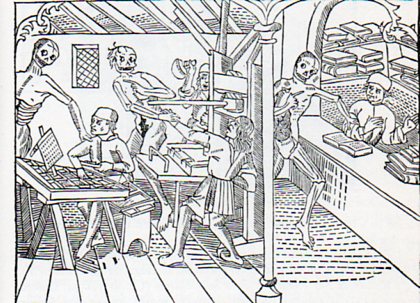
    Death444
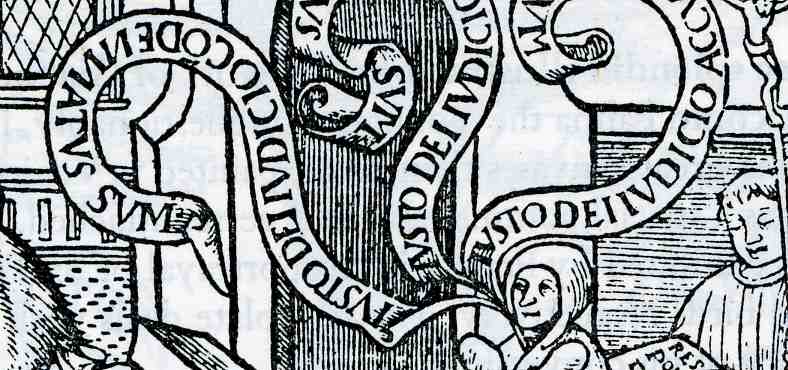
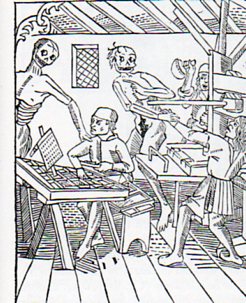
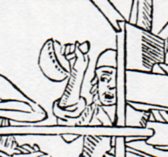
    This is intended to be a short mini-post on the end of printing, and the end of bookselling, such as we know it, or knew it–this image comes from 1499 (Le Grand Danse Macabre, Lyon), and tells us that death to these occupations is nothing new.  Of course when we speak of the death of the book nowadays we’re discussing something different–the death of the printed format.  But here in this print, which is also the first depiction of a mechanized book press, we see ironically that Death has come to claim its operators, or at least two of them.  The inkman in the background, the yelling third of a departing party of two, is spared for the time being.  Just as the reader is for the first time seeing this machine, they are also seeing Death in its in grim glory snatching away the machine’s main operators. 

    Death445

    The image and the functions of the people working the press are well described in the excellent history of all things books at the Bookn3rd website, here. 

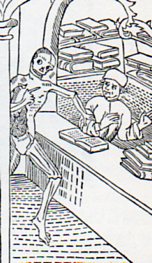
    Here’s Death coming for the bookseller–at least the man was reading at the time of the departure.  This is also a very early depiction of a book store, which again as the first visual information on such a place to the reader is wrapped around the visitation of the Great Inevitable. 

    Death446
    The inkman, in thr background, screaming/shocked. 

    Death447


  • Packed Tight in the Renaissance–Another Look at Quiet Crowds

    JF Science Books   Post 1464

    Crowded435
    I’ve written quite frequently on this blog about the forensic components of crowds, seeing the interesting bits of smallness inherent in virtually every crowd scene ever made. [For example, see Ephemeral Uniqueness of Large Crowds here, or just enter “crowds” in the “search” box at left.]  Today’s installment looks at some older representations of crowds, or people or things just packed tightly together. 

    It seems a little trite to lift this image from a superb example of Renaissance printing, and to attach it to a short post about crowds and being crowded, but so be it.  The image in question is from the semi-great Hypnerotomachia Poliphili1 (from Greek hypnos, ‘sleep’, eros, ‘love’, and mache, ‘fight’, or something like  Poliphilo’s Strife of Love in a Dream), which was a dreamscape novel hat was richly illustrated and beautifully designed, if not well written. Be that as it may, whether or not it was/is a dripping romance of sodden accomplishments and drippy sentimentality, it did encompass a weird allegorical element that linked architecture and feminine appreciation of sexuality with Poliphlio’s dream-search for his beloved Polia.   The book seems to have everything going for it except for a good story line and an author. 

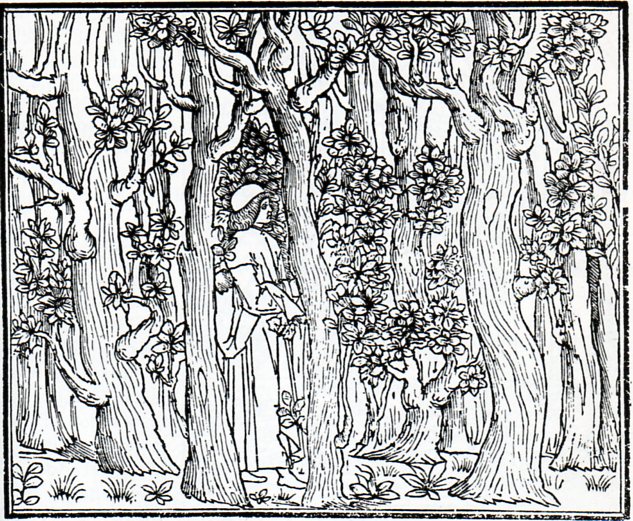
    Be that as it may, I liked this image of Poliphilo entering the woods in his search for love–crowded, dense, low growing branches, and so on.  Visually it is very striking with lots of verticals; allegorically, it is extremely sweet.

    Crowded436

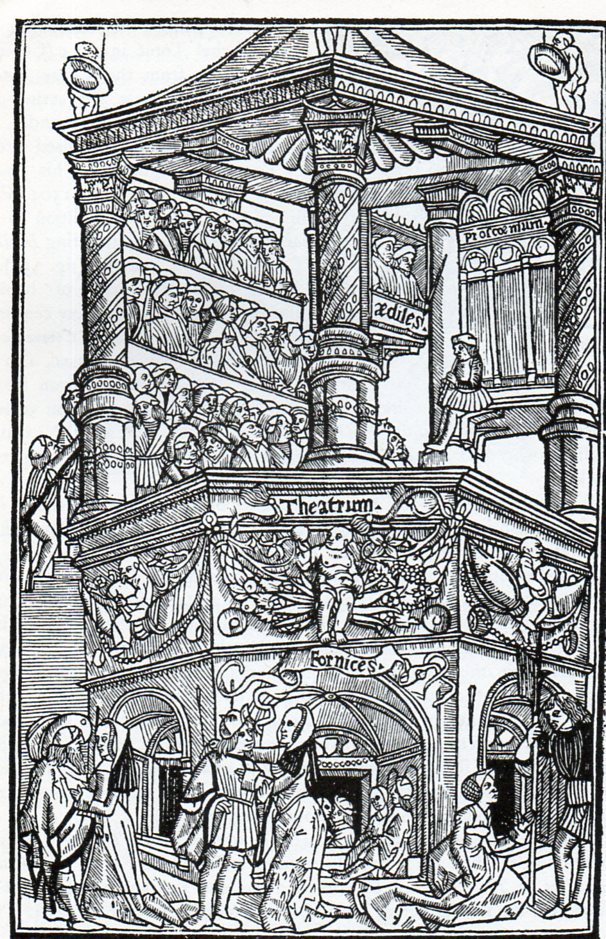
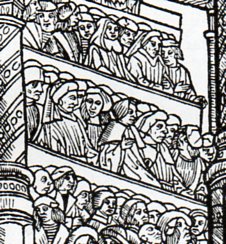
    Next (above) is this lively theatre image from Terence’s Comediae, printed in Lyon in 1493.  The Comedies of Terence were probably the thing that gave Latin a more-appealing public personae, something that was approachable to all and involved bits of life from all stations, much more so entertaining than a droning speech from the floor of the Roman Senate. (And in detail the crowded bit:)

    Crowded437

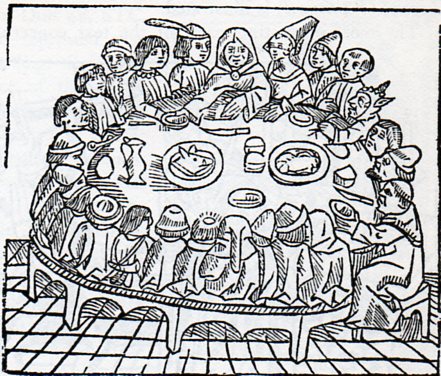
    And here’s some jowl-to-cheek seating in “The Pilgrims at Table”, from the Westminster edition of the Canterbury Tales, printed in 1484 by the great William Caxton:

    Crowded438

    There are no forks yet on the table–they wouldn’t come about for another few decades.

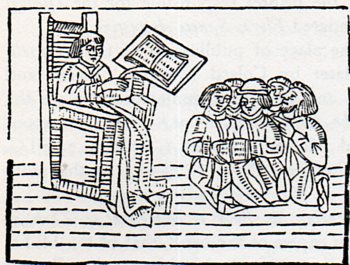
    And what are we to make of this scene–are these students as fearful of their instructor as they seem?

    Crowded439
    No–I think that its all about the book.  Books were very expensive when this woodcut was printed in William Caxton’s fantastic  Mirrour of the World (1481), and so if there was one book allowed for the classroom it was a lot, and all these people were trying to do was to huddle together so that everyone could get a look at the printed page. 

    There’s a certain stillness to the crowds above, much more so than most–there’s definitely no granular behavior about them, no extra-sensory physics to the ebb and flow.  They’re mostly just sedentary, but packed closely together. 

    Notes

    1.  This book was printed almost at the last moment of the 15th century, in December 1499, by Aldus Manutius in Venice. 


  • The Cosmology of Creation, 1554

    JF Ptak Science Books   Quick Post

    Biblia germanica419
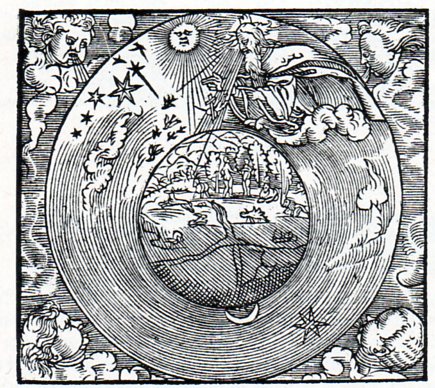
    This woodcut comes to us from Biblia: Dat ys De gantze Hillige Schrifft Vordudeschet dorch D. Mart. Luth. Vth der lesten Correctur mercklick vorbetert, and published in Mageburg by Michael Lotter in 1554.  I’d say that it depicts the Eath-centered cosmology of the creation just after the introduction of Eve, where everything seems to be in perfection and harmony, there (perhaps) inthe sixth day of the creation story.

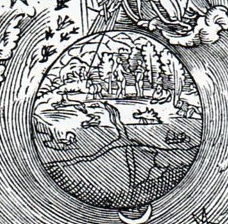
    In the detail we can clearly see the Garden:

    Biblia germanica419

    There doesn’t seem to be any sign of the serpent, though Eve does seem to be covering herself in some sort of modesty, even though we are told in the OT that the two humans were naked but not ashamed.

    The world seems to be divided into quarters, following the symbolic depiction of the world into sections, though more commonly seen as a three-section map,m the T-O, as seen below: