A Daily History of Holes, Dots, Lines, Science, History, Math, Physics, Art, the Unintentional Absurd, Architecture, Maps, Data Visualization, Blank and Missing Things, and so on. |1.6 million words, 7500 images, 4.9 million hits| Press & appearances in The Times, Le Figaro, Mensa, The Economist, The Guardian, Discovery News, Slate, Le Monde, Sci American Blogs, Le Pont, and many other places… 5000+ total posts since 2008.

Category: Art History

  • Backwards Atlas?

    JF Ptak Science Books   Quick Post

      Atlas470
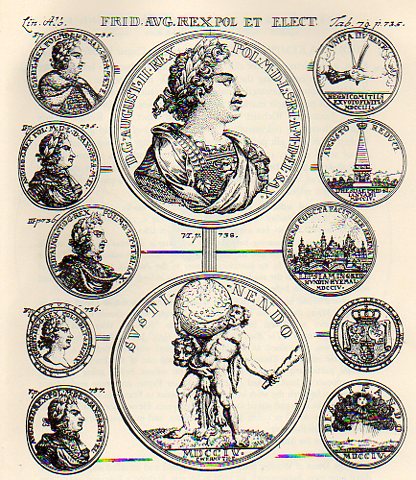
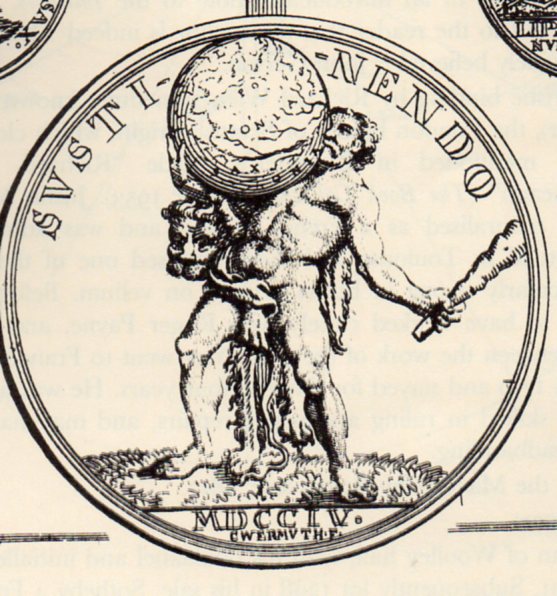
    I found a rather unusual image in this sniffy but no doubt very useful book on heraldry.  On the reverse side of a medal shown below (“Augustus II D.G. Rex Pol M. D Lit. D. Sax. I.C.M.A.”, or declouded it is August II, D.G., King of Poland, Grand Duke of Lithuania, Duke of Saxony, Julich, Cleves, Berg, Angria, and Westphalia) we see a compromised image of Hercules, the only time that I can remember seeing him balancing the sphere on his chest.  It looks very uncomfortable. 

    Atlas469

    Originally Atlas was supporting a sphere representing the sky, a punishment that he stand on the Earth and support the Heavens so that the two did not meet.  Over modern time Atlas has been given a new burden to bear, and generally it is that of the Earth rather than all creation. 

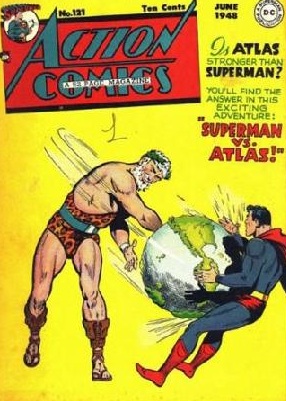
    Of course if we went looking a little further to see what else Atlas might be doing with his burden, there is the following:

    Atlas
    where for ten cents it would have been possible to see the outcome of this epic battle; but since I can’t spend the ten cents here, we’ll never know.  It is interesting to see the representations of the mountains on the globe–given their bumpiness I’d say that their scale would relate to those peaks being 50 miles high.

    And just for the sake of it “Atlas” became associated with a colletion of maps bound in a volume in  Antonio Lafreri’s  Tavole Moderne Di Geografia De La Maggior Parte Del Mondo Di Diversi Autori (1572) not because he employed the word first, but rather because he used an image of Atlas on the book’s title page–the first use of he word comes a little later in the work of Gerald Mercator. 


  • Fantastic Composition & Design: Frozen Anatomy of a Hanged Man

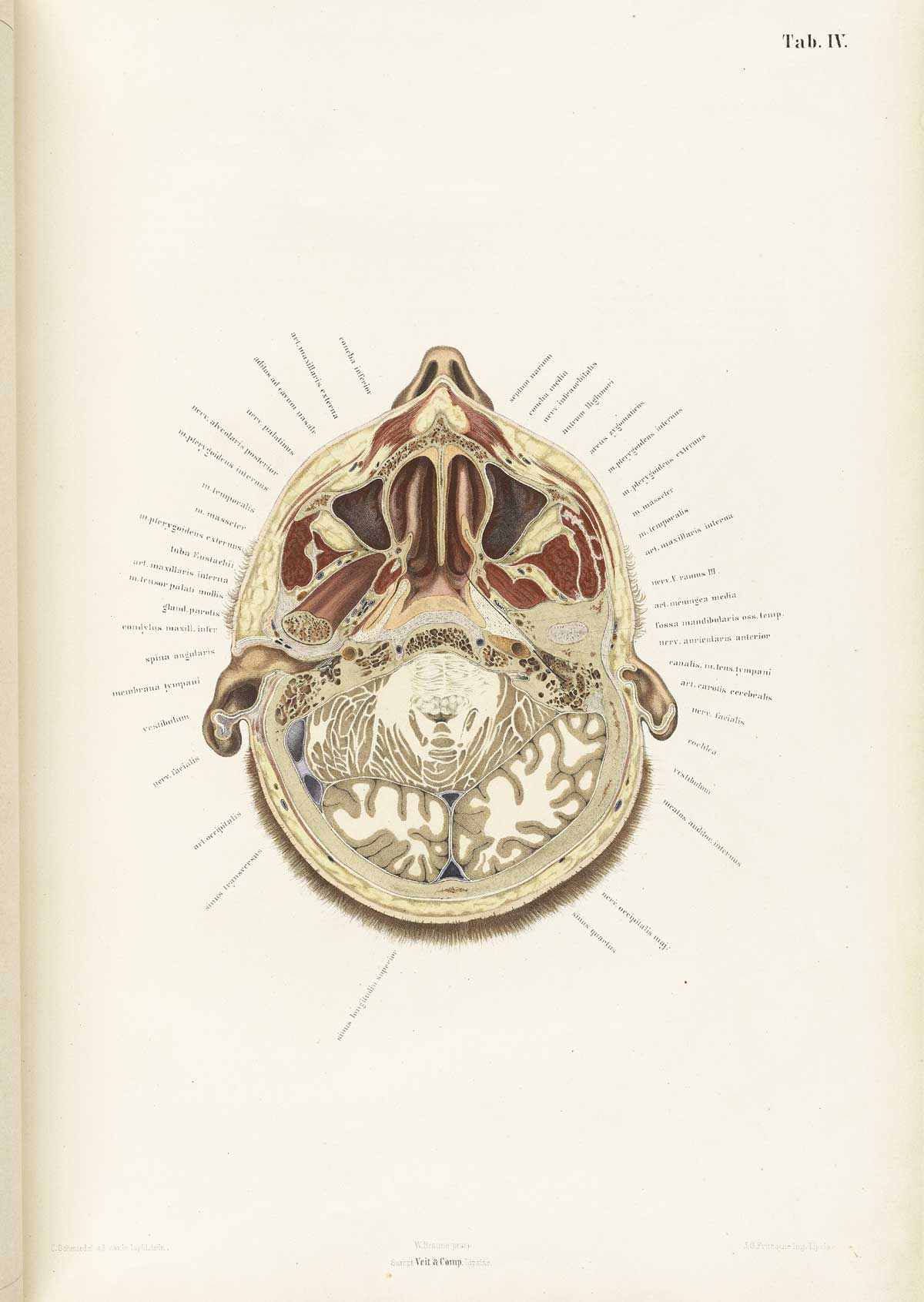
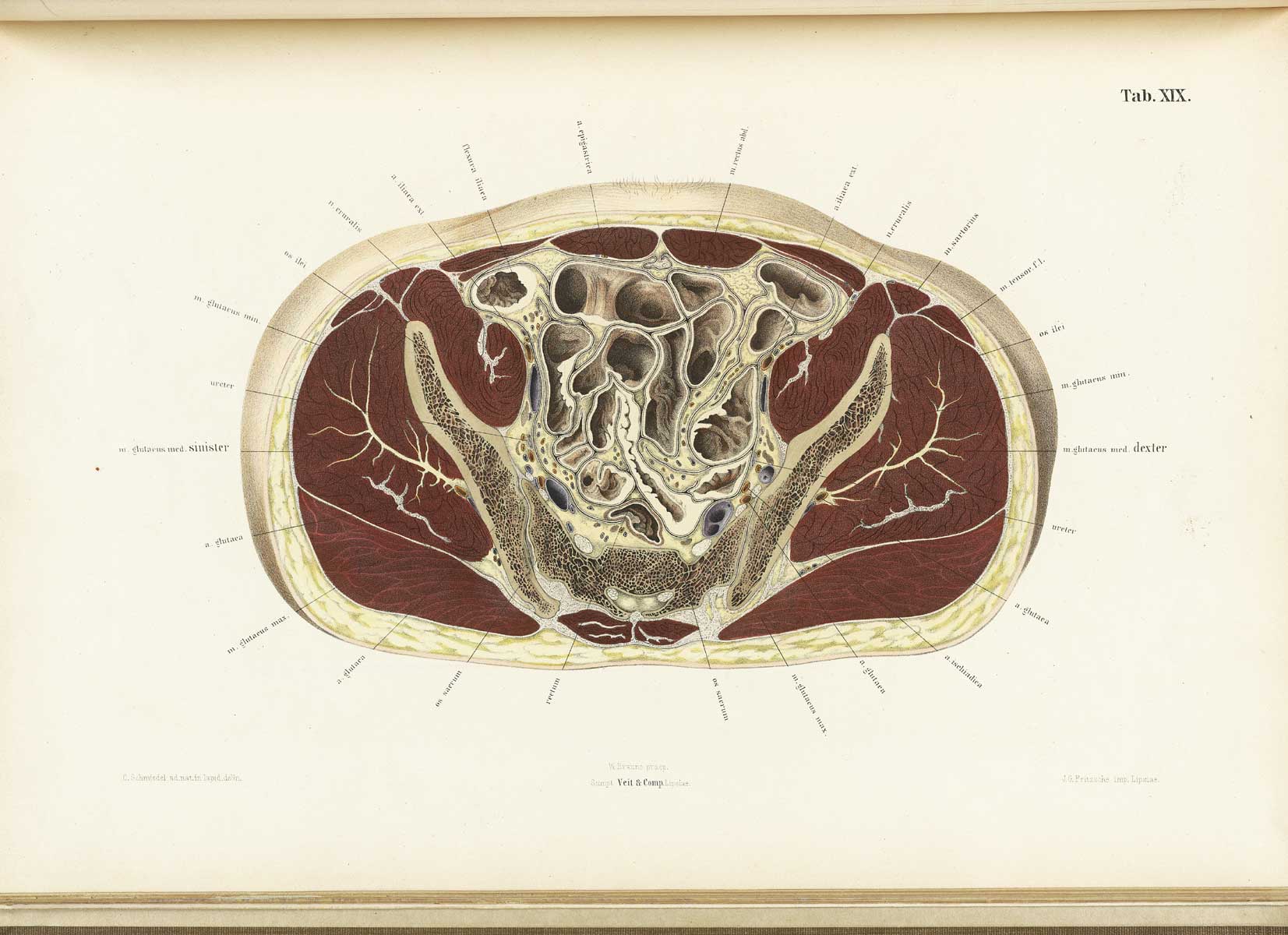
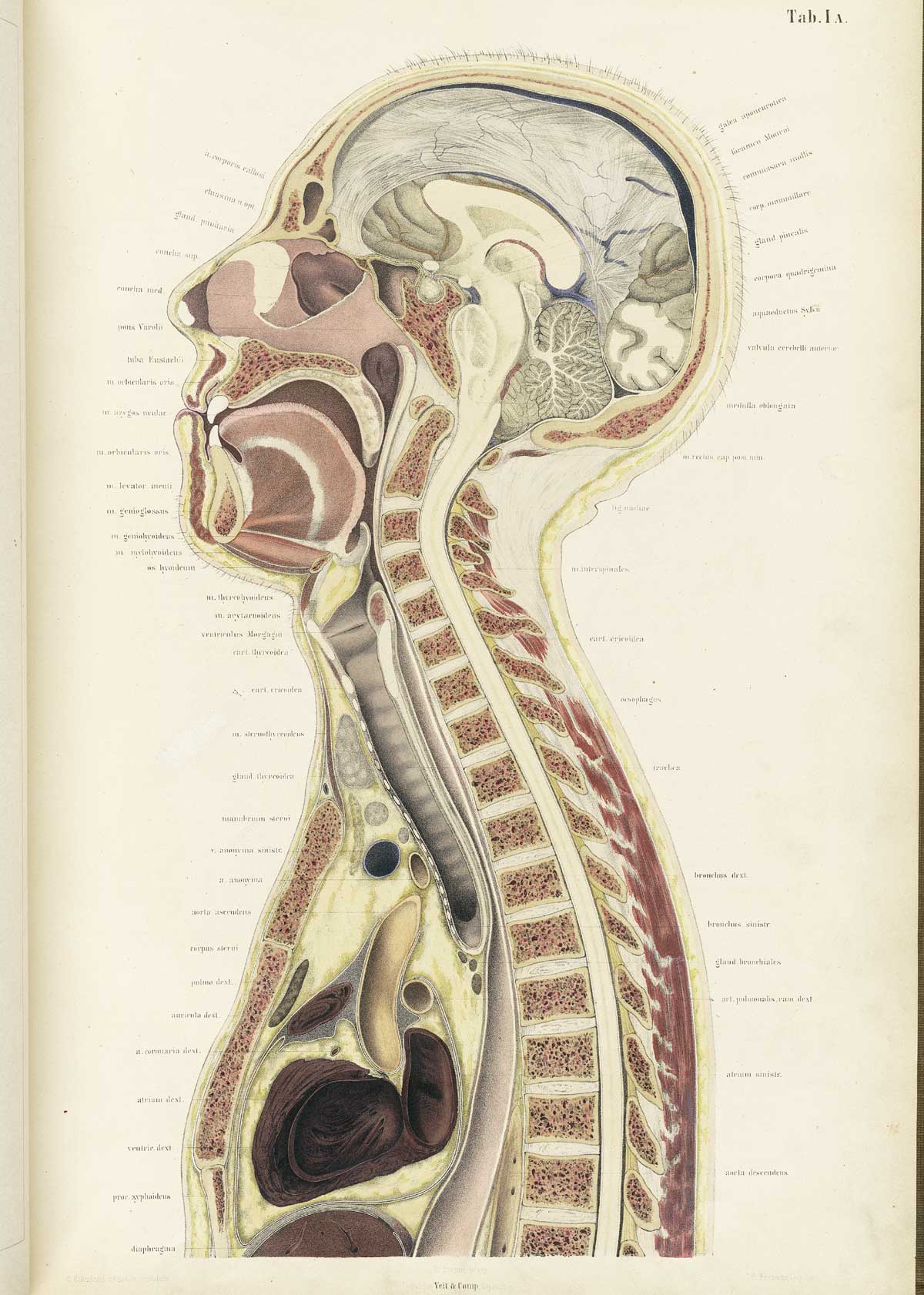
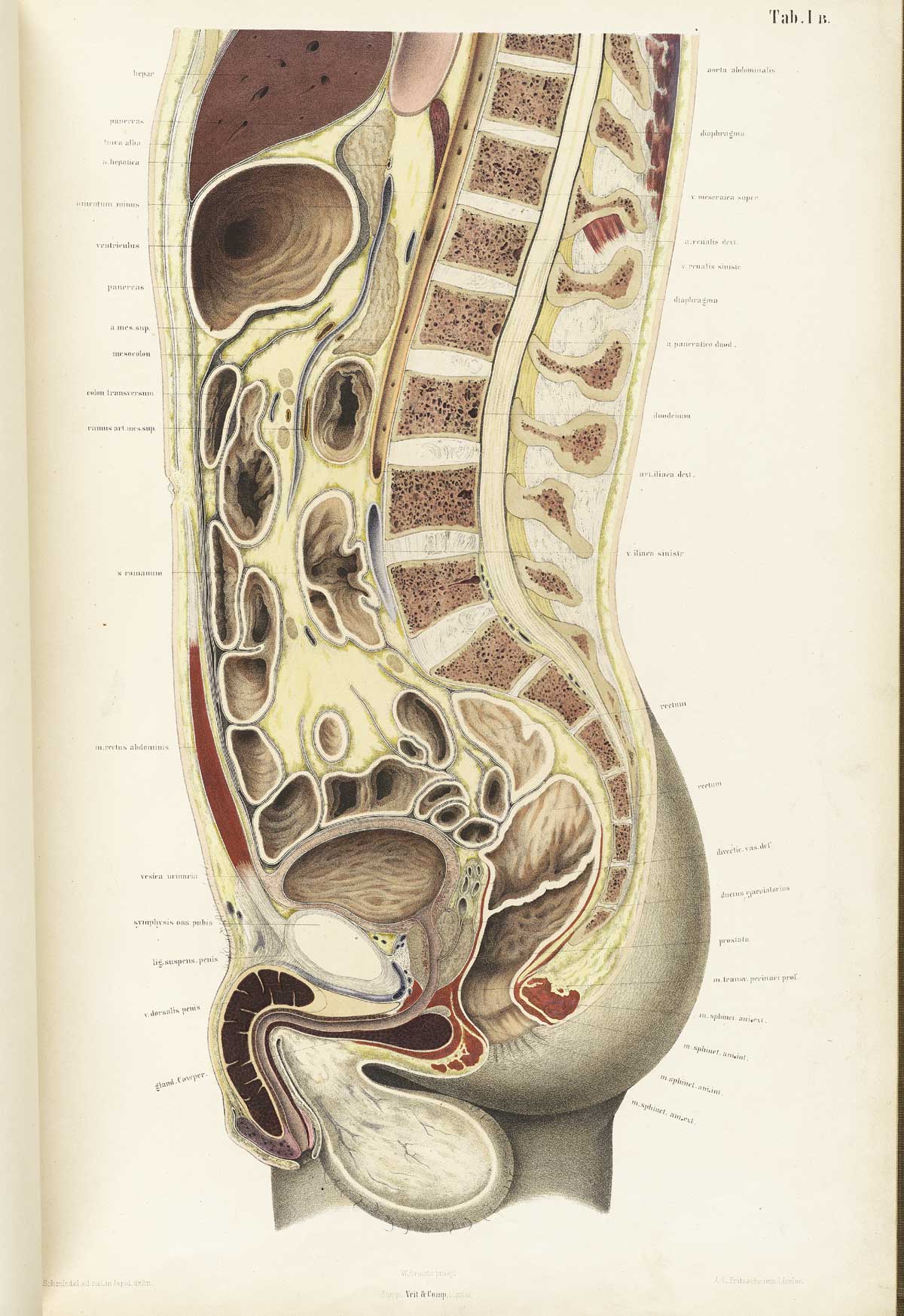
     JF Ptak Science Books   Post 1494

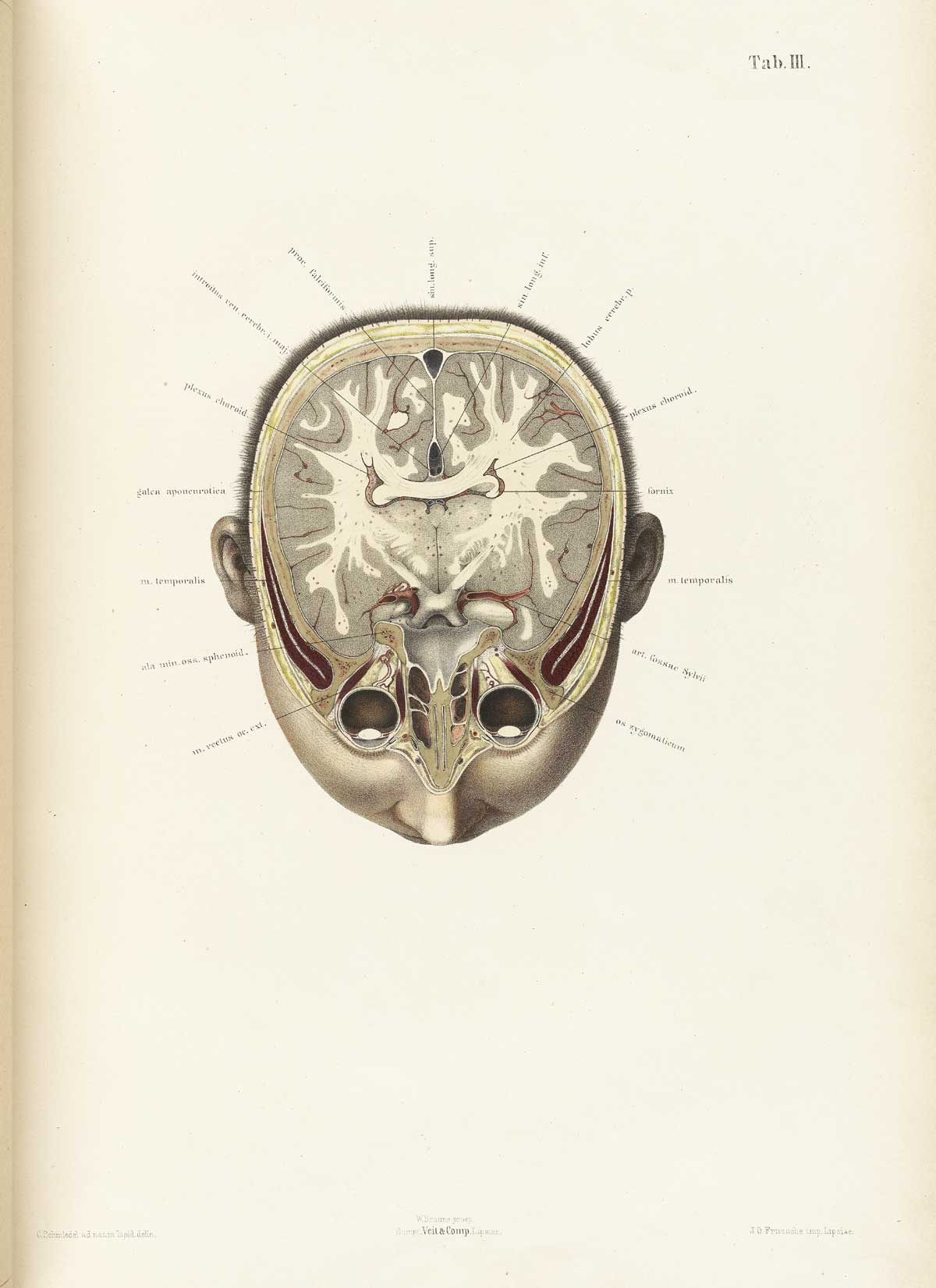
    http://www.nlm.nih.gov/exhibition/historicalanatomies/Images/1200_pixels/braune03.jpg

    Source [National Library of Medicine]:  Braune, Wilhelm. Topographisch-anatomischer Atlas : nach Durchschnitten an gefrornen Cadavern. (Leipzig: Verlag von Veit & Comp., 1867-1872).  And Supplement: Braune, Wilhelm. Die Lage des Uterus und Foetus am Ende der Schwangerschaft. (Leipzig: Verlag von Viet & Comp. , 1872).

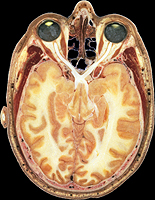
    This extraordinary work is part of an anatomical flap book by Wilhelm Braune (1831-1892), a professor of anatomy at the University of Leipzig.  The image above is a cross-section of the cadaver that was frozen and thinly cut in the similar vein (sorry!) as the more modern Adam & Eve of the Visible Human Project

    Visible human and which  consists of over 30 color lithographs of frozen cross sections of human anatomy.  The male images from the series are described by Braune:

    “[they are] taken from the body of a powerful, well-built, perfectly normal man, aged 21, who had hanged himself. The organs exhibited no pathological abnormalities. The body, which was brought unfrozen, was placed on a horizontal board … In this position, the subject lay untouched in the open air, and at the temperature of about 50 degrees F., for fourteen days. At the end of this time the process of freezing was commenced and completed …”

    http://www.nlm.nih.gov/exhibition/historicalanatomies/Images/1200_pixels/braune04.jpg

    The National Library of Medicine then continues with the description for preparation of the specimens:

    “After sections were cut, thin paper was placed over them and tracings were made of the anatomical features. Similar techniques were used to create the supplement, Die Lage des Uterus und Foetus am Ende der Schwangerschaft, which features large folded plates.  Tables B and C of the Supplement include large flaps showing different views of the lower half of the body, and scans were made of each flap along with the shared upper half (i.e. Table B (view 1), Table B (view 2), etc.).”

    http://www.nlm.nih.gov/exhibition/historicalanatomies/Images/1200_pixels/braune19.jpg

    http://www.nlm.nih.gov/exhibition/historicalanatomies/Images/1200_pixels/braune08.jpg

    Notes:

    Thw work was published in English as: Braune, W. An atlas of topographical anatomy after plane sections of frozen bodies. Trans. by Edward Bellamy. (Philadelphia: Lindsay and Blakiston, 1877)

    http://www.nlm.nih.gov/exhibition/historicalanatomies/Images/1200_pixels/braune01a.jpg

    http://www.nlm.nih.gov/exhibition/historicalanatomies/Images/1200_pixels/braune01b.jpg

    http://www.nlm.nih.gov/exhibition/historicalanatomies/Images/1200_pixels/braune2_B1.jpg


    ·Posted by :

    ·in:

    —

  • An Image Addition to a Series of Posts on the Antiquarian Publication of Artwork by Children

    JF Ptak Science Books   Quick Post

    Part of this blog’s series on The Antiquarian Publication of Children’s Artwork

    Continuing an earlier post on the Great Rarity and Sublimity of Antiquarian Artwork by Children

    I have found another small bit to add to the few posts I’ve made on this blog concerning the wide, vacant spaces of antiquarian publications of children’s artwork.  Its a small bit, but every bit is very difficult to come by:

    Childrens art507   Childrens art508


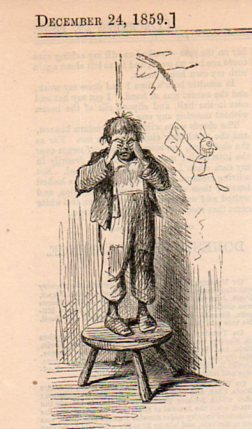
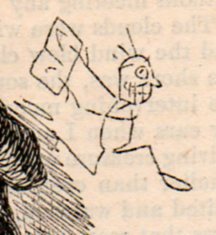
    I think that I can safely say that artwork by children does not make very many appearances in Western art prior to the 20th century–published images just don’t appear.  Nor do the originals–considering the ephemeral nature of the effort at art by children, their work just don’t seem to survive.  Some of that reason–particularly in America–was the scarcity of materials for kids to produce art with: paper was not inexpensive, and neither brushes and paints.  Crayons, invented for chubby and reachy fingers, were not invented for the mass market until 1903.  (Crayola sold eight crayons in a box for a nickel.  The colors?  Black, brown, blue, red, purple, orange, yellow, and green.)   Then of course the artwork would have to be saved, somehow, for generations.  As much as it would be fascinating to find artwork done at age four by your great-great grandparents, it would have to survive the cleansing tendencies of four generations of clean-up.  End result:  there’s just not that much antiquarian chldrens’ art floating around…

    (Continue reading here.)

    ·Posted by :

    ·in:

    — — —

  • The Earliest Art Inspired by the Epochal Discovery of the X-Ray?

    JF Ptak Science Books  Post 1493  [Thanks to Morbid Anatomy for surfacing this fantastic image!]

    Part of this blog’s series on  Blank, Empty and Missing Things:  the Skin.

    The impact of the sciences in (on?) art has been a frequent visitor to this blog–the photographic work of Etienne Marey and the coming of the futurists, the structuring of the fourth dimension, the discovery of the microscopic world, and so on., are fantastically interesting events which at some time bear some responsibility in the history of art.

    The artwork in question appeared in Jugend, Band 1, (February) 1896, and is called “Das Neue Strahlen”, calling directly on the announcement just a few months earlier in 1895 of Roentgen’s “Ueber eine neue Art von Strahlen”. The image depicts a young woman wearing a mask and clearly subjected to x-ray, as we see some parts of her clothing and beneath that the skeleton of her hips and legs, and within her rib cage we see a delicately drawn St. Valentine’s Day-like heart. 

    It seems to me–and this is just working on long memory–that this is an extremely early application of the X-Ray in the art world.  And while the anatomy is nothing new, the getting-to-the-anatomy is:   for the first time in human history, it was possible to see the structure of a body without performing a dissection, and it is this advance that the artist is exhibiting.  It is difficult to appreciate the impact of this advancement now–perhaps it would seem to people in 1895 something like a sudden announcement today that almost all surgery from this point forward is now accomplished with nanobots or a biological robotic element or whatever and which would eliminate virtually all previous complications of cut-and-stitch operations.  Monumental.  It was something like that for Roentgen’s discovery in 1895. 

    In 1895 50-year-old Wilhelm Conrad Röntgen’s ephochal discovery was announced (“Ueber eine neue Art von Strahlen”, “On a New Type of Ray”), which built upon the work of J. Plucker (1801-1868), J. W. Hittorf (1824-1914), C. F. Varley (1828-1883), E. Goldstein (1850-1931), Sir William Crookes (1832-1919), H. Hertz (1857-1894) and the horribly odious Phil Lenard (1862-1947 and who didn’t die soon enough). The experiment revealed as much to humans as did the experiments and inventions of Hooke and Leeuwenhoek on the invisible worlds revealed by their microscopes. Bertha, Roentgen’s wife, sat for 15 minutes while her husband passed his rays through her hand; she ran from the room once she saw the results, revealing her very bones and no doubt a strong sense of the fragility of life, and the strong presence of death.  Many had the a similar reaction to the Kandinsky’s shapes and Malevich’s white circles and red rectangles and Ibsen’s drama and Einstein’s dancing dust and the rogue syncopation of jazz—these newnesses were threatening to all of the established ways of looking at physics, and art, and theatre, and listening to jazz.  It was a new perspective which challenged the firmly established vision of these things, upsetting the nature of comfort and acceptance.    It is probably a very natural reaction to try and protect established memory—but memory is made all of the time, and so should be relatively flexible…at least it is mechanically healthier to allow a little bending than to be rigid and brittle. 

     Notes

    For example, one of Marey’s sequenced photographs from the 1870’s and which reminds me of  Duchamp’s revolutionary Nude Descending:

    Marey 


  • An Uncommon Sentence on Witch Liniment

    JF Ptak Science Books  Quick Post

    I’m not sure where to go with this post, exactly–I certainly wanted to capture this incredible sentence,  though, which is one of the most bizarre-sounding creatures I’ve encountered in quite some time.

    “The first liniment then is composed of the fat of young children seethed in a brazen vessel until it becomes thick as slab, and then scummed.”–Montague Summers, The Werewolf, 1933.

    Seethed/slab/scummed. 

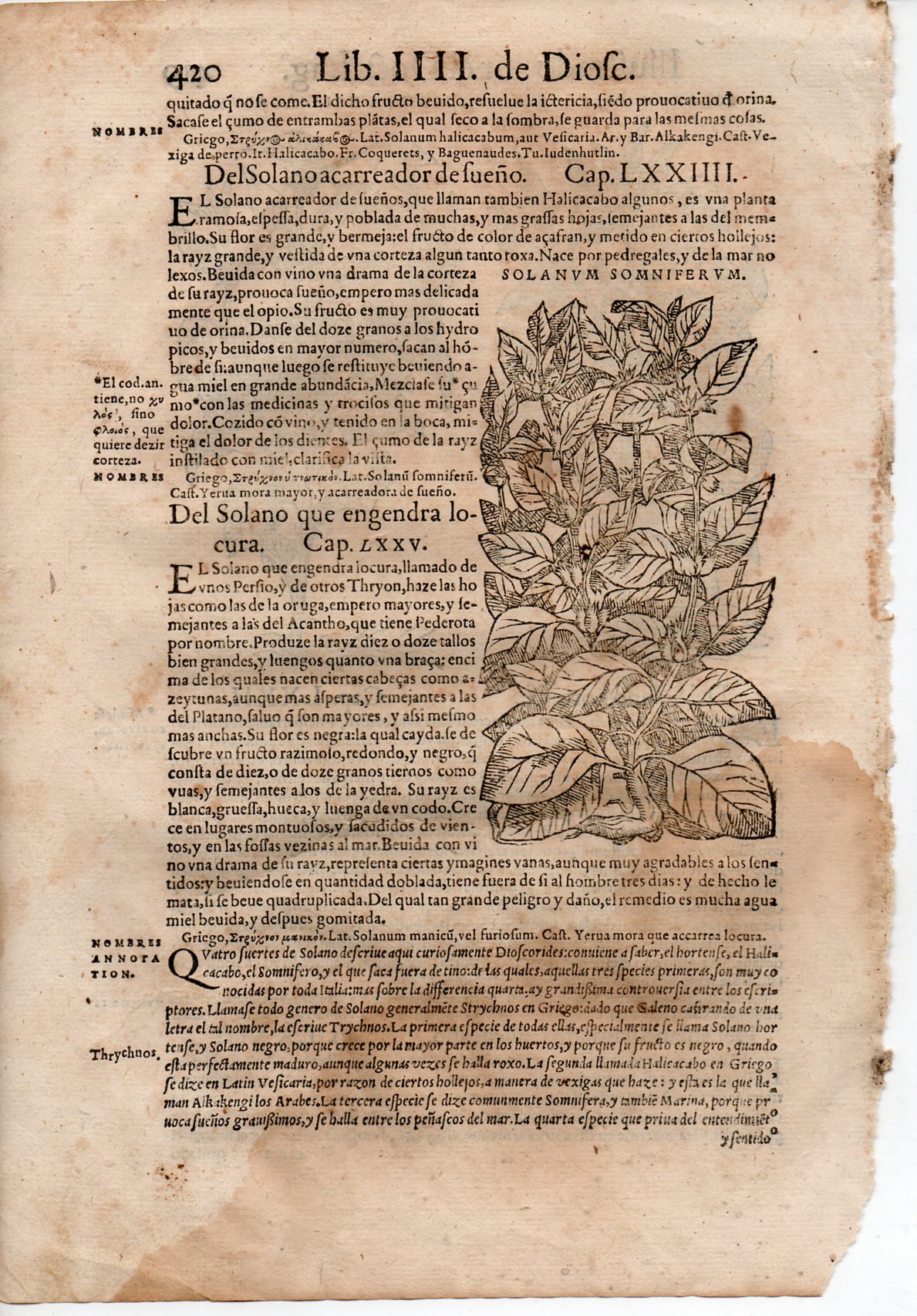
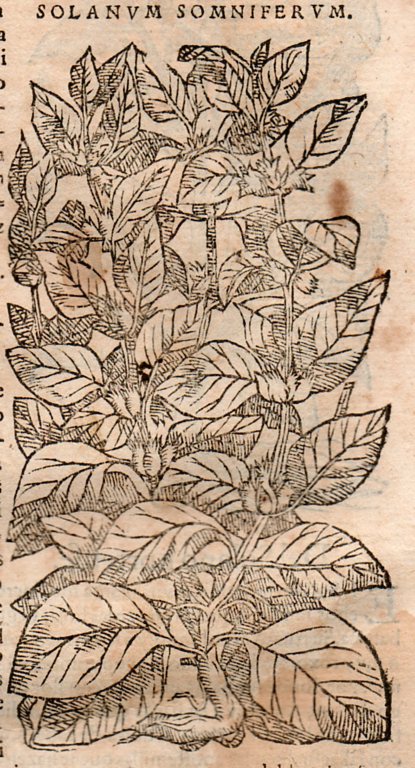
    Witches505 All’s fair in love and shape-shifting, which is what this is referenced, part of a Witch’s salve/potion for werewolf-y preparations.  It came about while looking around for some information on an image here for the plant Solanum Somniferum, a woodcut engraving from Pier Andrea Mattioli’s (1500 to 1577) translation of Panadius Dioscorides’ (40-90 a.c.e.) De Materia Medica.  This ancient botanical received treatment over the centuries by many writers (including  Fuchs, Anguillara, Mattioli, Maranta, Cesalpino, Dodoens, Fabio Colonna, and the Bauhins), though Mattioli’s (ca.) 1560 treatment included more than 150 text illustrations, one of which is this layered and flowing image of Solanum, which I believe is Shakespeare’s “insane root”, a basis for ointments and ungents of considerable diversity, finding use in undercoating for women’s makeup, and as a purgative, and aphrodisiac. And of course as an ingredient for a witch’s body lotion when dealing with such things as shape-shifters and werewolves, and also for hallucinogenic experiences, and (if enough is consumed) death.  It seems an all-purpose plant, seemingly not far-removed (to my non-botanical anti-gardening mind, please forgive me) from the equally expansive belladonna, night shade, a wide-ranging plant that even though its name in Italian means something like “beautiful woman” is famous for its lethal qualities.

    Witches506

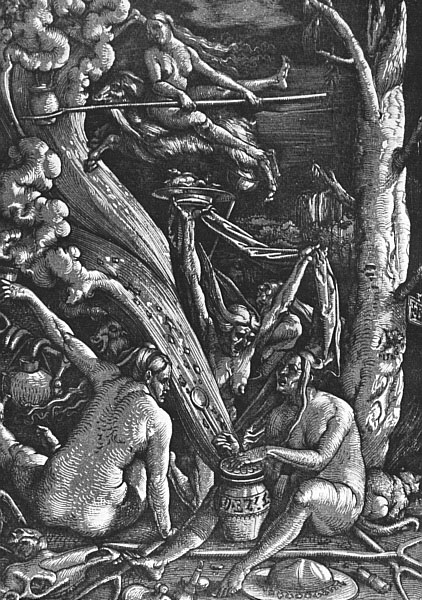
    Perhaps this sort of sentence, the seethed/slab/scummed bit above, is what Hans Baldung had in mind when he depicted his famous witches Sabbath (of 1510):

    Baldung_Witches_Sabbath_1510


    ·Posted by :

    ·in:


  • Strange Things in the Sky Department: the Sky-borne Seat of All Wisdom in the 12th century

    JF Ptak Science Books   Post 1486

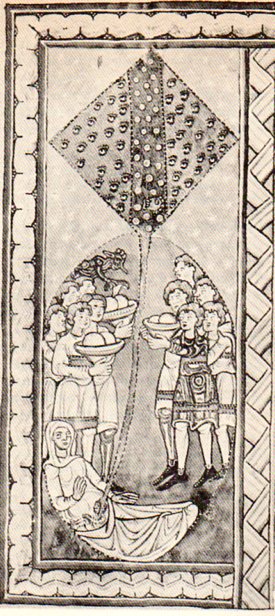
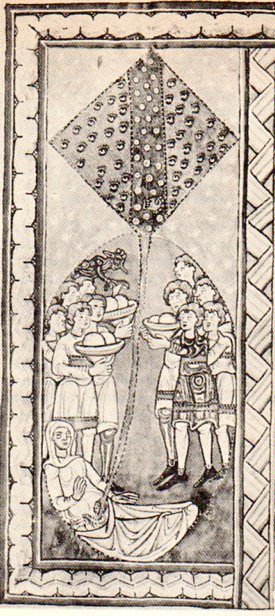
    Hildegard of Bingen (ca. 1098-1179) was a polymathic religious visionary1, composer and writer who was a well-know intellectual whose work attracted the attention of people at all levels, not the least of which were several popes  In one version of the manuscript of her 150,000-word work, Scivias (Scito vias Domini, or “Know the Ways of the Lord” ) we find the following illumination, which is basically an image of the object that contains the nameless stuff of the human soul:
    Sky strange hildegard492
    The image above—from the Wiesbaden manuscript and unfortunately only in a black-and-white, and found in Charles Singer’s From Magic to Science (1928)2–shows Hildegard’s vision of the soul entering the body. (There’s a wide range of opinion concerning how much influence Hildegard had on these images—some say that she sketched out the outlines, or directed the illuminator, or had some sort of hand in the construction of the image, all with varying levels of involvement.3)
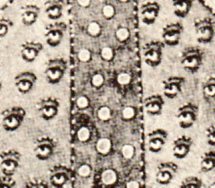
    Sky strange hildegard493

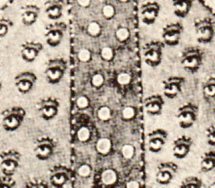
    It is an extraordinary thing, trying to represent what gives the human-ness to people as seen from a 12th-century perspective, and in Hildegard’s version/vision it is the soul, the very essence of the birth and death cycle of human nature.  It is resident as we see within a special place in the sky, the “the wisdom of god” (Singer page 226), and it passes from the vault of heaven into the fetus while still within the mother’s womb.  It is in this square, evidently, that the essential matter of the creator can be found, and within that structure can be seen the essence of the stuff of human nature that is about to pass into the developing fetus through the tube-like connection. As Singer writes, quoting (loosely?) from the manuscript: “down this [the tube] there passes into the child a bright object, described variously as ‘spherical’ and as ‘shapeless’ which ‘illuminates the whole body’ and becomes or developes into the soul.” (Singer, p. 226).

    In the frontispiece to another ms of Scivias, we see Hildegard herself sitting and making a sketch on a wax tablet (a sort of Medieval chapbook, or hornbook, or slate/charcoal sketchpad that could be reused), showing that the images she created were the product of a higher source, of light from another metaphoric vault:

    Strange sky--hildegard

    Notes

    1. Hildegard said that she had these vision,s from a very early age, beginning at about 3.

    2. This manuscript was removed from Wiesbaden during WWII and “sent to Dresden for safekeeping”, where it subsequently “disappeared”. “Destroyed” is more like it, as Dresden of course was the scene of an enormous firebombing campaign in the last days of the German involvement of WWII. There are still hopes that the ms lives somewhere in someone’s grandfather’s attic, perhaps taken in the third week of February 1945 as war booty, and then forgotten. “You guys burnt the place down, turned it into a single column of flame. More people died there in the firestorm, in that one big flame, than died in Hiroshima and Nagasaki combined.” –Kurt Vonnegut, Jr

    3. Historian of science Charles Singer and medical anomaly writer Oliver Sacks have both made strong cases for Hildegard to have been a migraine sufferer, though they do explicitly state that given that as the case it does not necessarily affect the vision that she had.

    As found in the Wikiu article on Scivias:” Some authors, such as Charles Singer, have suggested that the characteristics of the descriptions of the visions and the illustrations, such as bright lights and auras, imply they may have been caused by scintillating scotoma, a migraine condition.[25] Oliver Sacks, in his book Migraine, called her visions “indisputably migrainous,”[26] but stated that this does not invalidate her visions, because it is what one does with a psychological condition that is important.[27] The resemblance of the illuminations to typical symptoms of migraine attacks, especially in cases where it is not precisely described in the text, is one of the stronger arguments that Hildegard herself was directly involved in their creation.[28]

    It has also been suggested that the visions may have been due to hallucinogenic components present in ergot, common in that area of the Rhineland, at certain times of the year.[29]”

    The contents of Scivitas:


  • Famous Folks Leaning

    JF Ptak Science Books Quick Post

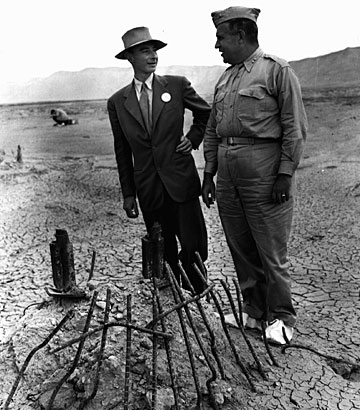
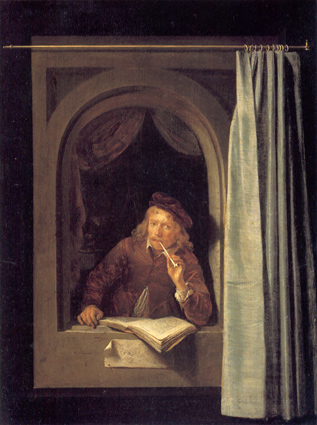
    Leaning, Oppenheimer I’m going to have to keep this category open while other famous leaners pop into my head.  For right now, presently, right at this moment, I’ve only a few,  but I’ve managed to break the leaning category into two segments:   leaning, without aid; leaning, with aid (or leaning against or on something).  Also for completely arbitrary reasons I’m excluding entire genres of people who must necessarily find themselves  leaning for one reason or another: speed skaters, sailboat racers, acrobats, gymnasts, yoga folks, speed bike racers, rollerderbyists, and people leaning away from the dead or some other font of pity, and so on. No Medieval or Renaissance anatomist drones “leaning” into their cadavers with sharp tools (as in Mondino’s directing a dissection from the late 15th century), or the endless peasants leaning into their farm tools as they work or catch a quick nap in the images creLeaner douated by the Breughels, nor any series of Adams and Eves leaning hard into their bleak future after having accepted the bait that doomed humanity, leaning first towards and then away from the Great Fall.   I just want relatively unexplained leaning, or leaning for the fun of it.  And of course no leaning Towers of Pisa–and no lounging, as in the image of Man in the creation of man scene in the Sistene Chapel.  And  no half-body leaning, as with say the images of all of those portraits that were so beautifully done by Gerrit Dou, featuring his subjects playing with trompe l’oeil and perspective, leaning a bit out of windows, outwards towards the viewer, or kids blowing bubbles leaning against open windowsill (as in this from Frans van Mieris)  or Jean-Baptiste-Siméon Chardin, The Soap Bubble (1739).

    I’m just looking for people leaning, for no good reason.  (First up was Robert Oppenheimer leaning away from the not-understood General Leslie Groves.)

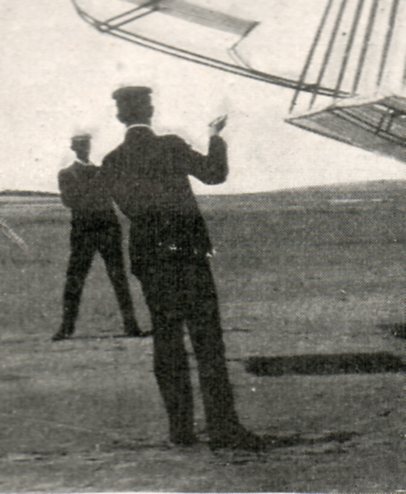
    Wilbur (?) Wright, 1901:

      Wright brother full 1901490
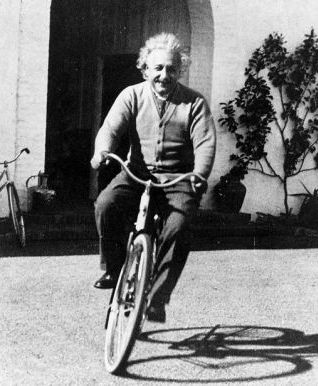
    Albert Einstein, California, 1935:

    Leaning--einstein

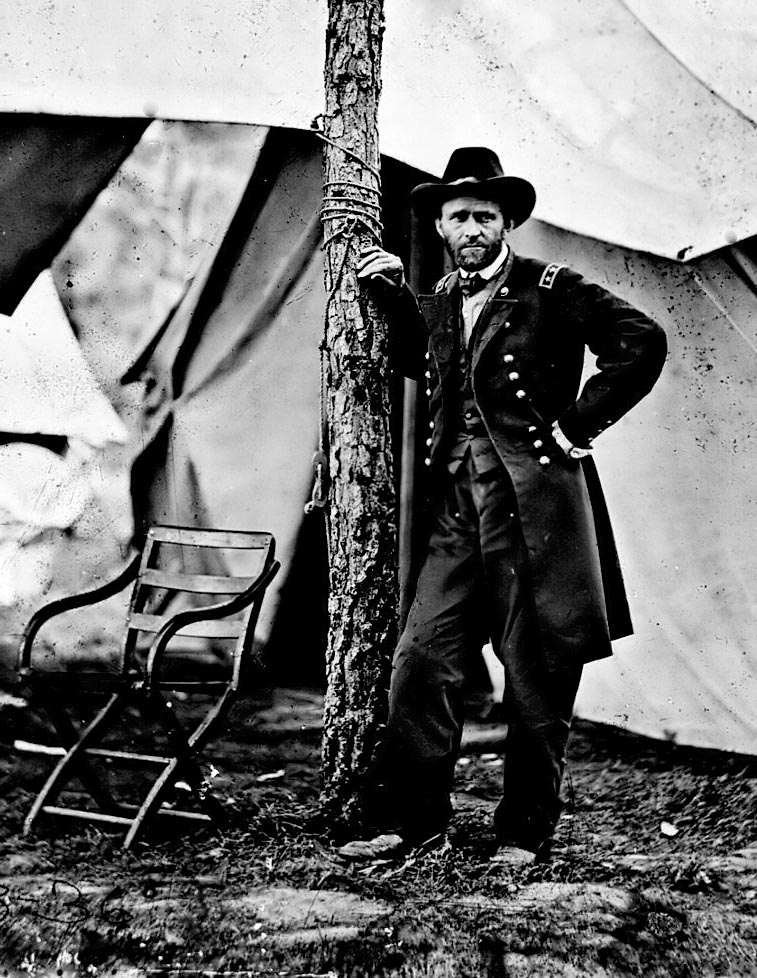
    General Ulysses Grant, 1863:

      Leaning ulysses
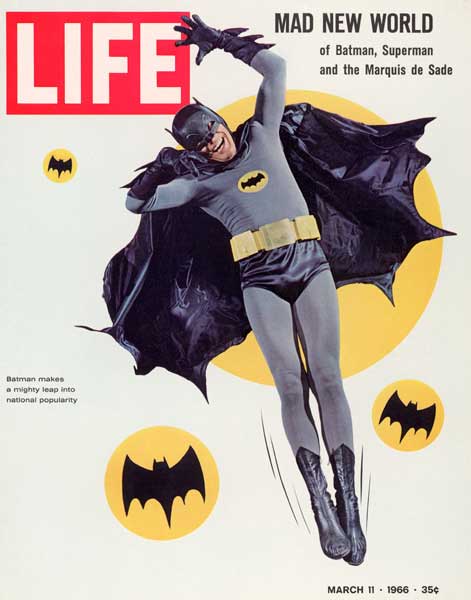
    Batman, 1966 (but seriously, Heath Ledger’s Joker wound up doing a tremendous amount of leading in that movie):

    Leaning batman

    Leaning joker

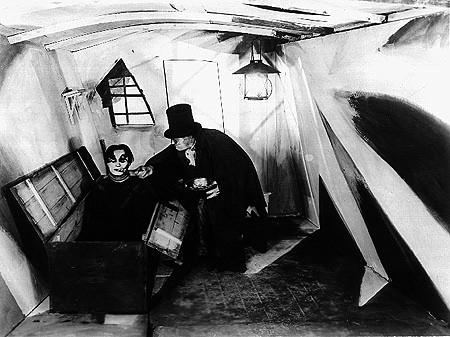
    And speaking of the leaning Joker, there’s always Dr. Caligari, who lives in a leaning world:

    Leaning caligari

    I’d love to hear from others who might have suggestions for other leaning people!


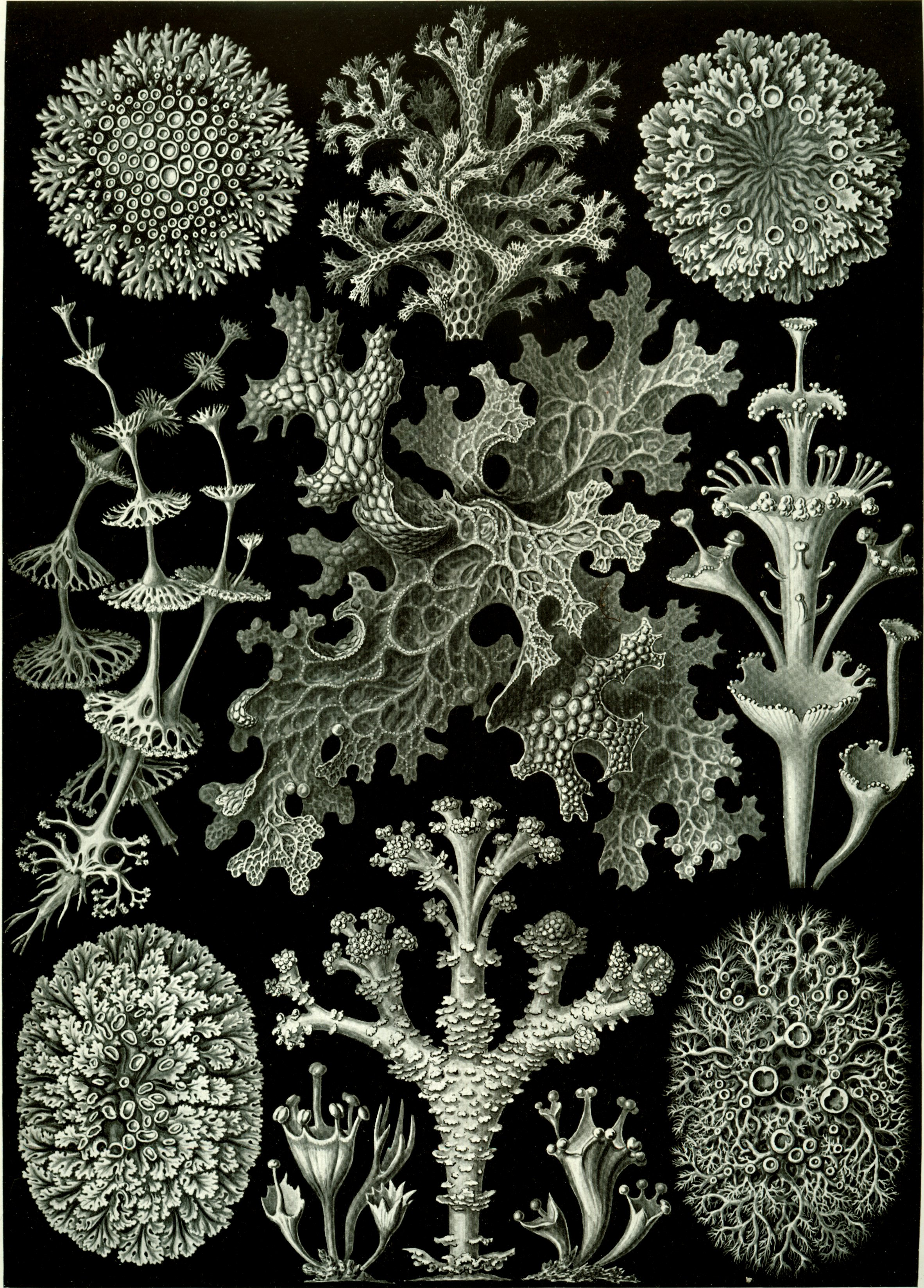
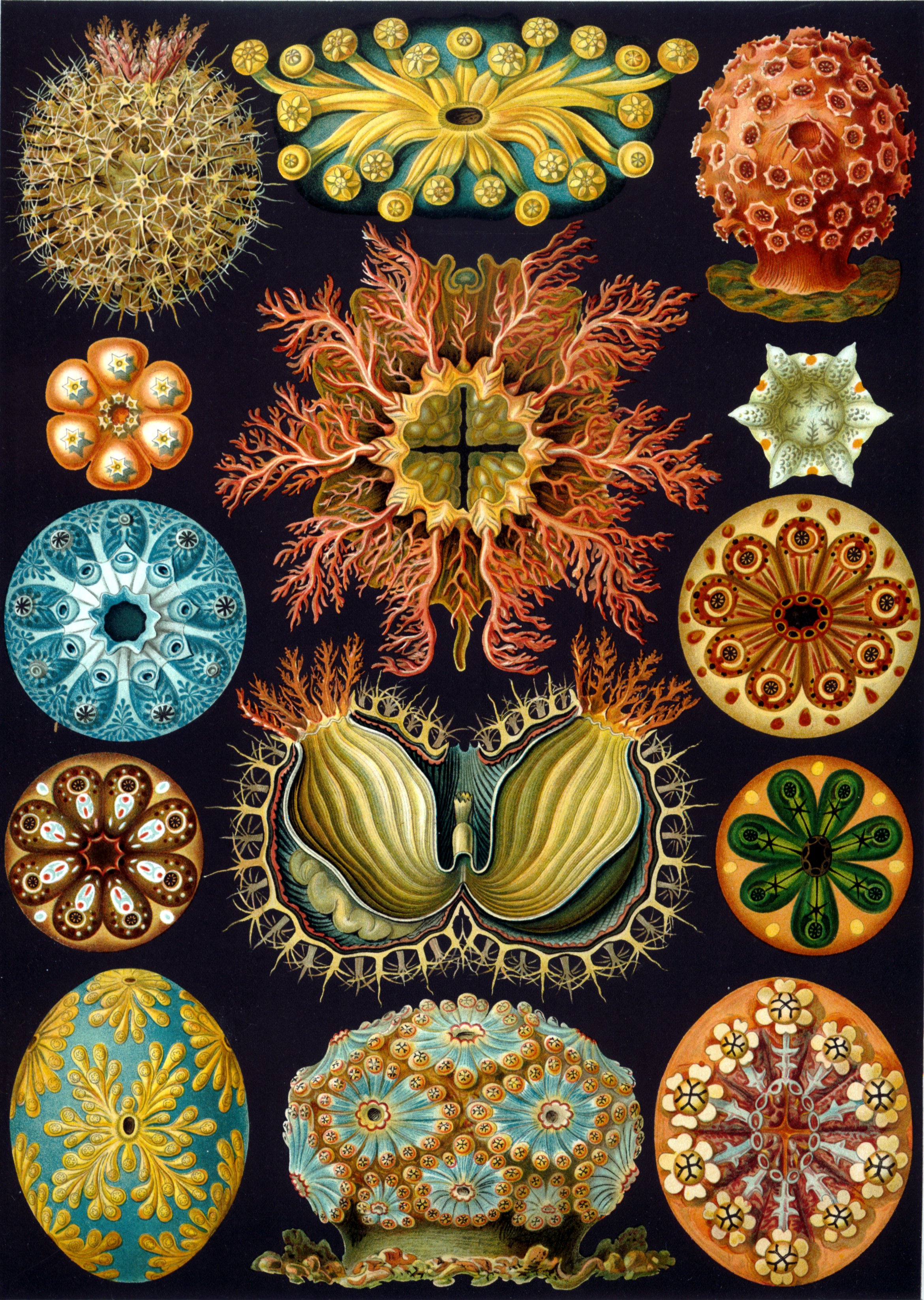
  • Beautiful Books: Haeckel’s Kunstformen der Natur, 1904

    JF Ptak Science Books    Quick Post

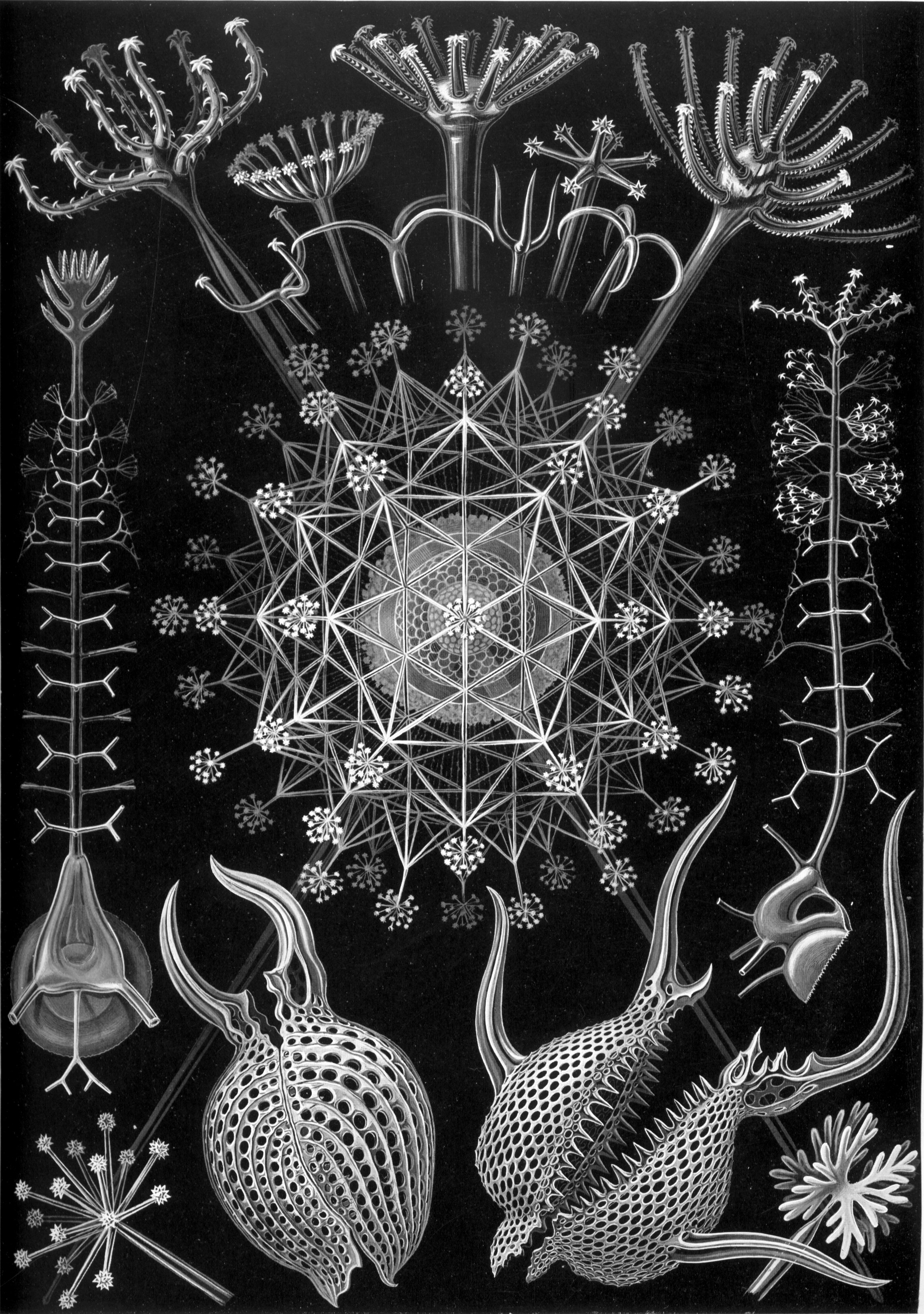
    In his long and vastly productive scientific life, Ernst Haeckel (1834-1919 ) produced this extraordinary work, Kunstformen der Natur, over a five year period from 1899 to 1904, a set of 100 images being  published in 1904 (though a result of a long lifetime of work).  Haeckel was a busy man working over a number of specialties, writing more than 40 books and a large number of  contributions to scientific publication.  He is perhaps best remembered early on in his career for a popular defense of Darwinism, writing Natürliche Schöpfungsgeschichte, (1868, nine years after the publication of the Origin, and translated into English as The History of Creation in 1876) which was a successful attempt to get Darwin’s complex ideas into public discussion.  But all I want to do here is to surface his Kunstformen, which evidently served as a sort of wish-book for the imagination among many modern artists. 

    And so to the examples:

    The phaeodaria:

    File:Haeckel Phaeodaria 1.jpg

    and another example of phaeodaria:

    File:Haeckel Phaeodaria 61.jpg

    The Lichenes:

    File:Haeckel Lichenes.jpg

    And the Stephoidea

    File:Haeckel Stephoidea edit.jpg

    And the ascidiae:

    File:Haeckel Ascidiae.jpg

    And some of the rest, which included all manner of other living things, big and small.  The micrscopic organisms (and black-and-white) to me are the most fantastic, though the renderings of jsut about everyhting in the work are superb, and their placement, the design of each plate, is just magnificent. 

    For a collection of excellent 300 dpi scans see here:  Kurt Stüber’s Biolib.  The following images are located here.

    ·Posted by :

    ·in:

    —

  • The Other Miracles of 1905–Winsor McCay, Little Nemo and Subversive Dreamscapes

    JF Ptak Science Books  Post 1453

    Okay, to be fair no one has ever had a year like Einstein’s annus mirabilis of 19051 perhaps no one has really ever come close–he defines the incomprehensibly high achievement for a single (less than) 365-day time span. There was other stuff going on in 1905–Ernest Starling2 introduced the term “hormone”, Vagn Ekman produced a beautiful paper on the mathematics of ice drift in the Arctic Sea and the ocean’s responses to different sorts of winds, Eduard Zirn performed the first cornea transplant, Ejnar Hertzprung3 published his famous diagrams, Henry Gruppy empirically established the manner of plant dispersal in the Pacific region4, Maurice Frechet’s groundbreaking work in topology, and Henrui Poincare and Howrd Ricketts and Oswald Veblen and so on. And the Wasserman test.  It was a pretty bountiful year–and this was just in the sciences and maths.

    And then there was the Russian Revolution (of 1905).

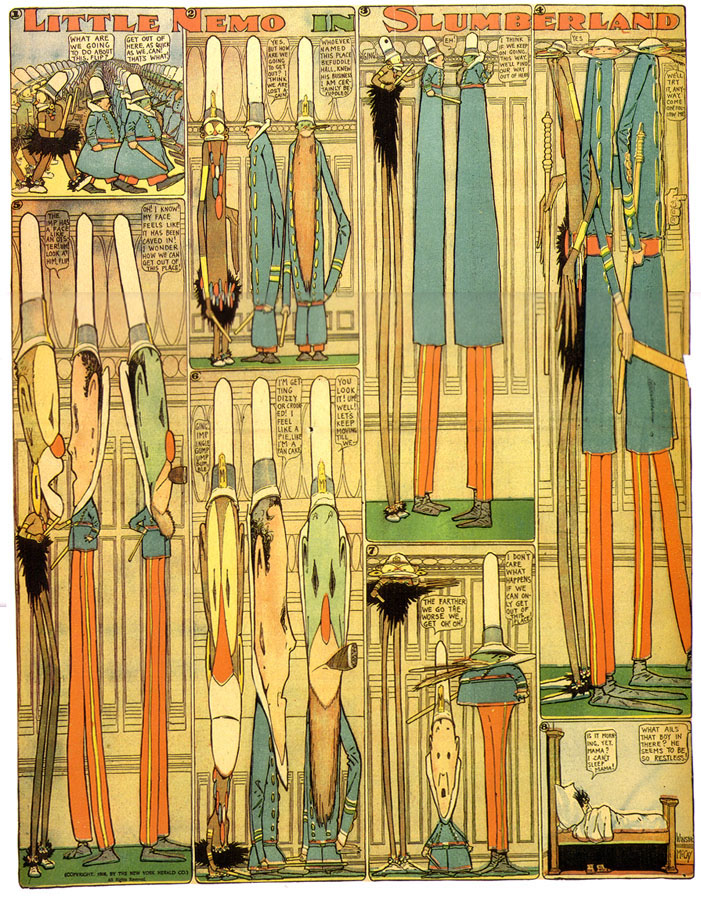
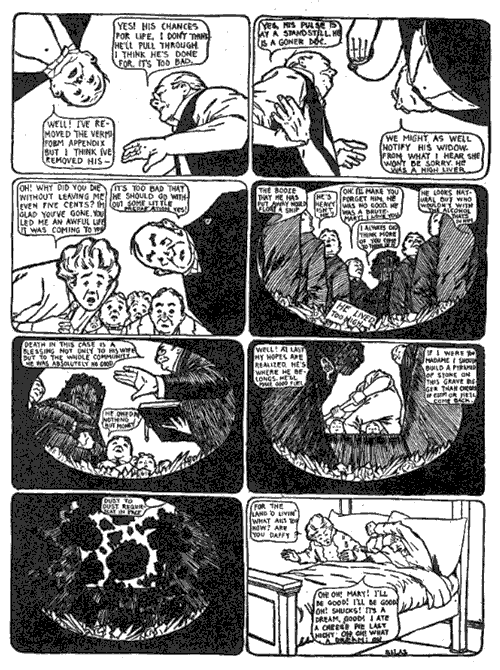
    But also back there in 1905 Winsor McCay was having a terrific year–this was the man who revolutionized the comic strip.  McKay may have been the Einstein of his field, and his work I think may still be the standard bearer for high excellence and creativity.  It was in 1905 that he began his Dreams of a Rarebit Fiend and also the crowning masterpiece of the medium, Little Nemo in Slumberland.  Nothing had really quite been seen like that before, two newspaper strips that were filled with vision and elegance and weirdness and the bizarre, beautiful stories illustrated on one sheet of paper, of great imagination and a wide stretch of subversiveness. They so captivated the readers of the time that McCay went off on illustrative lecture circuits, found movie (in their relative infancy) versions of his work, and performed in vaudeville venues along with Charlie Chaplin and W.C. Fields.

    And then he created the animated cartoon. 

    Here’s a page of Little Nemo:

    Little_nemo_1908
    And another of the Rarebit:

    Rarebit_fiend
    I guess you can get the picture of what McCay brought to the world–examples of his work are all over the web, and have been published in eight (?) volumes of reprints.  This was a particularly sumptuous time for this sort of story telling, but this is not the place to talk about anyone else, not really. (Okay–one very high talent is the seldom heard Rodolphe Topffer, but that’s another story.)

    And a very early Rarebit movie (which takes a little while to get moving):

    And another, this an animated cartoon from 1921–it doesn’t have anything to do with McCay in 1905, I just like its motion, and also because McCay is the father of the animated cartoon:

    Can anyone say “Up”?

    And then of course there’s Gertie, the first animated cartoon:


    Notes:

    1.”Über einen die Erzeugung und Verwandlung des Lichtes betreffenden heuristischen Gesichtspunkt” Annalen der Physik 17: 132–148;  “Über die von der molekularkinetischen Theorie der Wärme geforderte Bewegung von in ruhenden Flüssigkeiten suspendierten Teilchen” Annalen der Physik 17: 549–560; Zur Elektrodynamik bewegter Körper” Annalen der Physik 17: 891–921; “Ist die Trägheit eines Körpers von seinem Energieinhalt abhängig?” Annalen der Physik 18: 639–641.

    2.  “On the Chemical Correlation of the Functins of the Body”, not only defining the term but clarifying the hormone’s function.

    3. Hertzsprung, “Zur Strahlung der Sterne”, with another paper of the same name later in 1907. 

    4.  Observations of a Naturalist in the Pacific Between 1896 and 1899, the second volume, entitled Plant Dispersal, is where (surprise!) he discusses plant dispersal.  But the really cool thing here is that he figured out that there were a lot of seeds that floated here and there in/on the Pacific, going place to place, finding out how long they could stay afloat, and so on.  It was fantastic!


    ·Posted by :

    ·in:

    — — —

  • Unintentional Proto-Impressionist Photography, ca. 1863.

    JF Ptak Science Books   Quick Post

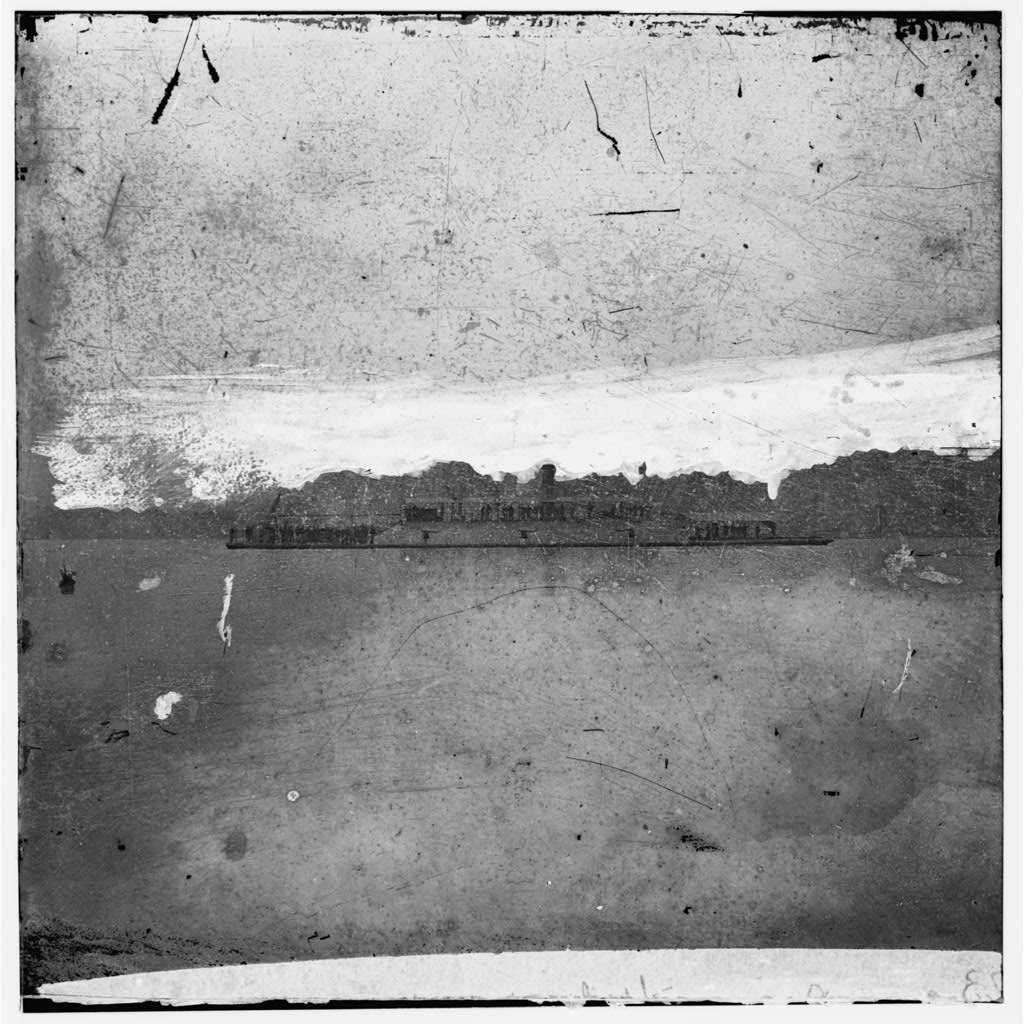
    Civil War Art b

    There is a continuing categorized thread in this blog called “Unintentional Absurdist“; there is another which follows intentional efforts that wind up being unintentional pieces of modern art that have surfaced before their time.  This later category includes the inscrutable color theory pre-Cubist work of Emily Vanderpoel, the spirit drawings of Georgina Houghton, the absolutely impressionist paintings of Victor Hugo (see here for examples of their work)–all of which were decades ahead of movements that would become standards of art, those these people were generally left behind. 

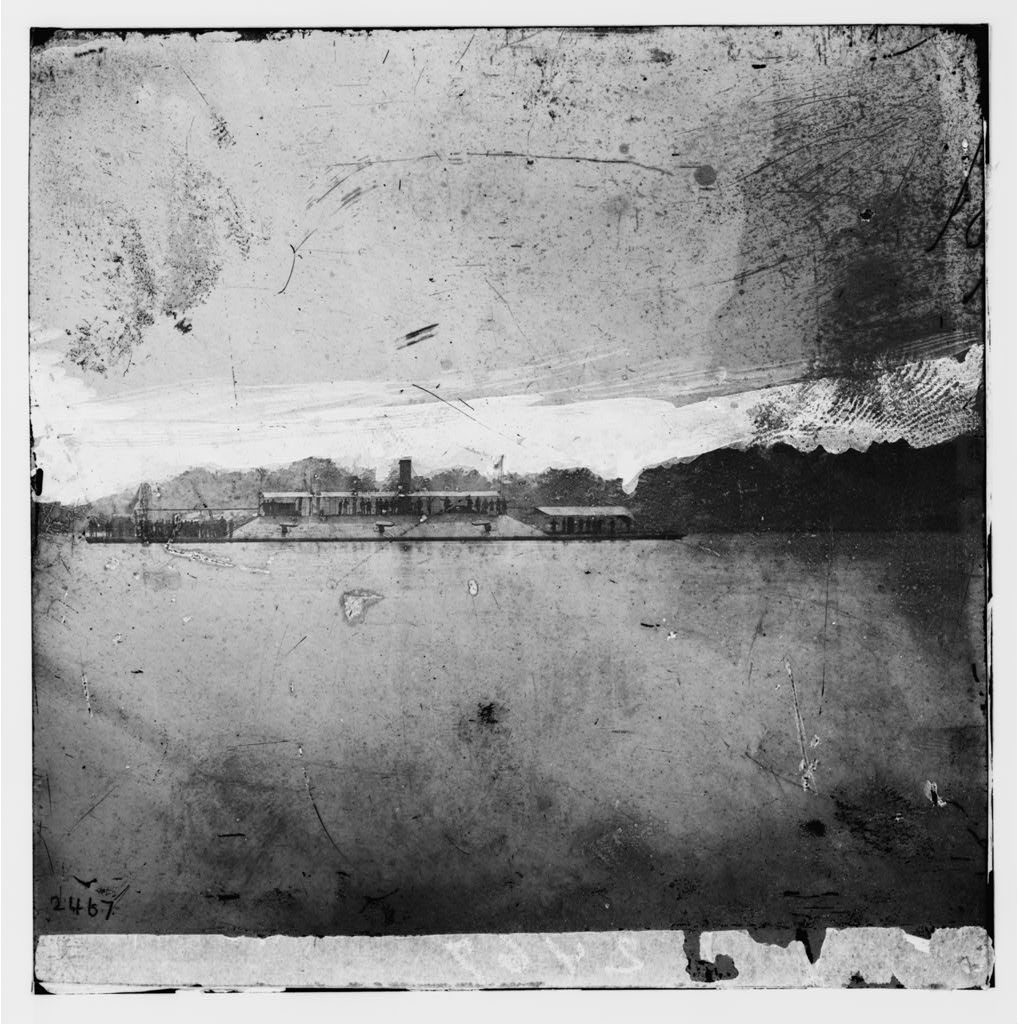
    In yet another flavor of this category is the unintended works which either in their whole or pieces seem to be very modern, like this half of a stereocard of the CSN ram Atlanta.  It was a documentary photograph that has perhaps printed not-so-well and which has suffered changes to it surface over time–the result of which though, in my head, has rendered a terrific pre-Impressionist Impressionist photograph.  I think it is beautiful.

    James River, Virginia. Confederate Ram ATLANTA after her capture.  Source; Prints andf Photographs Division, the Library of Congress.  

     Here’s the other half, complete with fingerprint:

    CIVIL WAR ART C


    ·Posted by :

    ·in: