A Daily History of Holes, Dots, Lines, Science, History, Math, Physics, Art, the Unintentional Absurd, Architecture, Maps, Data Visualization, Blank and Missing Things, and so on. |1.6 million words, 7500 images, 4.9 million hits| Press & appearances in The Times, Le Figaro, Mensa, The Economist, The Guardian, Discovery News, Slate, Le Monde, Sci American Blogs, Le Pont, and many other places… 5000+ total posts since 2008.

Author: JF Ptak

  • The Topography of Emotion, 1654–a Visit to Lake Indifference in the Land of Passion

    JF Ptak Science Books   Post  1459

    (Part of a new series on the mapping of imaginary places.) My thanks to Natalie Bouchard (Montreal, PQ, Canada) for suggesting this map.

    Tendre_gr
    [A massively expandable version of this map is available from here.]

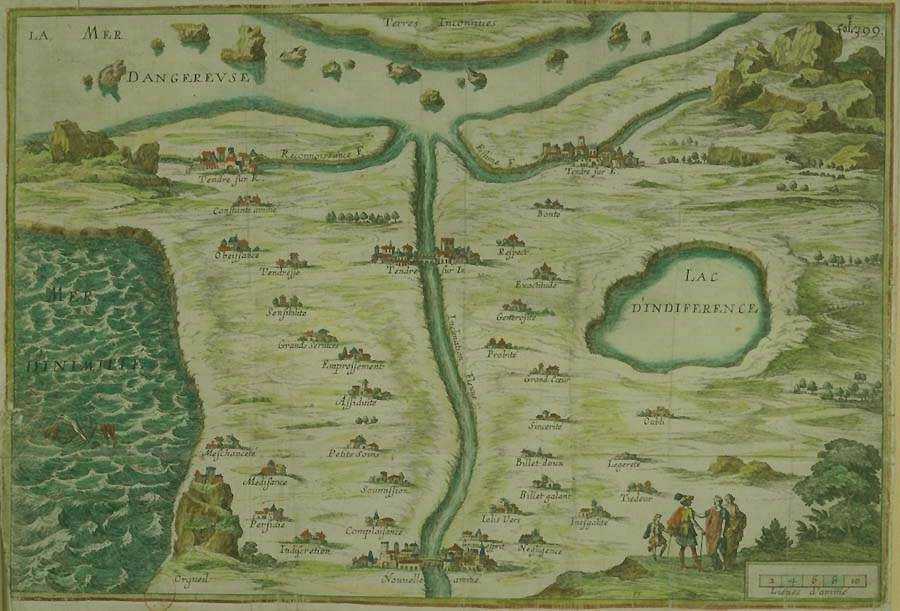
    This is an old , seemingly simple but somewhat deceptive map, drawn for the work of Madeleine de Scudery’s (1607-1701)  novel Clelie, and published in 1654.   It is for all intents and purposes a little more than its stated name (Tenderness, Carte de Tendre), diving deeper in the psycho/sexual area than anything else.  On the other hand it may be exactly what you want it to be–evidently many people did, as this map turned out to be used as  a very popular proto-game board in polite Salons.

    As a map of friendship and caring and love and sexual adventure, it is interesting that what seems (to me) to be the stand-alone focal point battling for our initial attention is the The Lake of Indifference–it just seems to me to be the first thing that the eye sees, the map’s most dominant geographical fixture.  It is not the largest feature, nor the most spectacular, but it does seem to capture the essence of what may be  one of the most ordinal of sins:  indifference is a suffocating malaise, a semi-disease, that covers an extraordinary amount of ground without even trying, a force invisible and while so immutable, a host to all manner of impending failures.  Indifference may be the worst thing going for humanity in general, as it allows oxygen for so much of the nastiness to burn.  Solidified hate is a much easier thing to deal with and potentially manage than a hate distilled and vaporous and filtered to a greater number of uncaring/discaring people. 

    And speaking of impending doom, one of the other main features of the map is the long, semi-straight river that feeds into the body of water at the top,  the Sea of Danger.  Now the Sea of Danger doesn’t appear so dangerous, except for the jagged island bits exploding from its calm, flat and not-detailed surface, though perhaps that is the very point.  The large river is called the Inclination–translated to a natural disposition, a “normal” way of doing things, a common bent, which means that the mapmaker says that our standard approach to life is to head towards the deceptive sea of danger. 

    Even though we are headed that way it doesn’t mean that we can get off the river and visit, or stay, in any of the many towns that we see along the way.  There are a number of alluring towns with charming names:  alacrity/cheery readiness (Empressement); assiduity (Assiduite); eagreness (Empressement); favors (of perhaps a sexual kind, Grands Services); (lasting) friendship (Constante Amitie); kindness (Complaisance); obedience (obaissance); pampering (Petits Soins); sensibility (Sensibilite); submission (Soumission);  and tenderness (Tendresse) are all places calling out for attention.  The other town names are further indications of the personal stabilities that are the goals of most people:  wit, sincerity, generosity, punctuality, respectfulness and goodness.
    There’s also those other places, towns of a more sinister and betrayed nature that form a north-south line east and west of the river:  Negligence, Inegalite, Tiedeur (tepidity), Legerete (lightness, not being there), Complaisance, Perfide, Meschancete (wickedness), and so on.  And don’t forget the town of Oubli (oblivion). 

    At the last moment, before entering the Sea of Danger (which is fed in the east by the much more volatile waters of the Mer de Inimittie (Sea of Enmite) , the River Inclination  is joined by the smaller rivers of Estime (Respect) and Reconnaissance (Gratitude), a mixing of waters all coming together at the same point, a combination that I do not understand. I have no doubt that there are abundant clues to all of this throughout the ten volumes of her novel, but I can’t give Mme. de Scudery that much time. 

    Maybe none of the placements and proximities in this map matter–maybe the rivers are flowing backwards or something, being filled by the waters from the Sea of Danger.  Maybe this isn’t a map at all, but just a suggestion of what stuff might look like, a spatial suggestion of the concept of emotion.  Or maybe it is just a board for a polite game. 


  • On Missing Antique Atlases of Imaginary Places and the Sameness of Alien Math and Music: Huygens’ 1698 ETs

    JF Ptak Science Books    Post 1458  [With thanks to Rich Lewis, Dickinson College, who found and suggested some remarkable cartographical curiosities!

    I was thinking about the history of atlases of imaginary places [in Western culture] composed before, say, 1900, and I had a hard time coming away with any.  Lowering the sites to a series of maps relating to the same idea didn’t help–its only when you get down to the single-map level that I found some results.  But even there, at the basic representational level of an imaginary place, there aren’t really that many examples, at least compared to the rich narrative life of created space.

    I wonder why that is? 

    If you widened the scope a bit you might look at the night sky as being a sort-of map locating ancient deities, but the sky is really just a picture book with dislocated images without very much to do with one another. 

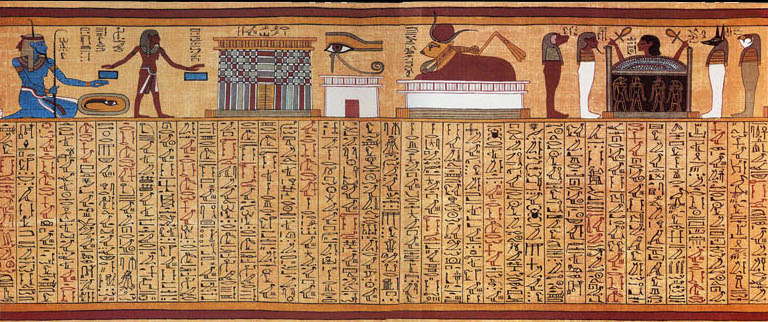
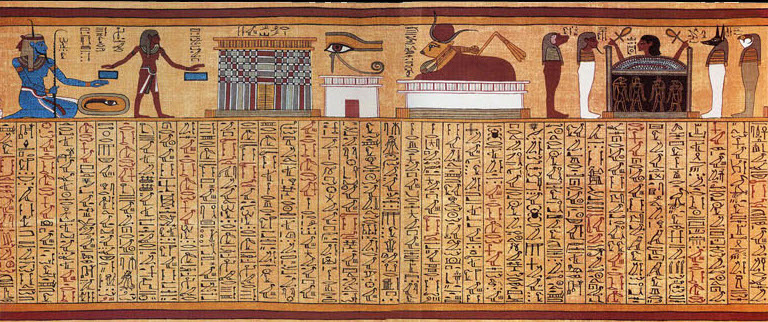
    Books of the Dead1 kind of fit the bill, but how come there aren’t any surviving ancient maps of Olympus, or
    Bookofthedeadspell17
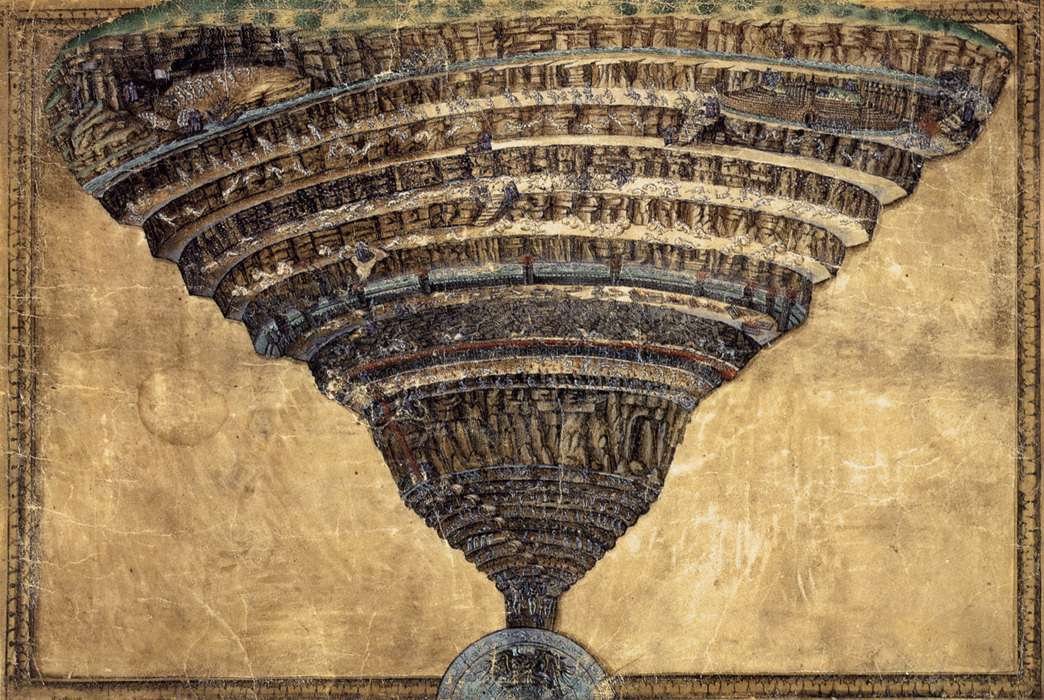
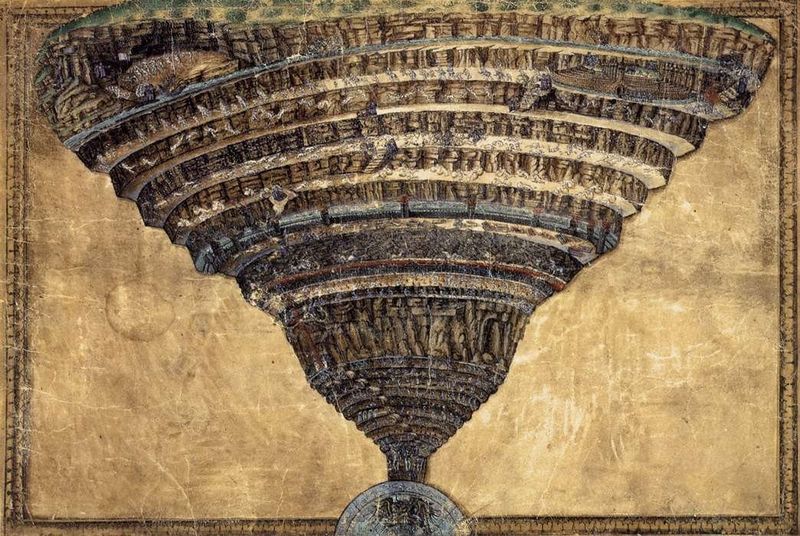
    Heaven for that matter?   The Heaven, and Hell, and Purgatory part does get mapped and mapped pretty heavily after Dante reaches the scene–there are at the very least dozens of cartographic/pictographic representations of the worlds that he surveyed in the Divine Comedy.  For example, there is this spectacular effort by Sandro Botticelli (being a drawing on parchment executed ca. 1480-1495):
    Hell_its_representation_through_the_ages

    The Botticelli is a scary accomplishment, frightening and heavy–you can almost feel the very burden of Hell coming down upon you. (Here’s a good link for a zoomifying version of this map so that you can see its elements in detail.)

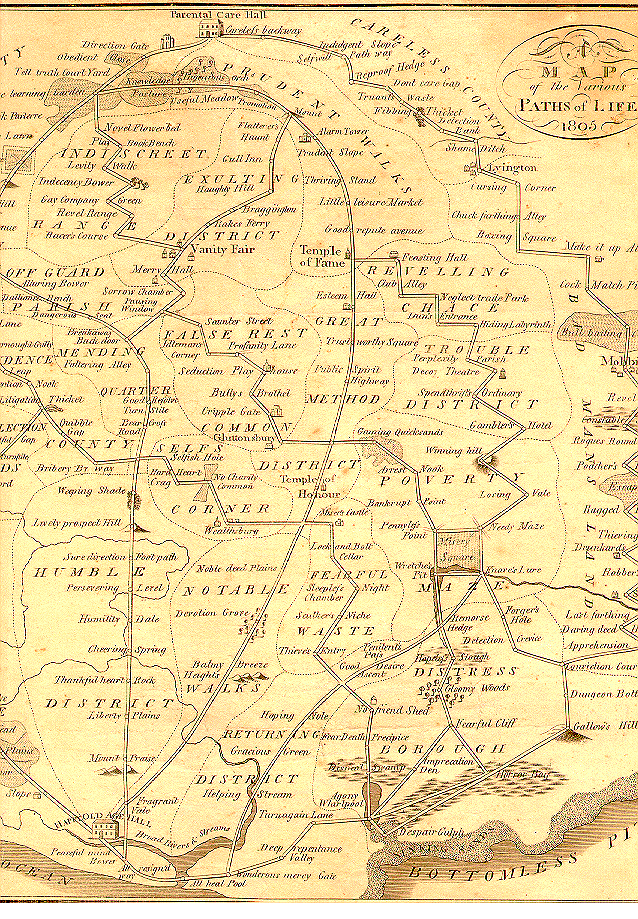
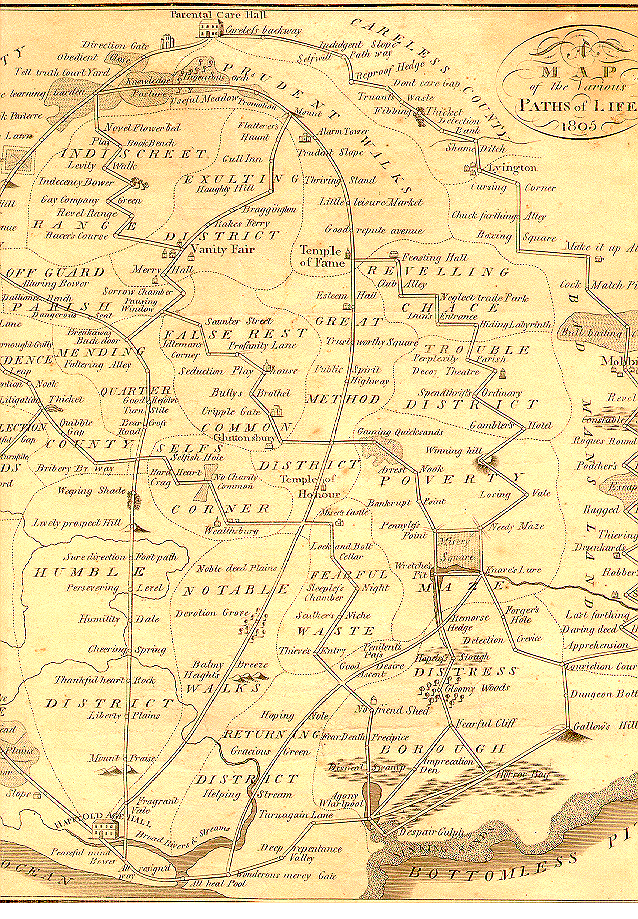
    Then there are allegorical maps that show the stages and stations of life, the progress of the arts and sciences.  A fine example here is a work by B. Johnson, who in 1805 published this fantastic map of the possible paths for living one’s life:
       Maps of Imagination
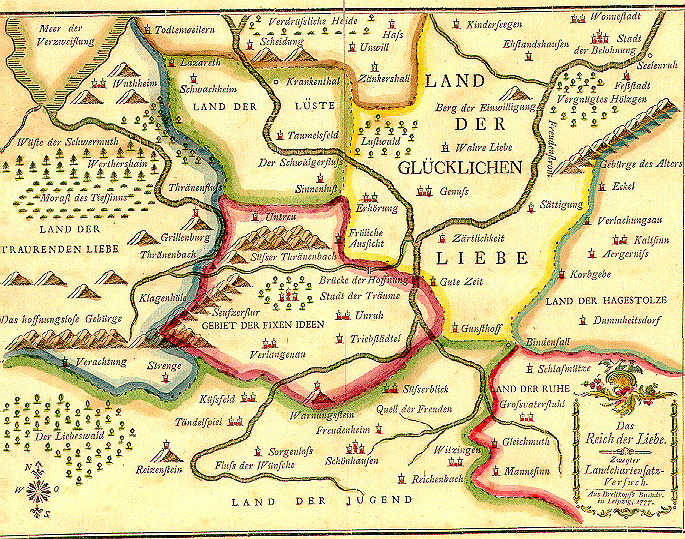
    which seems to tell the reader to keep away from the southeast. Another  map, this one earlier, printed in 1777, is by J.G.I. Breitkopf, Das Reich der Liebe (The Kingdom of Love):
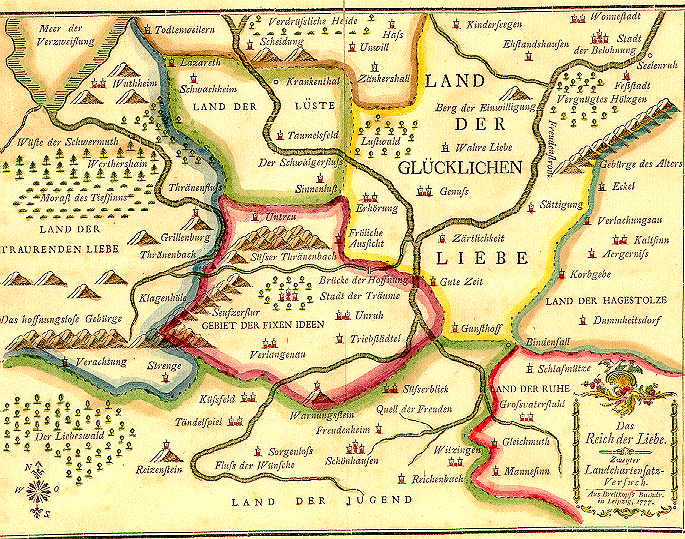
    Maps of the imagination--
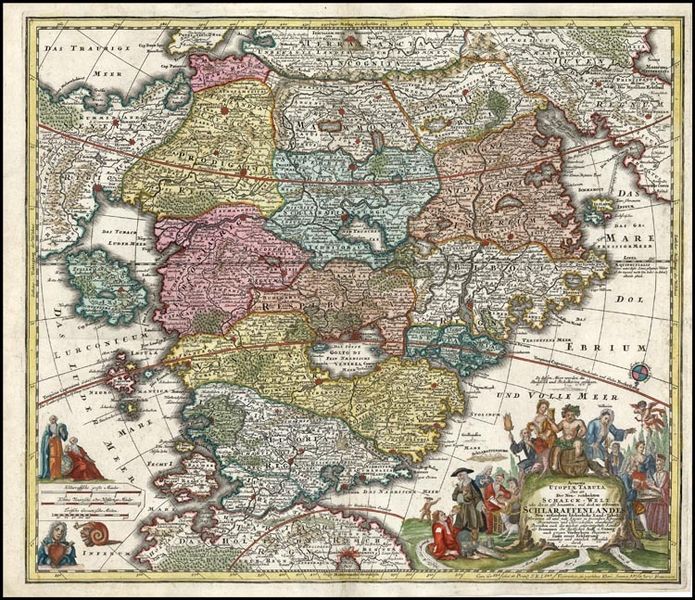
     Another fantastic example of mapping the imagination is found in Matthaus Seutter’s Accurata Utopiae Tabula. Das ist Der Neu entdeckten Schalck Welt, oder des so oft benannten und doch nie erkannten Schlarraffenlandes, published in 1730.  It depicts a Utopia of sorts, though not the world of Thomas More–this is like a pyrite of utopias, a fool’s gold, a fools’ paradise:
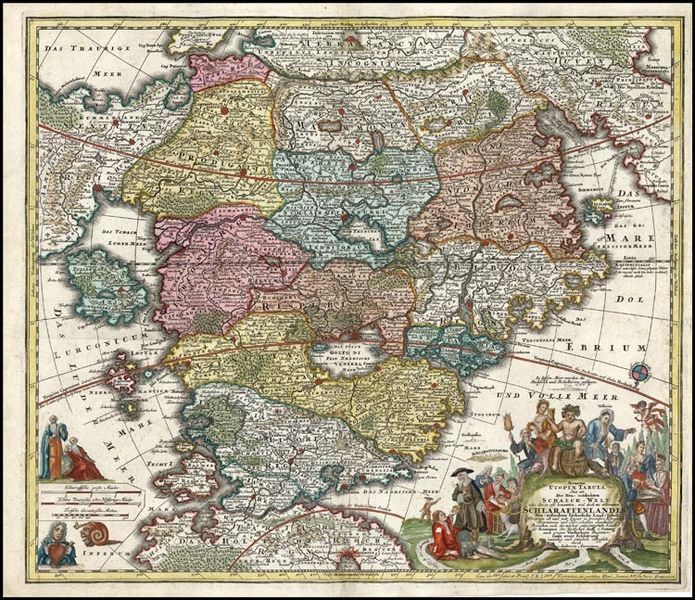
    Maps of imagination  utopia

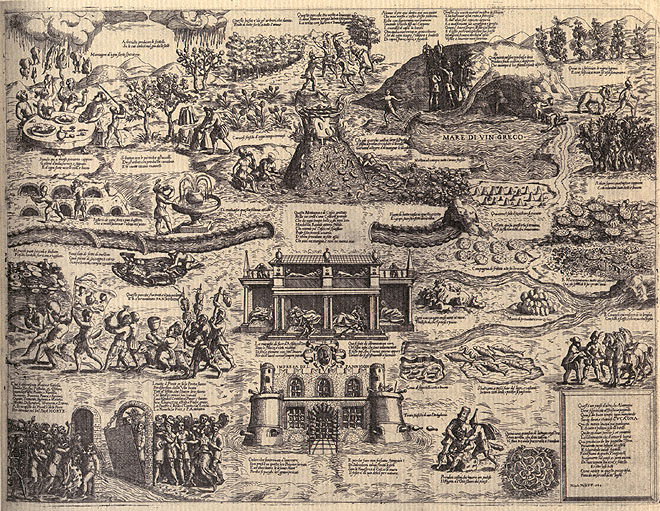
    This land is much like the land of Cockaigne, a mythical Medieval/Renaissance place of plenty, which is pictured below in an image made by Niccolop Nelli in 1564:
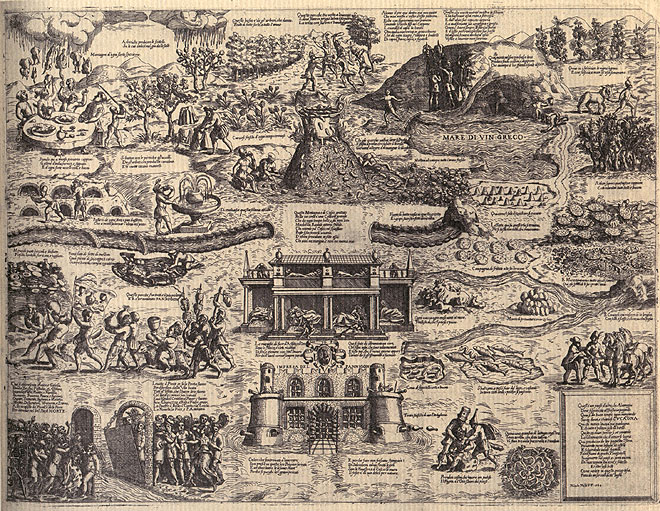
    Cockaigne1
    (It is interesting to picture these places of plenty and sloth in conjunction with some 20th century songs of the Great Depression and earlier, where the land of plenty is far, far simpler–as in the land of the Big Rock Candy Mountain–but that is a different story.)


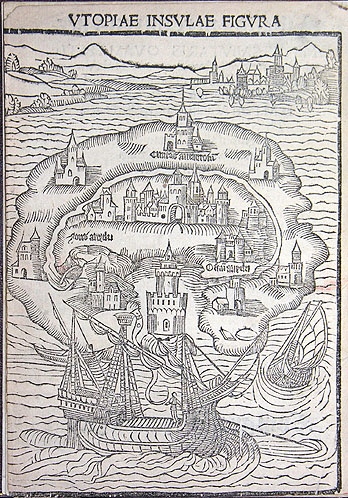
    As long as we’re mentioning Utopia, here’s a 1516 representation of More’s hopefullness, from the first edition of his work:
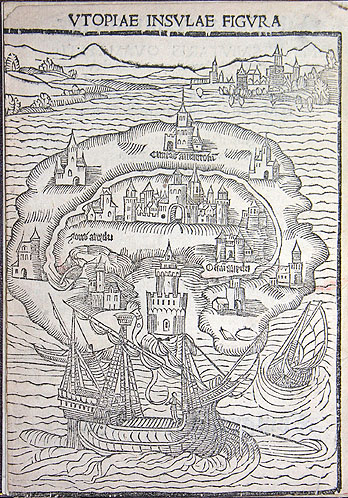
    Maps imagniation More's utopia 1515

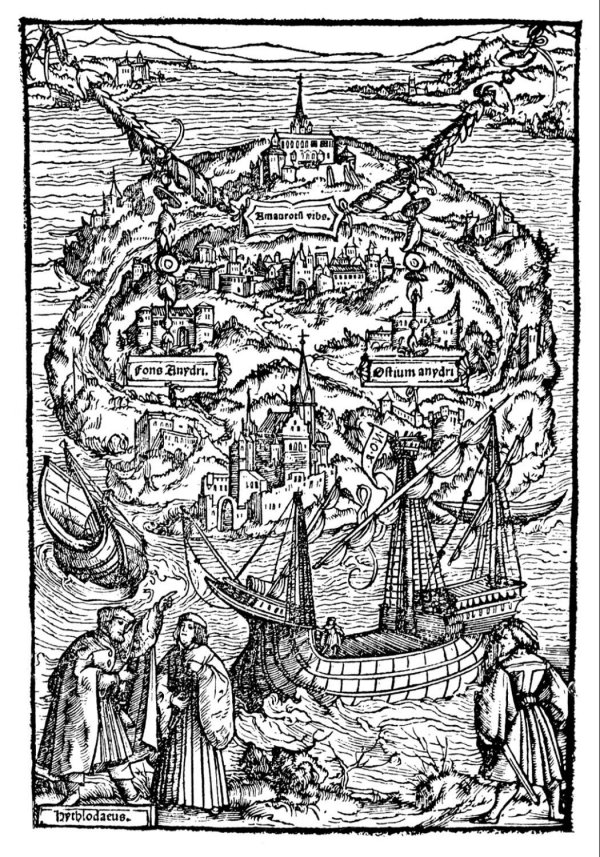
    And another represntation, two years later:
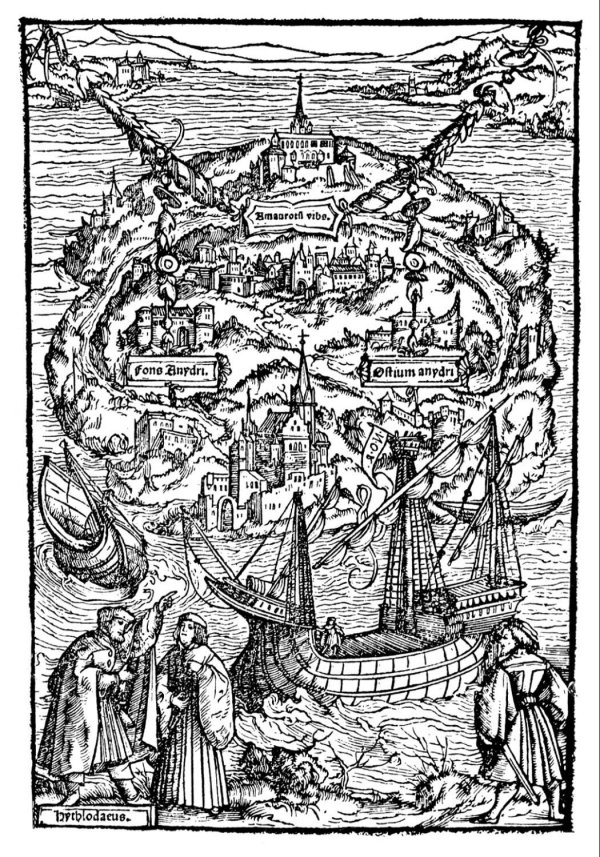
    Maps Imagination more's utopia

    There are more recent examples, but not that many, not so far, anyway.  There are editions of Pilgrims Progress (1678) that contain maps of the travels; there are also a number of charts showing the progress of Mr. Gulliver from the Swift book (1726);  Robinson Crusoe also contains a small sketch map opposite the title-page, and, more recently, R.L. Stevenson’s Treaure Island (1882) contains a map of that place.

    But given the extraordinarily rich tapestries of mythical/mystical places that have been created since the beginning of people telling stories, why weren’t there, well, tapestries (or something) illustrating what the whole of these places looked like?  Why for sample when we meet up with a map of the very pronounced extra-terrestrial wanderings of Cyrano de Bergerac (in his ancient-advanced science fiction work on traveling to other inhabited worlds)?  Taking the antiquarian thought on extra-terrestrials as a case study, why don’t we see more of that sort of thinking illustrated in some way?  The idea of extraterrestrial life is very old, stretching far back into Hindu cosmology, and even deep into the (eighteen worlds) of the Talmud.  Thales, Anaximander, Democritus, Aristole, Ptolemy all thought about and agreed on the possibilities of life being lived on places other than the Earth–infintely more life, in the case of Epicurus. Bruno, Copernicus, Fontenelle, Henry More–were all there, but without visual aids, and certainly without maps.  Except for Fontenelle–Bernard le Bovier de Fontenelle–who almost but not quite gets there in his 1682 book Entretriens sur la pluralite des mondes.

    Blog--plurality of world fontenelle :  

    It seems to me that as a representative of extraterrestrial imagination not being illustrated its hard to beat the case of the beautiful and polymathic Christian Huygens.  Huygens (1629-1685) worked across many fields, including astronomy, biology, math and physics, and was extraordinarily productive, making numerous contributions in the physical and theoretical areas, as well as being a prolific author and correspondant.  But towards the end of his relatively short life (he died at age 56) Huygens embarked down the science fiction road in pre-science fiction days, writing a wonderful and provocative book entitled Cosmotheoros, The Celestial World Discover’d: or, Conjectures Concerning the Inhabitants, Plants and Productions of the Worlds in the Planets3, where he establishes the possibilities of life being lived on worlds other than that of Earth. He developes a detailed fabric for these new heavens,m so much so that he can also establish samenesses for the ETs and humans, stating here his belief in the eternal/cosmoloigcal abilities of mathematics and music:

    “It’s the same with Musick as with Geometry, it’s every where immutably the same, and always will be so. For all Harmony consists in Concord, and Concord is all the World over fixt according to the same invariable measure and proportion. So that in all Nations the difference and distance of Notes is the same, whether they be in a continued gradual progression, or the voice makes skips over one to the next. Nay very credible Authors report, that there’s a sort of Bird in America, that can plainly sing in order six musical Notes: whence it follows that the Laws of Musick are unchangeably fix’d by Nature, and therefore the same Reason holds valid for their Musick, as we even now proposed for their Geometry”pg 86

    Huygens holds close to the immutable nature and close association of music and mathematics,m which would be the same here and everywhere (everywhere else, the ET communities, being referred to here as “other Nations”). 

    “For why, supposing other Nations and Creatures, endued with Reason and Sense as well as we, should not they reap the Pleasures arising from these Senses as well as we too? I don’t know what effect this Argument, from the immutable nature of these   Arts, may have upon the Minds of others; I think it no inconsiderable or contemptible one, but of as great Strength as that which I made use of above to prove that the Planetarians had the sense of Seeing.” pg 86/7

    Huygens is so sure of this that he is willing to tak a bet with long odds that not only do ETs enjoy the possibilities of muic but that they have also created instruments:

    “But if they take delight in Harmony, ’tis twenty to one but that they have invented musical Instruments. For, if nothing else, they could scarce help lighting upon some or other by chance; the sound of a tight String, the noise of the Winds, or the whistling of Reeds, might have given them the hint. From these small beginnings they perhaps, as well as we, have advanced by degrees to the use of the Lute, Harp, Flute, and many string’d Instruments. But altho the Tones are certain and determinate, yet we find among different Nations a quite different manner and rule for Singing; as formerly among the Dorians, Phrygians, and Lydians, and in our time among the French, Italians, and Persians” pg 87

    Huygens then continues to make a beautiful distinction between the musics of Earthling and ETs, in that it may not sound anything like any music we have on Earth, but–since the laws that govern math and music are the same, everywhere–it still might be “very good”.  And not only that, the alien music might be better than our’s:

    In like manner it may so happen, that the Musick of the Inhabitants of the Planets may widely differ  from all these, and yet be very good. But why we should look upon their Musick to be worse than ours, there’s no reason can be given; neither can we well presume that they want the use of half-notes and quarter-notes, seeing the invention of half-notes is so obvious, and the use of ’em so agreeable to nature. Nay, to go a step farther, what if they should excel us in the Theory and practick part of Musick, and outdo us in Consorts of vocal and instrumental Musick, so artificially compos’d, that they shew their Skill by the mixtures of Discords and Concords? pg 88

    And so on.  But why I wonder with all of the great images painted for us in his text is there no venturing into a visual artform?  There’s enough information in the Huygens work to allow for a map, but then there are none, not even something along the images of de Bergerac, who was perhaps among the greatest visionary of techno-anthropormorphic human flight.  Before he was the object of Edmund Rostand’s 1897 play, de Bergerac was a massively creative author, producing, among other things, the book Histoire des Etats et Empires de la Lune (History of the States and Empires of the Moon, published posthumously in 1657), followed by Histoire des Etats et Empires du Soleil (History of the States and Empires of the Sun, again, published further and deeper into his life’s surrender, 1662), both eventually collected as L’Autre Monde (Other Worlds).  Bergerac introduces us, the humble reader, to one of the most important concepts in the history of literature–namely that we humans were not only not alone in the universe, but that we were not even the dominant culture, and indeed we were actually hated by some of the other more advanced species.

    The foundations for structuring a visual habitat for the ideas of Huygens are abundant, as you can see easily in the table of contents (which is like an annotated table of contetns for a modern book) as seen in footnote #4–the signs for a road map are there, mostly–there’s just no road, but there are plenty of suggestions for one.

    So I bring this part of this open discussion to a close—I do ask forgiveness here in the likely case that I’ve left out some obvious examples, this is a Thinking-Out-Loud piece which takes place in the cultures west of the Urals–thinking about where the maps and images weren’t.  Finding almost nothing when you think there’s nothing there is easy to do, especially when you can hold yourself to a porous definition of “nothing”–the next step is harder, finding out how close people came to making these maps, or diagrams, or images.  

    And having said this about finding nothing I cannot let this piece go without mentioning The World’s Most Beautiful Map:  Lewis Carroll’s map from The Hunting of the Snark, an Agony in Eight Fits, and occurs in the Bellman’s tale, starting the second fit. It begins:

    The Bellman himself they all praised to the skies-
    Such a carriage, such ease and such grace!
    Such solemnity too! One could see he was wise,
    The moment one look in his face!
    He had bought a large map representing the sea,
    Without the least vestige of land:
    And the crew were much pleased when the found it to be
    A map they could all understand.
    “What’s the good of Mercator’s North Poles and Equators,
    Tropics, Zones, and Meridian Lines?”
    So the Bellman would cry: and the crew would reply,
    “They are merely conventional signs!
    “Other maps are such shapes, with their islands and capes!
    But we’ve got our brave Captain to thank”
    (So the crew would protest) “that he’s bought us the best-
    A perfect and absolute blank!”
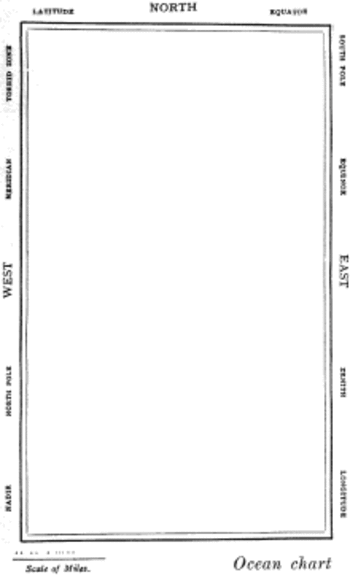
    Snarkmap

    Sometimes there is nothing so fine as something that beautifully illustrates the nothing that isn’t there, and this lovely map, unencumbered of all of the elements and details that define the mapness of something,  perfectly explains the origin of its need.

    Notes:

    1.  They’re not really the Book of the Dead, but collections of papyrus that each contain a unique set of instructions and magic spells and such to assist its dead reader of getting fromthe dead place into the light, into the afterlife.  This image is a rather famous one, pictured and described in the following Wiki bit:  “The mystical Spell 17, from the Papyrus of Ani. The vignette at the top illustrates, from left to right, the god Heh as a representation of the Sea; a gateway to the realm of Osiris; the Eye of Horus; the celestial cow Mehet-weret; and a human head rising from a coffin, guarded by the four Sons of Horus.“

    2.  Here’s another version of the Dante structures placed in context to the Earth, this image by A. Ritter. 

    3. Following the edition of 1698 translations appeared in English (1698) and in Dutch (1699). In the following years, translations also appeared in French (1702), German (1703), Russian (1717) and in Swedish (1774)
     
    4.  The table of contents (with links) is extremely interesting and tells much of the story of the book:

    Book 1

    • Some have already talk’d of the Inhabitants of the Planets, but went no fartherThe Objections of ignorant Cavillers prevented
    •   This Enquiry not overcurious
    • Conjectures not useless, because not certain
    • These Studies useful to Religion
    • Copernicus’s System explain’d
    • Arguments for the truth of it
    • The Proportion of the Magnitude of the Planets, in respect of one another, and the Sun
    • The Lamell more convenient than Micrometers
    • The Earth justly liken’d to the Planets, and the Planets to it
    • Arguments from their Similitude of no small weight
    • The Planets are solid, and not without Gravity
    • Have Animals and Plants
    • Not to be imagin’d too unlike ours
    • Planets have Water
    • But not just like ours
    • Plants grow and are nourish’d there as they are here
    • The same true of their Animals
    • Great variety of Animals in this Earth
    • And no less in the Planets
    • The same in Plants
    • Rational Animals in the Planets
    • Vices of Men no hindrance to their being the Glory of the Planet they inhabit
    • Reason not different from what ’tis here
    • They have Senses
    • Sight
    • Hearing
    • A Medium to convey Sound to the Ear
    • Touch
    • Smell and Tast
    • Their Senses not very different from ours
    • They have Pleasure arising from the Senses
    • All the Planets have Fire
    • The bigness of their Creatures not rightly guest at by the bigness of the Planets
    • In the Planets are many sorts of rational Creatures as well as here
    • Men chiefly differ from Beasts in the study of Nature
    • They have Astronomy
    • And all its subservient Arts
    • Geometry and Arithmetick
    • And Writing
    • And Opticks
    • These Sciences not contrary to Nature
    • They have Hands
    • And Feet
    • That they are upright
    • It follows not therefore that they have the same shape with us
    • A rational Soul may inhabit another Shape than ours
    • The Planetarians not less than we
    • They live in Society
    • They enjoy the pleasures of Society
    •    They have Houses to secure ’em from Weather
    • They have Navigation, and all Arts subservient
    • As Geometry
    • They have Musick
    • The Advantages we reap from Herbs and Animals
    • And from Metals
    • From the discoveries of our Age
    • The Planets have, tho not these same, yet as useful Inventions 

    Book 2

    • Kircher’s Journey in Ecstacy examin’d
    • The System of the Planets in Mercury
    • In VenusIn Mars
    •  Jupiter and Saturn the most eminent of the Planets both for bigness and attendants
    • The proportion of the Diameter of Jupiter, and of the Orbs of his Satellites, to the Orbit of the Moon round the Earth
    • The periods of Jupiter’s Moons
    • And Saturn’s
    • This proportion true according to all modern Observations
    • The apparent magnitude of the Sun in Jupiter, and a way of finding what light they there enjoy
    • And in Saturn
    • Always the same length
    • They see the fixt Stars just as we do
    • The appearances of the Ring in Saturn
    • Very little to be said of the Moon
    • The Guards of Jupiter and Saturn are of the same nature with our Moon
    • The Moon hath Mountains
    • But no Sea, nor Rivers, nor Clouds, nor Air and Water
    • The Conjecture of its Plants and Animals very dubious Jupiter’s and Saturn’s Moons turn always the same side to them
    • The Astronomy of the Inhabitants of the Moon
    • This may be applied to the Moons about Jupiter and Saturn
    • The immense distance between the Sun and Planets illustrated
    • No ground for Conjecture in the Sun
    • The Faculty in the Sun not easily seen
    • By reason of its Heat no Inhabitants like ours can live in the Sun
    • The fix’d Stars so many Suns
    • They are not all in the same Sphere
    • The Stars have Planets about them like our Sun
    • A way of making a probable guess at the distance of the Stars
    • Every Sun has a vortex round it, very different from those of Cartes 
     

    See: 

    “This Is Not a Map”, by Max Byrd, The Wilson Quarterly  Vol. 33, No. 3 (Summer, 2009) (pp. 26-32).

    John Pickles, A history of spaces: cartographic reason, mapping and the geo-coded world,  (London and New York, Routledge, 2004)

    Katharine Harmon, editor, You are here: personal geographies and other maps of the imagination. (New York, Princeton Architectural Press, 2004).

    Giuliana Bruno. Atlas of Emotion: Journeys in Art, Architecture, and Film (New York, Verso, 2002).

    Denis Wood, ‘Map art’, Cartographic perspectives 53 (2006), pp. 5–14: p. 11.

  • Strange Things in the Sky Dept.–Dante and Beatrice and the Vault of Stars

    JF Ptak Science Books    Post 1457

    There is a developing thread on this blog relating to strange things in the sky. Sometimes the images are extraordinary, impossible, beyond fiction:  multiple/duplicate Earths, flying buildings, horses in balloons, extra-human missing souls downloaded to the Earth from extra-Moons, and so on.  And at other times, the images are more subtle, questioning, ambiguous, as in the example of some 16th century prints that show the sky opening to reveal the Creator, who is in turn pictured against, say, a completely blank background, suggesting an enveloping nothingnesss of Heaven; or a field of beautiful stars filling a Renaissance sky of deepest red, at night.  A gigantic foot shown floating in the sky in a 17th century image might be ambiguous, and it also wildly so;  both it and the more subtle ambiguities–for example early representations of caves-over-mountains that give them an inside-out appearance–are welcomed sights.

    Perhaps some of the most beautiful of the Strange Things in the Sky department might belong to the skies of  Dante–they can be extraordinary, straightforwardly unusual and–when the narrative is presented pictorially–beautifully strange and with little ambiguity.  They are presentations of ideas of time and space, fantastic adventures in imaginary environments, as much an internal journey as Milton’s Paradise Lost is an external one1.
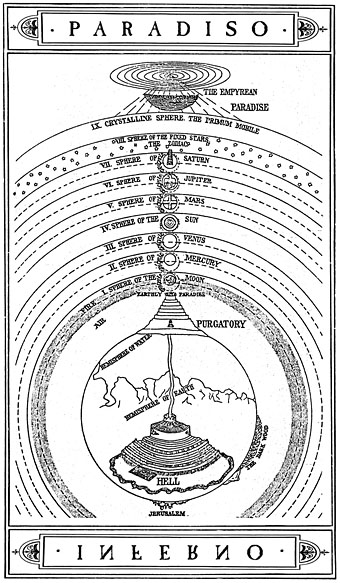
    Dante’s celestial exploration and the foundation that he provides have led to the possibility of an entire atlas of maps of paradise, hell and purgatory.  Here’s an interesting map2 constructed by Michelangelo Caetani (1804-1882) showing the structure of the Comnedia:
    Dante comedia
    I’ve presented this map just to give a context for the placement of the following images, though I do like the Caetani because it presents a good overview of the entire placement of Dante’s work, though necessarily having to leave out almost all of the detail of what is actually going on in each level. 

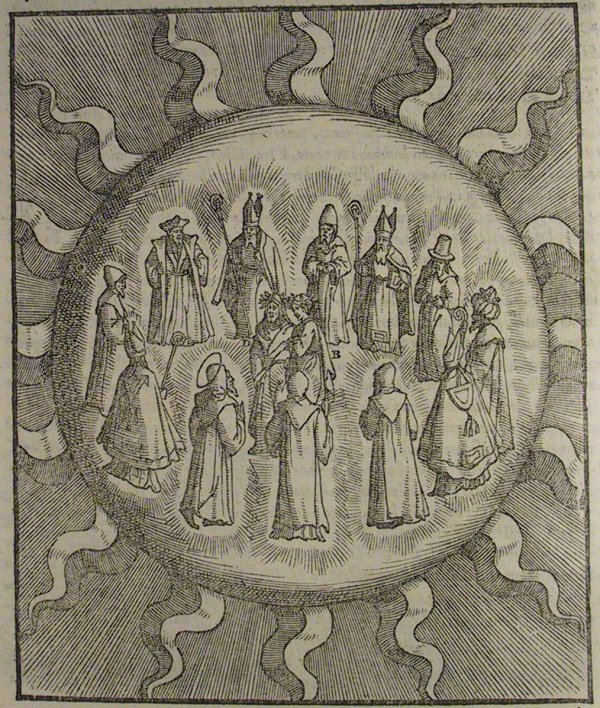
    Nearly all of the images below are from La comedia di Dante Aligieri con la nova espostione di Alessandro Vettlutello, published in Venice in 1544 by Francesco Marcolini (or Marcolino)3.  For the present collecting/browsing purposes I’m just going to go over the images lightly rather than try to launch into an ill-advised exegesis on a subject that I don’t know very well at all.

      Dante sun big
    In the Sphere of the Sun Dante and Beatrice among the wise and the learned, hearing them all (eleven) named so by Thomas Aquinas.  They include Albertus Magnus, Gratian, Peter Lombard, Solomon, Dionysius the Areopagite, Orosius, Boethius, Isidore of Seville, Bede, Richard of St. Victor, Siger of Brabant. Paradiso X

       Dante fixed stars
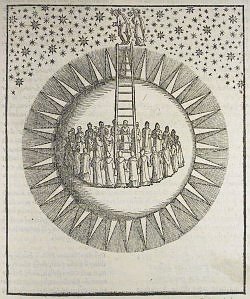
    Dante and Beatrice entering the sphere of the fixed stars, using a ladder of contemplation, mythically suggesting stairs and in this case a stairway to god. 

    Ante--empyrean

    The souls ascent to the Empyrean, with Dante looking down to see the Earth (“the little patch that makes us so vicious”), and to trace the (“mad”) voyage of Ulysses, and to see perhaps how far he has traveled (Paradiso XXVII).  Dante listens to St. Peter, and Beatrice, who describe the place, which is basically the mind of god and which is the envelope surrounding the final sphere:

             “The nature of the universe which holds
              The center still and whirls the spheres around it
              Takes from this region here its starting-point.
     
              “And here this heaven has no other where
              Than in God’s mind, where there flames up the love
              That spins it, and the power it pours down.
     
              “Light and love enclose it in one circle
              As it does all the rest, and this enclosing
              He alone who circles it can comprehend.

    Beatrice and Dante


    Beatrice and Dante together with Saint John and Saint James,  Paradiso XXV.

              “My body is still earth within the earth
              And will remain there with the rest until
              Our number equals the eternal tally.
     
              “Only those two lights who have ascended
              Wear their two robes here in the blessed cloister,
              And this word you shall bring back to your world.”
     

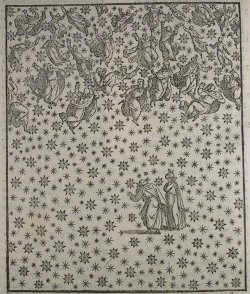
    Woodcut illustrating Paradiso II
    I couldn’t resist straying a bit to show this fantastic 1491 woodcut (published in Venice by Petrus de Plasiis) illustrating Dante and Beatrice surveying and then entering the Moon.  The scene is described in  Paradiso II:

              “Turned toward me, as glad as she was lovely,
              And said, “Direct your mind with thanks to God
             Who here has made us one with the first star.” –-[the Moon is described and identified as a star.]
     
              I thought we were enveloped in a cloud,
              Shining, solid, dense, and highly polished
              As a diamond struck by the sun would be.
     
              The timeless pearl took us inside itself
                In the same way that water can receive
              A ray of light while it remains intact”
    Again, my apologies to those among you who know Dante–I really was just trying to get at the luxuriant strangeness of these images and display them–much more so than talk about them. 

    Notes

    1. “The difference is that the visual phantasy bequeathed by Dante was mainly a congeries of intense and intricate symbolisms of his own personality,” Masson explains, “whereas that offered by Milton was mainly a sublime version of an independent objective tradition.” 12. David Masson, The Life ofJohn Milton: Narrated in Connexion with the Political, Ecclesiastical, and Literary History of His Time, vol. 6, 1660-1674 (1880; reprint, New York,
    1946), p. 522.

    2.  Michelangelo Caetani, La Materia della Divina Commedia di Dante Aligherie (1855).

    3..   Francesco Marcolini (or Marcolino), a typographer born in Forlì, also published the first book of cartomancy, or telling the telling of the future and fortune through the use of a deck of cards, in his 1540 Le sorti intitolate giardino d’i pensieri (“The oracle called garden of thoughts”).


  • Beautiful Books: Haeckel’s Kunstformen der Natur, 1904

    JF Ptak Science Books    Quick Post

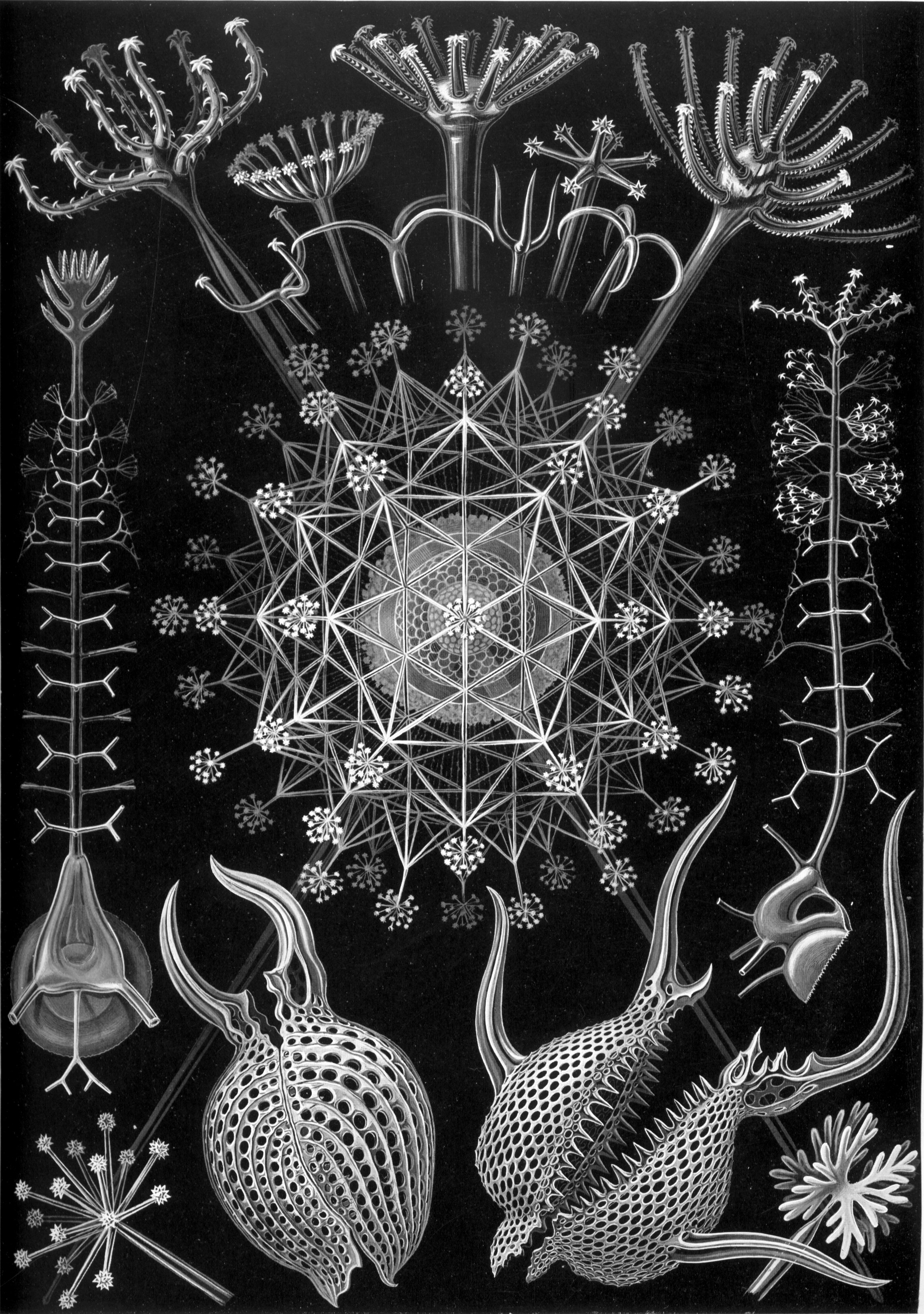
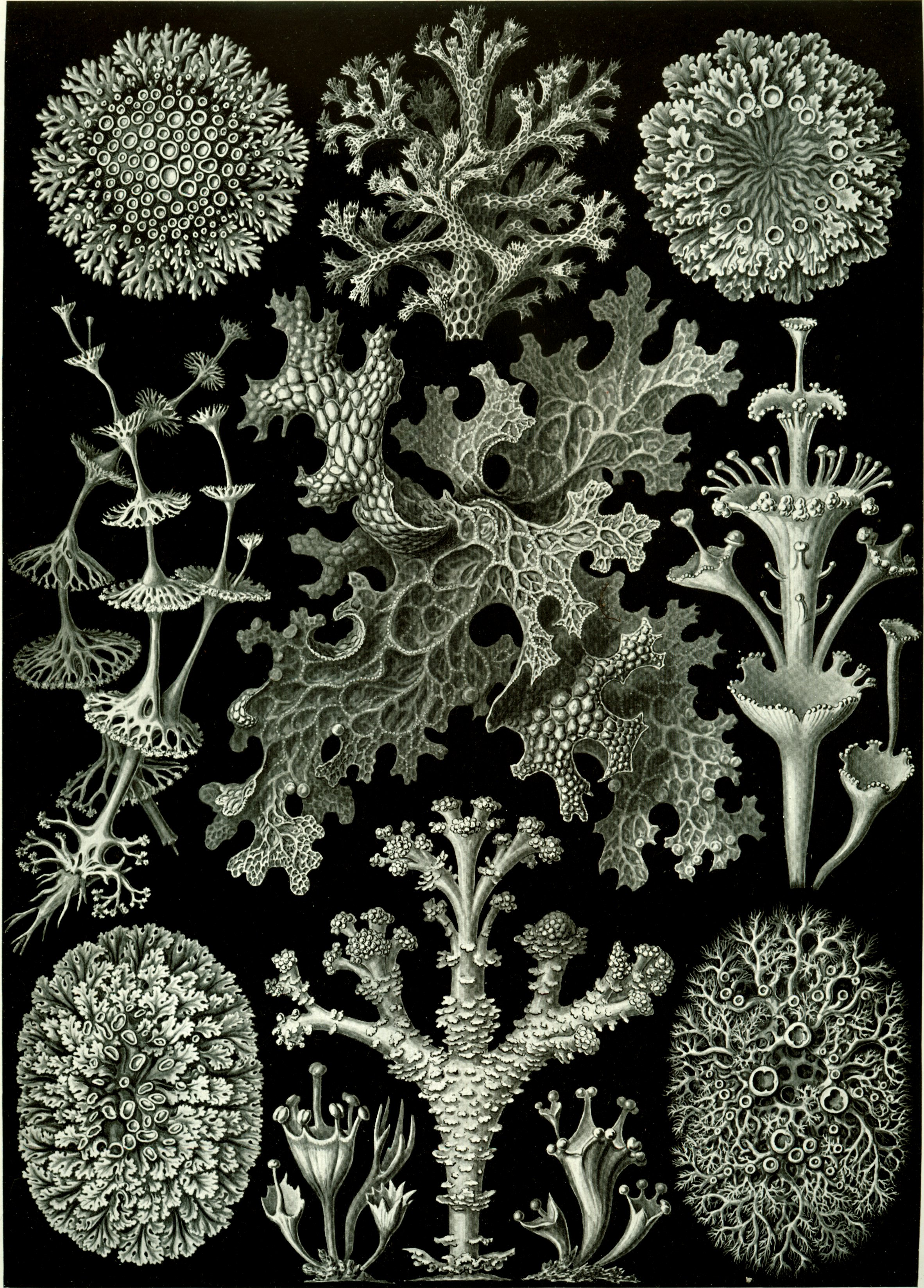
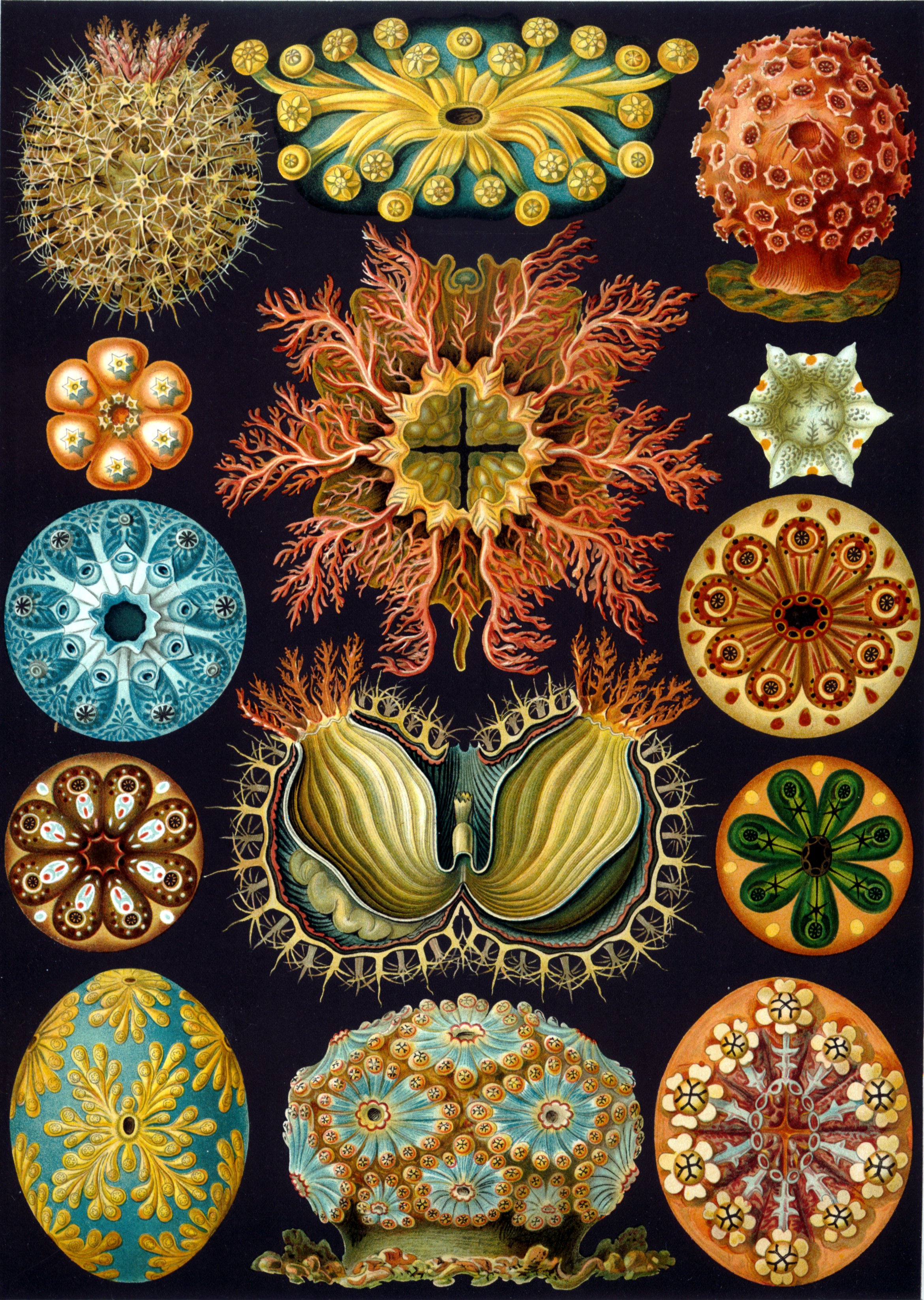
    In his long and vastly productive scientific life, Ernst Haeckel (1834-1919 ) produced this extraordinary work, Kunstformen der Natur, over a five year period from 1899 to 1904, a set of 100 images being  published in 1904 (though a result of a long lifetime of work).  Haeckel was a busy man working over a number of specialties, writing more than 40 books and a large number of  contributions to scientific publication.  He is perhaps best remembered early on in his career for a popular defense of Darwinism, writing Natürliche Schöpfungsgeschichte, (1868, nine years after the publication of the Origin, and translated into English as The History of Creation in 1876) which was a successful attempt to get Darwin’s complex ideas into public discussion.  But all I want to do here is to surface his Kunstformen, which evidently served as a sort of wish-book for the imagination among many modern artists. 

    And so to the examples:

    The phaeodaria:

    File:Haeckel Phaeodaria 1.jpg

    and another example of phaeodaria:

    File:Haeckel Phaeodaria 61.jpg

    The Lichenes:

    File:Haeckel Lichenes.jpg

    And the Stephoidea

    File:Haeckel Stephoidea edit.jpg

    And the ascidiae:

    File:Haeckel Ascidiae.jpg

    And some of the rest, which included all manner of other living things, big and small.  The micrscopic organisms (and black-and-white) to me are the most fantastic, though the renderings of jsut about everyhting in the work are superb, and their placement, the design of each plate, is just magnificent. 

    For a collection of excellent 300 dpi scans see here:  Kurt Stüber’s Biolib.  The following images are located here.

    ·Posted by :

    ·in:

    —

  • The Future of Hope and Fear: Fortune-Telling Questions for Men and Women, 1540

    JF Ptak Science Books  Post 1456

    In 1540 Francesco Marcolini (or Marcolino), a typographer born in Forlì, published in Venice Le sorti intitolate giardino d’i pensieri (“The oracle called garden of thoughts”). This book is among the earliest known documents of cartomancy (divination with cards), a card-playing fortune-telling and future-telling game and belief system. (I’ve written about other beautiful if not proud accomplishments in this area, other products of the 16th century, here.)  I find the illustrations of the combinations of cards to be rather beautiful, a suggestion of an unknown alphabet or hieroglyphic for a civilization of hope or distress or both that hangs somewhere out there in the gauzy future, the characters capable of change and interpretation depending on the needs of the viewer.  Therefore the story that is told can easily become the story that could be told, the characters permeable to whimsy and insight.  It seems unlikely that there is a numeral system associated with this quicksand.

    Image:Marcolini fraude.jpgThe tarot encyclopedia website provides an interesting insight to the times if not so much to the gearing of this wonder machine–this mainly in the form of the fifty questions to be asked of the players of this game/amusement/hopenet, including thirteen each to be answered solely by men and women. 

    Questions Asked of Men

    It turns out that for the men, 8 of the 13 questions deal with his wife or mistress–4 about wives, 3 about mistresses, and 1 that can go either way.  The remaining few questions then are left to cover the range of All Other Things

    1.Will the destiny of the man will be good or bad? [Fato - Fate]
    2.Is the lover loved by his mistress? [Fama / Fame]
    3.Is it better to marry a beautiful woman or an ugly one? [Beneficio - Gain]
    4.Will the desire of the man be fulfilled? [Tempo - Time]
    5.In which will the man be more lucky? [Fortuna - Fortune]
    6.Will the man have to suffer for his beloved? [Dolore - Pain]
    7.Is the man appreciated by the other people? [Virtu' - Virtue]
    8.How many wives will the man have? [Punizione - Punishment]
    9.Will he that goes to war gain victory? [Vittoria - Victory]
    10.Will a strange wife become humble? [Pertinacia - Obstinacy]
    11.Is it good to change mistress? [Peccato - Sin]
    12.Is it good to take a wife? [Matrimonio - Marriage]
    13.Which is the best mistress: the widow, the married woman or the unmarried woman? [Timore - Fear]
    

    Questions to be asked by women

    The questions for the women actually seem a little more balanced, or at least don't 
    deal with the blossoming aspects of additional/multiple lovers, though the question of

    whether her husband will be faithful does come up, as does the issue of whether it
    is good or not to change lovers. And the issue of how often she will be married.
    And whether or not she will suffer for her lover--I'm not sure what this one means
    in the antiquarian sense, but there seems to be a follow-up
    on whether the bad
    husband will become good. But overall these seem not so extra
    ordinarily self-indulgent
    as do the questions for the men.
    14.Is the woman appreciated by the man she adores? [Vanita' - Vanity]
    15.Will the destiny of the woman will be good or bad? [Destino - Destiny]
    16.Will the woman will give birth to a boy or a girl? [Natura - Nature]
    17.In which will the woman be more lucky? [Honore - Honour]
    18.How many husbands will the woman have? [Penitenza - Penitence]
    19.Will the woman have children? [Sterilita' - Sterility]
    20.Will the woman suffer for her lover? [Dipserazione - Desperation]
    21.Will the desire of the woman be fulfilled? [Insidia - Danger]
    22.Will the bad husband become good? [Sorte - Chance]
    23.Is the woman loved by everyone? [Disgrazia - Disgrace]
    24.Is it good for the woman to change lover? [Odio - Hate]
    25.Is it good to get married? [Servitu' - Slavery]
    26.Will the husband be faithful? [Occasione - Occasion]

    Questions that can be asked both by men and women

    Certainly the non-gender-specific questions are most interesting, some even poetically
    captivating ("will two lovers make peace?")
    , most of which could be asked today, and
    some still demanding long thought. In general though they do mostly have an
    adult-version of a Ouija experience, with a few golden nuggets tossed in for higher
    cortical seasoning.
    27.Is a certain courtesan infected with the French disease? [Difetto - Defect]
    28.Is it good to take vengeance of an offense? [Virilita' - Virility]
    29.Will the world find peace? [Parche - Moirae]
    30.Will art or trade produce gain? [Industria - Industry]
    31.Will some trouble bring happiness in the end? [Ricchezza - Richness]
    32.Is the rule of a Lord appreciated by the people? [Verita' - Truth]
    33.Is it good to serve Lords and priests? [Infingardo - Idler]
    34.Will a promise be kept? [Fraude - Fraud]
    35.Is the person that traveled far alive or dead? [Sapere - Knowledge]
    36.Will the exile return? [Esilio - Exile]
    37.Is it better the wife or the husband? [Poverta' - Poverty]
    38.Who loves with more passion, the man or the woman? [Nobilta' - Nobility]
    39.Will a dream come true? [Ignorantia - Ignorance]
    40.Is it good to start a certain enterprise? [Otio - Idelness]
    41.Will the person that went away be back soon? [Desiderio - Desire]
    42.Will the awaited new be good or bad? [Malinconia - Melancholy]
    43.Does the appearance of the person give a good impression? [Menzogna - Lie] 
    44.Must one trust what people say? [Discordia - Conflict]
    45.Will two lovers make peace? [Pace - Peace]
    46.Which will be the end of a very deep love? [Caso - Chance]
    47.Will changing place bring better luck? [Consiglio - Counsel]
    48.Will the person be the winner of a dispute? [Corruttella - Corruption]
    49.Will someone get free of a certain vice? [Furto - Theft]
    50.What will be the reward for faithfulness in serving? [Calamita' - Calamity]

    In short, much of this seems modern to me, at least with a little editorial clean-up.
    The big difference seems to be that people in 1540 actually interacted and answered
    these questions, while in 2011 most folks would be watching other folks talk about
    answering these questions on a reality t.v. show.

  • Paradise–Millennium–End of Days: Thomas Burnet, 1684

    JF Ptak Science Books   Post 1455

    Burnet
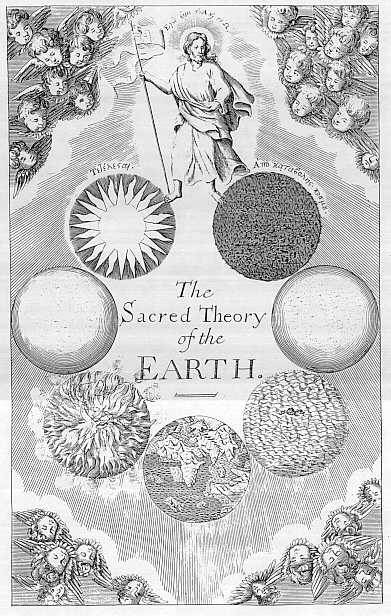
    It is uncommon to see the life stages of the life of the Earth depicted in seven stages, seven Earths at seven different epochs, alpha to omega–but it is particularly rare to see them illustrating the fronstipiece of a book, and an antiquarian one at that.  But that this  is exactly what happened with Thomas Burnet’s Theory of the Earth, in the English translation of 1684.1  Burnett was a quietly agitated writer whose underlying viewpoint of the existence of life on Earth and the planet itself was that it was the scourge of millennialism, that the cycle of seven Earths depicted on his book ws the life and death of the planet, all wrapped around the coming kingdom of Christ and teh book of Revelation. 

    And perhaps the most impressive image on the page is that the Earths of Paradise and the millennium were pretty much the same, perfectly well across from one another on a level plane. 

    Paradise is self-explanatory; the “millennial” part maybe less so–in Christian thought this is when after Certain Things have happened that Jesus Christ would come back to Earth and reign in a terrestrial kingdom, a heaven-on-earth, for a period of a thousand years.  Or more.  The eschatology is not clear on this so far as I can tell.  It seems as though the Earth is devoid of whatever it is that clogs nature’s bowels, as the planet looks remarkably sparse and tentative.

    The business end of the image is this:  rounding the images clockwise, the first is Chaos; the second,  Paradise; the third shows the Deluge; the fourth depicts the present world; the fifth is the Conflagration; the sixth is the long-awaited  Millennium; and the seventh, and last, the final seal, is the Consummation.  So the Paradise/Millennial Earth are figures 2 and 6, and they do look pretty much the same.

    And so the Earth is a thing of three distinct periods:  the first is the lost Paradise, the fated failure in the fall of man; the second is the world of today with its constancy of ruination and upheaval; and the third, paradise regained (but at a cost).   As Kerry V.  Magruder points out in his “Global Visions and the Establishment of Theories of the Earth”2  points out in his  there are “transitions between these scenes are four ‘Revolutions
    of our natural world’, accomplished through natural causes: chaos Noah’s universal deluge, a future conflagration, and a final consummation when the Earth will be transformed into a fixed star…”

    Burnet (1635-1715) poured out his pounding heart into these pages, teaching people about the structure and history of the  Earth with little or unsuccessful regard to science–but no matter.  (Burnet did try to figure out where all of the water came for the flood, which is  a great question.  It is impossible for it to come from a natural rain of any sort, and Burnet probably came to the conclusion this the answer for the flood couldn’t come from the surface of the Earth.  So to keep things in compliance with his faith, Burnet established that the water necessary for the flood came not from the surface of the sphere, but below it, in the hollow Earth which was actually filled with water.) This was a work of structured faith and a belief  system, and wasn’t seen as much more than that except to the initiated.

    Notes:

    1. Telluris Theoria Sacra, or Sacred Theory of the Earth was first published in 1681 in Latin and then again in English in 1684.  Latin was after all the language of science.  Newton’s Principia remember wasn’t translated into English 

    2. …which appeared in Centarus in 2006 volume 48, pp. 234–257


  • Wonders of Nature and Strange Things in the Sky, 1744: Comets.

    JF Ptak Science Books   Post 1454

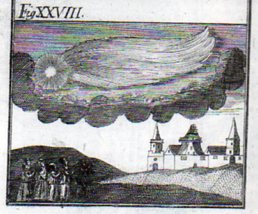
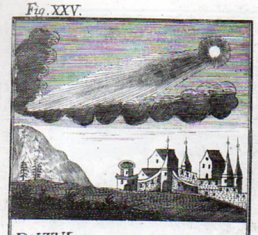
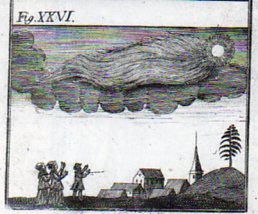
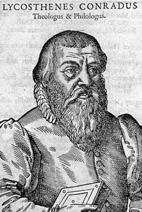
    As part of this blog’s continuing series on Strange Things in the Sky is this delightfully illustrated work by Conradus (Konrad)  Lycosthenes (1518-61), Die Wunder Gotes in der Natur, bey Ewrscheinung der Cometen oder, Besondere Anmerckung der vornehmsten Cometen, oder, Strobel-Stern published in Frankfurt in 1744.  I’m sure it was anything but “delightful” at the time, being a wonder book of God’s handiwork in the heavens and all, revealing twhat some  famous comets (and other celestial wonders) might have looked like through the ages.  Lycosthenes was a polymathic guy, teaching grammar and dialectics at Basel, and embarked on a wide writing career in which he wrote (and translated) on many different areas, though it seems that he was interested in recurring oddities and the unusual, a humanist encyclopaedist. 

    Comet wonders396

    Comet wonders393

    Comet wonders395

    The book is actually about nine inches tall or so and is illustrated with 41 pages each of which is crowded with two images, face-to-face, as so [source]:

    Conrad Lycosthenes - Cometen (1744)
    The author:
    Photo of Konrad Lykosthenes

    The rest of the 41 engraved plates can be seen below [source]:


    Phénomène obbservé lors du passage de la comète de 1744. [Cote :2487A]

    1 : Phénomène obbservé lors du passage de la comète de 1744. [Cote :2487A]


    ·Posted by :

    ·in:


  • The Other Miracles of 1905–Winsor McCay, Little Nemo and Subversive Dreamscapes

    JF Ptak Science Books  Post 1453

    Okay, to be fair no one has ever had a year like Einstein’s annus mirabilis of 19051 perhaps no one has really ever come close–he defines the incomprehensibly high achievement for a single (less than) 365-day time span. There was other stuff going on in 1905–Ernest Starling2 introduced the term “hormone”, Vagn Ekman produced a beautiful paper on the mathematics of ice drift in the Arctic Sea and the ocean’s responses to different sorts of winds, Eduard Zirn performed the first cornea transplant, Ejnar Hertzprung3 published his famous diagrams, Henry Gruppy empirically established the manner of plant dispersal in the Pacific region4, Maurice Frechet’s groundbreaking work in topology, and Henrui Poincare and Howrd Ricketts and Oswald Veblen and so on. And the Wasserman test.  It was a pretty bountiful year–and this was just in the sciences and maths.

    And then there was the Russian Revolution (of 1905).

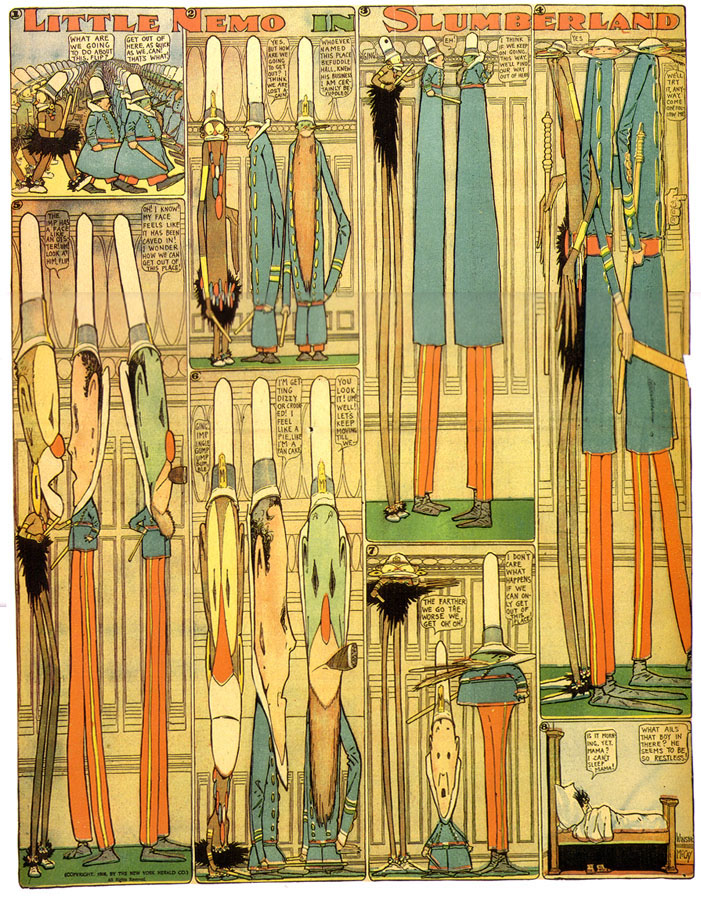
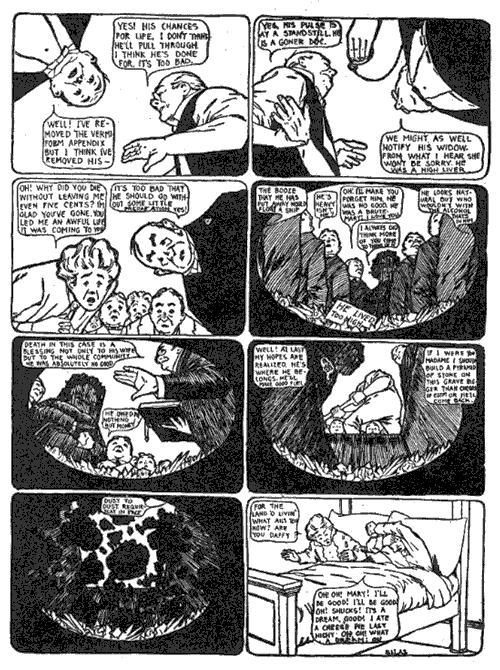
    But also back there in 1905 Winsor McCay was having a terrific year–this was the man who revolutionized the comic strip.  McKay may have been the Einstein of his field, and his work I think may still be the standard bearer for high excellence and creativity.  It was in 1905 that he began his Dreams of a Rarebit Fiend and also the crowning masterpiece of the medium, Little Nemo in Slumberland.  Nothing had really quite been seen like that before, two newspaper strips that were filled with vision and elegance and weirdness and the bizarre, beautiful stories illustrated on one sheet of paper, of great imagination and a wide stretch of subversiveness. They so captivated the readers of the time that McCay went off on illustrative lecture circuits, found movie (in their relative infancy) versions of his work, and performed in vaudeville venues along with Charlie Chaplin and W.C. Fields.

    And then he created the animated cartoon. 

    Here’s a page of Little Nemo:

    Little_nemo_1908
    And another of the Rarebit:

    Rarebit_fiend
    I guess you can get the picture of what McCay brought to the world–examples of his work are all over the web, and have been published in eight (?) volumes of reprints.  This was a particularly sumptuous time for this sort of story telling, but this is not the place to talk about anyone else, not really. (Okay–one very high talent is the seldom heard Rodolphe Topffer, but that’s another story.)

    And a very early Rarebit movie (which takes a little while to get moving):

    And another, this an animated cartoon from 1921–it doesn’t have anything to do with McCay in 1905, I just like its motion, and also because McCay is the father of the animated cartoon:

    Can anyone say “Up”?

    And then of course there’s Gertie, the first animated cartoon:


    Notes:

    1.”Über einen die Erzeugung und Verwandlung des Lichtes betreffenden heuristischen Gesichtspunkt” Annalen der Physik 17: 132–148;  “Über die von der molekularkinetischen Theorie der Wärme geforderte Bewegung von in ruhenden Flüssigkeiten suspendierten Teilchen” Annalen der Physik 17: 549–560; Zur Elektrodynamik bewegter Körper” Annalen der Physik 17: 891–921; “Ist die Trägheit eines Körpers von seinem Energieinhalt abhängig?” Annalen der Physik 18: 639–641.

    2.  “On the Chemical Correlation of the Functins of the Body”, not only defining the term but clarifying the hormone’s function.

    3. Hertzsprung, “Zur Strahlung der Sterne”, with another paper of the same name later in 1907. 

    4.  Observations of a Naturalist in the Pacific Between 1896 and 1899, the second volume, entitled Plant Dispersal, is where (surprise!) he discusses plant dispersal.  But the really cool thing here is that he figured out that there were a lot of seeds that floated here and there in/on the Pacific, going place to place, finding out how long they could stay afloat, and so on.  It was fantastic!


    ·Posted by :

    ·in:

    — — —

  • Standardizing Precision and Beautiful Technical Prints: Ramsden’s Dividing Engines

    JF Ptak Science Books   Post 1452.223221 and a quarter

      Ramsden386

    I like the idea of having something called a Dividing Engine–perhaps it would divide seeds, or complex problems, or simple problems, or perhaps it would divide division. 

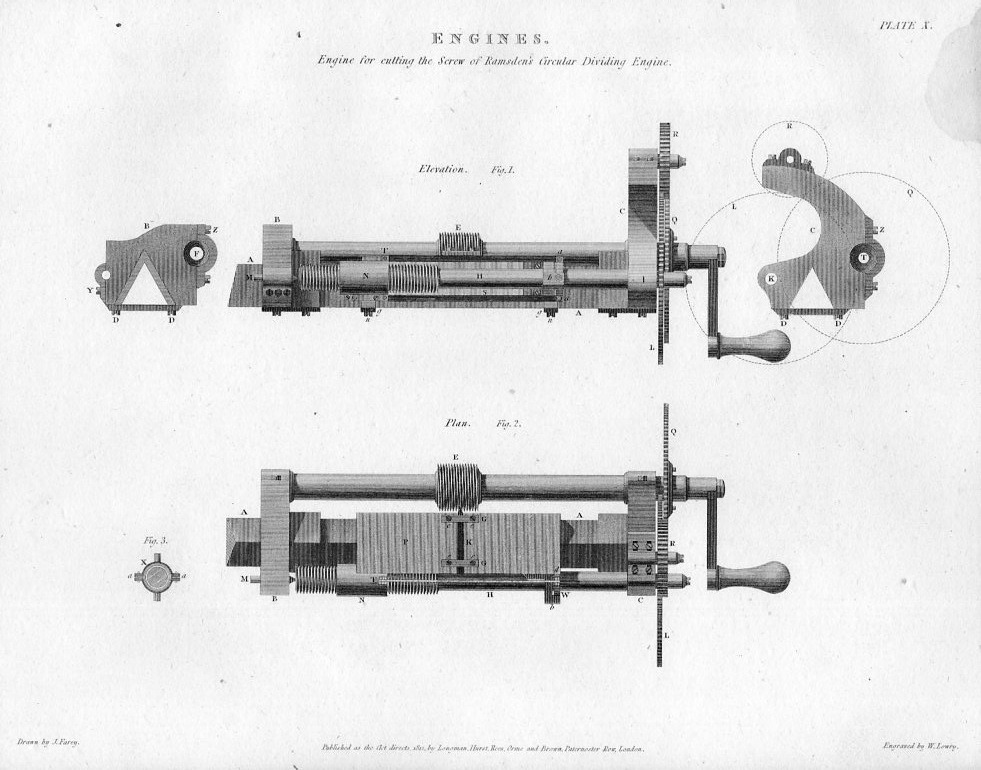
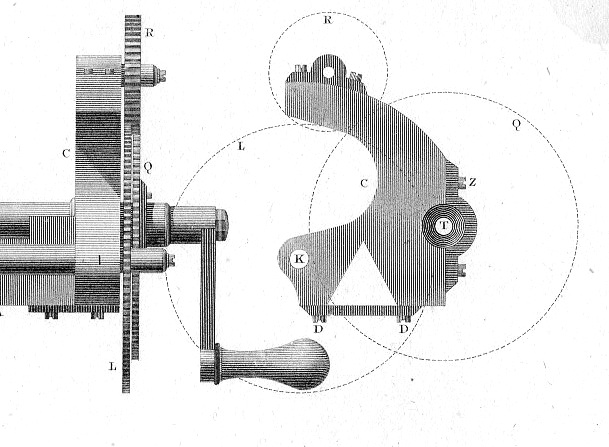
    What it really refers to here is a precision tool that whose effects were extremely wide felt but about which we don’t really hear about today.  This is the dividing engine of Jesse Ramsden,and Englishman who invented a circular instrument that would incise precise values on precision instruments like surveying compasses, delineate the linear and circular scales of measuring instruments used in astronomy and navigation,   Before Ramsden, the engraved marks on instruments would have been made by each individual manufacturer, each of those depending on marks that they made in the past, generations of such things in a line, over and over, a quite individualized effort, necessarily dependent upon the precision of each manufacturer. In 1777 Ramsden produced an instrument1 of exception precision that was correct and fine and dependable2. [The image above was found in Abraham Rees’ monumental Encyclopedic Dictionary…, and is entitled “Engine for cutting the screw of Ramsden’s Circular Dividing Engine” and was published in 1814.  Below is a detail of the plan for the winding of the gear works. In order for his machine to work at such a high degree of accuracy the component parts must also have been of a very high calibre–to that end Ramsden developed what is essentially the modern screw cutting lathe from which he manufactured the gear works for his Straight and Circular Dividing Engines.3]

    Ramsden387
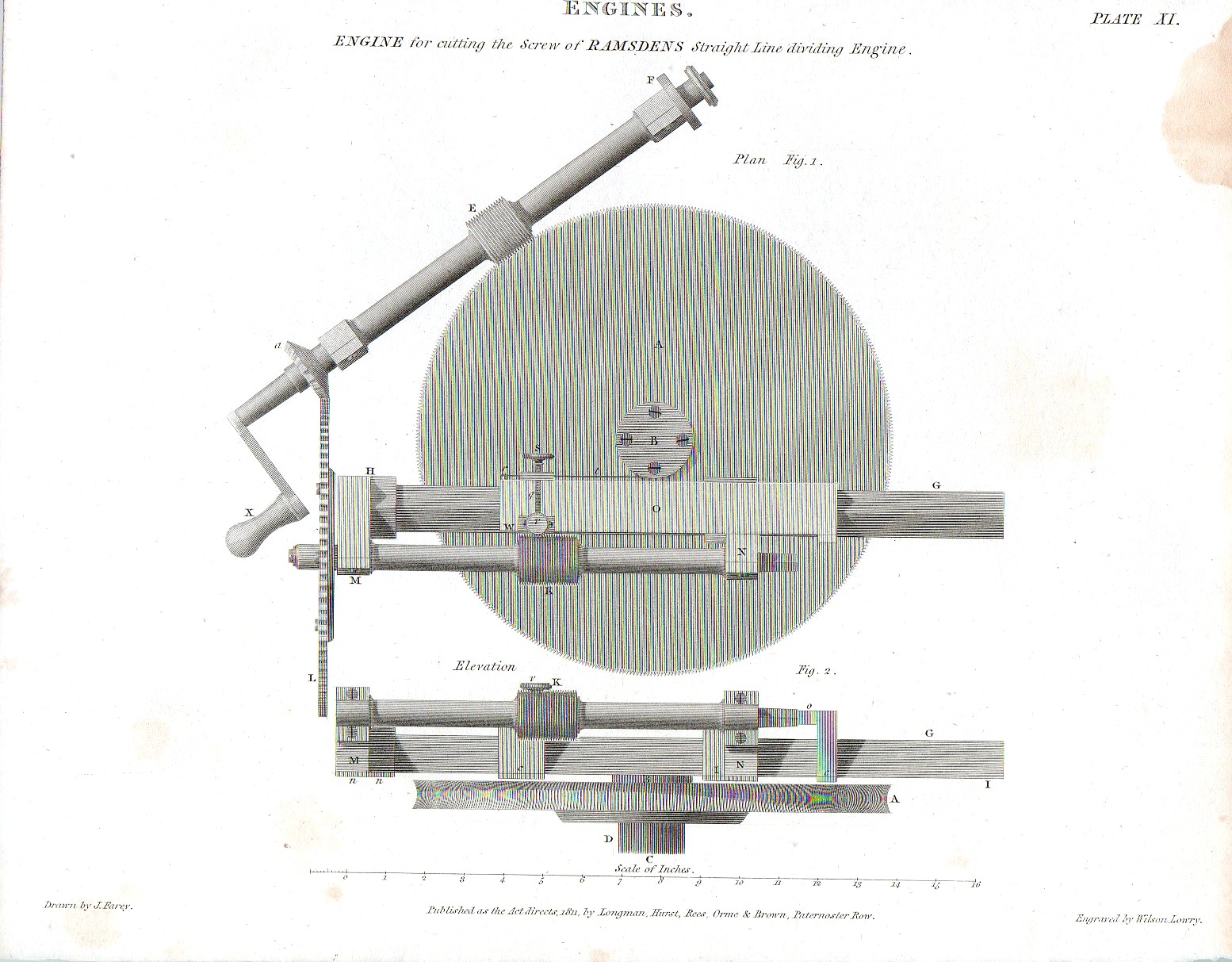
    And then there was the “Engine for cutting the Screw of Ramsden’s Straight Line Dividing Engine”, which is an absolutely gorgeous piece of drawing.  A person could crawl all over this image in varying degrees of microscopic inspection and find all sorts of beautiful internal images, a large example appears here:

    Ramsden388

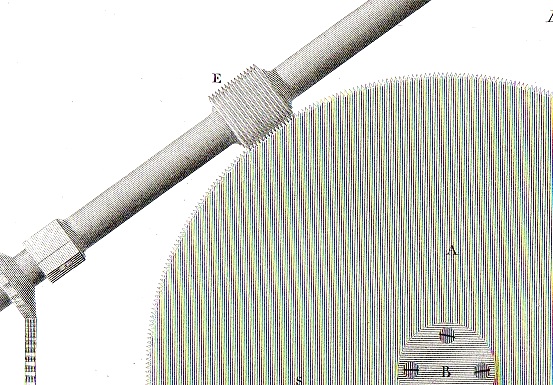
    And its fantastic detail:

    Ramsden389

    Basically though Ramsden’s inventions were key additions to the developing scientific technologies of the Industrial Revolution, integral improvements necessary for integral improvements. 

    Notes:

    1.  He published a Description of an Engine for dividing Mathematical Instruments in 1777.

    2. “The dividing engine was simple to operate. The instrument being divided was fixed to a large wheel on top of the engine. When the treadle was pressed, the wheel and the instrument were turned through a fixed angle. Then with the right hand, a cutting tool guided by a system of swinging links was used to mark the instrument scale. The process was repeated until the complete scale had been divided. Although this was many times faster than hand-dividing, it was backbreaking work having to lean over the engine to work on a small instrument.”-“Dividing Engine.” Smithsonian National Museum of American History. americanhistory.si.edu/collections/navigation/object.cfm?recordnumber=694508

    3. From WIki–“The first truly modern screw-cutting lathe was likely constructed by Jesse Ramsden in 1775. He appears to have been the first person to put a leadscrew into actual use (although, as Leonardo’s drawings show, he was not the first person ever to think of the idea), and he was the first to use diamond-tipped cutting tools.[2] His device also included a slide rest and change gear mechanism. These form the elements of a modern (non-CNC) lathe and are in use to this day. Ramsden was able to use his first screw-cutting lathe to make even more accurate lathes. With these, he was able to make an exceptionally accurate dividing engine and in turn, some of the finest astronomical, surveying, and navigational instruments of the 18th century.


  • Sticks as Gravestones? Fredericksburg, December 1862.

    JF Ptak Science Books     Post 1451

    “It is well that war is so terrible. We should grow too fond of it.”
            – General Robert E Lee, at the Battle of Fredericksburg

    I’ve been thinking a bit on the Civil War, the American Civil War, coming fast now on its 150th anniversary.  I’ve been looking at these stereocard photographs in the Library of Congress collection, and have been finding some interesting, troubling images.

    Fredericksburg

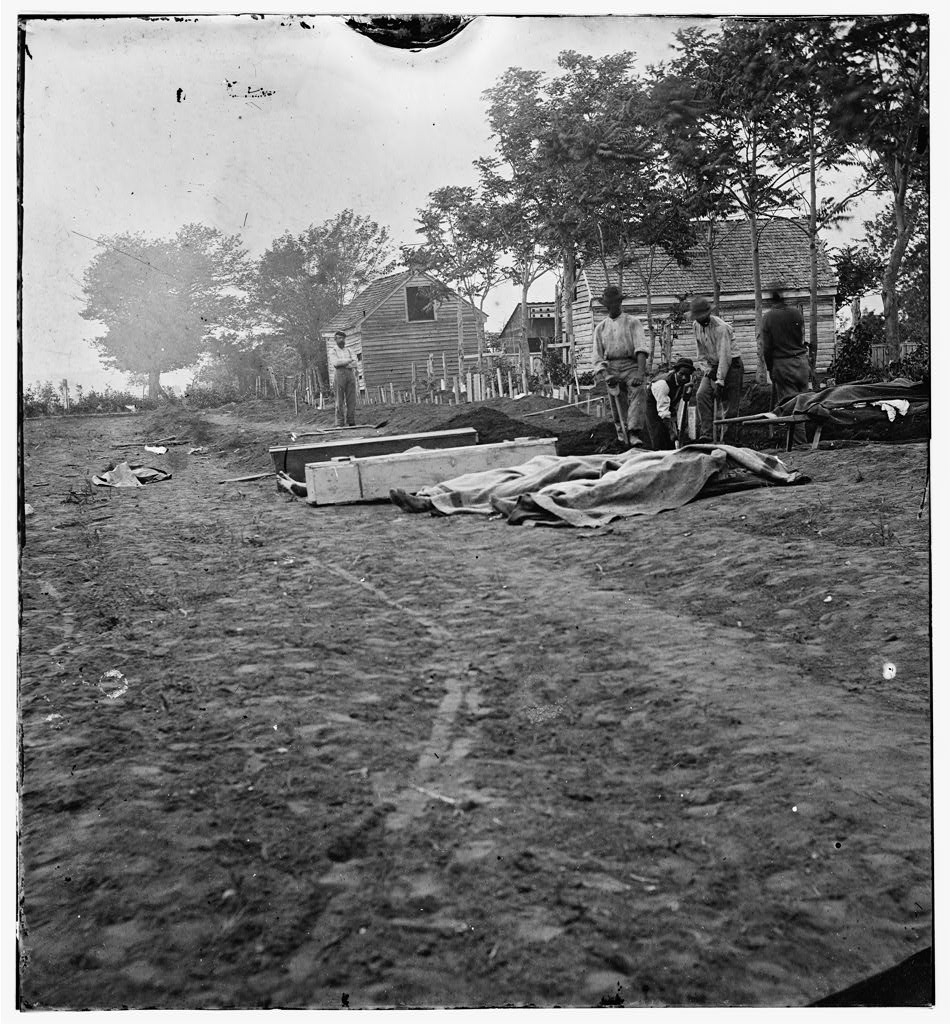
    This shows a burying detail at Fredericksburg

    Fredericksburg b
    This was a bad one for the Union.  IT was Lee against Burnside, Lee commanding the heights at Fredericksburg and making Burnside’s men pay dearly and forever for a bad plan–there were more than 13,000 Union casualties that day compared to about 5,000 for the Confederates, and was about the worst defeat suffered by the Union for the entire war, the outcome of two of the largest armies ever to meet for the entire conflict.  It is a famous battle and there is much about it all over the web.

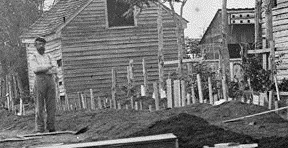
    I’m just looking at the sticks in the background of this photograph, over the shoulders of the African American gravediggers, just to the left of the man with the crossed arms.  Who was this?  He has no uniform, and is a bit older–but there is a shovel at his feet.  Maybe he is from the town, maybe he’s just watching.  But just to his left,  is a little rise of what looks like fresh dirt.  At the head are those narrow sticks, of all different sizes, and place at differing intervals. 

    Fredericksburg c

    But these sticks are in a straight line.   Are they temporary grave markers?  But they’re so close together–perhaps this is a mass grave.  Perhaps these markers at placed at where the heads of these soldiers are, laid shoulder to shoulder in a big pit, covered up.

    The grave detail seems to me to be standing in a pit, a shallow one.  I don’t know what else this could be.

    There are too many short, stubby sticks for this to be a simple fence of found wood.  I think that they are temporary headstones.  I realize these people were dealing with an horrific situation with very, very limited means, and that even getting stakes of wood for thousands of graves would’ve been a deep chore–but still, those stubby little bits of wood bother me.

    Mr. Shelby Foote in volume two  (“from Fredericksburg to Meridian”) of his spectacular The Civil War, A Narrative described a bit of the battle below.  My memory of reading this in Foote about this battle (my reading now more than 20 yeqars old) is mostly gone, but the overall impression of Foote’s painting was Lee looking out over the battlefield as the fog–which had enshrouded it all all morning long–had lifted.  That was the end of it for the Union army, the sun heating things up a bit, burning off the protective layer of fog, heating it up enough there in the middle of December to cause terrific havoc.  How would the parting fog and what it revealed underneath be seen in the mind of R.E. Lee?  He must have felt instantly that the day would be his. 

    “Defensively speaking, indeed, the record of Confederate arms could scarcely have been improved. Of the three objectives the Federals had set for themselves, announcing them plainly to all the world by moving simultaneously against them as 1862 drew to a close, Vicksburg had been disenthralled and Chattanooga remained as secure as Richmond. Davis himself had done as much as any man, and a good deal more than most, to bring about the result that not a single armed enemy soldier now stood within 50 airline miles of any one of these three vital cities. “
    “Of all these various battles and engagements, fought in all these various places, Fredericksburg, the nearest to the national capital, was the largest — in number engaged, if not in bloodshed — as well as the grandest as a spectacle, in which respect it equaled, if indeed it did not outdo, any other major conflict of the war. Staged as it was, with a curtain of fog that lifted, under the influence of a genial sun, upon a sort of natural amphitheater referred to by one of the 200,000 participants, a native of the site, as “a champaign tract inclosed by hills,” it quite fulfilled the volunteers’ early-abandoned notion of combat as a picture-book affair.”–Shelby Foote, The Civil War, a Narrative. Volume 2.

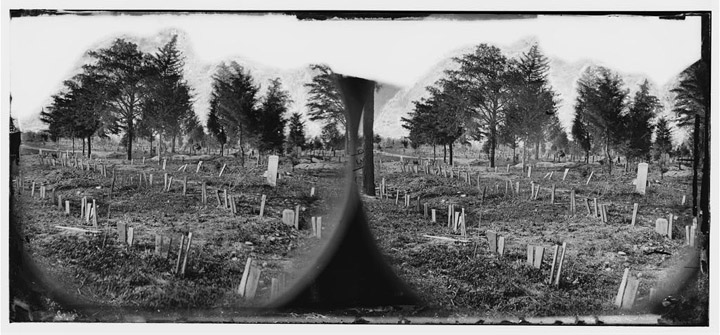
    My thanks to Rich Lewis for finding another temporary burial site:

    Confederate graves
    “
    Graves of Confederate Soldiers with Wooden Markers, Richmond 1865″