A Daily History of Holes, Dots, Lines, Science, History, Math, Physics, Art, the Unintentional Absurd, Architecture, Maps, Data Visualization, Blank and Missing Things, and so on. |1.6 million words, 7500 images, 4.9 million hits| Press & appearances in The Times, Le Figaro, Mensa, The Economist, The Guardian, Discovery News, Slate, Le Monde, Sci American Blogs, Le Pont, and many other places… 5000+ total posts since 2008.

  • First Appearance in Print of the Terms “Relativity Theory” and “Theory of Relativity” 1906

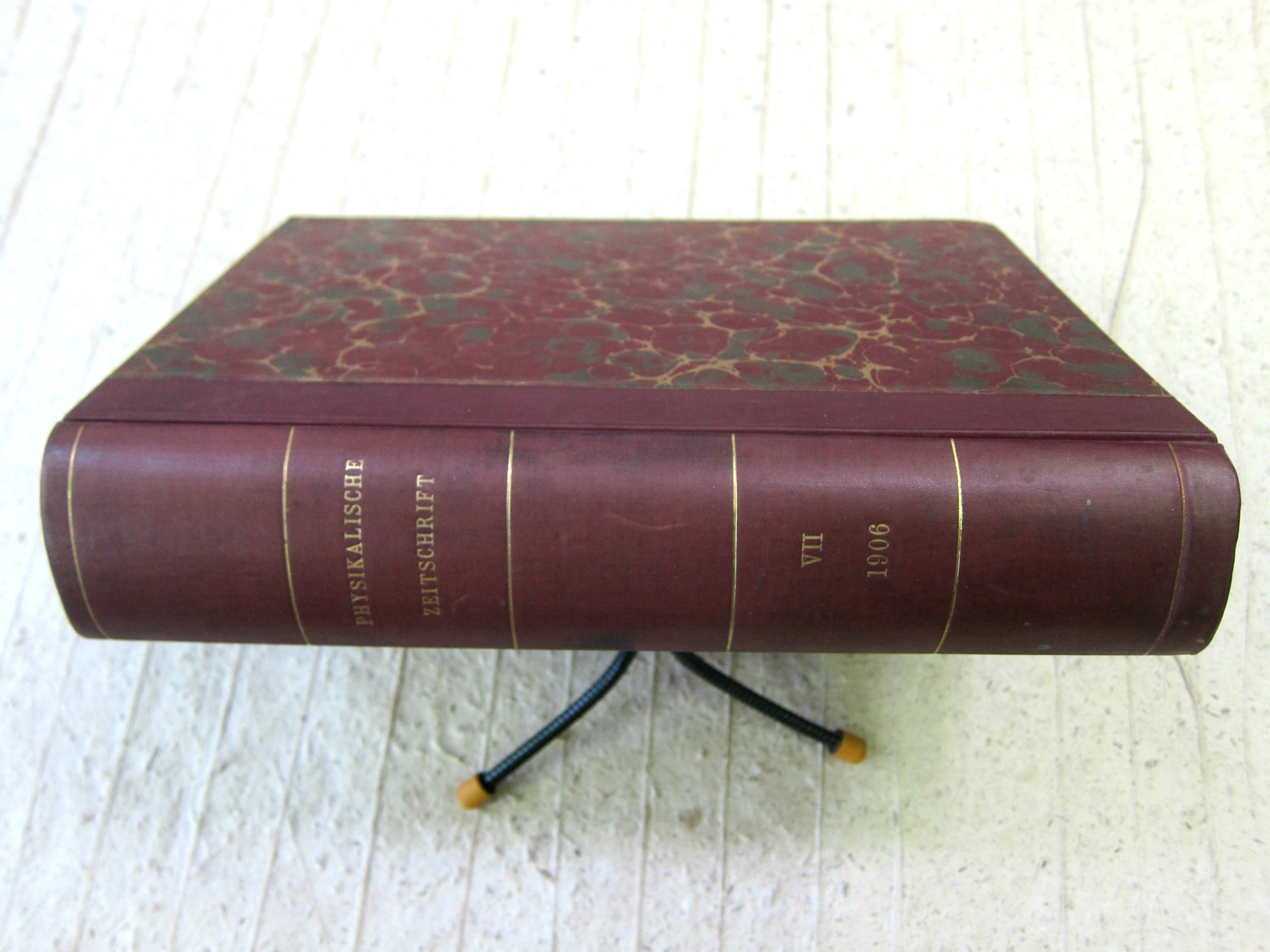
    Planck, Max. “Die Kaufmannschen Messungen der Ablenkbarkeit der β-Strahlen in ihrer Bedeutung für die Dynamik der Elektronen” [The Measurements of Kaufmann on the Deflectability of β-Rays in their Importance for the Dynamics of the Electrons], in Physikalische Zeitschrift, Leipzig, Hirzel, 1906, volume VII, the paper occupying pp 753-761 (printed in double columns). Offered in the full volume of 976pp. Period (? or thereabouts) cloth-backed marbled boards, very sturdily bound. Owner’s bookplate, plus five or so 1” rubber stamp owner’s marks on title page and a few plates, otherwise this would be a FINE copy. With those stamps being very slightly detracting, an overall VG grade. $450

    Einstein relativtheorie

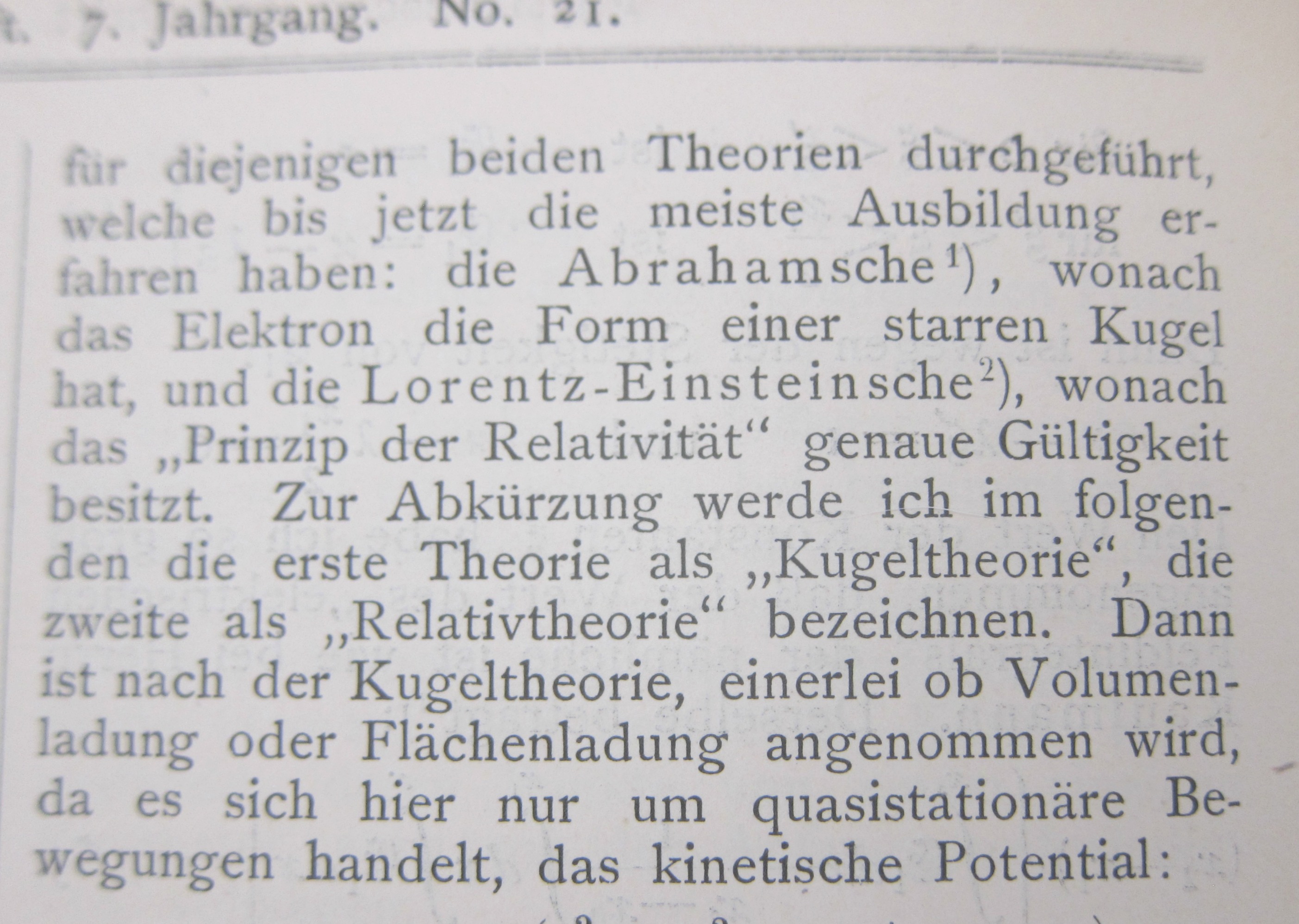
    Prior to using the words “postulate” and “principle” associated with relativity (as in Prinzip der Relativitat” (appearing in the second paragraph of Einstein’s June 1905 “Zur Elektrodynamik bewegter Körper” in Annalen der Physik) is first referred to as “relativity theory” (“Relativtheorie”) by Max Planck on p. 756 (col 2 line 9 and also on pp 758+759) of this volume. Then in the “discussion” part of the Planck paper the“theory of relativity” (“Einsteinische Relativitatstheorie”) appears for the first time in print just a few pages later (p. 760 col 2 line 15) by Alfred Bucherer.

    There are other papers of relativity in VII including Wacker (p 300), Farkas (p 654), Stark (p 353), and Wilkens (p. 846).

    • “The term “theory of relativity” was based on the expression “relative theory” (German: Relativtheorie) used in 1906 by Planck, who emphasized how the theory uses the principle of relativity. In the discussion section of the same paper, Alfred Bucherer used for the first time the expression “theory of relativity” (German: Relativitätstheorie).”–Wikipedia

     An excellent resource for this period: Miller, Arthur I. (1981), Albert Einstein’s special theory of relativity. Emergence (1905) and early interpretation (1905–1911)

    Phys Zeit 1906 vol 7

    ·Posted by :

    ·in:

    —
  • Early Works in the Physical Review on the Theory of Relativity (1912)

    Carmichael, R.D.  “On the Theory of Relativity: Analysis of the Postulates” and bound with:

    Tolman, Richard C. “Some Emission Theories of Light”,  both in the Physical Review, volume 35, 1912, pp 136-143 and 153-176, respectively, in the bound volume for July-December of 494pp. Also: an interesting paper by Arthur L. Foley and Wilmer Souder, “Photographing Sound waves”, with five photo plates, pp 375-386. Bound in green cloth. Provenance: U.S. Geological Survey, with their bookplate.  Although an ex-library copy, the only markings are the bookplate, a paper “strap” on the front paste down, and an old paper label on the spine. 

    Scarce–early issues of the PR are not much around. $150

    • Carmichael published at about this same time in 1912 a paper of the same title in the Bulletin of the American Mathematical Society; his book Relativity, published in 1913, is the first book to be published on the subject.
    • It looks like the first relativity-related paper appears in the PR in 1908 with Gilbert Lewis “Non-Newtonian Mechanics” , vol 27 p 578. and then in vol 28 again, this time with Lewis writing with Richard Tolman (“Non-Newtonian Mechanics and the principle of Relativity”).  There seem to be only seven other papers on relativity in the PR preceding these two. According to Lecat’s Bibliographie de la Relativite (1924) there were about 175 papers published worldwide in scientific periodicals on relativity in 1912. 

    ·Posted by :

    ·in:

  • A Great Classic in the History of Superconductivity–the BCS THeory

    Bardeen, J.L., L.N. Cooper, and J.R. Schrieffer. “Theory of Superconductivity” in the Physical Review, volume 108, Number 5, 1957, p.1175-1204 in the issue of pp 1357-1682, in the bound volume for #108, pp 913-1696, for November-December 1957. In a sturdy and attractive red cloth. Provenance: National Bureau of Standards Library, with their name gilt stamped on the spine bottom. save for some remnants of the paper spine label, this is a lovely, fresh copy. Offered with the issues # 4, 5, and 6 bound together, with their original wrappers bound in at the end. Each wrapper cover has a somewhat faded and small rubber stamp of the NBS $750 . 

    The Nobel Prize in Physics 1972 was awarded jointly to John Bardeen, Leon Neil Cooper and John Robert Schrieffer “for their jointly developed theory of superconductivity, usually called the BCS-theory”, a classic foundation paper of superconductivity and referenced some 13,000+ times.

    “The Bardeen-Cooper-Schrieffer theory (BCS), published in July 1957, proved to be the triumphant solution of the problem which for four and a half decades had stumped all the best theorists in the world.”–Dictionary of Scientific Biography

    “BCS theory or Bardeen–Cooper–Schrieffer theory (named after John Bardeen, Leon Cooper, and John Robert Schrieffer) is the first microscopic theory of superconductivity since Heike Kamerlingh Onnes’s 1911 discovery. The theory describes superconductivity as a microscopic effect caused by a condensation of Cooper pairs into a boson-like state. The theory is also used in nuclear physics to describe the pairing interaction between nucleons in an atomic nucleus.”–Wikipedia

    “BCS theory, in physics, a comprehensive theory developed in 1957 by the American physicists John Bardeen, Leon N. Cooper, and John R. Schrieffer (their surname initials providing the designation BCS) to explain the behaviour of superconducting materials. Superconductors abruptly lose all resistance to the flow of an electric current when they are cooled to temperatures near absolute zero.” Encyclopedia Britannica

    “The turn in the team’s work on superconductivity came in the last days of January 1957, soon after Bardeen returned from Stockholm. While riding on a subway in New Jersey, Schrieffer wrote down a promising expression for the superconducting ground state wave function. Recognizing the implications, Bardeen moved the team into an intense period of work in which the three feverishly computed all the relevant experimental quantities, including the energy gap and the second-order phase transition. The Bardeen-Cooper-Schrieffer theory (BCS), published in July 1957, proved to be the triumphant solution of the problem which for four and a half decades had stumped all the best theorists in the world.”–Dictionary of Scientific Biography

    See also the very extensive BCS 50 Years by Leon Cooper and D. Feldman, from World Scientific. (Cooper recalls, for example, that when John Bardeen was looking for a post doc to work with him on superconductivity in 1955, that he had never heard of superconductivity before.)

    Also: Lillian Hoddeson, “John Bardeen and the Theory of Superconductivity: A Study of Insight, Confidence, Perseverance, and Collaboration”,  October 2008, Volume 21, Issue 6, pp 319–327|  Journal of Superconductivity and Novel Magnetism.

  • The Complete Sextet of Schwinger Papers on Quantized Fields, 1951-1954

    Julian Schwinger. Theory of Quantized Fields, I-VI, six parts in five issues, 1951-1954.

    “On 13 June 1978 the Nobel laureate Chen Ning Yang wrote the following to the chairman of the physics department at the University of California, Los Angeles (UCLA) to support Julian Schwinger’s appointment as professor: ‘Professor Julian Schwinger is among the great physicists of the contemporary era. His work covers an amazing range, from nuclear physics to elementary particle physics to field theory, from synchrotron radiation to group theory to microwave propagation.… The most important work of Schwinger was his contribution to renormalization, a contribution that stands among the greatest developments in physics in mid-twentieth century. Professor Schwinger is an eminently successful teacher. He probably has graduated more influential theoretical Ph.D. students than any other living physicist’.”-DSB

    Including:

    “Theory of Quantized Fields. I”. In Physical Review, vol 82 number 6, June 15, 1951. Pp 914-927 in the issue of pp 777-1016. Original wrappers. VG/VG+ copy.  Copy of Al Wattenberg, with his “AW” in the upper right corner.  1000+ citations. 

    “Theory of Quantized Fields. II and III” In Physical Review, volume 91 number 3, August 1, 1953, pp 713-728 and 728-740 in the issue of pp 505-772. Original wrappers. This issue has some problems with the spine cover and the inch or so onto the front wrapper a sort of damp staining or some such. Copy of Al Wattenberg, with his signature on the upper right front wrapper.

    “Theory of Quantized Fields. IV.” In Physical Review,  volume 92 number 5, December 1, 1953, pp 1283-1300 in the issue of pp 1101-1329. Original wrappers. Fine copy.  

    “Theory of Quantized Fields. V.” In Physical Review, volume 93 number 3, February 1, 1954, pp 615-628 in the issue of pp 365-651.  Original wrappers. VG/VG+ copy.  

    “Theory of Quantized Fields. VI.”  In Physical Review, volume 94 number 5, June 1, 1954, pp 1362-1384 in the issue of pp 1091-1444.  Original wrappers. Fine copy. 

    The five issues: $750

    ·Posted by :

    ·in:

    —
  • General Relativity and Flat Space (1940)

    Nicholas Rosen, “General Relativity and Flat Space I” and “General Relativity and Flat Space II” and “Note on Ether-Drift Experiments”, the three papers in the Physical Review, volume 57, number 2, January 15, 1940, occupying pp 147-155 in the issue of pp 75-162. Original wrappers.   Solid, fresh, Very Good copy.  $200

    • Also in this issue J.R. Oppenheimer, H. Snyder and R. Serber, “Production of Soft Secondaries by Mesotrons”.  

    ·Posted by :

    ·in:

  • A Significant Paper by the Great John A. Wheeler (1937)

    Wheeler, John. “On the Mathematical Description of Light Nuclei by the Method of Resonating Group Structure”, Physical Review; Volume 52 No. 11, pp. 1107-1122 in the issue of pp 1079-1200. Offered in the original wrappers, a good fresh, crisp copy. The detraction here is some wear along the spine, which obscures much of the word “Review”; there’s also two small chips missing from the spine top and bottom. VG copy. $250

    “In a 1937 paper “On the Mathematical Description of Light Nuclei by the Method of Resonating Group Structure”, Wheeler introduced the S-matrix – short for scattering matrix – “a unitary matrix of coefficients connecting the asymptotic behavior of an arbitrary particular solution [of the integral equations] with that of solutions of a standard form.” Werner Heisenberg subsequently developed the idea of the S-matrix in the 1940s. Due to the problematic divergences present in quantum field theory at that time, Heisenberg was motivated to isolate the essential features of the theory that would not be affected by future changes as the theory developed. In doing so he was led to introduce a unitary “characteristic” S-matrix, which became an important tool in particle physics.”–Wikipedia entry on Wheeler. 

    (I just wanted to point out here that only seven years passed between the time that Wheeler graduated from high school and receiving his Ph.D., in 1933, at age 22. He published his first scientific paper in 1930, at age 19. Two years after this 1937 paper was published, Wheeler wrote a paper with Niels Bohr explaining the mechanism of nuclear fission (on the day that Germany invaded Poland).

    ·Posted by :

    ·in:

  • The Einstein-Cartan Theory (1922)

    Cartan, Elie. SIX gravitation papers from 1922, as follows: “Sur une définition géométrique du tenseur d’énergie d’Einstein”; bound with “Sur une généralisation de la notion de courbure de Riemann et les espaces à torsion”; bound with “Sur les espaces généralisés et la théorie de la Relativité”; bound with “Sur les espaces conformes généralisés et l’Univers optique”; bound with “Sur les équations de structure des espaces généralisés et l’éxpression analytique du tenseur d’Einstein”, all together in a two-brick-sized volume of the Comptes Rendus Hebdomadaires des Séances de L’Academie des Sciences, volume 174, January-June 1922, with the Cartan papers occupying 437-439, 593-595, 734-737, 857-60, and 1104-1107 in the volume of 1815pp.

    ALL with their ORIGINAL FRONT WRAPPERS bound at the end of the volume.

    Also offered with a sixth paper:

    Cartan, Elie. “Sur un theoreme fondamental de M.H. Weyl dans la theorie de l’espace metrique”, in Comptes Rendus, 1922, volume 175, number 2, pp 81-5. This is offered disbound from a  larger volume, but with the original front wrapper.  

    The volume bound in cloth with the previous owner/institution name gilt stamped at the spine bottom (“U.S. Weather Service”). The covers have some general wear and scuffing, and the text is printed on relatively skimpy post-war-affected paper stock (as is the case with the CR for most of the 1920’s and into the Depression years of the 1930’s). That said, this is a Good Copy. $950

    “Cartan was one of the most profound mathematicians of the last hundred years, and his influence is still one of the most decisive in the development of modern mathematics…”–Complete Dictionary of Scientific Biography

    Cartan had just attended (on 6 April 1922) the Societe Francaise de la Philosophie (founded in part by Henri Poincare) “for a discussion of the general and special theories of relativity”.   (Pais, Subtle is the Lord, p. 163) Also in attendance were Hadamard, Painleve, Jean Becquerel, Einstein, , Langevin, Bergson, Meyerson, and numerous others. Pais also points out (on page 340) that via this work that Einstein’s “labors had a major impact on mathematics”. “…Cartan was the first to introduce nonsymmetric connections…there is considerable interest by general relativitists in theories of this kind, called Einstein-Cartan theories…their main purpose is to link torsion to spin…” (Pais, p 344.)

    “Albert Einstein became affiliated with the theory in 1928 during his unsuccessful attempt to match torsion to the electromagnetic field tensor as part of a unified field theory. This line of thought led him to the related but different theory of teleparallelism…Einstein–Cartan theory has been historically overshadowed by its torsion-free counterpart and other alternatives like Brans–Dicke theory because torsion seemed to add little predictive benefit at the expense of the tractability of its equations. Since the Einstein–Cartan theory is purely classical, it also does not fully address the issue of quantum gravity. In the Einstein–Cartan theory, the Dirac equation becomes nonlinear and therefore the superposition principle used in usual quantization techniques would not work. Recently, interest in Einstein–Cartan theory has been driven toward cosmological implications, most importantly, the avoidance of a gravitational singularity at the beginning of the universe. The theory is considered viable and remains an active topic in the physics community.” –Wikipedia entry for Einstein-Cartan Theory, which also identifies the essential papers as “Cartan, E. (1922). Comptes Rendus 174, 437–439, 593–595, 734–737, 857–860, 1104–1107”.

    Three of the five papers are referenced in Lecat’s Bibliographie de la Relativite  (1924) #404-406, pg 18. 

    _____. ANOTHER Copy, without the original wrappers.  

    The volume bound in cloth and paper boards, and is from an institutional library in Baltimore, though with very minimal library markers. The text is printed on relatively skimpy post-war-affected paper stock (as is the case with the CR for most of the 1920’s and into the Depression years of the 1930’s). That said, this is a Very Good Copy. $400

    ·Posted by :

    ·in:

    —
  • Review of the First English Edition of a Great Classic in Chemistry (1891)

    (Mendeleleeff) “Mendeleeff’s Principles of Chemistry. The Principles of Chemistry…Translated from Russian (fifth edition) by George Kamensky, edited by A.J. Greenaway…”  by “T.E.T”. This is a book review of the English version of this great classic, appearing in Nature, volume 45, April 7, 1892, pp 529-30 in the issue of pp 529-552. Original wrappers, removed from a larger bound volume. Very Good copy. $75

    From the opening paragraph: “All English-speaking chemists will cordially welcome the appearance of this book, if for no other reason than because its author in its preparation was led to the recognition of that fundamental principle of chemistry with which his name will always be associated—the principle which is embodied in what is now known as the periodic law. This fact alone would serve to stamp the book as one of the classics of chemical science. But, even apart from this circumstance, the work has very remarkable, and, indeed, exceptional, merits. Probably no scientific treatise ever more strikingly reflected the personality of its author. We have absolutely nothing like it in our language. In grasp of principles, in philosophic breadth, in copiousness of detail, in richness of speculation and suggestion, it is altogether unique among chemical manuals.”

    ·Posted by :

    ·in:

  • A Great Moment in the History of Quantum Mechanics (Niels Bohr, 1928)

    Niels Bohr, “Das Quantenpostulat und die neurere Entwicklung der Atomistik”, in Die Naturwissenschaften, volume 16, part 15, 13 April 1928, pp 245-255 in the issue of pp 245-268. This is the complete weekly issue, without the wrappers, removed from a larger bound volume. Very Good condition.  $500

    ”From the epistemological point of view, the discovery of the new type of logical relationship that complementarity represents is a major advance that radically changes our whole view of the role and meaning of science. In contrast with the nineteenth-century ideal of a description of the phenomena from which every reference to their observation would be eliminated, we now have the much wider and truer prospect of an account of the phenomena in which due regard is paid to the conditions under which they can actually be observed—thereby securing the full objectivity of the description, since the description is based on purey physical operations intelligible and verifiable by all observers. The role of the classical concepts in this description is obviously essential, since those concepts are the only ones adapted to our capabilities of observation and unambiguous communication.

    ·Posted by :

    ·in:

    —
  • An Early Printing In English of Alexander Graham Bell’s Account of the First Unmanned Heavier-than-Air Sustained Powered Flight, 1896

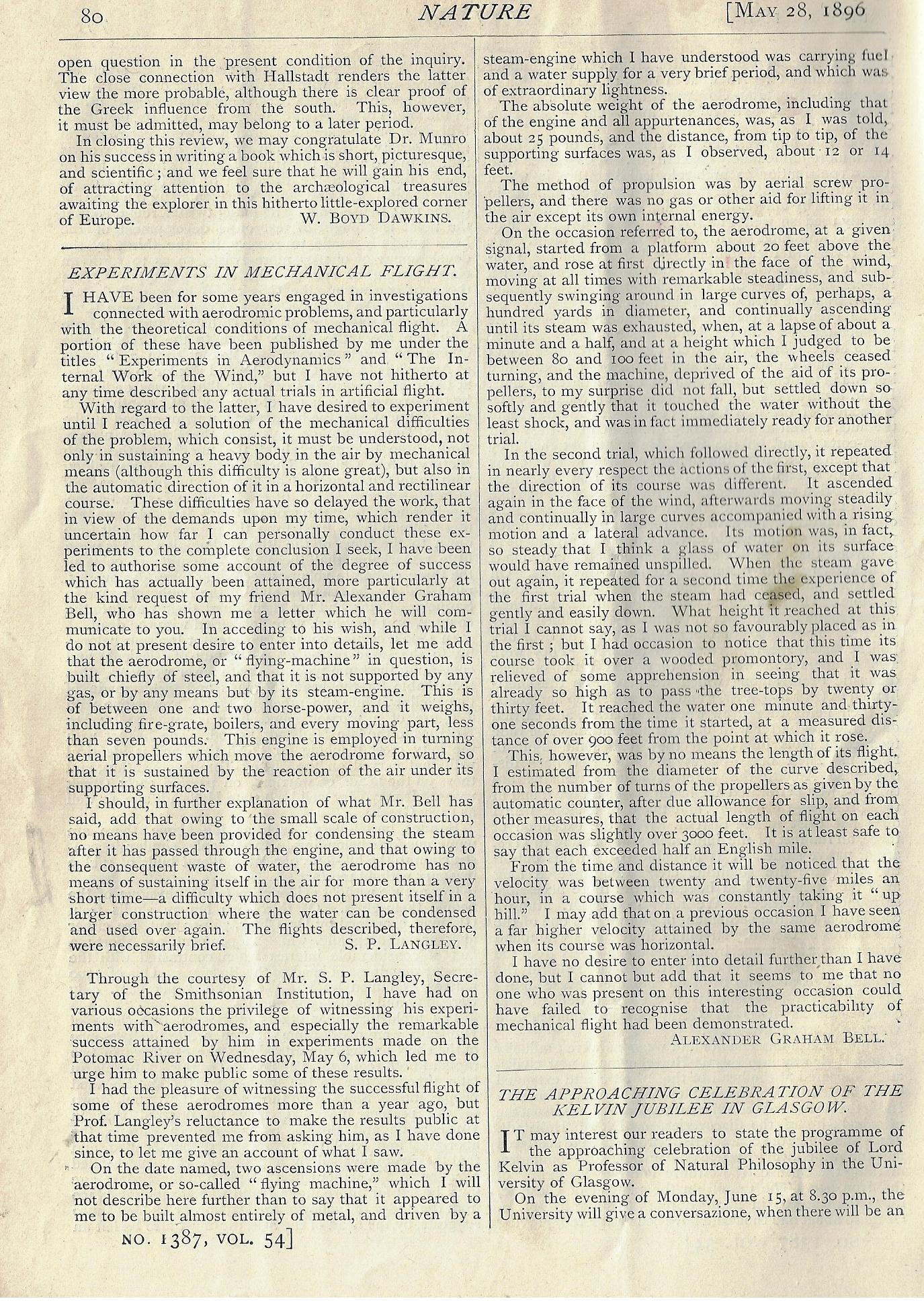
    Langley, Samuel Pierpont and Alexander Graham Bell. “Experiments in Mechanical Flight”, in Nature, volume 54, May 28, 1896, page 80 in the issue of pp 73-96. Offered is the weekly issue in the original wrappers (cover plus 3pp of advertisements), removed from a larger bound volume. Provenance: this is a good association copy as it comes from the Langley’s own Smithsonian Institutions’ Astrophysical Observatory, via the Library of Congress. Condition: there are two vertical pressure marks that run through the volume—they are very light, but they are definitely visible. GOOD+ copy  $250

    This is the first printing of the famous flight in English in Great Britain and Europe, appearing in Nature, May 28, 1896.

    • The first report on the flight seems to have been in Science, May 22, 1896, according to Brockett’s Bibliography of Aeronautics, #7160.
    • The first report of the flight to appear in Europe appeared two days earlier in Comptes Rendus, vol 122, May 26, 1896, p 1179. The contents of the report is mostly the same, though there are differences, particularly in the second to last paragraph, speaking of the gentleness of the plane gliding after the engine terminated. The last few sentences, with Bell’s famous statement, is pretty much the same. (“Il me semble que personne n’aurait pu assister à cet intéressant spectacle sans être convaincu que la possibilité de voler dans l’air à l’aide des moyens mécaniques venait d’être démontrée.”)
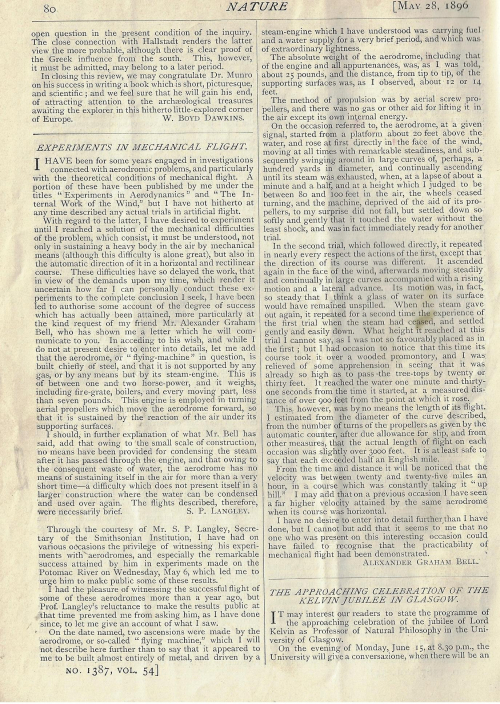
    Langley textI think most people remember Langley as the (Third) Secretary of the Smithsonian Institution and for his work in astrophysics and observational astronomy, but he was a significant figure in the history of aviation, publishing his first extended work in the field in Experiments in Aerodynamics in 1891, and became one of the first if not the first aerodynamics experimenter in the U.S. He was also the first government-sponsored in-house researcher in this field.

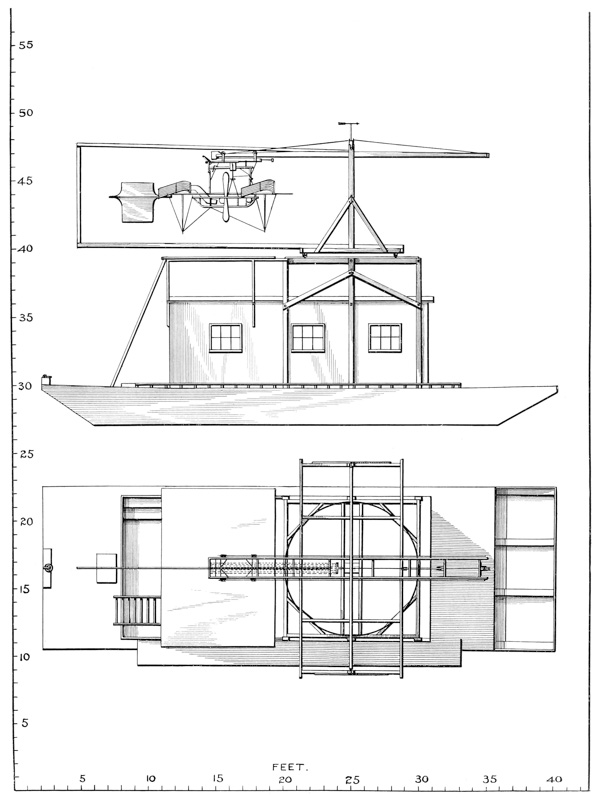
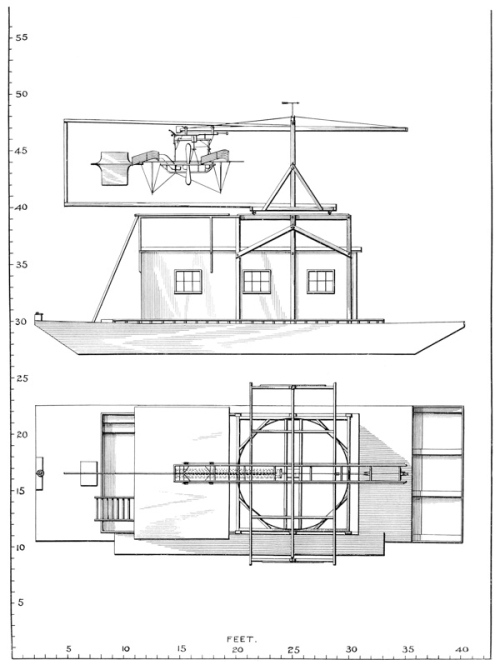
    Langley’s  historic experiments in May 1896 with his 13′-wide Aerodrome 5 took place on a makeshift “houseboat” (“…nothing more than a scow about 30 feet long by 12 feet wide, upon which a small house was erected, to be used for the occasional storing of the aerodromes…”)1 moored in the Potomac River a few miles south of D.C. near Quanitco, Virginia. There was one witness to this affair, Langley being very concerned for privacy, particularly not wanting news of failures to reach a general audience. His guest observer was his old friend, Alexander Graham Bell, who had already witnessed some of Langley’s earlier attempts with models and made monetary contributions to help fund the larger enterprises. Langley had no interest in making the report—though he did invite Bell to do so. And it is the second part of this short, two-part paper in which Bell’s observations appear.

    Langley’s own description of the aircraft appeared in his Mechanical Flight2 : “The aerodrome was built chiefly of steel, though lighter material entered into the construction, so that its density as a whole was a little below unity. No gas whatever entered into the construction of the machine, and the absolute weight, independent of fuel and water, was about 11 kilos (24 pounds). The width of the supporting surfaces was about 4 metres (13 feet), and the power was furnished by an extremely light engine of approximately one horse-power. There was no one to direct it on board, and the means for keeping it automatically in horizontal flight were not complete. It is important to remark that the small dimensions of the machine did not allow it to include any apparatus for condensing the steam, so that it could only carry water enough for a very brief course—a drawback which would not be encountered in one of a larger construction.”

    Bell’s description of the aircraft: “On the date named two ascensions were made by the aerodrome, or so-called “flying machine,” which I will not describe here further than to say that it appeared to me to be built almost entirely of metal, and driven by a steam engine which I have understood was carrying fuel and a water supply for a very brief period, and which was of an extraordinary lightness.” And “The method of propulsion was by aerial screw propellers, and there was no gas or other aid for lifting it in the air except its own internal energy…The absolute weight of the aerodrome, including that of the engine and all appurtenances, was, as I was told, about twenty-five pounds, and the distance from tip to tip of the supporting surfaces was, as I observed, about twelve or fourteen feet3.”

    The flying experiment began, and much to the delight of Langley, Bell, and the men who fished previous flying efforts from the Potomac, the two Aerodrome 5 flights for the day were successful. The first flight brought the steam-driven, one-quarter-scale model made a half mile at altitudes of up to 100 feet, marking it the world’s first flight of its type. The second flew longer, and faster, and Bell was much impressed by the serenity of the plane’s descent once the engine exhausted its fuel, turning the plane into a glider that touched lightly down onto the Potomac.

    Bell was thrilled with the display, and recorded what he felt:

    • The flying machine “resembled an enormous bird, swooping steadily upward in a spiral path until it reached a height of about 100 feet in the air.”

    And then, Bell famously observed:

    • “It seems to me that no one who was present on this interesting occasion could have failed to recognize that the practicability of mechanical flight had been demonstrated.”

    The once-reticent Langley himself writes an account of the event in “The Flying Machine” in the June 1897 issue of McClure’s (vol IX/2)–this was a very public article in a very popular magazine that also featured a drawing of the aerodrome right on the front cover.  The article also includes the Bell observations as well as the first printing of the photograph that Bell made of the second flight, the first of its kind, though it is really a drawing after the photograph, the photo itself used as proof of the event and the drawing done to enhance that. The coverage of the event and the Bell statement also appears in the Smithsonian Reports for 1896 (published in 1897). Later, Scientific American Supplement #1404 , Nov 29, 1902, reprints the Bell observations and other historical statements in “The Langley Aerodrome”.  
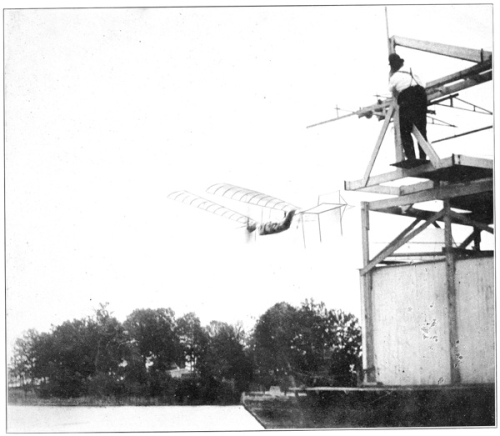
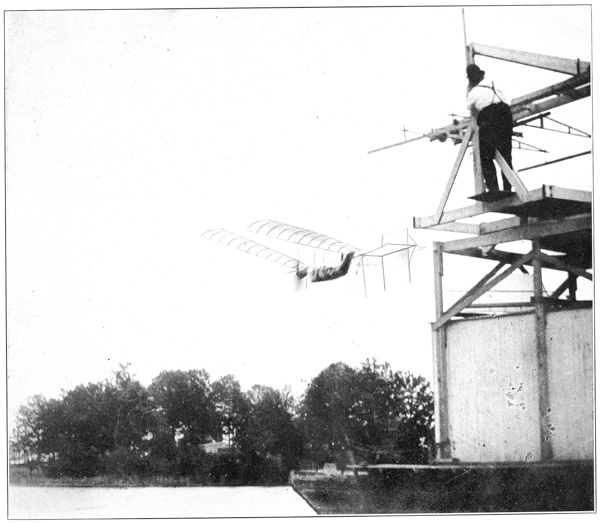
    Langley flightThe Aerodrome 5 in flight. Image via Langley’s 1911 Experiments…(see below; the image is not in the Nature article)

    Even in the face of support of U.S. presidents and stipends from the military, and with mounting successes, the public failures of his expanded, full-size Aerodrome 6 in 1903 proved to be too much for Langley and his supporters, and he retired from this field. Just two weeks later (December 17) the Wrights made their historic flight at Kitty Hawk–they were successful in many of the ways that Langley was not and made the first manned, powered, controlled, and sustained flight. Early aviation expert Tom Crouch of the National Air and Space Museum remarked that “The problem was the machine itself and Langley’s approach…he did just about everything wrong that the Wright brothers did right. “4

    That said, John D. Anderson Jr in the AIAA Journal states that it must not be overlooked that “[Langley] made extensive use of aerodynamic coeffcients and legitimately shares with Lilienthal the credit for introducing the concept of lift, drag, and resultant force coeffcients to the applied aerodynamics community. His data are the first substantive proof of the aerodynamic superiority of high-aspect-ratio wings over those with low aspect ratio; it is curious that Langley is not widely recognized for this important contribution.”  And significantly, “the work did serve a very useful purpose. The fact that a man of Langley’s stature believed in the possibility of the flying machine was enough to convince most laymen that aeronautics was no longer the pastime of fools.”5

    NOTES

    1. Samuel P. Langley and Charles Manly (editor), Langley Memoir in Mechanical Flight, Smithsonian Contributions to Knowledge, Washington, D.C., 1911. Part I (Langley), 1887-1896; Part II (Manly), 1897-1903. 
    2. _____. Langley, p. 123.
    3. From the Nature article, quoted above.
    4. Lee Wolff, “First in Flight (Almost)”, http://www.chopawamsic.com/First%20Flight.htm
    5. John D. Anderson Jr., “ Langley’s Aeronautical Research: A Modern Critique and Reassessment”, AIAA JOURNAL Vol. 35, No. 3, March 1997 Historical Review Paper.

    The extended  quote by Bell in the last three paragraphs from the Comptes Rendus:

    “La durée du vol, dans le second essai, fut d’une minute et trente-une secondes et la vitesse moyenne entre vingt et vingt-cinq milles à l’heure (soit dix mètres par seconde) sur un trajet qui fut constamment en pente ascendante.”

     “Je fus extrêmement frappé du vol aisé et régulier de la machine dans les deux essais, et du fait que lorsque l’appareil, privé de la force motrice de la vapeur au plus haut point de sa course, fut abandonné à lui-même, il descendit chaque fois avec une égalité d’allure qui rendrait tout choc ou tout danger impossibles.”

    “Il me semble que personne n’aurait pu assister à cet intéressant spectacle sans être convaincu que la possibilité de voler dans l’air à l’aide de moyens mécaniques venait d’être démontrée. “


    The “hosueboat”, with launching apparatus and with the aerodrome in place (from Langley, 1911):   Langley hosueboat
    ·Posted by :

    ·in:

    —
  • Maps of Missionary Expeditions, 1851

    Maps of the Missions of the American Board of Commissioners for Foreign Missions, September 1851. 8×5″, 16pp, with 19 woodcut maps on 16pp.  Original printed wrappers. Very Good condition. One small ownership rubber stamp on front upper-right wrapper, “Day Mission Library, Nov 19, 1923”.  Some browning and foxing, though that is mostly contained to the wrappers.  $125  “The American Board of Commissioners for Foreign Missions (ABCFM) was among the first American Christian missionary organizations. It was created in 1810 by recent graduates of Williams College. In the 19th century it was the largest and most important of American missionary organizations and consisted of participants from Reformed traditions such as Presbyterians, Congregationalists, and German Reformed churches.”–Wikipedia 

    Maps include:

    • West Africa
    • West Africa Mission (Gabon)
    • Map of Gaboon
    • South Africa
    • Map of the Vicinity of Beyroot
    • Lebanon
    • Armenia (x2 full page)
    • Broosa and Constantinople
    • Country of the Nestorians
    • Mission to the Mahrattas
    • Madras and Madura Missions
    • Madura
    • Jafna
    • Borneo
    • China
    • Fu-Chau
    • Hawaiian Islands

    ·Posted by :

    ·in:

Recent Posts

Archives

Categories