A Daily History of Holes, Dots, Lines, Science, History, Math, Physics, Art, the Unintentional Absurd, Architecture, Maps, Data Visualization, Blank and Missing Things, and so on. |1.6 million words, 7500 images, 4.9 million hits| Press & appearances in The Times, Le Figaro, Mensa, The Economist, The Guardian, Discovery News, Slate, Le Monde, Sci American Blogs, Le Pont, and many other places… 5000+ total posts since 2008.

  • Lewis Carroll and Long Division (1897 AND 1898)

    Two papers by Lewis Carroll: 

    DODGSON, Charles Lutwidge (‘Lewis Carroll’). “Abridged Long Division”, in Nature, page 269-271, in the weekly issue for 20 January 1898 composed of pp 265-288, with the original outer wrappers (including cover and 7pp of ads), and removed from a larger bound volume.  It is here that Carroll announces (in a long 3pp letter to the editor) his implementation of a new algorithm for division–it makes the process longer and more difficult, unfortunately. Provenance: library rubber stamp of the “Smithsonian Institution, Astrophysical Observatory”. There are shadows of two old vertical folds that run run the issue. A Good copy. $150

    AND:

    _____. “Abridged long division”, Nature 57, 269-271; “Brief method of dividing a given number by 9 or 11”, Nature  volume 56, October 14, 1897. pp 565-566 in the weekly issue of pp 561-584. Offered is the original weekly issue, removed from a larger bound volume, in Very Good condition.  $75

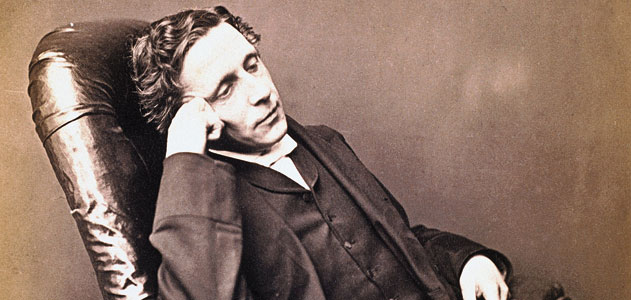
    I am probably not understanding this wonderful effort by the dead Lewis Carroll, establishing a new algorithm for doing long division.  It came into view while I was looking for a paper in Nature by A.A. Michelson on his analog computer, the harmonic analyzer, a fantastic device that he used to help measure the speed of light back in 1898.  Carroll (as Dodgson) appeared just a few pages away; his obituary appears not much after the division article, thus making the paper the last of his career here on Earth. 
    Presence-Lewis-Carroll-Charles-Dodgson-631
    It is a very interesting effort, and it perhaps is even brilliant and of a wonderful construct, but the bottom line is that it makes the process of division harder to do–perhaps it is mire understandable as a process, but the process itself is decidedly not a preferred one.  Perhaps it is appropriate for his last work to have been on mathematics, since the majority of his 20 published books relate to mathematics or logic.

    Notes

    1. The article is abstracted here, a few weeks after publication:

    Article abstract:  Nature 57, 390-391 (24 February 1898), “Abridged Long Division” abstracted by ROBT. W. D. CHRISTI:

    “HAVING been working on similar lines for some years, I was very much interested in the late Mr. Dodgson’s letter on abridged division in NATURE of January 20, and I should like to offer a few observations and to give a variation of the method which appears much simpler. It will be admitted that Mr. Dodgson’s plan is of limited application, and rather complicated for general use. There is nothing to hinder the method given below from being universally used, though it may not in all cases be the shortest. It also has the merit, I think, of directness and uniformity.”

    2. This is one of three publications of Carroll’s mathematical works that appeared in Nature, being “Abridged long division”, Nature 57, 269-271; “Brief method of dividing a given number by 9 or 11”, Nature 56, 565-566; “Pillow problems. Curiosa mathematica. Part II”, Nature XLVIII. 564. 
     

    ·Posted by :

    ·in:

  • Wigner and Resonance Reactions, 1946 & 1947

    Eugene Wigner. “Resonance Reactions”, in Physical Review, volume 70 number 9 and 10, November 1 and 15, 1946, pp 606-619 in the issue of pp 577-803.  In the original wrappers, a FINE copy.  This paper (cited 300+times) is reproduced in full in chapter 5, “Nuclear reactions”, in G Stoke’s The Physical Review, the First Hundred Years….  

    Offered with:

    _____  with Leonard Eisenbud. “Higher Angular Momenta and Long Range Interaction in Resonance Reactions.”  in Physical Review, 1947, volume 72 number 1,  7pp 29–41. In the original wrappers. Very Good copy. (Noted in the DSB.)

    $250/pair

    • “From this beginning Wigner made numerous important cross-disciplinary contributions, first in Europe and later in the United States, where he spent most of his adult life. Wigner demonstrated the importance of symmetry principles in quantum mechanics, an accomplishment that led to the Nobel Prize in Physics for 1963. Wigner made numerous other contributions to a wide variety of fields. In particular, he was one of the first to apply quantum mechanics to the theory of solids and chemical kinetics, led the World War II effort to design the first high-powered reactors and made numerous other contributions to reactor engineering, and pioneered work in the quantum theory of chaos.”
    • “Wigner also started and fully developed R-matrix theory for nuclear reactions. His work with R-functions and R-matrices extended beyond direct application to resonance reactions. One result of his continuing fascination with mathematics was work on random matrix elements that led to the founding of quantum chaos theory.”–Complete Dictionary of Scientific Biography, vol. 25


    ·Posted by :

    ·in:

  • “Capture of Slow Neutrons” (1936)

    BREIT, G. and  E.Wigner,  “Capture of Slow Neutrons.”  Lancaster, PA:  American Physical Society,  1936.  1st edition.  Physical Review, 49/7, April 1 1936  Fine copy in the weekly issue wrappers of this significant paper (cited 249 times by PROLOA).

    See Ezhela, Particle Physics, One Hundred Years of Discoveries, an Annotated Chronological Bibliography, p. 73. “Breit-Wigner form of the amplitude for resonance reactions.”  Also reprinted in G. Stokes (ed), The Physical Review, the First Hundred Years (1995), 265.

    The abstract from APS reads: “Current theories of the large cross sections of slow neutrons are contradicted by frequent absence of strong scattering in good absorbers as well as the existence of resonance bands. These facts can be accounted for by supposing that in addition to the usual effect there exist transitions to virtual excitation states of the nucleus in which not only the captured neutron but, in addition to this, one of the particles of the original nucleus is in an excited state. Radiation damping due to the emission of γ-rays broadens the resonance and reduces scattering in comparison with absorption by a large factor. Interaction with the nucleus is most probable through the s part of the incident wave. The higher the resonance region, the smaller will be the absorption. For a resonance region at 50 volts the cross section at resonance may be as high as 10-19 cm2 and 0.5×10⁻²⁰ cm2 at thermal energy. The estimated probability of having a nuclear level in the low energy region is sufficiently high to make the explanation reasonable. Temperature effects and absorption of filtered radiation point to the existence of bands which fit in with the present theory.”  $150

    ·Posted by :

    ·in:

  • Nobel Prize Effort by the Beautifully-Named Polykarp Kusch (1948)

    Kusch, Polycarp and Henry M. Foley. “The Magnetic Moment of the Electron”, in Physical Review, volume 74, number 3, August 1, 1948, pp 250-264. ALSO WITH: Maria G. Mayer, “On Closed Shells in Nuclei”. In the original wrappers. This is a GOOD+ copy, with some bit of rubbing on the front wrapper. Also has a rubber stamp “Property of/Physics Department”.

    “The Nobel Prize in Physics 1955 was divided equally between Willis Eugene Lamb “for his discoveries concerning the fine structure of the hydrogen spectrum” and Polykarp Kusch “for his precision determination of the magnetic moment of the electron.”

    From Kusch’s Nobel Prize (1955, physics) speech, “The magnetic moment of the electron Nobel Lecture, December 12, 1955”:  “I must tell you, and with considerable regret, that I am not a theoretical physicist. A penetrating analysis of the part that the discovery and meas- urement of the anomalous magnetic moment of the electron has played in the development of certain aspects of contemporary theoretical physics must be left to the group of men who have in recent years devised the theoretical structure of quantum electrodynamics. My role has been that of an exper- imental physicist who, by observation and measurement of the properties and operation of the physical world, supplies the data that may lead to the formulation of conceptual structures. The consistency of the consequences of a conceptual structure with the data of physical experiment determines the validity of that structure as a description of the physical universe. Our early predecessors observed Nature as she displayed herself to them. As know- ledge of the world increased, however, it was not sufficient to observe only the most apparent aspects of Nature to discover her more subtle properties; rather, it was necessary to interrogate Nature and often to compel Nature, by various devices, to yield an answer as to her functioning. It is precisely the role of the experimental physicist to arrange devices and procedures that will compel Nature to make a quantitative statement of her properties and behavior. It is in this spirit that I propose to discuss my participation in a sequence of earlier experiments that made possible the precision determination of the magnetic moment of the electron. I will then discuss the experiments them-selves which have yielded our present knowledge of the magnetic properties of the electron.“

    OFFERED WITH:

    Kusch, Polykarp and Henry M. Foley. “On the Intrinsic Moment of the Electron”, in The Physical Review, Second Series, Volume 73, number 4, 15 February 1948, pp 412. Originall wrappers. GOOD ONLY copy, with some damp staining in the text.

    • The two issues, $500

    “The Nobel Prize in Physics 1955 was divided equally between Willis Eugene Lamb “for his discoveries concerning the fine structure of the hydrogen spectrum” and Polykarp Kusch “for his precision determination of the magnetic moment of the electron.”

    This is referenced in Silvan S. Schweber, QED and the Men who Made it: Dyson, Feynman, Schwinger, and Tomonaga, 1994, p.700. Also referenced and reproduced in Henry Stroke’s massively useful The Physical Review, the first hundred years, a selection of seminal papers and commentaries, NY, (1995). (Then Maria Mayer is also reproduced in the Stoke book in full.)

    ·Posted by :

    ·in:

  • “Penetrating investigation of the so-called parity laws which has led to important discoveries regarding the elementary particles”

    “A rather complete theoretical structure has been shattered at the base and we are not sure how the pieces will be put together” –I. Rabi

    YANG, C.N. and T.D. Lee.  “Questions of Parity Conservation in Weak Interactions”. The Physical Review,  volume 104, October 1, No. 1, 1956.  Article occupies pp. 254-58 in the entire issue of 272pp.  Offered in the original wrappers, a fine copy.  $750

    Chen Ning Yang and Tsung-Dao Lee were awarded the 1957 Nobel Prize for their work “for their penetrating investigation of the so-called parity laws which has led to important discoveries regarding the elementary particles”. “The award was the climax of the most exciting year in postwar physics.”–Jeremy Bernstein, The New Yorker, 1962

    • “The importance of parity conservation, its fundamental nature, was discovered in 1927 by the physicist Eugene Wigner, Wigner proved that Laporte’s rule was a consequence of right-left symmetry (or mirror image symmetry) of the electromagnetic force. Conservation of parity rested upon Maxwell’s equations describing electromagnetism, but more important, the intuitive idea that nature should be left-right symmetric had been established on the quantum level. Thus, when in 1949, the weak force was postulated to explain disintegration of elementary particles, physicists could not conceive that parity conservation would not hold for reactions involving the weak force. It was a minor oversight however that there was no direct evidence for the extension of this law to the fourth force of nature. Seven years later physicists would come full circle to question their acceptance of parity conservation”
    • “The new province of weak interactions had not been tested before Lee and Yang made the suggestion. Nevertheless, the physicists’ assumption that nature will present a simple understanding is unflailing. Chen Ning Yang has stated, “In the study of nature, one believes in something simple underlying all”. Madame Wu agrees, “One hopes that nature possesses an order that one may aspire to comprehend. When we arrive at an understanding, we shall marvel how neatly all the elementary particles fit into the great scheme.” Violation of the law of conservation of parity, then, should lead one to search for an even more fundamental symmetry to the universe.”–Symmetry Destroyed: The Failure of Parity, 1984 Krishna Myneni

    ·Posted by :

    ·in:

  • Two Great Papers in One Issue of the Physical Review: Oppenheimer/Snyder and Bohr/Wheeler

    Robert Oppenheimer and Hartland Snyder, “On continued gravitational contraction”,

    • AND BOUND WITH

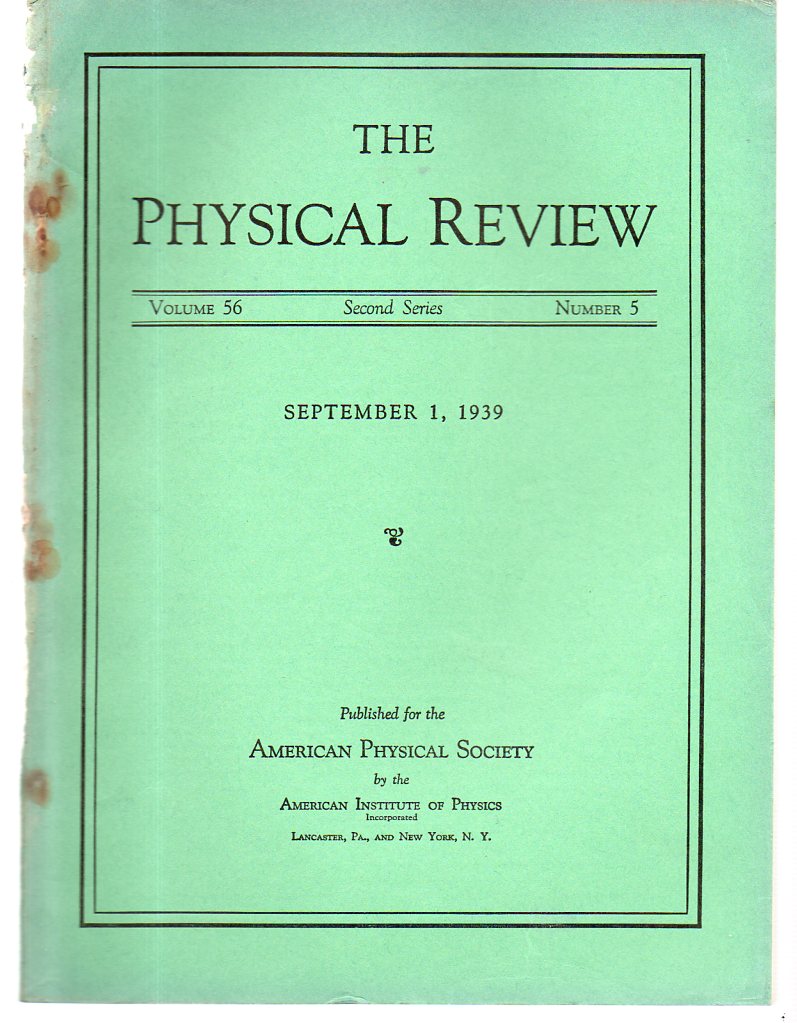
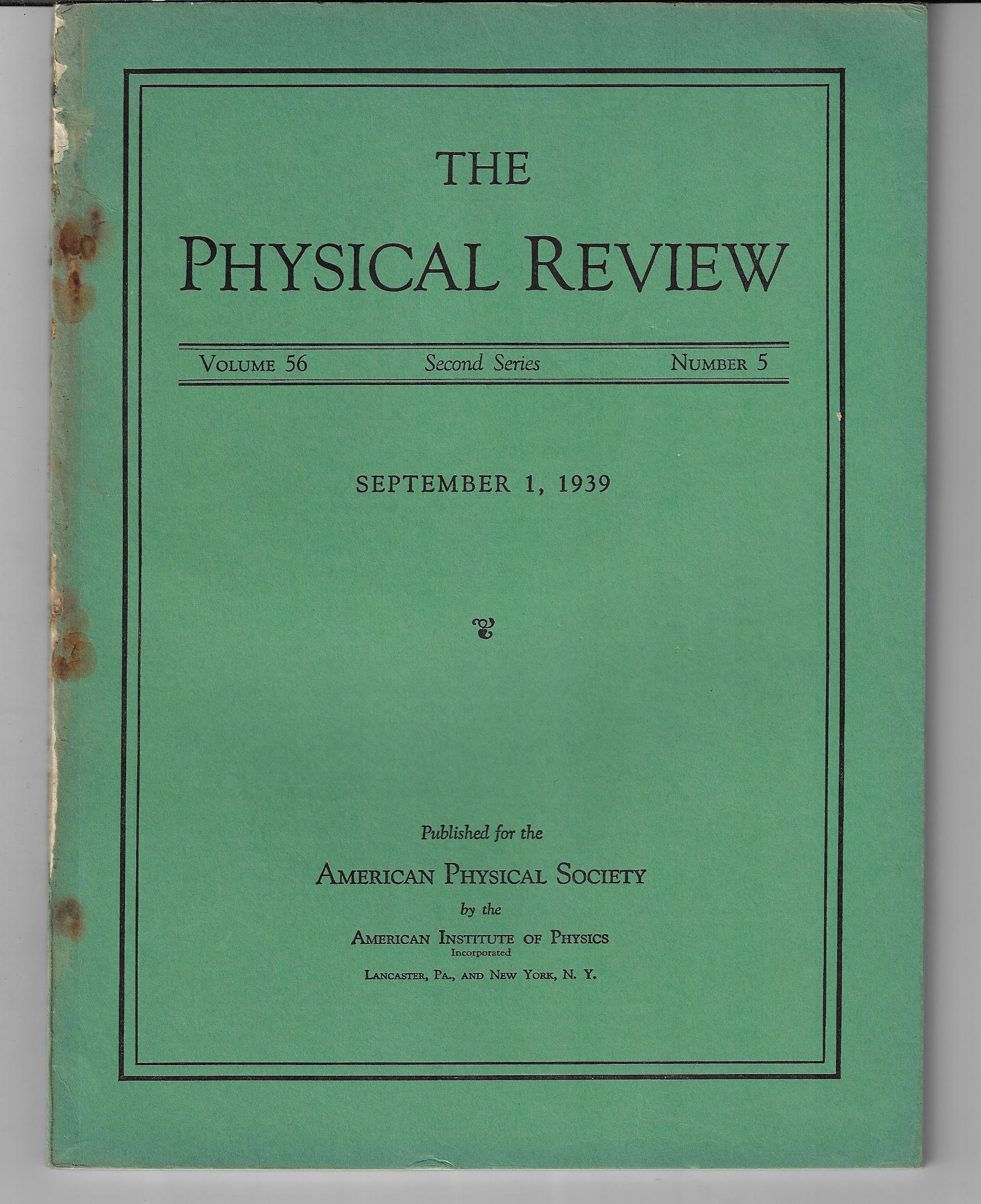
    Niels Bohr and J.A. Wheeler, “The mechanism of nuclear fission”  both appearing in the Physical Review, September 1, 1939, Vol. 56, #5, pp. 426-50 and pp. 455-59, respectively. 

    First editions of these two papers, presented in the original wrappered issue of the great Physical Review. Condition:  the issue is not without its problems, and these are limited mostly to the spine cover, which is mostly worn away, though the spine itself is fine. THe only legible part of the lettering on the spine is the date on the spine bottom. Also there is some rust staining from the internal staples.  Other than that the issue is really quite nice. All that said, I’m offering this at a fraction of what prettier copies are being sold for presently. $1250  
     
    The two papers appear together in a single issue of the journal, a remarkable set of achievements found in one small space–remarkable even more for the fact that 1939 (as with 1859, 1543, 1932, and 1948) is one of those remarkable single years in the history of science.
     
    The Oppenheimer and Snyder (a graduate assistant) paper is one of the most prescient in the history of modern physics, correctly physically describing (where Chandrasekhar and Eddington in their discussions did not) what happens in a particular collapse of a neutron star, and still today reads as fresh and and brightly as it did in 1939.  Really, it is an extraordinary work, and a foundation paper in the history of gravitation, the application of RT, singularity, and astrophysics.  (The Southampton GR Explorer site nicely states it this way: “This paper has strong claims to being one of the most prophetic ever written in this field of research. Today, 60 years later, this paper needs little revision – even the terminology is undated!”)
    Phys Rev 1939 Oppenheimer Gravitational
    In an often-repeated quotation, they write, somewhat in irony and in a certain and understated manner on page 456: “The star thus tends to close itself off from any communication with a distant observer; only its gravitational field persists”. And later: “When all thermonuclear sources of energy are exhausted, a sufficiently heavy star will collapse. Unless fission due to rotation, the radiation of mass, or the blowing off of mass by radiation, reduce the star’s mass to the order of that of the sun, this contraction will continue indefinitely”, they wrote.
     
    Next comes Bohr and Wheeler, “The mechanism of nuclear fission” is the experimental foundation stone (on the basis of the liquid drop model of atomic nuclei) of nuclear fission and the great leap forward in the construction of the atomic bomb.
    Condition: the paper of the spine of the publication is about one-third owrn away, otherwise this is a very nice copy. 

    From the abstract: “On the basis of the liquid drop model of atomic nuclei, an account is given of the mechanism of nuclear fission. In particular, conclusions are drawn regarding the variation from nucleus to nucleus of the critical energy required for fission, and regarding the dependence of fission cross section for a given nucleus on energy of the exciting agency. A detailed discussion of the observations is presented on the basis of the theoretical considerations. Theory and experiment fit together in a reasonable way to give a satisfactory picture of nuclear fission”.

    ·Posted by :

    ·in:

    —
  • Philip Abelson Investigation Of The Products Of The Disintegration Of Uranium By Neutrons In The Physical Review Volume 5

    Philip Abelson, “Investigation of the Products of the Disintegration of Uranium by Neutrons”. In: The Physical Review, volume 56, number 1, July 1, 1939. In the original wrappers, the weekly issue, on pp 1-10 (in the issue of pp 1-124).  Nice copy, with a tiny indentation on the front cover right-middle. This is #30 in Louis Turner’s bibliography, “Nuclear Fission”, 1940, in Reviews of Modern Physics, vol 12/1, January 1940, pp 1-30. SOLD

    ·Posted by :

    ·in:

    —
  • First Appearance of the Oppenheimer-Phillips Process

    J. Robert Oppenheimer and Melba Phillips. “Note on the transmutation function for deuterons”, in Physical Review volume 48, September 15, 1935, pp 500-502, in the issue of pp 491-572. Original wrappers. Very Good copy. $175

    “The Oppenheimer–Phillips process or strip reaction is a type of deuteron-induced nuclear reaction. In this process the neutron half of an energetic deuteron (a stable isotope of hydrogen with one proton and one neutron) fuses with a target nucleus, transmuting the target to a heavier isotope while ejecting a proton. An example is the nuclear transmutation of carbon-12 to carbon-13…The process allows a nuclear interaction to take place at lower energies than would be expected from a simple calculation of the Coulomb barrier between a deuteron and a target nucleus.”

    Also in this issue:Enrico Fermi “On the recombination of Neutrons and Protons”, E.O. Lawrence et al “Transmutation Functions for Some Cases of Deutron-Induced Radioactivity”, and others.

    From the abstract: “We consider the effect of the finite size and ready polarizability of the deuteron on the probability of transmutations involving the capture of the neutron. These have as a consequence that the Coulomb repulsion of the nucleus is less effective than for alpha-particles or protons, and that the corresponding transmutation functions increase less rapidly with deuteron energy. We treat the collision by the adiabatic approximation and obtain quantitative results for this energy dependence which are in good agreement with experiment.”

    This was a few years later expanded by H. A. Bethe in his paper “The Oppenheimer-Phillips Process”, in Phys. Rev. 53, 39 , 1 January 1938 and then again in 1940 in a paper of the same title in the Phys Rev by GM Volkoff.

    ·Posted by :

    ·in:

  • Part of a Busy Year for John Bardeen

    BARDEEN, J. “Electron-Vibration Interactions and Superconductivity.” APS, 1951. 1st edition. Reviews of Modern Physics 23/3, July 1951.

    Original printed wrappers. Fine condition. $150

    This was a busy year for Bardeen, publishing a number of papers on this topic, though almost entirely in the Phys Rev. Other contributors here include Walter Brattain (Copper Oxide Rectifier), George Breit (Topics in Scattering Theory) and JH Van Vleck (Angular Momentum). 

    ·Posted by :

    ·in:

    —
  • Theory of the Superconducting State

    Frohlich, H. “Theory of the Superconducting State. I. The Ground State at the Absolute Zero of Temperature”, in Physical Review, vol 79, 1950, pp 845-856 in the issue of pp 747-913. Original wrappers. Very Good copy.

    • “The paper proposed that the interaction between electrons and lattice vibrations (phonons) was responsible for superconductivity.”
    • “A competing explanation of the isotope effect experiments was proposed by John Bardeen in a short paper received by Physical Review just three days later, which is offered with the Frohlich:

    Bardeen, John. “Zero-Point Vibrations and Superconductivity” Physical Review, vol 79 no. 1, pg 167 in the issue of pp 1-246. Original wrappers. A Very Good copy, with a little tear at top front joint (about 1” long).

    The two issues: $500

    • “Starting with these events, the electron-phonon interaction became the focus of theoretical efforts attempting to explain superconductivity after 1950, culminating in the BCS theory in 1957, generally believed to explain ‘conventional’ superconductivity. Neither Frohlich’s (with 1000 citations) nor Bardeen’s 1950 theories stood the test of time. Nevertheless, based on the events of May 1950 recounted above, Fr¨ohlich is generally credited with having predicted the fundamental role of electron-phonon interactions in superconductivity and the isotope effect without any experimental input…”–J. E. Hirsch, “Did Herbert Frohlich predict or postdict the isotope effect in superconductors?”,

    See also L. Hoddeson, H. Schubert, S.J. Heims and G. Baym, “Out of the Crystal Maze; Chapters from the History of Solid-State Physics”, Oxford University Press, New York, 1992, p. 548-550.

    ·Posted by :

    ·in:

  • First Theoretical Calculation of the Lamb Shift in Non-Relativistic QED


    Hans Bethe, “Electromagnetic Shift of Energy Levels”, in Physical Review, volume 72, number 4, August 15, 1947 pp 339-341, in the issue of pp 263-356

    Original wrappers. Very Good copy. $450

    • Also in this issue: a report by

    Brattain, W.H. and John Bardeen. “Evidence for Surface States on Semiconductors from Changes to Contact Potential on Illumination”.

    See also the store’s entry for Willis Lamb on the Lamb Shift.

    _____. Another copy, this with the rubber stamp of MIT Library, also with the penned owner’s name (“Dr. Foster” is this Dr. F.L. Foster?) $350

    ·Posted by :

    ·in:

Recent Posts

Archives

Categories