A Daily History of Holes, Dots, Lines, Science, History, Math, Physics, Art, the Unintentional Absurd, Architecture, Maps, Data Visualization, Blank and Missing Things, and so on. |1.6 million words, 7500 images, 4.9 million hits| Press & appearances in The Times, Le Figaro, Mensa, The Economist, The Guardian, Discovery News, Slate, Le Monde, Sci American Blogs, Le Pont, and many other places… 5000+ total posts since 2008.

  • “The earliest paper that seems to have a direct bearing on the development of the transistor…” 1947

    Bardeen, John. “Surface States and Rectification at a Metal Semi-Conductor Contact”, in the Physical Review, volume 71, number 10, 717-735 in the issue of pp 649-743 (1947). Original wrappers, original owner’s surname on the front wrapper at upper left. Fine copy.  $500

    • “The earliest paper that seems to have a direct bearing on the development of the transistor…which was followed by the two letters reporting verification of the predictions of the theory…” [these located in Physical Review, 72, 845 (1947)].–George L. Trigg, Landmark Experiments in Twentieth Century Physics, p 153, bibliography for the chapter on the transistor.

    ·Posted by :

    ·in:

  • Computer History: Five Papers by Gordon K. Teal, Transistor Pioneer

    Five Papers by Gordon K. Teal (the extent of his publications in the Physical Review)

    • “[Teal] is best known for the results of his research in germanium and silicon and in particular for the preparation of the first high-purity, high-perfection, single-crystalline germanium for transistor use. He was a co-developer of the first junction transistor. As stated by W. Shockley…’There was probably no more important scientific development in the semiconductor field in the early days following the announcement of the transistor than the development of high-quality single crystals of germanium at Bell Telephone Laboratories’.” “Best known developments under his direction are the first commercial silicon transistor (1954) and a chemical reduction process for ultra-pure silicon (1957). According to opinions summarized in Fortune (November 1961), “The silicon transistor was a turning point in TI’s [Texas Instruments’] history. . . . TI sales rose almost vertically; the company was suddenly in the big leagues.” –Engineering and Technology Wiki (Gordon Teal)
    • “He invented a method of applying the Czochralski method to produce extremely pure germanium single crystals used in making greatly improved transistors. He, together with Morgan Sparks invented a modification of the process that produced the configuration necessary for the fabrication of bipolar junction transistors. He is most remembered for developing the first silicon transistor while at Texas Instruments.”–Wikipedia
    (1) W. Shockley, M. Sparks, and G. K. Teal. “p−n Junction Transistors”. Physical Review, 83, 151 (1951), 1 July 1951. Offered in the full volume 83, July-September 1951. Each issue with their original wrappers bound in at rear. Fine copy.

    ABSTRACT: “The effects of diffusion of electrons through a thin p-type layer of germanium have been studied in specimens consisting of two n-type regions with the p-type region interposed. It is found that potentials applied to one n-type region are transmitted by diffusing electrons through the p-type layer although the latter is grounded through an ohmic contact. When one of the p−n junctions is biased to saturation, power gain can be obtained through the device. Used as “n−p−n transistors” these units will operate on currents as low as 10 microamperes and voltages as low as 0.1 volt, have power gains of 50 db, and noise figures of about 10 db at 1000 cps. Their current-voltage characteristics are in good agreement with the diffusion th

    This volume also contains:

    (2) H. J. McSkimin, W. L. Bond, E. Buehler, and G. K. Teal,. “Measurement of the Elastic Constants of Silicon Single Crystals and Their Thermal Coefficients”, in Physical Review.  83, 1080 (1951), 1 September 1951

    (3) F. S. Goucher, G. L. Pearson, M. Sparks, G. K. Teal, and W. Shockley, “Theory and Experiment for a Germanium p−n Junction”, Phys. Rev. 81, 637 (1951), 15 February 1951

    This issue also contains:
    (4) G. K. Teal, M. Sparks, and E. Buehler, “Growth of Germanium Single Crystals Containing p−nJunctions”. Offered in the full volume 81, January-March 1951, 1096pp. Each issue with their original wrappers bound in at rear. Fine copy. 
    (5) W. L. Bond, W. P. Mason, H. J. McSkimin, K. M. Olsen, and G. K. Teal, “The Elastic Constants of Germanium Single Crystals”, Physical Review,  78, 176 (1950), 15 April 1950. Offered in the original green wrappers. Very Good copy.

    The set of papers: $500

    ·Posted by :

    ·in:

  • Nobel Prize Effort at the Beginning of Quantum Electrodynamics–the Lamb Shift, 1947

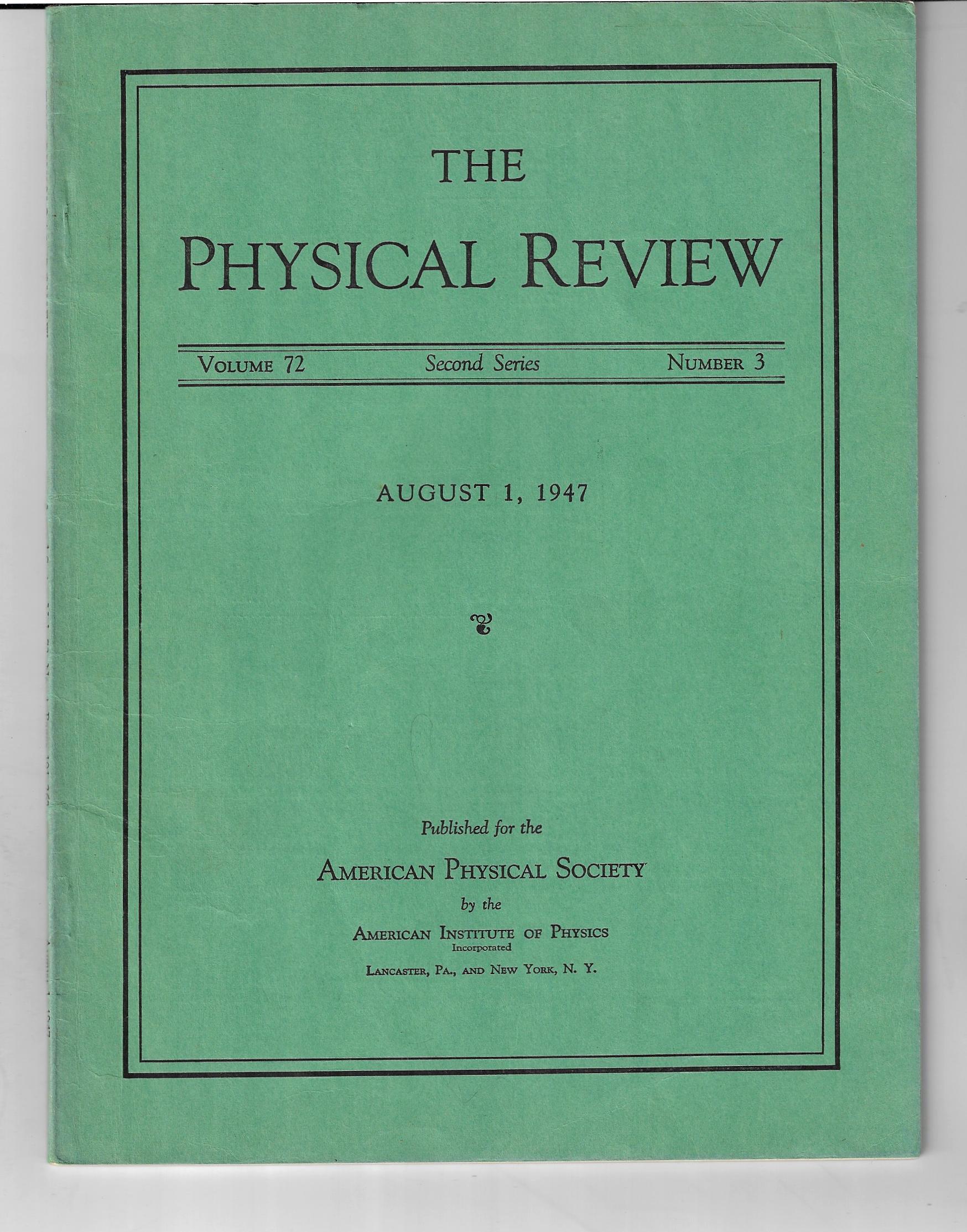
    Lamb, Willis E. And Robert C. Retherford, “Fine Structure of the Hydrogen Atom by a Microwave Method”. In Physical Review, volume 72, number 3, August 1, 1947, pp 241-243, in the issue of pp 189-261. Fine copy in the original wrappers. $1000

    _____. Another copy, not quite as nice. Very Good.  $750


    The Lamb Shift and the beginning of quantum electrodynamics. Lamb won the Nobel Prize in Physics in 1955 for his discoveries related to the Lamb shift.

    • “…it became clear that a new chapter in physics was upon us.” A. Pais, Inward Bound, relating Lamb delivering his report at Shelter Island, p 451.

    PR 1947 Lamb shift
    “This effect was first measured in 1947 in the Lamb–Retherford experiment on the hydrogen microwave spectrum and this measurement provided the stimulus for renormalization theory to handle the divergences. It was the harbinger of modern quantum electrodynamics developed by Julian Schwinger, Richard Feynman, Ernst Stueckelberg, Sin-Itiro Tomonaga and Freeman Dyson.”

    “On Lamb’s 65th birthday, Freeman Dyson addressed him as follows: “Those years, when the Lamb shift was the central theme of physics, were golden years for all the physicists of my generation. You were the first to see that this tiny shift, so elusive and hard to measure, would clarify our thinking about particles and fields.”–Wikipedia on the Lamb Shift

    Elsewhere Dyson referred to the best place for experiment in physics to be in the world at that time was Columbia, with Rabi in charge, and where Lamb (Ph.D. under Oppenheimer) was doing his work on the hydrogen atom. In an interview Dyson remarked that hydrogen was the “most deeply explored” object in science, and that “if you don’t understand the hydrogen atom, then you don’t understand anything”. When Lamb—using the new microwave measuring capacities—found that there was a discrepancy between theory and experiment regarding the hydrogen spectrum it was found to be, well, “deeply disturbing”.–quotes from Freeman Dyson on https://www.webofstories.com/play/freeman.dyson/64

    • This paper reprinted in Quantum Electrodynamics edited by Julian Schwinger (1958) paper 26.

    ·Posted by :

    ·in:

    —
  • Bethe’s “Best Paper”

    Bethe, Hans.  “Zur Theorie des Durchgangs schneller Korpuskularstrahlen durch Materie”  [“Theory of the Passage of Fast Corpuscular Rays Through Matter],” Annalen der Physik, Series V/5, 1930, (overall #397), a long paper of 75pp (pp 325-400) in the issue of pp 305-428. This is offered with the original wrappers, disbound from a larger volume. Ownership stamp from the U.S. Patent Office on the front wrapper. The wrappers are a little frail given the quality of the paper used, the paper of the test being better than that. Overall, a very conservative GOOD copy. $250

    • “According to J(eremy) Bernstein, Bethe considered this his best paper.”–from the Hans Bethe bibliography, at Sonoma, http://www.phys-astro.sonoma.edu/brucemedalists/bethe/BetheRefs.html

    This is a significant paper by Bethe (with 4000+ citations):

    • “The Bethe stopping-power theory is considered in the context of heavy target atoms in which the relativistic effects of’ the target electrons are partially accounted for within the semirelativistic and independent-particle description.”–PT Leung, “Bethe stopping-power theory for heavy-target atoms”, Physical Review A, 40/8, November 15, 1989.


    ·Posted by :

    ·in:

  • An Historic Article on How A Savant Human Calculator Thinks (1856)

    Bidder, George Parker. “On Mental Calculation”, pp 251-280, in Minutes of Proceedings of he Institution of Civil Engineers with Abstracts of the Discussions, volume XV, Session 1855-6, London, published by the Institution, 540pp.  Rebound in a sturdy library cloth (ca. 1970). A very nice, very sturdy and crisp copy. Ex-library, with the library name perforated on the title page and also rubber stamp on the text block ends at top of bottom.  Still, a very nice copy. $250

    George Parker Bidder (1806-1878) gave a lecture (without notes) explaining to the audience at the Institution of Civil Engineers in 1856 his interior practices and habits in performing absolutely prodigious and complex arithmetical feats entirely in his head. He was among the first tier of performing human calculators (like Zerah Colburn, b. 1804) mental calculations enchanted large audiences from the stages, answering seemingly impossible questions with accuracy and speed. It is in the 1856 paper (which Martin Gardner refers to as “historic” and “valuable”in his article “Mathematical Games”, in Scientific American, 216/4, April 1967, p. 117. ) that he relates some of the practices which clarify his process–for example, one large element was that he would keep one fact in his head at a time, until it was finished, and then move on. Of course for people who did not have anything even remotely resembling this impossible ability, the information is interesting, though I have no idea how useful it may be…unless you were already a savant, that is.  Some things are just not to be known by mere mortals. Like the probably-apocryphal story of someone asking Hans Bethe how Richard Feynman had solved–on his feet–some impossible something, and Bethe responds: “First he thinks very very hard….and then he gets the answer”.) Something like that. 

    Also of some high interest in this volume:

    John William Heinke, “On Improvement in Diving Dresses for Working Under Water”, pp 309-348. This paper is of some consideration, and is somewhat complicated in presentation, but the bottom line here is that Heinke writes about his new diving helmet and “dress” and their evidently famous Parisian test trials of 1855. Heinke was perhaps the leading figure in this area, especially it seems in the design of the helmet (of which there are three text illustrations).  It seems as tough Heinke included this paper in its entirety in his History of Diving… which was published in 1871. 

    Evan Hopkins. “On the Vertical Structure of the Primary Rocks and the General Character of their Gold-bearing Varieties”, pp 48-74, with a folding plate of geological profiles.

    Henry Robinson, “On the Past and Present Condition of the River Thames”, pp 195-250;

    Frederick M. Kelley, “On the Junction of the Atlantic and Pacific Oceans and the Practicability of a Ship Canal, without Locks, by the Valley of the Atrato”, pp376-417, with a large folding map.  


    ·Posted by :

    ·in:

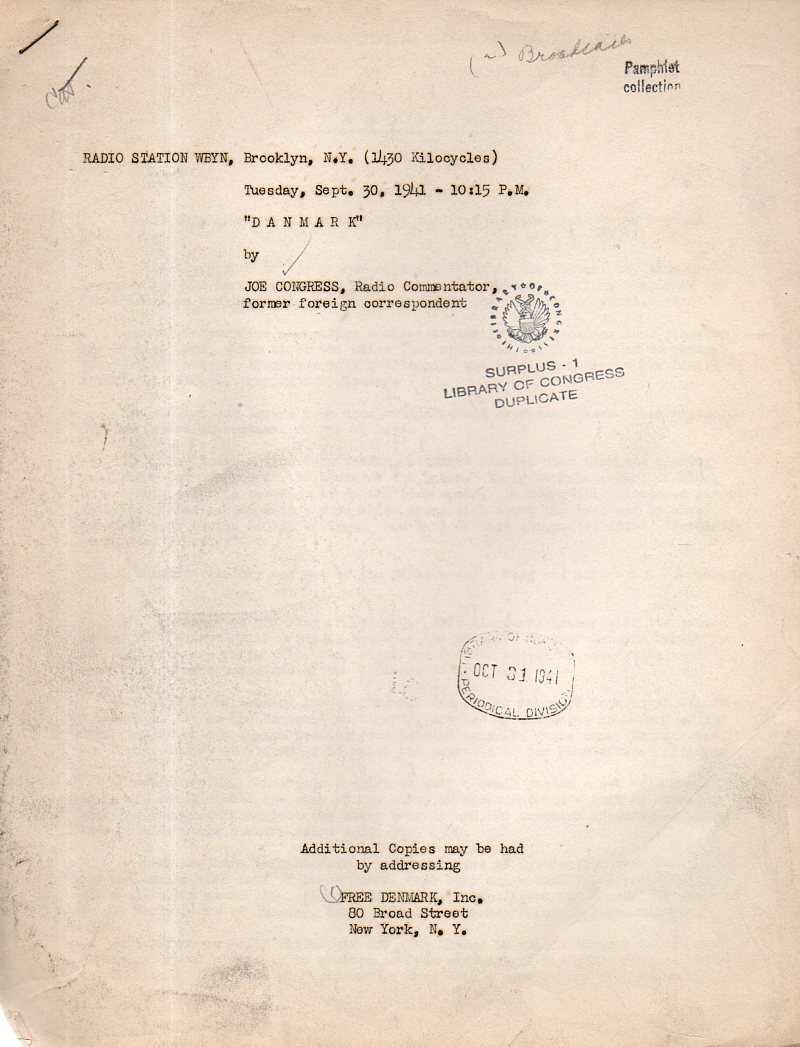
  • From the Denmark Information Service, 1944

    Hasselriis, C.H.W. (Capar Heinrik Wolfson, 1881-1972)

    Of the Land, the Character and the Faith of the Danes. Distributed by the Danish Information Service of the Friends of Denmark, NYC; “For release on or after Nov. 6, 1944. [1944] Offset mimeographed leaves, stapled. 11.5×8”, 5pp.

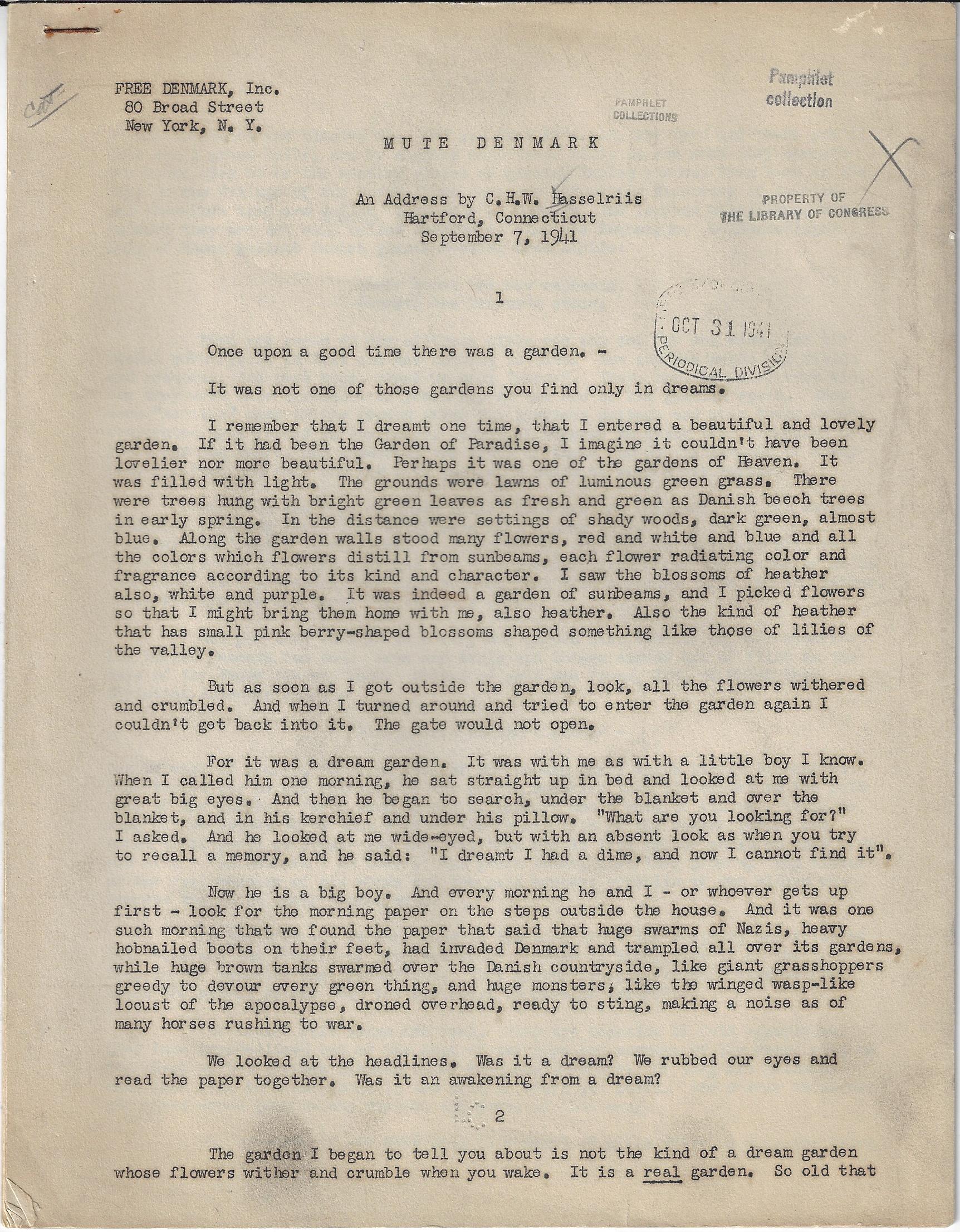
    _____. Mute Denmark. Published by Free Denmark, Inc., NYC, September 1941. Offset mimeographed leaves, stapled. 11.5×8″, 9pp. On the silencing of the voice of Denmark–a lyrical and poetic statement on the “lark no longer sing(ing)” though the spirit of Denmark remains dedicated to freedom.

    Neither publication is located in WorldCat/OCLC, $200/pair

    Denmark mute

    Denmark 1941 164

    ·Posted by :

    ·in:

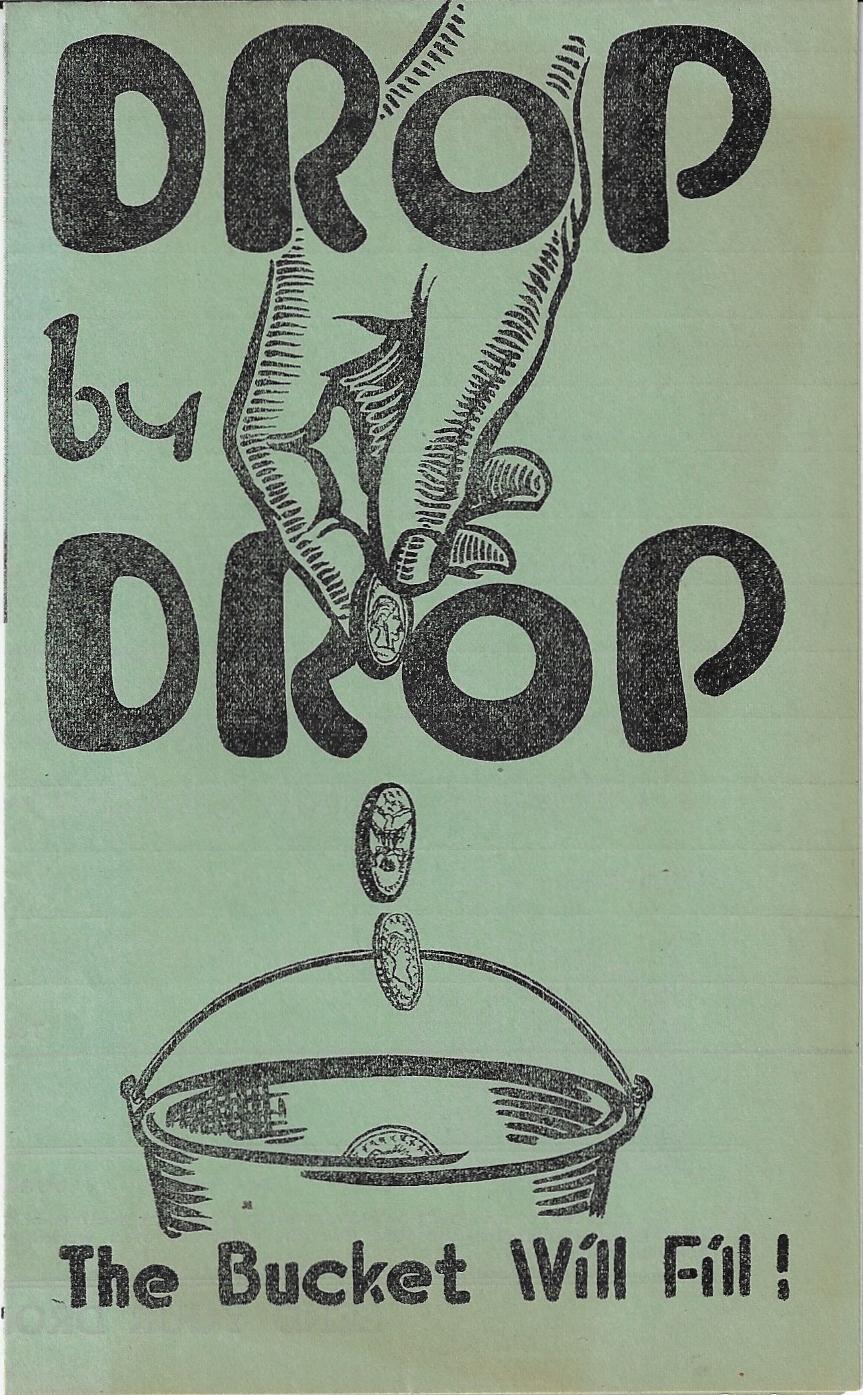
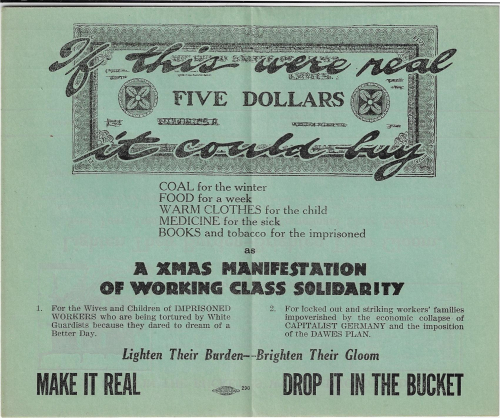
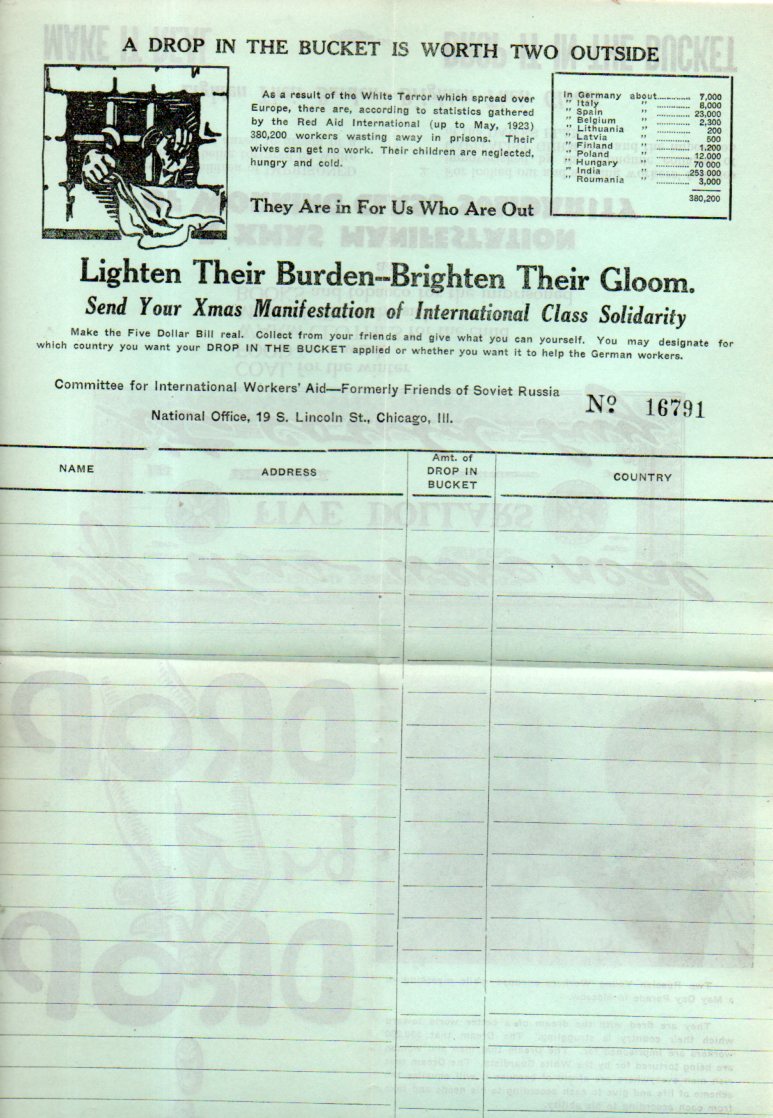
  • Pledge Sheet for a Communist Organization Helping Political Prisoners. ca. 1925

    Drop by drop _2_ JF Ptak Science Books  Quick Post

    Committee for International Workers Aid (formerly “Friends of Soviet Russia”) was a Communist organization created in Berlin in 1921 (as the International Arbeiter-Hilfe) to help raise money for famine and drought victims in Russia. It was evidently expanded to include collecting money to help victims and prisoner of Fascism, which seems to be the major target of this folding broadside. $200


    Drop by drop _3_

    The bucket here is a paper one, the pamphlet unfolding to be a broadside or broadsheet onto which you’d record peoples’ names and addresses and the amount of their contribution to help “class war victims of the laboring masses”, to help the imprisoned and their families (“they are in for us who are out”.  12.5×8 sheet folded into quarters. Fine condition save for a tear that I just made at the bottom center fold.  

    This is a scarce item–I could only find two copies (Yale and UC Davis) in WorldCat.  

    Drop by drop _4_

    ·Posted by :

    ·in:

  • Clausius, von Helmholtz, Bunsen, Plucker, Fizeau, and others (1854)

    Clausius, Rudolf. “Ueber einige Stellen in der Schrift von Helmholtz ‘Ueber die Erhaltung der Kraft’, zweite Notiz”, pp 568-579;(Clausius) Helmholtz, Herman von. “Erwiederung auf die Bemerkungen von Hrn. Clausius”, pp 241-260;

    Helmholtz, Hermann von. “Ueber einige Gesetz der Verteilung elektrischer Strome in korperlichen Leitern, mit Anwendung auf die thierisch-elkrtischen Versuche”, pp 234-246 AND pp 353-377;

    Fizeau, Ueber die Inductions-Elektrisirmachinen und ein leichtes Mittelzur Erhohung ihrerWirksamkeit”, pp 173-177;

    Bunsen, Robert. “Ueber die Darstellung von metallishcen Chrom auf galvanischem Wege. Aus einem Briefe des Prof. Bunsen”, Pp 619-625;

    Plucker, Julius. “Ueber das Gesetz der Induction bei paramagnetischen und diamanetischen Substanzen”, pp 1-56;

    Kohlrausch, R. “Theorie des elektrischen Ruckstandes in der Leidner Flasche”, pp 56-83; and pp179-214;

    G.G. Stokes, “Ueber die Aenderung der Brecharkeit des Lichts”, pp 158-161.

    • All in Annalen der Physik, 1854, series II/91, Johann Barth; x, 628pp, nine plates. Bound in cloth-backed marbled boards.

    PROVENANCE: Provinzial-Gewerbschule zu Aachen (with their small, oval rubber stamp on the title page; then on to the Deutsche Akademie der Luftfahrtforsuchung (with their name stamped in gilt at the spine bottom); and then on to Wright Patterson Air Force Base Field, with their rubber stamp on the page edges (exterior) top and bottom. Lastly, the Library of Congress, with their “surplus” stamp on the rear end papers. All that said, this is a nice, clean, crisp copy. VG $500

    ·Posted by :

    ·in:

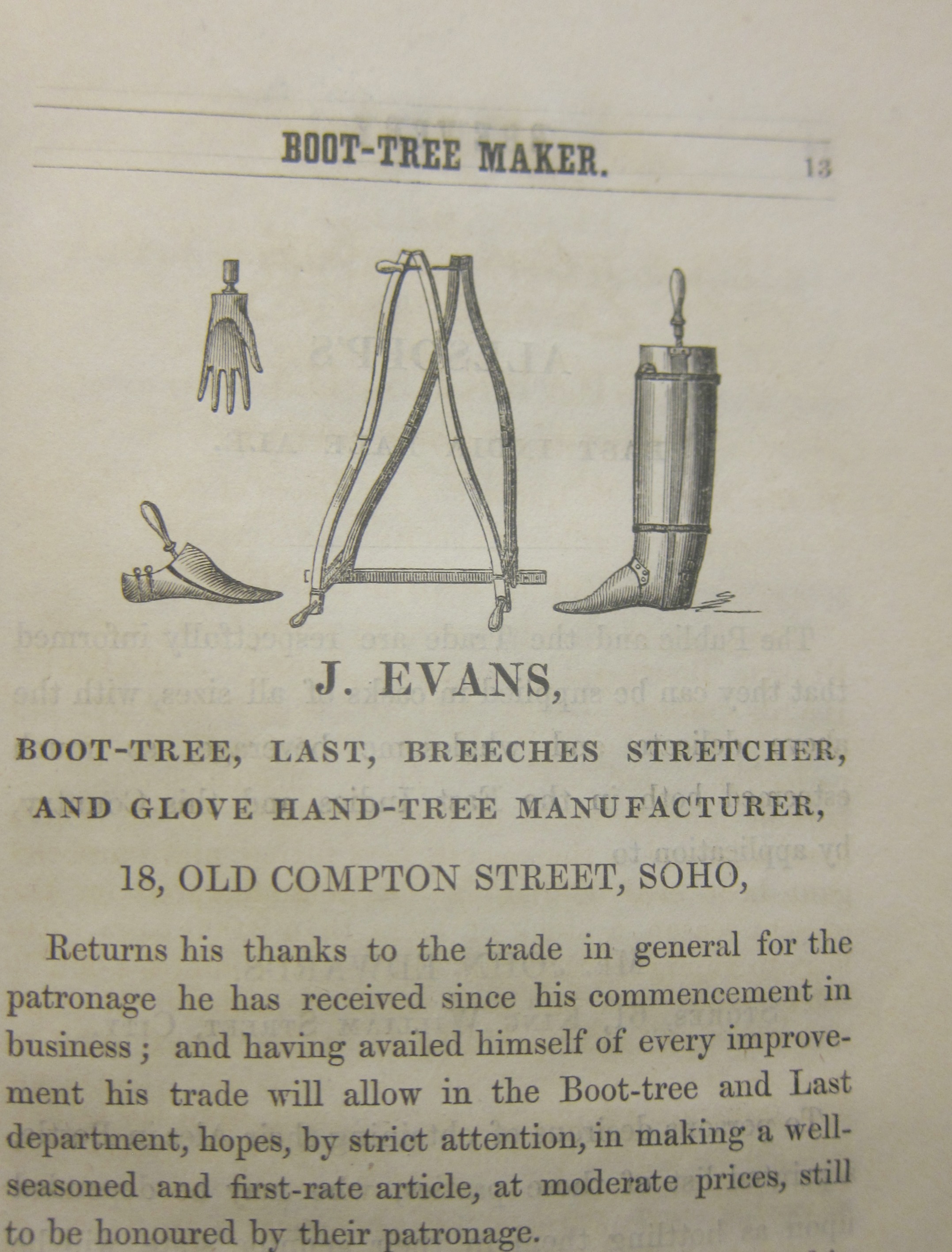
  • Some of the Minor and Major Businesses of London, 1845

    JF Ptak Science Books


    Panorama of Industry; or the Merchants’ and Shippers’ Guide; containing an account of only one of the principal houses, manufactories, or warehouses, in nearly every branch of industry in London. To which are subjoined, Useful Information and references for strangers.
     

    Published under the direction of Messrs. Brunswick and Dollingen, first year, at the offices of the Panorama of Industry…Cavendish Square, London. Brewster & West, printers, London: 1845.  Original wrappers. 8.5×5″, iv, 135pp, with an occasional trade illustration here and there. Delightfully presented and written.  Provenance: from the Boston Athenaeum, to the Library of Congress, with scant markings on the rear of the title page, and with the LC surplus/duplicate stamp on the interior of the front cover.  There is a 2″ tear at the top joint, and the flat spine’s printed title is only about 50% visible. Still, a nice copy (solid GOOD).  $150

    Panorama of Industry _4_

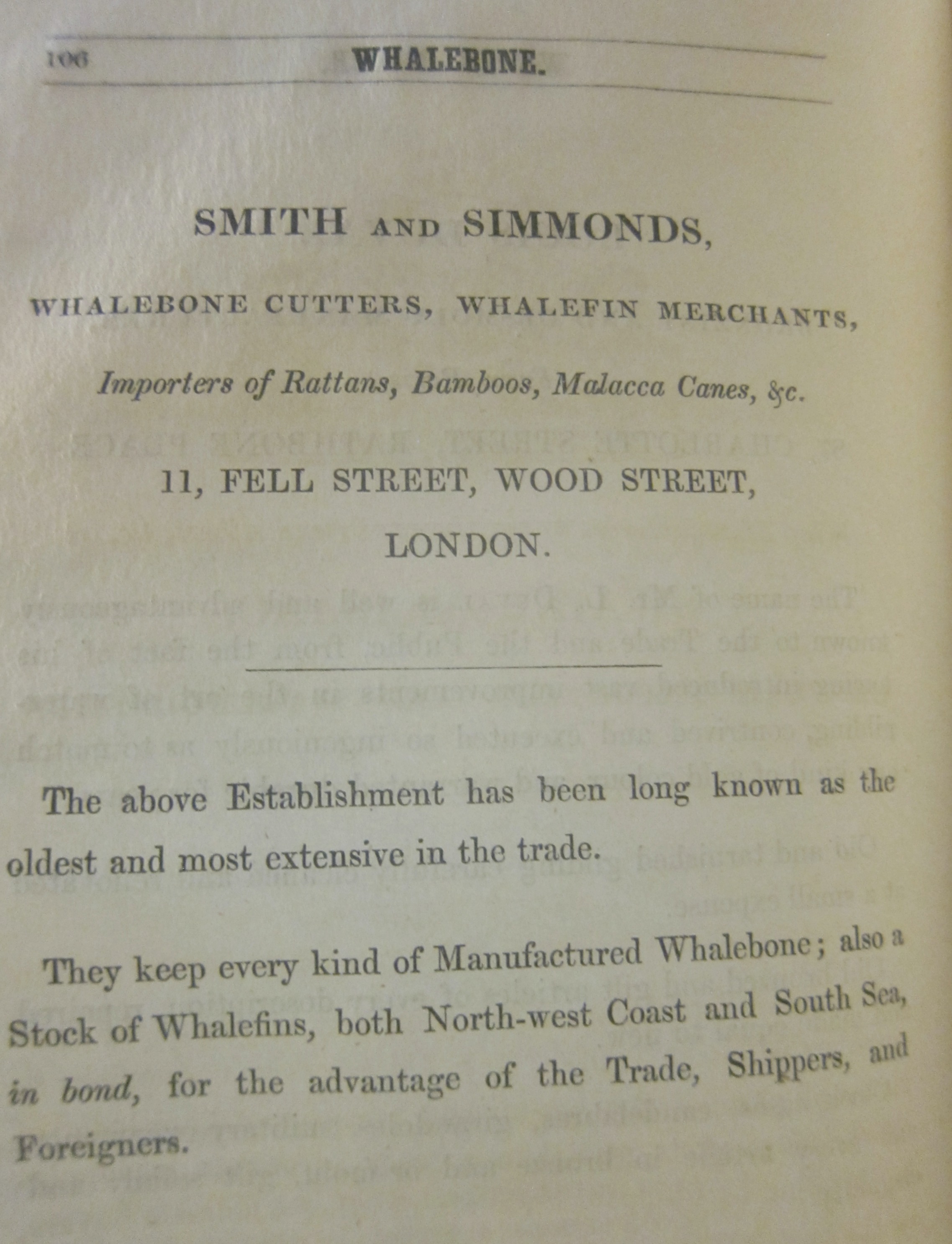
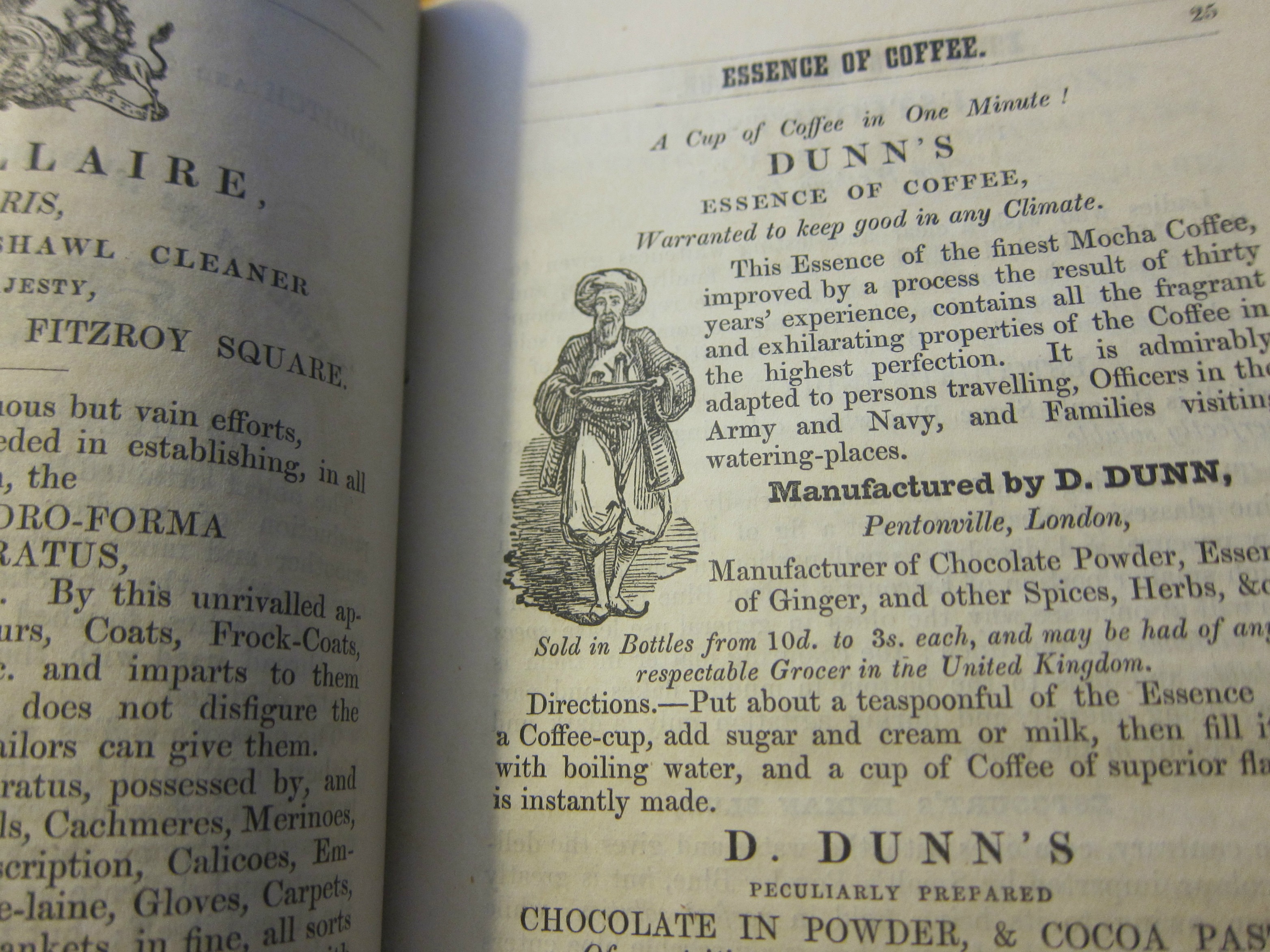
    This panorama of industry contains a splendid account of some integral businesses and industries in the London vicinity at mid-19th century which are now  and now nearly all entirely changed, with many of them being non-existent.Reading pamphlet like this, and city directories and such, looking at the listing of businesses, gives you an excellent feel for the essence of the business life of a city–businesses that are there because they are filling a need/demand. And so we see a big ads for

    • “artist’s colourman”–selling artists’ supplies 
    • blacking manufacturers,
    • razor manufacturers
    • cosmorama–essentially a large and sprawling perspective view that could be hundreds of feet long, utilizing “lenses” and creative lighting to give greater depth to the images)
    • coach builders
    • drilled needle manufacturers
    • dock builders
    • dyer and scourer
    • essence of coffee
    • floor cloth manufacturers
    • “French fancy goods”
    • “gold beater”
    • perforating machinery
    • preserved potato provisions
    • Sealing wax
    • stream engine boilers
    • straw hats
    • stay and corset makers
    • tea tray (papier mache) dealers
    • umbrella maker
    • water gilder
    • whalebone cutters
    • whalefin merchants
    • whip manufacturers

    ·Posted by :

    ·in:

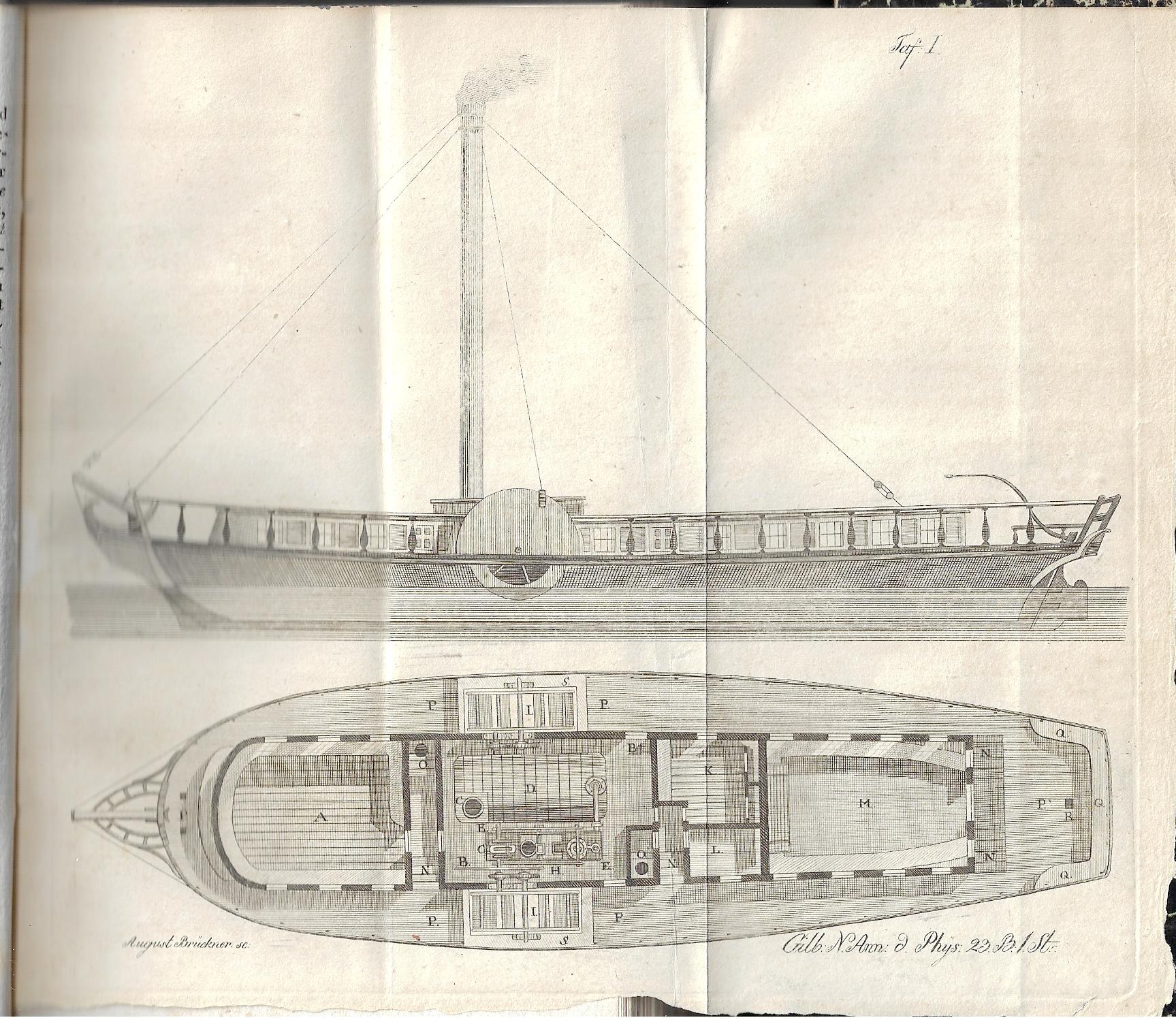
  • Early Steamboat Navigation, 1816

    [Steamboat travel] Five early articles on extensive steamboat travels as they appear in the Annalen der Physik, series I, vol 53; vi, 446pp.   Black cloth; dark marbled boards with cloth tips.  Ex-libris Deutsche Akademie der Luftfahrtforschung, then Wright Patterson Field Library (USAF), then Library of Congress.  Library markings:  small gilt-stamped “Akademie der Luftfahrtforschung”, page edges stamped “Wright Field Library/Dayton, Ohio” on top and bottom. Very good condition. $200

    Annalen 1816 steamboat


    Includes the following, among other papers in physics and chemistry:

    “Einige geschichtliche Nachrichten von der Erfindung der Dampf-Schisffahtr…” pp 63-70;

    Robertson Buchanan, “Ueber die sogennten Dampfboote…”, pp 70-77; 

    Isaac Weld. “Die erste Serreise mit einem von einer Dampsmachine bewegetn Schiffe, vom Glasgow in Schotland um Cap Landsend nach London”, pp 77-102;

    “Zwei schriben an Herrn Isaac Weld…die Dampf-Schiffharht und dem merkwurdigen…pp 102-110; 

    “Noch einige neuere Zeitungs-Nathrichten, Dampfshiffe betreffend… (with a small folding plate, with two views of the vessel), pp 110-119.


    ·Posted by :

    ·in:

  • Is this the Earliest Mention in a Scientific Periodical of the Results of the 1919 Eclipse Confirming the General Theory of Relativity ?

    Einstein, Albert. “Zuschriften an die Herausgeber, Prufung der allgemeinen relativitatstheorie”, in  Die Naturwissenschaften, volume 7, heft 42, October 17, 1919. p 776 in the issue of pp (761)-780, offered in the original wrappers, removed from a larger bound volume.  Condition: the wrappers are browned somewhat. given the supply of paper in the broken German economy of 1919, but the text paper is unaffected, being pretty much blemish-free, though slightly dulled to one of the myriad descriptors of “pale white” or “eggshell”…anyway, quite but not brilliantly so.  The announcement comes from Einstein himself, and is one short paragraph long. Given that the tiny notice appears in what looks like a short index on the front of the magazine that it was being given some sort of prestige, it wasn’t–every entry in the short issue is listed there, so no big deal on finding the Einstein on the front cover. Very nice copy. sold

    • This seems to be the earliest mention of confirming results of the 1919 expeditions to confirm GTR,  submitted by Einstein himself weeks before the formal announcement at the Royal Institution. There was at least one newspaper story on the eclipse–with the information again supplied by Einstein from a telegraphic communication from Lorentz–but I cannot locate the article to see if any of the figures were included in the story.  I cannot find any evidence that an article or notice appeared in a scientific journal before this and it seems unlikely that it would be so. Also a few simple Google searches on the title and author of the announcement reveals, well, almost nothing, which was unexpected.  But “unlikely” is hardly definitive, and so the qualified (and questioned) “firstness” of the announcement. 

    According to Abraham Pais, an “excited” Albert Einstein contributed a very short note (“Zuschriften an die Herausgeber, Prufung der allgemeinen relativitatstheorie”/”A Test of the General Theory of Relativity”) to the editors of the journal Die Naturwissenschaften1 reporting on the telegram he had received from H.A. Lorentz on September 22 on the impending confirmation of the theory of relativity as it was tested in the May 29, 1919 eclipse experiments organized by Sir Frank Dyson. Chandrasekhar explains the situation so: 

    • “It was some months before the two expeditions returned to England and the participants were able to measure their plates and collate their results. But rumours of the successful confirmation of Einstein’s prediction reached Einstein in early September 1919. And on 22 September 1919, the Dutch physicist Hendrik Antoon Lorentz sent Einstein a telegram confirming the rumours to which Einstein replied (also by telegram).. Einstein’s own satisfaction with the outcome of the British expeditions is shown by the postcard (dated September 27, 1919) to his ailing mother in Switzerland. It said: Dear Mother: Good news today. H. A. Lorentz has wired me that the British expeditions have actually proved the light deflection near the Sun….”

    “The telegram that had announced the news to Einstein…was an informal communication. Nothing was definitive. Yet Einstein sent almost at once a very brief note to Naturwissenschaften for the sole purpose of reporting the telegram he had received. He was excited.” (Pais, Subtle is the Lord, p 303).

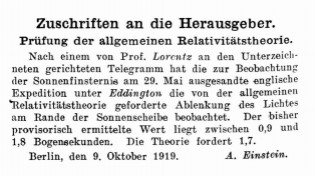
    Einstein’s note in Naturwissenschaften was concise and to the point: “…the English expedition, under Eddington…has observed the deflection of light at the limb of the sun demanded by the General Theory of Relativity3…”

    The results of the experiment were read on November 6, 1919 (the presentation begun by Dyson, followed by A. C. Crommelin, the leader of the Sobral expedition)  to a joint meeting of the Royal Society and the Royal Astronomical Society, and famously published in the Philosophical transactions of the Royal Society in 1920 as “A Determination of the Deflection of Light by the Sun’s Gravitational Field, from Observations Made at the Total Eclipse of May 29, 1919”4.  J.J. Thomson (as president of the Royal Society)  closed the meeting and “pronounced the canonization [of Einstein]”: ‘This is the most important result obtained in connection with the theory of gravitation since Newton’s day, and it is fitting that it should be announced at a meeting of the society so closely connected with him. . . . The result [is] one of the highest achievements of human thought.’ (Pais, Subtle…, in the chapter “The Suddenly Famous Doctor Einstein”, p 305) R.H. Fowler, president of the Royal Astronomical, also spoke and announced ‘“The conclusion is so important that no effort should be spared in seeking confirmation in other ways.”

    The Einstein note is dated October 9 in the text and was published a week later in the issue of  October 17, 1919.  It is one of the first appearances on the confirmation of the theory, with the exception, evidently, of at least one notice in a Berlin newspaper5 just days earlier. (Again, this according to Pais.) It would be on November 6 that “Lorentz sent another telegram to Einstein, confirming the news. On November 7, 1919, the Einstein legend began.” I assume that Pais is talking about the general article that appeared in the London Times on that day (and which would be written for the New York Times on the 9th, and then it was off to the races with the news, with Einstein himself contributing an article three weeks later to The Times). Well, “off to the races” except in Germany, where the reporting beyond this notice in Naturwissenschaften was more reserved, as noted by an article on the 1919 eclipse on the Max Planck Gesellschaft website: “In contrast to the enthusiastic reception shown by the foreign press, the media in Germany were more reticent on the subject. Not until 14 December 1919 did the Berliner Illustrierte Zeitung publish a photo of Einstein and an article entitled: “A new luminary for the history of the world: Albert Einstein, whose research means a total revolution in the way we see the world and whose findings are equal to those of a Copernicus, Kepler and Newton”. 

    Here’s the entire announcement from Naturwissenschaften:
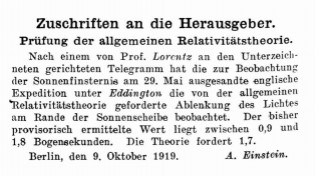
    EInstein 1919

    Writing about the eclipse on his website, Simon Singh says that J.P. McEvoy, author of Eclipse: The Science and History of Nature’s Most Spectacular Phenomenon (Fourth Estate Ltd., 1999), “encapsulated the significance of the announcement” writing of the ironies of the event:  “A new theory of the universe, the brain-child of a German Jew working in Berlin, had been confirmed by an English Quaker on a small African island.” A further bit to add here is that the expeditions were undertaken by British scientists to prove the work of a German scientist, beginning their work before the end of WWI.

    S. Chandrasekar reports that in 1933 Rutherford expounded on the eclipse and Einstein’s fame, rather more broadly and more deeply:

    “The war had just ended: and the complacency of the Victorian and the
    Edwardian times had been shattered. The people felt that all their values and
    all their ideals had lost their bearings. Now, suddenly, they learnt that an
    astronomical prediction by a German scientist had been confirmed by
    expeditions to Brazil and West Africa and, indeed, prepared for already
    during the war, by British astronomers. Astronomy had always appealed to
    public imagination; and an astronomical discovery, transcending worldly
    strife, struck a responsive cord. The meeting of the Royal Society, at which
    the results of the British expeditions were reported, was headlined in all the
    British papers; and the typhoon of publicity crossed the Atlantic. From that
    point on, the American press played Einstein to the maximum…”6

    I guess this is where the ultra-fame of Einstein begins.

    Notes:

    1.  Die Naturwissenschaften, volume 7, heft 42, October 17, 1919. p 776

    2. S. Chandrasekhar, “Verifying the Theory of Relativity”, in Notes and Records of the Royal Society of London Vol. 30, No. 2 (Jan., 1976), pp. 249-260.

    3.  The Collected Papers of Albert Einstein, Volume 7 (English).

    4. W. Dyson, A. S. Eddington, C. R. Davidson, “A Determination of the Deflection of Light by the Sun’s Gravitational Field, from Observations Made at the Solar eclipse of May 29, 1919”, Philosophical Transactions of the Royal Society,  A 220 (571-581): 291–333 (1920). Eddington had written previously on the expedition, “The total eclipse of 1919 May 29 and the influence of gravitation on light”, in The Observatory, Vol. 42, p. 119-122 (1919)

    5. “An article by Alexander Moszkopwski entitled ‘Die Sonne bracht es an den Tag’ in the Berliner Tageblatt of October 8, 1919, must presumably have been based in information from Einstein himself”. (Pais, Subtle…, footnote p 306.) Also, Andrew Claude de la Cherois Crommelin contributed  “The Eclipse Expedition to Sobral”  in The Observatory 42, 368-371, and though it published in October there is no mention of definitive results yet.  Crommelin also publishes an article in Nature on 13 November (volume 104, p. 280-1), appearing about a week after the Royal Society meeting, in which he publishes the results, all on the equivalent of a single page.  

    6.  Chandrasekhar, ibid., pg 251.

     [Interesting to note here that in Maurice Lecat’s Bibliographie de la Relativite (1924) this contribution receives only a scant placement within the Einstein section, in part 13 (c).]
    ·Posted by :

    ·in:

    —

Recent Posts

Archives

Categories