A Daily History of Holes, Dots, Lines, Science, History, Math, Physics, Art, the Unintentional Absurd, Architecture, Maps, Data Visualization, Blank and Missing Things, and so on. |1.6 million words, 7500 images, 4.9 million hits| Press & appearances in The Times, Le Figaro, Mensa, The Economist, The Guardian, Discovery News, Slate, Le Monde, Sci American Blogs, Le Pont, and many other places… 5000+ total posts since 2008.

  • A Major Step in Insuring the “Health” of Wine: Pasteur, 1863 & 1864

    Louis Pasteur, “Études sur les vins. Première partie: De l’influence de l’oxygene de l’air dans la vinification.” Comptes Rendus …, Paris, 1863, volume 57, no 23, pp 936-942 in the issue of pp 925-964; offered with:

    ____. “Deuxiéme partie: Des altérations spontanées ou maladies des vins, particulièrement dans le Jura”, Comptes Rendus, Paris, 1864, volume 58, no. 3, pp, the paper on pp 142-150 in the issue of pp 141- 180

    Both extracts from larger bound volumes of the Comptes Rendus. Good, solid copies. $300

    These are the first two publications on Pasteur’s practical studies on wine(s) that would culminate in 1866 in the publication of his Etudes sur la Vin (dedicated to Napoleon III) a result of his work from 1856 on the fermentation and spontaneous generation and the study on vinegar and wine. For this work in the ready application of his findings he was awarded the 1866 Gold Medal of the Comite Central Agricole de Sologne.

    • “Studies on Wine. In December 1863 Pasteur published the first of the papers that culminated in his Études sur le vin … In that first paper, dealing with the role of atmospheric oxygen in vinification, he sought to establish that the aging of wine resulted from the slow penetration of atmospheric oxygen through the porous wook casks into which new wine was decanted. By virtue of this slow oxidation, he claimed, new wine grows less harsh and acid to the taste as it becomes clearer and lighter from the to the taste as it becomes clearer and lighter from the precipation of dark coloring matters.
    • “In his second paper  Pasteur examined the “alterations” or “diseases of wine, especially wine from the Jura, his native department. Reviewing the familiar disease of “turned,” “acid” “ropy” or “oily “ wine, he associated each with a microscopic organism. He summarized the results of his first two papers by nothing that “wine, which is proudced by a cellular vegetation acting as a ferment [namely, yeast], is altered only by the influence of other vegetations of the same order; and once removed from the effects of their parasitism, it is made or matured principally by the action of atmospheric oxygen penetrating slowly through the staves of the casks.”
    • “Since the diseases of wine are due to the development of foreign orgnaisms, which are present before the wine becomes sensibly “sick” and the germs of which are bottled with the wine, the crucial task was to find a way of killing these germs without damaging the taste or other qualities of wine. On 1 May 1865 Pasteur told the Académie des Sciences that his attempts to cure diseased wines with chemical antiseptics had been less than satisfying, but that he had found a perfectly reliable and practical procedure for preserving healthy wine: by heating it in closed vessels for an hour or two at a temperature between 60° and 100° C. As a result of small-scale preliminary trials, Pasteurprogressively lowered the temperature to between 50° and 60° C. Within this range, he claimed, wine could be perfectly protected from disease at minimum risk to its taste, bouquet, and color.”—“Pasteur, Louis.” Complete Dictionary of Scientific Biography, vol. 10, Charles Scribner’s Sons, 2008, p 366.

    ·Posted by :

    ·in:

  • Victor Tatin’s Early Ornithoper and Aeroplane (1876 and 1879)

    Victor Tatin (1843-1914)  “Experiences sur la reproduction mechanique du vol de l’oiseau”, in Comptes Rendus, volume 83,  p 457-8 in the issue of pp 407-462, 14 August 1876. The weekly issue, extracted from a larger bound volume.  Offered with:

    “Nouvel aeroplane, mu par une machine a sir comprime; determination experimentale du travail necessaire pour faire voler cet appareil” in Comptes Rendus, volume 89 no. 24, 15 December 1879, pp 1024-1027 in the (extended) issue of pp 1083-1189, p 204, the Tatin appearing in the “Prix Decernes” section. This short notice identifies Tatin along with Tissandier and Duroy receiving the Prix Penaud (equally shared) for their work in aeronautics.The weekly issue, extracted from a larger bound volume. 

    • [AS it turns out, the word “aeroplane” in English is relatively new when Tatin writes it here in 1879, the word evidently making its first appearance in 1866, according to the Oxford English Dictionary:  “In the flying mechanism of beetles..when the..wing-cases are opened, they are checked by a stop, which sets them at a fixed angle. It is probable that these serve as ‘aeroplanes’, for carrying the weight of the insect.”–1866   F. H. Wenham in 1st Ann. Rep. Aëronaut. Soc. 33 And “airplane”: “We have yet to see the ‘aëroplane’ with buoyancy sufficient to sustain 150 lb., or with apparatus sufficiently light and portable to make headway on an ‘air plane’. “–1868   Eng. Mechanic & Mirror of Sci. 24 Apr. 91/2. Airplane as a verb doesn’t appear until 1906.  

    The two papers: $300

    “Victor Tatin of France was a superb mechanician and an active aerial experimenter who made a series of important test model flying machines in the 1870’s. About 1875 he began his series of experimental models building ornthopters (“Oiseau Mechanique” – “artificial birds”), the flapping wings of which were powered by rubber bands. Arguably his most important flying machine of that period was the Tatin Monoplane of 1879. This large machine (with a wing span of some 6 ft. 3 in.) made public circular flights tethered to a pole on the grounds of the French Army compound at Chalais-Meudon. The Tatin 1879 Monoplane, powered by compressed air, would take off under its own power, rise into the air, fly perhaps 50 feet through the air and then land, often causing damage to the fragile wheeled landing gear.”–Carroll Gray, from the website flying machines dot org

    ·Posted by :

    ·in:

  • Early Balloon-Based Aerial Photography

    Two Early Papers on Successful Free-Balloon Aerial Photography (1880 and 1886)

    Desmarets, Paul. “Sur les moyens d’obtenir des epreuves photographiques en ballon libre. Note de P. Desmarets, presentee par M. Janssen (Extrait)”, in  Comptes Rendus, vol  91 no. 4,  26 July 1880, the article on pp 246-7  in the issue of pp 187-250. This weekly issue is extracted from a larger bound volume, but it does come with the front wrapper, which is fairly scarce.  

    Offered with:

    Tissandier, Gaston (1843-1899). “Nouvelle experiences de photographie en ballon; ascension de Mm A. and G. Tissandier et P. Nadar”, in Comptes Rendus 19 July 1886, vol 103 no 5, the article appearing on p 224-5 in the issue of pp 179-226. Offered with the original wrappers, extracted from a larger bound volume.  Good solid copy.  Tissandier discusses particulars of the work by photographer Jacques Ducom who took advantage of new photographic plate tech improvements to make a superb image of Paris in a free balloon at about 1200 metres.  (“Gaston Tissandier  was a French chemist, meteorologist, aviator and editor. Adventurer could be added to the list of his titles, as he managed to escape besieged Paris by balloon in September 1870. He founded and edited the scientific magazine La Nature and wrote several books.”–Wiki)

    The two papers: $400

    “The history of aerial photography began in 1858, when the photographer Nadar took the first photographs from a balloon. His results were only partially successful, as were those of other experimenters who followed him, and it was not until 1878, when factory-made gelatin dry plates were introduced, that aerial photography came into its own. Using gelatin plates, which were twenty times faster than the old wet-collodion plates, the photographer Paul Desmarets obtained two birds-eye views of Rouen in 1880 from a balloon at 4,200 feet. [the first paper offered above]. However, Desmarets’ results were surpassed five years later by Jacques Ducom, who, in a balloon navigated by Gaston Tissandier, was able to take superb aerial photographs of Paris from a height of 1,800 feet” [the second paper offered above]. –Jeremy Norman, from his excellent and highly useful History of Information site (section on Tissandier’s book on aerial photography, which was the first of its kind, and issued in 1886.)

    “Ducom’s view of the Ile Saint-Louis, Paris from 1,800 ft leaves absolutely nothing to be desired. Through a magnifying glass people can be counted on the bridge. The exposure of this and the other photographs taken on this flight was 1/50 second, using a specially constructed guillotine shutter which was opened pneumatically and closed automatically with a rubber spring” (Gernsheim & Gernsheim, The History of Photography 1685-1914 p. 508)–again quoting the very resourceful Mr. Norman (above).


  • Classic Papers by Louis Pasteur (1880)

    Foundation Paper in the History of Immunology

    PASTEUR,  Louis “Sur la maladies virulentes, et en particulier sur la maladie appelée choléra des poules.” offered with “Sur le choléra des poules; etudes des conditions de la non-récidive de la maladie et de quelques autres de ses caractères”, 9 February1880 and 26 April 1880. In Comptes Rendus Hebdomadaires des Séances de L’Academie des Sciences, Paris, Gauthier-Villars, 1880, volume 90, number 6 and number 17, pp.239-248 in the issue of pp 233-260 and pp 952-958 in the issue of pp 937-1020 The two papers are offered here, disbound from a larger bound volume but accompanied by their original front wrapper (though without the spine cover); nice, fresh, crisp copies. $600/for the two papers.

    Garrison & Morton No 2537, Parkinson Breakthroughs

    PASTEUR, Louis.  “De l’extension de la théorie des germes à l’étiologie de quelques maladies communes” in Comptes Rendus Hebdomadaires des Séances de L’Academie des Sciences , 1880, volume 90, No 18, the article occupying pp. 1033-1044 in the issue of 1021-1092. Offered in the original issue, removed from a larger bound volume. A nice, crisp issue. $175

    This is the first appearance of a significant, foundational paper [“On the extension of the germ theory to the etiology of certain common diseases”] in the history of immunology.

    From the Pasteur paper:

    • “It seems to me that IMMEDIATELY AFTER CONFINEMENT the application of antiseptics should be begun. Carbolic acid can render great service, but there is another antiseptic, the use of which I am strongly inclined to advise…”
    • “Was I justified in calling this communication “ON THE EXTENSION OF THE GERM THEORY TO THE ETIOLOGY OF CERTAIN COMMON DISEASES?” I have detailed the facts as they have appeared to me and I have mentioned interpretations of them: but I do not conceal from myself that, in medical territory, it is difficult to support one’s self wholly on subjective foundations. I do not forget that Medicine and Veterinary practice are foreign to me. I desire judgment and criticism upon all my contributions. Little tolerant of frivolous or prejudiced contradiction, contemptuous of that ignorant criticism which doubts on principle, I welcome with open arms the militant attack which has a method in doubting and whose rule of conduct has the motto ‘More light.’” -­Translated by H. C. Ernst, M. D. , University of Adelaide


    ·Posted by :

    ·in:

  • An Early Paper with Extended Bibliography on Special Relativity, 1910

    J. Laub, “Uber die experimentellen Grundlagen Relativitatsprinzips, in Jahnrbuch der Radioaktivitat und Elektronik, 1910, volume 7, Leipzig, S. Hirzel, 662pp.  Bound in half calf. Ex-library, U.S. Patent Office. This volume is intact, though has a number if nicks and dings, and is in Fair condition, though perhaps a little better than that.  Uncommon.  $250

    Jakob Laub–the first collaborator of Albert Einstein–wrote one of the earliest histories/retrospectives of relativity theory for the Jahrbuch der Radioaktivitat und Electronik in volume 7 for 1910: “Uber die experimentellen Grundlagen des Relativitatsprinzips”, pp 405-463. (It seems that I don’t often see/notice references on this level citing the first German edition of an integral work in another language, which Laub does here for example in two articles by Fizeau that he found in Annalen when their original publication took place in the Comptes Rendus.)  (See the reference for Laub in Physics Before and After Einstein  edited by M. Mamone Cap; also The Scientist as Philosopher: Philosophical Consequences of Great Scientific ...by F. Weinert. 

    This paper also contains a 127-item bibliography.

    On Laub, from the Dictionary of Scientific Biography, volume 17:

    “Laub attended gymnasium in Rzeszόw. In 1902, after studying briefly at the universities of Cracow and Vienna, he entered the University of Göttingen as a student of mathematics and physics. There, taking courses and seminars with David Hilbert and Hermann Minkowski, he became interested in the electron theory. He turned to experiment, and in 1905 he decided to work with Wilhelm Wien at Würzburg. Laub’s doctoral dissertation (1907) concerned secondary cathode-ray emission. At his oral defense (1906), he introduced Einstein’s special theory of relativity, which Wien had recommended to him in September 1905. For the next several years Laub remained at Würzburg and concentrated on extending Einstein’s ideas.”

    “Although by early 1908 Einstein was attracting notice from distinguished physicists, he had not yet received a university appointment. It was an unusual step, then, when in February 1908 Laub wrote to Einstein to ask if he could visit Bern to study relativity with him. Laub became Einstein’s first scientific collaborator. Together they published articles criticizing Minkowski’s notion of electromagnetic force and suggesting an experiment to decide between Einstein’s special relativity and Hendrik Lorentz’s electron theory.”

    ·Posted by :

    ·in:

    —
  • Water and Life on Mars (and elsewhere?) 1888

    “There is a Lot of Water Vapous in the Atmosphere of Mars” (1888)

    8 article in 7 papers, all from the Comptes Rendus, all relating to the possibility of life and water on Mars, and on the canals being either constructed or naturally occurring. All are offered in their weekly issues, extracted from a larger bound volume.  7 issues: $600 

    Flammarion, Camille. “Les neiges, les glaces et les eaux de la planete Mars” (Snow, Ice and Water of the Planet Mars”) In Comptes Rendus, volume 107, no. 1, 2 July 1888, the paper occupying pp 19-22 in the issue of pp 1-63.

    Flamarrion writes in the paper above:

    “Cette fusion des taches polaires penilant l’été est en contradiction manifeste avec l’hypothèse que les continents de Mars seraient des champs de glace et que la température de la planète serait inférieure à celle de la Terre. Elle prouve le contraire, si l’on admet que ces neiges et ces eaux soient de même nature que les nôtres, ce qui n’est pas absolument certain, malgré les investigations de l’Analyse spectrale, car la pression amosphérique, les points de fusion et de saturation, la composition chimique de l’atmosphère et des liquides, doivent offrir des différences originaires et permanentes avec ce qui existe sur notre planète.”

    Flammarion does state in what looks like no uncertain terms but then qualifies:

    “Il y a beaucoup de vapeur d’eau dans l’atmosphère de Mars, ce qui est démontré par les raies d’absorption de son spectre (mais la coloration de la planète n’est pas due à cette cause, puisqu’elle est plus forte au centre du disque,ou il a moins d’épaisseur à traverser que vers les bords).”

    This paper is also offered with the following, all from the Comptes Rendus

    Perrotin , Charles-Joseph, “Sur le planete Mars”, volume 107, 16 July 1888 no. 3, pp 161-164 in the issue of pp 157-164, with four illustrations of Mars;

    _____ .“Sur le planete Mars”, volume 107, 10 September 1888 no. 11, 496-500 in the issue of pp 485-512, with four illustrations of Mars.

    _____. “Sur la Planete Mars”, volume 106, 18 June 1888 no. 25, pp 1718-1719 in the issue of pp 1703-1757

    • The Charles-Joseph Perrotin contributions in the vol 107 paper are discussed in Flammarion’s The Planet Mars: As Translated by Patrick Moore )p 342ff, the drawings made for the paper showing the comings and goings of the canals by periodic “innudations”.

    Dubois, M.E. “Sur les satellites de la planete Mars”, volume 107, 20 August 1888, no. 8, pp 437-439 in the issue of pp 429-452;

    Poincare, Henri (surprise!) “Sur les satellites de Mars” (referencing the Dubois paper), volume 107, 3 December 1888 no. 23,. 890-892 in the issue of pp 887-934pp.

    And with:

    Fizeau,“Sur les canaux de la Planete Mars” volume 106, no. 26, 1759-1762 (25 June 1888) the issue of pp 1759-1817). remarks in this effort that the canals can best be explained by geophysical means rather than as creations by intelligent life forms.

    Janssen, Jules. “Remarques sur la Communication precedente” (Fizeau, same issue),1762-1764 (mentioning the discovery of water vapour by himself, Huggins, and Vogel in 1867).

    ·Posted by :

    ·in:

  • The First Record of the Electrical Activity of the Spontaneously Beating Heart (1876)

    Marey Etienne J. 3 foundation papers in the history of cardiology and the electrocardiogram, all from the same volume of the Comptes Rendus Hebdomadaires des Seances de l’Acadamie des sciences volume 82, 1876. All offered in their original weekly issues, removed from the larger bound volume.  Nice, crisp copies. The 3 issues: $400

    These issue include:

    (1) “Des Mouvements que produit le couer lorsqu’il est soumis a des excitations artificielles” in Comptes Rendus… vol 82 no. 7 pp 408-411 in the issue of pp 397-428.

    => In this same issue is bound:  Dmitri Mendeleeff, “Des ecarts dans les lois relatives aux gaz”, same issue, pp 412-415. This is one of the first papers written by Mendeleeff in the area of aerodynamics.

    It is fun to note that Marey and Mendeleeff are found on the same page of the index and just happen to appear one after the other in the 1550pp volume!

    On Marey:

    • “Marey (a superb instrumentalist and experimenter and physician who will in a few years make pioneering breakthroughs in the study of locomotion and become a founder of cinematography) was the first to record the electrical activity of the spontaneously beating (tortoise) heart”, a premier breakthrough in the long line of the history of this graphical presentation, leading to Willem Einthoven (1860 – 1927) who invented and published on the first practical electrocardiogram in 1902, and who began transmitting electrocardiograms from hospital to his laboratory in 1905, for which he received the Nobel Prize.
    • “Marey uses the electrometer to record the electrical activity of an exposed [frog’s] heart.”–“A (not so) brief history of electrocardiography”
    • “Discovery of the waveform of the cardiac signal is due to Marey in France in 1876. With the assistance of Lippmann, a physicist, Marey was the first to record the electrical activity of the spontaneously beating tortoise heart, for which they devised the capillary electrometer that consisted of a mercury–sulfuric acid interface in a capillary tube. A current traversing this interface altered the charge distribution and, therefore, the contour of the meniscus. Continuous photography of the change in the meniscus provided an analog record of the cardiac voltage.”–in Cardiovascular Engineering: An International Journal, Vol. 2, No. 2, June 2002, “The First Electronic Electrocardiograph”, by Geddes and Roeder.

    AND WITH:

    (2) “Des variations electriques des muscles et du couer en particulier etudies au moyen de l’electrometre de M Lippman”, in Comptes Rendus, 1876, volume 82, pp 975-977. The full weekly issue extracted from a larger bound volume. The Lippmann reference in the title is to the French physicist Gabriel Lippmann who in 1872 invented a capillary electrometer which Marey employed. “It is a thin glass tube with a column of mercury beneath sulphuric acid. The mercury meniscus moves with varying electrical potential and is observed through a microscope.” 

    AND WITH:

    (3) “Le Couer eprouve, a chaque phase de sea revolution, des changements de temperature qui modifient son excitabilite”, Comptes Rendus, vol 82, pp 499-501, with EKG illustration. 28 February 1876, vol 82 no. 9, in the issue of pp 469-528. 

  • A classic paper in the developing field of non-Euclidean geometries (1870)

    Fritz Klein, “Sur uine certain famillie de courbes et de surfaces (en commun avec S. Lie)”, in Comptes Rendus…, 1870, vol 70, pp 1222 and 1275. The two weekly issues, removed from a larger bound volume. Nice copies. A classic paper in the developing field of non-Euclidean geometries. SOLD

    • Referenced in Hans Wussing, The Genesis of the Abstract Group Concept: A Contribution to the History of Mathematics…”; Thomas Hawkins, “Emergence of the Theory of Lie Groups: An Essay in the History of Mathematics…”; and David E. Rowe, John McCleary, “Ideas and Their Reception: Proceedings of the Symposium on the History of Mathematics…”

    ·Posted by :

    ·in:

  • Mathieu Functions (1868)

    Emile Mathieu (1835-1890) “Memoire sur le mouvement vibratoire d’une membrane de forme elliptique”, in Comptes Rendus..., 1868, volume 66, no. 11, pp 530-532 in he weekly issue of pp 509-564, 16 March 1868). Offered in the original weekly issue, detached from a larger bound volume, with no backstrip cover. That said, this issue does have the scarce wrappers.  $200

    “In all his work Mathieu built principally on solution methods introduced by Fourier and problems investigated by Poisson, Cauchy, and Lamé. The best-known of his achievements, directly linked with his name, are the “Mathieu functions,” which arise in solving the two-dimensional wave equation for the motion of an elliptic membrane…”–Mathieu, Émile Léonard.” Complete Dictionary of Scientific Biography, vol. 9, Charles Scribner’s Sons, 2008, pp. 174-175.

    Also published as “Mémoire sur le mouvement vibratoire d’une membrane de forme elliptique.”in J. math. pure appl. 13, 137-203, 1868—from where I sit though I cannot determine priority between the two.

    “…Mathieu’s…research on the vibrations of an elliptic membrane lead to his introduction of ellipitcal cylindrical coordinates and a set of functions appropriate to them later termed “Mathieu functions”.–C. Parkinson. Breakthroughs, p.371.

    ·Posted by :

    ·in:

  • A Significant Alteration and Correct in Chasing the Speed of Light (1882)

    Michelson, A.A. “Sur le mouvement relatif de la terre et de l’éther”, in Comptes Rendus Hebdomadaires des Séances de L’Academie des Sciences, 20 February 1882, vol 94, no 8, the Michelson on pp 520-523 in the weekly issue of pp. 473-548. Offered as an extract with no spine covering, from a larger bound volume. Nice, fresh issue. $150

    With a round, black rubber stamp from the Port de Toulon (library or tax stamp, I cannot tell).

    This is a report from Michelson correcting an error affecting the performance of the interferometer described and tested in the 1881 paper on ether drag (that appeared in the American Journal of Science”, Third series vol. XXII, 1881) leading to the iconic experiments on the speed of light (with Edward Morley beginning in 1885) in 1887 and 1888 (and etc., these preceded by the three efforts of Fizeau, Foucault, and Cornu, as well as Simon Newcomb).

    See: Gerald Holton, “Einstein, Michelson, and the ‘Crucial Experiment,’” in Isis, 60, no. 202 (Summer 1969), 133–197.

    ·Posted by :

    ·in:

  • Illustrations from Athanaseus Kircher’s Mundus Subterreaneus (1678)

    Birds with Stone Wings: Athanasius Kircher, 1678

    ITEM:  Original engraving from Athanaseus Kircher Mundus Subterreaneus....1678.  14×10″.  Very good condition.  $150.

    ref:  JF Ptak Science Books   Post 1347

    The great semi-mystifying polymath Athanasius Kircher (1602-1680) lived for a long time and filled his life with ideas and words,  producing dozens of books during his time on Earth, some of which were never published even though written, some manuscripts lost forever. His was a massive output of extraordinary breadth.  He wasted little time what I can see, writing on a spectacular range of subjects, enlightening people, confusing people, generating great theories and some bad ideas. 

    The images below comes from his Mundus Subterraenus (“Athanasii Kircheri Mundus subterraneus in XII libros digestus… “), published in 1678, and which was concerned mainly with geology and the theory of the Earth.  Kircher a product of the great Jesuit institution, the Collegio Romano, postulated the structure of the interior of the Earth, the origin of heat, the source of the tides, the composition of light, mechanics, the structure of music, linguistics, astronomy, and of course the existence of the Virgin Mary in amber.  There was also a fair amount of work on one of his side interests that populated a number of his works, alchemy and the search for the organization of materials.

    But what I am looking at today with Kircher is the Mary-in-Amber part, his investigations (and theorizing, and documentation) on naturally-appearing, organic objects found in inorganic material–rocks and minerals–like these birds:

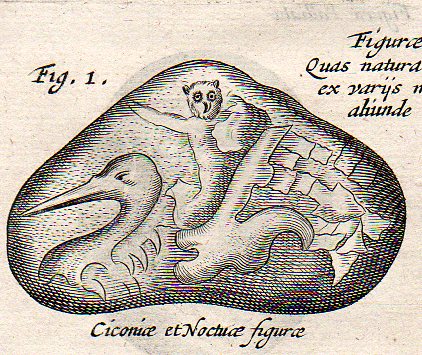
    Kircher  lapidibus birds451

    Which is a detail from  

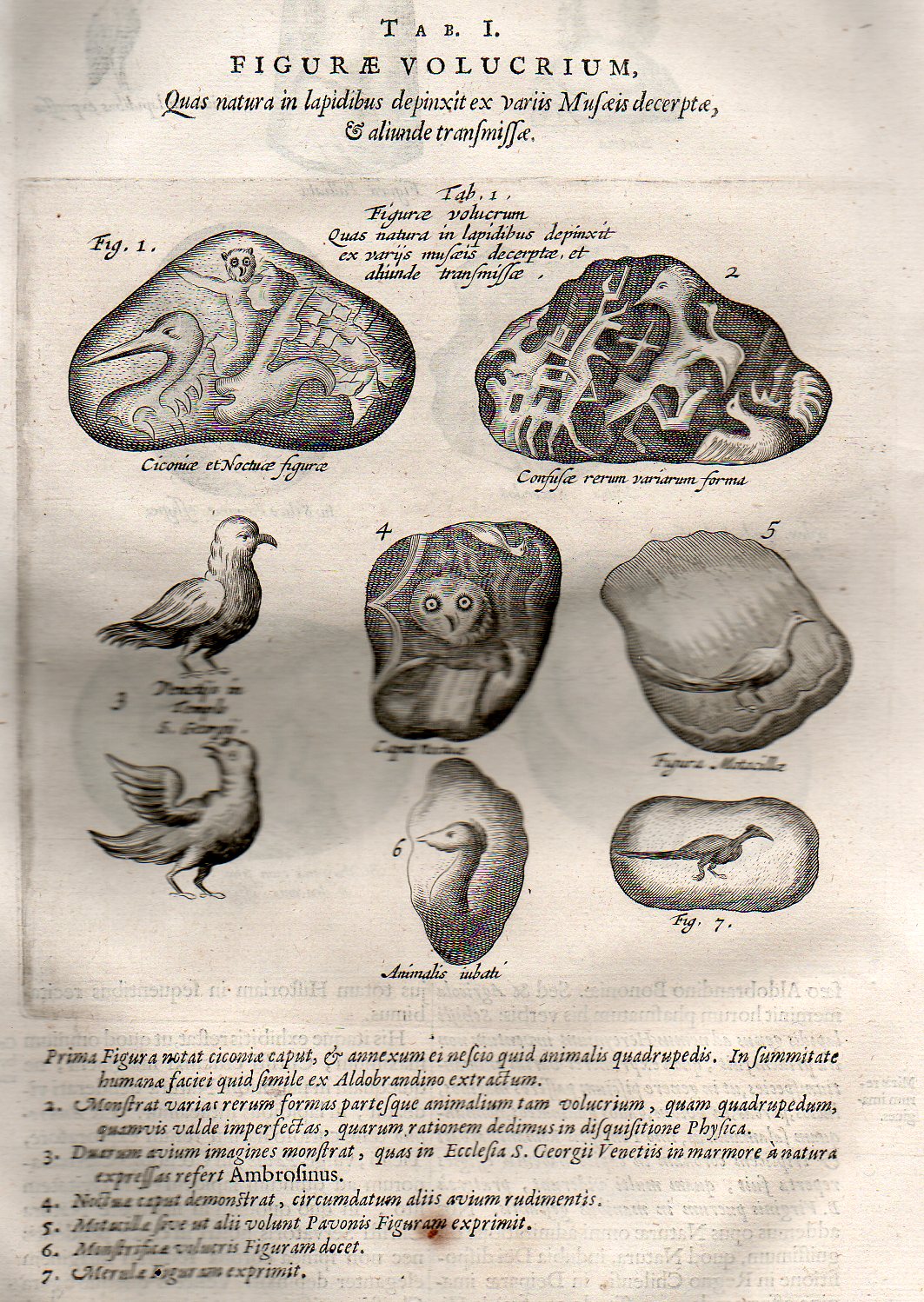
    Kircher  lapidibus birds449

    The engraving, entitled Figure Volucrum, quas Natura in lapidibus depinxit, ex variis Museia decerpt et aliunde transmissa (or “Figures of winged creatures, painted by nature on stones, taken from various museums, and otherwise transmitted.”) shows Kircher’s collection of anthropomorphically based inorganic items.  It is a remarkable exercise to try and place yourself within the context of the scientific world of Kircher’s time, 350 years ago, and try to explain these naturally-occurring phenomena, without even the benefits of the conception of long geologic time, or of expanded time in general.  

    The descriptive text (at the bottom of the engraving) from Kircher on these objects is translated, as follows:

    1.  The first figure represents a head of a Stork, together with some, but I do not know what, quadruped. At the top is something like a human face. Extracted from Aldobrandinot (see PI. XXIII. Fig. 1). 
    2.  Shows various forms and parts of animals, winged creatures as well as quadrupeds, although very imperfect, the cause of which we give in the physical examinations (see PI. XXIII. Fig. 2). 
    3.  Represents the figures of two birds expressed by nature on marble in the church of St. George’s, at Venice, referred to by Ambrosinua (see Vol. VII. PI. II. Figs. 3, 4). 
    4.  Shows the head of an Owl, surrounded by rudiments of other birds (see PI. XXIV. Fig. 2). 
    5.  Represents the figure of a Wagtail, or as others prefer, of a Peacock (PI. XXIV. Fig. 3). 
    6.  Shows the figure of a monstrous bird (Vol. VII. PI. II. Fig. 4). 
    7.  The figure of a Merle (Vol. VII. PI. II. Fig. 5).


    ·Posted by :

    ·in:

Recent Posts

Archives

Categories