A Daily History of Holes, Dots, Lines, Science, History, Math, Physics, Art, the Unintentional Absurd, Architecture, Maps, Data Visualization, Blank and Missing Things, and so on. |1.6 million words, 7500 images, 4.9 million hits| Press & appearances in The Times, Le Figaro, Mensa, The Economist, The Guardian, Discovery News, Slate, Le Monde, Sci American Blogs, Le Pont, and many other places… 5000+ total posts since 2008.

  • Very Early Papers on Alexander Graham Bell’s Photophone, 1880-1881–The First Optical (Audio) Communication

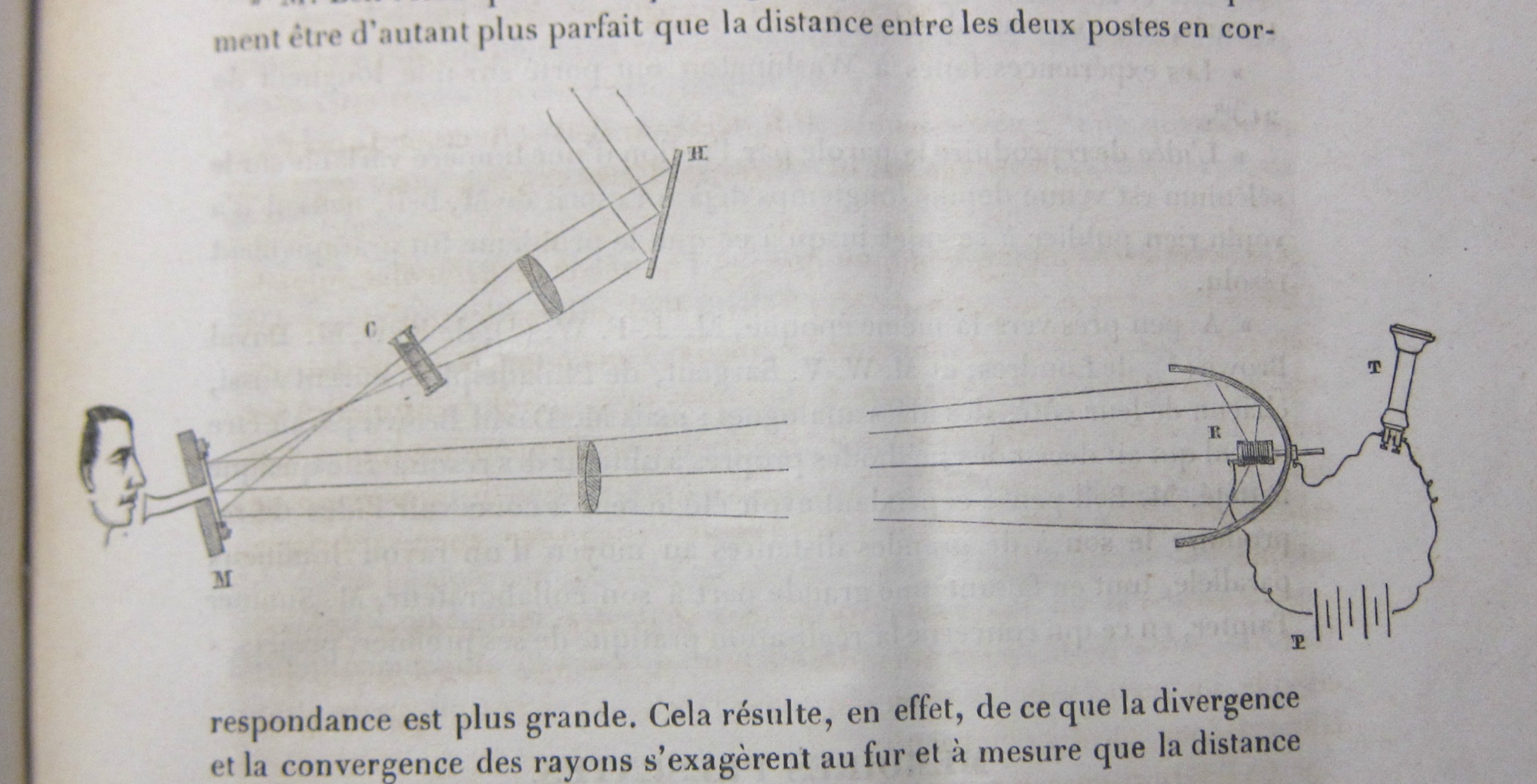
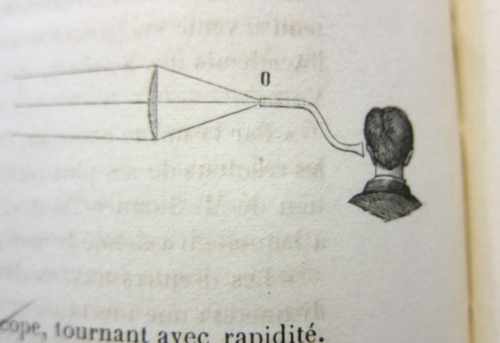
    Very Early Papers on Alexander Graham Bell’s Photophone Invention October-December 1880, and the First Wireless Communications

    Ten Papers in Seven Issues of the Comptes Rendus on Graham Bell’s June 1880 invention.

    “The photophone was in fact the World’s first device for wireless communications.  So optical wireless communications came first and wireless radio communications appeared some years later.  Bell did not just invent and patent the concept, he also built the Photophone and demonstrated it transmitting speech over distances of several hundred meters.”–Visible Light Communications dot com
    Photophone _2_

    Photophone _2_

    “Imagine a solar-powered telephone, and you’re close to understanding the important gadget Alexander Graham Bell invented on June 3, 1880, four years after he had patented the telephone. Bell considered the photophone one of his most important inventions. He’s probably right, since the technology behind the photophone led to the technology that helps computers send information around the world today…”–America’s Library

    These are very early papers on the photophone, following closely on the heals of what I think is the first appearance in print in The Electrician, September 18, 1880. Nature published a suite of articles on September 23, November 4 and 18 (which I offer for sale elsewhere on this site) which fit nicely with the Comptes Rendus articles below.

    7 issues of the Comptes Rendus, with 10 papers on the photophone, all detached from larger bound volumes, and offered with their original front wrapper. The wrapper covers are generally pretty tatty along the edges, but at least they are there. The issue all have an old vertical crease through teh text that runs down the center from when someone no doubt folded them into their coat pocket.  GOOD condition.  7 issues: $850

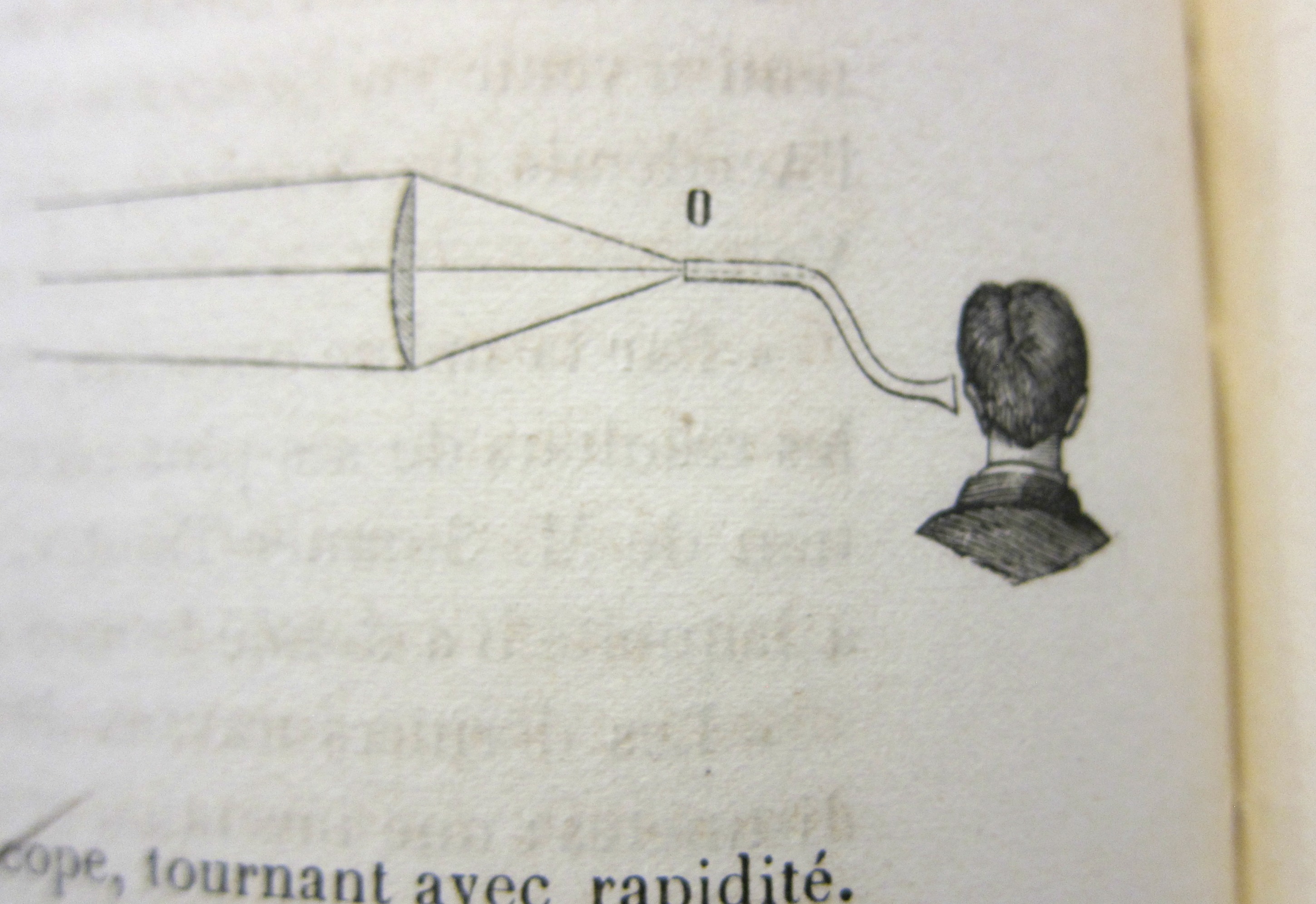
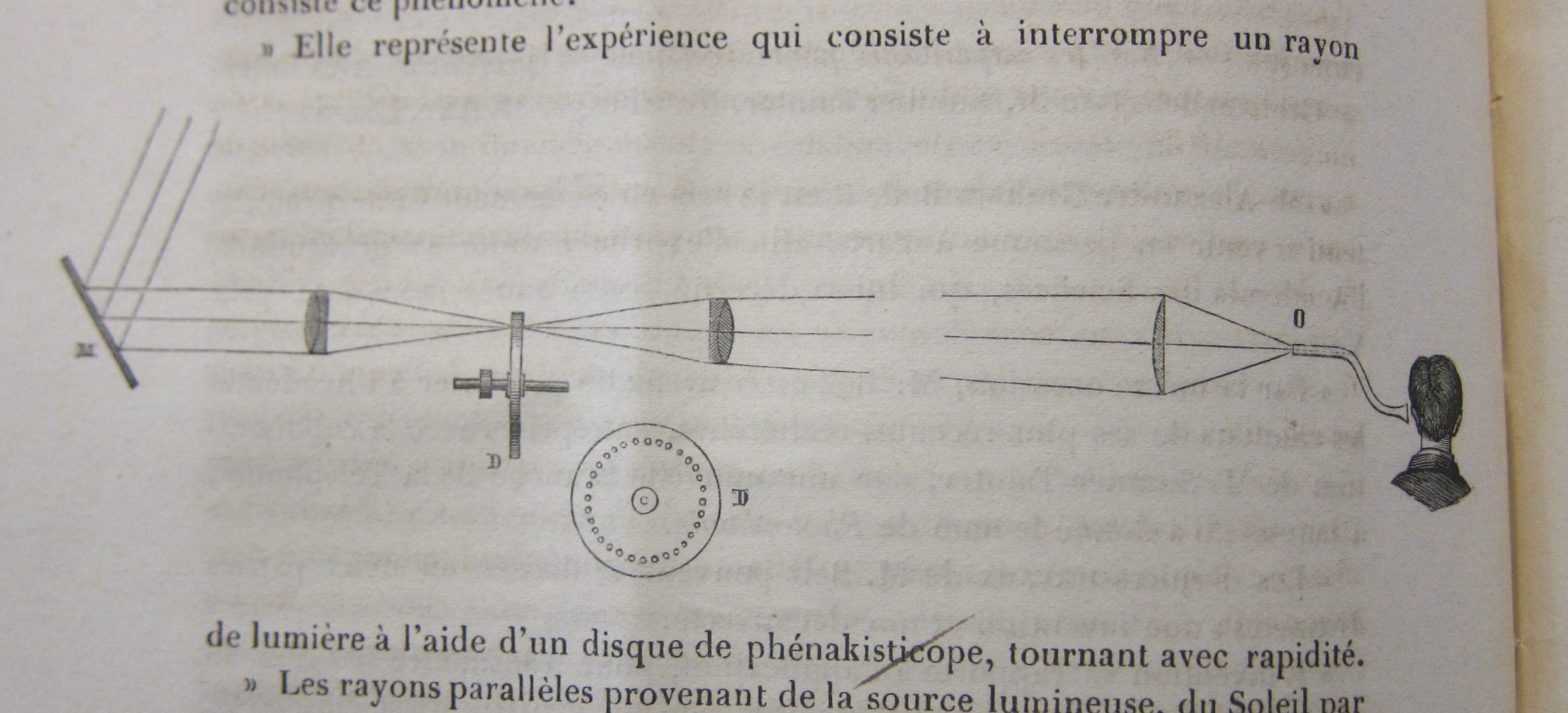
    BREGUIT, Antoine (1851-1882).“Sur les experiences photophoniques du professeur Alexander Graham Bell et de M. Sumner Tainter. Note lue par Ant. Breguit”, Vol 91, no. 15, 11 October 1880, pp 595-598, with lovely text illustration. BOUND WITH:

    CROS, Charles (1842-1888). “Sur les actions mecaniques de la lumiere; considerations theoriques pouvant servir a intereter les experiences realisees par M. G. Bell. Note de M. Cr. Cros.” p. 622-623.

    BREGUET, A. “Sur le photophone de Mm. Graham Bell et Sumner Tainter. Note lue par M. Antoine Breguet.” Vol 91, no. 16, 18 October 1880, pp 652-654 in the issue of pp 633-696

    **BELL, Alexander Graham. “Sur l’application du photophone a l’etude des bruits qui ont lieu a la durface solaire. Note presentee par M. Jansseb au nom de M. Alex. Graham Bell, Vol 91, no. 18, 2 November 1880, pp 726-727 in the issue of pp 697-736

    • Also in this issue is an announcement of Henry Draper’s first photograph of a nebula (Orion), p 716.

    **BELL. “De la production du son par la force de rayonnement”, Vol 92, no. 21,  25 May 1881, pp 1206-1224 (an extremely long piece for the CR) BOUND WITH  

    MERCADIER, Ernst. “Sur ;a radiophonie: thermophone reproduisant la voix”, pp 1224-6 AND BOUND WITH

    MERCADIER, E. “Sur la radiophonie; thermophone reproduisant la voix”, pp 1226-7.

    MERCADIER, E. “Sur la radiophonie”, vol 91, no. 23, 6 December 1880, pp 929-931 in the issue of pp 897-948

    MERCADIER, E. “Sur la radiophonie”, vol 91, no. 24, 13 December 1880, pp 982, in the issue of pp 949-1002.

    MERCADIER, E. “Sur l’influence de la temperature sur les recepteurs radiophoniques a selenium”, vol 92, 1881, no 24,  pp 1407-1408
     

     Photophone _2_

    ·Posted by :

    ·in:

  • On Weather and Vegetation 1897

    John CLAYTON. Effects of the Weather upon Vegetation A Lecture given by…to the Bradford Naturalists Society March 1st 1897. Byles & Sons Bradford 18978×5″, with a photograph. In the original wrappers. Provenance: from the Library of Congress Pamphlet Collection, with their deacquisition rubber stamp on the inside cover, and a 6mm “LC” perforated stamp on the title page. Otherwise a very nice copy.  $120

    “THIS is one of the most instructive and original lectures that we have seen for a long time Mr Clayton is evidently a keen painstaking and very original investigator and instead of the lecture being a series of platitudes and quotations as is generally the case it is almost wholly the result of investigations carried out with great care and patience during many years As is it published at a nominal price we merely specify a few of the points treated such as the relation of tree girth to amount of foliage relative growth of plants in sun and in shade followed by considerations as to the sunshine recorded in different parts of England and its influence on crops percolation gauges why trees split in times of frost and the relation between the elongation of twigs and their increase in girth When a well printed pamphlet gives information almost wholly original on all these points for sixpence we need not advise our botanical and agricultural readers what course to pursue…”–a review of the pamphlet in Meteorological Magazine, volume 32, pg 56, 1897.

    “BOOK NOTICE We have hitherto omitted to notice an admirable paper by Mr JoHN CLAYTON entitled Effects of the Weather upon Vegetation being a lecture delivered to the Bradford Naturalists Society on the 1st of March 1897 it was printed in Bradford and is sixpence We presume it is obtainable of the author or of the printers Wm Byles and Sons Mr Clayton is one of our most thoughtful botanists and anything that he writes is well worth reading the present paper being no exception A collotype photograph of a thorn hedge forms a frontispiece Experiments with bean plants in shade and in sunshine made in 1891 and 1892 are discussed and the results stated and the effects of sunshine shade shower are investigated.”–The Naturalist, London, 1898. 

    ·Posted by :

    ·in:

    —
  • Booze and the Lack of It, 1931

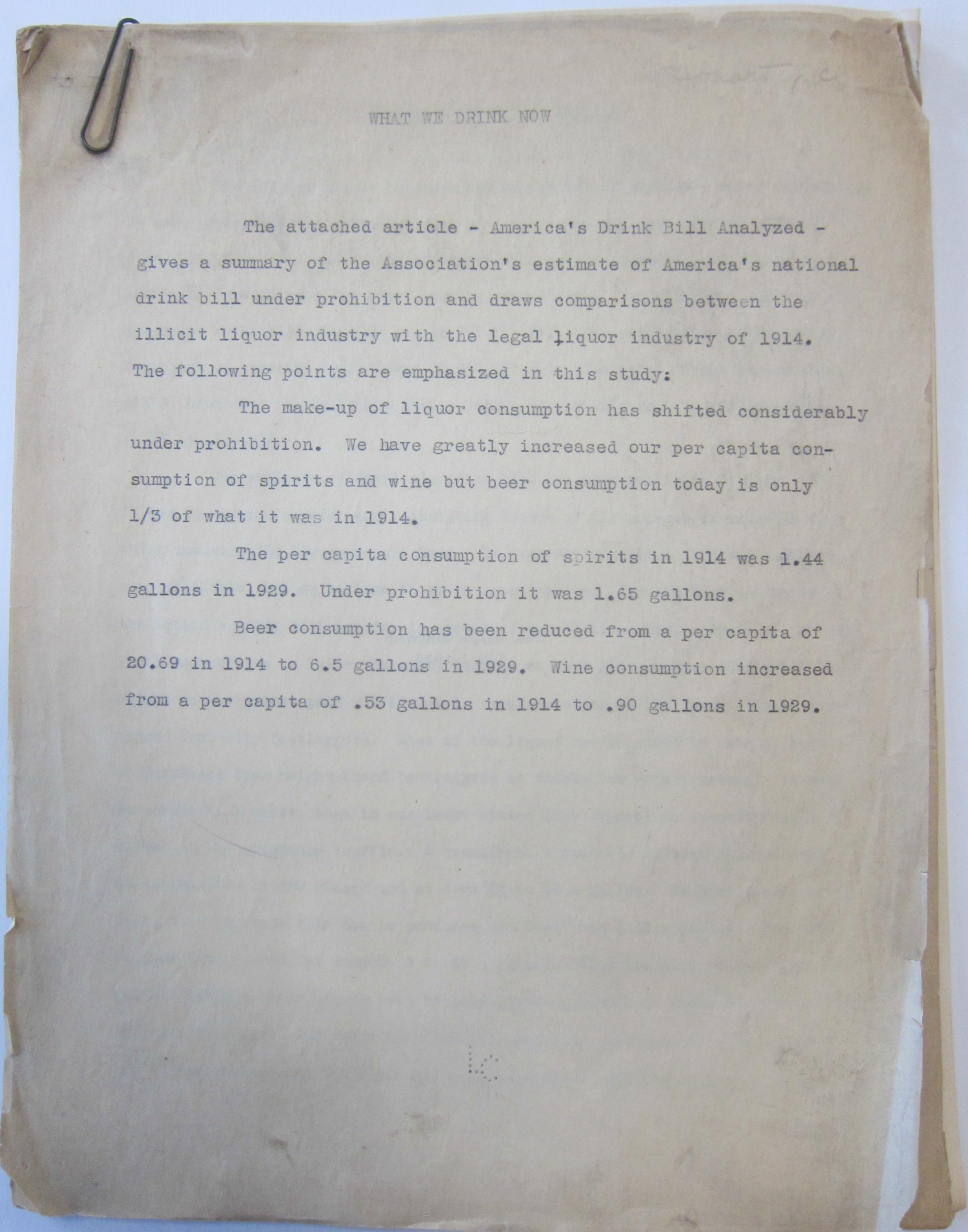
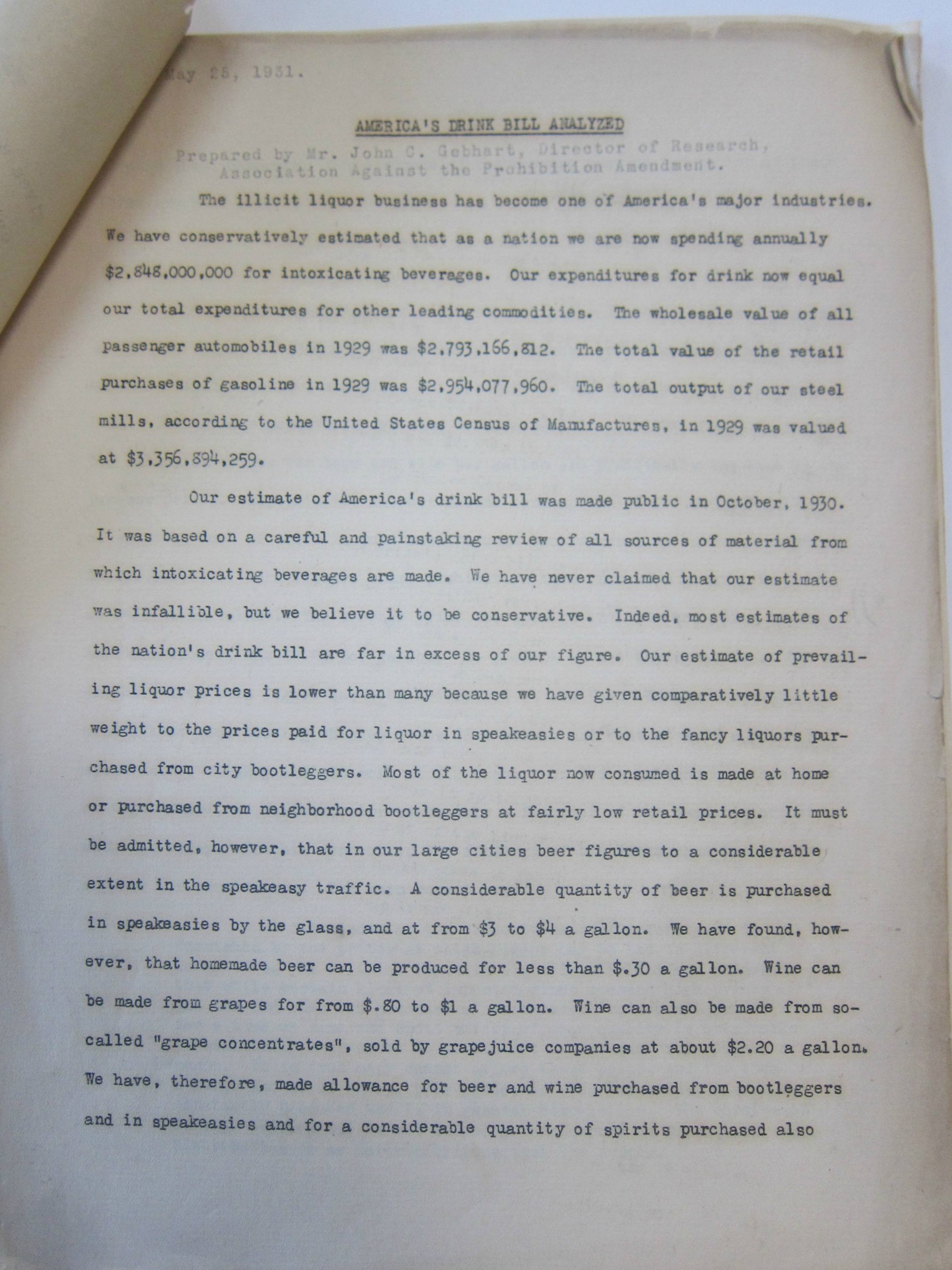
    John C. Gebhart. “What We Drink Now. America’s Drink Bill, Analyzed.”

    11×8.5″, offset printed on sheets, 14pp. Dated May 25, 1931.  Provenance: the copy of explorer, Senator (CT), and Mayan expert Hiram Bingham, via the Library of Congress; the paper-clip-bound sheets have a small gift notice from Bingham on the back of the first sheet, plus the LC’s surplus stamp on the back page, and the small perforated “LC” on the first/front leaf. Outside of  little edge wear and dusting to the first sheet, a VG copy.

    Americas drink bill _1_Gebhart was the Director of Research for the Association Against the Prohibition Amendment. Founded by William Slayton, the AAPA “…was the leading political pressure group helping to secure repeal of the Eighteenth Amendment to the U.S. Constitution. Historians credit the AAPA with fostering Republican-Democratic polarization on the issue, giving repeal greater respectability, and greatly speeding up the repeal process…The Association Against the Prohibition Amendment (AAPA) was the leading political pressure group helping to secure repeal of the Eighteenth Amendment to the U.S. Constitution. Historians credit the AAPA with fostering Republican-Democratic polarization on the issue, giving repeal greater respectability, and greatly speeding up the repeal process.”–Encyclopedia dot com

    Gebhart’s work was one of numbers, and didn’t concentrate at all int he reasons–many of which were sound–for the 18th amendment in the first place. He points out the U.S. alcohol consumption was actually up, from 1.44 gallons in 1929 to 1.65 gallons in 1931. In some compelling comparisons, he writes the illicit liquor produced more sales than wholesale auto sales figures (per year), and about 2/3 “the total output of our steel mills”, and that making booze was a flourishing industry that produced massive amounts of crimes (citing Al Capone) and no tax revenue. Anyway there’s 14pp of similar evidence, which I guess helped bring about the repeal of the 18th amendment with the adopted of the 21st in December 1933.  

    Americas drink bill _2_

    ·Posted by :

    ·in:

  • Important Very Early Papers and Announcements on Anaesthesia (1847)

    10 papers on Chloroform and Ether in 5 issues of the Comptes Rendus

     Early Works in Patient Comfort 

    “…the discovery that inhalation of various volatile substance caused insensitivity to pain”

    Papers by Flourens,Wells, Pirogov, Jackson, and others. All in the Comptes Rendus, volume 24, 1847, Paris, Gauthier-Villars, issues no. 8, 10, 12, 18, and 22.  

    All four are extracted from a larger bound volume, and so have no spine cover; that said, they do all come with their original wrappers.  Nice copies, at least solid GOOD and probably VERY GOOD.  $750

    (1) Flourens, Marie Jean Pierre (1794-1867). “Notes touchant l’action de l’ether sur les centres nerveux”, No. 10, 8 March 1847 at pp. 340-347, GM 5654

    Flourens here makes an historic obaservation on the life-saving properties of chloroform and ethyl chloride (that is he described the anaesthetic properties of chloroform vapour in non-human animals) —life-saving in that it would allow people to endure surgical procedures that might have otherwise gone badly or not at all due to pain or the promise of it. Flourens was also well known for his neurophysiological and nervous system studies and for his “pioneering efforts in experimental methods in neuroanatomy”.–Fatos Belgin Yildirim and Levent Sarikcioglu, “Marie Jean Pierre Flourens (1794–1867): an extraordinary scientist of his time”, J Neurol Neurosurg Psychiatry. 2007 Aug; 78(8): 852. “Flourens announced that chloroform had an anaesthetic effect analogous to that of ether. Little notice seems to have been taken of his papers, but later in the year Simpson independently demonstrated the value of chloroform ” (Garrison and Morton p. 770)

    Also, in the same issue: 

    (1a) [Wells, Horace] “Reclamation de priorite relative a l’emploi de l’ether admionistre par les voies de la respiration, pour suspendre la sesnsibilite chez les individus destines a subir des operations chirurgical, [Extrait d’une lettre de M. Wells, chirurgien dentiste a Hartford…” pp 372-374 (including a response from Beaumont). Wells was “an American dentist who pioneered the use of anesthesia in dentistry…”–Wikipedia]

    [A letter was sent to the French] ”…Academy to pass judgment upon his claim to priority in the discovery that inhalation of various volatile substances caused insensibility to pain. The letter to the Academie des Sciences was published in their Comptes Rendus for 8 March 1847 (PP- 372 -373)’ and the discussion that followed its presentation £lie de Beaumont reiterated Jackson’s claims…” –John F. Fulton and Madeline Earl Stanton, The centennial of surgical anesthesia; an annotated catalogue of books and pamphlets bearing on the early history of surgical anesthesia, 1946 . [Full text located at Archive dot org!]

    (2) Flourens, Marie Jean Pierre. “Note touchant les effets de l’inhalation de l’ether sur la moelle”, no. 8, 22 February 1847, pp 253-259;

    (3) Flourens, Marie Jean Pierre. “Note touchant l’action de l’ether dans les arteres”, 22 March 1847, no.12, pp 482-485; ALSO BOUND WITH

    (3a) [Charles T. Jackson] “Extrait d’une lettre de M. le docteur Charles T. Jackson a M. Elie de Beaumont (Commission de l’ether)”, pp 492-494; AND BOUND WITH

    (3b) “Expériences tendant a prouver que la cessation de l’hématose pulmonaire est la cause de l’insensibilitè qui suit les inspirations d’éther en vapeur; par MM. Preisser, Pillore et Melays, de Rouen”, pp 490-491; AND BOUND WITH

    (3c) “Comparaison des effets produits par l’inhalation des vapeurs éthérées et de l’acide carbonique; par M. Hossard, d’Angers”, pp 491-2; AND BOUND WITH

    (3d) “Recherches concernant la structure des nerfs qui ont perdu leur fonctions sous l’influence de l’éther”, pp 496-7;

    (4)  Flourens, Marie Jean Pierre. “Note touchant l’action de diverses substances injectees dans les arteres”, 31 May 1847, no 22, pp 905-909.

    “Charles T. Jackson’s letter ‘Antidote to physical suffering’ in Daily Advertiser, Boston 1. March 1847 was sent to the French Academy with a covering letter dated 28 February 1847 in which Jackson’s claims are reiterated. The text of this February letter to the Academy was issued in part in Comptes Rendus for 22 March (pp.492-494). A more popular account was published at Paris in Galignani’s Messenger for 17 February 1847 (reprinted in English in the Boston Atlas for 2 April 1847, columns 2 and 3 of page 2).–John F. Fulton and Madeline Earl Stanton. These are the only references to the Comptes Rendus that I can find in this work.

    (5) Pirogoff/Pirogov, Nicolai (1810-81). “Nouveau procédé pour produire, au moyen de la vapeur, d’éther, l’insensibilité chez les individus soumis ŕ des opérations chirurgicales”, No. 18, p 789.  Another pioneer of anaesthesia, and one of the first to employ the use of ether in a military situation.  

    ·Posted by :

    ·in:

  • Contributions by Marconi and Poincare (1912)

    Revue Scientifique (Revue Rose), January-June, 1912. 832, (50)pp.  Bound in a sturdy red cloth, with former owner stamps on the title page of each weekly issue, as well as a nice bookpalte.  The text is a little brittle around the edges.  Nice copy.  $145 Includes contributions by:

    MARCONI, G. “La Radiotelegraphie”, 10 February, pp 161-170 (from an address at the Royal Institution on 2 June 1911);

    POINCARE, Henri. “L’Hypothese des Quanta”, 24 February, pp 225-232 (not the paper given in Journal de Physique Theor. App., 1912, pp 5-34)

    RAMSAY, William. “Elements et energie”, 27 January, pp 97-109;

    LORENTZ, H.A. .Quelques Remarques sur la theorie du magnetisme”, June 3,  (pp3-6)

    BERTHELOT, D. “Les Rayons Ultra-Violets et les Actions Vitales”, pp 353-356;

    RICAHARDS, Theodore William. “Les Proprietes Fondamentales des Elements”, 16 March, 321-327; 

    LOEB, Jacques. “La Vie”, 9 March, pp 289-298.


    ·Posted by :

    ·in:

    —
  • Important Publications in the History of the Development of Nuclear Physics and the Atomic Bomb, 1938

    8 Important Publications in the History of the Development of Nuclear Physics and the Atomic Bomb, with papers by Irene Curie, Paul Savitch, Frederic Joliot, Louis Goldstein, Andre Moussa, and others.  All are weekly issues from Comptes Rendus, volume 206, 1938, and are detached from a larger bound volume, though they do each come supplied with their original front wrapper.  Each issue has an old vertical fold (now mostly faded) through the center of the text.  Good, sound copies.  8 issues: $450:

    CURIE, Irene  and Paul Savitch. “Sur le radioelement de periode 3.5 heures forme dans l’uraniumirradie par les neutrons” 21 March 1938, no. 12,  p 906-908;

    CURIE, Irene  and Paul Savitch.  “Sur le radioelement de periode 3.5 heures forme dans l’uraniumirradie par les neutrons” continued 30 May 1938, no. 22,  on pp 1643-5;

    JOLIOT, Frederic and Ignace Zlotowski, “SUr l’energie des groupes de protons emis lors de la transmutation du bore par les rayons X” 7 March 1938, vol 206 no. 10,   p 750-752 pp 705-792 

    JOLIOT, Frederic and Ignace Zlotowski, “Sur la formation d’un isotope cinq de l’helium lors des collisions entre helions et Deutrons”, 35 April 1938, no 17,   pp 1256-1259 pp 1229-1272, 

    And also with:

    MOUSSA, Andre and Mlle Helene Laurent, “”Sur les periodes desintegration des radioargents”, 1015

    GOLDSTEIN, Louis. “Sur la theorie des reactions nucleaires”, p 42

    _____. Sur la theorie des gerbes de prtons et de neutrons”, p 488

    _____. “Sur le mecanisme de l’activation des noyeaux atomiques”, p 1880

    ·Posted by :

    ·in:

    —
  • Tesla’s London Lectures, 1892

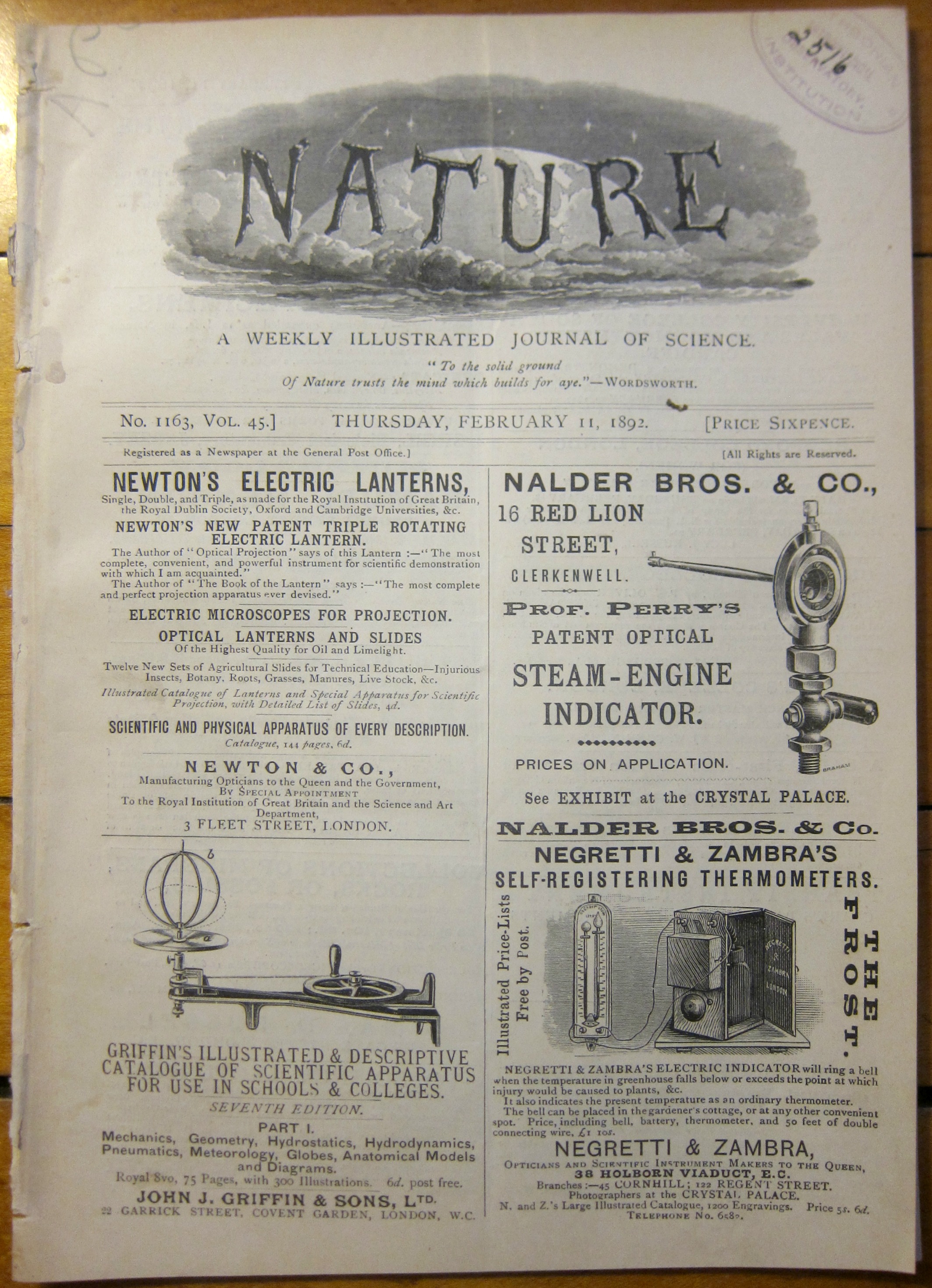
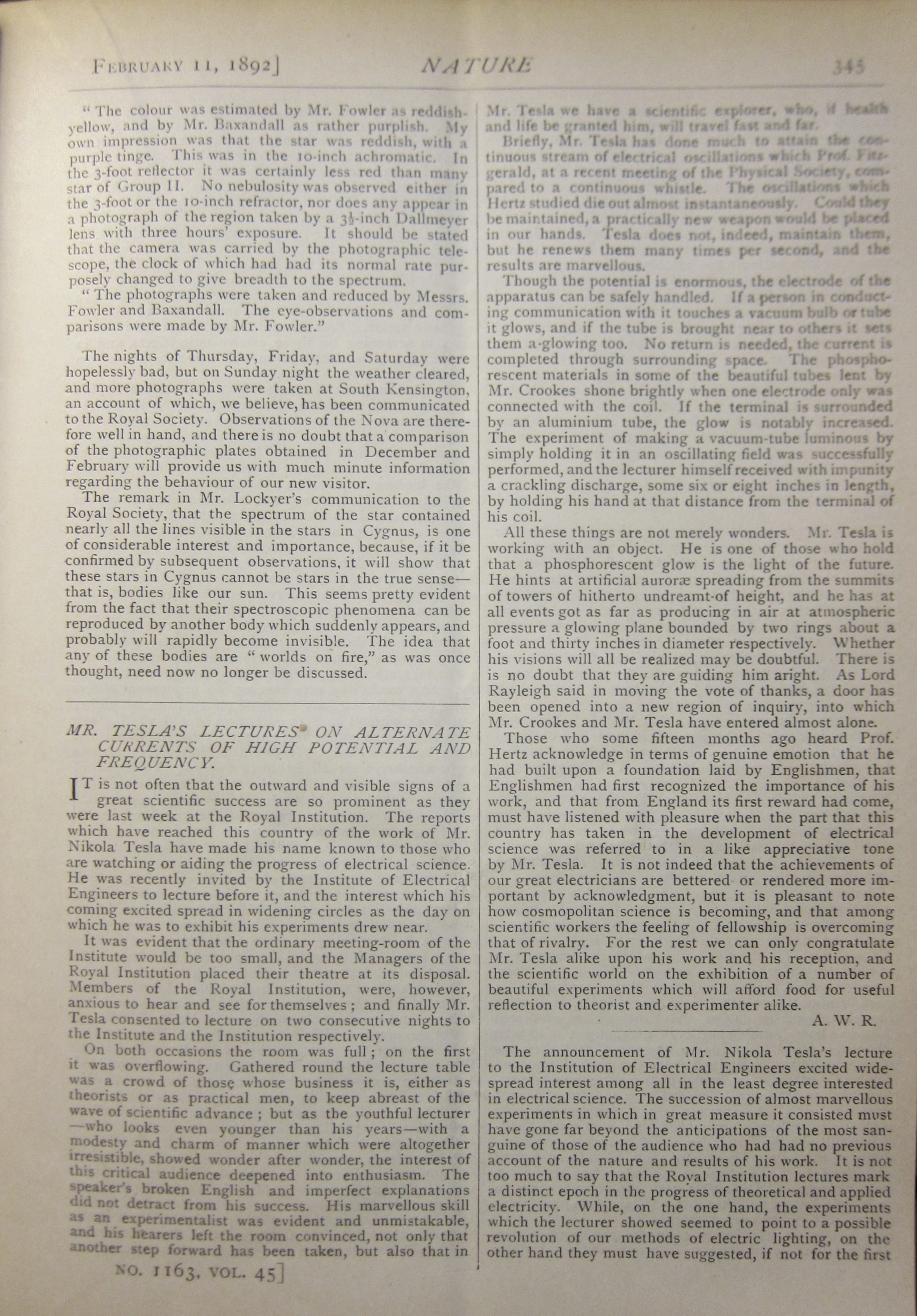
    [Tesla] “Mr. Tesla’s Lectures on Alternate Currents of High Potential and Frequency”, in Nature, volume 45, February 11, 1892, no. 1163, pp 345-7 in the weekly issue of pp 337-360. Offered with the original wrappers, including the cover plus 7pp of ads. This is extracted from a larger bound volume, ex-library from the Smithsonian Astrophysical Observatory , with their small oval rubber stamp in the upper corner of the front cover. Its a nice copy though it does have an old, mostly faded, vertical fold through the text.  The article runs around 2500 words and includes two reviews of the lecture(s), which overflow crowds enjoyed over two days at the Royal Institution.  Good, solid copy, with the uncommon wrappers.  $200

    TEsla 1892 cover

    Tesla 1892 text

    ·Posted by :

    ·in:

    —
  • Nuclear Fission in “Revue Scientifique”, 1939


    Revue Scientifique, January-August, 1939, volume 77, numbers 1-8, quarto, 551pp. Wrappers (front and back) bound in at the rear of the volume, with supplemental ads throughout the volume. Bound in an attractive red cloth. Tidy institutional bookplate; institutional rubber stamp on first page of each monthly issue as well as one rubber stamp on wrapper covers. Fine copy, very tight and fresh. $500

    This volume contains a couple of original articles of interest to the development of nuclear fission as well as 16 articles that are reviewed/abstracted/somewhat reprinted from other journals (in the February, March, and April issues), and when not in French written in or translated into French, which in many cases are the first translations of some of the great papers in this period of nuclear physics. The great majority are one or two columns in length.

    Included are works by Thibaud, Savitch, Joliot, Frisch, von Halban, Meitner, Feather, Bretscher, Heyn, Strassmann, Curie and others–these are rapidly published translations/reviews, in many cases coming jsut weeks after the original paper was published.  

    • Issue for February, 1939 

    VEIL, S. “Les controls chimiques de transmutations d’atomes”, p 111-112.

    And unattributed in the “echos” section:

    “La Rupture Explosive des noyaux d’uranium et de throium dans l’Action des Neutrons”. One column article on page 133, citing Fermi/Amaldi 1934, Curie/Savitch 1938, Hahn and Strassmann (Jan 1939).

    Then:

    “Un nouveau type de reaction nucleaire”, Nature, 143, 233, 1939, translated by S. Veil—this is the “introductory” statement in Nature preceding the Meitner/Frisch paper a few pages later.

    MEITNER, Lise and O. Frisch. “Disintegration de l’uranium par les neutrons: un nouveau type de reaction nucleaire”, translated by S. Veil, pp 133-4, and which appeared in Nature, 143, 233, 1939.

    JOLIOT, F and J. Perrin. “Preuve experimentale de la rupture, explosive des noyaux d’uranium et de thorium sous l’action des neutrons”, from Comptes Rendus, vol 208, 199, 341-343, and here appearing in two columns on one full page (135).

    CURIE, I. And P. Savitch. “Sur les radioelements formes dans l’uranium et le thorium irradies par les neutrons”, from Comptes Rendus, volume 208, 1939, p 343-346, and here on one full page (136).

    • The issue for March, 1939 77/3, pp (139)-218 is very interesting:

    THIBAUD, Jean and A. Moussa. “La cassure de l’uranium, la formation d’un halogene et la liberation d’energie qui en resulte”, pp 182-185.

    And then, in the “echo et information” section, which is basically a reporting section on work that was published elsewhere (though not necessarily in French), we find abstracts and announcements of a number of very significant publications:

    THIBAUD, Jean and Andre Moussa. “Sur la rupture des noyaux d’uranium sous l’action des neutrons et la liberation d’energie qui en resulte”, from the Comptes Rendus 208, 1939, pp 744-6, p 211-212.

    SAVITCH, Paul. “Sur un radioelement gazeux forme dans l’Uraium bombarde par les neutrons”, from Comptes Rendus, 208, 1939, pp 646-647, this all on a long columns on page 212.

    JOLIOT, F. “Observation par la methode de Wilson des trajectoires de brouillard des produits de l’explosion des noyaux d’uranium”, from Comptes Rendus, vol 208, 1939, pp 647-649. one and a half columns, with photo illustration.

    FRISCH, O. “Evidence physique de rupture du noyaux lourds sous bombardement de neutrons”, in Nature, 143, 1939, p 276. This 1.25 columns.

    Von HALBAN, H. and F. Joliot. “Liberation de neutrons dans l’explosion nucleaire de l’uranium”, from Nature, 143, 1939, p 470. This pp 214-215.

    MEITNER, L. and O.R. Frisch. “Les Produits de rupture du noyaux f’uranium”, in Nature143, p 471, 1939. This is all on page 215, in two full columns.

    • The issue for April, 1939: pp 186-298

    FEATHER, N. and E. Bretscher. “La Rupture Explosive des Noyaux d’Uranium”, from Nature, 143, p 516, 1939. Here occupies 1 column.

    HEYN, F. and Aten and Bakker. “Transmutations d’uranium et de thorium par neutrons”, from Nature, 143, 516, 1939. Here occupies two full columns.

    BRETWCHER, E. and L.G. Cook. “Transmutations de noyaux d’uraniumet de thorium en moyen de neutrons”, from Nature, 143, p 559, 1939. Here the work occupies a full column.

    FEATHER, N. “La duree du processis de rupture nucleaire”, from Nature, 143, p 597, 1939. Here the work occupies two columns.

    THIBAUD, J. and A.Moussa. “La disintegration de l’uranium par l;effet des neutrons et la partition de cet element”, from Comptes Rendus, 208, 652-4, 1939. Here the artcile occupies two columns on page 293.

    DODE, M. and von Halban and Joliot. “Sur l’energies des neutrons libertes lors de la partition nucleaire de l’uranium”, (no mention of origin). This is one full column on page 294. 

    • Issue for June-July 1939, pp 371-455

    COUFFIGNAL, L. reviews/abstracts/summarizes A. Einstein and L Infeld “L’Evolution des Idees en Physique”, pp 427-8

    Also for interest in the history of computer science: Nice article on Maurice d’Ocagne (1862-1938) by Louis COUFFIGNAL and Rene Harmegnies.Fe 1939, p 70 p. 67-76 Feb 1939

    ·Posted by :

    ·in:

    —
  • Important Papers in the History of Nuclear Fission, 1939

    The Atomic Bomb–the French Contribution, first half, 1939. 

    14 major papers (in 12 different weekly issues) in the history of nuclear fission, all published in Comptes Rendus hebdomadaires des Séances de l’Academie des Sciences, volume 208, January-June 1939, 2250pp, a single bound volume, thick and stout. Ex-libris, with a bookplate–also, each title-page of each weekly issue (of which there are 26 in this volume), has a small round rubber stamp of the library. Cloth binding. ca. 1950. Nice condition.  There is a faded, old vertical fold that extends through the text, no doubt from when the original owner folded the issues in half…over the years in binding, the fold is mostly gone.   $1000

    Included are the following:

    BECK, Guido and Peter Havas, “La dissymetrie de la rupture de l’uranium”, 3 April 1939, no. 14,  pp 1084-1086

    BECK, Guido and Peter Havas, “Sur le ralentissement dans l’air des fragments atomique résultant de l’explosion de l’uranium”,  22 May 1939, no. 21, pp 1643-1645;

    *CURIE, Irene and Paul Savitch. “Sur les radioelements formes dans l’uranium et le thorium irradies par les neutrons”, 30 January 1939 (one of two papers in this issue), pp 343-346; 

    DODE, Maurice, Hans von Halban, Frederic Joliot, Lew Kowarski. “Sur l’energie des neutrons liberes lors de la partion nucleairede l’uranium”, 27 March 1939,  p 995-997

    HAENNY, Charles and Albert Rosenberg. “Émission de neutrons lors de la rupture provoquée du noyau d’uranium. Possibilité de réaction par chaine” “20 March 1939, no 12, pp 898-900;  

    **JOLIOT, Frederic. “Preuve experimentale de la rupture explosive des nayaux d’uranium et de thoriumsous l’action des neutrons” 30 January 1939,  p 341-343– THE FIRST INDEPENDENT CONFIRMATION OF NUCLEAR FISSION. 

    *JOLIOT, Frederic. “Observations par la methode de Wilson des trajecoires de brouillard des produits de l’explosion des noyaux d’uranium”, 27 February 1939, p 647-649

    MAGNAN, Claude, “Sur la cassure des noyaux éléments plus légers que l’uranium, sous le bombardement des neutrons”, 6 March 1939, no. 10, pp 742-4;

    MAGNAN, Claude. “Sur les neutrons emis lors de la bipartition de l’uraniumsous l’action des neutrons”, 17 April 1939, pp 1218-1220

    *PERRIN, Francis. “Calcul relatif aux conditions éventuelles de transmutation en chaine de l’uranium”, 1 May 1939, no 18,  pp 1394-1396; 

    *PERRIN, Francis. “Calcul relatif aux conditions éventuelles de transmutation en chaine de l’uranium”, 15 May 1939, no. 20, pp 1573-1575; 

    *THIBAUD, Jean Thibaud and Andre Moussa. “Sur la rupture des noyaux d’uranium sous l’action des neutrons et la libération d’énergie qui en résulte”,  6 March 1939, no. 10 (second article of the issue) 744-6;

    von HALBAN, Hans, Lew Kowarski, Paul Savitch. ” Sur la capture simple des neutrons thermiques et des neutrons de resonance par l’uranium”, 1 May 1939, no 18 (second article in this issue) pp 1396-1398; 

    von Halban, Hans, Lew Kowarski, Michael Magot. “Sur l’intensite des neutrons dans le radiation cosmique”, 20 February 1939, pp 572-574.


    ·Posted by :

    ·in:

    —
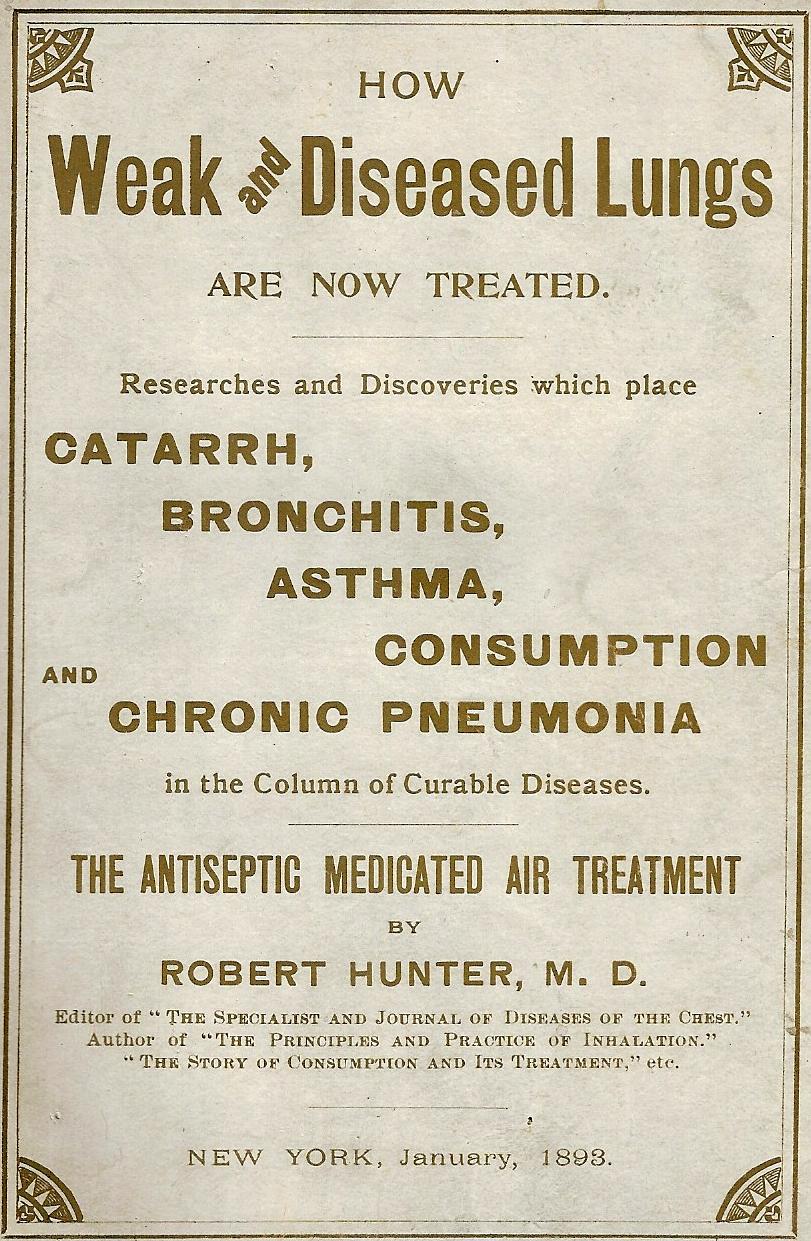
  • Medicated Air Cure for Weak and Diseased Lungs (1893)

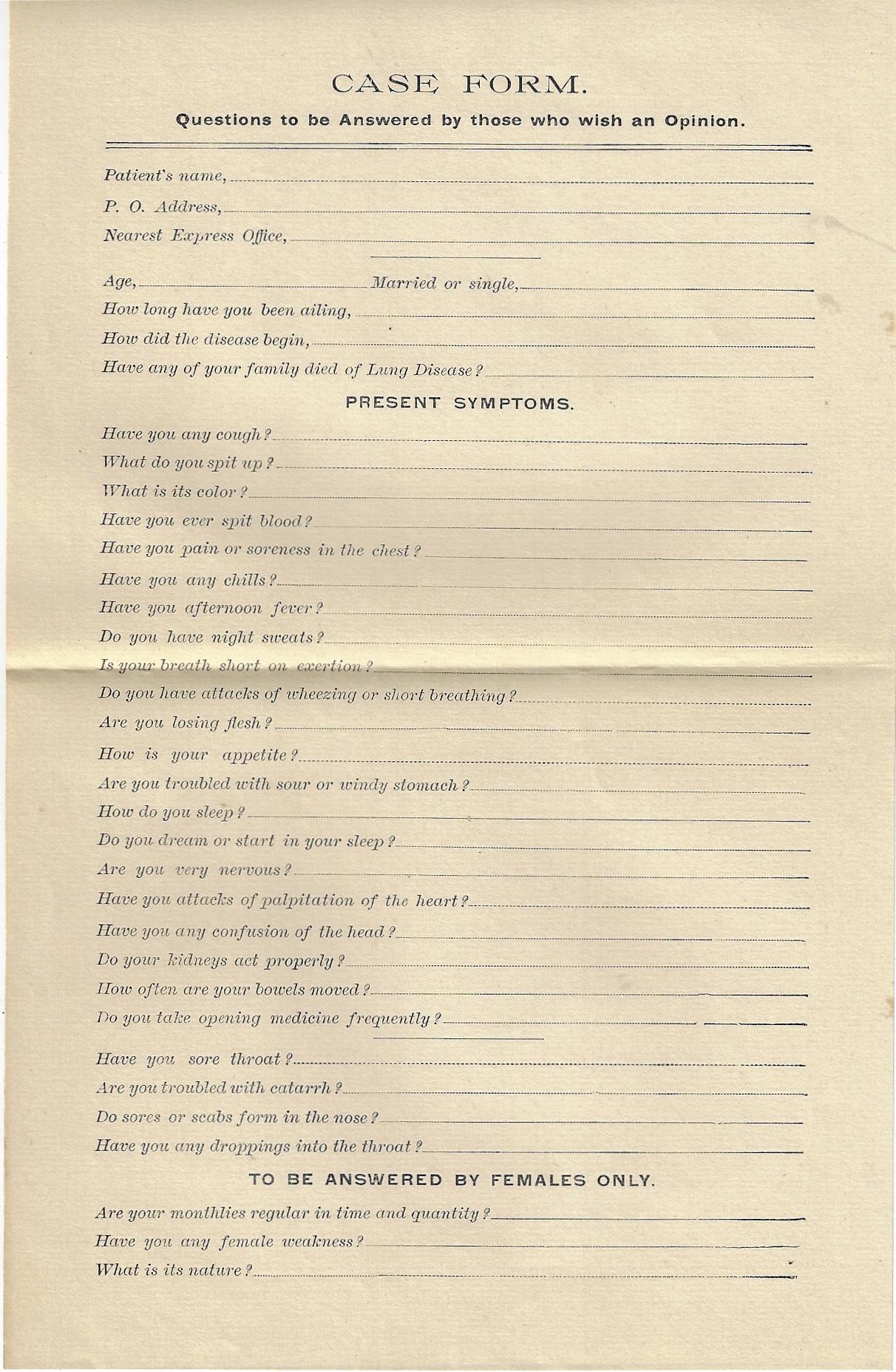
    Robert Hunter, M.D.  How Weak and Diseased Lungs are Now Treated. Researches and Discoveries which place Catarrh, Bronchitis, Asthma, Comsumption, and Chronic Pneumonia in the Column of Curable Diseases. The Antiseptic Medicated Air Treatment. New York, 1893. 7×5″, 32pp, with a 10″x6″ folded questionnaire.  Original wrappers. Very Good condition.  $95

    Hunter lungs_0002


    Hunter lungs form

    ·Posted by :

    ·in:

  • Six Early and Seldom Seen Papers Concerning the Theory of Relativity, 1905-1913

    Six papers by Victor Cremieu, all extracts from larger bound volumes of Comptes Rendus, 1905-1913.  The six: $225

    Crémieu, Victor. “Recherches sur la gravitation. Attraction observee entre gouttes liquides suspendues dans un liquid de mem densite”, in Comptes Rendus, 1905 volume 140, pp 80-83; offered with the following, all from the Comptes rendus:

    • “Recherches sur la gravitation “, volume 141, 25 October 1905, pp 653-656 (#17)
    • “Recherches sur la gravitation “, volume 141, 6 November 1905, #19, pp 713-715;
    • “Recherches sur la gravitation”, volume 143, 1906, pp 887-889
    • “Sur une ereur systematique qui limite la precision de l’experience de Caendish. Methode nouvelle pour l’etude de la gravitation”, 1910, volume 150, pp 863-866
    • “Effects de la flexion aux points d’attache du fil d’une bal;ance de torsion”, 1913, volume 156, pp 617-620;

    “Crémieu’s experiments were meant to test the dependence of gravitational attraction on the substance separating two test bodies. The experiments were of two types: in the first set, he measured the displacement of oil droplets in liquid, while in the second set, he relied on a custom-built torsion balance to measure the attraction of bodies in air and in water. Both sets of experiments produced results at odds with the Newtonian prediction, yet once again, Crémieu convinced himself that they were artifacts of his apparatus.”

    “Victor Crémieu (1872–1935) was born in Avignon, and obtained the Ph.D. in physics at the Sorbonne under Gabriel Lippmann’s direction in 1901. As a result of his experimental investigations of rotating electrified disks, Crémieu was led at first to deny the existence of a magnetic effect of convected electricity, predicted by Faraday and Maxwell, and first detected in 1876 by Henry Rowland. Crémieu later recognized the reality of Rowland’s effect, attributing his null results to an unsuspected masking phenomenon. He went on to perform delicate, but ultimately inconclusive experiments on gravitational attraction…”–from the Henri Poincare Papers website at the University of Nantes. 

    Lecat, Bibliographie de la Relativite, 479. 


    ·Posted by :

    ·in:

Recent Posts

Archives

Categories