A Daily History of Holes, Dots, Lines, Science, History, Math, Physics, Art, the Unintentional Absurd, Architecture, Maps, Data Visualization, Blank and Missing Things, and so on. |1.6 million words, 7500 images, 4.9 million hits| Press & appearances in The Times, Le Figaro, Mensa, The Economist, The Guardian, Discovery News, Slate, Le Monde, Sci American Blogs, Le Pont, and many other places… 5000+ total posts since 2008.

  • First Observation of the Wave Nature of Electron (1927)

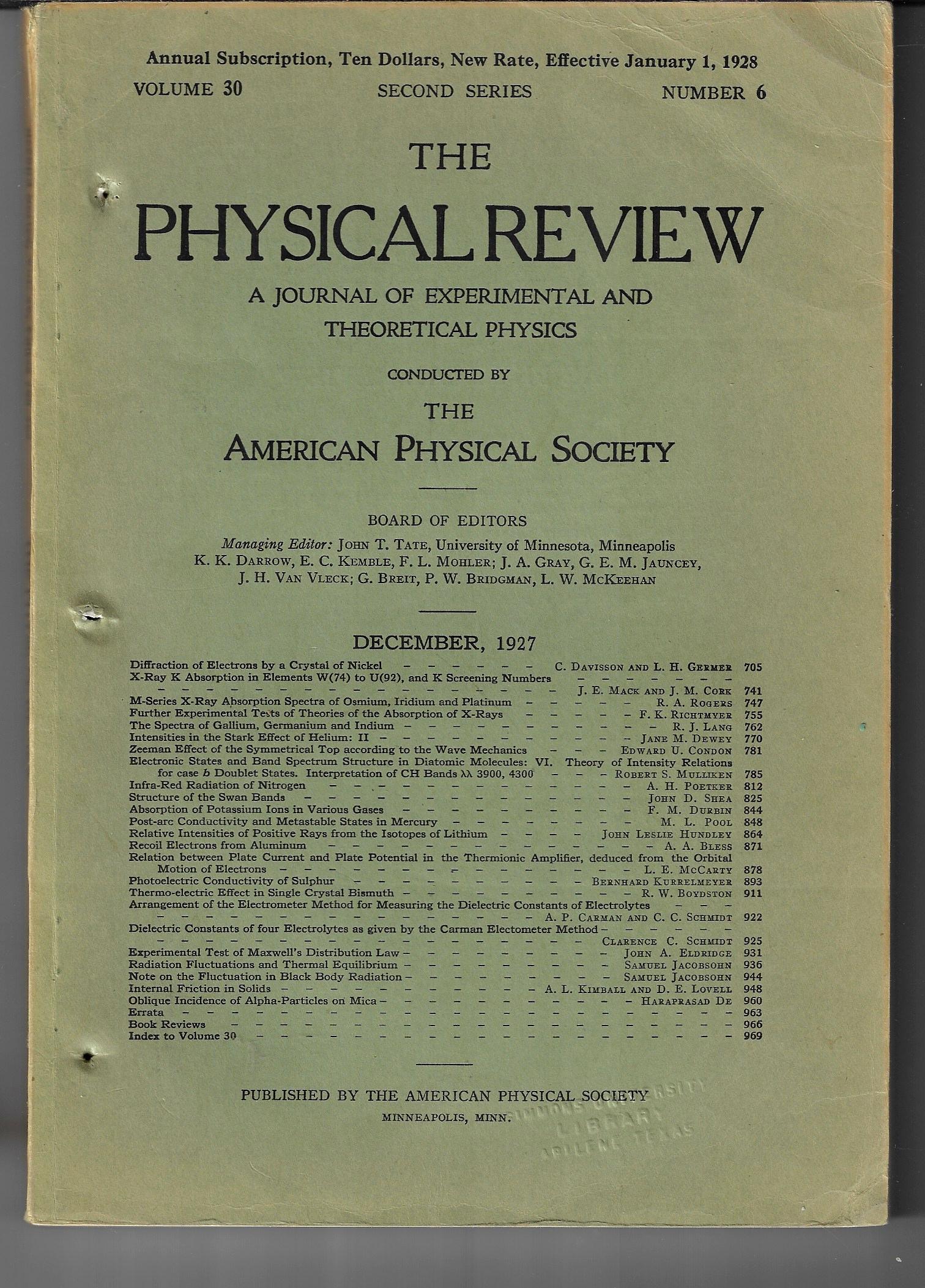
    PR 1927 davissonDAVISSON, Clinton Joseph (1881-1959) and L.H. Germer.  “Diffraction of Electrons by a Crystal of Nickel”, in Physical Review, volume 30, 6, December 1927, pp 705-741, in the issue of pp 705-978.  In the original wrappers. The issue with this copy is t hat it was crudely bound in a bad binding; when rescued, though it was left with three binding punch holes (as you can see). The binding did do a good job in protecting the spine and wrappers, but, well…  In any event, this nice fresh and punched copy is offered at a fraction of what a nice copy would sell for: $250

    “Change with wave theory of matter. De Broglie. Einstein. Confirmation by Davidson [sic]”. –in N. Bohr’s notebook,in “Complementarity before uncertainty” by Sandro Petruccioli, Arch. Hist. Exact Sci. (2011) 65:591–624. Davisson (mentored by three Nobelists in J.J. Thomson, O. Richardson, and R. Milliken) and George P. Thomson would share the Nobel ten years later in 1937 this brilliant and famous work, “for the experimental discovery of the diffraction of electrons by crystals” (Nobel Prize website).

    “It was his due for an experimental result that had showed the wave nature of matter beyond any doubt, as assumed by Louis de Broglie in 1924 and whose solid conceptual foundation lay in the context of Schrödinger’s wave mechanics. In his Nobel Lecture, Davisson attributed to Walter Elsasser, a young student of physics in Göttingen, the merit of having been the first, in 1925, to draw attention to the fact that “beams of electrons like beams of light would exhibit the properties of waves, that scattered by an appropriate grating they would exhibit diffraction”. In short, the experimental demonstration of diffraction had decreed the physical existence of the electron waves.”–Petruccioli (above).

    “In the summer of 1926 Davisson attended a meeting of the British Association for the Advancement of Science at Oxford. There he discussed his investigations of the scattering of the electrons with Max Born, James Franck, and others. For the first time he heard in detail about Louis de Broglie’s hypothesis that an electron possesses a wave nature and has a wavelength h/mv, where h is Planck’s constant, m the electron mass, and v the speed of the electron. The Oxford discussions persuaded Davisson that his experimental results were probably due to the effects of de Broglie waves. This interpretation of the earlier Davisson-Kunsman experiments had already been suggested, a year prior to the meeting, by Walter Elsasser, who carried out experiments himself, trying to confirm his point without success. Davisson knew of Elsasser’s suggestion but, failing to find any evidence of a wave phenomenon, dismissed it as irrelevant. Elsasser therefore had no influence on the course of Davisson’s experiments, and it was not until the Oxford conference that Davisson became fully aware of what his experimental results might reveal.”

    “When Davisson returned from England, he and Germer began a systematic search for some sort of interference phenomenon, and in January 1927 they observed electron beams resulting from diffraction by a single crystal of nickel. The results were in good agreement with de Broglie’s prediction. For his confirmation of electron waves. Davisson shared the Nobel Prize in physics in 1937 with G. P. Thomson, who had independently confirmed electron waves by a different method.”–Dictionary of Scientific Biography, pp 597-8.

    DSB lists the following as the significant papers for publication in this area in 1927/8, listing the Physical Review paper ahead of NAS and Nature.
    ·Posted by :

    ·in:

  • Rutherford Summarizes the Second Solvay Conference (1913)

    Ernest Rutherford. “International Conference on the Structure of Matter”, in Science, N.S. Vol 38, No. 988, December 5, 1913.

    “The first International Conference in Brussels on the Theory of Radiation in 1911 owed its inception to Mr. Ernest Solvay, and proved a great success. Shortly afterwards, Mr. Solvay generously gave the sum of one million francs to form an International Physical Institute…part of the proceeds to be devoted to assistance of researches in physics and chemistry, and part to defray the expenditure of an occasional scientific conference between men of all nations to discuss scientific problems of special interest. In pursuance of this aim the second International Conference or Conseil International de Physique Solvay, was held in Brussels this year on October 27–31, under the able presidency of Prof. Lorentz. On this occasion the general subjects of discussion were confined to the structure of the atom, the structure of crystals, and the molecular theory of solid bodies…”–from the paper. 

    This is the first U.S. appearance of the article which appeared a few weeks earlier in Nature, 92, 347 (20 November 1913), and is offered here in the weekly issue in original wrappers. The original owner made three notations in ink on the front cover of page numbers to read. Other than that, this is a near-fine copy, untrimmed. Not at all common to my experience. A near-fine copy: $125

    This is a very short, two-column paper over two pages, giving a very brief background to the Solvay Conference (not named so here). Rutherford is writing about the 2nd Solvay Conference, following the first (on radiation and quanta) of 1911. WWI would interrupt the process and when the conference resumed in 1921 Germans were restricted from attending. It is interesting to note that Einstein was invited but did not attend, showing solidarity for his countrymen trying to scratch their way out of their vanquished hole. There have been 27 conferences so far, meeting every three years or so, with the large exception of 1933-1948.


    ·Posted by :

    ·in:

  • The Discovery of the Anthrax Vaccine (1881, Pasteur)

    Five papers in four issues of the Comptes Rendus / The Discovery of the Anthrax Vaccine

    Louis Pasteur, Charles Chamberland, and Pierre P.E. Roux.

    All from the Comptes Rendus Hebdomadaires des Séances de L’Academie des Sciences, volume 92, 1881, issues 5, 9, 12, and 24. All have been disbound from a larger bound volume, though they are each offered with their original wrappers, which makes them fairly uncommon. The text is in good condition, though it has a common fault of an old fold going through vertically at the middle, no doubt from when some early reader folded it in half and put it in their pocket. Overall, still GOOD copies. The set:  $500
    The issues as follows:

    “Sur la longue durée de la vie des germes charbonneux et sur leur conservation dans les terres cultivées”, no. 5, the paper occupying pp 209-211 in the issue of pp 209-260;

    “De l’atténuation des virus et de leur retour à la virulence”, no. 9, pp 429-435 in pp 429-480;

    “De la possibilité de rendre les moutons réfractaires au charbon par la méthode des inoculations préventives”, no. 12, pp 662-665 WITH “La vaccine du charbon” pp 666-668 in the issue of pp 653-768;

    **“Compte rendu sommaire des experiences faites à Pouilly-le-Fort, près Melun, sur la vaccination charbonneuse”, no. 24, pp 1378-1383 in pp 1365-1476.

    “The famous French microbiologist and chemist, Louis Pasteur, pioneered the use of bacterial vaccines for prevention of infectious diseases in animals and humans. One of his early successes was in the development of a vaccine for the agriculturally important disease anthrax, a vaccine that is still in use today for animals worldwide and humans in some countries. He demonstrated the effectiveness of his vaccines often with dramatic public trials, one of the most famous of which was the spectacle at the small French village of Pouilly-le-Fort in May 1881. This paper…describes the set-up and outcome of this public test of anthrax vaccination. “YALE JOURNAL OF BIOLOGY AND MEDICINE 75 (2002), pp. 59-62. “Originally published in Comptes Rendus… 92:1378-1383, June 13, 1881″.  Yale Journal of Biology and Medicine. CLASSICS OF BIOLOGY AND MEDICINE

    ·Posted by :

    ·in:

  • One of the Earliest X-Ray Photos Published in a U.S. Journal (6 February, 1896)

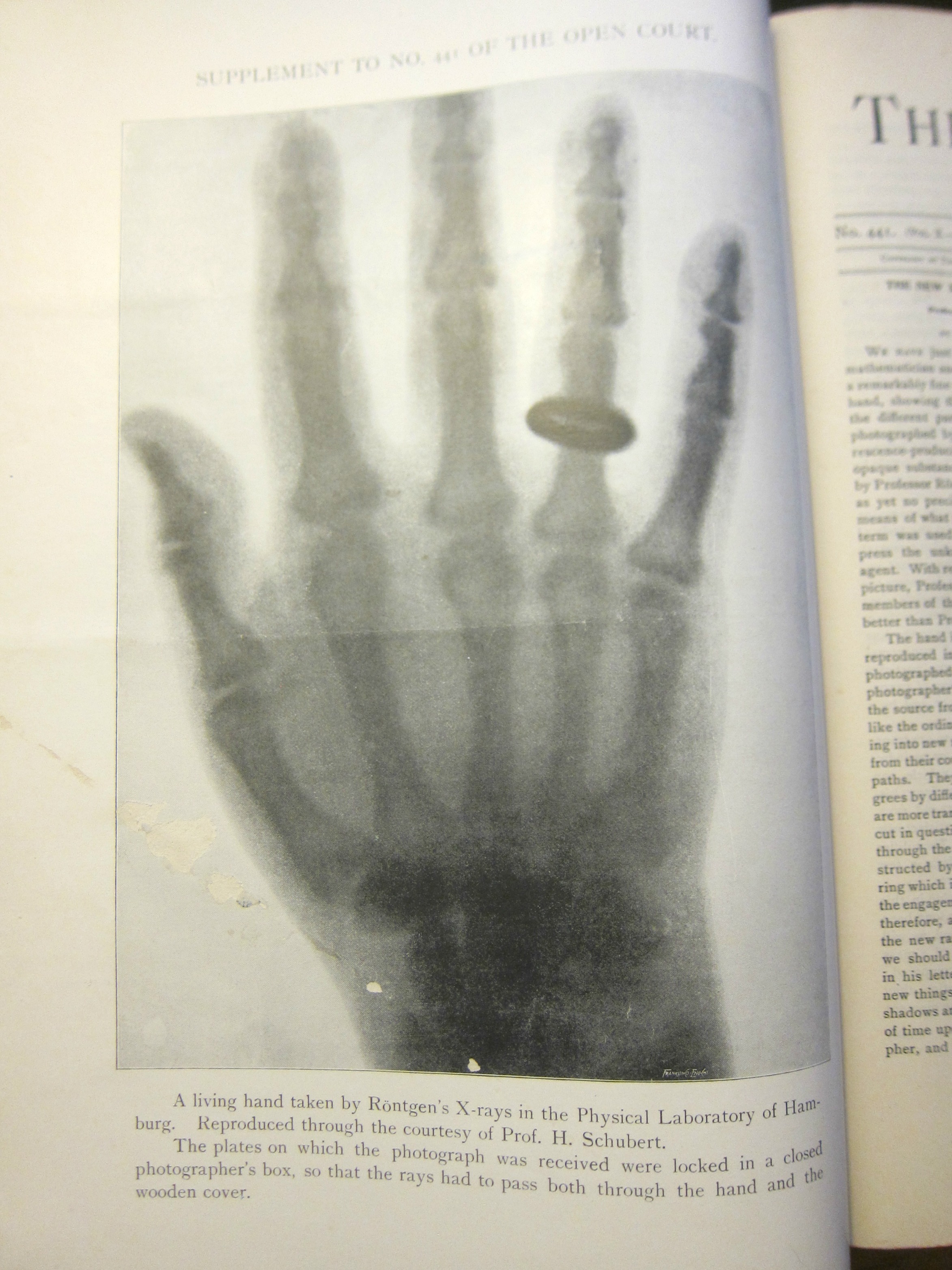
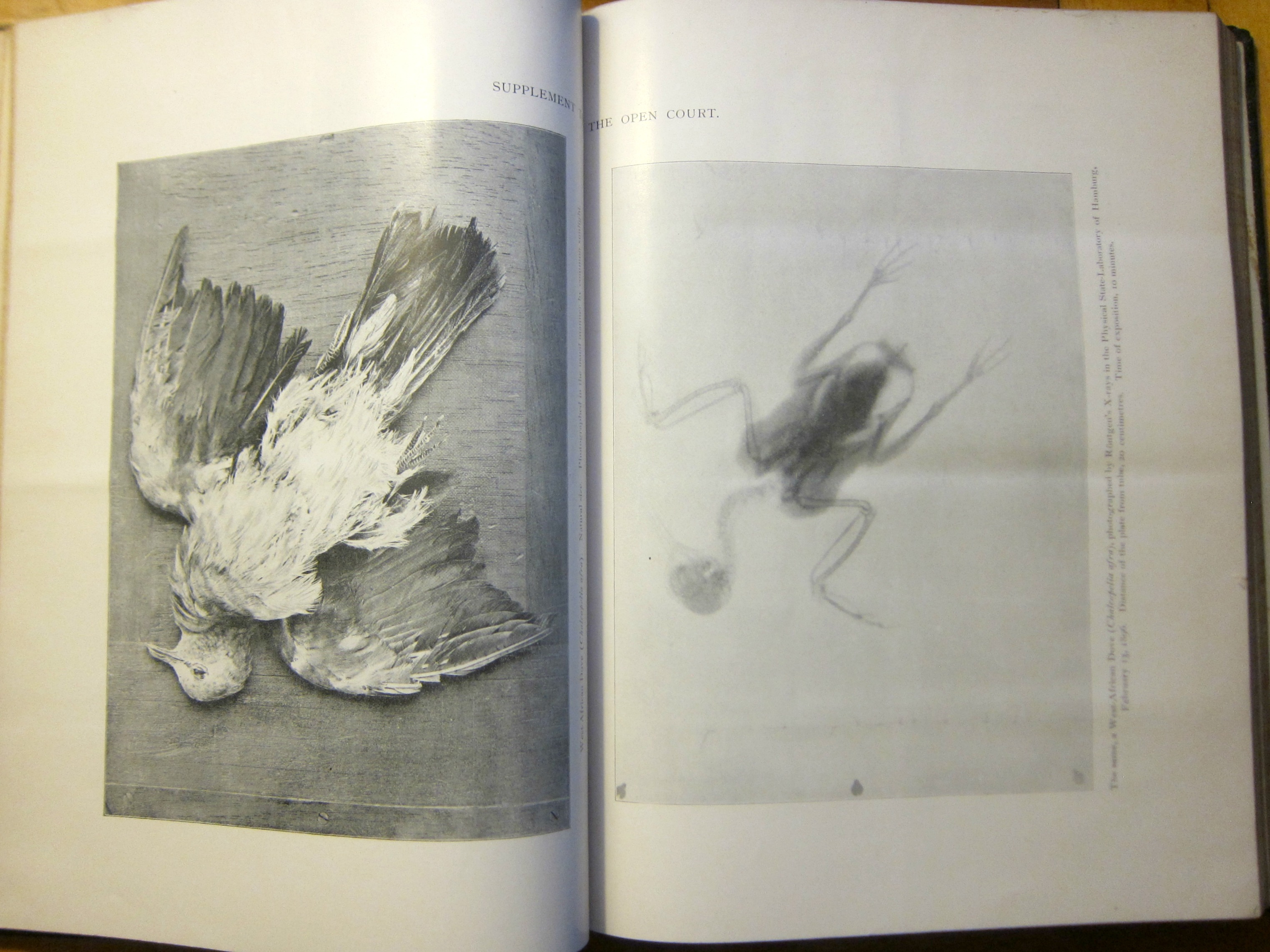
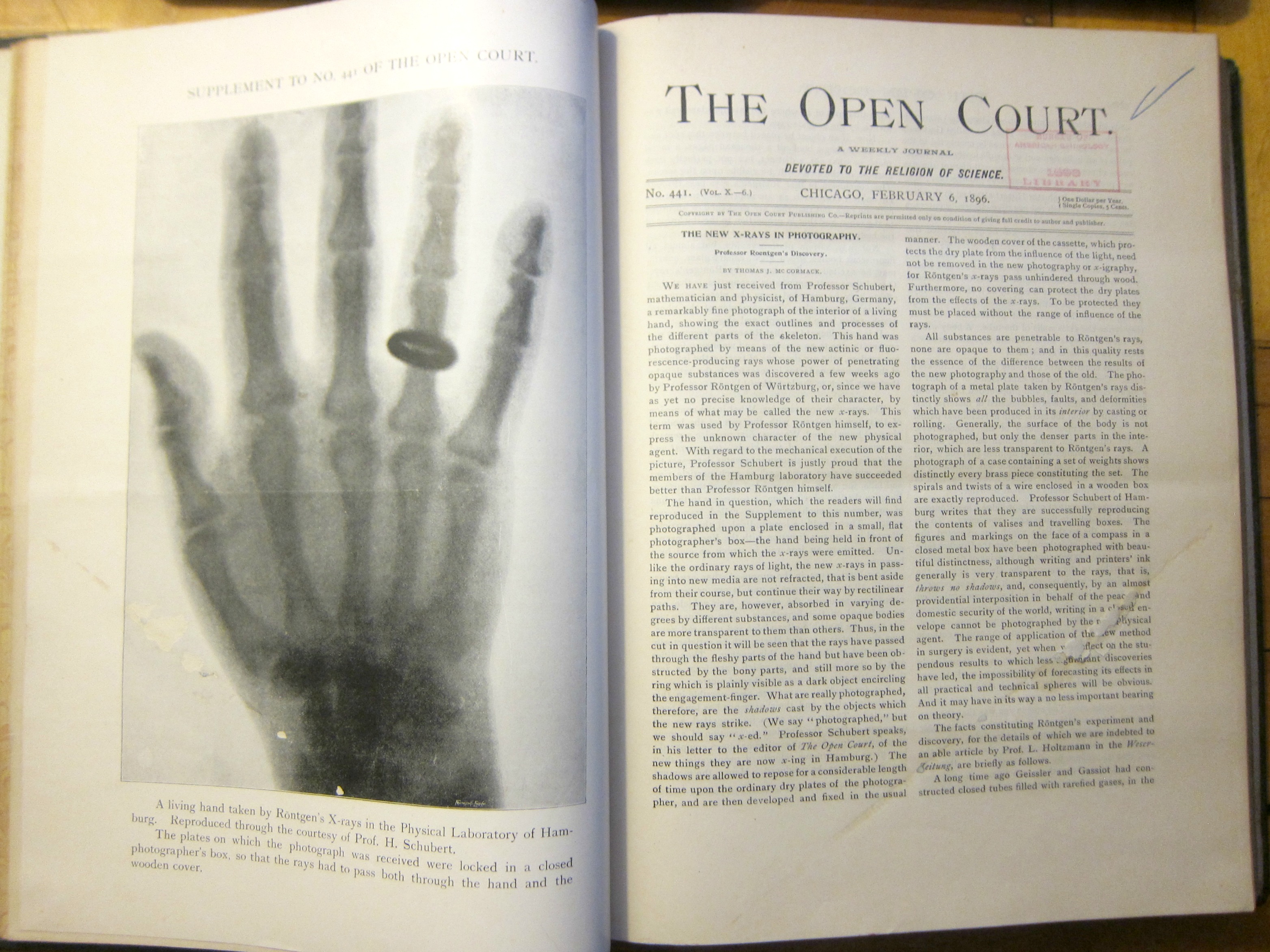
    Thomas J. McCormack, “The New X-Rays in Photography”, in a bound volume of The Open Court, a Weekly Journal Devoted to the Religion of Science, February 6, 1896, no. 441, volume x-6, pp 4799-4801.  With a very large photographic image (12×9.25″ 31x24cm).
    Also appearing in this volume: 

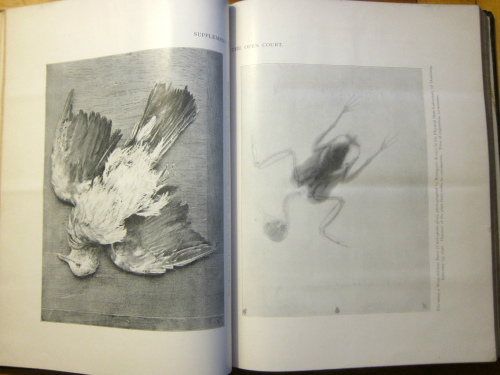
    _____. “Roentgen’s Rays Again”, no. 446 vol X-11, March 12, 1896, pp 4483-4844, illustrated with a double-page photographic image. 

    X-ray _3_

    This is offered in the full bound volume of pp 4759-5174. Bound in modern black cloth with a call number gilt stamped on spine bottom. Each weekly section title has a small rubber stamp from the former library. PROVENANCE: interesting Federal history of ownership on this volume, belonging to the Bureau of American Ethnology, the Smithsonian Institution, and then dispensed by the Library of Congress (with their surplus stamp on the front free endpaper). Also, the major issue is a little bit of damage to the text on the first page of text of the first x-ray paper; also, there is some scuffing to the photo plate of the x-ray, removing a 10x10mm section from the face of the background, which is really a shame. In any event, the price for this item takes this bits into account: $200

    This is a very early appearance in the U.S. of the weeks-old Roentgen discovery of the x-ray. The first journal edition in English appears to be 23 January 1896 in Nature (vol 53), and the first in a U.S. journal in Science on 31 January, though that is not illustrated.  (The Science article, written by Hugo Muinsterberg of Harvard, notes that this was a good thing for the reassurance of German stature in physics as they had in the last year lost Kundt, Hertz, and von Helmholtz, but now they had Wilhelm Roentgen to take their places in living greatness.)


    X-ray _2_

    A close-up of the 12″ tall image

    The illustrated article by McCormack, in the Taoist-historico-scientific journal Open Court, shares an example of x-ray photography by H(ermann). Schubert (1848-1911, and who would have his paper on the Rontgen rays translated for the Monist in April) ) of the Physical Laboratory in Hamburg which is very large, more than 12″ tall, and by far the largest of these famous photos that I have seen. There is a short discussion on what exactly to call the “photograph”, since it really wasn’t a photo by general standards, and the term “x-ed” is suggested…I’m not sure when the “X-Ray” as a term for the product of being exposed to x-rays and photographic film was, but it wasn’t long after this.)  There is a bit of history of the discovery of the x-ray, and a discussion on the idea of chance and discovery in scientific progress. 

    There would be an enormous wave of publications on the x-ray over the course of the next year–in fact, the Bibliography of X-ray Literature and Research (1896-1897) by Charles Phillips (published in 1906) is 68pp long and finds more than 1500 books and articles published over just two years. Oddly, the Open Court papers are not to be found in the Phillips bibliography, and I’m not sure why.  

    It seems to me that Open Court publishes on the of the first photographs of an x-ray in a U.S. journal. 

    McCormack (1865-1932) had an interesting career, translating Lagrange, Weismann, Mach, as well as the photographer and mathematician  Hermann Schubert’s books on recreational mathematics), and wrote several books in disparate disciplines.  

    X-ray _1_

    ·Posted by :

    ·in:

    —
  • One of the Earliest Appearances of the Modern Endoscope (1855)

    Desormeaux, Antonin Jean. “De l’endoscope, instrument propre à éclairer certaines cavités intérieures à l’économie”, Comptes Rendus, volume 40, 1855, pp 692-693. This is the weekly issue, removed from a larger bound volume, without the original wrappers. Very Good.  A very early (if not, possibly, the first) published report on Desormeaux’s endoscope. $200

    Also appearing in the issue, on the following page: Raimberg, “Appareil pour l’inhalation de chloroforme, réclamation de priorité sur Mounie”. 40, p. 694.

    “…Desormeaux was a 19th-century French physician and inventor who has been called the “father of endoscopy”, because he made significant improvements to the early endoscope and was the first to successfully use it to operate on a living patient (his device would be called a cystoscope today). He presented his device to the French Academy of Sciences in Paris on July 20, 1853.”–Wikipedia

    “…overall Desormeaux’s work was instrumental in catapulting endoscopy to a greater developmental stage. Though his work was not necessarily the first or most original, Desormeaux was nevertheless able to refine existing endoscopes and adapt better technologies in order to bring to the world one of the most functional endoscopes of his era. Desormeaux’s systematic collection of clear and indisputable clinical data of his experiments  was also a significant contribution, one which no doubt influenced others to conduct similar high quality research…he stood out as one of the most influential leaders, earning acclaim as one of the “fathers” of endoscopy. Desormeaux’s most outstanding accomplishment is that he put operative endoscopy on the map by performing the world’s first successful operative procedures using an endoscope. Desormeaux is also credited with coining the word “l’endoscopie,” a term he introduced, along with his revamped device, to the Academy of Science in Paris on July 20th, 1853.”  –Nazhat, History of Endoscopy, Chapter 8, “Desormeaux”, Laparoscopy Today.

    ·Posted by :

    ·in:

  • Proving the Einstein-Lorentz Formula, 1915

    GUYE, Charles-Eugene and Charles Lavanchy, “Vérification expérimentale de la formule de Lorentz-Einstein par les rayons cathodiques de grande vitesse “, in Comptes Rendus, vol 161, no 3, 19 July 1915, the article on pp 52-55 in the (very slim, wartime) issue of pp 45-60. Offered with the original front wrapper, removed from a larger bound volume. GOOD copy. $175

    “In 1915, Charles-Eugène Guye and Charles Lavanchy measured the deflection of cathode rays at 0.25c–0.5c. They used a tube with a cathode and anode in order to accelerate the rays. A diaphragm at the anode produced a beam which was deflected. A screen was placed at the end of the apparatus, at which the impacts were photographed by a camera. They subsequently computated the ratio of transverse electromagnetic mass mT and rest mass m0 indicated by the red and blue curve, and obtained good agreement with the Lorentz–Einstein formula…supplementing Neumann’s result. Neumann’s and Guye/Lavanchy’s experiments were considered by many as conclusively proving the Lorentz-Einstein formula.–Wikipedia

    “Experimental Confirmation of the Lorentz Einstein Formula for Highspeed Kathode Rays CE Guye and C Lavanchy Comptes Rendus 161 pp 62-65 July 19 1915. The experimental method here adopted is that of identical trajectories previously developed by CE Guye and S Ratnovsky see Abs 418 1910 A reproduction of the photographs is given A table of 25 determinations is appended and compared with the theories of Lorentz Einstein and of Abraham. The former is distinctly supported and not the latter,”–Science Abstracts, volume 18, 1915, #1453

    “In the debate over the circumstances which led to a full understanding and acceptance of Einstein’s theory of relativity, historians have in particular investigated the role played by the attempts to corroborate relativity by experimental investigations. We report here on the replication in progress of the celebrated experiment performed on cathode rays by the Swiss physicist Charles-Eugène Guye and his assistant in their attempt to vindicate the relativistic mass formula…”–“Replication of Guye and Lavanchy’s experiment on the velocity dependency of inertia”, Jack Lacki and Yacin Karim.

    ·Posted by :

    ·in:

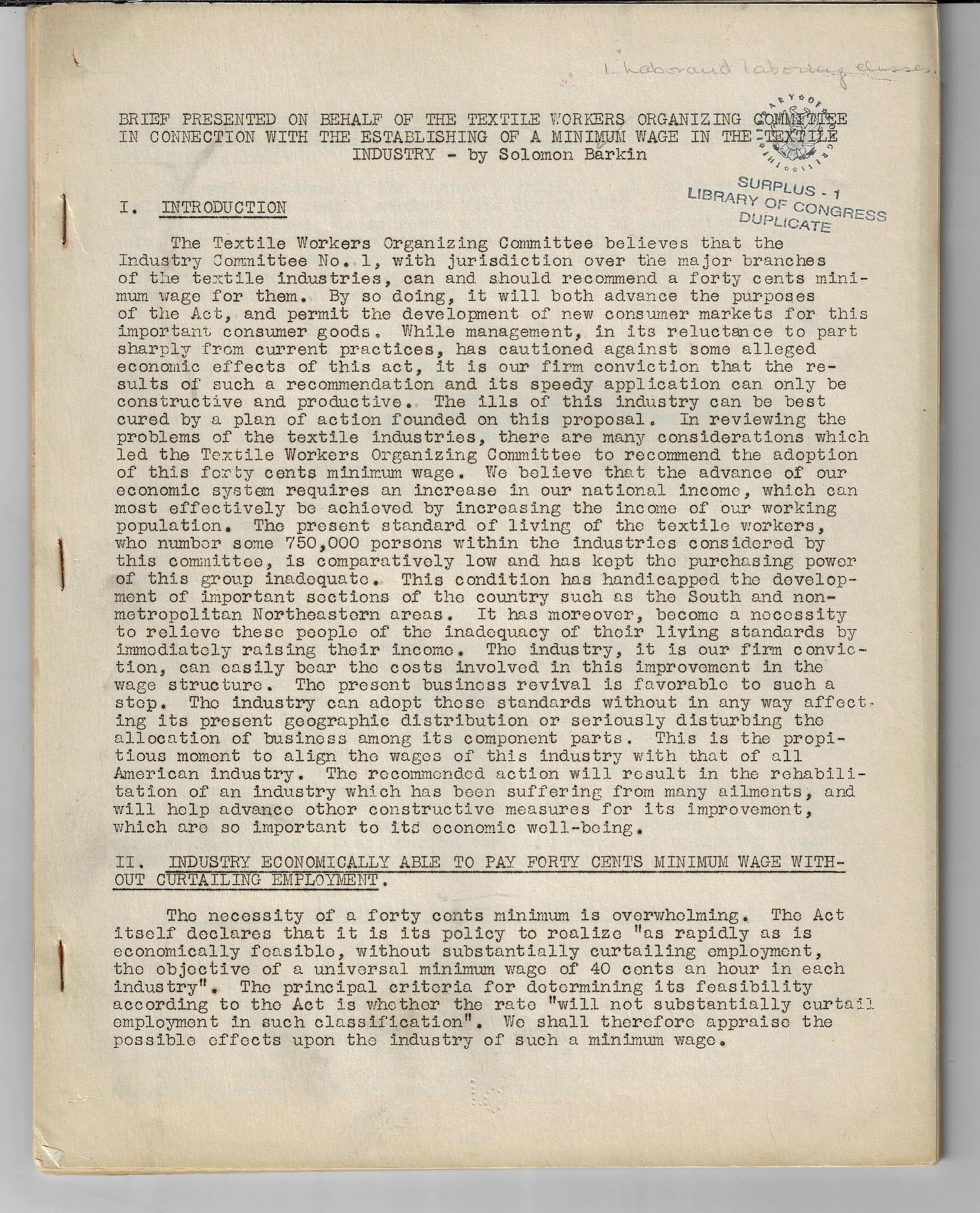
  • The Case for a 40-cent Hourly Minimum Wage, 193

    (40 cents in 1939=Federal minimum wage in 2018)


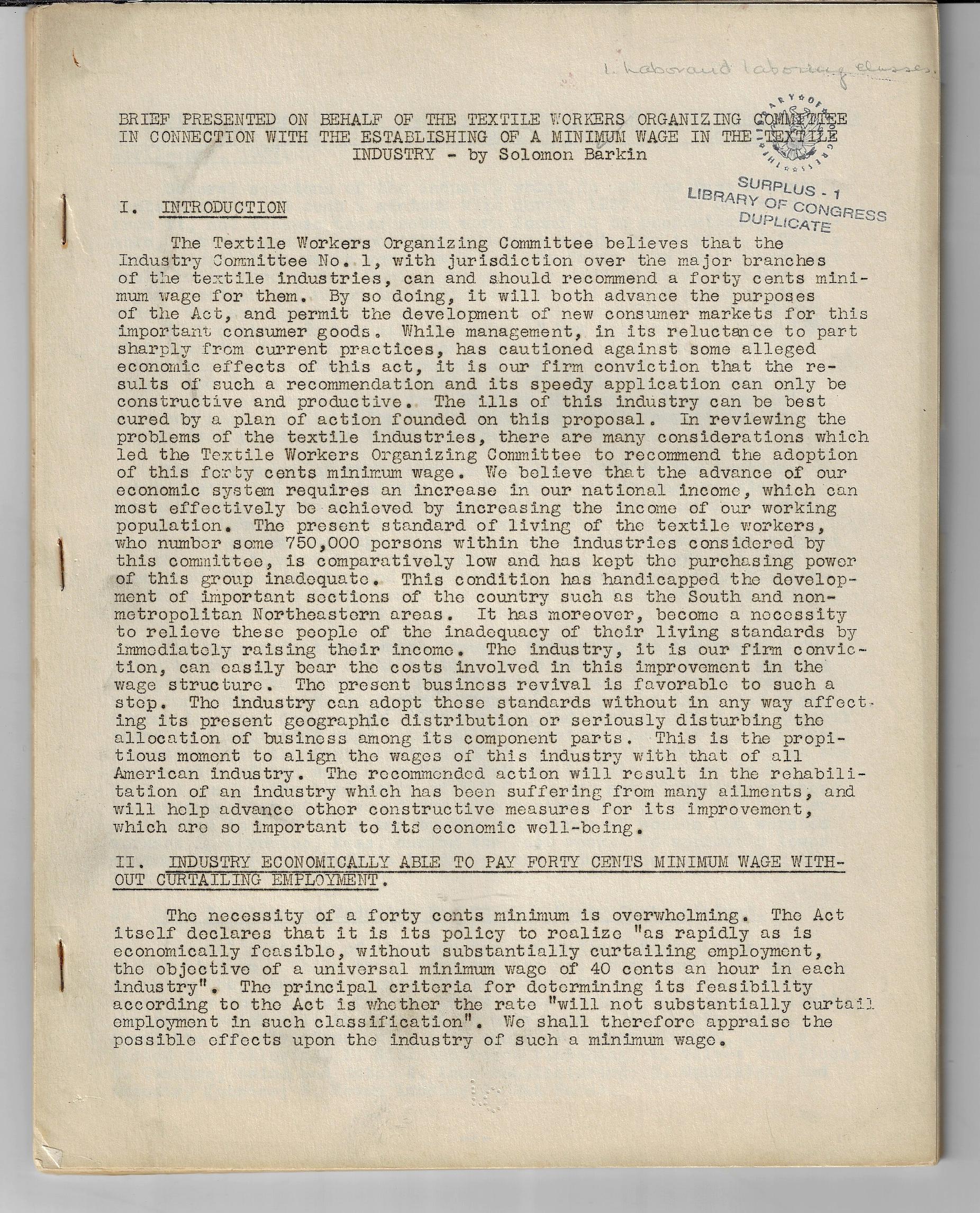
    BArkin documentSolomon Barkin (1908-2000), “Brief Presented on Behalf of the Textile Workers Organizing Committee in Connection with the Establishing of a Minimum Wage in the Textile Industry.” The Textile Workers Organizing Committee, 1939. 11×8.5”, 43 leaves (28 paginated plus 15pp of interleaved appendix pages). Offset production from typed original. Provenance: presented by the Textile Committee to the Library of Congress. Condition: small (6mm) perforated “LC” stamp at front page bottom; LC surplus rubber stamp at top right. Rare.  $150

    Coming a few years after what was basically the end of the New Deal as a result of a better economic climate, the textile worker reps were organizing around the minimum wage for the basic worker at 40 cents per hour. The idea behind the minimum wage would be beneficial to both worker and industry—it would allow more buying power resulting in more sales for industry.

    Adjusting for inflation, using the Bureau of Labor Statistic inflation calculator, 40 cents in 1939 would be about $7.09, which is very close to the current $7.25 federal minimum wage in 2018. The first federal minimum wage was set at 25 cents/hour in 1938, and then to 30 cents in 1940, 40 cents in 1945, and then 75 cents in 1950, which would be about $7.70 in 2018 dollars. This is the start of a period 26 years in which the contemporary minimum wage was higher than the minimum wage is now, adjusting for inflation. After the increase to $3.85 in April 1990 under Bush I, the minimum has been slightly sinusoidal above-and-below the current minimum—basically remaining very little changed in purchasing power for the last 28 years, and 20% or more weaker than the minimums from 1956-1990.

    The Barkin document is a compelling evidentiary presentation of the benefit to the textile industries in paying a higher minimum wage to its workers.

    “Professor Barkin spent 25 years in the labor movement, from 1937 to 1963, as director of research for the Textile Workers Union, now part of the Union of Needletrades, Industrial and Textile Employees. For the next five years, he was a manpower specialist and head of the social-affairs division of the Organization for Economic Cooperation and Development in Paris. He taught economics at Amherst from 1968 to 1978, when he was given emeritus status. Then he was a visiting professor of economics at Erasmus University in Rotterdam, the Netherlands, and a senior Fulbright professor at Victoria University in Wellington, New Zealand.”–NYTimes obituary for Mr. Barkin.

    ·Posted by :

    ·in:

  • The Abdank-Abakanowicz Integrator, 1881-2

    Bruno Abdank-Abakanowicz, “Sur un integrateur. instrument servant a l’integration graphique”, vol 92, no. 8, 21 February 1881, pp 402-405 in the issue of pp 373-428;Four papers developing his analytical calculating and graphing instrument in three different numbers of the Comptes Rendus (vols 92, 94, and 95), as follows, with the three papers from volumes 92 and 95 offered with their original wrappers.  All four papers are disbound from a larger bound volume. GOOD-VERY GOOD condition.   SOLD

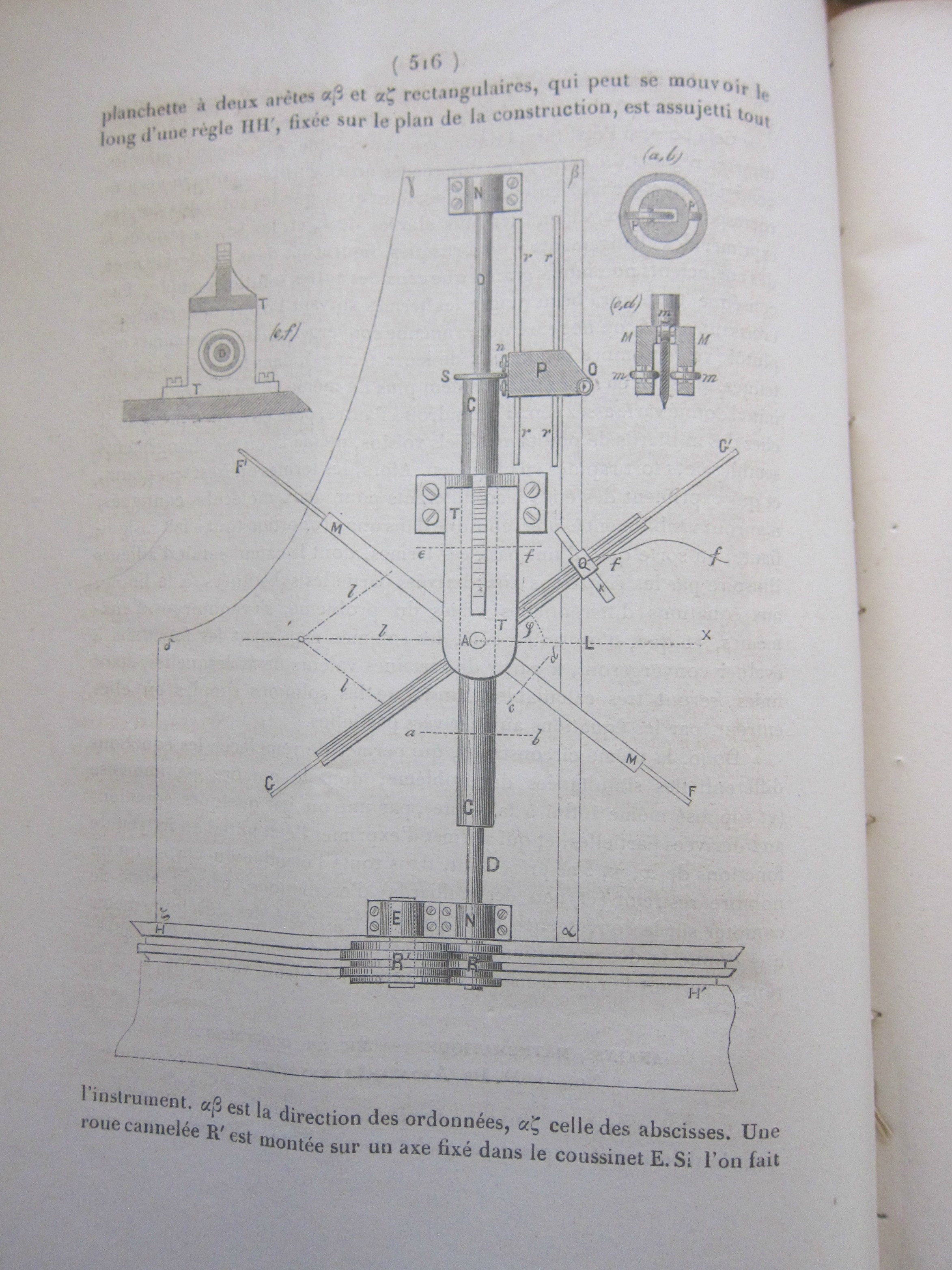
    _____. “Sur un integrateur. instrument servant a l’integration graphique”, vol 92, no. 10, 7 March 1881, pp 515-519 in the issue of pp 482-538;

    _____. “Sur l’integration mechanique”, vol 94, no. 12, 20 March 1882, pp 783-785 in the issue of 753-816;

    _____. “Sur un nouvel integrometre”, vol 95, no. 22, 27 November 1882,  pp 1047-1048 in the issue of pp 1017-1076.

    “Integraph, mathematical instrument for plotting the integral of a graphically defined function. Two such instruments were invented independently about 1880 by the British physicist Sir Charles Vernon Boys and the Lithuanian mathematician Bruno Abdank Abakanowicz and were later modified and improved by others. The integraph draws the graph of the integral as the user traces the graph of the given function.”–Encyclopedia Britannica

    “William Thomson. Lord Kelvin, had the powerful idea of using analog computing mechanisms tied together to solve a differential equatioms. Ten years later, AbdankAbakanowicz built an “integraph.” which had the purpose of solving one particular differential equation. Thomson’s idea was the conception of differential analyzers. which. however. did not become a practical reality until the 1930s with the work of V. Bush.’ Lord Kelvin also invented a pulley device for solving simultaneous equatioms Larger versions were built by MIT professor Wilbur in 1934 and 1935.–AB Clymer, “The mechanical analog computers of Hannibal Ford and William Newell”, IEEE Annals of the History of Computers, 15/2

    “The mechanical integraph is a noteworthy development in the history of calculating instruments, for it represents an early, albeit limited, analog approach to the solution of differential equations. It is worth noting that it was the need to solve partial differential equations with rapidity and accuracy that ultimately led to the development of the ENIAC…The integraph is an elaboration and extension of the planimeter, an earlier, simpler instrument used to measure area. It is a mechanical instrument capable of deriving the integral curve corresponding to a given curve. Hence, it is able to solve elementary differential equations graphically. Abdank-Abakanowicz concentrated on developing his integraph for several years. However, it was not until 1878 that he succeeded in developing a practical working model.”–from the Erwin Tomash Library site

    Also see H. Morin, Les appareils d’intégration: intégrateurs simples et composés; planimètres; intégromètres; intégraphes et courbes intégrales; analyse harmonique et analyseurs,pp 136-141, for descriptions of the Abdnak-Abakanowicz machines (as referred by Tomash). The full text of the Morin is found on the Cornell University classic maths books site.  


    Abdank intergrator _1_

    ·Posted by :

    ·in:

    —
  • On an 1836 Hearing Aid

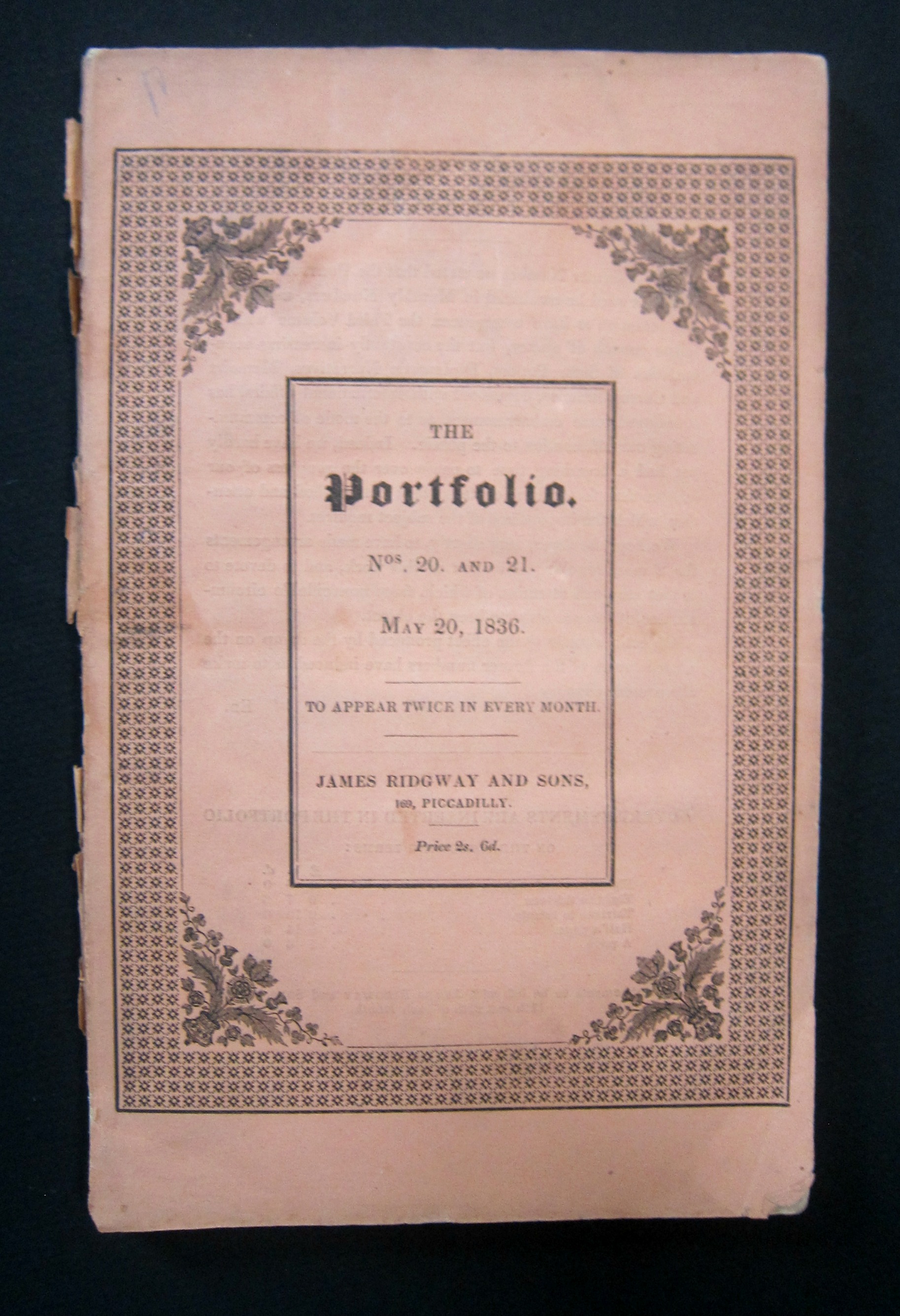
    PortfolioAlphonso William Webster. “The Otaphone,  Patent Invention for Assisting the Hearing.”  This is a tight 4pp “supplement to the uncommon-seen The Portfolio, or a Collection of State Papers…Nos 20 and 21, May 20, 1836. London, James Ridgway and Sons. 9×5″, pp 91-192,8,4,(6),3.   In the original wrappers. The wrappers are in surprisingly nice condition, though there are numerous paper chips out of the spine, and the binding will not take very many openings. Still, a GOOD copy. $75

    This is essentially an extended advertisement, closely written by Webster, who was a specialist practioner in the field of hearing, and who later in 1866 would write a book on the subject, A New and Familiar Treatise on the Structure of the Ear, and on Deafness. The device was a slim silver apparatus that would fit around the ear and extend outward slightly, basically replacing the cupped hand over the ear to help improve hearing. 

    “UK patent #7033, dated 17 March 1836, is the earliest British patent for a hearing aid device, granted to the aurist (19th century term for ear specialist) Alphonso William Webster, for his “curious” invention, the Otaphone (sometimes spelled “Otophone”). In his publication, A New and Familiar Treatise on the Structure of the Ear, and On Deafness (London: published by the author, sold by Simpkin & Marshall, 1836), Webster outlines he was first devised his invention by observing the common practice of cupping the hand to the back of the ear to enhance hearing. He wondered whether the practice could be obtained by “means less troublesome and unsightly”–from the 19th Century Disability website, contributed by Jaipreet Virdi-Dhes

    ·Posted by :

    ·in:

  • Uncommon Document Relating to an EE Pioneer (1913)

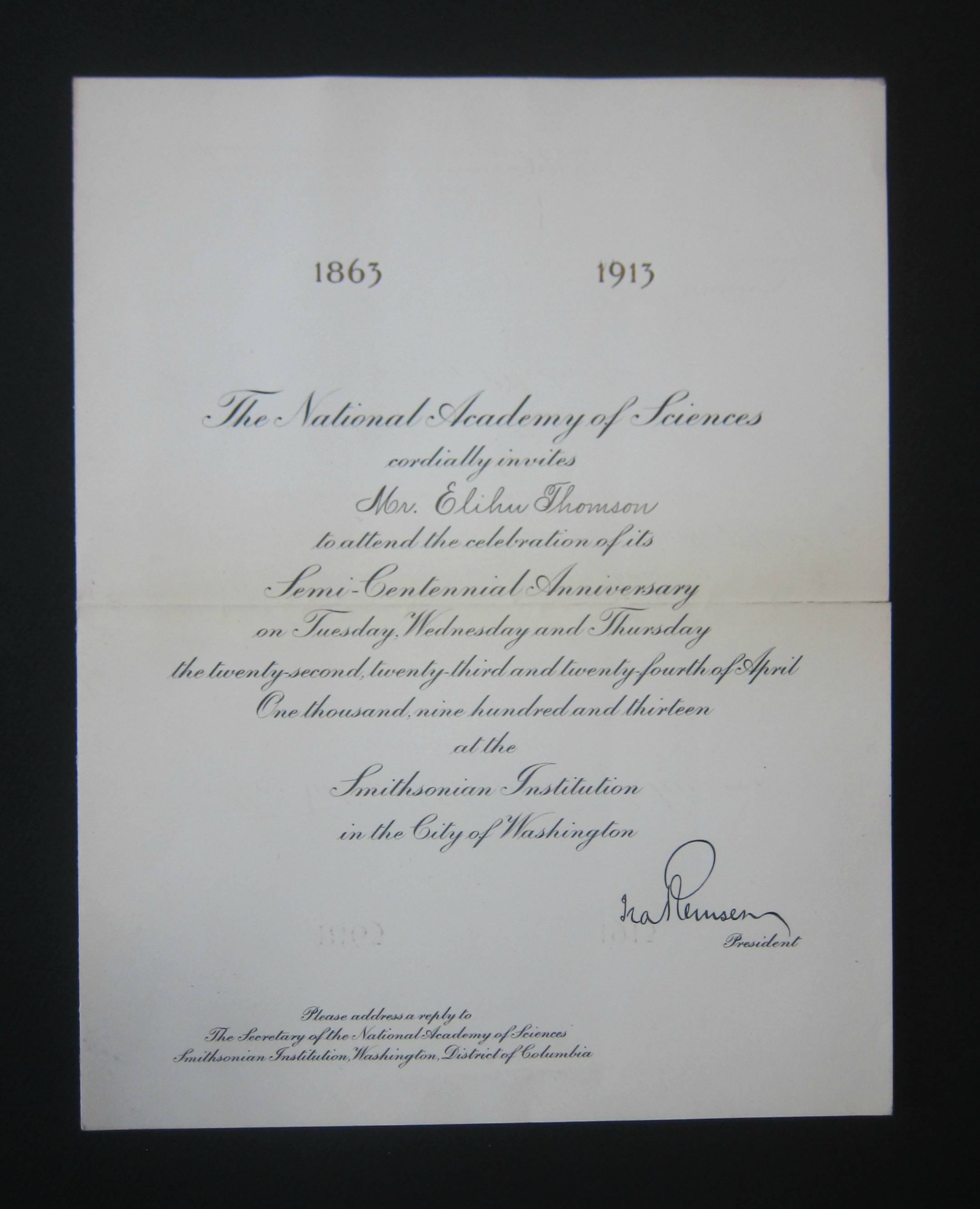
    Elihu ThomsonElihu Thomson. Engraved invitation to attend the National Academy of Sciences semi-centennial anniversary at the Smithsonian Institution, April 1913, “signed” by the Academy president, Ira Remsen.  

    10×8″, heavy paper, with an old horizontal fold at the center.  Thomson’s name is written by hand, but I’m pretty sure that Ira Remsen’s signature is printed. 

    This is an unusual piece of U.S. scientific ephemera.  $100

    “Elihu Thomson (March 29, 1853 – March 13, 1937) was an English-born American engineer and inventor who was instrumental in the founding of major electrical companies in the United States, the United Kingdom and France…with Edwin J. Houston…founded the Thomson-Houston Electric Company. Notable inventions created by Thomson during this period include an arc-lighting system, an automatically regulated three-coil dynamo, a magnetic lightning arrester, and a local power transformer.In 1892 the Thomson-Houston Electric Company merged with the Edison General Electric Company to become the General Electric Company…Thomson was the first recipient of the American Institute of Electrical Engineers AIEE (now Institute of Electrical and Electronics Engineers (IEEE)) Edison Medal, bestowed upon him in 1909 “For meritorious achievement in electrical science, engineering and arts as exemplified in his contributions thereto during the past thirty years’.”–Wikipedia

    ·Posted by :

    ·in:

  • On the Ins and Outs of Lightning Calculation (1872)

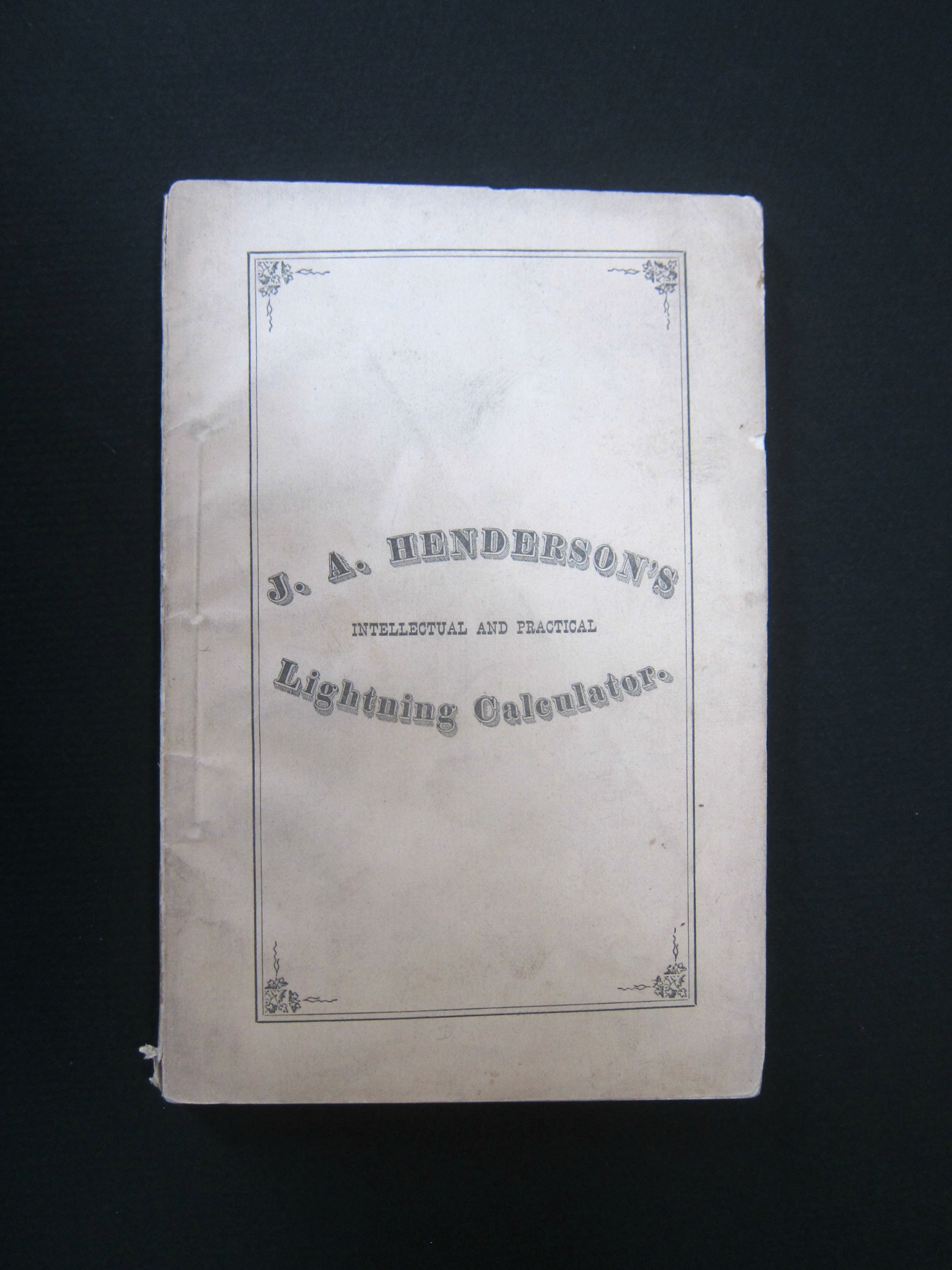
    Lightning Calculator _2_John Alexander Henderson. J.A. Henderson’s Intellectual and Practical Lightning Calculator, A.L. Bancroft, San Francisco, 1872.  First edition.  Original wrappers. 7×5″, 79pp. Provenance: Library of Congress, with their surplus stamp on the back of the front wrapper, and their 6mm “LC” perforated stamp on the title page.  $125

    The 1873 edition (below) has been identified as the “second edition” in WorldCat, and there is only this 1872 edition before it, making it (I am fairly well certain) the first edition.  There are only two copies located (NYPL and Bancroft) of this first edition.  

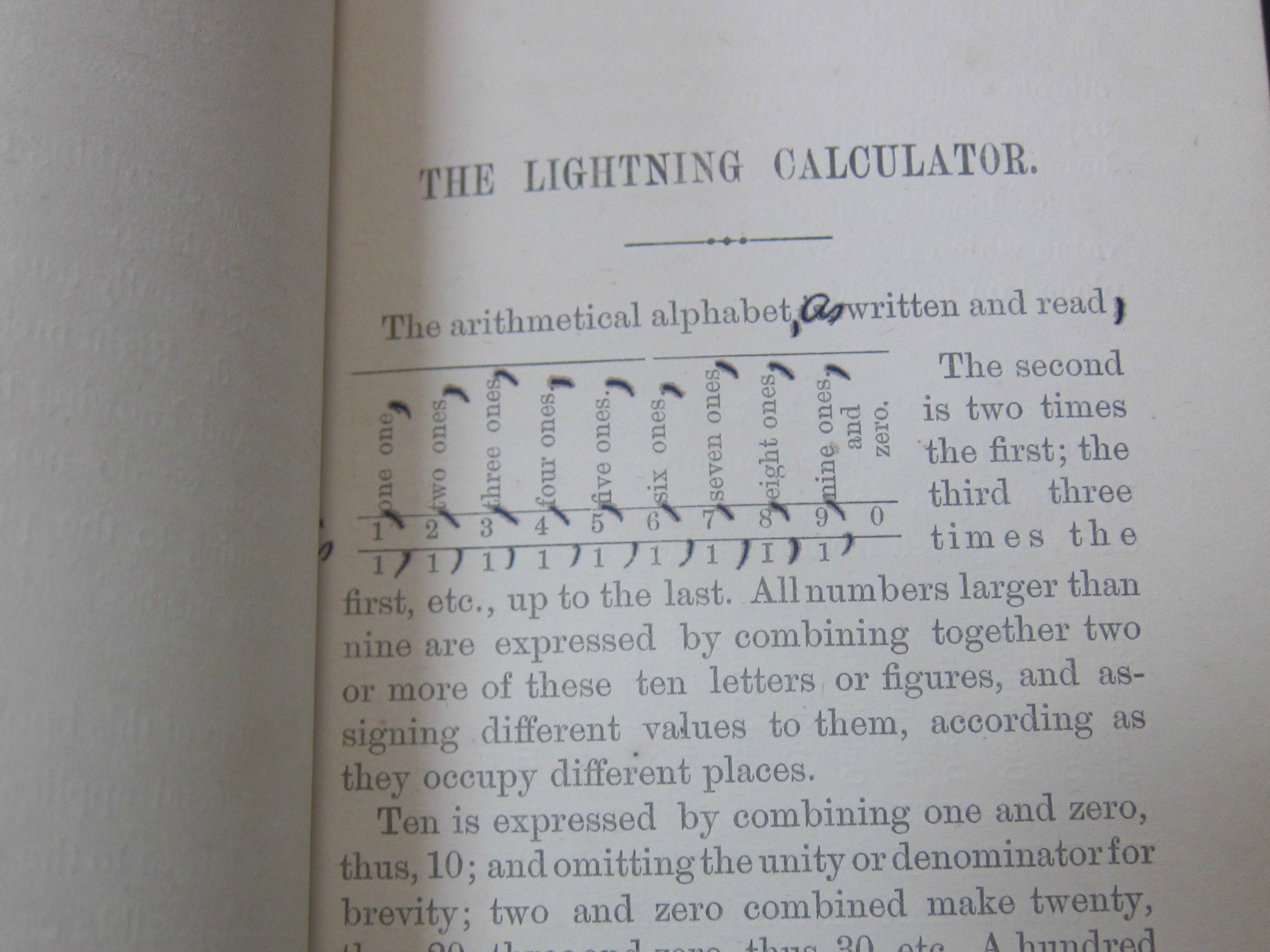
    Examining this against an 1873 printing–also San Francisco–finds that the ink corrections in the first table have been repaired in type. Also, it seems that Henderson is printing the book himself, and is acting as the “general agent”. He evidently had troubles with people pirating his work.  Also, the main block of the text from beginning to end looks to be about the same, though the 1873 version is beefed up with another 30pp of notices, translations, advertisements, and generally not very supportive (to the text) material.  The work seems to have been popular, with Henderson later claiming ten editions, with the book expanding to over 200pp. 

    Henderson was no doubt a lightning calculator and in this book offered some shortcuts, tricks, and general means for doing standard and involved calculations, written or mental. A curious work.  Henderson  evidently received a BS from Union College (Schenectady) in 1864 and a MS in 1867 (unsure of the school for this degree). 

      Lightning Calculator _1_

    ·Posted by :

    ·in:

Recent Posts

Archives

Categories