A Daily History of Holes, Dots, Lines, Science, History, Math, Physics, Art, the Unintentional Absurd, Architecture, Maps, Data Visualization, Blank and Missing Things, and so on. |1.6 million words, 7500 images, 4.9 million hits| Press & appearances in The Times, Le Figaro, Mensa, The Economist, The Guardian, Discovery News, Slate, Le Monde, Sci American Blogs, Le Pont, and many other places… 5000+ total posts since 2008.

  • Scientific Instruments: Gyroscopes, 1883

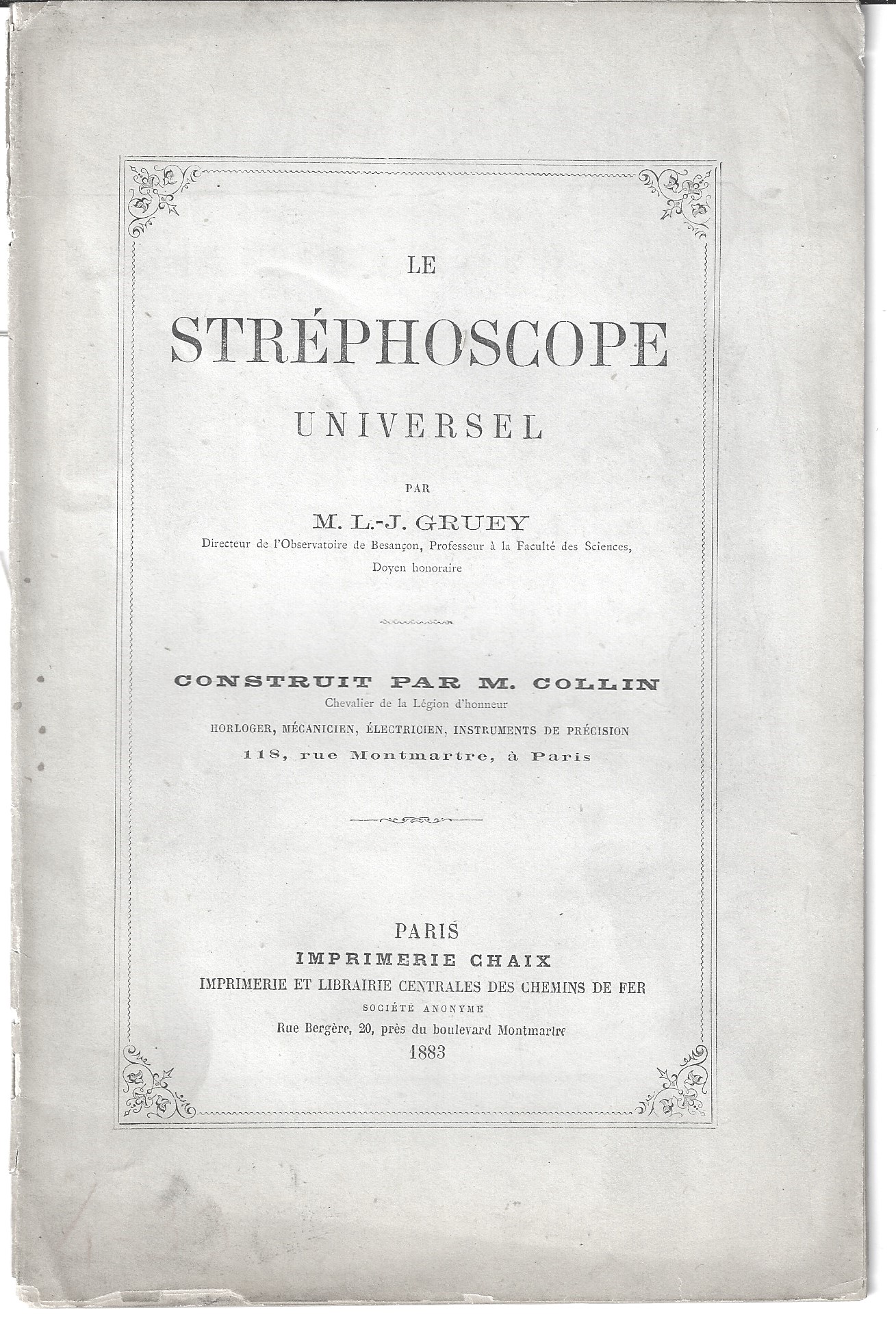
    DocFile (12)L.-J. Gruey, Le Strephoscope Universel…Construit par M. Collin… Paris, Imprimerie Chaix, 1883.  9.5×6″, 32pp, with descriptions of 14 devices, each with a small text illustration. In the original wrappers, with the text block becoming loose in the wrappers. Also includes a double-page illustration of the Gruey machine.  GOOD copy of a scarce title.  $125

    A description of this gyroscope demonstration device:

    “This device is nothing more than a new Gyroscopic box, of a particular composition…to highlight, for all, important and curious events in general mechanics or celestial mechanics, which were known only to scientists. The essential part of a gyroscopic apparatus is a bronze torus, with a cylindrical steel shaft. The ends of the shaft, cut into very thin points…fixed on a ring metallic, in two diametrically opposite points…We will briefly describe how to compare put each device with the pieces of our box, and that of executing experiments. We will not reproduce here the complete theory and rigorous of these devices exposed elsewhere, but we will give at the end of the description of each of them, under the heading ‘Explanation’…”

    ·Posted by :

    ·in:

  • Outside Looking Out–Space, 1899.

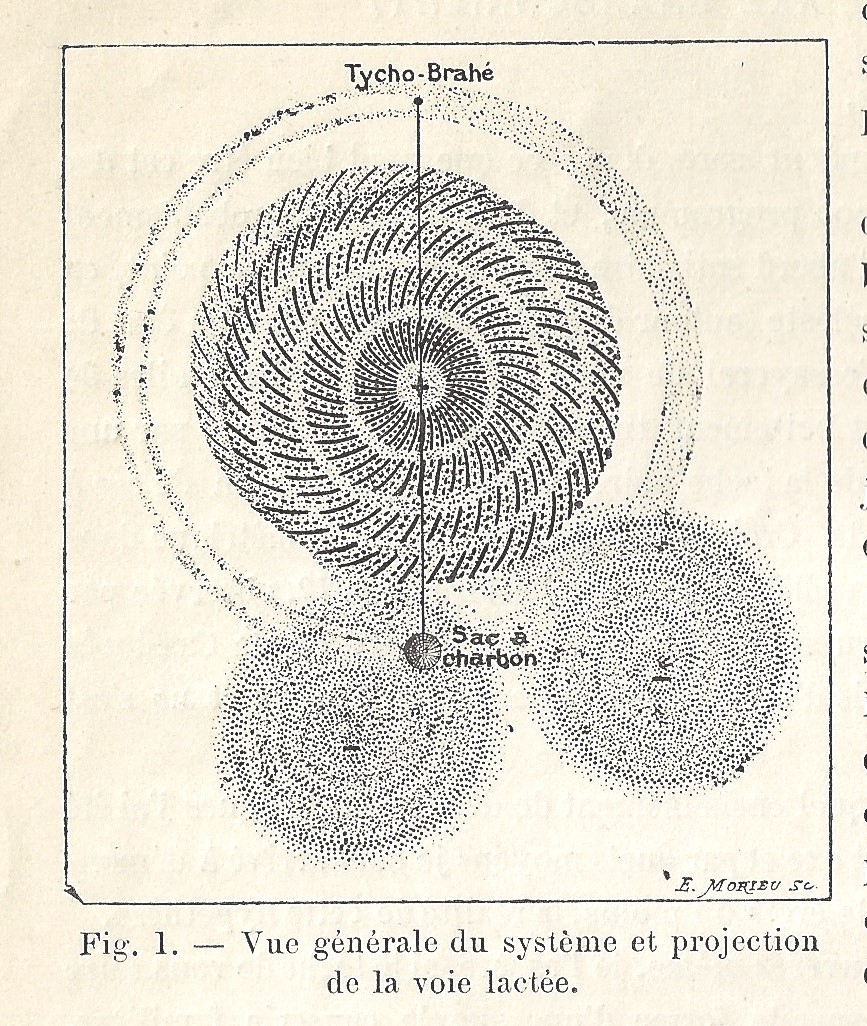
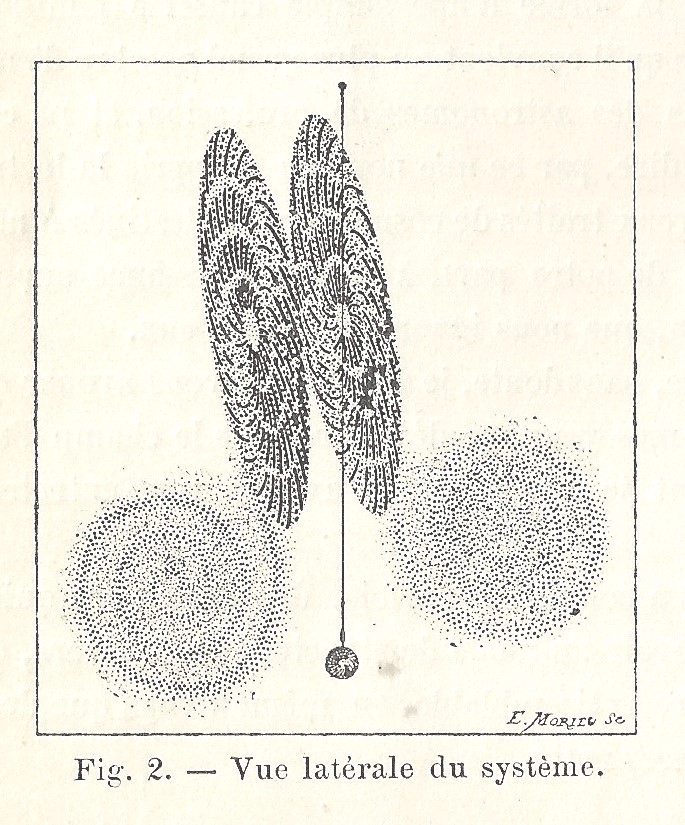
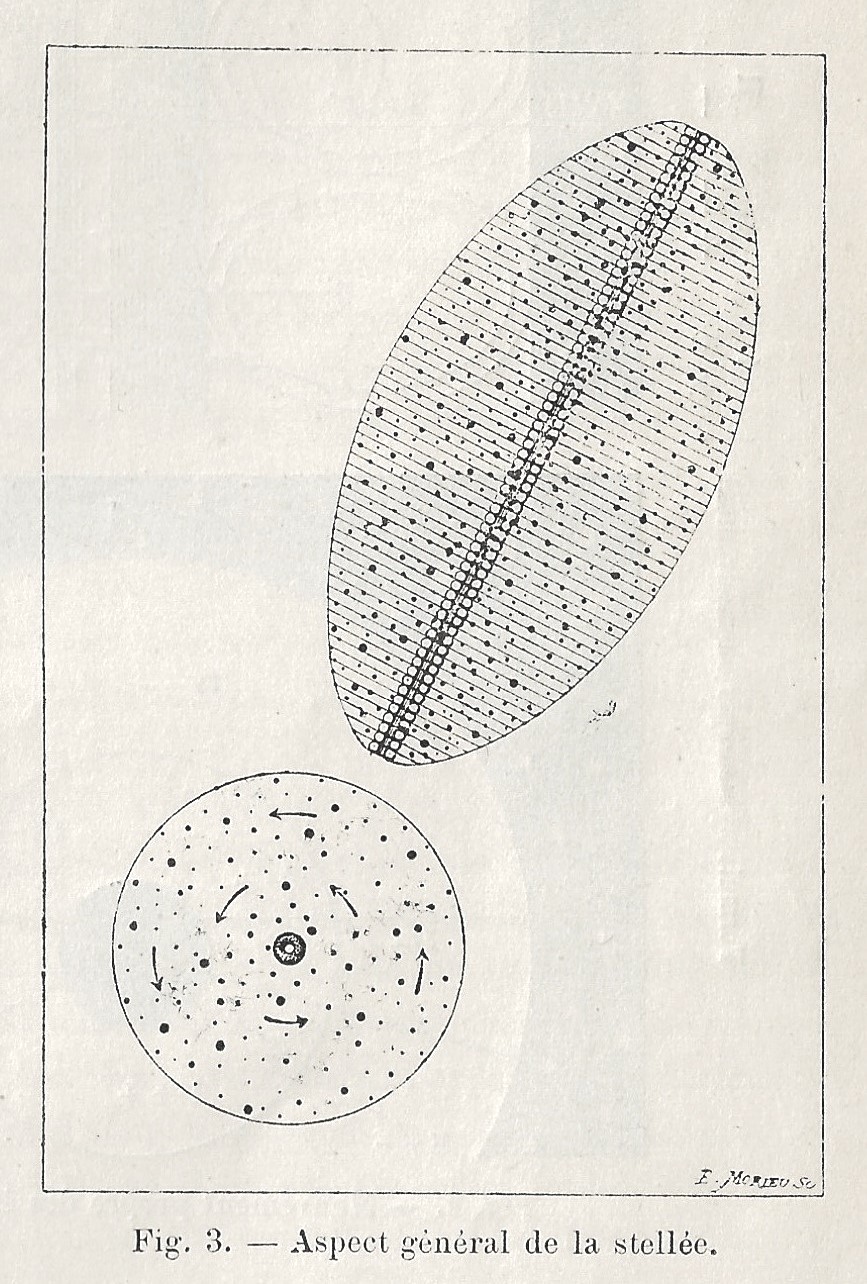
    Adolphe Duponchel,  “Circulation de notre groupe stellaire autour de l’axe charbonnier et mouvement parallactique de l’apex Solaire”. Printed by the author, in Paris, 1899, from its appearance in Societe Astronomique de France, 1 March 1899.  9×6″, 18pp.  Original wrappers. Condition: the wrappers are brittle and chipped, and detached; the text itself is quite good. Overall, though, this only gets a GOOD grade.   

    WorldCat/OCLC reports 1 copy in the U.S. And either 1 or 3 copies at the Observatoire de Paris—otherwise there are no other copies of this work located. Provenance: Smithsonian Institution, and then the Library of Congress (small mostly-faded oval stamp for the SI on front cover, and the LC surplus stamp on the back cover).   $150

    DocFile (3)

    Duponchel was an accomplished and published civil engineer, canal and bridge builder, and hydrologist, who later in life veered into cosmogony, publishing on the effects of meteors and solar activities on the distribution of stars, the structure of the galaxy, and the motions of the planets. He met with no success from what I can determine, though he seems to have been very active in his starry pursuits through the 1890’s, which was a prime period for French cosmogony. At the very least his ideas look entertaining, and some of the text figures imaging them are quite lovely.

    DocFile (4)

    The truth of the matter is that I do not understand what he is talking about, though sometimes it seems as though he is talking about black holes and the motion of stars, except that he seems to be talking about “apex charbonnier” that are dark regions of space that could not be penetrated given the optics of the day. In general though he writes about what effects the “circulation” of the stars and star clusters.  Liberally translating he states that “no astronomical problem could offer more interest, and in the absence of a solution of a rigorously demonstrated accuracy can be I am happy to have arrived at finding a plausible and at least probable explanation of the simultaneity of all these coordinated movements in the same state of general equilibrium.

    After this very pro forma and enormous statement, we arrive at the unknown stuff of his insight: 

    “…points noirs isolate correspondent a des rayons visuels qui auraient traverse les mailles des deux reseaux sans rencontrer aucune etoile sur leur passage. Dans une seule direction, sur un espace sans doute assez restreint, mais parfaitement defini par son contour piriforme, cette illumination fait reellement defaut.” (“Isolated black/dark spots correspond to visual rays that would have passed through the meshes of the two networks without encountering any stars in their path. In one direction, on a space which is doubtless rather small, but perfectly defined by its “piriforme” outline, this illumination is really lacking.” The translation doesn’t help the original too much, which left me understanding nothing.

    Then, a few pages later, he writes: 

    “…étudier ici tapissant en quelque sorte les parois du vide de l axe s y trouveraient distribuées en anneaux ou pour mieux dire en tores successifs dont chacun correspondrait à une strate particulière en forme discoi dale d étoiles extérieures. Ces to res successifs (figs 1+2) correspondant aux sphères magnétiques qui accompagnent les noyaux solides du Soleil et des planètes comprendraient chacun un certain nombre d étoiles circulant autour de l axe du tore avec un mouvement de rotation ac célérée en spirale comme celui des sphères magnétiques mais avec des vitesses alternativement de sens direct et de sens inverse de manière à assurer des vitesses concordantes de même direction aux points de tangence de deux tores consécutifs…” Or, “Firstly, to study here somehow lining the walls of the void of the axis would be distributed in rings or, to put it better, in successive tori, each of which corresponds to a particular stratum in the form of a disc of external stars. These successive rests (fig 1+2) corresponding to the magnetic spheres that accompany the solid nuclei of the Sun and planets would each include a number of stars circulating around the axis of the torus with a spiral arc rotational movement like that of the magnetic spheres but with alternately direct and reverse direction so as to ensure concordant speeds of the same direction at the points of tangency of two consecutive tori…”  Again, a not-good translation, but I really didn’t have much of an idea of what he was writing about. 

    DocFile (1)

    The pictures are pretty.


    Notes:

    “Et les individus qui participent à cet engouement pour la quête des origines cosmiques n’épargnent ni leurs efforts ni leur temps pour développer, étayer, rendre publique, et faire reconnaître leurs théories. Ainsi, l’ingénieur des Ponts et Chaussées Adolphe Duponchel (1821-1903), après avoir déposé un pli cacheté à l’Académie des sciences le 27 mars 1893 contenant le sommaire d’une brochure exposant ses « Principes de cosmogonie générale », fait imprimer celle-ci à ses frais et l’envoie à l’assemblée savante. Il n’obtient aucune réponse mais persévère et soumet six Notes ou Mémoires à l’Académie sur ce sujet entre 1893 et 1894. Ne parvenant pas à obtenir le soutien académique qu’il recherche, Duponchel va finalement publier sa théorie dans des revues populaires de science, d’abord dans la revue Cosmos le 2 septembre 1893 puis, sous une forme augmentée, dans la Revue Scientifique les 28 juillet et 4 août 1894.”Volny Fages, “Dire l’origine scientifique des astres. L’engouement pour la cosmogonie en France dans la seconde moitié du XIXe siècle”https://www.cairn.info/revue-romantisme-2014-4-page-32.htm

    See:

    ASTRONOMES FRANÇAIS 1850 – 1950 D’ABBADIE, Antoine.  www.obs-hp.fr/dictionnaire/astronomes_A-Z.pdf

    See: Agnes Mary Clerke , A Popular History of Astronomy During the Nineteenth Century, p 202, a review of some of the later 19th c solar astronomers.

    ·Posted by :

    ·in:

  • A Significant Paper in the History of Meteorology (1922)

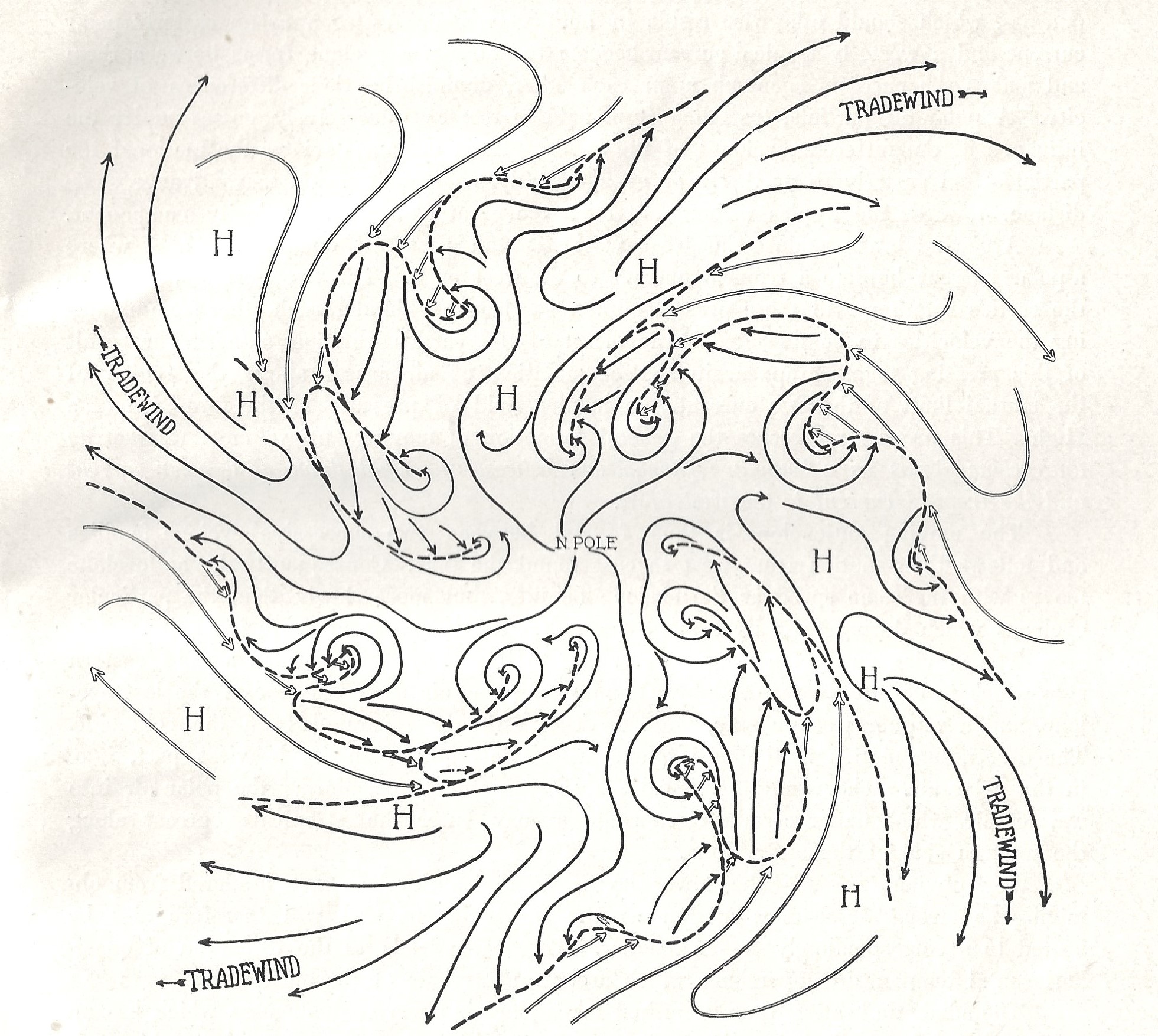
    J. Bjerknes and H. Solberg, Life Cycle of Cyclones and the Polar Front Theory of Atmospheric Circulation. Offprint/separate, Geofysiske Publikationer 3, no. 1, 1922. 12×9, 18pp (paginated 1-18). Bound in cloth, with a half-title and title, though no publication data save for a running abbreviation of the journal name and volume above the text. Nicely bound in buckram. Provenance: U.S. Navy, Naval War College, with a large “Discarded” stamp on front free flyleaf. There is also a bookplate. Very Good condition. Uncommon. $300/on hold

    “Bjerknes was part of a group of meteorologists led by his father, Vilhelm Bjerknes, at the University of Leipzig. Together they developed the model that explains the generation, intensification and ultimate decay (the life cycle) of mid-latitude cyclones, introducing the idea of fronts, that is, sharply defined boundaries between air masses. This concept is known as the Norwegian cyclone model.”–Wiki

    “Bjerknes’s father, Vilhelm. has often been called the father of modern meteorology. This title is doubly appropriate, for not only did Vilhelm’s vision and research programs lead to establishing new directions, methods, and the conceptual foundation for the science, but Vilhelm’s son also played a fundamental role in creating this new era in atmospheric science.”–DSB
    Bjernkes

    “Although rapid transitions or discontinuities in temperature, pressure, and wind velocity had been noted in Jacob’s first model*—and even by nineteenth century meteorologists—and although such discontinuities had been theoretically postulated, the 1919 Bergen cyclone model represented the introduction of discontinuities into meteorology as the major focus for practice and, eventually, theory. These “fronts,” as they later were termed, were endowed with scientific reality through the introduction of major changes in forecasting practice. ”

    “The cyclone model based on fronts entailed the ability to specify in time and three-dimensional space important weather phenomena associated with cyclones to a much greater degree than earlier models could achieve. During the next few years the Bergen group of Vilhelm and Jacob Bjerknes, Ernst Calwagen, Halvor Solberg, and Tor Bergeron, among others, expanded this preliminary cyclone model and accompanying forecasting methods to a comprehensive system for explaining midlatitude weather changes. The polar front, the occlusion process, an evolving cyclone model, and air mass analysis were the conceptual foundation for a new era in meteorology.”–DSB

    *This was evidently a longer and more thorough version of a paper submitted by Bjernkes and Solberg to the Monthly Weather Review in 1919 on the findings of the Bergen group. –Robert Marc Friedman, Appropriating the Weather: Vilhelm Bjerknes and the Construction of a Modern Meteorology, p. 180; also noting that this article is “frequently cited”.

    “Polar front theory is attributed to Jacob Bjerknes, derived from a coastal network of observation sites in Norway during World War I. … The convergence line ahead of the low became known as either the steering line or the warm front. The trailing convergence zone was referred to as the squall line or cold front.”–Wiki

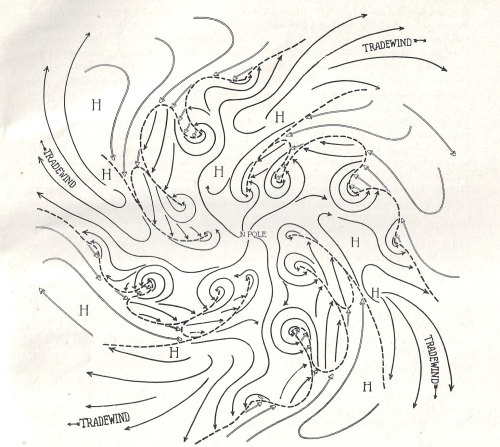
    The two authors “…pictured the polar front as a string of families of cyclones, described by dashed lines linking successive warm and cold front”.–Mark Monmonier, Air Apparent: How Meteorologists Learned to Map, Predict, and Dramatize Weather, pg 64, with several reproductions of some of the lovely diagrams.

    “The “Bergen School of Meteorology” is a school of thought which is the basis for much of modern weather forecasting. Founded by the meteorologist Prof. Vilhelm Bjerknes and his younger colleagues in 1917, the Bergen School attempts to define the motion of the atmosphere by means of the mathematics of interactions between hydro- and thermodynamics, some of which had originally been discovered or explained by Bjerknes himself, thus making mathematical predictions regarding the weather possible by systematic data analysis. Much of the work was done at the Geophysical Institute, University of Bergen, in Bergen, Norway.”–Wiki It should be noted that Jacob was the chief forecaster and head at Bergen 1918-1931.–DSB
    ·Posted by :

    ·in:

  • John von Neumann, 1935


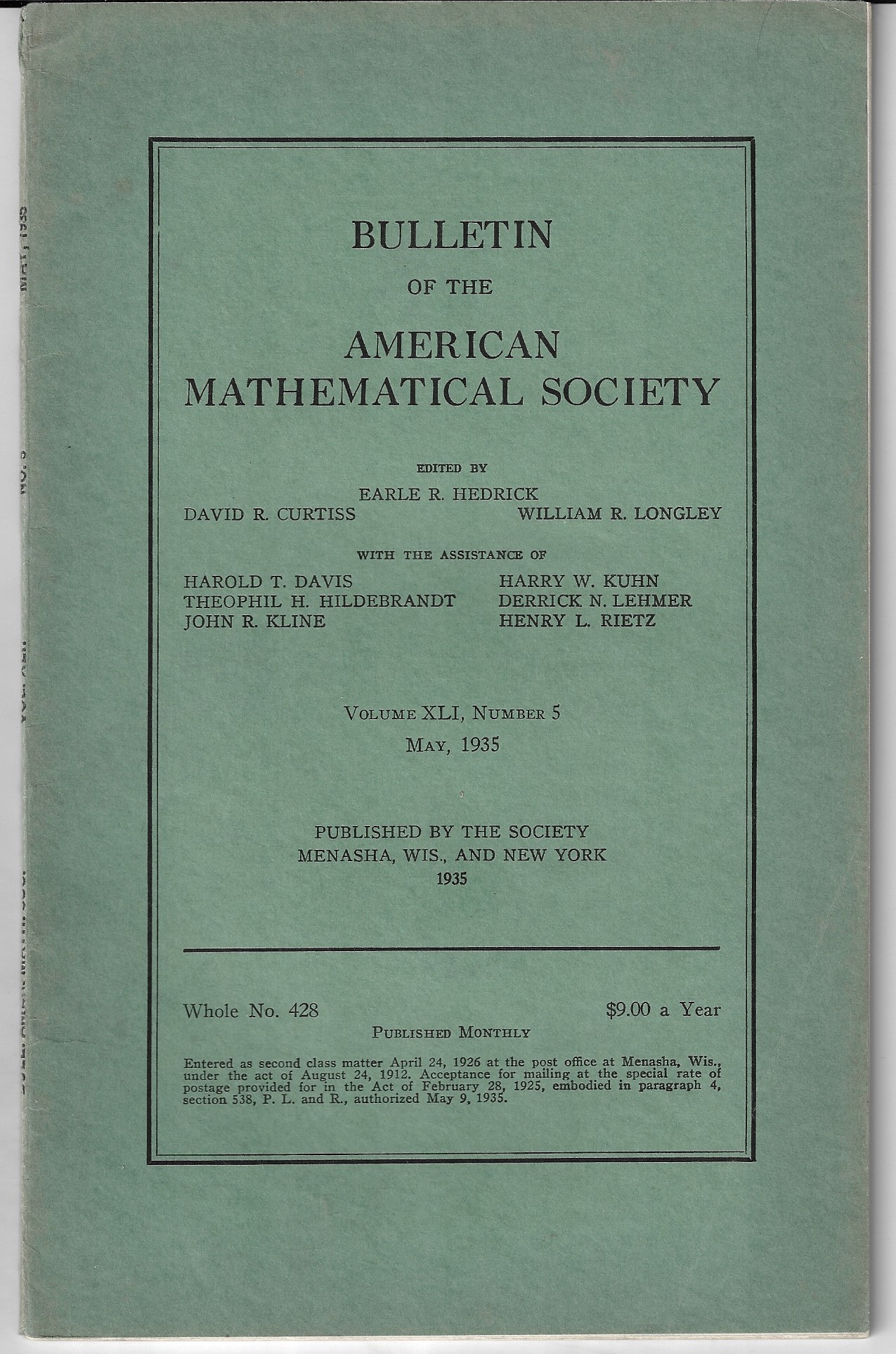
    Von Neumann AMS(John von Neumann)  “Representations and ray-representations in quantum mechanics”.  250-word abstract from the Pittsburgh Symposium on Group theory and Quantum Mechanics, published in the Bulletin of the American Mathematical Society, volume XLI, number 5, May 1935, page 350.  Offered is the entire issue pp 305-352, in the original printed wrappers. 

    Very Good copy.  $75

    See:

    Muraskin Murray, Brody F, Vamos Tibor, editors, The Neumann Compendium, appendix 2 (abstracts presented to the AMS), p 680 and p 49 #4 of bibliography.

    Hans Primas, Knowledge and Time, p 402

    ·Posted by :

    ·in:

    —
  • An Excellent Surveying Instrument of Heights and Distances (1900)

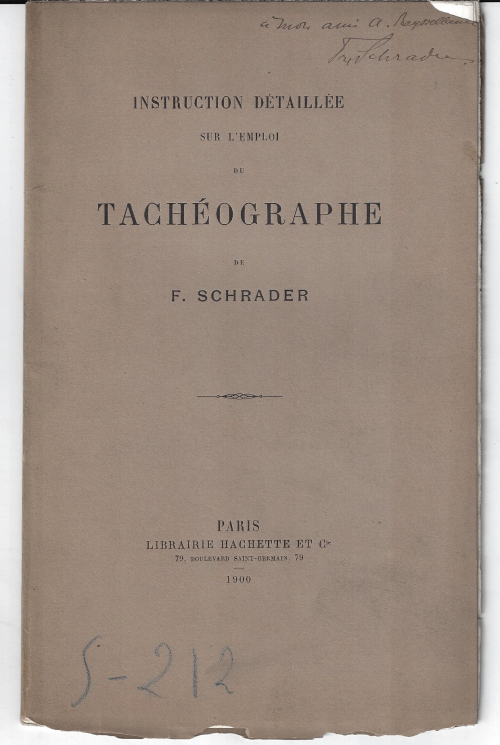
    Franz Schrader. Instruction Detaille sur l’emploi de Tacheographe de F. Schrader.  Paris, Librairie Hachette, 1900. 8×5″ 22pp, illustration.  Original wrappers. Signed presentation copy (“A mon ami A. …..”).  Condition: the covers are chipped along the edges, including a small chip at top right which removes about a quarter of the dedicatee’s name. Internally quite nice, and mostly unopenned. GOOD copy.  SOLD

    The tachograph is ” … a clever surveying instrument remarkably simple in theory and manipulation which has for several years been in use on the Continent but has not been noticed yet in this country [England]. It is the universal tacheograph of Victor von Ziegler a well known writer on geodesy…The instrument which is constructed in various forms for special purposes belongs to the class of plane table theodolites its chief merits are that horizontal distances and vertical heights are read off at the same time that there are no calculations that the instrument checks itself and that the operations require very little time and skill…”–Scientific American Supplement, October 15, 1898

    “THE death of M. Franz Schrader, formerly of the Ecole d’Anthropologie of Paris, which occurred in October, removes one of the most eminent of French geographers. Born at Bordeaux in 1844, Schrader travelled widely in Europe in his youth and served in the Franco-German war. By the influence of Elisee Reclus he turned to geography, his interests lying in the human rather than the physical aspect. But it is for his cartographical work that Schrader was best known. He completed and published in 1893 the “Atlas Universal de Geographie” begun by Vivien and Saint-Martin many years earlier. The last edition of this atlas was published in 1922 and is the principal French atlas of the time. Other notable works of Schrader were” Atlas de Geographie moderne” (1890) and “Atlas de Geographie historique” (1896). He was the editor of the annual publication entitled “L’Annee cartographique,” which records all new publications in cartography and exploration. As a keen alpinist, Schrader found much interest in devising his tacheograph by the use of which he produced his “Carte des Pyrenees centreles.”–Nature, 20 December 1924

    DocFile (2)

    ·Posted by :

    ·in:

  • Cryptography, 1944

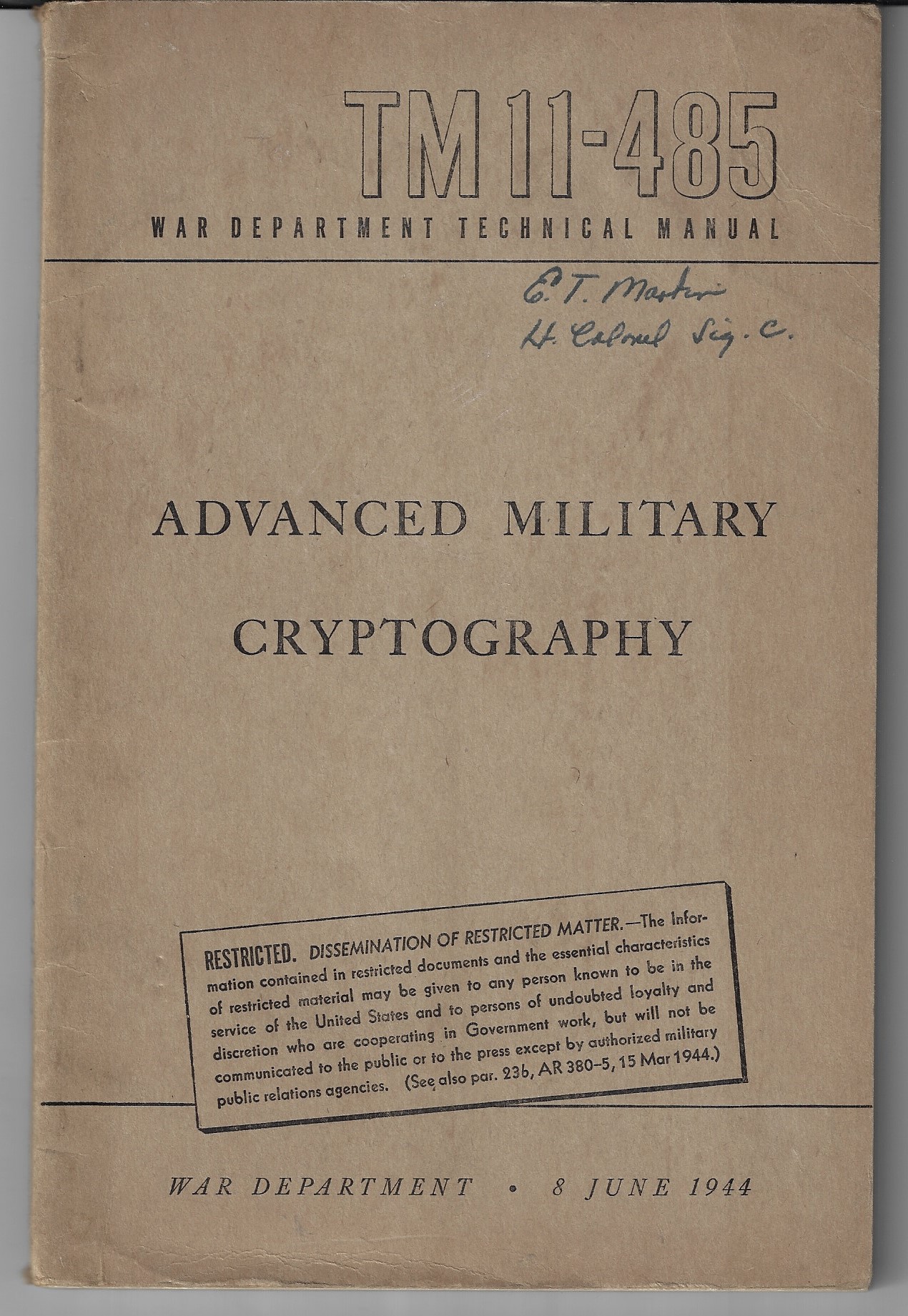
     Advanced Military Cryptography, War Department Technical Manual, TM11-485.

    Published by the War Department, 8 June 1944. 9×6″, 113 pretty dense pages, with numerous diagrams, and a folding table.

    Paper wrappers. Former owner’s name (Lt. Col., Signal Corps) in ink on front wrapper. formerly a “Restricted” document.  Very Good.  $75

    Cryptography military _1_

    ·Posted by :

    ·in:

  • The Klein-Gordon Equation (1926)

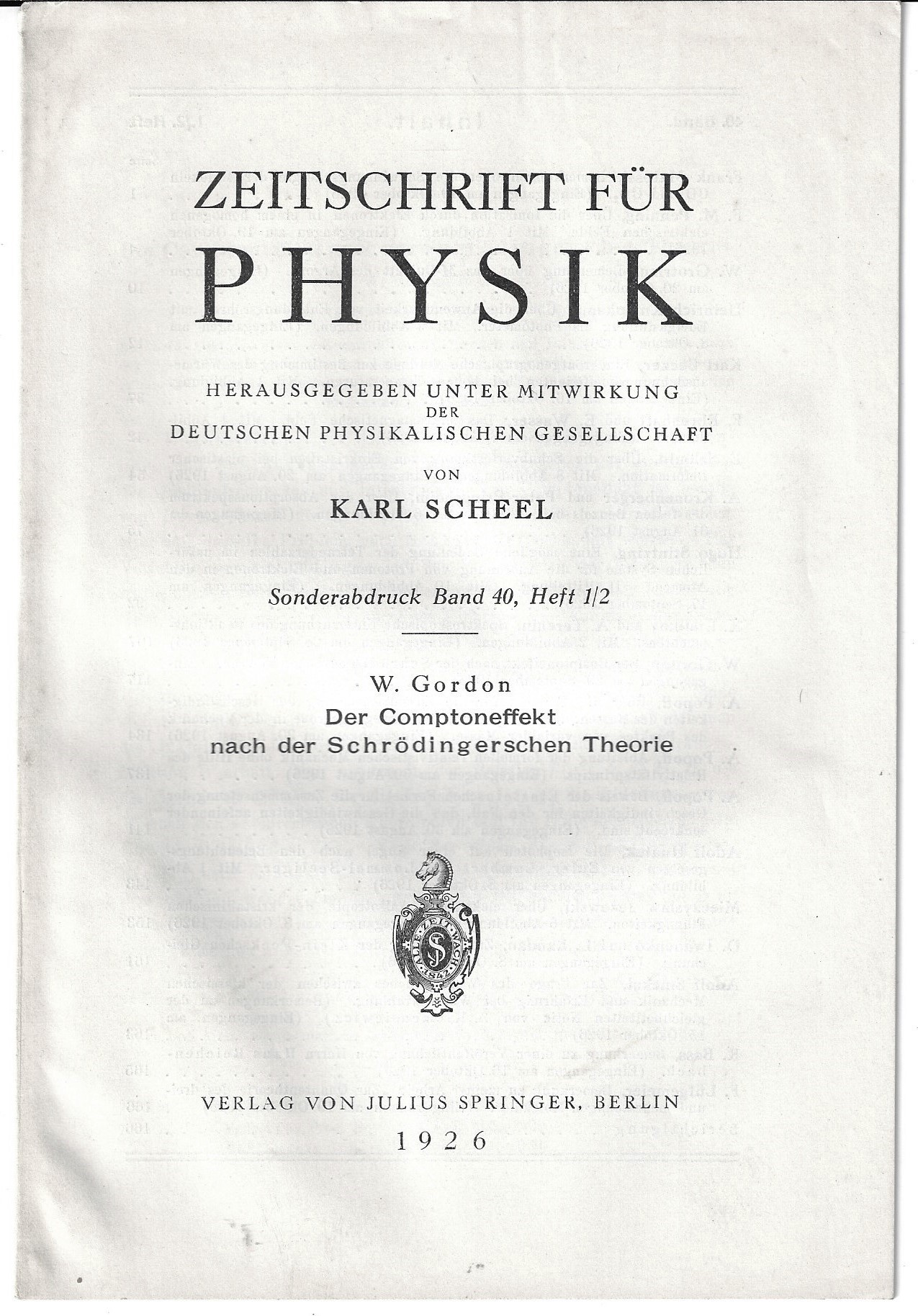
    Gordon Walter ComptoneffektW(alter) Gordon, Der Comptoneffekt nach der Schrödingerschen Theorie”, offprint from Zeitschrift fur Physik, 40, 1-2, Berlin, Julius Springer, 1926, pp 117-133. Original wrappers. Very Good.  SOLD


    “…the Klein–Gordon equation correctly describes the spinless relativisitic composite particles, like the pion. On July 4, 2012 CERN announced the discovery of the Higgs boson. Since the Higgs boson is a spin-zero particle, it is the first observed ostensibly elementary particle to be described by the Klein–Gordon equation.”–Wiki

    See also:

    • H. Kragh: “Equation with Many Fathers, the Klein-Gordon Equation in 1926”, AmJ Phys 52(100), pp 1024, 1984.  (Also citing Vladimir Fock, Johann Kudar, Théophile de Donder and Frans-H. van den Dungen, and Louis de Broglie. )
    • Weisstein, Eric W. “Klein-Gordon Equation.” From MathWorld–A Wolfram Web Resource.
    • Jiří Bičák, Tomáš Ledvinka, eds: Relativity and Gravitation: 100 Years after Einstein in Prague, p. 268.
    • Victor E. Borisenko, Stefano Ossicini, What is What in the Nanoworld: A Handbook on Nanoscience and Nanotechnology

    ALSO:

    W(alter) Gordon, “Zur Lichtfortpflanzung nach der Relativitätstheorie”, offprint from Annalen der Physik, IV/72, 1923, published by Barth in Leipzig., p (421)-456. Original wrappers. Very Good.  SOLD

    “…the main reason why Gordon’s paper should have been considered at the time of its appearance and remembered thereafter is, in our opinion, another one and, to our knowledge, it has remained completely unnoticed by everybody [in spite of 250+ citations?], if one excludes the attentive reviewer of Gordon’s article for “Physikalische Berichte”: that paper contains a clear-cut argument for selecting, through a clever reductio ad vacuum, the stress-energy-momentum tensor of the electromagnetic field in non-dispersive matter, provided that the latter be homogeneous and isotropic when considered in its rest frame “–A forgotten argument by Gordon uniquely selects Abraham’s tensor as the energy-momentum tensor for the electromagnetic field in homogeneous, isotropic matter. S. Antoci and L. Mihich Dipartimento di Fisica “A. Volta” – Pavia, Italy

    ·Posted by :

    ·in:

    —
  • Interesting Dust Numbers from 1933–Apartments in NYC.


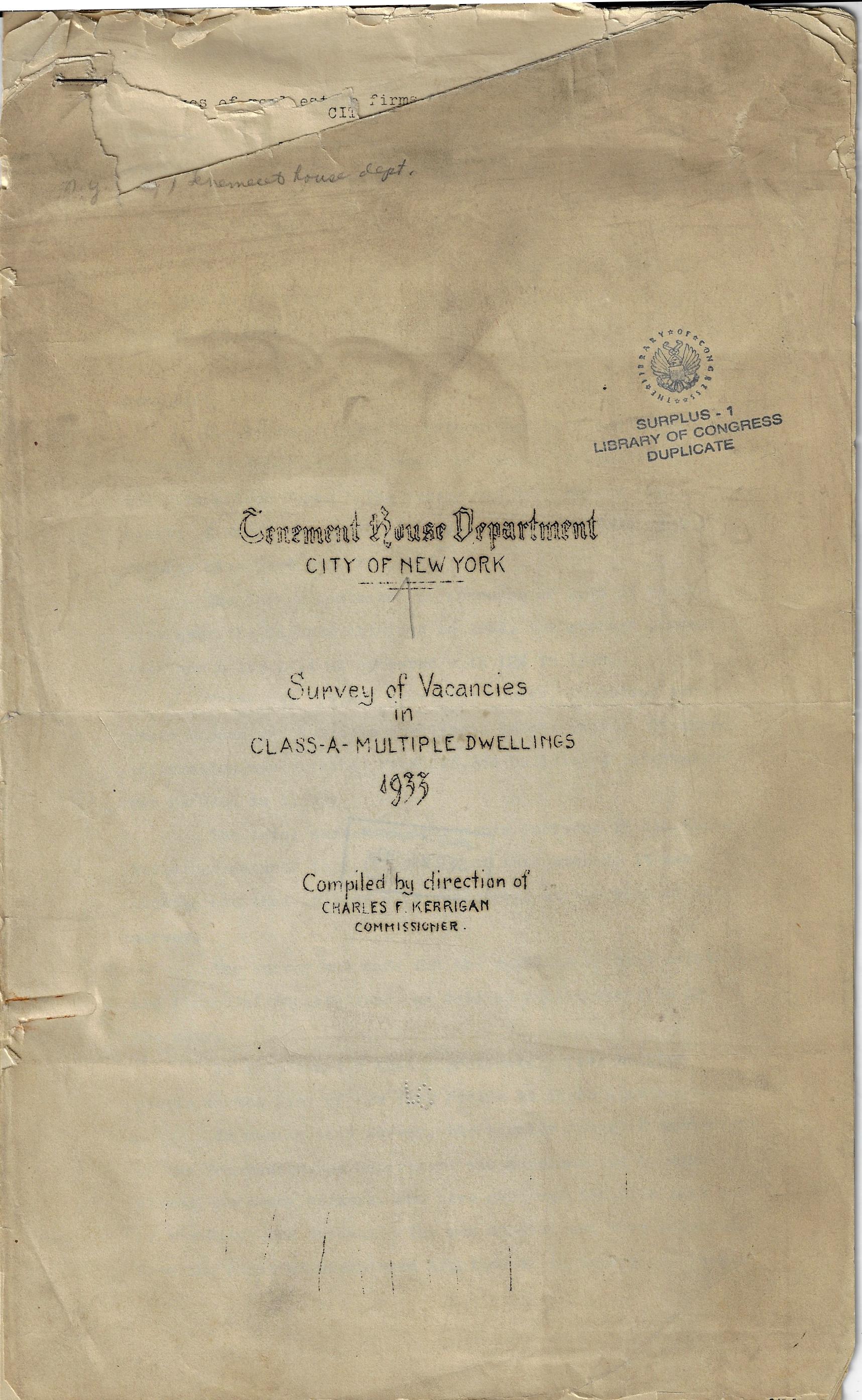
    NYC apartment rents 1933 coverTenement House Department, City of New York: Survey of Vacancies in Class-A-Multiple Dwellings, compiled by the Commissioner Charles F. Kerrigan, 14×8.5″, 9 sheets (2 sheets of text and 7 sheets of tables). Provenance: Library of Congress, with their stamps on the front cover. Condition: meh. The edges are a little tatty, and there’s a good sized chunk out of the top left corner of the front cover and similar to the first page, as well as two small bits off of the right corner of the two last sheets. Other than that, the publication is in Okay shape, but probably just Fair/Good overall.  $100

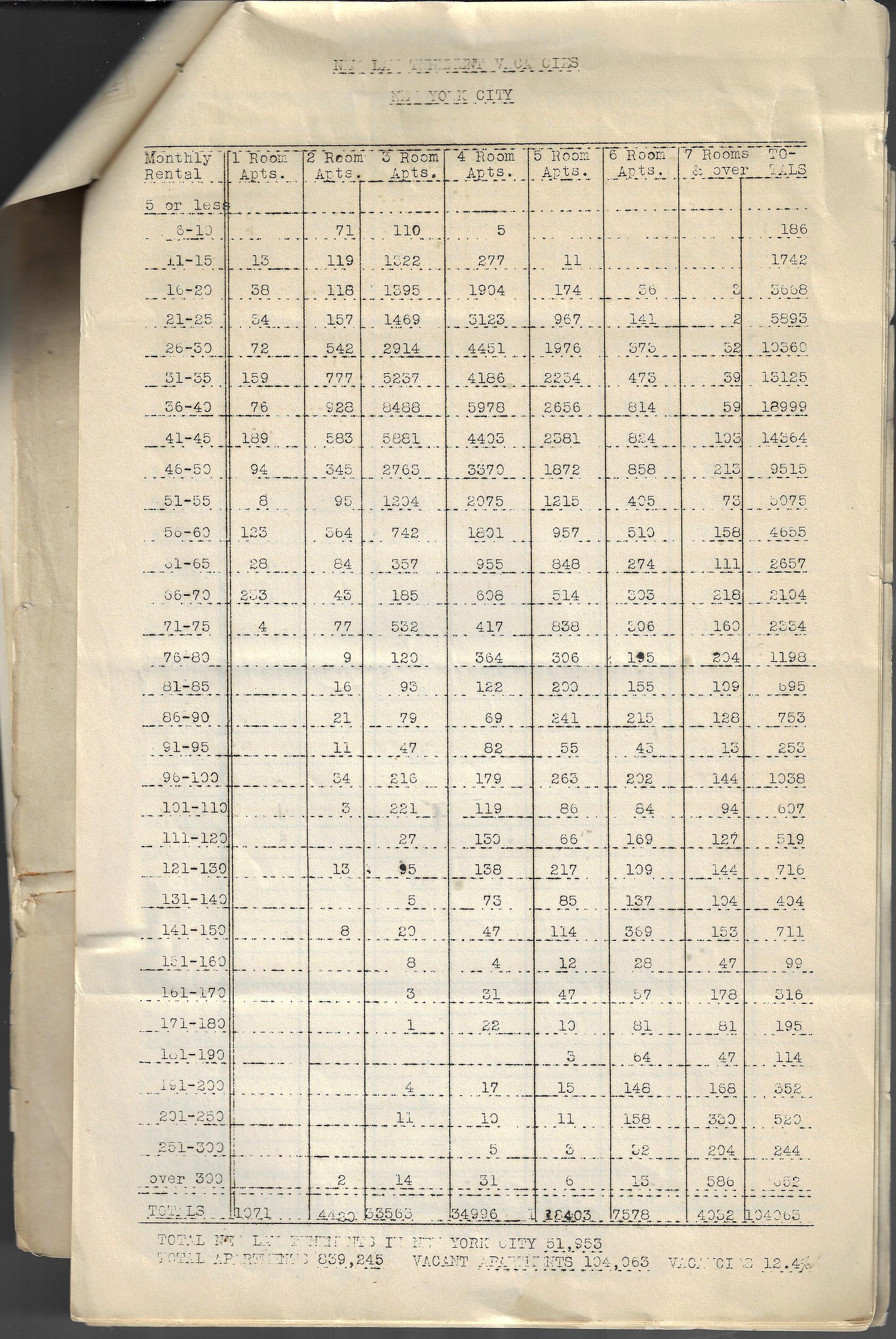
    I know that there must be someone out there in Webtubiana desperately looking for this in a way in which they didn’t know they (a) needed it at all and (b) didn’t know that that unknown need was desperate. And so here it is: New York City apartment vacancies in 1933. There is a tale being told here, in NYC, in the fourth year or so of the Depression and the first year of FDR, about what could be afforded and how much that all was. The list is found in eight pages of Tenement House Department, City of New York: Survey of Vacancies in Class-A-Multiple Dwellings, compiled by the Commissioner Charles F. Kerrigan, and dated in the text “May 11, 1933”.  It is a mimeographed production with a done-at-the-office quality to it, the typewriter having a problem with “9” and “0” and “O” as they tended to be filled in with ink. 

    I know this sounds as brittle as ice on an ego, but once you get past the dust, there is definitely a story being told, if you looked for it.

    At the very least this document will tell you what the rent was like on apartments from 1-7 rooms (elevator and non-elevator buildings), which means that if you consult the ever-useful Bureau of Labor Statistics inflation calculator you can at least establish a common denominator for value interpretation into current dollars. There are 33 (!) price classifications for monthly rental, ranging from $5 (or less) to “over $300”.  So, using the BLS formula $1 in 1933 is worth about $19.21 in 2018 (or for the sake of convenience let’s say 1:20). So the cheapest monthly rent in 1933 for a vacant 1-room apartment in 1933 was $100…except there weren’t any available. The next step up was $6-10, and using the upper end at $300/month there were only 13 1-rooms vacant. The most-available of these price ranges was 189 1-rooms in the $31-$35 range, or about $700 vacant. There was nothing vacant over $75/month in a total of 1071 vacancies. 

    The most commonly-vacant category was in the $26-$40/mo (or $800/month) 3 room apartments, where there were 8,488 apartments available in the 33,563 vacancies. 

    It turns out that of the 839,245  “total apartments” in NYC there were 194,963 vacancies for a rate of 12.4%. Nowadays the vacancy rate for Manhattan hit a high of 2.6% in 2017 and the average studio apartment rented for about $3k (or $156 in 1933 dollars, which would have put you in the upper tier apartment dwellers back then). 

    Different times.

    There’s more, and if anyone needs it they can let me know and I’ll provide what I can. Right now I’m dead-up against my THX-1138 time limit of 30-minutes/post, so this one ends now. 

    NYC apartment rents 1933


    ·Posted by :

    ·in:

  • Report on Fire Conditions in the Dress and Waist Industry, NYC, 1913–Not So Good…

    “The matter of fire protection in loft buildings, it must be remembered, is only a recent problem…”

    [PRICE, George Moses] Special Report on Sanitary Conditions in the Shops of the Dress and Waist Industry, a Preliminary report made by the Joint Board of Sanitary Control in the Dress and Waist Industry. No date (but I assumed this to be 1913), published by the Board of Sanitary Control, New York City. 9×6, 24pp. Condition: supplied with original wrappers which are detached and chipped; the text block however is in Very Good condition, and relatively bright. Provenance: Bureau of Mines.

    There are 7 interesting tables on the area and location of shops, number of shops and people operating at the 6th floor and above; fire protection;light, ventilation, dressing, washing, and toilet facilities; and general cleanliness. 

    WorldCat/OCLC locates NO copies. $125

    This report was published two years after NYC’s still-worst industrial disaster, the fire at the Triangle Shirtwaist Factory, March 25, 1911 at Washington Place and Greene Street, in which 146 people were killed, and of course the board found many safety issues among the 700 businesses surveyed. It was found that there were 319 shops employing 18,417 people located on the 6th story and above of high rise buildings, with little attention spent to fire safety and egress–this was significant as NYFD ladders could only reach to about the 6th floor; it was in the Triangle fire where the fire started on the sixth floor and then trapped many people on the 9th and 10  floors of the building (10% of the works in 1913 worked above the 10th floor).

    That said, the report states that in general businesses in this sector were in better condition and more healthy than many, though that statement so far as I can tell was not substantiated. So far as responding to fire, though, the businesses were not at a “standard”, finding for example that in most shops there was no instruction on how to react to a fire and had no proper safeguards from panic, and that 30% had doors that opened IN, and that there were basically no fire drills, and so on. I don’t know how much change could take place in 700 days or so in the not-closely-regulated and highly combustible clothing industry in NYC in 1913, but it does seem as though some safety measures were taken.

    There is no mention whatsoever of the deadly fire of 1911.

    The overall statement on fire protection:

    • “The crux of the problem of the sanitation of the shops…is the protection of the workers from fire…It is with deep regret that we are compelled to make the statement that..if a fire should break out today …there would be great loss of life.”


    ·Posted by :

    ·in:

  • A Serialized History of the Electro-Magnetic Telegraph (1848)

    [Telegraphy] “The Electric Telegraph”, appearing in 7 issues of the Scientific American, October 21, 1848 to December 9, 1848, volume 4 #s 6-12.  Each issue is 8pp long, stands 15″high, and is detached from a larger bound volume, with signs of that on the spine. 

    Each article is only about one column long, but the columns are dense, printed in 6pt type (!), and run about 750 words each, so the overall length is 11 columns, or about 4500 words.  The articles appear as follows: #1, vol 4/5, Oct 21, p. 35;  #2, 4/6, October 28, p 43; #3, 4/7, Nov 11, p. 51; #4, 4/8, Nov 11, p. 59; #5, 4/10, Nov. 25m p. 75; #6, 4/11, Dec 2, p 83; #7, 4/12, Dec 9, p. 92. 

    There is also much else of interest, as is normal with the Scientific American. These are some seldom seen early issues–in my experience issues of the SciAm are pretty uncommon before 1855.   7 issues: $150

    ·Posted by :

    ·in:

  • Lodge on Science and Etc., A to Z (1913)

    LODGE, Sir Oliver. “Continuity” (An address of the President of the British Association for the Advancement of Science), in two issues of Science:  vol 38, no. 977, 19 September 1913, a long article pp 379-395 in the issue of pp 379-416. AND: “Continuity II”, in Science, vol 38, no. 978, pp 417-430 in the issue of pp 417-454.

    Both in their original wrappers, untrimmed.  First issue VG; second, near-Fine.   $125/pair

    Lodge wrote on thermodynamics, laws of motion, abstraction and Euclid, Boyle’s and Kepler’s laws, Millikan and his new “determination of molecular magnitudes”, Plank’s quanta, Brownian motion, Michelson and Morley, and Tagore and the ether and telepathy, as well as the spirit world, and rounded off with the separation of consciousness from the brain.  It is an interesting read, and one which was expanded by him the next year in a separate publication.  

    ·Posted by :

    ·in:

Recent Posts

Archives

Categories