A Daily History of Holes, Dots, Lines, Science, History, Math, Physics, Art, the Unintentional Absurd, Architecture, Maps, Data Visualization, Blank and Missing Things, and so on. |1.6 million words, 7500 images, 4.9 million hits| Press & appearances in The Times, Le Figaro, Mensa, The Economist, The Guardian, Discovery News, Slate, Le Monde, Sci American Blogs, Le Pont, and many other places… 5000+ total posts since 2008.

  • Expanding the IRT, 1911

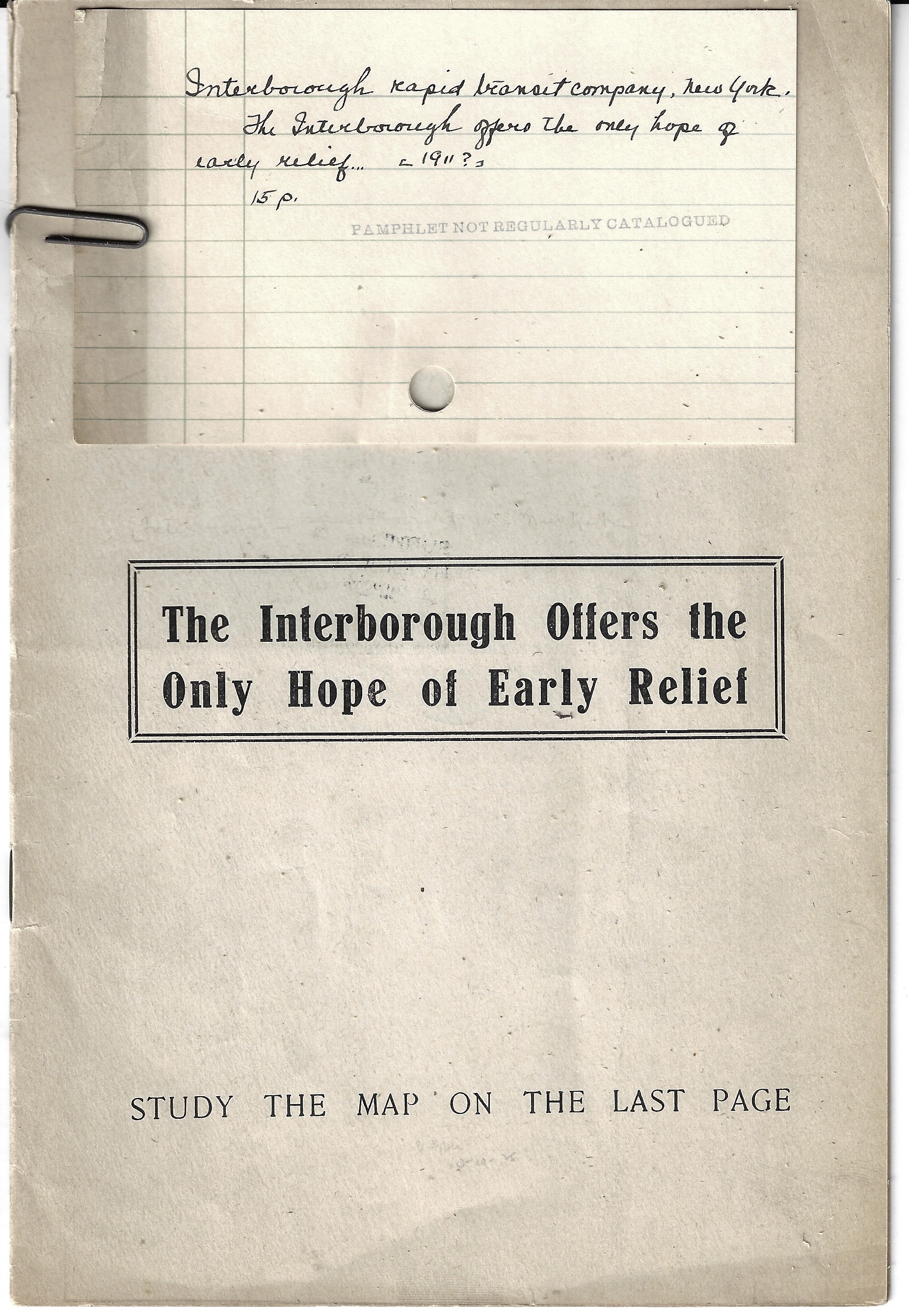
    The Interborough Offers the Only Hope of Early Relief.  Published by the Interborough Transit Company, printed by M.B. Brown Printing, NY. 1911, 8×5″, 15pp, map on the rear wrapper.  Original wrappers. This is a look at the upcoming expansion of the realtively-newly opened IRT that would come two years after the publication of this pamphlet, in 1913. 

    Provenance: Library of Congress, with their original hand-written LC card for the card catalog.  

    Condition:  nice copy. There is a LC surplus/duplicate stamp on the rear cover, in the middle of the full-page map. (The stamp doesn’t obscure, anything, really…it just isn’t “pretty”.)  Scarce: only four copies located in WorldCat: Hagley, Yale, NYPL, NY State Archives.   $125
    DocFile (2)

    “The first IRT subway ran between City Hall and 145th Street at Broadway, opening on October 27, 1904. It opened following more than twenty years of public debate on the merits of subways versus the existing elevated rail system and on various proposed routes.

    Founded on May 6, 1902, by August Belmont, Jr., the IRT’s mission was to operate New York City’s initial underground rapid transit system after Belmont’s and John B. McDonald’s Rapid Transit Construction Company was awarded the rights to build the railway line in 1900, outbidding Andrew Onderdonk. On April 1, 1903, over a year before its first subway line opened, the IRT acquired the pre-existing elevated Manhattan Railway by lease, gaining a monopoly on rapid transit in Manhattan. The Manhattan EL was the operator of four elevated railways in Manhattan with an extension into the Bronx. The IRT coordinated some services between what became its subway and elevated divisions, but all the lines of the former Manhattan EL have since been dismantled. In 1913, as a result of massive expansion in the city, the IRT signed the Dual Contracts with Brooklyn Rapid Transit (BRT) in order to expand the subway.  The agreement also locked the subway fare at 5 cents for forty-nine years. The IRT unsuccessfully attempted to raise the fare to seven cents in 1929, in a case that went to the United States Supreme Court.”–Wikipedia (on the IRT)
    ·Posted by :

    ·in:

  • A Moving Sidewalk, NYC, 1903

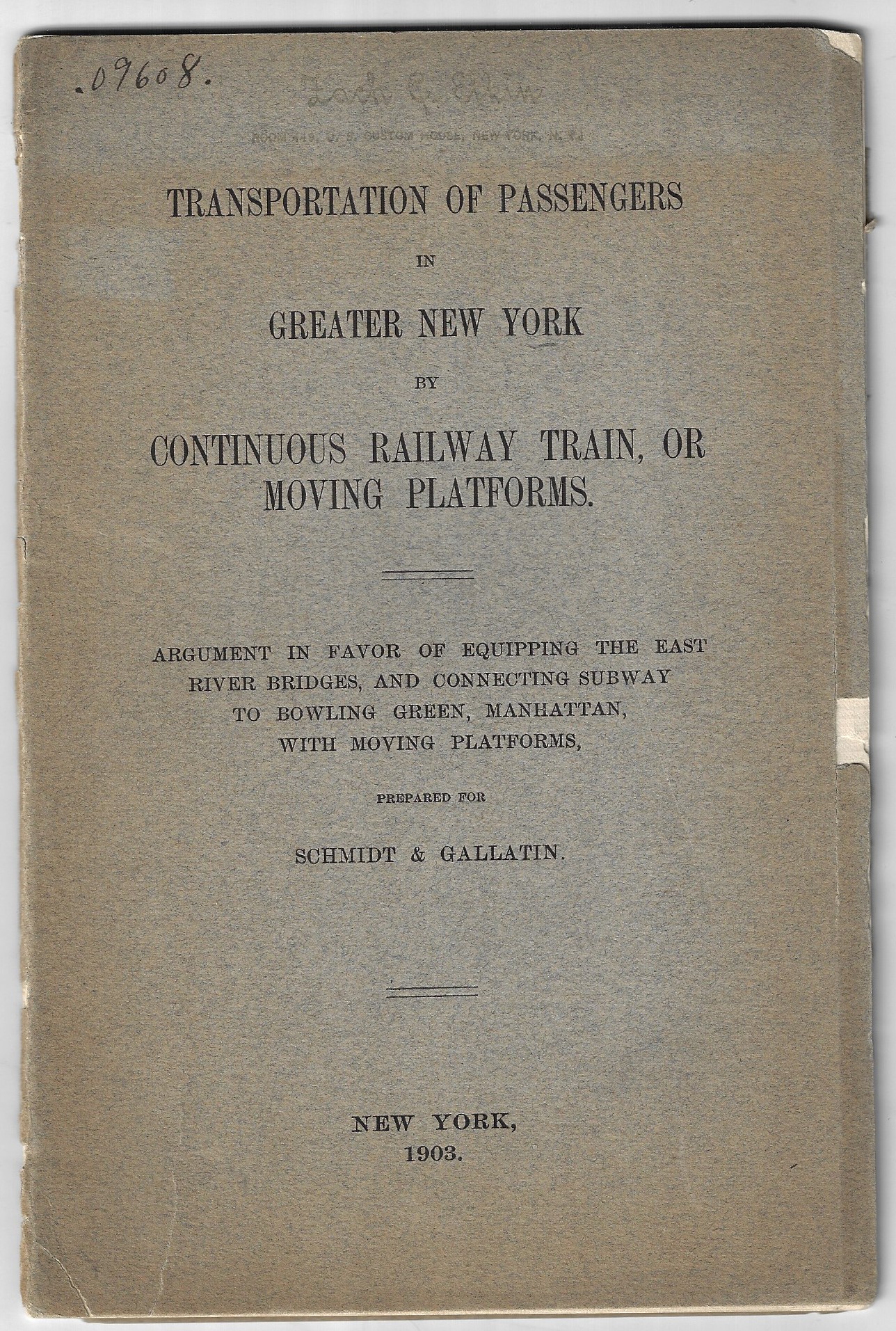
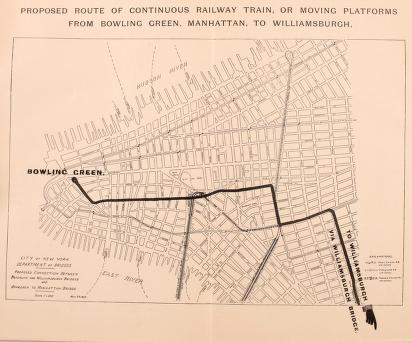
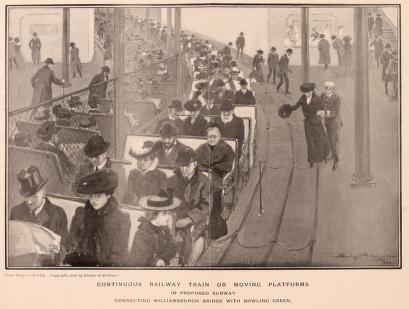
    Transportation of passengers in Greater New York by continuous railway train, or moving platforms. Argument in favor of equipping the East River bridges, and connecting subway to Bowling-Green, Manhattan, with moving platforms, prepared for Schmidt & Gallatin. New York, 1903. (No indication of publisher.)

    9″x 6”, 20pp, plus 4 folding plates (including a map).

    Original wrappers. Condition: the original wrappers are chipped and detached. The text however is clean and bright. Overall, this is probably a GOOD copy (only), probably a 5 out of 10 (“10” being “new”).  Only six copies located in WorldCat (Henry Ford, Yale, U Chicago, NYHS, NYPL, Columbia). 

    Provenance: US Customs House (NYC, Herman Melville retiring from there in 1885 btw) with their tiny rubber stamp barely visible on the front wrapper; Library of Congress (with their rubber stamp on rear cover, which probably resulted in the wrappers detaching).  $250

      Continuous railway


    DocFile (2)

    This seems a wonderful example of future thinking and city planning–but just not a very good idea.  It is hard to imagine a continuously moving sidewalk functioning in lower Manhattan. 

    Continuous railway _2_

    From the pamphlet: 

    “Moving Platforms for the conveyance of passengers were recommended by Mr. Horace Greeley thirty years ago. They were successfully operated, first, at the World’s Columbian Exposition of 1893, where 2,700,000 people were transported. In 1896 they were installed at the Berlin Exposition, and again at the Paris Exposition of 1900, where they carried over eight million passengers. Few persons know what Moving Platforms are. From the face that sometimes they are called ” Moving Side- walks,” it is believed that they must be some sort of a pavement on rollers, on which it is difficult to step with safety and maintain equilibrium. The Moving Platforms are to all intents a railway, operated like other railways, propelled by electricity, with cars, seats, motors, passenger stations, ticket booths, guards, electric lights — in fact, everything belonging to a first-class railway.” 

    “Where it differs from the ordinary railway is that the cars, or trains, are not running at intervals, but are coupled up continuously, so that there is no interruption of traffic at any time, but a large seating capacity at all times. It differs also in the construction of the cars, which are mere flat cars, provided with seats placed crosswise, and so arranged that all passengers face in the direction of motion. Each of these seats may be made wide enough to accommodate one, two or more persons. The most approved plan is to provide seats on one side of the cars only and leave the other for passengers to walk, thus giving them an opportunity to further accelerate their speed if they so desire…”

    ·Posted by :

    ·in:

  • Meteorological Instruments (1926)

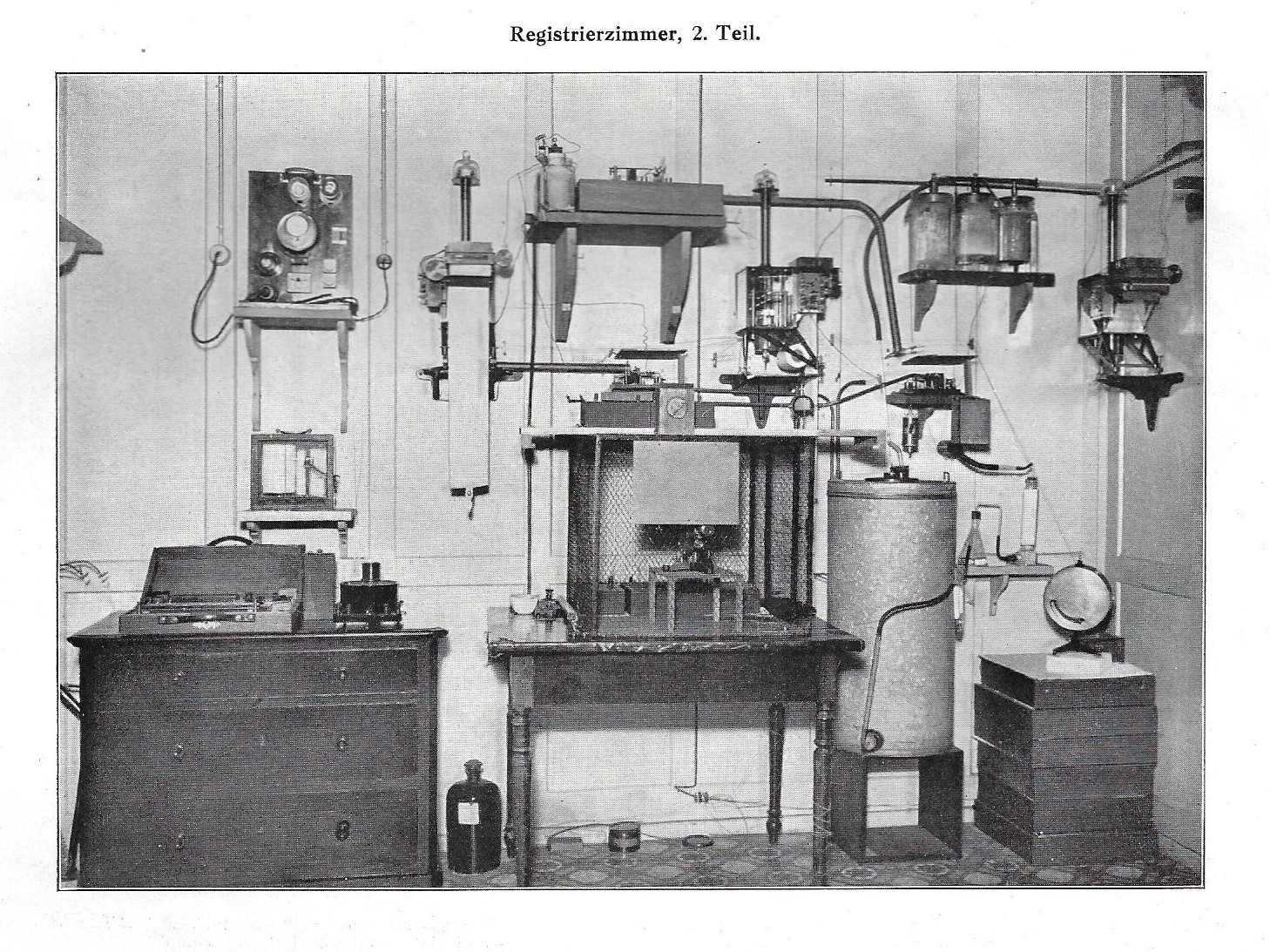
    Dorno, C. Ausstattung moderner Strahlungsobservatorien, Braunschweig, Vieweg u. Sohn, 1926. 10×7”, 13pp+ an interesting illustrated section, “Bilder aus dem Physikalisch_Meteorlogischen Obervatorium, Davos”, which has 9 photo illustrations of the instruments, 6 of which have numbered glassine overlays to help with the identifying legend for the plate. Original wrappers. There is a 2”-long 1”-square bit missing from the upper right corner. Provenance: U.S. Weather Bureau (1932), and the Library of Congress, with a stamp on the reverse of the title page and on the back cover. Good copy, though the text is bright and fresh. $45

    “The latter work aims at uniformly comprehending the whole economy of atmospheric light, that is to say, establishing what has become of the incident solar radiation, and what sort of charges it has undergone with regard to intensity, have been devoted to the perfection of recording methods measurements in the foregoing years. These efforts arrived at an almost complete success, as has been shown in “Progress in radiation measurements” published in the Monthly Weather Review in 1922, according to which Davos is the first place in the world to continuously record the total exchange of heat by radiation during the course of a whole year”. —Monthly Weather Review, March 1924, pg 150

    DocFile (2)

    ·Posted by :

    ·in:

  • Four Cosmology Papers by R.C. Tolman, 1931-2

    Richard C. Tolman, “On the theoretical Requirements for a Periodic Behaviour of the Universe”, in Physical Review, vol 38/9, November 1, 1931,  pp 1758-1771 in the issue of pp 1575-1796.

    And offered with:

    • Tolman RC. “Nonstatic model of universe with reversible annihilation of matter.” Physical Review. 38/4, August 15, 1931. 797-814. VG+ copy
    • Tolman RC. “Possibilities in relativistic thermodynamics for irreversible processes without exhaustion of free energy.” Physical Review, vol 39/2, January 15, 1932, pp 320-336. About a 1/4-inch chip missing from top of spine. [Also contains M. True et. al., “High Speed Protons”.] VG copy
    • Tolman RC, Ehrenfest P, Podolsky B. “On the gravitational field produced by light.” Physical Review, vol 37/5, March 1, 1931, pp 602-615. VG copy.

    All in original wrappers.

    All copies are 3-hole three-ring-bound, meaning that the decrepit binding was removed to reveal  nicely preserved issues, with lovely spines (which on the Phys Rev are easily damaged), but with the three binding holes through-and-through. So, there’s that. 4 issues: $200

    Tolman was a Ph.D. MIT (1910), then positions at University Michigan (1910-11), (1912-1916), then U Cincinnati and U of Illinois before US WWI involvement, then on to  UC Berkeley, and then  CalTech (1922-1948). During World War II, “Tolman served as vice chairman of the National Defense Research Committee, as scientific adviser to General Leslie R. Groves on the Manhattan Project.”–DSB
    The main thrust of Tolman’s work in statistical mechanics, relativistic thermodynamics, and cosmology was mathematical and theoretical.  An “…early interest in relativity theory was further stimulated by Hubble’s discovery in 1929 that red shifts are proportional to distance, and led to a series of studies on the applications of the general theory to the overall structure and evolution of the universe. In his comprehensive treatise on relativistic thermodynamics, Tolman presented his theory of a universe expanding and contracting rhythmically like a beating heart, arguing that gravity has the effect of counteracting the influence of radiation, thus preventing the complete cessation of motion as predicted by the second law of thermodynamics.”–DSB

    Abstract from the first paper, “On the theoretical Requirements for a Periodic Behaviour of the Universe”: “This article investigates, on the basis of relativistic mechanics and relativistic thermodynamics, the theoretical requirements for nonstatic models of the universe to exhibit a behaviour which is periodic in time. The discussion is limited to models which can be regarded from a large-scale point of view as filled with a uniform distribution of fluid, and the time coordinate is purposely chosen so as to agree with the proper time that would be used by local observers at rest in this fluid. It is first shown that the analytical requirements which would correspond to the continuous expansion and contraction of such models between definite maximum and minimum limits, together with the thermodynamic requirement that the expansion and contraction must be reversible, could not both be simultaneously satisfied with any fluid for filling the model which has reasonable properties. Attention is then turned to models of the universe having line elements which would be quasi-periodic in the time. A wide range of possibilities is found for models which would expand from zero proper volume to a maximum and then return, the treatment failing however to provide the analytical conditions for a minimum at the lower limit. It is pointed out, nevertheless, that from a physical point of view contraction to zero proper volume could only be followed by renewed expansion, so that we might expect for such models a continued series of expansions and contractions. Furthermore, it is found possible to satisfy the analytical requirements for such quasi-periodic behaviour by models which would expand and contract at a finite rate reversibly without increase in entropy, so that we might then expect a continued series of identical expansions and contractions. It is pointed out that Einstein’s recent model of a nonstatic universe filled with incoherent matter, exerting no pressure and unaccompanied by radiation, would satisfy the thermodynamic as well as the analytical requirements for such a series of identical repetitions, and models filled solely with black-body radiation and with an equilibrium mixture of radiation and perfect gas are discussed which also satisfy these requirements. In conclusion some remarks are made concerning the bearing of such findings on the behaviour of the actual universe. “


    ·Posted by :

    ·in:

    —
  • Financial Report on Engineering in the Orleans Levee District, 1935

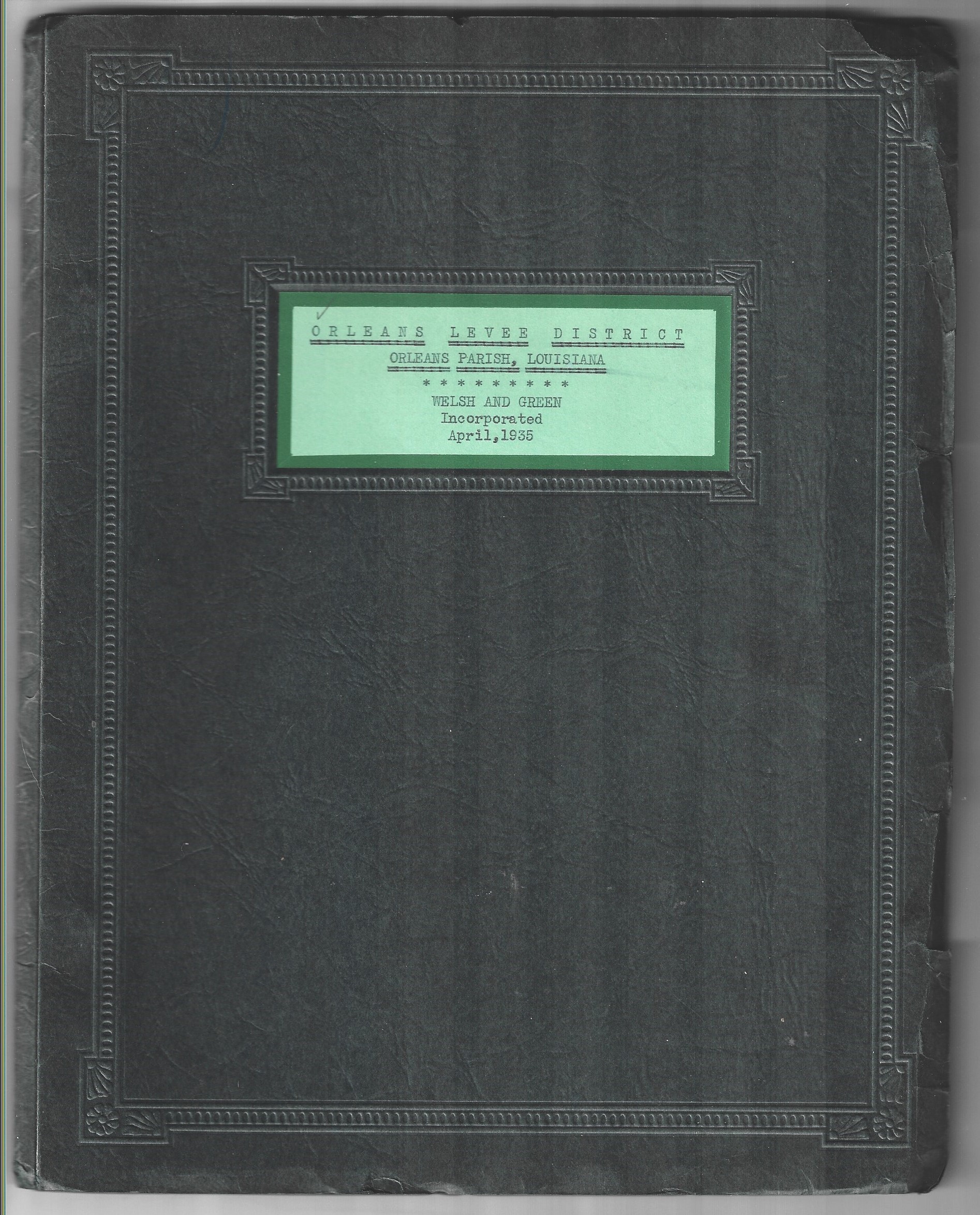
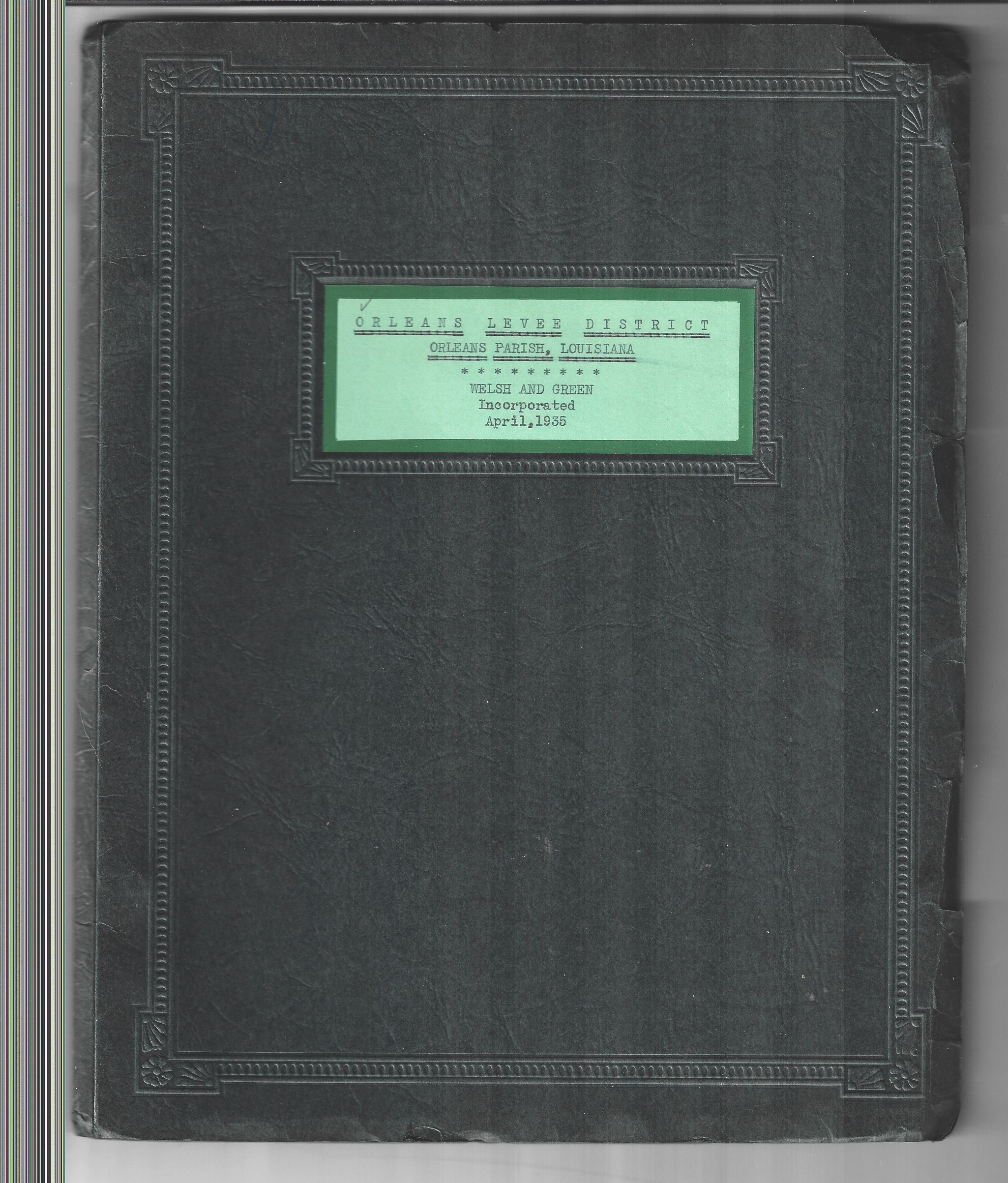
    Welsh & Green, Inc (Chicago).   Orleans Levee District, Orleans Parish, Louisiana.   No publisher, no place of printing, April 1935.  11.5×8″, 31 leaves, plus (20) leaves, including 5 folding plates of tables and one map.  This is a offset type-printed document, presumably done so in very small numbers, for a presentation made by the firm of Welsh & Green before the Orleans Levee District Board, recommending ways of financing the various improvements to the levees and the airport. 

    This report is bound in a stiff manila folder with brass punches and has a hand-made typed label pasted onto the front cover.  The cover has some bumps and tears along the edges but is in generally Very Good condition; the text is Fine. Provenance: the Library of Congress, with their surplus/duplicate stamp on the rear page. $300

    Levee Report

    “Welsh & Green was retained by Newman, Harris & Co., of New Orleans, to investigate the financial conditions of the district, and to devise ways and means for remedying the (financial) situation.” In effect it seems as though this presentation looked at different ways to legislate and issue bonds to fund a 7 million dollar public debt for the work.

    The report was issued in April 1935, just a few months ahead of the “other” storm of the century, the Labor Day Storm of 1935. NOT LOCATED in the OCLC/WorldCat. I can’t locate this anywhere, so far, except for the Catalog of Copyright Entries for 1935. (I did find something that looked similar to this report by Welsh & Green on the financial status of Chicago, 1934.)

    ·Posted by :

    ·in:

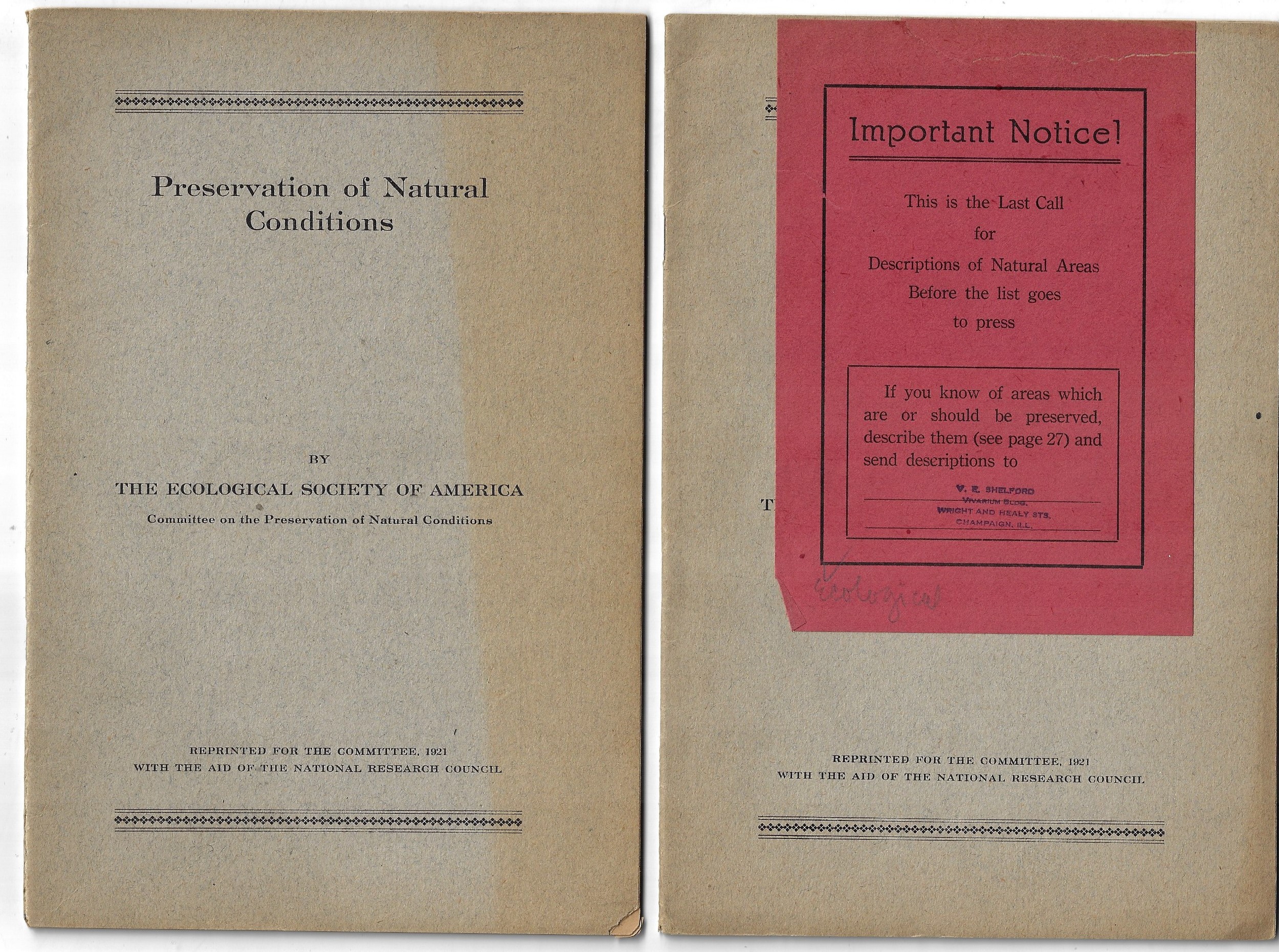
  • A Strong Statement Made in Defense of the Environment, 1921

    Preservation of Natural Conditions 9×6″, 32pp, illustrations. Original wrappers. 

    OFFERED WITH:

    Preserves of Natural Conditions, both published by the Ecological Society of America (Committee on the Preservation of Natural Conditions), reprinted 1921 with assistance of NRC. 9×6″, 31pp. Originl wrappers. This copy also accompanied by a 2pp guideline (dated November 1921) for readers who cared to participate in recommending areas in their vicinity for preservation.  

    These two pamphlets seem to be one in the same work, though there are a number of significant differences among the many similarities. Both copies in Very Good condition, with Library of Congress surplus/duplicate rubber stamps on the back cover. $125/the pair

    DocFile (7)

    The pamphlets make the case for scientific selection of preserves to take place in the U.S. before it was too late to save those areas from abuse and exploitation. Of the many cases made for this activity:

    • “The automobile is fast opening up the most inaccessible sections of the country to the hunter and the industrial exploiter as well as to every week end excursionist who chances to own a tin Lizzie. All are combining to destroy our native fauna and flora and to upset the general balance which was maintained for ages before the entrance of man. Nearly every day’s papers throughout the summer and fall chronicle a considerable list of forest fires most of which according to wardens are due to carelessness on the part of campers or hunters. But this list does not include the hundreds of square miles of brush and chaparral which are burned over every season.” Francis Bertody Sumner, 1874-1945 (Scripps Institution for Scientific Research, La Jolla), one of the first biologists at Scripps.
    • “Any statesman like view of the situation will convince one that the people who live in this country fifty years hence will be extremely grateful to this generation for every area it may succeed in having reserved however the present need of preservation may appear.” G. Biggs

    All of these guys were pretty much right on pretty much everything. 

    Two notes on the ESA:

    • “Between 1917 and 1945, the Ecological Society of America (ESA) housed a Committee for the Preservation of Natural Conditions specifically charged with identifying and taking political action toward the preservation of wilderness sites for scientific study.”  Journal of the History of Biology, Nov 2012, Volume 45, Issue 4, pp 613–650|
    • “In 1917 the Ecological Society of America established a committee for the Preservation of Natural Conditions for Ecological Study, under the chairmanship of Victor E. Shelford, “to initiate and carry out action concerned with preservation of natural conditions” (Bulletin ESA 1 [4]: 1). Dr. Shelford was one of the founders of the Society in 1914 and had served as its first president. Also, in 1926 The Naturalists’ Guide to the Americas was published under his editorship. This volume made a preliminary inventory of natural areas in the new world, and it served as a guide for pointing out areas in need of preservation.”. ESA and the Ecologists’ Union, June 25, 2014 SL White The Ecological Society of America’s History and Records by the ESA Historical Records Committee


    ·Posted by :

    ·in:

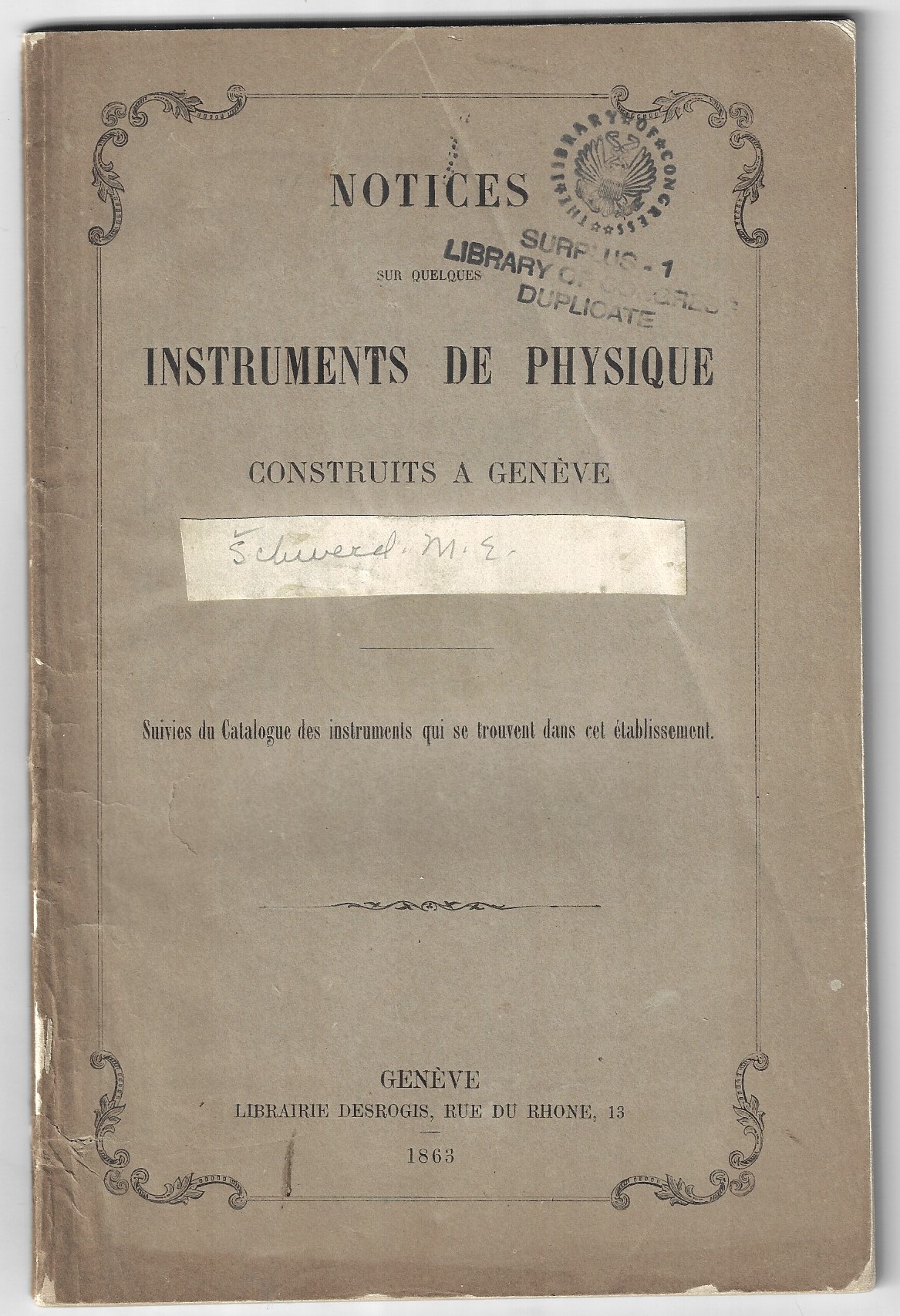
  • Scientific Instruments

    Sci instruments schwerdM. E. Schwerd. Notices sur quelques instruments de physique construits à Genève dans l’atelier dirigé par M. E. Schwerd : suivies du catalogue des instruments qui se trouvent dans cet établissement .

    Genève : Librairie Desrogis, 1863 56pp., 1 plate, 8pp. 20 cm. The 8-page supplement at the rear of the pamphlet is a priced catalog from the manufacturer.  

    Original wrappers. Condition: Good. The wrappers are somewhat dusted and chipped. Provenance: Library of Congress, with their surplus/duplicate stamp on the front cover. $150


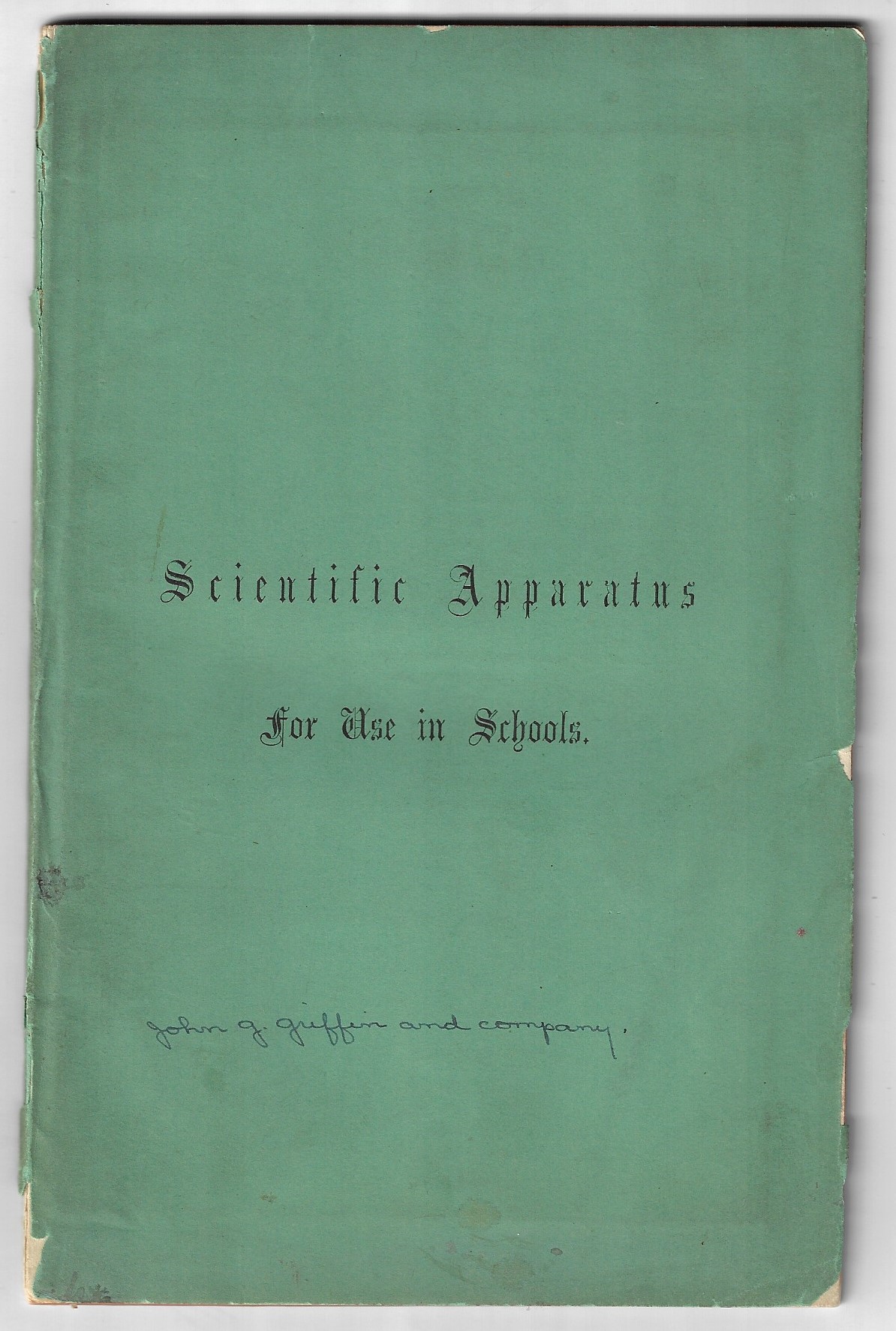
    DocFile (6)[John J. Griffin] Scientific Apparatus for Use in Schools A Catalogue of Instruments required for the Performance of Experiments to Illustrate the Physical Sciences especially the subjects of Mechanics, Hydrostatics, Pneumatics, Heat, Light, Magnetism, Electricity, Galvanism, Electro Magnetism, &c.  49, (4)pp, with a shorter 16pp catalog pasted in at front interior. This catalog lists hundreds of instruments, with very short descriptions and a price, but no illustrations. For some reason this is unlocated in WorldCat/OCLC.  Good copy, only.  $100

    Provenance: Library of Congress, with their surplus/duplicate stamp on the rear wrapper. 

    ·Posted by :

    ·in:

  • Jean Le Clerc Andjean Cornande De Al Crosebibliotheque Universelle Et Historique De Lannee Mdc Lxxxix Amsterdam Wolfgan

     Bibliotheque Universelle et Historique, 1689

    Jean Le Clerc and Jean Cornande de al Crose,  Bibliotheque Universelle et Historique de l’annee M.D.C. LXXXIX. Amsterdam, Wolfgang, Waesberge, Boom, Someren. 1689. 5.5×3”, vi,519, (21); vi,476,(15)pp. Volumes 13 and 14 of the journal series, bound together. Bound in full vellum. Condition: a lovely copy, with a very fresh textblock. There is a centuries-old paper label on the spine bottom (“F”), and a faint “13” and “14” in a very old hand taking up about a half-inch square in the middle of the spine. Taking these as “Found book art”, they are very attractive. VERY GOOD condition. $150

    This interesting volume contains numerous papers, including book notices, book “reviews”, and in the first half of the book a yearly review that can include works done for 1688 and 1689 in the fields of philosophy, history, ethics, and others that don’t fit neatly into a category. The second part of the volume includes original papers, this volume including, for example:

    • Joannis Bompartii, “Paralella sacra & prophana”;
    • Carolus du Cange, “Glossarium Greco-barbarium”;
    • Cellarii, Christohors, “Collectanea Samaritana”;
    • Gravii, Georgii, “Panacea Vegetabilis Calida sive Majorama…Experimentia lapida…”

    and a number of others.

    On the Bibliotheque: “Like its great rival, Pierre Bayle’s Nouvelles de la re´publique des lettres, it [the Bibliotheque…] was a source of information and means of communication for members of the nascent Republic of Letters. It was also one of the remote ancestors of the modern academic journal, though much less specialised than most of its successors.”J.R. Milton, “Locke’s Publications in the Bibliothèque Universelle et Historique”, British Journal for the History of Philosophy, 05/2011, Volume 19, Issue 3

    Editors and contributors included: Jean Le Clerc et Jean Cornande de al Crose, vols 1-9; Jean Le Clerc, 10, 12, 14-19; Jean Cornand de La Crose, vol 11; Charles le Cene and Jean Le Clerc, vol 13; Jacques Bernard and Jean Le Clerc, vol 20; Jacques Bernard, vols 24-5. The journal was published every 4 months in vols 1-3; every 3 in 4-19, and then twice a year for 20-25.

     Bibliotheque Universelle et Historique, 1691-2

    Jean Le Clerc and Jean Cornande de al Crose,  Bibliotheque Universelle et Historique de l’annee M.D.C. XCI Amsterdam, Abraham Wolfgang, 1691. 5.5×3”, Volume 21 BOUND WITH:   Bibliotheque Universelle et Historique de l’annee M.D.C. XCII Amsterdam, Abraham Wolfgang, 1692, volume 22 of the journal series, bound together. (ii), 164; (viii), 136, (xvi); (II), 518, (xviii)pp., with volume 21 in two parts and volume 22 in one part, all three parts bound together. Part Ia includes months from July-September 1791; Part Ib includes October-December 1691; Part II (with the imprint of 1792) includes January-June 1692.

    Bound in full vellum. Condition: a lovely copy, with a very fresh textblock. There is a centuries-old paper label on the spine bottom (“F”). VERY GOOD condition. $150

    This interesting volume contains numerous papers, including book notices, book “reviews”, including (in the volume for 1692) a long treatment of Daniel Horthemels’ 1100pp biography of Descartes (d. 1650), which runs 70pp.

    On the Bibliotheque: “Like its great rival, Pierre Bayle’s Nouvelles de la re´publique des lettres, it [the Bibliotheque…] was a source of information and means of communication for members of the nascent Republic of Letters. It was also one of the remote ancestors of the modern academic journal, though much less specialised than most of its successors.”J.R. Milton, “Locke’s Publications in the Bibliothèque Universelle et Historique”, British Journal for the History of Philosophy, 05/2011, Volume 19, Issue 3

    Editors and contributors included: Jean Le Clerc et Jean Cornande de al Crose, vols 1-9; Jean Le Clerc, 10, 12, 14-19; Jean Cornand de La Crose, vol 11; Charles le Cene and Jean Le Clerc, vol 13; Jacques Bernard and Jean Le Clerc, vol 20; Jacques Bernard, vols 24-5. The journal was published every 4 months in vols 1-3; every 3 in 4-19, and then twice a year for 20-25.

    ·Posted by :

    ·in:

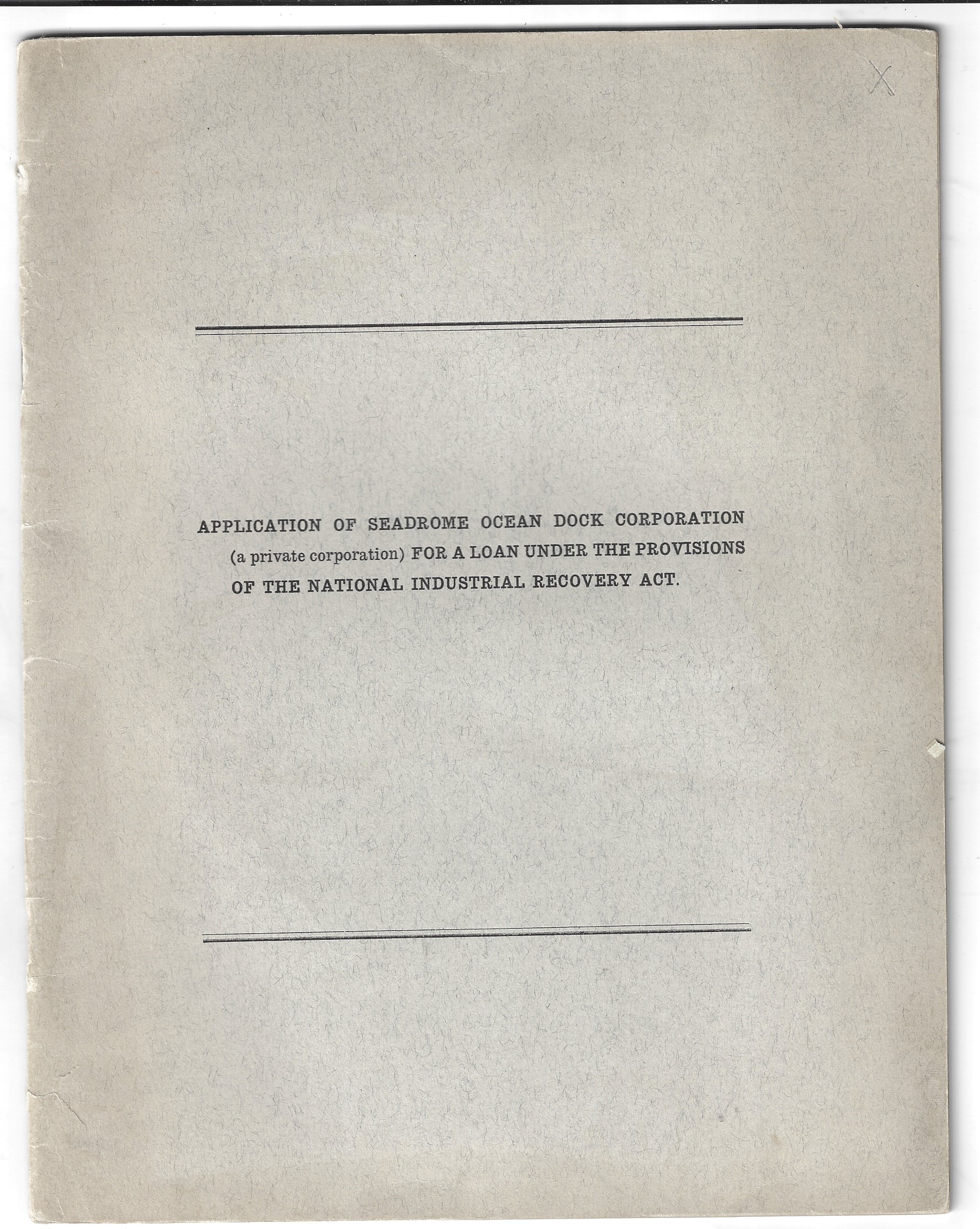
  • Floating Transoceanic Airport Network, 1936–from the White House Library

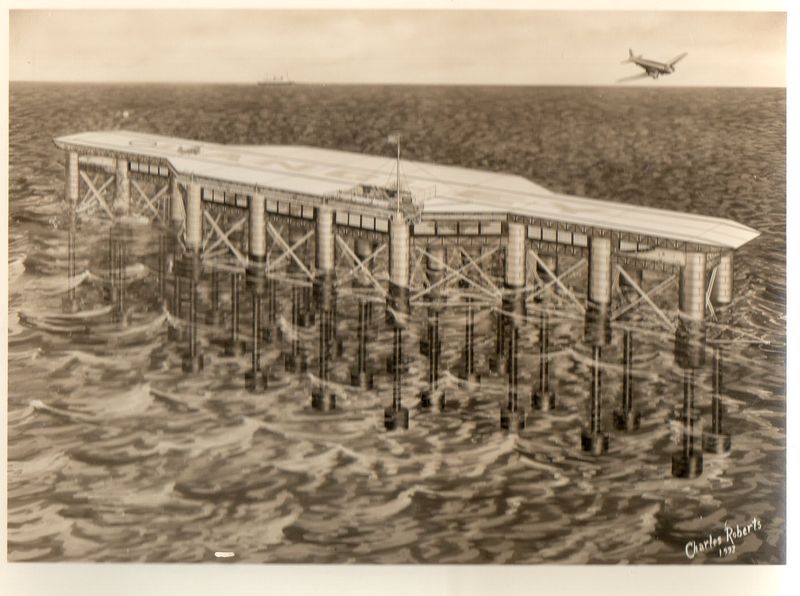
    DocFile (5)Edward R. Armstrong (1880-1955). Application of Seadrome Ocean Dock Corporation (a private corporation) for a Loan Under the Provisions of the National Industrial Recovery Act, printed ca. 1933.  11×8 inches, 34pp.  With two original photographs one of the floating airports, and a map.  This copy comes from the White House Library, transferred to the Library of Congress in 1933. Printed wrappers. There is a Library of Congress surplus stamp on the rear cover, ans a tiny “LC” perforated stamp at the bottom of page one. Very nice copy.  $500 

    The outline for this plan asks the federal government for a loan of $30 million (Depression) dollars to undertake the construction of a five floating airports transoceanic network.  “It will require the work of approximately 10,000 men per month for a period of twenty-four to thirty months”.  The labor figures did not include was what necessary to produce all of the material necessary for the project ( for reasons unknown).  Once finished the network would enable aircraft  to make it across the ocean in 18 to 36 hours.

    The members of the Seadrome Corporation estimated that the entire 30 million would be paid back by 1945,  and that the corporation would be completely debt-free.  Perhaps all of  this made sense when Armstrong first developed the plan in 1913, just ten years after the Wright brothers’ successful first in North Carolina. The idea of the floating airport girding the Atlantic was a pretty interesting idea, seeing as how the world record for sustained non-stop flight in 1913 was 11 hours (in a Maurice Farman MF-2), and that was under more-or-less optimal conditions; the speed record was 120mph, and again, optimal conditions and not sustained for hours on end.  By 1933 it seems to me that it had become obvious that non-stop transoceanic flight was coming, and coming soon.  That would of course make an investment in the Seadrome project superfluous, like building an antique, though an unnecessary one. The first transatlantic non-stop flight was made by John Alcock and Arthur W. Brown in 1919, averaging about 100mph; Lindbergh would come later to accomplish the first solo non-stop in 1927–by the early 1950’s jet aircraft would be making the trip with regularity, which means that  for most of the life of the completed Seadrome it would have been unnecessary.  I feel certain that the Seadrome–which was supposed to be paid off by 1945, though in 1933 there was no inkling on the part of the Corporation members who wrote the request for the money that a war was looming and that there would have been almost no way for them to have been made at any time between 1939 and 1945–would never have been paid for.Armstrong’s idea would get major play in the popular press from time-to-time, and discussed as a series of floating islands.  Armstrong himself would organize the Seadrome Ocean Dock Corp. in the late 1930’s, his pretty but  impractical idea (reported by Time Magazine1 in 1933 as little more than “a perennial gift to Sunday feature editors”)  finally grinding to a salty end with greater fuel capacity and efficiency in transatlantic aircraft. 
    Seadrome152

    Notes:
     

    ·Posted by :

    ·in:

    —
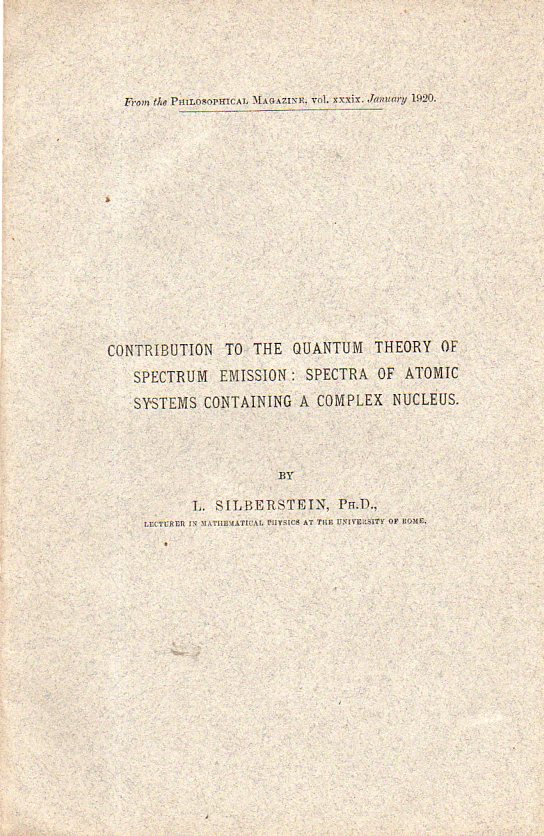
  • Ludwik Silberstein Contribution To The Quantum Theory Of Spectrum Emission Spectra Of Atomic Systems Containing A Complex N

    SIlberstein313Ludwik Silberstein.  “Contribution to the Quantum Theory of Spectrum Emission: Spectra of Atomic Systems Containing a Complex Nucleus.”  Offprint:  Philosophical Magazine, vol xxxix, January 1920. 

    Original printed wrappers.pp 46-66.  Inscribed, “with the author’s best regards, 21.I.1920”.  $125

    Silberstein was as we all know an interesting thinker, working early and with some elegance in relativity, though he did run into a spot of bother with Einstein in which the good Dr. Silberstein fared not so well. I’ve always rather “liked” Silberstein for his early work on relativity. 

     “Ludwik Silberstein (1872 – 1948) was a Polish-American physicist who helped make special relativity and general relativity staples of university coursework. His textbook The Theory of Relativity was published by Macmillan in 1914 with a second edition, expanded to include general relativity, in 1924.”–Wikipedia

    ·Posted by :

    ·in:

  • First Appearance in Print of the Terms “Relativity Theory” and “Theory of Relativity” (1906)

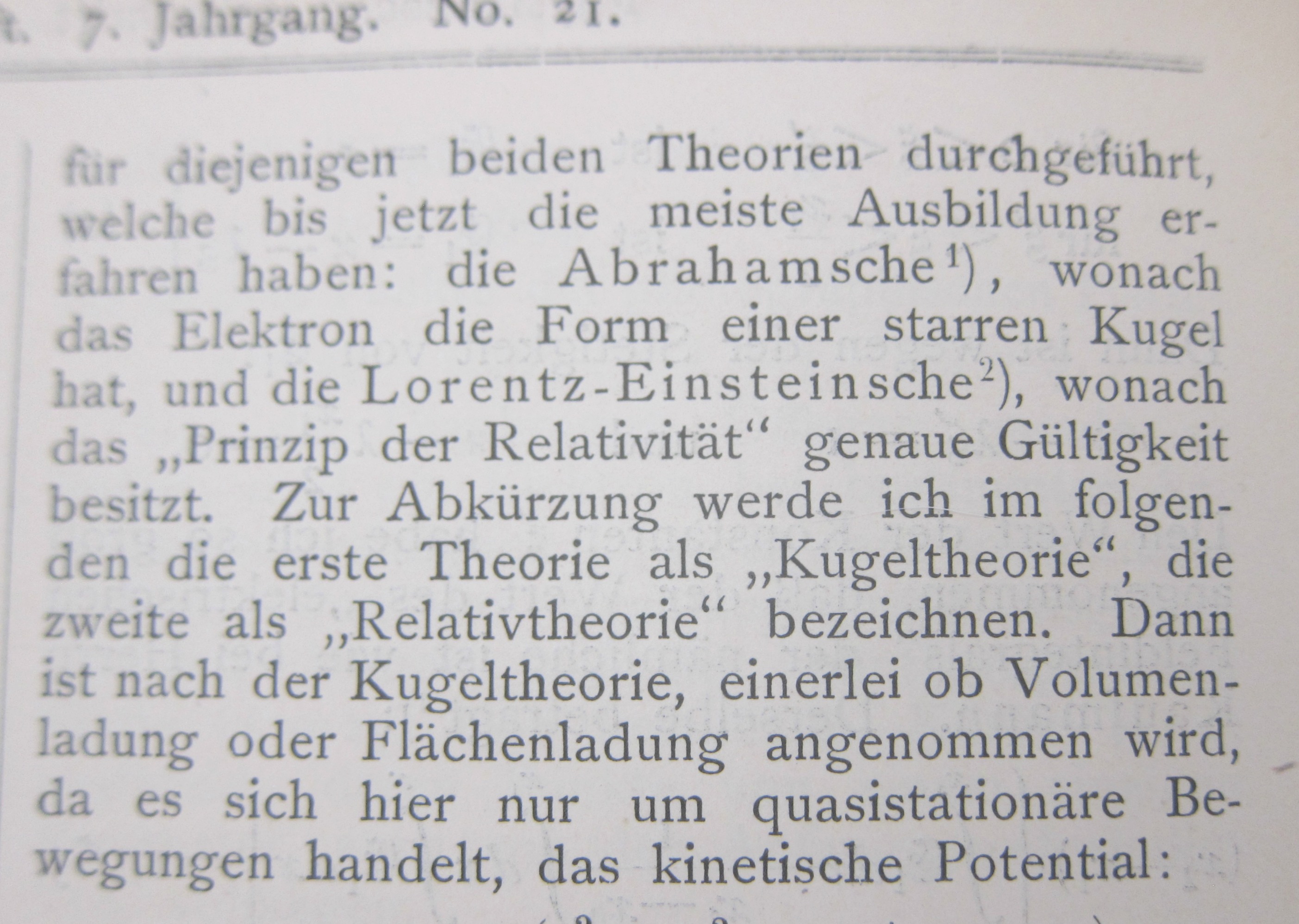
    Max Planck, “Die Kaufmannschen Messungen der Ablenkbarkeit der β-Strahlen in ihrer Bedeutung für die Dynamik der Elektronen” [The Measurements of Kaufmann on the Deflectability of β-Rays in their Importance for the Dynamics of the Electrons], in a bound volume of Physikalische Zeitschrift, 1906, volume VII, the paper occupying pp 753-761 (printed in double columns), printed in Leipzig by S. Hirzel. There are other papers of relativity in VII including Wacker (p 300), Farkas (p 654), Stark (p 353), and Wilkens (p. 846). Bound in cloth. Fine and sturdy copy.  $500

    Prior to using the words “postulate” and “principle” associated with relativity (as in “Prinzip der Relativitat”, appearing in the second paragraph of Einstein’s June 1905 “Zur Elektrodynamik bewegter Körper” in Annalen der Physik)  it is first referred to as “relativity theory” (“Relativtheorie”) by Max Planck on p. 756 (col 2 line 9 and also on pp 758+759) of this volume. Then in the “discussion” part of the Planck paper the “theory of relativity” (“Einsteinische Relativitatstheorie”) appears for the first time in print just a few pages later (p. 760 col 2 line 15) by Alfred Bucherer.

    • “The term “theory of relativity” was based on the expression “relative theory” (German: Relativtheorie) used in 1906 by Planck, who emphasized how the theory uses the principle of relativity. In the discussion section of the same paper, Alfred Bucherer used for the first time the expression “theory of relativity” (German: Relativitätstheorie).”–Wikipedia

    It was very surprising, finding this, the first time that something so familiar as “relativity theory” appeared in its most familiar form. 

    Einstein relativtheorie


    And there it is.

    ·Posted by :

    ·in:

    —

Recent Posts

Archives

Categories