A Daily History of Holes, Dots, Lines, Science, History, Math, Physics, Art, the Unintentional Absurd, Architecture, Maps, Data Visualization, Blank and Missing Things, and so on. |1.6 million words, 7500 images, 4.9 million hits| Press & appearances in The Times, Le Figaro, Mensa, The Economist, The Guardian, Discovery News, Slate, Le Monde, Sci American Blogs, Le Pont, and many other places… 5000+ total posts since 2008.

  • A.M. Lyapunov, Six Papers, 1897-1901.

    Aleksandr Mikhailovich Lyapunov (1857 – 1918), six papers, as follows: 

    Lyapunov was a Russian mathematician, mechanician and physicist. His surname is sometimes romanized as Ljapunov, Liapunov, Liapounoff or Ljapunow. He was the son of astronomer Mikhail Lyapunov and the brother of pianist and composer Sergei Lyapunov. Lyapunov is known for his development of the stability theory of a dynamical system, as well as for his many contributions to mathematical physics and probability theory.”

    The following six papers, all in weekly issues of the Comptes Rendus, 1897-1901.  $350
    
    “Sur un theorem du calcul des probabilities” in the Comptes Rendus, vol 132#3, 21 January 1901, pp 126-128 
    in the issue of pp 101-188.
    AND WITH: “Une Proposition Generale du calcul des probabilities”, 2 April 1901, vol 132 #13, pp 814-815 in the issue of
    pp 813-868.
    Both have their original front wrapper, and both are removed/disbound from a larger bound volume.
    See: Hans Fischer, A History of the Central Limit Theorem: from Classical to Modern Probability...

    Also with the following, all from the Comptes Rendus:
    “Sur le potentiel de la double couche”, (1897) vol 125, pp 694-696; “Sur certaines questions se rattachant au probleme de Dirichlet”, (1897) vol 125, pp 808-810; “Sur une question differentielle lineare du seconde ordre”, (1899) vol 128, pp 911-913; “Sur une serie relative a la theorie d'une equation differentielle lineaire du second ordre”, (1900) vol 131,
    pp 1185-1188.
    All are detached/removed from larger bound volumes and offered in their complete weekly issues.

     There are a number of different mathematical concepts therefore bear his name: Lyapunov equation, Lyapunov exponent, Lyapunov function, Lyapunov fractal, Lyapunov stability, Lyapunov’s central, limit theorem, Lyapunov vector.

    ·Posted by :

    ·in:

  • Felix Klein

    KLEIN, Felix (1849-1925). Two papers from the Comptes rendus:

    (1) “Formes principales sur les surfaces de Riemann”, in Comptes Rendus, 21 January 1889, volume 108 #3, pp 134-136 in the issue of pp 113-156.

    (2) “Des fonctions theta sur la surface generale de Riemann”, in Comptes Rendus, 1889, volume 108 #6, pp 277-280 in the issue of pp 261-315. 

    Both weekly issues removed from a larger bound volume, and offered together at $150.  

    “Klein…saw his work on function theory as his major contribution to mathematics. As W Burau and B Schoenberg write:

    Klein considered his work in function theory to be the summit of his work in mathematics. He owed some of his greatest successes to his development of Riemann’s ideas and to the intimate alliance he forged between the later and the conception of invariant theory, of number theory and algebra, of group theory, and of multidimensional geometry and the theory of differential equations, especially in his own fields, elliptic modular functions and automorphic functions.”–St. Andrews History of Math site.

    ·Posted by :

    ·in:

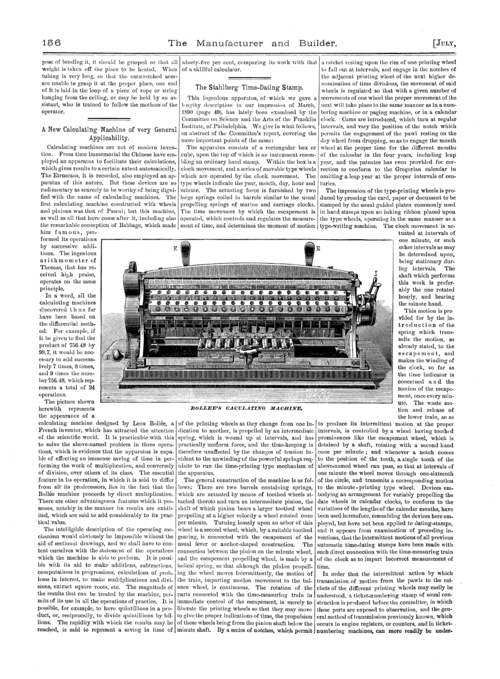
  • Bollee’s Calculating Machine

    BOLLEE< Leon. “Sur une nouvelle machine a calculer”, in  Comptes Rendus, Paris, Gauthier-Villars, November 11, 1889, volume 109, #20, pp 737-739 in the weekly issue of pp 723-774. Removed from a larger bound volume.  Good condition.  SOLD


    Bollee
    [Source: http://www.rechnerlexikon.de/artikel/Bild:Bollee-mit-Maschine-CNAM1990.jpg]

    This was a surprise, finding M. Bollee’s article (Sur une nouvelle machine a calculer) in this 1889 Comptes Rendus, pecking around in that big 10-pound volume looking for something else.  It was very easy to miss if you weren’t looking for it, just a few pages long in a 1000-page book.  But there it was, nestled comfortably in pp 737-739.  It these few pages Bollee describes his machine and with particular reference to his innovative approach to direct multipilication–a fine addition (ha!) to the long line of contributions by Babbage and Clement, Scheutz, Wiberg and Grant and Hamann. Bollee’s device would be more popularly remembered in its incarnation in the 1890’s as the relatively popular device named “The Millionaire”.  


    An image of the machine from The Manufacturer and Builder:

    Bollee

    See:  the Making of America, http://digital.library.cornell.edu/cgi/t/text/pageviewer-idx?c=manu;cc=manu;rgn=full%20text;idno=manu0022-7;didno=manu0022-7;view=image;seq=0162;node=manu0022-7%3A21


    ·Posted by :

    ·in:

  • A Summer Camp for Brooklyn City Kids, 1908

    Brooklyn Italian Settlement, Conclusions on the Settlement Camp at New Canaan, Ct., 1908. Published at the Settlement House, front Street, Brooklyn, NY. 7×5″, 9pp. Original wrappers. Good copy, only. Scarce. $45 

    “WORK AT SETTLEMENT CAMP. Children for First Time Close to Nature ‘Is This the Same Sun That Shines on Front Street?’ A little pamphlet [the one described above] describing some of the work of the Settlement Camp at New Canaan. Conn., conducted by the Italian Settlement whose house is at 29 Front street, has been issued. It is an interesting interesting story, and one which will appeal to many persons. The settlement camp is an old farm of 45 acres, on which is an old barn half full of hay, a small new house, several apple trees, a big and interesting interesting woods, full of oak, ash and hickory trees, brooks and springs, berries and nuts, with a swimming pool, and various wood folk. Here the leader, Fred McCollum, erected four tents, while Miss Errlco had charge of the house and the girls. Between June 29 and September 2 there were 180 persons at the camp for a longer or shorter period. The average stay of the boys and girls was ten days. Here is a Quotation. amusing but pathetic: “From Stamford the trip to New Canaan was by train, and thence to the camp by wagon. At first the breadth of the sky, the panorama of the hills, the darkness of the night, the cries of the screech owl and… created an Impression too strong for comfort. It seemed to take jr the youngsters’ breath and rendered then strangely silent. For these children children knew nothing of nature; girls of 12 talked of picking up apples from the floor meaning the ground, and again and again asked: ‘Is this the same sun that shines in Front street?” —Brooklyn Eagle, October 1, 19078, pg 4, courtesy of the great Brooklyn Public Library.

    ·Posted by :

    ·in:

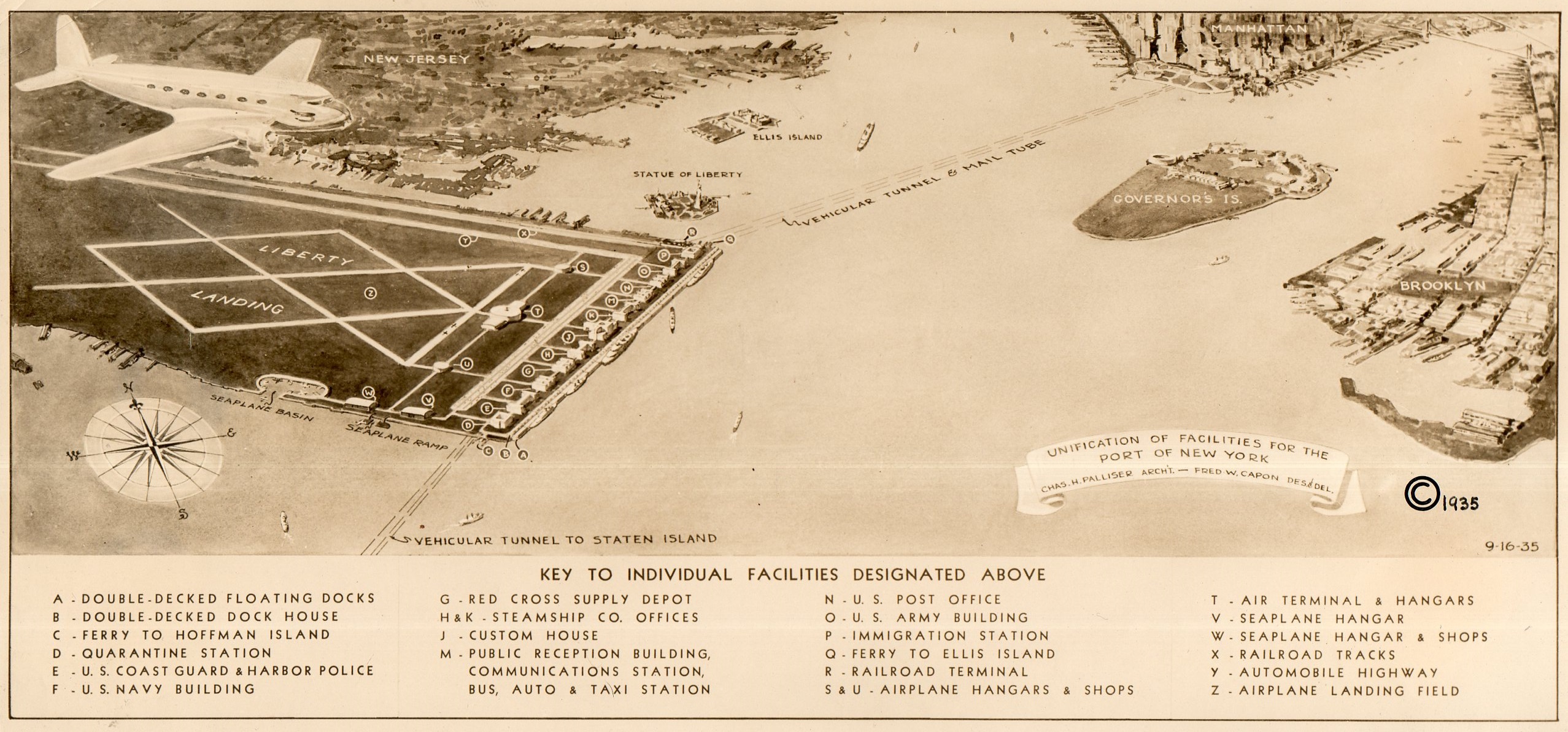
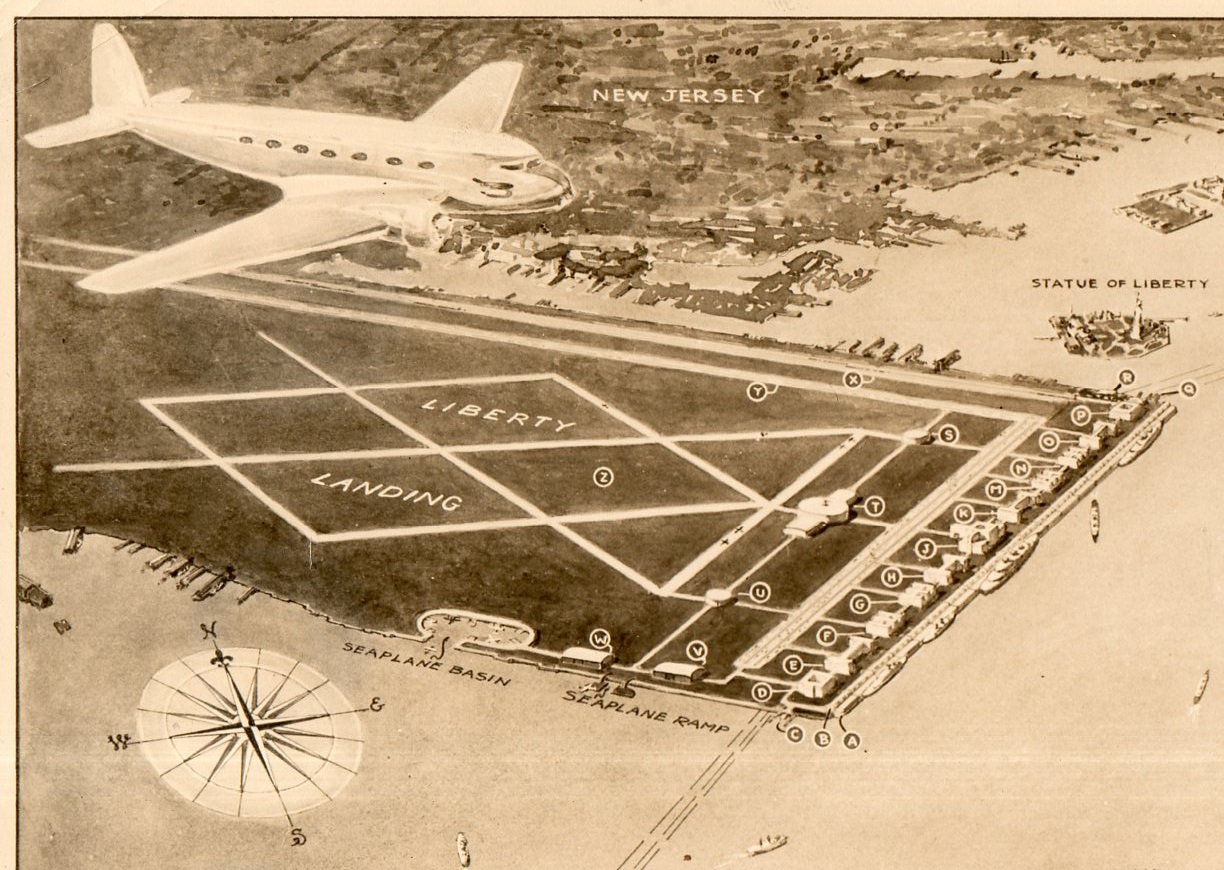
  • Filling Up the Harbor: NYC, 1935

    Liberty Landing, by Charles E. Palliser (architect) and Frederick W. Capon (Designer and Delineator), Jackson Heights, NYC, September 16, 1935. Offset printed from typed originals. 13×8.5″, 5 leaves, with one original photograph (4×11″). With original wrappers (detached).  Provenance: Library of Congress, with their surplus/duplicate stamp on title page.  Good condition. $750

  • Poincare’s Great 1905 Paper

    POINCARE, Henri. “Sur le dynamique de l’electron”, in Comptes Rendus, Paris,  1905, volume 140, pp 1504-1508, offered in the entire bound volume for the half year.  Bound in bloards and  leather spine, the spine cover nearly detached.  A good copy.  $650  (English translation found here, though it is the version that appeared in the Rendiconti del Circolo matematico di Palermo 21: 129–176.)

    “HENRI POINCARE’S major work on a theory of the electron is “Sur la dynamique de l’electron”.  It is considered, by some, as evidence that POINCARE, more than anyone else in the late 19th and early 20th centuries, anticipated EINSTEIN’S 1905 theory of relativity.

    “This study will focus on POINCARE’S attempt in “Sur la dynamique…” to formulate a purely electromagnetic theory of a deformable electron that is consonant with his conception of the principle of relativity. POlNCAIRE believed that if all physical processes could be reduced ultimately to the interaction of charged particles which move about in LORENTZ’S all-pervasive ether, then such a theory would be an important step toward a unified description of nature. Thus, the laws of the various branches of physics, and in particular NEWTON’S second law, could be derived from those of electromagnetism. This scientific viewpoint (or Weltbild) will hereafter be referred to as the “electromagnetic world-picture. ”…–From the introduction of Arthur Miller’s fine study of this paper in Archive for History of Exact Sciences, Vol. 10, No. 3/4/5 (18.IX.1973), pp. 207-328, “A Study of Henri Poincaré’s “Sur la Dynamique de l’Électron”.”

    It has always seemed strange to me that Poincare never followed up on this paper, nor did he seem interested in Einstein’s great work of 1905; nor did Einstein show much interest in Poincare’s work on this topic (or nearly any other), and was otherwise indisposed when he was approached to write an appreciation of Poincare upon is death six years later. 

    ·Posted by :

    ·in:

  • Breakthrough Papers in Color Photography (1891-1906), Gabriel Lippmann (Nobel for this work in 1908)

    LIPPMANN, Gabriel. A suite of papers on breakthrough research establishing color photograpy, 1891-1906, all published in the Comptes Rendus Hebdomadaires des Séances de l’Académie des Sciences.

    Lippmann was awarded the Nobel Prize in physics for this accomplishment (“”for his method of reproducing colours photographically based on the phenomenon of interference”) in 1908 (the only Nobel awarded for work in photography).

    • (1) “La photographie des couleurs” in Comptes Rendus , Vol. 112, No. 5, February 2, 1891, pp. 274-275;
    • (2)”Sur  la photographie des couleurs [deuxième note]” in CR Vol. 114, No. 17, April 25, 1892, pp. 961-962;
    • (3) “Photographies colorées du spectre sur albumine et sur gélatine bichromatées” in CR Vol. 115, No. 17 October 24, 1892, p. 575;
    • (4) “Sur la theorie de la photographie des couleurs simples et composees par la methode interferentielle” in CR Vol. 118, No. 3, January 15, 1894, pp. 92-102
    • (5)“De divers principes sur lesquels on peut fonder la photographie direct des couleurs…” in CR Vol 130, 1900, pp 278 (this being a very brief one-paragraph note);
    • (6) “Remarques generales sur la photographie interferentielles des coulleurs”, in CR Vol 143, No. 5, July 30 1906, pp 273-4.

    Of the 80+ papers Lippmann published in the CR for the 1885-1910 period this is the extent of his publications there on color photography, save for one short note that appears in volume 140–unfortunately that one is the very next article in the issue bearing the famous Poincare “relativity” paper of 1905.

    All six are offered in their complete weekly issues, all extracted from larger bound volumes of the CR. The issues from volumes 112, 115, and 143 are offered with their original wrappers. GOOD copies.  $950

    “Gabriel Lippmann, professor of mathematical physics at the Sorbonne invented, demonstrated and mathematically formulated the process of interference colour photography, also known as interferential photography, or Lippmann photography, in the years 1891-1894…Few photographers today are familiar with the name Gabriel Lippmann (1845-1921), even fewer have seen a Lippmann colour photograph. Lippmann was awarded the 1908 Nobel Prize in Physics for his invention of Interference Photography, an early colour technique exploiting the phenomenon of optical standing waves. Lippmann’s prize represents the only time this prestigious award has been given for a photographic invention “–”Lippmann Colour Photography”, Dr. Hans I. Bjelkhagen, alternativephotography.com

    “In 1891, Professor Gabriel Lippmann demonstrated to the French Académie des Sciences interference colour photographs of the spectrum and of stained glass windows, taken by a modification of Wiener’s method. An exceedingly fine grained, virtually transparent emulsion of silver bromide in an albumen coating on a glass plate was exposed in contact with a film of mercury, with the glass plate towards the lens. The mercury, in optical contact with the emulsion, reflected light which had passed through the emulsion back on itself, producing the standing waves and layered exposure predicted by Zenker. The developed plate appeared to be a conventional negative by transmitted light, but when viewed at a suitable angle, by reflected light the image appeared as a brilliantly coloured positive.”–(Coe, Brian (1978): Colour Photography – The first hundred years 1840-1940.

    “One of our most distinguished physicists, M. Gabriel Lippmann, Member of the Institute and Professor in the Faculty of Sciences, has accomplished a memorable experiment in photographing the solar spectrum. At the meeting of the Academy of Sciences M. Lippmann presented to his, colleagues several photographs, of the solar spectrum, with the colors fixed upon the sensitized plate with their exact sheadings and brilliancy… The way so brilliantly opened by M. Lippmann must lead to important work, and the first results of the discoverer, which we are happy to be able to present here, assure a brilliant future to the art of photography in color. “-­ Photography in Colors. In: The American Journal of Photography, 12, pp. 180-183, translated from La Nature, February 14, 1891, which appeared 12 days after the CR printing.

    Earlier work in this area was carried out by Seebeck (1810), Herschel (1839), Ed. Becquerel (1848) and others though “…the process was never of practical value”…”In 1891 G. Lippmann of Paris succeeded in carrying through these suggestions with an albumen emulsion of exceedingly fine grains.”–  Evans, Ralph Merrill; Hanson, W.T., Jr.; Brewer, W. Lyle (1953): Principles of Color Photography. New York: Wiley, pp. 275-278.
    ·Posted by :

    ·in:

    —
  • When Cottages Have (a Suite) of Maids’ Quarters (1937)

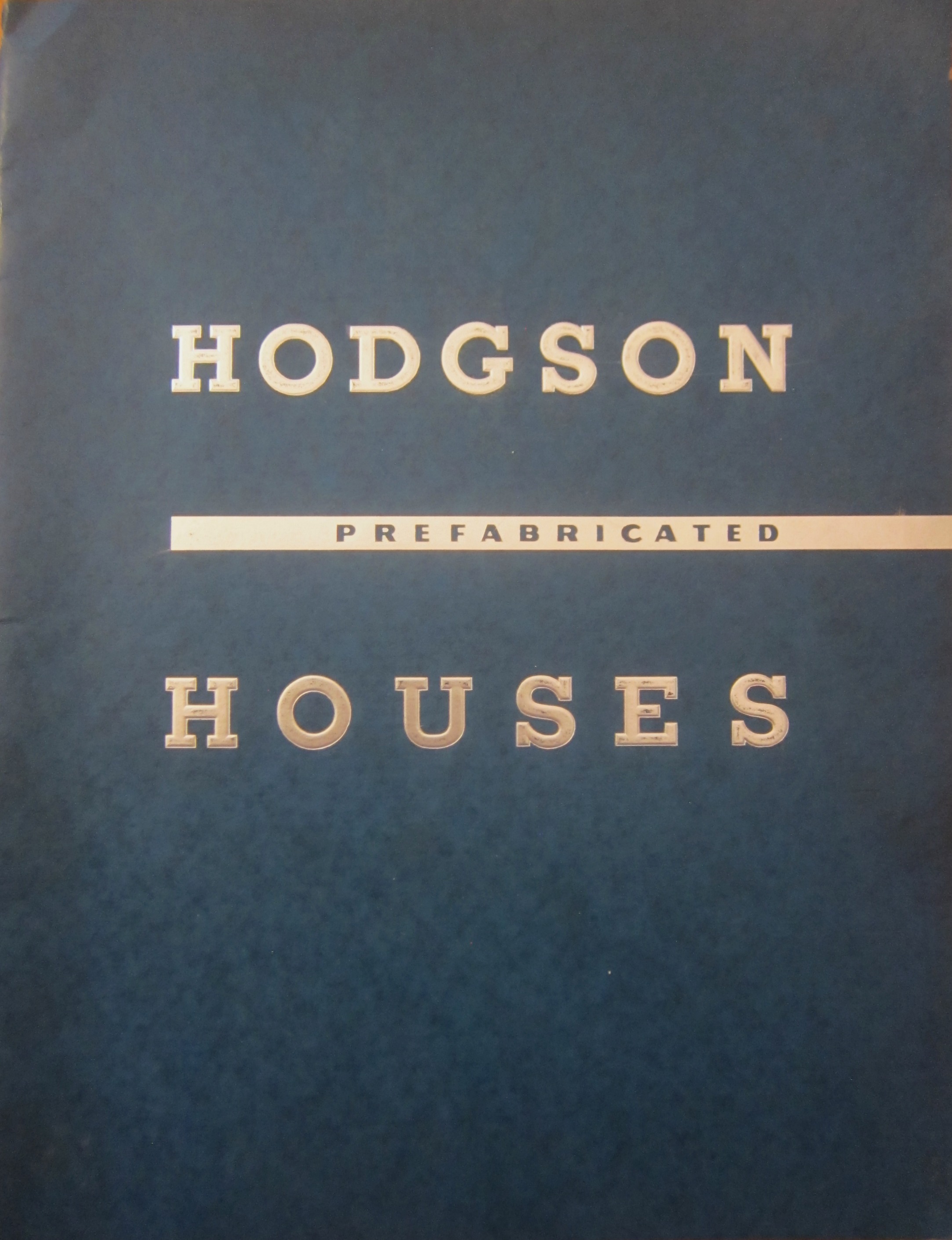
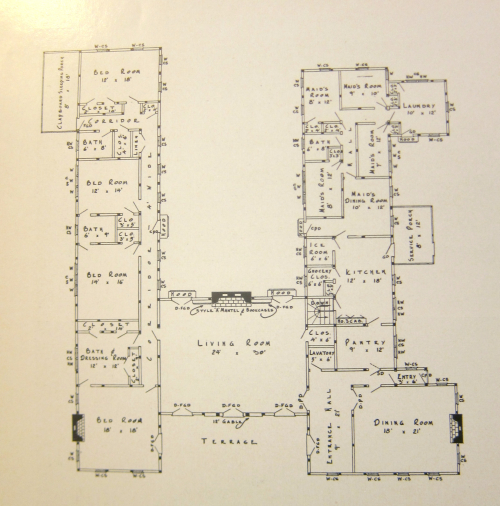
    Architecture Hodgson _1_Hodgson Prefabricated Houses. E.F. Hodgson & Company, 1937. 12×9.5”, 48pp. Illustrated throughout with photos and plans. Fine copy. Published with a heavy wrapper with an embossed title, and printed on a glossy heavy paper. $135

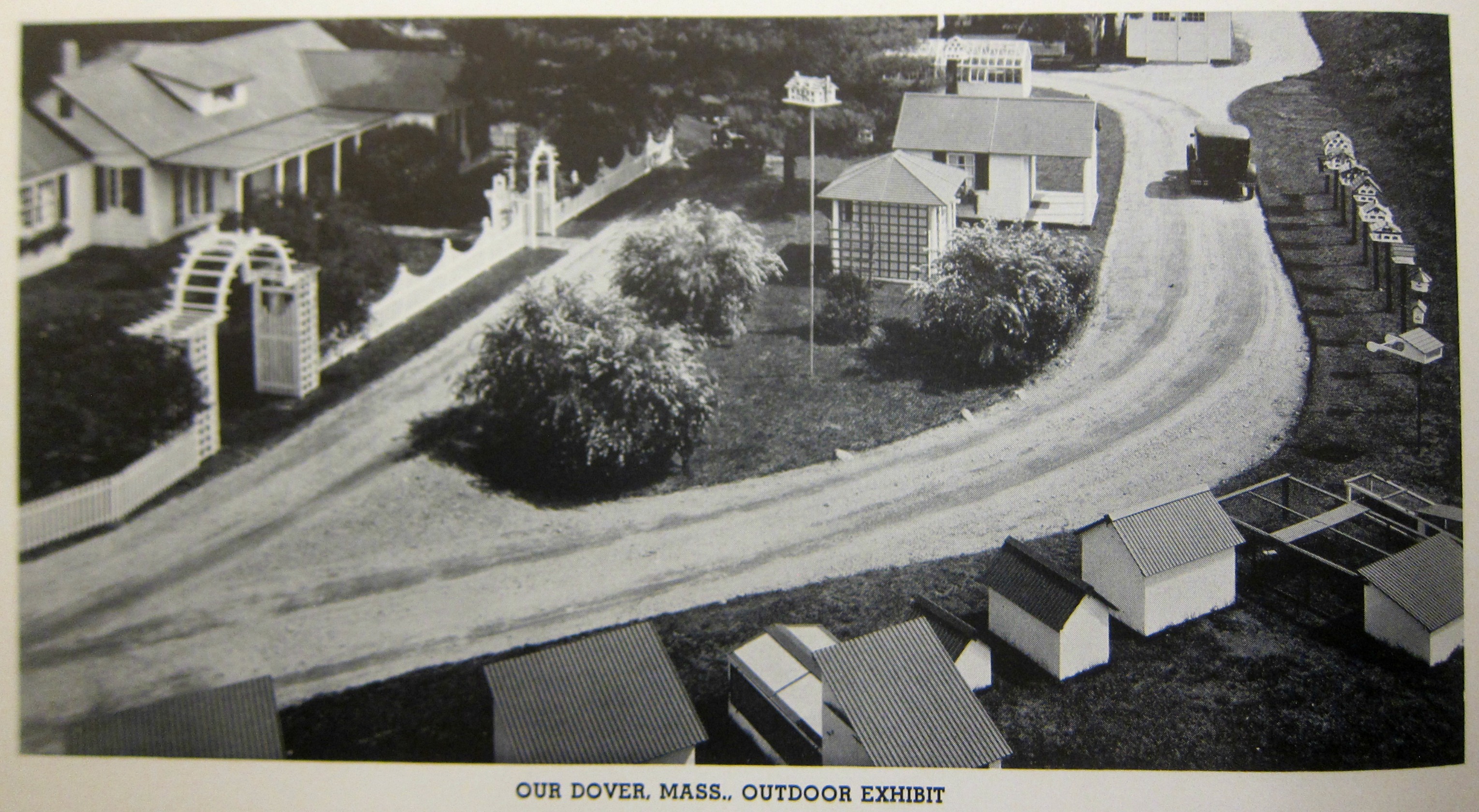
    These are “prefabricated” structures in a sense that we wouldn’t much identify today—these are impressive structures. Some are labeled as “cottages” some of which are, again,not what we’d call a “cottage” unless were referred to them in an independently wealthy way…at least I wouldn’t call anything a “cottage” that was designed with multiple bedrooms for maids. So these may have been a cottage for someone with a Substantial Home in Greenwich or if they were Mrs. Bucket looking for a getaway place in a tiny suite in a grand home in the countryside. That said, there are some bona fide “small houses” (or “camp houses”) offered for sale by Hodgson in addition to garages (along with garages with chauffeur’s quarters), workshops, doghouses, tonic stands, schools, “play and guest houses”, and other related bits. There are also a few pages devoted to doors, floors, and fittings.

    Architecture Hodgson _7_.jpg  outdoor exhibit

    Architecture Hodgson _7_.jpg  outdoor exhibit


    ·Posted by :

    ·in:

  • “The Light that Never Fails”


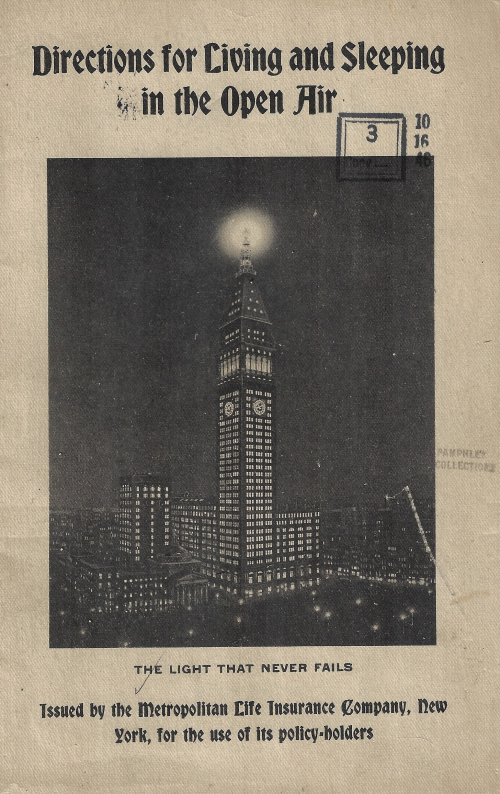
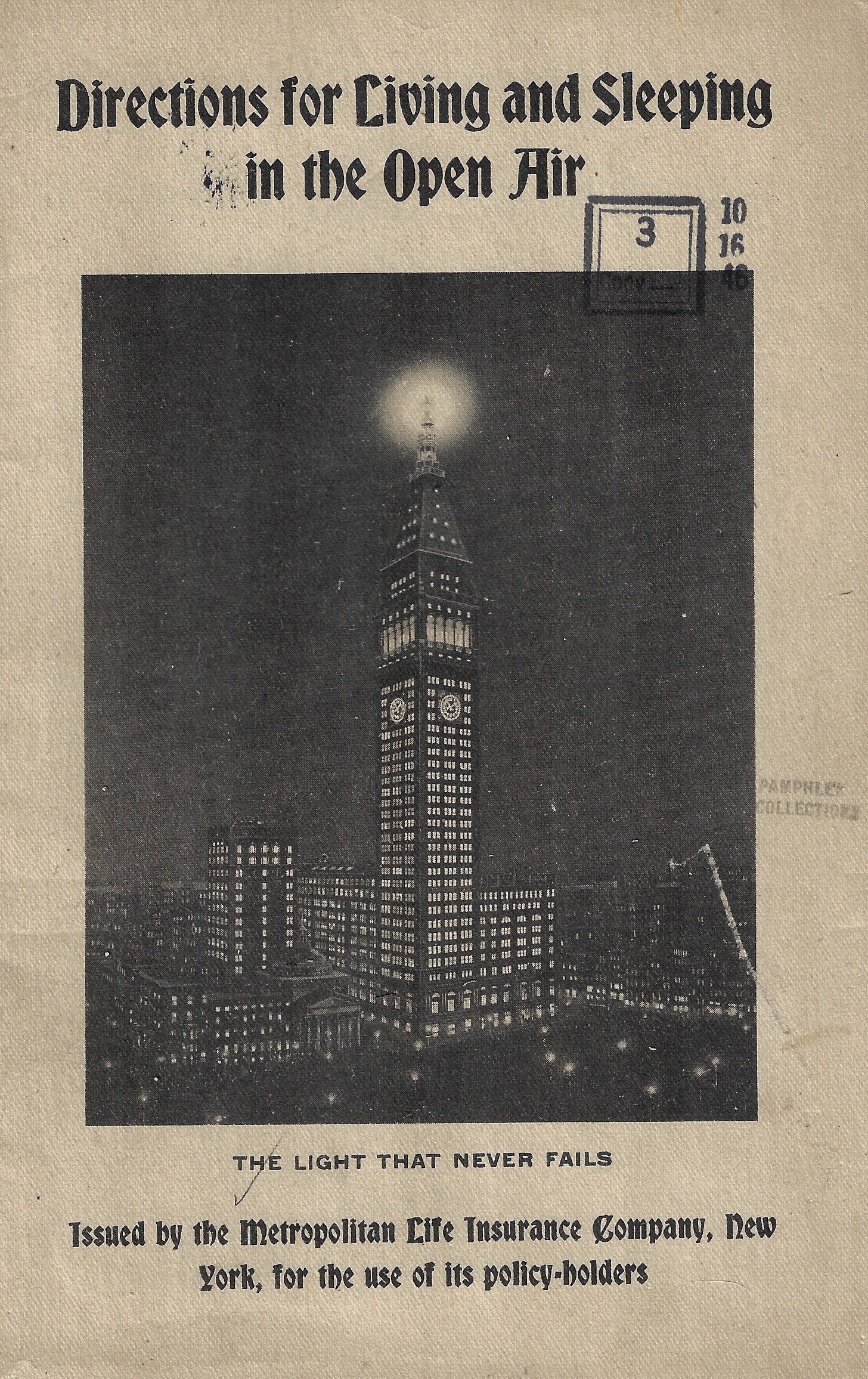
    Thomas Spees Carrington, Directions for Living and Sleeping in the Open Air. Metropolitan Life Insurance Co., 1913 9×6″, 24pp., many photos.  Original wrappers.  Nice copy of a sweet little pamphlet about the benefits of sleeping outside, from the Metropolitan Life Insurance Company.  $75

    “The light that never fails”, a slogan used by the company for decades and one that we see on the front cover of the pamphlet, was an actual light at the top of the tower, and was “one of a few broadly visible features of the New York City nighttime skyline until the mid-20th century”.  

    “The Metropolitan Life Insurance Company Tower, colloquially known as the Met Life Tower, is a landmark skyscraper, built in 1909 and located on Madison Avenue near the intersection with East 23rd Street, across from Madison Square Park in Manhattan, New York City. Designed by the architectural firm of Napoleon LeBrun & Sons and built by the Hedden Construction Company, the tower is modeled after the Campanile in Venice, Italy. The tower was a later addition to the original 11-story, full-block Metropolitan Life Home Office building (the “East Wing”), which was completed in 1893 and was also designed by Napoleon LeBrun & Sons. Plans for the tower were first announced in June, 1905.  In 1953-57, the original Home Office building was replaced with the current building, designed by D. Everett Waid. Then, between 1960 and 1964, the Tower itself was modernized by Lloyd Morgan and Eugene V. Meroni.”

    “The building figured prominently in the Metropolitan Life Insurance Company’s advertising for many years, illustrated with a light beaming from the top of its spire and the slogan, “The Light That Never Fails.” The reference was to a beacon at the top of the tower which flashed once at the quarter hour and the time of day at the hour. The beacon was one of a few broadly visible features of the New York City nighttime skyline until the mid-20th century.”–Wikipedia

    Books covers metropolitan life

    ·Posted by :

    ·in:

    —
  • One of the Earliest Reviews on the State of Quantum Theory, 1929-1930

    KEMBLE, Edwin C. “General Principles of Quantum Mechanics, Part I.”  In: the Physical Review Supplement, Studies in Contemporary Physics, October 1929, volume 1 #2, pp 157-215 in the issue of pp 157-240.

    With: Kemble:  “General Principles of Quantum Mechanics, Part II”, in Reviews of Modern Physics, January 1930, volume 2 #1, pp 1-58 in the issue of pp 1-122. 

    Both in the their original printed wrappers.  Very good condition. There is some sort of 1/4″ plastic adhesive (?) on the front hinge of both issues…I’m not sure if these actually re-enforce the pamphlet, or not, but they don’t seem to make much of an impact appearance-wise.  $150, the pair.

    It is interesting to see these early issues of the Reviews of Modern Physics–especially the vol 1/2 issue under the Physical Review Supplement, which would soon changes its name to the RMP.  Kemble evidently did a service to the physics community with these well-received papers, coming at a time when there were not many writing in this area . (H. Krage points out in Quantum Generations  p. 171) that of the 284 papers published in that year (from among the 2400 members and fellows of the APS) that only 45 of them concerned themselves with quantum theory.)  Abraham Pais states in Subtle is the Lord that the Kemble paper is the first reviewing the state of quantum mechanics at the end of the decade…and at first blush, this seems to be not the case as a review of the subject, though that feeling (for me) is quickly disassociated. (There are some interesting references int eh footnotes, including some that are unexpected to me, at least, like a Bridgman paper cited from Harper’s Magazine from March 1929.  In any event if you’re not familiar with this paper it is available online and is at least worth a peek for the footnotes.) 

    ·Posted by :

    ·in:

    —
  • The First Appearance of the “Compton Effect” 1923–Important, “Turning Point in Physics”, and Nobel Prize Effort

    Arthur H. Compton, “A Quantum Theory of the Scattering of X-Rays by Light Elements” in Physical Review, volume 21, May 1923, pp. 483-502. Offered in the full bound volume, iv, 736pp. 

    • The great paper is preceded in print by a ca. 175-word abstract of the paper given by Compton at the Chicago meeting of the American Physical Society, December 1 and 2, 1922, in the February issue, pg 207. 

    Bound in a very sturdy green cloth. Provenance: US Geological Survey, with their bookplate. There is a Library of Congress surplus stamp on the front free end paper.  This copy was evidently not or little-used, as it is nice and fresh and in great condition.    $1750

    On Compton and his “Compton Effect” 

    “Compton’s achievement in 1923 was not merely in describing the effect, but also in explaining it in the context of quantum theory. Although Compton was well acquainted with quantum theory, it was only after he read a paper by Albert Einstein (1879–1955) on the linear momentum of photons that he saw a way to demonstrate it using X-rays. A photon, according to quantum theory, was the basic unit (or quantum) of electromagnetic radiation. If an X-ray photon carried linear momentum as well as energy, Compton could treat the interaction in terms of momentum and its conservation, as an X-ray photon collides with an electron in the target substance. Assuming the conservation of energy (a fundamental principle of physics), Compton had to account for all of the energy after impact. He showed that the collision resulted in a new photon of less energy (and thus greater wavelength) being scattered after contact, while the target electron took on some of the energy as well. The total energy was conserved. The shift in wavelength depended on the mass of the electron and the angle of scattering. This work was crucial in establishing experimental evidence for conceiving of electromagnetic radiation (such as light and X-rays) as composed of quanta, with both energy and directed momentum.”

    “The Compton effect was important not only for its description of photon scattering, but also for its ramifications for understanding electrons. In the interaction just described, the electron was at rest. After a collision, however, the electron recoiled. Compton calculated the wavelength of the electron in motion after striking a photon, and the result became known as the Compton wavelength. Compton’s results, which support the notion that radiation behaves as both wave and particle, precipitated a flurry of fundamental work in quantum physics in the 1920s. The quantum mechanics that emerged at the end of the decade can be viewed in part as the theoretical explanation of the experimental evidence found in Compton’s laboratory. Even Werner Heisenberg’s (1901–1976)uncertainty principle, asserting the impossibility of locating the electron with accuracy, can trace its origins to the problems of electron recoil described by Compton in 1923.”

    “Compton’s 1927 Nobel Prize, shared with C. T. R. Wilson (1869–1959), demonstrated the international recognition of his work and cemented his leading position in the U.S. community of physicists. He turned his research from X-rays to cosmic rays, for which he led expeditions throughout the world to measure their intensity. This work ended abruptly during World War II, when Compton entered the project to build the atomic bomb.”–Science in the Early 20th Century, by Jacob Jamblin (an interesting encyclopedia I haven’t used before…”early” meaning 1900-1950). 

    See also:

    Compton, Arthur Holly. Atomic Quest: A Personal Narrative. New York: Oxford University Press, 1956

    Shankland, Robert S. “Compton, Arthur Holly.” In Gillispie, Charles Coulston, ed., Complete Dictionary of Scientific Biography, vol. III. New York: Charles Scribner’s Sons, 1971, 366–372.

    Stuewer, Roger. The Compton Effect: Turning Point in Physics. New York: Science History Publications, 1975

    ·Posted by :

    ·in:

    —

Recent Posts

Archives

Categories