Birds with Stone Wings: Athanasius Kircher, 1678
ITEM: Original engraving from Athanaseus Kircher Mundus Subterreaneus....1678. 14×10″. Very good condition. $150.
ref: JF Ptak Science Books Post 1347
The great semi-mystifying polymath Athanasius Kircher (1602-1680) lived for a long time and filled his life with ideas and words, producing dozens of books during his time on Earth, some of which were never published even though written, some manuscripts lost forever. His was a massive output of extraordinary breadth. He wasted little time what I can see, writing on a spectacular range of subjects, enlightening people, confusing people, generating great theories and some bad ideas.
The images below comes from his Mundus Subterraenus (“Athanasii Kircheri Mundus subterraneus in XII libros digestus… “), published in 1678, and which was concerned mainly with geology and the theory of the Earth. Kircher a product of the great Jesuit institution, the Collegio Romano, postulated the structure of the interior of the Earth, the origin of heat, the source of the tides, the composition of light, mechanics, the structure of music, linguistics, astronomy, and of course the existence of the Virgin Mary in amber. There was also a fair amount of work on one of his side interests that populated a number of his works, alchemy and the search for the organization of materials.
But what I am looking at today with Kircher is the Mary-in-Amber part, his investigations (and theorizing, and documentation) on naturally-appearing, organic objects found in inorganic material–rocks and minerals–like these birds:
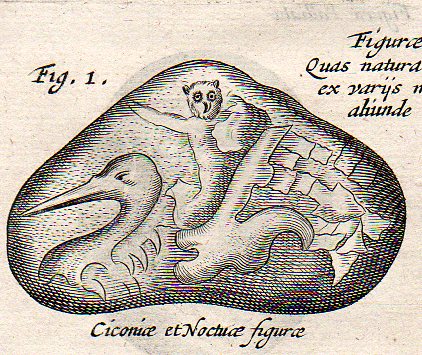
Which is a detail from
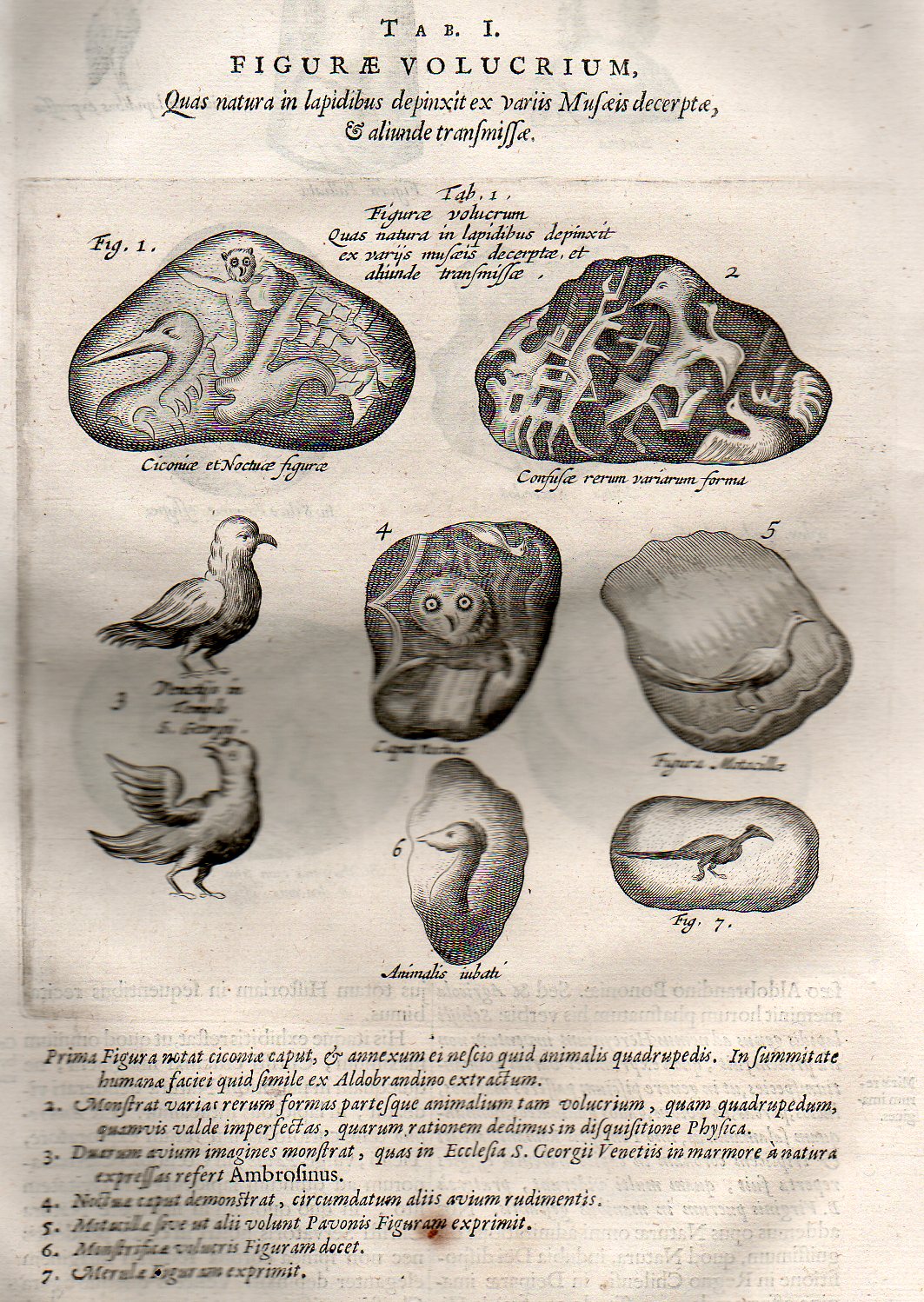
The engraving, entitled Figure Volucrum, quas Natura in lapidibus depinxit, ex variis Museia decerpt et aliunde transmissa (or “Figures of winged creatures, painted by nature on stones, taken from various museums, and otherwise transmitted.”) shows Kircher’s collection of anthropomorphically based inorganic items. It is a remarkable exercise to try and place yourself within the context of the scientific world of Kircher’s time, 350 years ago, and try to explain these naturally-occurring phenomena, without even the benefits of the conception of long geologic time, or of expanded time in general.
The descriptive text (at the bottom of the engraving) from Kircher on these objects is translated, as follows:
1. The first figure represents a head of a Stork, together with some, but I do not know what, quadruped. At the top is something like a human face. Extracted from Aldobrandinot (see PI. XXIII. Fig. 1).
2. Shows various forms and parts of animals, winged creatures as well as quadrupeds, although very imperfect, the cause of which we give in the physical examinations (see PI. XXIII. Fig. 2).
3. Represents the figures of two birds expressed by nature on marble in the church of St. George’s, at Venice, referred to by Ambrosinua (see Vol. VII. PI. II. Figs. 3, 4).
4. Shows the head of an Owl, surrounded by rudiments of other birds (see PI. XXIV. Fig. 2).
5. Represents the figure of a Wagtail, or as others prefer, of a Peacock (PI. XXIV. Fig. 3).
6. Shows the figure of a monstrous bird (Vol. VII. PI. II. Fig. 4).
7. The figure of a Merle (Vol. VII. PI. II. Fig. 5).