A Daily History of Holes, Dots, Lines, Science, History, Math, Physics, Art, the Unintentional Absurd, Architecture, Maps, Data Visualization, Blank and Missing Things, and so on. |1.6 million words, 7500 images, 4.9 million hits| Press & appearances in The Times, Le Figaro, Mensa, The Economist, The Guardian, Discovery News, Slate, Le Monde, Sci American Blogs, Le Pont, and many other places… 5000+ total posts since 2008.

  • Economics in the Edinburgh Review, 1802-1810

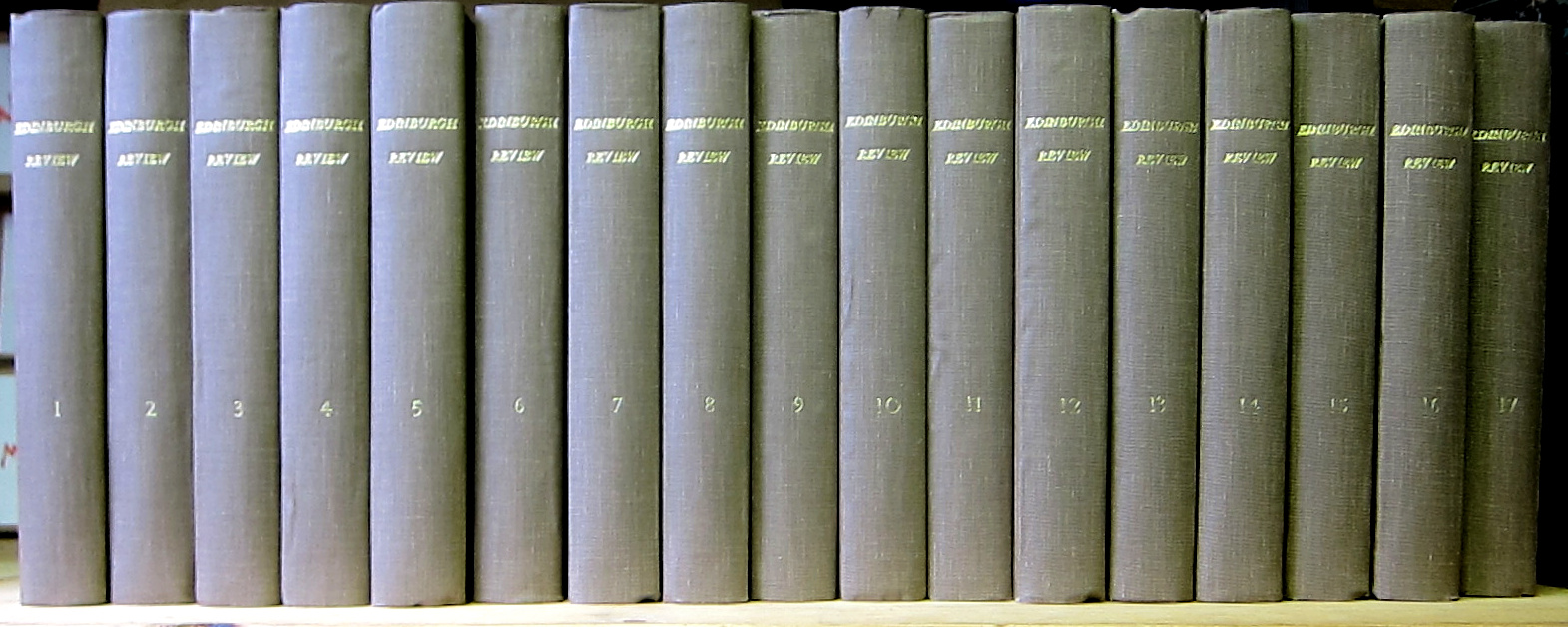
    Edinburgh review set _2_

    47 papers in 17 volumes, plus many dozens of other papers in varied areas. Contains contributions by Malthus (4), Brougham (21), Horner (8), Jeffrey (3), Napier (2), Ellis (1), Allen (4), Alex. Hamilton (1), Buchanan (1), James Mill (1), Mackintosh (1). The Edinburgh Review was “the closest thing Great Britain had to an economic journal” (Fetter, “The Authorship of Economic Articles in the Edinburgh Review, 1802-47”, in the Journal of Political Economy, 1953).

    8.5”x 5.25”, vols 1-17. All bound in the same nice cloth. Text has some browning and foxing; bindings nearly as-new. It seems unlikely, but all of these are Second through 11th editions, published between 1812 to 1821; the originals being 1802-1811.

    (Note: all of this information regarding authorship–including the use of teh parenthetic “possibly” and “probably” is taken from the terrific piece of research by Fetter, noted above.)

    October, 1802

    • “Irvine’s Emigration from the Highlands”, Francis Horner
    • “The Utility of Country Banks”, Horner;
    • “Thornton on the Paper Credit”, Horner;
    • “Crisis of the Sugar Colonies”, by Henry Brougham;

    January, 1803

    • “Canard’s Principes d’economie politique”, by Horner;

    April, 1803

    • “Guineas an Unnecessary and Expensive”, by Brougham;
    • “Incumbrance on Commerce, Sir John Sinclair’s Essays”, by Francis Jeffrey;

    July, 1803

    • “Lord King’s Thoughts on the Restriction Payments in Specie at the Banks of England and Ireland” , Horner;

    October, 1803

    • “Wheatley’s Remarks on Currency and Commerce”, by Brougham;

    ·Posted by :

    ·in:

  • Iron Lighthouses, Aluminum, Engineering and Farm Implements, Non-photographic Photographs, and more (1856)

    Journal of the Franklin Institute, Philadelphia, Vol 31 (third series), volume 61 (overall), January-June 1856, 443 pp.,with text illustrations, and three plates, including one folding.. Half-calf, with raised bands. Ex-library, with some scuffing on the spine; also a few stamps on the title page. Nice copy. $225 Contains many articles of interest, including an early report on industrialized aluminum, “nature printing”, the McCormack reaper patent case, lighthouses, the Suez Canal, and a lot more, including:

    “Aluminum, the So-Called New Metal”, pp 27-31 and “History and Properties of Aluminium”, pp 65-7. I’d like to point out that I rarely see the hyphenated word “so-called” in the JFI. That said, aluminum had been around for 100+ years at this point, and then first truly described by Wohler, though it wasn’t until the period of this vol of the JFI that aluminum was produced in such a way as to be industrially useful.

    Henry Bradbury, “On Nature Printing”, pp 37-39. This was a style of printing in which a sample was impressed on a sheet of soft lead and then electroplated and use as a printing block, the result being some very defined imagery. Bradbury perfects a style of this printing and found it very useful even in the early age of mass-produced photo images. 

    “The Canal through the Isthmus of Suez”, pp 150-155, with a lovely litho view of the canal;

    G. Herbert, “On the Construction of Buoys, Beacons, and other stationary floating bodies”, pp79-84;

    J. Vaughan Merrick, “On the History and Construction of Iron Lighthouses, with a description of Coffin’s Patches Light”, pp 145-150, with a lovely lithographic plate.

    George Simmons, “Method of Calculating Excavation and Embankment”, pp 1-4;

    Edward Allen, “Mechanical Engineering as applied to Farm Implements”, pp 41-45, 138-142 (with text illustrations), 186-190, 258-260, 334-338, 397-406 (to be concluded in the next volume)

    C.H. McCormick vs. J.H. Manny, “Law Reports of Patent Cases: the Reaper Case”, pp 176-186;

    David Stevenson, “Remarks on Floating and Fixed Lighthouses”, pp 221-227; John W. Nystrom, “Experiments on Sound for the Application of Ringing Bells”, pp 260-266; R.D. Thomson, “On the Condition of the Atmosphere during Cholera”, pp 202-204.

    Also:

    Erastus W. Smith, “United States Steam Mailer Fulton”, pp 339-340, with a beautiful folding plate of the ship.


  • EDINBURGH REVIEW—a continuing series of posts of volumes for sale in this series.

    The Edinburgh Reivew was a sort of TLS and NYTBR for its day, with very long and penetrating articles reviewing books and reports on a very wide range of topics.

    • Available so far: 1825, 1826, 1828, 1831, 1833, 1835 (many more to come).
    • For 1802-1810, see the very last entry.

    1825/6

    The Edinburgh Review and Critical Journal, November 1825 to February 1826. Published in Edinburgh, printed by Ballantyne & Co., 1826. 9’x6 , (2), 519pp. Recently rebound in modern linen, with new endpapers. Very crisp. Very Good copy. $125

    Three good papers in economics/political economy:

    “A Discourse on the Rise, Progress, Peculiar Objects, and Importance of Political Economy: Containing an Outline of a Course of Lectures on the Principles and Doctrines of that Science” by J. R. M’Culloch, Esq.,[book review] pp 1-23; “Reports and Evidence upon the State of Ireland. Ordered to be printed by the House of Lords and the House of Commons, Sessions 1824 1825”; and “Thoughts on the Education of the Irish Poor”, by J. O’Driscoll.

    Also:

    “England enslaved by her own Slave Colonies. An Address to the Electors and People of the United Kingdom”, by James Stephen, Esq., long review of a 91pp paper published in the same year, 1826, pp 406-422. Stephen (1758-1832) was the principal English lawyer associated with the abolitionist movement (Wiki), writer, and great-grandfather of Virginia Woolf.  “Thoughts on Popular Education”; “Considerations on the Game-Laws”, by Edward Lord Suffield; “Considerations on the Expediency of the Law of Entail in Scotland”, by Patrick Irvine, Esq.; “Reports and Evidence on the State of Ireland, ordered to be printed by the House of Lords and the House of Commons. Session 1825”; “A Treatise on the Law of Landlord and Tenant in Ireland”, by John Finlay, Esq.

    1828: Exploration, Police Reports, and Alehouses

    Edinburgh Review, or Critical Journal for June 1826…September 1826, Edinburgh, printed by the Heirs of D Williams, 1826; iv, 526pp, volume 44, 8.25×5.5”. Rebound in modern cloth. Very tidy, in FINE condition. $75  For example, for this volume we have:

    Several reviews of early attempts at reaching the North Pole:

    “Narrative of a Second Expedition to the Shores of the Polar Sea, in the years 1825, 1826, and 1827”, by John Franklin, Captain; “Narrative of an Attempt to reach the North Pole, in 1827”, by William Edward Parry, Captain R.N. F.R.S. “Remarks on the Probability of Reaching the North Pole; being an Examination of the Recent Expedition under Captain Parry”, by the Rev. William Scoresby, F.R.S. Pp 423-451.

    “(A Letter to the Lord Lieutenant of the County of Surrey…”) with the more interesting dropped title “Licensing of Alehouses” “The immense importance of a pint of ale to a common person should never be overlooked…”

    Major Denham, “Narrative of Travels and Discoveries in Northern and Central Africa, in the Years 1822, 1823, and 1824. June 1826, pp 173-219.

    George Combe, “A System of Phrenology”, September 1826 253-318;

    “Massacre of St. Bartholomew”, June 1826, pp 95-155;

    Also in the volume:

    “History of the Life and Voyages of Christopher Columbus”, by Washington Irving, pp 1-32;

    “The History of Painting in Italy, from the Period of the Revival of the Fine Arts, to the end of the 18th
    Century”, translated from the original Italian of the Abate Luigi Lanzi., by Thomas Roscoe.

    ”Proceedings of the Expedition to explore the Northern Coast of Africa, from Tripoly eastward, in 1821-22; comprehending an Account of the Greater Syrtis and Cyrenaica, and of the ancient cities composing the Pentapolis”, by Captain F. W. Beechey. “The Life of Robert Burns”, y J. G. Lockhart,, . Pp267-312. “Narrative of a Journey through the Upper Provinces of India, from Calcutta to Bombay, 1824, 1825, (with Notes upon Ceylon;) an Account of a Journey to Madras and the Southern Provinces, 1826; and Letters written in India. By the late Right Reverend Reginald Hebe”. “A View of the present State and future Prospects of the Free Trade and Colonization of India; 312-348.

    And some very interesting pre-Sherlockian London crime reporting: “Report from the Select Committee on the Police of the Metropolis, ordered, by the House of Commons…” pp 411-423.
    ·Posted by :

    ·in:

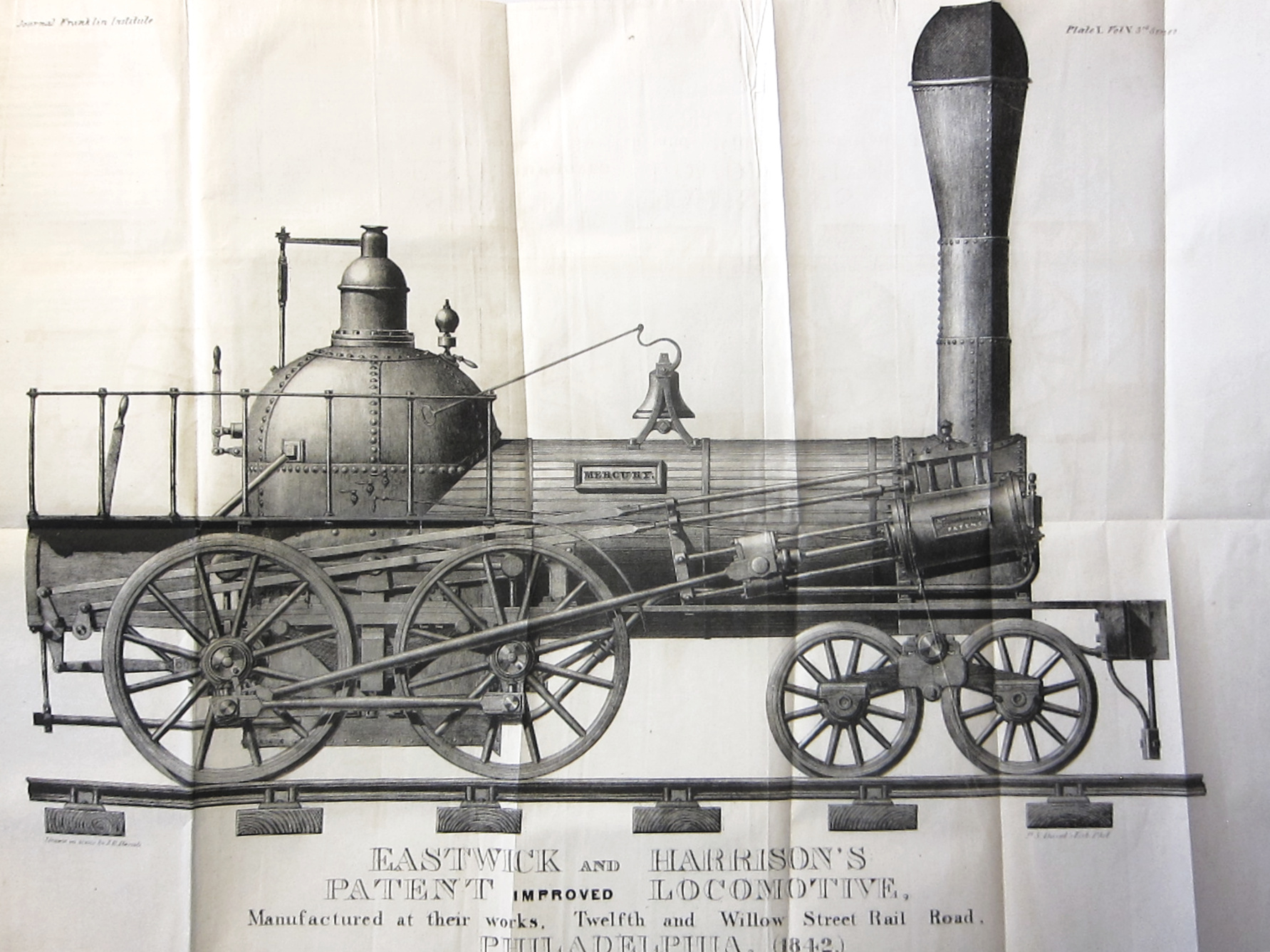
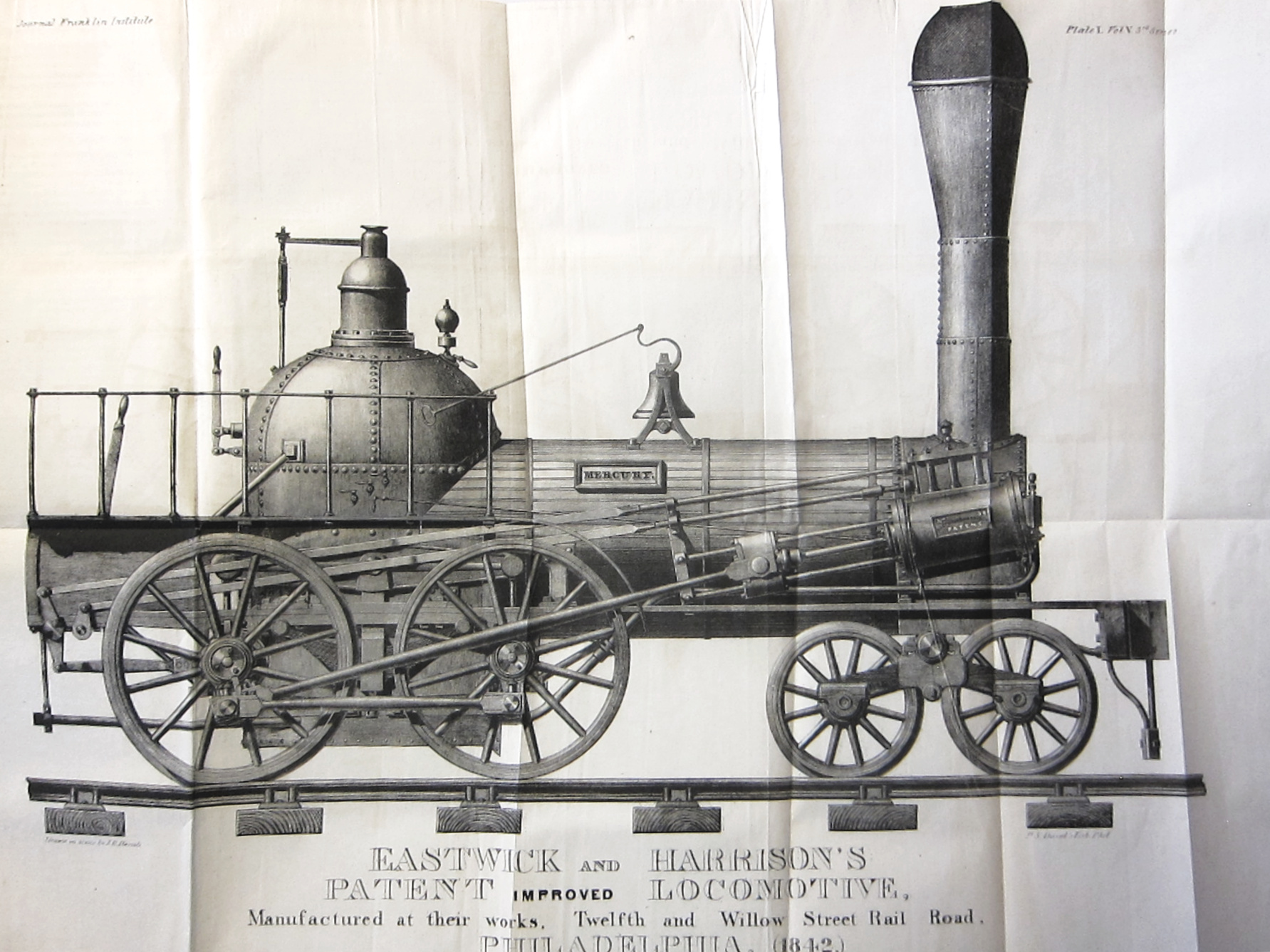
  • A Gorgeous Lithograph of a U.S. Locomotive (1843)

    Journal of the Franklin Institute, Philadelphia, Vol 5 (third series) vol 35 overall, January-June 1843, with text illustrations. 430, 8 pp., and one folding plate. Half-calf, with raised bands. Ex-library, with some scuffing on the spine and leather cover tips nearly obscuring the gilt-stamped title; front joint sprung, though binding still tight; also a few stamps on the title page. In Solid GOOD condition.

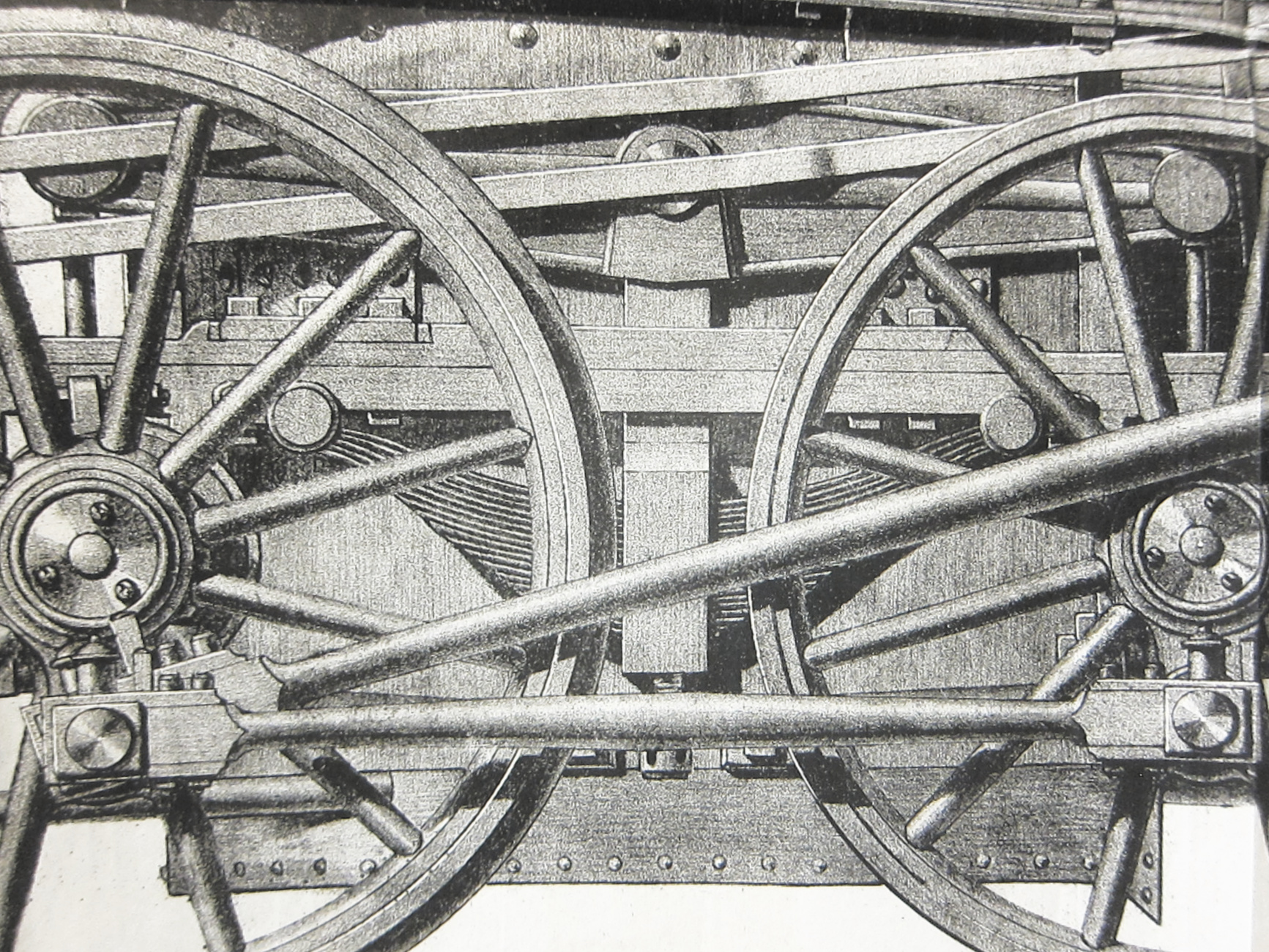
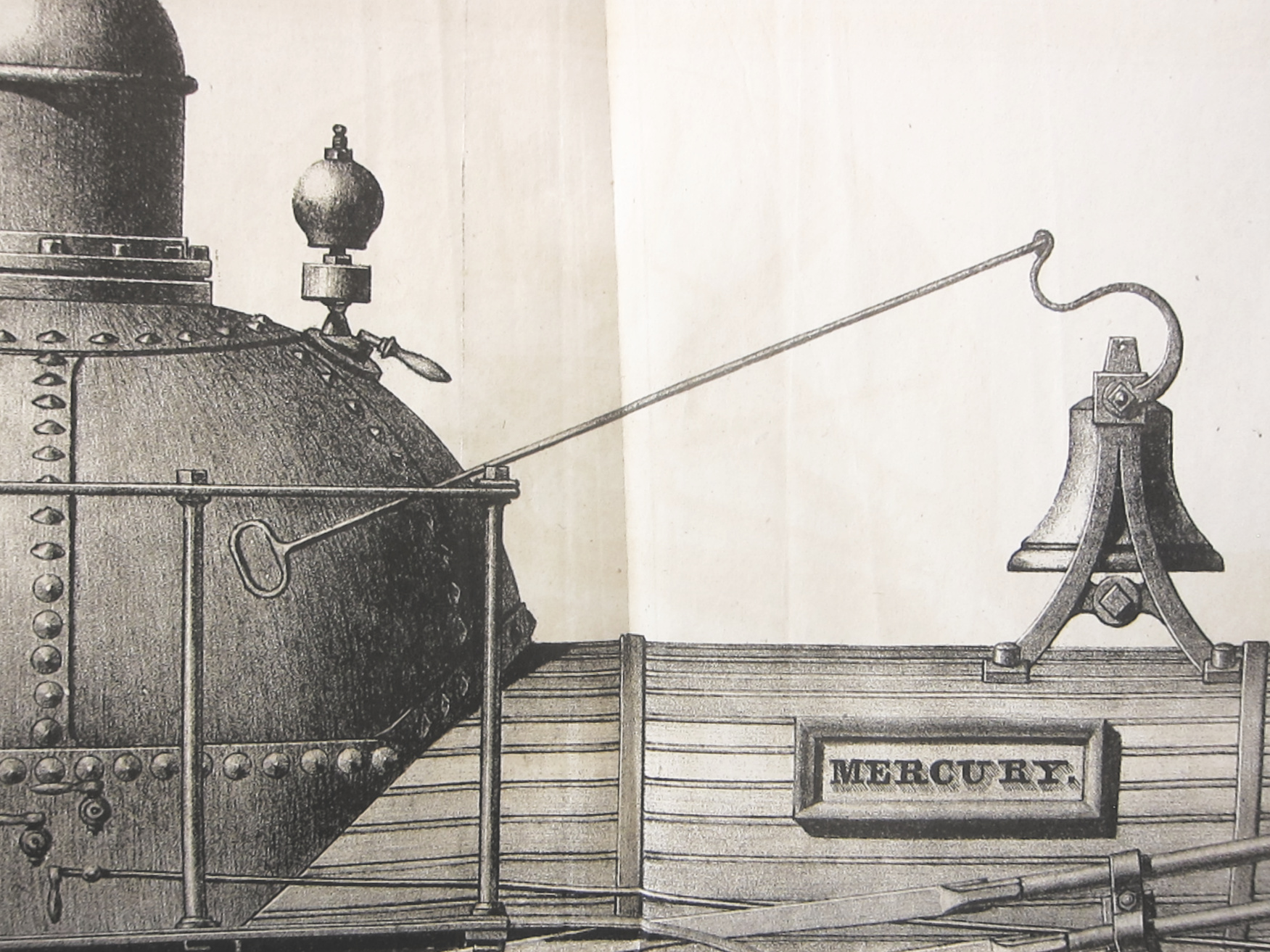
    The great attraction in this volume is the gorgeous lithograph of a steam railway locomotive illustrating “Letter from Charles Moering…to Messrs. Eastwick and Harrison, Locomotive Builders…Philadelphia”, pp 15-19. The illustration is 20”x 15” (folded), and titled “Eastwick & Harrison Patent Improved Locomotive”, lithographed by Duval of Philadelphia, drawn by J.R. Hoessli, and printed 1842. The name of the locomotive is “Mercury”. It is just a lovely things, nearly without blemish, with no tears along any folds.

    Poncelet, “Memoir upon the Stability of Revetments…” translated by John Sanders, long article pp. 1-11, 73-79, 217-225, 289-295, 361-371, and concluded in the next volume (available elsewhere via this store). Also an article on a modern steam shovel (with illustration), painting frescoes, plus articles on various railways, roofing for a diorama, concrete, batteries, astronomical clocks, preserving timber, and much else.

    The image is a little off-color in the left upper panel, though in reality there is no discoloration…I just couldn’t get the shadow problem tackled. 

    Locomotive 1843 detail _2_


    Locomotive 1843 detail _2_
    Locomotive 1843 detail _2_


    (Click to expand.)

    ·Posted by :

    ·in:

  • Raman and Krishnan on the Nobel Prize Work on the Raman Effect (1928)

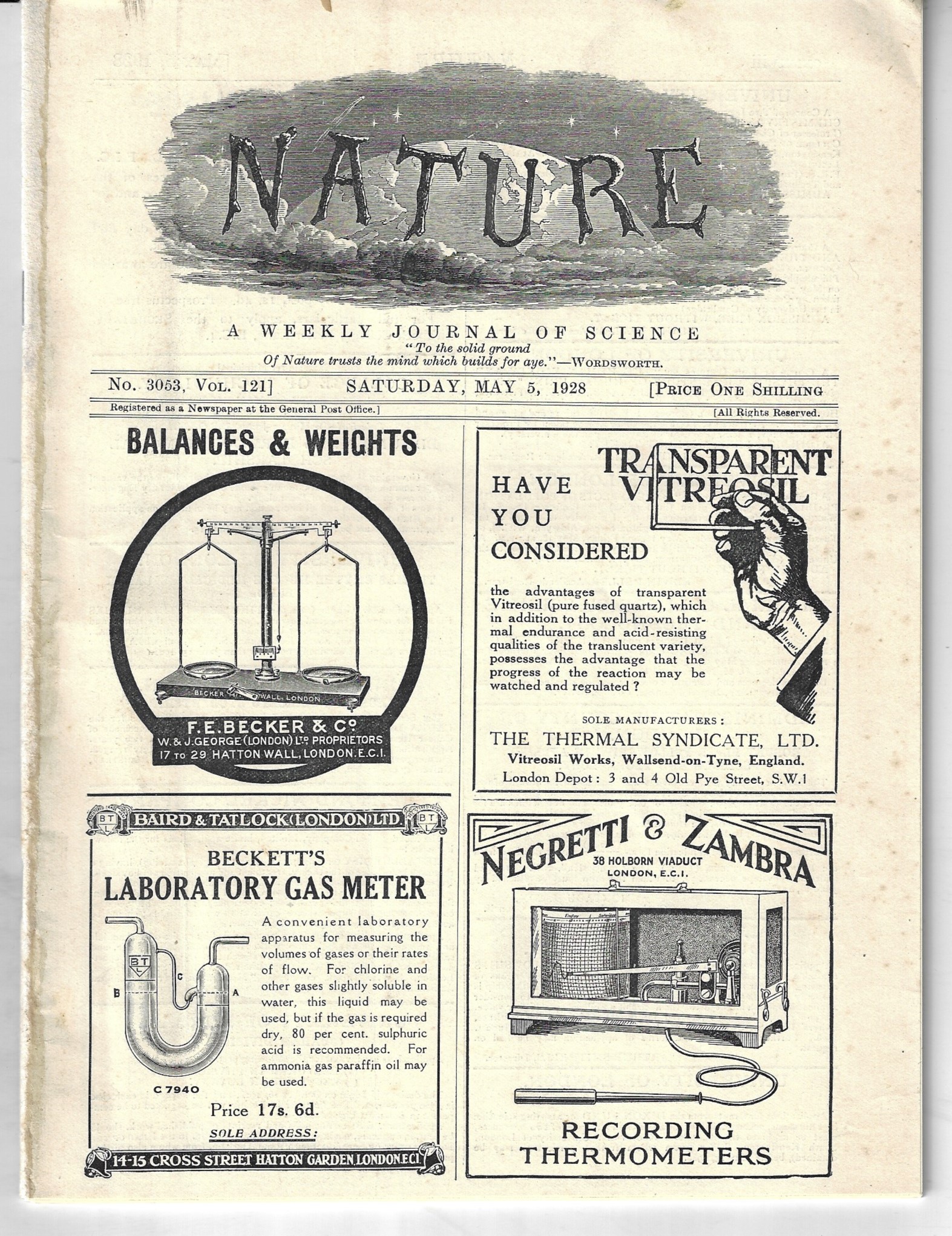
    Nature 1928 RamanC.V. Raman and K.S. Krishnan, “The Optical Properties of the Compton Effect”, in Nature, vol 121, No. 3053, May 5, 1928, the weekly issue, pp 697-736. Original wrappers, with a very fine and nearly invisible repair is made to the spine.   $200  

    In this paper Raman (1886-1970) and Krishnan return to their earlier paper of February (pg 501, “A New Type of Secondary Radiation” of Nature in which the effect which bears Ramsn’s name appears and for which Raman would be awarded the Nobel in 1930 (“for his work on the scattering of light and for the discovery of the effect named after him.”–Nobel Prize organization). “Raman and K. S. Krishnan then undertook to isolate the effect under impeccable experimental conditions. They employed complementary light filters placed in the paths of the incident and scattered light, respectively, and observed a “new type of secondary radiation” from the scattering of focused beams of sunlight in both carefully purified liquid and dust-free air. They reported this discovery in a letter to Nature in February 1928. Raman then refined the experiment by using a mercury arc as the source of light; the effect was thus clearly seen for the first time on 28 February 1928 and was reported to the Science Congress at Bangalore the following month. The secondary radiation showed several lines shifted toward longer wavelengths, the shifts being characteristic of the substances being examined, and indicated the absorption of energy by the scattering molecule—the precise effect that had been predicted by A. Smekal in 1923. G. Landsberg and L. Mandelshtam, in the U.S.S.R., independently observed the same phenomenon in quartz, shortly after Raman and Krishnan”–DSB

    ·Posted by :

    ·in:

  • Contemporary Review of Darwin’s “Descent of Man” April 1871

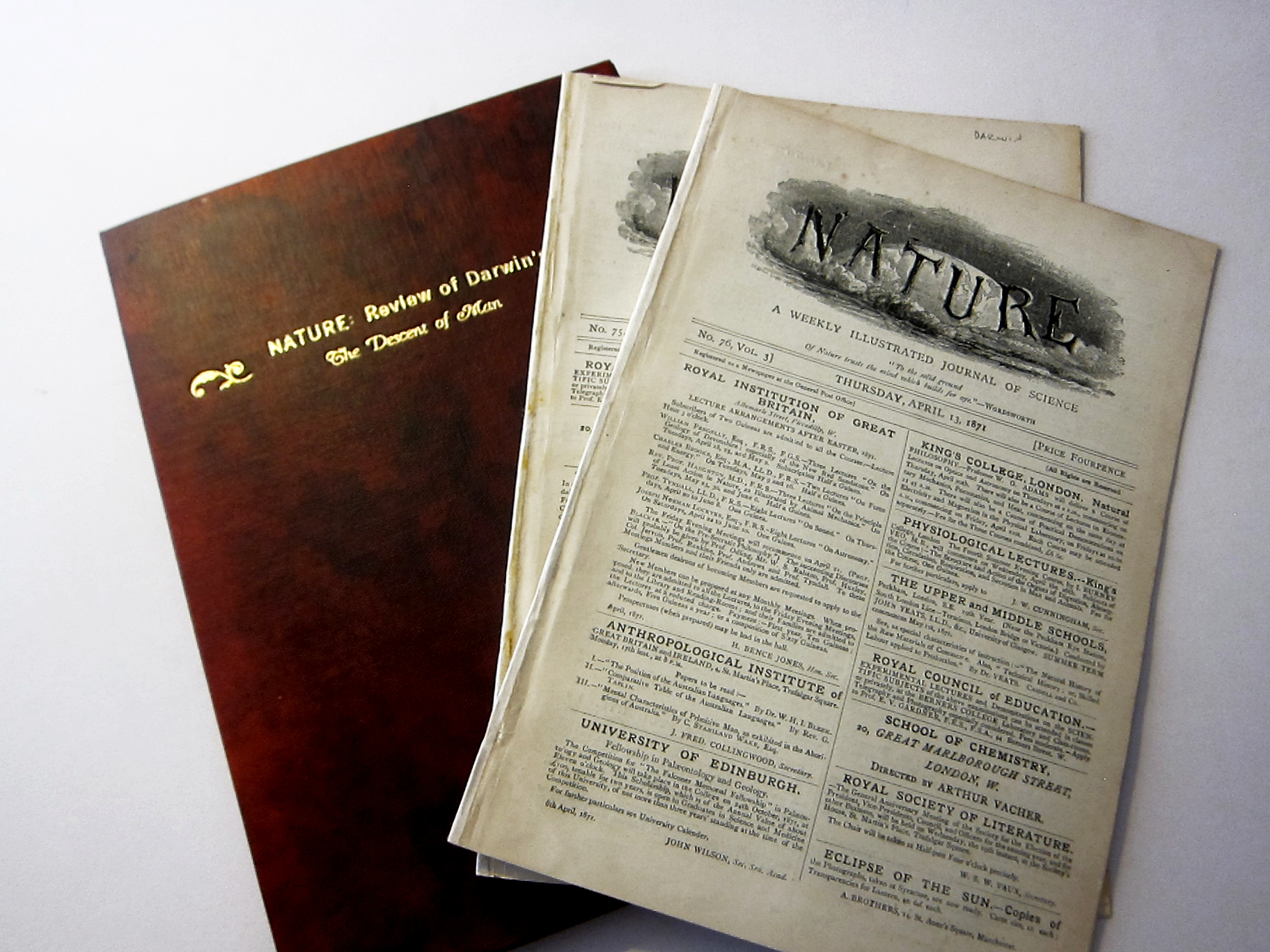
    [DARWIN, Charles]. Pye-Smith, P.H. A review of  The Descent of Man, and Selection in relation to Sex in two issues of Nature, a Weekly Illustrated Journal of Science. Two issues: vol. 3 #75, April 6, 1871, pp 441-460 and vol 3 #76, April 13, 1871, pp 461-480 in the weekly issue.  Both very nice copies with expertly repaired (with minimal invasion and maximum blendedness) spines. Offered in their original wrappers. Housed in a new and fine folding (and gilt-embossed gas).  $250 

    Charles Darwin’s  great classic The Descent of Man, and Selection in relation to Sex was published by John Murray (in two volumes) on 24 February 1871, and Prof /Dr Philip Henry  Pye-Smith (1839-1914) was quickly on board to review it six weeks after publication for Nature magazine in two issues for April 6 and the following issue for April 13, 1871.  pp 442-4 and pp 463-5, respectively. It is noted in the Darwin Online site that Darwin’s use of the word “evolution” first appears in the first page of the first volume of this work (note following) and Pye-Smith’s very favorable and highly complimentary review uses the word (“Evolution”) in the first paragraph, and is so far as I can tell the second appearance of the word in the great journal Nature (of 45,000 more that would follow over the years). His review of the Darwin work is among the earliest, as is his own use of the word “evolution”. (“Darwin wrote, in the preface to the second edition, of ‘the fiery ordeal through which this book has passed’. He had avoided the logical outcome of the general theory of evolution, bringing man into the scheme, for twelve years, and in fact it had, by that time, been so much accepted that the clamour of the opposition was not strident. He had also been preceded in 1863 by Huxley’s Man’s place in nature. The book, in its first edition, contains two parts, the descent of man itself, and selection in relation to sex. The word ‘evolution’ occurs, for the first time in any of Darwin’s works, on page 2 of the first volume of the first edition, that is to say before its appearance in the sixth edition of The origin of species in the following year.”) 

    Darwin descent review

    ·Posted by :

    ·in:

  • Histoire de l’ Academie Royale des Sciences, 1728

    Histoire de l’ Academie Royale des Sciences. Annee M. DCCXXVIII Avec le memoires de mathematique & de physique, pour la meme annee. Tires des registres de cette academie. Printed in Amsterdam by Pierre Moerier, 1732. volumes 1 and 2, complete. The two volume work is 6.5”x3.5” and is in two sections with three working title pages: Histoire de l’Academie Royale des Sciences… (164pp) followed by Memoires de Mathematique et de Physique tirez des registres de l’Academie Royale des Sciences…(197pp and 5 folding plates) in volume 1; volume II is Suite des Memoires de Mathematique et de Phyqiue tirez des registres de l’Academie Royale des Sciences (pp 201-605 and 17 folding plates).

    Very Good condition—lovely copies, really. $500/two volumes.

    Many interesting articles, reprinted here in 1732, and including such contributions as:

    “Sur le Mouvement de Saturne”, pp 94-100;

    “Sur la Foce des Corps des mouvement”, pp 100-134;

    C.E.L. Camus, “Du Mouvement Accelere par des Ressorts et des Forces qui resident dans les Corps en Mouvement”, pp 230-283 (A significant paper, especially influential to Lagrange—see Isaac Todhunter, “A History of the Theory of Elasticity and of the Strength of Materials”.)

    Jean-Jacques d’Ortous de Mairan (1678 – 1771, French geophysicist, astronomer and most notably, chronobiologist), “Dissertation sur l’Estimation et la mesure des forces motrices des corps”, pp 17-81.

    Giovanni Cassini (d. 1712, first observation of the moons of Saturn), “Du Mouvement de Saturne”, pp 95-124;

    Jean-Jacques Dortous de Mairan (1678-1771,”was a mathematician and an enthusiastic experimenter whose major works were on the formation of ice and on the aurora borealis. However, he was also interested in all the important topics addressed the scientific community in the eighteenth century, among them, the shape of Earth, light, colors, sound, the composition of matter, and vis viva (the debate around the force of moving bodies and the conservation of matter).”–DSB . “Eclaireissement sur le Memoire de la Cause generale du Froid en Hiver at de la Chaleur en Ete, pp 10-23.

    René Antoine Ferchault de Réaumur  (1683-1757, French entomologist and writer who contributed to many different fields, especially the study of insects), “Histoire des Teignes, ou des Insects qui Ronguet les Laines et les Pelleteries”, premiere part, pp 201-282 and parte seconde pp 439-476.

    Abbe de Molieres, “Loix Genrales du Mouvement dans le Tourbillon Spherique”, pp 349-380;

    Petit, “Observation sur la Rupture Incomplette du Tendon d’Achille”, pp 331-380;

    Geoffroy le Cadet. “Suite d’ Observations fur les Huiles ejfentielles , leur altération & la manière de reâifer celles de certains fruits , avec un examen  des changemens i]ui arrivent à l’Huile d’Anis.”M. 

    De Maupertuis, “Sur toutes les Développées qu’mie Courbe peut avoir à l’Infini”;

    Du Hamel, “Recherches sur les causes de la multiplication des Especes de Fruits”, 477-499;

    Du Fay, “ “Observations sur qualques Experiences de l’Aimant”, pp 500-520;

    Pitot, “Remarque sur les Rapports des surfaces des grands et des petits corps”, pp 521-530

    Bourdelin, “Memoire sur la Formation des sels Lixiviels”, pp 541-567;

    ·Posted by :

    ·in:

    — —
  • A Very Early U.S. Printing of the Calotype Process (1842)–the Introduction of the Paper Negative Process

    Journal of the Franklin Institute, Philadelphia, Vol 3 (third series) vol 33 overall, January-June 1842, with text illustrations, folding charts, one engraved plate. 430 pp. Half-calf, with raised bands. Ex-library, with some scuffing on the spine and leather cover tips; front joint sprung though binding still tight; also a few stamps on the title page. The front board unfortunately is almost entirely detached, held on by two tie at top and bottom joint. In solid GOOD condition. $1500

    (Talbot, H.F.) “Calotype.” This is a  very early printing in the U.S. of the new process, introducing the major improvement of the paper negative. This printing seems to be done in the same year or is slightly earlier than what is possible the first Calotypes made in the United States (between 1842-4), according to G. Smith in “The First American Calotypes?” in History of Photography, vol 6/4, 1982. “Calotype, also called talbotype, early photographic technique invented by William Henry Fox Talboto f Great Britain in the 1830s. In this technique, a sheet of paper coated with silver chloride was exposed to light in a camera obscura; those areas hit by light became dark in tone, yielding a negative image. The revolutionary aspect of the process lay in Talbot’s discovery of a chemical (gallic acid) that could be used to “develop” the image on the paper—i.e., accelerate the silver chloride’s chemical reaction to the light it had been exposed to. The developing process permitted much shorter exposure times in the camera, down from one hour to one minute. The developed image on the paper was fixed with sodium hyposulfite. The “negative,” as Talbot called it, could yield any number of positive images by simple contact printing upon another piece of sensitized paper. Talbot’s process was superior in this respect to the daguerreotype, which yielded a single positive image on metal that could not be duplicated. Talbot patented his process in 1841.”—-Ency Britannica

    Some of the other articles of interest:

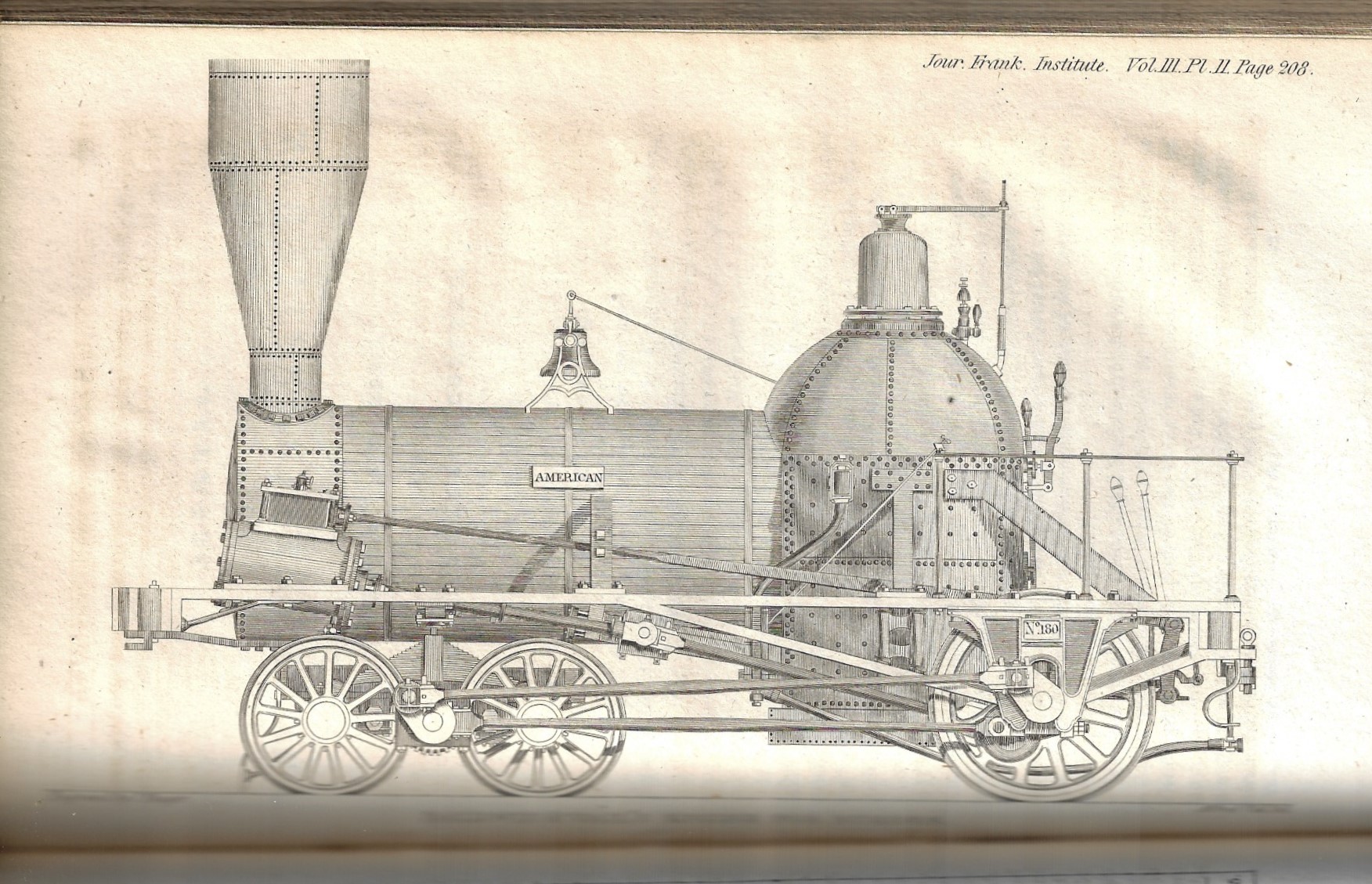
    “Baldwin’s Geared Truck Locomotive Engine”, pp 208-209 (with a lovely full page elevation of the Baldwin machine).

    Louis Daguerre, “New Photographic Discoveries”, translated from the French by Prod. F. Frazer (a half-page article on pg 109.

    Ellwood Morris, “On the Force of the Wind and Sea…”pp10-21;

    John Herapath, “Facts and Observations on Four and Six-Wheel Engines”, pp 244-249; W.A. Provis, “Effect of Wind on the Menai Suspension Bridge”, pp 210-214;

    T.R. Robinson, “History of the Reflecting Telescope”, pp392-398

    JFI 1842 Baldwin

    ·Posted by :

    ·in:

    —
  • Embroidery by Machinery, Hughes’ Typewriting Telegraph, Submarine Cables, and more (1859)

    Journal of the Franklin Institute, Philadelphia, Vol 38 (third series), July-December 1859, with text illustrations, and one (movable) plate, 430 pp. Half-calf, with raised bands. Ex-library, with some scuffing on the spine; also a few stamps on the title page. Nice copy. $150 The volume has many dozens of articles, including the following:

    “Supply of Coal”, an interesting approximation of the life of the coal supply, though the common denominator is badly defined. Anyway, the writer was thinking about the future supply of coal, reckoning it at 36,000 years.

    Alfred Varley, “On the Physical Theory of Electricity in Submarine Telegraphy, the Electrical Difficulties in Long Circuits…” (on submarine cable communications), pp 52-61, 132-138, 199-206, 259-267;

    J.P. Espy, “Joule’s Unit Verified”, pp 254-6;

    James H. Warner, “Mechanical Expansion Table”, pp 4-5, with a plate exhibiting the table with a 6” long moving indicator affixed by string, in good working order. (This seems to be the only movable table in the whole of the journal.)

    “Fog Signals by Sounds”, pp 61-2;

    H. Hyde, “On Professor Hughes’ System of Type-printing Telegraphs and methods of Insulation, with Special Reference to Submarine Cables”, pp 44-51, with a text illustration of the instrument; continued on pp 125-131 (concluded).

    George Wallace, “On Embroidery by Machinery”, pp 181-188 (3 text illustrations), 273-277, 337-340 (concluded).


  • One of the First Journal Appearances of the Successful Demonstration of the Morse Telegraph and Very Possibly the First Appearance of the “Dots” of the Morse Code (February 1838)

    JF Ptak Science Books 

    Morse dots _2_

    “Report on Prof. Morse’s Electro-Magnetic Telegraph“,  in Journal of the Franklin Institute, pp 106-108, Philadelphia, 1838; volume 21 (new series) and volume 25 overall, with text illustrations and one folding plate, 442 pp.  Half-calf, with raised bands. Ex-library, with some scuffing on the spine and with the ghost remnants of a call number label at spine bottom; also a few stamps on the title page. As a whole the book is fresh and tight. Good/Very Good condition. $750

    This may well be the one of the two earliest journal appearances of the successful demonstration of the Morse/Vail electromagnetic recording telegraph (it was not the first demonstration of an electric telegraph nor an electromagnetic telegraph, priority of which belong to Gauss and Wheatstone and others), and is perhaps the very first appearance of the “dot” part of what would become known as the Morse Code.

    This was a significant report. As it turns out Morse makes the first public demonstration of his and Alfred Vail’s recording electromagnetic telegraph on January 6 1838 at Speedwell Ironworks near Morristown, New Jersey, just weeks before this JFI appearance.  On this success, Morse went south to Philadelphia and demonstrated his invention to the Franklin Institute on February 8, 1838 (summarized in the present report), appearing two weeks later on February 21 1838 midway between Phila and home in Washington D.C., demonstrating the apparatus to President Van Buren and members of the Congressional Committee on Commerce.

    This may well be the one of the two earliest journal appearances of the successful demonstration of the Morse/Vail electromagnetic recording telegraph, and is perhaps the very first appearance of the “dot” end of the Morse Code.

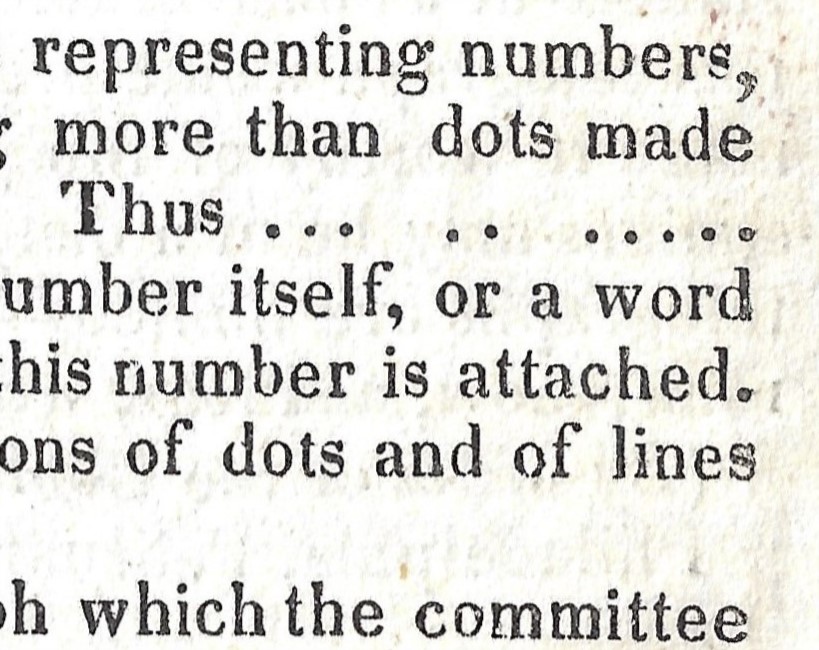
    The narrative identifies two systems of signals (“…one representing numbers, the other letters”) that were displayed in the demonstration. The first “representing numbers” were a series of dots. This is perhaps the first publication in a journal of the dot method of transcribed signals of a recording electromagnetic telegraph. The dots are pictured “…   ..   …..” on page 107, representing the number “325” or as explained could also mean the word represented by the number “325” in Morse’s code book (“indicate…a word in a dictionary, prepared for this purpose…”). The second, “alphabetical signals are made up by a combination of dots and lines of different lengths”), an example of which is not shown. 

    I have only been able top locate a symbolic system of the code in published journal reports (and a newspaper article) showing a “V” system, as in the American Journal of Science and the Arts (vol 33 #1, 1838), which prints an image of the register, and shows a “specimen of telegraphic writing” using this “V”: so, “V   VV   VVV” governed by spaces of long and short intervals,  would stand for 1,2,3 or 123, or to some word designated “123” in a code book. (I should point out that this article is about half the length of the JFI article.) 

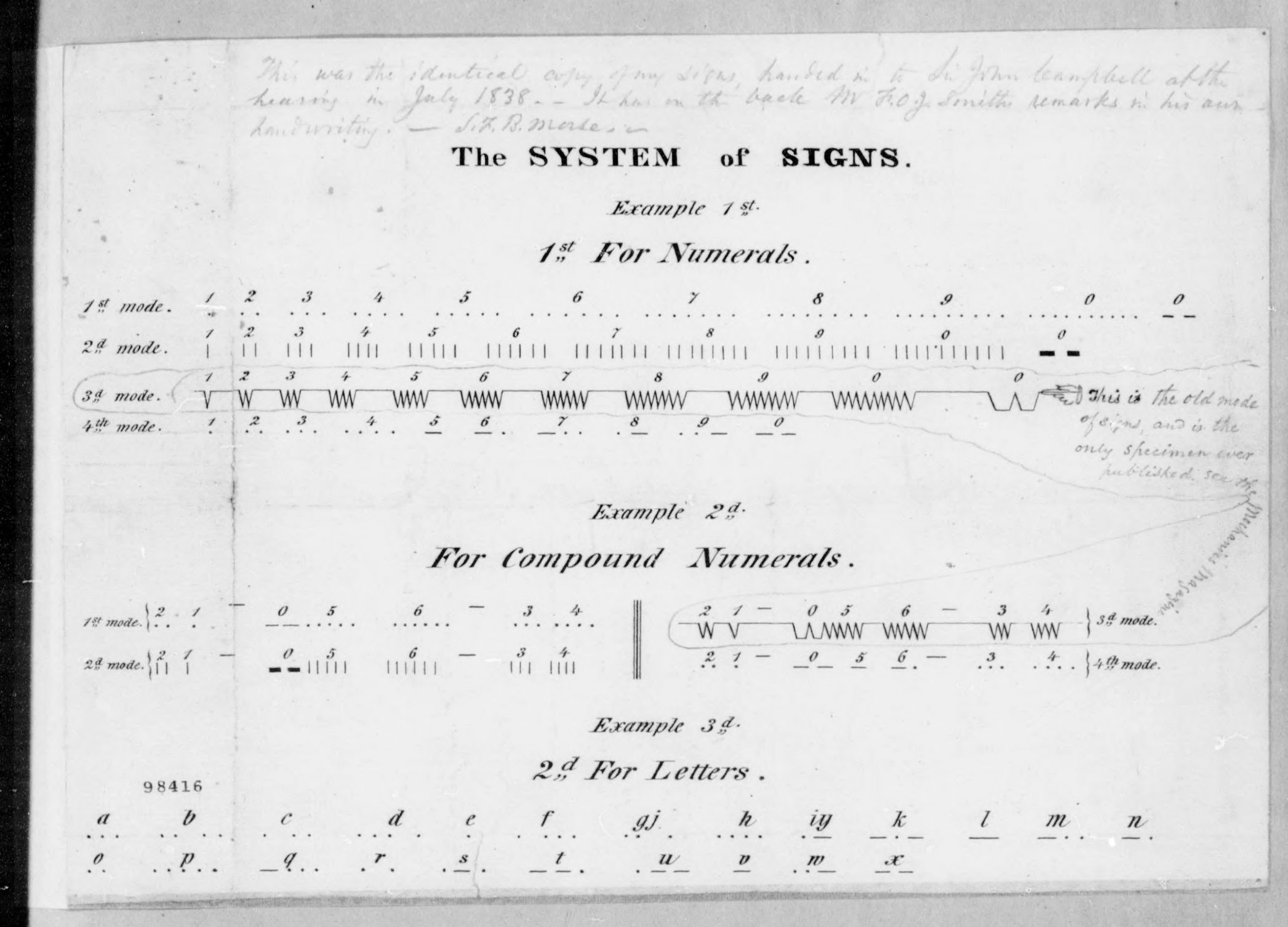
    What is surprising is to see what Morse himself had to say on this issue. Here are his notes on the system of notation, from the SFB Morse papers at the Library of Congress, Manuscripts Division, bound volume 28 November 1835-18 April 1838, page 154 (“Drawings to Accompany Copy of Caveat of Oct 6 1837”). The penciled note states “this is old mode of sign and is the only specimen ever published. See the Mechanics Magazine”.  It was also evidently published in the American Journal of Science and Arts at about the same time. There is no reference to the JFI report or the “dots” (or “1st Mode”).  It may simply be the case that at the time of his writing this that Morse was simply unaware of the JFI report, as the three appearances were all published at about the same time (within weeks of one another). 

    Morse system signs _2_

    Source: LOC.gov, Manuscripts Division, Samuel F.B. Morse papers. 

    The famous “first” telegraph “What Hath…”1  transmission (at least seven years after the true “first”) was made of a series of raised symbols corresponding to Morse’s dictionary. 

    Also bound with:

    Charles Goodyear, “Specification of a Patent for divesting Caoutchouc, or India Rubber, of its adhesive properties…” in the March issue, reporting on patent of June 17, 1837, pp 186-188. (Goodyear gets closer to his great and happenstance discovery and innovation the following year, 1839, in which he finally figures out how to prevent rubber from melting in the summer and cracking in the winter.)

    “Of Sand, and Hydraulic Sand”, pp 89-94;

    Thomas Elliot Harrison, “Specification of a Patent for an Improvement in Locomotive Engines…”, pp 122-123; Hall, “Abstract of the Specification of Mr. Samuel Hall’s Patent Paddle Wheel”, pp 124-5;

    J. Reade, “Method of producing a Permanent Soap Bubble, illustrating the colors of thin plates”, pp 65-66;

    “On Concrete, Circumstances in which it is advantageous to use it”, pp 145-153;

    “Alexander’s Electric Telegraph”.

    Notes:

    1. The full quote, suggested by a young girl, was from Numbers xxiii, 23:

    “22…Surely there is no enchantment against Jacob, neither is there any divination against Israel: according to this time it shall be said of Jacob and of Israel, What hath God wrought!

    24 Behold, the people shall rise up as a great lion, and lift up himself as a young lion: he shall not lie down until he eat of the prey, and drink the blood of the slain.”

  • Articles on Meteorology, the History of Metals, Steam, Steam Boilers, and Many Others (1836)

    Journal of the Franklin Institute, Philadelphia, 1836; volume 17 (new series) and volume 21 overall, with text illustrations and four plates, 440 pp Half-calf, with raised bands. Ex-library, with some scuffing on the spine; also a few stamps on the title page, and a library card pocket at the rear endpaper. Good/Very Good. $145

    Michael Faraday, “Experimental Researches in Electricity, Eighth Series” (first published in the Phil Trans for 1835), pp 282-285 and pp 362-365;

    Espy, James P. “Essays on Meteorology… On Hail, No 1.” pp 241-246, “No. II”, pp 309-316; No. III pp 309-316;

    (Espy, James P.) “Second Report of the Joint Committee on Meteorology”, pp 386-393;

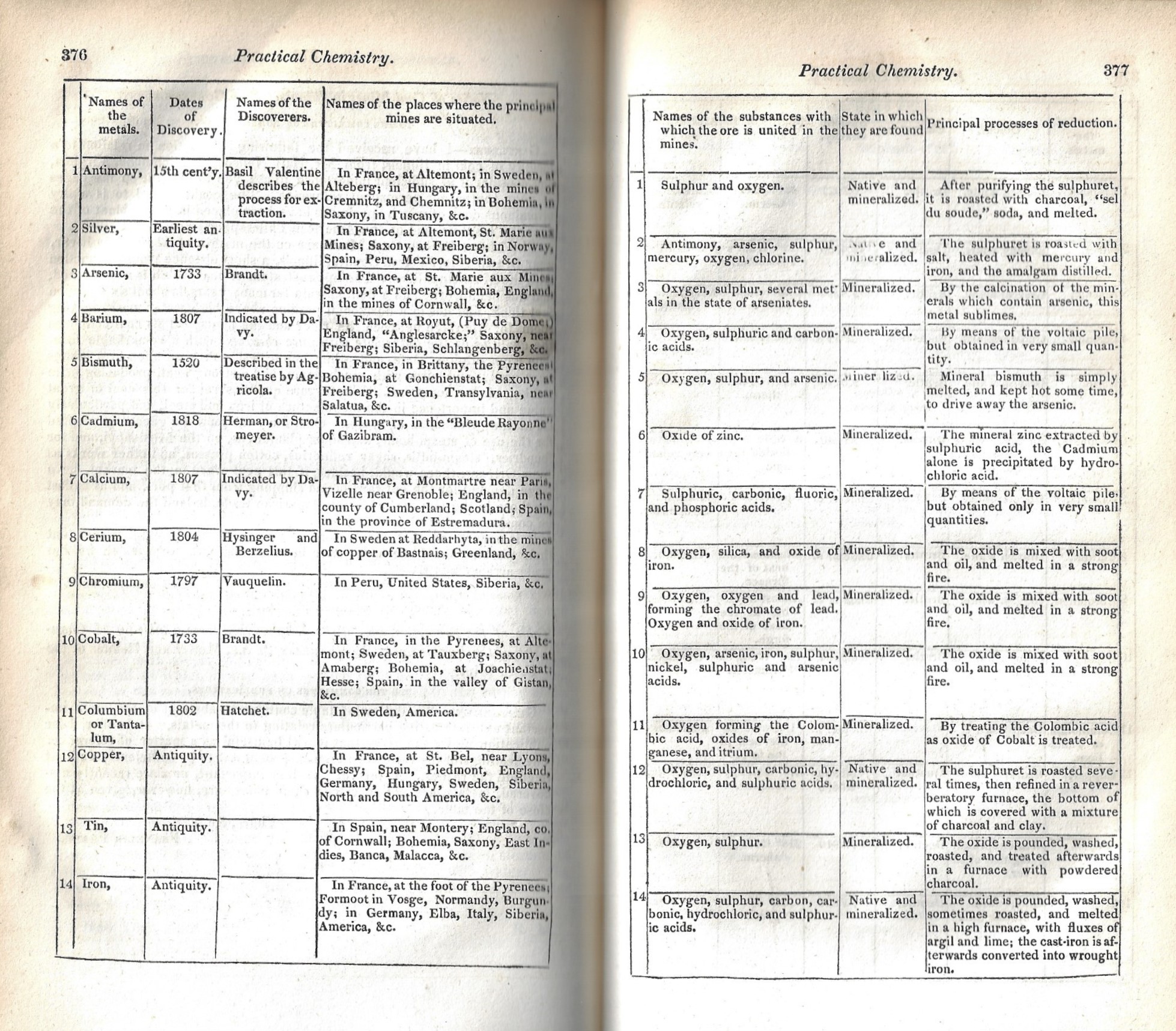
    Franklin Peale, “Table of Properties &c., of the Metals, taken from a table by M. Chaudet of the Paris Mint”, pp 375-385. This is basically a tabular report on 34 metals, listed alphabetically, and including dates of discovery and the names of discoverers (which is not very usual to make experience), plus the names and locations of the principle mines, plus color, character, stability, specific gravity, state in which the metals are found, and several other properties.

    JFI 1833 Metals _1_

    H.R. Campbell, “Report to the President and Managers of the West Philadelphia Rail Road Company”, pp 174-176, with a fine 23”x6.5” lithographed map, with hand-colored highlights.

    Scanlan, “Instances of Spontaneous Combustion…”, pp 424-427;

    John Draper, “Experiments on Endosmosis”, pp 177-283;

    John Draper, “Of the Tidal Motions of Conductors, free to move”, pp 27-33;

    “Report in relation to a proposed rail-road from the River Ohio to the Tide Waters of the Carolinas”, pp 161-168;

    Featherstonhaugh, G.W. “Review of ‘Geological Report of an Examination, made in 1834, of the Elevated Country between the Missouri and Red Rivers”, pp 184—190;

    “Report of Experiments made on…the Explosions of Steam-Boilers…” pp 1-20, 73-93, 145-164, 217-233, 289-296.


    ·Posted by :

    ·in:

Recent Posts

Archives

Categories