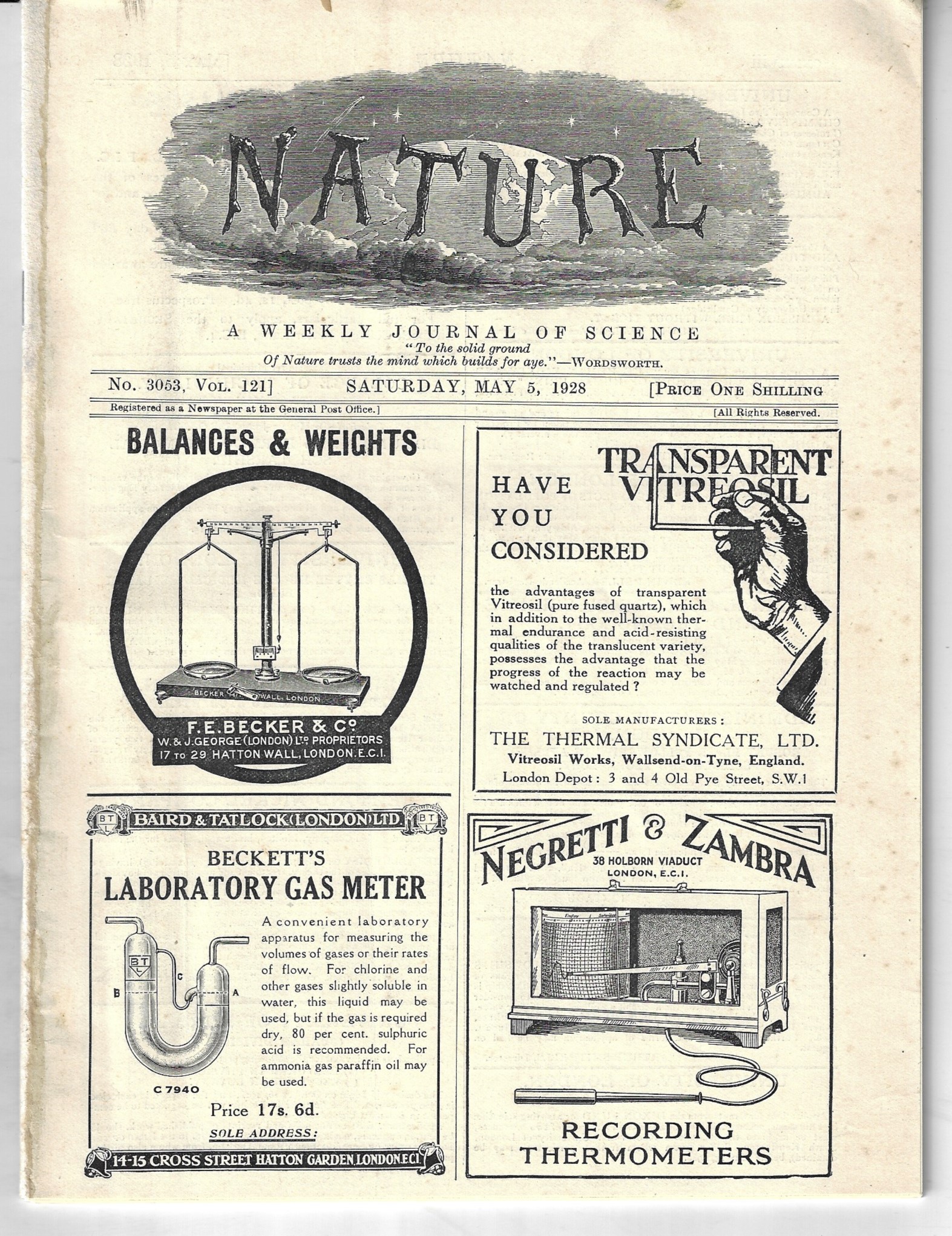
 C.V. Raman and K.S. Krishnan, “The Optical Properties of the Compton Effect”, in Nature, vol 121, No. 3053, May 5, 1928, the weekly issue, pp 697-736. Original wrappers, with a very fine and nearly invisible repair is made to the spine. $200
In this paper Raman (1886-1970) and Krishnan return to their earlier paper of February (pg 501, “A New Type of Secondary Radiation” of Nature in which the effect which bears Ramsn’s name appears and for which Raman would be awarded the Nobel in 1930 (“for his work on the scattering of light and for the discovery of the effect named after him.”–Nobel Prize organization). “Raman and K. S. Krishnan then undertook to isolate the effect under impeccable experimental conditions. They employed complementary light filters placed in the paths of the incident and scattered light, respectively, and observed a “new type of secondary radiation” from the scattering of focused beams of sunlight in both carefully purified liquid and dust-free air. They reported this discovery in a letter to Nature in February 1928. Raman then refined the experiment by using a mercury arc as the source of light; the effect was thus clearly seen for the first time on 28 February 1928 and was reported to the Science Congress at Bangalore the following month. The secondary radiation showed several lines shifted toward longer wavelengths, the shifts being characteristic of the substances being examined, and indicated the absorption of energy by the scattering molecule—the precise effect that had been predicted by A. Smekal in 1923. G. Landsberg and L. Mandelshtam, in the U.S.S.R., independently observed the same phenomenon in quartz, shortly after Raman and Krishnan”–DSB