A Daily History of Holes, Dots, Lines, Science, History, Math, Physics, Art, the Unintentional Absurd, Architecture, Maps, Data Visualization, Blank and Missing Things, and so on. |1.6 million words, 7500 images, 4.9 million hits| Press & appearances in The Times, Le Figaro, Mensa, The Economist, The Guardian, Discovery News, Slate, Le Monde, Sci American Blogs, Le Pont, and many other places… 5000+ total posts since 2008.

  • A Tale of Massive Deceit and Corruption in the Coroner’s Office, NYC (1915)

    Report on Special Examination of the Accounts and Methods of the Office of Coroner in the City of New York…Office of the Commissioner of Accounts, City of New York; Leonard M. Wallstein, Commissioner of Accounts. 1915, 10″ x 7″, 82pp. Original wrappers, bound in a workaday black cloth-like cardboard. Bookplate of the library of the Metropolitan Life Insurance Co., and also the NY Public Library, which sent the book to the Library of Congress in 1933. With a pasted-in “voucher for medical examiner’s reports” on the front pastedown. The book is staple bound, and the paper in some areas is becoming brittle. Overall, only a fair copy, but intact. $150

    • WorldCat locates 10 copies, including: Columbia, Cornell, Yale, University of Illinois Urbana, Harvard, U Missouri, U Chicago. It seems as though there is only one copy in NYC. 
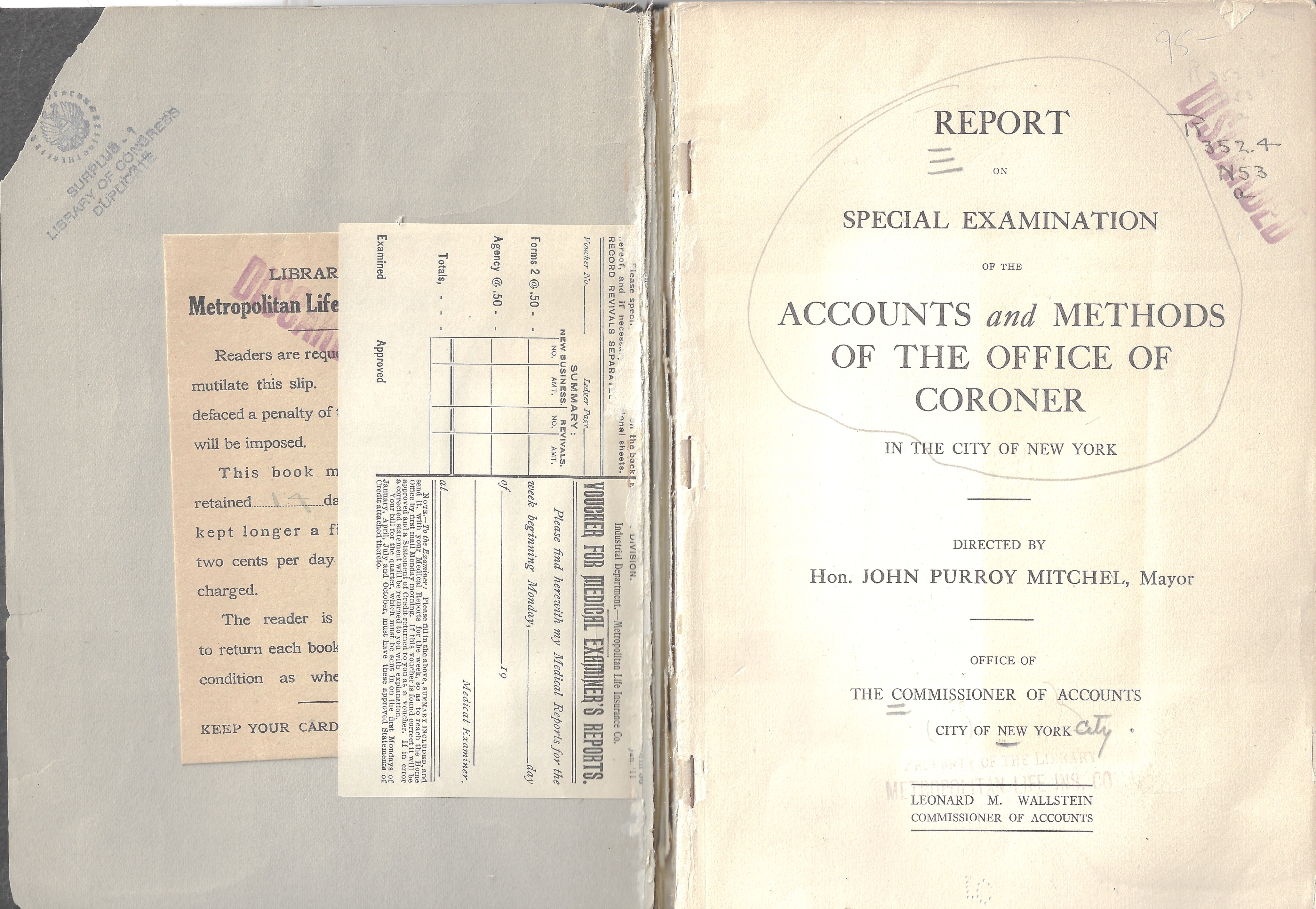
    Coroner rept

    If you ever had any interest—known and unknown—in reading about very impressive amounts of corruption and its constituents in the coroner’s office for NYC 104 years ago, here’s your chance to satisfy it. I’ve found a scarce report documenting the extraordinary conditions of that agency.

    You don’t want to be on the other end of this paper—it is scathing, and angry, and well-written and documented. From a quick read of it the office of the coroner of NYC was simply a fantastic mess of incompetent work and very highly competent corruption.

    The report starts at the end, with a summary of findings, and then goes downhill from there:

    • “The elective coroner in New York City represents a combination of power, obscurity and irresponsibility which has resulted in inefficiency and malfeasance in the administration of the office. With constant temptation and easy opportunity for favoritism and even extortion, with utter lack of supervision and control, and without the slightest preparation and training to create in the coroner’s mind a scientific and professional interest in the performance of his duties, the present system could not have been better devised intentionally to render improbable, if not impossible, the honest and efficient performance of the important public function entrusted to his office.

    Of the 65 men who have held the office of coroner since consolidation, not one was thoroughly qualified by training or experience for the adequate performance of his duties….”
  • The First Weather Map Printed in the United States (1838)

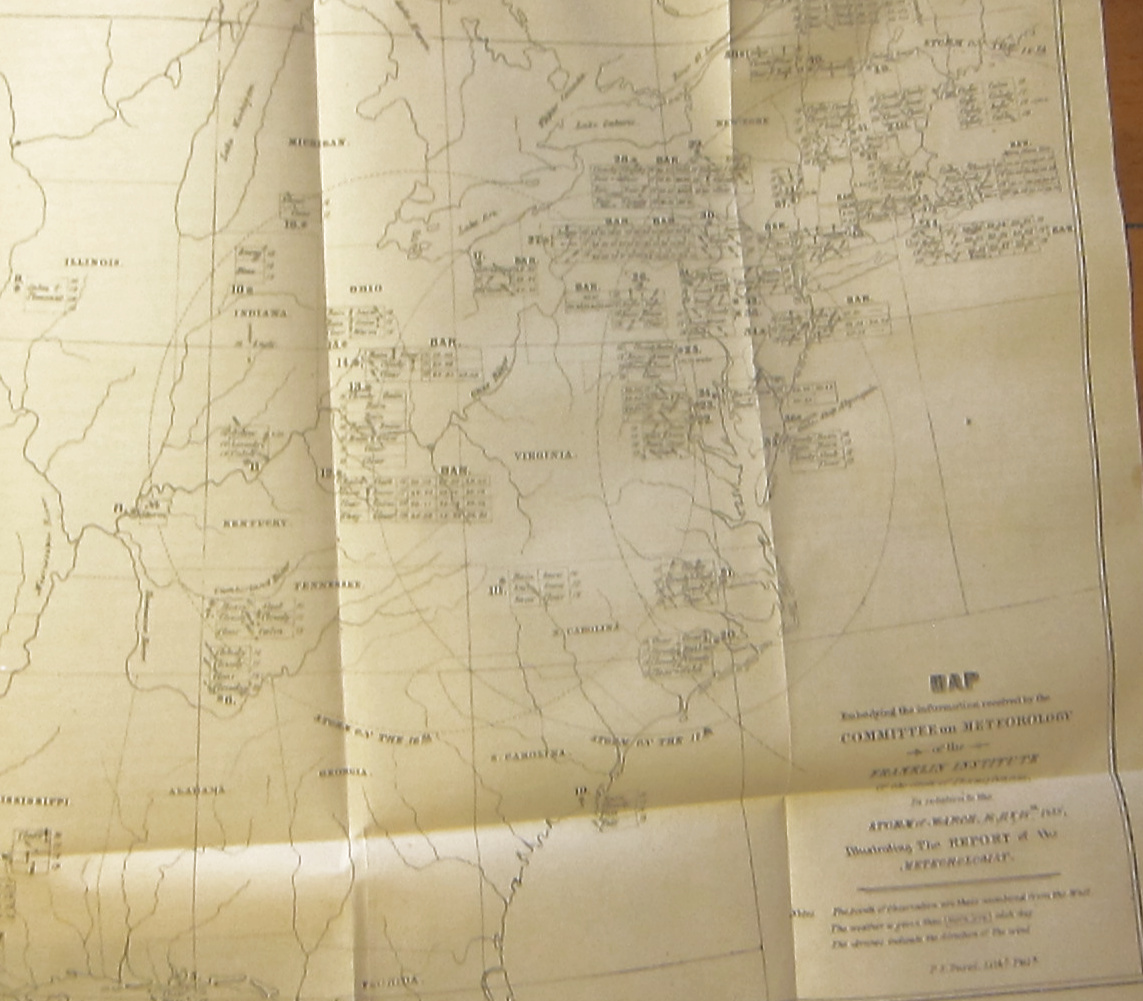
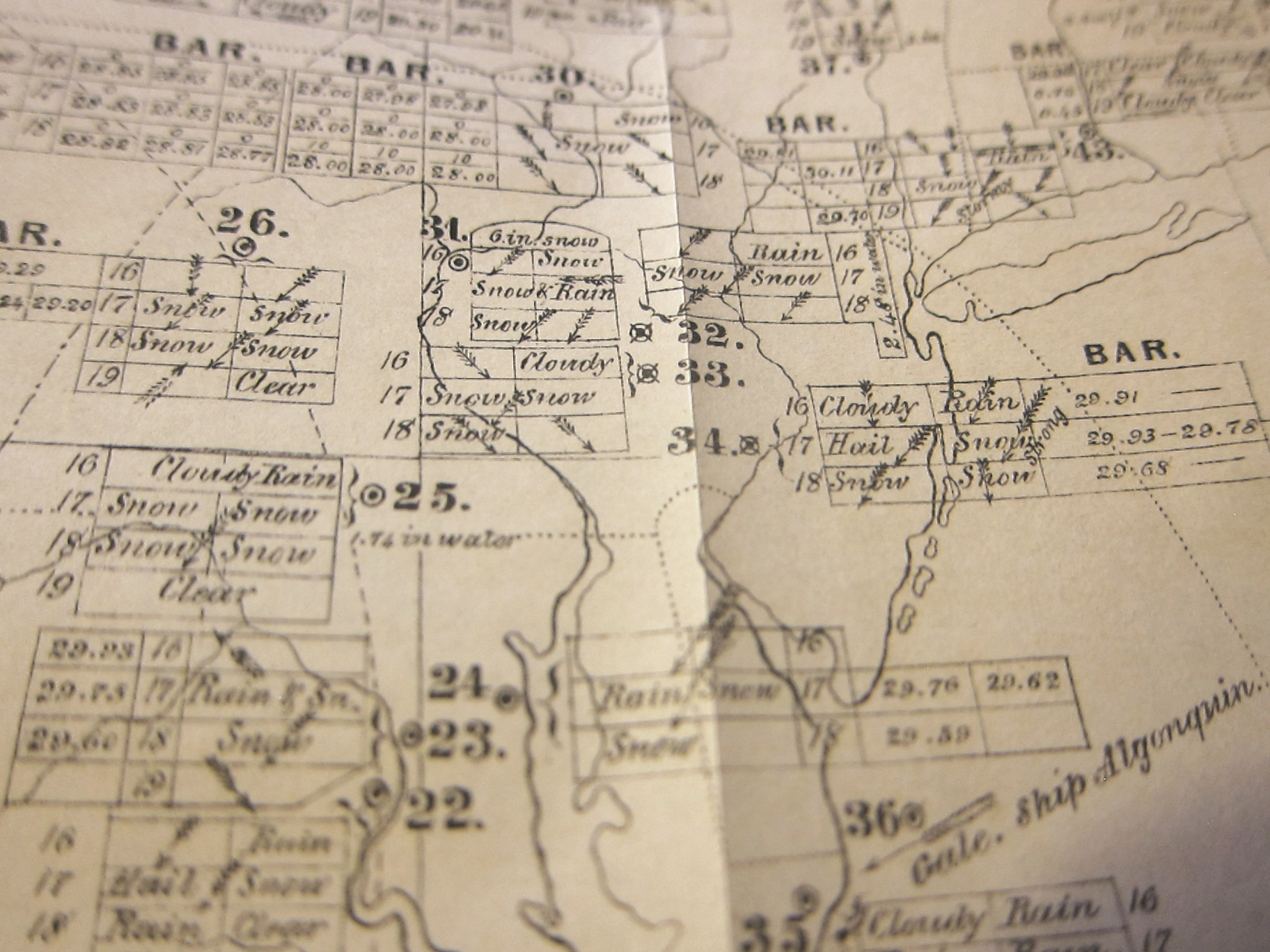
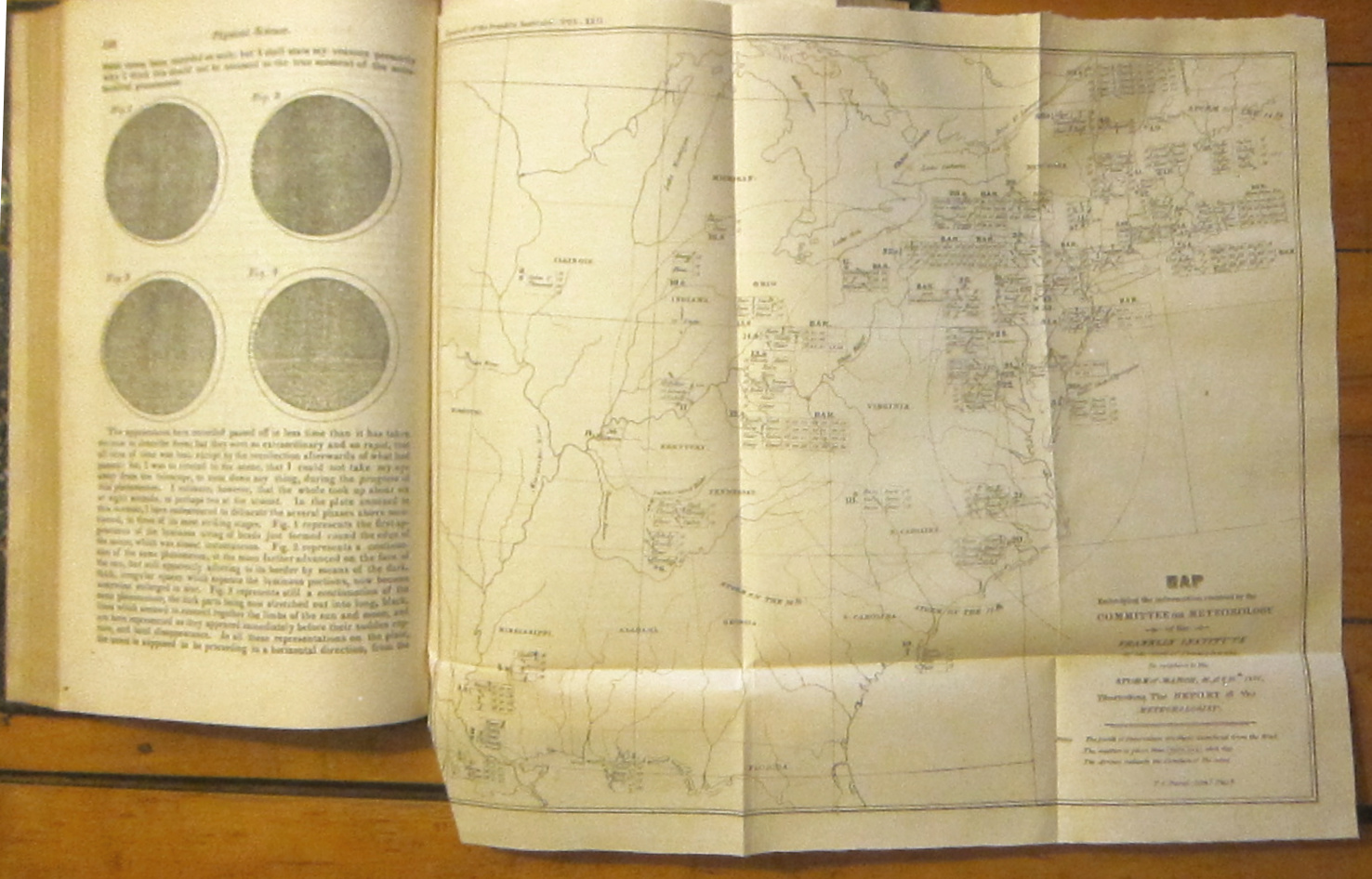
    (Espy, James P) Robley Dunglison, A.D. Bache, James Espy, and others. “Report of the Committee on Meteorology to the Board of Managers of the Franklin Institute, embodying the facts collated by the Meteorologist relative to the storm of the 1 6th, 17th, and 18th March, 1838.” (The report is signed by Espy at the last line.)  Illustrated with a folding map, also by the pioneering Espy:“Map Embodying the Information Received by the Committee on Meteorology of the Franklin Institute of the State of Pennsylvania in Relation to the Storm of March, 16th, 17th, & 18th, 1838, Illustrating the Report of the Meteorologist.,” and is a folding 23x27cm, and which was lithographed (“by steam”) by Duval in Philadelphia. In: Journal of the Franklin Institute, Philadelphia, Vol   22  (new series) vol 26 overall, July-December 1838, with text illustrations, and a folding map. 442pp. Half-calf, with raised bands. Ex-library, with some scuffing on the spine; and the remnants of a paper spine call number label; also a few stamps on the title page. That said, still in Very Good condition.  The map is in excellent condition, without any tears, and printed on a good, thin paper.   $950

    Espy weather map _2_
    Espy weather map _2_

    • [That piece at the bottom left corner is not missing–it is just folded back.]

    This is the first weather map printed in the U.S. (The first weather map(s) to be printed by the U.S. government occurred with the same author, in 1850, in ESPY, James Pollard. (1785-1860) Letter of the Secretary of the Navy Transmitting the Report [containing] Second Report on Meteorology to the Secretary of the Navy (which is actually the) Third Report on Meteorology with Directions for Mariners, etc. Navy Department, Washington DC, March 13, 1850).

    • “This is the first U.S. weather map. In his accompanying report, Espy states that the committee received back 50 responses from the 250 circulars it sent out to different parts of the United States and Canada regarding this notable storm. The map represents the assembled data, with reporting stations numbered from 1 to 50, roughly in order from south to north and from west to east as the storm was tracked. The three large circles show the eastern progress of the storm over the three days. Readings of barometric pressure, arrows for wind direction and relative strength, and descriptive words for precipitation/sky (rain/sleet/hail/snow, clear/fair/cloudy/heavy) are provided in the cells of small tables (three or four rows by two or three columns) printed next to each station number. Morning and evening results, if given, appear in adjacent cells of a row, and each row represents a different day (March 16, 17, 18, and sometimes 19). Like a time-delay photograph, the map nicely traces the regional movement of the storm, but graphic methods (shading, color, use of symbols) have not been developed yet to replace Espy’s data tables—FROM Harvard’s Mapping History site.

    There are many other papers in the volume in different fields and of varying lengths and depths—it is the Espy though that is the heavyweight here, and supports the entire value of the volume.

    Espy weather map _2_

    ·Posted by :

    ·in:

  • McCulloch on Economics; Mill and Bentham on Utilitarianism; and Basil Hall in America (1829)

    Edinburgh Review, or Critical Journal for March 1829….June 1829.  Edinburgh, printed Ballantyne for Longmans Rees, etc.,  iv, 544pp, volume 49, nos. 97+98, 1829.  8.25×5.5”. Rebound in modern cloth. Very tidy, in FINE condition. The Edinburgh Review was a sort of TLS and NYTBR for its day, with very long and penetrating articles reviewing books and reports on a very wide range of topics. It was also one of the most popular journals for the 1800-1830 period. $150

    This volume contains the following articles of interest:

    James Mill, “Utilitarian Logic And Politics Essays On Government Jurisprudence The Liberty Of The Press And Prison Discipline Colonies The Law Of Nations And Education By James Mill Reprinted By Permission Of The Encyclopaedia Britannica (Not For Sale )”, pp 159-189. Long and highly regarded work by one of the founders of Utilitarianism.  “James Mill was a Scottish historian, economist, political theorist, and philosopher. He is counted among the founders of the Ricardian school of economics. His son, John Stuart Mill, was also a noted philosopher of liberalism, utilitarianism and the civilizing mission of the British Empire”—Wiki

    With: (Jeremy Bentham, defense of Mr. Mill), “Article on Mill’s Essay on Government &c.”, pp 273-299.

    (J.R. McCulloch), “Maltster and Brewer’s Guide”, pp 362-388.

     “John Ramsay McCulloch (1789 –1864) was a Scottish economist, author and editor, widely regarded as the leader of the Ricardian school of economists after the death of David Ricardo in 1823. He was appointed the first professor of political economy at University College London in 1828. He wrote extensively on economic policy, and was a pioneer in the collection, statistical analysis and publication of economic data. McCulloch was a co-founder, and one of the first editors, of The Scotsman newspaper, and worked on the Edinburgh Review. He edited the 1828 edition of The Wealth of Nations.”—Wiki  

    And a very long piece on travelling in the U.S.:

    “Notions of the Americans, by a Travelling Bachelor…Travels in North America, by Captain Basil Hall” (published in 1829), pp 473-525.

    Clapperton, “Journal of a Second Expedition into the Interior of Africa, from the Bight of Benin to Sacatoo.   Also: “The Journal of Richard Lander to the Sea Coast, Partly by a more Eastern Route”,  pp127-149.

    Henry Steuart, “The Planter’s Guide, or a Practical Essay on the best Method of giving immediate Effect to Wood”…An interesting and somewhat early piece on arborculture. Pp 102-127.

    ·Posted by :

    ·in:

  • A Very Early U.S. Appearance of a Significant Instructional on the Calotype Process

    Journal of the Franklin Institute, Philadelphia, Vol 8 (third series) vol 38 overall, July-December 1844, with text illustrations. 430, 8 pp., and one folding plate. Half-calf, with raised bands. Ex-library, with some scuffing on the spine and leather cover tips nearly obscuring the gilt-stamped title. The boards are detached, though binding still tight; also a few stamps on the title page. Text is Good and crisp; binding is FAIR at best. $250

    Cundell, George S. [1798-1882, and one of four brothers who together made an impact in the early history of photography] “Extracts from an Article on the Practice of the Calotype Process of Photography”, pp 43-51 (in the July 1844 issue), an extract from his major paper in the Philosophical Magazine printed two months earlier (vol. .xxiv., No. 160. May, 1844) this being one of the processes earliest appearance in print in the U.S. (The essence of the article is very much a DYI/How-to instructional.) 

    • “George Cundell’s process was a significant step forward in making the Calotype accessible to the Amateur photographer. He was referred to as “Most Worthy Master” by the great engineer of the day James Nasmyth. And indeed his instructions were still being cited well into the 1850s. One contemporary quoted in Humphrey’s Journal in 1856 that “Amateurs date their success from the time Mr Cundell published. His comprehensive instructions were printed in the London, Edinburgh and Dublin Philosophical magazine in May 1844 “.—from the Papers, Shadows and Light website.  

    Another photographic item in the volume:

    “Robert Hunt, “Energiatype, a New Photographic Process”, 283-285, a ferrotype, and an early alternative process, (from the London Rep. Pat. Inventions).

    Also:

    “Mr. Bain’s Electric Printing Telegraph”, pp 61-65;

    H.M. Denham, “Description and Structure of the Wyre (Seward) Lighthouse…” pp 3-4 AND “Specification of the above Screw Pile Light-house…”, pg 5, with two plates accompanying the two short reports);

    And two short papers on the newly-implemented modern screw propeller:

    “Remarks on the Screw Propeller”, September 1844, pp 145-154;

    “Account of some Experiments on a Vessel called “the Liverpool Screw”, fitted with Grantham’s Engine and Woodcroft’s Screw Propeller…from the Minutes of the Proceedings of the Inst of Civil Engineers), pp 86-101.

    Plus:

    “Report on the Explosion of the Gun on Board the Steam Frigate ‘Princeton’”, pp 206-216;

    G.W. Hughes, “Extracts from a report…Relative to the Working of Copper Ore”, pp 31-43, 124-133,  194-202, 261-267 (including a section on Cornish pumps, concluded);

    Scoles, J.J. “On the Pyramids of Egypt”, pp 6-12, 81-85;

    “The Dipleidoscope” (a transit instrument);

    And last but hardly the least:

    John Leonard, “Report on the Atmospheric Railway”, pp 361-367 (from the Civil Engineers and Architects Journal), this being a stationary engine that would move rail cars in a pressurized tube).

    ·Posted by :

    ·in:

    —
  • Humphrey Davy and Thomas Malthus (1811)

    Edinburgh Review, or Critical Journal for June 1826…September 1826, Edinburgh, printed by D. Willison for Archibald Constable, iv, 530pp, volume 18, nos. 35+36, 1811.  8.25×5.5”. Rebound in modern cloth. Very tidy, in FINE condition. The Edinburgh Reivew was a sort of TLS and NYTBR for its day, with very long and penetrating articles reviewing books and reports on a very wide range of topics. It was also one of the most popular journals for the 1800-1830 period. $250

    For example, for this volume we have:

    DAVY, Sir Humphrey. “The Bakerian Lecture—On some of the Combinations of Oxymuriatic Gas and Oxygene, and on the Chemical Relations of these Principles to inflammable Bodies. “ And “On a Combination of Oxymuriatic Gas and Oxygen Gas….from the Philosophical Transactions, 1811, Part I”. Pp 471-480.  The new gas that Davy names in this paper is “chlorine or chlorine gas” which appears on p. 475.  (In the August, 1811 issue, No. 36.) 

    “Gay-Lussac and Thenard had simultaneously been experimenting on this subject and had concluded that it would be possible to argue for the elementary nature of oxymuriatic acid; but they resisted Davy’s arguments when he put them forward. He declared that oxygen was never produced in reactions in which oxymuriatic acid was concerned unless water was present, and concluded that no substance had a better claim to be regarded as undecomposed. Applying Lavoisier’s criterion more rigidly than Lavoisier, he placed oxymuriatic acid among the elements as an analog of oxygen and gave it the theory-free name “chlorine.” With the demolition of the scaffolding of the oxygen theory of acids, the view that all exothermic reactions were oxidations, and the caloric theory, Lavoisier’s revolution was complete; and Davy’s chemical career, to all intents and purposes, was over.”–DSB online

    With:

     (Malthus, Thomas Robert, though written anonymously.) “Review of the Controversy respecting the High Price of Bullion; A short Investigation of the alleged superfluous Issue of Bank Notes, and the unſavourable State of Foreign Exchanges, London, 1811; The Theory of Money; or a Practical Inquiry into the present State of the Circulating Medium; Deſence of Abstract Currencies, in Reply to the Bullion Report, and Mr Huskisson;  A Plain Statement of the Bullion Question, b Davis Giddy, Esq. M. P.;  The Expediency and Practicability of the Resumption of Cash Payments by the Bank of England, by J. L. Tavers.”All reviewed on pp 448-470.

    And with: Abraham Gottlob Werner, “New Theory of the Formation of Veins”; “Memoires sur le Grand Mastodonte…”;

    Robert Wilson, “Brief Remarks on the Character and Composition of the Russian Army, and a Sketch of the Campaigns in Poland” (30pp);

    “Essays on the Superstitions of the Highlanders of Scotland” (30pp).

    ·Posted by :

    ·in:

  • The Earliest Appearance in the U.S. of an Experiment Showing Lead in the Atmosphere? (1835)

    Arthur Dunn, “Experiments to ascertain the Existence of Lead in the Atmosphere of a White Lead Manufactory”, pp 355-6. In: Journal of the Franklin Institute, Philadelphia, Vol 16 (third series), volume 20 (overall), July-December 1835, 438 pp, with text illustrations.  Half-calf, with raised bands. Ex-library, with some scuffing on the spine; also a few stamps on the title page. Nice copy. Good condition.  $350 (There are dozens of other papers of interest in this volume–this seems to be the most compelling of the group.)

    • This paper seems among the earliest printed in the U.S. to experimentally demonstrate the presence of lead in the atmosphere. It is also suggestive of what would become the concern of human impact on the environment.

    The issue of lead poisoning was considerable—people became sick by touching, drinking, and breathing in lead under many different circumstances. For example, poisoning occurred when lead was used in paint by breathing or touching or eating paint chips, the most harmed of those would be the color mixers who prepared the paint. There was also a problem with lead caused by eating it in the form of food coloring for bread (to give it a yellowish tint using ‘chrome yellow”), candies, bon bons, and an emulsifier for snuff, among many other things. Lead was also ingested via the use of lead utensils, pipes, and drinking ware.

    The deadly problem of lead sickness/poisoning (“colic”) was known to the Hippocrates, Nicander, Celsus, Dioscorides, Galen, Avicenna and other ancients of Greece, Rome, and Persia, and was a known concern through the Dark and Middle Ages, through the Renaissance and up to the present day. (It should be stated that some of these writers described the effects of lead poisoning without the association with lead.) It was Stockhausen, “the father of lead colic”, who would in the 18th establish the connection between lead and the diseases caused by it, with Henkel showing lead as the exclusive vector agent to the diseases (in 1812).

    It has been shown that the “(f)irst article about lead poisoning was published in 1848” by Samuel L. Dana1. This was the first translation and expansion of the article “Traits des Maladies de Plomb, ou Saturines”, by Tanquerel des Planches, which was published nine years earlier, in 1839, which has been noted as one of the earliest papers in the medical literature on lead poisoning. 2,3 The Dana translation, according to the American Journal of Science, was a great contribution to health in the U.S., as the Tanquerel des Planches work was “doubtless unknown to intelligent readers of this country”. American Journal of Science, volume 6, November 1848.

    I have been unable to find anything by Dunn, whose work is reprinted in the Philosophical Magazine five months earlier in the year (series III, vol 7, issue 31). There are other earlier works that come close to what Dunn is doing4, but so far as I can determine this seems to be the first to prove that the lead could be supported in the atmosphere and be breathed into the body (or absorbed through the eyes), something that no doubt was suspected but not demonstrated. 

    Notes

    1.  Lead Diseases: A Treatise from the French of L. Tanquerel Des Planches: With Notes and Additions on the Use of Lead Pipe and Its Substitutes, printed in Lowell, (Ma.), by Daniel Bixby & Co., 1848)–Parissa Karrari  et al., “A systematic review on status of lead pollution and toxicity in Iran; Guidance for preventive measures” (–Daru Jnl Pharmaceutical  Sciences, 2012; 20(1): 2:.
    2. “The medical literature on lead poisoning in children can be traced back to the work of Louis Tanquerel des Planches he remarked on children placing leadpainted toys in their mouths and developing lead colic. As early as 1887, medical authorities in the United States noted cases of lead poisoning. David Stewart reported in Medical News that nine members of a single family developed lead poisoning from lead chromate used to dye bread yellow. [Stewart, “Notes on some obscure cases on poisoning by lead chromate manifested chiefly by encephalopathy.” Med News 1887; 1:676-81. 11.] In the 19th century, lead chromate was often added to lead sulfate to form what was called “chrome yellow,” a substance used by bakers and candy makers as a coloring agent. In 1889, an article in Science reported on the deaths of two children from the ingestion of baked confectioners’ products that contained chrome yellow. [Glenn W. Chrome yellow considered as a poison. Science 1889; 13:347-9. 12.]”— David Rosner, et al, “Lockhart Gibson and the Discovery of the Impact of Lead Pigments on Children’s Health: A Review of a Century of Knowledge”, Public Health Reports (1974-) Vol. 120, No. 3 (May – June., 2005), pp. 296-300
    3. On Louis Tanquerel des Planches (1795-1868): “He is known for his research of lead poisoning, about which, he is credited with conducting one of the first comprehensive studies of occupational illness. By way of analysis of 1200 cases of lead poisoning at the Hôpital de la Charité in Paris, he reported that the disease was more frequently found in workers who were exposed to lead fumes than those who worked with the solid metal. In his studies he used the term encéphalopathie saturnine to point out neuropsychiatric indications of lead poisoning.”—Wiki
    4. But then there’s this earlier paper (1830), which certainly describes the consequences of lead in a closed environment but does not discus at any point any experiment to show that this is so: “…favorables à la production du mal Qui ne sait que parmi les professions qui exposent à la colique on compte celle d imprimeur c est à dire celle de compositeur ou de metteur en page en un mot celle des ouvriers qui manient les caractères Car je ne sache pas qu on voie fréquemment cette maladie attaquer les corrcctcurs ou autres employés qui vivent dans la même atmosphère si l on se rappelle en outre que le plomb n entre que pour une très faible proportion dans l alliage dont on se sert Pour les caractères Qn comprendra qu il est fort difficile qu il s en échappe en grande quantité des émanations saturines et que ce n est que par un contact Inumédiat que l infection doit avoir lieu…” -discussing the problems to employees handling lead type in a print shop.  Fouquier, “Colique de Plombe, Nature et Traitement” (Revue Clinque de la Medicale), in Gazette Medical, vol 1, 1830, pp 430-1


    ·Posted by :

    ·in:

  • Physiological Testing with the New Technology of the Telephone (1880)

    [Alexander Graham Bell and the Telephone]  

    Thompson, Sylvanus P. (signed “S.P.T.”)  “Graham Bell’s Experiments in Binaural Audition”, in Nature, October 21,1880, pp 586-587, with illustration, in the weekly issue of pp 571-600. Also with a lovely full-page etching of Richard Owen to illustrate a short biography of him to lead the issue.  Original (and longer) article  appeared earlier in the year in Am. J. Otol. (1880, 2, 169–179.)  He concluded that “the direction of a source of sound is less perfect by a single ear than by both ears”.  See: “Early Studies of Binocular and Binaural Directions” Nicholas J. Wade, in “Vision”, February 22, 2018

    Nice copy in wrappers, extracted from larger bound volume.  $95

    ·Posted by :

    ·in:

  • An Early Proto-Typewriter (1857)

    Journal of the Franklin Institute, Philadelphia, Vol 31 (third series), volume 61 (overall0, July-December 1857, 443 pp.,with text illustrations.  Half-calf, with raised bands. Ex-library, with some scuffing on the spine; also a few stamps on the title page. Nice copy. Good condition. $150.00 Includes such interesting works as:

    Report on J.H. Cooper’s Hand Printing Machine”., pp 213-215Being a hand printing press, invented by John H. Cooper of Philadelphia.  Here we have a lovely attempt at what is close to being a typewriter (a “hand-printing machine”), found in the Journal of the Franklin Institute for June 1857. The size isn’t given but my guess is that it would be about the size of foolscap paper, easily desk-top. It seems fairly simple in a slightly complex way, and I can easily see where it would serve as a stop-gap implement between what came before and the typewriter. 

    The short article introducing the workings of the machine is surprisingly, and very readable, even though it is brisk and sharp. It is just well done.

    It is difficult to see some of the annotations, even in the original, and even with a magnifying glass, but for that first indicator “H” you can find it just southward of the bell-like object (“M”, which turns out to be a handle for the paper roller), and “E” was another difficult one to find, and that one turns out to be the pivot in the center of the type circular.  In any event, the thing operates much like a typewriter, the lever “D” moved to the position of the letter needed, then pressed down, moving the type into place against the ink and the paper, which is loaded in rollers much like a modern typewriter. 

    Also:

    “Report on Gordon’s Card Printing”—a machine unique for its combination of capabilities in printing, cutting, and counting the cards it prints., pp 212-213;

    Milnor Roberts, “Practical Views on the Proposed Improvement of the Ohio River”,  a long article in parts pp 23-38, 73-85,  146-158,  217-231,  289-303,  361-372 (concluded).

    ·Posted by :

    ·in:

  • Papers by William Crookes

    Welcome to Plasma!

    CROOKES, William.  “A Fourth State of Matter”, in Nature, 17 June 1880, pp 153-4, in the weekly issue of pp 141-164.  This is the popular appearance of the article that appeared in the Philosophical Transactions for the week earlier, June 10.  Very good  copy in the original wrappers, removed from a larger bound volume.  $150

    CROOKES, WIlliam.  “Contributions to Molecular Physics in High Vacua”, in Nature, volume 22, June 3, 1880, pp 101-104.  OFFERED WITH: Crookes, “Contributions to Molecular Physics in High Vacua, II”, in Nature, June 10, 1880, pp 125-128.  Both are in their original wrappers, removed from a larger bound volumes.  Nice copies.  $150

    CROOKES, William with Lecoq de Boisbaudran.   “Radiant Matter Spectroscopy”, in Nature, July 23, 1885, pp 2183-286 in the weekly issue of pp 265-288.  Wrappers, cleanly extracted from a larger bound volume.  $100

    ·Posted by :

    ·in:

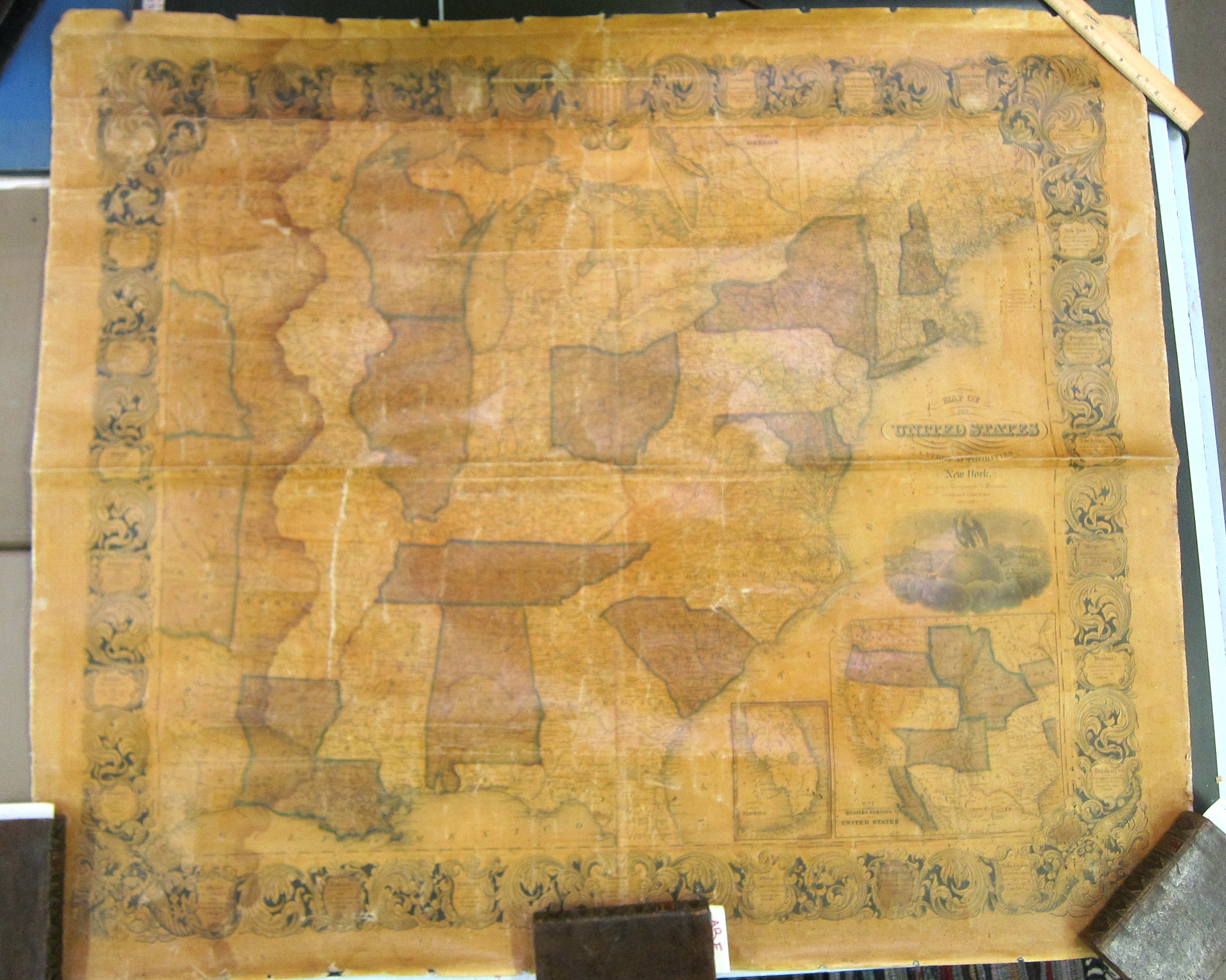
  • Fine Wall Map of the U.S., 1853

    Map of the United States from the Latest Authorities. Thayer, Bridgman, Fanning. 1853.

    Large 44” x 38” wall map showing cities large and small, rivers, lakes, and other natural formations. The map covers the United States to just west of the Mississippi River, getting into east Texas and north to the Canadian border. There are two inset maps: one smaller, showing Florida; the other larger, showing the rest of the U.S. Territories to the West Coast.

    Uncommon. No listing for this map in WorldCat/OCLC. $2500.00

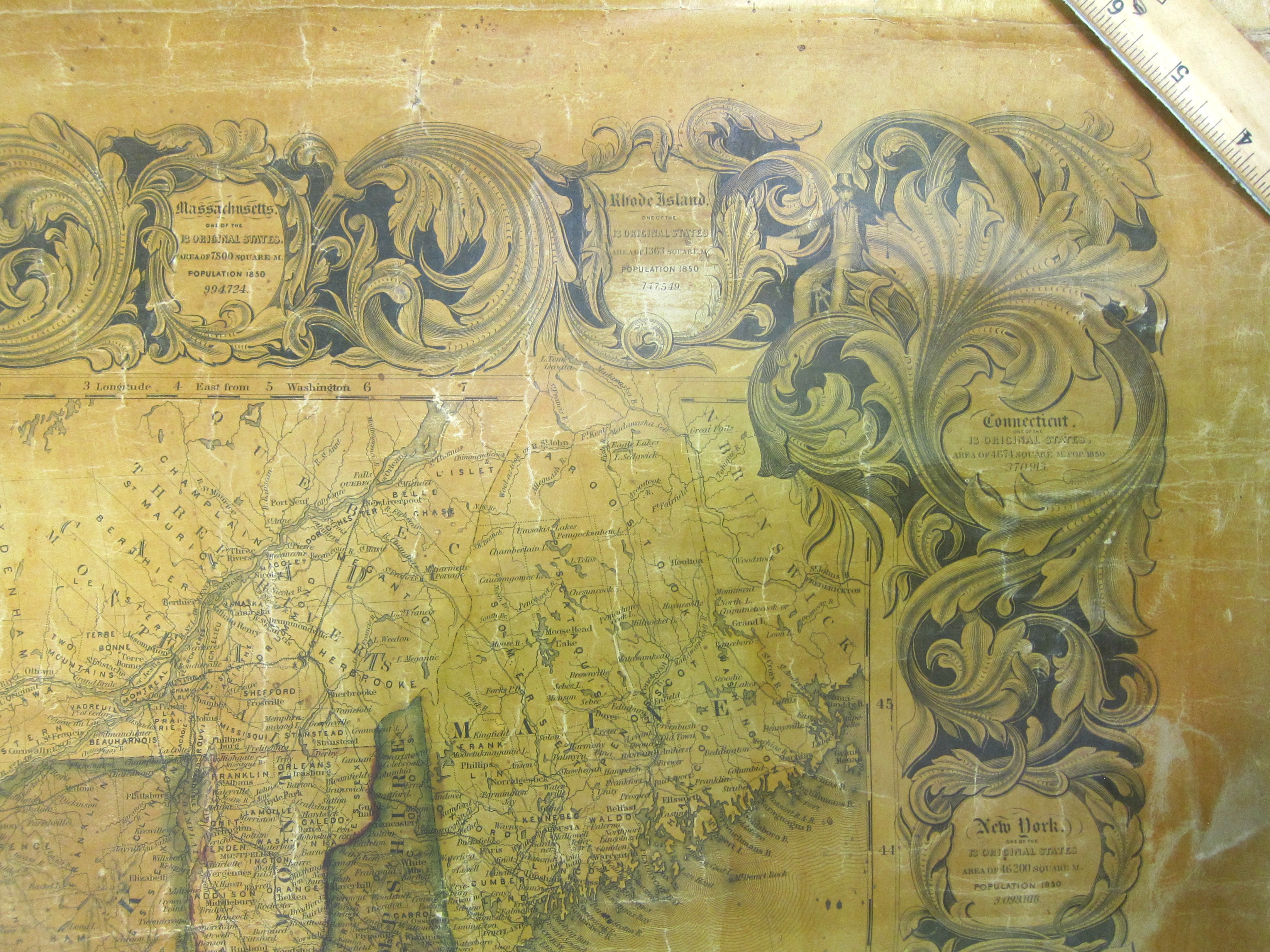
    There is a charming cartouche, with the highly decorated borders featuring the names of the states with their very basic data.

    Numerous cracks across the surface of the map as you can see in the detail photos.

    Full margins.

    Widener wall upper right

    Widener wall upper right


    ·Posted by :

    ·in:

  • Saving the Lives of Miners Everywhere (1816)

    Davy, Sir Humphry, “On the Fire-Damp of Coal Mines, containing an Account of an Invention for Lighting the Mines, and consuming the Fire-Damp, without danger to the Miner” In: Edinburgh Review, or Critical Journal for June 1826…September 1816, Vol 26 No. Li, Edinburgh, printed by the Heirs of D Williams,1816; iv, 510pp, 8.25×5.5”. Rebound in modern cloth. Very tidy, in FINE condition. $250

    The Edinburgh Reivew was a sort of TLS and NYTBR for its day, with very long and penetrating articles reviewing books and reports on a very wide range of topics, as well as being one of the most popular journals in Great Britain for half a century.

    “On the Fire-Damp of Coal Mines, containing an Account of an Invention for Lighting the Mines, and consuming the Fire-Damp, without danger to the Miner” was published February 1816, was a review of the important discovery reported by Davy just weeks before in the Philosophical Transactions. Davy (1778-1829, knighted in 1812) already the most famous chemist in Great Britain, in 1815 attacked the subject of safety lighting in mines—this in response to ongoing problems and disasters in mine lighting igniting “fire-damp”. (“Fire-damp” or “damps”, perhaps deriving from the German “dampf” for “vapor”, correlates to a number of explosive gases found especially in bituminous coal mines, and particularly in reference to methane.)

    Following the catastrophic explosions at the Felling Colliery (May 25, 1812) in which 92 men and boys were killed there was a very general rush to concern all levels of society to find a solution to this dreadful problem. 

    The present (6pp) article appears in the Edinburgh immediately following Davy’s technical publication in the Phil Trans, for which, oddly enough, there is no reference, even though there are bits here and there in the ER that seem to me directly lifted from the PT paper.  In any event this must be about the earliest ‘popular” appearance announcing Davy’s very significant find. 

    The ER article is a fine summary of Davy’s experimental work—much deeper than I expected. It ends with a great series of compliments to Davy:

    “The result is as wonderful as it is important. An invisible and impalpable barrier made effectual against a force the most violent and irresistible in its operations—and a power that, in its tremendous effects, seemed to emulate the lightning and the earthquake—confined within a narrow space, and shut up in a net of the most slender texture—are facts which must excite a degree of wonder and astonishment, from which, neither ignorance nor wisdom can defend the beholder.”
    “When to this we add the beneficial consequences, and the saving of the lives of men, and consider that the effects are to remain as long as coal continues to be dug from the bowels of the earth, it may fairly be said, that there is hardly, in the whole compass of Art or Science, a single invention, of which one would rather wish to be the author. It is little that the highest praise, and that even the voice of national gratitude, when most strongly expressed, can add to the happiness of one who is conscious of having done such a service to his fellow men. We hope, however, that some distinguished mark of such gratitude will not be wanting, to a person, who, by disarming one of the most powerful agents of destruction, has so well merited a Civic Crown. In this, indeed, the honour of the giver is more interested than that of the receiver: The latter may not admit
    of much increase; but it nevertheless becomes those, who administer the affairs of a free People, to show themselves grateful for benefits conferred even on the humblesland most obscure of their fellow citizens.”

    Here’s the reference for Davy in the Philosophical Transactions, “On the fire-damp of coal mines, and on methods of lighting the mines so as to prevent its explosion. Read November 9, 1815. (And) An account of an invention for giving light in explosive mixtures of fire-damp in coal mines, by consuming the fire-damp.”

    ·Posted by :

    ·in:

    —

Recent Posts

Archives

Categories